I take the pro-market position in this special report on Fox News.
The discussion focuses on the following questions.
Does government spending create jobs? This is the discredited Keynesian notion that you become richer by switching money from your right pocket to left pocket, and I explain that this approach has never worked.
What does create jobs? I explain we need to shrink the burden of government and I cite my favorite Golden Rule about the importance of making sure the productive sector of the economy grows faster than the public sector.
Should there be more government workers? Anyone who has seen this video knows my answer to that question.
Is it a good idea to raise taxes on the rich? I argue that penalizing success doesn’t make sense, so class warfare tax policy should be rejected.
Would it help to impose higher taxes on corporations? Since the United States already penalizes companies with the world’s highest corporate tax rate, that question answers itself.
In other words, there is no secret to job creation. Just get government out of the way.
________________
Thank you so much for your time. I know how valuable it is. I also appreciate the fine family that you have and your commitment as a father and a husband.
Sincerely,
Everette Hatcher III, 13900 Cottontail Lane, Alexander, AR 72002, ph 501-920-5733, lowcostsqueegees@yahoo.com
But there’s rarely, if ever, a discussion of wholesale reform.
That’s actually a good thing. Compared to the income tax, the payroll tax does far less damage. And it’s not just because it collects less money. On a per-dollar-raised basis, the payroll tax is considerably less destructive than the income tax.
It has only one tax rate. There’s a 12.4 percent tax for Social Security and a 2.9 percent tax for Medicare, which means a flat tax of 15.3 percent.
There’s almost no double taxation. The payroll tax applies to wage and salary income, as well as personal earnings from business activities (sometimes known as “Schedule C” income). But dividends, interest, and capital gains are generally spared – other than the 3.8 percent Obamacare surtax.
There are no loopholes or deductions for politically connected interest groups.
And because of these three features, the tax is remarkably simple and doesn’t even require a tax form unless taxpayers have Schedule C income.
None of this, by the way, means the payroll tax is a good or desirable levy.
It takes for too much money from the American people and is far and away the biggest tax paid by the majority of American workers.
The 15.3 percent tax undermines work incentives by driving a wedge between pre-tax income and post-tax consumption.
And the tax is very non-transparent, particularly since many taxpayers don’t even realize that the “F.I.C.A.” tax on their pay stub only reflects 50 percent of their payroll tax burden. In a hidden form of pre-withholding, employers pay an equal amount to the government on behalf of their workers – funds that otherwise would be part of worker compensation.
In other words, the payroll tax is a bad imposition. That being said, it still does considerably less damage, on a per-dollar-collected basis, than the income tax.
With that in mind, I’m puzzled that some folks want to keep the income tax and get rid of the payroll tax.
My friends at the Heritage Foundation, for instance, have a tax reform proposal that would fold the payroll tax into the income tax. Since they’re also proposing to turn the income tax into a form of flat tax, with one rate and no double taxation, the overall proposal clearly is a big improvement over today’s tax system. But all of the improvement is because of reforms to the income tax.
The payroll tax — 12.4 percent, split between workers and their employers to help finance Social Security – is one of the worst taxes on the books for several reasons. A basic economic principle is that when the government taxes something, the nation gets less of it. Because the payroll tax makes it more expensive and administratively burdensome for businesses to hire workers, it’s a drag on employment. Also, even the employer’s share of the tax is effectively passed on to workers in the form of lower salaries and benefits.
There’s nothing overtly wrong with the above passage. The tax does all those bad things. But the income tax does all those things as well, but in an even more destructive fashion.
The editorial addresses a couple of potential objections, starting with the notion that the payroll tax is a revenue dedicated to social Security.
There are two main objections to scrapping the payroll tax. The first is the theoretical idea that payroll taxes are a dedicated revenue stream for Social Security. In practice, it just isn’t true. All government expenditures ultimately come from the same place. Payroll taxes help subsidize other government functions, and the government will use other tax revenue and borrowing to pay for Social Security when revenues are short.
They’re right that all taxes basically get dumped into the same pile of money and that the relationship between payroll taxes and Social Security benefits is imprecise.
But since my argument has nothing to do with this issue, I don’t think it matters.
Here’s the part of the editorial that doesn’t make sense.
The other objection is the massive revenue hit to the federal government. In 2010 (the last year before the recent payroll tax holiday), social insurance taxes raised $865 billion in revenue, according to the Congressional Budget Office. But there are a number of ways to recoup that revenue. As stated above, eliminating the payroll tax would make it easier to get rid of a lot of credits, loopholes and deductions. Also, if lower-income Americans aren’t paying payroll taxes, they can pay a bit more in income taxes. This would also deal with a conservative complaint that the income tax system needs to be reformed so everybody has at least some skin in the game.
This passage has a policy mistake and a political mistake.
The policy mistake is that the proposed swap almost surely would make the overall tax code more hostile to growth. The Examiner is proposing to get rid of an $865 billion tax that does a modest amount of damage per dollar collected, and somehow make up for that foregone revenue by collecting an additional $865 billion from the income tax system – which we know does a very large amount of damage per dollar collected.
To be sure, it’s possible to collect that extra money by eliminating distortions such as the state and local tax deduction or the healthcare exclusion. Compared to raising marginal tax rates, those are much-preferred ways of generating more revenue. But even in a best-case scenario – with politicians miraculously trying to collect an extra $865 billion without making the income tax system even worse, it’s hard to envision a better fiscal regime if we swap the payroll tax for a bigger income tax.
The political mistake is the assumption that more people will have “skin in the game” if the income tax is expanded. That’s almost surely not true. The poor don’t pay income tax, but the payroll tax grabs 15.3 percent of every penny earned by low-income households. And since very few taxpayers pay attention to which tax is shrinking their paychecks, it doesn’t really matter whether the “skin” is a payroll tax or an income tax.
Since the Examiner isn’t proposing a specific plan, there’s no way of making a definitive statement, but it’s 99 percent likely that eliminating the Social Security payroll tax would result in low-income households paying even less money to Washington. I think everybody should send less to Washington, but I don’t think shifting a greater share of the tax burden onto the middle class and the rich is the right way of achieving that goal.
I have one final objection, and this applies to both the Heritage Foundation plan and the Examiner proposal.
Notwithstanding everything I just wrote, I actually agree with them that we should eliminate the Social Security payroll tax. But we should get rid of the tax as part of a transition to a system of personal retirement accounts.
This is a reform that has been successfully implemented in about 30 nations and it also should happen in the United States. But an integral feature of this reform is that workers would be allowed to shift their payroll taxes into personal accounts. Needless to say, that’s not possible if the payroll tax has disappeared.
And let’s not forget that the Medicare portion of the payroll tax could and should be part of a broader agenda of entitlement reform. But that’s also less likely if the payroll tax is folded into the income tax.
Milton Friedman shot straight with Donahue on two great episodes. I have posted several of these clips the past here, here, here, here, here, here, here, and here.
President Obama c/o The White House
1600 Pennsylvania Avenue NW
Washington, DC 20500
The liberal John Brummett in his article, “The fine art of thinking,” Arkansas Democrat-Gazette, August 2, 2012, asserted:
This pledge has become ruling Republican creed and a requirement to escape a GOP primary since it was cooked up by Grover Norquist. He’s a pugnacious lobbyist and conservative activist, formerly with the rabidly right-wing U.S. Chamber of Commerce, who heads a group he calls Americans for Tax Reform.
The pledge is probably not wholly responsible for destroying Washington.
Part of the blame also must be assigned to money, particularly the kind to which Burris referred that comes only if you sign the pledge.
If exercised to its logical conclusion, the pledge would force Republicans in Congress to reduce spending without adding new tax revenue. That, in turn, would send new burdens for roads and human services to state governments, where Republican legislators also would have vowed not to raise taxes.
Not only is that the logical conclusion, but it is also, I suspect, the real objective. By that I mean trying to squeeze government nearly out of business.
Liberals like Brummett think the government knows better than us how to spend money and that is why he is so angry at Grover Norquist. I come from a conservative point of view and I see the world much differently.
Government will spend whatever money we give it. About 100 years ago the federal government was spending than 5% of GDP and state and local governments were spending about double that amount. Now the federal government is at 24.7%. We need to stop giving them so much money and the only way to do that is to cut taxes.
“.If we adopt such programs, does not fiscal responsibility at least call for imposing taxes to pay for them? The answer is that postwar experience has demonstrated two things. First, that Congress will spend whatever the tax system will raise—plus a little (and recently, a lot) more. Second, that, surprising as it seems, it has proved difficult to get taxes down once they are raised. The special interests created by government spending have proved more potent than the general interest in tax reduction.
“If taxes are raised in order to keep down the deficit, the result is likely to be a higher norm for government spending. Deficits will again mount and the process will be repeated.”
Sure enough, a year later a 10% income tax surcharge was enacted by Congress to cut the deficit and fight inflation. His prediction having been confirmed
__________
Thank you so much for your time. I know how valuable it is. I also appreciate the fine family that you have and your commitment as a father and a husband.
Sincerely,
Everette Hatcher III, 13900 Cottontail Lane, Alexander, AR 72002, ph 501-920-5733, lowcostsqueegees@yahoo.com
Milton Friedman videos and transcripts Part 11 On my blog http://www.thedailyhatch.org I have an extensive list of posts that have both videos and transcripts of MiltonFriedman’s interviews and speeches. Here below is just small list of those and more can be accessed by clicking on “Milton Friedman” on the side of this page or searching […]
Milton Friedman – White House Tribute (2002) Published on May 31, 2012 by BasicEconomics President Bush spoke about the life and career of Milton Friedman at a ceremony honoring him for his work and impact in the field of economics. Friedman was awarded a Nobel Prize in 1976 ___________ Milton Friedman – Biography From Milton […]
MILTON FRIEDMAN: THE MIND BEHIND THE REPUBLICAN TAX REVOLT Jack Roberts | Jul 22, 2011 | 0 comments The on-going debate over raising the debt ceiling has focused on many areas of disagreement between Democrats and Republicans but none bigger than the Republican determination not to raise taxes. Many pundits credit this to the […]
Milton Friedman videos and transcripts Part 10 On my blog http://www.thedailyhatch.org I have an extensive list of posts that have both videos and transcripts of MiltonFriedman’s interviews and speeches. Here below is just small list of those and more can be accessed by clicking on “Milton Friedman” on the side of this page or searching […]
Milton Friedman – Power of Choice (Biography) Part 3 Published on May 21, 2012 by BasicEconomics Tribute to Milton Friedman English Pages, 8. 9. 2008 Dear colleagues, dear friends, (1) It is a great honor for me to be asked to say a few words to this distinguished and very knowledgeable audience about one of our greatest […]
Milton Friedman on the American Economy (6 of 6) Uploaded by donotswallow on Aug 9, 2009 THE OPEN MIND Host: Richard D. Heffner Guest: Milton Friedman Title: A Nobel Laureate on the American Economy VTR: 5/31/77 _____________________________________ Below is a transcipt from a portion of an interview that Milton Friedman gave on 5-31-77: Friedman: […]
Milton Friedman videos and transcripts Part 9 On my blog http://www.thedailyhatch.org I have an extensive list of posts that have both videos and transcripts of MiltonFriedman’s interviews and speeches. Here below is just small list of those and more can be accessed by clicking on “Milton Friedman” on the side of this page or searching […]
Below is a discussion from Milton Friedman on Bill Clinton and Ronald Reagan. February 10, 1999 | Recorded on February 10, 1999 audio, video, and blogs » uncommon knowledge PRESIDENTIAL REPORT CARD: Milton Friedman on the State of the Union with guest Milton Friedman Milton Friedman, Senior Research Fellow, Hoover Institution and Nobel Laureate in […]
Biography Part 2 In 1977, when I reached the age of 65, I retired from teaching at the University of Chicago. At the invitation of Glenn Campbell, Director of the Hoover Institution at Stanford University, I shifted my scholarly work to Hoover where I remain a Senior Research Fellow. We moved to San Francisco, purchasing […]
Milton Friedman was a great economist and a great american. A Tribute to Milton Friedman by Mark Skousen on November 28, 2006 Mark Skousen and Milton Friedman at lunch I was at the New Orleans Investment Conference when I learned that free-market economist extraordinaire Milton Friedman, died on November 16. He was a dear friend. […]
How can Washington D. C. get enough money to balance the budget and not cut spending. The answer is that everyone’s taxes must go up. Don’t let anyone fool you. There is not enough money to just tax the rich. Instead, entitlements need to be reform and real spending cuts need to be made. The real problem is spending. Washington already has enough of our taxes.
The Washington establishment loves talking about the “distribution” of income and taxes. The CBO has issued a new report on the topic that will no doubt keep the discussion rolling on.
The mindset of many people in government is encapsulated by this sentence in the CBO report: “Market income is very unevenly distributed.” But anyone with a decent appreciation of America’s economy knows that market income is in fact earned in a decentralized fashion by 140 million people and 25 million businesses spread across this vast land. It is not ”distributed” from a big vault in the capital by central-planning czars with a god-given preemptive right to decide how much everyone gets.
Yes, the huge subsidies that the federal government hands out each year are “distributed.” But CBO statisticians seem to be so used to thinking about the entire economy as a giant government-created pie that they say market income is also distributed.
That said, the CBO report has some interesting statistics to consider. Most important are calculations of average federal tax rates, which are total federal taxes paid as a share of income. The chart shows average tax rates by quintiles, which each contain one fifth of U.S. households grouped by income level. The households at the top are hit with the largest burdens by far. Elsewhere, I’ve discussed who some of these high-earning households are and the damage done by nailing them with such high taxes. (For example, see here and here).
Thank you so much for your time. I know how valuable it is. I also appreciate the fine family that you have and your commitment as a father and a husband.
Sincerely,
Everette Hatcher III, 13900 Cottontail Lane, Alexander, AR 72002, ph 501-920-5733, lowcostsqueegees@yahoo.com
Some folks say they want “austerity,” but that’s largely a code word for higher taxes. They’re fighting against the people who say they want “growth,” but that’s generally a code word for more Keynesian spending.
And then, to get me even more irritated, lots of people support bailouts because they supposedly are needed to save the euro currency.
When I ask these people why a default in, say, Greece threatens the euro, they look at me as if it’s the year 1491 and I’ve declared the earth isn’t flat.
So I’m delighted that the Wall Street Journal has published some wise observations by a leading French economist (an intellectual heir to Bastiat!), who shares my disdain for the current discussion. Here are some excerpts from Prof. Salin’s column, starting with his common-sense hypothesis.
…there is no “euro crisis.” The single currency doesn’t have to be “saved” or else explode. The present crisis is not a European monetary problem at all, but rather a debt problem in some countries—Greece, Spain and some others—that happen to be members of the euro zone. Specifically, these are public-debt problems, stemming from bad budget management by their governments. But there is no logical link between these countries’ fiscal situations and the functioning of the euro system.
Salin then looks at how the artificial link was created between the euro currency and the fiscal crisis, and he makes a very good analogy (and I think it’s good because I’ve made the same point) to a potential state-level bankruptcy in America.
The public-debt problem becomes a euro problem only insofar as governments arbitrarily decide that there must be some “European solidarity” inside the euro zone. But how does mutual participation in the same currency logically imply that spendthrift governments should get help from the others? When a state in the U.S. has a debt problem, one never hears that there is a “dollar crisis.” There is simply a problem of budget management in that state.
Because European politicians have decided to create an artificial link between national budget problems and the functioning of the euro system, they have now effectively created a “euro crisis.” To help out badly managed governments, the European Central Bank is now buying public bonds issued by these governments or supplying liquidity to support their failing banks. In so doing, the ECB is violating its own principles and introducing harmful distortions.
Last but not least, Salin warns that politicians are using the crisis as an excuse for more bad policy – sort of the European version of Mitchell’s Law, with one bad policy (excessive spending) being the precursor of additional bad policy (centralization).
Politicians now argue that “saving the euro” will require not only propping up Europe’s irresponsible governments, but also centralizing decision-making. This is now the dominant opinion of politicians in Europe, France in particular. There are a few reasons why politicians in Paris might take that view. They might see themselves being in a similar situation as Greece in the near future, so all the schemes to “save the euro” could also be helpful to them shortly. They might also be looking to shift public attention away from France’s internal problems and toward the rest of Europe instead. It’s easier to complain about what one’s neighbors are doing than to tackle problems at home. France needs drastic tax cuts and far-reaching deregulation and labor-market liberalization. Much simpler to get the media worked up about the next “euro crisis” meeting with Angela Merkel.
Thank you so much for your time. I know how valuable it is. I also appreciate the fine family that you have and your commitment as a father and a husband.
Sincerely,
Everette Hatcher III, 13900 Cottontail Lane, Alexander, AR 72002, ph 501-920-5733, lowcostsqueegees@yahoo.com
Ronald Reagan introduces this program, and traces a line from Adam Smith’s “The Wealth of Nations” to Milton Friedman’s work, describing Free to Choose as “a survival kit for you, for our nation and for freedom.” Dr. Friedman travels to Hungary and Czechoslovakia to learn how Eastern Europeans are rebuilding their collapsed economies. His conclusion: they must accept the verdict of history that governments create no wealth. Economic freedom is the only source of prosperity. That means free, private markets. Attempts to find a “third way” between socialism and free markets are doomed from the start. If the people of Eastern Europe are given the chance to make their own choices they will achieve a high level of prosperity. Friedman tells us individual stories about how small businesses struggle to survive against the remains of extensive government control. Friedman says, “Everybody knows what needs to be done. The property that is now in the hands of the state, needs to be gotten into the hands of private people who can use it in accordance with their own interests and values.” Eastern Europe has observed the history of free markets in the United States and wants to copy our success. After the documentary, Dr. Friedman talks further about government and the economy with Gary Becker of the University of Chicago and Samuel Bowles of the University of Massachusetts. In a wide-ranging discussion, they disagree about the results of economic controls in countries around the world, with Friedman defending his thesis that the best government role is the smallest one.
___________
Below is a portion of the transcript of the program and above you will find the complete video of the program:
Hello, I am Linda Chavez and welcome to Free to Choose. Joining Dr. Friedman for a discussion of the failure of socialism are Gary Becker from the University of Chicago and Samuel Bowles of the University of Massachusetts. Dr. Bowles, I think we can all agree that socialism has failed Eastern Europe. Dr. Friedman believes that the path out of that is the free market and I think he thinks there are lessons for the United States. What do you think?
Bowles: The homeless people are homeless because they are poor and they are out of work. They are not homeless because of rent control.
Friedman: I beg your pardon. All of them aren’t. Of course there are some like that, but the existence of rent control has certainly increased the number of homeless.
Becker: Many people are homeless because they are mentally ill. But the homeless is a tiny fraction. Housing policy in the United States should not be oriented around the homeless because that is a tiny part of the problem in any major city, and certainly outside of major cities. If you look at the bulk of housing in the United States, I see no evidence that it cannot be adequately provided by the private sector.
Bowles: Let’s talk about incentives because I know both of you like to talk about incentives a lot. I think incentives are terribly important. Milton says in the show, and I agree with him, that we have to choose between taking orders from the top down, or incentives at the bottom. Now Milton’s idea of how do you get the incentives down at the bottom is essentially a view of an economy in which individuals, through their ownership of property, can own the results of their hard work and their innovation. It is a great idea. It doesn’t exist anywhere and it can’t exist. When I read your stuff Milton and when I watch you on TV, I think, you know, Milton has this idea of, Charlie Brown and Linus are going to have a lemonade stand and Lucy is going to have another lemonade stand and that is your idea of capitalism. But that is a myth. That is not what capitalism is. We don’t have thousands and millions of little firms competing on a level playing field. We have giant industrial corporations that use their power to their own advantage and to the disadvantage of others. That is what you have to be able to deal with you if you want to be relevant to the modern world. That is what the countries that I talked about, Sweden, Korea, Norway, Japan, are very good at doing __ dealing with the problem of economic power so that the power of those institutions can be used by and large for public good. If you ignore them with this lemonade stand capitalism myth, you are simply giving those powerful spenders of wealth and affluence free rein.
Friedman: Gary, it is a strange thing that not a single one of the countries that you have described has a standard of living as high as that of the United States with respect to the bulk of its population.
Bowles: Yes and the United States got its standard of living through precisely the policies that you have opposed such as protecting our industrial base from . . . . . .
Becker: I would be very happy to go back to the 19th century U.S. policy. It was a tiny part. The government, sure they did some things, but as a tiny part of the economy and let’s go back to a resource that went through the government at that time what was it? Ten percent of the maximum. The largest employer of the government was the postal system. That is the main thing the government was doing. Some tariff policies probably hurt us and a few other activities. Let me come back to the other issue raised then. There are millions and millions of companies in the United States. It is true that in some sectors these are very large companies like in manufacturing. But what I think has happened, particularly in the modern world, is these large companies are now having to compete with large countries from elsewhere. It is not capitalism. It is the political sector that is limiting that competition, partly at the behest of these companies, but also at the behest of the employees of these companies to limit the competition from abroad, but most industries, it would be hard put for you to argue now that even the large companies aren’t facing significant competition in the United States markets, not only from domestic companies, but from large companies based abroad.
Bowles: Oh, I agree with that completely. But what I am concerned about is this. If you work at General Motors or IBM and you are a secretary or you are a production worker, what you are getting there is you are getting orders from the top down. You don’t own your work. You don’t own the results of your work. When you talk about incentives from the bottom, if you want to get incentives from the bottom, you have to get the people who work at the bottom to own the results of their work and to have a say in how their work is going to be used. You can do that if you . . . like employee ownership and employee control. That is what made Wierton Steel from almost bankruptcy to one of the most successful steel companies in the United States __ employee ownership and control. The same with Columbia Aluminum, one of the most efficient aluminum companies in the United States. It went from shutdown to being a very successful company through employee ownership and employee control over their production processes. That is what I call putting incentives at the bottom where they belong, but you never advocate that.
Becker: I am not against employee ownership, but you have to permit employee ownership to compete on a level playing field against other forms. We permitted that in the United States, up until 1975, when you had trivial employee ownership in the United States. That to me suggests that workers didn’t want it.
Chavez: Dr. Friedman, who owns companies now? Are these in the hands of a small number of people or is it stockholders?
Friedman: No, it is the stockholders who own it and a very large fraction of that is owned in pension plans which are for the benefit of the employees. But of course, Gary is right, what produced the spate of employee ownership was government subsidy through ESOP’s since 1975.
Friedman: I think that is disgraceful.
Becker: That is the only reason you have gotten the growth of employee ownership in the United States. We have 5,000 or 6,000 employee owned companies now in the United States, and you take away these subsidies and they think that would go down to 1,000 or so, and let them be there, that is fine. Let the market determine which form is most desired and which form is most efficient.
Chavez: Gentlemen, obviously we have not exhausted this subject, but we are out of time. Thank you for watching Free to Choose. Next week we will be discussing the failure of our schools. We send our kids to school hoping that they will receive something that will benefit them in the future for when they go out here and compete in the job market. Unfortunately, none of that is taking place out of Hyde Park.
The federal government spends less than 10% of their budget on goods that may help businesses out and then much of the rest of the federal budget does nothing to help out businesses and lots of it is for red tape that businesses have to struggle with. That is the point of this letter today. And by the way, do you really think you were taken out of context?
But since I was talking about the staggering burden of red tape and regulation, I wasn’t being very supportive of the President’s assertion that government deserves a big chunk of the credit when a business is successful.
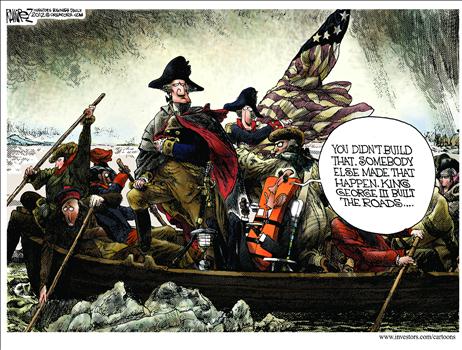
This cartoon makes the same point, but adds taxation to the mix.
As far as I recall (I sound like a politician under oath when I write something like that), this is the first Branco cartoon I’ve used, but I think it’s the best one in this post, so I’m looking forward to more of his (her?) work.
Regular readers know about Michael Ramirez, of course, and he has an amusing take on the you-didn’t-build-that controversy.
Last but not least, we have another Allie cartoon. I think this is the first time I’ve used two cartoons by the same person, but I think you’ll agree they’re worth sharing.
This gives me an opportunity to end on a serious note. The Obama campaign is asserting that the President was simply stating that private sector prosperity is made possible by the provision of “public goods” such as roads and bridges.
Which is why the second Allie cartoon is so good. Even when government does something that is theoretically good, it causes a lot of collateral damage because of the excessive size and scope of the welfare state.
Thank you so much for your time. I know how valuable it is. I also appreciate the fine family that you have and your commitment as a father and a husband.
Sincerely,
Everette Hatcher III, 13900 Cottontail Lane, Alexander, AR 72002, ph 501-920-5733, lowcostsqueegees@yahoo.com
Ryan is the shot in the arm that Romney needed. If last night’s “60 Minutes” interview of the two is any indication, Romney is finally focused on the big issues. It’s rare that a vice-presidential pick adds much to a ticket, but this case may be the exception. So, yes, Ryan can boost Romney’s poll numbers. Just look at the weekend crowds.
Ryan put it simply: The country’s going broke. You’d never know that from listening to the Democratic response to the pick. For that side, it’s all about what the Romney-Ryan team will take away from seniors, women, students, and the middle class — as if all of that ”stuff” were free from government. They’re counting on seniors being too senile, women being too emotional, young people being too uneducated, and the middle-class being too focused on their mortgages to understand the situation we’re in, where we borrow 40 percent of what we spend and add trillions to the national debt every year. The Ryan budget won’t push Granny over the cliff. The Obama team’s head-in-the-sand will.
And it isn’t as if the Obama team doesn’t know exactly what they’re doing. In Obama’s latest ad, run last night during the Olympics closing ceremonies, he himself states plainly that the nation faces two fundamentally different visions of where we’re going. But he talks only about government benefits, not about costs — the “Life of Julia” nonsense. It’s a cynical view of the American public — a view that this election, more than any in recent memory, will put to the test.
I am not upset with you because you are a Democrat. I am upset because you don’t cut the excessive spending in our government and balance our federal budget like all of us have to balance our household budgets. Is that too much to ask. I am critical of Republicans too who do nothing to cut the budget. I wish the Republicans would be brave enough to vote against excessive spending in Washington.
Drudge is currently linking to a Brietbart TVvideo titled “‘USA! USA!’ Congressman’s Anti-Big Government Rant Gets Standing Ovation on House Floor.” In it, Rep. Mike Kelly (R-Pa.) unleashes an oratorical blast against the stifling regulatory regime in Washington. It’s good stuff, but, unfortunately, Rep. Kelly’s anti-big government credentials are questionable.
The Pennsylvania freshman Republican is a member of the so-called “Tea Party Class.” His campaign website says the following:
America needs to have a business conversation. Along with many of his colleagues in the 2010 freshman class, Rep. Kelly has played a role in changing the debate from “How much do we grow government” to “How much do we shrink government.” If nothing else is accomplished in the 112th Congress, both sides of the aisle are now acknowledging that we cannot continue to bankrupt the future for our children and grandchildren. Mike has supported, voted for and co-sponsored a number of pieces of legislation that aim to reduce the size and scope of government. As long as he is serving the 3rd Congressional District, Mike will continue to be an unwavering voice for fiscal responsibility in Washington.
I’ve been trying to keep an eye on how the Republican freshmen are voting on bills and amendments to eliminate (or reauthorize) big government programs. On six recent votes, Kelly voted for big government every time:
He voted against an amendment that would have terminated the Economic Development Administration.
He voted against an amendment that would have defunded the Advanced Manufacturing Technology Consortia program, a new corporate welfare program requested by the Obama administration.
He voted to reauthorize the Export-Import Bank.
He voted against an amendment that would have terminated the Essential Air Service subsidy program.
He voted against an amendment that would have shut down the Department of Energy’s Title 17 loan guarantee program—the program that gave birth to Solyndra.
He voted against an amendment that would have terminated the Community Development Block Grant program.
So much for voting to “reduce the size and scope of government.”
Thank you so much for your time. I know how valuable it is. I also appreciate the fine family that you have and your commitment as a father and a husband.
Sincerely,
Everette Hatcher III, 13900 Cottontail Lane, Alexander, AR 72002, ph 501-920-5733, lowcostsqueegees@yahoo.com
The Sixty Six who resisted “Sugar-coated Satan Sandwich” Debt Deal (Part 21) This post today is a part of a series I am doing on the 66 Republican Tea Party favorites that resisted eating the “Sugar-coated Satan Sandwich” Debt Deal. Actually that name did not originate from a representative who agrees with the Tea Party, […]
The Sixty Six who resisted “Sugar-coated Satan Sandwich” Debt Deal (Part 20) This post today is a part of a series I am doing on the 66 Republican Tea Party favorites that resisted eating the “Sugar-coated Satan Sandwich” Debt Deal. Actually that name did not originate from a representative who agrees with the Tea Party, […]
The Sixty Six who resisted “Sugar-coated Satan Sandwich” Debt Deal (Part 19) This post today is a part of a series I am doing on the 66 Republican Tea Party favorites that resisted eating the “Sugar-coated Satan Sandwich” Debt Deal. Actually that name did not originate from a representative who agrees with the Tea Party, […]
The Sixty Six who resisted “Sugar-coated Satan Sandwich” Debt Deal (Part 18) This post today is a part of a series I am doing on the 66 Republican Tea Party favorites that resisted eating the “Sugar-coated Satan Sandwich” Debt Deal. Actually that name did not originate from a representative who agrees with the Tea Party, […]
The Sixty Six who resisted “Sugar-coated Satan Sandwich” Debt Deal (Part 17) This post today is a part of a series I am doing on the 66 Republican Tea Party favorites that resisted eating the “Sugar-coated Satan Sandwich” Debt Deal. Actually that name did not originate from a representative who agrees with the Tea Party, […]
The Sixty Six who resisted “Sugar-coated Satan Sandwich” Debt Deal (Part 16) This post today is a part of a series I am doing on the 66 Republican Tea Party favorites that resisted eating the “Sugar-coated Satan Sandwich” Debt Deal. Actually that name did not originate from a representative who agrees with the Tea Party, […]
Sen Obama in 2006 Against Raising Debt Ceiling The Sixty Six who resisted “Sugar-coated Satan Sandwich” Debt Deal (Part 15) This post today is a part of a series I am doing on the 66 Republican Tea Party favorites that resisted eating the “Sugar-coated Satan Sandwich” Debt Deal. Actually that name did not originate from […]
Washington’s chronic overspending is just like a junkie’s addiction to drugs. Unless the cycle of addiction is broken, our economic and unemployment situation will continue to suffer. Washington is out of time. To avoid hitting rock bottom, Washington must cut spending today. To spread this message, Washington Could Learn a Lot has created this video. Learn more at washingtoncouldlearnalot.com.
Update: Now, our economic situation has deteriorated even further. We are now approaching $15 trillion in debt and Congress has raised the debt ceiling 11 times in the past ten years.
Washington Could Learn a Lot is a project of Public Notice Research & Education Fund (PNREF). PNREF is an independent non-profit dedicated to educating the American people about economic policy and the principles of economic freedom.
Through our education and awareness projects, PNREF will explore the future consequences of public policies being enacted today.
_________________
We got to lower spending and not raise taxes. It is sad to me that the left acts like they are taking up for the middle class but they know that the largest amount of money they can raise is from the middle class and they will eventually get around to raising taxes on them.
While I disagree with statists, I sometimes admire their discipline. They are very good at staying “on message.”
I am 100 percent confident, for instance, that they intend big tax hikes on the middle class, even though they would piously swear an oath to the contrary. Indeed, I suspect more than 90 percent of them secretly would like a value-added tax.
It’s not that they necessarily dislike ordinary people, but privately they understand that you can’t finance big government by taxing rich people.
So it makes sense that they want to screw the middle class, but it’s also obvious that they don’t want to admit this is their goal. As such, it’s always interesting and revealing when folks on the left slip up and admit their true intentions.
That plan will have to include tax increases beyond just the wealthiest households, although that is the right place to start. But what should happen next? …The best thing to do, once the economic recovery is solidly under way, is to simply let the Bush tax cuts expire and return to the tax structure that prevailed under Bill Clinton. …I’d urge Democrats to be forthright with the fact that we’re way below where we need to be in terms of revenue collection.
Bernstein, by the way, was a co-author of the infamous prediction that enacting Obama’s stimulus would keep the unemployment rate below 8 percent.
…it’s impossible to tackle the federal debt by taxing only the wealthy. …the middle class is going to have to pay more…the only way to achieve tax reform with a reasonable increase in revenue is to reset everyone’s rates at Clinton-era levels.
Keep in mind, by the way, that these proposals are just the tip of the iceberg. Once tax rates are pushed back to 2000 levels, then the drumbeat will sound for additional tax hikes.
“The middle class is an easy target”
And, sooner or later, the left will push for its big goal of a value-added tax.
This is not a trivial threat. Obama, for instance, already has expressed support, saying that the VAT is “something that has worked for other countries.” Romney’s also untrustworthy on the issue, having left the door open to this European-style national sales tax.
But the main point of this post is to explain that class-warfare taxes on the rich are a real threat, but they’re also just the camel’s nose under the tent. The left’s real goal is to fleece the middle class.
There’s no way to boost the burden of government spending to European levels without mimicking European tax policies.
And the dirty little secret about European tax policy is that taxes on the rich are about the same on both sides of the Atlantic. The reason government is so much bigger in Europe is that they ransack the middle class.




 The Daily Hatch