Category Archives: spending out of control

Milton Friedman tells us why our government spends out money so foolishly

The 4 Ways to Spend Money by Milton Friedman

Uploaded by on Aug 26, 2006

1. You spend your own money on yourself.
2. You spend your own money on someone else.
3. You spend someone else’s money on yourself.
4. You spend someone else’s money on someone else.

___________

We need a Balanced Budget Amendment today so we can limit the amount of money the federal government can spend. Why does the government spend our money so foolishly? Milton Friedman has the answer below.

Friedman’s Four Ways

By on 10.5.11 @ 6:08AM

Who’s spending whose money? That’s the crucial question.

Sometimes the explanation for vexing problems is clear as can be after you see it. A perfect example is an observation made by the late Milton Friedman in a 2004 interview with Fox News:

There are four ways to spend money. You can spend your own money on yourself. When you do that, why you really watch out for what you’re doing, and you try to get the most for your money. Then you can spend your own money on somebody else. For example, I buy a birthday present for someone. Well then, I’m not so careful about the content of the present, but I’m very careful about the cost. Then, I can spend somebody else’s money on myself. And if I spend somebody else’s money on myself, then I’m going to have a good lunch! Finally, I can spend somebody else’s money on somebody else. And if I spend somebody else’s money on somebody else, I’m not concerned about how much it costs, and I’m not concerned about what I get. And that’s government. And that’s close to 40 percent of our national income.

It would be nearly impossible to exaggerate how many of our current economic problems are explained by Friedman’s four ways of spending money. Think of the four ways in the order they’re presented as S1, S2, S3, and S4. As Friedman explains, the effectiveness of how money is spent declines inexorably as you move from S1 to S4.

The important demarcation line in ways money can be spent is between S2 and S3. In other words, the issue that matters most is your money versus someone else’s money. If you’re spending your own money on someone else, your spouse or children, for example, you still take the expenditure seriously. You still pay a price if you don’t look for bargains.

A new Gallup survey finds that “Americans believe, on average, that the federal government wastes 51 cents of every tax dollar, similar to a year ago, but up significantly from 46 cents a decade ago and from an average 43 cents three decades ago.” This is a good example of “the wisdom of crowds.” The trend shows that the crowd is wising up regarding the implications of gargantuan government.

The survey respondents are correct in their assessment of how government spends money, and you need go no further than Friedman’s distinctions of how to spend money in understanding the source of the problem.

My guess would be that many of the respondents would think the government doesn’t necessarily need to waste half the public’s money. The problem, however, is it’s the nature of the beast. Because of the realities Friedman refers to, the government will never be able to spend money as effectively as the private sector.

The problems associated with how the government spends money are not the result of who’s running the government. The problems are systemic. Unless government is seriously downsized, waste and inefficiency will remain problems no matter which party is in power.

The source of the problem can be further clarified by keeping in mind the observations of another economist, Steven Landsburg: “Most of economics can be summarized in four words: People respond to incentives.” (That’s the first sentence in his excellent book, The Armchair Economist.)

The incentives for spending money wisely and efficiently are simply too weak when it’s not your own money. It’s no skin off your nose if the benefits of the expenditure are a small fraction of the costs. When it’s your own funds being used, you will not only restrict your expenditures to things having more benefits than costs, you will choose the ones you think will have the highest ratio of benefits to costs.

When it’s your own money you’re spending, it costs you something when you spend it foolishly. That’s not to say that we never spend our own money foolishly, but it comes out of our own hides when we do. When we spend our own money foolishly, we’re left with less money to spend well. It’s a self-policing structure. Of course, your incentives are even stronger when you worked hard for the money in question.

When a politician or bureaucrat spends taxpayer money it’s treated essentially a freebie. It’s only natural that taxpayer money gets treated like monopoly money. Politicians and bureaucrats have virtually no incentive to care about the value of an expenditure or its cost. This is a profound disadvantage of public spending that will never, ever go away.

Contrary to the straw-man accusations of some liberals, conservatives do not advocate zero government expenditures. Conservatives definitely are not anarchists. Nevertheless, the inherent and inescapable inferiority of spending someone else’s money on someone else is a strong argument for minimizing the size of government. The public’s opinion that the amount of government waste has been increasing parallels the exponential growth of government.

The Solyndra fiasco is another recent confirmation of Friedman’s observations. Despite alarm bells going off, the Obama administration pushed the doomed endeavor forward. Why not? It wasn’t their money, after all. Because it has now becoming so notorious, it appears the administration may pay a political price. Nevertheless, half a billion dollars of taxpayer money has gone down a rat hole. Unfortunately, Solyndra is the rule, not the exception. Absurdly generous public employee pension plans are another predictable result of spending someone else’s money.

Friedman said that the fourth spending alternative is how we spend forty percent of GDP. He was, I think, referring only to budgetary expenditures. Forty percent is a lot. Unfortunately, it understates the full extent of the problem.

The vast regulatory apparatus of the government is basically a system of spending someone else’s money on someone else. It is estimated that government regulations currently cost the economy $1.7 trillion a year. For example, requiring a private business owner to spend hundreds of thousands of dollars to comply with the American with Disabilities Act is a clear case of spending someone else’s money on someone else. Requiring a private business to spend a million dollars doing an “environmental impact report” is a clear example of spending someone else’s money on someone else. Spending a million dollars or more on an EIR, in fact, is an example of spending someone else’s money for no one and for nothing. Minimum wage laws likewise are a case of spending someone else’s money on someone else.

The billions of hours Americans spend each year preparing their tax returns is a case of spending someone else’s time on someone else. Time is money, as they say, and most people I know complain a lot more about a scarcity of time than they do of money.

When you spend your own money (or time) on yourself, or for your loved ones, the process is essentially self-regulating. The incentives are automatically aligned with waste minimization. When such incentives are not present, elaborate and complex systems of rules and artificial punishments must be put in their place. There can never be enough rules and regulations to match the effectiveness and elegance of the self-regulating market.
Greece going broke before the USA?

Federal Spending by the Numbers

Uploaded by on Jun 10, 2010

http://blog.heritage.org/2010/06/10/new-video-federal-spending-by-the-numbers The Federal Government is addicted to spending. Watch this video from the Heritage Foundation to learn about the trouble we are in and where to find solutions.

_______

Greece going broke before the USA? We got to control the entitlement mentality.

I wrote yesterday that the United Kingdom is doomed because there isn’t a political party with the vision or courage to restrain the welfare state.

At various points, I’ve also expressed pessimism about the future of France, Germany, Italy, Spain, Ireland, and even the United States.

Simply stated, almost all western nations suffer from the same toxic combination of dependency, demographic decline, and poorly structured entitlement programs.

But some nations are heading in the wrong direction more rapidly than others, and Greece is best example (perhaps I should say worst example?) of a country that is careening toward catastrophe.

It’s such a basket case that I’m not sure whether the politicians or the people deserve the lion’s share of the blame.

  •  The politicians deserve blame because they treat public office as a tool for self-enrichment and self-aggrandizement, largely by steering taxpayer money to friends, cronies, contributors, and supporters. Sometimes they do this in a search for votes. Sometimes in a search for cash.
  •  The people deserve blame because they view the state as a magical source of freebies and they see no economic or moral problem with using a coercive government to steal from fellow citizens. They realize the system is corrupt, which is why they seek to evade taxes, but that doesn’t stop them from trying to live at the expense of others.

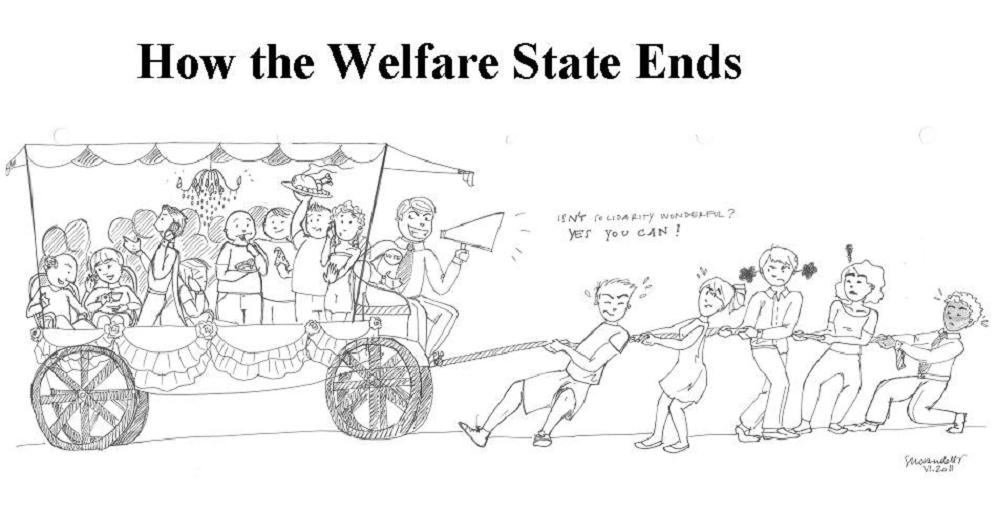
In a best-case scenario, this type of dysfunctional system reduces prosperity. But when the number of people mooching off the state reaches a critical mass (as illustrated by these two cartoons), then you get societal meltdown.

Which is a good description of what’s happening in Greece.

And even when the government is on the verge of collapse and there’s pressure for reform, the political elite somehow figure out how to screw things up.

The latest example is the possible creation of “special economic zones.” When I first glanced at the story excerpted below, I thought this meant the Greek government was going to create something akin to “enterprise zones” featuring lower tax rates and less red tape.

Because I’m a supporter of the law applying equally to everybody, I’m not a big fan of such policies. I want to reduce the burden of government, of course, but I want that approach for entire countries, not just a handful of areas selected by politicians.

But at least the concept is good, right?

Not when Greek politicians are involved. They have taken the worst features of enterprise zones and combined them with the worst features of redistributionism. Here’s some of the story from Ekathimerini.

The government is paving the way for negotiations with the European Commission regarding the creation of special economic zones (SEZ) in Greece, Development Minister Costis Hatzidakis confirmed on Tuesday in Athens. …“SEZ will give a boost to the basis of the real economy,” said Hatzidakis, reiterating that the existing labor legislation will be fully respected. ..This forms part of the 10-point priority plan Hatzidakis announced yesterday aimed at boosting growth. Changes to the investment incentives law and the fast-track regulations will be completed within the next 15 days. The bill to be prepared will include subsidies of up to 80 percent for smaller companies… Public-private partnerships will be used for bolstering regional growth.

So the zones will keep all the bad labor laws, but provide big subsidies and create “public-private partnerships” (i.e., cronyism).

I hate to sound negative all the time, but that sounds precisely like the kind of nonsense that put Greece in a ditch to begin with.

To be fair, the article does talk about targeted tax relief and accelerated procedures for dealing with red tape. But that’s not exactly good news. Targeted tax cuts are a form of discrimination and they create an environment favorable to lobbying and corruption. And while it seems like good news to approve licenses more quickly, why not just get rid of bureaucratic hurdles? After all, this is the country (this is not a joke) that requires stool samples from entrepreneurs seeking to set up online companies.

It’s very hard to have any optimism after reading this type of story. Greece surely is an example of statism run amok, but let’s return to the point I made above about almost all other western nations heading in the same direction. Greece may be closest to the fiscal cliff, but the rest of us are driving in the same direction.

And if you think this is overheated rhetoric (yes, I’m prone to hyperbole), check out these dismal numbers from the Bank for International Settlements and the Organization for Economic Cooperation and Development.

P.S. The BIS and OECD numbers show that the United States is in worse shape – in the long run – than every European welfare state. I assume this is largely based on assumptions of health care spending rising more rapidly in America. The bad news is that this is a reasonable assumption (thanks to our third-party payer problem). The good news is that we can easily solve the problem with a combination of entitlement reform (which deals with a direct cause of third-party payer) and tax reform (which deals with an indirect cause of third-party payer).

Socialism steals our freedom

Milton Friedman – Socialism is Force

Uploaded by on May 21, 2010

Milton Friedman discusses the moral values encouraged by economic systems and explains that a primary difference between capitalism and socialism is the difference between free choice and compulsory force.

________________

Do we want freedom or may we don’t?  It seems to me those who want more of our private money to be given over to government control are limiting our freedom greatly.

Every so often, you read something so ridiculously stupid and absurd that you assume that you’re being pranked. So you look to the date of the article to see if it says April 1. Or you look at the Internet address to see if it’s a parody of a real website.

So when I read a column suggesting that the United States should become more like Italy, I thought this must be some sort of practical joke. After all, Italy is teetering on the edge of bankruptcy, kept afloat by bailouts and subsidies. Its economy is in the toilet, with pervasively high unemployment, almost no growth for a decade, and living standards that are only about two-thirds of U.S. levels.

The Italian government is also famously incompetent (naming the wrong people to high-level posts), with stifling levels of regulation, a dysfunctional fiscal system, and a corrupt legal system (and when it’s not crooked, it’s inane).

Notwithstanding all these crippling flaws, Italy has something akin to catnip for the left. It has a punitive tax burden, and that means it must be a nation worth emulating.

Here’s some of what Eduardo Porter wrote for the New York Times.

Italy may be in a funk, with a shrinking economy and a high unemployment rate, but the United States can learn a lot from it, and not just about the benefits of public health care. Italians live longer. Their poverty rate is much lower than ours. If they lose their jobs or suffer some other misfortune, they can turn to a more generous social safety net. …The reason is not difficult to figure out: rich though we are, we can’t afford the policies needed to improve our record. …But though the nation’s fiscal challenge has taken center stage in the presidential election campaign, raising more taxes from American families remains stubbornly off the table.

I’m willing to believe Italians live longer, but every other assertion in that passage is upside down. Yes, they have more subsidies for joblessness, but that’s one of the reasons they have higher unemployment (as even Paul Krugman and Larry Summers have acknowledged).

And the claim about less poverty is laughable. I’m guessing the author naively relied upon the slipshod analysis from the statists at the Organization for Economic Cooperation and Development. Those bureaucrats put together a moving-goalposts measure of income distribution and falsely categorized it as a tool for measuring poverty.

Setting aside these mistakes, the column is designed to convince people that we should give more money to Washington.

Citizens of most industrial countries have demanded more public services as they have become richer. And they have been by and large willing to pay more taxes to finance them. Since 1965, tax revenue raised by governments in the developed world have risen to 34 percent of their gross domestic product from 25 percent, on average. The big exception has been the United States. …the United States raises less tax revenue, as a share of the economy, than every other industrial country. No wonder we can’t afford to keep more children alive. In 2007, the most recent year for which figures are available, the United States government spent about 16 percent of its output on social programs — things like public health, food and housing for the poor. In Italy, that figure was 25 percent. …Every other industrial country has a national consumption tax, which can be used to raise a lot of money.

I will give the author credit. If you read the entire column, it’s clear he wants all Americans to pay higher taxes, not just the so-called rich. So at least he’s being honest, unlike a lot of statists (click here for a list of honest leftists who admit you can’t finance big government without screwing the middle class).

But honesty about goals doesn’t mean desirability of policy. If America becomes more like Italy, it will mean Italian-style stagnation and joblessness.

And it’s particularly worrisome to see that the author wants a value-added tax, which is a sure-fire way of giving politicians a big pile of money that will be used to expand the burden of government spending.

I have nothing against copying other nations, either when they get one policy right (such as Estonia’s flat tax or Australia’s system of personal retirement accounts), or when they get a bunch of policies right and routinely rank at the top for economic freedom and prosperity (such as Hong Kong and Singapore).

But I’m mystified by those who look at failure and conclude America should do likewise.

P.S. The Italians have a bad tax system, but they don’t meekly comply. Whether they’re firebombing tax offices or sailing yachts to other countries, they are a powerful example of the Laffer Curve insight that higher tax rates don’t necessarily translate into higher tax revenues.

Videos on government debt

Federal Spending by the Numbers

Uploaded by on Jun 10, 2010

http://blog.heritage.org/2010/06/10/new-video-federal-spending-by-the-numbers The Federal Government is addicted to spending. Watch this video from the Heritage Foundation to learn about the trouble we are in and where to find solutions.

_______

Here’s a riddle for policy wonks. What do you get if you take my videos on the  economics of government spending and mix them in a blender with my videos on America’s entitlement crisis?

You get this concise but compelling video from the Blaise Ingoglia at Government Gone Wild.

Blaise has several other videos I strongly recommend.

You’ll notice a common theme in all his videos: He lays out the facts in a blunt, hard-hitting manner.

And if you watch all of them, you’ll realize that government is the problem, not the solution.

In 2011 49 percent of Americans lived in a household where at least one member of the family received a government benefit

Cato Institute’s Dan Mitchell on WMAL 07-10-12

Published on Jul 10, 2012 by

INTERVIEW: DAN MITCHELL — Senior Fellow, Cato Institute — discussed the ObamaCare tax vs. penalty rhetoric, the growing number of people on disability, whether America is becoming Europe and President Obama’s tax-the-rich speech yesterday.

ObamaCare: Is It a Tax or a Penalty? Dan examines the messaging.
Obama’s Class Warfare: President Obama Monday proposed a one-year extension of the Bush-era tax cuts for American families earning less than $250,000 a year.
Spain Given Extra Year To Reach Deficit Reduction Targets. Spain is getting another year to meet its deficit-reduction targets. The country was given until 2014 to meet its goals in exchange for budget savings and an aid package for banks. Euro zone ministers were concerned that Spain, their fourth-largest economy, was on the path to a full bailout which they could not afford. Spain has been hit hard with bad debts from the housing crash and worldwide recession.
AEI’s Arthur Brooks writes in the WSJ: “America Already Is Europe: In spending, debt and progressivity of taxes, the U.S. is as much a social-welfare state as Spain.

________________

I wish we have a country where freedom was everywhere but instead we have many enslaved to the federal government. We need to get the government interference  out of our lives so we can truly be free again.

Alison Acosta Fraser

September 18, 2012 at 5:39 pm

Mother Jones has opened a broad debate about the role of government in our society.

In a clandestine tape recorded in May and obtained by the magazine, former Governor Mitt Romney (R-MA) remarked that 47 percent of taxpayers pay no federal income taxes. He notes, among other things, the increase in dependency on government in the country.

This is not a widely held secret: 47 percent of all tax filers paid no federal individual income taxes in 2009, and in 2011 that figure was 46 percent. This is all perfectly legitimate as taxpayers take advantage of various credits, deductions, exemptions, and the like. These filers are largely (but not exclusively) low-income Americans including seniors and students.

This doesn’t necessarily mean that these taxpayers are dependent on the federal government. (More on that later.) But it does raise a crucial issue for our democracy: Who should pay to fund the federal government?

Who Pays Taxes

At 47.4 percent of federal revenue, the federal income tax is by far the single largest source of revenue for the federal government. The payroll tax is next largest, raising 35.6 percent. But those revenues are reserved for Social Security and Medicare benefits. So the individual income tax funds the bulk of operations of the federal government, including such core things as national defense, homeland security, and the judicial system.

Shouldn’t all Americans have some stake, even if just a nominal one, in funding these government programs? Should nearly 50 percent of Americans really be exempt from funding the most basic constitutional functions of government—along with education, food stamps, energy, welfare, foreign aid, veterans’ benefits, housing, and so forth?

Do the non-taxpayers represent those Americans who are dependent on government? Not necessarily, but there is overlap. Many take advantage of Washington policies that remove their liability or even send them money, via the IRS, that they never paid in to begin with. But to really understand government dependence requires looking at the full panoply of government programs and direct benefits.

Who’s Dependent on the Government

The 2012 Heritage Index of Dependence on Government found that 63.7 million Americans received either Temporary Assistance for Needy Families, Social Security, or support for higher education—an 8 percent increase over the previous year. These same people were very likely to receive other federal benefits, such as Medicare or food stamps. Separately, The Wall Street Journal found that in 2011, 49 percent of Americans lived in a household where at least one member of the family received a government benefit.

So we find the nation at a tipping point. Nearly half of all taxpayers pay no income tax, while nearly half of all Americans receive direct government support for income, food, housing, medical care, school lunches, etc. This makes strong incentives for those who pay no income taxes to press for more and higher benefits. But government programs are rife with poor outcomes.

As Heritage scholar Robert Rector writes, “The federal government operates more than 80 means-tested welfare programs to provide cash, food, housing, medical care, and social services to poor and low-income people. President Obama has increased federal means-tested welfare spending by a third since taking office. Last year, combined federal and state spending on means-tested welfare hit $927 billion.” Yet according to the Census Bureau, 15 percent of the population still lives in poverty.

Growing these dependency programs, as the President would do, will balloon the federal checkbook. Moreover, government dependency erodes human dignity and civil society. As Curtis Dubay writes, “the goal of government policy shouldn’t be to make more people dependent. It should be to maximize the ability of all Americans to make the greatest use of their abilities so they can lead meaningful, purposeful lives.”

Can We Afford This?

We reach this tipping point just as the nation struggles to confront our twin crises of spending and debt. The total national debt just surpassed $16 trillion; total federal spending is projected to be nearly 23 percent of the economy in 2012; and, for the fourth year in a row, the federal government will run a deficit in excess of $1 trillion.

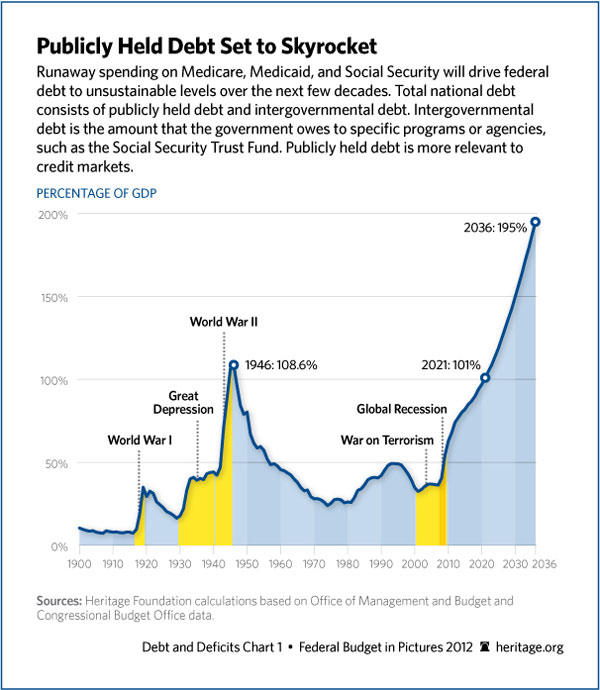
That’s just for starters. Nearly 78 million baby boomers are already starting to pour into Social Security and Medicare, while Medicaid is exploding. Within just one generation, total federal spending will reach nearly 36 percent of GDP, and debt held by the public will reach nearly 200 percent of GDP. (continues below chart)

This is unsustainable. But it is also economically and morally bankrupting. America is on the verge of becoming a nation in decline—economically stagnant and permanently debt-ridden, more dependent, and less self-governing.

Government should be smaller. Taxes should be flatter and should not penalize ordinary and low-income Americans for saving—whether for a car, a condo, or retirement. Federal dependency programs should be redesigned to not just assist low-income individuals, but also move them out of dependency. Social Security, Medicare, and Medicaid should be overhauled. The goal is to strengthen the safety net, not destroy it. The out-of-control growth of these programs virtually ensures their ultimate destruction, so we should act now.

These choices, while difficult, are not radical: extending the means testing in Medicare today further to fix the program’s finances while also embracing premium support to improve health care delivery and outcomes; extending means testing in Social Security further (after all, do Bill Gates or Warren Buffett really need Social Security?); gradually moving Social Security away from a benefit for everyone to a benefit that, unlike today, guarantees that seniors won’t live in poverty because their benefits are so low.

Ah, Mother Jones, these are the kinds of solutions that will help in Saving the American Dream.

Posted in Entitlements

Dear Senator Pryor, why not pass the Balanced Budget Amendment? (“Thirsty Thursday”, Open letter to Senator Pryor)

Thomas Sowell – Growth Of Government

Uploaded by on Sep 23, 2011

Professor Sowell comments on how the Founder’s vision of limited government transmogrified into its present state.

____________

Dear Senator Pryor,

Why not pass the Balanced  Budget Amendment? As you know that federal deficit is at all time high (1.6 trillion deficit with revenues of 2.2 trillion and spending at 3.8 trillion).

On my blog www.HaltingArkansasLiberalswithTruth.com I took you at your word and sent you over 100 emails with specific spending cut ideas. However, I did not see any of them in the recent debt deal that Congress adopted. Now I am trying another approach. Every week from now on I will send you an email explaining different reasons why we need the Balanced Budget Amendment. It will appear on my blog on “Thirsty Thursday” because the government is always thirsty for more money to spend.

We got to prevent tax hikes and the Balanced Budget Amendment does a good job on that front.

Top 10 Reasons to Support the Lee-Walsh Balanced Budget Amendment

1. It Would Require the Federal Government to Balance Its Budget Every Year.

The federal budget deficit is a record high $1.6 trillion—more than 10 percent of the nation’s entire ouput, or Gross Domestic Product (GDP). We face such an enormous deficit because we spend too much, not because we tax too little. The Lee-Walsh Balanced Budget Amendment (BBA) would force Washington to live within its means.  

2. It Would Prevent Tax Hikes.

The Lee-Walsh BBA would require a two-thirds majority vote in both chambers to raise taxes, which would help prevent the prosperity-killing tax hikes that years of trillion dollar deficits, as proposed by President Obama’s budget, would surely bring. The Lee-Walsh BBA would achieve a balanced budget by cutting spending instead of raising taxes.

3. It Would Make it More Difficult to Raise the Debt Ceiling.

The Lee-Walsh BBA would require a three-fifths majority vote in both chambers to raise the debt ceiling. The debt ceiling has been raised ten times in just the past decade. It’s clear that we need to make it more difficult to raise the debt ceiling. The Lee-Walsh BBA does this to ensure that Congress cannot raise the debt ceiling so carelessly.

4. It Would Limit Spending to 18 Percent of GDP.

Congressional spending currently consumes approximately 25 percent of GDP. Federal revenue from taxes over the past 40 years has averaged about 18 percent of GDP, making 18 percent a reasonable limit for spending if Congress is in fact interested in balancing the budget for the long haul.

5. It Would Reduce the Size and Scope of Government.

If we want economic growth to return and be a permanent part of American life, it is imperative that we dramatically reduce the size and scope of government. The Lee-Walsh BBA would put real restraints on the amount of money Washington can spend.

6. It Has a Good Chance of Passing.

The Lee-Walsh BBA has a very good chance of passing the Republican-controlled House. In the Senate, the BBA has unanimous support from all 47 Republicans. It’s likely to gain bipartisan support in both chambers.

7. The Lee-Walsh BBA Has Teeth.

Some proposed BBAs have numerous loopholes that make it easy for Congress to override the amendment. The Lee-Walsh BBA has real teeth that would require Washington to balance its budget each year.

8. Americans Overwhelmingly Support Balanced Budget Amendments.

Balanced Budget Amendments have always been popular with the American people. By 72-20 percent, most voters favor a balanced budget amendment to the U.S. Constitution, according to a Fox News poll.

9. It Would Prohibit Congress from Perpetual Deficit Spending.

Deficit spending is simply a hidden tax on future earnings. It is irresponsible for Washington to continue to borrow now and tax us more down the road. The Lee-Walsh BBA would help end our deficit spending and our debt culture.

10. It is a Good Start to Restoring Fiscal Sanity to Washington.

A Balanced Budget Amendment may not be a cure all. But it’s a step in the right direction to rein in excessive spending. Enactment of this amendment will go a long way in ensuring Washington never gets so carried away with reckless spending again.

________

Thank you again for your time and for this opportunity to share my ideas with you.

Sincerely,

Everette Hatcher


Is the no new tax pledge going to work?

Milton and Rose Friedman with President Bush.

Milton Friedman on Donahue 1979 (2/5)

I believe the “no new tax pledge” ultimately will work. Milton Friedman believed we should starve the beast and that is good enough for me. “If taxes are raised in order to keep down the deficit, the result is likely to be a higher norm for government spending.” Milton Friedman

There’s a debate among policy wonks about whether a no-tax-hike policy is an effective way of restraining the burden of government spending.

At the risk of over-simplifying, the folks who support the “starve the beast” theory argue that there are political and/or economic limits to government borrowing, so if you don’t let politicians tax more, you indirectly impose a cap on total spending (outlays = tax revenue + borrowing limit). We’ll call this the STB approach, for obvious reasons.

Critics of the theory, by contrast, say that a low-tax policy creates fiscal illusion by making government spending seem artificially cheap. After all, standard microeconomic analysis tells us that people will demand more of something when the perceived price is low (get a $1 of spending for 80 cents of tax = recipe for higher outlays). We’ll call this the “pay for government” approach, or PFG.

There’s almost surely some truth to both arguments, but the real issue if whether one effect is dominant – particularly in the long run. In other words, should supporters of small government fight tax increases? Or welcome them?

I’ve never studied this issue, but my gut instinct has been on the “STB” side of the debate. Here are a few of the reasons.

  1. The politicians and interest groups that favor bigger government seem especially anxious to convince anti-tax lawmakers to change their minds. If nothing else, that suggests higher taxes would “feed the beast.” I suppose this could be a clever example of reverse psychology, but something tells me that Harry Reid and Nancy Pelosi lack the cleverness and subtlety to pull off that kind of trick.
  2. The people who pay for government generally aren’t the ones who reap the benefits. And if you keep increasing taxes on the “rich,” as Obama proposes, why would that affect the preferences of the rest of the population? Especially the huge chunk of the population that doesn’t pay income tax? Simply stated, the PFG approach incorrectly assumes that payers and payees are the same.
  3. Casual empiricism certainly suggests that higher taxes are associated with more government, not less red ink. We see this, for instance, in the evidence I recently shared from Europe. Taxes have jumped in recent decades, but government debt also has climbed, which implies all additional revenue was spent, and then some.
  4. Just look at the real world, specifically the fiscal crisis in nations such as Greece. At the risk of stating the obvious, the recent events in Europe confirm that there does come a point when governments lose the ability to borrow. So if taxpayers somehow can prevent politicians from seizing more money, there is a de facto limit on government spending.

Seems like the STB approach makes sense, but not everyone thinks my theoretical musings and generic observations are all that’s needed to settle an argument.

Particularly when there are some very sensible people on the other side. The late Bill Niskanen wrote in the 2006 Cato Journal that:

There are three major problems with the starve-the-beast argument: (1) it is not a plausible economic theory; (2) it is inconsistent with the facts; and (3) it has diverted attention away from the political reforms needed to limit government growth.

I fully agree with Bill that there should be much more focus on restraining the growth of government, so there’s no disagreement on his third point. I think he’s wrong on the first point because half the population no longer pays federal income tax and the top 20 percent pay the lion’s share, but that’s a bit of a judgment call.

What about the facts? Bill does some regression analysis for the 1949-2005 period, where he looks at the change in federal spending as a share of GDP and tests its relationship with the level of tax receipts as a share of GDP, the change in the unemployment rate, and the change in interest payments (the latter two variables are there to hopefully wash out the effects of the business cycle and to limit the analysis to the spending that lawmakers actually can control).

Bill crunches the numbers and concludes:

For no extended period did these estimates reveal a significant positive relation between the change in federal spending as a percent of GDP and the level of federal receipts as a percent of GDP, the necessary condition for the starve-the-beast hypothesis to be confirmed.

Moreover, Bill even found evidence for the PFG approach when he looked solely at the 1981-2005 period.

A 1 percentage point increase in current federal receipts as a share of GDP apparently reduces the change in current federal spending as a share of GDP by about one-seventh of 1 percent a year indefinitely.

I don’t doubt that Bill’s numbers are sound. Indeed, Cato Adjunct Scholar Michael New re-crunched the numbers for the Cato Journal in 2009 and produced similar findings, even when looking only at non-defense discretionary spending.

But I don’t find this research very compelling, and it’s not just because I’m from Austrian school, which sometimes has a reputation for being skeptical about empirical analysis.

Here are some reasons why I’m not convinced, and even the biggest quant jocks in the world should share these concerns.

  1. Is 57 years of data (1949-2005) or 25 years of data (1981-2005) really enough to draw any sweeping conclusions, particularly when there could be many other factors involved? We would be very reluctant to jump to conclusions about the demand for Big Macs by interviewing a handful of customers and looking at just three variables.
  2. More important, why didn’t Bill measure changes in spending against legislated tax changes? After all, lawmakers rarely pay attention to tax receipts as a share of GDP, and that variable rarely if ever is part of the lawmaking process. But politicians are acutely aware of whether they are voting to either reduce taxes or increase them.
  3. And why use spending as a share of GDP rather than nominal spending or inflation-adjusted spending, particularly since Congress votes to spend specific amounts of money, not for outlays as a percent of economic output.
  4. Equally perplexing, why didn’t Bill include lags in his research? I’m not aware of any STB proponents who claim that there’s an instantaneous impact. Instead, they argue that long-term limits on revenue can impose long-run restraints on spending.

To be fair, Bill was breaking some new ground. There was not a lot of empirical analysis to that point, so there was no right or wrong way to test the relationship between taxing and spending. Niskanen picked one approach, and it’s the role of subsequent researchers to poke and prod the results and contemplate alternatives.

That’s exactly what Christina Romer and David Romer did in their article that appeared in the 2009 Brookings Papers on Economic Activity. They investigated the data from several angles and decided it made the most sense to look at legislated tax changes and look at the long-run impact on spending. And, in an attempt to test the STB hypothesis, they looked solely at major tax bills designed to reduce government revenue.

That’s the good news. The bad news is that this gave them only four pieces of data – the Revenue Act of 1948, the Kennedy tax cuts, the Reagan tax cuts, and the 2001/2003 Bush tax cuts.

Setting aside this problem of limited data, what did Romer and Romer discover? Their headline results were similar to Niskanen’s.

The results provide no support for the hypothesis that tax cuts restrain government spending.

That sounds like bad news for STB advocates. But if you dig into their findings, you find out that the real problem is that politicians can’t resist the temptation to feed the beast.

…roughly three-quarters of a long-run tax cut is typically undone by legislated tax increases of various sorts within five years. …The fact that policymakers have been able to largely reverse tax cuts helps to explain why the cuts have not reduced spending.

In other words, you can’t starve the beast if you don’t maintain the diet.

Which is basically what other economists concluded when analyzing the work of Romer and Romer. Here’s what Steven Davis of the University of Chicago wrote.

…if it takes 5 years for a new policymaker to reverse a previous tax cut, so that it remains in effect for 10 years rather than 5, the starve-thebeast effect roughly doubles. In the extreme case where tax cuts cannot be reversed, government spending cuts must eventually absorb the entire adjustment. Clearly, then, tax cuts can produce large starve-the-beast effects if they are sufficiently sticky.

And Jeffrey Miron of Harvard University had a similar interpretation.

…concerns over letting children play with matches—that is, giving politicians access to increased tax revenue—are valid. Thus, advocates of small government would seem to have good reason to oppose tax increases.

All things considered, I think that STB is correct.

But I’ll close by returning to one of Bill Niskanen’s points. He warned that the focus on tax limitation was harmful because it “diverted attention away from the political reforms needed to limit government growth.”

I fully agree. Too many politicians focus on the easy – and more politically popular – job of fighting tax increases. But then they fail to support measures to restrain the burden of government spending.

Or, as we saw during the Bush years, they cut taxes and then opened the spigot on the spending side of the fiscal equation. No wonder Romer and Romer found that tax cuts generally are reversed. Tax cuts are difficult to maintain and preserve if they are simply gimmicks put in place by feckless politicians.

P.S. Another interesting tidbit is that Romer and Romer acknowledge the Laffer Curve.

We also find that the overall rebound in revenue exceeds the portion due to legislated changes. The key source of the nonlegislated change in revenue is almost certainly the effect of the tax cut on economic activity.

Too bad Christina Romer didn’t share that insight with the President when she was at the Council of Economic Advisers.

Videos by Dan Mitchell of the Cato Institute found here on www.thedailyhatch.org

Dan Mitchell of the Cato Institute has some great videos and I have posted lots of them on my blog. I like to go to Dan’s blog too. Take a look at some of them below and then the links to my blog.

It’s Simple to Balance The Budget Without Higher Taxes

Uploaded by on Oct 4, 2010

Politicians and interest groups claim higher taxes are necessary because it would be impossible to cut spending by enough to get rid of red ink. This Center for Freedom and Prosperity video shows that these assertions are nonsense. The budget can be balanced very quickly by simply limiting the annual growth of federal spending.

_______

Six Reasons Why the Capital Gains Tax Should Be Abolished

Uploaded by on May 3, 2010

The correct capital gains tax rate is zero because there should be no double taxation of income that is saved and invested. This is why all pro-growth tax reform plans, such as the flat tax and national sales tax, eliminate the capital gains tax. Unfortunately, the President wants to boost the official capital gains tax rate to 20 percent, and that is in addition to the higher tax rate on capital gains included in the government-run healthcare legislation. http://www.freedomandprosperity.org


______________

Keynesian Economics Is Wrong: Bigger Gov’t Is Not Stimulus

Uploaded by on Dec 15, 2008

Based on a theory known as Keynesianism, politicians are resuscitating the notion that more government spending can stimulate an economy. This mini-documentary produced by the Center for Freedom and Prosperity Foundation examines both theory and evidence and finds that allowing politicians to spend more money is not a recipe for better economic performance.

___________________

Obama’s So-Called Stimulus: Good For Government, Bad For the Economy

Uploaded by on Jan 26, 2009

President Obama wants Congress to dramatically expand the burden of government spending. This CF&P Foundation mini-documentary explains why such a policy, based on the discredited Keynesian theory of economics, will not be successful. Indeed, the video demonstrates that Obama is proposing – for all intents and purposes – to repeat Bush’s mistakes. Government will be bigger, even though global evidence shows that nations with small governments are more prosperous.

____________

Big Government Is Not Stimulus: Why Keynes Was Wrong (The Condensed Version)

Uploaded by on Jan 13, 2009

The CF&P Foundation has released a condensed version of our successful mini-documentary explaining why so-called stimulus schemes do not work. Based on a theory known as Keynesianism, politicians are resuscitating the notion that more government spending can stimulate an economy. This mini-documentary produced by the Center for Freedom and Prosperity Foundation examines both theory and evidence and finds that allowing politicians to spend more money is not a recipe for better economic performance.

_________________

Eight Reasons Why Big Government Hurts Economic Growth

Uploaded by on Aug 17, 2009

This Center for Freedom and Prosperity Foundation video analyzes how excessive government spending undermines economic performance. While acknowledging that a very modest level of government spending on things such as “public goods” can facilitate growth, the video outlines eight different ways that that big government hinders prosperity. This video focuses on theory and will be augmented by a second video looking at the empirical evidence favoring smaller government.

___________________

Now that I have been critical of the Democrat President, I wanted to show that I am not concerned about taking up for Republicans but looking at the facts. President Clinton did increase government spending at a slower rate than many other presidents. Here are two  videos that praise both Reagan and Clinton for both accomplished this feat.

Spending Restraint, Part I: Lessons from Ronald Reagan and Bill Clinton

Uploaded by on Feb 14, 2011

Ronald Reagan and Bill Clinton both reduced the relative burden of government, largely because they were able to restrain the growth of domestic spending. The mini-documentary from the Center for Freedom and Prosperity uses data from the Historical Tables of the Budget to show how Reagan and Clinton succeeded and compares their record to the fiscal profligacy of the Bush-Obama years.

______________

Spending Restraint, Part II: Lessons from Canada, Ireland, Slovakia, and New Zealand

Uploaded by on Feb 22, 2011

Nations can make remarkable fiscal progress if policy makers simply limit the growth of government spending. This video, which is Part II of a series, uses examples from recent history in Canada, Ireland, Slovakia, and New Zealand to demonstrate how it is possible to achieve rapid improvements in fiscal policy by restraining the burden of government spending. Part I of the series examined how Ronald Reagan and Bill Clinton were successful in controlling government outlays — particularly the burden of domestic spending programs. www.freedomandprosperity.org

Here are some posts that include videos from Dan Mitchell:

Videos by Cato Institute on failed stimulus plans

In this post I have gathered several videos from the Cato Institute concerning the subject of failed stimulus plans. _____ Government Spending Doesn’t Create Jobs Uploaded by catoinstitutevideo on Sep 7, 2011 Share this on Facebook: http://on.fb.me/qnjkn9 Tweet it: http://tiny.cc/o9v9t In the debate of job creation and how best to pursue it as a policy […]

Balanced Budget Amendment the answer? Boozman says yes, Pryor no, Part 28 (Input from Norm Coleman, former Republican Senator from MN)

  It’s Simple to Balance The Budget Without Higher Taxes Steve Brawner in his article “Safer roads and balanced budgets,” Arkansas News Bureau, April 13, 2011, noted: The disagreement is over the solutions — on what spending to cut; what taxes to raise (basically none ever, according to Boozman); whether or not to enact a […]

Obama’s plan is not too smart on taxes

Dan Mitchell did a great article concerning the affect of raising taxes in these two areas and horrible results: How Can Obama Look at these Two Charts and Conclude that America Should Have Higher Double Taxation of Dividends and Capital Gains? Posted by Daniel J. Mitchell As discussed yesterday, the most important number in Obama’s […]

______________

Reagan and Clinton put Obama to shame when it comes to creating jobs

Reagan and Clinton put Obama to shame when it comes to creating jobs.

I shared a remarkable chart last year exposing Obama’s terrible record on job creation.

It showed that the economy enjoyed big employment increases during the Reagan and Clinton years, but it also revealed anemic data for the Obama years.

That’s not a surprise since Reagan was the most pro-freedom President since World War II and Clinton almost surely comes in second place.

Yes, Clinton did raise tax rates in his first year, but he put together a very strong record in subsequent years. He was particularly good about restraining the burden of government spending and overall economic freedom expanded during his reign.

He was no Reagan, to be sure, and the anti-government Congress that took power after the 1994 elections may deserve much of the credit for the good news during the Clinton years. Regardless, we had good economic performance during that period – unlike what we’ve seen during the Obama years.

Which makes this Michael Ramirez cartoon both amusing (in a tragic way) and economically accurate.

Obama v Reagan + Clinton

Since we’ve had relatively weak numbers for both jobs and growth this entire century, it would have been even better if the cartoon showed Bush and Obama both trying to raise the bar.

The real lesson is that big government is bad for jobs and growth, regardless of whether politicians have an “R” or “D” after their names.

P.S. Interestingly, now that the election is over, even the Washington Post is willing to publish charts confirming that Obama’s economic track record is miserable.

Let’s spend someone else’s money to solve our problems!!! That is the number one reason we have a national debt so high!!!

President Barack Obama speaks about the debt limit in the East Room of the White House in Washington. | AP Photo

“The credit of the United States ‘is not a bargaining chip,’ Obama said on 1-14-13. However, President Obama keeps getting our country’s credit rating downgraded as he raises the debt ceiling higher and higher!!!!

Washington Could Learn a Lot from a Drug Addict

Just spend more, don’t know how to cut!!! Really!!! That is not living in the real world is it?

Making more dependent on government is not the way to go!!

Why is our government in over 16 trillion dollars in debt? There are many reasons for this but the biggest reason is people say “Let’s spend someone else’s money to solve our problems.” Liberals like Max Brantley have talked this way for years. Brantley will say that conservatives are being harsh when they don’t want the government out encouraging people to be dependent on the government. The Obama adminstration has even promoted a plan for young people to follow like Julia the Moocher.  

David Ramsey demonstrates in his Arkansas Times Blog post of 1-14-13 that very point:

Arkansas Politics / Health Care Arkansas’s share of Medicaid expansion and the national debt

Posted by on Mon, Jan 14, 2013 at 1:02 PM

Baby carrot Arkansas Medicaid expansion image

Imagine standing a baby carrot up next to the 25-story Stephens building in Little Rock. That gives you a picture of the impact on the national debt that federal spending in Arkansas on Medicaid expansion would have, while here at home expansion would give coverage to more than 200,000 of our neediest citizens, create jobs, and save money for the state.

Here’s the thing: while more than a billion dollars a year in federal spending would represent a big-time stimulus for Arkansas, it’s not even a drop in the bucket when it comes to the national debt.

Currently, the national debt is around $16.4 trillion. In fiscal year 2015, the federal government would spend somewhere in the neighborhood of $1.2 billion to fund Medicaid expansion in Arkansas if we say yes. That’s about 1/13,700th of the debt.

It’s hard to get a handle on numbers that big, so to put that in perspective, let’s get back to the baby carrot. Imagine that the height of the Stephens building (365 feet) is the $16 trillion national debt. That $1.2 billion would be the length of a ladybug. Of course, we’re not just talking about one year if we expand. Between now and 2021, the federal government projects to contribute around $10 billion. The federal debt is projected to be around $25 trillion by then, so we’re talking about 1/2,500th of the debt. Compared to the Stephens building? That’s a baby carrot.

______________

Here is how it will all end if everyone feels they should be allowed to have their “baby carrot.”

How sad it is that liberals just don’t get this reality.

Here is what the Founding Fathers had to say about welfare. David Weinberger noted:

While living in Europe in the 1760s, Franklin observed: “in different countries … the more public provisions were made for the poor, the less they provided for themselves, and of course became poorer. And, on the contrary, the less was done for them, the more they did for themselves, and became richer.”

Alexander Fraser Tytler, Lord Woodhouselee (15 October 1747 – 5 January 1813) was a Scottish lawyer, writer, and professor. Tytler was also a historian, and he noted, “A democracy cannot exist as a permanent form of government. It can only exist until the majority discovers it can vote itself largess out of the public treasury. After that, the majority always votes for the candidate promising the most benefits with the result the democracy collapses because of the loose fiscal policy ensuing, always to be followed by a dictatorship, then a monarchy.”

Thomas Jefferson to Joseph Milligan

April 6, 1816

[Jefferson affirms that the main purpose of society is to enable human beings to keep the fruits of their labor. — TGW]
 

To take from one, because it is thought that his own industry and that of his fathers has acquired too much, in order to spare to others, who, or whose fathers have not exercised equal industry and skill, is to violate arbitrarily the first principle of association, “the guarantee to every one of a free exercise of his industry, and the fruits acquired by it.” If the overgrown wealth of an individual be deemed dangerous to the State, the best corrective is the law of equal inheritance to all in equal degree; and the better, as this enforces a law of nature, while extra taxation violates it.

[From Writings of Thomas Jefferson, ed. Albert E. Bergh (Washington: Thomas Jefferson Memorial Association, 1904), 14:466.]

_______

Jefferson pointed out that to take from the rich and give to the poor through government is just wrong. Franklin knew the poor would have a better path upward without government welfare coming their way. Milton Friedman’s negative income tax is the best method for doing that and by taking away all welfare programs and letting them go to the churches for charity.

_____________

Related Posts:

Related posts:

Welfare Spending Shattering All-Time Highs

  We got to act fast and get off this path of socialism. Morning Bell: Welfare Spending Shattering All-Time Highs Robert Rector and Amy Payne October 18, 2012 at 9:03 am It’s been a pretty big year for welfare—and a new report shows welfare is bigger than ever. The Obama Administration turned a giant spotlight […]

We need more brave souls that will vote against Washington welfare programs

We need to cut Food Stamp program and not extend it. However, it seems that people tell the taxpayers back home they are going to Washington and cut government spending but once they get up there they just fall in line with  everyone else that keeps spending our money. I am glad that at least […]

Welfare programs are not the answer for the poor

Government Must Cut Spending Uploaded by HeritageFoundation on Dec 2, 2010 The government can cut roughly $343 billion from the federal budget and they can do so immediately. __________ Liberals argue that the poor need more welfare programs, but I have always argued that these programs enslave the poor to the government. Food Stamps Growth […]

Private charities are best solution and not government welfare

Milton Friedman – The Negative Income Tax Published on May 11, 2012 by LibertyPen In this 1968 interview, Milton Friedman explained the negative income tax, a proposal that at minimum would save taxpayers the 72 percent of our current welfare budget spent on administration. http://www.LibertyPen.com Source: Firing Line with William F Buckley Jr. ________________ Milton […]

The book “After the Welfare State”

Dan Mitchell Commenting on Obama’s Failure to Propose a Fiscal Plan Published on Aug 16, 2012 by danmitchellcato No description available. ___________ After the Welfare State Posted by David Boaz Cato senior fellow Tom G. Palmer, who is lecturing about freedom in Slovenia and Tbilisi this week, asked me to post this announcement of his […]

President Obama responds to Heritage Foundation critics on welfare reform waivers

Is President Obama gutting the welfare reform that Bill Clinton signed into law? Morning Bell: Obama Denies Gutting Welfare Reform Amy Payne August 8, 2012 at 9:15 am The Obama Administration came out swinging against its critics on welfare reform yesterday, with Press Secretary Jay Carney saying the charge that the Administration gutted the successful […]

Welfare reform part 3

Thomas Sowell – Welfare Welfare reform was working so good. Why did we have to abandon it? Look at this article from 2003. The Continuing Good News About Welfare Reform By Robert Rector and Patrick Fagan, Ph.D. February 6, 2003 Six years ago, President Bill Clinton signed legislation overhauling part of the nation’s welfare system. […]

Welfare reform part 2

Uploaded by ForaTv on May 29, 2009 Complete video at: http://fora.tv/2009/05/18/James_Bartholomew_The_Welfare_State_Were_In Author James Bartholomew argues that welfare benefits actually increase government handouts by ‘ruining’ ambition. He compares welfare to a humane mousetrap. —– Welfare reform was working so good. Why did we have to abandon it? Look at this article from 2003. In the controversial […]

Why did Obama stop the Welfare Reform that Clinton put in?

Thomas Sowell If the welfare reform law was successful then why change it? Wasn’t Bill Clinton the president that signed into law? Obama Guts Welfare Reform Robert Rector and Kiki Bradley July 12, 2012 at 4:10 pm Today, the Obama Department of Health and Human Services (HHS) released an official policy directive rewriting the welfare […]

“Feedback Friday” Letter to White House generated form letter response July 10,2012 on welfare, etc (part 14)

I have been writing President Obama letters and have not received a personal response yet.  (He reads 10 letters a day personally and responds to each of them.) However, I did receive a form letter in the form of an email on July 10, 2012. I don’t know which letter of mine generated this response so I have […]