Does Government Have a Revenue or Spending Problem?
People say the government has a debt problem. Debt is caused by deficits, which is the difference between what the government collects in tax revenue and the amount of government spending. Every time the government runs a deficit, the government debt increases. So what’s to blame: too much spending, or too little tax revenue? Economics professor Antony Davies examines the data and concludes that the root cause of the debt is too much government spending.
____________
We got to cut wasteful spending out of the government and here is another fine suggestion from the Heritage Foundation.
The massive spending bill, or continuing resolution, released by the Senate this week continues spending on programs which are inappropriate or wasteful and fails to adopt good policies in many areas. Here’s a rundown of some of the worst offenders in the Senate bill:
Housing and Urban Development Public Operating Fund: $562 million. The bill restores money from an FY 2012 cut to previous levels for a total 2013 funding request of $3.962 billion. The fund pays local public housing authorities annual subsidies for such things as maintenance, management, insurance and energy costs. These should be the responsibility of local jurisdictions.
Economists often do a crummy job of teaching people about the impact of fiscal policy on the labor force, largely because we put people to sleep with boring discussions about “labor supply” decisions (my blog post from last year perhaps being an example of this tendency).
From now on, I will try to remember to use this cartoon. It’s a parody of Obama’s policies, but the last slide (or is it a panel?) is a great teaching tool about what happens when politicians turn the safety net into a hammock.
Since 1950 the staffing of public schools has skyrocketed but we are getting a good return on our money. We need to turn to the voucher system that Milton Friedman proposed.
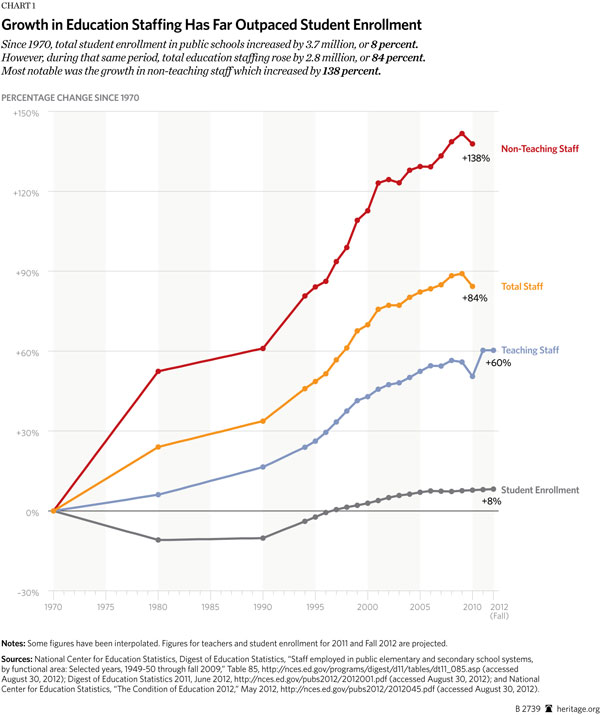
The Friedman Foundation has published an excellent report detailing the administrative bloat plaguing our nation’s public schools. The School Staffing Surge: Decades of Employment Growth in America’s Public Schoolsshows dramatic increases in teaching and non-teaching staff over the past five decades despite modest increases in student enrollment.
As we detailed in a recent report on growth in non-teaching positions in public schools across the country, student enrollment has increased just 8 percent since 1970, while the number of teachers has increased 60 percent, and the number of non-teaching administrative and other staff has increased 138 percent. (continues below chart)
The Friedman report, authored by Ben Scafidi, PhD, takes an even longer look, demonstrating that since 1950, public school enrollment has increased 96 percent, while the number of teachers has increased 252 percent and the number of non-teaching personnel (administrators and other staff) has increased an astonishing 702 percent. “Put differently,” Scafidi notes, “the rise in non-teaching staff was more than seven times faster than the increase in students”:
Between 1950 and 2009, the pupil-staff ratio declined to 7.8 students per public school employee from 19.3 students per public school employee. By 2009, there were fewer than eight public school students per adult employed in the public school system. The drop in the pupil-teacher ratio also was large—the pupil-teacher ratio was 27.5 students per teacher in 1950 and only 15.4 in 2009.
Scafidi also shows how this administrative bloat has affected schools on a state-by-state basis (and uses an interactive map to make the point). Of note: “Nine states with declining student populations had significant increases in public school personnel—D.C., Iowa, Louisiana, Maine, Mississippi, North Dakota, South Dakota, Wyoming, and Vermont.”
The Friedman report notes that the dramatic reduction in class size over the decades has not led to increases in student achievement. Why? As Scafidi reports, an increase in teacher quantity has not produced an increase in teacher quality:
As public schools have reduced class sizes continually since at least 1950, they have had to hire more teachers. And, the evidence is in—the disparity in effectiveness across teachers is considerable. Accordingly, state governments and local public school boards should have been more concerned with improving teacher effectiveness than lowering class sizes.
Continuing a trend of growing staff positions in our nation’s public schools won’t create the types of improvements that the system so desperately needs.
Instead, public school districts should trim bureaucracy and work on long-term reform options for better targeting of taxpayer resources. And decision making should be decentralized, placing staffing and other decisions in the hands of principals, teachers, and parents.
Finally, parents—and teachers—should have options. We’ll never see improvement in our nation’s education system without providing students with a choice about which schools—public, private, virtual, or homeschooling—will best meet their unique learning needs.
___________
Thank you so much for your time. I know how valuable it is. I also appreciate the fine family that you have and your commitment as a father and a husband.
Sincerely,
Everette Hatcher III, 13900 Cottontail Lane, Alexander, AR 72002, ph 501-920-5733, lowcostsqueegees@yahoo.com
Max Brantley of the Arkansas Times Blog reports today that Mitt Romney is for school vouchers. I am glad to hear that. Over and over we hear that the reason private schools are better is because they don’t have to keep the troubling making kids. It reminds me of this short film that I saw many […]
Milton Friedman – Public Schools / Voucher System (Q&A) Part 2 Published on May 7, 2012 by BasicEconomics __________ We need to get competition back again among schools and the voucher system is the best way to do that. D.C. Public Schools Spend Almost $30,000 Per Student Ericka Andersen July 25, 2012 at 10:00 am […]
Milton Friedman – Public Schools / Voucher System (Q&A) Part 1 Published on May 7, 2012 by BasicEconomics ___________ We have to turn to the school voucher system if we want competition between schools and want to lower the cost of education. Chile’s Amazing School Choice Revolution September 29, 2012 by Dan Mitchell I wrote back […]
Johan Norberg – Free or Equal – Free to Choose 30 years later 5/5 Published on Jun 10, 2012 by BasicEconomics In 1980 economist and Nobel laureate Milton Friedman inspired market reform in the West and revolutions in the East with his celebrated television series “Free To Choose.” Thirty years later, in this one-hour documentary, […]
Everywhere school vouchers have been tried they have been met with great success. Why do you think President Obama got rid of them in Washington D.C.? It was a political disaster for him because the school unions had always opposed them and their success made Obama’s allies look bad. In 1980 when I first sat […]
Johan Norberg – Free or Equal – Free to Choose 30 years later 4/5 Published on Jun 10, 2012 by BasicEconomics In 1980 economist and Nobel laureate Milton Friedman inspired market reform in the West and revolutions in the East with his celebrated television series “Free To Choose.” Thirty years later, in this one-hour documentary, […]
Johan Norberg – Free or Equal – Free to Choose 30 years later 3/5 Published on Jun 10, 2012 by BasicEconomics In 1980 economist and Nobel laureate Milton Friedman inspired market reform in the West and revolutions in the East with his celebrated television series “Free To Choose.” Thirty years later, in this one-hour documentary, […]
The Machine: The Truth Behind Teachers Unions Published on Sep 4, 2012 by ReasonTV America’s public education system is failing. We’re spending more money on education but not getting better results for our children. That’s because the machine that runs the K-12 education system isn’t designed to produce better schools. It’s designed to produce more […]
Milton Friedman on Hayek’s “Road to Serfdom” 1994 Interview 2 of 2 Uploaded by PenguinProseMedia on Oct 26, 2011 2nd half of 1994 interview. ________________ I have a lot of respect for the Friedmans.Two Lucky People by Milton and Rose Friedman reviewed by David Frum — October 1998. However, I liked this review below better. It […]
Johan Norberg – Free or Equal – Free to Choose 30 years later 2/5 Published on Jun 10, 2012 by BasicEconomics In 1980 economist and Nobel laureate Milton Friedman inspired market reform in the West and revolutions in the East with his celebrated television series “Free To Choose.” Thirty years later, in this one-hour documentary, […]
Steve Hanke points out, “When President Clinton took office in 1993, government expenditures were 22.1% of GDP, and when he departed in 2000, the federal government’s share of the economy had been squeezed to a low of 18.2%.”
That is not what has happened the last four years!!!! We have got to cut federal government spending back to the level it was under Clinton in 2000.
Last night, Bill Clinton introduced President Barack Obama as the Democratic nominee. He went to great lengths to stress their similarities, but failed to mention their divergent views on the appropriate size of government.
When President Clinton took office in 1993, government expenditures were 22.1% of GDP, and when he departed in 2000, the federal government’s share of the economy had been squeezed to a low of 18.2%. As the accompanying table shows, during the Clinton years, federal government expenditures as a percent of GDP fell by 3.9 percentage points. No other modern president has come close.
And, that’s not all. During the final three years of the former President’s second term, the federal government was generating fiscal surpluses. Clinton was even confident enough to boldly claim, in his January 1996 State of the Union address, that “the era of big government is over.”
When it comes to the appropriate size of government, Clinton and Obama are polar opposites.
Thank you so much for your time. I know how valuable it is. I also appreciate the fine family that you have and your commitment as a father and a husband.
Sincerely,
Everette Hatcher III, 13900 Cottontail Lane, Alexander, AR 72002, ph 501-920-5733, lowcostsqueegees@yahoo.com
Interest payments on U.S. government debt are three times spending in the Iraq and Afghanistan wars already, and that is with the lowest interest rate we have seen since the 1960s. A rise in interest rates would increase interest payments dramatically. What can the U.S. government do today to prevent a crisis from happening when interest rates go up?
____________________
We got to cut wasteful spending out of the government and here is another fine suggestion from the Heritage Foundation.
The massive spending bill, or continuing resolution, released by the Senate this week continues spending on programs which are inappropriate or wasteful and fails to adopt good policies in many areas. Here’s a rundown of some of the worst offenders in the Senate bill:
National Science Foundation (NSF): $221 million. The bill would increase funding for NSF by $221 million, compared to the fiscal year (FY) 2012 enacted level, putting the total funding amount to $7.25 billion. Yet NSF has spent large amounts on research projects that are clearly not federal priorities ($325,000 for a “Robosquirrel” study; $516,000 creating a video game simulating prom week; and $350,000 for a study on how golfers should imagine a bigger hole when playing). Basic research is important, but given that NSF funding is diverted to inappropriate projects, it becomes wasteful. Budget reductions may help encourage more prudence.
National Institutes of Health (NIH): $71 million. Some of NIH’s funding goes to projects that seem inappropriate, such as $550,000 to acquire evidence that heavy drinking in a person’s 30s can lead to feelings of immaturity, while in their 20s it would not.
Legal Services Corporation (LSC): $358 million. This program should be terminated, because these services should be funded locally. The money is often diverted instead of going to poor people needing legal services, and there is a long history of waste and abuse of these funds by executives at the LSC.
Transportation. The bill would increase funding for highway programs and transit formula grants to match the levels authorized in Moving Ahead for Progress in the 21st Century (MAP-21), current surface transportation law. It also funds a $4 million Transit Safety office that was authorized in MAP-21. By funding this new office and the transit formula grants, the bill would continue diversions of limited Highway Trust Fund (HTF) user fees to transit, which is a demonstrated local—not a federal—priority.
Transit serves truly local needs and is predominantly concentrated in just six cities. Congress should end such diversions from the HTF, because they come at the expense of highway and bridge maintenance and expansion projects and do not demonstrably improve mobility and safety.
You would think, therefore, that Republicans would instinctively recognize that they should hold firm. After all, when your enemy wants you to do something, it’s not because he has your best interests at heart.
At the rate the federal government spends, it runs out of money on July 31. What programs should be cut to balance the budget and fund the government for the remaining five months of the year? Cutting NASA might buy two days; cutting the Navy could buy fifteen. It seems that balancing the budget may require more than just cutting government programs. What should be done?
____________________
We got to cut wasteful spending out of the government and here is another fine suggestion from the Heritage Foundation.
The massive spending bill, or continuing resolution, released by the Senate this week continues spending on programs which are inappropriate or wasteful and fails to adopt good policies in many areas. Here’s a rundown of some of the worst offenders in the Senate bill:
Postal Service Saturday delivery: $2 billion. The Senate CR continues—by omission—the prior year’s ban on using the Postal Service’s small appropriation to reduce service levels, effectively mandating Saturday service. This, along with other such congressional restriction, limits the Postal Service’s ability to reduce costs and increases the risk of massive federal subsidies in the near future.
—James Gattuso, Senior Research Fellow in Regulatory Policy
NASA Manned Spacecraft: $1.2 billion. The Orion Multi-Purpose Crew Vehicle is the new manned spacecraft NASA is developing for exploration of the Moon and Mars and for other purposes. Manned space flight is vastly more expensive than robotic exploration and is largely a public relations showcase for NASA to market itself to the American people. NASA’s budget should be pared back to a tight focus on cost-effective projects to advance its core missions.
—J. D. Foster, Norman B. Ture Senior Fellow in the Economics of Fiscal Policy
Regular readers know that I get very excited when I see signs that more and more people are realizing that the real fiscal problem is big government. Even if the sound analysis comes from foreigners or international bureaucracies.
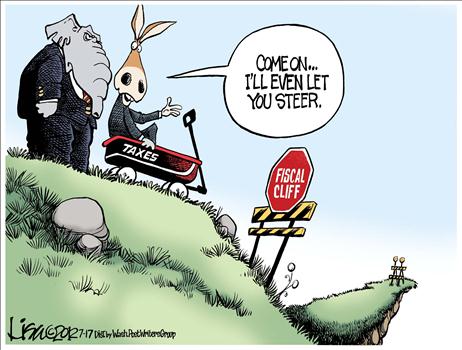
Congress better step up to the plate and avoid the huge tax increase coming at the end of 2012. You don’t want that this tax increase to go into affect do you?
In a bit of scheduling serendipity, Tax Freedom Day—the day when Americans finally earn enough income to pay off the bill for all federal, state, and local taxes for the year—falls on April 17 this year. That also happens to be Tax Filing Day 2012.
Absent tax changes made by Congress, Tax Freedom Day moves earlier or later in the calendar from year to year based on the economy. If the economy is stronger, then more Americans are working and wages are rising. Larger incomes mean they pay more taxes and Tax Freedom day falls later in the year. The reverse happens when the economy is weak, as it is today.
Tax Freedom Day next year promises to be much later than April 17, but unfortunately not because of a strong economy, which even the Obama Administration is not predicting. No, Tax Freedom Day will be much later if Congress and President Obama fail to act promptly and prevent Taxmageddon from striking America’s families and small businesses.
Taxmageddon is a $494 billion tax hike. Not only would it push Tax Freedom Day much deeper into 2013, it would also make next year’s Tax Day considerably more painful than it was this year: American households would face an average tax increase of $3,800.
A big portion of the Taxmageddon increase would occur because tax cuts enacted more than a decade ago lowered all tax rates and put in place a new 10 percent bracket. They also doubled the child tax credit from $500 to $1,000, reduced the marriage penalty, and reduced the tax disincentives toward saving. These tax cuts are all slated to expire at the end of 2012. In total, because of the expiration of just these three tax policies, 70 percent of Taxmageddon would fall directly on low-income and middle-income families. That’s about $346 billion less for families to spend and a whole lot more for government to spend.
That’s not all. If Congress fails to act, then a lot more Americans are going to pay the alternative minimum tax, or AMT. This tax was only supposed to be paid by “the rich.” But, as so often happens, a tax targeted at the rich expanded over time so that it now threatens millions of middle-income families.
If Congress fails to act, workers won’t have to wait very long to feel the effects. Every payday, they would see a jump in their payroll tax as it takes a bigger bite out of every paycheck. And that only reflects the direct hit they’ll face. The health care surtax on investment income and salaries over $250,000—which begins in 2013 along with five other tax hikes—would slow job creation, because it would take away resources from businesses, investors, and entrepreneurs.
Other Taxmageddon tax hikes, such as the expiration of the “tax extenders,” the rise of the death tax, and end of 100 percent expensing for business investment, would also slow the economy. These would make it harder for those out of work to find a job or for those looking for a new opportunity to land a better job. It would also slam the stock market, making it harder to rebuild depleted retirement savings.
Congress and President Obama need to show voters they actually can get important things done, even in an election year. Stopping a nearly $500 billion economy-crushing tax hike shouldn’t be controversial. So what’s the hold up?
_________
Thank you so much for your time. I know how valuable it is. I also appreciate the fine family that you have and your commitment as a father and a husband.
Sincerely,
Everette Hatcher III, 13900 Cottontail Lane, Alexander, AR 72002, ph 501-920-5733, lowcostsqueegees@yahoo.com
Why not pass the Balanced Budget amendment? As you know that federal deficit is at all time high (1.6 trillion deficit with revenues of 2.2 trillion and spending at 3.8 trillion).
On my blog www.HaltingArkansasLiberalswithTruth.com I took you at your word and sent you over 100 emails with specific spending cut ideas. However, I did not see any of them in the recent debt deal that Congress adopted. Now I am trying another approach. Every week from now on I will send you an email explaining different reasons why we need the Balanced Budget Amendment. It will appear on my blog on “Thirsty Thursday” because the government is always thirsty for more money to spend.
In January of 2013 I read this fine article by George Will:
Democrats not allergic to arithmetic must know the cost of their “fiscal cliff” victory. When they flinched from allowing all of George W. Bush’s tax rates, especially those on middle-class incomes, to expire, liberalism lost its nerve and began what will be a long slide into ludicrousness.
Those temporary rates were enacted in 2001, when only 28 House Democrats supported them, and in 2003, when only seven did. But with the “American Taxpayer Relief Act of 2012” — did liberals think about that title? — 172 House Democrats voted to make the Bush income-tax rates permanent for all but 0.7 percent of taxpayers — individuals earning more than $400,000 and couples earning more than $450,000.
Liberals could have had a revenue increase of $3.7 trillion over 10 years. Instead, they surrendered nearly $3.1 trillion of that. They cannot have repeated bites at this apple. They cannot now increase government revenue as a share of gross domestic product through tax reform because Republicans insist that the Taxpayer Relief Act closed the revenue question. And because tax reform is dead for the foreseeable future, so are hopes for a revenue surge produced by vigorous economic growth.
No numerate person thinks that today’s entitlement state, let alone the steady expansion of it that is liberalism’s aspiration, can be funded by taxing the income of the 0.7 percent of taxpayers whose rates were just raised. Or the 2 percent whose rates would have been raised had liberals and their president simply allowed the automatic increase of rates for individuals earning more than $200,000 and couples earning more than $250,000.
Because 82 percent of American earners pay more in payroll taxes than income taxes, no politically conceivable or economically feasible middle-class tax rate can fund the entitlement state. And America’s political culture rules out funding it with new consumption or energy taxes. By rescuing almost everyone from the restoration of Clinton-era rates, liberals abandoned any pretense of paying for their program of ever- expanding entitlements. Instead, they made trillion-dollar deficits their program.
From 1950 to 2000, economic growth averaged 3.6 percent; since then, it has averaged less than 2 percent. Liberals think today’s correlation between the slow economic growth and rapid governmental growth — including under George W. Bush — is a coincidence. Conservatives do not. And they note some recent actions, done in December’s bright light of public attention and fiscal anxiety, which indicate that this government’s indiscipline is incorrigible and shameless. Consider one detail in the Taxpayer Relief Act, and an issue pertinent to the aftermath of Hurricane Sandy.
Years ago, Congress decided that, to save the planet, there should be tax credits to bribe Americans to buy electric cars. Sen. Ron Wyden (D-Ore.) believes it only fair that buyers of electric motorcycles, some of which are made in Oregon, not get left out of the bribery business. Thanks to the Taxpayer Relief Act, they won’t.
People who choose to live in places vulnerable to flooding believe it would be unfair that the cost of their property insurance fully reflect this risk. So government subsidizes their insurance, and hence their decision to live where there is increased risk of property damage that, when it happens, the government helps pay to rebuild.
Today’s government, whose railroad, Amtrak, lost $834 million over the past 10 years just on its food service, has neither wit nor will to stop subsidizing electric motorcycles or to reform flood insurance. Hence Republicans should rally ’round one of several well-refined constitutional amendments requiring balanced budgets. Such an amendment would be popular everywhere, but especially in six states important in 22 months.
Republicans need to gain six seats to win Senate control in 2014, when Democrats will be defending 20 seats, Republicans only 13. Six Democratic incumbents represent states in which Barack Obama received less than 42 percent of the 2012 vote — Montana’s Max Baucus (41.7), Alaska’s Mark Begich (40.8), Louisiana’s Mary Landrieu (40.6), South Dakota’s Tim Johnson (39.9), Arkansas’s Mark Pryor (36.9) and West Virginia’s Jay Rockefeller (35.5).
Sixty-seven Senate votes are needed to send a proposed amendment to the states for ratification. There are 45 Republican senators. There are nowhere near 22 Democrats who would vote for an amendment Republicans could support. Still, Republicans, whose divisions cause Democratic gloating, could use a balanced-budget amendment to divide Democrats who threw the remnants of their fiscal self-respect off the cliff.
The Balanced Budget Amendment is the only thing I can think of that would force Washington to cut spending. We have only a handful of balanced budgets in the last 60 years, so obviously what we are doing is not working. We are passing along this debt to the next generation.
Thank you for this opportunity to share my ideas with you.
Does Government Have a Revenue or Spending Problem?
People say the government has a debt problem. Debt is caused by deficits, which is the difference between what the government collects in tax revenue and the amount of government spending. Every time the government runs a deficit, the government debt increases. So what’s to blame: too much spending, or too little tax revenue? Economics professor Antony Davies examines the data and concludes that the root cause of the debt is too much government spending.
_______________
If we want to cut back on the size of government then we have to cut our spending and not grow our spending. Look at what is happening right now in the federal government with the foodstamp program.
Across the country, states are courting participants for food stamps (now known as the Supplemental Nutrition Assistance Program, or SNAP). The U.S. Department of Agriculture (USDA) even has a webpage dedicated to helping states create “SNAP Outreach Plans.”
The argument from the USDA is that “Food Stamps Make America Stronger” by stimulating states’ economies. States are responding to the call. According to The Washington Post: “Rhode Island hosts SNAP-themed bingo games for the elderly. Alabama hands out fliers that read: ‘Be a patriot. Bring your food stamp money home.’ Three states in the Midwest throw food-stamp parties where new recipients sign up en masse.” And Florida even employs recruiters.
The recruiter profiled in the Post’s story, Dillie Nerios, is required to get “at least 150 seniors” to enroll in “food stamps each month, a quota she usually exceeds.”
“Help is available. You deserve it. So, yes or no?” she tells prospective food stamp recipients. “State-issued training manuals” even provides responses she can use when individuals protest.
Policy changes over the years have also helped swell the numbers. For example, in 2000, the Clinton Administration broadened food stamp eligibility by allowing states to weaken income limits and waive asset limits. Then, in 2009, President Obama suspended food stamp work requirements for able-bodied adults. This was to be a temporary change, but he’s continued to allow states to waive work requirements.
The underlying mentality of all of this is one that completely overlooks helping individuals achieve self-sufficiency, instead promoting government dependence.
The U.S. welfare system—which today includes roughly 80 means-tested welfare programs that provide food, housing, cash, medical care, and social services—has operated under this mentality since the War on Poverty began in the 1960s. For decades now, welfare has failed to promote individual independence through addressing the causes of poverty, instead growing ever larger to merely band-aid the symptoms.
Americans are a generous people and want to help their neighbors—but they also know that work is the best way out of poverty. And helping individuals out of poverty should be the goal.
Said Senator Jeff Sessions (R–AL) in February of this year, “No longer can we measure compassion by how much we spend on poverty, but [instead we should measure it by] how many people we help to lift out of poverty.”
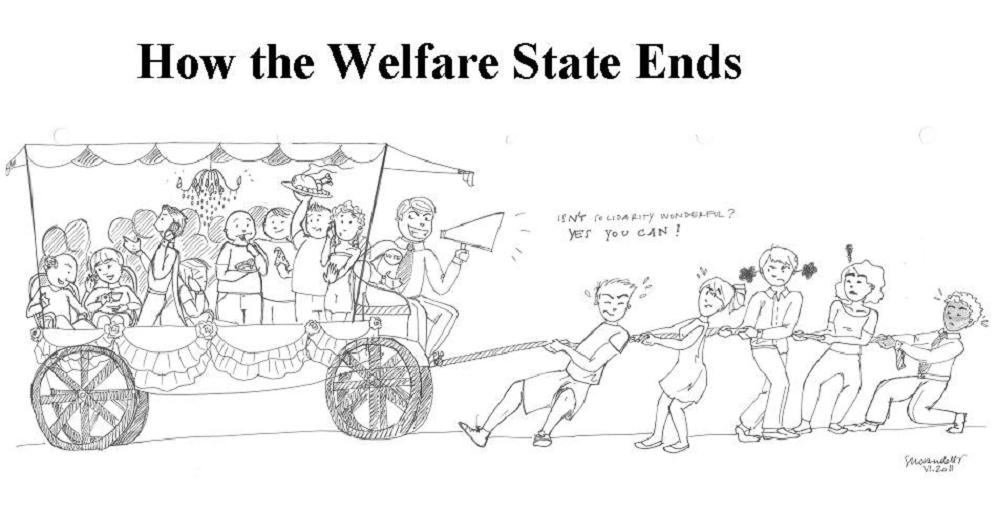
In my speeches, especially when talking about the fiscal crisis in Europe (or the future fiscal crisis in America), I often warn that the welfare state reaches a point-of-no-return when the number of people riding in the wagon begins to outnumber the number of people pulling the wagon.
To be more specific, if more than 50 percent of the population is dependent on government (employed in the bureaucracy, living off welfare, receiving pensions, etc), it becomes rather difficult to form a coalition to fix the mess. This may explain why Greek politicians have resisted significant reforms, even though the nation faces a fiscal death spiral.
But you don’t need me to explain this relationship. One of our Cato interns, Silvia Morandotti, used her artistic skills to create two images (click pictures for better resolution) that show what a welfare state looks like when it first begins and what it eventually becomes.
These images are remarkably accurate. The welfare state starts with small programs targeted at a handful of genuinely needy people. But as politicians figure out the electoral benefits of expanding programs and people figure out the that they can let others work on their behalf, the ratio of producers to consumers begins to worsen.
Then things get really interesting. Small nations such as Greece can rely on permanent bailouts from bigger countries and the IMF, but sooner or later, as larger nations begin to go bankrupt, that approach won’t be feasible.
I often conclude my speeches by joking with the audience that it’s time to stock up on canned goods, bottled water, and ammo. Many people, I’m finding, don’t think that line very funny.
If you spend too much then people won’t want to work anymore.
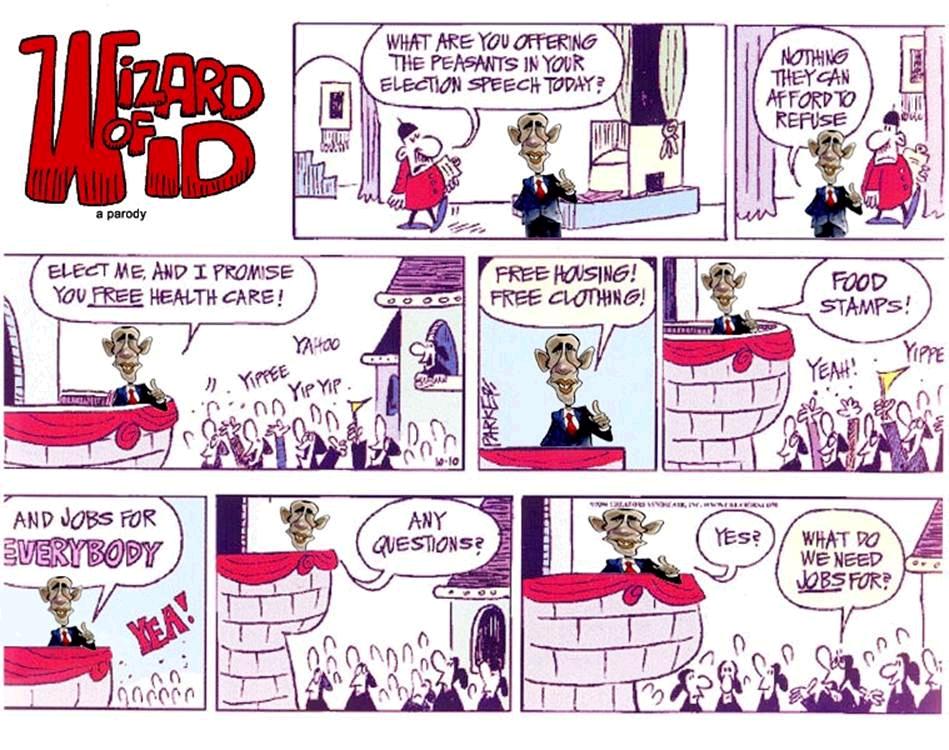
Economists often do a crummy job of teaching people about the impact of fiscal policy on the labor force, largely because we put people to sleep with boring discussions about “labor supply” decisions (my blog post from last year perhaps being an example of this tendency).
From now on, I will try to remember to use this cartoon. It’s a parody of Obama’s policies, but the last slide (or is it a panel?) is a great teaching tool about what happens when politicians turn the safety net into a hammock.
Welfare Can And Must Be Reformed Uploaded on Jun 29, 2010 If America does not get welfare reform under control, it will bankrupt America. But the Heritage Foundation’s Robert Rector has a five-step plan to reform welfare while protecting our most vulnerable. __________________________ We got to slow down the growth of Food Stamps. One […]
Eight Reasons Why Big Government Hurts Economic Growth __________________ We got to cut spending and we must first start with food stamp program and we need some Senators that are willing to make the tough cuts. Food Stamp Republicans Posted by Chris Edwards Newt Gingrich had fun calling President Obama the “food stamp president,” but […]
Milton Friedman’s negative income tax explained by Friedman in 1968: We need to cut back on the Food Stamp program and not try to increase it. What really upsets me is that when the government gets involved in welfare there is a welfare trap created for those who become dependent on the program. Once they […]
Welfare Can And Must Be Reformed Uploaded by HeritageFoundation on Jun 29, 2010 If America does not get welfare reform under control, it will bankrupt America. But the Heritage Foundation’s Robert Rector has a five-step plan to reform welfare while protecting our most vulnerable. __________________________ If welfare increases as much as it has in the […]
I am glad that my state of Arkansas is not the leader in food stamps!!! Mirror, Mirror, on the Wall, Which State Has the Highest Food Stamp Usage of All? March 19, 2013 by Dan Mitchell The food stamp program seems to be a breeding ground of waste, fraud, and abuse. Some of the horror stories […]
Government Must Cut Spending Uploaded by HeritageFoundation on Dec 2, 2010 The government can cut roughly $343 billion from the federal budget and they can do so immediately. __________ We are becoming a country filled with people that dependent on the federal government when we should be growing our economy by lowering taxes and putting […]
Uploaded by oversightandreform on Mar 6, 2012 Learn More at http://oversight.house.gov The Oversight Committee is examining reports of food stamp merchants previously disqualified who continue to defraud the program. According to a Scripps Howard News Service report, food stamp fraud costs taxpayers hundreds of millions every year. Watch the Oversight hearing live tomorrow at 930 […]
Why are despicable people sometimes subsidized by taxpayers? Are You Happy that Your Tax Dollars Subsidized the Tsarnaev Family? April 28, 2013 by Dan Mitchell The bad news is that there are despicable and evil people seeking to kill innocents. The worse news is that some of these pathetic excuses for protoplasm are subsidized by […]
We got to stop encouraging people to stay on welfare. How the Welfare State Erodes Social Capital, as Illustrated by a Chuck Asay Cartoon April 26, 2013 by Dan Mitchell I’m a big fan of Chuck Asay’s political cartoons. My favorite is his nothing-left-to-steal masterpiece. And his tractor cartoon and his regime-uncertainty cartoon are brilliant indictments […]
The Dangers of Government Dependency Published on Jun 10, 2012 This video from the Center for Freedom and Prosperity Foundation contrasts the dependency mentality in the President’s “Life of Julia” campaign with the traditional American approach of self reliance and individual achievement. _____________________ Moocher’s Hall of Fame is a hall of shame. The Moocher […]
Does Government Have a Revenue or Spending Problem?
People say the government has a debt problem. Debt is caused by deficits, which is the difference between what the government collects in tax revenue and the amount of government spending. Every time the government runs a deficit, the government debt increases. So what’s to blame: too much spending, or too little tax revenue? Economics professor Antony Davies examines the data and concludes that the root cause of the debt is too much government spending.
_______________
Will Rogers has a great quote that I love. He noted, “Lord, the money we do spend on Government and it’s not one bit better than the government we got for one-third the money twenty years ago”(Paula McSpadden Love,The Will Rogers Book,(1972) p. 20.)
We got to cut wasteful spending out of the government and here is another fine suggestion from the Heritage Foundation.
The massive spending bill, or continuing resolution, released by the Senate this week continues spending on programs which are inappropriate or wasteful and fails to adopt good policies in many areas. Here’s a rundown of some of the worst offenders in the Senate bill:
Supplemental Nutrition Assistance Program (SNAP):$77.2 billion. The recommendation continues record-high food stamp benefits. Food stamp spending has approximately doubled since President Obama came to office. It is one of the largest and fastest growing federal welfare programs. The federal government operates 80 federal welfare programs at a cost of nearly $1 trillion a year. Over 10 of these provide food assistance.
Food stamp spending should be rolled back to pre-recession levels. Able-bodied adults without dependents who receive food stamp benefits should be required to work or prepare for work as a condition of receiving benefits.
—Rachel Sheffield, Research Associate
Job Corps: $30 million added to the funding level already provided under sequestration. This program should be terminated, because a scientifically rigorous impact evaluation of Job Corps participants were less likely to obtain high school degrees, were no more likely to attend or complete college, and earned only $0.22 more in hourly wages than non-participants. Further, the Department of Labor Office of Inspector General estimates each Job Corps participant who is successfully placed into any job costs taxpayers $76,574.
Violence Against Women Act (VAWA) grants: $416.5 million. VAWA grants should be terminated, because these services should be funded locally. Using federal agencies to fund the routine operations of domestic violence programs that state and local governments could provide is a misuse of federal resources and a distraction from concerns that are truly the province of the federal government.
Office of Justice Programs (OJP) grants: $1.1 billion. OJP grants should be terminated, because these grants assign functions to the federal government that fall within the expertise, jurisdiction, and constitutional responsibilities of state and local governments. Further, the Edward Byrne Memorial Justice Assistance Grants ($392 million) within OJP have been used to place criminals on the street without posting bail.
Office of Juvenile Justice and Delinquency Prevention (OJJDP): $279.5 million. OJJDP grants should be terminated, because these grants fund juvenile justice and prevention programs that fall under the unique responsibilities of state and local governments. Further, there is little evidence that these grants are effective at preventing delinquency.
Community Oriented Policing Services (COPS): $225.5 million. COPS grants should be terminated, because these grants assign functions to the federal government that fall within the expertise, jurisdiction, and constitutional responsibilities of state and local governments. Further COPS grants were used to supplant local funds and had little to no effect on reducing crime.
FEMA Fire Grants: $675 million. Fire grants should be terminated. Fire grants, which subsidize the routine operations of local fire departments, are ineffective at reducing fire-related deaths and injuries of firefighters and civilians. Fire grants incorrectly encourage local fire departments to become increasingly dependent on federal funding.
—David B. Muhlhausen, Ph.D., Research Fellow in Empirical Policy Analysis
In my speeches, especially when talking about the fiscal crisis in Europe (or the future fiscal crisis in America), I often warn that the welfare state reaches a point-of-no-return when the number of people riding in the wagon begins to outnumber the number of people pulling the wagon.
To be more specific, if more than 50 percent of the population is dependent on government (employed in the bureaucracy, living off welfare, receiving pensions, etc), it becomes rather difficult to form a coalition to fix the mess. This may explain why Greek politicians have resisted significant reforms, even though the nation faces a fiscal death spiral.
But you don’t need me to explain this relationship. One of our Cato interns, Silvia Morandotti, used her artistic skills to create two images (click pictures for better resolution) that show what a welfare state looks like when it first begins and what it eventually becomes.
These images are remarkably accurate. The welfare state starts with small programs targeted at a handful of genuinely needy people. But as politicians figure out the electoral benefits of expanding programs and people figure out the that they can let others work on their behalf, the ratio of producers to consumers begins to worsen.
Then things get really interesting. Small nations such as Greece can rely on permanent bailouts from bigger countries and the IMF, but sooner or later, as larger nations begin to go bankrupt, that approach won’t be feasible.
I often conclude my speeches by joking with the audience that it’s time to stock up on canned goods, bottled water, and ammo. Many people, I’m finding, don’t think that line very funny.
If you spend too much then people won’t want to work anymore.
Over and over you have said that the purpose of raising taxes on the rich would be to stop deficit spending. However, if we took all the money away from the rich we still would not have a balanced budget. Don’t we need to stop the overspending?
President Obama says his “Buffett Rule” — which imposes higher taxes on wealthy Americans and job creators — will help “stabilize our debt and deficits for the next decade.” But if you compare how much money his policy raises with how much he’d like to spend, you get a much different picture.
The Buffett Rule would impose a minimum 30 percent tax on businesses and families earning $1 million. That would bring in $47 billion in revenue in ten years. Next to the President’s budget, which adds $6.7 trillion to the national debt, you can see that Obama’s answer to America’s budget woes isn’t much of an answer at all. Do the math, and you’ll find that the Buffett Rule would cover just 0.7% of all of Obama’s debt and .1% of Obama’s spending.
As you can see, that’s a small drop in a very large bucket.
Thank you so much for your time. I know how valuable it is. I also appreciate the fine family that you have and your commitment as a father and a husband.
Sincerely,
Everette Hatcher III, 13900 Cottontail Lane, Alexander, AR 72002, ph 501-920-5733, lowcostsqueegees@yahoo.com







 The Daily Hatch