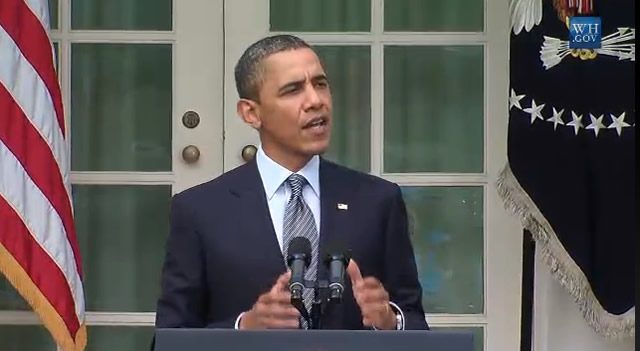
Heritage’s experts watched President Barack Obama’s debt reduction and tax increase proposal. Here are their immediate reactions:
_______________
Obama Vague on “Buffett Rule”
President Obama wants tax reform to adhere to his newly formulated “Buffett Rule” which states: Families and small businesses making more than $1 million should not pay a smaller share of their income in taxes than a middle income family.
But the Congressional Budget Office shows that Buffett Rule is already in effect. The highest earners pay more than double the amount of taxes as a share of their income than middle income earners. The top 1 percent of earners currently pays 29.5 percent of their income in all federal taxes while middle income families pay 14.3 percent.
The President and his staff surely know this so the Buffett Rule likely refers to something else. It is impossible to say for sure since, as usual, the President’s plan is light on details. One likely direction the President may propose when details come out is to equalize the taxation of capital gains with the taxation of income for millionaires. The President wants the top income tax rate to be 39.6 percent like it was before the Bush tax cuts. And that’s just for starters. Perhaps the Buffet Rule would then raise the capital gains rate to that level. This comes after three years of the President claiming he only wanted to raise the capital gains rate to 20 percent.
So kind of surtax on high earners is not a new idea. Then Speaker of the House Nancy Pelosi wanted one to pay for Obamacare. It went nowhere then when Democrats controlled both houses of Congress so it has no chance of passing now. The President proposes to further tax the rich not because he wants his class warfare policies to become law, but so he has a talking point for his re-election campaign.
Should the President’s misguided Buffett Rule become law who would lose more? Millionaires or the economy? The so-called coddled rich, or America’s workers? The cost of capital would rise considerably. This would make it harder to businesses to expand and add new workers. It would also hamper entrepreneurs looking to get their ideas off the ground. And even if President Obama and Warren Buffet can “afford to pay a little more” it’s not like this money is just lying around idly in mattresses – it’s already at work invested in some way in the economy, whether it’s cash in the banking system which keeps the nation’s finances moving, or invested in businesses which create jobs. Pulling money out and putting it into government spending will not help the economy. Ultimately the Buffett Rule would result in fewer jobs for American workers and lower wages for those employed. The punitive effect the rule would have on American workers is hard to reconcile with the President’s supposed new focus on job creation.
The Sixty Six who resisted “Sugar-coated Satan Sandwich” Debt Deal (Part 18)
This post today is a part of a series I am doing on the 66 Republican Tea Party favorites that resisted eating the “Sugar-coated Satan Sandwich” Debt Deal. Actually that name did not originate from a representative who agrees with the Tea Party, but from a liberal.
Rep. Emanuel Clever (D-Mo.) called the newly agreed-upon bipartisan compromise deal to raise the debt limit “a sugar-coated satan sandwich.”
“This deal is a sugar-coated satan sandwich. If you lift the bun, you will not like what you see,” Clever tweeted on August 1, 2011.
Graves Votes Against Deal To Raise Debt Limit
Washington, D.C., Aug 1 –
U.S. Rep. Tom Graves (R-GA-09) issued the following statement after voting against the deal President Obama and Congressional leaders reached to raise the debt limit:
“America’s call for sweeping change last November set the stage for this great debate over our debt burden. Washington has pushed its recklessness to the limit and violated the trust of the American people for far too long. A debt of $14 trillion isn’t an indictment; it’s a conviction.
“Unfortunately, the final deal before us today fails the match the magnitude of the crisis. In fact, it doesn’t come close. In exchange for giving President Obama the largest debt limit increase in United States history, the American people receive only $10 billion in savings over the next two years. The bill does seek out deeper spending cuts in the future, but if we’re to learn anything from history, that promise is bound to be broken. The fact is, by the end of next year our national debt will be near $17 trillion and will remain a serious threat to our economy.
“Ultimately, the voices of the Georgians I represent weren’t reflected in the final result, and I could not support the bill.
“Despite the legislation’s many flaws, I do want to commend Speaker Boehner for his hard work and critical victory on the issue of taxes. By preventing any job-destroying tax hikes from making their way into the deal, the Speaker protected a great many American jobs from being sacrificed for Washington’s bailout.
“I realize this debate has been long and very difficult, but if we intend to change a government as broken as ours, prepare for the road ahead to be even more challenging. This debate is far from over, and I’ll continue to work toward solving our debt crisis—even if it means going against the grain every time. We have made progress, and we will continue to fight for a brighter, more prosperous future for America.”
The so-called War on Poverty has failed. Making government bigger and creating more federal redistribution programs has been bad news for taxpayers. But the welfare state also has been a disaster for the less fortunate, creating a flypaper effect that makes it difficult for people to lead independent and self-reliant lives. This Center for Freedom and Prosperity Foundation video shows how the poverty rate was falling after World War II — but then stagnated once the federal government got involved. www.freedomandprosperity.org
This testimony was delivered on September 20, 2011.
Baseline Projections Are Optimistic
In support of building a large “fiscal buffer,” policymakers should recognize that both short-term and long-term CBO projections are optimistic in various ways. Perhaps the future will include some positive budget surprises, but the big risk factors seem to be on the negative side.
In CBO’s baseline, federal deficits fall substantially over the coming decade, partly due to changes under the recent Budget Control Act. However, spending will be higher than projected if:
Policymakers lift caps in the Budget Control Act.
Policymakers launch new spending programs or respond to unforeseen crises or wars.
Higher interest rates push up interest costs, which is a risk that gets magnified as federal debt grows larger.
A major recession causes large cost increases in programs sensitive to economic cycles, such as unemployment insurance.
Policymakers respond to another recession with costly new “stimulus” plans. The persistence of Keynesian policy ideas in Washington is an important risk to the outlook for federal debt.
There are likely to be negative shocks in coming years that we don’t foresee. Consider that in its January 2008 budget outlook, CBO projected that U.S. economic growth would slow in 2008 but then rebound fairly strongly in subsequent years.15 CBO discussed the risk of a recession, but didn’t foresee the calamity that was already starting. The upshot is that policymakers should take a conservative approach and build a “fiscal buffer” with large spending cuts now before another recession causes the deficit to soar again.
CBO’s long-range projections — such as the “alternative fiscal scenario” (AFS) shown in Figure 1 — are also optimistic. In its basic projections, CBO does not factor in the negative effects of rising spending, debt, or taxes on GDP after 2021, but it does do that in a separate analysis.16 If spending actually followed the course shown in Figure 1, CBO estimates that GDP in 2035 would be up to 10 percent less than shown in the AFS, and GNP would be up to 18 percent less. In turn, spending-to-GDP and debt-to-GDP ratios would be worse than usually shown in long-range budget charts.
Under the AFS, rising deficit spending could reduce American incomes. The CBO finds that real GNP per capita could stop growing in the late 2020s, and then start falling after that. In a historic reversal, future generations of Americans would become successively poorer.
The way to ensure our continued prosperity is to cut federal spending and reduce debt. In a 2010 analysis, the CBO compared the high-spending AFS with Rep. Paul Ryan’s “Roadmap” plan.17 The Ryan plan would restrain federal spending to roughly current levels for the next few decades, and then start reducing it. By the late 2020s, GNP per capita under the Ryan plan would begin rising above the flat and then falling levels under the AFS. By the late 2050s, GNP per capita would be 70 percent higher under the Ryan plan than under the AFS.18
15 Congressional Budget Office, “The Budget and Economic Outlook: Fiscal Years 2008 to 2018,” January 2008, Chapter 2. 16 See Chapter 2 in Congressional Budget Office, “Long-Term Budget Outlook,” June 2011. 17 Congressional Budget Office, Douglas Elmendorf letter to Paul Ryan, January 27, 2010, http://www.cbo.gov/ftpdocs/108xx/doc10851/01-27-Ryan-Roadmap-Letter.pdf. 18 Congressional Budget Office, Douglas Elmendorf letter to Paul Ryan, January 27, 2010, p. 16.
The so-called War on Poverty has failed. Making government bigger and creating more federal redistribution programs has been bad news for taxpayers. But the welfare state also has been a disaster for the less fortunate, creating a flypaper effect that makes it difficult for people to lead independent and self-reliant lives. This Center for Freedom and Prosperity Foundation video shows how the poverty rate was falling after World War II — but then stagnated once the federal government got involved. www.freedomandprosperity.org
This testimony was delivered on September 20, 2011.
Baseline Projections Are Optimistic
In support of building a large “fiscal buffer,” policymakers should recognize that both short-term and long-term CBO projections are optimistic in various ways. Perhaps the future will include some positive budget surprises, but the big risk factors seem to be on the negative side.
In CBO’s baseline, federal deficits fall substantially over the coming decade, partly due to changes under the recent Budget Control Act. However, spending will be higher than projected if:
Policymakers lift caps in the Budget Control Act.
Policymakers launch new spending programs or respond to unforeseen crises or wars.
Higher interest rates push up interest costs, which is a risk that gets magnified as federal debt grows larger.
A major recession causes large cost increases in programs sensitive to economic cycles, such as unemployment insurance.
Policymakers respond to another recession with costly new “stimulus” plans. The persistence of Keynesian policy ideas in Washington is an important risk to the outlook for federal debt.
There are likely to be negative shocks in coming years that we don’t foresee. Consider that in its January 2008 budget outlook, CBO projected that U.S. economic growth would slow in 2008 but then rebound fairly strongly in subsequent years.15 CBO discussed the risk of a recession, but didn’t foresee the calamity that was already starting. The upshot is that policymakers should take a conservative approach and build a “fiscal buffer” with large spending cuts now before another recession causes the deficit to soar again.
CBO’s long-range projections — such as the “alternative fiscal scenario” (AFS) shown in Figure 1 — are also optimistic. In its basic projections, CBO does not factor in the negative effects of rising spending, debt, or taxes on GDP after 2021, but it does do that in a separate analysis.16 If spending actually followed the course shown in Figure 1, CBO estimates that GDP in 2035 would be up to 10 percent less than shown in the AFS, and GNP would be up to 18 percent less. In turn, spending-to-GDP and debt-to-GDP ratios would be worse than usually shown in long-range budget charts.
Under the AFS, rising deficit spending could reduce American incomes. The CBO finds that real GNP per capita could stop growing in the late 2020s, and then start falling after that. In a historic reversal, future generations of Americans would become successively poorer.
The way to ensure our continued prosperity is to cut federal spending and reduce debt. In a 2010 analysis, the CBO compared the high-spending AFS with Rep. Paul Ryan’s “Roadmap” plan.17 The Ryan plan would restrain federal spending to roughly current levels for the next few decades, and then start reducing it. By the late 2020s, GNP per capita under the Ryan plan would begin rising above the flat and then falling levels under the AFS. By the late 2050s, GNP per capita would be 70 percent higher under the Ryan plan than under the AFS.18
15 Congressional Budget Office, “The Budget and Economic Outlook: Fiscal Years 2008 to 2018,” January 2008, Chapter 2. 16 See Chapter 2 in Congressional Budget Office, “Long-Term Budget Outlook,” June 2011. 17 Congressional Budget Office, Douglas Elmendorf letter to Paul Ryan, January 27, 2010, http://www.cbo.gov/ftpdocs/108xx/doc10851/01-27-Ryan-Roadmap-Letter.pdf. 18 Congressional Budget Office, Douglas Elmendorf letter to Paul Ryan, January 27, 2010, p. 16.
Everyone wants to know more about the budget and here is some key information with a chart from the Heritage Foundation and a video from the Cato Institute.
The federal government is spending more per household than ever before. Since 1965, spending per household has grown by nearly 162 percent, from $11,431 in 1965 to $29,401 in 2010. From 2010 to 2021, it is projected to rise to $35,773, a 22 percent increase.
INFLATION-ADJUSTED DOLLARS (2010)
Download
Source: U.S. Census Bureau, White House Office of Management and Budget, and Congressional Budget Office.
The charts in this book are based primarily on data available as of March 2011 from the Office of Management and Budget (OMB) and the Congressional Budget Office (CBO). The charts using OMB data display the historical growth of the federal government to 2010 while the charts using CBO data display both historical and projected growth from as early as 1940 to 2084. Projections based on OMB data are taken from the White House Fiscal Year 2012 budget. The charts provide data on an annual basis except… Read More
Authors
Emily GoffResearch Assistant
Thomas A. Roe Institute for Economic Policy StudiesKathryn NixPolicy Analyst
Center for Health Policy StudiesJohn FlemingSenior Data Graphics Editor
Heritage’s experts watched President Barack Obama’s debt reduction and tax increase proposal. Here are their immediate reactions:
_______________
Here’s How to Pay Your “Fair Share,” Mr. Buffett
President Obama proposes the “Buffett Rule” to make sure the rich pay their “fair share.” However, there is already a system in place for Mr. Buffett and all the other millionaires and billionaires to pay more without a new job-killing tax hike.
There they can follow these simple instructions for sending more of their money to the Treasury to reduce the national debt:
How do I make a contribution to the U.S. government?
Citizens who wish to make a general donation to the U.S. government may send contributions to a specific account called “Gifts to the United States.” This account was established in 1843 to accept gifts, such as bequests, from individuals wishing to express their patriotism to the United States. Money deposited into this account is for general use by the federal government and can be available for budget needs. These contributions are considered an unconditional gift to the government. Financial gifts can be made by check or money order payable to the United States Treasury and mailed to the address below.
Gifts to the United States
U.S. Department of the Treasury
Credit Accounting Branch
3700 East-West Highway, Room 622D
Hyattsville, MD 20782
Any tax-related questions regarding these contributions should be directed to the Internal Revenue Service at (800) 829-1040.
It is as simple as that. Now how can we stop seeing poor Warren every time we turn on the television incorrectly whining about his taxes are lower than his secretary?
Curtis Dubay
Where Will the Tax Hike REALLY Go???
Obama’s economics are at times stunning. Proposing tax hikes in the midst of the highest and most persistent unemployment in decades is stunning. Doing it to pay for a massive jobs package is also stunning. But for a moment, set all that aside.
Set aside the terrible effect these tax hikes would have on jobs in America. On investors. On job creators. On American competitiveness. Set aside the cigarette tax that went to pay for expansion of SCHIP at the very beginning of the President’s term. Set aside the 18 new or increased taxes in Obamacare. Set all that aside and consider this.
Do you believe for one simple moment that these new taxes will be used for paying down the deficit? Or do you believe that past is prologue? The President’s own jobs package is proof: New taxes go to pay for new spending.
The Sixty Six who resisted “Sugar-coated Satan Sandwich” Debt Deal (Part 17)
This post today is a part of a series I am doing on the 66 Republican Tea Party favorites that resisted eating the “Sugar-coated Satan Sandwich” Debt Deal. Actually that name did not originate from a representative who agrees with the Tea Party, but from a liberal.
Rep. Emanuel Clever (D-Mo.) called the newly agreed-upon bipartisan compromise deal to raise the debt limit “a sugar-coated satan sandwich.”
“This deal is a sugar-coated satan sandwich. If you lift the bun, you will not like what you see,” Clever tweeted on August 1, 2011.
Washington –Congressman Phil Gingrey (GA-11) today issued the following statement after the passage of S. 365, the bill to provide for an increase in the debt limit.“I commend our leadership for so steadfastly pursuing a deal that results in spending cuts that exceed the level of the debt ceiling increase. Since Republicans took over the House, the tenor in Washington has changed from how much are we going to spend to how much are we going to cut. This is a victory in and of itself for the American people.However, I am firmly committed to the principles of Cut, Cap and Balance, and while this bill moves the ball in the right direction, it does not make the debt ceiling increase contingent upon passage of a Balanced Budget Amendment. It further concerns me that tax increases could come into play as the newly created commission formulates its proposal and that the Department of Defense could be disproportionately affected by the process of sequestration. While I applaud some aspects of this agreement, I believe that this is the time to amend to our Constitution to finally force Washington to live within its means—and I encourage my colleagues to continue their efforts to advance this principle.”
Dan Mitchell is right about the “Occupy Wall St crowd”
Here is some video and pictures of the Occupy Arkansas March of October 15, 2011 followed by an excellent article by Jason Tolbert. Steve Brawner has rightly said:
For now, the Occupy movement doesn’t seem to be offering a lot of concrete solutions for the nation’s problems, and until it does, it won’t accomplish much.
In this video clip there is mention of the peaceful march. It was peaceful but one of the targets, the Bank of America, did get attacked with a large rock that busted the window out front.
Few will deny that the Tea Party has had a dramatic impact on politics the last couple of years. What has been interesting to watch is the reaction from the left, which has gone from dismissing them, to demonizing them, to finally trying to copy them.
The Tea Party — which stands for Taxed Enough Already — began around the country on April 15, 2009. Although it is a movement made up of a number of viewpoints, its participants are united behind one simple idea — taxes are too high and government spending is too big.
When this group burst onto the scene, they were dismissed by most as a flash in the pan — little more than Republicans disgruntled over President Obama’s landslide 2008 election.
But then curiously they did not go away. So instead, we were told that they must be right-wing extremists or, worse, racists. But little to no evidence of that ever turned up.
A recent poll conducted by Talk Business and Hendrix College showed that at least in Arkansas the Tea Party movement is quite popular, with 41 percent having a favorable view compared to 37 percent with an unfavorable view. Among self-identified independent voters, the favorable rate goes up to 50 percent and unfavorable, 30 percent.
So if you can’t beat them, imitate them. By all appearances, that is what the new Occupy Wall Street movement is attempting to do. But they are going about it all wrong.
For one thing, Occupy Wall Street and their local spin off protests, Occupy Arkansas and Occupy Little Rock, have little idea what they are protesting. It appears to be a group of angry liberals spurred on by liberal groups such as MoveOn.org and labor unions that are mad about the general poor state of the economy.
Videos from the organizational meetings in Little Rock showed them debating what they are upset about and what they want to advocate.
But they did not let that get in the way of a good march. So perhaps I could offer some suggestions, lest this new group become little more than an urban hiking club.
First, if Occupy Wall Street really wants to be as effective as the Tea Party, the protesters should learn from the Tea Party’s successes. The Tea Party’s primary influence has been to move the political discussion to the right. They have done that by not just holding big rallies and marches but by getting involved in the political process, many for the first time.
Occupy Wall Street could do the same thing by moving the political discussion to the left.
Republican officials became increasingly aware that a move toward the middle could get them a primary Tea Party challenger forcing them to battle a flank from their right. The mere threat of that has been strong enough to force most of them to shift markedly to a more conservative position.
If Occupy Wall Street wants to have the same impact, they should quit marching on the stock exchange and corporate headquarters and move their attention to the White House and the statehouse. If they want to shift the country to their left-leaning positions, go recruit some primary opponents for some moderate Democrats. Candidates definitely will listen then.
Second — and this is key — the OWS folks should figure out what they are for and keep it simple. The Tea Party’s success was largely because it was organized around one simple idea with broad appeal. It is not hard for many to understand that Americans are over taxed and that government has grown too big.
If Occupy Wall Street figures these two things out, perhaps they will have success. In the meantime, my Tea drinking friends, sit back and enjoy the show. After all, imitation is the sincerest form of flattery.
Demonstrators march through the streets of Little Rock on Saturday in a protest organized by Occupy Little Rock. (John Lyon photo) Occupy Arkansas got cranked up today in Little Rock with their first march and several hundred showed up. It was unlike the pro-life marches that I have been a part of that have had […]
COUNTER-DEMONSTRATION: At Kappa Sigma house in Fayetteville. The Drew Wilson photo above went viral last night — at least in Arkansas e-mail and social media users — after the Fayetteville Flyer posted it in coverage of an Occupy Northwest Arkansas demonstration in Fayetteville. The 1 percent banner was unfurled briefly on the Kappa Sigma frat […]
I found this article interesting from the Wall Street Journal: OCTOBER 10, 2011 The Corporate Exec: Hollywood Demon Nazis are getting old, moviemakers don’t want to offend foreign audiences, so corporate types top the list of evil stereotypes By EDWARD JAY EPSTEIN It is not surprising that pop-culture protesters are now intent on occupying Wall […]
Left leaning blogs like Blue Arkansas have praised the “Occupy Arkansas” but I wonder if they know about some of the crazy things the leaders of this movement have said. Jason Tolbert noted on October 7, 2011: Max Brantley with the Arkansas Times reports on the efforts currently under way to organize an “Occupy Arkansas” […]
Dan Mitchell, Senior Fellow at the Cato Institute, speaks at Moving Forward on Entitlements: Practical Steps to Reform, NTUF’s entitlement reform event at CPAC, on Feb. 11, 2011.
This testimony was delivered on September 20, 2011.
Harmful Effects of Deficit Spending
Federal deficit spending has exploded. Even with the recent passage of the Budget Control Act, the deficit is still expected to be about $1 trillion next year. The damage caused by this spending includes:
1. Transferring resources from higher-valued private activities to lower-valued government activities. With government spending already at 41 percent of GDP, new spending will likely have a negative return, which will reduce output.
2. Creating pressure to increase taxes in the future, which would reduce growth. Higher taxes impose “deadweight losses” on the economy of at least $1 for every $2 of added revenues, as discussed below.
3. Increasing federal debt, which creates economic uncertainty and a higher risk of financial crises, as Europe’s woes illustrate. Research indicates that economic growth tends to fall as debt rises above about 90 percent of GDP, as discussed below.
Economists in the Keynesian tradition dispute the first point. They believe that the demand-side “stimulus” benefits of spending are so important that they outweigh the problems of microeconomic distortions and misallocations caused by federal programs. However, it is very difficult to see any economic boost from the huge deficit spending of recent years.
The total Keynesian stimulus in recent years includes not only the 2009 stimulus package of more than $800 billion, but the total amount of federal deficit spending. We’ve had deficit spending of $459 billion in fiscal 2008, $1.4 trillion in fiscal 2009, $1.3 trillion in fiscal 2010, and $1.3 trillion in fiscal 2011. Despite that huge supposed stimulus, U.S. unemployment remains at high levels and the current recovery has been the slowest since World War II.5
The Obama administration claimed that there are large “multiplier” benefits of federal spending, but the recent spending spree seems to have mainly just suppressed private-sector activities.6 Stanford University’s John Taylor took a detailed look at GDP data over recent years, and he found little evidence of any benefits from the 2009 stimulus bill.7 Any “sugar high” to the economy from spending increases was apparently small and short-lived. Harvard University’s Robert Barro estimates that any small multiplier benefits that the stimulus bill may have had is greatly outweighed by the future damage caused by higher taxes and debt.8
John Taylor recently testified that deficit-spending stimulus actions “have not only been ineffective, they have lowered investment and consumption demand by increasing concerns about the federal debt, another financial crisis, threats of inflation or deflation, higher taxes, or simply more interventions. Most businesses have plenty of cash to invest and create jobs. They’re sitting on it because of these concerns.”9
As federal debt grows larger, the problems caused by fiscal uncertainty will get magnified. The CBO notes that “growing federal debt also would increase the probability of a sudden fiscal crisis, during which investors would lose confidence in the government’s ability to manage its budget and the government would thereby lose its ability to borrow at affordable rates. Such a crisis would . . . probably have a very significant negative impact on the country.”10
Research by economists Kenneth Rogoff and Carmen Reinhart found that government debt burdens above 90 percent of GDP are associated with lower economic growth.11 After examining data on dozens of countries, they concluded that “high debt is associated with slower growth; a relationship which is robust across advanced and emerging markets.”12 High debt can also be associated with inflation crises, “financial repression,” and other problems. Furthermore, high public and private debt acts as a “contagion amplifier” in the globalized economy.
A new paper by economists at the Bank for International Settlements (BIS) similarly found that when government debt in OECD countries rises above a threshold of about 85 percent of GDP, economic growth is slower.13 As debt rises, borrowers become increasingly sensitive to changes in interest rates and other shocks. “Higher nominal debt raises real volatility, increases financial fragility, and reduces average growth,” the authors note.14
The BIS economists conclude that countries should build a “fiscal buffer” by keeping its debt well below the danger threshold. They note that without major reforms, debt-to-GDP levels will soar in coming decades in most advanced economies due to population aging. Thus, one more reason for the United States to cut its spending and debt is to help it weather future financial crises spilling over from countries that are in even worse shape than we are.
5 See Joint Economic Committee, “Uncharted Depths: Welcome to Barack Obama’s ‘Recover Bummer,'” Republican Staff, June 23, 2011. And see the comments of economists Robert Gordon and Robert Hall at http://www.cato-at-liberty.org/biggest-keynesian-stimulus-slowest-recovery. 6 See Robert J. Barro, “Government Spending Is No Free Lunch,” Wall Street Journal, January 22, 2009; John F. Cogan and John B. Taylor, “The Obama Stimulus Impact? Zero,” Wall Street Journal, December 9, 2010; John H. Cochrane, “Fiscal Stimulus, Fiscal Inflation, or Fiscal Fallacies,” University of Chicago Booth School of Business, February 27, 2009. 7 John Taylor, Testimony to the House Committee on Oversight and Government Reform, Subcommittee on Regulatory Affairs, Stimulus Oversight, and Government Spending, February 16, 2011. 8 Robert J. Barro, “The Stimulus Evidence One Year Later,” Wall Street Journal, February 23, 2010. 9 John Taylor, Testimony to the Senate Finance Committee, Subcommittee on Fiscal Responsibility and Economic Growth, September 13, 2011. 10 Congressional Budget Office, “Long-Term Budget Outlook,” June 2011, p. 22. 11 The authors summarize their findings in Carmen Reinhart and Kenneth Rogoff, “A Decade of Debt,” National Bureau of Economic Research, Working Paper 16827, February 2011. 12 Carmen Reinhart and Kenneth Rogoff, “A Decade of Debt,” National Bureau of Economic Research, Working Paper 16827, February 2011, p. 5. 13 Stephen Cecchetti, M.S. Mohanty, and Fabrizio Zampolli, “The Real Effects of Debt,” Bureau for International Settlements, September 2011. 14 Stephen Cecchetti, M.S. Mohanty, and Fabrizio Zampolli, “The Real Effects of Debt,” Bureau for International Settlements, September 2011, p. 4.
Everyone wants to know more about the budget and here is some key information with a chart from the Heritage Foundation and a video from the Cato Institute.
In the past, wars and the Great Depression contributed to rapid but temporary increases in the national debt. Over the next few decades, runaway spending on Medicare, Medicaid, and Social Security will drive the debt to unsustainable levels.
PERCENTAGE OF GDP
Download
Source: Heritage Foundation calculations based on data from the U.S. Department of the Treasury, Institute for the Measurement of Worth, Congressional Budget Office, and White House Office of Management and Budget.
The charts in this book are based primarily on data available as of March 2011 from the Office of Management and Budget (OMB) and the Congressional Budget Office (CBO). The charts using OMB data display the historical growth of the federal government to 2010 while the charts using CBO data display both historical and projected growth from as early as 1940 to 2084. Projections based on OMB data are taken from the White House Fiscal Year 2012 budget. The charts provide data on an annual basis except… Read More
Authors
Emily GoffResearch Assistant
Thomas A. Roe Institute for Economic Policy StudiesKathryn NixPolicy Analyst
Center for Health Policy StudiesJohn FlemingSenior Data Graphics Editor



 Federal Spending Is Growing Faster Than Federal Revenue


 Total Tax Burden Is Rising to Highest Level in History
 Each American’s Share of National Debt Is Growing


 The Daily Hatch