Category Archives: spending out of control

Dear Senator Pryor, why not pass the Balanced Budget Amendment? ( “Thirsty Thursday”, Open letter to Senator Pryor)

Dear Senator Pryor,

Why not pass the Balanced Budget Amendment? As you know that federal deficit is at all time high (1.6 trillion deficit with revenues of 2.2 trillion and spending at 3.8 trillion).

On my blog www.HaltingArkansasLiberalswithTruth.com I took you at your word and sent you over 100 emails with specific spending cut ideas. However, I did not see any of them in the recent debt deal that Congress adopted. Now I am trying another approach. Every week from now on I will send you an email explaining different reasons why we need the Balanced Budget Amendment. It will appear on my blog on “Thirsty Thursday” because the government is always thirsty for more money to spend.

Considering a Balanced Budget Amendment: Lessons from History

July 14, 2011


Abstract: Attempts at passing a balanced budget amendment (BBA) date back to the 1930s, and all have been unsuccessful. Both parties carry some of the blame: The GOP too often has been neglectful of the issue, and the Democratic Left, recognizing a threat to big government, has stalled and obfuscated, attempting to water down any proposals to mandate balanced budgets. On the occasion of the July 2011 vote on a new proposed BBA, former Representative from Oklahoma Ernest Istook presents lessons from history.

A proposed balanced budget amendment (BBA) to the Constitution is set to be considered by Congress this July—the first such vote since 1997.

The BBA is a powerful proposal that attracts great vitriol from the American Left, which recognizes it as an enormous threat to its big-government ways—perhaps the greatest threat. For that reason, the history of Congress’s work on a BBA is full of frustrations, high-profile defections, reversals, and betrayals.

This paper discusses that history. It also describes some of the milktoast versions and amendments that have been offered to gut the BBA while providing political cover for those who are unwilling to support a robust version.

Brief History

Thomas Jefferson wrote in 1798, “I wish it were possible to obtain a single amendment to our Constitution. I would be willing to depend on that alone for the reduction of the administration of our government; I mean an additional article taking from the Federal Government the power of borrowing.”[1] Yet according to the Congressional Research Service,[2] the first balanced budget amendment was not proposed until 1936, when Representative Harold Knutson (R–MN) introduced House Joint Resolution 579, proposing a per capita limit on federal debt.

No BBA measure passed either body of Congress until 1982, when the Senate took 11 days to consider it and mustered the necessary two-thirds majority on the version crafted by Senator Strom Thurmond (R–SC).[3] A companion measure received a vote of 236 to 187 in the House—short of the required two-thirds. Despite opposition from Speaker Thomas “Tip” O’Neill (D–MA), the floor vote was obtained by means of a discharge petition led by Representatives Barber Conable (R–NY) and Ed Jenkins (D–GA).[4]

Subsequently, continuing opposition from Speaker O’Neill and his successor, Jim Wright (D–TX), prompted creative use of discharge petitions to circumvent leadership opposition. Several House votes were held in the early 1990s, when Representative Charles Stenholm (D–TX) led bipartisan coalitions to force Democratic leaders to permit (unsuccessful) floor votes. At the time, even prominent Democrats such as Representative Joseph Kennedy (MA) openly supported the BBA and voted for it. There were multiple House and Senate votes, but all were unsuccessful.[5]

The first and only time the House gave two-thirds approval to a balanced budget amendment was in 1995, when Members voted for the “Contract with America” that helped Republicans win major congressional majorities. That was the last time the House held a floor or committee vote. Since then, the Senate has failed twice—each time by a single vote—to gather the two-thirds needed.[6]

Defections Block BBA Approval

Three Senators were the key defectors who prevented Congress from approving a balanced budget amendment in the 1990s. One actually had never supported it and bucked his party to oppose it. The other two flip-flopped in order to go along with their party in opposing the BBA.

First, in 1995, Senator Mark Hatfield (R–OR) took the heat when he would not join his party in support of a BBA. But Hatfield’s vote would have been unnecessary had Senator Tom Daschle (D–SD) not reversed years of prior support to oppose the BBA at President Bill Clinton’s urging.

Then, in 1997, the measure again failed by a single vote in the Senate when newly elected Senator Robert Torricelli (D–NJ) broke his campaign pledge and refused to support the same BBA that he had supported as a House member.[7]

More recently, many House Democrats who voted for the BBA in 1995 are now saying they will vote no in 2011. Most notable among these is House Democratic Whip Steny Hoyer (D–MD).

Senate Defections

Senator Hatfield called the BBA a “political gimmick,” and his high-profile defection broke GOP party unity. Less noticed was that his opposition could have been a moot point. Then-Senate Majority Leader Bob Dole (R–KS) told The New York Times that Hatfield offered to resign before the vote—a resignation that would have produced a 66-to-33 victory for the BBA—but Dole refused to accept the resignation offer.[8]

Still, with or without Hatfield’s vote or resignation, the BBA would have prevailed in the 1995 Senate vote were it not for Senator Daschle’s reversal. That flip-flop is described in a book about his later ousting from office by the voters:

Although the balanced budget amendment had not been a major issue nationally for several years, it provided a striking contrast between Daschle’s first campaign in 1978 and his early career in Congress, when he consistently promoted the amendment, and his later years in the Senate. During his last competitive Senate bid in 1986, Daschle ran a television ad saying that “in 1979, Tom Daschle saw the damage these deficits could do to our country. His first official act was to sponsor a Constitutional amendment to balance the budget.” In 1992, Daschle’s campaign literature touted the “Daschle Plan,” which included the balanced budget amendment: “In 1979, before it became popular, I was pushing a balanced budget amendment to the Constitution. It was my first official action, and I’ve authored or coauthored one every year.” In 1995, the amendment had the support of sixty-six of the sixty-seven senators needed for passage, but Daschle voted against it because of opposition from the Clinton administration…. When pressed on the amendment in the last [2004] television debate, Daschle said that he had opposed the bill in the 1990s because there were no provisions in the amendment allowing for emergencies such as war. But the record showed that there was an emergency clause.[9]

In 2011, Daschle has penned several articles denouncing the BBA, complaining that it would make the country’s fiscal crisis even worse and would tie lawmakers’ hands.[10]

The 1997 effort to approve the BBA failed in the Senate by a single vote, just as it had in 1995. This time it was Senator Torricelli doing the political acrobatics. As the New York Daily News described it:

Sen. Robert Torricelli (D–N.J.) yesterday announced he will vote against the balanced budget amendment to the Constitution giving Democrats the one-vote margin they need to kill it. The freshman senator flipped on his campaign pledge to support the amendment and on his own past voting record in the House in favor of similar proposals. “I have struggled with this decision more than any I have ever made in my life,” Torricelli said…

Torricelli acknowledged that he had campaigned in support of the amendment to win his Senate seat last year and had voted three times in favor of similar amendments as a House member. But he said President Clinton’s efforts in bringing down annual budget deficits from $300 billion to $100 billion, and the President’s commitment to a balanced budget by 2002, had relieved the pressure for a constitutional amendment.[11]

Trying to give himself political cover, Torricelli tried but failed to get the Senate to support a loophole-riddled version.

House Reversals

Chief among Representatives who supported a BBA in 1995 but say they will actively oppose it in 2011 is Representative Hoyer. In 1995, he even helped to garner votes for the BBA. As the Baltimore Sun reported at the time, “‘The issue of a balanced budget is not a conservative one or a liberal one, and it is not an easy one,’ said Mr. Hoyer, who said he fears the consequences of a national debt that is headed toward $5 trillion. ‘But it is an essential one.’”[12] Arguing for the BBA on the House floor in 1995, Hoyer said:

[T]his country confronts a critical threat caused by the continuation of large annual deficits…. I am absolutely convinced that the long term consequences of refusing to come to grips with the necessity to balance our budget will be catastrophic…. [T]hose who will pay the highest price for our fiscal irresponsibility, should we fail, will be those least able to protect themselves, and the children of today and the generations of tomorrow.[13]

Hoyer reversed course after rising to high leadership within his party, as did Daschle. Daschle did a turnaround against the same language he previously had supported. Hoyer, however, argued that the latest 2011 version (with tax limitation and size-of-government limits) had gone beyond what he originally supported in 1995:

It would require drastic and harmful cuts to programs like Medicare, Medicaid, and Social Security, programs that form the heart of America’s social compact…. Unlike previous balanced budget amendments, this amendment would mean great pain for ordinary Americans, even as it shielded the most privileged from any comparable sacrifice. It is not a solution to our nation’s pressing fiscal challenges.[14]

It is an open question how other Democrats who supported the 1995 version of the BBA will vote on the tougher 2011 version.[15] They include another member of the current Democratic House leadership, James Clyburn (SC).

The GOP was also guilty of abandoning the BBA—by neglect. The BBA had been the number one item on its Contract with America legislative agenda in 1994, but after the single (and successful) 1995 House vote, House GOP leaders refused all entreaties to bring it up again. No House or Senate vote has been held since Torricelli’s dramatic about-face in 1997.

For part of the time while Republican leaders were dormant on a BBA, the budget was balanced. Rather than spotting an opportunity to cement that condition into a permanent requirement, however, some saw it as proving that a BBA is not needed.

During that time when the federal budget was balanced without a BBA requirement (fiscal years 1998–2001),[16] Congress had political incentives to maintain that balance. However, after 9/11, Washington not only ramped up national security spending, but also let other spending rise significantly. The prevailing notion seemed to be that if the budget was not balanced, then it mattered little just how far out of balance it was.

That experience illustrates not only the need for a proper BBA, but also the need for any national security exceptions to be drafted narrowly, to permit deficits only to the extent necessary to provide for non-routine defense circumstances and not to justify unrelated deficit spending.

Watering Down the BBA

The versions of the BBA to be voted on in 2011 are improvements over the Contract with America. Because of this strengthening, the current versions are described herein as “BBA-plus.”[17]

Simply put, the additional features require a supermajority to raise taxes; create limits on the level of federal spending (as a percentage of the national economy); tighten the permitted and limited exceptions to a balanced budget; and limit the potential for judicially imposed tax increases as a means of enforcement.

According to their strictness, different variations in proposed texts could be considered good, better, and best, with a full-featured BBA-plus being the best. But the greater the strictures, the more difficult passage becomes. Many pro-BBA lawmakers have therefore introduced and supported versions that were not as strong as they prefer but have greater likelihood of adoption.

These variations also create potential for mischief. Because they recognize the huge popular support for the BBA, many opponents have attempted to offer amendments and variations that would water down or emasculate the provisions of the BBA so that they could posture as supporters while justifying their “no” votes. The following is a historical synopsis of those tactics.

Taking Social Security Off-Budget. The most prominently advanced effort to weaken a BBA is a provision to separate Social Security payments and receipts from the requirements for a balanced budget. Amendments to do so were offered in both the House and Senate from 1995 to 1997. Senator Harry Reid (D–NV) was a principal leader of that effort in 1997.

Reid and others argued that removing Social Security from a BBA would protect the program from spending cuts. They argued that its funds do not actually constitute government spending since the program involves a trust fund. This ignored the fact that the entirety of the trust fund has been invested in federal bonds and that all of the borrowed money has been spent. Furthermore, during the 1990s, the Social Security program was producing annual surpluses ranging from $60 billion to $65 billion, which disguised deficit spending elsewhere. Today, Social Security runs an annual deficit.

If Social Security were removed from a BBA’s requirements, Congress would be approving major deficit spending while not counting it as a deficit. Politicians would only be pretending to have balanced the budget. As the Congressional Budget Office reported this past January, “Excluding interest, surpluses for Social Security become deficits of $45 billion in 2011 and $547 billion over the 2012–2021 period.”[18]

The Torricelli Ploy. As previously mentioned, the most transparent ploy to create an excuse for opposing the BBA came in 1997 from newly elected Senator Robert Torricelli. As a House member, he had voted for a substitute version and also voted “yea” on final passage of the Contract with America BBA in 1995. He campaigned for the Senate in 1996 as a BBA supporter.

As heads were counted for the 1997 Senate vote, it was apparent that Torricelli and Senator Mary Landrieu (D–LA), both previous BBA supporters, were the swing votes. If both voted “yea,” the necessary two-thirds would be achieved in the Senate. President Clinton lobbied both Senators to vote “nay.” Landrieu announced that she would vote yes, and Torricelli announced that he would vote no. Reporters openly asked him whether “he drew the short straw.”

In a move that was publicly derided, Torricelli offered an amendment to the BBA on the Senate floor and then announced he would vote no because the amendment failed. Then, minutes later in a news conference, he undercut his own explanation by stating that in the future, he would vote no on all Republican versions of a BBA and yes on all Democratic versions.

Torricelli’s unsuccessful amendment would have waived the balanced budget requirement whenever a simple majority in Congress declared “an imminent and serious military threat” or “a period of economic recession or significant economic hardship” or when Congress chose to approve deficit spending for “investments in major public physical capital that provides long-term economic benefits.”[19] The three-pronged nature of Torricelli’s effort was a lumping together of provisions that were also offered separately in both the House and Senate by others.

Other Diluting Amendments. The following is a sampling of other proposals offered on the House or Senate floors during the 1995–1997 considerations:[20]

  • Representative Robert Wise (D–WV) offered a multifaceted substitute that would have provided for separate federal capital and operating budgets; would have required that only the operating budget be balanced; would have exempted Social Security from balanced budget calculations; and would have permitted Congress to waive the balanced budget provisions in times of war, military conflict, or recession.
  • Senator Richard Durbin (D–IL) tried to insert the following language into the BBA: “The provisions of this article may be waived for any fiscal year in which there is an economic recession or serious economic emergency in the United States as declared by a joint resolution, adopted by a majority of the whole number of each House, which becomes law.”
  • Senator Barbara Boxer (D–CA) proposed, “The provisions of this article may be waived for any fiscal year in which there is a declaration made by the President (and a designation by the Congress) that a major disaster or emergency exists, adopted by a majority vote in each House of those present and voting.”
  • Representative Major Owens (D–NY) wanted “to allow a majority of Congress to waive the balanced budget provisions contained in the joint resolution in any fiscal year that the national unemployment rate exceeds 4 percent.”
  • Representative John Conyers (D–MI) wanted to require a detailed plan of spending cuts before balance could be required, proposing “to exempt Social Security from balanced budget calculations; and provide that before the constitutional amendment could take effect, Congress would be required to pass legislation showing what the budget will be for the fiscal years 1996 through 2002, containing aggregate levels of new budget authority, outlays, reserves, and the deficit and surplus, as well as new budget authority and outlays on an account-by-account basis.”
  • Representative David Bonior (D–MI) tried not only to exempt Social Security from the calculations, but also to require only a simple constitutional majority vote (218 in the House, 51 in the Senate) to allow deficit spending.
  • Additional amendments were more straightforward, such as whether a supermajority would or would not be required to raise taxes under the BBA. The House Rules Committee screened out 38 proposed floor amendments; only six were permitted.

Conclusion

History shows that the potency of a balanced budget amendment attracts fervent efforts to confuse the issues, especially by creating counterfeit versions and exceptions to provide political cover. Proponents of a BBA should prepare accordingly.

If not for high-profile political defections in the mid-1990s, the BBA would have been approved by Congress. Had it then been ratified by the requisite three-fourths of the states, today’s debates over borrowing limits, entitlements, and spending levels would be greatly different, if not absent.

However, the versions considered in the ’90s were notably weaker than both the House and Senate versions of the BBA-plus now being considered. Had an earlier version been adopted, today’s debate might be about efforts by Congress to evade the spirit of the BBA by exploiting loopholes in that earlier version. This is why vigilance is necessary to prevent the insertion of loopholes into the language of a BBA-plus.

Those who do not learn from the failures of history are doomed to repeat them.

The Honorable Ernest J. Istook, Jr., a former Member of Congress, is Distinguished Fellow in Government Studies in the Department of Government Studies at The Heritage Foundation.

Reasons why Mark Pryor will be defeated in 2014 (Part 4)

It is apparent from this statement below that Senator Mark Pryor is against the Balanced Budget Amendment. He has voted against it over and over like his father did and now I will give reasons in this series why Senator Pryor will be defeated in his re-election bid in 2014. However, first I wanted to quote the statement Senator Pryor gave on December 14, 2011. This information below is from the Arkansas Times Blog on 12-14-11 and Max Brantley:

THREE CHEERS FOR MARK PRYOR: Our senator voted not once, but twice, today against one of the hoariest (and whoriest) of Republican gimmicks, a balanced budget amendment. Let’s quote him:

As H.L. Mencken once said, “For every complex problem there is a solution which is simple, clean, and wrong.” This quote describes the balanced budget amendment. While a balanced budget amendment makes for an easy talking point, it is an empty solution. Moreover, it’s a reckless choice that handcuffs our ability to respond to an economic downturn or national emergencies without massive tax increases or throwing everyone off Medicare, Social Security, or veteran’s care.There is a more responsible alternative to balance the budget. President Clinton led the way in turning deficits into record surpluses. We have that same opportunity today, using the blueprint provided by the debt commission as a starting point. We need to responsibly cut spending, reform our tax code and create job growth. This course requires hard choices over a number of years. However, it offers a more balanced approach over jeopardizing safety net programs and opportunity for robust economic growth.

____________________

Senator Pryor has continued to vote for budgets in the past that have allowed the federal government to spend an increasing amount of GDP. ONE OF THE MAIN REASONS PRYOR WILL BE DEFEATED IN 2014 IS THAT HE DOES NOT SUPPORT THE IDEA THAT THE FEDERAL GOVERNMENT SHOULD BE LIMITED TO SPENDING 18% OR LESS OF GDP. SENATOR PRYOR THINKS IT WOULD BE GREAT IF THE FEDERAL GOVERNMENT CONTINUES TO SPEND MORE. WHY ELSE DID HE VOTE FOR THE STIMULUS?

(CNSNews.com) – Rep. Louie Gohmert (R-Texas) will not vote for a balanced budget amendment proposal unless it includes a cap on federal spending. However, he is undecided whether the amendment absolutely must require a supermajority of Congress to approve a tax hike for him to support it.

“The most important element is the cap on spending,” Gohmert told CNSNews.com. “If there is no cap on spending, then the balanced budget amendment is a formula for ever- increasing spending and ever-increasing taxing that will just spiral upward and upward again. So there’s got to be included a cap on spending, and best if it’s related to a percentage of GDP. But, absolutely, if there is no cap on spending, I could not vote for it.”

The actual language of the balanced budget amendment that Congress will vote on before the end of the year has not yet been determined. However, many conservatives fear that Republican leaders may agree to vote on a stripped down amendment that requires Congress to balance the budget but does not cap spending as a percentage of GDP or require supermajorities to raise taxes. They fear that an amendment of that nature–which might win the backing of some incumbent congressional liberals–would become a constitutional lever for sustaining big government via ever-escalating federal taxation.

When the Republican-controlled-House approved the cut, cap and balance plan last on July 19 in 234-190 vote, it included a version of the balanced budget amendment to cap federal spending at 19.9 percent of GDP. The GOP originally sought to hold federal spending to 18 percent of GDP.

The version of the balanced budget amendment in the cut, cap and balance plan also required two-thirds majorities in both houses to approve a tax increase. The amendment also would have prohibited deficit spending unless there was a national security emergency or a supermajority of Congress voted for it. On July 22, the Senate voted 51-46 to approve a procedural motion that blocked substantive consideration of the cut, cap and balance bill in that body.

The debt-limit deal reached by President Barack Obama, House Speaker John Boehner (R-Ohio) and Senate Majority Leader Harry Reid (D-Nev.) requires that both houses of Congress give an up or down vote to a balanced budget amendment before the end of the year. However, it does not specify what the language of the amendment would be.

If two-thirds of Congress votes to approve a balanced budget amendment, it would then have to be ratified by 38 states, or three-fourths.

The House passed that debt-limit deal by a 269-161 vote on Aug. 1. Gohmert was one of 66 Republicans who voted against it.

“As far as the supermajority to raise taxes, that’s our preference, but the key element, the most important element is the cap on spending,” Gohmert said. “If there is no supermajority to raise taxes then I’d just have to look at it more closely to see what all was there to see if it was something I could vote for or not.”

Gohmert believes this is a winning issue for Republicans.

“Well, I think it’s like this: We either have a legitimate Balanced Budget Amendment pass with a cap on spending, or I really believe if it does not pass, you will see many of those who voted against it turned out both in the House and Senate in the next election,” Gohmert said. “So I think it’s an either/or. Either people vote for it and it passes, or we have a significant change in the people that are in the House and Senate that voted against it.”

Reasons why Mark Pryor will be defeated in 2014 (Part 3)

It is apparent from this statement below that Senator Mark Pryor is against the Balanced Budget Amendment. He has voted against it over and over like his father did and now I will give reasons in this series why Senator Pryor will be defeated in his re-election bid in 2014. However, first I wanted to quote the statement Senator Pryor gave on December 14, 2011. This information below is from the Arkansas Times Blog on 12-14-11 and Max Brantley:

THREE CHEERS FOR MARK PRYOR: Our senator voted not once, but twice, today against one of the hoariest (and whoriest) of Republican gimmicks, a balanced budget amendment. Let’s quote him:

As H.L. Mencken once said, “For every complex problem there is a solution which is simple, clean, and wrong.” This quote describes the balanced budget amendment. While a balanced budget amendment makes for an easy talking point, it is an empty solution. Moreover, it’s a reckless choice that handcuffs our ability to respond to an economic downturn or national emergencies without massive tax increases or throwing everyone off Medicare, Social Security, or veteran’s care.There is a more responsible alternative to balance the budget. President Clinton led the way in turning deficits into record surpluses. We have that same opportunity today, using the blueprint provided by the debt commission as a starting point. We need to responsibly cut spending, reform our tax code and create job growth. This course requires hard choices over a number of years. However, it offers a more balanced approach over jeopardizing safety net programs and opportunity for robust economic growth.

____________________

Mark Pryor has voting over and over to spend more than we have. A Balanced Budget Amendment would make that impossible. PROBABLY ONE OF THE MOST OFFENSIVE THINGS THAT PRYOR HAS DONE IS CONTINUE TO VOTE TO PASS BUDGETS THAT ARE NOT BALANCED AND NOW HE HAS BEEN GUILTY OF EARNING OUR COUNTRY A CREDIT DOWNGRADE. THAT IS ONE OF THE MAIN REASONS ARKANSANS WILL VOTE HIM OUT IN 2014 AND PUT SOMEONE IN THAT WILL VOTE FOR A BALANCED BUDGET AMENDMENT (like they did in 2010 when they replaced Senator Lincoln with a conservative Republican).

Congressman Walsh Issues Statement on His Vote Against Debt Deal

08/01/11

WASHINGTON–  Today, Congressman Joe Walsh (IL-08) voted against the latest debt ceiling deal brokered by President Obama and Congressional leaders.

“Last night’s deal shows how far the debate has moved in just a few months,” said Congressman Walsh. “At the beginning of this debate President Obama demanded a blank check increase in the debt limit with no spending cuts attached.  When that didn’t work, he insisted on huge tax increases on American families and job creators. The Republican Party, however, stood strong and refused to pay for reckless spending withmoretax increases.”

“While I give my Republican leadership all the credit in the world, I cannot support this latest deal: it spends too much and cuts too little.  While this deal will cut $2.4 trillion from the national debt over the next 10 years, Washington will still add another $7 trillion to the national debt over that same period.”

“The fact that there are only $7 billion in cuts next year, an election year, shows how blatantly political this bill is.  We need to be slashing reckless spending now and in the future, not just when it is politically convenient for the President.”

Democrats still don’t get it and refuse to make the spending cuts necessary to avoid a credit downgrade. I have made it clear from day one that I will never vote for an increase in the debt ceiling unless it fundamentally and structurally changes the way Washington spends money. I believe that the way to do that is through statutory spending caps and a Balanced Budget Amendment to the Constitution.”

Uploaded by on Jun 14, 2011

Our country’s debt continues to grow — it’s eating away at the American Dream. We need to make real cuts now. We need Cut, Cap, and Balance.


Senator Pryor asks for Spending Cut Suggestions! Here are a few!(Part 126)

Senator Mark Pryor wants our ideas on how to cut federal spending. Take a look at this video clip below:

Senator Pryor has asked us to send our ideas to him at cutspending@pryor.senate.gov and I have done so in the past and will continue to do so in the future.

On May 11, 2011,  I emailed to this above address and I got this email back from Senator Pryor’s office:

Please note, this is not a monitored email account. Due to the sheer volume of correspondence I receive, I ask that constituents please contact me via my website with any responses or additional concerns. If you would like a specific reply to your message, please visit http://pryor.senate.gov/contact. This system ensures that I will continue to keep Arkansas First by allowing me to better organize the thousands of emails I get from Arkansans each week and ensuring that I have all the information I need to respond to your particular communication in timely manner.  I appreciate you writing. I always welcome your input and suggestions. Please do not hesitate to contact me on any issue of concern to you in the future.

Therefore, I went to the website and sent this email below:

Here are a few more I just emailed to him myself.

Fix the budget process. Lawmakers still cling to a budget process created in 1974. Over the past 30 years, successive Congresses have punched this process full of holes, and federal spending has correspondingly tripled. The current budget process provides no workable tools to limit spending, no restrictions on passing massive costs onto future generations, and no incentive to bring all parties to the table early in the budget process to set a framework. The Family Budget Protection Act, authored by Representatives Jeb Hensarling (R-TX), Paul Ryan (R-WI), Chris Chocola (R-IN), and Christopher Cox (R-CA), provides a comprehensive proposal for creating a budget process that reflects America’s budget priorities and should be closely examined by anyone interested in budget reform.

Where Is All the Money Going?

Federal Spending by Category from 2000 to 2010

Reasons why Mark Pryor will be defeated in 2014 (Part 2)

It is apparent from this statement below that Senator Mark Pryor is against the Balanced Budget Amendment. He has voted against it over and over like his father did and now I will give reasons in this series why Senator Pryor will be defeated in his re-election bid in 2014. However, first I wanted to quote the statement Senator Pryor gave on December 14, 2011. This information below is from the Arkansas Times Blog on 12-14-11 and Max Brantley:

THREE CHEERS FOR MARK PRYOR: Our senator voted not once, but twice, today against one of the hoariest (and whoriest) of Republican gimmicks, a balanced budget amendment. Let’s quote him:

As H.L. Mencken once said, “For every complex problem there is a solution which is simple, clean, and wrong.” This quote describes the balanced budget amendment. While a balanced budget amendment makes for an easy talking point, it is an empty solution. Moreover, it’s a reckless choice that handcuffs our ability to respond to an economic downturn or national emergencies without massive tax increases or throwing everyone off Medicare, Social Security, or veteran’s care.There is a more responsible alternative to balance the budget. President Clinton led the way in turning deficits into record surpluses. We have that same opportunity today, using the blueprint provided by the debt commission as a starting point. We need to responsibly cut spending, reform our tax code and create job growth. This course requires hard choices over a number of years. However, it offers a more balanced approach over jeopardizing safety net programs and opportunity for robust economic growth.

____________________

Arkansans want Senator Pryor to tackle our Washington spending problem but SENATOR PRYOR VOTES LIKE HE WANTS TO PASS ON OUR SPENDING PROBLEM TO THE NEXT GENERATION SO THEY WILL HAVE TO PAY THE BILL. HOWEVER, WE ALL LIVE IN A FAMILY SOCIETY AND WE LOVE OUR KIDS AND WE WANT TO HELP THEM IN WITH THEIR FUTURES AND THIS IS ONE OF THE MAIN REASONS PRYOR WILL BE REPLACED BY SOMEONE IN 2014 THAT WILL VOTE FOR A BALANCED BUDGET AMENDMENT (just like Senator Lincoln was replaced by a republican that favored the Balanced Budget Amendment in 2010).

Marco Rubio rightly noted:

A balanced budget amendment would be a necessary step in reversing Washington’s tax-borrow-spend mantra. It would force Congress to balance its budget each year – not allow it to pass our problems on to the next generation any longer.

The Balanced Budget Amendment is the only thing I can think of that would force Washington to cut spending. We have only a handful of balanced budgets in the last 60 years, so obviously what we are doing is not working. We are passing along this debt to the next generation.

 In my two short months in office, it has become clear to me that the spending problem in Washington is far worse than many of us feared. For years, politicians have blindly poured more and more borrowed money into ineffective government programs, leaving us with trillion dollar deficits and a crippling debt burden that threatens prosperity and economic growth.

In the Florida House of Representatives, where a balanced budget is a requirement, we had to make the tough choices to cut spending where necessary because it was required by state law. By no means was this an easy process, but it was our duty as elected officials to be accountable to our constituents and to future generations of Floridians. In Washington, a balanced budget amendment is not just a fiscally-responsible proposal, it’s a necessary step to curb politicians’ decades-long penchant for overspending.

Several senators have proposed balanced budget amendments that ensure Congress will not spend a penny more than we take in, while setting a high hurdle for future tax hikes. I am a co-sponsor of two balanced budget amendments, since it is clear that these measures would go a long way to reversing the spending gusher we’ve seen from Washington in recent years.

During my Senate campaign, while surrounded by the employees of Jacksonville’s Meridian Technologies, I proposed 12 simple ways to cut spending in Washington. That company, founded 13 years ago, has grown into a 200-employee, high-tech business, and the ideas I proposed would help ensure that similar companies have the opportunity to start or expand just like Meridian did.

To be clear, our unsustainable debt and deficits are threatening companies like Meridian and impeding job creation. In addition to proposing a balanced budget amendment, I recommended canceling unspent “stimulus” funds, banning all earmarks and returning discretionary spending to 2008 levels.

Fortunately, some of my ideas have found their way to the Senate chamber. The first bill I co-sponsored in the Senate was to repeal ObamaCare, the costly overhaul of our nation’s health care system that destroys jobs and impedes our economic recovery. Democratic leaders in the Senate have expressed their willingness to ban earmarks for two years after the Senate Republican conference adopted a moratorium. I have also co-sponsored the REINS Act, a common-sense measure that would increase accountability and transparency in our outdated and burdensome regulatory process. These bills, along with a balanced budget amendment, would help get our country back on a sustainable path and provide certainty to job creators.

While Republicans are proposing a variety of ideas to rein in Washington’s out-of-control spending, unfortunately, President Obama’s budget for the upcoming fiscal year proposes to spend $46 trillion, and even in its best year, the deficit would remain above $600 billion. Worst of all, the President’s budget completely avoids addressing the biggest drivers of our long-term debt – Social Security, Medicare and Medicaid.

Rather than tackle these tough, serious issues, President Obama is proposing a litany of tax hikes on small businesses and entrepreneurs, to the tune of more than $1.6 trillion. These tax increases destroy jobs, make us less competitive internationally and hurt our efforts to grow the economy and get our fiscal house in order.

A balanced budget amendment would be a necessary step in reversing Washington’s tax-borrow-spend mantra. It would force Congress to balance its budget each year – not allow it to pass our problems on to the next generation any longer.

Marco Rubio

Marco Rubio, a Republican, is a U.S. senator from Florida and former speaker of the Florida House of Representatives.


Reasons why Mark Pryor will be defeated in 2014 (Part 1)

It is apparent from this statement below that Senator Mark Pryor is against the Balanced Budget Amendment. He has voted against it over and over like his father did and now I will give reasons in this series why Senator Pryor will be defeated in his re-election bid in 2014. However, first I wanted to quote the statement Senator Pryor gave on December 14, 2011. This information below is from the Arkansas Times Blog on 12-14-11 and Max Brantley:

THREE CHEERS FOR MARK PRYOR: Our senator voted not once, but twice, today against one of the hoariest (and whoriest) of Republican gimmicks, a balanced budget amendment. Let’s quote him:

As H.L. Mencken once said, “For every complex problem there is a solution which is simple, clean, and wrong.” This quote describes the balanced budget amendment. While a balanced budget amendment makes for an easy talking point, it is an empty solution. Moreover, it’s a reckless choice that handcuffs our ability to respond to an economic downturn or national emergencies without massive tax increases or throwing everyone off Medicare, Social Security, or veteran’s care.There is a more responsible alternative to balance the budget. President Clinton led the way in turning deficits into record surpluses. We have that same opportunity today, using the blueprint provided by the debt commission as a starting point. We need to responsibly cut spending, reform our tax code and create job growth. This course requires hard choices over a number of years. However, it offers a more balanced approach over jeopardizing safety net programs and opportunity for robust economic growth.

____________________

Arkansans clearly see that if our leaders in Washington do not take the bull by the horns and pass the Balanced Budget Amendment that will continue to head toward the direction we are going now. Soon and I am afraid sooner than Mark Pryor realizes, we will be arriving where Greece is now. WE MUST AVOID HEADING TO GREECE AND THE PEOPLE OF ARKANSAS REALIZE THIS AND PRYOR DOES NOT. THIS IS ONE OF THE MAIN REASONS PRYOR WILL BE DEFEATED IN 2014.

Cato Institute scholar Dan Mitchell is right about Greece and the fate of socialism:

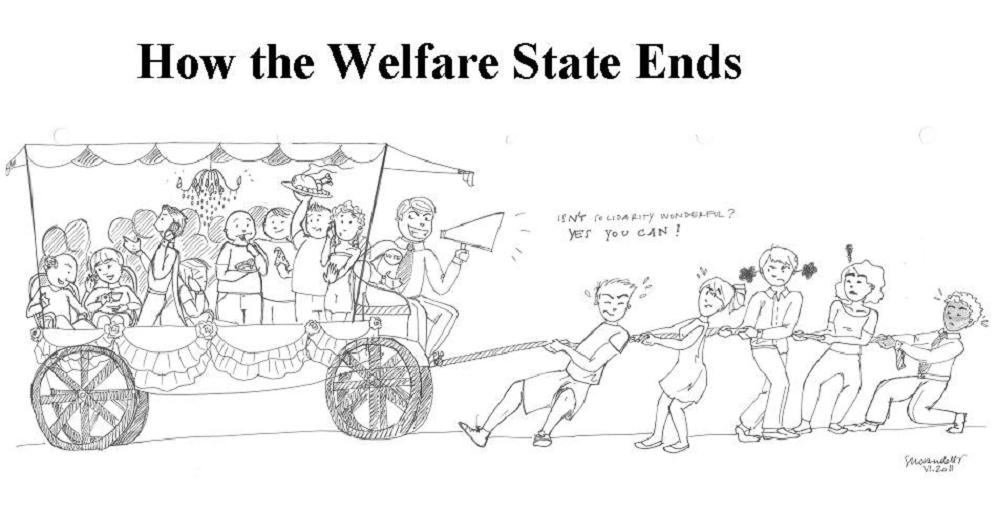
In my speeches, especially when talking about the fiscal crisis in Europe (or the future fiscal crisis in America), I often warn that the welfare state reaches a point-of-no-return when the number of people riding in the wagon begins to outnumber the number of people pulling the wagon.

To be more specific, if more than 50 percent of the population is dependent on government (employed in the bureaucracy, living off welfare, receiving pensions, etc), it becomes rather difficult to form a coalition to fix the mess. This may explain why Greek politicians have resisted significant reforms, even though the nation faces a fiscal death spiral.

But you don’t need me to explain this relationship. One of our Cato interns, Silvia Morandotti, used her artistic skills to create two images (click pictures for better resolution) that show what a welfare state looks like when it first begins and what it eventually becomes.

These images are remarkably accurate. The welfare state starts with small programs targeted at a handful of genuinely needy people. But as  politicians figure out the electoral benefits of expanding programs and people figure out the that they can let others work on their behalf, the ratio of producers to consumers begins to worsen.

Eventually, even though the moochers and looters should realize that it is not in their interest to over-burden the people pulling the wagon, the entire system breaks down.

Then things get really interesting. Small nations such as Greece can rely on permanent bailouts from bigger countries and the IMF, but sooner or later, as larger nations begin to go bankrupt, that approach won’t be feasible.

I often conclude my speeches by joking with the audience that it’s time to stock up on canned goods, bottled water, and ammo. Many people, I’m finding, don’t think that line very funny.

___________________

The Department of Health and Human Services administers the huge and fast-growing Medicare and Medicaid programs. These programs fuel rising health costs, distort health markets, and are plagued by waste and fraud. The department also runs an array of other expensive subsidy programs, including Head Start, TANF, and LIHEAP. Growth in HHS spending is creating a federal financial crisis, and the 2010 health care law sadly makes the situation worse.

The department will spend $910 billion in 2011, or $7,710 for every U.S. household. It employs 68,000 workers and runs more than 420 subsidy programs.


Timeline of Government Growth

  • See this timeline for key events in the department’s growth.

Reading Room

Cato Experts

Spending Cuts Summary

  • Here are proposed reforms to save $81 billion annually in the short-run and prevent federal health costs from consuming a growing share of the economy in the long-run.

Downsize This!

  • Medicare Reforms. Medicare should be transformed into a system based on vouchers, individual savings, and competitive insurance markets.
  • Medicaid Reforms. Federal spending on low-income health care should be converted to block grants for the states.
  • TANF and Welfare Spending. Welfare reforms in 1996 created Temporary Assistance for Needy Families, but this sort of aid should be provided by private charities.
  • Head Start and Other Subsidies. HHS funds a vast array of other subsidy programs, many of which are wasteful and ineffective.
  • 2010 Health Care Legislation. The law expanded Medicaid, added new taxes and subsidies, created new bureaucracies, and did little to reduce cost growth in health care.

The government of the United States is a definite government, confined to specified objects. It is not like the state governments, whose powers are more general. Charity is no part of the legislative duty of the government.

– James Madison. A paraphrase from Elliot’s Debates regarding a proposed subsidy bill, House of Representatives, January 10, 1794.

Dear Senator Pryor, why not pass the Balanced Budget Amendment? (“Thirsty Thursday”, Open letter to Senator Pryor)

Talk about timing, every Thursday I have been running this series on why Mark Pryor should vote to pass the Balanced Budget Amendment and I get to the computer this morning and read on the Arkansas Times Blog that Senator Pryor released a statement on the Balanced Budget Amendment yesterday. I can’t wait to talk about that. However, first I wanted to quote the statement Senator Pryor gave on December 14, 2011. This information below is from the Arkansas Times Blog on 12-14-11 and Max Brantley:

THREE CHEERS FOR MARK PRYOR: Our senator voted not once, but twice, today against one of the hoariest (and whoriest) of Republican gimmicks, a balanced budget amendment. Let’s quote him:

As H.L. Mencken once said, “For every complex problem there is a solution which is simple, clean, and wrong.” This quote describes the balanced budget amendment. While a balanced budget amendment makes for an easy talking point, it is an empty solution. Moreover, it’s a reckless choice that handcuffs our ability to respond to an economic downturn or national emergencies without massive tax increases or throwing everyone off Medicare, Social Security, or veteran’s care.There is a more responsible alternative to balance the budget. President Clinton led the way in turning deficits into record surpluses. We have that same opportunity today, using the blueprint provided by the debt commission as a starting point. We need to responsibly cut spending, reform our tax code and create job growth. This course requires hard choices over a number of years. However, it offers a more balanced approach over jeopardizing safety net programs and opportunity for robust economic growth.

Dear Senator Pryor,

Why not pass the Balanced Budget Amendment? As you know that federal deficit is at all time high (1.6 trillion deficit with revenues of 2.2 trillion and spending at 3.8 trillion).

On my blog www.HaltingArkansasLiberalswithTruth.com I took you at your word and sent you over 100 emails with specific spending cut ideas. However, I did not see any of them in the recent debt deal that Congress adopted. Now I am trying another approach. Every week from now on I will send you an email explaining different reasons why we need the Balanced Budget Amendment. It will appear on my blog on “Thirsty Thursday” because the government is always thirsty for more money to spend.

In this paper below you will read:

America cannot raise taxes to continue overspending, because tax hikes shrink our economy and grow our government. America cannot borrow more to continue overspending, because borrowing puts an enormous financial burden on the American children of tomorrow. A BBA will help address this long-term problem because, after the multi-year process for securing ratification of the BBA by three-quarters of the states, the BBA will keep federal spending under control in subsequent years.

Washington has not been able to cut spending so the BBA is needed to force Washington to do the right thing. Your father David Pryor was the governor of Arkansas and he knew what it meant to have a balanced budget by mandate.

Thank you again for this opportunity to share my ideas with you.

Sincerely,

Everette Hatcher, lowcostsqueegees@yahoo.com

Balanced Budget Amendment: Cut Spending Later, Cut Spending Now

March 31, 2011


Two key principles should govern congressional consideration of an amendment to the U.S. Constitution that requires the federal government to balance its budget:

  • First Principle: A Balanced Budget Amendment (BBA) is important to help bring long-term fiscal responsibility to America’s future when the BBA takes effect after ratification by three-quarters of the state legislatures; it is equally important for Congress to cut spending nowto address the current overspending crisis.
  • Second Principle: An effective BBA will include three elements to: (a) control spending, taxation, and borrowing, (b) ensure the defense of America, and (c) enforce the requirement to balance the budget.

Cuts for the Future, Cuts for the Present

Federal spending is out of control—both obligations for the future and spending right now.

Congress must get spending under control in the long term. America cannot raise taxes to continue overspending, because tax hikes shrink our economy and grow our government. America cannot borrow more to continue overspending, because borrowing puts an enormous financial burden on the American children of tomorrow. A BBA will help address this long-term problem because, after the multi-year process for securing ratification of the BBA by three-quarters of the states, the BBA will keep federal spending under control in subsequent years.

Congress also must get spending under control in the short term. Federal overspending is not simply about the future, but also about the present. Under the President’s Fiscal Year 2012 Budget Submission, measured by the Congressional Budget Office, the federal government will spend $1.2 trillion more than it will take in, a gargantuan burden of additional debt forced on future generations to pay current bills.

Thus, America needs both a Balanced Budget Amendment for the long term and deep cuts in federal spending starting right now, without waiting for a BBA to take effect. As Congress considers budget resolutions, appropriations bills, appropriations continuing resolutions, and debt limit bills, Congress should take every opportunity now to cut federal spending, including for the biggest overspending problem: the ever-growing entitlement programs.

Congress should recognize that the best way to encourage state legislatures to ratify a BBA is to demonstrate, through consistent congressional cuts in spending, that the American people have the will to accept spending cuts to balance the budget.

Elements of a Successful Balanced Budget Amendment

A successful BBA will:

  • Control spending, taxing, and borrowing through a requirement to balance the budget.The BBA should cap annual spending at a level not exceeding either: (a) a specified percentage of the value of goods and services the economy produces in a year (known as gross domestic product, or GDP), or (b) the level of revenues. To ensure that Congress cannot simply balance the budget by continually raising taxes instead of cutting overspending, the BBA should require Congress to act by supermajority votes if Members wish to raise taxes. Any authority the BBA grants Congress to deal with economic slowdowns, by waiving temporarily the requirement that spending not exceed the GDP percentage or revenue level, should specify the amount of above-revenue spending allowed and require supermajority votes.
  • Defend America. The BBA should allow Congress by supermajority votes to waive temporarily compliance with the balanced budget requirement when waiver is essential to pay for the defense of Americans from attack.
  • Enforce the balanced budget requirement. The BBA should provide for its own enforcement, but must specifically exclude courts from any enforcement of the BBA, so unelected judges do not make policy decisions such as determining the appropriate level of funding for federal programs. A government that spends money in excess of its revenues must borrow to cover the difference. Therefore, to enforce the requirement to balance the budget, the BBA should prohibit government issuance of debt, except when necessary to finance a temporary deficit resulting from congressional supermajority votes discussed above.

America is in a fiscal crisis. Our government spends too much. Overspending must stop immediately. Overspending will stop only if Congress cuts spending now, including with respect to the ever-expanding entitlement programs. For the future, Congress and three-quarters of state legislatures can adopt and ratify a Balanced Budget Amendment to the U.S. Constitution to anchor the American willingness to live within a balanced budget.

David S. Addington is Vice President for Domestic and Economic Policy, and J. D. Foster, Ph.D., is Norman B. Ture Senior Fellow in the Economics of Fiscal Policy, at The Heritage Foundation.

Consumer spending is caused by growth of economy

Will liberals ever learn?

The Consumer Spending Fallacy behind Keynesian Economics

Posted by Daniel J. Mitchell

I’m understandably fond of my video exposing the flaws of Keynesian stimulus theory, but I think my former intern has an excellent contribution to the debate with this new 5-minute mini-documentary.

Keynesian Economics Is Wrong: Economic Growth Causes Consumer Spending, Not the Other Way

Uploaded by on Nov 29, 2010

Politicians and journalists who fixate on consumer spending are putting the cart before the horse. Consumer spending generally is a consequence of growth, not the cause of growth. This Center for Freedom and Prosperity video helps explain how to achieve more prosperity by looking at the differences between gross domestic product and gross domestic income. http://www.freedomandprosperity.org

________________

The main insight of the mini-documentary is that Gross Domestic Product (GDP) only measures how national output is allocated between consumption, investment, and government. That’s useful information in many ways, but if we want more output, we should focus on Gross Domestic Income (GDI), which measures how national income is earned.

Focusing on GDI hopefully would lead lawmakers to consider ways of boosting employee compensation, corporate profits, small business income, and other components of national income. Focusing on GDP, by contrast, is misguided since any effort to boost consumption generally leads to less investment. This is why Keynesian policies only redistribute national income, but don’t boost overall output.

Consumer spending is caused by growth of economy

You may recognize Hiwa. She narrated a very popular video earlier this year on the nightmare of income-tax complexity.

Case Study on Chelsea Clinton:Can equality of results be acheived best by punishing those who were born rich?

 chelsea_clinton1.jpg

Milton Friedman – Redistribution of Wealth

Uploaded by on Feb 12, 2010

Milton Friedman clears up misconceptions about wealth redistribution, in general, and inheritance tax, in particular. http://www.LibertyPen.com

_______________________________

Many times in the past our government has tried to even the playing field but the rich and poor will always be with us as Christ reminded us so long ago. Providing people a chance is fine but trying to punish others is not and it does not work.

Max Brantley pointed out that there are many kinds of riches. You are rich if you have two parents who love you enough to teach you the importance of education like Max’s parents taught him.  

Chelsea Clinton is a perfect example of this. She was not born rich in money but she definately got a big headstart in other areas.

Max Brantley of the Arkansas Times noted:

The New York Times carried a glowing profile Sunday about Chelsea Clinton’s decision to step fully from the shadows and seek a public life.

She’s joined a corporate board, gotten a job as a correspondent for NBC and has her pick of gatherings of the mighty or simply important just about anywhere on the globe.

Reactions tended to fall along partisan lines. Fans of Bill and/or Hillary Clinton were happy for their 31-year-old daughter. Non-fans weren’t impressed. She’d done nothing to deserve her good fortune except choose good parents, they said. The really ugly ones criticized everything from her hairstyle to her speech.

I’m not impartial on the subject. I’ve known Chelsea since she was an infant, though most of my exposure came before her move to Washington in junior high. She’s remained friendly with my daughter and has been good to her. That’s enough for me.

But Chelsea is smart and poised. She’s worked hard at demanding schools and jobs. Would she be precisely where she is today without her famous parents? Of course not. She hasn’t claimed otherwise. (I do like how often she credits her Grandmother Rodham for sage advice.)

But she now has made the important decision to accept inheritance of her parents’ considerable public franchise. If nothing else, her growth in the larger public world might position her to someday take leadership of the Clinton Foundation. If she’s lucky — if we’re all lucky — she will continue to amass the resources her father has raised for fighting significant global problems. If she should decide to try politics, she’s been homeschooled by the best and brightest.

Make no mistake. Chelsea Clinton is a one percenter, if not precisely in the net worth category, close enough. She is also, if you prefer, a lucky sperm club member. But she manages to send a signal that she understands how much of her stature is owed to her parents. She signals a generosity of spirit about her good fortune that is more reminiscent of a Buffett than a Koch.

We will always have the 1 percent. There’s nothing inherently evil about being in that small number. The question is how much the 1 percent is willing to allow the 99 percent to share.

____________________________

Milton Friedman discusses the inheritance of talent on “Free to Choose”

Uploaded by on Nov 1, 2009

“The inheritance of talent is no different (from an ethical point of view) from the inheritance of other forms of property– of bonds, of stocks, of houses, or of factories. Yet many people resent the one, but not the other.”

From “Free to Choose” (1980), Part V: “Created Equal.”
______________________________

Here is an article that shows how silly it is to use government to try and achieve equality of results:

Our Economic Past | Burton W. Folsom Jr.

Equality, Markets, and Morality

September 2008 • Volume: 58 • Issue: 7

Burton Folsom, Jr. is a professor of history at Hillsdale College and author of New Deal or Raw Deal?, to be published by Simon & Schuster this year.

The subject of “equality” is the source of much political debate. Ever since the founding era, free-market thinkers have argued for equality of opportunity in the economic order. Equality, in other words, is a framework, not a result. In modern terms the goal is a level playing field. Government is a referee that enforces property rights, laws, and contracts equally for all individuals.

What the free-market view means in policy terms is no (or few) tariffs for business, no subsidies for farmers, and no racism written into law. Also, successful businessmen will not be subject to special taxes or the seizure of property.

In America this view of equality is enshrined in the Declaration of Independence (“all men are created equal and are endowed by their creator with certain inalienable rights”) and the Constitution (“imposts and excises shall be uniform throughout the United States” and “equal protection of the laws”). Much of America’s first century as a nation was devoted to ending slavery, extending voting rights, and securing property and inheritance rights for women—fulfilling the Founders’ goal of equal opportunity for all citizens.

Progressives and modern critics of equality of opportunity have launched two significant criticisms against the Founders’ view. First, that equality of opportunity is impossible to achieve. Second, to the extent that equality of opportunity has been tried, it has resulted in a gigantic inequality of outcomes. Equality of outcome, in the Progressive view, is desirable and can only be achieved by massive government intervention. Let’s study both of these objections.

To some extent, of course, the Progressives have a valid point—equality of opportunity is, at an individual level (as opposed to an institutional level) hard to achieve. We are all born with different family advantages (or disadvantages), with different abilities, and in different neighborhoods with varying levels of opportunity. As socialist playwright George Bernard Shaw said on the subject, “Give your son a fountain pen and a ream of paper and tell him that he now has an equal opportunity with me of writing plays and see what he says to you.”

What the Progressives miss is that their cure is worse than the illness. Any attempt to correct imbalances in family, ability, and neighborhood will produce other inequalities that may be worse than the original ones. Thomas Sowell writes, “[A]ttempts to equalize economic results lead to greater—and more dangerous—inequality in political power.” Or, as Milton Friedman concluded, “A society that puts equality—in the sense of equality of outcome—ahead of freedom will end up with neither equality nor freedom. The use of force to achieve equality will destroy freedom, and the force, introduced for good purposes, will end up in the hands of people who use it to promote their own interests.”

Failure During the New Deal

Sowell’s and Friedman’s point is illuminated by the failed efforts of the federal government to reduce inequalities during the New Deal. In the early 1930s the United States had massive unemployment (sometimes over 20 percent). In 1932 President Herbert Hoover supported the nation’s first relief program: $300 million was distributed to states. This was not a transfer from richer states to poorer states but a political grab by most state governors to secure all they could. Illinois played this game well and secured over $55 million, more than New York, California, and Texas combined.

Massachusetts, with almost as many people as Illinois, received zero federal money. Massachusetts had much poverty and distress, but Governor Joseph Ely believed states should try to supply their own needs and not rush to Washington to gain funds at someone else’s expense. Ely therefore promoted a variety of fundraising events throughout his state to help those in need. “Whatever the justification for [federal] relief,” Ely noted, “the fact remains that the way in which it has been used makes it the greatest political asset on the practical side of party politics ever held by any administration.”

In 1935 President Franklin Roosevelt confirmed Ely’s beliefs by turning the Works Progress Administration (WPA), which he had established, into a gigantic political machine to transfer money to key states and congressional districts to secure votes. Roosevelt and his cohorts used the rhetoric of removing inequalities as a political cover to gain power. Reporter Thomas Stokes won a Pulitzer Prize for his investigative research that exposed the WPA for using federal funds to buy votes.

The use of tax dollars, then, to mitigate inequality failed because—whatever the good intentions—the funds quickly became politicized.

Presidential (and congressional) authority to tax and to transfer funds from one group to another also proved to be a dangerous centralization of power. Taxation increased both in size and complexity. The IRS thus became a weapon a president could use against those who resisted him. “My father,” Elliott Roosevelt observed of his famous parent, “may have been the originator of the concept of employing the IRS as a weapon of political retribution.”

Sowell and Friedman indeed recognized that efforts to remove inequalities would create new inequalities, perhaps just as severe, and would also dangerously concentrate power in the hands of politicians and bureaucrats. But Sowell and Friedman have readily conceded that when markets are left free, the inequality of outcomes is not necessarily morally justified. In other words, some people—through luck or inheritance—become incredibly rich and others, who may have worked harder and more diligently, end up barely earning a living. Rewards, as F. A. Hayek, among others, has noted, are “based only partly on achievements and partly on mere chance.” Societies are more prosperous under free markets, but individual success and failure can occur independently of ability and hard work.

Progressive Claims in Light of History

What the historical record does seem to demonstrate is that the richest men in American history have been creative entrepreneurs who have improved the lives of millions of Americans and have achieved remarkable upward mobility doing so. For example, the first American to be worth $10 million was John Jacob Astor, a German immigrant and a son of a butcher. Astor founded the largest fur company in the United States, transforming tastes and lowering costs in clothing for people all over the world.

John D. Rockefeller, the first American to be worth $1 billion, was the son of an itinerant peddler. Yet Rockefeller, with little education or training, went into the business of refining oil and did it better than anyone in the world. As a result, he sold the affordable kerosene that lit up most homes in the world. (He had a 60 percent world market share in the late 1800s.)

Henry Ford, the son of a struggling farmer, was the second American billionaire. He used the cheap oil sold by Rockefeller and cheap steel that was introduced by immigrant Andrew Carnegie to make cars affordable for most American families. The most recent wealthiest men in the United States—Sam Walton and Bill Gates—both came from middle-class households and both added much value for most American consumers.

Free markets may yield odd results and certainly unequal outcomes, but the greater opportunities and prosperity have made the tradeoff worthwhile for American society.

Mandatory Spending Has Increased Five Times Faster Than Discretionary Spending

Mandatory Spending Has Increased Five Times Faster Than Discretionary Spending

 Everyone wants to know more about the budget and here is some key information with a chart from the Heritage Foundation and a video from the Cato Institute.

Only one-third of the federal budget, discretionary spending, is subject to annual budgets. The remainder, mandatory spending, is set on autopilot without congressional debate and has increased more than five times faster than discretionary spending. Most of the current increase is due toentitlement spending.

INFLATION-ADJUSTED TRILLIONS OF DOLLARS (2010)

 
Download

Mandatory Spending Has Increased Five Times Faster Than Discretionary Spending

Source: White House Office of Management and Budget.

Chart 6 of 42

In Depth

  • Policy Papers for Researchers

  • Technical Notes

    The charts in this book are based primarily on data available as of March 2011 from the Office of Management and Budget (OMB) and the Congressional Budget Office (CBO). The charts using OMB data display the historical growth of the federal government to 2010 while the charts using CBO data display both historical and projected growth from as early as 1940 to 2084. Projections based on OMB data are taken from the White House Fiscal Year 2012 budget. The charts provide data on an annual basis except… Read More

  • Authors

    Emily GoffResearch Assistant
    Thomas A. Roe Institute for Economic Policy StudiesKathryn NixPolicy Analyst
    Center for Health Policy StudiesJohn FlemingSenior Data Graphics Editor