Category Archives: spending out of control

Bill Clinton’s welfare reform undone by Obama

.

 When the Republicans took over Congress in 1994 they were able to work with President Clinton and get Welfare reform passed which Clinton signed. However, since President Obama got in office he has been trying to stimulate the economy and he abandoned welfare reform.
  • President Ronald Reagan  after delivering a speech on television in this 1987 photo.By Doug Mills, APPresident Ronald Reagan after delivering a speech on television in this 1987 photo.
     

    Editor’s note: This article was co-authored by Susan A. Carleson and Robert Knight.

    We knew things weren’t good, but nearly one seventh of all Americans on food stamps? Forty-three million people?

    That’s the news this week from the U.S. Department of Agriculture, which noted that only 30 million were on food stamps as recently as 2008. For Big Government fans, this news should trigger a high five. But wait – many of those high fivers are lamenting the “epidemic of obesity” among the poor. Remember, liberalism need not be consistent or effective; it just has to be caring.

    For the average American this food stamp spike should be a wake up call. It exposes two things: One, Obamanomics’ massive government spending is not improving the economy; and, two, poorly designed welfare programs create ever more dependency. Food stamps and other welfare programs were meant to be a safety net for people down on their luck, not a way of life passed from one generation to the next.

    Over the years, the federal government has grown exponentially. The notable exception occurred in 1996 with the passage of welfare reform, which marked the first and only repeal of a Great Society entitlement program, Aid to Families with Dependent Children.

    That reform, which reversed the incentives for states to increase their welfare rolls, was an unqualified success by every measure. Caseloads dropped by more than two-thirds – from a record 5 million families in 1994 to just 1.6 million families in 2009. Recipients left welfare in droves — most of them to work — and earnings rose as child poverty fell.

    But, following the 2008 election, liberals in Congress and the White House began to dismantle this historic achievement. In the first “stimulus bill” they undermined the 1996 reform, made it easier for states to increase their welfare caseloads without having to meet federal work requirements, and added a host of new welfare programs. These destructive policies must be reversed.

    Ronald Reagan was the first modern president to truly appreciate the wisdom of America’s founders about the virtues of limited government. He understood the dynamics of spending and the inherent danger of overburdening taxpayers and free markets.

    In the early 1970s, when California was headed toward bankruptcy because of its profligate welfare spending, then-Gov. Reagan tapped Robert B. Carleson to design and implement a plan to salvage the state’s budget. And it worked. Welfare rolls plummeted and the state’s most needy received a long-delayed benefit increase. It was a true American success story.

    The ultimate triumph of these efforts was the historic welfare reform of 1996, which freed millions of Americans from the narcotic of dependency. While Bill Clinton deserves credit for ultimately signing this landmark legislation, it was in fact the product of 30 years of Ronald Reagan’s dream and Bob Carleson’s tenacity.

    Ronald Reagan was a man of strong beliefs, and he surrounded himself with policy experts who understood big bureaucracy and who knew how to roll back its overreach through common sense approaches. Sadly, people with those attitudes and know-how have not been in positions of power for many years. And the country has drifted, some would say lurched, leftward in its acceptance of big government.

    But as we all saw last November, complacency reached its limit. Americans now hunger for a return to sensible policies that instill individual responsibility, reduce government and taxes, increase prosperity and create real – not make-work – jobs.

    A new organization, the Carleson Center for Public Policy (CCPP), has been formed to assist this effort by serving as a proxy for “What Reagan would do.” Comprised exclusively of men and women who served under Ronald Reagan and who understand what works, the Center (www.theccpp.org) will offer public policy officials guidance and advice on welfare and entitlement reform.

    For a detailed look at the 25-year fight that truly reformed welfare, see Bob Carleson’s book Government Is the Problem: Memoirs of Ronald Reagan’s Welfare Reformer (American Civil Rights Union, 2010) www.governmentistheproblem.us.

    As we celebrate Ronald Reagan’s 100th birthday on February 6, it is appropriate to recall his words:

    “Freedom is never more than one generation away from extinction. We didn’t pass it to our children in the bloodstream. It must be fought for, protected, and handed on for them to do the same, or one day we will spend our sunset years telling our children and our children’s children what it was once like in the United States where men were free.”

    This is America. We can do better than offer our children more and more food stamps.

    Robert Knight

    Robert Knight is an author, columnist and frequent contributor to Townhall.

Dear Senator Pryor, why not pass the Balanced Budget Amendment? ( “Thirsty Thursday”, Open letter to Senator Pryor)

Dear Senator Pryor,

Why not pass the Balanced  Budget Amendment? As you know that federal deficit is at all time high (1.6 trillion deficit with revenues of 2.2 trillion and spending at 3.8 trillion).

On my blog www.HaltingArkansasLiberalswithTruth.com I took you at your word and sent you over 100 emails with specific spending cut ideas. However, I did not see any of them in the recent debt deal that Congress adopted. Now I am trying another approach. Every week from now on I will send you an email explaining different reasons why we need the Balanced Budget Amendment. It will appear on my blog on “Thirsty Thursday” because the government is always thirsty for more money to spend.

You asked for ideas to cut spending, but you voted for the 800 billion dollar stimulus that did not help the economy at all. I have included an article below that makes a very good point about the Balanced Budget Amendment and the stimulus:

Lee believes there are several key components to a balanced budget amendment which he outlines in his book, including making tax increases contingent on a two-thirds vote in Congress so that the option to increase taxes is not the default maneuver to balance a budget. He believes the amendment should require Congress spends no more than it takes in, and in fact should cap the spending at a fixed percent of GDP (the proposal submitted in the Senate caps it at 18 percent of GDP, just about the historical average). There would also be a supermajority vote required to raise the debt ceiling.

And for those who argue that stimulus packages wouldn’t have been possible under the amendment, Lee sees little difficulty responding.

“That’s exibit A for why we ought to have it,” Lee said of the Obama stimulus package.

That is a very good point in favor of having a balanced budget amendment in my view. I have been critical of you for supporting the stimulus in the past.

Thank you again for your time and for this opportunity to share my ideas with you.

Sincerely,

Everette Hatcher

Lee Makes His Case for a Balanced Budget Amendment

By Elisabeth Meinecke

7/18/2011

As Washington spends the summer arguing over its spending addiction, GOP Sen. Mike Lee of Utah has a solution to help prevent the same crisis for future generations: a balanced budget amendment.

The House made news last week when, in the heat of negotiations over raising the debt ceiling, they announced a vote on a balanced budget amendment this Wednesday. Though the Senate GOP introduced a one earlier this year, President Obama has stated emphatically otherwise, telling Americans last week during a press conference that the country does not need a balanced budget amendment.

“Yes, we do,” Lee told Townhall when asked to respond to the president, adding later when talking about simultaneously raising the debt ceiling and cutting spending, “We can’t bind what a future Congress will do. We can pass laws that will affect this year, but there will be a new Congress that takes power in January of 2013, and then another new one that will take power in January 2015. And they will make their own spending decisions then — we can’t bind them unless we amend the Constitution to do so.”

Lee points out that the American people support the idea of a balanced budget – 65 percent, according to a Sachs/Mason Dixon poll from this year – but politicians have been reluctant to wade into the debate.

“The fact that we’re in this debate, the fact that we’re sort of deadlocked, or we’ve reached a point of gridlock in the discussions, is indicative of the problem that we have,” Lee said.

In fact, Lee thinks a balanced budget amendment is so important to the future of the country that he’s written a book on it: The Freedom Agenda: Why a Balanced Budget Amendment Is Necessary to Restore Constitutional Government.

Lee even takes the argument a step beyond fiscal issues, saying a balanced budget amendment safeguards individual liberties.

““The more money it [Congress] has access to, whether it’s through borrowing or through taxation, either way, that’s going to fuel Congress’ expansion, and whenever government acts, it does so at the expanse of individual liberty,” Lee said. “We become less free every time government expands.”

Lee believes there are several key components to a balanced budget amendment which he outlines in his book, including making tax increases contingent on a two-thirds vote in Congress so that the option to increase taxes is not the default maneuver to balance a budget. He believes the amendment should require Congress spends no more than it takes in, and in fact should cap the spending at a fixed percent of GDP (the proposal submitted in the Senate caps it at 18 percent of GDP, just about the historical average). There would also be a supermajority vote required to raise the debt ceiling.

And for those who argue that stimulus packages wouldn’t have been possible under the amendment, Lee sees little difficulty responding.

“That’s exibit A for why we ought to have it,” Lee said of the Obama stimulus package.

Lee also pointed out that his balanced budget amendment includes an exception to the spending restriction in time of war – “not a blank check, but to the extent necessary.” Congress would also be able to supersede the amendment with a two-thirds vote.

“We wanted to make it difficult, but not impossible, for Congress to spend more than it had access to,” Lee said, citing as an example a massive or immediate crisis created by a national emergency or natural disaster. “What this is designed to do is to make it more difficult – to make it impossible – for Congress to just do this as a matter of course.”

Elisabeth Meinecke

Elisabeth Meinecke is Associate Editor with Townhall.com

Reasons why Mark Pryor will be defeated in 2014 (Part 13)

It is apparent from this statement below that Senator Mark Pryor is against the Balanced Budget Amendment. He has voted against it over and over like his father did and now I will give reasons in this series why Senator Pryor will be defeated in his re-election bid in 2014. However, first I wanted to quote the statement Senator Pryor gave on December 14, 2011. This information below is from the Arkansas Times Blog on 12-14-11 and Max Brantley:

THREE CHEERS FOR MARK PRYOR: Our senator voted not once, but twice, today against one of the hoariest (and whoriest) of Republican gimmicks, a balanced budget amendment. Let’s quote him:

As H.L. Mencken once said, “For every complex problem there is a solution which is simple, clean, and wrong.” This quote describes the balanced budget amendment. While a balanced budget amendment makes for an easy talking point, it is an empty solution. Moreover, it’s a reckless choice that handcuffs our ability to respond to an economic downturn or national emergencies without massive tax increases or throwing everyone off Medicare, Social Security, or veteran’s care.There is a more responsible alternative to balance the budget. President Clinton led the way in turning deficits into record surpluses. We have that same opportunity today, using the blueprint provided by the debt commission as a starting point. We need to responsibly cut spending, reform our tax code and create job growth. This course requires hard choices over a number of years. However, it offers a more balanced approach over jeopardizing safety net programs and opportunity for robust economic growth.

____________________

SENATOR MARK PRYOR WILL NOT BE RE-ELECTED BECAUSE THIS IS NOT THE SAME DEMOCRATIC STATE THAT RE-ELECTED HIS FATHER OVER AND OVER, BUT ARKANSAS NOW IS A REPUBLICAN STRONGHOLD. HECK, THE ONLY REASON PRYOR GOT RE-ELECTED IN 2008 WAS BECAUSE THE REPUBLICANS THOUGHT FOR SURE HILLARY WOULD BE ON THE DEMOCRATIC PRESIDENTIAL TICKET AND WOULD HAVE COAT TAILS.

Back in 2009 there were 3 Democratic Congressman and 2 Democratic Senators from Arkansas. Now there are 3 Republican Congressman and 1 Republican Senator and the other two seats are held currently by Pryor who is not up for re-election till 2014 and Mike Ross who is vacated his seat at the end of 2012. Could it be that will no longer have any Democrats in Washington representing Arkansas in a couple of years?

I believe that Pryor has miscalculated by opposing the Balanced Budget Amendment and I think that Mike Ross is very popular because of his support of it.

Below is a piece I wrote a while back about Mike Ross.

The Arkansas Times Blog reported today:

U.S. Mike Ross photo

  • U.S. REP. MIKE ROSS

U.S. Mike Rossof Prescott surprised everyone by scheduling an announcement this morning in Little Rock to say he would not seek a seventh term in Congress in 2012.His statement is on the jump. He said he hadn’t decided yet on a race for governor in 2014, which he’s long been expected to make. But his reference to the race indicates it is very much in his sights.

ROSS NEWS RELEASE

WASHINGTON — U.S. Congressman Mike Ross of Prescott on Monday announced he will not be seeking re-election to the U.S. House of Representatives. Ross, who won re-election in 2010 by 18 points and has no announced opponent, has represented Arkansas’s Fourth Congressional District in Congress since 2001. A fifth generation Arkansan, Ross is a former state senator and former small business owner.

Statement from U.S. Congressman Mike Ross:

Representing my home state of Arkansas in the U.S. Congress for the past eleven years has been a real privilege and honor. It is a job that I take very seriously and one that I love. However, as I reflect on turning 50 this year, I believe it is time for me to begin a new chapter in my life by spending more time with my family and exploring new opportunities here at home in Arkansas.

That’s why I have decided not to seek a seventh term to the United States House of Representatives from Arkansas’s Fourth Congressional District. This was not an easy decision and one that I carefully made after a lot of reflection, thought and prayer.

Last year was a tough political environment to seek re-election. Yet, I won by 18 points—one of the largest margins of any member of Congress in a swing district. The trust and confidence the folks here at home have continually placed in me is something I will never forget. The people of Arkansas’s Fourth Congressional District are good, decent, hard working people and I am proud to serve and represent them in the U.S. Congress.

A lot has changed since I was first elected to the U.S. Congress in 2000. Congressional campaigns have gone from several months in length to never-ending, costing millions of dollars every two years. As a result, fundraising never ends nor do the political attacks. While I have worked hard to bring folks to the middle to craft commonsense solutions to the many problems that confront our nation, Washington is mired in gridlock, gamesmanship and constant partisan bickering. Too many issues and votes are based on partisan politics rather than good public policy. Despite our many challenges, I remain optimistic that America’s best days are still ahead of us.

I never believed that my service in the U.S. Congress should become a permanent career. This seat never belonged to me—it belongs to the people of Arkansas. And I know there are many bright people in Arkansas ready to step up, go to Washington and offer a new generation of leadership. Simply put, it is someone else’s turn to represent our state in the U.S. Congress.

I have many good memories of my service in the U.S. Congress, and we have helped thousands of people. None of this would have been possible without the support of the people here in Arkansas, and for that, my family and I will always be grateful to them.

I look forward to serving out the remainder of my term in the U.S. Congress, which doesn’t end until January 2013. I will continue to work each and every day on behalf of the people I represent, just as I have faithfully tried to do from the beginning.

I have received a lot of encouragement to run for Governor of Arkansas when Governor Beebe’s term ends in 2014. I’ve always been very upfront and honest in the fact that, as a fifth generation Arkansan, I love our state and would like very much to help lead it at some point in the future. Whether I run for Governor in 2014 is a decision I have not yet made and won’t make until sometime after my term in this Congress ends.

__________________________________

Ross will tough to beat in the governor race in 2014. However, I do think that the Republicans will have an excellent chance to capture a fourth Congressional seat in 2012. Will there ever be another Democratic member of the House of Representatives from Arkansas? (In fact if you check out some of the information at the Red Arkansas Blog and you will see that most people view this district as a Republican pick up.)

John Brummett in his article “Ross is running, but I repeat myself,” Arkansas News Bureau, July 26, 2011 noted:

To win, a Democrat will need to be as good a politician as Ross. I can’t identify such a Democrat at present.

At this point I’d give tea party pageanteer Beth Anne Rankin, the Sarah Palin wannabe of Arkansas, a decent shot.

Jason Tolbert reported:

 
With the sudden news from Rep. Mike Ross that he will not seek re-election, potential Republican candidates will quickly emerge.  However, two Republicans have already been busy lining up support behind the scenes before Ross even announced his decision.

Republican Tom Cotton from Dardanelle confirms to the Tolbert Report this morning that he will seek the open seat and is already putting together his team.  Potential donors have confirmed that Cotton is lining up support and may already have over six figures in commitments.  In addition, Cotton has been seen meeting recently with Second District Congressman Tim Griffin who could lend support to Cotton’s campaign.

Cotton was one of the many names considering a run for Senate in 2010 against former Sen. Blanche Lincoln, but ultimately decided against it. Cotton currently works for international consulting firm, McKinsey and Company. A veteran, he also serves in the U.S. Army Reserves. Cotton lives in Yell County, which was part of the Second Congressional District represented by Congressman Griffin. It was moved to the Fourth Congressional Disctrict in the last redistricting process.

In addition, Beth Anne Rankin of Magnolia, former candidate and general election opponent of Mike Ross, has been exploring another run as well.  Rankin is a former Miss Arkansas and worked in former Gov. Mike Huckabee’s administration.  She recently appeared on his Fox News program “Huckabee” cutting her red hair for “Locks of Love” – something she does every few years.  Rankin recieved 40 percent of the vote in 2010 with Ross pulling in 57 percent.
In addition, sources close to State Rep. Lane Jean of Magnolia confirm that he is “strongly considering” getting into the race as well.  Jean was elected to his first term in the Arkansas House in 2010.

Other potential Republicans names mentioned are: State Rep. Matthew Shepherd, former Congressional candidate Glenn Gallas, and Will Rockfeller – the son of the late Lt. Gov. Win Rockfeller.

Reagan and Clinton had good fiscal policies according to Cato Institute

Uploaded by on Dec 16, 2010

http://blog.heritage.org/2010/12/16/new-video-pork-filled-spending-bill-just-… Despite promises from President Obama last year and again last month that he opposed reckless omnibus spending bills and earmarks, the White House and members of Congress are now supporting a reckless $1.1 trillion spending bill reportedly stuffed with roughly 6,500 earmarks.

________________________

Below you see an article and videos by Dan Mitchell of the Cato Institute concerning Reagan and Clinton. First lets look at where we are now with Obama.

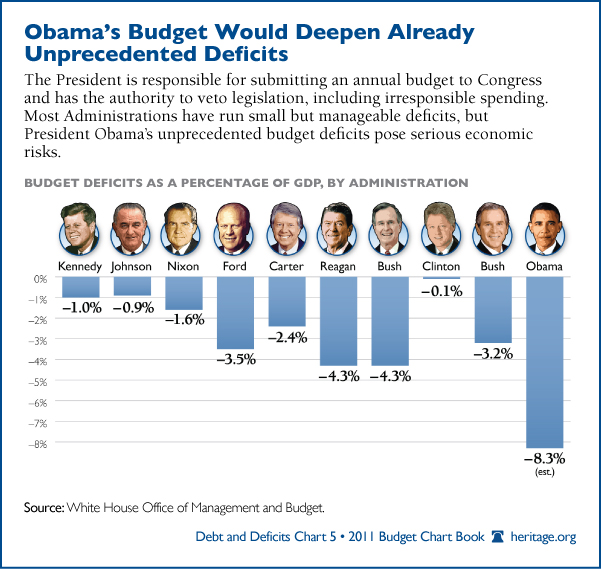
Over the last 10 presidents was have had 16.9% of GDP of deficits total from five Republican presidents and 12.7% total from Democratic presidents. However, what is most disturbing is that 8.3% of the 12.7% comes from the Obama administration who is currently in power and we are no longer in the cold war era. That is almost double the total of all the other four Democratic presidents combined under just one president. Take a look at the chart below from the Heritage Foundation:

Rob Bluey

January 1, 2012 at 9:56 am

Over the past 50 years, 10 U.S. presidents have made annual budget requests to Congress, projecting deficits both big and small. But no other president compares to Barack Obama when it comes to the size and scale of the current budget deficit facing the United States.

The country is facing an 8.3 percent estimated average national deficit of a two-term Obama administration — the biggest of the past 50 years. By comparison, the current estimate for Obama is nearly double the percentage under Presidents Ronald Reagan and George H.W. Bush — and they were fighting the Cold War.

Political party doesn’t tell the whole story, however. President Bill Clinton leads the pack of presidents since 1961, according to data from the White House Office of Management and Budget. Heritage put together this graphic as part of our Budget Chart Book.

So what does the current trajectory mean for the United States? We’re certainly no longer looking at a continuation of manageable deficits in the years to come. This is a dramatic change in the magnitude of annual shortfalls at the federal level. That’s one reason Heritage came up with a plan to fix the debt crisis.

If you have a suggestion for a chart we should feature in the future, please post a comment below, email us at scribe@heritage.org, or send me at tweet @RobertBluey.

_______________________
Here is a perspective from Dan Mitchell of the Cato Institute:

To Fix the Budget, Bring Back Reagan…or Even Clinton

Posted by Daniel J. Mitchell

President Obama unveiled his fiscal year 2012 budget today, and there’s good news and bad news. The good news is that there’s no major initiative such as the so-called stimulus scheme or the government-run healthcare proposal. The bad news, though, is that government is far too big and Obama’s budget does nothing to address this problem.

But perhaps the folks on Capitol Hill will be more responsible and actually try to save America from becoming a big-government, European-style welfare state. The solution may not be easy, but it is simple. Lawmakers merely need to restrain the growth of government spending so that it grows slower than the private economy.

Actual spending cuts would be the best option, of course, but limiting the growth of spending is all that’s needed to slowly shrink the burden of government spending relative to gross domestic product.

Fortunately, we have two role models from recent history that show it is possible to control the federal budget. This video from the Center for Freedom and Prosperity uses data from the Historical Tables of the Budget to demonstrate the fiscal policy achievements of both Ronald Reagan and Bill Clinton.

Spending Restraint, Part I: Lessons from Ronald Reagan and Bill Clinton

Uploaded by on Feb 14, 2011

Ronald Reagan and Bill Clinton both reduced the relative burden of government, largely because they were able to restrain the growth of domestic spending. The mini-documentary from the Center for Freedom and Prosperity uses data from the Historical Tables of the Budget to show how Reagan and Clinton succeeded and compares their record to the fiscal profligacy of the Bush-Obama years.

_____________________


Some people will want to argue about who gets credit for the good fiscal policy of the 1980s and 1990s.

Bill Clinton’s performance, for instance, may not have been so impressive if he had succeeded in pushing through his version of government-run healthcare or if he didn’t have to deal with a Republican Congress after the 1994 elections. But that’s a debate for partisans. All that matters is that the burden of government spending fell during Bill Clinton’s reign, and that was good for the budget and good for the economy. And there’s no question he did a much better job than George W. Bush.

Indeed, a major theme in this new video is that the past 10 years have been a fiscal disaster. Both Bush and Obama have dramatically boosted the burden of government spending — largely because of rapid increases in domestic spending.

This is one of the reasons why the economy is weak. For further information, this video looks at the theoretical case for small government and this video examines the empirical evidence against big government.

Another problem is that many people in Washington are fixated on deficits and debt, but that’s akin to focusing on symptoms and ignoring the underlying disease. To elaborate, this video explains that America’s fiscal problem is too much spending rather than too much debt.

Last but not least, this video reviews the theory and evidence for the “Rahn Curve,” which is the notion that there is a growth-maximizing level of government outlays. The bad news is that government already is far too big in the United States. This is undermining prosperity and reducing competitiveness.

Spending Restraint, Part II: Lessons from Canada, Ireland, Slovakia, and New Zealand

Uploaded by on Feb 22, 2011

Nations can make remarkable fiscal progress if policy makers simply limit the growth of government spending. This video, which is Part II of a series, uses examples from recent history in Canada, Ireland, Slovakia, and New Zealand to demonstrate how it is possible to achieve rapid improvements in fiscal policy by restraining the burden of government spending. Part I of the series examined how Ronald Reagan and Bill Clinton were successful in controlling government outlays — particularly the burden of domestic spending programs. http://www.freedomandprosperity.org


Reasons why Mark Pryor will be defeated in 2014 (Part 12)

It is apparent from this statement below that Senator Mark Pryor is against the Balanced Budget Amendment. He has voted against it over and over like his father did and now I will give reasons in this series why Senator Pryor will be defeated in his re-election bid in 2014. However, first I wanted to quote the statement Senator Pryor gave on December 14, 2011. This information below is from the Arkansas Times Blog on 12-14-11 and Max Brantley:

THREE CHEERS FOR MARK PRYOR: Our senator voted not once, but twice, today against one of the hoariest (and whoriest) of Republican gimmicks, a balanced budget amendment. Let’s quote him:

As H.L. Mencken once said, “For every complex problem there is a solution which is simple, clean, and wrong.” This quote describes the balanced budget amendment. While a balanced budget amendment makes for an easy talking point, it is an empty solution. Moreover, it’s a reckless choice that handcuffs our ability to respond to an economic downturn or national emergencies without massive tax increases or throwing everyone off Medicare, Social Security, or veteran’s care.There is a more responsible alternative to balance the budget. President Clinton led the way in turning deficits into record surpluses. We have that same opportunity today, using the blueprint provided by the debt commission as a starting point. We need to responsibly cut spending, reform our tax code and create job growth. This course requires hard choices over a number of years. However, it offers a more balanced approach over jeopardizing safety net programs and opportunity for robust economic growth.

____________________

One of the biggest reasons that Senator Mark Pryor will not be re-elected in 2014 to the Senate is because EVEN THOUGH HE ASKS FOR SPENDING CUT IDEAS, HE REALLY DOESN’T WANT TO EMBRACE THEM. FOR INSTANCE, IN THIS ARTICLE BELOW BY JOHN STOSSEL THERE ARE PLENTY OF GREAT SUGGESTIONS BUT PRYOR HAS HEARD THEM ALL AND DOES NOT LIKE THEM BECAUSE HE LIKES SPENDING MORE!!!!

On August 4, 2011 John Brummett wrote:

The point is that we don’t need to choke our government — or, more to the point, ourselves — with such simplistic devices as balanced budget amendments. The point is that we need to make our often-essential deficit and debt more sustainable, more manageable, more responsible and less massive, and that we should do that by addressing both income and outgo.

You’re right, my tea party friend, about how government must change its ways. You’re not right, though, in the over-simplicity of your assessment or in the impractical, even drastic, nature of your remedies.

Brummett’s view used to be the majority view, but  in a recent poll by CNN over 70% now favor a Balanced Budget Amendment. I am starting a series today on the Balanced Budget Amendment!!!

Dear Senator Pryor,

Why not pass the Balanced Budget Amendment? As you know that federal deficit is at all time high (1.6 trillion deficit with revenues of 2.2 trillion and spending at 3.8 trillion).

On my blog www.HaltingArkansasLiberalswithTruth.com I took you at your word and sent you over 100 emails with specific spending cut ideas. However, I did not see any of them in the recent debt deal that Congress adopted. Now I am trying another approach. Every week from now on I will send you an email explaining different reasons why we need the Balanced Budget Amendment. It will appear on my blog on “Thirsty Thursday” because the government is always thirsty for more money to spend.

You are right to ask for ideas to cut spending because that is the real cause of the deficit. John Stossel rightly noted, “Milton Friedman always said taxes don’t tell the whole story. What counts is how much of our resources government spends, however it acquires them. The doubling of spending under Bush and Obama hasn’t gotten enough attention.”

Senator Pryor, you asked for spending cut advice. Here is some from John Stossel:

It’s not hard to balance the budget. On my show, we made enough cuts to create a $237 billion surplus. I cut whole departments, like Education and Commerce. I cut two-thirds of the Defense Department (which still leaves it much bigger than China’s). I indexed Medicare, Medicaid and Social Security to inflation, raised the retirement age, and took away benefits for rich people. But I don’t have to run for office. Congressmen do, and they can’t even manage to cut ridiculous tax breaks like those for ethanol.

Thank you again for your time.

Everette Hatcher, lowcostsqueegees@yahoo.com

Balancing the Budget

By John Stossel

8/3/2011


The political class predicted “disaster” if Congress didn’t raise its debt limit.

I think that was a scam to get more money. See, the poor politicians don’t have enough, and they need to borrow more. We taxpayers are cheap. This year we’ll give them only $2.2 trillion. They want to spend $3.8 trillion.

The president said if he didn’t get more money, Social Security checks wouldn’t go out. Why not?

With $2 trillion, they can pay Social Security, Medicare, the interest on the debt and still have billions left. It’s billions more than the government spent when President George W. Bush took office. What’s the problem?

The problem is that Republicans and Democrats under Bush and President Obama doubled spending. Now, Obama wants more taxes.

Taxes shouldn’t be the answer when spending is the problem.

Grover Norquist, who heads Americans for Tax Reform (ATR), leads the charge to keep the focus on spending. Norquist and ATR are famous for asking officeholders and candidates to sign a pledge not to raise taxes. Some say he is the reason the debt-ceiling debate was so drawn out.

“I think the reason there isn’t a tax increase on the table,” he told me, “is that 235 members of the House of Representatives signed a pledge never to raise taxes, a pledge to their voters, and 41 senators did. …

“Only if you take tax increases off the table do you even begin to … focus on spending, and that’s what Obama wants to keep our focus off of. He wants us to talk about the deficit, not spending.”

I pointed out that Obama might have scored points with the public because new revenues he sought — even though they wouldn’t do much to shrink the deficit — would come from closing unpopular tax “loopholes.”

Norquist said he favors that — if tax rates are lowered at the same time.

“(We) want to simplify the code,” he said. “(We) want to take a lot of the goodies that politicians have laced into that code … as long as you reduce tax rates and it’s not a hidden tax increase.”

Milton Friedman always said taxes don’t tell the whole story. What counts is how much of our resources government spends, however it acquires them. The doubling of spending under Bush and Obama hasn’t gotten enough attention.

“We need to ask what it is government should do,” Norquist said. “But it’s going to be knockdown, drag-out. All government overspending creates the constituency for its own perpetuation. … Weaning people off, that is very difficult.”

He’s right. When politicians make little cuts in the rate of spending growth, every interest group mobilizes to protect its little piece of the pie. That’s why you must cut government like you take off a Band-Aid: quickly and all at once.

It’s not hard to balance the budget. On my show, we made enough cuts to create a $237 billion surplus. I cut whole departments, like Education and Commerce. I cut two-thirds of the Defense Department (which still leaves it much bigger than China’s). I indexed Medicare, Medicaid and Social Security to inflation, raised the retirement age, and took away benefits for rich people. But I don’t have to run for office. Congressmen do, and they can’t even manage to cut ridiculous tax breaks like those for ethanol.

Obama predicted disaster if the debt ceiling wasn’t raised. Some predict disaster if the ratings agencies downgrade Treasury bonds. I’m dubious. In 1995, President Clinton and Republican Congress couldn’t agree on a budget, so the government shut down twice, the second time for three weeks.

Did the economy grind to a halt? No. During the first shutdown, the stock market went up. During the second, it dropped then recovered.

The alarmists screamed that the fight over the debt ceiling would discourage lenders. Wrong. Ten-year Treasury bonds sold for a measly 3 percent interest (versus 15 percent in 1981).

I wasn’t worried that Congress would fail to raise the debt ceiling. But I am worried that Congress will keep spending.

John Stossel

John Stossel is host of “Stossel” on the Fox Business Network. He’s the author of “Give Me a Break” and of “Myth, Lies, and Downright Stupidity.” To find out more about John Stossel, visit his site at johnstossel.com.


Republicans need to tackle runaway entitlement spending

Republicans need to tackle runaway entitlement spending

Uploaded by on Feb 15, 2011

Dan Mitchell, Senior Fellow at the Cato Institute, speaks at Moving Forward on Entitlements: Practical Steps to Reform, NTUF’s entitlement reform event at CPAC, on Feb. 11, 2011.

__________________________

I am disappointed in some of the Republicans who do not want to take the bull by the horns on this issue.

GOP Needs an Entitlement Plan

by Michael D. Tanner

Michael Tanner is a senior fellow at the Cato Institute and coauthor of Leviathan on the Right: How Big-Government Conservatism Brought Down the Republican Revolution.

Added to cato.org on September 28, 2011

This article appeared on National Review (Online) on September 28, 2011

There was telling moment during the CNN Republican presidential debate: Asked about the possibility of repealing George W. Bush’s Medicare prescription-drug benefit, which is adding some $17 trillion to Medicare’s unfunded liabilities, every one of the candidates pledged varying degrees of fealty to the program. No one came out for significantly cutting this vestige of Bush-style big-government conservatism, let alone repealing it. This put the current crop of Republicans to the left of John McCain, who at least campaigned in favor of means-testing the program in 2008.

The failure to stand up against one of the Bush administration’s most obvious mistakes is not just a case of hypocrisy; it is part of a disturbing trend toward ducking the tough decisions on budget cutting among the Republican aspirants. For all the sound and fury, and the charges and countercharges surrounding entitlement reform, the GOP candidates have been remarkably reluctant to put forward actual proposals.

Former Massachusetts governor Mitt Romney, for example, has been attacking Texas governor Rick Perry over Social Security from the left, praising the program as “an essential federal program,” that has been a “success” for more than 70 years. But for all his criticism of Perry, Romney has been much vaguer about his own plans for reform. At times he has sounded almost like Obama, suggesting that there are lots of reform ideas — raising the retirement age, means testing, changing the wage-price indexing formula — that are “on the table,” but not actually endorsing any of them. One reform that Romney has taken off the table is allowing younger workers to privately invest a portion of their payroll taxes through personal accounts. In his book, No Apology, Romney endorses so-called “add on” accounts, allowing workers to save in addition to Social Security, but not carving out a portion of their current taxes. “Given the volatility of investment values that we have just experienced, I would prefer that individual accounts were added to Social Security, not diverted from it,” Romney wrote.

The Republican candidates all talk about reducing government spending. But they cannot do that unless they commit to real entitlement reform.

On Medicare, Romney has avoided specifics as well, praising Paul Ryan’s proposed reforms for example as “taking important strides in the right direction,” but not endorsing them.

For his part, Governor Perry has been forthright about the flaws of Social Security but has offered nothing in the way of a proposal for reform. As Romney has pointed out endlessly, Perry suggested in his book that Social Security might be returned to the states. But Perry has since disavowed that idea, claiming that he was only referring to state employees, some 7 million of whom are currently outside the Social Security system. Perry has also praised the privatized system for public employees in Galveston and two other Texas counties, suggesting that he might be open to some type of private investment option. But “suggesting” is as far as he goes.

On Medicare, Perry has been equally murky. At times, he has suggested that we should “transition away from” the current Medicare system, but without saying what we should transition to. His aides point out that Perry has only recently joined the race and hasn’t had time to develop specific proposals. But given his fiery talk on the issues, until he does he will seem more hat than cattle.

Rep. Michelle Bachmann has also largely tried to have it both ways on entitlement reform. She voted for the Ryan plan in Congress but promptly put out a statement distancing herself from it, claiming that her vote came with an asterisk. On Social Security, Bachmann once called the program a “monstrous fraud,” but has now joined Romney in attacking Perry’s “Ponzi scheme” description. She says that a key difference between her and Perry is that she believes Social Security “is an important safety net and that the federal government should keep its promise to seniors.” But with Social Security currently facing more than $20 trillion in unfunded liabilities, the question is how it will keep that promise.

Second-tier candidates, with less to lose, have been more willing to spell out their proposals. Businessman Herman Cain, for example, supports both the Ryan plan and Chilean-style personal accounts for Social Security. Former Pennsylvania senator Rick Santorum takes similar positions, as does former New Mexico governor Gary Johnson. Former Utah governor Jon Huntsman has endorsed the Ryan plan but has not spelled out his views on Social Security reform. Newt Gingrich, on the other hand, has focused on cutting “fraud, waste, and abuse,” rather than fundamentally altering the structure of those programs. Ever the iconoclast, Rep. Ron Paul opposes both the Ryan plan and personal accounts for Social Security, since he opposes a federal role in either health care or retirement on principle.

The facts are both simple and frightening. The unfunded liabilities of Social Security and Medicare run between $50 trillion and $110 trillion. Those two programs, along with Medicaid, are the primary drivers of our future indebtedness. In fact, by 2050, those three programs alone will consume 18.4 percent of GDP. If one assumes that revenues return to and stay at their traditional 18 percent of GDP, then those three programs alone will consume all federal revenues. There would not be a single dime available for any other program of government, from national defense to welfare.

The Republican candidates all talk about reducing government spending. But they cannot do that unless they commit to real entitlement reform. There’s time, and lots of debates, to hear specifics from them. But so far, the omens are not auspicious.

Max Brantley and Paul Krugman would love to take us to Greece


Max Brantley noted today:

Paul Krugman should make teabaggers’ heads explode today — and by ‘baggers I mean Arkanas’s Republican delegation in Congress. It’s another explanation about why, in a tenuous recovery, the government needs to put job stimulus, not debt reduction, at the forefront. We need more government spending, he writes.

Now, the fact that federal debt isn’t at all like a mortgage on America’s future doesn’t mean that the debt is harmless. Taxes must be levied to pay the interest, and you don’t have to be a right-wing ideologue to concede that taxes impose some cost on the economy, if nothing else by causing a diversion of resources away from productive activities into tax avoidance and evasion. But these costs are a lot less dramatic than the analogy with an overindebted family might suggest.

And that’s why nations with stable, responsible governments — that is, governments that are willing to impose modestly higher taxes when the situation warrants it — have historically been able to live with much higher levels of debt than today’s conventional wisdom would lead you to believe.

It is obvious to me that the stimulus in 2009 failed. However, the liberals keep saying that we must spend more. Where will that take us? It will take us to Greece.

Too many riding in the wagon and not enough pulling the wagon. Is the USA heading down the same path as Greece?

U.S. Should Learn from Europe’s Welfare State Mistakes

by Daniel J. Mitchell

Daniel J. Mitchell is a top expert on tax reform and supply-side tax policy at the Cato Institute.

Added to cato.org on November 8, 2011

This article appeared in US News and World Report on November 7, 2011.

Our long-run outlook is grim, but at least we still have time to reform the entitlement programs and save America from Greek-style fiscal collapse.

The conventional wisdom among economists is that a nation gets in deep trouble when government debt reaches 90 percent of GDP. That’s generally true, but it would be much more accurate to say that a nation gets in deep trouble when debt approaches 90 percent of GDP and the fiscal outlook shows even more red ink.

But this distinction doesn’t really matter much for the United States and Europe. Thanks to a combination of entitlement programs and aging populations, both face a bleak fiscal future. A 2010 study from the Bank for International Settlement shows that government debt in most industrialized nations will soar above 200 percent of GDP (in some cases, much higher) within the next few decades.

At some point, investors are going to realize that the United States is on an unsustainable path.

The only major difference is that European nations are farther down the path to fiscal collapse. The welfare state was adopted earlier in Europe and government spending among euro nations now consumes a staggering 49 percent of economic output. This heavy fiscal burden, especially when combined with onerous tax systems, helps explain why growth is anemic.

But the United States is only a couple of decades behind. According to long-run forecasts from the Congressional Budget Office, the burden of federal spending will reach European levels as the baby boom generation retires.

At some point, investors are going to realize that the United States is on an unsustainable path. Whether that’s 10 years from now or 20 years from now is anybody’s guess.

Daniel J. Mitchell is a top expert on tax reform and supply-side tax policy at the Cato Institute.

More by Daniel J. Mitchell

What we do know, however, is that Greece, Portugal, and Ireland already have stuck their snouts in the bailout trough, and it’s probably just a matter of time before Italy, Spain, and Belgium are in the same category. Heck, they’re already receiving indirect bailouts from the European Central Bank, which is buying up their dodgy debt in hopes of postponing the day of reckoning.

The one silver lining to this dark cloud is that the United States still can turn things around. Greece, Italy, and other welfare states have probably passed the point of no return, but it’s still possible for American lawmakers to fix the entitlement crisis by turning Medicaid over to the states , modernizing Medicare into a premium-support system, and transitioning to a system of personal retirement accounts for younger workers.

If those reforms don’t take place, the consequences won’t be pleasant. To be blunt, there won’t be an IMF to bail out the United States.

Related posts:

Max Brantley and Paul Krugman would love to take us to Greece

Max Brantley noted today: Paul Krugman should make teabaggers’ heads explode today — and by ‘baggers I mean Arkanas’s Republican delegation in Congress. It’s another explanation about why, in a tenuous recovery, the government needs to put job stimulus, not debt reduction, at the forefront. We need more government spending, he writes.   Now, the fact […]

Reasons why Mark Pryor will be defeated in 2014 (Part 11)

It is apparent from this statement below that Senator Mark Pryor is against the Balanced Budget Amendment. He has voted against it over and over like his father did and now I will give reasons in this series why Senator Pryor will be defeated in his re-election bid in 2014. However, first I wanted to […]

Spending cuts proposed by Republican presidential candidates

I have talked a lot about spending cuts on this blog. Here is a great article on this very subject: A Guide to the Presidential Candidates’ Proposals to Cut Spending Posted by Tad DeHaven Over at Downsizing the Federal Government, Chris Edwards and I have regularly complained that most policymakers have been insufficiently specific when it comes […]

How much of our pay should we be allowed to keep?

Liberals want to spend our money and they think that government should get more of our money. Rep. Jan Schakowsky: “You Don’t Deserve To Keep All Your Money” Brandon Stewart September 14, 2011 at 11:16 am In a interview with Chicago’s Don Wade & Roma radio show this morning, Congresswoman Jan Schakowsky claimed that Americans […]

Stimulus plans never work!!!

Government Spending Doesn’t Create Jobs Uploaded by catoinstitutevideo on Sep 7, 2011 Share this on Facebook: http://on.fb.me/qnjkn9 Tweet it: http://tiny.cc/o9v9t In the debate of job creation and how best to pursue it as a policy goal, one point is forgotten: Government doesn’t create jobs. Government only diverts resources from one use to another, which doesn’t […]

Stimulus plans do not work (part 2)

Dan Mitchell discusses the effectiveness of the stimulus Uploaded by catoinstitutevideo on Nov 3, 2009 11-2-09 When I think of all our hard earned money that has been wasted on stimulus programs it makes me sad. It has never worked and will not in the future too. Take a look at a few thoughts from […]

Stimulus plans do not work (Part 1)

Government Spending Doesn’t Create Jobs Uploaded by catoinstitutevideo on Sep 7, 2011 Share this on Facebook: http://on.fb.me/qnjkn9 Tweet it: http://tiny.cc/o9v9t In the debate of job creation and how best to pursue it as a policy goal, one point is forgotten: Government doesn’t create jobs. Government only diverts resources from one use to another, which doesn’t […]

Dear Senator Pryor, why not pass the Balanced Budget Amendment? (Part 13 Thirsty Thursday, Open letter to Senator Pryor)

Dear Senator Pryor, why not pass the Balanced Budget Amendment? (Part 13 Thirsty Thursday, Open letter to Senator Pryor) Office of the Majority Whip | Balanced Budget Amendment Video In 1995, Congress nearly passed a constitutional amendment mandating a balanced budget. The Balanced Budget Amendment would have forced the federal government to live within its […]

Cato Institute:Spending is our problem Part 4

Cato Institute:Spending is our problem Part 4 Should we spend more federal money to help the poor? Uploaded by CFPEcon101 on Oct 3, 2011 The so-called War on Poverty has failed. Making government bigger and creating more federal redistribution programs has been bad news for taxpayers. But the welfare state also has been a disaster […]

Cato Institute:Spending is our problem Part 4

Cato Institute:Spending is our problem Part 4 Should we spend more federal money to help the poor? Uploaded by CFPEcon101 on Oct 3, 2011 The so-called War on Poverty has failed. Making government bigger and creating more federal redistribution programs has been bad news for taxpayers. But the welfare state also has been a disaster […]

Senator Pryor asks for Spending Cut Suggestions! Here are a few!(Part 128)

Senator Mark Pryor wants our ideas on how to cut federal spending. Take a look at this video clip below:

Senator Pryor has asked us to send our ideas to him at cutspending@pryor.senate.gov and I have done so in the past and will continue to do so in the future.

On May 11, 2011,  I emailed to this above address and I got this email back from Senator Pryor’s office:

Please note, this is not a monitored email account. Due to the sheer volume of correspondence I receive, I ask that constituents please contact me via my website with any responses or additional concerns. If you would like a specific reply to your message, please visit http://pryor.senate.gov/contact. This system ensures that I will continue to keep Arkansas First by allowing me to better organize the thousands of emails I get from Arkansans each week and ensuring that I have all the information I need to respond to your particular communication in timely manner.  I appreciate you writing. I always welcome your input and suggestions. Please do not hesitate to contact me on any issue of concern to you in the future.

Here are a few more I just emailed to him myself:

Belt-Tightening Budgets Versus Priority Budgets
Following several “expansion budgets,” President Bush has moved the debate in a more responsible direction by proposing a “belt-tightening budget” that asks most agencies to accept a near-freeze in discretionary spending. But would most families trying to cut costs simply freeze each expenditure equally? Or would they fully fund priorities like food, the mortgage payment, and insurance while completely eliminating unaffordable luxuries such as vacations and entertainment?
Most families would choose this “priority budget” over a “belt-tightening budget,” and so should government. A priority budget would ask lawmakers to fully fund a few top priorities, such as defense, homeland security, and a few domestic programs, and then terminate such unaffordable luxuries as the approximately $60 billion in corporate welfare spending; the $20 billion pork-project budget; $100 billion (at least) in waste, fraud, and abuse; and hundreds of ineffective, outdated, and unnecessary programs.
Belt-tightening budgets are certainly preferable to the expansion budgets of the past few years. However, reducing a program’s funding without correspondingly adjusting its structure, goals, and duties can lead to ineffective government. Better a few vital activities performed well than a multitude of activities performed poorly.
President Bush proposes terminating 65 programs at a savings of $4.9 billion. (See Appendix 1.) Although a step in the right direction, these low-priority terminations represent only 0.2 percent of all federal spending. By contrast, a priority budget would:
  • Fully fund a limited number of high-priority spending categories, such as defense and homeland security;
  • Terminate entire categories of lower-priority programs, such as corporate welfare;
  • Institute a moratorium on pork projects;
  • Limit non-security spending increases to programs that pass their audits; and
  • Substantially reform programs growing at unsustainable rates, such as Social Security and Medicare.
Time to be Bold
Congress last attempted to enact a priority budget in 1995 and 1996, when the 104th Congress terminated several programs whose irrelevance was proven by how quickly they were forgotten. But Congress then committed several strategic errors, such as overreaching and shutting down the federal government in 1995. After President Bill Clinton deftly exploited these mistakes, budget cutters overreacted to Clinton’s tactics by completely abandoning the mission of smaller government. By 1998, federal spending was growing once again as a paralyzed Congress decided that budget confrontations with the Clinton White House could never be won and should be avoided at all costs.
In 2004, national defense, homeland security, and entitlement challenges make spending reform more important than ever. It is time to step back and think about the role of government, the obligations of the private sector, and the delineation between federal and state responsibilities. For those interested in lean, effective government with low taxes, the following are 10 guidelines for getting spending under control.

Discretionary Spending

Real Discretionary Outlays Have Surged 79% Since 2000

Governments know what they are doing these days?

 I really enjoyed this article below:

The Year of Governments Living Dangerously

The Fed’s low-interest policy is doing little to help banks and doing a lot to put public pension funds in jeopardy.

By GEORGE MELLOAN

What words could best describe the most baleful influence on the global economy in the year 2011? How about “governmental dysfunction?”

The European banking crisis that has threatened global finance is about nothing more or less than the failure of the governments of Greece, Italy, Portugal, et al., to control their budgets, raising doubts about the value of their bonds. Rather than trim their bloated public sectors, they have preferred to beg for bailouts.

The U.S. government has run deficits exceeding a trillion dollars for the last three fiscal years, forcing it to borrow heavily from the Federal Reserve, China and Japan. Despite warning signals from credit-rating agencies, Washington is doing no better than the Europeans in bringing spending under control.

Private banks in the U.S., Asia and Japan have been enlisted to help finance massive public deficits. As a Christmas present to beleaguered governments, the European Central Bank on Dec. 21 pumped $640 billion into European banks. French President Nicolas Sarkozy suggested pointedly that they use it to buy sovereign debt. So much for the ECB’s one-time resolve to hold the line on sovereign-debt bailouts.

U.S. and Japanese banks, whose main business once was lending to the private sector, also are responding to various inducements to load up on government-issued paper. In simple terms, governments are increasingly plundering the private sector to raise cash. Meanwhile, the Federal Reserve’s low-interest-rate monetary policy is doing little to help the banks and doing a lot to put public pension funds in jeopardy. Teachers, policemen, firemen and the like won’t be able to count on the benefits defined in their contracts if the funds continue to have extreme difficulty in getting a decent return on investments.

[melloan]Corbis

The Republican House and its budget chairman, Paul Ryan, have at least put the budget problem on the agenda. But hopes for big achievements have been disappointed. Congress finally passed the fiscal-year 2011 budget last April—six months late—but with only a minuscule cut in discretionary spending. Unsurprisingly, Congress once again missed its Sept. 30 deadline for passing a new budget.

The fiscal-year 2012 appropriation bills offer no hope of reform. According to a Heritage Foundation analysis, the drafts now moving through Congress spend more than the House Budget Resolution last spring—a resolution that called for only a $30 billion reduction from FY 2011 discretionary spending of $1.0498 trillion. Obsolete or ineffectual departments like Agriculture, Commerce, Labor and Education will still receive their accustomed share of taxpayer billions.

Budgetary stasis is unhappily only part of the problem of dysfunctional government. Federal regulatory agencies, the Environmental Protection Agency in particular, have gone out of control. Washington is still laboring under the hallucination that it can change the climate of the planet (they assume it needs to be changed) by writing rules and regulations. The latest EPA brainstorm will force the shutdown of enough coal-fired power plants to put the nation in danger of serious power shortages. Scare tactics, like posing a nonexistent threat of mercury poisoning, is part of the game.

And then there is Dodd-Frank, that massive law passed in 2010 to punish “Wall Street” for a 2008 financial meltdown that was mostly the fault of the bill’s two authors, Sen. Chris Dodd and Rep. Barney Frank. They were the two main defenders in Congress of Fannie Mae and Freddie Mac, the two government-sponsored enterprises mainly responsible for poisoning the world securities market with toxic mortgage-backed securities.

Dodd-Frank left it to regulators to write the detailed rules for how banks and securities houses will henceforth run their businesses. And boy, do those guys know how to write rules. The proposed guideline for just one of the many strictures in Dodd-Frank runs 288 pages. It deals with the so-called “Volcker rule,” which will prohibit banks from trading securities for their own account. Former FDIC chairwoman Sheila Bair, writing in Fortune, describes it as a “Rube Goldberg contraption of regulation,” noting that the Glass-Steagall Act, which applied something similar to the Volcker rule from 1933 until it was repealed in 1999, ran to only 32 pages.

The Pelosi-Reid Congresses from 2007 through 2010 were responsible for such effusions. There’s also ObamaCare, yet another massive bill that turns over the vital details to the federal bureaucracy. Businesses, doctors and hospital administrators can only await with fear what confusions and delusions the bureaucrats produce out of their efforts to mastermind the many millions of decisions that must be made daily in a vital and complex industry.

Judging from opinion polls showing increasing public contempt for what goes on in Washington, voters are frustrated by their seeming inability to get the attention of the beast. The ups and downs in the polls of the Republican presidential candidates reflect an anxiety over whether any of them are up to the job.

Of course, there is a president now, Barack Obama. But he resigned from active duty last summer, preferring to spend most of his time giving speeches in his campaign for re-election. Like the Republicans, he too is running against the government. That’s a curious position to take, given that what he is running against is very much his creation.

Mr. Melloan, a former columnist and deputy editor of the Journal editorial page, is author of “The Great Money Binge: Spending Our Way to Socialism” (Simon & Schuster, 2009).

Reasons why Mark Pryor will be defeated in 2014 (Part 11)

It is apparent from this statement below that Senator Mark Pryor is against the Balanced Budget Amendment. He has voted against it over and over like his father did and now I will give reasons in this series why Senator Pryor will be defeated in his re-election bid in 2014. However, first I wanted to quote the statement Senator Pryor gave on December 14, 2011. This information below is from the Arkansas Times Blog on 12-14-11 and Max Brantley:

THREE CHEERS FOR MARK PRYOR: Our senator voted not once, but twice, today against one of the hoariest (and whoriest) of Republican gimmicks, a balanced budget amendment. Let’s quote him:

As H.L. Mencken once said, “For every complex problem there is a solution which is simple, clean, and wrong.” This quote describes the balanced budget amendment. While a balanced budget amendment makes for an easy talking point, it is an empty solution. Moreover, it’s a reckless choice that handcuffs our ability to respond to an economic downturn or national emergencies without massive tax increases or throwing everyone off Medicare, Social Security, or veteran’s care.There is a more responsible alternative to balance the budget. President Clinton led the way in turning deficits into record surpluses. We have that same opportunity today, using the blueprint provided by the debt commission as a starting point. We need to responsibly cut spending, reform our tax code and create job growth. This course requires hard choices over a number of years. However, it offers a more balanced approach over jeopardizing safety net programs and opportunity for robust economic growth.

____________________

Mark Pryor will not be re-elected in 2014 in part because he voted for a 900 billion stimulus bill in 2009. SENATOR PRYOR DOES NOT WANT THE BALANCED BUDGET AMENDMENT BECAUSE IT WOULD MAKE FUTURE STIMULUS BILLS UNLIKELY. BASICALLY PRYOR BELIEVES THAT GOVERNMENT IS THE SOLUTION TO ALL OUR PROBLEMS. WHY ELSE DID HE VOTE FOR THE FAILED STIMULUS IN 2009?

I have included an article below that makes a very good point about the Balanced Budget Amendment and the stimulus:

Lee believes there are several key components to a balanced budget amendment which he outlines in his book, including making tax increases contingent on a two-thirds vote in Congress so that the option to increase taxes is not the default maneuver to balance a budget. He believes the amendment should require Congress spends no more than it takes in, and in fact should cap the spending at a fixed percent of GDP (the proposal submitted in the Senate caps it at 18 percent of GDP, just about the historical average). There would also be a supermajority vote required to raise the debt ceiling.

And for those who argue that stimulus packages wouldn’t have been possible under the amendment, Lee sees little difficulty responding.

“That’s exibit A for why we ought to have it,” Lee said of the Obama stimulus package.

That is a very good point in favor of having a balanced budget amendment in my view. I have been critical of Pryor for supporting the stimulus in the past.

Lee Makes His Case for a Balanced Budget Amendment

By Elisabeth Meinecke

7/18/2011

As Washington spends the summer arguing over its spending addiction, GOP Sen. Mike Lee of Utah has a solution to help prevent the same crisis for future generations: a balanced budget amendment.

The House made news last week when, in the heat of negotiations over raising the debt ceiling, they announced a vote on a balanced budget amendment this Wednesday. Though the Senate GOP introduced a one earlier this year, President Obama has stated emphatically otherwise, telling Americans last week during a press conference that the country does not need a balanced budget amendment.

“Yes, we do,” Lee told Townhall when asked to respond to the president, adding later when talking about simultaneously raising the debt ceiling and cutting spending, “We can’t bind what a future Congress will do. We can pass laws that will affect this year, but there will be a new Congress that takes power in January of 2013, and then another new one that will take power in January 2015. And they will make their own spending decisions then — we can’t bind them unless we amend the Constitution to do so.”

Lee points out that the American people support the idea of a balanced budget – 65 percent, according to a Sachs/Mason Dixon poll from this year – but politicians have been reluctant to wade into the debate.

“The fact that we’re in this debate, the fact that we’re sort of deadlocked, or we’ve reached a point of gridlock in the discussions, is indicative of the problem that we have,” Lee said.

In fact, Lee thinks a balanced budget amendment is so important to the future of the country that he’s written a book on it: The Freedom Agenda: Why a Balanced Budget Amendment Is Necessary to Restore Constitutional Government.

Lee even takes the argument a step beyond fiscal issues, saying a balanced budget amendment safeguards individual liberties.

““The more money it [Congress] has access to, whether it’s through borrowing or through taxation, either way, that’s going to fuel Congress’ expansion, and whenever government acts, it does so at the expanse of individual liberty,” Lee said. “We become less free every time government expands.”

Lee believes there are several key components to a balanced budget amendment which he outlines in his book, including making tax increases contingent on a two-thirds vote in Congress so that the option to increase taxes is not the default maneuver to balance a budget. He believes the amendment should require Congress spends no more than it takes in, and in fact should cap the spending at a fixed percent of GDP (the proposal submitted in the Senate caps it at 18 percent of GDP, just about the historical average). There would also be a supermajority vote required to raise the debt ceiling.

And for those who argue that stimulus packages wouldn’t have been possible under the amendment, Lee sees little difficulty responding.

“That’s exibit A for why we ought to have it,” Lee said of the Obama stimulus package.

Lee also pointed out that his balanced budget amendment includes an exception to the spending restriction in time of war – “not a blank check, but to the extent necessary.” Congress would also be able to supersede the amendment with a two-thirds vote.

“We wanted to make it difficult, but not impossible, for Congress to spend more than it had access to,” Lee said, citing as an example a massive or immediate crisis created by a national emergency or natural disaster. “What this is designed to do is to make it more difficult – to make it impossible – for Congress to just do this as a matter of course.”

Elisabeth Meinecke

Elisabeth Meinecke is Associate Editor with Townhall.com