Category Archives: spending out of control

Cato Institute:Spending is our problem Part 1

Uploaded by on Feb 15, 2011

Dan Mitchell, Senior Fellow at the Cato Institute, speaks at Moving Forward on Entitlements: Practical Steps to Reform, NTUF’s entitlement reform event at CPAC, on Feb. 11, 2011.

People think that we need to raise more revenue but I say we need to cut spending. Take a look at a portion of this article from the Cato Institute:

The Damaging Rise in Federal Spending and Debt

by Chris Edwards

Joint Economic Committee
United States Congress

Joint Economic CommitteeUnited States Congress

Added to cato.org on September 20, 2011

This testimony was delivered on September 20, 2011.

Mr. Chairman and members of the committee, thank you for inviting me to testify today. My comments will examine the likely damage to the economy if federal spending and debt keep spiraling upward.

Rising Spending and Debt

Federal spending and debt have soared over the past decade. As a share of gross domestic product, spending grew from 18 percent in 2001 to 24 percent in 2011, while debt held by the public jumped from 33 percent to 67 percent. The causes of this expansion include the costs of wars, growing entitlement programs, rising spending on discretionary programs, and the 2009 economic stimulus bill.

Projections from the Congressional Budget Office show that without reforms spending and debt will keep on rising for decades to come.1 Under the CBO’s “alternative fiscal scenario,” spending will grow to about 34 percent of GDP by 2035, as shown in Figure 1, and debt held by the public will increase to at least 187 percent of GDP.2

Hopefully, we will never reach anywhere near those levels of spending and debt. Going down that path would surely trigger major financial crises, as the ongoing debt problems in Europe illustrate. It is also very unlikely that Americans would support such a huge expansion of the government. The results of the 2010 elections suggest that the public has already started to revolt against excessive federal spending and debt.

Some policymakers are calling for a “balanced” package of spending cuts and tax increases to reduce federal deficits. But CBO projections show that the long-term debt problem is not a balanced one — it is caused by historic increases in spending, not shortages of revenues. Revenues have fallen in recent years due to the poor economy, but when growth returns, revenues are expected to rise to the normal level of about 18 percent of GDP — even with all current tax cuts in place. It is spending that is expected to far exceed normal levels in the future, and thus spending is behind the huge increases in debt that are projected.

1 Congressional Budget Office, “Long-Term Budget Outlook,” June 2011.
2 Organization for Economic Cooperation and Development, “Economic Outlook Database,” September 2011, Annex Table 25, http://www.oecd.org/dataoecd/5/51/2483816.xls.

President Obama’s projections are way off on future deficits

Rep Michael Burgess response

Uploaded by on Jan 25, 2012

This week Dr. Burgess provides an update from Washington and responds to President Obama’s State of the Union address.

_______________

Here is an excellent piece from the Heritage Foundation with a reaction to the president’s proposed budget:

Obama’s Budget Sings a Golden Oldie: “Do You Believe in Magic?”– J.D. Foster Imagine if every President magically got an extra year. Budgets are always full of contestable assumptions and assertions, and President Obama’s fiscal year 2013 budget is no exception. But few budgets get an extra year—certainly none in recent memory, until now. It’s not that President Obama’s budget assumes his first term will last five years instead of four, or that a second term would last an extra year. But there is an extra year in the budget. It shows up in the economic assumptions, specifically, his assumptions for economic growth. Every budget rests on two basic pillars: the President’s policy proposals in conjunction with current law, and the economic assumptions that drive tax receipts and much of federal spending. A President can be forgiven a little optimism in formulating these economic assumptions, as every Administration believes its policies would produce a stronger economy. And, after all, these economic forecasts, while painstakingly developed, are nevertheless little more than SWAGs, which is budget speak for Silly, Wild-A** Guesses. Even so, ever since the humorous debates about rosey-scenario forecasts dating back to the 1980s, a budget’s economic forecasts rarely diverge substantially from the conventional wisdom as evidenced by the Blue Chip forecast, essentially an average of selected private-sector forecasters. It’s not that the Blue Chip forecast is more likely than any other to be right, but at least it does reflect something of a safe, prudent consensus. The January Blue Chip forecast as reported in the budget has growth in real output in 2012 of 2.2 percent, which agrees with the Congressional Budget Office forecast. The Administration shows a substantially higher forecast of 2.7 percent. That’s a big difference for the most important year—the current year. A pattern of the Administration projecting substantially stronger growth continues in the forecasts for every year up until 2017—what would be the end of President Obama’s second term if re-elected, when at last the Administration’s forecast returns to earth. The net effect of these uber-strong annual economic growth forecasts is that from 2012 to 2017, the Administration projects a whopping 3.9 percent more cumulative growth than does the Blue Chip forecast. In economic terms, that’s like adding an extra year of growth—an extra very good year of growth. And the effect of this irrational economic forecasting exuberance on the deficit in 2017? The budget tells us that, too, in a sensitivity table (3-1). According to the President’s own budget, the deficit in 2016 would jump by about $195 billion, from $649 billion to about $844 billion, if they used the more conservative Blue Chip forecast. If only we could count on this magical economic year of growth, maybe we could wish our fiscal troubles away. As the Lovin’ Spoonful sang it: “Do you believe in magic?”

_________________________________

I don’t know much about projections and the assumptions they are based on. However, I do know that it is impossible to claim that this budget proposal cuts anything when in fact it adds 8 trillion to the deficit in coming years.

Curtis Dubay of Heritage Foundation responds to Obama’s budget proposal

Sen. Paul Delivers State of the Union Response – Jan. 24, 2012

Uploaded by on Jan 24, 2012

Sen. Rand Paul delivered the following Republican response to President Barack Obama’s State of the Union Address this evening.

_________________

Here is an excellent piece from the Heritage Foundation with a reaction to the president’s proposed budget:

Obama’s Budget: A Barrage of Economy-Slowing Tax Hikes – Curtis Dubay To no one’s surprise, President Obama’s budget contains a multitude of tax increases. In total they add up to $1.8 trillion in new levies over 10 years. This is a net total after subtracting for the roughly $88 billion in new tax cuts the President proposes. Many of the tax increases are recycled policies from previous budgets that Congress has repeatedly rejected. The small amount of tax cuts the President offers are mostly incentives for engaging in behaviors (including “green activities”) that the President favors. These are the type of economy-distorting tax policies that tax reform would wipe out, the exception being auto-enrollment in IRA plans. The average revenue collected by the federal government since World War II is around 18 percent of GDP. President Obama’s budget would blow past this upper bound on what Americans will tolerate their government taking from them. Under his budget, revenues would surpass the average revenue mark in 2014. By the end of the 10-year window, revenue would be 20.1 percent of GDP—well above the historical marker and almost equal to the all-time high revenue number set in 2000. Included in the President’s tax hikes are his old favorites, such as raising tax rates on families making more than $250,000 a year back to their level prior to the 2001 and 2003 Bush tax cuts. President Obama would also curtail their deductions and personal exemptions, hike the capital gains tax to 20 percent (23.8 percent when including the new Obamacare surtax), and raise the death tax. Tax hikes on oil and coal companies are back again, as are higher taxes on U.S. multinational companies, which would only increase these businesses’ incentives to locate jobs in more competitive countries. More in-depth analysis of these tax hikes can be found here. The biggest new tax is President Obama’s proposal to tax dividends at the same rate as regular income: 43.4 percent after accounting for the top income tax rate rising to 39.6 percent and the 3.8 percent Obamacare surcharge. Of course, the dividends tax is a double tax, since the corporate income that dividends come from are already taxed 35 percent at the business level. The effective rate on dividends would stand at more than 63 percent if President Obama’s misguided policy became law. This would significantly curtail investment and slow economic growth. The President’s much-touted Buffett tax is not a fleshed out policy in the budget but is paid lip service in a half-hearted outline for tax reform. The President envisions his misguided rule as replacing the Alternative Minimum Tax as part of a broader redo of the tax code. Another policy the President hints at in his tax reform outline is eliminating deductions for families earning more than $1 million a year. Such a policy would eliminate their deductions for mortgage interest, saving for retirement, and health care expenses. The still frail economy cannot withstand the barrage of tax hikes the President calls for. Nor would it benefit from his vision of tax reform. Tax reform first and foremost is revenue neutral. The President’s outline calls for it to raise another $1.5 trillion for the government to spend. Congress should disregard the President’s tax proposals, as it wisely has in previous years, and focus on true tax reform like the plan laid out in The Heritage Foundation’s New Flat Tax.

___________________________________

I am glad that JFK and Ronald Reagan saw the wisdom of cutting taxes and these moves by them resulted in two of the biggest times of economic expansion by the US economy. However, this budget proposal for 2012 tries to take us back to some of the highest tax rates we have seen in over 30 years. Why would we want to go back to those levels again?

Our federal government is getting fat like “Chubby”

Our federal government is getting fat like “Chubby”

When I think of “Chubby” I get really sad. He had a problem with his glands and he became real fat. Later he had to have an operation and he went from 300 lbs to 110 lbs when he died at age 21.

Unfortunately our federal government is getting bloated and eventually distract measures may be necessary. I wish we could find a good middle ground, but it doesn’t look like we will until all the liberals are kicked out of government.

______________

Here is a short film I enjoyed when I was a kid:

Norman Chaney

From Wikipedia, the free encyclopedia
Jump to: navigation, search
Norman Chaney

Chaney as Chubby in School’s Out
Born Norman Myers Chaney
November 1, 1914(1914-11-01)
Baltimore, Maryland
U.S.
Died May 29, 1936(1936-05-29) (aged 21)[1][2][3][4]
Baltimore, Maryland
U.S.
Cause of death glandular ailment
Occupation Film actor
Years active 1929-1931

Norman Myers Chaney (November 1, 1914 – May 29, 1936) was an American child actor, notable for appearing in the Our Gang comedies as “Chubby” from 1929 to 1931.

Contents

[edit] Early life and career

According to some sources, Chaney was born on November 1, 1914 in Baltimore, Maryland, while according to “The Little Rascals, The Life & Times of Our Gang” written by Leonard Maltin and Richard W. Bann, he was born in 1918. He became a member of Our Gang at the dawn of the sound era. He relied on an affable personality, a flair for funny dialogue, and a priceless frown of frustration that seemed to swallow up his whole moon face. In fall 1928, Our Gang producer Hal Roach and director Robert F. McGowan began to look for an overweight child actor to replace Joe Cobb in the popular film series. Cobb was twelve years old, and the series was about to transition to sound. Roach and McGowan held a nationwide contest to find a replacement for Cobb. Chaney won this contest in early 1929 and was offered a two year contract. “He adapted gracefully, and we all liked him, he was a nice fellow,” said McGowan of Chaney.[4] The roly-poly youngster’s stay with the series was destined to be brief, but he still made a memorable impression on generations of fans. He was taught the expression of the “slow burn” by the comedian Edgar Kennedy.

At the time, Chaney was only 3′ 11″ and weighed about 113 pounds. He was nicknamed “Chubby” for the series and made his debut in the second sound entry, Railroadin’, appearing in two years’ worth of Our Gang films, including shorts such as Boxing Gloves and Teacher’s Pet. Norman Chaney and Joe Cobb appeared in three shorts together. Chubby’s meatiest moments are in Love Business, in which he competed with Jackie Cooper for the affections of their teacher, Miss Crabtree (bringing her flowers and candy, he coyly proposes, “Don’t call me Norman, call me ‘Chubsy-Ubsy'”).

By spring 1931, Chaney was getting taller and increasingly heavier. He finished out the 1930-31 season without being offered another contract. Both Chaney and his parents decided he would not pursue acting following his final Our Gang short, Fly My Kite (1931). Jackie Cooper, who had been in the series for about as long as Chaney, also departed Our Gang in early 1931, as did Mary Ann Jackson, a holdover from the silent era, and stalwart kid Allen Hoskins, a member of the original 1922 cast.

[edit] Later years and death

After leaving the series, Chaney returned to his native Baltimore and attended public school, where he excelled in his studies. He continued to gain weight and eventually topped 300 lb (140 kg), though he never grew beyond 4 ft 7 in (1.4 m). His weight continued to increase, and it was discovered that he had a glandular ailment. In 1935, Chaney underwent treatment for the ailment at Johns Hopkins Hospital; his weight then dropped from over 300 lb (140 kg) to less than 140 lb (64 kg).

Chaney became seriously ill afterward and died on May 29, 1936 at age 21. At the time of his death, Chaney weighed 110 lb (50 kg). He was the first of the regular Our Gang alumni to die and the only one not to live to see the end of the series in 1944.

Chaney is buried in an unmarked grave in Section ‘E’ of Baltimore Cemetery in Baltimore, Maryland. As recent as 2009, fans arose interest in collecting funds for a gravestone.

[edit] Filmography

Senator Pryor asks for Spending Cut Suggestions! Here are a few!(Part 137)

Senator Mark Pryor wants our ideas on how to cut federal spending. Take a look at this video clip below:

Senator Pryor has asked us to send our ideas to him at cutspending@pryor.senate.gov and I have done so in the past and will continue to do so in the future.

On May 11, 2011,  I emailed to this above address and I got this email back from Senator Pryor’s office:

Please note, this is not a monitored email account. Due to the sheer volume of correspondence I receive, I ask that constituents please contact me via my website with any responses or additional concerns. If you would like a specific reply to your message, please visit http://pryor.senate.gov/contact. This system ensures that I will continue to keep Arkansas First by allowing me to better organize the thousands of emails I get from Arkansans each week and ensuring that I have all the information I need to respond to your particular communication in timely manner.  I appreciate you writing. I always welcome your input and suggestions. Please do not hesitate to contact me on any issue of concern to you in the future.

Here are a few more I just emailed to him myself:

GUIDELINE #6: Terminate corporate welfare and other mistargeted programs.
There is no justification for taxing waitresses and welders to subsidize Fortune 500 companies. Mistargeted programs, such as approximately $60 billion in annual corporate welfare spending, come in many formsdirect payments, low-cost loans or insurance, and subsidized servicesbut they all provide services to which special interests are not entitled and that they do not need.
These programs harm the economy. Operating subsidies and loans to private businesses overtax productive sectors of the economy and redistribute that money to less productive sectors, based on the fallacy that it will somehow create jobs. Programs subsidizing start-up companies represent a misguided attempt by government to pick the market’s winners and losers.
In addition, research subsidies for profit-seeking businesses, which already have an incentive to fund their own profitable research, merely displace private research funding with taxpayer funds. Emergency grant and loan programs encourage businesses to take irrational risks with the assurance that taxpayers will cover any losses.
Congress therefore should:
  • Eliminate direct corporate welfare payments by:
  1. Closing down the Minority Business Development Agency (2004 spending: $22 million, discretionary);26
  2. Disqualifying high-income farmers and agribusinesses from farm subsidies ($8,000 million, mandatory);27
  3. Eliminating the Small Business Administration ($3,978 million, discretionary);
  4. Terminating the Overseas Private Investment Corporation (-$157 million, discretionary);
  5. Shutting down the Trade and Development Agency ($62 million, discretionary);
  6. Eliminating the Market Access Program ($119 million, mandatory);
  7. Closing down the Export−Import Bank
    (-$1,582 million, mandatory);
  8. Repealing the Davis−Bacon and Service Contract Acts; and
  9. Terminating the Essential Air Service Program ($57 million, discretionary).

This is how bad it is getting:

Popular Programs Are Growing Rapidly

K-12 Education Spending Has Surged 219 Percent Since 2000

  • Lawmakers have had difficulty setting budget priorities in recent years. In addition to funding two wars and the largest anti-poverty budgets in American history, they have increased spending on popular programs like education, veterans benefits, and Medicare at unsustainable rates.

An open letter to President Obama (Part 26 of my response to State of Union Speech 1-24-12)

Congressman Rick Crawford State of the Union Response 2012

Uploaded by on Jan 24, 2012

Rep. Rick Crawford responds to the State of the Union address January 24, 2012

Sen. Paul Delivers State of the Union Response – Jan. 24, 2012

Uploaded by on Jan 24, 2012

Sen. Rand Paul delivered the following Republican response to President Barack Obama’s State of the Union Address this evening

President Obama’s state of the union speech Jan 24, 2012

Barack Obama  (Photo by Saul Loeb-Pool/Getty Images)

President Obama c/o The White House
1600 Pennsylvania Avenue NW
Washington, DC 20500

Dear Mr. President,

I know that you receive 20,000 letters a day and that you actually read 10 of them every day. I really do respect you for trying to get a pulse on what is going on out here.

I am an avid reader of the National Review and I remember watching those famous debates at Harvard between John Kenneth Galbraith and William Buckley. You probably were at some of those debates. Below is a portion of an article that talks about your recent State of the Union address:

NATIONAL REVIEW ONLINE          www.nationalreview.com           PRINT

Obama’s Final SOTU?

WILLIAM W. BEACH
The president wants an economy that’s built to last, as he said repeatedly in tonight’s State of the Union speech. However, among the litany of programs he announced, he promised little action on the driver of economic decay: the blooming debt of governments at all levels, but particularly the government that President Obama runs. Total government debt is chewing away at innovation and economic growth by squeezing credit markets for private borrowers; it is spreading fear and uncertainty among investors about this country’s future; and it is condemning an entire generation to an economic life well below their potential.

If you are under 30 years of age, you belong to the Debt-Paying Generation. This enormous, growing federal debt will have to be repaid across your lifetime. Higher taxes will almost certainly be imposed to pay down this debt, thus reducing your income and increasing your cost of living. You are likely to marry later, as you will have trouble saving up to start a family. If you marry later, you are likely to have fewer children, which further hurts the economy by reducing the future labor force. Higher interest rates from higher federal debt will mean that the Debt-Paying Generation will start their home mortgages later in life, which may mean that they will never own a home. A slower economy means not only slower income growth for the Debt-Paying Generation, but also less savings for retirement, education, and health care.

The real tragedy of the president’s litany of economic-policy changes is its failure to address federal debt. Why? Simple: The failure to reduce debt condemns an entire generation to the least prosperous life in U.S. history relative to the generation that preceded it. That’s not the way to build an economy that lasts.

― William W. Beach is director of the Center for Data Analysis at the Heritage Foundation.

____________________

We have got to lower the federal spending or else this country will go bankrupt.

Thank you so much for your time. I know how valuable it is. I also appreciate the fine family that you have and your committment as a father and a husband.

Sincerely,

Everette Hatcher III, 13900 Cottontail Lane, Alexander, AR 72002, ph 501-920-5733, lowcostsqueegees@yahoo.com

Federal government loves to eat up our money: “Yum Yum Eat em up”

The federal government loves to eat up more and more of our money. Back in the first few years of the 20th century our federal government usually spent about 3% of our money per year unless we were involved in a war, but now the percentage of GDP is up to almost 25%. It reminds me of the “Yum Yum Eat em up” short film I saw many years ago.

Federal Spending Is Outpacing Inflation

Everyone wants to know more about the budget and here is some key information with a chart from the Heritage Foundation and a video from the Cato Institute.

Prices of goods and services normally rise year to year, but federal spending has risen even faster. Although spending grew substantially after 9/11, less than half of the increase can be attributed to defense and homeland security spending.

YEAR-TO-YEAR PERCENTAGE CHANGE

Download

Federal Spending Is Outpacing Inflation

Source: U.S. Bureau of Labor Statistics and White House Office of Management and Budget.

Chart 4 of 42

In Depth

  • Policy Papers for Researchers

  • Technical Notes

    The charts in this book are based primarily on data available as of March 2011 from the Office of Management and Budget (OMB) and the Congressional Budget Office (CBO). The charts using OMB data display the historical growth of the federal government to 2010 while the charts using CBO data display both historical and projected growth from as early as 1940 to 2084. Projections based on OMB data are taken from the White House Fiscal Year 2012 budget. The charts provide data on an annual basis except… Read More

  • Authors

    Emily GoffResearch Assistant
    Thomas A. Roe Institute for Economic Policy StudiesKathryn NixPolicy Analyst
    Center for Health Policy StudiesJohn FlemingSenior Data Graphics Editor

Wild Man From Borneo – YUM YUM EEAAAAT EM UP!

Obama’s budget according to the Heritage Foundation

Rep Michael Burgess response

Uploaded by on Jan 25, 2012

This week Dr. Burgess provides an update from Washington and responds to President Obama’s State of the Union address.

Sen. Toomey responds to State of the Union address 2012

 Here is an excellent piece from the Heritage Foundation:

 What Would Obama Do? Insights from his budget – J.D. Foster What is President Obama’s vision for America, truly? What would he intend in a second term if re-elected? We need not wait for yet another soaring presidential speech to illuminate and clarify. We now have much of the answer to these questions in black and white from his own Administration. The answer is provided in the budget he released this morning. The answer, in short, is more of the same—only more, and less. In summary, Obama’s vision for America according to his own budget is: To add about $3 trillion more in national debt to the roughly $5.5 trillion he added in his first term. To increase federal spending by half a trillion dollars between 2012 and 2016, from $3.8 trillion to $4.3 trillion. To ignore the 2012 budget deficit (projected at $1.3 trillion), allow spending to grow substantially in the years immediately following, and then take sterner measures in some distant future—read: He intends to leave the pending fiscal disaster to his successor. To step up his economy-defeating and self-delusional ideological tax hike war. To hope Congress ignores his tax policies and the economy somehow continues to strengthen on its own. Ultimately, to live up to the moniker of tax-and-spend liberal. There is more, like a tax plan to turn the ownership of America’s largest companies over to foreign ownership. Once again the President has trotted out the liberals’ favorite lines about “investment” when referring to huge jumps in infrastructure spending. The budget also includes a smattering of public-relations-oriented micro policies like a community college proposal that give the President a chance to talk about something on the campaign trail, indeed anything, except the real issues facing America. There is also some good news in the budget. While spending goes up rapidly over time, there are at least no new efforts to pump up the economy and waste taxpayer dollars with another debt-based stimulus. Has the Obama Administration learned this will never work, or is the deficit now simply too large for them to try it again? In truth, a President’s second term is rarely a time of bold initiative and action. For the most part, it’s a time of marking time and continuing and completing policies laid out in a first term. It is also an exercise of denying the opposition power. But there have been notable exceptions. In his second term, President Reagan managed to slow the growth of spending substantially and to sign into law in 1986, the last great tax reform effort. President Clinton signed the landmark welfare reform into law, somewhat begrudgingly perhaps and at the point of a Republican policy bayonet perhaps, but he signed it nevertheless. President Bush tried mightily and failed spectacularly to turn Social Security from a fiscal disaster to a sustainable program for generations to come, but at least he tried. President Obama’s budget lays bare and strips away any pretense that a second Obama term would be marked by bold leadership to address problems like high unemployment, massive budget deficits, and vital entitlement programs headed for financial disaster of Greek-like proportions. As this message sinks in, the Administration will no doubt try to establish an alternative narrative of fear-mongering leavened with promised leadership. But the true picture is painted in black and white in his own budget.

______________

I am glad there is no more efforts in this budget to try another stimulus effort like before, but the sharp cuts that are necessary to balance the budget are not in this budget. Instead of adding 5.5 trillion to the debt like we did in the last three years we will add around 8 trillion.

Need to lower the federal government spending to less than 10% of GDP

1,000 Days Without A Budget

Uploaded by on Jan 24, 2012

http://blog.heritage.org | Today marks the 1,000th day since the United States Senate has passed a budget. While the House has put forth (and passed) its own budget, the Senate has failed to do the same. To help illustrate how extraordinary this failure has been, our new video highlights a few of impressive feats in history that have been accomplished in less time.

I wish our federal government would lower spending from 25% of GDP to less than 10% of GDP where it had been the first 150 years of our country’s life. Take a look at this article below from the Heritage Foundation.

Debt Limit Increases to Nearly $16.4 Trillion

Emily Goff

January 27, 2012 at 4:32 pm

At the close of business, the federal government’s debt limit will increase by another $1.2 trillion, the final installment in a series of hikes that started last summer.

This last increase, from $15.194 trillion to $16.394 trillion, was essentially granted in the Budget Control Act (BCA) of 2011, passed August 2 at the culmination of the debt limit debate. Last week, the House rejected the debt limit increase in a resolution of disapproval, but the Senate blocked that legislation. The BCA states that unless both legislative bodies agree to reject the scheduled increase and no Presidential veto follows, then the increase will go into effect.

So this was expected. Yet now more than ever, Congress has work to do. It must make tough decisions to steer the nation in a new, fiscally responsible direction.

Though some question the value of debt ceiling votes, they are a useful exercise, as they force Congress to confront the consequences of reckless spending, which would be lost if the limit increased automatically. This check on the nation’s level of borrowing therefore serves an important, albeit painful, function. As The Heritage Foundation’s J. D. Foster describes the situation:

A change of course in federal spending is inevitable. The question is whether it will be orderly, beneficial change brought by design or disorderly, harmful change brought by disaster. Reaching the debt limit provides the critical moment to force the necessary action to reduce spending and borrowing.

This most recent increase of $1.2 trillion is practically automatic, taking the pressure off of Congress at a time when it should be taking steps to swiftly rein in runaway federal spending.

There is a lot to do to get the nation’s fiscal house in order. Before the ink on the BCA was dry last August, Heritage President Edwin Feulner spelled out Congress’s charge: come up with solutions that “drive spending down toward a balanced budget, reduce the share of the economy devoted to public debt, preserve America’s ability to protect the nation, and shift to a job-creating tax system without raising taxes.” This is Congress’s crucial job this year.

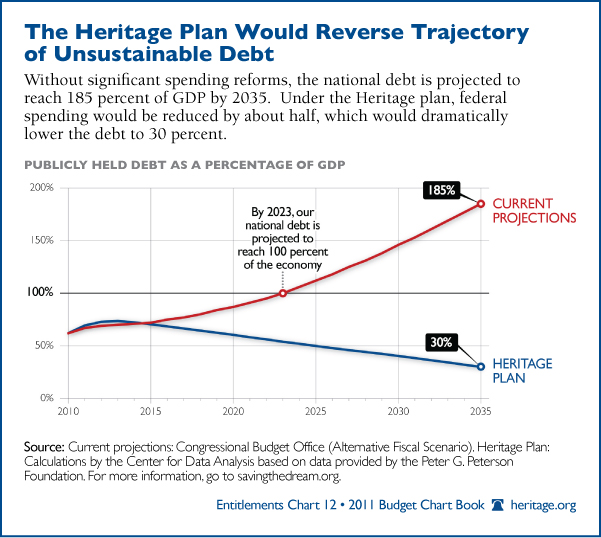
Other than insisting that the rich pay their “fair share,” which The Heritage Foundation has explained is “Fair to No One,” President Obama’s State of the Union address this week did not contain any ideas to get spending and deficits under control. Instead, he proposed even more spending, which of course has to be paid for through higher taxes or borrowing. Doing either will harm the economy further and do nothing to lower the level of debt. Publicly held debt represents about 70 percent of gross domestic product and, driven by expanding entitlement program spending, is on track to surpass 100 percent within a decade, as this chart illustrates.

The credit markets will not stand for this, because they know that a country cannot thrive economically with debt levels that high and rising.

Congress and the President should not let this happen. America needs bold solutions now that solve the spending and debt crisis. Now is the time to change course.

Obama’s budget gets money to his friends and pet causes

On Bloomberg, Sessions Discusses Astounding Gimmicks In President’s Budget

Uploaded by on Feb 13, 2012

___

It is a time to cut the budget and not increase it. However, it seems we are heading the wrong direction with this budget.

Morning Bell: Obama’s Friends Win Big in Budget

Mike Brownfield

February 15, 2012 at 8:44 am

You don’t need to log on to President Barack Obama’s Facebook page to find out who his friends are, and you don’t need to read tea leaves, gaze into a crystal ball, or consult a psychic to learn where his priorities lie. No, you only have to take a look at his 2013 budget, just released on Monday, to see what kind of company the president keeps and to what extent he will go to lend his pals a helping hand.

The folks seated at the president’s head table haven’t changed much in the past few years — the only difference is how much is being served up in the taxpayer-funded buffet. As in the past, the president has plenty of handouts for his big labor buddies. His budget delivers a fourth consecutive annual deficit exceeding $1 trillion — and that spending goes to yet another round of not-so-shovel-ready construction projects and government “investments” totaling $178 billion. Heritage’s Patrick Knudsen writes that the spending includes the president’s favored road, bridge, and school construction projects, but “then they go alarmingly beyond the usual ‘infrastructure’ arguments to fund teachers’ pay.” In other words, unions representing the construction site and the classroom win big.

Other winners in the president’s budget are those who fit into the Administration’s vision of a green economy that is propelled not by the market’s demand, but by Obama’s whim. The 2013 budget proposes to spend $310 million to make solar energy cost-competitive without subsidies by 2020, $290 million to expand R&D on energy efficient manufacturing techniques, and $421 million in fossil energy research and development. Heritage energy expert Nicolas Loris writes that the budget “rejects the notion of a market-based energy industry and wastes taxpayer dollars at a time when we desperately need to curtail out-of-control spending.” In other words, he says, the president’s blueprint is all wrong.

There’s no clearer example of just how wrong the president’s blueprint is than his decision to increase subsidies for electric vehicles like the $41,000 Chevy Volt while ending funding for the D.C. Opportunity Scholarship Program (DCOSP), which gives low-income children in the nation’s capital a chance to escape underperforming schools. The White House intends to increase taxpayer-funded subsidies for those who purchase new-technology vehicles to $10,000 per buyer, up from $7,500. Keep in mind that the average income of a Volt buyer is $175,000 per year. That means that middle-class taxpayers are helping the rich buy pricy, politically correct cars.

With his other hand, President Obama is taking from the poor. The DCOSP provides $8,000 vouchers to 1,600 low-income children in the District of Columbia, empowering them to attend a school that they choose. The program has been a stunning success — though it has drawn criticism from the president’s teachers union allies. If the president gets his way, those children will pay the price.

They won’t be the only ones in their generation, though, who will suffer under the president’s budget. From a big picture perspective, the president’s budget rises from $3.8 trillion to $5.8 trillion in 2022. Putting that into context, that means outlays above 22 percent of gross domestic product — more than twice the New Deal’s share of the economy in its peak years. In constant dollars, outlays are more than three times the peak of World War II. With all that spending, someone will have to pay for it. Whose names will be on the bill? Those under 30 — America’s debt-paying generation. Their entire lives will be dominated by paying down today’s mountains of debt. And some of them are waking up to that fact.

“It will be my generation, rather than the retiring baby boomers, that will be paying off the national debt through higher income taxes,” says Amanda Winkler, 24, a Master’s Student at American University. Shaun Rabenius, 26, is a part-time construction worker and student. He says, “I have never followed politics much, except for when I vote. But in looking at the last decade, the presidencies, and the debt they have accumulated, I am scared out of my mind.”

They’re right to be worried. With a Senate that hasn’t passed a budget in well over 1,000 days and a president who seems intent on spending more, not less, without addressing the country’s underlying budgetary crisis, future generations will soon find that the winners today will make them losers tomorrow.

_________________