Category Archives: spending out of control

An open letter to President Obama (Part 42 of my response to State of Union Speech 1-24-12)

Congressman Rick Crawford State of the Union Response 2012

Uploaded by on Jan 24, 2012

Rep. Rick Crawford responds to the State of the Union address January 24, 2012

President Obama’s state of the union speech Jan 24, 2012

Barack Obama  (Photo by Saul Loeb-Pool/Getty Images)

President Obama c/o The White House
1600 Pennsylvania Avenue NW
Washington, DC 20500

Dear Mr. President,

I know that you receive 20,000 letters a day and that you actually read 10 of them every day. I really do respect you for trying to get a pulse on what is going on out here.

I am an avid reader of the National Review and I remember watching those famous debates at Harvard between John Kenneth Galbraith and William Buckley. You probably were at some of those debates. Below is a portion of an article that talks about your recent State of the Union address:

NATIONAL REVIEW ONLINE          www.nationalreview.com           PRINT

RICHARD VEDDER
While it took President Obama only five minutes into the State of the Union address before he started bashing the rich, Wall Street, and the Chinese, he actually muted his confrontational approach as compared with other recent efforts. Still, it was a typical overlong speech, overstating accomplishments and ignoring negatives. Five examples of the latter: he misstated and dramatically downplayed his failure to stimulate the economy, claiming 3 million new jobs when in fact employment is lower than when he took office.

Second, there was hardly a word about health care, given fierce public opposition to Obamacare.

Third, he spoke about student-loan debt before even mentioning the national debt, where he renewed his tired and empirically indefensible solution of taxing the rich.

Fourth, he announced the Defense Department would push clean energy and somehow we would produce lots of clean energy on federal lands, but ignored the damage created by bowing to environmental Know-Nothing policies that have nixed the Keystone pipeline project and other energy initiatives.

Lastly, he uttered not a word about the huge long-term unfunded liabilities arising from unsustainable entitlement commitments like Social Security and Medicare. In short, it was a tale full of sound and fury, signifying nothing.

— Richard Vedder directs the Center for College Affordability and Productivity, is an adjunct scholar at the American Enterprise Institute, and teaches at Ohio University

Thank you so much for your time. I know how valuable it is. I also appreciate the fine family that you have and your committment as a father and a husband.

Sincerely,

Everette Hatcher III, 13900 Cottontail Lane, Alexander, AR 72002, ph 501-920-5733, lowcostsqueegees@yahoo.com

Washington Post admits stimulus did not work!!!!

Government Spending Doesn’t Create Jobs

Uploaded by on Sep 7, 2011

Share this on Facebook: http://on.fb.me/qnjkn9 Tweet it: http://tiny.cc/o9v9t

In the debate of job creation and how best to pursue it as a policy goal, one point is forgotten: Government doesn’t create jobs. Government only diverts resources from one use to another, which doesn’t create new employment.

Video produced by Caleb Brown and Austin Bragg.

___________________________

 I have said that the stimulus did not work, but the liberals always responded that it needed to be bigger. Who was right? Now the most liberal paper in the country has weighed in on this.

J.D. Foster, Ph.D.

March 6, 2012 at 5:00 pm

Does unprecedented deficit-spending such as on highways stimulate the economy? For the last few years, some have argued it could. Some have argued it might. Some have argued it would if done right.

We have consistently argued that deficit spending on highways or anything else intended to lift aggregate demand, and therefore jobs, must and would fail. The economic evidence that we were right has now been joined by the illustrious trio of The Washington Post, the Associated Press, and the esteemed Alice Rivlin, former director of the Congressional Budget Office and the Office of Management and Budget.

Monday’s edition of the Post carries a story sourced to the Associated Press entitled, “Highway bills pitched as by lawmakers as job creators, but are they really? Economists say no.

Notice especially the subject of the piece: federal highway spending. If ever there was a sympathetic topic for stimulus, it is infrastructure spending, especially highway funding. Remember, these were some of President Obama’s “shovel-ready” projects that turned out to be not so shovel ready, as he later admitted.

So what went wrong? Why is this not short-term stimulus? The widely respected Rivlin explained it clearly and succinctly: “Investments in infrastructure, if well designed, should be viewed as investments in future productivity growth.”

Exactly right—future productivity growth.

She went on to say that if investments in infrastructure “speed the delivery of goods and people, they will certainly do that. They will also create jobs, but not necessarily more jobs than the same money spent in other ways.”

Exactly right—a dollar spent is a dollar spent. A job gained here, a job lost there.

This speaks to a longstanding flaw of highway spending arguments. Proponents argue that this spending creates tens of thousands of jobs, and they are half right. The other half is the tens of thousands of jobs not created (or saved) by shifting spending to highways from other areas in the economy. The valid argument about infrastructure spending is: If done right, it will lift future productivity growth, not current job growth.

The central failing—the essential fiscal alchemy of Keynesian stimulus—is the belief that government can increase total spending in the economy by borrowing and spending. What Keynesians ignore is that we have financial markets whose job in good times and bad is first and foremost to shift funds from savers to investors, from those who have money they do not wish to spend today to those who have a need to borrow to spend as much as they’d like, whether on new business equipment, a home, or a car.

There are no vast sums of “excess funds” just sitting around in bank tellers’ drawers waiting for government to borrow and spend them. Government borrowing means less money available to the private sector to spend. So government deficit spending goes up, and dollar-for-dollar private spending goes down. America’s resources are generally speaking spent less wisely, and the federal debt is unequivocally higher.

If past is prologue, the current infatuation with Keynesian deficit spending as stimulus will fade, just as it always has in the past, in this country as elsewhere. Perhaps this simple WaPo article marks the beginning of the end for the latest incarnation of this fiscal folly.

An open letter to President Obama (Part 41, A response to your budget)

1,000 Days Without A Budget

Uploaded by on Jan 24, 2012

http://blog.heritage.org | Today marks the 1,000th day since the United States Senate has passed a budget. While the House has put forth (and passed) its own budget, the Senate has failed to do the same. To help illustrate how extraordinary this failure has been, our new video highlights a few of impressive feats in history that have been accomplished in less time.

President Obama c/o The White House
1600 Pennsylvania Avenue NW
Washington, DC 20500

Dear Mr. President,

I know that you receive 20,000 letters a day and that you actually read 10 of them every day. I really do respect you for trying to get a pulse on what is going on out here.

I have to be frank and it seems that this budget proposal presented on 2-13-2012 to Congress was just an attempt by a President to get himself re-elected by promising a lot of free lunches to a lot of special interest groups.

Obama’s Budget: This Isn’t Built to Last

Posted by Tad DeHaven

In his recent State of the Union address, President Obama said that he wanted an American economy that is “built to last.” Today’s release of his fiscal 2013 budget proposal shows that the president still thinks he can build economic prosperity with more spending, taxes, and debt. Those are the building materials for an economic time-bomb that will explode on future generations.

The following charts show that federal spending and debt as a share of the economy would remain at elevated levels under the president’s budget proposal:

Given that policymakers always seem to find an excuse to spend more money than was planned – and that there are virtually no limits on what the government can spend money on – these figures could prove to be optimistic.

So forget about the president’s cheap sloganeering about “investing in our future.” And ignore the double-talk about “re-establish[ing] fiscal responsibility.” The fact is the president is proposing to spend $47 trillion dollars over the next ten years – almost $6 trillion of which would go toward interest on the debt alone. This budget isn’t about creating an economy that’s built to last – it’s about keeping the president’s Democratic constituencies satisfied in November and selling voters on the impossible promise of more free lunches.

______________

Thank you so much for your time. I know how valuable it is. I also appreciate the fine family that you have and your committment as a father and a husband.

Sincerely,

Everette Hatcher III, 13900 Cottontail Lane, Alexander, AR 72002, ph 501-920-5733, lowcostsqueegees@yahoo.com

Bigger government hurts economic growth

The Cato Institute videos are always good and these are no different.

New Video Has Important Message: Freedom and Prosperity vs. Big Government and Stagnation

Posted by Daniel J. Mitchell

The folks from the Koch Institute put together a great video a couple of months ago looking at why some nations are rich and others are poor.

That video looked at the relationship between economic freedom and various indices that measure quality of life. Not surprisingly, free markets and small government lead to better results.

Now they have a new video that looks at recent developments in the United States. Unfortunately, you will learn that the U.S. is slipping in the wrong direction.

Uploaded by on Oct 11, 2011

Continue the discussion at http://www.facebook.com/economicfreedom

For years the United States has been a world leader in economic freedom. But runaway government spending and burdensome regulations have caused a decline in economic freedom in the United States. If our economic freedom continues to fall, how will it affect our quality of life?

_________

The entire video is superb, but there are two things that merit special praise, one because of intellectual honesty and the other because of intellectual effectiveness.

1. The refreshingly honest aspect of the video is its non-partisan tone. It explains, in a neutral fashion, that Bush undermined prosperity by making government bigger and that Obama is undermining prosperity by increasing the burden of government.

2. The most important and effective argument in the video, at least from my perspective, is that it shows clearly that a larger government necessarily comes at the expense of the productive sector of the economy. Pay extra-close attention around the 2:00 mark.

It’s also worth pointing out that there are several policies that impact on economic performance. The Koch Institute video focuses primarily on the key issues of fiscal policy and regulation, but trade, monetary policy, property rights, and rule of law are examples of other policies that also are very important.

This video, narrated by yours truly, looks at economic growth from this more comprehensive perspective.

Uploaded by on Feb 17, 2009

Now that the so-called stimulus has been enacted, hopefully policy makers will turn their attention to policies that actually improve economic performance. This Center for Freedom and Prosperity Foundation video reviews the key finding in the Fraser Institute’s Economic Freedom of the World and explains that, contrary to the policies of Presidents Bush and Obama, smaller government and free markets are the way to boost economic growth. For more information: http://www.freedomandprosperity.org

________

The moral of the story from both videos is very straightforward. If the answer is bigger government, you’ve asked a very strange question.

An open letter to President Obama (Part 39 of my response to State of Union Speech 1-24-12)


President Obama’s state of the union speech Jan 24, 2012

Barack Obama  (Photo by Saul Loeb-Pool/Getty Images)

President Obama c/o The White House
1600 Pennsylvania Avenue NW
Washington, DC 20500

Dear Mr. President,

I know that you receive 20,000 letters a day and that you actually read 10 of them every day. I really do respect you for trying to get a pulse on what is going on out here.

The Heritage Foundation website (www.heritage.org ) has lots of good articles and one that caught my attention was concerning your State of Union Speech on January 24, 2012 and here is a short portion of that article:

Social Security Silence David John

In a night of disappointments, the complete lack of any mention of Social Security other than as an excuse to raise taxes was one of the greatest.  Although the Social Security trustees, several of whom are members of the President’s cabinet, has warned that the program faces perpetual deficits, the President evidently has no plan to protect the retirement security of millions of Americans who face a 25% benefit cut in less than 25 years.  Most officeholders join the President in treating Social Security as an issue that can be discussed later – much later, but the reality is that just like a leaky roof, the longer that the President and Congress waits to fix the program, the more expensive the reforms will be.

Tax Reform? It’s Needed, but There’s A Better Way to GoEmily Goff

President Obama says he is ready and willing to embark on tax reform. This is a welcome statement, as our current tax system is ripe for overhaul. However, instead of piecemeal approaches or solutions that give preferences to one industry or company over another, the President should look to the fundamental reforms that the New Flat Tax, as part of The Heritage Foundation’s Saving the American Dream, would bring.

Obama Doubles Down on the Worst U.S. Tax Policy – J.D. Foster

One of the universally acknowledged banes of the federal income tax has for years been the individual Alternative Minimum Tax.  Borne in its current form in the 1986 tax reform act, this parallel system which runs in parallel to the regular income tax forces taxpayers to calculate their taxes twice and pay the larger of the two.

Today, this tax makes no sense, and most tax reform proposals of sufficient heft seek as a primary goal the repeal of the AMT.  Tonight, President Obama proposed not merely to embrace the AMT in principle, but to extend the principle robustly to the business income tax – to create a new basic minimum tax for businesses.  Once again, when it comes to tax policy, President Obama sees what needs to be done – and does the exact opposite.

___________________

Got to tackle entitlement reform but your speech did not mention that once.

Thank you so much for your time. I know how valuable it is. I also appreciate the fine family that you have and your committment as a father and a husband.

Sincerely,

Everette Hatcher III, 13900 Cottontail Lane, Alexander, AR 72002, ph 501-920-5733, lowcostsqueegees@yahoo.com

Senator Pryor asks for Spending Cut Suggestions! Here are a few!(Part 139)

Senator Mark Pryor wants our ideas on how to cut federal spending. Take a look at this video clip below:

Senator Pryor has asked us to send our ideas to him at cutspending@pryor.senate.gov and I have done so in the past and will continue to do so in the future.

On May 11, 2011,  I emailed to this above address and I got this email back from Senator Pryor’s office:

Please note, this is not a monitored email account. Due to the sheer volume of correspondence I receive, I ask that constituents please contact me via my website with any responses or additional concerns. If you would like a specific reply to your message, please visit http://pryor.senate.gov/contact. This system ensures that I will continue to keep Arkansas First by allowing me to better organize the thousands of emails I get from Arkansans each week and ensuring that I have all the information I need to respond to your particular communication in timely manner.  I appreciate you writing. I always welcome your input and suggestions. Please do not hesitate to contact me on any issue of concern to you in the future.

Here are a few more I just emailed to him myself:

  • Enact user fees that recover all the costs of programs with identifiable users, such as:
  1. Requiring agribusinesses and farmers to assume the full cost of their crop insurance coverage (2004 spending: $3,965 million, mandatory); and
  2. Imposing user fees on commodity futures and options contract transactions to help finance the Commodity Futures Trading Commission ($91 million, discretionary).
  • Reform other programs targeted to the wrong recipients by:
  1. Restricting federal housing assistance to those with the greatest need and requiring able-bodied, non-elderly recipients to engage in work-related activities;
  2. No longer providing substantially more federal aid to Howard University than is provided to other private universities;
  3. Limiting Congress’s franking privilege to non-election years to prevent taxpayer funding of campaign mailings; and
  4. Enforcing current laws limiting School Lunch program eligibility to low-income families.

This is how bad it is getting:

The Consequence of Runaway Spending: Budget Deficits

The President's Budget Would Bring Record Budget Deficits ...

Updated version:Rick Crawford falls for Democrats’ trick:raise taxes first and we will cut spending later

RAISE TAXES: Report says Rick Crawford will break from GOP and back millionaires tax.

  • RAISE TAXES: Report says Rick Crawford will break from GOP and back millionaires’ tax.

The Arkansas Times reported that Congressman Rick Crawford has a plan that includes raising taxes for 5 years if there is an agreement to pass the Balanced Budget Amendment. However, if after 5 years the Balanced Budget Amendment does not get passed then the new tax increase would be abolished.

My question to Crawford would be this: “Would the tax money collected during that 5 year period be refunded?”

In 1982 the Democrats promised future spending cuts if Ronald Reagan would agree to a tax increase, but you guessed it, the taxes were increased and the spending cuts never came. THE REAL PROBLEM IS NOT THAT WE DON’T HAVE ENOUGH TAXES BUT WE DON’T WANT TO CUT SPENDING!!!

Washington Could Learn a Lot from a Drug Addict

Concerning spending cuts Reagan believed, that members of Congress “wouldn’t lie to him when he should have known better.” However, can you believe a drug addict when he tells you he is not ever going to do his habit again? Congress is addicted to spending too much money.  Lee Edwards wrote in his article “Golden Years” about Ronald Reagan:

Sometimes Reagan went along with a pragamatist like chief of staff James Baker, who persuaded the president to accept the Tax Equity and Fiscal Responsibility Act of 1982 (TEFRA), which turned out to be the great tax increase of 1982 — $98 billion over the next three years. That was too much for eighty-nine House Republicans (including second-term Congressman Newt Gingrich of Georgia) or for prominent conservative organizations from the American Conservative Union like the Conservative Caucus and the U.S. Chamber of Commerce, which all opposed the measure.

Baker assured his boss that Congress would approve three dollars in spending cuts for every dollar of tax increase. To Reagan, TEFRA looked like a pretty good “70 percent” deal. But Congress wound up cutting less than twenty-seven cents for every new tax dollar. What had seemed to be an acceptable 70-30 compromise turned out to be a 30-70 surrender. Ed Meese described TEFRA as “the greatest domestic error of the Reagan administration,” although it did leave untouched the individual tax rate reductions approved the previous year. (TEFRA was built on a series of business and excise taxes plus the removal of business tax deductions.)[xxx]

The basic problem was that Reagan believed, as Lyn Nofziger put it, that members of Congress “wouldn’t lie to him when he should have known better.”[xxxi] As a result of TEFRA, Reagan learned to “trust but verify,” whether he was dealing with a Speaker of the House or a president of the Soviet Union.

________

Dan Mitchell has a great article on Crawford.

I’ve remarked before that Democrats are the evil party and Republicans are the stupid party. Well, if anyone needs additional proof about GOPers being clueless and tone deaf, exhibit A is Congressman Rick Crawford of Arkansas, who has decided to preemptively capitulate in favor of higher tax rates.

Here are the relevant details from a Politico story.

Freshman Republican Rep. Rick Crawford will propose a surtax on millionaires Thursday morning, a crack in the steadfast GOP opposition to extracting more money from the nation’s top earners. The Arkansas Republican will unveil the plan during a local television interview Thursday morning, and plans to introduce legislation when the House returns next week, according to sources familiar with his thinking. Crawford will propose the additional tax— expected to be north of 2.5 percent — on individual income over $1 million as part of a broader fiscal responsibility package.

I have no idea if Congressman Crawford is simply naive, unaware that tax-increase deals inevitably lead to higher spending and more red ink. Or perhaps he’s trying to become the kind of Republican who thinks he can advance his career by saying things that will earn him pats on the head from the establishment media.

But I do know that America’s fiscal problem is a government that is far too big. You don’t solve the problem with more taxes, just as you don’t cure alcoholics by giving them more to drink.

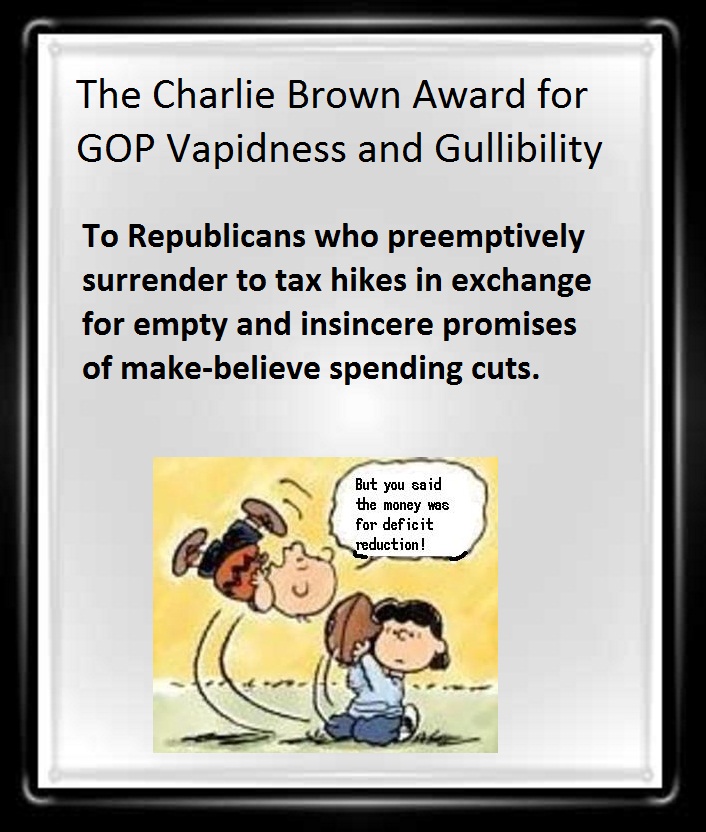
Congressman Crawford, though, wants to give away the keys to a liquor store without even asking for an insincere commitment for future sobriety in exchange. Indeed, the Congressman’s naiveté is so impressive that he is the first winner of the Charlie Brown Award for Vapidness and Gullibility.

There’s a rumor that he is sending former President George H.W. “read my lips” Bush to collect his award, but I’m unable to confirm at this point.

This new award is part of a series, with the “Bob Dole Award” having been announced earlier this year.

In the same vein, but recognizing concepts rather than people, we also have “Mitchell’s Law” and “Mitchell’s Golden Rule.”

____________

UPDATE: Crawford claims the tax would not go into law until the Balanced Budget Amendment was passed according to the Tolbert Report.

Crawford’s Democrat opponents have called him opportunist and they are right.  People go into the booth to vote for the welfare party or the conservative job creating party and they can tell when someone is talking out of both sides of their mouth. It is sad when a newbie don’t talk to someone who has been in the conservative trenches for years fighting the good fight.

Ronald Wilson Reagan versus Barrack Obama

Government Spending Doesn’t Create Jobs

Uploaded by on Sep 7, 2011

Share this on Facebook: http://on.fb.me/qnjkn9 Tweet it: http://tiny.cc/o9v9t

In the debate of job creation and how best to pursue it as a policy goal, one point is forgotten: Government doesn’t create jobs. Government only diverts resources from one use to another, which doesn’t create new employment.

Video produced by Caleb Brown and Austin Bragg.

___________________________

 I have a son named Wilson Daniel Hatcher and he is named after two of the most respected men I have ever read about : Daniel from the Old Testament and Ronald Wilson Reagan.

One of the thrills of my life was getting to hear President Reagan speak in the beginning of November of 1984 at the State House Convention Center in Little Rock.  Immediately after that program I was standing outside on Markham with my girlfriend Jill Sawyer (now wife of 25 years) and we were alone on a corner and the President was driven by and he waved at us and we waved back.

My former pastor from Memphis, Adrian Rogers, got the opportunity to visit with President Ronald Reagan on several occasions and my St Senator Jeremy Hutchinson got to meet him too. I am very jealous.

Today we are going to compare Reagan’s record to that of Obama:

On this day last year, I posted two charts that I developed using the Minneapolis Federal Reserve Bank’s interactive website.

Those two charts showed that the current recovery was very weak compared to the boom of the early 1980s.

But perhaps that was an unfair comparison. Maybe the Reagan recovery started strong and then hit a wall. Or maybe the Obama recovery was the economic equivalent of a late bloomer.

So let’s look at the same charts, but add an extra year of data. Does it make a difference?

Meh…not so much.

Let’s start with the GDP data. The comparison is striking. Under Reagan’s policies, the economy skyrocketed.  Heck, the chart prepared by the Minneapolis Fed doesn’t even go high enough to show how well the economy performed during the 1980s.

Under Obama’s policies, by contrast, we’ve just barely gotten back to where we were when the recession began. Unlike past recessions, we haven’t enjoyed a strong bounce. And this means we haven’t recovered the output that was lost during the downturn.

This is a damning indictment of Obamanomics

Indeed, I made this point several months ago when analyzing some work by Nobel laureate Robert Lucas. And it’s been highlighted more recently by James Pethokoukis of the American Enterprise Institute and the news pages of the Wall Street Journal.

Unfortunately, the jobs chart is probably even more discouraging. As you can see, employment is still far below where it started.

This is in stark contrast to the jobs boom during the Reagan years.

So what does this mean? How do we measure the human cost of the foregone growth and jobs that haven’t been created?

Writing in today’s Wall Street Journal, former Senator Phil Gramm and budgetary expert Mike Solon compare the current recovery to the post-war average as well as to what happened under Reagan.

If in this “recovery” our economy had grown and generated jobs at the average rate achieved following the 10 previous postwar recessions, GDP per person would be $4,528 higher and 13.7 million more Americans would be working today. …President Ronald Reagan’s policies ignited a recovery so powerful that if it were being repeated today, real per capita GDP would be $5,694 higher than it is now—an extra $22,776 for a family of four. Some 16.9 million more Americans would have jobs.

By the way, the Gramm-Solon column also addresses the argument that this recovery is anemic because the downturn was caused by a financial crisis. That’s certainly a reasonable argument, but they point out that Reagan had to deal with the damage caused by high inflation, which certainly wreaked havoc with parts of the financial system. They also compare today’s weak recovery to the boom that followed the financial crisis of 1907.

But I want to make a different point. As I’ve written before, Obama is not responsible for the current downturn. Yes, he was a Senator and he was part of the bipartisan consensus for easy money, Fannie/Freddie subsidies, bailout-fueled moral hazard, and a playing field tilted in favor of debt, but his share of the blame wouldn’t even merit an asterisk.

My problem with Obama is that he hasn’t fixed any of the problems. Instead, he has kept in place all of the bad policies – and in some cases made them worse. Indeed, I challenge anyone to identify a meaningful difference between the economic policy of Obama and the economic policy of Bush.

  • Bush increased government spending. Obama has been increasing government spending.
  • Bush adopted Keynesian “stimulus” policies. Obama adopted Keynesian “stimulus” policies.
  • Bush bailed out politically connected companies. Obama has been bailing out politically connected companies.
  • Bush supported the Fed’s easy-money policy. Obama has been supporting the Fed’s easy-money policy.
  • Bush created a new healthcare entitlement. Obama created a new healthcare entitlement.
  • Bush imposed costly new regulations on the financial sector. Obama imposed costly new regulations on the financial sector.

I could continue, but you probably get the  point. On economic issues, the only real difference is that Bush cut taxes and Obama is in favor of higher taxes. Though even that difference is somewhat overblown since Obama’s tax policies – up to this point – haven’t had a big impact on the overall tax burden (though that could change if his plans for higher tax rates ever go into effect).

This is why I always tell people not to pay attention to party labels. Bigger government doesn’t work, regardless of whether a politician is a Republican or Democrat. The problem isn’t Obamanomics, it’s Bushobamanomics. But since that’s a bit awkward, let’s just call it statism.

Cato Institute:Spending is our problem Part 6

But we also know that it is difficult to convince politicians to do what’s right for the nation. And if they don’t change the course of fiscal policy, and we leave the federal government on autopilot, then America is doomed to become another Greece.

The combination of poorly designed entitlement programs (mostly Medicare and Medicaid) and an aging population will lead to America’s fiscal collapse.

People think that we need to raise more revenue but I say we need to cut spending. Take a look at a portion of this article from the Cato Institute:

The Damaging Rise in Federal Spending and Debt

by Chris Edwards

Joint Economic Committee
United States Congress

Joint Economic CommitteeUnited States Congress

Added to cato.org on September 20, 2011

This testimony was delivered on September 20, 2011.

Conclusions

Federal spending is soaring, and government debt is piling up at more than a trillion dollars a year. Official projections show rivers of red ink for years to come unless policymakers enact major budget reforms. Unless spending and deficits are cut, the United States is headed for economic ruin as growth falls and rising debt threatens further financial crises.

Policymakers should turn their full attention to long-run spending reforms. They should begin terminating the many unneeded and damaging federal programs that draw resources out of the private sector and sap the economy’s strength. The essays on Cato’s website http://www.DownsizingGovernment.org describe many federal programs that produce low or negative returns. Programs often create economic distortions, damage the environment, restrict individual freedom, or have high levels of fraud and abuse.

I’ve proposed a plan to cut spending on entitlements, defense, and discretionary spending over 10 years to balance the budget.25 Spending reforms should aim to revive constitutional federalism and reverse the expansion of the federal government into areas better left to state and local governments, businesses, charities, and individuals.

Some analysts worry that spending cuts would hurt the economy, but other high-income nations have cut spending with very positive results. In the mid-1990s, for example, Canada faced a debt crisis caused by runaway spending — similar to our current situation. But the Canadian government changed course and slashed total spending 10 percent in just two years — which would be like us chopping annual spending by $360 billion in two years.26 Total government spending in Canada was cut by more than 10 percentage points of GDP over a decade. The Canadian economy did not sink into a recession as Keynesian economists might fear, but instead was launched on a 15-year economic boom.

A recent Joint Economic Committee report summarizes other international examples of spending cuts coinciding with strong economic growth.27 Thus, spending cuts should not be viewed as bad tasting medicine needed only to cure our debt disease, but as an opportunity to create positive and lasting benefits to the economy and society.

Thank you for holding these important hearings.


Notes:
.
25 http://www.DownsizingGovernment.org/balanced-budget-plan.
26 See http://www.cato-at-liberty.org/cutting-government-the-canadian-way and see http://www.cato-at-liberty.org/canadas-spending-cuts-and-economic-growth.
27 Joint Economic Committee, “Spend Less, Owe Less, Grow the Economy,” Republican Staff, March 15, 2011

Dear Senator Pryor, why not pass the Balanced Budget Amendment? (“Thirsty Thursday”, Open letter to Senator Pryor)

Dear Senator Pryor,

Why not pass the Balanced  Budget amendment? As you know that federal deficit is at all time high (1.6 trillion deficit with revenues of 2.2 trillion and spending at 3.8 trillion).

On my blog www.HaltingArkansasLiberalswithTruth.com I took you at your word and sent you over 100 emails with specific spending cut ideas. However, I did not see any of them in the recent debt deal that Congress adopted. Now I am trying another approach. Every week from now on I will send you an email explaining different reasons why we need the Balanced Budget Amendment. It will appear on my blog on “Thirsty Thursday” because the government is always thirsty for more money to spend.

Marco Rubio is one of your fellow citizens and he noted:

A balanced budget amendment would be a necessary step in reversing Washington’s tax-borrow-spend mantra. It would force Congress to balance its budget each year – not allow it to pass our problems on to the next generation any longer.

The Balanced Budget Amendment is the only thing I can think of that would force Washington to cut spending. We have only a handful of balanced budgets in the last 60 years, so obviously what we are doing is not working. We are passing along this debt to the next generation.

Thank you for this opportunity to share my ideas with you.

Sincerely,

Everette Hatcher, lowcostsqueegees@yahoo.com

 In my two short months in office, it has become clear to me that the spending problem in Washington is far worse than many of us feared. For years, politicians have blindly poured more and more borrowed money into ineffective government programs, leaving us with trillion dollar deficits and a crippling debt burden that threatens prosperity and economic growth.

In the Florida House of Representatives, where a balanced budget is a requirement, we had to make the tough choices to cut spending where necessary because it was required by state law. By no means was this an easy process, but it was our duty as elected officials to be accountable to our constituents and to future generations of Floridians. In Washington, a balanced budget amendment is not just a fiscally-responsible proposal, it’s a necessary step to curb politicians’ decades-long penchant for overspending.

Several senators have proposed balanced budget amendments that ensure Congress will not spend a penny more than we take in, while setting a high hurdle for future tax hikes. I am a co-sponsor of two balanced budget amendments, since it is clear that these measures would go a long way to reversing the spending gusher we’ve seen from Washington in recent years.

During my Senate campaign, while surrounded by the employees of Jacksonville’s Meridian Technologies, I proposed 12 simple ways to cut spending in Washington. That company, founded 13 years ago, has grown into a 200-employee, high-tech business, and the ideas I proposed would help ensure that similar companies have the opportunity to start or expand just like Meridian did.

To be clear, our unsustainable debt and deficits are threatening companies like Meridian and impeding job creation. In addition to proposing a balanced budget amendment, I recommended canceling unspent “stimulus” funds, banning all earmarks and returning discretionary spending to 2008 levels.

Fortunately, some of my ideas have found their way to the Senate chamber. The first bill I co-sponsored in the Senate was to repeal ObamaCare, the costly overhaul of our nation’s health care system that destroys jobs and impedes our economic recovery. Democratic leaders in the Senate have expressed their willingness to ban earmarks for two years after the Senate Republican conference adopted a moratorium. I have also co-sponsored the REINS Act, a common-sense measure that would increase accountability and transparency in our outdated and burdensome regulatory process. These bills, along with a balanced budget amendment, would help get our country back on a sustainable path and provide certainty to job creators.

While Republicans are proposing a variety of ideas to rein in Washington’s out-of-control spending, unfortunately, President Obama’s budget for the upcoming fiscal year proposes to spend $46 trillion, and even in its best year, the deficit would remain above $600 billion. Worst of all, the President’s budget completely avoids addressing the biggest drivers of our long-term debt – Social Security, Medicare and Medicaid.

Rather than tackle these tough, serious issues, President Obama is proposing a litany of tax hikes on small businesses and entrepreneurs, to the tune of more than $1.6 trillion. These tax increases destroy jobs, make us less competitive internationally and hurt our efforts to grow the economy and get our fiscal house in order.

A balanced budget amendment would be a necessary step in reversing Washington’s tax-borrow-spend mantra. It would force Congress to balance its budget each year – not allow it to pass our problems on to the next generation any longer.

Marco Rubio

Marco Rubio, a Republican, is a U.S. senator from Florida and former speaker of the Florida House of Representatives