Category Archives: spending out of control

Bill Clinton getting praise from Cato Institute

Spending Restraint, Part I: Lessons from Ronald Reagan and Bill Clinton

Uploaded by on Feb 14, 2011

Ronald Reagan and Bill Clinton both reduced the relative burden of government, largely because they were able to restrain the growth of domestic spending. The mini-documentary from the Center for Freedom and Prosperity uses data from the Historical Tables of the Budget to show how Reagan and Clinton succeeded and compares their record to the fiscal profligacy of the Bush-Obama years.

______________

I wish we could get a budget that did not spend away our children’s future. Dan Mitchell of the Cato Institute feels the same way about this issue and he actually praises Democratic President Bill Clinton from Arkansas for his efforts to keep spending down in the 1990’s. Take a look:

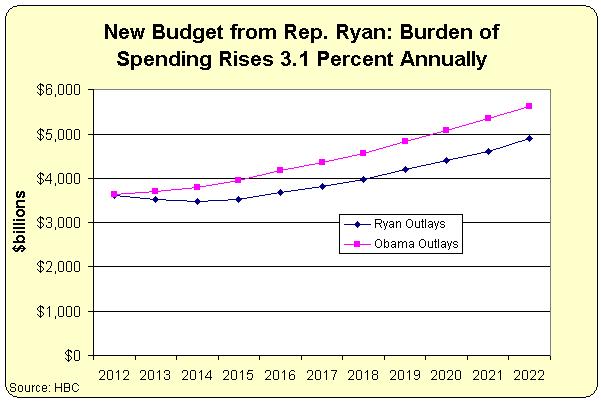
A couple of weeks ago, I offered some guarded praise for Paul Ryan’s budget, pointing out that it satisfies the most important requirement of fiscal policy by restraining spending – to an average of 3.1 percent per year over the next 10 years – so that government grows slower than the productive sector of the economy (I call this my Golden Rule).

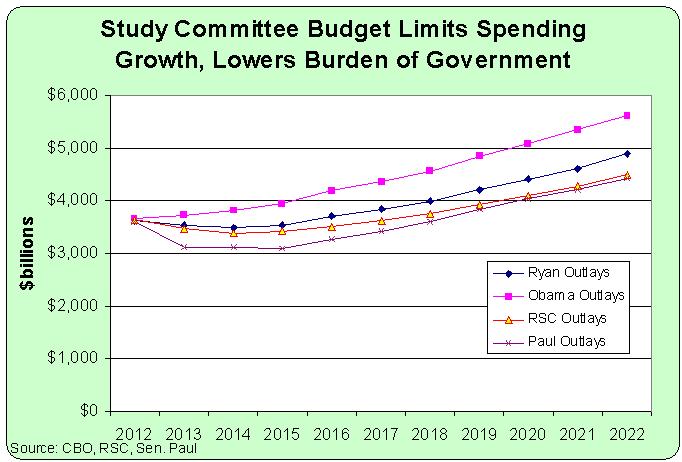
I was more effusive in my comments about Senator Rand Paul’s budget, which limited the growth of the federal budget over the next 10 years to an average of 2.2 percent each year.

Now the Republican Study Committee from the House of Representatives has put forth a plan that also deserves considerable applause. Like Senator Paul, the RSC plan would impose immediate significant fiscal discipline such that spending in 2017 would be about the same level as it is this year.

Think of this as being similar to the very successful fiscal reforms of New Zealand and Canada in the 1990s.

After the initial period of spending restraint, the budget would be allowed to grow, but only about as fast as the private economy. This chart shows spending levels for the Obama budget, the Paul Ryan budget, the Rand Paul budget, and the RSC budget.

A couple of final points.

1. For all the whining and complaining from the pro-spending lobbies, the RSC budget is hardly draconian. Federal spending, measured as a share of GDP, would only drop to where it was when Bill Clinton left office.

2. One preferable feature of the Rand Paul budget is that the Kentucky Senator eliminates four needless and wasteful federal departments – Commerce, Education, Energy, and Housing and Urban Development. As far as I can tell, no departments are eliminated in the RSC plan. Also, Senator Paul’s plan is bolder on tax reform, scrapping the corrupt internal revenue code and replacing it with a simple and fair flat tax.

3. The RSC comes perilously close to winning a Bob Dole Award. The first chapter of their proposal fixates on symptoms of debt and deficits rather than the real problem of excessive government spending. Indeed, the first six charts all relate to deficits and debt, creating an easy opening for leftists to say they can solve the mis-defined problem with higher taxes.

There are lots of other details worth exploring, but the main lesson is that restraining spending is the key to good fiscal policy.

And that’s what’s happening.  Indeed, the good news is that policymakers have proposed several budget plans that would shrink the burden of spending as a share of GDP. It’s refreshing to debate the features of several good plans (rather than comparing the warts in the competing plans during the big-government Bush years).

The bad news is that Harry Reid and Barack Obama will succeed in blocking any progress this year, so America will move ever closer to becoming another Greece.

____________

Spending Restraint, Part II: Lessons from Canada, Ireland, Slovakia, and New Zealand

Uploaded by on Feb 22, 2011

Nations can make remarkable fiscal progress if policy makers simply limit the growth of government spending. This video, which is Part II of a series, uses examples from recent history in Canada, Ireland, Slovakia, and New Zealand to demonstrate how it is possible to achieve rapid improvements in fiscal policy by restraining the burden of government spending. Part I of the series examined how Ronald Reagan and Bill Clinton were successful in controlling government outlays — particularly the burden of domestic spending programs. www.freedomandprosperity.org

______________

Dan Mitchell of the Cato Institute takes on entitlement reform

It is the elephant in the room that nobody wants to talk about. Here Dan Mitchell takes it on.

Most people have a vague understanding that America has a huge long-run fiscal problem.

They’re right, though they probably don’t realize the seriousness of that looming crisis.

Here’s what you need to know: America’s fiscal crisis is actually a spending crisis, and that spending crisis is driven by entitlements.

More specifically, the vast majority of the problem is the result of Medicaid, Medicare, and Social Security, programs that are poorly designed and unsustainable.

America needs to fix these programs…or eventually become another Greece.

Fortunately, all of the problems can be solved, as these three videos demonstrate.

The first video explains how to fix Medicaid.

Promote Federalism and Replicate the Success of Welfare Reform with Medicaid Block Grants

Uploaded by on Jun 26, 2011

The Medicaid program imposes high costs while generating poor results. This Center for Freedom and Prosperity Foundation video explains how block grants, such as the one proposed by Congressman Paul Ryan, will save money and improve healthcare by giving states the freedom to innovate and compete.

The second video shows how to fix Medicare.

Saving Medicare: Free Market Reforms Are Better than Bureaucratic Rationing

Uploaded by on May 17, 2011

This Center for Freedom and Prosperity Foundation video explains how a “premium-support” plan would solve Medicare’s fiscal crisis and improve the overall healthcare system. This voucher-based system also would protect seniors from bureaucratic rationing. http://www.freedomandprosperity.org

And the final video shows how to fix Social Security.

Saving Social Security with Personal Retirement Accounts

Uploaded by on Jan 10, 2011

There are two crises facing Social Security. First the program has a gigantic unfunded liability, largely thanks to demographics. Second, the program is a very bad deal for younger workers, making them pay record amounts of tax in exchange for comparatively meager benefits. This video explains how personal accounts can solve both problems, and also notes that nations as varied as Australia, Chile, Sweden, and Hong Kong have implemented this pro-growth reform. www.freedomandprosperity.org

_______________________

Regular readers know I’m fairly gloomy about the future of liberty, but this is one area where there is a glimmer of hope.

The Chairman of the House Budget Committee actually put together a plan that addresses the two biggest problems (Medicare and Medicaid) and the House of Representatives actually adopted the proposal.

The Senate didn’t act, of course, and Obama would veto any good legislation anyhow, so I don’t want to be crazy optimistic. Depending on how things play out politically in the next six years, I’ll say there’s actually a 20 percent chance to save America.

HERITAGE FOUNDATION INTERVIEW:Sen. Mitch McConnell: Americans Don’t Approve of Anything Obama Has Done

Sen. Mitch McConnell: Americans Don’t Approve of Anything Obama Has Done

Uploaded by on Dec 8, 2011

In an exclusive interview at The Heritage Foundation, Senate Minority Leader Mitch McConnell (R-KY) sharply criticized President Obama for engaging in class warfare and accused him of shifting the focus away from his own failed policies in advance of next year’s election.

“My view is he’ll have a hard time convincing Americans he deserves four more years of this,” McConnell said. “There’s nothing he’s done the American people approve of, so of course, he’s trying to change the subject.”

HERITAGE FOUNDATION INTERVIEW:Sen. Rand Paul on Occupy Wall Street, Repealing No Child Left Behind

Sen. Rand Paul on Occupy Wall Street, Repealing No Child Left Behind

Uploaded by on Oct 18, 2011

The latest iteration of No Child Left Behind comes before a Senate committee tomorrow with bipartisan support. But if Sen. Rand Paul (R-KY) has anything to say about it, the bill won’t go anywhere fast.

Paul also addressed the ongoing Occupy Wall Street protest in New York and similar demonstrations taking place across America. He warned of the “mob mentality” on display and the “lurking danger” of the movement.

Paul, the Tea Party favorite who won election last November, has promised to introduce 100 amendments to No Child Left Behind which comes before a Senate committee tomorrow, including a complete repeal of the legislation.

Ryan’s plan better than Democrat’s plan but not as good as Rand Paul’s

Promote Federalism and Replicate the Success of Welfare Reform with Medicaid Block Grants

Uploaded by on Jun 26, 2011

The Medicaid program imposes high costs while generating poor results. This Center for Freedom and Prosperity Foundation video explains how block grants, such as the one proposed by Congressman Paul Ryan, will save money and improve healthcare by giving states the freedom to innovate and compete

__________

President Obama thinks the answer to our budget problem is to raise taxes. I disagree and think that we must restrain spending and reform entitlements.

Below is an article by Dan Mitchell of the Cato Institute on the Ryan plan.

The Chairman of the House Budget Committee has produced a new budget plan which contrasts very favorably with the tax-heavy, big-spending proposal submitted by the President last month.

Perhaps most important, Congressman Ryan’s plan restrains spending growth, allowing the private sector to grow faster than the burden of government, thus satisfying Mitchell’s Golden Rule so that spending falls as a share of GDP.

The most important detail in the proposal is that the federal budget, which currently consumes 24 percent of GDP, would fall to less than 20 percent of GDP beginning in 2016.

That’s the good news. There are three pieces of not-so-good news.

1. Ryan’s plan allows spending to grow by an average of 3.1 percent annually over the next 10 years, with is faster than the 2.8 percent average annual growth in last year’s budget.

2. His proposed Medicare reform, while far better than current law, also is not as good as what was proposed last year.

3. The federal budget would still consume a greater share of the economy’s output than it did when Bill Clinton left office.

I suppose it’s also worth mentioning that Ryan’s proposal isn’t as good as Rand Paul’s budget. Spending only climbs 2.2 percent yearly under the plan put together by the Kentucky Senator, and he also abolishes several useless cabinet-level departments.

But the very good shouldn’t be the enemy of the good. As noted already, Congressman Ryan’s plan meets the most important test, which is restraining spending so that the federal budget grows slower than the private economy. And, as the chart shows, he obviously imposes more fiscal restrain then President Obama.

Regular readers know that I generally show no mercy to jelly-spined Republicans, but I praised GOPers for approving last year’s Ryan budget. The same will be true if they approve this year’s version.

P.S. I am frustrated and nauseated by all the people who are fixating on whether Congressman Ryan’s plan balances the budget in 10 years, 20 years, or whenever. What matters is shrinking the burden of government. I hereby bestow the Bob Dole Award on all the people who are mistakenly focusing on the symptom of red ink rather than the underlying disease of bloated government.

P.P.S. I’m happy to report that there is no value-added tax in the revenue portion of Congressman Ryan’s budget. There is a VAT in his Roadmap plan, and I endlessly worry that this poison pill will re-emerge and ruin other good fiscal plans put forth by the Wisconsin lawmaker.

_______

Saving Medicare: Free Market Reforms Are Better than Bureaucratic Rationing

Uploaded by on May 17, 2011

This Center for Freedom and Prosperity Foundation video explains how a “premium-support” plan would solve Medicare’s fiscal crisis and improve the overall healthcare system. This voucher-based system also would protect seniors from bureaucratic rationing. http://www.freedomandprosperity.org


Senator Pryor asks for Spending Cut Suggestions! Here are a few!(Part 140)

Senator Mark Pryor wants our ideas on how to cut federal spending. Take a look at this video clip below:

Senator Pryor has asked us to send our ideas to him at cutspending@pryor.senate.gov and I have done so in the past and will continue to do so in the future.

On May 11, 2011,  I emailed to this above address and I got this email back from Senator Pryor’s office:

Please note, this is not a monitored email account. Due to the sheer volume of correspondence I receive, I ask that constituents please contact me via my website with any responses or additional concerns. If you would like a specific reply to your message, please visit http://pryor.senate.gov/contact. This system ensures that I will continue to keep Arkansas First by allowing me to better organize the thousands of emails I get from Arkansans each week and ensuring that I have all the information I need to respond to your particular communication in timely manner.  I appreciate you writing. I always welcome your input and suggestions. Please do not hesitate to contact me on any issue of concern to you in the future.

Here are a few more I just emailed to him myself:

GUIDELINE #7: Consolidate duplicative and contradictory programs.
Government’s layering of new programs on top of old ones inherently creates duplication. Having several agencies perform similar duties is wasteful and confuses program beneficiaries who must navigate each program’s distinct rules and requirements.
Some overlap is inevitable because some agencies are defined by whom they serve (e.g., veterans, Native Americans, urbanites, and rural families), while others are defined by what they provide (e.g., housing, education, health care, and economic development). When these agencies’ constituencies overlap, as in veterans housing or rural economic development, each relevant agency will often have its own program. With 342 separate economic development programs, the federal government needs to make consolidation a priority

This is how bad it is getting:

  • From 1989 through 2008, annual budget deficits averaged $210 billion (adjusted for inflation).
  • President Bush handed President Obama a $1.2 trillion deficit for 2009. Obama added more than $200 billion to it.
  • President Bush’s budget deficits averaged $447 billion. President Obama’s budget shows average deficits of $851 billion over the eight years he would serve if he wins a second term.
  • President Obama’s budget would double the publicly held national debt by 2020.

HERITAGE FOUNDATION INTERVIEW:Senator Marco Rubio Talks Cuba, Budget and Obamacare

Senator Marco Rubio Talks Cuba, Budget and Obamacare

Uploaded by on Mar 22, 2012

http://blog.heritage.org/2012/03/22/exclusive-interview-sen-marco-rubio-talks… | Pope Benedict XVI will visit the communist island of Cuba next week. But while there, the Catholic leader has no plans to visit Cuban dissidents who are fighting for freedom from the Castro regime.

Sen. Marco Rubio (R-FL), born to Cuban immigrants, told us in an exclusive interview Wednesday that the pope should make time to see dissidents. Rubio was at Heritage to promote freedom in Cuba, particularly as it relates to technology and Internet access.

HERITAGE FOUNDATION INTERVIEW:Rep. Paul Ryan Blames Obama for Dividing America

Rep. Paul Ryan Blames Obama for Dividing America

Uploaded by on Oct 28, 2011

Rep. Paul Ryan (R-WI) is mighty disappointed with President Obama. The chairman of the House Budget Committee, who has bested Obama in head-to-head policy showdowns, blames the president for failing to outline a solution to the debt crisis while dividing America with talk of class warfare.

Ryan’s speech at Heritage yesterday made news for its strong critique of Obama. He sat down for an interview afterward to outline why he’s so disheartened by Obama. Ryan also redefined how Americans should look at class warfare, taking aim at crony capitalism and the politically connected who drive American further into debt.

Despite the monumental challenges facing America, Ryan said he remains an optimist. He’s hopeful the Joint Select Committee on Deficit Reduction will include some of the House-passed budget reforms in its final report.

The interview runs 5 minutes. Hosted by Rob Bluey and produced by Kyle Tuckness with the help of Hannah Sternberg. For more videos from Heritage, subscribe to our YouTube channel.

Listing of transcripts and videos of “Free to Choose” episode 4 – From Cradle to Grave on www.theDailyHatch.org

In the last few years the number of people receiving Food Stamps has skyrocketed. President Obama has not cut any federal welfare programs but has increased them, and he  has used class warfare over and over the last few months and according to him equality at the finish line is the equality that we should all be talking about. However, socialism has never worked and it has always killed incentive to produce more. Milton Friedman shows in this film series below how so many people get caught in the “Welfare Trap.” Friedman also gives a great solution to this problem in the “negative income tax.” I am glad that I had the chance to be studying his work for over 30 years now.

In 1980 when I first sat down and read the book “Free to Choose” I was involved in Ronald Reagan’s campaign for president and excited about the race. Milton Friedman’s books and film series really helped form my conservative views. Take a look at one of my favorite films of his:

Friedman Friday:(“Free to Choose” episode 4 – From Cradle to Grave, Part 1 of 7)

Volume 4 – From Cradle to Grave
Abstract:

Since the Depression years of the 1930s, there has been almost continuous expansion of governmental efforts to provide for people’s welfare. First, there was a tremendous expansion of public works. The Social Security Act followed close behind. Soon other efforts extended governmental activities in all areas of the welfare sector. Growth of governmental welfare activity continued unabated, and today it has reached truly staggering proportions. Travelling in both Britain and the U.S., Milton Friedman points out that though many government welfare programs are well intentioned, they tend to have pernicious side effects. In Dr. Friedman’s view, perhaps the most serious shortcoming of governmental welfare activities is their tendency to strip away individual independence and dignity. This is because bureaucrats in welfare agencies are placed in positions of tremendous power over welfare recipients, exercising great influence over their lives. Because people never spend someone else’s money as carefully as they spend their own, inefficiency, waste, abuse, theft, and corruption are inevitable. In addition, welfare programs tend to be self-perpetuating because they destroy work incentives. Indeed, it is often in the welfare recipients’ best interests to remain unemployed. Dr. Friedman suggests a negative income tax as a way of helping the poor. The government would pay money to people falling below a certain income level. As they obtained jobs and earned money, they would continue to receive some payments from the government until their outside income reached a certain ceiling. This system would make people better off who sought work and earned income. This contrasts with many of today’s programs where one dollar earned means nearly one dollar lost in welfare payments.

Volume 4 – From Cradle to Grave
Transcript:
Friedman: After the 2nd World War, New York City authorities retained rent control supposedly to help their poorer citizens. The intentions were good. This in the Bronx was one result.
By the 50’s the same authorities were taxing their citizens. Including those who lived in the Bronx and other devastated areas beyond the East River to subsidize public housing. Another idea with good intentions yet poor people are paying for this, subsidized apartments for the well-to-do. When government at city or federal level spends our money to help us, strange things happen.
The idea that government had to protect us came to be accepted during the terrible years of the Depression. Capitalism was said to have failed. And politicians were looking for a new approach.
Franklin Delano Roosevelt was a candidate for the presidency. He was governor of New York State. At the governor’s mansion in Albany, he met repeatedly with friends and colleagues to try to find some way out of the Depression. The problems of the day were to be solved by government action and government spending. The measures that FDR and his associates discussed here derived from a long line of past experience. Some of the roots of these measures go back to Bismark’s Germany at the end of the 19th Century. The first modern state to institute old age pensions and other similar measures on the part of government. In the early 20th Century Great Britain followed suit under Lloyd George and Churchill. It too instituted old age pensions and similar plans.
These precursors of the modern welfare state had little effect on practice in the United States. But they did have a very great effect on the intellectuals on the campus like those who gathered here with FDR. The people who met here had little personal experience of the horrors of the Depression but they were confident that they had the solution. In their long discussions as they sat around this fireplace trying to design programs to meet the problems raised by the worst Depression in the history of the United States, they quite naturally drew upon the ideas that were prevalent at the time. The intellectual climate had become one in which it was taken for granted that government had to play a major role in solving the problems in providing what came later to be called Security from Cradle to Grave.
Roosevelt’s first priority after his election was to deal with massive unemployment. A Public Works program was started. The government financed projects to build highways, bridges and dams. The National Recovery Administration was set up to revitalize industry. Roosevelt wanted to see America move into a new era. The Social Security Act was passed and other measures followed. Unemployment benefits, welfare payments, distribution of surplus food. With these measures, of course, came rules, regulations and red tape as familiar today as they were novel then. The government bureaucracy began to grow and it’s been growing ever since.
This is just a small part of the Social Security empire today. Their headquarters in Baltimore has 16 rooms this size. All these people are dispensing our money with the best possible intentions. But at what cost?
In the 50 years since the Albany meetings, we have given government more and more control over our lives and our income. In New York State alone, these government buildings house 11,000 bureaucrats. Administering government programs that cost New York taxpayers 22 billion dollars. At the federal level, the Department of Health, Education and Welfare alone has a budget larger than any government in the world except only Russia and the United States.
Yet these government measures often do not help the people they are supposed to. Richard Brown’s daughter, Helema, needs constant medical attention. She has a throat defect and has to be connected to a breathing machine so that she’ll survive the nights. It’s expensive treatment and you might expect the family to qualify for a Medicaid grant.
Richard Brown: No, I don’t get it, cause I’m not eligible for it. I make a few dollars too much and the salary that I make I can’t afford to really live and to save anything is out of the question. And I mean, I live, we live from payday to payday. I mean literally from payday to payday.
Friedman: His struggle isn’t made any easier by the fact that Mr. Brown knows that if he gave up his job as an orderly at the Harlem Hospital, he would qualify for a government handout. And he’d be better off financially.
Hospital Worker: Mr. Brown, do me a favor please? There is a section patient.
Friedman: It’s a terrible pressure on him. But he is proud of the work that he does here and he’s strong enough to resist the pressure.
Richard Brown: I’m Mr. Brown. Your fully dilated and I’m here to take you to the delivery. Try not to push, please. We want to have a nice sterile delivery.
Friedman: Mr. Brown has found out the hard way that welfare programs destroy an individual’s independence.
Richard Brown: We’ve considered welfare. We went to see, to apply for welfare but, we were told that we were only eligible for $5.00 a month. And, to receive this $5.00 we would have to cash in our son’s savings bonds. And that’s not even worth it. I don’t believe in something for nothing anyway.
Mrs. Brown: I think a lot of people are capable of working and are willing to work, but it’s just the way it is set up. It, the mother and the children are better off if the husband isn’t working or if the husband isn’t there. And this breaks up so many poor families.
Friedman: One of the saddest things is that many of the children whose parents are on welfare will in their turn end up in the welfare trap when they grow up. In this public housing project in the Bronx, New York, 3/4’s of the families are now receiving welfare payments.
Well Mr. Brown wanted to keep away from this kind of thing for a very good reason. The people who get on welfare lose their human independence and feeling of dignity. They become subject to the dictates and whims of their welfare supervisor who can tell them whether they can live here or there, whether they may put in a telephone, what they may do with their lives. They are treated like children, not like responsible adults and they are trapped in the system. Maybe a job comes up which looks better than welfare but they are afraid to take it because if they lose it after a few months it maybe six months or nine months before they can get back onto welfare. And as a result, this becomes a self-perpetuating cycle rather than simply a temporary state of affairs.
Things have gone even further elsewhere. This is a huge mistake. A public housing project in Manchester, England.
Well we’re 3,000 miles away from the Bronx here but you’d never know it just by looking around. It looks as if we are at the same place. It’s the same kind of flats, the same kind of massive housing units, decrepit even though they were only built 7 or 8 years ago. Vandalism, graffiti, the same feeling about the place. Of people who don’t have a great deal of drive and energy because somebody else is taking care of their day to day needs because the state has deprived them of an incentive to find jobs to become responsible people to be the real support for themselves and their families.

Other segments:

Milton Friedman Friday:(“Free to Choose” episode 4 – From Cradle to Grave, Part 7 of 7)

I am currently going through his film series “Free to Choose” which is one the most powerful film series I have ever seen. TEMIN: We don’t think the big capital arose before the government did? VON HOFFMAN: Listen, what are we doing here? I mean __ defending big government is like defending death and taxes. […]

Milton Friedman Friday:(“Free to Choose” episode 4 – From Cradle to Grave, Part 6 of 7)

I am currently going through his film series “Free to Choose” which is one the most powerful film series I have ever seen worked pretty well for a whole generation. Now anything that works well for a whole generation isn’t entirely bad. From the fact __ from that fact, and the undeniable fact that things […]

Milton Friedman discusses Reagan and Reagan discusses Friedman

Uploaded by YAFTV on Aug 19, 2009 Nobel Laureate Dr. Milton Friedman discusses the principles of Ronald Reagan during this talk for students at Young America’s Foundation’s 25th annual National Conservative Student Conference MILTON FRIEDMAN ON RONALD REAGAN In Friday’s WSJ, Milton Friedman reflectedon Ronald Reagan’s legacy. (The link should work for a few more […]

Milton Friedman Friday:(“Free to Choose” episode 4 – From Cradle to Grave, Part 5 of 7)

 I am currently going through his film series “Free to Choose” which is one the most powerful film series I have ever seen. PART 5 of 7 MCKENZIE: Ah, well, that’s not on our agenda actually. (Laughter) VOICE OFF SCREEN: Why not? MCKENZIE: I boldly repeat the question, though, the expectation having been __ having […]

War on poverty is a failure in USA

Milton Friedman’s solution to limiting poverty Liberals just don’t get it. They should listen to Milton Friedman (who is quoted in this video below concerning the best way to limit poverty). New Video Shows the War on Poverty Is a Failure Posted by Daniel J. Mitchell The Center for Freedom and Prosperity has released another […]

Milton Friedman Friday: (“Free to Choose” episode 4 – From Cradle to Grave, Part 4 of 7)

 I am currently going through his film series “Free to Choose” which is one the most powerful film series I have ever seen. PART 4 of 7 The massive growth of central government that started after the depression has continued ever since. If anything, it has even speeded up in recent years. Each year there […]

Milton Friedman Friday: (“Free to Choose” episode 4 – From Cradle to Grave, Part 3 of 7)

 I am currently going through his film series “Free to Choose” which is one the most powerful film series I have ever seen. PART 3 OF 7 Worse still, America’s depression was to become worldwide because of what lies behind these doors. This is the vault of the Federal Reserve Bank of New York. Inside […]


Milton Friedman Friday:(“Free to Choose” episode 4 – From Cradle to Grave, Part 2 of 7)

 I am currently going through his film series “Free to Choose” which is one the most powerful film series I have ever seen. For the past 7 years Maureen Ramsey has had to buy food and clothes for her family out of a government handout. For the whole of that time, her husband, Steve, hasn’t […]

Friedman Friday:(“Free to Choose” episode 4 – From Cradle to Grave, Part 1 of 7)

Friedman Friday:(“Free to Choose” episode 4 – From Cradle to Grave, Part 1 of 7) Volume 4 – From Cradle to Grave Abstract: Since the Depression years of the 1930s, there has been almost continuous expansion of governmental efforts to provide for people’s welfare. First, there was a tremendous expansion of public works. The Social Security Act […]

An open letter to President Obama (Part 47, A response to your budget)

Corker Says President’s 2012 Budget Proposal Shows “Lack of Urgency” on Spending

Uploaded by on Feb 14, 2011

In remarks on the Senate floor today, U.S. Senator Bob Corker, R-Tenn., expressed disappointment in President Obama’s 2012 budget proposal, saying it displayed a “lack of urgency” to get federal spending under control. Corker has introduced the CAP Act to dramatically cut federal spending over the next decade.

__________________

President Obama c/o The White House
1600 Pennsylvania Avenue NW
Washington, DC 20500

Dear Mr. President,

I know that you receive 20,000 letters a day and that you actually read 10 of them every day. I really do respect you for trying to get a pulse on what is going on out here.

Your budget proposal is filling with bloated spending and therefore I wanted to drop a line to you.

It is true that the USA is a very powerful country in many ways, but it also true that we are BROKE AND OWE MORE THAN ANY OTHER COUNTRY IN THE WORLD. That reminds me of the mighty shark in this picture below that is swallowed whole. It was so mighty until it was brought down by another giant. Our giant problem in the USA is our debt and we need to run from it as fast as we can.

Photo by Daniela Ceccarelli

National Geographic has released this soon-to-be classic photograph of one shark eating another shark whole.

The photo comes from Daniela Ceccarelli, of Australia’s Research Council Center of Excellence for Coral Reef Studies.  Ceccarelli was working with fellow researcher David Williamson on conducting a “fish census” off Great Keppel Island, part of the country’s Great Barrier Reef. That’s when Ceccarelli thought she spotted a brown-banded bamboo shark hanging out near the ocean’s floor.

“The first thing that caught my eye was the almost translucent white of the bamboo shark,” Ceccarelli told National Geographic in an email. Instead, as Ceccarelli moved in for a closer look she noticed a camouflaged wobbegong shark emerging from seclusion with the same bamboo shark partially wedged inside its jaws.

“It became clear that the head of the bamboo shark was hidden in its mouth,” she said. “The bamboo shark was motionless and definitely dead.”

As the New Scientist explains, Wobbegongs, aka carpet sharks, are silent predators, waiting at the bottom of the ocean floor for their pray to pass by. And as stunning as this photo may be, it’s not uncommon for Wobbegongs to devour such large meals. Like several kinds of snakes, the Wobbegong has a dislocating jaw and rearward-pointing teeth that help it consume disproportionately large prey.

Thank you so much for your time. I know how valuable it is. I also appreciate the fine family that you have and your committment as a father and a husband.

Sincerely,

Everette Hatcher III, 13900 Cottontail Lane, Alexander, AR 72002, ph 501-920-5733, lowcostsqueegees@yahoo.com

Related posts:

A mighty shark is swallowed whole just like USA being swallowed by debt

It is true that the USA is a very powerful country in many ways, but it also true that we are BROKE AND OWE MORE THAN ANY OTHER COUNTRY IN THE WORLD. That reminds me of the mighty shark in this picture below that is swallowed whole. Photo by Daniela Ceccarelli National Geographic has released […]

Each American’s Share of National Debt Is Growing

Each American’s Share of National Debt Is Growing Everyone wants to know more about the budget and here is some key information with a chart from the Heritage Foundation and a video from the Cato Institute. As Washington continues to spend more than it can afford, future generations of taxpayers will be on the hook for increasing levels […]

Senator Pryor asks for Spending Cut Suggestions! Here are a few!(Part 134)

Senator Mark Pryor wants our ideas on how to cut federal spending. Take a look at this video clip below: Senator Pryor has asked us to send our ideas to him at cutspending@pryor.senate.gov and I have done so in the past and will continue to do so in the future. On May 11, 2011,  I emailed to […]

Dear Senator Pryor, why not pass the Balanced Budget Amendment? ( “Thirsty Thursday,” Open letter to Senator Pryor)

Dear Senator Pryor,  Why not pass the Balanced Budget Amendment? As you know that federal deficit is at all time high (1.6 trillion deficit with revenues of 2.2 trillion and spending at 3.8 trillion). On my blog www.HaltingArkansasLiberalswithTruth.com I took you at your word and sent you over 100 emails with specific spending cut ideas. However, I did […]

Protectionism does not work

Do you think protectionism would help, in the long run, if we don’t implement pro-growth reforms? Sometimes I wonder what are the motives of those who oppose free trade. Eight Questions for Protectionists Posted by Daniel J. Mitchell When asked to pick my most frustrating issue, I could list things from my policy field such as […]

Van Jones liberal alternative movement doomed to fail

Van Jones liberal alternative movement doomed to fail There is such an angry response to the message of the Tea Party, but is there any choice but to cut spending? Why Van Jones’ Anti-Tea Party Will Fail Brandon Stewart June 24, 2011 at 4:47 pm He talks about “rebuilding America,” but his ideas will do […]

Ron Paul’s opinion of Fed

I really like Ron Paul a lot. OCTOBER 20, 2011 Blame the Fed for the Financial Crisis The Fed fails to grasp that an interest rate is a price, the price of time. Attempting to manipulate that price is as destructive as any other government price control. By RON PAUL To know what is wrong with […]

Norquist is right, Brantley is wrong

Max Brantley went on another tyrade about raising taxes instead of cutting spending (“How to raise taxes,” Arkansas Times Blog, November 28, 2011). However, spending is the main problem and it appears that Democrats do not want to cut a dime. Instead, they blame Glover Norquist for all their problems. Does Norquist deserve all the […]