Category Archives: spending out of control

Listing of transcripts and videos of “Free to Choose” episode 4 – From Cradle to Grave on www.theDailyHatch.org

In the last few years the number of people receiving Food Stamps has skyrocketed. President Obama has not cut any federal welfare programs but has increased them, and he  has used class warfare over and over the last few months and according to him equality at the finish line is the equality that we should all be talking about. However, socialism has never worked and it has always killed incentive to produce more. Milton Friedman shows in this film series below how so many people get caught in the “Welfare Trap.” Friedman also gives a great solution to this problem in the “negative income tax.” I am glad that I had the chance to be studying his work for over 30 years now.

In 1980 when I first sat down and read the book “Free to Choose” I was involved in Ronald Reagan’s campaign for president and excited about the race. Milton Friedman’s books and film series really helped form my conservative views. Take a look at one of my favorite films of his:

Friedman Friday:(“Free to Choose” episode 4 – From Cradle to Grave, Part 1 of 7)

Volume 4 – From Cradle to Grave
Abstract:

Since the Depression years of the 1930s, there has been almost continuous expansion of governmental efforts to provide for people’s welfare. First, there was a tremendous expansion of public works. The Social Security Act followed close behind. Soon other efforts extended governmental activities in all areas of the welfare sector. Growth of governmental welfare activity continued unabated, and today it has reached truly staggering proportions. Travelling in both Britain and the U.S., Milton Friedman points out that though many government welfare programs are well intentioned, they tend to have pernicious side effects. In Dr. Friedman’s view, perhaps the most serious shortcoming of governmental welfare activities is their tendency to strip away individual independence and dignity. This is because bureaucrats in welfare agencies are placed in positions of tremendous power over welfare recipients, exercising great influence over their lives. Because people never spend someone else’s money as carefully as they spend their own, inefficiency, waste, abuse, theft, and corruption are inevitable. In addition, welfare programs tend to be self-perpetuating because they destroy work incentives. Indeed, it is often in the welfare recipients’ best interests to remain unemployed. Dr. Friedman suggests a negative income tax as a way of helping the poor. The government would pay money to people falling below a certain income level. As they obtained jobs and earned money, they would continue to receive some payments from the government until their outside income reached a certain ceiling. This system would make people better off who sought work and earned income. This contrasts with many of today’s programs where one dollar earned means nearly one dollar lost in welfare payments.

Volume 4 – From Cradle to Grave
Transcript:
Friedman: After the 2nd World War, New York City authorities retained rent control supposedly to help their poorer citizens. The intentions were good. This in the Bronx was one result.
By the 50’s the same authorities were taxing their citizens. Including those who lived in the Bronx and other devastated areas beyond the East River to subsidize public housing. Another idea with good intentions yet poor people are paying for this, subsidized apartments for the well-to-do. When government at city or federal level spends our money to help us, strange things happen.
The idea that government had to protect us came to be accepted during the terrible years of the Depression. Capitalism was said to have failed. And politicians were looking for a new approach.
Franklin Delano Roosevelt was a candidate for the presidency. He was governor of New York State. At the governor’s mansion in Albany, he met repeatedly with friends and colleagues to try to find some way out of the Depression. The problems of the day were to be solved by government action and government spending. The measures that FDR and his associates discussed here derived from a long line of past experience. Some of the roots of these measures go back to Bismark’s Germany at the end of the 19th Century. The first modern state to institute old age pensions and other similar measures on the part of government. In the early 20th Century Great Britain followed suit under Lloyd George and Churchill. It too instituted old age pensions and similar plans.
These precursors of the modern welfare state had little effect on practice in the United States. But they did have a very great effect on the intellectuals on the campus like those who gathered here with FDR. The people who met here had little personal experience of the horrors of the Depression but they were confident that they had the solution. In their long discussions as they sat around this fireplace trying to design programs to meet the problems raised by the worst Depression in the history of the United States, they quite naturally drew upon the ideas that were prevalent at the time. The intellectual climate had become one in which it was taken for granted that government had to play a major role in solving the problems in providing what came later to be called Security from Cradle to Grave.
Roosevelt’s first priority after his election was to deal with massive unemployment. A Public Works program was started. The government financed projects to build highways, bridges and dams. The National Recovery Administration was set up to revitalize industry. Roosevelt wanted to see America move into a new era. The Social Security Act was passed and other measures followed. Unemployment benefits, welfare payments, distribution of surplus food. With these measures, of course, came rules, regulations and red tape as familiar today as they were novel then. The government bureaucracy began to grow and it’s been growing ever since.
This is just a small part of the Social Security empire today. Their headquarters in Baltimore has 16 rooms this size. All these people are dispensing our money with the best possible intentions. But at what cost?
In the 50 years since the Albany meetings, we have given government more and more control over our lives and our income. In New York State alone, these government buildings house 11,000 bureaucrats. Administering government programs that cost New York taxpayers 22 billion dollars. At the federal level, the Department of Health, Education and Welfare alone has a budget larger than any government in the world except only Russia and the United States.
Yet these government measures often do not help the people they are supposed to. Richard Brown’s daughter, Helema, needs constant medical attention. She has a throat defect and has to be connected to a breathing machine so that she’ll survive the nights. It’s expensive treatment and you might expect the family to qualify for a Medicaid grant.
Richard Brown: No, I don’t get it, cause I’m not eligible for it. I make a few dollars too much and the salary that I make I can’t afford to really live and to save anything is out of the question. And I mean, I live, we live from payday to payday. I mean literally from payday to payday.
Friedman: His struggle isn’t made any easier by the fact that Mr. Brown knows that if he gave up his job as an orderly at the Harlem Hospital, he would qualify for a government handout. And he’d be better off financially.
Hospital Worker: Mr. Brown, do me a favor please? There is a section patient.
Friedman: It’s a terrible pressure on him. But he is proud of the work that he does here and he’s strong enough to resist the pressure.
Richard Brown: I’m Mr. Brown. Your fully dilated and I’m here to take you to the delivery. Try not to push, please. We want to have a nice sterile delivery.
Friedman: Mr. Brown has found out the hard way that welfare programs destroy an individual’s independence.
Richard Brown: We’ve considered welfare. We went to see, to apply for welfare but, we were told that we were only eligible for $5.00 a month. And, to receive this $5.00 we would have to cash in our son’s savings bonds. And that’s not even worth it. I don’t believe in something for nothing anyway.
Mrs. Brown: I think a lot of people are capable of working and are willing to work, but it’s just the way it is set up. It, the mother and the children are better off if the husband isn’t working or if the husband isn’t there. And this breaks up so many poor families.
Friedman: One of the saddest things is that many of the children whose parents are on welfare will in their turn end up in the welfare trap when they grow up. In this public housing project in the Bronx, New York, 3/4’s of the families are now receiving welfare payments.
Well Mr. Brown wanted to keep away from this kind of thing for a very good reason. The people who get on welfare lose their human independence and feeling of dignity. They become subject to the dictates and whims of their welfare supervisor who can tell them whether they can live here or there, whether they may put in a telephone, what they may do with their lives. They are treated like children, not like responsible adults and they are trapped in the system. Maybe a job comes up which looks better than welfare but they are afraid to take it because if they lose it after a few months it maybe six months or nine months before they can get back onto welfare. And as a result, this becomes a self-perpetuating cycle rather than simply a temporary state of affairs.
Things have gone even further elsewhere. This is a huge mistake. A public housing project in Manchester, England.
Well we’re 3,000 miles away from the Bronx here but you’d never know it just by looking around. It looks as if we are at the same place. It’s the same kind of flats, the same kind of massive housing units, decrepit even though they were only built 7 or 8 years ago. Vandalism, graffiti, the same feeling about the place. Of people who don’t have a great deal of drive and energy because somebody else is taking care of their day to day needs because the state has deprived them of an incentive to find jobs to become responsible people to be the real support for themselves and their families.

Other segments:

Milton Friedman Friday:(“Free to Choose” episode 4 – From Cradle to Grave, Part 7 of 7)

I am currently going through his film series “Free to Choose” which is one the most powerful film series I have ever seen. TEMIN: We don’t think the big capital arose before the government did? VON HOFFMAN: Listen, what are we doing here? I mean __ defending big government is like defending death and taxes. […]

Milton Friedman Friday:(“Free to Choose” episode 4 – From Cradle to Grave, Part 6 of 7)

I am currently going through his film series “Free to Choose” which is one the most powerful film series I have ever seen worked pretty well for a whole generation. Now anything that works well for a whole generation isn’t entirely bad. From the fact __ from that fact, and the undeniable fact that things […]

Milton Friedman discusses Reagan and Reagan discusses Friedman

Uploaded by YAFTV on Aug 19, 2009 Nobel Laureate Dr. Milton Friedman discusses the principles of Ronald Reagan during this talk for students at Young America’s Foundation’s 25th annual National Conservative Student Conference MILTON FRIEDMAN ON RONALD REAGAN In Friday’s WSJ, Milton Friedman reflectedon Ronald Reagan’s legacy. (The link should work for a few more […]

Milton Friedman Friday:(“Free to Choose” episode 4 – From Cradle to Grave, Part 5 of 7)

 I am currently going through his film series “Free to Choose” which is one the most powerful film series I have ever seen. PART 5 of 7 MCKENZIE: Ah, well, that’s not on our agenda actually. (Laughter) VOICE OFF SCREEN: Why not? MCKENZIE: I boldly repeat the question, though, the expectation having been __ having […]

War on poverty is a failure in USA

Milton Friedman’s solution to limiting poverty Liberals just don’t get it. They should listen to Milton Friedman (who is quoted in this video below concerning the best way to limit poverty). New Video Shows the War on Poverty Is a Failure Posted by Daniel J. Mitchell The Center for Freedom and Prosperity has released another […]

Milton Friedman Friday: (“Free to Choose” episode 4 – From Cradle to Grave, Part 4 of 7)

 I am currently going through his film series “Free to Choose” which is one the most powerful film series I have ever seen. PART 4 of 7 The massive growth of central government that started after the depression has continued ever since. If anything, it has even speeded up in recent years. Each year there […]

Milton Friedman Friday: (“Free to Choose” episode 4 – From Cradle to Grave, Part 3 of 7)

 I am currently going through his film series “Free to Choose” which is one the most powerful film series I have ever seen. PART 3 OF 7 Worse still, America’s depression was to become worldwide because of what lies behind these doors. This is the vault of the Federal Reserve Bank of New York. Inside […]


Milton Friedman Friday:(“Free to Choose” episode 4 – From Cradle to Grave, Part 2 of 7)

 I am currently going through his film series “Free to Choose” which is one the most powerful film series I have ever seen. For the past 7 years Maureen Ramsey has had to buy food and clothes for her family out of a government handout. For the whole of that time, her husband, Steve, hasn’t […]

Friedman Friday:(“Free to Choose” episode 4 – From Cradle to Grave, Part 1 of 7)

Friedman Friday:(“Free to Choose” episode 4 – From Cradle to Grave, Part 1 of 7) Volume 4 – From Cradle to Grave Abstract: Since the Depression years of the 1930s, there has been almost continuous expansion of governmental efforts to provide for people’s welfare. First, there was a tremendous expansion of public works. The Social Security Act […]

Obama’s big government solutions have not worked

Government Spending Doesn’t Create Jobs

Uploaded by on Sep 7, 2011

Share this on Facebook: http://on.fb.me/qnjkn9 Tweet it: http://tiny.cc/o9v9t

In the debate of job creation and how best to pursue it as a policy goal, one point is forgotten: Government doesn’t create jobs. Government only diverts resources from one use to another, which doesn’t create new employment.

Video produced by Caleb Brown and Austin Bragg.

___________________________

I don’t understand why people think that big government is the answer for everything when what the federal government should do is get out of the way. Cutting taxes and regulations would help us get out of the recession!!

Obama Has Tried All the Wrong Policies

by Daniel J. Mitchell

Daniel J. Mitchell is a top expert on tax reform and supply-side tax policy at the Cato Institute.

Added to cato.org on March 13, 2012

This article appeared in U.S. News & World Report on March 13, 2012

The Minneapolis Federal Reserve Bank has a very useful interactive website that allows anybody to compare recessions and recoveries during the post-World War II era. It takes only a couple of clicks to complete the exercise, and does not reflect well on the current occupant of the White House—as you can see at this link.

This does not mean that Obama caused the economic downturn. That was the result of policies that were implemented during the Bush years (though the current president was a big supporter of the Fannie Mae and Freddie Mac subsidies that played such a big role in the financial crisis). Indeed, the recession officially began in December 2007, more than one year before Obama’s inauguration.

Taking money out of the economy’s productive sector and letting politicians engage in a spending spree is the opposite of prudent policy.

But we can hold the president at least partially responsible for an extraordinarily weak and slow recovery. It’s been nearly three years since the recession officially ended in June 2009, yet jobs are still well below their pre-recession levels. And overall economic output, or gross domestic product, has just now finally gotten back to where it was when the downturn began.

This is an anemic record. Especially since an economy normally enjoys a strong bounce when coming out of a deep recession.

Daniel J. Mitchell is a top expert on tax reform and supply-side tax policy at the Cato Institute.


More by Daniel J. Mitchell

The problem is that Obama has tried all the wrong policies. He tried a big-spending Keynesian package that was supposed to be a “stimulus,” butthat’s the same failed approach that Bush tried in 2008, the same failed approach that Japan tried in the 1990s, and the same failed approach that Hoover and Roosevelt tried in the 1930s. Taking money out of the economy’s productive sector and letting politicians engage in a spending spree is the opposite of prudent policy.

The president also has continuously expanded subsidies for unemployment, even though academic scholars (and even left-wing economists) all agree that such policies cause more joblessness.

And now he’s demanding higher tax rates, holding a Sword of Damocles over entrepreneurs, investors, and small business owners.

The nation recently endured eight years of a big-spending interventionist in the White House. The problem with Obama is that he promised hope and change, but he’s continuing the failed statist policies of his predecessor.

“Feedback Friday” Letter to White House generated form letter response (on deficit spending) Jan 25, 2011 (part 1)

I have been writing President Obama letters and have not received a personal response yet.  (He reads 10 letters a day personally and responds to each of them.) However, I did receive a form letter in the form of an email on January 25, 2011. I don’t know which letter of mine generated this response so I have linked several of the letters I sent to him below with the email that I received, but maybe it was this letter below:

Government Spending Doesn’t Create Jobs

Uploaded by on Sep 7, 2011

Share this on Facebook: http://on.fb.me/qnjkn9 Tweet it: http://tiny.cc/o9v9t

In the debate of job creation and how best to pursue it as a policy goal, one point is forgotten: Government doesn’t create jobs. Government only diverts resources from one use to another, which doesn’t create new employment.

Video produced by Caleb Brown and Austin Bragg.

_________

President Obama c/o The White House
1600 Pennsylvania Avenue NW
Washington, DC 20500

Dear Mr. President,

I know that you receive 20,000 letters a day and that you actually read 10 of them every day. I really do respect you for trying to get a pulse on what is going on out here.

Judging from what you had to say in your State of the Union address you haven’t changed at all. You still believe we should make “investments” but what you really mean is that government can provide everyone jobs. I just don’t believe that and I don’t believe you are brave enough to make the tough cuts in government spending to bring down out federal spending from almost 25% of GDP to more acceptable levels like under 19% under Clinton.

After saddling the nation with trillion-dollar boondoggles like the faux stimulus and Obamacare, I’m not sure it’s possible for Obama to reinvent himself as a budget cutter before the election.

But I welcome converts, even ones that are insincere, so I’m happy he’s at least pretending to want to deal with waste and duplication in the federal budget.

Here’s a blurb from the Daily Beast about his new idea.

President Barack Obama is seeking the power to merge agencies in a bid to shrink the federal government in a sweeping move. Obama will ask Congress to give him authority to consolidate six trade and commerce agencies that have overlapping programs, cutting up to 2,000 jobs and saving $3 billion over 10 years. He’ll call for a vote by Congress within 90 days.

But I’ll definitely wait to see the fine print. After all, the President claimed in 2009 that he was directing his Cabinet to find $100 million of budget cuts.

“I hate pretending to be a fiscal conservative”
But even that trivial gesture (almost immeasurably small compared to t a$3.6 trillion budget) turned out to be empty rhetoric.

And even if he’s serious about this latest plan, $3 billion of saving over 10 years is chicken feed compared to all of his new spending.

But if you allow me to modify an old saying, a journey of tens of trillions of dollars begins with the first $3 billion.

__________

Thank you so much for your time. I know how valuable it is. I also appreciate the fine family that you have and your commitment as a father and a husband.

Sincerely,

Everette Hatcher III, 13900 Cottontail Lane, Alexander, AR 72002, ph 501-920-5733, lowcostsqueegees@yahoo.com

The White House, Washington January 25, 2012
  Dear Friend:

Thank you for writing.  President Obama has heard from many Americans concerning the ongoing debate about our national debt and his budget for Fiscal Year 2012, and we want to make sure you are aware of some relevant information about these important issues.

The President is committed to working in a bipartisan way to solve the fiscal challenges before us while continuing to grow the economy and create jobs.  The debt-ceiling compromise removes the cloud of uncertainty over the economy, and takes important steps toward reducing our deficit.  This is just the first step, and the President supports a balanced approach to creating a larger plan for the long-term health of our economy. 

Thank you, again, for writing.  President Obama is grateful to hear from thousands of Americans each day, and we appreciate your taking the time to contact the White House.

Sincerely,

The White House

An open letter to President Obama

 Milton Friedman’s Free to Choose (1980), episode 1 – Power of the Market. part 1 January 29, 2012 President Obama c/o The White House 1600 Pennsylvania Avenue NW Washington, DC 20500 Dear Mr. President, I know that you receive 20,000 letters a day and that you actually read 10 of them every day. I really […]

An open letter to President Obama jh100

 January 25, 2012 President Obama c/o The White House 1600 Pennsylvania Avenue NW Washington, DC 20500 Dear Mr. President, I know that you receive 20,000 letters a day and that you actually read 10 of them every day. I really do respect you for trying to get a pulse on what is going on out […]

An open letter to President Obama

January 27, 2012 President Obama c/o The White House 1600 Pennsylvania Avenue NW Washington, DC 20500 Dear Mr. President, I know that you receive 20,000 letters a day and that you actually read 10 of them every day. I really do respect you for trying to get a pulse on what is going on out […]

An open letter to President Obama

January 26, 2012 President Obama c/o The White House 1600 Pennsylvania Avenue NW Washington, DC 20500 Dear Mr. President, I know that you receive 20,000 letters a day and that you actually read 10 of them every day. I really do respect you for trying to get a pulse on what is going on out […]

An open letter to President Obama

  January 25, 2012 President Obama c/o The White House 1600 Pennsylvania Avenue NW Washington, DC 20500 Dear Mr. President, I know that you receive 20,000 letters a day and that you actually read 10 of them every day. I really do respect you for trying to get a pulse on what is going on […]

President Obama’s plan is failing and he is attacking all opposing plans

I really believe that we should balance the budget now!!! I really don’t understand how people can seriously think that bringing in 2.2 trillion while spending almost double that can continue very long without us heading to Greece.

President Obama recently was critical of Paul Ryan’s plan and he said some very hateful words like “social darwinism” about it. Yet Democratic President left office with our government spending 18.2 % of GDP when Ryan’s plan spends much more than that!!! Is Obama attacking other plans because his is failing?

Alison Acosta Fraser

April 3, 2012 at 1:28 pm

Why would the President, elected to the highest office in the land, stoop to attack a plan authored by the Chairman of the House Budget Committee, Paul Ryan (R–WI)? It’s a budget whose individual policies stand virtually no chance of ever becoming law, if for no other reason than the President’s own veto pen.

Obama has chosen to directly criticize the plan. In doing so, he curiously elevates Ryan to the level of contender, worthy of direct presidential attention in a contentious election year. Why not just let this plan die quietly in the Senate, as Harry Reid (D–NV) has already promised? Perhaps Obama is stinging from the sound rejection of his own budget proposal. Not a single Democrat voted in for it in the House last week. Last year’s budget fared no better in the Senate. It is Obama who truly has the radical plan: Do nothing.

Perhaps the President is worried about his own policies. He should be; they have failed to get the economy’s engines revving at full speed, and unemployment is still unacceptably high. On his watch, the debt has increased dramatically. Despite his lofty rhetoric about “an obligation to future generations to address our long-term, structural deficits, which threaten to hobble our economy and leave our children and grandchildren with a mountain of debt,” his plan would do nothing. This year Obama proposed, again, a budget which fails to tackle the twin crises of spending and debt and hikes taxes to unprecedented levels with divisive class warfare arguments. So, as a counter to his failure to lead us away from the fiscal abyss, Obama has chosen to attack Ryan and the House budget with scary rhetoric about Trojan horses, social Darwinism, and a radical vision for the country. (And whining about President George W. Bush’s policies—the great bulk of which Obama has maintained—doesn’t cut it any more.) Americans are a smart lot and are not fooled easily.

This is really about two visions for the future of the country. Under one, we follow in the footsteps of Greece and Italy, replete with debt crises and an economic and cultural meltdown and in the end, vastly higher taxes. Under another, we return to our smaller government roots with lower spending and lower taxation—for all Americans—and unshackle our system of free enterprise so Americans from all walks of life can seize opportunity.

Under Obama’s vision, we close our eyes and pretend that big government has all the answers to every risk and problem in society, real or perceived. Under Obama’s vision, fairness and prosperity come from spreading the wealth around and the government picking winners and losers. Crony capitalism, waste, and corruption capture the headlines. We do nothing about our entitlement crisis and instead pretend it doesn’t exist, while driving health care further into the clutches of unelected government bureaucrats and away from patient-centered care. Under Obama’s vision, we get crushing levels of debt or crippling levels of taxation, and America’s younger generations pay the price in terms of lost freedom, opportunity, and prosperity. Obama truly has the radical plan.

Many of Ryan’s proposals are similar to proposals in Heritage’s Saving the American Dream plan. Under Ryan’s vision, health care is moved away from bureaucrats and into the hands of patients and their doctors. It starts with the repeal of Obamacare, which adds trillions in new government spending and puts the government in the middle of Americans’ health care decisions. The President doesn’t fix entitlements in his budget or his health law; instead, Obamacare ends Medicare as we know it by raiding it to pay for other new programs and handing control over to an unelected board of officials to further ratchet down its cost through perpetuation of the flawed price control model.

The Ryan budget takes a better route to preserve both the Medicare program and patient choice. It builds a premium support system for America’s seniors to choose a health plan that suits them best, expanding upon the success of choice and competition that seniors already experience today under the Medicare prescription drug program. Ryan’s vision would drive down costs without meddling from Washington and would preserve Medicare for today’s and tomorrow’s seniors. His budget also addresses the need for change in Medicaid, reforming the program’s financing to remove incentives for its runaway costs and encouraging states to improve the quality of the program for beneficiaries.

Rather than punitive tax hikes, Ryan would tackle the entire mess of today’s tax code with the goals of increasing growth, wages, and of course jobs. It’s not that affluent American’s aren’t part of the solution in the Ryan plan. But rather than raising their taxes, Ryan simply reduces the taxpayer-funded contributions to their benefits. Taxes stay low, and so does spending. Under Ryan’s plan, defending the nation is a priority, not a casualty. Under Ryan’s plan—passed by the House of Representatives—today’s soaring spending levels decline, the level of debt stabilizes and then declines, while taxes are kept at roughly their historical level.

Under the President’s vision, we walk squarely and knowingly into a Grecian-style debt and democratic crisis. Under Ryan’s vision, we correct course and unshackle opportunity for all Americans. No, Obama has the truly radical plan. Curious he would choose to highlight it to the American people.

Obama on Ryan Plan: “It’s Laughable. It Is a Trojan Horse. It’s Thinly-Veiled Social Darwinism.”

Dan Mitchell of the Cato Institute has hit a home run with this post. If Congressman Paul Ryan could get criticized for wanting to bring down our federal spending to around 20% in 11 years  and earn the label of “social darwinist” from President Obama then surely President Obama would have thought President Clinton’s effort to cut spending to 18.2 % of GDP in 2001 as extremely devilish.

Dear Senator Pryor, why not pass the Balanced Budget Amendment? (“Thirsty Thursday”, Open letter to Senator Pryor)

Dear Senator Pryor,

Why not pass the Balanced  Budget Amendment? As you know that federal deficit is at all time high (1.6 trillion deficit with revenues of 2.2 trillion and spending at 3.8 trillion).

On my blog www.HaltingArkansasLiberalswithTruth.com I took you at your word and sent you over 100 emails with specific spending cut ideas. However, I did not see any of them in the recent debt deal that Congress adopted. Now I am trying another approach. Every week from now on I will send you an email explaining different reasons why we need the Balanced Budget Amendment. It will appear on my blog on “Thirsty Thursday” because the government is always thirsty for more money to spend.

The Case for a Balanced Budget

By Bruce Bialosky

12/20/2010


No objective is more important for the new Congress than putting America on course toward a balanced federal budget. We used to balance our budget regularly but, except for a short period during the late 1990’s, Congress has been unable to accomplish what should be a clear-cut mission. Americans understand that deficit spending may be unavoidable in wartime or in a Katrina-like emergency, but we also believe that in the absence of these events, there is no excuse for irresponsibly increasing our national debt.

Unfortunately, our national agenda no longer seems to include a balanced budget. President Obama established a national debt commission (whose report I will address in a future column), but that was only after cranking up federal expenditures and deficits to previously unseen levels.

We all know that the big enchiladas in the Federal budget are Social Security, Medicare and Medicaid, and national defense. That still leaves a lot of money to be saved elsewhere, yet even these opportunities are far too often belittled by elitists. For example, Jackie Calmes, a New York Times reporter, wrote that while there is general agreement on an earmark ban, “… [it] would hardly dent the projected annual deficits.” Paul Krugman, her colleague at the Times and the current economic guru of the left, routinely dismisses any savings at all, his most recent tantrum being Obama’s proposal for a two-year freeze on pay raises. He states “The actual savings, about $5 billion over two years, are chump change given the scale of the deficit.” These are two examples that occurred within days – and I could probably cite hundreds more, from both sides of the aisle.

The United States has a budget crisis that should be met by expenditure reductions, but our government has acted only with foolishness and cowardice. Let’s say your employer came to you and said “Look, the company is struggling, but I can keep you on if we reduce your annual salary from $80,000 to $70,000.” You would go home, sit down with your spouse, and figure out where you can start saving money. You could skip the Saturday night movies and join Netflix. You could learn to live without HBO. You could stop getting water delivered to the house. The bottom line is that you would adjust your expenditures because you have no choice; after all, you can’t print money or sell bonds to your neighbors. Not even to China.

What our government is doing has been going on for hundreds of years, ever since the Rothschilds made their fortune lending monies to the monarchies of Europe, and it has become an international problem of gargantuan proportions. Political leaders all over the world are making fiscal promises that they cannot keep, and this irresponsible practice has exploded in the past seventy-five years with the advent of left-wing, socialist governments. Overspending has become so pervasive that our society makes fun of it. In his recent HBO special, Dennis Miller spoke about not understanding the deficit. Miller said that he asked his son if he was upset that his generation would be saddled with the national debt. His son replied “Christ no Dad, I’m just going to saddle my kids with it.” It was good for a laugh – but Miller would never force his own kids to pay his credit card bills.

Virtually every parent I have ever met worries about what will be left for their children or grandchildren when they die. These people understand that it is immoral and sinful to leave their kids a pile of debt. Yet when it comes to the government – for which we are all responsible – people perceive it as some amorphous entity that can merrily spend more each year than it takes in without any consequences. They believe government, apparently, can pay for everything.

And unfortunately we do. Prodded by spineless and corrupt politicians who consider power far more important than responsibility, government has become the fixer of all our problems. People can live in a flood plain without insurance and then get paid by the government to rebuild in that same flood plain only to be wiped out again in the next flood. Every challenge that we have in this country is being discussed by a commission that lasts forever without ever solving the problem. Responsible Americans put their hand out when they hear of a government program because they rationalize they want their share, and if they don’t get it now someone else will. The sense of communal cost has disappeared.

The numbers are staggering. If the U.S. government had to employ the same accounting standards used by major corporations, it would report an annual deficit between $4 and $5 trillion. 41% of our current federal expenditures are paid for by borrowing money, and by 2015, America will be about $20 trillion in debt.

Our elected officials must face these facts, along with the immoral and pathetic aspects of their reckless behavior. Polls that say that taxpayers demand certain things need to be disregarded, and responsible leaders with some backbone must instead broadcast the simple truth: The jig is up and we need to reverse course. You cannot have everything you want. You can have Social Security, but you should expect less and start saving for yourself more. Medicare will help with your retirement healthcare, but you should have something saved for that as well. If you have a catastrophe, you’d better have an insurance policy because we cannot guarantee every one of your risks. And if your parents get ill in their old age, you’d better be prepared to take care of them just as they took care of you.

Saddling our kids with more and more debt is just plain wrong. The debt is bad enough now and we need to stop it from getting worse. The time is now and this Congress was elected to do just that thing.

Bruce Bialosky

Bruce Bialosky is the founder of the Republican Jewish Coalition of California and a former Presidential appointee.

Heritage Foundation Videos and Interviews are displayed on www.thedailyhatch.org

Sen. Mitch McConnell: Americans Don’t Approve of Anything Obama Has Done

Uploaded by on Dec 8, 2011

In an exclusive interview at The Heritage Foundation, Senate Minority Leader Mitch McConnell (R-KY) sharply criticized President Obama for engaging in class warfare and accused him of shifting the focus away from his own failed policies in advance of next year’s election.

“My view is he’ll have a hard time convincing Americans he deserves four more years of this,” McConnell said. “There’s nothing he’s done the American people approve of, so of course, he’s trying to change the subject.”

__________

I love these videos from the Heritage Foundation. They include great interviews and very good illustrations. Below are some links.

What is School Choice?

Uploaded by on Aug 2, 2011

School choice offers families the opportunity to select schools that meet their child’s needs. Watch the video from Heritage Foundation explaining school choice, how it benefits parents and children and why school choice is needed.

__________

HERITAGE FOUNDATION VIDEO:What is School Choice?

What is School Choice? Uploaded by HeritageFoundation on Aug 2, 2011 School choice offers families the opportunity to select schools that meet their child’s needs. Watch the video from Heritage Foundation explaining school choice, how it benefits parents and children and why school choice is needed.

HERITAGE FOUNDATION VIDEO:1,000 Days Without A Budget

1,000 Days Without A Budget Uploaded by HeritageFoundation on Jan 24, 2012 http://blog.heritage.org | Today marks the 1,000th day since the United States Senate has passed a budget. While the House has put forth (and passed) its own budget, the Senate has failed to do the same. To help illustrate how extraordinary this failure has […]

HERITAGE FOUNDATION INTERVIEW:Sen. Mitch McConnell: Americans Don’t Approve of Anything Obama Has Done

Sen. Mitch McConnell: Americans Don’t Approve of Anything Obama Has Done Uploaded by HeritageFoundation on Dec 8, 2011 In an exclusive interview at The Heritage Foundation, Senate Minority Leader Mitch McConnell (R-KY) sharply criticized President Obama for engaging in class warfare and accused him of shifting the focus away from his own failed policies in […]

HERITAGE FOUNDATION INTERVIEW:Senator Blunt Vows to Keep Pressure on President Obama Over Contraceptive Mandate

Senator Blunt Vows to Keep Pressure on President Obama Over Contraceptive Mandate Uploaded by HeritageFoundation on Feb 13, 2012 http://blog.heritage.org/2012/02/13/sen-blunt-vows-to-keep-pressure-on-obama-… | Sen. Roy Blunt (R-MO) introduced legislation to protect religious organizations from Obamacare’s overreach last summer. Now, as President Obama presses forward with his anti-conscience mandate, Blunt is prepared to keep the pressure on the […]

HERITAGE FOUNDATION INTERVIEW:Senator Lee Fights Back Against Obama’s Unconstitutional “Recess” Appointments

Senator Lee Fights Back Against Obama’s Unconstitutional “Recess” Appointments Uploaded by HeritageFoundation on Feb 13, 2012 Few lawmakers have expressed as much outrage over President Obama’s unconstitutional “recess” appointments as Sen. Mike Lee (R-UT). He was among the first to warn about the consequences of the president’s unilateral action on Jan. 4. More than a […]

HERITAGE FOUNDATION INTERVIEW:Senator John Barrasso On the Fight Against Obamacare

Senator John Barrasso On the Fight Against Obamacare Uploaded by HeritageFoundation on Mar 26, 2012 Sen. John Barrasso earned the nickname “Wyoming’s Doctor” after working for 24 years as an orthopedic surgeon in Casper. Today he represents the state in the U.S. Senate and is one of the leading critics of Obamacare. More than two […]

Historian David Barton’s videos and articles are displayed here on the www.thedailyhatch.org

David Barton on Glenn Beck – Part 3 of 5 Uploaded by ToRenewAmerica on Apr 9, 2010 Wallbuilders’ Founder and President David Barton joins Glenn Beck on the Fox News Channel for the full hour to discuss our Godly heritage and how faith was the foundational principle upon which America was built. _____________ David Barton is a historian  […]

HERITAGE FOUNDATION INTERVIEW:Rep. Paul Ryan Blames Obama for Dividing America

Rep. Paul Ryan Blames Obama for Dividing America Uploaded by HeritageFoundation on Oct 28, 2011 Rep. Paul Ryan (R-WI) is mighty disappointed with President Obama. The chairman of the House Budget Committee, who has bested Obama in head-to-head policy showdowns, blames the president for failing to outline a solution to the debt crisis while dividing […]

HERITAGE FOUNDATION VIDEO:The Role of Economic Freedom

The Role of Economic Freedom Uploaded by HeritageFoundation on Jan 6, 2012 According to the 2012 Index of Economic Freedom, a joint publication of The Heritage Foundation and The Wall Street Journal, global economic freedom has declined over the past year. But what does this mean for America and the world? Economic freedom empowers ordinary […]


Dan Mitchell of the Cato Institute on President Obama’s “Social Darwinism speech”

Dan Mitchell of the Cato Institute rightly has pointed out that President Obama is off base to be critical of Paul Ryan’s budget since it allows the government to grow by over 3% each year and he wished that the Republicans would taking a sharper knife to the budget cuts!!!!

I posted yesterday about Obama’s demagoguery against the Ryan budget and criticized the President for sloppy budget math, tedious class warfare, and a deeply flawed grasp of America’s founding principles.

This was followed by an opportunity yesterday evening to debate Jared Bernstein on the PBS NewsHour.

Here’s the interview, though I warn you that excerpts of Obama’s  speech take up the first 3:17 of the video, and you won’t get to the debate until about 4:20.

Uploaded by on Apr 3, 2012

In a blistering attack on the House-Passed Republican budget Tuesday, President Obama called the plan proposed by Rep. Paul Ryan a “Trojan Horse” and “a prescription for decline.” Judy Woodruff, Jared Bernstein of the Center on Budget and Policy Priorities and the CATO Institute’s Daniel Mitchell discuss the GOP budget plan.

__________

A few observations about the interview (other than that I need a haircut).

By the way, Jared Bernstein is a co-author of the infamous White House report that claimed unemployment would never rise above 8 percent if we squandered $800 billion on a faux stimulus package based on Keynesian economics. But I’m a nice guy, so I chose not to raise that issue.

Related posts:

The real truth about Obamacare can be seen on the www.thedailyhatch.org

Michael Cannon on Medicare and Healthcare You want to know the real truth about Obamacare then check out these videos and articles linked below: American people do not want Obamacare and the regulations that go with it March 7, 2012 – 8:02 am In this article below you will see that the American people do not […]

Videos by Dan Mitchell of the Cato Institute found here on www.thedailyhatch.org

Dan Mitchell of the Cato Institute has some great videos and I have posted lots of them on my blog. I like to go to Dan’s blog too. Take a look at some of them below and then the links to my blog. It’s Simple to Balance The Budget Without Higher Taxes Uploaded by afq2007 […]

Cato Institute praises Bill Clinton’s restraint to spend, President Obama calls that level of spending “social darwinism”

Dan Mitchell always has some great cartoons he posts: Michael Ramirez is a first-rate cartoonist for Investor’s Business Daily. Here are two of his recent gems. As always, humor works when it is based on something true. With that in mind, do you prefer this cartoon, which shows Obama scolding the Founding Fathers for their […]

Obamacare expands dependence on government health care

Tim Sandefur Discusses ObamaCare’s Medicaid Expansion Uploaded by catoinstitutevideo on Mar 26, 2012 http://www.cato.org/event.php?eventid=9074 Tim Sandefur of the Pacific Legal Foundation explains some of the implications of the Affordable Care Act’s Medicaid expansion. ___________________ Great chart from Heritage Foundation on Obamacare: Obamacare expands dependence on government health care DOWNLOAD HIGH-RES (JPG, Color) Slide 1 | […]

An open letter to President Obama (Part 47, A response to your budget)

Corker Says President’s 2012 Budget Proposal Shows “Lack of Urgency” on Spending Uploaded by senatorcorker on Feb 14, 2011 In remarks on the Senate floor today, U.S. Senator Bob Corker, R-Tenn., expressed disappointment in President Obama’s 2012 budget proposal, saying it displayed a “lack of urgency” to get federal spending under control. Corker has introduced […]


Videos by Dan Mitchell of the Cato Institute found here on www.thedailyhatch.org

Dan Mitchell of the Cato Institute has some great videos and I have posted lots of them on my blog. I like to go to Dan’s blog too. Take a look at some of them below and then the links to my blog.

It’s Simple to Balance The Budget Without Higher Taxes

Uploaded by on Oct 4, 2010

Politicians and interest groups claim higher taxes are necessary because it would be impossible to cut spending by enough to get rid of red ink. This Center for Freedom and Prosperity video shows that these assertions are nonsense. The budget can be balanced very quickly by simply limiting the annual growth of federal spending.

_______

Six Reasons Why the Capital Gains Tax Should Be Abolished

Uploaded by on May 3, 2010

The correct capital gains tax rate is zero because there should be no double taxation of income that is saved and invested. This is why all pro-growth tax reform plans, such as the flat tax and national sales tax, eliminate the capital gains tax. Unfortunately, the President wants to boost the official capital gains tax rate to 20 percent, and that is in addition to the higher tax rate on capital gains included in the government-run healthcare legislation. http://www.freedomandprosperity.org


______________

Keynesian Economics Is Wrong: Bigger Gov’t Is Not Stimulus

Uploaded by on Dec 15, 2008

Based on a theory known as Keynesianism, politicians are resuscitating the notion that more government spending can stimulate an economy. This mini-documentary produced by the Center for Freedom and Prosperity Foundation examines both theory and evidence and finds that allowing politicians to spend more money is not a recipe for better economic performance.

___________________

Obama’s So-Called Stimulus: Good For Government, Bad For the Economy

Uploaded by on Jan 26, 2009

President Obama wants Congress to dramatically expand the burden of government spending. This CF&P Foundation mini-documentary explains why such a policy, based on the discredited Keynesian theory of economics, will not be successful. Indeed, the video demonstrates that Obama is proposing – for all intents and purposes – to repeat Bush’s mistakes. Government will be bigger, even though global evidence shows that nations with small governments are more prosperous.

____________

Big Government Is Not Stimulus: Why Keynes Was Wrong (The Condensed Version)

Uploaded by on Jan 13, 2009

The CF&P Foundation has released a condensed version of our successful mini-documentary explaining why so-called stimulus schemes do not work. Based on a theory known as Keynesianism, politicians are resuscitating the notion that more government spending can stimulate an economy. This mini-documentary produced by the Center for Freedom and Prosperity Foundation examines both theory and evidence and finds that allowing politicians to spend more money is not a recipe for better economic performance.

_________________

Eight Reasons Why Big Government Hurts Economic Growth

Uploaded by on Aug 17, 2009

This Center for Freedom and Prosperity Foundation video analyzes how excessive government spending undermines economic performance. While acknowledging that a very modest level of government spending on things such as “public goods” can facilitate growth, the video outlines eight different ways that that big government hinders prosperity. This video focuses on theory and will be augmented by a second video looking at the empirical evidence favoring smaller government.

___________________

Now that I have been critical of the Democrat President, I wanted to show that I am not concerned about taking up for Republicans but looking at the facts. President Clinton did increase government spending at a slower rate than many other presidents. Here are two  videos that praise both Reagan and Clinton for both accomplished this feat.

Spending Restraint, Part I: Lessons from Ronald Reagan and Bill Clinton

Uploaded by on Feb 14, 2011

Ronald Reagan and Bill Clinton both reduced the relative burden of government, largely because they were able to restrain the growth of domestic spending. The mini-documentary from the Center for Freedom and Prosperity uses data from the Historical Tables of the Budget to show how Reagan and Clinton succeeded and compares their record to the fiscal profligacy of the Bush-Obama years.

______________

Spending Restraint, Part II: Lessons from Canada, Ireland, Slovakia, and New Zealand

Uploaded by on Feb 22, 2011

Nations can make remarkable fiscal progress if policy makers simply limit the growth of government spending. This video, which is Part II of a series, uses examples from recent history in Canada, Ireland, Slovakia, and New Zealand to demonstrate how it is possible to achieve rapid improvements in fiscal policy by restraining the burden of government spending. Part I of the series examined how Ronald Reagan and Bill Clinton were successful in controlling government outlays — particularly the burden of domestic spending programs. www.freedomandprosperity.org

Here are some posts that include videos from Dan Mitchell:

Videos by Cato Institute on failed stimulus plans

In this post I have gathered several videos from the Cato Institute concerning the subject of failed stimulus plans. _____ Government Spending Doesn’t Create Jobs Uploaded by catoinstitutevideo on Sep 7, 2011 Share this on Facebook: http://on.fb.me/qnjkn9 Tweet it: http://tiny.cc/o9v9t In the debate of job creation and how best to pursue it as a policy […]

Balanced Budget Amendment the answer? Boozman says yes, Pryor no, Part 28 (Input from Norm Coleman, former Republican Senator from MN)

  It’s Simple to Balance The Budget Without Higher Taxes Steve Brawner in his article “Safer roads and balanced budgets,” Arkansas News Bureau, April 13, 2011, noted: The disagreement is over the solutions — on what spending to cut; what taxes to raise (basically none ever, according to Boozman); whether or not to enact a […]

Obama’s plan is not too smart on taxes

Dan Mitchell did a great article concerning the affect of raising taxes in these two areas and horrible results: How Can Obama Look at these Two Charts and Conclude that America Should Have Higher Double Taxation of Dividends and Capital Gains? Posted by Daniel J. Mitchell As discussed yesterday, the most important number in Obama’s […]

______________

Massive government spending encourages fraud and discourages hard work in private market

The Rahn Curve and the Growth-Maximizing Level of Government

Uploaded by on Jun 29, 2010

Government spending can promote economic growth if money is used for core “public goods” such as rule of law and property rights. But the burden of government spending in the United States and other industrialized nations is far higher than needed to finance such activities. Citing scholarly studies, this CF&P Foundation video examines the Rahn Curve, which graphically illustrates the negative impact of excessive government spending. www.freedomandprosperity.org

___________

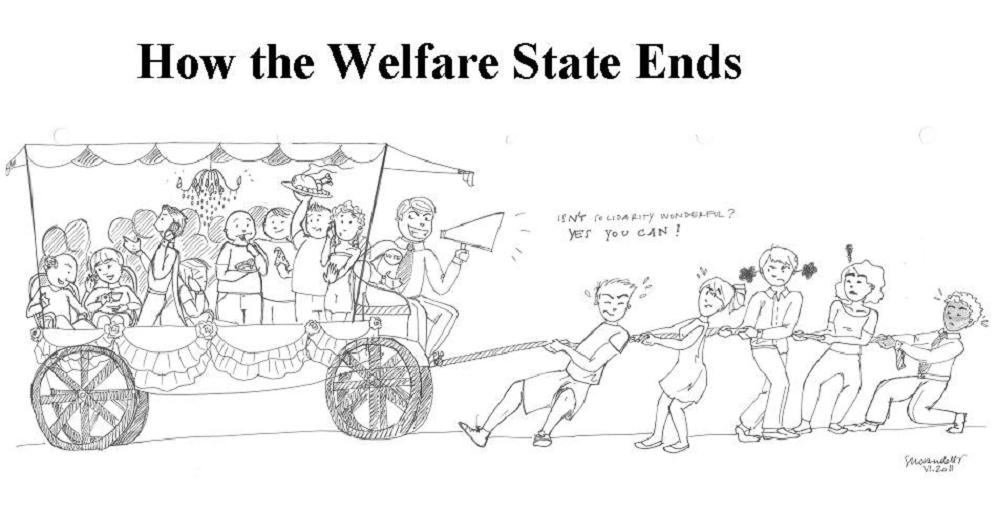
These images are remarkably accurate. The welfare state starts with small programs targeted at a handful of genuinely needy people. But as  politicians figure out the electoral benefits of expanding programs and people figure out the that they can let others work on their behalf, the ratio of producers to consumers begins to worsen.

_________

When the government gets so big that it distorts the behavior of the private market then it is too big. The federal government is  now spending 24.8% of GDP and traditionally for the first 150 years of our nation’s history we spent under 5% unless in wartime. This massive spending now by the federal encourages people to lie in order to get money for the government too instead of trying to work hard to earn money in the private market.

Why is big government bad for an economy? The easy answer is that big government usually means high tax rates, and this penalizes work, saving, investment, and entrepreneurship. And perhaps some of the spending is financed by borrowing, and this diverts money from private investment.

That’s a correct answer, but it’s only part of the story. In most cases, there is added damage because politicians spend money in ways that further undermine incentives to produce.

For instance, let’s assume a government spends $1 billion on some sort of redistribution program. Extracting that money from the productive sector of the economy obviously will cause some damage, but it’s also important to estimate how the supposed beneficiaries of the money will react. What if they decide to earn less income in order to be eligible for the handouts, as even the statists at the OECD have recognized?

In other words, it hurts the economy when government collects money, and it often hurts the economy when government spends money. Sort of a perverse 2-for-1 special (though “Rahn Curve” analysis does show that some types of spending – on core public goods – is correlated with better economic performance)

Let’s look at an example from Greece, showing how handouts distort behavior and corrupt people. Here are some remarkable tidbits from a Wall Street Journal story.

The Greek health ministry is investigating on Zakynthos after local officials flagged records showing what they said is an implausibly high number of disability claims for blindness. About 1.8% of the island’s population of 39,000 claimed the benefit last year, according to the health ministry. That is around nine times the prevalence of blindness estimated for many European countries in a 2004 study published in a World Health Organization journal. Among those who put in for the blindness benefit on Zakynthos, a local official said, were a taxi driver and a bird hunter. …But the island is hardly alone, according to health ministry officials, who say fraudulent disability claims are a problem across the nation… Zakynthos Mayor Stelios Bozikis on a Greek television talk show said residents angry about the benefits crackdown and other financial overhauls pelted him with yogurt at a recent event.

Before sneering at the Greeks, keep in mind that “disability” claims also are rising in the United States, which is rather remarkable since jobs have become less arduous over time. Heck, the Social Security Administration decided to give disability payments to a grown man who gets his jollies by wearing diapers.

I’m not sure if that’s better or worse than the Greek government deciding to reward pedophiles with disability payments, but taxpayers are getting screwed in both examples.

Let’s go back to the story and look at a rough estimate of how much fraud exists.

In an attempt to root out fraud, the Greek health ministry recently required disability claimants nationwide to register in a centralized database, appearing in person or sending a representative. The registration resulted in 36,000 fewer disability claims than in 2011, the health ministry said. The ministry alleges these dropped claims were fraudulent, in many cases reflecting multiple claims for the same disability or payments in the name of dead beneficiaries. It also alleges that some doctors accepted money for false diagnoses and some local politicians signed off on the benefits to win support, and said it is giving public prosecutors information about areas where it suspects a high level of fraud. Only 190 of the nearly 700 people it says had been collecting the blindness benefit on Zakynthos participated in the registration, the ministry said.

I have no idea if Zakynthos is representative, but that’s an incredibly high fraud rate. And this is just a glimpse at the workings of one government program. Now multiply that by some large number and you’ll begin to understand the damage caused by government.

And America is not immune. When politicians make it easier to ride in the wagon than to pull the wagon (as this cartoon illustrates), society sooner or later gets in trouble.

Cato Institute praises Bill Clinton’s restraint to spend, President Obama calls that level of spending “social darwinism”

Dan Mitchell always has some great cartoons he posts:

Michael Ramirez is a first-rate cartoonist for Investor’s Business Daily. Here are two of his recent gems.

As always, humor works when it is based on something true.

With that in mind, do you prefer this cartoon, which shows Obama scolding the Founding Fathers for their extreme libertarian views?

Or what about this cartoon, which makes the obvious point that growth is rather difficult when the productive sector of the economy is hobbled by too much government.

Obama on Ryan Plan: “It’s Laughable. It Is a Trojan Horse. It’s Thinly-Veiled Social Darwinism.”

Dan Mitchell of the Cato Institute has hit a home run with this post. If Congressman Paul Ryan could get criticized for wanting to bring down our federal spending to around 20% in 11 years  and earn the label of “social darwinist” from President Obama then surely President Obama would have thought President Clinton’s effort to cut spending to 18.2 % of GDP in 2001 as extremely devilish.

Actually, Bill Clinton must be something even worse than a social Darwinist. That’s because the title of this post is wrong. Obama said that Paul Ryan’s plan (which allows spending to grow by an average of 3.1 percent per year over the next decade) is a form of “social Darwinism.”

Proponent of social Darwinism?

But the proposal from the House Budget Committee Chairman only reduces the burden of federal spending to 20.25 percent of GDP by the year 2023.

Yet when Bill Clinton left office in 2001, following several years of spending restraint, the federal government was consuming 18.2 percent of economic output.

And by the President’s reasoning, this must make Clinton something worse than a Darwinist. Perhaps Marquis de Sade or Hannibal Lecter.

Here’s a blurb from the New York Times on Obama’s speech.

Mr. Obama’s attack, in a speech during a lunch with editors and reporters from The Associated Press, was part of a broader indictment of the Republican economic blueprint for the nation. The Republican budget, and the philosophy it represents, he said in remarks prepared for delivery, is “antithetical to our entire history as a land of opportunity and upward mobility for everyone who’s willing to work for it.” …“Disguised as a deficit reduction plan, it’s really an attempt to impose a radical vision on our country. It’s nothing but thinly veiled social Darwinism,” Mr. Obama said. “By gutting the very things we need to grow an economy that’s built to last — education and training, research and development — it’s a prescription for decline.”

I’m particularly amused by the President’s demagoguery that Ryan’s plan is “antithetical to our entire history” and “a radical vision.”

Is he really unaware that a small and constrained central government is part of America’s history and vision? Doesn’t he know that the federal government, for two-thirds of our nation’s history, consumed less than 5 percent of GDP?

Of course, that was back in the dark ages when people in Washington actually believed that the Constitution’s list of enumerated powers in Article 1, Section 8, actually enumerated the powers of the federal government. How quaint.

No wonder this Ramirez cartoon is so effectively amusing. It certainly seems to capture the President’s view of America’s founding principles.