Category Archives: spending out of control

A handout is not what the poor needs

Welfare Can And Must Be Reformed

Uploaded by on Jun 29, 2010

If America does not get welfare reform under control, it will bankrupt America. But the Heritage Foundation’s Robert Rector has a five-step plan to reform welfare while protecting our most vulnerable.

______________

I don’t understand why liberals do not see that they are hurting and not helping the poor with these programs.

Rachel Sheffield

April 12, 2012 at 3:00 pm

A new report from the U.S. Department of Agriculture states that the Supplemental Nutrition Assistance Program (SNAP, more commonly known as food stamps) helps “alleviate” poverty.

Essentially, the report says that by including the dollar amount of food stamps as part of a family’s income, fewer families are considered poor—or at least not as poor.

No surprises here. Not even the federal government can spend over $70 billion on food stamps annually and have no impact on a family’s bottom line. (Of course, federal poverty calculations don’t include the value of food stamps or most of the benefits received from federal welfare programs as part of a household’s income, so it’s little wonder that federal poverty rates have remained nearly unchanged over the last several decades despite massive increases in welfare spending. But that’s another story.)

The report also notes that “SNAP’s contribution to reducing poverty increased between 2000 and 2009, a period when the SNAP caseload nearly doubled and total SNAP benefits more than quadrupled.”

In other words, the federal government seems to be saying that federal dependence translates to poverty relief.

If dependence on the federal government is the standard of success, then certainly the food stamps program is a smash hit. Not only is it the largest of the federal government’s roughly 10 food assistance programs, but it’s also one of the largest of all the federal government’s welfare programs.

And it’s been growing, recession or not. Since 2000, as the report points out, participation rates have skyrocketed from just 17.2 million to 44.7 million in 2011—an increase of roughly 260 percent. Naturally, this means that the federal government has “successfully” increased the program’s cost—in fact, more than tripled it—from approximately $20 billion in 2000 to a whopping $72 billion in fiscal year 2011.

While some of the program’s most recent “successes” in growth are no doubt partly attributed to the recession, roles were already steadily growing prior to 2008. In fact, food stamps has for the most part been continually growing since it began in the 1960s.

To what can such “accomplishment” be attributed? As the report notes, some of the growth is due to policy changes over the last decade “designed to increase SNAP participation among working poor households.” The report notes that states have “implemented a number of program changes to simplify the administrative process to apply for and remain on SNAP.”

So the secret of “success” is not only expanding eligibility but making sure people stay on food stamps.

Tragically, such a measure of success is completely counter to what the purpose of any good welfare program should be: to help individuals become independent and enjoy the fruits of their own labor—not dependent on government largesse.

Food stamps, along with just about every other of the federal government’s over 70 welfare assistance programs, fails to include any functional provisions to promote personal responsibility, such as work requirements and time limits. Rather than addressing the causes of poverty, the federal government’s method of operation has been to pour more taxpayer dollars into more welfare programs, edging near a cost of $1 trillion annually. Not only does this approach fail to help individuals, but it creates a growing burden on taxpayers.

Successfully helping the poor should mean promoting individual freedom through self-reliance, not promoting dependence through a government dole.

John Boehner in Little Rock, I wish he would propose real spending cuts!!!!

Will Rogers has a great quote that I love. He noted, “Lord, the money we do spend on Government and it’s not one bit better than the government we got for one-third the money twenty years ago”(Paula McSpadden Love, The Will Rogers Book, (1972) p. 20.)

Max Brantley of the Arkansas Times noted:

House Speaker John Boehner was spotted in Little Rock yesterday — lunch at Whole Hog Cafe and at Cajun’s Wharf during the evening hours.

My spin on John Boehner is very simple. He needs to be brave enough to join those conservatives in the House that really do want to stop our path to Greece. Only 66 brave souls voted against the debt ceiling increase deal that President Obama wanted so bad. I have spent a lot of time praising those 66. I wish Boehner was brave enough to propose some deep spending cuts so we can balance the budget.

Sixty Six who resisted “Sugar-coated Satan Sandwich” Debt Deal (Part 48)

This post today is a part of a series I am doing on the 66 Republican Tea Party favorites that resisted eating the “Sugar-coated Satan Sandwich” Debt Deal. Actually that name did not originate from a representative who agrees with the Tea Party, but from a liberal.

Rep. Emanuel Clever (D-Mo.) called the newly agreed-upon bipartisan compromise deal to raise the  debt limit “a sugar-coated satan sandwich.”

“This deal is a sugar-coated satan sandwich. If you lift the bun, you will not like what you see,” Clever tweeted on August 1, 2011.

Washington, Aug 1 

Congressman Jim Jordan (R-Urbana) released the following statement regarding his vote against the debt limit deal agreed to by President Obama and Congressional leaders.

“At the beginning of the year, Democrats demanded a blank check increase in the debt limit with absolutely no spending cuts attached.  When that didn’t work, they demanded an upfront agreement for huge tax increases on America’s job creators.  Conservatives stood firm, and we succeeded in forcing Washington to begin addressing its spending-driven debt crisis.”

“When looking at the details of this deal, a few concerns in particular rise to the top.  The framework opens the door to dangerous national security cuts and raises the possibility that six Democrats and one misguided Republican could put tax increases on the table.”

“The requirement that Congress vote on a Balanced Budget Amendment is a positive step.  Unless we send a Balanced Budget Amendment to the states, however, promises to cut spending today can always disappear tomorrow.  It happens year after year, and it will happen again unless Americans remain vigilant.”

“Our AAA credit rating remains at risk because President Obama and his fellow tax-and-spend liberals refused to support the Cut, Cap, and Balance plan that could actually solve our debt problem and prevent a credit downgrade.  Supporters of the Balanced Budget Amendment have come a long way this year, but there’s still a lot of work to be done.”

Sixty Six who resisted “Sugar-coated Satan Sandwich” Debt Deal (Part 49)

Sixty Six who resisted “Sugar-coated Satan Sandwich” Debt Deal (Part 49) This post today is a part of a series I am doing on the 66 Republican Tea Party favorites that resisted eating the “Sugar-coated Satan Sandwich” Debt Deal. Actually that name did not originate from a representative who agrees with the Tea Party, but […]

Sixty Six who resisted “Sugar-coated Satan Sandwich” Debt Deal (Part 48)

Sixty Six who resisted “Sugar-coated Satan Sandwich” Debt Deal (Part 48) This post today is a part of a series I am doing on the 66 Republican Tea Party favorites that resisted eating the “Sugar-coated Satan Sandwich” Debt Deal. Actually that name did not originate from a representative who agrees with the Tea Party, but […]

Are there brave conservatives out there?

I wish there were more like those 66 brave conservatives that voted against the compromise that kept the government going (see links below). Now it seems that the Republicans could also stop this excessive regulations if they wanted to, but do they have the will power? I wish we had more like those 66!!!! No […]

Obama’s March 16, 2006 speech against raising debt ceiling

Obama’s March 16, 2006 speech against raising the debt ceiling is here: The fact that we are here today to debate raising America’s debt limit is a sign of leadership failure. It is a sign that the U.S. Government can’t pay its own bills. It is a sign that we now depend on ongoing financial assistance from […]

Federal government spending money so fast they will pass debt ceiling before election

Sen Obama in 2006 Against Raising Debt Ceiling Uploaded by RepCliffStearns on Jun 20, 2011 Rep. Stearns on the House Floor cites Sen. Obama’s opposition in 2006 to increasing the debt ceiling, 6-14-11 ________________________ It has greatly troubled me for sometime that the federal government spends so much over their budget every year. That is […]

The Sixty Six who resisted “Sugar-coated Satan Sandwich” Debt Deal (Part 26)

The Sixty Six who resisted “Sugar-coated Satan Sandwich” Debt Deal (Part 26) This post today is a part of a series I am doing on the 66 Republican Tea Party favorites that resisted eating the “Sugar-coated Satan Sandwich” Debt Deal. Actually that name did not originate from a representative who agrees with the Tea Party, […]

The Sixty Six who resisted “Sugar-coated Satan Sandwich” Debt Deal (Part 25)

Uploaded by RepJoeWalsh on Jun 14, 2011 Our country’s debt continues to grow — it’s eating away at the American Dream. We need to make real cuts now. We need Cut, Cap, and Balance. The Sixty Six who resisted “Sugar-coated Satan Sandwich” Debt Deal (Part 25) This post today is a part of a series […]

The Sixty Six who resisted “Sugar-coated Satan Sandwich” Debt Deal (Part 23)

The Sixty Six who resisted “Sugar-coated Satan Sandwich” Debt Deal (Part 23) This post today is a part of a series I am doing on the 66 Republican Tea Party favorites that resisted eating the “Sugar-coated Satan Sandwich” Debt Deal. Actually that name did not originate from a representative who agrees with the Tea Party, […]

The Sixty Six who resisted “Sugar-coated Satan Sandwich” Debt Deal (Part 22)

The Sixty Six who resisted “Sugar-coated Satan Sandwich” Debt Deal (Part 22) This post today is a part of a series I am doing on the 66 Republican Tea Party favorites that resisted eating the “Sugar-coated Satan Sandwich” Debt Deal. Actually that name did not originate from a representative who agrees with the Tea Party, […]

No one wants to cut spending and as a result another credit downgrade coming

The Price of a U.S. Credit Rating Downgrade Uploaded by catoinstitutevideo on Aug 5, 2011 http://www.downsizinggovernment.org The federal government’s debt may soon be downgraded by major credit rating agencies. What would that mean? Video produced by Caleb O. Brown and Austin Bragg __________ Looks like the politicians in Washington better cut spending or another downgrade […]

The Sixty Six who resisted “Sugar-coated Satan Sandwich” Debt Deal (Part 21)

The Sixty Six who resisted “Sugar-coated Satan Sandwich” Debt Deal (Part 21) This post today is a part of a series I am doing on the 66 Republican Tea Party favorites that resisted eating the “Sugar-coated Satan Sandwich” Debt Deal. Actually that name did not originate from a representative who agrees with the Tea Party, […]

The Sixty Six who resisted “Sugar-coated Satan Sandwich” Debt Deal (Part 20)

The Sixty Six who resisted “Sugar-coated Satan Sandwich” Debt Deal (Part 20) This post today is a part of a series I am doing on the 66 Republican Tea Party favorites that resisted eating the “Sugar-coated Satan Sandwich” Debt Deal. Actually that name did not originate from a representative who agrees with the Tea Party, […]

Obama’s budget versus Paul Ryan’s budget

Obama Calls GOP Budget Plan “Prescription for Decline”

Uploaded by on Apr 3, 2012

In a blistering attack on the House-Passed Republican budget Tuesday, President Obama called the plan proposed by Rep. Paul Ryan a “Trojan Horse” and “a prescription for decline.” Judy Woodruff, Jared Bernstein of the Center on Budget and Policy Priorities and the CATO Institute’s Daniel Mitchell discuss the GOP budget plan.

_______

President Obama was really hard on Paul Ryan for his plan, but Obama’s plan will NEVER LEAD TO A BALANCED BUDGET.

Obama’s And Paul Ryan’s Conflicting Budget Visions

by Michael D. Tanner

Michael Tanner is a senior fellow at the Cato Institute and author of Leviathan on the Right: How Big-Government Conservatism Brought Down the Republican Revolution.

Added to cato.org on April 6, 2012

This article appeared in Fiscal Times on April 6, 2012.

With his speech to news editors and executives this week, President Obama has made it clear that he plans to run a starkly ideological campaign, contrasting his vision for the future of the country with that of his Republican opponents. And, he plans to make the Republican budget, written by rising GOP star Rep. Paul Ryan of Wisconsin and embraced by presumptive Republican nominee Mitt Romney, exhibit one in that contrast. It would be worthwhile therefore to actually compare that budget with the one proposed by the president.

Deficits and Debt
The president’s budget proposal would reduce future deficits — at least until 2018 — but would never achieve balance. By 2018, the president projects deficits to fall to only $575 billion. After that, they begin rising again, reaching $704 billion by 2022. Overall, the president’s budget would add an additional $6.7 trillion to the national debt over the next 10 years.

Paul Ryan does better when it comes to deficit reduction, but only because the president has set such a low bar. Unlike the president, Ryan would eventually balance the budget — but not until 2040 or so. He does, however, generally run much lower annual deficits than the president would, and adds $3.3 trillion less to the national debt over the next 10 years.

Obama and Ryan have presented two distinct visions of the future.

Over the longer-term, the differences are much more pronounced. By 2050, for instance, Ryan would be running a surplus equal to as much as 3 percent of GDP. The president’s budget, in contrast, projects that we would still face budget deficits in excess of 6 percent of GDP.

Government Spending
Neither President Obama nor Paul Ryan actually cuts government spending. Rather, both are playing the time-honored game of calling a reduction in the rate of increase a “cut.” Thus, the president would increase federal spending from $3.8 trillion in 2013 to $5.82 trillion in 2022. That might not be as big an increase there might otherwise be, but in no way can it be called a cut. Meanwhile, Ryan, who is being accused of “thinly veiled Social Darwinism,” would actually increase spending from $3.53 trillion in 2013 to $4.88 trillion in 2022.

The president warns that Ryan’s spending “cuts” would “gut” the social safety net. And, it is true that Ryan’s budget knife falls more heavily on domestic discretionary spending than does the president’s — but only relatively. Over the next 10 years, Ryan would spend $352 billion less on those programs than would Obama, an average of just $35.2 billion per year in additional cuts. Given that domestic discretionary spending under the president’s budget will total more than $4 trillion over the next decade, Ryan’s cuts look less than draconian.

One area where the president appears to have the better argument is on defense spending. Ryan would undo the defense spending sequester agreed to under last year’s debt-ceiling compromise, and would spend $203 billion more over 10 years than was agreed to. Obama would cut defense by an additional $240 billion. Given our budget problems and the lack of a conventional military threat, Ryan’s plan to spare defense seems shortsighted.

Taxes
The president would increase tax revenue to 20.1 percent of GDP. That’s a huge increase from the current 15.4 percent, and higher than the post-World War II average of 18 percent. His budget includes tax hikes on people and small businesses making as little as $200,000 per year, as well as the usual panoply of tax hikes on energy products, businesses, investment and pretty much anything else the president can think of.

The president also continues to push for the so-called Buffet Rule, a new 30 percent minimum tax on the rich, based on the misleading claim that Warren Buffett pays a lower tax rate than his secretary. The Buffett Rule would raise very little revenue — less than $3.2 billion per year on average according to the Congressional Budget Office — but the president is pushing it as a matter of fairness.

Ryan would also allow taxes to increase as a percentage of GDP, returning to roughly their historical average around 18 percent of GDP. However, he is also calling for a major reform of the U.S. tax code. Ryan would replace the current four tax rates with two: 15 and 25 percent. He would also lower the current 38 percent corporate tax rate, the world’s highest, to 25 percent. At the same time, he would broaden the taxable base by eliminating many current deductions and loopholes. Unfortunately, Ryan has ducked the unpopular task of actually spelling out which loopholes would be eliminated.

Entitlement Reform
Perhaps the biggest disagreement between the president and Ryan is over how to reform the entitlement programs that are driving this country toward bankruptcy. Ryan would restructure Medicare for those under age 55 to give recipients a choice between the traditional program and a voucher that would allow them to purchase private insurance. That plan, drafted together with Democratic Sen. Ron Wyden of Oregon, would have little impact in the short-term — in 2022, it would spend just $21 billion less than the president’s budget — but over the longer term would reduce Medicare’s unfunded liability, which the Medicare trustees put at $24.6 trillion, by trillions of dollars.

The president makes no significant changes to Medicare, relying instead on expansion of changes contained in the new health care law to save a projected $364 billion over the next 10 years.

Ryan would also turn the current Medicaid program to the states in the form of a federal block grant, while reducing spending by $810 billion over 10 years. States would have far more freedom to experiment with ways to reform the system, but would likely receive less federal funds over the long term. Obama, by contrast, leaves the program unchanged, while significantly expanding eligibility under the health care law.

Unsurprisingly in an election year, both Ryan and the president punt on Social Security reform. Neither offers any reform of the troubled retirement system, despite its $21 trillion in unfunded liabilities.

Two Visions
The United States is teetering on the edge of Greek-style bankruptcy. Our total indebtedness, including the unfunded liabilities of Social Security and Medicare, could run as high as $130 trillion, more than 900 percent of GDP. In the face of this looming crisis, Obama and Ryan have presented two distinct visions of the future. The president offers a bigger government, paid for with more debt and higher taxes. Ryan’s vision may be maddeningly timid and vague in places, but it takes important steps toward a smaller, less costly, and less intrusive government.

If that’s the debate that President Obama wants to have, let’s do it.

Balancing the budget possible with socialist solutions?

I got this cartoon below from Dan Mitchell’s blog.

Where can our government turn to get out of this socialist mess they have got themselves in? They have to realize what really creates wealth. Over in France they are facing the same problems we are because of the welfare state and they are about to put in a bunch of new leaders who want more of the same. How can you get out of this mess by doing the same thing that got you in the mess to begin with? Bradley Gitz wrote on 4-29-12 in the Arkansas Democrat-Gazette:

Escape from reality

LITTLE ROCK — The “left” is making a comeback in France. Not just Francois Hollande’s Socialists, but the hard left guys, the French Communist Party (PCF).

More than two decades after the dissolution of the Soviet Union supposedly signaled the end of Marxism-Leninism as a viable belief system, the Communists are once again attracting huge crowds waving red flags and their candidate, the “charismatic” Jean-Luc Melenchon, is said to hold the key to the outcome of the May run-off between Hollande and French President Nicolas Sarkozy.

Just as some Catholics can be more Catholic than the Pope, during the Cold War the PCF was often more Stalinist than Stalin (or at least Leonid Brezhnev and Andrei Gromyko). The crimes against humanity committed by the Soviet regime and other Communist despotisms around the world never seemed to make a dent in their moral obtuseness. The PCF even condemned Mikhail Gorbachev’s perestroika as a betrayal of the dictatorship of the proletariat.

That such a blight on the human experience, one exceeding even Nazism in its body count, could gain electoral traction in an advanced postindustrial democracy tells us something other than that cheese-eating surrender monkeys have a unique capacity for political idiocy. Indeed, the foundation of the Communist comeback has been resistance to the austerity measures that the French government has been reluctantly forced to embrace due to France’s mounting debt problems. The irony comes when considering that Communism represents the most extreme extrapolation of the welfare state mentality that produced such debt levels in the first place.

The European crisis (and the American crisis, too) is essentially a crisis of the welfare state. More precisely, it represents the presentation of the bill for payment that the welfare state has racked up for decades on both sides of the Atlantic. And in both Europe and America, the left, whether Communist, socialist,or “liberal-progressive,” is counting upon voters refusing to accept reality and the austerity measures that it so obviously dictates. More of what caused the disease is now being recommended as treatment.

Just as Communism in its heyday represented an effort to repeal the laws of human nature and the economic realities that flowed from them, today’s French Communists (and American liberals) seek to deny that budget numbers have any real meaning because money grows on trees.

What Charles Krauthammer calls “free lunch egalitarianism” is now firmly, perhaps irreversibly, entrenched in the politics of democratic states. That you can get something for nothing (or at least something that others can be made through political coercion to pay for) increasingly drives the voting behavior of ever-larger chunks of their dependent, dumbed-down electorates.

Momentum in that direction continues even after the money has run out.

The ability of Communism to survive in the electoral politics of France requires both historical amnesia regarding its crimes as well as an encouragement of the human desire to believe that two plus two really can be made to add up to seven or eight if one wishes it hard enough; that if we just close our eyes, plug up our ears, and stamp our feet in unison those nasty budget deficits will magically disappear, there will be no need for painful austerity programs, and we can go on providing free college tuition, health care, housing, and anything else that the political left designates as a fundamental human right without economic repercussion.

In the end, there is apparently something deeply ingrained in human nature that makes Communism and other forms of political leftism alluring. But just as there will always be credulous people living under the imperfections of capitalism who crave what Communism promises, there will always also be people who seek to escape from the ugly practice of Communism wherever it is established. What history has never produced, and likely never will, are a people who, once having arrived at the Communist paradise, are content to remain there. The guard towers atop the Berlin Wall weren’t, after all, designed to prevent people from entering.

Of course, no one with anything resembling a functioning brain really believes that if the French do what Melenchon and the PCF recommends-to confiscate wealth, nationalize banks and industries, and dramatically increase government benefits and the minimum wage-things will go well for France. Rather,

their supporters appear to only be hoping that it will provide them with the ability to continue to live beyond their means for a bit longer, and thereby push the inevitable crash onto the next generation.

The truly sad thing about all of this is that the formula for economic growth in the post-industrial age isn’t all that complicated, consisting as it does of secure property rights, low tax rates, and reasonable constraints upon governmental regulation, spending, and welfare state entitlements.

The left, whether in its French Communist or American liberal permutations, cannot construct sustainable societies because it has never figured out where wealth comes from. There are, in the end, no “shortcuts” to prosperity, and reality can only be temporarily ignored.

———◊-

———

Freelance columnist Bradley R. Gitz, who lives and teaches in Batesville, received his Ph.D. in political science from the University of Illinois.

Editorial, Pages 75 on 04/29/2012

Print Headline: Escape from reality

<!–Editorial 75

–>

Senator Pryor asks for Spending Cut Suggestions! Here are a few!(Part 145)

Senator Mark Pryor wants our ideas on how to cut federal spending. Take a look at this video clip below:

Senator Pryor has asked us to send our ideas to him at cutspending@pryor.senate.gov and I have done so in the past and will continue to do so in the future.

On May 11, 2011,  I emailed to this above address and I got this email back from Senator Pryor’s office:

Please note, this is not a monitored email account. Due to the sheer volume of correspondence I receive, I ask that constituents please contact me via my website with any responses or additional concerns. If you would like a specific reply to your message, please visit http://pryor.senate.gov/contact. This system ensures that I will continue to keep Arkansas First by allowing me to better organize the thousands of emails I get from Arkansans each week and ensuring that I have all the information I need to respond to your particular communication in timely manner.  I appreciate you writing. I always welcome your input and suggestions. Please do not hesitate to contact me on any issue of concern to you in the future.

Here are a few more I just emailed to him myself:

The President should try to eliminate wasteful programs in his budget. Legislators should also examine every line item in the President’s budget appendix and terminate programs that lack sufficient explanations or justifications.
Conclusion
Difficult times present opportunities for leaders to chart a new course. During World War II, President Franklin Roosevelt reduced non-defense spending by 36 percent to save resources. Policymakers funded the Korean War by immediately reducing non-defense spending by 25 percent. Those spending cuts required difficult choices, and lawmakers rose to the challenge.
In 2004, bold steps are again needed to rein in spending. The choices will be as difficult as those of the past, but that is what budgets are about–setting priorities. Congress and the President should seize this opportunity to refocus the federal government on the programs that matter most. Otherwise, the American people will face higher taxes, fewer jobs, less economic growth, and less effective government.

Here are some more places to cut:

  • Washington spends $92 billionon corporate welfare (excluding TARP) versus $71 billion on homeland security.
  • Washington spends $25 billionannually maintaining unused or vacant federal properties.

__________________

Reagan and Clinton had good fiscal policies according to Cato Institute

Uploaded by on Dec 16, 2010

http://blog.heritage.org/2010/12/16/new-video-pork-filled-spending-bill-just-… Despite promises from President Obama last year and again last month that he opposed reckless omnibus spending bills and earmarks, the White House and members of Congress are now supporting a reckless $1.1 trillion spending bill reportedly stuffed with roughly 6,500 earmarks.

________________________

Below you see an article and videos by Dan Mitchell of the Cato Institute concerning Reagan and Clinton. First lets look at where we are now with Obama.

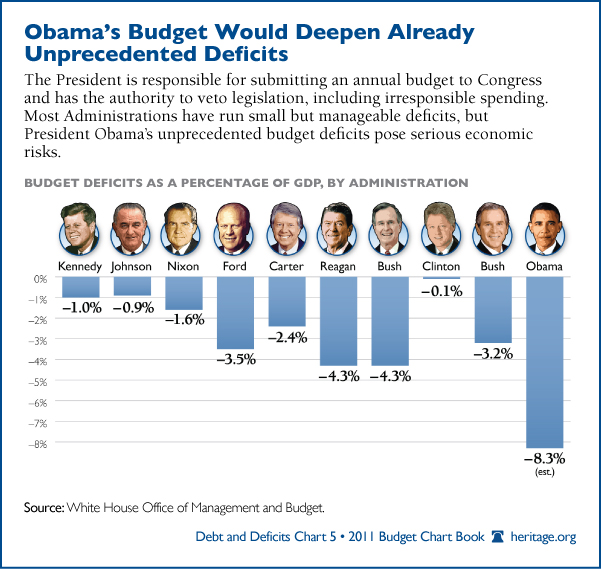
Over the last 10 presidents was have had 16.9% of GDP of deficits total from five Republican presidents and 12.7% total from Democratic presidents. However, what is most disturbing is that 8.3% of the 12.7% comes from the Obama administration who is currently in power and we are no longer in the cold war era. That is almost double the total of all the other four Democratic presidents combined under just one president. Take a look at the chart below from the Heritage Foundation:

Rob Bluey

January 1, 2012 at 9:56 am

Over the past 50 years, 10 U.S. presidents have made annual budget requests to Congress, projecting deficits both big and small. But no other president compares to Barack Obama when it comes to the size and scale of the current budget deficit facing the United States.

The country is facing an 8.3 percent estimated average national deficit of a two-term Obama administration — the biggest of the past 50 years. By comparison, the current estimate for Obama is nearly double the percentage under Presidents Ronald Reagan and George H.W. Bush — and they were fighting the Cold War.

Political party doesn’t tell the whole story, however. President Bill Clinton leads the pack of presidents since 1961, according to data from the White House Office of Management and Budget. Heritage put together this graphic as part of our Budget Chart Book.

So what does the current trajectory mean for the United States? We’re certainly no longer looking at a continuation of manageable deficits in the years to come. This is a dramatic change in the magnitude of annual shortfalls at the federal level. That’s one reason Heritage came up with a plan to fix the debt crisis.

If you have a suggestion for a chart we should feature in the future, please post a comment below, email us at scribe@heritage.org, or send me at tweet @RobertBluey.

_______________________
Here is a perspective from Dan Mitchell of the Cato Institute:

To Fix the Budget, Bring Back Reagan…or Even Clinton

Posted by Daniel J. Mitchell

President Obama unveiled his fiscal year 2012 budget today, and there’s good news and bad news. The good news is that there’s no major initiative such as the so-called stimulus scheme or the government-run healthcare proposal. The bad news, though, is that government is far too big and Obama’s budget does nothing to address this problem.

But perhaps the folks on Capitol Hill will be more responsible and actually try to save America from becoming a big-government, European-style welfare state. The solution may not be easy, but it is simple. Lawmakers merely need to restrain the growth of government spending so that it grows slower than the private economy.

Actual spending cuts would be the best option, of course, but limiting the growth of spending is all that’s needed to slowly shrink the burden of government spending relative to gross domestic product.

Fortunately, we have two role models from recent history that show it is possible to control the federal budget. This video from the Center for Freedom and Prosperity uses data from the Historical Tables of the Budget to demonstrate the fiscal policy achievements of both Ronald Reagan and Bill Clinton.

Spending Restraint, Part I: Lessons from Ronald Reagan and Bill Clinton

Uploaded by on Feb 14, 2011

Ronald Reagan and Bill Clinton both reduced the relative burden of government, largely because they were able to restrain the growth of domestic spending. The mini-documentary from the Center for Freedom and Prosperity uses data from the Historical Tables of the Budget to show how Reagan and Clinton succeeded and compares their record to the fiscal profligacy of the Bush-Obama years.

_____________________


Some people will want to argue about who gets credit for the good fiscal policy of the 1980s and 1990s.

Bill Clinton’s performance, for instance, may not have been so impressive if he had succeeded in pushing through his version of government-run healthcare or if he didn’t have to deal with a Republican Congress after the 1994 elections. But that’s a debate for partisans. All that matters is that the burden of government spending fell during Bill Clinton’s reign, and that was good for the budget and good for the economy. And there’s no question he did a much better job than George W. Bush.

Indeed, a major theme in this new video is that the past 10 years have been a fiscal disaster. Both Bush and Obama have dramatically boosted the burden of government spending — largely because of rapid increases in domestic spending.

This is one of the reasons why the economy is weak. For further information, this video looks at the theoretical case for small government and this video examines the empirical evidence against big government.

Another problem is that many people in Washington are fixated on deficits and debt, but that’s akin to focusing on symptoms and ignoring the underlying disease. To elaborate, this video explains that America’s fiscal problem is too much spending rather than too much debt.

Last but not least, this video reviews the theory and evidence for the “Rahn Curve,” which is the notion that there is a growth-maximizing level of government outlays. The bad news is that government already is far too big in the United States. This is undermining prosperity and reducing competitiveness.

Spending Restraint, Part II: Lessons from Canada, Ireland, Slovakia, and New Zealand

Uploaded by on Feb 22, 2011

Nations can make remarkable fiscal progress if policy makers simply limit the growth of government spending. This video, which is Part II of a series, uses examples from recent history in Canada, Ireland, Slovakia, and New Zealand to demonstrate how it is possible to achieve rapid improvements in fiscal policy by restraining the burden of government spending. Part I of the series examined how Ronald Reagan and Bill Clinton were successful in controlling government outlays — particularly the burden of domestic spending programs. http://www.freedomandprosperity.org


Federal government should not be involved with post office

I really wish that President Obama would have not had the federal government buy up General Motors. We need to keep the federal government out of the private market as much as possible. This goes for the post office too. It should be in private hands.

Senators voted recently to hold off closing some post offices but I wish we had radical changes being voted on.

Postal Problems: the Role of Government Micromanagement

Posted by Tad DeHaven

Postal expert Michael Schuyler has released a follow-up to his January paper that compared the recent financial performance of the U.S. Postal Service to foreign postal service providers. Not surprisingly, the USPS has fared relatively poorly in comparison to its foreign counterparts. In his new paper, Schuyler looks at the role government micromanagement plays and finds that “Foreign posts have much more flexibility than USPS to adjust operations to keep costs in line with revenue.”

The following are some key points:

  • Foreign governments intervene in their postal markets, but “foreign governments often temper their demands and grant their postal services substantial operational discretion, in order that they not undermine their posts’ financial viability.”
  • The USPS has reduced headcount by 29 percent since 1999, but in comparison to foreign operators, it has less flexibility when it comes to managing labor costs. For instance, “there have been few layoffs because contracts with postal unions contain no-layoff provisions that protect the jobs of most career postal workers…Although the reduction the Service accomplished through attrition and buyouts has been skillful, it has not been sufficient to bring the workforce into balance with reduced mail volume.”
  • While many foreign operators have moved to five-day mail delivery, Congress continues to insist that the USPS deliver mail six days a week. Given the continuing – and permanent – decline in the demand for mail, the case for cutting back on delivery is getting stronger. Regardless of whether the USPS should move to five day delivery, the “requirement shows how the U.S. Postal Service is hamstrung in its ability to rein in costs through operational adjustments, compared to many foreign posts.”
  • Congressional meddling makes it harder for the USPS to downsize its retail network to better reflect financial reality. When the USPS tries to close post offices and other facilities, “members of Congress often object vigorously to proposed closings within their jurisdictions and occasionally threaten to introduce legislation to block proposed changes.” As a result, the USPS usually backs down.

I’ll conclude by making my standard pitch for liberalization of the U.S. postal market, which would ideally lead to privatization of the USPS. The word “privatization” scares a lot of people, but it shouldn’t. If one were to spend a couple of years working in the U.S. Senate, as I have, there’s a good chance that he or she will conclude that continuing to allow 535 politicians to manage a business is a whole lot scarier.

 
Related posts:

Private entrepreneurs can solve our post office problem

When you look at how good the private enterprise does with deliveries and then compare it to how bad the federal government does with the same duties it is laughable. The answer to the federal post office problem is to encourage private entrepreneurs to fill the gap and provide competition for the post office in […]

Senator Pryor asks for Spending Cut Suggestions! Here are a few!(Part 131)

Senator Mark Pryor wants our ideas on how to cut federal spending. Take a look at this video clip below: Senator Pryor has asked us to send our ideas to him at cutspending@pryor.senate.gov and I have done so in the past and will continue to do so in the future. On May 11, 2011,  I emailed to […]

Privatize the post office

The Arkansas Times rightly jumped on Republicans for whining about the local post office branches that were closing.  (It is sad to me that Republican Presidential Candidates are not very brave about offering any spending cuts.) The real answer is privatizing the post office. Here is a good article from the Cato Institute:   The USPS […]

We need to close U.S.Post Office

We need to close U.S.Post Office There is only one option in my view. We can not keep on losing money every year like the U.S.Postal Service (7 billion this year). Closing Post Offices   PrintThe U.S. Postal Service just posted a $3.1 billion loss for the third quarter and the outlook for the rest […]


Dear Senator Pryor, why not pass the Balanced Budget Amendment? (“Thirsty Thursday”, Open letter to Senator Pryor)

Dear Senator Pryor,

Why not pass the Balanced  Budget Amendment? As you know that federal deficit is at all time high (1.6 trillion deficit with revenues of 2.2 trillion and spending at 3.8 trillion).

On my blog www.HaltingArkansasLiberalswithTruth.com I took you at your word and sent you over 100 emails with specific spending cut ideas. However, I did not see any of them in the recent debt deal that Congress adopted. Now I am trying another approach. Every week from now on I will send you an email explaining different reasons why we need the Balanced Budget Amendment. It will appear on my blog on “Thirsty Thursday” because the government is always thirsty for more money to spend.


About Edward Glaeser

Edward Glaeser, a professor of economics at Harvard, is the author of “Triumph of the City: How Our Greatest Invention Makes Us Richer, Smarter, Greener, Healthier and Happier.”

More about Edward Glaeser

U.S. Debt Plan and Debt-to-GDP Ratio


Aug. 1 (Bloomberg) — Under the current political compromise the U.S. debt ceiling will eventually be raised by $2.1 to $2.4 trillion dollars says Bloomberg Government analyst Scott Anchin. The cuts will only lower the nation’s debt to GDP ratio to 76.2% by 2020 says Bloomberg Government analyst Christopher Payne. (Source: Bloomberg)

We have stared hard into the abyss of a national default, and the close call with financial Armageddon is starting to make a balanced-budget amendment look good.

A stringent restriction on public borrowing, if properly crafted, offers the hope for more fiscal responsibility, less wasteful spending and a slightly less terrifying budgetary process. Yet while a well-crafted amendment looks a little better, there are enormous challenges in creating a sensible measure that balances fiscal restraint with the ability to adapt to new circumstances.

Balanced-budget amendments have been in circulation for decades; Minnesota Representative Harold Knutson proposed a constitutional limit on borrowing back in 1936. In 1982, the Senate approved an amendment requiring that “prior to each fiscal year, the Congress shall adopt a statement of receipts and outlays for that year in which total outlays are no greater than total receipts,” but that proposal died in the House. In 1995, the House passed an amendment requiring that “total outlays for any fiscal year shall not exceed total receipts for that fiscal year;” it failed in the Senate.

The possibility of a balanced-budget amendment is back, and the case today seems a lot stronger than it did in the 1980s and 1990s. I rarely favor changing the Constitution, which can lead to fits of folly like the 18th Amendment that brought about prohibition. Moreover, Congress can run a balanced budget any time it wants simply by cutting spending and raising taxes.

Broken Process

Throughout most of my life, the debt has seemed manageable and the budgetary process seemed to work, more or less. The robust deficits of the Reagan era were reduced with a bipartisan deal signed by President George H.W. Bush. During the Clinton years, the combination of a centrist Democrat who cared about bond markets and an empowered Republican House led to budget surpluses.

During those years, it seemed clear that deficits were rarely the real enemy. The big social costs from big government came from wasteful spending, not from financing that spending with taxes today or tomorrow. If you spend $100 million on a bridge to nowhere, it doesn’t much matter if that bridge is paid for with taxes or debt.

The best argument for balanced budgets is that forcing governments to pay for their spending with current taxes will produce less wasteful spending. The past decade has done much to illustrate the allure of spending without taxation in Washington. The rotation of the parties was supposed to cycle gently back and forth between Democratic generosity and Republican thrift, but that model disappeared in the 1980s. Instead, Democratic taxing and spending is succeeded by Republican spending and not taxing.

Political Pandering

And it’s hard to give any government much credit for cutting taxes without cutting spending. That’s not political courage; it’s pandering.

If we were confident that federal spending was delivering great bang for the buck and that the U.S. was going to be much richer in the future, then perhaps high interest payments could be accepted as the cost of a better tomorrow. But there is plenty of federal spending that could be cut, such as agricultural subsidies, new highway construction and subsidies for homebuilding inTexas. Surely, not every dollar of defense procurement is absolutely necessary.

State Beneficiaries

Another reason to favor more federal fiscal restraint is that we could use a better balance between state and federal spending. Over the past 50 years, the federal government has become heavily involved in financing infrastructure, even when those projects overwhelmingly serve in-state users and could be funded with user fees. Why is it so obvious that the federal government has a role in funding rail between Tampa and Orlando, or a big tunnel in Boston?

Washington’s prominence is explained primarily by the federal government’s ability to borrow, and not by any inherent edge it has in infrastructure development. Federalizing expenditures breaks the connection between the projects’ funders and the projects’ users. Any instance when we’re spending other people’s money is an invitation for waste.

States and localities saddled with balanced-budget rules are relatively parsimonious and spend a fair amount of time debating even relatively modest public investments. That’s far more desirable than the federal government’s freedom to distribute billions without imposing taxes on voters.

Responding to Downturns

The current system’s pathologies should leave us open to the possibility of a new budgeting procedure, but the literature on state balanced-budget rules teaches us that the devil is in the details. In many cases, the state rules have weak teeth, and do little. When they do work, they can seriously constrain a state’s ability to respond to downturns.

During the recent collapse, the federal ability to borrow has thrown a lifeline to local governments, leading to greater preservation of important local services, such as education. Although the federal government could benefit from a little less budgetary freedom, the states either need more ability to borrow during downturns or more investment in rainy-day funds.

Any federal balanced-budget amendment should allow the government to spend more than it collects in taxes during wars and recessions, with the understanding that it will spend less during peaceful times of plenty. If the budget is to be balanced, it should be balanced over the business cycle, not year by year.

State of Emergency

But the crafting of such an amendment won’t be easy. The most natural out, perhaps, is to allow Congress to declare an economic emergency, which would temporarily eliminate the budgetary straightjacket. But then what’s to prevent lawmakers from declaring a perpetual state of emergency?

Another worry is that freezing the federal ability to borrow will create more pseudo-borrowing through semi-public entities, such as the mortgage lenders Fannie Mae and Freddie Mac.

I dreaded the prospect of default and would love to see a system that ensures the books are regularly balanced except during extreme times. A balanced-budget amendment might make that happen, but it would have to be done right. It would be far better if we could just count on Congress to live within its means, but the fiscal experience of the last decade has made such optimism untenable.

(Edward Glaeser, an economics professor at Harvard University, is a Bloomberg View columnist. He is the author of “Triumph of the City.” The opinions expressed are his own.)

To contact the writer of this article: Edward L. Glaeser at eglaeser@harvard.edu.

To contact the editor responsible for this article: Max Berley at mberley@bloomberg.net.

President Obama biggest spender of all time?

Federal Spending by the Numbers
I wondered how much debt has been run up during the last 3 years. The democrats downplay our debt problem and maybe the republicans have been making it sound worse than it is. What is the real truth? Is the current adminstration running up our national debt faster than any previous administration?
 
 
Posted: April 15, 2012 – 12:25am  

By Carole Fader jacksonville.com April 15, 2012 – 12:25am

Fact Check: President Obama ‘undisputed debt king’ of last 5 presidents

Times-Union readers want to know:

Is it true that the national debt has increased more under President Barack Obama than all the previous 43 presidents combined?

Sarah Palin told this to Fox News last year and it has been repeated in viral emails since.

It wasn’t true when she said it in May 2011 and it still isn’t true today. But partisan comments about the debt are nothing new and, according to fact-finding organizations, there’s been a lot of “sugarcoating” going on by both parties.

House Democratic leader Nancy Pelosi, for example, said on her website in early May 2011 that the debt had increased only 16 percent since Obama took office. That number was bandied about for a while by Democrats but, despite being corrected later, it is still being used in various postings and emails.

On a Flickr page, Pelosi had listed the following debt-increase numbers for these presidents: Ronald Reagan, up 189 percent; George H.W. Bush, up 55 percent; Bill Clinton, up 37 percent; George W. Bush, up 115 percent; Obama, up 16 percent.

PolitiFact.com, a Pulitzer Prize-winning fact-finding project of the Tampa Bay Times, took a hard look at the chart and found that Obama’s number was based on him taking office on Jan. 20, 2010, a year later than his actual inauguration date.

Using the real time frame, PolitiFact.com found that as of May 2011, George W. Bush had an increase of $4.899 trillion, or 86 percent, not 115 percent, and debt under Obama had risen $3.661 trillion, or 34 percent — not 16 percent. Numbers for the elder Bush, Reagan and Clinton were essentially correct.

When pointed out by PolitiFact.com, Pelosi’s office acknowledged the calculation error and changed the information.

PolitiFact.com also went one step farther. It looked at the debt as a percentage of the gross domestic product because this factors out complications such as economic cycles and inflation. Using Office of Management and Budget statistics, here’s what PolitiFact found:

Reagan, up 14.9 percentage points; George H.W. Bush, up 7.1 percentage points; Clinton, down 13.4 percentage points; George W. Bush, up 5.6 percentage points; Obama, up 21.9 percentage points.

PolitiFact.com reported: “So by this measurement — potentially a more important one — Obama is the undisputed debt king of the last five presidents, rather than the guy who added a piddling amount to the debt, as Pelosi’s chart suggested.”

It also depends on what kind of debt you look at: public debt, which is debt held by the public, or gross federal debt, which combines that debt plus debt held by the government itself. The Washington Post also pointed out other ways to look at presidential debt in an article at tinyurl.com/79erqx7.

Another way of checking out the national debt is at the Treasury Department’s “debt to the penny” website at tinyurl.com/djlqmw.

That database shows that Palin’s statement about Obama’s debt increase surpassing all previous presidents combined is not factual. The nation’s total debt was $10.626 trillion on the day Obama took office and, as of Thursday, it had increased to $15.614 trillion — a rise of $4.988 trillion.

Actually, Obama’s debt-increase number overtook that of George W. Bush — which rose from $5.727 trillion to $10.626, or $4.899 trillion — last month.

So, yes, the debt increase has risen more during Obama’s almost three years and three months in office than it did during eight years of Bush’s presidency — but obviously not more than all presidents combined.

carole.fader@jacksonville.com, (904) 359-4635

Obama’s stimulus was a failure like Dan Mitchell of the Cato Institute predicted

The stimulus was a huge failure and I hope everyone who voted for it will be defeated in their re-election attempts. Dan Mitchell of the Cato Institute predicted it would be a failure back in January of 2009!!!!

President Obama imposed a big-spending faux stimulus program on the economy back in 2009, claiming that the government needed to squander about $800 billion to keep the unemployment rate from rising above 8 percent.

How did that work out? One possible description is that the so-called stimulus became a festering pile of manure. About three years have passed, and the joblessness rate hasn’t dropped below 8 percent. But the White House has been sprinkling perfume on that pile of you-know-what and claiming that the Keynesian spending binge was good policy.

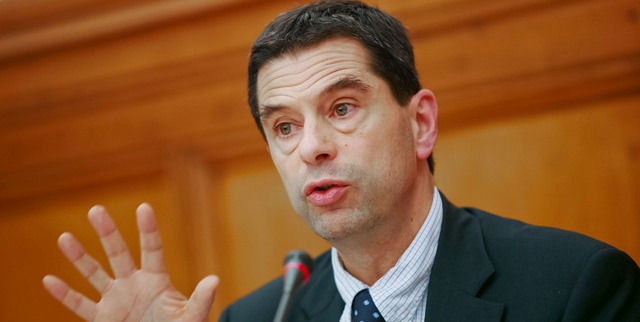
But not every politician is blindly ideological like Obama. Vitor Gaspar, Portugal’s Finance Minister, is willing to admit error. Here are some relevant excerpts from a New York Times report.

Unlike Obama, willing to admit mistakes

Mr. Gaspar, speaking to The New York Times last week, has a message for observers who say Europe needs to substantially relax its austerity approach: We tried stimulus and it backfired. Like some other European countries, Portugal tried what Mr. Gaspar called “a Keynesian style expansion” in 2008, referring to a theory by economist John Maynard Keynes. But it didn’t turn things around, and may have made things worse.

Why does the Portuguese Finance Minister have this view? Well, for the simple reason that the economy got worse and more spending put his country in a deeper fiscal ditch.

The yield on Portuguese government bonds – more than 11 percent on longer-term bonds — is substantially higher than the yields on debt issued by Ireland, Spain or Italy. …The main fear among investors is that Portugal is going to have to ask for a second bailout from the International Monetary Fund and the European Union, which committed $103 billion of financial aid in 2011.

Maybe the big spenders in Portugal should import some of the statist bureaucrats at Congressional Budget Office. The CBO folks could then regurgitate the moving-goalposts argument that they’ve used in the United States and claim that the economy would be even weaker if the government hadn’t wasted more money.

But perhaps the Portuguese left doesn’t think that will pass the laugh test.

Amazingly, the Germans, who have a disturbing affinity for powerful government, decided against Keynesianism and that’s paid dividends for their economy.

In any event, some of us can say we were right from the beginning about this issue.

_________________

Obama’s So-Called Stimulus: Good For Government, Bad For the Economy

Uploaded by on Jan 26, 2009

President Obama wants Congress to dramatically expand the burden of government spending. This CF&P Foundation mini-documentary explains why such a policy, based on the discredited Keynesian theory of economics, will not be successful. Indeed, the video demonstrates that Obama is proposing – for all intents and purposes – to repeat Bush’s mistakes. Government will be bigger, even though global evidence shows that nations with small governments are more prosperous.

_________________

Not that being right required any keen insight. Keynesian policies failed for Hoover and Roosevelt in the 1930s. So-called stimulus policies also failed for Japan in 1990s. And Keynesian proposals failed for Bush in 2001 and 2008.

Just in case any politicians are reading this post, I’ll make a point that normally goes without saying: Borrowing money from one group of people and giving it to another group of people does not increase prosperity.

But since politicians probably aren’t capable of dealing with a substantive argument, let’s keep it simple and offer three very insightful cartoons: here, here, and here.