Category Archives: spending out of control

Brantley and his liberal friends don’t want budget cuts but taxes raised on rich!!!!

Over and over in the past Max Brantley and his liberal friends have said that they don’t want budget cuts but they want taxes raised on the rich. In France their recipe for success is about to be tried and we will see how it works out.

The Arkansas Times blogger going by the username “Outlier” noted:

Nothing like doubling down on a bad bet considering all the evidence coming out of Europe on the failures of austerity. Way to go repubs!

Take a look at this fine article by Dan Mitchell of the Cato Institute:

Even though he is a foolish statist, I wanted Francois Hollande to win the French presidency. Sarkozy was a statist as well, after all, and my “Richard Nixon Disinfectant Rule” says that it’s better to have the out-of-the-closet statist prevail in such contests in hopes that the supposedly right-of-center party can then regroup and offer voters a true choice in the next election.

But I have another reason for wanting Monsieur Hollande. Simply stated, we need role models. Not only role models to show the effects of good policy (like Estonia and Hong Kong), but also clear-cut examples of nations that do the wrong thing.

I fully expect France to be that kind of role model over the next few years. Particularly if Hollande follows through on his scheme to push the top tax rate to 75 percent.

I’ve already written about the experiment America conducted in the 1980s, when Reagan lowered the top tax rate from 70 percent to 28 percent. Hollande wants to conduct a similar experiment, but in reverse.

Indeed, we’re already seeing the potential impact of class-warfare tax policy in France. Here are the key passages from a report in the Financial Times.

Wealthy French people are looking to London as a refuge from fresh taxes on high earners pledged by candidates in the country’s presidential elections. The “soak the rich” rhetoric that has punctuated the presidential campaign has prompted a sharp rise in the numbers weighing a move across the Channel, according to London-based wealth managers, lawyers and property agents specialising in French clients. François Hollande, the Socialist candidate…, wants to impose a tax rate of 75 per cent on income above €1m… Inquiries from French clients had risen by roughly 40 per cent since the speech, says David Blanc, a partner at Vestra Wealth, a London-based wealth manager. …The prospect of a Gallic diaspora of high earners was backed up by Knight Frank, the property agent, which said numbers of French web users searching online for its prime London properties online in the past three months had risen 19 per cent compared with the same period last year. The equivalent figure for Europe as a whole fell 9 per cent. …Mr Blanc says some French clients were even contemplating acquiring British or other nationality in order to safeguard assets from fears that France could move to collect more tax from citizens overseas. “A lot of people are extremely worried,” he said. Alexandre Terrasse, a partner in corporate and property law at Jeffrey Green Russell, says he had seen a 25 per cent rise in activity from French clients over the past six months, “The 75 per cent tax is clearly a sign that the politicians will hit the wealthy and they don’t want to have to deal with that.”

In other words, just a productive people “vote with their feet” by escaping from high-tax hell-holes like California to zero-income-tax states such as Texas, the same phenomenon exists for people crossing national borders.

This means Mr. Hollande is going to learn an interesting math lesson: 75 percent of zero is a very small number.

The Laffer Curve lives! And left wingers who pretend it doesn’t exist learn very unhappy lessons.

P.S. Here’s a good joke about Texas and California, and here’s a serious post about the differences between the two states.


Churchill: ” the inherent virtue of socialism is the equal sharing of misery”

Uploaded by on Jan 18, 2009

Margaret Thatcher’s last House of Commons Speech on November 22, 1990.

________________

Socialism is not the answer to our problems but the cause of them.

The statists are making a big issue out of income inequality, hoping to convince ordinary Americans that redistribution is their only hope for a better life.

I’ve explained with a pizza analogy that this is horribly misguided because it falsely assumes the economy is a fixed pie.

Simply stated, it doesn’t make sense – or help anybody – if inequality is reduced by policies that hurt everyone, but happen to hurt upper-income people more than lower-income people.

Moreover, redistribution tends to create a “poverty trap” as people get seduced by dependency.

That’s why I’ve argued that economic growth is the best way of helping the less fortunate.

But I have to admit that Margaret Thatcher does a much better job of eviscerating the left’s agenda on this issue.

__________

The Prime Minister Thatcher:

People on all levels of income are better off than they were in 1979. The hon. Gentleman is saying that he would rather that the poor were poorer, provided that the rich were less rich. That way one will never create the wealth for better social services, as we have. What a policy. Yes, he would rather have the poor poorer, provided that the rich were less rich. That is the Liberal policy.

_______________

While it’s inspiring to watch Thatcher in action, it’s also painful to realize that the current crop of GOP presidential candidates seems generally incapable of making similar arguments. Can you imagine, for instance, Mitt Romney making these remarks?

Last but not least, Thatcher’s remarks remind me about Churchill’s famous quote, which is very appropriate for this discussion.

The inherent vice of capitalism is the unequal sharing of blessings; the inherent virtue of socialism is the equal sharing of misery.

And if you want real-world examples, look at this chart comparing North Korea and South Korea, or this chart comparing Chile, Argentina, and Venezuela. Now ask yourself a simple question: Which societies have generated more prosperity and higher living standards for ordinary people?

__________

Senator Pryor asks for Spending Cut Suggestions! Here are a few!(Part 146)

Senator Mark Pryor wants our ideas on how to cut federal spending. Take a look at this video clip below:

Senator Pryor has asked us to send our ideas to him at cutspending@pryor.senate.gov and I have done so in the past and will continue to do so in the future.

On May 11, 2011,  I emailed to this above address and I got this email back from Senator Pryor’s office:

Please note, this is not a monitored email account. Due to the sheer volume of correspondence I receive, I ask that constituents please contact me via my website with any responses or additional concerns. If you would like a specific reply to your message, please visit http://pryor.senate.gov/contact. This system ensures that I will continue to keep Arkansas First by allowing me to better organize the thousands of emails I get from Arkansans each week and ensuring that I have all the information I need to respond to your particular communication in timely manner.  I appreciate you writing. I always welcome your input and suggestions. Please do not hesitate to contact me on any issue of concern to you in the future.

Here are a few more I just emailed to Senator Pryor myself:

Government auditors spent the past five years examining all federal programs and found that 22 percent of them—costing taxpayers a total of $123 billion annually—fail to show any positive impact on the populations they serve.

  • The Advanced Technology Program spends $150 million annually subsidizing private businesses; 40 percent of this funding goes to Fortune 500 companies.
  • The Conservation Reserve program pays farmers $2 billion annually not to farm their land.

Reasons why Mark Pryor will be defeated in 2014 (Part 1)

It is apparent from this statement below that Senator Mark Pryor is against the Balanced Budget Amendment. He has voted against it over and over like his father did and now I will give reasons in this series why Senator Pryor will be defeated in his re-election bid in 2014. However, first I wanted to quote the statement Senator Pryor gave on December 14, 2011. This information below is from the Arkansas Times Blog on 12-14-11 and Max Brantley:

THREE CHEERS FOR MARK PRYOR: Our senator voted not once, but twice, today against one of the hoariest (and whoriest) of Republican gimmicks, a balanced budget amendment. Let’s quote him:

As H.L. Mencken once said, “For every complex problem there is a solution which is simple, clean, and wrong.” This quote describes the balanced budget amendment. While a balanced budget amendment makes for an easy talking point, it is an empty solution. Moreover, it’s a reckless choice that handcuffs our ability to respond to an economic downturn or national emergencies without massive tax increases or throwing everyone off Medicare, Social Security, or veteran’s care.There is a more responsible alternative to balance the budget. President Clinton led the way in turning deficits into record surpluses. We have that same opportunity today, using the blueprint provided by the debt commission as a starting point. We need to responsibly cut spending, reform our tax code and create job growth. This course requires hard choices over a number of years. However, it offers a more balanced approach over jeopardizing safety net programs and opportunity for robust economic growth.

____________________

Arkansans clearly see that if our leaders in Washington do not take the bull by the horns and pass the Balanced Budget Amendment that will continue to head toward the direction we are going now. Soon and I am afraid sooner than Mark Pryor realizes, we will be arriving where Greece is now. WE MUST AVOID HEADING TO GREECE AND THE PEOPLE OF ARKANSAS REALIZE THIS AND PRYOR DOES NOT. THIS IS ONE OF THE MAIN REASONS PRYOR WILL BE DEFEATED IN 2014.

Cato Institute scholar Dan Mitchell is right about Greece and the fate of socialism:

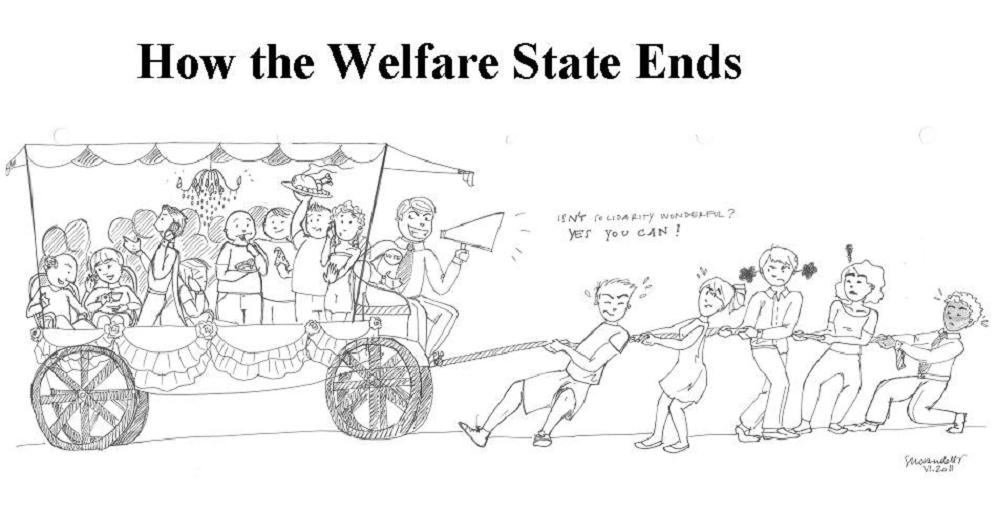
In my speeches, especially when talking about the fiscal crisis in Europe (or the future fiscal crisis in America), I often warn that the welfare state reaches a point-of-no-return when the number of people riding in the wagon begins to outnumber the number of people pulling the wagon.

To be more specific, if more than 50 percent of the population is dependent on government (employed in the bureaucracy, living off welfare, receiving pensions, etc), it becomes rather difficult to form a coalition to fix the mess. This may explain why Greek politicians have resisted significant reforms, even though the nation faces a fiscal death spiral.

But you don’t need me to explain this relationship. One of our Cato interns, Silvia Morandotti, used her artistic skills to create two images (click pictures for better resolution) that show what a welfare state looks like when it first begins and what it eventually becomes.

These images are remarkably accurate. The welfare state starts with small programs targeted at a handful of genuinely needy people. But as  politicians figure out the electoral benefits of expanding programs and people figure out the that they can let others work on their behalf, the ratio of producers to consumers begins to worsen.

Eventually, even though the moochers and looters should realize that it is not in their interest to over-burden the people pulling the wagon, the entire system breaks down.

Then things get really interesting. Small nations such as Greece can rely on permanent bailouts from bigger countries and the IMF, but sooner or later, as larger nations begin to go bankrupt, that approach won’t be feasible.

I often conclude my speeches by joking with the audience that it’s time to stock up on canned goods, bottled water, and ammo. Many people, I’m finding, don’t think that line very funny.

___________________

The Department of Health and Human Services administers the huge and fast-growing Medicare and Medicaid programs. These programs fuel rising health costs, distort health markets, and are plagued by waste and fraud. The department also runs an array of other expensive subsidy programs, including Head Start, TANF, and LIHEAP. Growth in HHS spending is creating a federal financial crisis, and the 2010 health care law sadly makes the situation worse.

The department will spend $910 billion in 2011, or $7,710 for every U.S. household. It employs 68,000 workers and runs more than 420 subsidy programs.


Timeline of Government Growth

  • See this timeline for key events in the department’s growth.

Reading Room

Cato Experts

Spending Cuts Summary

  • Here are proposed reforms to save $81 billion annually in the short-run and prevent federal health costs from consuming a growing share of the economy in the long-run.

Downsize This!

  • Medicare Reforms. Medicare should be transformed into a system based on vouchers, individual savings, and competitive insurance markets.
  • Medicaid Reforms. Federal spending on low-income health care should be converted to block grants for the states.
  • TANF and Welfare Spending. Welfare reforms in 1996 created Temporary Assistance for Needy Families, but this sort of aid should be provided by private charities.
  • Head Start and Other Subsidies. HHS funds a vast array of other subsidy programs, many of which are wasteful and ineffective.
  • 2010 Health Care Legislation. The law expanded Medicaid, added new taxes and subsidies, created new bureaucracies, and did little to reduce cost growth in health care.

The government of the United States is a definite government, confined to specified objects. It is not like the state governments, whose powers are more general. Charity is no part of the legislative duty of the government.

– James Madison. A paraphrase from Elliot’s Debates regarding a proposed subsidy bill, House of Representatives, January 10, 1794.

Videos by Cato Institute on failed stimulus plans

In this post I have gathered several videos from the Cato Institute concerning the subject of failed stimulus plans.

_____

Government Spending Doesn’t Create Jobs

Uploaded by on Sep 7, 2011

Share this on Facebook: http://on.fb.me/qnjkn9 Tweet it: http://tiny.cc/o9v9t

In the debate of job creation and how best to pursue it as a policy goal, one point is forgotten: Government doesn’t create jobs. Government only diverts resources from one use to another, which doesn’t create new employment.

Video produced by Caleb Brown and Austin Bragg.

___________________________

Keynesian Catastrophe: Big Money, Big Government & Big Lies

Uploaded by on Jan 19, 2012

The Cato Institute’s Dan Mitchell explains why Obama’s stimulus was a flop! With Glenn Reynolds.

See more at http://www.pjtv.com and http://www.cato.org

___________________

Keynesian Economics Is Wrong: Bigger Gov’t Is Not Stimulus

Uploaded by on Dec 15, 2008

Based on a theory known as Keynesianism, politicians are resuscitating the notion that more government spending can stimulate an economy. This mini-documentary produced by the Center for Freedom and Prosperity Foundation examines both theory and evidence and finds that allowing politicians to spend more money is not a recipe for better economic performance.

___________________

Obama’s So-Called Stimulus: Good For Government, Bad For the Economy

Uploaded by on Jan 26, 2009

President Obama wants Congress to dramatically expand the burden of government spending. This CF&P Foundation mini-documentary explains why such a policy, based on the discredited Keynesian theory of economics, will not be successful. Indeed, the video demonstrates that Obama is proposing – for all intents and purposes – to repeat Bush’s mistakes. Government will be bigger, even though global evidence shows that nations with small governments are more prosperous.

____________

Big Government Is Not Stimulus: Why Keynes Was Wrong (The Condensed Version)

Uploaded by on Jan 13, 2009

The CF&P Foundation has released a condensed version of our successful mini-documentary explaining why so-called stimulus schemes do not work. Based on a theory known as Keynesianism, politicians are resuscitating the notion that more government spending can stimulate an economy. This mini-documentary produced by the Center for Freedom and Prosperity Foundation examines both theory and evidence and finds that allowing politicians to spend more money is not a recipe for better economic performance.

_________________

Eight Reasons Why Big Government Hurts Economic Growth

Uploaded by on Aug 17, 2009

This Center for Freedom and Prosperity Foundation video analyzes how excessive government spending undermines economic performance. While acknowledging that a very modest level of government spending on things such as “public goods” can facilitate growth, the video outlines eight different ways that that big government hinders prosperity. This video focuses on theory and will be augmented by a second video looking at the empirical evidence favoring smaller government.

___________________

Keynesian Economics Is Wrong: Economic Growth Causes Consumer Spending, Not the Other Way

Uploaded by on Nov 29, 2010

Politicians and journalists who fixate on consumer spending are putting the cart before the horse. Consumer spending generally is a consequence of growth, not the cause of growth. This Center for Freedom and Prosperity video helps explain how to achieve more prosperity by looking at the differences between gross domestic product and gross domestic income. www.freedomandprosperity.org

_____________

Deficits, Debts and Unfunded Liabilities: The Consequences of Excessive Government Spending

Uploaded by on May 10, 2010

Huge budget deficits and record levels of national debt are getting a lot of attention, but this video explains that unfunded liabilities for entitlement programs are Americas real red-ink challenge. More important, this CF&P mini-documentary reveals that deficits and debt are symptoms of the real problem of an excessive burden of government spending. www.freedomandprosperity.org

___________

Now that I have been critical of the Democrat President, I wanted to show that I am not concerned about taking up for Republicans but looking at the facts. President Clinton did increase government spending at a slower rate than many other presidents. Here are two  videos that praise both Reagan and Clinton for both accomplished this feat.

Spending Restraint, Part I: Lessons from Ronald Reagan and Bill Clinton

Uploaded by on Feb 14, 2011

Ronald Reagan and Bill Clinton both reduced the relative burden of government, largely because they were able to restrain the growth of domestic spending. The mini-documentary from the Center for Freedom and Prosperity uses data from the Historical Tables of the Budget to show how Reagan and Clinton succeeded and compares their record to the fiscal profligacy of the Bush-Obama years.

______________

Spending Restraint, Part II: Lessons from Canada, Ireland, Slovakia, and New Zealand

Uploaded by on Feb 22, 2011

Nations can make remarkable fiscal progress if policy makers simply limit the growth of government spending. This video, which is Part II of a series, uses examples from recent history in Canada, Ireland, Slovakia, and New Zealand to demonstrate how it is possible to achieve rapid improvements in fiscal policy by restraining the burden of government spending. Part I of the series examined how Ronald Reagan and Bill Clinton were successful in controlling government outlays — particularly the burden of domestic spending programs. www.freedomandprosperity.org

______________

It seems that liberals will never wake up. On 3-8-12 a Arkansas Times blogger pointed out that Obama’s stimulus in 2009 was not made up of just increased but also tax cuts. That is true but the real truth is that there have been about 1/2 dozen stimulus efforts by President Obama and all of them have failed.  Over and over they have tried stimulus plans but they don’t work. Take a look at this excellent article from the Cato Institute:

Keynesian Policies Have Failed

by Chris Edwards

Chris Edwards is the director of tax policy studies at the Cato Institute and the editor of Downsizing Government.org.

Added to cato.org on December 2, 2011

This article appeared on U.S. News & World Report Online on December 2, 2011

Lawmakers are considering extending temporary payroll tax cuts. But the policy is based on faulty Keynesian theories and misplaced confidence in the government’s ability to micromanage short-run growth.

In textbook Keynesian terms, federal deficits stimulate growth by goosing “aggregate demand,” or consumer spending. Since the recession began, we’ve had a lot of goosing — deficits were $459 billion in 2008, $1.4 trillion in 2009, $1.3 trillion in 2010, and $1.3 trillion in 2011. Despite that huge supposed stimulus, unemployment remains remarkably high and the recovery has been the slowest since World War II.

Policymakers should ignore the Keynesians and their faulty models, and instead focus on reforms to aid long-run growth…

Yet supporters of extending payroll tax cuts think that adding another $265 billion to the deficit next year will somehow spur growth. That “stimulus” would be on top of the $1 trillion in deficit spending that is already expected in 2012. Far from helping the economy, all this deficit spending is destabilizing financial markets, scaring businesses away from investing, and imposing crushing debt burdens on young people.

For three years, policymakers have tried to manipulate short-run economic growth, and they have failed. They have put too much trust in macroeconomists, who are frankly lousy at modeling the complex workings of the short-run economy. In early 2008, the Congressional Budget Office projected that economic growth would strengthen in subsequent years, and thus completely missed the deep recession that had already begun. And then there was the infamously bad projection by Obama’s macroeconomists that unemployment would peak at 8 percent and then fall steadily if the 2009 stimulus plan was passed.

Chris Edwards is the director of tax policy studies at the Cato Institute and the editor of Downsizing Government.org.


More by Chris Edwards

Some of the same Keynesian macroeconomists who got it wrong on the recession and stimulus are now claiming that a temporary payroll tax break would boost growth. But as Stanford University economist John Taylor has argued, the supposed benefits of government stimulus have been “built in” or predetermined by the underlying assumptions of the Keynesian models.

Policymakers should ignore the Keynesians and their faulty models, and instead focus on reforms to aid long-run growth, which economists know a lot more about. Cutting the corporate tax rate, for example, is an overdue reform with bipartisan support that would enhance America’s long-run productivity and competitiveness.

If Congress is intent on cutting payroll taxes, it should do so within the context of long-run fiscal reforms. One idea is to allow workers to steer a portion of their payroll taxes into personal retirement accounts, as Chile and other nations have done. That reform would feel like a tax cut to workers because they would retain ownership of the funds, and it would begin solving the long-term budget crisis that looms over the economy.

Related posts:

Stimulus plans do not work (part 2)

Dan Mitchell discusses the effectiveness of the stimulus Uploaded by catoinstitutevideo on Nov 3, 2009 11-2-09 When I think of all our hard earned money that has been wasted on stimulus programs it makes me sad. It has never worked and will not in the future too. Take a look at a few thoughts from […]

Stimulus plans do not work (Part 1)

Government Spending Doesn’t Create Jobs Uploaded by catoinstitutevideo on Sep 7, 2011 Share this on Facebook: http://on.fb.me/qnjkn9 Tweet it: http://tiny.cc/o9v9t In the debate of job creation and how best to pursue it as a policy goal, one point is forgotten: Government doesn’t create jobs. Government only diverts resources from one use to another, which doesn’t […]

Dumas thinks we don’t need Balanced Budget Amendment but should balance it on our own

In his recent article Ernie Dumas sticks to his guns that we should balance the budget without being forced to with a “Balanced Budget Amendment,” but I wonder how well that has worked so far? I have made this a key issue for this blog in the past as you can tell below: Dear Senator […]

Maybe the “Occupy Wall Street” crowd should be angry at Obama

(Picture from Arkansas Times Blog) When I think about all the anger and hate coming from the Occupy Wall Street crowd, I wonder if they have read this story below? Solyndra: Crooked Politics or Just Bad Economics? Posted by David Boaz Amy Harder has a good take on the Solyndra issue in National Journal Daily […]

Dear Senator Pryor, why not pass the Balanced Budget Amendment? (Part 13 Thirsty Thursday, Open letter to Senator Pryor)

Dear Senator Pryor, why not pass the Balanced Budget Amendment? (Part 13 Thirsty Thursday, Open letter to Senator Pryor) Office of the Majority Whip | Balanced Budget Amendment Video In 1995, Congress nearly passed a constitutional amendment mandating a balanced budget. The Balanced Budget Amendment would have forced the federal government to live within its […]

Mark Pryor not for President’s job bill even though he voted for it

Andrew Demillo pointed this out  and also Jason Tolbert noted: PRYOR OPPOSES THE OBAMA JOBS BILL THAT HE VOTED TO ADVANCE  Sen. Mark Pryor has been traveling around the state touting a six-part jobs plan that he says “includes a number of bipartisan initiatives, is aimed at creating jobs by setting the table for growth, encouraging new […]

Is a lack of money the problem for our public schools?

Is a lack of money the problem for our public schools? Everything You Need to Know About Public School Spending in Less Than 2½ Minutes Posted by Adam Schaeffer Neal McCluskey gutted the President’s new “Save the Teachers” American Jobs Act sales pitch a good while back, as did Andrew Coulson here. Thankfully, it seems […]

Obama is out to outgive Romney in the big government game!!!

Real Time with Bill Maher March 16 2012 – Alexandra Pelosi Interviews Welfare Recipients in NYC

Published on Mar 18, 2012 by

Real Time with Bill Maher March 16 2012 – Alexandra Pelosi Interviews Welfare Recipients

_________________________

Alexandra Pelosi (Nancy’s daughter) did a great job of showing in this clip on Bill Maher’s show on how many people who receive welfare benefits are really able bodied people who have no desire to get a job. Some of them have mutiple children with several women and many of them feel that they are owed their benefits by Obama because they voted for him. Dan Mitchell does a great job below showing the mentality of Obama’s re-election campaign which encourages people to add up all the benefits people can get from big government and how they can outgive Romney!!!

Back in 2010, I declared that Olga Stefou was a symbol of everything that’s wrong with the Greek welfare state.

She was one of the protesters and – if the story captured her thoughts accurately – she displayed an unlimited entitlement mentality. Sort of helps one understand why this cartoon is so accurate.

Now we have an American version of Olga. Her name is Julia, and she is just as much of a moocher.

The good news, though, is that Julia is only a make-believe leech. She’s been created by the Obama campaign to show how big government can provide cradle-to-grave handouts.

The full series can be found at this link, and here’s a screenshot of the handouts that Julia might take at age 31.

Poor Julia is getting mercilessly mocked as everything from a deadbeat to a New Soviet Woman. But I realize my circle of friends, acquaintances, and contacts are not a representative sample.

So I do wonder whether this new gimmick from the Obama campaign will be successful. If it does work, it will show that this Chuck Asay cartoon was depressingly prescient. Heck, this cartoon about government as Santa Claus also will be accurate.

Stimulus programs never work

The stimulus did not work for the USA and it has never worked.

There’s an old saying that insanity is doing the same thing over and over again while expecting different results. This certainly is a good description of Keynesians, who relentlessly push more government spending as some sort of magic potion for the economy – notwithstanding a record of failure.

The latest example if Larry Summers, the former economist for the Obama White House, who says Europeans need to make government bigger.

Here is some of what he writes for today’s Washington Post.

European efforts to contain crisis have fallen short. …Much of what is being urged on and in Europe is likely to be not just ineffective but counterproductive to maintaining the monetary union, restoring normal financial conditions and government access to markets, and reestablishing economic growth. The premise of European policymaking is that countries are overindebted and so unable to access markets on reasonable terms, and that the high interest rates associated with excessive debt hurt the financial system and inhibit growth. The strategy is to provide financing while insisting on austerity, in hopes that countries can rein in their excessive spending enough to restore credibility, bring down interest rates and restart economic growth.

The good news is that Summers recognizes that there has been “excessive spending.” The bad news is that he uses the wrong definition of austerity.

Many European nations seem to think higher taxes are a sign of fiscal conservatism (see this post by Veronique de Rugy for a good discussion of this confusion). Summers accepts that approach, and says that policy makers should choose a Keynesian policy instead.

Unfortunately, Europe has misdiagnosed its problems in important respects and set the wrong strategic course. …Europe’s problem countries are in trouble because the financial crisis underway since 2008 has damaged their financial systems and led to a collapse in growth. High deficits are much more a symptom than a cause of their problems. And treating symptoms rather than underlying causes is usually a good way to make a patient worse. …The right focus for Europe is on growth; in this dimension, increased austerity is a step in the wrong direction.

There’s more good news. Summers is right in stating that Europe suffers from low growth. And I agree with him that the European version of austerity – higher taxes – is not a solution.

But, as always, there is a catch. Summers has the wrong approach on how to encourage growth. He wants Keynesian spending, and here is his defense.

 Skeptics will rightly wonder how a prescription for more spending by countries that already have trouble borrowing can be correct. The answer lies in the difference between borrowing by individuals and countries. Normally, an individual helps his creditors by borrowing less; but a person who stops borrowing to finance commuting to his job does his creditors no favor. A country’s income is determined by spending, so a country that pursues austerity to the point where its economy is driven into a downward spiral does its creditors no favor.

Sounds semi-reasonable. After all, everyone understands that it is important to get to their place of employment. Sometimes you spend money to make money.

But here’s the problem. Can anyone name anything in so-called stimulus schemes that actually increase a nation’s productive capacity? As we saw with Obama’s failed stimulus, lots of money gets distributed, but the main purpose seems to be buying votes and creating dependency.

What about jobs? A miserable failure.

Adding insult to injury, you probably won’t be surprised to learn that American taxpayers are supposed to pick up the lion’s share of the tab for the new spending in Europe since Summers wants the IMF to be the sugar daddy.

Going forward, the IMF and international community should condition further support not merely on individual countries’ actions but on a common European commitment to growth.

This approach is illogical, as explained in this video.

And let’s consider the historical record. Nations that have tried this type of “stimulus” have not fared well. Big spending increase under Hoover and Roosevelt failed in the 1930s. Japan tried several Keynesian packages and failed in the 1990s. Bush failed in 2008 and Obama failed in 2009.

Germany did not go with a big program of government spending, and they did better than the United States. The same is true about Canada. But the real success story is the Baltic nations. They imposed real spending restraint, not the fake austerity found in places such as the United Kingdom.

And even though it caused some short-term pain since there’s a short-term cost when labor and capital get redeployed to more productive uses, the Baltic nations are now in much better shape that the European nations that have floundered because they limited themselves to the no-win choice of Keynesianism and tax hikes.

Once the baby boomers are finished getting on Social Security (2011 to 2030) there will be nothing left.

Uploaded by on Jun 21, 2011

Senator Kay Bailey Hutchison delivered remarks regarding her landmark proposal on entitlement reform, the Defend and Save Social Security Act at the Heritage Foundation’s “Saving Social Security” event. Sen. Hutchison announced that Senator Jon Kyl (R-AZ), member of Biden’s budget working group, has lent his support of her bill as the original cosponsor. At her press conference last week, Sen. Hutchison unveiled her Social Security proposal, and today she reiterated the urgency of putting Social Security on the table in the Biden budget group discussions. Sen. Hutchison sent a letter to Vice President Joe Biden last week urging him to incorporate Social Security reform in the ongoing deficit reduction debates that he is leading.

____________________

Once the baby boomers are finished getting on Social Security (2011 to 2030) there will be nothing left.

There are two serious problems with America’s Social Security system. Almost everyone knows about the first problem, which is that the system is bankrupt, with huge unfunded liabilities of about $30 trillion.

The other crisis is that the system gives workers a lousy level of retirement income compared to the amount of taxes they pay during their working years. Younger workers are particularly disadvantaged, as are African-Americans because of lower life expectancy.

These are critical issues, but perhaps looking at a couple of charts is the best way to illustrate why the Social Security system is inadequate.

Let’s start by looking at some numbers from Australia, where workers set aside 9 percent of their income in personal retirement accounts.

This system, which was made universal by the Labor Party beginning in the 1980s, has turned every Australian worker into a capitalist and generated private wealth of nearly 100 percent of GDP. Here’s a chart, based on data from the Australian Prudential Regulation Authority.

Now let’s look at one of the key numbers generated by America’s tax-and-transfer entitlement system. Here’s a chart showing the projected annual cash-flow deficits for the Social Security system, based on the just-released Trustees’ Report.

By the way, the chart shows inflation-adjusted 2012 dollars. The numbers would look far worse if I used the nominal numbers.

The two charts aren’t analogous, of course, but that’s because there’s nothing to compare. The Social Security system has no savings. Indeed, it discourages people from setting aside income.

And Australia’s superannuation system doesn’t have anything akin to America’s unfunded liabilities. The closest thing to an analogy would be the safety net provision guaranteeing a basic pension to people with limited savings (presumably because of a spotty employment record).

So now ask yourself whether Australia should copy America or America should copy Australia? Seems like a no-brainer.

Get people off of government support and get them in the private market place!!!!(great cartoon too)

Dan Mitchell hits the nail on the head and sometimes it gets so sad that you just have to laugh at it like Conan does. In order to correct this mess we got to get people off of government support and get them in the private market place!!!!

The third-most viewed post in the history of this blog, with more than 22,000 views, is this set of cartoons showing how the welfare state begins and how it ends.

A similar theme can be found in this great new cartoon from Chuck Asay.

And just in case you think Asay is being unfair, keep in mind that folks like Obama and Pelosi actually have claimed that more unemployment benefits is “stimulus.” Yes, you read correctly. Subsidizing unemployment is good for growth to these strange ideologues.

Asay’s cartoon is so good that it may dethrone my previous top choice. Though sometimes I am most impressed by this one showing why parasites shouldn’t kill their host animal.

I’d be curious to know which one all of you think is most effective.

And since Asay’s work is almost always worth sharing, you can find more of my top picks hereherehere, and here.

Sometimes it is tragic that you got to laugh about it.

Brandon Stewart

August 10, 2011 at 7:31 pm

Late-night comedian Conan O’Brien’s blog has a new post parodying Washington’s excessive spending. “Team Coco has found out why our government is so broke,” the blog explains, “They’ve been spending all our hard earned tax dollars on some pretty ridiculous programs.” The post contains a list of humorous fake programs and encourages readers submit their own.

But sadly, there’s no need to turn to a crack team of comedy writers to gin up examples of ridiculous government spending. Instead, one need only look to the shenanigans on Capitol Hill to find a list of absurd expenditures of taxpayer dollars. As Heritage has reported, in addition to long-term, substantive reforms$343 billion of wasteful government spending could be cut immediately. And while Conan’s list is populated by a number of outlandish (but fake) programs, there are plenty of REAL government programs that are just as ridiculous. Conan, try these on for size:

  • Washington will spend $2.6 million training Chinese prostitutes to drink more responsibly on the job.
  • Because of overstaffing, the U.S. Postal Service selects 1,125 employees per day to sit in empty rooms. They are not allowed to work, read, play cards, watch television, or do anything. This costs $50 million annually.
  • Stimulus dollars have been spent on mascot costumes, electric golf carts, and a university study examining how much alcohol college freshmen women require before agreeing to casual sex.
  • Washington will spend $615,175 on an archive honoring the Grateful Dead.
  • The Securities and Exchange Commission spent $3.9 million rearranging desks and offices at its Washington, D.C., headquarters.
  • Congress recently gave Alaska Airlines $500,000 to paint a Chinook salmon on a Boeing 737.
  • Washington spends $25 billion annually maintaining unused or vacant federal properties.
  • The Federal Communications Commission spent $350,000 to sponsor NASCAR driver David Gilliland.
  • Washington has spent $3 billion re-sanding beaches—even as this new sand washes back into the ocean.
  • Taxpayers are funding paintings of high-ranking government officials at a cost of up to $50,000 apiece.
  • The Conservation Reserve program pays farmers $2 billion annually not to farm their land.

And the list goes on and on. When it comes to government spending, the truth is often stranger than fiction.

Dear Senator Pryor, why not pass the Balanced Budget Amendment? (“Thirsty Thursday”, Open letter to Senator Pryor)

Dear Senator Pryor,

Why not pass the Balanced  Budget Amendment? As you know that federal deficit is at all time high (1.6 trillion deficit with revenues of 2.2 trillion and spending at 3.8 trillion).

On my blog www.HaltingArkansasLiberalswithTruth.com I took you at your word and sent you over 100 emails with specific spending cut ideas. However, I did not see any of them in the recent debt deal that Congress adopted. Now I am trying another approach. Every week from now on I will send you an email explaining different reasons why we need the Balanced Budget Amendment. It will appear on my blog on “Thirsty Thursday” because the government is always thirsty for more money to spend.

____________

(CNSNews.com) – Rep. Louie Gohmert (R-Texas) will not vote for a balanced budget amendment proposal unless it includes a cap on federal spending. However, he is undecided whether the amendment absolutely must require a supermajority of Congress to approve a tax hike for him to support it.

“The most important element is the cap on spending,” Gohmert told CNSNews.com. “If there is no cap on spending, then the balanced budget amendment is a formula for ever- increasing spending and ever-increasing taxing that will just spiral upward and upward again. So there’s got to be included a cap on spending, and best if it’s related to a percentage of GDP. But, absolutely, if there is no cap on spending, I could not vote for it.”

The actual language of the balanced budget amendment that Congress will vote on before the end of the year has not yet been determined. However, many conservatives fear that Republican leaders may agree to vote on a stripped down amendment that requires Congress to balance the budget but does not cap spending as a percentage of GDP or require supermajorities to raise taxes. They fear that an amendment of that nature–which might win the backing of some incumbent congressional liberals–would become a constitutional lever for sustaining big government via ever-escalating federal taxation.

When the Republican-controlled-House approved the cut, cap and balance plan last on July 19 in 234-190 vote, it included a version of the balanced budget amendment to cap federal spending at 19.9 percent of GDP. The GOP originally sought to hold federal spending to 18 percent of GDP.

The version of the balanced budget amendment in the cut, cap and balance plan also required two-thirds majorities in both houses to approve a tax increase. The amendment also would have prohibited deficit spending unless there was a national security emergency or a supermajority of Congress voted for it. On July 22, the Senate voted 51-46 to approve a procedural motion that blocked substantive consideration of the cut, cap and balance bill in that body.

The debt-limit deal reached by President Barack Obama, House Speaker John Boehner (R-Ohio) and Senate Majority Leader Harry Reid (D-Nev.) requires that both houses of Congress give an up or down vote to a balanced budget amendment before the end of the year. However, it does not specify what the language of the amendment would be.

If two-thirds of Congress votes to approve a balanced budget amendment, it would then have to be ratified by 38 states, or three-fourths.

The House passed that debt-limit deal by a 269-161 vote on Aug. 1. Gohmert was one of 66 Republicans who voted against it.

“As far as the supermajority to raise taxes, that’s our preference, but the key element, the most important element is the cap on spending,” Gohmert said. “If there is no supermajority to raise taxes then I’d just have to look at it more closely to see what all was there to see if it was something I could vote for or not.”

Gohmert believes this is a winning issue for Republicans.

“Well, I think it’s like this: We either have a legitimate Balanced Budget Amendment pass with a cap on spending, or I really believe if it does not pass, you will see many of those who voted against it turned out both in the House and Senate in the next election,” Gohmert said. “So I think it’s an either/or. Either people vote for it and it passes, or we have a significant change in the people that are in the House and Senate that voted against it.”