We have spent over 19 trillion on welfare since LBJ started the war on poverty and it has only brought us several generations who are dependent on the government.
These examples highlight the need to reform a welfare system that is contributing to a culture of entitlement. A crucial element of reform is tackling the ballooning costs of the welfare state, which has become the fastest growing part of government spending.
First, Rector dispelled the myth that the 1996 welfare reforms ended “welfare as we know it.” In fact, he noted, since 1996 the U.S “spends 50 percent more on means-tested cash, food and housing than it did when Bill Clinton entered office on a promise to ‘end welfare as we know it.’”
The reforms have been significantly watered down over the last several years, and as Rector explained on Tuesday, they touched only one of dozens of federal welfare programs:
The public is almost totally unaware of the size and scope of government spending on the poor. This is because Congress and the mainstream media always discuss welfare in a fragmented, piecemeal basis. Each of the 79 programs is debated in isolation as if it were the only program affecting the poor. This piecemeal approach to welfare spending perpetuates the myth that spending on the poor is meager and grows little, if at all.
In reality, welfare programs are costing taxpayers hundreds of billions of dollars each year. In fiscal year 2011, total welfare costs equaled $927 billion ($717 billion from the federal government and $210 billion from states).
Yet, despite current annual welfare costs already twice the amount necessary “to lift all Americans out of poverty,” as Rector noted, President Obama plans to increase welfare spending. Welfare costs have already grown by a third since he came to office in 2009. And this isn’t temporary spending due to the recession. President Obama plans to grow welfare such that by 2022 costs will reach $1.56 trillion. Based on President Obama’s plan, in the next decade U.S. taxpayers will fork out roughly $12.7 trillion on welfare.
To control the burgeoning costs, Rector explained that Congress must put a cap on aggregate welfare spending. Once the current recession ends or by 2013 at the latest, welfare funding should be rolled back to pre-recession levels (adjusted for inflation) and then allowed to grow thereafter only at the rate of inflation. This would save U.S. taxpayers more than $2.7 trillion over 10 years. In addition to the spending cap, Congress should tackle the causes of poverty by promoting self-reliance through work requirements and time limits as well as efforts to strengthen marriage in low-income communities.
Pouring more federal dollars into welfare is creating a burden on taxpayers and promoting a system of government dependence. Reforming welfare by getting costs under control and promoting personal responsibility is an approach that not only respects American taxpayers but also benefits individuals in need.
It is apparent from this statement below that Senator Mark Pryor is against the Balanced Budget Amendment. He has voted against it over and over like his father did and now I will give reasons in this series why Senator Pryor will be defeated in his re-election bid in 2014. However, first I wanted to quote the statement Senator Pryor gave on December 14, 2011. This information below is from the Arkansas Times Blog on 12-14-11 and Max Brantley:
THREE CHEERS FOR MARK PRYOR: Our senator voted not once, but twice, today against one of the hoariest (and whoriest) of Republican gimmicks, a balanced budget amendment. Let’s quote him:
As H.L. Mencken once said, “For every complex problem there is a solution which is simple, clean, and wrong.” This quote describes the balanced budget amendment. While a balanced budget amendment makes for an easy talking point, it is an empty solution. Moreover, it’s a reckless choice that handcuffs our ability to respond to an economic downturn or national emergencies withoutmassive tax increases or throwing everyone off Medicare, Social Security, or veteran’s care.There is a more responsible alternative to balance the budget. President Clinton led the way in turning deficits into record surpluses. We have that same opportunity today, using the blueprint provided by the debt commission as a starting point. We need to responsibly cut spending, reform our tax code and create job growth. This course requires hard choices over a number of years. However, it offers a more balanced approach over jeopardizing safety net programs and opportunity for robust economic growth.
____________________
Senator Pryor will be defeated in 2014 BECAUSE HE IS OFTEN INVOLVED WITH DOUBLETALK INSTEAD OF MAKING THE HARD CHOICES THAT IT TAKES TO BALANCE THE BUDGET. For instance, Senator Pryor said “While a balanced budget amendment makes for an easy talking point, it is an empty solution. Moreover, it’s a reckless choice that handcuffs our ability to respond to an economic downturn or national emergencies withoutmassive tax increases… We need to responsibly cut spending, reform our tax code and create job growth. This course requires hard choices over a number of years.”
However, he is knows that “any sensible amendment proposal would feature a “safety valve” to exempt deficits incurred in response to such emergencies, requiring, for example, a three-fifths “super majority” in both houses of Congress…” as Dick Thornburgh has noted below. Furthermore, Thornburgh refutes the other potential problems Pryor has noted below.
There’s nothing nutty about a balanced-budget amendment
In fact, it makes a lot of sense
Thursday, July 21, 2011
By A late entry in the budget deficit-debt ceiling talkathon in Washington is increasing support for a constitutional requirement that the federal budget be balanced each and every year.
Doctrinaire liberals will no doubt characterize this proposal as a nutty one, but careful scrutiny of such an amendment to our Constitution demonstrates its potential to prevent future train wrecks in the budgeting process.
Coupled with a presidential line-item veto and separate capital budgeting (which differentiates investments from current outlays), a constitutional budget-balancing requirement makes sense. These tools already are available to most governors and state legislatures. And they work.
The current debate in the Congress will likely include the following arguments usually raised against a balanced-budget amendment.
First, it will be argued that the amendment would “clutter up” our basic document in a way contrary to the intention of the founding fathers.
This is clearly wrong. The framers of the Constitution contemplated that amendments would be necessary to keep it abreast of the times. It already has been amended on 27 occasions.
Moreover, at the time of the Constitutional Convention, one of the major preoccupations was how to liquidate the Revolutionary War debts of the states. Certainly, it would have been unthinkable to the framers that the federal government itself would systematically run at a deficit, decade after decade. Indeed, the Treasury did not begin to follow such a practice until the mid-1930s.
Second, critics will argue that the adoption of a balanced-budget amendment would not solve the deficit problem overnight.
This is correct, but begs the issue. Serious supporters of the amendment recognize that a phasing-in period of five or 10 years would be required to reach a zero deficit. During this interim period, however, budget makers would be disciplined to meet declining deficit targets in order to reach a balanced budget by the established deadline.
As pointed out by former Commerce Secretary Peter G. Peterson, such “steady progress toward eliminating the deficit will maintain investor confidence, keep long-term interest rates headed down and keep our economy growing.”
Third, it will be argued that such an amendment would require vast cuts in social services and entitlements or defense expenditures.
Not necessarily. True, these programs would have to be paid for on a current basis rather than heaped on the backs of upcoming generations. Certainly, difficult choices would have to be made about priorities and levels of program funding. But the very purpose of the amendment is to discipline the executive and legislative branches actually to debate these choices and not to propose or perpetuate vast spending programs without providing the revenues to fund them.
The amendment would, in effect, make the president and Congress fully accountable for their spending and taxing decisions, as they should be.
Fourth, critics will say that a balanced-budget amendment would prevent or hinder our capacity to respond to national defense or economic emergencies.
This concern is easy to counter. Any sensible amendment proposal would feature a “safety valve” to exempt deficits incurred in response to such emergencies, requiring, for example, a three-fifths “super majority” in both houses of Congress. Such action should, of course, be based on a finding that such an emergency actually exists.
Fifth, it will be said that a balanced-budget amendment would be “more loophole than law” and might be easily circumvented.
The experience of the states suggests otherwise. Balanced-budget requirements are now in effect in all but one of the 50 states and have served them well.
Moreover, the line-item veto, available to 43 governors, would assure that any specific congressional overruns (or loophole end-runs) could be dealt with by the president. The public’s outcry, the elective process and the courts would also provide backup restraint on any tendency to simply ignore a constitutional directive.
In the final analysis, most of the excuses raised for not enacting a constitutional mandate to balance the budget rest on a stated or implied preference for solving our deficit dilemma through the “political process” — that is to say, through responsible action by the president and Congress.
But that has been tried and found wanting, again and again.
Surely, this country is ready for a simple, clear and supreme directive that its elected officials fulfill their fiscal responsibilities. A constitutional amendment is the only instrument that will meet this need effectively. Years of experience at the state level argue persuasively in favor of such a step. Years of debate have produced no persuasive arguments against it.
Perhaps Thomas Jefferson put it best:
“To preserve our independence, we must not let our rulers load us down with perpetual debt.”
That is the aim of a balanced-budget amendment. Reform-minded members of Congress should choose to support such an amendment to our Constitution as a means of resolving future legislative crises and ending “credit card” government once and for all.
A nutty idea? Not by a long shot.
Dick Thornburgh, of counsel to the Pittsburgh law firm K&L Gates, is a former U.S. attorney general and governor of Pennsylvania.
I have been writing President Obama letters and have not received a personal response yet. (He reads 10 letters a day personally and responds to each of them.) However, I did receive a form letter in the form of an email on May 9, 2012. I don’t know which letter of mine generated this response so I have linked several of the letters I sent to him below with the email that I received. However, this letter below may have been the one that did it:
President Obama c/o The White House
1600 Pennsylvania Avenue NW
Washington, DC 20500
The government can not spend themselves out of a recession. It doesn’t work. Japan did 8 stimulus packages in the last 20 years but it has never worked. The best approach to get out of a recession was done by Ronald Reagan in the early 1980’s when he cut taxes then we experienced 7% economic growth. However, somehow Max Brantley of the Arkansas Times claims today that the stimulus did work and that we should have done more!!!
Mired in excruciating negotiations over the budget and the debt ceiling, President Barack Obama might reflect that things didn’t have to turn out this way. The impasse grows mainly out of one major decision he made early on: pushing through a giant stimulus.
When he took office in January 2009, this was his first priority. The following month, Obama signed the American Recovery and Reinvestment Act, with a price tag eventually put at $862 billion.
It was, he said at the time, the most sweeping economic recovery package in our history,” and would “create or save three and a half million jobs over the next two years.”
The president was right about the first claim. As a share of gross domestic output, it was the largest fiscal stimulus program ever tried in this country. But the second claim doesn’t stand up so well. Today, total nonfarm employment is down by more than a million jobs.
What Obama didn’t foresee is that his program would spark a populist backlash and give rise to the tea party. Where would Michele Bachmann be if the stimulus had never been enacted — or if it had been a brilliant success?
To say it has not been is to understate the obvious. The administration says the results look meager because the economy was weaker than anyone realized. Maybe so, but fiscal policy is a clumsy and uncertain tool for stimulating growth, which the past two years have not vindicated.
The package had three main components: tax cuts, aid to state governments and spending on infrastructure projects. Tax cuts would induce consumers to buy stuff. State aid would prop up spending by keeping government workers employed. Infrastructure outlay would generate hiring to build roads, bridges and other public works.
That was the alluring theory, which vaporized on contact with reality. The evidence amassed so far by economists indicates that the stimulus has come up empty in every possible way.
Consider the tax cuts. Wage-earners saw their take-home pay rise as the IRS reduced withholding. But as with past rebates and one-time tax cuts, consumers proved reluctant to perform their assigned role.
Claudia Sahm of the Federal Reserve Board and Joel Slemrod and Matthew Shapiro of the University of Michigan found that only 13 percent of households indicated they would spend most of the windfall. The rest said they preferred to put it in the bank or pay off debts — neither of which boosts the sale of goods and services.
This puny yield was even worse than that of the 2008 tax rebate devised by President George W. Bush. Neither attempt, the study reported, “was very effective in stimulating spending in the near term.”
The idea behind channeling money to state governments is that it would reduce the paring of government payrolls, thus preserving the spending power of public employees. But the plan went awry, according to a paper by Dartmouth College economists James Feyrer and Bruce Sacerdote published by the National Bureau of Economic Research.
“Transfers to the states to support education and law enforcement appear to have little effect,” they concluded. Most likely, they said, states used the money to avoid raising taxes or borrowing money.
That’s right: The federal government took out loans that it will have to cover with future tax increases … so states don’t have to. It’s like paying your Visa bill with your MasterCard.
The public works component could have been called public non-works. It sounds easy for Washington to pay contractors to embark on “shovel-ready projects” that needed only money to get started. The administration somehow forgot that even when the need is urgent, the government moves at the speed of a glacier.
John Cogan and John Taylor, affiliated with Stanford University and the Hoover Institution, reported earlier this year that out of that $862 billion, a microscopic $4 billion has been used to finance infrastructure. Even Obama has been chagrined.
“There’s no such thing as shovel-ready projects,” he complained last year.
Even if jobs were somehow created or saved by this ambitious effort, they came at a prohibitive price. Feyrer and Sacerdote say the costs may have been as high as $400,000 perjob.
Based on all this evidence, we don’t really know whether the federal government can use fiscal policy to engineer a recovery. We do know it can go broke trying.
__________________________
Thank you so much for your time. I know how valuable it is. I also appreciate the fine family that you have and your committment as a father and a husband.
Sincerely,
Everette Hatcher III, 13900 Cottontail Lane, Alexander, AR 72002, ph 501-920-5733, lowcostsqueegees@yahoo.com
May 9, 2012
Dear Everette:
Thank you for writing. I have heard from many Americans about Government spending and our national debt. I appreciate your perspective.
I am committed to working in a bipartisan way to solve the financial challenges before us and to construct an economy where every hard-working American gets a fair shot, does their fair share, and plays by the same rules. By focusing on job creation, security for working families, and fiscal responsibility, we can get people the help they need, prepare for the future, and reduce the Federal deficit.
This is a make-or-break moment for the middle class and those trying to reach it. After decades of eroding middle-class security and after a recession that plunged our economy into a crisis from which we are still fighting to recover, it is time to construct an economy built to last. To put our Nation back on a path of living within our means, we must cut wasteful spending, ask all Americans to shoulder their fair share, and make tough choices on some things we cannot afford. The Federal Government, like families across America, is going to have to cut spending while protecting investments that are vital to growing our economy and creating jobs. My proposed budget for Fiscal Year 2013 targets scarce Federal resources to the areas critical to growing our economy and restoring middle-class security: education and skills for American workers, innovation and manufacturing, clean energy, and infrastructure. This proposal will reduce our deficit by $4 trillion by 2022 and will help put our country back on a more sustainable fiscal path.
An economy built to last also demands we renew the American values of fair play and shared responsibility—principles that must guide our approach to solving our Nation’s deficit problem. As we extend middle-class tax cuts to help working families, I am pursuing the end of costly tax breaks and special deductions for the wealthiest Americans and biggest corporations. I have repeatedly called on Congress to stop giving away $4 billion a year in oil subsidies to an industry that has never been more profitable, and instead, to pass clean energy tax credits to cultivate a market for innovation in clean energy technology. I also proposed a fee on big banks and other major financial institutions to recoup taxpayer assistance that was crucial to saving the economy.
To prevent Congress from worsening our deficit outlook, I pushed for and signed into law pay-as-you-go rules for Congress—rules critical to creating the surpluses of the 1990s. Additionally, I established the Campaign to Cut Waste, which is aggressively rooting out misspent tax dollars, and sent Congress the Consolidating and Reforming Government Act to reinstate the authority past presidents have had to streamline the Executive Branch and create a leaner, more efficient Federal Government. Through these and other efforts, we can reduce the deficit and ensure a more stable future for our children.
To learn more about our budget, please visit www.Budget.gov. Thank you, again, for writing.
Sen. Toomey responds to State of the Union address 2012 Leader Cantor On CNN Responding To President Obama’s State of the Union Address Uploaded by EricCantor on Jan 25, 2012 Sen. Paul Delivers State of the Union Response – Jan. 24, 2012 President Obama c/o The White House 1600 Pennsylvania Avenue NW Washington, DC 20500 […]
Rick Santorum’s (entire) Speech at Chattanooga Tea Party’s Liberty Forum Uploaded by TinShipProd on Feb 25, 2012 http://www.tinshipproductions.com Chattanooga Tea Party’s Liberty Forum Saturday, February 25, 2012 This speech is unedited and shown in it’s entire 55 minutes. ___________________ President Obama c/o The White House 1600 Pennsylvania Avenue NW Washington, DC 20500 Dear Mr. President, […]
President Obama c/o The White House 1600 Pennsylvania Avenue NW Washington, DC 20500 Dear Mr. President, I know that you receive 20,000 letters a day and that you actually read 10 of them every day. I really do respect you for trying to get a pulse on what is going on out here. The government […]
Uploaded by CFPEcon101 on May 3, 2011 This Economics 101 video from the Center for Freedom and Prosperity gives seven reasons why the political elite are wrong to push for more taxes. If allowed to succeed, the hopelessly misguided pushing to raise taxes would only worsen our fiscal mess while harming the economy. The seven […]
President Obama c/o The White House 1600 Pennsylvania Avenue NW Washington, DC 20500 Dear Mr. President, I know that you receive 20,000 letters a day and that you actually read 10 of them every day. I really do respect you for trying to get a pulse on what is going on out here. I know […]
President Obama c/o The White House 1600 Pennsylvania Avenue NW Washington, DC 20500 Dear Mr. President, I know that you receive 20,000 letters a day and that you actually read 10 of them every day. I really do respect you for trying to get a pulse on what is going on out here. The result […]
Rick Santorum’s (entire) Speech at Chattanooga Tea Party’s Liberty Forum Uploaded by TinShipProd on Feb 25, 2012 http://www.tinshipproductions.com Chattanooga Tea Party’s Liberty Forum Saturday, February 25, 2012 This speech is unedited and shown in it’s entire 55 minutes. __________________ President Obama c/o The White House 1600 Pennsylvania Avenue NW Washington, DC 20500 Dear Mr. President, […]
I have been writing President Obama letters and have not received a personal response yet. (He reads 10 letters a day personally and responds to each of them.) However, I did receive a form letter in the form of an email on April 16, 2011. First you will see my letter to him which was mailed around April 9th. […]
President Obama c/o The White House 1600 Pennsylvania Avenue NW Washington, DC 20500 Dear Mr. President, I know that you receive 20,000 letters a day and that you actually read 10 of them every day. I really do respect you for trying to get a pulse on what is going on out here. I fear […]
Uploaded by CFPEcon101 on May 3, 2011 This Economics 101 video from the Center for Freedom and Prosperity gives seven reasons why the political elite are wrong to push for more taxes. If allowed to succeed, the hopelessly misguided pushing to raise taxes would only worsen our fiscal mess while harming the economy. The seven […]
Rep Michael Burgess response Uploaded by MichaelCBurgessMD on Jan 25, 2012 President Obama c/o The White House 1600 Pennsylvania Avenue NW Washington, DC 20500 Dear Mr. President, I know that you receive 20,000 letters a day and that you actually read 10 of them every day. I really do respect you for trying to get […]
President Obama c/o The White House 1600 Pennsylvania Avenue NW Washington, DC 20500 Dear Mr. President, I know that you receive 20,000 letters a day and that you actually read 10 of them every day. I really do respect you for trying to get a pulse on what is going on out here. In this […]
Sen. Toomey responds to State of the Union address 2012 Leader Cantor On CNN Responding To President Obama’s State of the Union Address President Obama c/o The White House 1600 Pennsylvania Avenue NW Washington, DC 20500 Dear Mr. President, I know that you receive 20,000 letters a day and that you actually read 10 of them […]
I have been writing President Obama letters and have not received a personal response yet. (He reads 10 letters a day personally and responds to each of them.) However, I did receive a form letter in the form of an email on April 3, 2011. I don’t know which letter of mine generated this response so I have linked […]
I have been writing letters to President Obama almost all of 2012. I have received several responses from the White House but none of the responses have been personal responses from the President. Below is a letter I wrote to the President and a form letter response that I got followed by links to other […]
Leader Cantor On CNN Responding To President Obama’s State of the Union Address Uploaded by EricCantor on Jan 25, 2012 ______________ President Obama c/o The White House 1600 Pennsylvania Avenue NW Washington, DC 20500 Dear Mr. President, I know that you receive 20,000 letters a day and that you actually read 10 of them every day. I […]
Sen. Paul Delivers State of the Union Response – Jan. 24, 2012 Uploaded by SenatorRandPaul on Jan 24, 2012 Sen. Rand Paul delivered the following Republican response to President Barack Obama’s State of the Union Address this evening. _________________ President Obama c/o The White House 1600 Pennsylvania Avenue NW Washington, DC 20500 Dear Mr. President, […]
I have been writing President Obama letters and have not received a personal response yet. (He reads 10 letters a day personally and responds to each of them.) However, I did receive a form letter in the form of an email on March 7, 2011. I don’t know which letter of mine generated this response so I have […]
I have been writing President Obama letters and have not received a personal response yet. (He reads 10 letters a day personally and responds to each of them.) However, I did receive a form letter in the form of an email on January 27, 2011. I don’t know which letter of mine generated this response so I have […]
I have been writing President Obama letters and have not received a personal response yet. (He reads 10 letters a day personally and responds to each of them.) However, I did receive a form letter in the form of an email on January 25, 2011. I don’t know which letter of mine generated this response so I have […]
People on all levels of income are better off than they were in 1979. The hon. Gentleman is saying that he would rather that the poor were poorer, provided that the rich were less rich. That way one will never create the wealth for better social services, as we have. What a policy. Yes, he would rather have the poor poorer, provided that the rich were less rich. That is the Liberal policy.
__________
No wonder Ronald Wilson Reagan (who I named my son Wilson after) and Prime Minister Thatcher were good friends. They both saw through the motives of the liberals.
For too many liberals like Obama, “fairness” is not about enriching the modest; it’s about impoverishing the moneyed. Multibillionaire Warren Buffett has energized liberals with his still-unverified claim that his tax rate lags his secretary’s. …Somehow, reducing the secretary’s taxes never came up. Instead liberals demand the so-called Buffett Rule, an instrument for bludgeoning the successful rather than boosting the downtrodden. …Here’s how the Right should challenge the Left: “If you dislike income inequality, lift those with the least. Let’s adopt universal school choice, allow personal Social Security retirement accounts (to democratize long-term capital accumulation), radically reduce or eliminate America’s anti-competitive 35 percent corporate tax (to supercharge businesses), and pass right-to-work laws (so the jobless won’t fester outside closed shops). Let’s build the Keystone Pipeline (to create 20,000 blue-collar positions right now and lower everyone’s energy costs), frack for natural gas, and tame the EPA, OSHA, SEC, and other power-mad bureaucracies, so U.S. companies will stay here, and foreign firms will move in.”
Needless to say, the left will not accept Deroy’s challenge.
Why not pass the Balanced Budget Amendment? As you know that federal deficit is at all time high (1.6 trillion deficit with revenues of 2.2 trillion and spending at 3.8 trillion).
On my blog www.HaltingArkansasLiberalswithTruth.com I took you at your word and sent you over 100 emails with specific spending cut ideas. However, I did not see any of them in the recent debt deal that Congress adopted. Now I am trying another approach. Every week from now on I will send you an email explaining different reasons why we need the Balanced Budget Amendment. It will appear on my blog on “Thirsty Thursday” because the government is always thirsty for more money to spend.
Washington, D.C. – U.S. Rep. Randy Hultgren (IL-14) released the following statement after voting against the Budget Control Act.
“Tonight, I voted against a flawed bill that doesn’t go far enough,” said Hultgren. “I’ve been clear from the very beginning I would not support any effort to increase our nation’s debt ceiling if the proposal does not hold true to the values of Cut, Cap, and Balance, as well as enact serious structural changes.
“It is my opinion that the proposal approved by the House tonight falls short of what we need to do to put our country back on the right track. By failing to require Congress to approve a Balanced Budget Amendment (BBA) prior to any further increases in the debt ceiling, this bill does not provide the structural changes that I stated were necessary to earn my support.
“When leadership changed the bill on Thursday night to strengthen the BBA provision, that change earned my support; in failing to keep that strong language, I could not, in good conscience, support this bill.”
It is apparent from this statement below that Senator Mark Pryor is against the Balanced Budget Amendment. He has voted against it over and over like his father did and now I will give reasons in this series why Senator Pryor will be defeated in his re-election bid in 2014. However, first I wanted to quote the statement Senator Pryor gave on December 14, 2011. This information below is from the Arkansas Times Blog on 12-14-11 and Max Brantley:
THREE CHEERS FOR MARK PRYOR: Our senator voted not once, but twice, today against one of the hoariest (and whoriest) of Republican gimmicks, a balanced budget amendment. Let’s quote him:
As H.L. Mencken once said, “For every complex problem there is a solution which is simple, clean, and wrong.” This quote describes the balanced budget amendment. While a balanced budget amendment makes for an easy talking point, it is an empty solution. Moreover, it’s a reckless choice that handcuffs our ability to respond to an economic downturn or national emergencies without massive tax increases or throwing everyone off Medicare, Social Security, or veteran’s care.There is a more responsible alternative to balance the budget. President Clinton led the way in turning deficits into record surpluses. We have that same opportunity today, using the blueprint provided by the debt commission as a starting point. We need to responsibly cut spending, reform our tax code and create job growth. This course requires hard choices over a number of years. However, it offers a more balanced approach over jeopardizing safety net programs and opportunity for robust economic growth.
____________________
Senator Pryor has continued to vote for budgets in the past that have allowed the federal government to spend an increasing amount of GDP. ONE OF THE MAIN REASONS PRYOR WILL BE DEFEATED IN 2014 IS THAT HE DOES NOT SUPPORT THE IDEA THAT THE FEDERAL GOVERNMENT SHOULD BE LIMITED TO SPENDING 18% OR LESS OF GDP. SENATOR PRYOR THINKS IT WOULD BE GREAT IF THE FEDERAL GOVERNMENT CONTINUES TO SPEND MORE. WHY ELSE DID HE VOTE FOR THE STIMULUS?
“The most important element is the cap on spending,” Gohmert told CNSNews.com. “If there is no cap on spending, then the balanced budget amendment is a formula for ever- increasing spending and ever-increasing taxing that will just spiral upward and upward again. So there’s got to be included a cap on spending, and best if it’s related to a percentage of GDP. But, absolutely, if there is no cap on spending, I could not vote for it.”
The actual language of the balanced budget amendment that Congress will vote on before the end of the year has not yet been determined. However, many conservatives fear that Republican leaders may agree to vote on a stripped down amendment that requires Congress to balance the budget but does not cap spending as a percentage of GDP or require supermajorities to raise taxes. They fear that an amendment of that nature–which might win the backing of some incumbent congressional liberals–would become a constitutional lever for sustaining big government via ever-escalating federal taxation.
When the Republican-controlled-House approved the cut, cap and balance plan last on July 19 in 234-190 vote, it included a version of the balanced budget amendment to cap federal spending at 19.9 percent of GDP. The GOP originally sought to hold federal spending to 18 percent of GDP.
The version of the balanced budget amendment in the cut, cap and balance plan also required two-thirds majorities in both houses to approve a tax increase. The amendment also would have prohibited deficit spending unless there was a national security emergency or a supermajority of Congress voted for it. On July 22, the Senate voted 51-46 to approve a procedural motion that blocked substantive consideration of the cut, cap and balance bill in that body.
The debt-limit deal reached by President Barack Obama, House Speaker John Boehner (R-Ohio) and Senate Majority Leader Harry Reid (D-Nev.) requires that both houses of Congress give an up or down vote to a balanced budget amendment before the end of the year. However, it does not specify what the language of the amendment would be.
If two-thirds of Congress votes to approve a balanced budget amendment, it would then have to be ratified by 38 states, or three-fourths.
The House passed that debt-limit deal by a 269-161 vote on Aug. 1. Gohmert was one of 66 Republicans who voted against it.
“As far as the supermajority to raise taxes, that’s our preference, but the key element, the most important element is the cap on spending,” Gohmert said. “If there is no supermajority to raise taxes then I’d just have to look at it more closely to see what all was there to see if it was something I could vote for or not.”
Gohmert believes this is a winning issue for Republicans.
“Well, I think it’s like this: We either have a legitimate Balanced Budget Amendment pass with a cap on spending, or I really believe if it does not pass, you will see many of those who voted against it turned out both in the House and Senate in the next election,” Gohmert said. “So I think it’s an either/or. Either people vote for it and it passes, or we have a significant change in the people that are in the House and Senate that voted against it.”
http://www.tinshipproductions.com Chattanooga Tea Party’s Liberty Forum Saturday, February 25, 2012
This speech is unedited and shown in it’s entire 55 minutes.
___________________
President Obama c/o The White House
1600 Pennsylvania Avenue NW
Washington, DC 20500
Urging Congress to spend more money on infrastucture, Rep. John Sarbanes (Big Government-Maryland) says, ”You’ve got to kind of get past this mentality that you can’t spend any money at all.”
Right. Because it’s that kind of attitude that has given us a federal budget of $3.8 trillion, up more than 100 percent in a decade, and spending at permanently higher levels of GDP:
Thank you so much for your time. I know how valuable it is. I also appreciate the fine family that you have and your committment as a father and a husband.
Sincerely,
Everette Hatcher III, 13900 Cottontail Lane, Alexander, AR 72002, ph 501-920-5733, lowcostsqueegees@yahoo.com
It is apparent from this statement below that Senator Mark Pryor is against the Balanced Budget Amendment. He has voted against it over and over like his father did and now I will give reasons in this series why Senator Pryor will be defeated in his re-election bid in 2014. However, first I wanted to quote the statement Senator Pryor gave on December 14, 2011. This information below is from the Arkansas Times Blog on 12-14-11 and Max Brantley:
THREE CHEERS FOR MARK PRYOR: Our senator voted not once, but twice, today against one of the hoariest (and whoriest) of Republican gimmicks, a balanced budget amendment. Let’s quote him:
As H.L. Mencken once said, “For every complex problem there is a solution which is simple, clean, and wrong.” This quote describes the balanced budget amendment. While a balanced budget amendment makes for an easy talking point, it is an empty solution. Moreover, it’s a reckless choice that handcuffs our ability to respond to an economic downturn or national emergencies without massive tax increases or throwing everyone off Medicare, Social Security, or veteran’s care.There is a more responsible alternative to balance the budget. President Clinton led the way in turning deficits into record surpluses. We have that same opportunity today, using the blueprint provided by the debt commission as a starting point. We need to responsibly cut spending, reform our tax code and create job growth. This course requires hard choices over a number of years. However, it offers a more balanced approach over jeopardizing safety net programs and opportunity for robust economic growth.
____________________
Mark Pryor has voting over and over to spend more than we have. A Balanced Budget Amendment would make that impossible. PROBABLY ONE OF THE MOST OFFENSIVE THINGS THAT PRYOR HAS DONE IS CONTINUE TO VOTE TO PASS BUDGETS THAT ARE NOT BALANCED AND NOW HE HAS BEEN GUILTY OF EARNING OUR COUNTRY A CREDIT DOWNGRADE. THAT IS ONE OF THE MAIN REASONS ARKANSANS WILL VOTE HIM OUT IN 2014 AND PUT SOMEONE IN THAT WILL VOTE FOR A BALANCED BUDGET AMENDMENT (like they did in 2010 when they replaced Senator Lincoln with a conservative Republican).
WASHINGTON– Today, Congressman Joe Walsh (IL-08) voted against the latest debt ceiling deal brokered by President Obama and Congressional leaders.
“Last night’s deal shows how far the debate has moved in just a few months,” said Congressman Walsh. “At the beginning of this debate President Obama demanded a blank check increase in the debt limit with no spending cuts attached. When that didn’t work, he insisted on huge tax increases on American families and job creators. The Republican Party, however, stood strong and refused to pay for reckless spending withmoretax increases.”
“While I give my Republican leadership all the credit in the world, I cannot support this latest deal: it spends too much and cuts too little. While this deal will cut $2.4 trillion from the national debt over the next 10 years, Washington will still add another $7 trillion to the national debt over that same period.”
“The fact that there are only $7 billion in cuts next year, an election year, shows how blatantly political this bill is. We need to be slashing reckless spending now and in the future, not just when it is politically convenient for the President.”
“Democrats still don’t get it and refuse to make the spending cuts necessary to avoid a credit downgrade. I have made it clear from day one that I will never vote for an increase in the debt ceiling unless it fundamentally and structurally changes the way Washington spends money. I believe that the way to do that is through statutory spending caps and a Balanced Budget Amendment to the Constitution.”
My liberal friends on the Arkansas Times Blog (Elwood and Sound Policy) are always upset when I suggest that we should have some real spending cuts in the budget but we can no longer kick the can down the street. I have heard people say that for years but after several deficits of a trillion in a row I am starting to really believe that fact.
The General Services Administration’s (GSA) scandalous spending at a 2010 conference has gotten plenty of attention. Rightly so, because the GSA officials’ misconduct resulted in a gross misuse of taxpayer dollars. But there is much more than egregious abuses of public resources by federal employees and managers.
One of the underlying drivers of such irresponsible spending is a big, bloated government that has a penchant for waste and an accompanying lack of oversight. Taxpayers deserve a better return on their money, a truth that Congress should put into practice by cleaning up any and all government waste.
Washington also misuses taxpayer dollars in less blatant ways. Take the 47 federal job training programs the federal government runs, for example. Or the 15 agencies involved in food safety and inspection. Congress ought to identify areas of program duplication and fragmentation and then consolidate or eliminate unnecessary ones. This recent Government Accountability Office report offers a myriad of programs to cut, combine, or restructure.
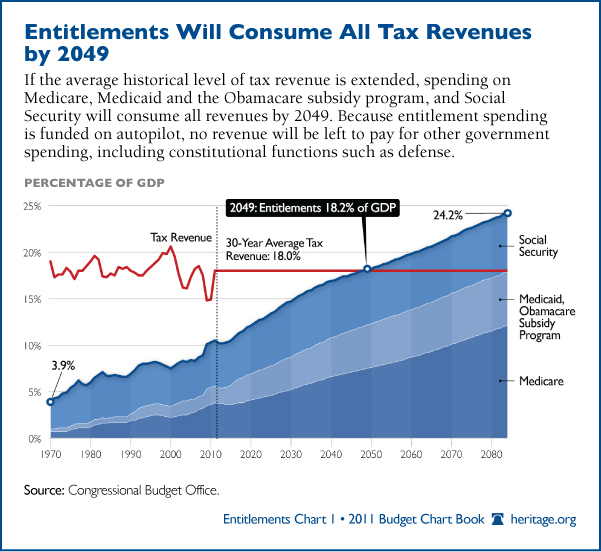
Don’t be fooled, though, by thinking that tackling waste alone or combining a handful of programs will solve the country’s twin crises of spending and debt. Waste is deplorable and unacceptable, yet it is small in comparison to the trillion-dollar-plus deficits recorded in recent years. More importantly, it is not the main contributor to Washington’s spending problem. The three major entitlement programs—Medicare, Medicaid, and Social Security—constitute the lion’s share of current spending.
The future portends an even more oppressive burden from entitlement spending. The first baby boomers have reached retirement already, and millions more will become eligible for Medicare and Social Security benefits. Entitlement spending is on track to eclipse all tax revenues, meaning at that point the federal government would have to tax or borrow money to fund all other programs.
Congress and the President are expected to spend today’s taxpayer dollars wisely. They can accomplish this by rooting out waste, eliminating duplicative programs, and returning to a more limited government at the federal level. All of this will help restore Americans’ trust in their government. But to assure Americans that their children can have an even more prosperous future than they had, Congress should do the hard work of proposing entitlement program reforms—reforms that will get spending under control and unshackle future generations from crushing levels of taxes and debt.
It is apparent from this statement below that Senator Mark Pryor is against the Balanced Budget Amendment. He has voted against it over and over like his father did and now I will give reasons in this series why Senator Pryor will be defeated in his re-election bid in 2014. However, first I wanted to quote the statement Senator Pryor gave on December 14, 2011. This information below is from the Arkansas Times Blog on 12-14-11 and Max Brantley:
THREE CHEERS FOR MARK PRYOR: Our senator voted not once, but twice, today against one of the hoariest (and whoriest) of Republican gimmicks, a balanced budget amendment. Let’s quote him:
As H.L. Mencken once said, “For every complex problem there is a solution which is simple, clean, and wrong.” This quote describes the balanced budget amendment. While a balanced budget amendment makes for an easy talking point, it is an empty solution. Moreover, it’s a reckless choice that handcuffs our ability to respond to an economic downturn or national emergencies without massive tax increases or throwing everyone off Medicare, Social Security, or veteran’s care.There is a more responsible alternative to balance the budget. President Clinton led the way in turning deficits into record surpluses. We have that same opportunity today, using the blueprint provided by the debt commission as a starting point. We need to responsibly cut spending, reform our tax code and create job growth. This course requires hard choices over a number of years. However, it offers a more balanced approach over jeopardizing safety net programs and opportunity for robust economic growth.
____________________
Arkansans want Senator Pryor to tackle our Washington spending problem but SENATOR PRYOR VOTES LIKE HE WANTS TO PASS ON OUR SPENDING PROBLEM TO THE NEXT GENERATION SO THEY WILL HAVE TO PAY THE BILL. HOWEVER, WE ALL LIVE IN A FAMILY SOCIETY AND WE LOVE OUR KIDS AND WE WANT TO HELP THEM IN WITH THEIR FUTURES AND THIS IS ONE OF THE MAIN REASONS PRYOR WILL BE REPLACED BY SOMEONE IN 2014 THAT WILL VOTE FOR A BALANCED BUDGET AMENDMENT (just like Senator Lincoln was replaced by a republican that favored the Balanced Budget Amendment in 2010).
Marco Rubio rightly noted:
A balanced budget amendment would be a necessary step in reversing Washington’s tax-borrow-spend mantra. It would force Congress to balance its budget each year – not allow it to pass our problems on to the next generation any longer.
The Balanced Budget Amendment is the only thing I can think of that would force Washington to cut spending. We have only a handful of balanced budgets in the last 60 years, so obviously what we are doing is not working. We are passing along this debt to the next generation.
In my two short months in office, it has become clear to me that the spending problem in Washington is far worse than many of us feared. For years, politicians have blindly poured more and more borrowed money into ineffective government programs, leaving us with trillion dollar deficits and a crippling debt burden that threatens prosperity and economic growth.
In the Florida House of Representatives, where a balanced budget is a requirement, we had to make the tough choices to cut spending where necessary because it was required by state law. By no means was this an easy process, but it was our duty as elected officials to be accountable to our constituents and to future generations of Floridians. In Washington, a balanced budget amendment is not just a fiscally-responsible proposal, it’s a necessary step to curb politicians’ decades-long penchant for overspending.
Several senators have proposed balanced budget amendments that ensure Congress will not spend a penny more than we take in, while setting a high hurdle for future tax hikes. I am a co-sponsor of two balanced budget amendments, since it is clear that these measures would go a long way to reversing the spending gusher we’ve seen from Washington in recent years.
During my Senate campaign, while surrounded by the employees of Jacksonville’s Meridian Technologies, I proposed 12 simple ways to cut spending in Washington. That company, founded 13 years ago, has grown into a 200-employee, high-tech business, and the ideas I proposed would help ensure that similar companies have the opportunity to start or expand just like Meridian did.
To be clear, our unsustainable debt and deficits are threatening companies like Meridian and impeding job creation. In addition to proposing a balanced budget amendment, I recommended canceling unspent “stimulus” funds, banning all earmarks and returning discretionary spending to 2008 levels.
Fortunately, some of my ideas have found their way to the Senate chamber. The first bill I co-sponsored in the Senate was to repeal ObamaCare, the costly overhaul of our nation’s health care system that destroys jobs and impedes our economic recovery. Democratic leaders in the Senate have expressed their willingness to ban earmarks for two years after the Senate Republican conference adopted a moratorium. I have also co-sponsored the REINS Act, a common-sense measure that would increase accountability and transparency in our outdated and burdensome regulatory process. These bills, along with a balanced budget amendment, would help get our country back on a sustainable path and provide certainty to job creators.
While Republicans are proposing a variety of ideas to rein in Washington’s out-of-control spending, unfortunately, President Obama’s budget for the upcoming fiscal year proposes to spend $46 trillion, and even in its best year, the deficit would remain above $600 billion. Worst of all, the President’s budget completely avoids addressing the biggest drivers of our long-term debt – Social Security, Medicare and Medicaid.
Rather than tackle these tough, serious issues, President Obama is proposing a litany of tax hikes on small businesses and entrepreneurs, to the tune of more than $1.6 trillion. These tax increases destroy jobs, make us less competitive internationally and hurt our efforts to grow the economy and get our fiscal house in order.
A balanced budget amendment would be a necessary step in reversing Washington’s tax-borrow-spend mantra. It would force Congress to balance its budget each year – not allow it to pass our problems on to the next generation any longer.
Marco Rubio
Marco Rubio, a Republican, is a U.S. senator from Florida and former speaker of the Florida House of Representatives.






 The Daily Hatch