A satirical short film taking a look at the national debt and how it applies to just one family. Watch the guy from the Ferris Bueller Superbowl Spot! Produced by Seth William Meier, DP/Edited by Craig Evans, 1st AC Brian Andrews, Sound Mixer Gus Salazar, Written and Directed by Brian Stepanek. Help us spread the word by clicking ads or at www.debtlimitusa.org
_________________
I read some wise words by Rep. Justin Amash (R-MI) and I wanted to pass them on. He sees how dangerous it is to keep kicking the can down the street: “The Budget Control Act trades $21 billion in cuts next year for a debt ceiling increase of $2.1 trillion. That’s one penny in cuts for each dollar of new debt. The bill does not seriously address the drivers of the federal government’s fiscal crisis. It does not improve entitlement programs. It does not include a balanced budget amendment to the Constitution.”
After all, despite all the sturm und drang about spending cuts as part of last year’s debt-ceiling deal, federal spending not only increased from 2011 to 2012, it rose faster than inflation and population growth combined.
We need some national statesmen (and ladies) who are willing to stop running up the nation’s credit card.
This week the Club for Growth released a study of votes cast in 2011 by the 87 Republicans elected to the House in November 2010. The Club found that “In many cases, the rhetoric of the so-called “Tea Party” freshmen simply didn’t match their records.” Particularly disconcerting is the fact that so many GOP newcomers cast votes against spending cuts.
The study comes on the heels of three telling votes taken last week in the House that should have been slam-dunks for members who possess the slightest regard for limited government and free markets. Alas, only 26 of the 87 members of the “Tea Party class” voted to defund both the Economic Development Administration and the president’s new Advanced Manufacturing Technology Consortia program (see my previous discussion of these votes here) and against reauthorizing the Export-Import Bank (see my colleague Sallie James’s excoriation of that vote here).
One of those Tea Party heroes was Justin Amash of Michigan. Last year I posted this below concerning his conservative views and his willingness to vote against the debt ceiling increase:
Washington, D.C. – Rep. Justin Amash (R-MI) issued the following statement after the vote on the Budget Control Act of 2011:
“The Budget Control Act trades $21 billion in cuts next year for a debt ceiling increase of $2.1 trillion. That’s one penny in cuts for each dollar of new debt. The bill does not seriously address the drivers of the federal government’s fiscal crisis. It does not improve entitlement programs. It does not include a balanced budget amendment to the Constitution. I cannot in good conscience vote for so little reform when so much is at stake.
“I had hoped that Democrats and Republicans would work together to develop a reasonable compromise that is fiscally responsible. I would favor a package that combines eliminating special tax breaks and subsidies with a well-structured balanced budget amendment. I believe that type of package would have broad-based support from the American people. Instead, Congress continues to kick the can down the road.
“We can do better. I look forward to working with my colleagues on both sides of the aisle over the next several months to adopt structural reforms that will put the government back on a sustainable path.”
It has greatly troubled me for sometime that the federal government spends so much over their budget every year. That is probably the number one reason I started my blog (www.theDailyHatch.org ) a little over a year ago. The results have been overwhelming. I have had over 170,000 hits and have even been quoted in a national magazine.
Back in the summer of 2011, 66 brave souls in the Republican party voted against the debt ceiling compromise in the House of Representatives and I actually took time to put up 48 different posts praising those 66 tea-party type conservatives. One of them was Cliff Stearns. Representative Stearns actually went on C-Span and mentioned your March 2006 vote against raising the debt ceiling and he quoted you directly. The funny thing is I agreed totally with every word of his your speech.
Why do we have to keep spending money like this? Here is an excellent article from the Cato Institute that reflects my views:
Michael Tanner is a senior fellow at the Cato Institute and author of Leviathan on the Right: How Big-Government Conservatism Brought Down the Republican Revolution.
If you liked last year’s battle over raising the debt ceiling, just get ready for the fight to come.
Last summer’s agreement, you will recall, raised the federal government’s debt limit from $15.194 trillion to $16.394 trillion in exchange for promised future reductions in spending. Until recently, the consensus has been that federal borrowing will bump up against the new limit sometime between late November of this year and early January 2013.
But buried in President Obama’s 2013 budget was the news that the national debt will hit $16.334 trillion by the end of fiscal year 2012, or September 30, 2012. This is just $60 billion below the current debt limit. Since the federal government is continuing to borrow at a rate of over $130 billion a month, we will likely reach the debt ceiling by mid-October — before Election Day.
From a budgeting perspective, there will not be an immediate crisis. The Treasury Department could, if it chooses, employ “extraordinary measures” to enable the government to keep paying its bills until well after the elections. Despite their name, these measures are not all that “extraordinary,” involving such things as delaying contributions to the civil-service pension fund or suspending sales of certain nonessential securities. In fact, the Treasury used such measures last year from May until the final debt agreement in August, and no one really noticed.
Can Republicans really be trusted to fight for spending cuts just weeks before the election?
But as a political matter, it will be a very different matter.
Suppose that instead of using such measures to push off the day of reckoning until after the election, President Obama threatens default. Suppose he insists on a tax increase as part of any deal to raise the debt ceiling, and threatens international economic chaos and a collapsing stock market if Republicans fail to go along. Can Republicans really be trusted to fight for spending cuts instead, just weeks before the election?
And regardless of what happens before the election, another fight over the debt ceiling will be coming shortly thereafter. Every Republican candidate will have to go on record about whether or not they would raise the debt ceiling and what concessions they would demand.
Republicans, of course, will have a good argument to make about how the president’s spending has driven up the debt. The fact that a $1.2 trillion increase in the debt ceiling barely lasted a year could be powerful. But Republicans would have a better time making this argument if they were actually doing something to reduce spending. After all, despite all the sturm und drang about spending cuts as part of last year’s debt-ceiling deal, federal spending not only increased from 2011 to 2012, it rose faster than inflation and population growth combined.
And Republicans continue to talk about undoing the sequester that is responsible for more than half the projected savings to come out of the 2011 deal. In particular, Republicans want to undo cuts to the defense budget, and may be willing to give up domestic-spending cuts in exchange.
Meanwhile, what of Mitt Romney, the presumptive Republican nominee after last night’s primaries? Can anyone think of a single major spending program that Romney would eliminate? (Cutting funding to Planned Parenthood doesn’t count, especially given the way Republicans mishandled the contraceptive-mandate debate).
President Obama’s reckless spending could be a godsend to Republicans. It was, after all, debt and spending that energized the Tea Party and led to the 2010 election wave. Not only is it an issue that unites all factions of the Republican base, it is also of importance to independents and suburbanites, including those suburban women who have been turned off by the Republican-primary debate.
But if Republicans don’t want to be blindsided by President Obama come October, they need to start preparing for this debate now.
___________
We got to cut spending now!!!
Thank you so much for your time. I know how valuable it is. I also appreciate the fine family that you have and your commitment as a father and a husband.
Sincerely,
Everette Hatcher III, 13900 Cottontail Lane, Alexander, AR 72002, ph 501-920-5733, lowcostsqueegees@yahoo.com
Related posts (these posts show how much study I have down on this issue before, frankly all 66 of these representatives are my heroes!!):
Sixty Six who resisted “Sugar-coated Satan Sandwich” Debt Deal (Part 49) This post today is a part of a series I am doing on the 66 Republican Tea Party favorites that resisted eating the “Sugar-coated Satan Sandwich” Debt Deal. Actually that name did not originate from a representative who agrees with the Tea Party, but […]
Sixty Six who resisted “Sugar-coated Satan Sandwich” Debt Deal (Part 48) This post today is a part of a series I am doing on the 66 Republican Tea Party favorites that resisted eating the “Sugar-coated Satan Sandwich” Debt Deal. Actually that name did not originate from a representative who agrees with the Tea Party, but […]
Congressmen Tim Huelskamp on the debt ceiling Sixty Six who resisted “Sugar-coated Satan Sandwich” Debt Deal (Part 31) This post today is a part of a series I am doing on the 66 Republican Tea Party favorites that resisted eating the “Sugar-coated Satan Sandwich” Debt Deal. Actually that name did not originate from a representative […]
Uploaded by RepJoeWalsh on Jun 14, 2011 Our country’s debt continues to grow — it’s eating away at the American Dream. We need to make real cuts now. We need Cut, Cap, and Balance. The Sixty Six who resisted “Sugar-coated Satan Sandwich” Debt Deal (Part 25) This post today is a part of a series […]
Sen Obama in 2006 Against Raising Debt Ceiling The Sixty Six who resisted “Sugar-coated Satan Sandwich” Debt Deal (Part 15) This post today is a part of a series I am doing on the 66 Republican Tea Party favorites that resisted eating the “Sugar-coated Satan Sandwich” Debt Deal. Actually that name did not originate from […]
Today I read a post by Max Brantley on the Arkansas Times Blog concerning the falling poll numbers for the Tea Party. Wednesday, August 17, 2011 – 06:54:18 The Tea Party: is the fun over An interesting New York Times op-ed reviews the plunging poll approval numbers for the Tea Party and delves into the […]
Duncan Hunter at San Diego Eagle Forum.MP4 The Sixty Six who resisted “Sugar-coated Satan Sandwich” Debt Deal (Part 7) This post today is a part of a series I am doing on the 66 Republican Tea Party favorites that resisted eating the “Sugar-coated Satan Sandwich” Debt Deal. Actually that name did not originate from a […]
Rep Himes and Rep Schweikert Discuss the Debt and Budget Deal The Sixty Six who resisted “Sugar-coated Satan Sandwich” Debt Deal (Part 6) This post today is a part of a series I am doing on the 66 Republican Tea Party favorites that resisted eating the “Sugar-coated Satan Sandwich” Debt Deal. Actually that name did […]
Rep. Quayle on Fox News with Neil Cavuto The Sixty Six who resisted “Sugar-coated Satan Sandwich” Debt Deal (Part 5) This post today is a part of a series I am doing on the 66 Republican Tea Party favorites that resisted eating the “Sugar-coated Satan Sandwich” Debt Deal. Actually that name did not originate […]
“What good is a debt limit that is always increased?” The Sixty Six who resisted “Sugar-coated Satan Sandwich” Debt Deal (Part 2) This post today is a part of a series I am doing on the 66 Republican Tea Party favorites that resisted eating the “Sugar-coated Satan Sandwich” Debt Deal. Actually that name did not […]
This post today is a part of a series I am doing on the 66 Republican Tea Party favorites that resisted eating the “Sugar-coated Satan Sandwich” Debt Deal. Actually that name did not originate from a representative who agrees with the Tea Party, but from a liberal. Rep. Emanuel Clever (D-Mo.) called the newly agreed-upon […]
Bachmann Explains “No” Vote on Raising the Debt Ceiling Uploaded by RepMicheleBachmann on Aug 2, 2011 On Monday, August 1, 2011, Congresswoman Michele Bachmann appeared on “Hannity” to explain why she voted “no” on the plan to raise the debt ceiling. _______________________________________ Full House roll call By: Associated Press August 1, 2011 08:46 PM EDT […]
Ep. 4 – From Cradle to Grave [5/7]. Milton Friedman’s Free to Choose (1980)
With the national debt increasing faster than ever we must make the hard decisions to balance the budget now. If we wait another decade to balance the budget then we will surely risk our economic collapse.
The first step is to remove all welfare programs and replace them with the negative income tax program that Milton Friedman first suggested.
Milton Friedman points out that though many government welfare programs are well intentioned, they tend to have pernicious side effects. In Dr. Friedman’s view, perhaps the most serious shortcoming of governmental welfare activities is their tendency to strip away individual independence and dignity. This is because bureaucrats in welfare agencies are placed in positions of tremendous power over welfare recipients, exercising great influence over their lives. In addition, welfare programs tend to be self-perpetuating because they destroy work incentives. Dr. Friedman suggests a negative income tax as a way of helping the poor. The government would pay money to people falling below a certain income level. As they obtained jobs and earned money, they would continue to receive some payments from the government until their outside income reached a certain ceiling. This system would make people better off who sought work and earned income.
Participants: Robert McKenzie, Moderator; Milton Friedman; James R. Dumpson, Chief Administrator, Human Resources Admin., NYC; Thomas Sowell, Professor of Economics, UCLA; Robert Lampman, Professor of Economics, Institute of Poverty; Helen Bohen O’Bannon, Secretary of Welfare, State of Pennsylvania
O’BANNON: I think the other __ we have a program in Pennsylvania for essentially all of those who are not taken care of by the AFDC program. It’s called the General Assistance Program. And there less than 15 percent are on more than eighteen months. So we have a great turnover. We have essentially young males moving into the welfare system after unemployment compensation, and then moving out when a job opportunity comes along. This, you know, I think the notion of generations of people on welfare is a very small minority in the whole system. That doesn’t mean that the system as presently defined and as the set of programs that we have put together don’t often contradict each other and I’m the first to agree with Dr. Friedman that some of the programs are conflicting. However, I think it is overly broad to say that we turn people into helpless children.
SOWELL: I don’t remember talking to anyone who’s ever been on welfare who didn’t think they were being treated like children while they were on it.
DUMPSON: Of course, I think, you know, you __ one must make a difference, a distinction between a system that was set up to help people and the people who are employed in that system. Look at any public welfare system around the country and we have no, practically few trained people who to work with people. We employ them ill-trained, people who are not equipped to be helping people. We say they’re social workers. They’re not social workers, they have neither the skills, the attitudes, and some of them not even the concerns; so I think one has to separate how a conceptual framework of a system designed to help people and what the country and community puts into that system to implement those programs.
SOWELL: You mean to separate the hopes from the reality.
DUMPSON: I separate the skills that are available in order to implement what the objectives of the program are. I think we have to separate whether we are talking about program objectives, or we’re talking about how it operates. I would be the first to say that the system that I administered had ill-prepared people to do the job that we were set up to do, and I would not say that the system that we set up __
SOWELL: I talked to some social welfare people who think that in fact they were so hamstrung by the system that there was very little they could do to help people to get off welfare; that is to build up skills at jobs, do whatever was necessary to get off welfare. They felt it was the system.
MCKENZIE: Bob Lampman, your comment.
LAMPMAN: The system that we’re stereotyping is one of a great deal of paternalistic interference in individual family’s lives and in fact isn’t it true, Mr. Dumpson, that case load is so high for an individual welfare worker that they can’t do a lot of interfering in individual family lives. Moreover, in the last decade there’s been a real attempt to ease this welfare trap in AFDC by changing the take-back rate and by administering work expenses and child care expenses in such a way as to facilitate work by those who may want to do it; so it’s not quite as harsh a picture as we sometimes get that there is this omniscient welfare worker who’s right there in the living room with the family making all their decisions for them.
FRIEDMAN: I’ve never heard of a government program which was defective in which the people who ran it didn’t say, “If only we had more money to spend on what we’re not being able to accomplish with the amount we’re spending now.”
MCKENZIE: Milton, we’re going to move along now to some of your prescriptions in that film because I think it’s good ground for discussion. The most drastic one was when you said, speaking of an unemployed man, “Supposing you were cruel and took away welfare from this man, he would find a job at some wage, there’d always be a job he could get; he might need some charity on route, private charity, but he would get a job.” Now, I want you to react, those of you, before we come back to Milton on that. Is that a picture that seems plausible to you?
DUMPSON: He may get a job, and he may get a job in what we refer to as the underground economy, and that’s where a number of our youth are now going to get their jobs. Those activities that are illegal, the only opportunities they have for earning their part of a livelihood.
O’BANNON: I think the other issue is that you have a whole group of people who are the single, female head of the household; and yes, cut off welfare tomorrow: What will they do? What will be their immediate response? At what price to their small children and to their middle-aged children? Yes, they’ll get a job, in fact the statistics show that women, in fact, are the most successful through the employment program. But what has to supplement that typically is the provision of some kind of day care arrangement. Either the individual woman has to earn enough money to be able to pay privately for her day care, or in fact, she is quote “subsidized” through this insidious, corrupting program, set of programs, run by the federal government which, in fact, makes her employable and a taxpayer. It’s an interesting notion of trying to get people in a productive mode.
MCKENZIE: Tom Sowell.
SOWELL: It’s incredible the way you start the story in the middle as if there’s a predestined amount of poverty, a predestined amount of unemployment and that the welfare system is not itself in any way responsible for that __
O’BANNON: There is a predestined 20 percent of the bottom half of the population.
SOWELL: I have never __ well, that’s always been true __
(Everyone speaking at once)
O’BANNON: There’s going to be 20 percent at the bottom.
SOWELL: It’s also true that 20 percent of the bottom population doesn’t have to be living on the government and ruled by the government. You mentioned, for example, a female head of household. Many of those, in addition to the grown woman who has all the kids, are teenage pregnancies. There’s not a predestined amount of teenaged pregnancies. I grew up in an era when people, and particularly blacks, were a lot poorer than today, faced a lot more discrimination than today, and in which teenage pregnancy rate was a lot lower than today. I don’t believe there is a predestined amount of teenage pregnancy. A predestined amount of husband desertion. Gutman has done a study of a black family showing that this whole notion that the black family has always been disintegrating, that is nonsense. His studies go up to 1925, the great bulk of black families were intact two-parent families up to 1925 and going all the way back through the era of slavery, so it is now, only within our own time, that we suddenly see this inevitable tragedy which the welfare system says it’s going to rush in to solve.
O’BANNON: We’re talking to Tom about __
SOWELL: To which it is itself a point __
O’BANNON: We’re talking about a very small group. We’re talking about twelve percent of the families are not intact. Are not two-parent families at any one period __
SOWELL: Do you mean __ among welfare recipients __
O’BANNON: No.
SOWELL: __ or the public at large?
O’BANNON: Among the public at large. We’re talking about twelve percent of the families; twelve percent.
SOWELL: That’s right.
O’BANNON: That’s a small number. But __
SOWELL: We’ve got to build on welfare.
O’BANNON: We’re still talking about a significant component of the bottom twenty percent that are the bottom twenty percent. Whether they are above the poverty line or below the poverty line; they are still the bottom twenty percent. And the issue is: What is the responsibility of the other eighty percent; if any, towards those others?
SOWELL: There’s no program plan to eliminate there being a bottom twenty percent?
O’BANNON: No. But it intends to raise the bottom twenty percent so __
SOWELL: We’re raising them by having more __ by having more illegitimacy, more unemployment, by having __
O’BANNON: I’m not making them be __ have illegitimate children. I hope that’s clear.
SOWELL: Oh, I_I__ you don’t have to do that. You simply subsidize it.
FRIEDMAN: We, as human beings, don’t have a responsibility; but I hope we have a compassion and an interest in the bottom twenty percent. And I only want to say to you that the capitalist system, the private enterprise system in the 19th century did a far better job of expressing that sense of compassion than the governmental welfare programs are today. The 19th century, the period which people denigrate as the high tide of capitalism was the period of the greatest outpouring of Ella Mosner in charitable activity that the world has ever known. And one of the things I hold against the welfare system, most seriously, is that it has destroyed private charitable arrangements which are far more effective, far more compassionate, far more person-to-person in helping people who are really, for no fault of their own, in disadvantaged situations.
O’BANNON: I have to disagree with you though, because I think that the whole notion of private property was excluded, whole segments of society were excluded from the notion of private property in the 19th century; namely, women, idiots and imbeciles. And so, I don’t go back to the 19th century and hold it up as any paragon that we would want to replicate today.
MCKENZIE: Anyway. I want Milton now to come to your major prescription, which I know you don’t say is on the agenda for tomorrow, but it lies ahead; that is, the negative income tax. And I’m not sure people fully understand how it would work. We can’t, I think, go to the details of it, but I’d like to get a reaction around the panel first of all, is this a viable approach to the enduring problems of poverty? Negative income tax.
Last weekend, the people of France took a sharp turn to the left, and the rest of Europe may be on the brink of rebuking its recent tack toward fiscal responsibility. With Sunday’s election of French Socialist leader Francois Hollande, France has leapt backward toward the policies that have helped sink the continent in a sovereign debt crisis. Disturbingly, the big government platform Hollande campaigned on is all too familiar to the American people, and if the United States is not careful, it could suffer the same fate as its European allies.
Hollande sailed to victory by appealing to an electorate dissatisfied with having to face necessary cutbacks, proclaiming that he is “proud to have been capable of giving people hope again.” That brand of hope called for a change from President Nicolas Sarkozy’s relatively conservative policies — in his first term, Sarkozy worked to reduce the number of public sector employees, eliminate the 35-hour work week, reform the university system and cut taxes.
Hollande, by contrast, promised to raise taxes on big corporations and wealthy individuals, implement a top rate tax of 75 percent, increase public spending by 20 billion euros, raise the minimum wage, hire 60,000 more teachers, and lower the retirement age from 62 to 60 for some workers. He says he is “president of the youth of France” and believes that government stimulus, not cutting spending, is the right way to achieve economic growth.
If you’ve been a student of President Obama’s presidency, much of this should sound familiar. President Obama came into office on a promise of hope and change, appealed to young Americans and promised renewed prosperity. His solution was more government spending to the tune of a near-trillion-dollar stimulus, a government-run health care plan, a bailout of government unions, and a call for higher taxes on wealthy Americans and corporations.
The difference between the United States and France is that the latter is much further down the path of a social welfare state. Hollande’s proposals are not a new direction, they’re merely a return to form. France is notoriously emblematic of the European way of life. As Daniel Hannan, a member of the European Parliament, describes in Why America Must Not Follow Europe, “Long vacations, paternity leave, a higher minimum wage, a short working week: What’s not to like? The trouble is that eventually the money runs out.”
In France, the money has indeed run out. The country’s public debt now stands at more than 80 percent of GDP, government spending is at 55 percent of GDP, the tax burden is equivalent to 42 percent of total domestic income, and it hasn’t balanced its budget since 1974.
The United States, unfortunately, is headed in much the same direction. As Heritage’s Federal Budget in Pictures shows, U.S. debt stood at 67 percent of GDP in 2011, but unless the United States controls its spending, its debt will surpass that of France, Italy and even Greece, hitting 187 percent of GDP by 2035. Spending on Medicare, Medicaid, the Obamacare subsidies, and Social Security will devour all revenues by 2045, and taxes are soaring past their highest levels ever. And as for the budget, the U.S. Senate hasn’t passed one in three years — let alone brought it to balance.
The world has seen what lies at the end of this road to perdition. Though France is a prime example of a country that is spending itself into crisis, Greece has already gone beyond that tipping point. The country’s debt has exploded, 21.8 percent of its people are unemployed, and among the youth, more are out of work than have jobs. In the face of belt-tightening measures that came as a condition of an EU/IMF bailout — which include public sector pay cuts and pension reductions — the country turned to open political revolt with violent riots in the streets. In elections this week, Greek voters rejected the political parties that support fiscal responsibility and instead turned toward the Radical Left.
If there is any bright spot in Europe’s far left turn, it came Friday in the re-election of Boris Johnson, the Conservative mayor of London. Johnson campaigned for tax cuts and eliminating public sector waste in the hopes of spurring job growth. But alas, France’s return to the deeply entrenched socialist policies could signal an end to the fiscally responsible measures that German Chancellor Angela Merkel has championed, leading to economic disaster.
Though Europe is an ocean away, the policies that are sinking the continent could have the same impact in the United States if replicated here. Endless spending has dire consequences, and if America is not careful, it could follow Europe’s path to economic ruin.
Debating whether the United States has gone too far in accumulating debt, with Dan Mitchell, Cato Institute; Christian Weller, Center for American Progress; and CNBC’s Erin Burnett.
_______________
Does anyone care about growing the economy anymore?
Economists often do a crummy job of teaching people about the impact of fiscal policy on the labor force, largely because we put people to sleep with boring discussions about “labor supply” decisions (my blog post from last year perhaps being an example of this tendency).
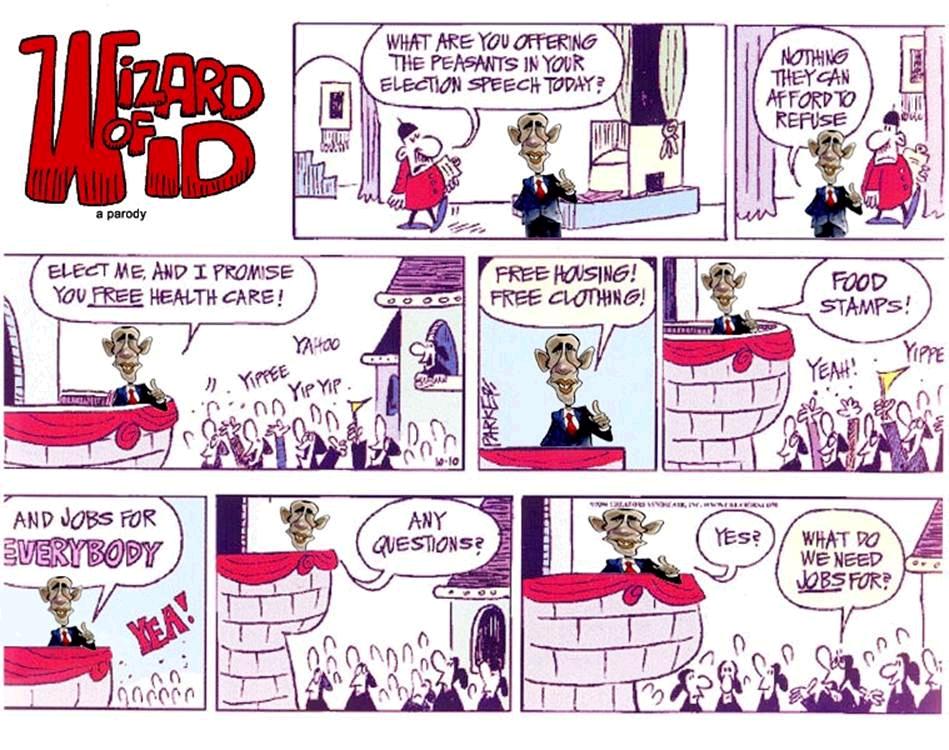
From now on, I will try to remember to use this cartoon. It’s a parody of Obama’s policies, but the last slide (or is it a panel?) is a great teaching tool about what happens when politicians turn the safety net into a hammock.
The fact that we are here today to debate raising America’s debt limit is a sign of leadership failure. It is a sign that the U.S. Government can’t pay its own bills. It is a sign that we now depend on ongoing financial assistance from foreign countries to finance our Government’s reckless fiscal policies.
And the cost of our debt is one of the fastest growing expenses in the Federal budget. This rising debt is a hidden domestic enemy, robbing our cities and States of critical investments in infrastructure like bridges, ports, and levees; robbing our families and our children of critical investments in education and health care reform; robbing our seniors of the retirement and health security they have counted on.
Every dollar we pay in interest is a dollar that is not going to investment in America’s priorities. Instead, interest payments are a significant tax on all Americans–a debt tax that Washington doesn’t want to talk about. If Washington were serious about honest tax relief in this country, we would see an effort to reduce our national debt by returning to responsible fiscal policies.
Increasing America’s debt weakens us domestically and internationally. Leadership means that “the buck stops here.” Instead, Washington is shifting the burden of bad choices today onto the backs of our children and grandchildren. America has a debt problem and a failure of leadership. Americans deserve better.
I therefore intend to oppose the effort to increase America’s debt limit.
Sen. Barack Hussein Obama, Jr., (Senate – March 16, 2006)
_______________
3 Reasons Why The Debt-Ceiling Debate is Full of Malarkey
All anybody in Washington can talk about these days is the debt limit or debt ceiling — the total amount of money the federal government is authorized to borrow at any given time. After a decade in which spending increased by more than 60 percent in inflation-adjusted dollars and the debt limit was raised no fewer than 10 times, the government is about to max out its $14.3 trillion credit line, leading to fears that Washington is going to default on its bonds, stop cutting Social Security checks, and destroy the economy more than it already has.
But the current debate over the debt ceiling is full of malarkey for at least three reasons.
1. August 2 is a phony deadline. Treasury Secretary Timothy Geithner has pushed back the drop-dead date when the U.S. finally reaches its limit a bunch of times already: March 31, April 15, May 31 were all cited as deadlines before August 2 was inked in as Armageddon. But this time, he means it, man, really.
2. Reaching the debt limit is not the same as defaulting on our debt — which would indeed be catastrophic.
Think about it: You can max out your credit cards but as long as you keep paying the minimum amount due each month, your creditors don’t go crazy. Interest on the debt is a small fraction of total outlays and the government has a series of tools — from using cash on hand to selling assets to scrimping on nonessential payments — to make sure interest payments are made and seniors aren’t put on an all cat-food diet.
3. Legislating-by-Panic is no way to run a country. The reason we’re in this mess is because government can’t stop spending. And the government can’t even pass a budget on a year’s notice. But we’re expecting them to come up with a good plan for the country’s borrowing in a couple of weeks? Trying to force through an expansion of the country’s credit line by promising cuts in spending down the road is exactly why we’re in this situation to begin with.
It makes far more sense to do something like sell some TARP assets — the government is sitting on $320 billion in outstanding direct loans and equities investments — to cover interest payments through the end of the fiscal year then force Congress and the president to come up with a budget that cuts spending — and borrowing — for real, next year, not is some distant future.
Produced by Nick Gillespie and Meredith Bragg, edited by Joshua Swain.
Go to Reason.tv for downloadable versions, and subscribe to Reason.tv’s YouTube Channel to receive automatic notifications when new material goes live.
_________________
It seems silly to keep spending like we are when we can clearly see what our future holds by seeing the problems that Greece is now having because of their socialism.
Thank you so much for your time. I know how valuable it is. I also appreciate the fine family that you have and your commitment as a father and a husband.
Sincerely,
Everette Hatcher III, 13900 Cottontail Lane, Alexander, AR 72002, ph 501-920-5733, lowcostsqueegees@yahoo.com
Why not pass the Balanced Budget Amendment? As you know that federal deficit is at all time high (1.6 trillion deficit with revenues of 2.2 trillion and spending at 3.8 trillion).
On my blog www.HaltingArkansasLiberalswithTruth.com I took you at your word and sent you over 100 emails with specific spending cut ideas. However, I did not see any of them in the recent debt deal that Congress adopted. Now I am trying another approach. Every week from now on I will send you an email explaining different reasons why we need the Balanced Budget Amendment. It will appear on my blog on “Thirsty Thursday” because the government is always thirsty for more money to spend.
In the immediate term, Congress should address this problem by pursuing a reform path that drives down federal spending and borrowing and gets to a balanced budget. Saving the American Dream is Heritage’s plan to do just that: balancing the federal budget in 10 years and keeping it balanced in the future—without raising taxes or neglecting our national defense. Starting immediately, Congress should take every opportunity to cut and cap federal spending, and that includes addressing the unsustainable costs of America’s entitlement programs.
A part of the long-term agenda to rein in government is an appropriate and sound amendment to the Constitution that would keep federal spending under control in subsequent years. Indeed, the principal reason for adopting a balanced budget constitutional amendment is to limit the size and scope of the federal government by limiting its spending.
Proponents have long advocated this extraordinary step because other methods of controlling spending—by rule or statute—have broken down. What was once considered part of the nation’s “unwritten” constitution—that as a rule the government should not spend beyond its means—has been lost. A constitutional rule, if properly written and enforced, would have more power than any legislative mechanism for maintaining a limit on spending.
As Heritage’s David Addington has previously stated, a BBA should do three core things.
First, it should control spending, taxation, and borrowing by capping annual spending and requiring Congress to act by supermajority votes if Members wish to raise taxes. These requirements are especially necessary under current circumstances—prior to having seriously reduced spending and reformed entitlement programs, the main drivers of the country’s debt.
Second, it should allow Congress by supermajority votes to waive temporarily compliance with the balanced budget requirement when it is essential to national security—the one core function that is the federal government’s exclusive constitutional responsibility.
Third, it should provide for its own enforcement, specifically excluding courts from any enforcement and preventing government from just borrowing more money to meet the BBA requirement.
A BBA without these provisions doesn’t address the underlying spending problem, puts pressure on Congress to increase taxes or issue more debt rather than cut spending or reform entitlements, and invites unelected judges to insert themselves even more in the policymaking process. Which is to say that, rather than simplifying matters, a weak BBA would likely make the situation much worse.
Ep. 4 – From Cradle to Grave [4/7]. Milton Friedman’s Free to Choose (1980)
With the national debt increasing faster than ever we must make the hard decisions to balance the budget now. If we wait another decade to balance the budget then we will surely risk our economic collapse.
The first step is to remove all welfare programs and replace them with the negative income tax program that Milton Friedman first suggested.
Milton Friedman points out that though many government welfare programs are well intentioned, they tend to have pernicious side effects. In Dr. Friedman’s view, perhaps the most serious shortcoming of governmental welfare activities is their tendency to strip away individual independence and dignity. This is because bureaucrats in welfare agencies are placed in positions of tremendous power over welfare recipients, exercising great influence over their lives. In addition, welfare programs tend to be self-perpetuating because they destroy work incentives. Dr. Friedman suggests a negative income tax as a way of helping the poor. The government would pay money to people falling below a certain income level. As they obtained jobs and earned money, they would continue to receive some payments from the government until their outside income reached a certain ceiling. This system would make people better off who sought work and earned income.
Participants: Robert McKenzie, Moderator; Milton Friedman; James R. Dumpson, Chief Administrator, Human Resources Admin., NYC; Thomas Sowell, Professor of Economics, UCLA; Robert Lampman, Professor of Economics, Institute of Poverty; Helen Bohen O’Bannon, Secretary of Welfare, State of Pennsylvania
MCKENZIE: The discussion’s already underway here at the University of Chicago, so let’s join it.
DUMPSON: As I looked at the film, I had a growing sense of anger. Anger that that position failed to recognize that the system that was being attacked was necessary in our capitalistic, free enterprise system that by its own failure produces poverty, and therefore requires governmental intervention in the interest of those people caught in the traps of poverty. So, as I sat and looked at the film, and as I hear Dr. Friedman’s statement, I was aroused to the point, as I said, of anger because only half the story is told. We are really blaming again a victim, this time a system, the welfare system, for the failure of other systems to operate in the interest of people.
MCKENZIE: Let’s get other reactions now to that statement: “Trying to do good with other people’s money simply has not worked, the welfare system is rotting away the very fabric of society.” Tom Sowell.
SOWELL: My reaction was just the opposite from __ my anger was at what had been created in the city where I grew up, under very different conditions, during the period of capitalistic failure, during the period when there wasn’t this humanitarianism, and when it was possible for people to live better and to get out of that poverty. Now, I think someone who lived in the very same place where I lived would find it much harder to escape from that poverty because of all these things. Buildings were not abandoned like the buildings that we saw in that film when I lived in Harlem. The crime rate __ they’re all things that are blamed upon the failures of the previous method did not exist. I slept out on the fire escapes in Harlem. I would defy anybody to do that in any part of New York City today.
LAMPMAN: Traditionally in the United States we have tried to avoid some of the welfare trap that was referred to by denying eligibility to people who are able-bodied and not aged and so on. And we’ve therefore tried to close the welfare door to a good number of categories within the poor population. The second point that was emphasized and I think needs to be put in some perspective is that some, but not all, of what we might call welfare programs broadly, have this very strong take-back of benefits as you earn some more money and that I guess is what I would like to single out as the principal problem identified in the film but it is not common to any and all welfare programs that one might think of.
O’BANNON: When the family fails, when the private sector fails to create jobs at a fast enough rate you find that people are unemployed and drift into needing help in order to exist and the welfare system was created in the ’30’s to do exactly that. When the private sector, essentially, failed we have the development of a welfare system, and it’s not corrupting society, it is taking what society _ institutions have left behind: The family breaking up, the economy not expanding fast enough, the health system failing, the educational system not doing its job. We have untrained, unskilled people looking for jobs in a highly technical society or jobs that pay so low that people cannot in fact live at a decent level of humanity. I see the welfare system not corrupting, but in fact taking the remains and attempting to help people live in dignity.
MCKENZIE: So rotting away the fabric of society is not supported __ except perhaps by you, would you back that phrase or so.
SOWELL: Absolutely. You’re saying __ you’re talking about the failures of the other parts of society. What the welfare system and other kinds of governmental programs are doing is paying people to fail insofar as they fail they receive the money; insofar as they succeed, even to a moderate extent, the money is taken away. This is even extended into the school systems where they will give money to schools with low scores; insofar as the school improves its education the money is taken away, so that you are subsidizing people to fail in their own private lives and become more dependent upon the handouts.
O’BANNON: We have expectations built in today about the quality of life, the quality of jobs, the level if income for which one expects in return. Why? Because we look at the level around us that it takes us to have __
SOWELL: No, that’s not why. That’s not why. I may have all sorts of expectations, the question is: What can I do? If someone else is subsidizing my expectations, my expectations would be far higher. But insofar as the Center for Advanced Study was subsidizing my expectations a few years ago, I refused to work at UCLA for the normal full professor’s salary. Why should I when I can get the same money for being at the Center for Advanced Study with no hours, no duties and no classes.
MCKENZIE: Let’s look at another proposition in Milton’s case. The insidious effect on those who receive welfare. They lose their independence and dignity, are treated like children, and so on. Now, Dr. Dumpson, as a former Administrator of a major program, is that a great hazard?
DUMPSON: That is not a great hazard. As a matter of fact, that presumes that people get on welfare, stay on welfare, and therefore have the result that Dr. Friedman’s statement issues. The fact of the matter is that in our AFDC program throughout the country and particularly was this true in New York, there is a graduate __ a turnover of the welfare AFDC roles _ about a third of them go off each year. Now, if these people were so destroyed by the system, when they go off they wouldn’t go into employment, they wouldn’t hold employment, they wouldn’t stay off the roles for six months, eighteen months, twenty-four months, as long as they are able to stay off. So, there’s something wrong with that argument when one looks at people and what they do. People, you know, who are poor are no different from those of us who are not poor and their motivation for self-dependency, self-support and mobility in the economic scale is no different that those of __ than the motives we have, so that they will not let the system __ you remember, Dr. Friedman, the welfare rights organization who refused to let the system squash them down as it was attempting to do. We turned the policies around.
FRIEDMAN: You and I agree completely, that the people who are poor and are on welfare roles are no different from the rest of us. Of course not. They are human beings and they deserve every sympathy and every possibility of making their own way, but the welfare system makes them different.
DUMPSON: But you give them __
FRIEDMAN: It makes it in their interest to be different.
MCKENZIE: How do you account for them going off the roles, Milton?
FRIEDMAN: Oh, but figures are figures and you’ve got to be careful with figures. The fact that a third, there’s a turnover of a third does not mean that there aren’t half who are on all the time. People come on, go off; come on, go off. We’ve got to have the other figures __
DUMPSON: The latest statistic, Dr. Friedman, is that __
FRIEDMAN: __ fraction __
DUMPSON: __ 34 percent of the people on AFDC are on for five years or longer and when one thinks of the purpose of the AFDC program, which was the rearing and support of children, dependent children, minor children, I would submit to you that five years is not a terribly long time for a mother and children to have to be dependent if there’s no other source of income.
Today is the 113th anniversary of the birth of F. A. Hayek, perhaps the most subtle social thinker of the 20th century.
He was awarded the Nobel Prize in Economics in 1974. He met with President Reagan at the White House, and Margaret Thatcher banged The Constitution of Liberty on the table at Conservative headquarters and declared “This is what we believe.” Milton Friedman described him as “the most important social thinker of the 20th century,” and Lawrence H. Summers called him the author of “the single most important thing to learn from an economics course today.”
He is the hero of The Commanding Heights, the book and PBS series by Daniel Yergin and Joseph Stanislaw. His most popular book, The Road to Serfdom, has never gone out of print and sold 125,000 copies last year. John Cassidy wrote in the New Yorker that “on the biggest issue of all, the vitality of capitalism, he was vindicated to such an extent that it is hardly an exaggeration to refer to the 20th century as the Hayek century.”
Last year the Cato Institute invited Bruce Caldwell, Richard Epstein, and George Soros to discuss the new edition of The Constitution of Liberty, edited by Ronald Hamowy. In a report on that session, I concluded:
Hayek was not just an economist. He also published impressive works on political theory and psychology.
He’s like Marx, only right.
Cato published two original interviews with Hayek, in 1983 and 1984.
Find more on Hayek, including an original video lecture, at Libertarianism.org.
It is apparent from this statement below that Senator Mark Pryor is against the Balanced Budget Amendment. He has voted against it over and over like his father did and now I will give reasons in this series why Senator Pryor will be defeated in his re-election bid in 2014. However, first I wanted to quote the statement Senator Pryor gave on December 14, 2011. This information below is from the Arkansas Times Blog on 12-14-11 and Max Brantley:
THREE CHEERS FOR MARK PRYOR: Our senator voted not once, but twice, today against one of the hoariest (and whoriest) of Republican gimmicks, a balanced budget amendment. Let’s quote him:
As H.L. Mencken once said, “For every complex problem there is a solution which is simple, clean, and wrong.” This quote describes the balanced budget amendment. While a balanced budget amendment makes for an easy talking point, it is an empty solution. Moreover, it’s a reckless choice that handcuffs our ability to respond to an economic downturn or national emergencies without massive tax increases or throwing everyone off Medicare, Social Security, or veteran’s care.There is a more responsible alternative to balance the budget. President Clinton led the way in turning deficits into record surpluses. We have that same opportunity today, using the blueprint provided by the debt commission as a starting point. We need to responsibly cut spending, reform our tax code and create job growth. This course requires hard choices over a number of years. However, it offers a more balanced approach over jeopardizing safety net programs and opportunity for robust economic growth.
____________________
Senator Mark Pryor will be defeated in 2014 BECAUSE HE WILL NOT TELL THE TRUTH ABOUT HE DOES NOT REALLY WANT TO SLOW THE PACE OF SPENDING INCREASES AND HE DOES NOT WANT YOU TO KNOW THAT IF SLOW THE GROWTH OF THE FEDERAL GOVERNMENT TO 1% THEN THE BUDGET WOULD BALANCE ITSELF IN A FEW YEARS.
Furthermore, it does his best to guard this secret so he can continue to spend like crazy. The only thing that can stop this is a Balanced Budget Amendment and he knows it.
Many of the politicians in Washington, including President Obama during his State of the Union address, piously tell us that there is no way to balance the budget without tax increases. Trying to get rid of red ink without higher taxes, they tell us, would require “savage” and “draconian” budget cuts.
The Congressional Budget Office has just released its 10-year projections for the budget, so I crunched the numbers to determine what it would take to balance the budget without tax hikes. Much to nobody’s surprise, the politicians are not telling the truth.
The chart below shows that revenues are expected to grow (because of factors such as inflation, more population, and economic expansion) by more than 7 percent each year. Balancing the budget is simple so long as politicians increase spending at a slower rate. If they freeze the budget, we almost balance the budget by 2017. If federal spending is capped so it grows 1 percent each year, the budget is balanced in 2019. And if the crowd in Washington can limit spending growth to about 2 percent each year, red ink almost disappears in just 10 years.
These numbers, incidentally, assume that the 2001 and 2003 tax cuts are made permanent (they are now scheduled to expire in two years). They also assume that the AMT is adjusted for inflation, so the chart shows that we can balance the budget without any increase in the tax burden.
We also have international evidence showing that spending restraint – not higher taxes – is the key to balancing the budget. New Zealand got rid of a big budget deficit in the 1990s with a five-year spending freeze. Canada also got rid of red ink that decade with a five-year period where spending grew by an average of only 1 percent per year. And Ireland slashed its deficit in the late 1980s by 10 percentage points of GDP with a four-year spending freeze.




 The Daily Hatch