Ep. 4 – From Cradle to Grave [7/7]. Milton Friedman’s Free to Choose (1980)
With the national debt increasing faster than ever we must make the hard decisions to balance the budget now. If we wait another decade to balance the budget then we will surely risk our economic collapse.
The first step is to remove all welfare programs and replace them with the negative income tax program that Milton Friedman first suggested.
Milton Friedman points out that though many government welfare programs are well intentioned, they tend to have pernicious side effects. In Dr. Friedman’s view, perhaps the most serious shortcoming of governmental welfare activities is their tendency to strip away individual independence and dignity. This is because bureaucrats in welfare agencies are placed in positions of tremendous power over welfare recipients, exercising great influence over their lives. In addition, welfare programs tend to be self-perpetuating because they destroy work incentives. Dr. Friedman suggests a negative income tax as a way of helping the poor. The government would pay money to people falling below a certain income level. As they obtained jobs and earned money, they would continue to receive some payments from the government until their outside income reached a certain ceiling. This system would make people better off who sought work and earned income.
Participants: Robert McKenzie, Moderator; Milton Friedman; James R. Dumpson, Chief Administrator, Human Resources Admin., NYC; Thomas Sowell, Professor of Economics, UCLA; Robert Lampman, Professor of Economics, Institute of Poverty; Helen Bohen O’Bannon, Secretary of Welfare, State of Pennsylvania
FRIEDMAN: __ but political reality changes and that’s the important thing. I want to say one more thing about this, this whole problem that we’ve been talking about. And that is, going back to Bob Lampman’s comment, there is one thing that can be said in favor on the welfare program. Unaccustomed as I am to saying anything in favor of it; and that is, that it is the only social program I know of which at least, on the average, give money to people who are in lower income classes than those who pay the taxes. Every other welfare program, not only does a lot of money go to the people who are well off, but on the average the poor are taxed and the well-to-do are subsidized. We in the upper income classes have been very clever at conning the poor suckers at the bottom to pay us nice salaries as bureaucrats and to provide us with nice benefits at their expense, and at least the welfare program doesn’t do that.
MCKENZIE: And you stated with great confidence that it will come, the negative income tax, even though you recognize the hurdles. Why are you so sure it will come?
FRIEDMAN: Because the present system has within it the seeds of its own destruction. There is no way in which a system constructed like the present, in my opinion, can avoid creating more and more social problems, and something is going to have to be done. Nobody has proposed any alternative, so far as I know, there is no effective alternative to the negative income tax and so it gets knocked down and it keeps rising, it gets knocked down and it keeps rising.
MCKENZIE: He finally raised the question though whether in any modern industrial democracy like this one it’s conceivable system to be run without fairly elaborate welfare underpinning of some kind. What do you feel?
O’BANNON: I don’t think it can be because I think essentially the welfare __ set of welfare programs reflect the values of this society that if it didn’t there would have been revolt long before now. Yes, there are rumblings about its cost, and I think that’s primarily a function of rapid rates of inflation eroding real income earning power of the middle-class taxpayer, but I think on one level we wanted to give up the responsibility of caring, the responsibility of day-to-day actual caring and in a technical, modern, industrial society like we have the tax system and the government system is probably __ is a viable alternative. I don’t think we’re going to get out of it. I don’t think you’re going to see private charities who can take my money that I’m free to give, or not give, and essentially make a difference in people’s lives of any substance on any level.
SOWELL: I don’t think it has anything to do with the society being modern, technological or industrial, it has to do with an ideology and particularly an ideology that is very strong among academic intellectuals or in the media, and I think that as time goes on and more and more intelligent ideas replace the kinds of vague visions that dominate today, that the political climate will change and that’s the only thing that stands in the way of reform right now.
MCKENZIE: Jim Dumpson.
DUMPSON: I don’t think you’re going to get rid of the system but I’m interested __ welfare system, I’m interested in Tom’s last statement about academicians and theories and so forth, we forgot that we’re talking about people and we may sit in the ivory tower and talk about whether this system will work and either logically or illogically why it won’t work, at the same time there are masses of people outside who are locked out of the system that you and I are part of and somehow we’ve got to make sure those people are taken care of and the short of not doing it, of course, means that your safety and my safety and the vitality of this government and of our country is at stake. The Mayor of the city of New York asked me, when we had a strike, what would I do if I couldn’t get checks out to people when our workers were on strike and I said to him, “After the first month _ chaos.” And he said, “What do you mean?” I said, “No man or woman in this city of New York, you included Mr. Mayor, will be safe if we cannot take care of people…”
MCKENZIE: We leave this discussion and hope you’ll join us for the next episode of Free To Choose
It is apparent from this statement below that Senator Mark Pryor is against the Balanced Budget Amendment. He has voted against it over and over like his father did and now I will give reasons in this series why Senator Pryor will be defeated in his re-election bid in 2014. However, first I wanted to quote the statement Senator Pryor gave on December 14, 2011. This information below is from the Arkansas Times Blog on 12-14-11 and Max Brantley:
THREE CHEERS FOR MARK PRYOR: Our senator voted not once, but twice, today against one of the hoariest (and whoriest) of Republican gimmicks, a balanced budget amendment. Let’s quote him:
As H.L. Mencken once said, “For every complex problem there is a solution which is simple, clean, and wrong.” This quote describes the balanced budget amendment. While a balanced budget amendment makes for an easy talking point, it is an empty solution. Moreover, it’s a reckless choice that handcuffs our ability to respond to an economic downturn or national emergencies without massive tax increases or throwing everyone off Medicare, Social Security, or veteran’s care.There is a more responsible alternative to balance the budget. President Clinton led the way in turning deficits into record surpluses. We have that same opportunity today, using the blueprint provided by the debt commission as a starting point. We need to responsibly cut spending, reform our tax code and create job growth. This course requires hard choices over a number of years. However, it offers a more balanced approach over jeopardizing safety net programs and opportunity for robust economic growth.
____________________
Mark Pryor will not be re-elected in 2014 in part because he voted for a 900 billion stimulus bill in 2009. SENATOR PRYOR DOES NOT WANT THE BALANCED BUDGET AMENDMENT BECAUSE IT WOULD MAKE FUTURE STIMULUS BILLS UNLIKELY. BASICALLY PRYOR BELIEVES THAT GOVERNMENT IS THE SOLUTION TO ALL OUR PROBLEMS. WHY ELSE DID HE VOTE FOR THE FAILED STIMULUS IN 2009?
I have included an article below that makes a very good point about the Balanced Budget Amendment and the stimulus:
Lee believes there are several key components to a balanced budget amendment which he outlines in his book, including making tax increases contingent on a two-thirds vote in Congress so that the option to increase taxes is not the default maneuver to balance a budget. He believes the amendment should require Congress spends no more than it takes in, and in fact should cap the spending at a fixed percent of GDP (the proposal submitted in the Senate caps it at 18 percent of GDP, just about the historical average). There would also be a supermajority vote required to raise the debt ceiling.
And for those who argue that stimulus packages wouldn’t have been possible under the amendment, Lee sees little difficulty responding.
“That’s exibit A for why we ought to have it,” Lee said of the Obama stimulus package.
As Washington spends the summer arguing over its spending addiction, GOP Sen. Mike Lee of Utah has a solution to help prevent the same crisis for future generations: a balanced budget amendment.
The House made news last week when, in the heat of negotiations over raising the debt ceiling, they announced a vote on a balanced budget amendment this Wednesday. Though the Senate GOP introduced a one earlier this year, President Obama has stated emphatically otherwise, telling Americans last week during a press conference that the country does not need a balanced budget amendment.
“Yes, we do,” Lee told Townhall when asked to respond to the president, adding later when talking about simultaneously raising the debt ceiling and cutting spending, “We can’t bind what a future Congress will do. We can pass laws that will affect this year, but there will be a new Congress that takes power in January of 2013, and then another new one that will take power in January 2015. And they will make their own spending decisions then — we can’t bind them unless we amend the Constitution to do so.”
Lee points out that the American people support the idea of a balanced budget – 65 percent, according to a Sachs/Mason Dixon poll from this year – but politicians have been reluctant to wade into the debate.
“The fact that we’re in this debate, the fact that we’re sort of deadlocked, or we’ve reached a point of gridlock in the discussions, is indicative of the problem that we have,” Lee said.
In fact, Lee thinks a balanced budget amendment is so important to the future of the country that he’s written a book on it: The Freedom Agenda: Why a Balanced Budget Amendment Is Necessary to Restore Constitutional Government.
Lee even takes the argument a step beyond fiscal issues, saying a balanced budget amendment safeguards individual liberties.
““The more money it [Congress] has access to, whether it’s through borrowing or through taxation, either way, that’s going to fuel Congress’ expansion, and whenever government acts, it does so at the expanse of individual liberty,” Lee said. “We become less free every time government expands.”
Lee believes there are several key components to a balanced budget amendment which he outlines in his book, including making tax increases contingent on a two-thirds vote in Congress so that the option to increase taxes is not the default maneuver to balance a budget. He believes the amendment should require Congress spends no more than it takes in, and in fact should cap the spending at a fixed percent of GDP (the proposal submitted in the Senate caps it at 18 percent of GDP, just about the historical average). There would also be a supermajority vote required to raise the debt ceiling.
And for those who argue that stimulus packages wouldn’t have been possible under the amendment, Lee sees little difficulty responding.
“That’s exibit A for why we ought to have it,” Lee said of the Obama stimulus package.
Lee also pointed out that his balanced budget amendment includes an exception to the spending restriction in time of war – “not a blank check, but to the extent necessary.” Congress would also be able to supersede the amendment with a two-thirds vote.
“We wanted to make it difficult, but not impossible, for Congress to spend more than it had access to,” Lee said, citing as an example a massive or immediate crisis created by a national emergency or natural disaster. “What this is designed to do is to make it more difficult – to make it impossible – for Congress to just do this as a matter of course.”
Elisabeth Meinecke
Elisabeth Meinecke is Associate Editor with Townhall.com
Real Time with Bill Maher March 16 2012 – Alexandra Pelosi Interviews Welfare Recipients
__________
Liberals like the idea of the welfare state while conservatives suggest charity through private organizations serve the poor better. I ran across this attitude on the Arkansas Times Blog. The person using the username “Elwood” noted:
Indeed the Bible teaches us a lot about where our concerns should be:
Proverbs 29:7) The righteous is concerned with the poor: but the wicked regardeth them not.
Conservatives are often portrayed as selfish scrooges who only care about their own bottom lines. But when it comes to truly meeting people’s needs, they’re the leaders of the pack.
Star Parker knew poverty personally. As a young drug addict in southern California, she lacked money, employment and hope. At one point, she was arrested for helping to rob a liquor store, and over the span of a few years, she had four abortions—all paid for by the government. Parker survived on welfare checks and free medical-care stickers, which she would sell to purchase illegal drugs.
The scriptural call to care for people such as Parker is clear: Loving our neighbor entails helping those in dire straits and working for the common good of their community.
In the biblical sense, seeking welfare has to do with promoting circumstances that allow people to flourish. It means helping people thrive in their homes, workplaces, neighborhoods, economies and political communities. This goal characterizes a true conservative political framework.
Now the president of a social policy research center focused on poverty issues, Parker testifies that a biblical view of human flourishing is at home in a conservative agenda—one focused on basic human dignity, strong families, a vibrant civil society, prosperous free markets and limited government.
Who Cares?
Many conservatives—and especially those motivated by faith—are on the front lines of caring for the poor. They’re the “street saints” who work quietly but tirelessly in the trenches, providing critical services in education, health, drug rehabilitation, prisoner re-entry, job training and disaster relief.
In fact, research shows conservatives actually give more to the poor than liberals. Syracuse University professor Arthur Brooks compiled this body of research in his 2006 book Who Really Cares: The Surprising Truth about Compassionate Conservatism. Brooks found that conservative-headed households tend to give about 30 percent more money to charity than liberal-headed households, even though liberal families earn an average of 6 percent more each year than conservative families. Conservatives also tend to volunteer more time and give more blood than do liberals.
Despite such data, conventional wisdom portrays liberals as being the ones intent on fighting poverty and conservatives as selfish scrooges. Sadly, the promotion of free markets and limited government is often mistakenly equated with a disregard for people in need. Meanwhile, support for government redistribution programs functions as a kind of litmus test for genuine care and compassion. (Never mind the paradoxical fact that, according to Brooks, Americans who favor income-redistribution policies are significantly less likely to behave charitably than those who do not.)
True compassion, though, isn’t measured by how much money the federal government spends. The real question is which approach actually helps people escape poverty and flourish over the long-run. Conservatives tend to answer that question differently than liberals, although they both share the goal of “seeking the welfare of the city.”
Real Time with Bill Maher March 16 2012 – Alexandra Pelosi Interviews Welfare Recipients
It is truly sad to me that we have got to such a low point in our country that our president has attempted to get votes by giving away things for votes.
________________
The Arkansas Democrat-Gazette had an excellent aricle on this on May 20, 2012:
This article was published May 20, 2012 at 3:09 a.m
LITTLE ROCK — The Democratic Party campaign video “The Life of Julia” performs a public service by informing the public of the Obama administration’s vision of the ideal society.
It is not a pretty picture.
For those who haven’t seen it yet, the video traces the life of a fictional “Julia” from birth all the way into retirement, with government providing for her care and comfort (even her contraceptives) each step along the way.
As National Review’s Rich Lowry puts it, “Julia’s central relationship is to the state. It is her educator, banker, health-care provider, venture capitalist and retirement fund. And she is, fundamentally, a taker. Every benefit she gets is cut-rate or free. She apparently doesn’t worry about paying taxes.” The end result is a pathetic creature more closely resembling a whining infant in its cradle than a free, adult human being.
Implicit in this “cradle to grave” view of government is the goal of creating, in Lowry’s words, “a nation of Julias,” dependent, needy and forever being succored by the nanny state. The more people depend upon government for their sustenance, and the more extreme the level of typical dependence, the closer we will have moved toward the ideal political order.
Charles Krauthammer calls this “free-lunch egalitarianism.” Mitt Romney has referred to it as “the entitlement society.” By whatever term, it represents a radical shift in Americans’ understanding of the role of government in their lives.
Barack Obama may claim that these are “American values,” but they most certainly aren’t the values of our Founding Fathers; indeed, it might be difficult to identify any ideas further removed from those that influenced the delegates at Philadelphia back in1787.
Perhaps never before has an American political party more nakedly offered up a life on the dole as a morally desirable condition for able-bodied citizens.
Implicit in the “Julia Nation” is a number of sub-themes-that Americans have lost any sense of self reliance and can’t fend for themselves in even the most trivial ways; that government should always grow bigger because of this incapacity; and that there are no adverse social or fiscal consequences flowing from, or even logical limits to, the growth of government spending.
For those of us with an interest in political ideology, the cradle-to grave concept explicit in Julia’s life also represents the final extinguishing of any remaining differences between American “progressivism” and European social democracy.
Cradle-to-grave security has, of course, been the abiding promise of European social democratic parties since at least the end of World War II. A term first coined by British Labor Party leader Clement Attlee, “cradle to grave” would represent the fulfillment of the European socialist movement without all of the nasty “dictatorship of the proletariat” and violent revolutionary stuff. It was the logical ideological descendent of Eduard Bernstein and the Fabians, if not Vladimir Lenin and Joseph Stalin.
By so openly embracing this concept, American Democrats have now removed any doubt that they have become and have actually long been such a party.
Those who take umbrage at such claims are free to identify for the rest of us any fundamental differences between the program and aspirations of American Democrats and those of the British Labor Party, the German Social Democratic Party, or Francois Hollande’s Socialist Party in France.
Irrefutable logic tells us that, if the American Democratic Party is a social democratic party, and social democracy has long been understood as a strain of socialism, then the American Democratic Party, and its titular leader, President Obama, are clearly socialists of at least some sort, too.
They just won’t, until now-until “Julia”-admit it.
What this also means is that what we call American liberalism has come to have scant relation to the classical liberalism of America’s founding. The central tenet of liberalism historically is restraints upon the size and power of the state for the sake of individual liberty; the central tenet of both American progressivism and European social democracy is the creation of a huge and powerful state for the purpose of providing cradle-to-grave security. Understood properly, liberalism and socialism are antithetical, not complementary, propositions.
So we should thank Democrats for the “Life of Julia.” They might not have intended to be, but they are now finally being honest with the American people about what ideology they subscribe to and where they wish to take the nation under the slogan “forward.”
Thus, the central question that Obama’s re-election bid poses is whether we want the transformation of America into a full-fledged European-style social democracy to continue. It is that issue, not the Romney family dog, women’s contraceptive tab, or Obama’s “evolution” on gay marriage that matters most.
There was, once upon a time, not even all that long ago, something disgraceful about able-bodied citizens living off the labor of others (“going on the dole”). Obama and his party now unapologetically and enthusiastically invite all of us to do so.
———◊-
———
Freelance columnist Bradley R. Gitz, who lives and teaches in Batesville, received his Ph.D. in political science from the University of Illinois.
A satirical short film taking a look at the national debt and how it applies to just one family. Watch the guy from the Ferris Bueller Superbowl Spot! Produced by Seth William Meier, DP/Edited by Craig Evans, 1st AC Brian Andrews, Sound Mixer Gus Salazar, Written and Directed by Brian Stepanek. Help us spread the word by clicking ads or at www.debtlimitusa.org
_________________
I was so proud of the 66 brave Republicans who stood up to President Obama and voted against his deal that raised the debt limit. I hope we can find more brave souls this tme around.
One of the big stories from Washington is that there may be another fight over the debt limit, which could mean…gasp, hide the women and children…gridlock, downgrades, government shutdown, default, and tooth decay.
Okay, perhaps not tooth decay, but the DC establishment nonetheless is aghast.
Last year, there were actually two big confrontations between House Republicans and President Obama.
But I wasn’t surprised when GOPers buckled under pressure and accepted a deal that – at best – could be categorized as a kiss-your-sister compromise (and, as I noted elsewhere, our sister wasn’t Claudia Schiffer).
Republicans in Congress are heading into summer much the way they did last year — instigating a showdown with the White House by demanding massive federal budget cuts in exchange for what used to be the routine task of raising the nation’s debt limit to pay the government’s bills. House Speaker John A. Boehner (R-Ohio) is doubling down on the strategy that ended in mixed results last year after the country came to the brink of a federal default before a deal was struck with President Obama. In that go-round, both sides saw their approval ratings with voters plummet and the nation’s credit was downgraded. …The risk for Republicans is not only in presenting another high-stakes showdown at a time when voters have grown weary of the gridlock in Washington.
The reporter’s assertion that the debt limit fight led to the downgrade is a bit silly, as I explain here, but that’s now part of the official narrative.
“The issue is the debt,” Boehner said Sunday on ABC’s ”This Week With George Stephanopoulos.” “Dealing with our deficit and our debt would help create more economic growth in the United States and it would lift this cloud of uncertainty that’s causing employers to wonder what’s next.”
Returning to the main issue, the debt limit isn’t the only big fiscal fight that may happen this year. There will also be the spending bills for the 2013 fiscal year, which starts on October 1 of this year. That will mean another fight, particularly since the left has no intention of abiding by the spending limit that was part of last year’s debt limit deal.
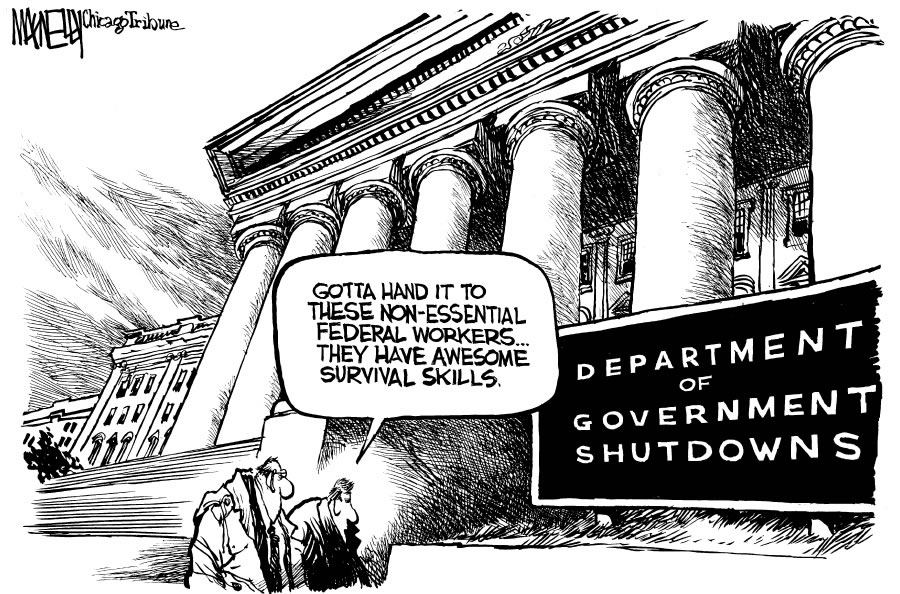
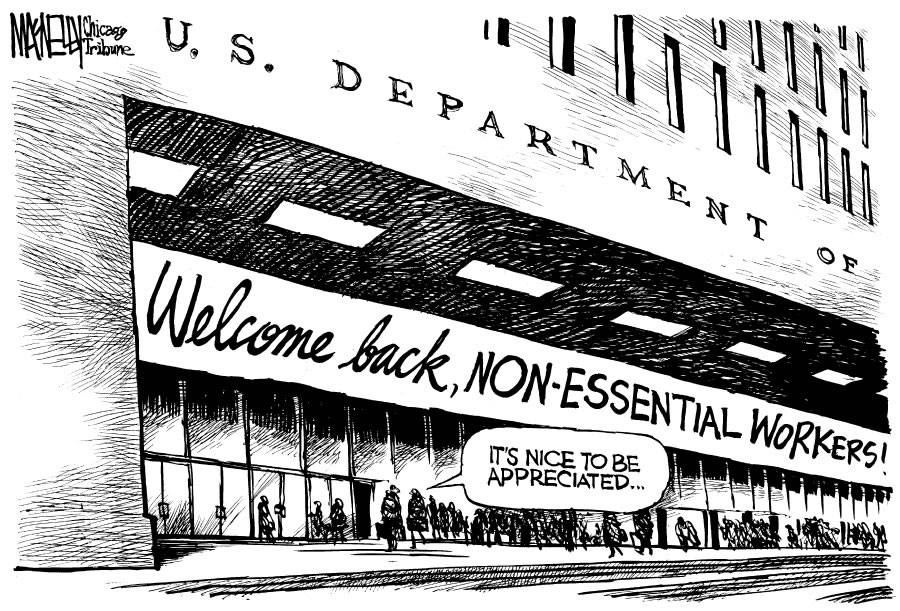
And if Republicans hold firm, that means another “government shutdown.” Though it really should be called a “government slowdown” since it’s only the non-essential bureaucrats who get sent home.
In any event, since I’m glum about the likelihood of anything good happening, let’s at least enjoy some good cartoons from Jeff MacNelly. He passed away a number of years ago, but these cartoons from the mid-1990s are just as applicable today as they were then.
These are amusing cartoons, so long as you don’t actually think about the fact that government is bloated in part because Washington is littered with programs, departments, and agencies that are filled with non-essential bureaucrats. And don’t forget that these bureaucrats are overpaid, getting, on average, twice the compensation of workers in the productive sector of the economy.
DEBT LIMIT – A GUIDE TO AMERICAN FEDERAL DEBT MADE EASY. Uploaded by debtlimitusa on Nov 4, 2011 A satirical short film taking a look at the national debt and how it applies to just one family. Watch the guy from the Ferris Bueller Superbowl Spot! Produced by Seth William Meier, DP/Edited by Craig Evans, […]
Senator Mark Pryor wants our ideas on how to cut federal spending. Take a look at this video clip below:
Senator Pryor has asked us to send our ideas to him at cutspending@pryor.senate.gov and I have done so in the past and will continue to do so in the future.
On May 11, 2011, I emailed to this above address and I got this email back from Senator Pryor’s office:
Please note, this is not a monitored email account. Due to the sheer volume of correspondence I receive, I ask that constituents please contact me via my website with any responses or additional concerns. If you would like a specific reply to your message, please visit http://pryor.senate.gov/contact. This system ensures that I will continue to keep Arkansas First by allowing me to better organize the thousands of emails I get from Arkansans each week and ensuring that I have all the information I need to respond to your particular communication in timely manner. I appreciate you writing. I always welcome your input and suggestions. Please do not hesitate to contact me on any issue of concern to you in the future.
Government auditors spent the past five years examining all federal programs and found that 22 percent of them—costing taxpayers a total of $123 billion annually—fail to show any positive impact on the populations they serve.
Examples from multiple Government Accountability Office (GAO) reports of wasteful duplication include 342 economic development programs; 130 programs serving the disabled; 130 programs serving at-risk youth; 90 early childhood development programs; 75 programs funding international education, cultural, and training exchange activities; and 72safe water programs.
A GAO audit classified nearly half of all purchases on government credit cards as improper, fraudulent, or embezzled. Examples include gambling, mortgage payments, liquor, lingerie, iPods, Xboxes, jewelry, Internet dating services, and Hawaiian vacations. In one extraordinary example, the Postal Service spent $13,500on one dinner at a Ruth’s Chris Steakhouse, including “over 200 appetizers and over $3,000 of alcohol, including more than 40 bottles of wine costing more than $50 each and brand-name liquor such as Courvoisier, Belvedere and Johnny Walker Gold.” The 81 guests consumed an average of $167 worth of food and drink apiece.
Ep. 4 – From Cradle to Grave [6/7]. Milton Friedman’s Free to Choose (1980)
With the national debt increasing faster than ever we must make the hard decisions to balance the budget now. If we wait another decade to balance the budget then we will surely risk our economic collapse.
The first step is to remove all welfare programs and replace them with the negative income tax program that Milton Friedman first suggested.
Milton Friedman points out that though many government welfare programs are well intentioned, they tend to have pernicious side effects. In Dr. Friedman’s view, perhaps the most serious shortcoming of governmental welfare activities is their tendency to strip away individual independence and dignity. This is because bureaucrats in welfare agencies are placed in positions of tremendous power over welfare recipients, exercising great influence over their lives. In addition, welfare programs tend to be self-perpetuating because they destroy work incentives. Dr. Friedman suggests a negative income tax as a way of helping the poor. The government would pay money to people falling below a certain income level. As they obtained jobs and earned money, they would continue to receive some payments from the government until their outside income reached a certain ceiling. This system would make people better off who sought work and earned income.
Participants: Robert McKenzie, Moderator; Milton Friedman; James R. Dumpson, Chief Administrator, Human Resources Admin., NYC; Thomas Sowell, Professor of Economics, UCLA; Robert Lampman, Professor of Economics, Institute of Poverty; Helen Bohen O’Bannon, Secretary of Welfare, State of Pennsylvania
LAMPMAN: I think it’s a viable approach to some part of the problems of poverty. It involves, first of all, cash payments rather than in kind payments as I understand it? It involves payments on a non-categorical basis.
MCKENZIE: What do you mean non-categorical?
LAMPMAN: That is to say, it doesn’t matter whether you’re a female-headed family or a male-headed family or whether you’re young or old, you’re sick or well.
MCKENZIE: If your income falls below a certain level you __
LAMPMAN: Pay some guaranteed income level for people based on family size and then it has a take-back rate which is modest, I suppose, by definition. Now, the question is: How many things you want to use that program to replace? How many things you want to replace with such a negative income tax program.
MCKENZIE: Would you replace everything with it __ just __ we clear that point up. Would you virtually wipe out the remaining forms of welfare if you got this program going?
FRIEDMAN: Yes, I would not __ I think its purpose is precisely to provide a transition between where we are now and where we would like to go because while __ because I agree with you, that given that we’ve corrupted the people on welfare and gotten them on there. We do have an obligation not to throw them out in the street and put them in the difficult adjustment you’ve made. We’ve got to ease the __
MCKENZIE: Yeah. Okay. Right.
FRIEDMAN: __ ease it off __
MCKENZIE: Sure. Yeah.
FRIEDMAN: __ and so __ but I would want to replace all __
MCKENZIE: Yeah. Okay.
FRIEDMAN: __ present welfare programs.
MCKENZIE: Let’s get reactions to this and then we’ll come back to you.
SOWELL: Well, I saw some figures recently which said that if you took all the money spent on poverty in the United States and divided it by all the poverty families you’d come out with a figure of $32,000 per family. Now, the average poverty family is apparently not getting the $32,000 and so clearly someone in between the treasury and those families is getting an awful lot of that money and I think if you simply eliminated the middle man, as they say in the commercials, that there’d be an awful lot of benefit both to the poor and to the taxpayers.
DUMPSON: I’m supportive of the negative income tax concept and the objective of it. I’d like to point out, however, that administratively we have another bureaucracy set up. Somebody has to take into account earnings. Someone has to decide when to pay back that which they’re entitled to. There’s a time lag between the paying back __ the earning and the paying back. There are a variety of problems in there that I will be prepared to accept but I want you to know that government intervention is not going to be eliminated.
O’BANNON: The issue that I have is: Where do children come in? What are their rights under a negative income tax? And are we, by building in a negative income tax, in fact subsidizing the illegitimacy that Tom Sowell is so concerned about?
FRIEDMAN: The major reason it is not feasible today to have a negative income tax is because the present welfare bureaucracy would be out of work. They are the major objectors and as Senator Pat __ he’s now a senator, Pat Moynihan demonstrated in his book on the Nixon program, the chief obstacle to getting it enacted was the welfare bureaucracy. So that I don’t believe these administrative problems, if you got it enacted, would be at all serious.
O’BANNON: I think the other assumption under the negative income tax, and it’s one that I’m not sure I can buy, is that everybody has a minimum level of understanding about how to spend money. In other words, how to use the marketplace to satisfy wishes. And I, as an economist, would say, yes, we do. We __ everybody from age four to a hundred knows how to use money to satisfy wants and that’s the __
FRIEDMAN: But they don’t. They don’t. There are all sorts of problems of people who are not going to be able to. But that’s a minority problem. That’s a problem for private activity and private charity. One thing is sure: They’re spending __ they would be spending their own money and that however knowledgeable you are about money __
O’BANNON: They would be spending my money.
FRIEDMAN: They would be spending my money, but it would be one stage less then. Right now, the welfare worker is spending Mr. A’s money to help Mr. C. And there’s a big takeoff in the middle as Tom Sowell said.
SOWELL: The question is not whether the people on welfare or low incomes can all spend their money effectively; the question is: How effectively do they spend it as compared to how effectively the bureaucrats spend it for them. Comparing anything to perfection or to some arbitrary standard settles nothing. The same thing is true in the education area. They’re saying “Would families be able to spend their __ select schools for their kids under a voucher system,” for example. Well, the question is: Could they possibly do much worse than the current bureaucrats are doing in the public school system.
O’BANNON: Oh __
MCKENZIE: We’ve run on education on another program. Bob Lampman.
(Laughing)
LAMPMAN: I want to quibble with something you said, Tom, about half of the money not going to the poor or something. That doesn’t __ shouldn’t leave the viewer to think that all the money is going to the administrators of programs. A lot of what you are talking about goes to non-poor recipients. For example, social security, as a program, pays a roughly half of its benefits to people who otherwise would not be poor. Unemployment insurance pays about two-thirds of its benefits or so to non-poor persons. And those are, in some definitions, welfare or anti-poverty programs and that’s how statisticians come up with this horrendous sounding discrepancy between the total amount of money spent and the total cash benefits that go to the poor.
SOWELL: Well, I think, I think it’s a perfectly valid point though, because supposedly we were not setting up unemployment benefits and social security in order to keep the affluent.
LAMPMAN: Well, this goes back to its big philosophy, debate we might have. I think that it’s easy to oversimplify things and say that all these programs, including the public schools are there to be a help to the poor and poor only.
FRIEDMAN: Yeah, but I was saying __
LAMPMAN: But let me mention that the negative income tax has some of its impetus in that it would be a way of confining benefit payments to people who are __
SOWELL: Yes. Yes.
LAMPMAN: __ and it would cut out benefits for an awful lot of people who now have expectations that they’re going to get them, not in the form of public assistance, but in the form of social insurance as we use the term.
SOWELL: Well, in order to be made for not disappointing the expectations on which people have built their lives for one generation, but not of continuing for eternity in order to avoid one generation of transition.
MCKENZIE: What are the other hurdles toward getting underway. Now, you said, I don’t know how seriously, the biggest almost the only hurdle is the welfare bureaucracy.
FRIEDMAN: No. Now, there’d be the biggest immediate group of lobbyists that will lobby against it.
MCKENZIE: Yep.
FRIEDMAN: The biggest hurdle in getting it over at the moment is that there is no way of constructing a sensible negative income tax system that will not hurt some people. There will be some people who will get less money than they are now getting under __ particularly those in the upper income groups. Particularly the affluent who are now being subsidized by the welfare and they, will make it politically difficult for the people to put it into effect. The attempt is to put a negative income tax in effect which costs less money, is easier to administer, and yet which doesn’t pay anybody in the society one dollar less than he’s now getting. There’s no way in which you can construct such a program. But, although it’s not politically feasible now, the force of history is on its side, it’s going to become political __
MCKENZIE: Dr. James Dumpson.
DUMPSON: Let’s not say that the __ give the impression that welfare administrators were against negative income tax, the fat program for example, as Moynihan says, because they would lose their jobs, for example. Many of us were opposed to it because of certain features in that program: A $24 __ $2,400 level for a family of four. We were opposed to that. And if one goes down the Congressional record, those who testified, will be shown to be saying, “Yes, we’re for it conceptually. But we’re against this piece and this piece, if you change that you’ll have our support.”
FRIEDMAN: I was in the same position. I first proposed the negative income tax twenty-five years ago but I testified against the final version of the Nixon plan. Why? Because the welfare bureaucrats had led them to introduce changes in it which converted it from a decent satisfactory negative income tax to one which would have been just as bad as what you have now. Would have been added on top of everything else.
It is apparent from this statement below that Senator Mark Pryor is against the Balanced Budget Amendment. He has voted against it over and over like his father did and now I will give reasons in this series why Senator Pryor will be defeated in his re-election bid in 2014. However, first I wanted to quote the statement Senator Pryor gave on December 14, 2011. This information below is from the Arkansas Times Blog on 12-14-11 and Max Brantley:
THREE CHEERS FOR MARK PRYOR: Our senator voted not once, but twice, today against one of the hoariest (and whoriest) of Republican gimmicks, a balanced budget amendment. Let’s quote him:
As H.L. Mencken once said, “For every complex problem there is a solution which is simple, clean, and wrong.” This quote describes the balanced budget amendment. While a balanced budget amendment makes for an easy talking point, it is an empty solution. Moreover, it’s a reckless choice that handcuffs our ability to respond to an economic downturn or national emergencies without massive tax increases or throwing everyone off Medicare, Social Security, or veteran’s care.There is a more responsible alternative to balance the budget. President Clinton led the way in turning deficits into record surpluses. We have that same opportunity today, using the blueprint provided by the debt commission as a starting point. We need to responsibly cut spending, reform our tax code and create job growth. This course requires hard choices over a number of years. However, it offers a more balanced approach over jeopardizing safety net programs and opportunity for robust economic growth.
____________________
Senator Mark Pryor will lose his bid for re-election in 2014 BECAUSE HE IS AFRAID TO TELL THE TRUTH ABOUT ENTITLEMENTS AND THEN TO DO SOMETHING ABOUT THEIR FUTURE WHICH WILL BANKRUPT THIS NATION IF LEFT ALONE ANY LONGER.
Two key principles should govern congressional consideration of an amendment to the U.S. Constitution that requires the federal government to balance its budget:
First Principle: A Balanced Budget Amendment (BBA) is important to help bring long-term fiscal responsibility to America’s future when the BBA takes effect after ratification by three-quarters of the state legislatures; it is equally important for Congress to cut spending nowto address the current overspending crisis.
Second Principle: An effective BBA will include three elements to: (a) control spending, taxation, and borrowing, (b) ensure the defense of America, and (c) enforce the requirement to balance the budget.
Cuts for the Future, Cuts for the Present
Federal spending is out of control—both obligations for the future and spending right now.
Congress must get spending under control in the long term. America cannot raise taxes to continue overspending, because tax hikes shrink our economy and grow our government. America cannot borrow more to continue overspending, because borrowing puts an enormous financial burden on the American children of tomorrow. A BBA will help address this long-term problem because, after the multi-year process for securing ratification of the BBA by three-quarters of the states, the BBA will keep federal spending under control in subsequent years.
Congress also must get spending under control in theshort term. Federal overspending is not simply about the future, but also about the present. Under the President’s Fiscal Year 2012 Budget Submission, measured by the Congressional Budget Office, the federal government will spend $1.2 trillion more than it will take in, a gargantuan burden of additional debt forced on future generations to pay current bills.
Thus, America needs both a Balanced Budget Amendment for the long term and deep cuts in federal spending starting right now, without waiting for a BBA to take effect. As Congress considers budget resolutions, appropriations bills, appropriations continuing resolutions, and debt limit bills, Congress should take every opportunity now to cut federal spending, including for the biggest overspending problem: the ever-growing entitlement programs.
Congress should recognize that the best way to encourage state legislatures to ratify a BBA is to demonstrate, through consistent congressional cuts in spending, that the American people have the will to accept spending cuts to balance the budget.
Elements of a Successful Balanced Budget Amendment
A successful BBA will:
Control spending, taxing, and borrowing through a requirement to balance the budget.The BBA should cap annual spending at a level not exceeding either: (a) a specified percentage of the value of goods and services the economy produces in a year (known as gross domestic product, or GDP), or (b) the level of revenues. To ensure that Congress cannot simply balance the budget by continually raising taxes instead of cutting overspending, the BBA should require Congress to act by supermajority votes if Members wish to raise taxes. Any authority the BBA grants Congress to deal with economic slowdowns, by waiving temporarily the requirement that spending not exceed the GDP percentage or revenue level, should specify the amount of above-revenue spending allowed and require supermajority votes.
Defend America. The BBA should allow Congress by supermajority votes to waive temporarily compliance with the balanced budget requirement when waiver is essential to pay for the defense of Americans from attack.
Enforce the balanced budget requirement. The BBA should provide for its own enforcement, but must specifically exclude courts from any enforcement of the BBA, so unelected judges do not make policy decisions such as determining the appropriate level of funding for federal programs. A government that spends money in excess of its revenues must borrow to cover the difference. Therefore, to enforce the requirement to balance the budget, the BBA should prohibit government issuance of debt, except when necessary to finance a temporary deficit resulting from congressional supermajority votes discussed above.
America is in a fiscal crisis. Our government spends too much. Overspending must stop immediately. Overspending will stop only if Congress cuts spending now, including with respect to the ever-expanding entitlement programs. For the future, Congress and three-quarters of state legislatures can adopt and ratify a Balanced Budget Amendment to the U.S. Constitution to anchor the American willingness to live within a balanced budget.
David S. Addington is Vice President for Domestic and Economic Policy, and J. D. Foster, Ph.D., is Norman B. Ture Senior Fellow in the Economics of Fiscal Policy, at The Heritage Foundation.
It is apparent from this statement below that Senator Mark Pryor is against the Balanced Budget Amendment. He has voted against it over and over like his father did and now I will give reasons in this series why Senator Pryor will be defeated in his re-election bid in 2014. However, first I wanted to quote the statement Senator Pryor gave on December 14, 2011. This information below is from the Arkansas Times Blog on 12-14-11 and Max Brantley:
THREE CHEERS FOR MARK PRYOR: Our senator voted not once, but twice, today against one of the hoariest (and whoriest) of Republican gimmicks, a balanced budget amendment. Let’s quote him:
As H.L. Mencken once said, “For every complex problem there is a solution which is simple, clean, and wrong.” This quote describes the balanced budget amendment. While a balanced budget amendment makes for an easy talking point, it is an empty solution. Moreover, it’s a reckless choice that handcuffs our ability to respond to an economic downturn or national emergencies without massive tax increases or throwing everyone off Medicare, Social Security, or veteran’s care.There is a more responsible alternative to balance the budget. President Clinton led the way in turning deficits into record surpluses. We have that same opportunity today, using the blueprint provided by the debt commission as a starting point. We need to responsibly cut spending, reform our tax code and create job growth. This course requires hard choices over a number of years. However, it offers a more balanced approach over jeopardizing safety net programs and opportunity for robust economic growth.
____________________
Mark Pryor will be defeated for his re-election because he is involved constantly in cover votes!!! Take a look at the video below and the discussion of a cover vote concerning the Balanced Budget Amendment. Look at the excellent article below concerning the history of the Balanced Budget Amendment votes of the past. OVER AND OVER POLITICIANS HAVE TRIED TO COVER THEMSELVES WHEN WHAT THEY REALLY WANT TO DO IS TO SPEND LOTS OF OUR KIDS’ MONEY THAT THEY WILL HAVE TO PAY BACK.
Abstract:Attempts at passing a balanced budget amendment (BBA) date back to the 1930s, and all have been unsuccessful. Both parties carry some of the blame: The GOP too often has been neglectful of the issue, and the Democratic Left, recognizing a threat to big government, has stalled and obfuscated, attempting to water down any proposals to mandate balanced budgets. On the occasion of the July 2011 vote on a new proposed BBA, former Representative from Oklahoma Ernest Istook presents lessons from history.
A proposed balanced budget amendment (BBA) to the Constitution is set to be considered by Congress this July—the first such vote since 1997.
The BBA is a powerful proposal that attracts great vitriol from the American Left, which recognizes it as an enormous threat to its big-government ways—perhaps the greatest threat. For that reason, the history of Congress’s work on a BBA is full of frustrations, high-profile defections, reversals, and betrayals.
This paper discusses that history. It also describes some of the milktoast versions and amendments that have been offered to gut the BBA while providing political cover for those who are unwilling to support a robust version.
Brief History
Thomas Jefferson wrote in 1798, “I wish it were possible to obtain a single amendment to our Constitution. I would be willing to depend on that alone for the reduction of the administration of our government; I mean an additional article taking from the Federal Government the power of borrowing.”[1] Yet according to the Congressional Research Service,[2] the first balanced budget amendment was not proposed until 1936, when Representative Harold Knutson (R–MN) introduced House Joint Resolution 579, proposing a per capita limit on federal debt.
No BBA measure passed either body of Congress until 1982, when the Senate took 11 days to consider it and mustered the necessary two-thirds majority on the version crafted by Senator Strom Thurmond (R–SC).[3] A companion measure received a vote of 236 to 187 in the House—short of the required two-thirds. Despite opposition from Speaker Thomas “Tip” O’Neill (D–MA), the floor vote was obtained by means of a discharge petition led by Representatives Barber Conable (R–NY) and Ed Jenkins (D–GA).[4]
Subsequently, continuing opposition from Speaker O’Neill and his successor, Jim Wright (D–TX), prompted creative use of discharge petitions to circumvent leadership opposition. Several House votes were held in the early 1990s, when Representative Charles Stenholm (D–TX) led bipartisan coalitions to force Democratic leaders to permit (unsuccessful) floor votes. At the time, even prominent Democrats such as Representative Joseph Kennedy (MA) openly supported the BBA and voted for it. There were multiple House and Senate votes, but all were unsuccessful.[5]
The first and only time the House gave two-thirds approval to a balanced budget amendment was in 1995, when Members voted for the “Contract with America” that helped Republicans win major congressional majorities. That was the last time the House held a floor or committee vote. Since then, the Senate has failed twice—each time by a single vote—to gather the two-thirds needed.[6]
Defections Block BBA Approval
Three Senators were the key defectors who prevented Congress from approving a balanced budget amendment in the 1990s. One actually had never supported it and bucked his party to oppose it. The other two flip-flopped in order to go along with their party in opposing the BBA.
First, in 1995, Senator Mark Hatfield (R–OR) took the heat when he would not join his party in support of a BBA. But Hatfield’s vote would have been unnecessary had Senator Tom Daschle (D–SD) not reversed years of prior support to oppose the BBA at President Bill Clinton’s urging.
Then, in 1997, the measure again failed by a single vote in the Senate when newly elected Senator Robert Torricelli (D–NJ) broke his campaign pledge and refused to support the same BBA that he had supported as a House member.[7]
More recently, many House Democrats who voted for the BBA in 1995 are now saying they will vote no in 2011. Most notable among these is House Democratic Whip Steny Hoyer (D–MD).
Senate Defections
Senator Hatfield called the BBA a “political gimmick,” and his high-profile defection broke GOP party unity. Less noticed was that his opposition could have been a moot point. Then-Senate Majority Leader Bob Dole (R–KS) told The New York Times that Hatfield offered to resign before the vote—a resignation that would have produced a 66-to-33 victory for the BBA—but Dole refused to accept the resignation offer.[8]
Still, with or without Hatfield’s vote or resignation, the BBA would have prevailed in the 1995 Senate vote were it not for Senator Daschle’s reversal. That flip-flop is described in a book about his later ousting from office by the voters:
Although the balanced budget amendment had not been a major issue nationally for several years, it provided a striking contrast between Daschle’s first campaign in 1978 and his early career in Congress, when he consistently promoted the amendment, and his later years in the Senate. During his last competitive Senate bid in 1986, Daschle ran a television ad saying that “in 1979, Tom Daschle saw the damage these deficits could do to our country. His first official act was to sponsor a Constitutional amendment to balance the budget.” In 1992, Daschle’s campaign literature touted the “Daschle Plan,” which included the balanced budget amendment: “In 1979, before it became popular, I was pushing a balanced budget amendment to the Constitution. It was my first official action, and I’ve authored or coauthored one every year.” In 1995, the amendment had the support of sixty-six of the sixty-seven senators needed for passage, but Daschle voted against it because of opposition from the Clinton administration…. When pressed on the amendment in the last [2004] television debate, Daschle said that he had opposed the bill in the 1990s because there were no provisions in the amendment allowing for emergencies such as war. But the record showed that there wasan emergency clause.[9]
In 2011, Daschle has penned several articles denouncing the BBA, complaining that it would make the country’s fiscal crisis even worse and would tie lawmakers’ hands.[10]
The 1997 effort to approve the BBA failed in the Senate by a single vote, just as it had in 1995. This time it was Senator Torricelli doing the political acrobatics. As the New York Daily News described it:
Sen. Robert Torricelli (D–N.J.) yesterday announced he will vote against the balanced budget amendment to the Constitution giving Democrats the one-vote margin they need to kill it. The freshman senator flipped on his campaign pledge to support the amendment and on his own past voting record in the House in favor of similar proposals. “I have struggled with this decision more than any I have ever made in my life,” Torricelli said…
Torricelli acknowledged that he had campaigned in support of the amendment to win his Senate seat last year and had voted three times in favor of similar amendments as a House member. But he said President Clinton’s efforts in bringing down annual budget deficits from $300 billion to $100 billion, and the President’s commitment to a balanced budget by 2002, had relieved the pressure for a constitutional amendment.[11]
Trying to give himself political cover, Torricelli tried but failed to get the Senate to support a loophole-riddled version.
House Reversals
Chief among Representatives who supported a BBA in 1995 but say they will actively oppose it in 2011 is Representative Hoyer. In 1995, he even helped to garner votes for the BBA. As the Baltimore Sun reported at the time, “‘The issue of a balanced budget is not a conservative one or a liberal one, and it is not an easy one,’ said Mr. Hoyer, who said he fears the consequences of a national debt that is headed toward $5 trillion. ‘But it is an essential one.’”[12] Arguing for the BBA on the House floor in 1995, Hoyer said:
[T]his country confronts a critical threat caused by the continuation of large annual deficits…. I am absolutely convinced that the long term consequences of refusing to come to grips with the necessity to balance our budget will be catastrophic…. [T]hose who will pay the highest price for our fiscal irresponsibility, should we fail, will be those least able to protect themselves, and the children of today and the generations of tomorrow.[13]
Hoyer reversed course after rising to high leadership within his party, as did Daschle. Daschle did a turnaround against the same language he previously had supported. Hoyer, however, argued that the latest 2011 version (with tax limitation and size-of-government limits) had gone beyond what he originally supported in 1995:
It would require drastic and harmful cuts to programs like Medicare, Medicaid, and Social Security, programs that form the heart of America’s social compact…. Unlike previous balanced budget amendments, this amendment would mean great pain for ordinary Americans, even as it shielded the most privileged from any comparable sacrifice. It is not a solution to our nation’s pressing fiscal challenges.[14]
It is an open question how other Democrats who supported the 1995 version of the BBA will vote on the tougher 2011 version.[15] They include another member of the current Democratic House leadership, James Clyburn (SC).
The GOP was also guilty of abandoning the BBA—by neglect. The BBA had been the number one item on its Contract with America legislative agenda in 1994, but after the single (and successful) 1995 House vote, House GOP leaders refused all entreaties to bring it up again. No House or Senate vote has been held since Torricelli’s dramatic about-face in 1997.
For part of the time while Republican leaders were dormant on a BBA, the budget was balanced. Rather than spotting an opportunity to cement that condition into a permanent requirement, however, some saw it as proving that a BBA is not needed.
During that time when the federal budget was balanced without a BBA requirement (fiscal years 1998–2001),[16] Congress had political incentives to maintain that balance. However, after 9/11, Washington not only ramped up national security spending, but also let other spending rise significantly. The prevailing notion seemed to be that if the budget was not balanced, then it mattered little just how far out of balance it was.
That experience illustrates not only the need for a proper BBA, but also the need for any national security exceptions to be drafted narrowly, to permit deficits only to the extent necessary to provide for non-routine defense circumstances and not to justify unrelated deficit spending.
Watering Down the BBA
The versions of the BBA to be voted on in 2011 are improvements over the Contract with America. Because of this strengthening, the current versions are described herein as “BBA-plus.”[17]
Simply put, the additional features require a supermajority to raise taxes; create limits on the level of federal spending (as a percentage of the national economy); tighten the permitted and limited exceptions to a balanced budget; and limit the potential for judicially imposed tax increases as a means of enforcement.
According to their strictness, different variations in proposed texts could be considered good, better, and best, with a full-featured BBA-plus being the best. But the greater the strictures, the more difficult passage becomes. Many pro-BBA lawmakers have therefore introduced and supported versions that were not as strong as they prefer but have greater likelihood of adoption.
These variations also create potential for mischief. Because they recognize the huge popular support for the BBA, many opponents have attempted to offer amendments and variations that would water down or emasculate the provisions of the BBA so that they could posture as supporters while justifying their “no” votes. The following is a historical synopsis of those tactics.
Taking Social Security Off-Budget. The most prominently advanced effort to weaken a BBA is a provision to separate Social Security payments and receipts from the requirements for a balanced budget. Amendments to do so were offered in both the House and Senate from 1995 to 1997. Senator Harry Reid (D–NV) was a principal leader of that effort in 1997.
Reid and others argued that removing Social Security from a BBA would protect the program from spending cuts. They argued that its funds do not actually constitute government spending since the program involves a trust fund. This ignored the fact that the entirety of the trust fund has been invested in federal bonds and that all of the borrowed money has been spent. Furthermore, during the 1990s, the Social Security program was producing annual surpluses ranging from $60 billion to $65 billion, which disguised deficit spending elsewhere. Today, Social Security runs an annual deficit.
If Social Security were removed from a BBA’s requirements, Congress would be approving major deficit spending while not counting it as a deficit. Politicians would only be pretending to have balanced the budget. As the Congressional Budget Office reported this past January, “Excluding interest, surpluses for Social Security become deficits of $45 billion in 2011 and $547 billion over the 2012–2021 period.”[18]
The Torricelli Ploy. As previously mentioned, the most transparent ploy to create an excuse for opposing the BBA came in 1997 from newly elected Senator Robert Torricelli. As a House member, he had voted for a substitute version and also voted “yea” on final passage of the Contract with America BBA in 1995. He campaigned for the Senate in 1996 as a BBA supporter.
As heads were counted for the 1997 Senate vote, it was apparent that Torricelli and Senator Mary Landrieu (D–LA), both previous BBA supporters, were the swing votes. If both voted “yea,” the necessary two-thirds would be achieved in the Senate. President Clinton lobbied both Senators to vote “nay.” Landrieu announced that she would vote yes, and Torricelli announced that he would vote no. Reporters openly asked him whether “he drew the short straw.”
In a move that was publicly derided, Torricelli offered an amendment to the BBA on the Senate floor and then announced he would vote no because the amendment failed. Then, minutes later in a news conference, he undercut his own explanation by stating that in the future, he would vote no on all Republican versions of a BBA and yes on all Democratic versions.
Torricelli’s unsuccessful amendment would have waived the balanced budget requirement whenever a simple majority in Congress declared “an imminent and serious military threat” or “a period of economic recession or significant economic hardship” or when Congress chose to approve deficit spending for “investments in major public physical capital that provides long-term economic benefits.”[19] The three-pronged nature of Torricelli’s effort was a lumping together of provisions that were also offered separately in both the House and Senate by others.
Other Diluting Amendments. The following is a sampling of other proposals offered on the House or Senate floors during the 1995–1997 considerations:[20]
Representative Robert Wise (D–WV) offered a multifaceted substitute that would have provided for separate federal capital and operating budgets; would have required that only the operating budget be balanced; would have exempted Social Security from balanced budget calculations; and would have permitted Congress to waive the balanced budget provisions in times of war, military conflict, or recession.
Senator Richard Durbin (D–IL) tried to insert the following languageinto the BBA: “The provisions of this article may be waived for any fiscal year in which there is an economic recession or serious economic emergency in the United States as declared by a joint resolution, adopted by a majority of the whole number of each House, which becomes law.”
Senator Barbara Boxer (D–CA) proposed, “The provisions of this article may be waived for any fiscal year in which there is a declaration made by the President (and a designation by the Congress) that a major disaster or emergency exists, adopted by a majority vote in each House of those present and voting.”
Representative Major Owens (D–NY) wanted “to allow a majority of Congress to waive the balanced budget provisions contained in the joint resolution in any fiscal year that the national unemployment rate exceeds 4 percent.”
Representative John Conyers (D–MI) wanted to require a detailed plan of spending cuts before balance could be required, proposing “to exempt Social Security from balanced budget calculations; and provide that before the constitutional amendment could take effect, Congress would be required to pass legislation showing what the budget will be for the fiscal years 1996 through 2002, containing aggregate levels of new budget authority, outlays, reserves, and the deficit and surplus, as well as new budget authority and outlays on an account-by-account basis.”
Representative David Bonior (D–MI) tried not only to exempt Social Security from the calculations, but also to require only a simple constitutional majority vote (218 in the House, 51 in the Senate) to allow deficit spending.
Additional amendments were more straightforward, such as whether a supermajority would or would not be required to raise taxes under the BBA. The House Rules Committee screened out 38 proposed floor amendments; only six were permitted.
Conclusion
History shows that the potency of a balanced budget amendment attracts fervent efforts to confuse the issues, especially by creating counterfeit versions and exceptions to provide political cover. Proponents of a BBA should prepare accordingly.
If not for high-profile political defections in the mid-1990s, the BBA would have been approved by Congress. Had it then been ratified by the requisite three-fourths of the states, today’s debates over borrowing limits, entitlements, and spending levels would be greatly different, if not absent.
However, the versions considered in the ’90s were notably weaker than both the House and Senate versions of the BBA-plus now being considered. Had an earlier version been adopted, today’s debate might be about efforts by Congress to evade the spirit of the BBA by exploiting loopholes in that earlier version. This is why vigilance is necessary to prevent the insertion of loopholes into the language of a BBA-plus.
Those who do not learn from the failures of history are doomed to repeat them.
—The Honorable Ernest J. Istook, Jr., a former Member of Congress, is Distinguished Fellow in Government Studies in the Department of Government Studies at The Heritage Foundation.
The USPS is proposing to close 3,700 post office locations across the country, as mail volume falls and the agency is losing billions of dollars.
Kudos to Postmaster Patrick Donahoe for cutting costs, but he missed at least one location. He should add to his list one of the two offices in my neighborhood, which are only a mile apart.
For its story today, the Washington Post went looking for citizens who would complain about the reform, and they found some. One lady in Chevy Chase, Maryland, groused that the post office near her is “part of the culture of the town.” Boy, does that town’s culture ever need help if a sterile government office plays a key role!
Anyway, my neighborhood lost its “culture” when the Borders book store closed last weekend. But that’s life; things change. Maybe a cool new café will open up in the Chevy Chase post office location. I don’t know why people take for granted the huge dynamism we have in arts, society, and the business world, yet they want the government to be a fossilized dinosaur.
Donahoe is trying to cut post office costs, but he does need to expand his horizons to consider more fundamental reforms. On Larry Kudlow’s TV show last night, I pointed to privatized European post offices and expanding postal competition as a good model for the United States, but Donahoe was dismissive. Meanwhile, Susan Collins, who oversees the USPS in the Senate, is even grumbling about Donahoe’s limited reforms.
Will we have to wait until mail volume plummets another 20 percent for U.S. policymakers to get serious about postal reforms?



 The Daily Hatch