I just don’t understand why people think we can go on and act like everything is okay when we have a trillion dollar deficit. Sometimes you run across some very wise words like I did the other day. Kansas Congressman Tim Huelskamp made the following comment on the irresponsible Budget Control Act of August 1, 2011:
I refuse to dig America into a deeper and un-scalable hole. I refuse to be complicit in recklessly spending and borrowing on the backs of the next generation. And, I believe conservatives should make good on their promises to cut trillions in spending…”
This week the Club for Growth released a study of votes cast in 2011 by the 87 Republicans elected to the House in November 2010. The Club found that “In many cases, the rhetoric of the so-called “Tea Party” freshmen simply didn’t match their records.” Particularly disconcerting is the fact that so many GOP newcomers cast votes against spending cuts.
The study comes on the heels of three telling votes taken last week in the House that should have been slam-dunks for members who possess the slightest regard for limited government and free markets. Alas, only 26 of the 87 members of the “Tea Party class” voted to defund both the Economic Development Administration and the president’s new Advanced Manufacturing Technology Consortia program (see my previous discussion of these votes here) and against reauthorizing the Export-Import Bank (see my colleague Sallie James’s excoriation of that vote here).
One of those Tea Party heroes was Tim Huelskamp of Kansas. Last year I posted this below concerning his conservative views and his willingness to vote against the debt ceiling increase:
(WASHINGTON) – Kansas Congressman Tim Huelskamp issued the following statement after voting against the Budget Control Act:
“My fellow freshmen and I were sent to Washington to end tricks and gimmicks that put America in this position,” Congressman Tim Huelskamp said. “I voted ‘no’ today because I refuse to dig America into a deeper and un-scalable hole. I refuse to be complicit in recklessly spending and borrowing on the backs of the next generation. And, I believe conservatives should make good on their promises to cut trillions in spending, enact structural reforms, and fill the role of elected representatives, rather than hand control to an exclusive committee.”
“Back in April – when I voted against the continuing resolution for this year – I said ‘no’ because the cuts were minimal. I came to the same conclusion today: these are paltry cuts compared to the $14.3 trillion in debt we already have and the $7 trillion in new debt we can expect in the next decade. This is not a path to fiscal solvency, it’s a path to fiscal insanity. My constituents and our economy deserve a long-term solution that ends the biggest problem: we simply spend too much.”
“Despite having pledged to the American people an open and transparent process and despite having months to fix this problem, we were asked to vote in the 11th hour for a bill that the public had less than 16 hours to read and understand. The culture of fiscal irresponsibility may not have been created by this Congress, but we were sent here to put an end to it; I’m afraid this bill does not rise to that occasion.”
If our country is the grow the economy and get our budget balanced it will not be by raising taxes!!! The recipe for success was followed by Ronald Reagan in the 1980’s when he cut taxes and limited spending. As far as limiting spending goes only Bill Clinton (with his Republican Congress) were ability to control the growth of government better than Reagan.
I had the pleasure of hearing Arthur Laffer speak in 1981 and he predicted all the economic growth that we would see because of the Reagan tax cuts and he was right. Unfortunately in California today they have forgotten all of those lessons!!!
President Obama’s fiscal policy is a dismal mixture. On spending, he wants a European-style welfare state. On taxes, he is fixated on class-warfare tax policy.
If we want to know the consequences of that approach, we can look at the ongoing collapse of Greece. Or, if we don’t like overseas examples, we can look at California.
California Controller John Chiang reported last week that April tax collections were a gigantic 20.2%, or $2.44 billion, below 2012-13 budget projections. …Among the biggest surprises is a 21.5% or nearly $2 billion decline in personal income tax payments from what Governor Jerry Brown had anticipated. This reinforces the point that when states rely too heavily on the top 1% of taxpayers to pay the bills, fiscal policy is a roller coaster ride. California is suffering this tax drought even as most other states enjoy a revenue rebound. State tax collections were up nationally by 8.9% last year, according to the Census Bureau, and this year revenues are up by double digits in many states. The state comptroller reports that Texas is enjoying 10.9% growth in its sales taxes (it has no income tax), while California can’t seem to keep up despite one of the highest tax rates in the land.
The WSJ editorial suggests a supply-side response, but you won’t be surprised to learn that the state’s kleptomaniac governor is pushing an Obama-style soak-the-rich tax hike.
This would seem to suggest that California should try cutting tax rates to keep more people and business in the state, but Sacramento is intent on raising them again. Governor Brown and the public-employee unions are sponsoring a ballot initiative in November to raise the state sales tax by a quarter point to 7.5% and to raise the top marginal income-tax rate to 13.3% from 10.3%. This will make the state even more reliant on the fickle revenue streams provided by the rich. Meanwhile, an analysis by Joseph Vranich, who studies migration of businesses from one state to another, finds that since 2009 the flight of businesses out of California “has increased fivefold due to high taxes and regulatory costs.”
But while voters can impose higher taxes, they can’t repeal the laws of economics. So if California voters do the wrong thing, they will learn a hard lesson about the Laffer Curve.
Why not pass the Balanced Budget Amendment? As you know that federal deficit is at all time high (1.6 trillion deficit with revenues of 2.2 trillion and spending at 3.8 trillion).
On my blog www.HaltingArkansasLiberalswithTruth.com I took you at your word and sent you over 100 emails with specific spending cut ideas. However, I did not see any of them in the recent debt deal that Congress adopted. Now I am trying another approach. Every week from now on I will send you an email explaining different reasons why we need the Balanced Budget Amendment. It will appear on my blog on “Thirsty Thursday” because the government is always thirsty for more money to spend.
You asked for ideas to cut spending, but you voted for the 800 billion dollar stimulus that did not help the economy at all. I have included an article below that makes a very good point about the Balanced Budget Amendment and the stimulus:
Lee believes there are several key components to a balanced budget amendment which he outlines in his book, including making tax increases contingent on a two-thirds vote in Congress so that the option to increase taxes is not the default maneuver to balance a budget. He believes the amendment should require Congress spends no more than it takes in, and in fact should cap the spending at a fixed percent of GDP (the proposal submitted in the Senate caps it at 18 percent of GDP, just about the historical average). There would also be a supermajority vote required to raise the debt ceiling.
And for those who argue that stimulus packages wouldn’t have been possible under the amendment, Lee sees little difficulty responding.
“That’s exibit A for why we ought to have it,” Lee said of the Obama stimulus package.
As Washington spends the summer arguing over its spending addiction, GOP Sen. Mike Lee of Utah has a solution to help prevent the same crisis for future generations: a balanced budget amendment.
The House made news last week when, in the heat of negotiations over raising the debt ceiling, they announced a vote on a balanced budget amendment this Wednesday. Though the Senate GOP introduced a one earlier this year, President Obama has stated emphatically otherwise, telling Americans last week during a press conference that the country does not need a balanced budget amendment.
“Yes, we do,” Lee told Townhall when asked to respond to the president, adding later when talking about simultaneously raising the debt ceiling and cutting spending, “We can’t bind what a future Congress will do. We can pass laws that will affect this year, but there will be a new Congress that takes power in January of 2013, and then another new one that will take power in January 2015. And they will make their own spending decisions then — we can’t bind them unless we amend the Constitution to do so.”
Lee points out that the American people support the idea of a balanced budget – 65 percent, according to a Sachs/Mason Dixon poll from this year – but politicians have been reluctant to wade into the debate.
“The fact that we’re in this debate, the fact that we’re sort of deadlocked, or we’ve reached a point of gridlock in the discussions, is indicative of the problem that we have,” Lee said.
In fact, Lee thinks a balanced budget amendment is so important to the future of the country that he’s written a book on it: The Freedom Agenda: Why a Balanced Budget Amendment Is Necessary to Restore Constitutional Government.
Lee even takes the argument a step beyond fiscal issues, saying a balanced budget amendment safeguards individual liberties.
““The more money it [Congress] has access to, whether it’s through borrowing or through taxation, either way, that’s going to fuel Congress’ expansion, and whenever government acts, it does so at the expanse of individual liberty,” Lee said. “We become less free every time government expands.”
Lee believes there are several key components to a balanced budget amendment which he outlines in his book, including making tax increases contingent on a two-thirds vote in Congress so that the option to increase taxes is not the default maneuver to balance a budget. He believes the amendment should require Congress spends no more than it takes in, and in fact should cap the spending at a fixed percent of GDP (the proposal submitted in the Senate caps it at 18 percent of GDP, just about the historical average). There would also be a supermajority vote required to raise the debt ceiling.
And for those who argue that stimulus packages wouldn’t have been possible under the amendment, Lee sees little difficulty responding.
“That’s exibit A for why we ought to have it,” Lee said of the Obama stimulus package.
Lee also pointed out that his balanced budget amendment includes an exception to the spending restriction in time of war – “not a blank check, but to the extent necessary.” Congress would also be able to supersede the amendment with a two-thirds vote.
“We wanted to make it difficult, but not impossible, for Congress to spend more than it had access to,” Lee said, citing as an example a massive or immediate crisis created by a national emergency or natural disaster. “What this is designed to do is to make it more difficult – to make it impossible – for Congress to just do this as a matter of course.”
Elisabeth Meinecke
Elisabeth Meinecke is Associate Editor with Townhall.com
Back in 2010, I crunched the numbers from the Congressional Budget Office and reported that the budget could be balanced in just 10 years if politicians exercised a modicum of fiscal discipline and limited annual spending increases to about two percent yearly.
Well, the new CBO 10-year forecast was released this morning. I’m going to give you three guesses about what I discovered when I looked at the numbers, and the first two don’t count.
Yes, you guessed it. As the chart illustrates (click to enlarge), balancing the budget doesn’t require any tax increases. Nor does it require big spending cuts (though that would be a very good idea).
Even if we assume that the 2001 and 2003 tax cuts are made permanent, all that is needed is for politicians to put government on a modest diet so that overall spending grows by about two percent each year. In other words, make sure the budget doesn’t grow faster than inflation.
Tens of millions of households and businesses manage to meet this simple test every year. Surely it’s not asking too much to get the same minimum level of fiscal restraint from the crowd in Washington, right?
At this point, you may be asking yourself whether it’s really this simple. After all, you’ve probably heard politicians and journalists say that deficits are so big that we have no choice but to accept big tax increases and “draconian” spending cuts.
But that’s because politicians use dishonest Washington budget math. They begin each fiscal year by assuming that spending automatically will increase based on factors such as inflation, demographics, and previously legislated program changes.
This creates a “baseline,” and if they enact a budget that increases spending by less than the baseline, that increase magically becomes a cut. This is what allowed some politicians to say that last year’s Ryan budget cut spending by trillions of dollars even though spending actually would have increased by an average of 2.8 percent each year.
Needless to say, proponents of big government deliberately use dishonest budget math because it tilts the playing field in favor of bigger government and higher taxes.
There are two important caveats about these calculations.
2. We should be focusing on the underlying problem of excessive government, not the symptom of too much red ink. By pointing out the amount of spending restraint that would balance the budget, some people will incorrectly conclude that getting rid of deficits is the goal.
Last but not least, here is the video I narrated in 2010 showing how red ink would quickly disappear if politicians curtailed their profligacy and restrained spending growth.
___________________________
Other than updating the numbers, the video is just as accurate today as it was back in 2010. And the concluding message—that there is no good argument for tax increases—also is equally relevant today.
P.P.S. Some people will say that the CBO baseline is unrealistic because it assumes the sequester will take place. They may be right if they’re predicting politicians are too irresponsible and profligate to accept about $100 billion of annual reductions from a $4,000 billion-plus budget, but that underscores the core message that there needs to be a cap on total spending so that the crowd in Washington isn’t allowed to turn America into Greece.
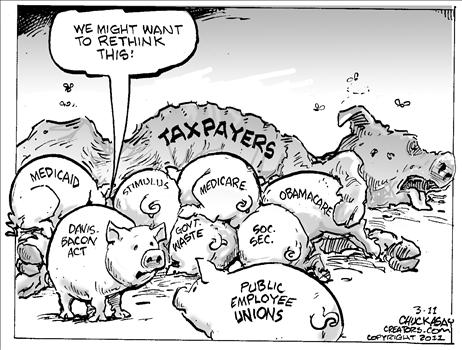
More than two years ago, I explained in a TV interview that the looters and moochers should be careful that they don’t kill the geese that lay the golden eggs. After all, parasites need a healthy host.
The collapse of Europe’s welfare states should be a wake-up call for these people, but that hasn’t stopped the demands for more redistribution in Washington. As Michael Barone noted, the folks on the left assume that there will always be someone to plunder.
But at least the piglets in this Chuck Asay cartoon are finally waking up to reality.
In order to balance the budget we must make deep cuts. Take a look at the study refers to below by Dan Mitchell of the Cato Institute in his fine article on the French mess. Raising taxes has not worked in the thirty countries studied.
Though, to be fair, France hasn’t gotten to the point where it’s being bailed out (it’s probably just a matter of time).
If you want some good analysis of the situation in Europe, Veronique de Rugy of the Mercatus Center hits the nail on the head in her column in today’s Washington Examiner.
France has yet to cut spending. In fact, to the extent that the French are frustrated with “budget cuts,” it’s only because the increase in future spending won’t be as large as they had planned. The same can be said about the United Kingdom. Spain, Italy and Greece have had no choice to cut some spending. However, in the case of these particular countries, the cuts were implemented alongside large tax increases. …This approach to austerity, also known in the United States as the “balanced approach,” has unfortunately proven a recipe for disaster. In a 2009 paper, Harvard University’s Alberto Alesina and Silvia Ardagna looked at 107 attempts to reduce the ratio of debt to gross domestic product over 30 years in countries in the Organisation for Economic Co-operation and Development. They found fiscal adjustments consisting of both tax increases and spending cuts generally failed to stabilize the debt and were also more likely to cause economic contractions. On the other hand, successful austerity packages resulted from making spending cuts without tax increases. They also found this form of austerity is more likely associated with economic expansion rather than with recession. …While the debate over austerity continues, the evidence seems to point to the conclusion that austerity can be successful, if it isn’t modeled after the “balanced approach.” It’s a lesson for the French and other European countries, as well as for American lawmakers who often seem tempted by the lure of closing budget gaps with higher taxes.
There are obvious lessons from Europe for the United States. If politicians don’t reform entitlement programs, we’re doomed to have our own fiscal crisis at some point in the not-too-distant future.
It is apparent from this statement below that Senator Mark Pryor is against the Balanced Budget Amendment. He has voted against it over and over like his father did and now I will give reasons in this series why Senator Pryor will be defeated in his re-election bid in 2014. However, first I wanted to quote the statement Senator Pryor gave on December 14, 2011. This information below is from the Arkansas Times Blog on 12-14-11 and Max Brantley:
THREE CHEERS FOR MARK PRYOR: Our senator voted not once, but twice, today against one of the hoariest (and whoriest) of Republican gimmicks, a balanced budget amendment. Let’s quote him:
As H.L. Mencken once said, “For every complex problem there is a solution which is simple, clean, and wrong.” This quote describes the balanced budget amendment. While a balanced budget amendment makes for an easy talking point, it is an empty solution. Moreover, it’s a reckless choice that handcuffs our ability to respond to an economic downturn or national emergencies without massive tax increases or throwing everyone off Medicare, Social Security, or veteran’s care.There is a more responsible alternative to balance the budget. President Clinton led the way in turning deficits into record surpluses. We have that same opportunity today, using the blueprint provided by the debt commission as a starting point. We need to responsibly cut spending, reform our tax code and create job growth. This course requires hard choices over a number of years. However, it offers a more balanced approach over jeopardizing safety net programs and opportunity for robust economic growth.
____________________
SENATOR MARK PRYOR WILL NOT BE RE-ELECTED BECAUSE THIS IS NOT THE SAME DEMOCRATIC STATE THAT RE-ELECTED HIS FATHER OVER AND OVER, BUT ARKANSAS NOW IS A REPUBLICAN STRONGHOLD. HECK, THE ONLY REASON PRYOR GOT RE-ELECTED IN 2008 WAS BECAUSE THE REPUBLICANS THOUGHT FOR SURE HILLARY WOULD BE ON THE DEMOCRATIC PRESIDENTIAL TICKET AND WOULD HAVE COAT TAILS.
Back in 2009 there were 3 Democratic Congressman and 2 Democratic Senators from Arkansas. Now there are 3 Republican Congressman and 1 Republican Senator and the other two seats are held currently by Pryor who is not up for re-election till 2014 and Mike Ross who is vacated his seat at the end of 2012. Could it be that will no longer have any Democrats in Washington representing Arkansas in a couple of years?
I believe that Pryor has miscalculated by opposing the Balanced Budget Amendment and I think that Mike Ross is very popular because of his support of it.
Below is a piece I wrote a while back about Mike Ross.
U.S. Mike Rossof Prescott surprised everyone by scheduling an announcement this morning in Little Rock to say he would not seek a seventh term in Congress in 2012.His statement is on the jump. He said he hadn’t decided yet on a race for governor in 2014, which he’s long been expected to make. But his reference to the race indicates it is very much in his sights.
ROSS NEWS RELEASE
WASHINGTON — U.S. Congressman Mike Ross of Prescott on Monday announced he will not be seeking re-election to the U.S. House of Representatives. Ross, who won re-election in 2010 by 18 points and has no announced opponent, has represented Arkansas’s Fourth Congressional District in Congress since 2001. A fifth generation Arkansan, Ross is a former state senator and former small business owner.
Statement from U.S. Congressman Mike Ross:
Representing my home state of Arkansas in the U.S. Congress for the past eleven years has been a real privilege and honor. It is a job that I take very seriously and one that I love. However, as I reflect on turning 50 this year, I believe it is time for me to begin a new chapter in my life by spending more time with my family and exploring new opportunities here at home in Arkansas.
That’s why I have decided not to seek a seventh term to the United States House of Representatives from Arkansas’s Fourth Congressional District. This was not an easy decision and one that I carefully made after a lot of reflection, thought and prayer.
Last year was a tough political environment to seek re-election. Yet, I won by 18 points—one of the largest margins of any member of Congress in a swing district. The trust and confidence the folks here at home have continually placed in me is something I will never forget. The people of Arkansas’s Fourth Congressional District are good, decent, hard working people and I am proud to serve and represent them in the U.S. Congress.
A lot has changed since I was first elected to the U.S. Congress in 2000. Congressional campaigns have gone from several months in length to never-ending, costing millions of dollars every two years. As a result, fundraising never ends nor do the political attacks. While I have worked hard to bring folks to the middle to craft commonsense solutions to the many problems that confront our nation, Washington is mired in gridlock, gamesmanship and constant partisan bickering. Too many issues and votes are based on partisan politics rather than good public policy. Despite our many challenges, I remain optimistic that America’s best days are still ahead of us.
I never believed that my service in the U.S. Congress should become a permanent career. This seat never belonged to me—it belongs to the people of Arkansas. And I know there are many bright people in Arkansas ready to step up, go to Washington and offer a new generation of leadership. Simply put, it is someone else’s turn to represent our state in the U.S. Congress.
I have many good memories of my service in the U.S. Congress, and we have helped thousands of people. None of this would have been possible without the support of the people here in Arkansas, and for that, my family and I will always be grateful to them.
I look forward to serving out the remainder of my term in the U.S. Congress, which doesn’t end until January 2013. I will continue to work each and every day on behalf of the people I represent, just as I have faithfully tried to do from the beginning.
I have received a lot of encouragement to run for Governor of Arkansas when Governor Beebe’s term ends in 2014. I’ve always been very upfront and honest in the fact that, as a fifth generation Arkansan, I love our state and would like very much to help lead it at some point in the future. Whether I run for Governor in 2014 is a decision I have not yet made and won’t make until sometime after my term in this Congress ends.
__________________________________
Ross will tough to beat in the governor race in 2014. However, I do think that the Republicans will have an excellent chance to capture a fourth Congressional seat in 2012. Will there ever be another Democratic member of the House of Representatives from Arkansas? (In fact if you check out some of the information at the Red Arkansas Blog and you will see that most people view this district as a Republican pick up.)
To win, a Democrat will need to be as good a politician as Ross. I can’t identify such a Democrat at present.
At this point I’d give tea party pageanteer Beth Anne Rankin, the Sarah Palin wannabe of Arkansas, a decent shot.
Jason Tolbert reported: With the sudden news from Rep. Mike Ross that he will not seek re-election, potential Republican candidates will quickly emerge. However, two Republicans have already been busy lining up support behind the scenes before Ross even announced his decision.
Republican Tom Cotton from Dardanelle confirms to the Tolbert Report this morning that he will seek the open seat and is already putting together his team. Potential donors have confirmed that Cotton is lining up support and may already have over six figures in commitments. In addition, Cotton has been seen meeting recently with Second District Congressman Tim Griffin who could lend support to Cotton’s campaign.
Cotton was one of the many names considering a run for Senate in 2010 against former Sen. Blanche Lincoln, but ultimately decided against it. Cotton currently works for international consulting firm, McKinsey and Company. A veteran, he also serves in the U.S. Army Reserves. Cotton lives in Yell County, which was part of the Second Congressional District represented by Congressman Griffin. It was moved to the Fourth Congressional Disctrict in the last redistricting process.
In addition, Beth Anne Rankin of Magnolia, former candidate and general election opponent of Mike Ross, has been exploring another run as well. Rankin is a former Miss Arkansas and worked in former Gov. Mike Huckabee’s administration. She recently appeared on his Fox News program “Huckabee” cutting her red hair for “Locks of Love” – something she does every few years. Rankin recieved 40 percent of the vote in 2010 with Ross pulling in 57 percent.
In addition, sources close to State Rep. Lane Jean of Magnolia confirm that he is “strongly considering” getting into the race as well. Jean was elected to his first term in the Arkansas House in 2010.
Other potential Republicans names mentioned are: State Rep. Matthew Shepherd, former Congressional candidate Glenn Gallas, and Will Rockfeller – the son of the late Lt. Gov. Win Rockfeller.
It is apparent from this statement below that Senator Mark Pryor is against the Balanced Budget Amendment. He has voted against it over and over like his father did and now I will give reasons in this series why Senator Pryor will be defeated in his re-election bid in 2014. However, first I wanted to quote the statement Senator Pryor gave on December 14, 2011. This information below is from the Arkansas Times Blog on 12-14-11 and Max Brantley:
THREE CHEERS FOR MARK PRYOR: Our senator voted not once, but twice, today against one of the hoariest (and whoriest) of Republican gimmicks, a balanced budget amendment. Let’s quote him:
As H.L. Mencken once said, “For every complex problem there is a solution which is simple, clean, and wrong.” This quote describes the balanced budget amendment. While a balanced budget amendment makes for an easy talking point, it is an empty solution. Moreover, it’s a reckless choice that handcuffs our ability to respond to an economic downturn or national emergencies without massive tax increases or throwing everyone off Medicare, Social Security, or veteran’s care.There is a more responsible alternative to balance the budget. President Clinton led the way in turning deficits into record surpluses. We have that same opportunity today, using the blueprint provided by the debt commission as a starting point. We need to responsibly cut spending, reform our tax code and create job growth. This course requires hard choices over a number of years. However, it offers a more balanced approach over jeopardizing safety net programs and opportunity for robust economic growth.
____________________
One of the biggest reasons that Senator Mark Pryor will not be re-elected in 2014 to the Senate is because EVEN THOUGH HE ASKS FOR SPENDING CUT IDEAS, HE REALLY DOESN’T WANT TO EMBRACE THEM. FOR INSTANCE, IN THIS ARTICLE BELOW BY JOHN STOSSEL THERE ARE PLENTY OF GREAT SUGGESTIONS BUT PRYOR HAS HEARD THEM ALL AND DOES NOT LIKE THEM BECAUSE HE LIKES SPENDING MORE!!!!
The point is that we don’t need to choke our government — or, more to the point, ourselves — with such simplistic devices as balanced budget amendments. The point is that we need to make our often-essential deficit and debt more sustainable, more manageable, more responsible and less massive, and that we should do that by addressing both income and outgo.
You’re right, my tea party friend, about how government must change its ways. You’re not right, though, in the over-simplicity of your assessment or in the impractical, even drastic, nature of your remedies.
Brummett’s view used to be the majority view, but in a recent poll by CNN over 70% now favor a Balanced Budget Amendment. I am starting a series today on the Balanced Budget Amendment!!!
Dear Senator Pryor,
Why not pass the Balanced Budget Amendment? As you know that federal deficit is at all time high (1.6 trillion deficit with revenues of 2.2 trillion and spending at 3.8 trillion).
On my blog www.HaltingArkansasLiberalswithTruth.com I took you at your word and sent you over 100 emails with specific spending cut ideas. However, I did not see any of them in the recent debt deal that Congress adopted. Now I am trying another approach. Every week from now on I will send you an email explaining different reasons why we need the Balanced Budget Amendment. It will appear on my blog on “Thirsty Thursday” because the government is always thirsty for more money to spend.
You are right to ask for ideas to cut spending because that is the real cause of the deficit. John Stossel rightly noted, “Milton Friedman always said taxes don’t tell the whole story. What counts is how much of our resources government spends, however it acquires them. The doubling of spending under Bush and Obama hasn’t gotten enough attention.”
Senator Pryor, you asked for spending cut advice. Here is some from John Stossel:
It’s not hard to balance the budget. On my show, we made enough cuts to create a $237 billion surplus. I cut whole departments, like Education and Commerce. I cut two-thirds of the Defense Department (which still leaves it much bigger than China’s). I indexed Medicare, Medicaid and Social Security to inflation, raised the retirement age, and took away benefits for rich people. But I don’t have to run for office. Congressmen do, and they can’t even manage to cut ridiculous tax breaks like those for ethanol.
The political class predicted “disaster” if Congress didn’t raise its debt limit.
I think that was a scam to get more money. See, the poor politicians don’t have enough, and they need to borrow more. We taxpayers are cheap. This year we’ll give them only $2.2 trillion. They want to spend $3.8 trillion.
The president said if he didn’t get more money, Social Security checks wouldn’t go out. Why not?
With $2 trillion, they can pay Social Security, Medicare, the interest on the debt and still have billions left. It’s billions more than the government spent when President George W. Bush took office. What’s the problem?
The problem is that Republicans and Democrats under Bush and President Obama doubled spending. Now, Obama wants more taxes.
Taxes shouldn’t be the answer when spending is the problem.
Grover Norquist, who heads Americans for Tax Reform (ATR), leads the charge to keep the focus on spending. Norquist and ATR are famous for asking officeholders and candidates to sign a pledge not to raise taxes. Some say he is the reason the debt-ceiling debate was so drawn out.
“I think the reason there isn’t a tax increase on the table,” he told me, “is that 235 members of the House of Representatives signed a pledge never to raise taxes, a pledge to their voters, and 41 senators did. …
“Only if you take tax increases off the table do you even begin to … focus on spending, and that’s what Obama wants to keep our focus off of. He wants us to talk about the deficit, not spending.”
I pointed out that Obama might have scored points with the public because new revenues he sought — even though they wouldn’t do much to shrink the deficit — would come from closing unpopular tax “loopholes.”
Norquist said he favors that — if tax rates are lowered at the same time.
“(We) want to simplify the code,” he said. “(We) want to take a lot of the goodies that politicians have laced into that code … as long as you reduce tax rates and it’s not a hidden tax increase.”
Milton Friedman always said taxes don’t tell the whole story. What counts is how much of our resources government spends, however it acquires them. The doubling of spending under Bush and Obama hasn’t gotten enough attention.
“We need to ask what it is government should do,” Norquist said. “But it’s going to be knockdown, drag-out. All government overspending creates the constituency for its own perpetuation. … Weaning people off, that is very difficult.”
He’s right. When politicians make little cuts in the rate of spending growth, every interest group mobilizes to protect its little piece of the pie. That’s why you must cut government like you take off a Band-Aid: quickly and all at once.
It’s not hard to balance the budget. On my show, we made enough cuts to create a $237 billion surplus. I cut whole departments, like Education and Commerce. I cut two-thirds of the Defense Department (which still leaves it much bigger than China’s). I indexed Medicare, Medicaid and Social Security to inflation, raised the retirement age, and took away benefits for rich people. But I don’t have to run for office. Congressmen do, and they can’t even manage to cut ridiculous tax breaks like those for ethanol.
Obama predicted disaster if the debt ceiling wasn’t raised. Some predict disaster if the ratings agencies downgrade Treasury bonds. I’m dubious. In 1995, President Clinton and Republican Congress couldn’t agree on a budget, so the government shut down twice, the second time for three weeks.
Did the economy grind to a halt? No. During the first shutdown, the stock market went up. During the second, it dropped then recovered.
The alarmists screamed that the fight over the debt ceiling would discourage lenders. Wrong. Ten-year Treasury bonds sold for a measly 3 percent interest (versus 15 percent in 1981).
I wasn’t worried that Congress would fail to raise the debt ceiling. But I am worried that Congress will keep spending.
John Stossel
John Stossel is host of “Stossel” on the Fox Business Network. He’s the author of “Give Me a Break” and of “Myth, Lies, and Downright Stupidity.” To find out more about John Stossel, visit his site at johnstossel.com.
http://blog.heritage.org | Today marks the 1,000th day since the United States Senate has passed a budget. While the House has put forth (and passed) its own budget, the Senate has failed to do the same. To help illustrate how extraordinary this failure has been, our new video highlights a few of impressive feats in history that have been accomplished in less time.
________________
It seems ironic to me that we have not had a budget passed by the Senate for over three years yet we have President Obama bragging to the G-8 audience that he has made a lot of progress getting measures passed that have helped the U.S. economy.
Europe is in bad shape, there’s no doubt about it. The sovereign debt crisis continues to roil the continent, Greece may leave the euro, Spain may have to revise its budget deficit upward for the second time because of bad loans, and France has a new socialist president pledging more spending instead of austerity. So when the G8 leaders met last week, President Obama had some words of advice to offer — “Look at me and learn from my stellar example!”
OK, that’s a paraphrase, but his actual words aren’t all that much different. No joke, the president who has presided over a downgraded credit rating, three years without a budget, an exploding deficit, an entitlement system desperately in need of reform, and an unemployment rate still over 8 percent has painted himself as a model for others to follow.
Quite remarkably, the president bragged that he has worked to “bring down our deficits and debt over the longer term” while staying “focused on growing the economy and creating jobs in the immediate term.” Though he acknowledges that “Of course, we still have a lot of work to do,” he says that now there’s “room to take a balanced approach to reducing our deficit and debt, while preserving our investments in the drivers of growth and job creation over the long term — education, innovation, and infrastructure for the 21st century.”
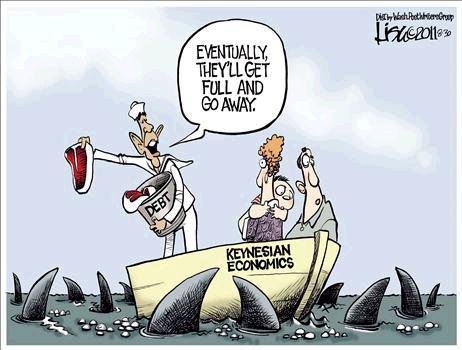
In other words, because of his supposed successes, America can afford to spend even more money on stimulus.
It’s hard to say whether the president’s intended audience was the leaders of the G8 or the American electorate, but regardless of who it was, there’s not much for Obama to brag about.
In the past four years, unemployment has gone up, more people are unemployed longer, gas prices are higher, the cost of health care insurance has increased, the national debt is higher, federal spending has increased, more Americans are on food stamps, regulatory costs are higher, home values have declined, America’s economic recovery is historically slow, and while federal spending on education has increased, results remain flat. You can see for yourself just how bad America’s fiscal outlook is in Heritage’s 2012 edition of the Federal Budget in Pictures.
Though Europe needs solutions, they certainly shouldn’t be looking at President Obama for the answers.




 With the sudden news from Rep. Mike Ross that he will not seek re-election, potential Republican candidates will quickly emerge. However, two Republicans have already been busy lining up support behind the scenes before Ross even announced his decision.
 In addition, Beth Anne Rankin of Magnolia, former candidate and general election opponent of Mike Ross, has been exploring another run as well. Rankin is a former Miss Arkansas and worked in former Gov. Mike Huckabee’s administration. She recently appeared on his Fox News program “Huckabee” cutting her red hair for “Locks of Love” – something she does every few years. Rankin recieved 40 percent of the vote in 2010 with Ross pulling in 57 percent.


 The Daily Hatch