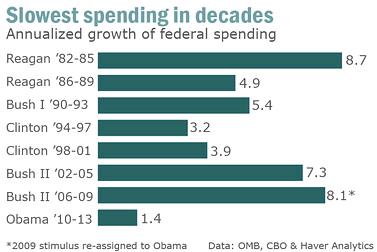
Category Archives: spending out of control

Austerity has not happened in Italy yet

Max Brantley and Paul Krugman are constantly being critical of the austerity in Europe but in most cases in Europe what we have is tax increases and fake spending cuts. Instead of destroying economic growth with tax increases the right method would be real spending cuts.

We need some austerity in the USA and I don’t mean tax increases. That never helps. However, just like many of the European countries we have run away federal government spending that needs to be cut. Why can’t we learn from others mistakes?

Looking at Austerity in Italy

Posted by Juan Carlos Hidalgo

The Italian economy contracted for a third quarter in a row, deepening the country’s recession and adding to the fire of the euro crisis. Italy is the third largest economy in the Eurozone, and many view it as the endgame of an eventual collapse of the common currency because it is too big to fail. Neither the EU nor the IMF have enough cash to rescue it. If the country defaults, that would probably spell the end of the euro.

Austerity is being blamed for Italy’s economic troubles. Chiara Corsa, an economist at UniCredit, wrote that “The key factor is austerity, which is weighing heavily on consumption and investment.” Recent local elections saw the rise of anti-austerity parties. Paul Krugman warned about this back in December when he described the austerity push of Prime Minister Mario Monti as “self-defeating” and “delusional.”

However, as is the case for Britain, France and Greece, commentators are unclear about what austerity means for Italy, although many seem to imply spending cuts. For example, if Krugman’s criticism about Italian austerity is consistent with his critiques about austerity elsewhere in Europe, we know he means spending cuts. So let’s take a look and see if there has been any:


* Using GDP deflator.
Source: European Commission, Economic and Financial Affairs.

Spending in nominal terms increased by a yearly average of 4.1% between 2000 and 2009, and then fell slightly the following year. In 2011 government spending was just 0.14% below its 2009 level. As for spending in real terms, there’s no cut whatsoever. And as a share of the economy, total spending reached a peak in 2009 at 51.6% of GDP, and it fell to 49.6% last year, a decline far from significant.

So what’s austerity all about in Italy so far? According to The Financial Times, the “government’s €30 billion austerity package, passed in December, was heavily oriented towards tax increases rather than spending cuts, an emphasis that is now widely recognized by ministers as having driven Italy deeper into recession.” The FT adds that the Monti administration is facing “intense pressure from business, politicians and the public to shift the burden of austerity away from heavy taxation towards cuts in public spending.” As a result, the Italian Prime Minister announced €4.2 billion in spending cuts starting in June, still less than 1% of total public spending. That doesn’t sound savage to me.

But it’s quite fascinating to see the hysteria surrounding non existent spending cuts and its supposedly negative impact on economic growth. For example, last December The Economist warned:

“But too great an emphasis on austerity in the short run risks sending the continent’s economy into a deep recession; the latest data on Italian industrial production showed an annual fall of 4.1% in October, even before budget cuts were introduced by the new government.”

Interestingly, according to The Economist, spending cuts were somehow responsible for a decline in economic output in Italy even before being implemented!

If austerity is to blame for Italy’s recession, we need to be clear that by austerity we mean mostly tax increases with almost no reduction in government spending.

Related posts:

Austerity has not happened in Italy yet

Max Brantley and Paul Krugman are constantly being critical of the austerity in Europe but in most cases in Europe what we have is tax increases and fake spending cuts. Instead of destroying economic growth with tax increases the right method would be real spending cuts. We need some austerity in the USA and I […]

Austerity not practiced in Britain yet

Uploaded by danmitchellcato on Feb 26, 2012 I wish we would put in real spending cuts in the USA instead of fake ones like the ones in the United Kingdom. Looking at ‘Austerity’ in Britain Posted by Juan Carlos Hidalgo I’m going to jump into the debate about austerity in Europe because it is being […]

Dan Mitchell of Cato Institute: low taxes best for creating jobs

Dan Mitchell on Soaking the Rich There are many economic approaches out there but the one that works best is the free market approach of low taxes and low amounts of government spending and intervention. Daniel in the Lion’s Den: Fighting for Liberty at the United Nations May 18, 2012 by Dan Mitchell I posted yesterday […]

Got to avoid raising taxes if we want the economy to grow and eventually balance the budget

Dan Mitchell on Austerity in Europe 2012 In order to balance the budget we must make deep cuts. Take a look at the study refers to below by Dan Mitchell of the Cato Institute in his fine article on the French mess. Raising taxes has not worked in the thirty countries studied. Some French Economic Humor […]

Obama brags of progress in USA on economy to G-8 audience

1,000 Days Without A Budget Uploaded by HeritageFoundation on Jan 24, 2012 http://blog.heritage.org | Today marks the 1,000th day since the United States Senate has passed a budget. While the House has put forth (and passed) its own budget, the Senate has failed to do the same. To help illustrate how extraordinary this failure has […]

If Europe follows Obama’s plan it would go broke even faster

U.S. President Barack Obama (R) waves as French President Francois Hollande looks on following their bilateral meeting in the Oval Office of the White House in Washington May 18, 2012. Hollande is in the United States to join other leaders of the major industrial economies and meet for a G8 Summit at Camp David this […]

France today: government spending is at 55 percent of GDP

The liberals in France do not want austerity but more spending but who will pay for their party? Morning Bell: Socialism Rises Again Mike Brownfield May 8, 2012 at 8:55 am Last weekend, the people of France took a sharp turn to the left, and the rest of Europe may be on the brink of […]

Europe has a bleak future because they don’t want austerity

The medicine for the sickness of spending is real budget cuts but no one in liberal europe wants to hear that. Sadly we are on the same road in the USA. Liberals (like my blogger opponent “the Outlier” and others) love to say that austerity has been tried in Europe and it doesn’t work but the truth […]


John Brummett: President Obama has not been big spender

Dan Mitchell explains in the above video that Europe can grow and prosper, but only if politicians are willing to reduce the burden of government spending and lower tax rates.

_____________

I have a lot of respect for Tea Party heroes like Tim Huelskamp and Justin Amash who are willing to propose deep spending cuts so we can eventually balance our budget. Nevertheless there are some liberals like John Brummett that want us to think that President Obama did right by doing that stimulus spending and he has not been a big spender. I will straighten that out later in this post.

It is a fact that we must balance the budget soon. I do not believe that we can wait to balance the budget at some distant time in the future. The financial markets will not allow us a long time to get our house in order. Look at how things have been going the last four years and no matter how anyone tries to spin it, we are going down the financial drain fast. Dan Mitchell of the Cato Institute showed in an article that I posted earlier about how much spending has exploded the last four years.

John Brummett wrote in the online addition of the Arkansas Democrat-Gazette on May 30, 2012:

Obama did indeed run up the deficit with a stimulus measure to keep the economy from collapsing as he entered office…But in regard to budgets that he actually has proposed as president, beginning with the one for the fiscal year starting nearly a year after his election, Obama has raised spending at a slower rate than Clinton…

Republicans simply are more effective than Democrats at declaring a simple untruth loudly and repetitively through a pliable and powerful echo chamber of talk radio and cable news, thus embedding that untruth beneath the superficial consciousness of people otherwise disengaged.

__________

Now the truth of the matter is that Obama has spent around 25% of GDP when Clinton and most of the other presidents spent 20% or less. This fact allow disproves Brummett’s assertions listed above.

Dan Mitchell of the Cato Institute sets the record straight concerning Obama’s spending:

Last week, I jumped into the surreal debate about whether Obama has been the most fiscally conservative president in recent history.

I sliced the historical data from the Office of Management and Budget a couple of ways, showing that overall spending has grown at a relatively slow rate during the Obama years. Adjusted for inflation, both total spending and primary spending (total spending minus interest payments) have been restrained.

So does this make Obama a fiscal conservative?

And how can these numbers make sense when the President saddled the nation with the faux stimulus and Obamacare?

Good questions. It turns out that Obama supposed frugality is largely the result of how TARP is measured in the federal budget. To put it simply, TARP pushed spending up in Bush’s final fiscal year (FY2009, which began October 1, 2008) and then repayments from the banks (which count as “negative spending”) artificially reduced spending in subsequent years.

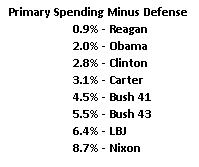
The combination of those two factors made a big difference in the numbers. Here’s another table from my prior post, looking at how the presidents rank when you subtract both defense and the fiscal impact of deposit insurance and TARP.

All of a sudden, Obama drops down to the second-to-last position, sandwiched between two of the worst presidents in American history. Not exactly a ringing endorsement.

But this ranking is incomplete. At that point, I was trying to gauge Obama’s record on domestic spending, and the numbers certainly provide some evidence that he is a stereotypical big-spending liberal.

But the main debate is about which president was the biggest overall spender. So I’ve run through the numbers again, and here’s a new table looking at the rankings based on average annual changes in inflation-adjusted primary spending, minus the distorting impact of deposit insurance and TARP.

Obama is still in the second-to-last position, but spending is increasing by “only” 5.5 percent per year rather than 7.0 percent annually. This is obviously because defense spending is not growing as fast as domestic spending.

Reagan remains in first place, though his score drops now that his defense buildup is part of the calculations. Clinton, conversely, stays in second place but his score jumps because he benefited from the peace dividend after Reagan’s policies led to the collapse of the Soviet Empire.

Let’s now look at these numbers from a policy perspective. Rahn Curve research shows that government is far too big today, so the goal of fiscal policy should be to restrain the burden of government spending relative to economic output.

This means that policy moves in the right direction when government grows more slowly than the private sector, as it did under Reagan and Clinton.

But if government spending is growing faster than the productive sector of the economy, as has been the case during the Bush-Obama years, then a nation eventually will become Greece.

Dear Senator Pryor, why not pass the Balance Budget Amendment? ( “Thirsty Thursday”, Open letter to Senator Pryor)

Dear Senator Pryor,

Why not pass the Balanced  Budget amendment? As you know that federal deficit is at all time high (1.6 trillion deficit with revenues of 2.2 trillion and spending at 3.8 trillion).

On my blog www.HaltingArkansasLiberalswithTruth.com I took you at your word and sent you over 100 emails with specific spending cut ideas. However, I did not see any of them in the recent debt deal that Congress adopted. Now I am trying another approach. Every week from now on I will send you an email explaining different reasons why we need the Balanced Budget Amendment. It will appear on my blog on “Thirsty Thursday” because the government is always thirsty for more money to spend.

Marco Rubio is one of your fellow citizens and he noted:

A balanced budget amendment would be a necessary step in reversing Washington’s tax-borrow-spend mantra. It would force Congress to balance its budget each year – not allow it to pass our problems on to the next generation any longer.

The Balanced Budget Amendment is the only thing I can think of that would force Washington to cut spending. We have only a handful of balanced budgets in the last 60 years, so obviously what we are doing is not working. We are passing along this debt to the next generation.

Thank you for this opportunity to share my ideas with you.

Sincerely,

Everette Hatcher, lowcostsqueegees@yahoo.com

 In my two short months in office, it has become clear to me that the spending problem in Washington is far worse than many of us feared. For years, politicians have blindly poured more and more borrowed money into ineffective government programs, leaving us with trillion dollar deficits and a crippling debt burden that threatens prosperity and economic growth.

In the Florida House of Representatives, where a balanced budget is a requirement, we had to make the tough choices to cut spending where necessary because it was required by state law. By no means was this an easy process, but it was our duty as elected officials to be accountable to our constituents and to future generations of Floridians. In Washington, a balanced budget amendment is not just a fiscally-responsible proposal, it’s a necessary step to curb politicians’ decades-long penchant for overspending.

Several senators have proposed balanced budget amendments that ensure Congress will not spend a penny more than we take in, while setting a high hurdle for future tax hikes. I am a co-sponsor of two balanced budget amendments, since it is clear that these measures would go a long way to reversing the spending gusher we’ve seen from Washington in recent years.

During my Senate campaign, while surrounded by the employees of Jacksonville’s Meridian Technologies, I proposed 12 simple ways to cut spending in Washington. That company, founded 13 years ago, has grown into a 200-employee, high-tech business, and the ideas I proposed would help ensure that similar companies have the opportunity to start or expand just like Meridian did.

To be clear, our unsustainable debt and deficits are threatening companies like Meridian and impeding job creation. In addition to proposing a balanced budget amendment, I recommended canceling unspent “stimulus” funds, banning all earmarks and returning discretionary spending to 2008 levels.

Fortunately, some of my ideas have found their way to the Senate chamber. The first bill I co-sponsored in the Senate was to repeal ObamaCare, the costly overhaul of our nation’s health care system that destroys jobs and impedes our economic recovery. Democratic leaders in the Senate have expressed their willingness to ban earmarks for two years after the Senate Republican conference adopted a moratorium. I have also co-sponsored the REINS Act, a common-sense measure that would increase accountability and transparency in our outdated and burdensome regulatory process. These bills, along with a balanced budget amendment, would help get our country back on a sustainable path and provide certainty to job creators.

While Republicans are proposing a variety of ideas to rein in Washington’s out-of-control spending, unfortunately, President Obama’s budget for the upcoming fiscal year proposes to spend $46 trillion, and even in its best year, the deficit would remain above $600 billion. Worst of all, the President’s budget completely avoids addressing the biggest drivers of our long-term debt – Social Security, Medicare and Medicaid.

Rather than tackle these tough, serious issues, President Obama is proposing a litany of tax hikes on small businesses and entrepreneurs, to the tune of more than $1.6 trillion. These tax increases destroy jobs, make us less competitive internationally and hurt our efforts to grow the economy and get our fiscal house in order.

A balanced budget amendment would be a necessary step in reversing Washington’s tax-borrow-spend mantra. It would force Congress to balance its budget each year – not allow it to pass our problems on to the next generation any longer.

Marco Rubio

Marco Rubio, a Republican, is a U.S. senator from Florida and former speaker of the Florida House of Representatives.

Austerity not practiced in Britain yet

Uploaded by on Feb 26, 2012

I wish we would put in real spending cuts in the USA instead of fake ones like the ones in the United Kingdom.

Looking at ‘Austerity’ in Britain

Posted by Juan Carlos Hidalgo

I’m going to jump into the debate about austerity in Europe because it is being closely followed in Latin America, and many people are drawing the wrong conclusions about how austerity is strangling the European economies. But first, we have to be clear about what we mean by “austerity.”

As the debate between Veronique de Rugy of the Mercatus Center and Ryan Avent at The Economist shows, there are different definitions of austerity. The term could mean fiscal consolidation only by spending cuts. It could mean a mixture of spending cuts and tax increases (the so called “balanced approach”), and it could even be just tax increases. So when people blame “austerity” for Europe’s economic malaise, we could be talking about a very different set of policies in each country.

Let’s look at Britain, which just entered into a double dip recession because of, according to Paul Krugman, “the evident failure” of austerity policies. If we look at spending levels in the UK both in nominal and real terms, we can clearly see that despite the announcement of deep cuts, government spending continues to rise:


Source: European Commission, Economic and Financial Affairs.

It’s clear that, at least in nominal terms, the rate of growth of spending has declined, but that hardly constitutes brutal cuts as Krugman and others want us to believe. If we look at total government spending as a percentage of the economy, Britain reached a peak in 2009 at 51.5%, and that came down to 49.9% in 2011. Can anyone seriously argue that Britain is in a recession because of that tiny drop in spending as a share of the economy?

Now, let’s remember that the Conservative-Liberal Democrat coalition government that came to power in May 2010 adopted what The Economist hailed as a balanced approach of fiscal consolidation based on £1 of tax increases for £3 of spending cuts. To be fair, the British magazine also said that if economic recovery proved hard to achieve, the government should consider a reprieve in tax increases, but not on spending cuts. We all know that the tax increases already took place (the VAT rate went up from 17.5% to 20%, for example). But as we can see, spending cuts haven’t taken place at all. Thus, austerity in Britain consists only of tax increases.

It’s hard to estimate the impact of tax increases on the British economy. Certainly the economic turmoil in Continental Europe has played a role in taking the U.K. into a second recession. But those who claim that “austerity” is responsible for Britain’s economic malaise should be honest and acknowledge that by austerity they mean only tax increases, not spending cuts.

Rand Paul v. President Obama

Sen. Rand Paul Urges Colleagues to Vote for his Budget Resolution – 05/16/12

What are our choices here in the USA with our huge budget deficit? We could head to Greece or cut our budget until we have it balanced. Obama would never even consider getting close to a balanced budget while Paul would put in the spending cuts that we need to get the job done.

A few months ago, I wrote some very nice things about a budget plan put together by Senator Rand Paul of Kentucky, noting that:

Senator Paul and his colleagues are highlighting the fact that the plan generates a balanced budget in just five years. That’s a good outcome, but it should be a secondary selling point. All the good results in the plan – including the reduction in red ink and the flat tax – are made possible because the overall burden of federal spending is lowered.

Not surprising, one of the columnists at the Washington Post has a different perspective. In his hyperventilating column today, Dana Milbank says that Senator’s Paul’s proposal is “monstrous” and “nasty” for reining in the federal government.

The tea party darling’s plan would, among other things, cut the average Social Security recipient’s benefits by nearly 40 percent, reduce defense spending by nearly $100 billion below a level the Pentagon calls “devastating,” and end the current Medicare program in two years — even for current recipients, according to the Senate Budget Committee staff. It would eliminate the education, energy, housing and commerce departments, decimate homeland security, eviscerate programs for the poor, and give the wealthy a bonanza by reducing tax rates to 17 percent and eliminating taxes on capital gains and dividends. It is, all in all, quite a nasty piece of work.

Setting aside some of the inaccuracies (Social Security benefits would rise, for instance, but not as fast as they would under current law), I have two reactions to Milbank’s screed.

1. Milbank seems to think that Rand Paul’s budget is heartless and mean. Does that mean it would be nice and caring to let America descend into Greek-style fiscal chaos and economic decline? Should the United States be more like Europe, even though living standards are about 30 percent lower?

2. More amusingly, what does he think about the fact that the Senate voted against Obama’s tax-and-spend budget by a stunning margin of 99-0? That’s even worse than the 97-0 vote against the budget Obama proposed last year. The 16 votes for Rand Paul’s budget may not sound like much, but 16 is a lot more than zero.

Setting aside the snarky comments, all that Rand Paul is proposing is to limit the growth of government so that the federal budget grows by an average of about 2 percent annually.

Other nations, such as Canada and New Zealand were much more frugal when they solved their fiscal problems. But for leftists such as Milbank, any fiscal restraint apparently is “nasty” and “monsrous.”

U.S. Debt on Track to Fuel Economic Crisis

U.S. Debt on Track to Fuel Economic Crisis

Everyone wants to know more about the budget and here is some key information with a chart from the Heritage Foundation and a video from the Cato Institute.

Countries like Greece and Portugal have suffered or are anticipating financial crises as a result of mounting debt. If the U.S. continues federal deficit spending on its current trajectory, it will face similar economic woes.

PROJECTED U.S. PUBLICLY HELD DEBT AS PERCENTAGE OF GDP

Download

U.S. Debt on Track to Fuel Economic Crisis

Source: Organisation for Economic Co-operation and Development and Congressional Budget Office (Alternative Fiscal Scenario).

Chart 27 of 42

In Depth

  • Policy Papers for Researchers

  • Technical Notes

    The charts in this book are based primarily on data available as of March 2011 from the Office of Management and Budget (OMB) and the Congressional Budget Office (CBO). The charts using OMB data display the historical growth of the federal government to 2010 while the charts using CBO data display both historical and projected growth from as early as 1940 to 2084. Projections based on OMB data are taken from the White House Fiscal Year 2012 budget. The charts provide data on an annual basis except… Read More

  • Authors

    Emily GoffResearch Assistant
    Thomas A. Roe Institute for Economic Policy StudiesKathryn NixPolicy Analyst
    Center for Health Policy StudiesJohn FlemingSenior Data Graphics Editor

Senator Pryor asks for Spending Cut Suggestions! Here are a few!(Part 149)


Senator Mark Pryor wants our ideas on how to cut federal spending. Take a look at this video clip below:

Senator Pryor has asked us to send our ideas to him at cutspending@pryor.senate.gov and I have done so in the past and will continue to do so in the future.

On May 11, 2011,  I emailed to this above address and I got this email back from Senator Pryor’s office:

Please note, this is not a monitored email account. Due to the sheer volume of correspondence I receive, I ask that constituents please contact me via my website with any responses or additional concerns. If you would like a specific reply to your message, please visit http://pryor.senate.gov/contact. This system ensures that I will continue to keep Arkansas First by allowing me to better organize the thousands of emails I get from Arkansans each week and ensuring that I have all the information I need to respond to your particular communication in timely manner.  I appreciate you writing. I always welcome your input and suggestions. Please do not hesitate to contact me on any issue of concern to you in the future.

Here are a few more I just emailed to Senator Pryor myself:

Government auditors spent the past five years examining all federal programs and found that 22 percent of them—costing taxpayers a total of $123 billion annually—fail to show any positive impact on the populations they serve.

  • Improper or fraudulent Medicare spending now totals $47 billionannually—12.4 percent of its budget.
  • New York distributed $140 million in stimulus money into the individual accounts of families on welfare, yet neglected to mention it was intended for school supplies. Local ATMs were depleted, and much of the money was reportedly spent on “flat screen TV’s, iPods and video gaming systems” as well as “cigarettes and beer.”
  • Washington will spend $615,175on an archive honoring the Grateful Dead.
  • Federal employees owe more than $3 billionin income taxes they failed to pay in 2008.

Federal Spending Is Outpacing Inflation

Federal Spending Is Outpacing Inflation

Everyone wants to know more about the budget and here is some key information with a chart from the Heritage Foundation and a video from the Cato Institute.

Prices of goods and services normally rise year to year, but federal spending has risen even faster. Although spending grew substantially after 9/11, less than half of the increase can be attributed to defense and homeland security spending.

YEAR-TO-YEAR PERCENTAGE CHANGE

Download

Federal Spending Is Outpacing Inflation

Source: U.S. Bureau of Labor Statistics and White House Office of Management and Budget.

Chart 4 of 42

In Depth

  • Policy Papers for Researchers

  • Technical Notes

    The charts in this book are based primarily on data available as of March 2011 from the Office of Management and Budget (OMB) and the Congressional Budget Office (CBO). The charts using OMB data display the historical growth of the federal government to 2010 while the charts using CBO data display both historical and projected growth from as early as 1940 to 2084. Projections based on OMB data are taken from the White House Fiscal Year 2012 budget. The charts provide data on an annual basis except… Read More

  • Authors

    Emily GoffResearch Assistant
    Thomas A. Roe Institute for Economic Policy StudiesKathryn NixPolicy Analyst
    Center for Health Policy StudiesJohn FlemingSenior Data Graphics Editor

Some Tea Party heroes (Part 3)

I read some wise comments by Idaho First District Congressman Raúl R. Labrador concerning the passage of the Budget Control Act on August 1, 2011 and I wanted to point them out: “The legislation  lacks a rock solid commitment to passage of a balanced budget amendment, which I believe is necessary to saving our nation.”

I just don’t understand why we don’t have a Balanced Budget Amendment in this country. In Arkansas we have balanced our budget every year because we have a Balanced Budget Law!!!

Michael Tanner of the Cato Institute in his article, “Hitting the Ceiling,” National Review Online, March 7, 2012 noted:

After all, despite all the sturm und drang about spending cuts as part of last year’s debt-ceiling deal, federal spending not only increased from 2011 to 2012, it rose faster than inflation and population growth combined.

We need some national statesmen (and ladies) who are willing to stop running up the nation’s credit card.

Ted DeHaven noted his his article, “Freshman Republicans switch from Tea to Kool-Aid,”  Cato Institute Blog, May 17, 2012:

This week the Club for Growth released a study of votes cast in 2011 by the 87 Republicans elected to the House in November 2010. The Club found that “In many cases, the rhetoric of the so-called “Tea Party” freshmen simply didn’t match their records.” Particularly disconcerting is the fact that so many GOP newcomers cast votes against spending cuts.

The study comes on the heels of three telling votes taken last week in the House that should have been slam-dunks for members who possess the slightest regard for limited government and free markets. Alas, only 26 of the 87 members of the “Tea Party class” voted to defund both the Economic Development Administration and the president’s new Advanced Manufacturing Technology Consortia program (see my previous discussion of these votes here) and against reauthorizing the Export-Import Bank (see my colleague Sallie James’s excoriation of that vote here).

One of those Tea Party heroes was Congressman Labrodor of Idaho. Last year I posted this below concerning his conservative views and his willingness to vote against the debt ceiling increase:

Labrador Statement on Budget Control Act

Aug 1, 2011 Issues: Budget and Spending


Washington, D.C.—Idaho First District Congressman Raúl R. Labrador today issued the following statement following the passage of the Budget Control Act of 2011.

“The debt ceiling agreement that was considered by Congress today represents a good plan to resolve the uncertainty surrounding the debt ceiling debate.  It immediately cuts federal spending and implements new spending caps to prevent government expansion when our economy begins to recover.  While this bill has the potential to reduce the size of our budget and the trajectory of government spending, this bill doesn’t go far enough to make the changes necessary to get us out of our fiscal mess.

“I promised my constituents that I would come to Congress to fundamentally change the way the federal government operates. While this legislation is a good first step towards that goal, it also relies on the time honored Washington tradition of delegating problems to commissions instead of solving them ourselves. It places more confidence in its Super Commission than is warranted.  The legislation also lacks a rock solid commitment to passage of a balanced budget amendment, which I believe is necessary to saving our nation. With the help of the new members of Congress, the standard operating procedure in Washington has begun to change from spending recklessly to cutting spending sensibly, but there is a lot more that needs to change.  ”

Dan Mitchell: Rex Nutting’s recent claim that Obama is not a big spender is false

Dan Mitchell explains in the above video that Europe can grow and prosper, but only if politicians are willing to reduce the burden of government spending and lower tax rates.

_____________

I have a lot of respect for Tea Party heroes like Tim Huelskamp , Idaho First District Congressman Raúl R. Labrador, and Justin Amash who are willing to propose deep spending cuts so we can eventually balance our budget.  

It is a fact that we must balance the budget soon. I do not believe that we can wait to balance the budget at some distant time in the future. The financial markets will not allow us a long time to get our house in order. Look at how things have been going the last four years and no matter how anyone tries to spin it, we are going down the financial drain fast.

A financial columnist named Rex Nutting recently triggered a firestorm of controversy by claiming that Barack Obama is not a big spender.

Here’s the chart he prepared, which certainly seems to indicate that Obama is a fiscal conservative. Not only that, it shows that Republicans generally are the big spenders, while Democrats are frugal with other people’s money.

In some ways, these numbers don’t surprise me. I’ve explained before that Bush bears a lot of blame for the big expansion in the burden of government this century, and I’ve specifically pointed out that he deserves the blame for most of the higher spending from the 2009 fiscal year (which began October 1, 2008).

That being said, Nutting’s numbers seemed a bit nutty. Sorry, couldn’t resist. Nutting’s numbers actually seem accurate, including the fact that he decided that Obama should be responsible for $140 billion of the spending in Bush’s last fiscal year (a number he may have taken from one of my posts).

But sometimes accurate can be misleading, so I decided to dig into the data.

I went to the Historical Tables of the Budget from the Office of Management and Budget, and I calculated all the numbers for every President since LBJ (with the exception of Gerald Ford, whose 2-year reign didn’t seem worth including).

But I corrected a big mistake in Nutting’s analysis. I adjusted the numbers for inflation, using OMB’s GDP deflator.

As you can see, this changes the results. My chart isn’t as pretty, but based on the inflation-adjusted average annual growth of outlays, it shows that Clinton was the most frugal president, followed by the first President Bush and Obama.

With his guns-n-butter Keynesianism, it’s no big surprise that LBJ ranks last. And “W” also gets a very low grade.

But then I figured we should take interest payments out of the budget and focus on inflation-adjusted “primary spending.” After all, Presidents shouldn’t be held responsible for the national debt that existed before they took office.

Looking at these numbers, it turns out that Obama does win the prize for being the most fiscally conservative president in recent memory. Reagan jumps to second place. Clinton is in third place, which won’t surprise people who watched this video, while W and LBJ again are in last place.

But I don’t want my Republican friends to get too angry with me, so let’s expand our analysis. Just as we don’t want to blame Presidents for net interest payments on debt that was accrued before their tenure, perhaps we should make sure they don’t get credit or blame for defense outlays that often are dictated by external events.

There’s obviously room for disagreement, but most people will agree that the Cold War and 9/11 meant higher defense spending, regardless of which party controlled the White House. Similarly, the collapse of the Soviet Empire inevitably meant lower military expenditures, regardless of whether Republicans or Democrats were in charge.

So let’s now look at primary spending after subtracting defense outlays (still adjusting for inflation, of course). All of a sudden, Reagan jumps to the top of the list by a comfortable margin. LBJ and W continue to score poorly, but Nixon takes over last place.

But it’s also worth noting that Obama still scores relatively well, beating Clinton for second place. Inflation-adjusted domestic spending (which is mostly what we’re measuring) has grown by 2.0 percent annually during his three years in office.

So does that mean Obama deserves re-election? Well, before you answer, I want to make one final calculation. Just as there are good reasons to exclude interest payments because they’re not something a president can control, we also should take a look at what spending would be if we don’t count the cost of bailouts.

To be sure, these types of expenditures can be controlled, but if we go with the assumption that the federal government was going to re-capitalize the banking system (whether using the good FDIC-resolution approach or the corrupt TARP approach), then it seems that Presidents shouldn’t get arbitrary blame or credit simply because some financial institutions failed during their tenure.

So let’s take the preceding set of numbers and subtract out the long-run numbers for deposit insurance, as well as the TARP outlays since 2009. And keep in mind that repayments of TARP monies (as well as deposit insurance premiums) show up in the budget as “negative spending.”

As you can see, this produces a remarkable result. All of a sudden, Obama drops from second to second-to-last.

This is because there was a lot of TARP spending in Bush’s last fiscal year (FY2009), which created an artificially high benchmark. And then repayments by banks during Obama’s fiscal years counted as negative spending.

When you subtract out the big TARP spending surge, as well as the repayments, then Bush 43 doesn’t look quite as bad (though still worse than Carter and Clinton), while Obama takes a big fall.

In other words, Obama’s track record does show that he favors an expanding social welfare state. Outlays on those programs have jumped by 7.0 percent annually. And that’s after adjusting for inflation! Not as bad as Nixon, but that’s not saying much since he was one of America’s most statist presidents.

Allow me to conclude with some caveats. None of the tables perfectly captures what any president’s fiscal record. Even my first table may be wrong if you want to blame or credit presidents for the inflation that occurs on their watch. And there certainly are strong arguments that bailout spending and defense spending are affected by presidential policies rather than external events.

And keep in mind that presidents don’t have full power over fiscal policy. The folks on Capitol Hill are the ones who actually enact the bills and appropriate the money.

Moreover, the federal government is akin to a big rusty cargo ship that is traveling in a certain direction, and presidents are like tugboats trying to nudge the boat one way or the other.

But enough equivocating. The four different tables at least show more clearly which presidents presided over faster-growing government or slower-growing government. More importantly, the various tables provide a good idea of where most of the new spending was taking place.

We can presumably say Reagan and Clinton were comparatively frugal, and we can also say that Nixon, LBJ, and Bush 43 were relatively profligate. As for Obama, I think his tugboat is pushing in the wrong direction, but it’s only apparent when you strip out the distorting budgetary impact of TARP.

Related posts:

Some Tea Party heroes (Part 1)

DEBT LIMIT – A GUIDE TO AMERICAN FEDERAL DEBT MADE EASY. Uploaded by debtlimitusa on Nov 4, 2011 A satirical short film taking a look at the national debt and how it applies to just one family. Watch the guy from the Ferris Bueller Superbowl Spot! Produced by Seth William Meier, DP/Edited by Craig Evans, […]

Some Tea Party heroes (Part 2)

Congressmen Tim Huelskamp on the debt ceiling I just don’t understand why people think we can go on and act like everything is okay when we have a trillion dollar deficit. Sometimes you run across some very wise words like I did the other day. Kansas Congressman Tim Huelskamp made the following comment on the […]