Category Archives: spending out of control

Federal spending continues to skyrocket

Government Spending Doesn’t Create Jobs

Uploaded by on Sep 7, 2011

Share this on Facebook: http://on.fb.me/qnjkn9 Tweet it: http://tiny.cc/o9v9t

In the debate of job creation and how best to pursue it as a policy goal, one point is forgotten: Government doesn’t create jobs. Government only diverts resources from one use to another, which doesn’t create new employment.

Video produced by Caleb Brown and Austin Bragg.

_____________

I have a lot of respect for Tea Party heroes like Tim Huelskamp , Idaho First District Congressman Raúl R. Labrador, and Justin Amash who are willing to vote against proposals that increase our spending. They all favor balancing the budget.   

It is a fact that we must balance the budget soon. I do not believe that we can wait to balance the budget at some distant time in the future. The financial markets will not allow us a long time to get our house in order. Look at how things have been going the last four years and no matter how anyone tries to spin it, we are going down the financial drain fast.

Brian Darling

May 24, 2012 at 2:51 pm

Spending has skyrocketed under President Obama, but of late some are claiming that the opposite is true. Case in point: MarketWatch columnist Rex Nutting wrote, “Obama spending binge never happened,” and Politifact rated this statement “mostly true.”

But Mitt Romney this week said that “Since President Obama assumed office three years ago, federal spending has accelrated at a pace without precedent in recent history.” So who has it right? Mitt Romney.

What Politifact must have missed is a very important data point: President Obama signed most of the spending attributed to President George W. Bush’s last year in office, which was assigned wrongly to Bush in Nutting’s piece. (Heritage’s Emily Goff and Alison Fraser set the record straight on The Foundry.)

Nutting argues that President G.W. Bush’s second term spending bills from Fiscal Year 2006-2009 averaged 8.1% and President Obama’s annualized growth averaged 1.4%.  The reason why Nutting included FY 2009 is because it was “the last of George W. Bush’s presidency — federal spending rose by 17.9% from $2.98 trillion to $3.52 trillion.”  This assumption is incorrect and dishonest.  This flaw in Nutting’s analysis is the reason why the Obama numbers are wrong and Nutting’s whole piece is based on flawed data.

Nutting operates under the flawed assumption that President Obama is not responsible for FY 2009 spending.  Under normal circumstances Nutting would be correct.  If Congress were a functioning body that passed appropriations bills on time, then this analysis would be correct.  The fact of the matter is that in recent history Congress has not done appropriations bills on time and in FY 2009, President Obama signed these spending bills into law that President Bush would have under different circumstances.

Usually, the president in office prior to a new president would have helped craft and sign into law government spending bills applied to the first 9 months of spending the next year and a president’s new term.  A fiscal year starts on October 1 of the year prior to the calendar year to September 30th of the calendar year.  In other words the fiscal year starts three months early.

In FY2009, Congress did not complete work by September 30, 2008.  President Bush did sign some appropriations bills and a continuing resolution to keep the government running into President Obama’s first term, yet a Democrat controlled Congress purposely held off on the big spending portions of the appropriations bills until Obama took office.  They did so for the purposes of jacking up spending.  President Obama signed the final FY2009 spending bills on March 11, 2009.

Congressional Quarterly (subscription required) maps out a history of the FY 2009 final appropriations bills (H.R. 1105 and PL 111-8), that would lead one to attribute most of the accelerated spending in FY 2009 to President Obama in a piece titled “2009 Legislative Summary: Fiscal 2009 Omnibus.” From CQ, “the omnibus provided a total of $1.05 trillion — $410 billion of it for discretionary programs — and included many of the domestic spending increases Democrats were unable to get enacted while George W. Bush was president.”  If accepted as true, this statement alone undercuts Nutting’s whole premise that FY 2009 is wholly Bush spending.

President Bush signed only three of the twelve appropriations bills for FY 2009:  Defense; Military Construction/Veterans Affairs; and, Homeland Security.  President Bush also signed a continuing resolution that kept the government running until March 6, 2009 that level of funding the remaining nine appropriations bills at FY 2008 levels.  President Bush and his spending should only be judged on these three appropriations bills and FY 2008 levels of funding for the remaining nine appropriations bills.  Bush never consented to the dramatic increase in spending for FY 2009 and he should not be blamed for that spending spree.

The Democrats purposely held off on the appropriations process because they hoped they could come into 2009 with a new Democrat-friendly Congress and a President who would sign bloated spending bills.  Remember, President Obama was in the Senate when these bills were crafted and he was part of this process to craft bloated spending bills.  CQ reported that “in delaying the nine remaining bills until 2009, Democrats gambled that they would come out of the November 2008 elections with bigger majorities in both chambers and a Democrat in the White House who would support more funding for domestic programs.”  And they did.

If you trust CQ’s reporting, and I do, then this is damning.  Democrats in Congress purposely held off on pushing bloated appropriations bills because they knew President Bush would not sign the bill and Republicans in the Senate would block consideration of it.  You have to remember that the Senate went from 51-49 Democrat control under President Bush’s last year to 59-41 in the early days of President Obama.  On April 28, 2009, Senator Arlen Specter switched parties from Republican to Democrat to give the Democrats a 60 vote filibuster proof majority in the Senate.  The House had a similar conversion from a 233-202 Democrat majority to 257-178 Democrat majority. Democrats were banking on a big enough majorities in the Senate and House that they could pass the bloated spending bill and they got it.

Bush issued a veto threat on the bloated spending bills pending in Congress in late 2008.  CQ estimated that the final spending bill “provided about $31 billion more in discretionary funding than was included in the fiscal 2008 versions of the nine bills” which is “about $19 billion more than Bush sought.”  I would argue that Obama gets credit for the whole $31 billion in new spending.  The most damning fact from the CQ piece is that “Bush had threatened to veto spending bills that exceeded his request.”

Now one can argue that even $31 billion is a drop in the bucket when one considers that spending went from $2.98 trillion to $3.52 trillion.  Much of the spike in increased spending is on the mandatory spending side, and much of it can be attributed to President Obama.  Look at OMB Tables on FY 2008 spending versus FY 2009 spending and you can see why the numbers spiked between those two years.

Overall spending, mandatory and discretionary spending went from $2.98 trillion in FY 2008 to $3.52 trillion in FY 2009.  There were two of the big spikes in spending from FY’08 to ’09.  One was in Federal Payments for Individuals not including Social Security and Medicare from $758 billion in FY’08 to 918 billion in FY’09.  President Obama’s Stimulus spending bill included an increase in food stamps and an extension of unemployment benefits that should not be attributable to President Bush.  Also, the category of “Other Federal” spending spiked from $261 billion to $540 billion.  This includes TARP spending that was recovered on the back end by President Obama further distorting the Nutting analysis.

So how can Nutting attribute spending to President Bush that he expressly vowed to veto?  Also, some of the mandatory spending has been wrongly attributed to President Bush in Nutting’s analysis.  Finally, TARP spending under Bush and the recovery of TARP money under Obama further distorts these numbers.

This is unethical and fuzzy math.  The Truth-O-Meter may want to consider these facts when further analyzing the complications and distortions in analysis used by Nutting to argue that Obama is more fiscally responsible than his predecessors.

Taxes per Household Have Risen Dramatically

Taxes per Household Have Risen Dramatically

Though the economic downturn has temporarily lowered overall tax revenues, the tax burden on Americans is still high.

INFLATION-ADJUSTED DOLLARS (2010)

Download

Taxes per Household Have Risen Dramatically

Source: U.S. Census Bureau and White House Office of Management and Budget.

Chart 12 of 42

In Depth

  • Policy Papers for Researchers

  • Technical Notes

    The charts in this book are based primarily on data available as of March 2011 from the Office of Management and Budget (OMB) and the Congressional Budget Office (CBO). The charts using OMB data display the historical growth of the federal government to 2010 while the charts using CBO data display both historical and projected growth from as early as 1940 to 2084. Projections based on OMB data are taken from the White House Fiscal Year 2012 budget. The charts provide data on an annual basis except… Read More

  • Authors

    Emily GoffResearch Assistant
    Thomas A. Roe Institute for Economic Policy StudiesKathryn NixPolicy Analyst
    Center for Health Policy StudiesJohn FlemingSenior Data Graphics Editor

Senator Pryor asks for Spending Cut Suggestions! Here are a few!(Part 152)

Senator Mark Pryor wants our ideas on how to cut federal spending. Take a look at this video clip below:

Senator Pryor has asked us to send our ideas to him at cutspending@pryor.senate.gov and I have done so in the past and will continue to do so in the future.

On May 11, 2011,  I emailed to this above address and I got this email back from Senator Pryor’s office:

Please note, this is not a monitored email account. Due to the sheer volume of correspondence I receive, I ask that constituents please contact me via my website with any responses or additional concerns. If you would like a specific reply to your message, please visit http://pryor.senate.gov/contact. This system ensures that I will continue to keep Arkansas First by allowing me to better organize the thousands of emails I get from Arkansans each week and ensuring that I have all the information I need to respond to your particular communication in timely manner.  I appreciate you writing. I always welcome your input and suggestions. Please do not hesitate to contact me on any issue of concern to you in the future.

Here are a few more I just emailed to Senator Pryor myself:

Government auditors spent the past five years examining all federal programs and found that 22 percent of them—costing taxpayers a total of $123 billion annually—fail to show any positive impact on the populations they serve.

  • The State Department will spend $450,000on art shows in Venice, Italy.
  • During a recent three-day conference, NASA spent $62,611on “light refreshments” for its 317 attendees—$66 per day per person. NASA officials said such expensive snacks were needed to keep its officials from wandering away from the conference.
  • NASA spent $500 millionconstructing a 355-foot steel tower to launch a rocket that is now unlikely to ever be built.
  • The Congressional Research Service has confirmed that the new health care law may subsidize Viagraand other sexual performance drugs for convicted rapists and sex offenders.
  • Federal agencies are delinquent on nearly 20 percent of employee travel charge cards, costing taxpayers hundreds of millions of dollarsannually.
  • The Securities and Exchange Commission spent $3.9 millionrearranging desks and offices at its Washington, D.C., headquarters.

Open letter to President Obama (Part 88)

Rick Santorum’s (entire) Speech at Chattanooga Tea Party’s Liberty Forum

Uploaded by on Feb 25, 2012

http://www.tinshipproductions.com Chattanooga Tea Party’s Liberty Forum Saturday, February 25, 2012
This speech is unedited and shown in it’s entire 55 minutes.

____________

President Obama c/o The White House
1600 Pennsylvania Avenue NW
Washington, DC 20500

Dear Mr. President,

I know that you receive 20,000 letters a day and that you actually read 10 of them every day. I really do respect you for trying to get a pulse on what is going on out here.

This recovery is way too slow and too small.

Mike Brownfield

March 9, 2012 at 9:11 am

In the Super Tuesday primary, the economy was the number one issue on voters’ minds, be they in Massachusetts, Georgia, Ohio, or Virginia. And that wasn’t because they were happy about high unemployment and slow wage growth. Yet according to President Barack Obama, “the economy is getting stronger, and the recovery is speeding up.” Of course, these things are relative. A disappointing recovery is underway. It just hasn’t touched the millions of Americans who remain out of work, the millions more whose wages can’t keep up with inflation, and it doesn’t offset the effects of high gas prices on family budgets.

Voters’ old-fashioned common sense about the economy was backed up by the numbers in the February jobs report just released this morning. According to the Bureau of Labor Statistics, the U.S. economy added 227,000 jobs last month. That’s the good news, and it does evidence that the recovery continues, albeit slowly. And this slow-trot recovery is why the unemployment rate remains at 8.3 percent, while the number of long-term unemployed workers remained at 5.4 million, accounting for 42.6 percent of the unemployed.

What’s more, an extraordinarily high number of Americans have dropped out of the work force, either choosing not to work, losing heart and abandoning the hunt for jobs, or accepting disability benefits. Because of the meager recovery, very few potential workers have returned to the job market to find work. With fewer people in the work force, the unemployment rate appears lower than it should as a matter of simple arithmetic. But this artificially low rate does not disguise the fact that talented, experienced, discouraged workers are choosing to sit on the sidelines instead of participating in the economy. In short, though the labor market is improving, it’s nowhere near where it should be given America’s potential.

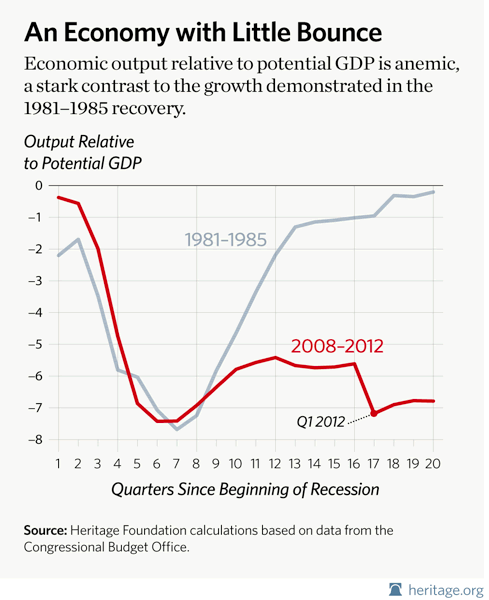
What should the economy’s recovery look like? Take a glance at history (and the chart below). Following the 1981-1982 recession — which looked a lot like the one America saw in 2008 in both depth and duration — the economy returned to near-full employment (which is around 5.5 percent) by 1984. Today, nearly three years after the most recent recession ended, the unemployment rate remains stuck well above 8 percent. So while the economy has grown for 10 straight quarters, it’s only done so at a measly 2.4 percent rate. In fact, it’s the slowest recovery America has seen in the post-war era. No wonder millions of Americans aren’t feeling the effects of the economic rebound and are voting their displeasure. (Article continued below chart.)

Even liberal economist / columnist Paul Krugman sees the economy for what it is. In a recent column in The New York Times, he wrote, “our economy remains deeply depressed” and that “every silver lining comes with a cloud.” So what’s bringing about that cloud? Why is this economy growing, and yet growing so slowly by comparison to the 1980s recovery?

While President Obama might like to take credit for the meager growth the economy is seeing, there’s an important fact to keep in mind. It’s the natural tendency for the economy to grow — and taking credit for its meager improvement is sort of like accepting kudos for the rising and setting of the sun. In fact, the President should of course (but never will) accept some blame for the fact that the economy isn’t growing faster. The policies Obama ushered in are markedly different from those that President Ronald Reagan adopted to unleash the economic recovery in the 1980s, and the results show the difference — a powerful recovery under Reagan, and weak recovery under Obama.

For starters, President Obama says he wants to encourage job creators to ramp up their economic engines, while at the same time he has proposed $2 trillion in higher taxes, much of which would fall on small businesses — the job creators. Add onto that a discouragingly successful policy of encouraging higher gas prices by opposing domestic energy production. This policy is so unpopular that eleven Democratic Senators voted with their Republican colleagues on Thursday to overturn the Obama decision to kill the Keystone XL pipeline. Proponents failed to get the 60 votes necessary to overturn the Keystone decision, but with Democratic support it came very close. Instead of tapping proven resources, Obama puts his faith in pie-in-the-sky renewable energy projects like Solyndra. No wonder Super Tuesday’s voters were worried about the economy.

On top of job-killing tax hikes and higher gas prices, President Obama continues to embrace the burden of untenably high spending and debt — which will of course motivate the left to call for even higher taxes — and you’re left with a mess of policies emanating from Washington signaling small businesses to hunker down instead of investing for the future. A better path for growth would be to enact a budget that curbs spending, reforms entitlements, and reforms the tax code to focus it on economic growth as proposed in Heritage’s Saving the American Dream plan — all of which would free the economy to grow at a faster rate than we’re witnessing today.

While any economic growth and job creation is welcome, a barely perceptible, incremental recovery doesn’t offer much hope for those Americans who can’t feel, see, or touch the fruits of recovery. Millions remain unemployed in the Obama economy, and Washington can and should do better for the American people.

__________

Thank you so much for your time. I know how valuable it is. I also appreciate the fine family that you have and your commitment as a father and a husband.

Sincerely,

Everette Hatcher III, 13900 Cottontail Lane, Alexander, AR 72002, ph 501-920-5733, lowcostsqueegees@yahoo.com

Open letter to President Obama (Part 87)

Uploaded by on Mar 6, 2012

Learn More at http://oversight.house.gov

The Oversight Committee is examining reports of food stamp merchants previously disqualified who continue to defraud the program. According to a Scripps Howard News Service report, food stamp fraud costs taxpayers hundreds of millions every year.

Watch the Oversight hearing live tomorrow at 930 AM EST at http://oversight.house.gov. Full hearing information is available here: http://oversight.house.gov/index.php?option=com_content&view=article&…

_______________________

President Obama c/o The White House
1600 Pennsylvania Avenue NW
Washington, DC 20500

Dear Mr. President,

I know that you receive 20,000 letters a day and that you actually read 10 of them every day. I really do respect you for trying to get a pulse on what is going on out here.

The Food Stamp Program is a very bad program and it is abused every day. It should be abolished.

Alison Meyer

March 9, 2012 at 4:35 pm

Food-stamp fraud and the government’s failed attempts to stop it were the focus of a House Oversight and Government Reform Committee hearing yesterday.

Chairman Darrell Issa (R-CA) called the hearing in response to a Scripps Howard News Service investigative report exposing widespread abuse. The investigation revealed that retailers who lost authorization to accept food stamps were still conducting business despite their restrictions.

“[D]ozens of individuals who had been banned as food-stamp vendors nonetheless remained in the business in New York; Los Angeles; Phoenix; San Diego; Tulsa, Okla.; West Palm Beach, Fla.; Baltimore and other communities across the country,” according to the report. Scripps Howard discovered this by comparing U.S. Department of Agriculture disqualification records against documents from health-inspection reports to business filings and corporate certificates.

At yesterday’s hearing, Kevin Concannon, undersecretary of the U.S. Department of Agriculture’s Food and Nutrition Service, defended the government’s efforts to combat fraud. He also cast blame on the messenger.

“As with other leads and observations we receive from the public, we took this information very seriously. We began an immediate investigation into all of the stores that were brought to our attention and we have added further layers of security to our retailer oversight process. However, our research indicates that many of the cases identified by Scripps Howard do not involve improper activity,” he said.

Scripps Howard isn’t the first to expose food-stamp fraud. Heritage’s Rachel Sheffield wrote last year on The Foundry that $2.5 billion in taxpayer money that was spent on improper food-stamp payments. Lawmakers such as Rep. Jim Jordan (R–OH) and Sen. Jim DeMint (R–SC) have proposed reforms to the program.

Issa, meanwhile, vowed to keep a watchful eye on USDA, demanding additional documents and information.

“With record numbers of Americans using food stamps, with an annual price tag of $75.3 billion, anything short of rigorous anti-fraud measures will be very costly to taxpayers,” Issa said.

The USDA should have been conducting the oversight that the Scripps Howard News Service was doing, according to Issa. “It was the government’s own databases that [Scripps] went to and discovered there was no enforcement under this administration,” he said.

The most common type of fraud is food-stamp trafficking where retailers encourage food-stamp recipients to trade their benefits for cash, alcohol or cigarettes. Once the card is swiped, the merchant takes full payment for the transaction’s stated price and pockets the difference, which can add up to $50,000 a month.

“The crime is as widespread as it is simple: Stores accept food stamps, but instead of requiring that customers walk away with wholesome groceries, they provide the customers a small amount of cash — typically 50 cents on the food stamp dollar. While taxpayers lose out — the money isn’t going toward wholesome food — food stamp recipients are receiving no-strings attached cash while stores are taking a hefty profit for serving as a moneychanger,” according to the Scripps Howard report.

This fraud comes at a high price to taxpayers. “According to Reuters, food stamp fraud accounts for just 1 percent of food stamp benefits, but equals about $750 million each year,” Issa wrote in a letter to USDA. “Since President Obama took office three years ago, the number of SNAP enrollees has dramatically increased. Today approximately 46.1 million people receive food stamps, with 14 million of those individuals enrolling since President Obama took office.  According to the Washington Times, SNAP enrolled six million new people in Fiscal Year 2011 at an increased cost of $7 billion.”

The Supplemental Nutrition Assistance Program, which administers food stamps, has a mission to address hunger and poverty. The SNAP website reads like an advertisement: “Only 86% of eligible District residents, and 41% of eligible low-income working families, receive SNAP/Food Stamps. Every $1 of SNAP/Food Stamps spent in the community generates $1.85 in local economic activity. D.C. would gain millions in federal funds by signing up eligible households — funds that would stimulate the local economy. People who work sometimes assume they are not eligible for SNAP/Food Stamps, or that time-off from work is required to apply. This is not true. A family of 3 with a minimum wage earner could be eligible for over $3,000 annually in benefits, and working families can complete phone interviews rather than go to the SNAP/Food Stamps office in-person.”

Under the Obama administration, the United States has seen a dramatic increase in the welfare state, making individuals more dependent on government.

“Now, more than 67.3 million Americans depend on the federal government for everything from food stamps and college tuition to retirement services and health care,” according to Heritage’s Index of Dependence on Government, which revealed an 8.1 percent increase at a cost of roughly $2.5 trillion.

__________

Thank you so much for your time. I know how valuable it is. I also appreciate the fine family that you have and your commitment as a father and a husband.

Sincerely,

Everette Hatcher III, 13900 Cottontail Lane, Alexander, AR 72002, ph 501-920-5733, lowcostsqueegees@yahoo.com

Total Welfare Spending Is Rising Despite Attempts at Reform

Total Welfare Spending Is Rising Despite Attempts at Reform

Everyone wants to know more about the budget and here is some key information with a chart from the Heritage Foundation and a video from the Cato Institute.

Total means-tested welfare spending (cash, food, housing, medical care, and social services for the poor) has increased 17-fold since the beginning of Lyndon Johnson’s War on Poverty in 1964. Though the current trend is unsustainable, the Obama Administration plans to increase future welfare spending rather than enact true policy reforms.

WELFARE SPENDING IN INFLATION-ADJUSTED DOLLARS (2010)

Receive Information on Federal Budget Data

First Name
Last Name
Email Address
Zip Code
SUBMIT
Download

Total Welfare Spending Is Rising Despite Attempts at Reform

Source: Heritage Foundation calculations based on data from current and previous White House Office of Management and Budget documents and other official government sources.

Chart 10 of 42

In Depth

  • Policy Papers for Researchers

  • Technical Notes

    The charts in this book are based primarily on data available as of March 2011 from the Office of Management and Budget (OMB) and the Congressional Budget Office (CBO). The charts using OMB data display the historical growth of the federal government to 2010 while the charts using CBO data display both historical and projected growth from as early as 1940 to 2084. Projections based on OMB data are taken from the White House Fiscal Year 2012 budget. The charts provide data on an annual basis except… Read More

  • Authors

    Emily GoffResearch Assistant
    Thomas A. Roe Institute for Economic Policy StudiesKathryn NixPolicy Analyst
    Center for Health Policy StudiesJohn FlemingSenior Data Graphics Editor

Michael Tanner: “Time for Republicans to live up to the hype and get truly serious about cutting spending.”

Keynesian Economics Is Wrong: Bigger Gov’t Is Not Stimulus

Uploaded by on Dec 15, 2008

Based on a theory known as Keynesianism, politicians are resuscitating the notion that more government spending can stimulate an economy. This mini-documentary produced by the Center for Freedom and Prosperity Foundation examines both theory and evidence and finds that allowing politicians to spend more money is not a recipe for better economic performance.

_____________

I have a lot of respect for Tea Party heroes like Tim Huelskamp , Idaho First District Congressman Raúl R. Labrador, and Justin Amash who are willing to vote against proposals that increase our spending,  and they want to pass the Balanced Budget Amendment.    

It is a fact that we must balance the budget soon. I do not believe that we can wait to balance the budget at some distant time in the future. The financial markets will not allow us a long time to get our house in order. Look at how things have been going the last four years and no matter how anyone tries to spin it, we are going down the financial drain fast and headed to Greece!!!

Baby Budget Hawks of the GOP

by Michael D. Tanner

Michael Tanner is a senior fellow at the Cato Institute and author of Leviathan on the Right: How Big-Government Conservatism Brought Down the Republican Revolution.

Added to cato.org on May 23, 2012

This article appeared in National Review (Online) on May 23, 2012

The conventional wisdom, pushed for very different reasons by both Republicans and Democrats, is that Republicans in Congress, controlled by radical tea-partiers, have been slashing government spending. Thus it becomes a little hard to understand how, in the few short months since last year’s debt-ceiling deal, the federal debt has increased by more than $1.5 trillion, roughly $13,000 per household. If Republicans are such great budget cutters, how come we continue to spend more, run more deficits, and accumulate more debt?

The latest evidence suggests that it is because, contrary to conventional wisdom, Republicans still aren’t such radical budget hawks after all.

For example, the latest Club for Growth scorecard suggests that, on the whole, Republicans in this congress have actually been less fiscally responsible than those in past congresses. For 2011, the average Republican received a weighted score of 69.5 out of 100. That’s far short of the 86.3 average score in 2010, and it hardly suggests a tea-party-led wave of austerity.

Forty Republicans received scores of 90 or higher, and nine — Representatives Amash (Mich.), Chaffetz (Utah), Flake (Ariz.), Franks (Ariz.), Graves (Ga.), Huelskamp (Kan.), Jordan (Ohio), Labrador (Idaho), and Lamborn (Colo.) — received perfect scores of 100 percent. However, 25 Republicans had scores below 50. In fact six Republicans – Ros-Lehtinen (Fla.), Diaz-Balart (Fla.), McKinley (W.Va.), Smith (N.J.), Young (Alaska), and LoBiando (N.J.) — had scores worse than those of some Democrats, such as Dan Boren (Okla.). Interestingly, for all the attention paid to freshmen representatives who are supposedly in hock to the Tea Party, only three freshmen — Amash, Huelskamp, and Labrador — received perfect scores, while three other freshmen — Representatives Dold (Ill.), Meehan (Pa.), and McKinley — were among the worst-performing Republicans. Compare this with 2010, when 28 Republicans received a perfect score from the Club for Growth and only two had scores below 50.

Republicans still seem unwilling to make the tough choices when it comes to spending cuts.

Of course one could be argue that scorecards that focus on specific votes are not a particularly good measure of a lawmaker’s overall record. Perhaps the votes were tougher this year, or the Club for Growth stopped scoring on a curve. Let’s take a look, then, at a slightly different measure of fiscal responsibility, the National Taxpayer Union’s latest measure of proposed spending increases and cuts by members of Congress. By this measure, there has also been an improvement by Republicans in this congress, but not an overwhelming one.

On an annualized basis, Republicans in the House proposed spending increases of $5.3 billion and cuts of $135 billion. Thus, if every one of their proposals had passed, total federal spending would have been reduced by $130.2 billion, which is 3.6 percent of this year’s projected spending. That would still have left us with a budget deficit this year of $1.17 trillion.

That’s an improvement over last year, when Republicans proposed a net spending reduction of only $45 billion. So it’s a baby step in the right direction — but far from what we need to keep us from falling off the debt-and-deficit cliff.

Moreover, the actual Republican record is not quite as good as even this baby step looks, because nearly all Republicans backed the repeal of Obamacare, which accounts for $40.3 billion of the annualized savings. Supporting repeal was easy, and it had no actual chance of passing. If we take that away, then Republicans called for only $95.3 billion in other cuts, which is roughly 2.6 percent of federal spending. Overall, Republicans still seem unwilling to make the tough choices when it comes to spending cuts.

Those Republicans proposing the biggest net reductions in spending are Representatives Jason Chaffetz (Utah), Trent Franks (Ariz.), and Jeff Duncan (S.C.). Among the freshmen class in the House, Representatives Duncan, Huelskamp, Labrador, and Guinta proposed the largest net reductions, with the first three also receiving near-perfect Club for Growth scores.

On the other side, ten House Republicans actually proposed net spending increases, among them Representatives Chris Smith (N.J.), Chris Gibson (N.Y.) and Patrick Meehan (Pa.). Notably, Representatives Gibson and Meehan were also among those with the worst voting records, according to the Club for Growth.

Let’s look at one more measure of Republican seriousness when it comes to debt and deficit reduction: the most recent budget votes. Nearly all House Republicans, of course, voted in favor of the Ryan budget. While certainly not perfect — it would take more than 20 years to achieve balance — the Ryan budget nonetheless laid down an important marker on entitlement reform and spending restraint. Among the ten House Republicans who voted against the Ryan budget were both those who thought it spent too much money (Representatives Amash and Huelskamp) and those who thought it didn’t spend enough (Representatives Gibson and McKinley, of course).

In the Senate, Republicans were less likely to support the Ryan budget, in part because Senate rules allowed them more alternatives. Still, the results from a fiscal-responsibility perspective were mixed. Only 16 Republicans supported the most fiscally conservative alternative, proposed by Senator Rand Paul of Kentucky. They picked up one more vote for a proposed budget by Senator Mike Lee of Utah. A third proposal by Pennsylvania’s Senator Pat Toomey garnered 32 votes, and the original Ryan budget received 41. Four Republican senators voted against all four alternatives: Brown (Mass.), Collins (Maine), Heller (Nev.), and Snowe (Maine).

Recent weeks have also seen Republicans in the House vote to reauthorize the Export-Import Bank, an example of corporate welfare if there ever was one, and abandon the sequester for cuts in military spending. Senate Republicans also agreed on a highway bill that hikes the deficit in the long run.

None of this suggests that Republicans were not generally more fiscally conservative than Democrats. The average Democrat score on the Club for Growth Scorecard was only 10.95 out of 100. All but three Democrats in the House scored below every Republican, and six Democrats received a score of 0. The average Democrat proposed net spending increases of $496 billion — almost half a trillion dollars in new net spending. Not a single Democrat voted for the Ryan budget, or for any of the lower-spending alternatives.

But better is not good enough.

Unless Washington gets spending under control, we are headed toward a debt crisis of Greek proportions, and time is running out. It’s time for Republicans to live up to the hype and get truly serious about cutting spending.

Case Study on Chelsea Clinton:Can equality of results be acheived best by punishing those who were born rich? “Friedman Friday”

chelsea_clinton1.jpg

Milton Friedman – Redistribution of Wealth

Uploaded by on Feb 12, 2010

Milton Friedman clears up misconceptions about wealth redistribution, in general, and inheritance tax, in particular. http://www.LibertyPen.com

_______________________________

Many times in the past our government has tried to even the playing field but the rich and poor will always be with us as Christ reminded us so long ago. Providing people a chance is fine but trying to punish others is not and it does not work.

Max Brantley pointed out that there are many kinds of riches. You are rich if you have two parents who love you enough to teach you the importance of education like Max’s parents taught him. 

Chelsea Clinton is a perfect example of this. She was not born rich in money but she definately got a big headstart in other areas.

Max Brantley of the Arkansas Times noted:

The New York Times carried a glowing profile Sunday about Chelsea Clinton’s decision to step fully from the shadows and seek a public life.

She’s joined a corporate board, gotten a job as a correspondent for NBC and has her pick of gatherings of the mighty or simply important just about anywhere on the globe.

Reactions tended to fall along partisan lines. Fans of Bill and/or Hillary Clinton were happy for their 31-year-old daughter. Non-fans weren’t impressed. She’d done nothing to deserve her good fortune except choose good parents, they said. The really ugly ones criticized everything from her hairstyle to her speech.

I’m not impartial on the subject. I’ve known Chelsea since she was an infant, though most of my exposure came before her move to Washington in junior high. She’s remained friendly with my daughter and has been good to her. That’s enough for me.

But Chelsea is smart and poised. She’s worked hard at demanding schools and jobs. Would she be precisely where she is today without her famous parents? Of course not. She hasn’t claimed otherwise. (I do like how often she credits her Grandmother Rodham for sage advice.)

But she now has made the important decision to accept inheritance of her parents’ considerable public franchise. If nothing else, her growth in the larger public world might position her to someday take leadership of the Clinton Foundation. If she’s lucky — if we’re all lucky — she will continue to amass the resources her father has raised for fighting significant global problems. If she should decide to try politics, she’s been homeschooled by the best and brightest.

Make no mistake. Chelsea Clinton is a one percenter, if not precisely in the net worth category, close enough. She is also, if you prefer, a lucky sperm club member. But she manages to send a signal that she understands how much of her stature is owed to her parents. She signals a generosity of spirit about her good fortune that is more reminiscent of a Buffett than a Koch.

We will always have the 1 percent. There’s nothing inherently evil about being in that small number. The question is how much the 1 percent is willing to allow the 99 percent to share.

____________________________

Milton Friedman discusses the inheritance of talent on “Free to Choose”

Uploaded by on Nov 1, 2009

“The inheritance of talent is no different (from an ethical point of view) from the inheritance of other forms of property– of bonds, of stocks, of houses, or of factories. Yet many people resent the one, but not the other.”

From “Free to Choose” (1980), Part V: “Created Equal.”
______________________________

Here is an article that shows how silly it is to use government to try and achieve equality of results:

Our Economic Past | Burton W. Folsom Jr.

Equality, Markets, and Morality

September 2008 • Volume: 58 • Issue: 7

Burton Folsom, Jr. is a professor of history at Hillsdale College and author of New Deal or Raw Deal?, to be published by Simon & Schuster this year.

The subject of “equality” is the source of much political debate. Ever since the founding era, free-market thinkers have argued for equality of opportunity in the economic order. Equality, in other words, is a framework, not a result. In modern terms the goal is a level playing field. Government is a referee that enforces property rights, laws, and contracts equally for all individuals.

What the free-market view means in policy terms is no (or few) tariffs for business, no subsidies for farmers, and no racism written into law. Also, successful businessmen will not be subject to special taxes or the seizure of property.

In America this view of equality is enshrined in the Declaration of Independence (“all men are created equal and are endowed by their creator with certain inalienable rights”) and the Constitution (“imposts and excises shall be uniform throughout the United States” and “equal protection of the laws”). Much of America’s first century as a nation was devoted to ending slavery, extending voting rights, and securing property and inheritance rights for women—fulfilling the Founders’ goal of equal opportunity for all citizens.

Progressives and modern critics of equality of opportunity have launched two significant criticisms against the Founders’ view. First, that equality of opportunity is impossible to achieve. Second, to the extent that equality of opportunity has been tried, it has resulted in a gigantic inequality of outcomes. Equality of outcome, in the Progressive view, is desirable and can only be achieved by massive government intervention. Let’s study both of these objections.

To some extent, of course, the Progressives have a valid point—equality of opportunity is, at an individual level (as opposed to an institutional level) hard to achieve. We are all born with different family advantages (or disadvantages), with different abilities, and in different neighborhoods with varying levels of opportunity. As socialist playwright George Bernard Shaw said on the subject, “Give your son a fountain pen and a ream of paper and tell him that he now has an equal opportunity with me of writing plays and see what he says to you.”

What the Progressives miss is that their cure is worse than the illness. Any attempt to correct imbalances in family, ability, and neighborhood will produce other inequalities that may be worse than the original ones. Thomas Sowell writes, “[A]ttempts to equalize economic results lead to greater—and more dangerous—inequality in political power.” Or, as Milton Friedman concluded, “A society that puts equality—in the sense of equality of outcome—ahead of freedom will end up with neither equality nor freedom. The use of force to achieve equality will destroy freedom, and the force, introduced for good purposes, will end up in the hands of people who use it to promote their own interests.”

Failure During the New Deal

Sowell’s and Friedman’s point is illuminated by the failed efforts of the federal government to reduce inequalities during the New Deal. In the early 1930s the United States had massive unemployment (sometimes over 20 percent). In 1932 President Herbert Hoover supported the nation’s first relief program: $300 million was distributed to states. This was not a transfer from richer states to poorer states but a political grab by most state governors to secure all they could. Illinois played this game well and secured over $55 million, more than New York, California, and Texas combined.

Massachusetts, with almost as many people as Illinois, received zero federal money. Massachusetts had much poverty and distress, but Governor Joseph Ely believed states should try to supply their own needs and not rush to Washington to gain funds at someone else’s expense. Ely therefore promoted a variety of fundraising events throughout his state to help those in need. “Whatever the justification for [federal] relief,” Ely noted, “the fact remains that the way in which it has been used makes it the greatest political asset on the practical side of party politics ever held by any administration.”

In 1935 President Franklin Roosevelt confirmed Ely’s beliefs by turning the Works Progress Administration (WPA), which he had established, into a gigantic political machine to transfer money to key states and congressional districts to secure votes. Roosevelt and his cohorts used the rhetoric of removing inequalities as a political cover to gain power. Reporter Thomas Stokes won a Pulitzer Prize for his investigative research that exposed the WPA for using federal funds to buy votes.

The use of tax dollars, then, to mitigate inequality failed because—whatever the good intentions—the funds quickly became politicized.

Presidential (and congressional) authority to tax and to transfer funds from one group to another also proved to be a dangerous centralization of power. Taxation increased both in size and complexity. The IRS thus became a weapon a president could use against those who resisted him. “My father,” Elliott Roosevelt observed of his famous parent, “may have been the originator of the concept of employing the IRS as a weapon of political retribution.”

Sowell and Friedman indeed recognized that efforts to remove inequalities would create new inequalities, perhaps just as severe, and would also dangerously concentrate power in the hands of politicians and bureaucrats. But Sowell and Friedman have readily conceded that when markets are left free, the inequality of outcomes is not necessarily morally justified. In other words, some people—through luck or inheritance—become incredibly rich and others, who may have worked harder and more diligently, end up barely earning a living. Rewards, as F. A. Hayek, among others, has noted, are “based only partly on achievements and partly on mere chance.” Societies are more prosperous under free markets, but individual success and failure can occur independently of ability and hard work.

Progressive Claims in Light of History

What the historical record does seem to demonstrate is that the richest men in American history have been creative entrepreneurs who have improved the lives of millions of Americans and have achieved remarkable upward mobility doing so. For example, the first American to be worth $10 million was John Jacob Astor, a German immigrant and a son of a butcher. Astor founded the largest fur company in the United States, transforming tastes and lowering costs in clothing for people all over the world.

John D. Rockefeller, the first American to be worth $1 billion, was the son of an itinerant peddler. Yet Rockefeller, with little education or training, went into the business of refining oil and did it better than anyone in the world. As a result, he sold the affordable kerosene that lit up most homes in the world. (He had a 60 percent world market share in the late 1800s.)

Henry Ford, the son of a struggling farmer, was the second American billionaire. He used the cheap oil sold by Rockefeller and cheap steel that was introduced by immigrant Andrew Carnegie to make cars affordable for most American families. The most recent wealthiest men in the United States—Sam Walton and Bill Gates—both came from middle-class households and both added much value for most American consumers.

Free markets may yield odd results and certainly unequal outcomes, but the greater opportunities and prosperity have made the tradeoff worthwhile for American society.

Dear Senator Pryor, why not pass the Balanced Budget Amendment? (“Thirsty Thursday”, Open letter to Senator Pryor)

Sadly Senator Pryor has voted against the Balanced Budget Amendment over and over in his long time in the Senate. Senator Pryor: “There are a lot of people who think a balanced-budget amendment solves all the fiscal problems. I completely disagree.” (Peter Urban, Pryor Tilts Balanced Budget, Southwest Times Record, 11/17/11)

Dear Senator Pryor,

Why not pass the Balanced Budget Amendment? As you know that federal deficit is at all time high (1.6 trillion deficit with revenues of 2.2 trillion and spending at 3.8 trillion).

On my blog www.HaltingArkansasLiberalswithTruth.com I took you at your word and sent you over 100 emails with specific spending cut ideas. However, I did not see any of them in the recent debt deal that Congress adopted. Now I am trying another approach. Every week from now on I will send you an email explaining different reasons why we need the Balanced Budget Amendment. It will appear on my blog on “Thirsty Thursday” because the government is always thirsty for more money to spend.

New CBO Numbers Re-Confirm that Balancing the Budget Is Simple with Modest Fiscal Restraint

Posted by Daniel J. Mitchell

Many of the politicians in Washington, including President Obama during his State of the Union address, piously tell us that there is no way to balance the budget without tax increases. Trying to get rid of red ink without higher taxes, they tell us, would require “savage” and “draconian” budget cuts.

I would like to slash the budget and free up resources for private-sector growth, so that sounds good to me. But what’s the truth?

The Congressional Budget Office has just released its 10-year projections for the budget, so I crunched the numbers to determine what it would take to balance the budget without tax hikes. Much to nobody’s surprise, the politicians are not telling the truth.

The chart below shows that revenues are expected to grow (because of factors such as inflation, more population, and economic expansion) by more than 7 percent each year. Balancing the budget is simple so long as politicians increase spending at a slower rate. If they freeze the budget, we almost balance the budget by 2017. If federal spending is capped so it grows 1 percent each year, the budget is balanced in 2019. And if the crowd in Washington can limit spending growth to about 2 percent each year, red ink almost disappears in just 10 years.

These numbers, incidentally, assume that the 2001 and 2003 tax cuts are made permanent (they are now scheduled to expire in two years). They also assume that the AMT is adjusted for inflation, so the chart shows that we can balance the budget without any increase in the tax burden.

I did these calculations last year, and found the same results. And I also examined how we balanced the budget in the 1990s and found that spending restraint was the key. The combination of a GOP Congress and Bill Clinton in the White House led to a four-year period of government spending growing by an average of just 2.9 percent each year.

We also have international evidence showing that spending restraint – not higher taxes – is the key to balancing the budget. New Zealand got rid of a big budget deficit in the 1990s with a five-year spending freeze. Canada also got rid of red ink that decade with a five-year period where spending grew by an average of only 1 percent per year. And Ireland slashed its deficit in the late 1980s by 10 percentage points of GDP with a four-year spending freeze.

No wonder international bureaucracies such as the International Monetary fund and European Central Bank are producing research showing that spending discipline is the right approach

Daniel J. Mitchell • January 27, 2011 @ 12:00 pm
Filed under: Government and Politics; Health Care; Tax and Budget Policy

Spending still going up

Great article from Heritage Foundation:

Super Failure: No Spending Cuts, and the Debt Keeps Rising

Emily Goff

November 22, 2011 at 2:15 pm

With the failure of the super committee to recommend at least $1.2 trillion in deficit reduction, Congress’s latest attempt at budget control has collapsed. There will be many analyses of why the process did not work, but it’s worth stepping back to recall what generated the need for this extraordinary procedure and what the exercise actually produced.

From early in the year, it was generally accepted that the divided Congress would be unable to agree on a budget through regular procedures. Republicans chose to use a necessary vote on the debt limit to force the Administration to face the need for spending reductions. After a summer-long debate, rife with hyperbole about a potential government “default,” the Budget Control Act of 2011 (BCA) was born, crafted in a way that at face value expressed the goal of fiscal prudence.

The BCA both imposed a set of discretionary spending caps to limit annually appropriated spending and established the super committee to recommend policies that would reduce the deficit by at least an additional $1.2 trillion through 2021. In return, the BCA included debt limit increases in three tranches: $400 billion, $500 billion, and then $1.2 trillion, as the chart below illustrates.

The debt limit hikes were ostensibly contingent on deficit reduction and a vote on a balanced budget amendment to the Constitution. But in fact, under the language of the BCA legislation, they could be blocked only if Congress passed a joint resolution of disapproval. If passed, such a resolution would be subject to a presidential veto, requiring the usual two-thirds vote of both houses to override. Thus these debt ceiling increases up to $2.1 trillion were all but assured from the beginning. (Article continued below chart)

The first two increases totaling $900 billion have already occurred, and the debt limit now stands at an astounding $15.124 trillion. It is up from the $14.29 trillion limit set in early 2010 and follows a history of frequent and growing debt limit increases, as shown in this Heritage Budget Chart Book chart(Article continued below chart)

The third increase of $1.2 trillion—projected to occur early in 2012 when the debt begins to again encroach upon the limit—would raise the debt limit to an unprecedented $16.324 trillion, or over 100 percent of GDP.

Thus, the debt limit will climb ever higher, accommodating the profligate spending of the President and Congress. As Heritage’s J. D. Foster wrote in January: “The need to raise the debt limit reflects an intention to continue deficit financing” and should signal to Congress that it should urgently reexamine its current policy decisions.

Policies that promote reckless spending—forcing the government to borrow about 40 cents of every dollar it spends, while pushing total debt past 100 percent of gross domestic product (GDP)—are flat-out irresponsible. This upward trajectory makes it crystal clear that the government’s spending priorities have deviated severely from what the Founders laid out in the Constitution.

Equally disappointing, both the existing spending caps and the automatic enforcement in the BCA are less than advertised. The caps contain flaws that may make them all but meaningless. The “sequester” mechanism that would impose spending cuts will not be triggered until January 2013, giving Congress plenty of time to rewrite or abandon it.

As The Heritage Foundation’s David Addington writes, “The overspending problem is still here. Congress must still act to get the federal spending under control, in a thoughtful, intelligent manner that meets the needs of the American people.” It should do this without succumbing to pressure to hike taxes on Americans and further weigh down an already struggling economy. Remember, the problem is Washington’s spending.

Congress should demonstrate that it is serious about tackling the problems of rising spending, debt, and deficits. That means reforms to Medicare, Medicaid, and Social Security; transforming the maddeningly complicated tax system; and reducing the size and scope of government. In Saving the American Dream, The Heritage Foundation offers the kinds of bold solutions needed to put America back on a path toward fiscal sustainability and economic prosperity.

Posted in EntitlementsFeatured