I wonder what the people would have said if Rutherford Hayes had spent 24.7% of GDP a year? You laughed at the thought of Rutherford on Mount Rushmore, but with the economic mess we have now I don’t there is much of a chance that you will end up on there EITHER UNLESS YOU START CUTTING SPENDING. Here is an excellent article by Dan Mitchell of the Cato Institute:
But I feel the need to rise to the defense of Rutherford B. Hayes, who was mocked recently by the current President. This Mark Steyn column is a deliciously vicious commentary on Obama’s speech, so no need for me to delve into the details.
Instead, I want to jump on the bandwagon and produce some posters comparing the 19th President and the 44th President (if you’re not aware, posters of Pres. Hayes with self-created captions have been all over the Internet).
You won’t be surprised to learn that I’m focused on the policy differences between Hayes and Obama.
Most important, Hayes largely was true to the Founding Fathers’ vision of a limited central government. Government spending averaged only about 6 percent of economic output during his tenure (probably less, the data are not very robust, so I took the worst-case numbers) and America was blessedly free of the income tax.
So which President would you prefer, Hayes or Obama?
_____________
Thank you so much for your time. I know how valuable it is. I also appreciate the fine family that you have and your commitment as a father and a husband.
Sincerely,
Everette Hatcher III, 13900 Cottontail Lane, Alexander, AR 72002, ph 501-920-5733, lowcostsqueegees@yahoo.com
Federal Revenues Have More Than Tripled Since 1965
Overall tax revenues have risen despite a recent decline due to the recession. Congress cut income taxes and the death tax in 2001 and capital gains taxes and dividends in 2003, yet revenues continued to surge even after the tax cuts were passed.
INFLATION-ADJUSTED DOLLARS (2010)
Download
Source: White House Office of Management and Budget.
The charts in this book are based primarily on data available as of March 2011 from the Office of Management and Budget (OMB) and the Congressional Budget Office (CBO). The charts using OMB data display the historical growth of the federal government to 2010 while the charts using CBO data display both historical and projected growth from as early as 1940 to 2084. Projections based on OMB data are taken from the White House Fiscal Year 2012 budget. The charts provide data on an annual basis except… Read More
Authors
Emily GoffResearch Assistant
Thomas A. Roe Institute for Economic Policy StudiesKathryn NixPolicy Analyst
Center for Health Policy StudiesJohn FlemingSenior Data Graphics Edito
Total Tax Burden Is Rising to Highest Level in History
Everyone wants to know more about the budget and here is some key information with a chart from the Heritage Foundation and a video from the Cato Institute about the Laffer Curve. In a year and half (end of 2012) the Bush Tax Cuts will expire. However, is that wise? Not if you understand the Laffer Curve.
Taxes are projected to increase rapidly under various policy scenarios. If the 2001 and 2003 tax cuts expire and more middle-class Americans are required to pay the alternative minimum tax (AMT), taxes will reach unprecedented levels. The tax burden will climb even if those tax breaks are extended. President Obama’s budget, which cuts some taxes and raises others, also increases the overall tax burden.
PERCENTAGE OF GDP
Download
Source: Heritage Foundation calculations based on Congressional Budget Office and White House Office of Management and Budget data.
The charts in this book are based primarily on data available as of March 2011 from the Office of Management and Budget (OMB) and the Congressional Budget Office (CBO). The charts using OMB data display the historical growth of the federal government to 2010 while the charts using CBO data display both historical and projected growth from as early as 1940 to 2084. Projections based on OMB data are taken from the White House Fiscal Year 2012 budget. The charts provide data on an annual basis except… Read More
Authors
Emily GoffResearch Assistant
Thomas A. Roe Institute for Economic Policy StudiesKathryn NixPolicy Analyst
Center for Health Policy StudiesJohn FlemingSenior Data Graphics Editor
Net Interest Spending Will More Than Triple Over the Next Decade
Everyone wants to know more about the budget and here is some key information with a chart from the Heritage Foundation and a video from the Cato Institute.
As the national debt grows, interest payments will consume more and more of the federal budget, even without interest rate increases. Under the President’s budget, the national debt would double and real net interest costs would more than triple over the next decade.
INFLATION-ADJUSTED DOLLARS (2010)
Download
Source: White House Office of Management and Budget and Congressional Budget Office.
The charts in this book are based primarily on data available as of March 2011 from the Office of Management and Budget (OMB) and the Congressional Budget Office (CBO). The charts using OMB data display the historical growth of the federal government to 2010 while the charts using CBO data display both historical and projected growth from as early as 1940 to 2084. Projections based on OMB data are taken from the White House Fiscal Year 2012 budget. The charts provide data on an annual basis except… Read More
Authors
Emily GoffResearch Assistant
Thomas A. Roe Institute for Economic Policy StudiesKathryn NixPolicy Analyst
Center for Health Policy StudiesJohn FlemingSenior Data Graphics Editor
Sweden is a powerful example of the importance of public policy. The Nordic nation became rich between 1870 and 1970 when government was very small, but then began to stagnate as welfare state policies were implemented in the 1970s and 1980s. The CF&P Foundation video explains that Sweden is now shifting back to economic freedom in hopes of undoing the damage caused by an excessive welfare state. www.freedomandprosperity.org
In this 1968 interview, Milton Friedman explained the negative income tax, a proposal that at minimum would save taxpayers the 72 percent of our current welfare budget spent on administration. http://www.LibertyPen.com
Source: Firing Line with William F Buckley Jr.
________________
We got to cut our welfare state. Why not look at other countries like Sweden have learned this lesson of over spending and are trying to cut back now.
So who’s right? Well, it depends what you care about.
Jeffrey and other folks on the left are correct in that Sweden has a big government financed by high tax rates. According to OECD data, only France and Denmark have a bigger burden of government spending. And the OECD also shows that Sweden’s top income tax rate of 56.6 percent is the most onerous in the industrialized world.
In a column for Bloomberg, Anders Aslund elaborates on Sweden’s efforts to reduce the size of the state.
Not so long ago, Sweden could claim world leadership in unmitigated Keynesian economics, with a 90 percent marginal tax rate and a welfare state second to none. …but in the last two decades the country has been reformed. Public spending has fallen by no less than one-fifth of gross domestic product, taxes have dropped and markets have opened up. …no turnabout has been as dramatic as Sweden’s. From 1970 until 1989, taxes rose exorbitantly, killing private initiative, while entitlements became excessive. Laws were often altered and became unpredictable. As a consequence, Sweden endured two decades of low growth. In 1991-93, the country suffered a severe crash in real estate and banking that reduced GDP by 6 percent. Public spending had surged to 71.7 percent of GDP in 1993, and the budget deficit reached 11 percent of GDP. …Sweden’s traditional scourge is taxes, which used to be the highest in the world. The current government has cut them every year and abolished wealth taxes. Inheritance and gift taxes are also gone. Until 1990, the maximum marginal income tax rate was 90 percent. Today, it is 56.5 percent. That is still one of the world’s highest, after Belgium’s 59.4 and there is strong public support for a cut to 50 percent. The 26 percent tax on corporate profits may seem reasonable from an American perspective, but Swedish business leaders want to reduce it to 20 percent.
Interestingly, the Swedish people and the Swedish elite (just like the Estonians, as I discussed in my takedown of Paul Krugman) seem to understand that there’s no going back to the statist era of the 1970s and 1980s.
Where are the left-wing intellectuals to challenge this new order? They have disappeared. The old socialist research organizations have closed down. The Center for Labor Market Studies was a state institution that generated propaganda, not research, and the government closed it. The Trade Union Confederation had a sophisticated research institute, which it eliminated for not being sufficiently political. The union economists, who dominated Swedish economic debate in the 1970s and ’80s, have been replaced by bank economists. The free-market right has influential research centers in Stockholm. After many years of absence from the debate, I attended a conference on the Swedish economy in the southern city of Malmo last month. …the 180 speakers represented the full range of Swedish views. I was amazed to hear how far the consensus had moved to the free- market right, even among Social Democrats and trade-union leaders. …The Social Democrats haven’t only joined the free-market consensus, but seem to attack the current government from the right, pushing for a better business environment. Gone are demands for the restoration of social benefits. Opinion polls have rewarded the Social Democrats for their right turn with sharply improved ratings.
In the debate of job creation and how best to pursue it as a policy goal, one point is forgotten: Government doesn’t create jobs. Government only diverts resources from one use to another, which doesn’t create new employment.
Video produced by Caleb Brown and Austin Bragg.
___________________________
President Obama c/o The White House
1600 Pennsylvania Avenue NW
Washington, DC 20500
I have said that the stimulus did not work, but the liberals always responded that it needed to be bigger. Who was right? Now the most liberal paper in the country has weighed in on this.
Does unprecedented deficit-spending such as on highways stimulate the economy? For the last few years, some have argued it could. Some have argued it might. Some have argued it would if done right.
We have consistently argued that deficit spending on highways or anything else intended to lift aggregate demand, and therefore jobs, must and would fail. The economic evidence that we were right has now been joined by the illustrious trio of The Washington Post, the Associated Press, and the esteemed Alice Rivlin, former director of the Congressional Budget Office and the Office of Management and Budget.
Notice especially the subject of the piece: federal highway spending. If ever there was a sympathetic topic for stimulus, it is infrastructure spending, especially highway funding. Remember, these were some of President Obama’s “shovel-ready” projects that turned out to be not so shovel ready, as he later admitted.
So what went wrong? Why is this not short-term stimulus? The widely respected Rivlin explained it clearly and succinctly: “Investments in infrastructure, if well designed, should be viewed as investments in future productivity growth.”
Exactly right—future productivity growth.
She went on to say that if investments in infrastructure “speed the delivery of goods and people, they will certainly do that. They will also create jobs, but not necessarily more jobs than the same money spent in other ways.”
Exactly right—a dollar spent is a dollar spent. A job gained here, a job lost there.
This speaks to a longstanding flaw of highway spending arguments. Proponents argue that this spending creates tens of thousands of jobs, and they are half right. The other half is the tens of thousands of jobs not created (or saved) by shifting spending to highways from other areas in the economy. The valid argument about infrastructure spending is: If done right, it will lift future productivity growth, not current job growth.
The central failing—the essential fiscal alchemy of Keynesian stimulus—is the belief that government can increase total spending in the economy by borrowing and spending. What Keynesians ignore is that we have financial markets whose job in good times and bad is first and foremost to shift funds from savers to investors, from those who have money they do not wish to spend today to those who have a need to borrow to spend as much as they’d like, whether on new business equipment, a home, or a car.
There are no vast sums of “excess funds” just sitting around in bank tellers’ drawers waiting for government to borrow and spend them. Government borrowing means less money available to the private sector to spend. So government deficit spending goes up, and dollar-for-dollar private spending goes down. America’s resources are generally speaking spent less wisely, and the federal debt is unequivocally higher.
If past is prologue, the current infatuation with Keynesian deficit spending as stimulus will fade, just as it always has in the past, in this country as elsewhere. Perhaps this simple WaPo article marks the beginning of the end for the latest incarnation of this fiscal folly.
________________
Do you still want to claim that the stimulus was the right thing to do considering that it passes on the new debt to our children and grandchildren to pay off?
Thank you so much for your time. I know how valuable it is. I also appreciate the fine family that you have and your commitment as a father and a husband.
Sincerely,
Everette Hatcher III, 13900 Cottontail Lane, Alexander, AR 72002, ph 501-920-5733, lowcostsqueegees@yahoo.com
Total Welfare Spending Is Rising Despite Attempts at Reform
Everyone wants to know more about the budget and here is some key information with a chart from the Heritage Foundation and a video from the Cato Institute.
Total means-tested welfare spending (cash, food, housing, medical care, and social services for the poor) has increased 17-fold since the beginning of Lyndon Johnson’s War on Poverty in 1964. Though the current trend is unsustainable, the Obama Administration plans to increase future welfare spending rather than enact true policy reforms.
WELFARE SPENDING IN INFLATION-ADJUSTED DOLLARS (2010)
First Name
Last Name
Email Address
Zip Code
SUBMIT
Download
Source: Heritage Foundation calculations based on data from current and previous White House Office of Management and Budget documents and other official government sources.
The charts in this book are based primarily on data available as of March 2011 from the Office of Management and Budget (OMB) and the Congressional Budget Office (CBO). The charts using OMB data display the historical growth of the federal government to 2010 while the charts using CBO data display both historical and projected growth from as early as 1940 to 2084. Projections based on OMB data are taken from the White House Fiscal Year 2012 budget. The charts provide data on an annual basis except… Read More
Authors
Emily GoffResearch Assistant
Thomas A. Roe Institute for Economic Policy StudiesKathryn NixPolicy Analyst
Center for Health Policy StudiesJohn FlemingSenior Data Graphics Editor
In the debate of job creation and how best to pursue it as a policy goal, one point is forgotten: Government doesn’t create jobs. Government only diverts resources from one use to another, which doesn’t create new employment.
Video produced by Caleb Brown and Austin Bragg.
___________________________
Keynesian Catastrophe: Big Money, Big Government & Big Lies
Based on a theory known as Keynesianism, politicians are resuscitating the notion that more government spending can stimulate an economy. This mini-documentary produced by the Center for Freedom and Prosperity Foundation examines both theory and evidence and finds that allowing politicians to spend more money is not a recipe for better economic performance.
___________________
Obama’s So-Called Stimulus: Good For Government, Bad For the Economy
President Obama wants Congress to dramatically expand the burden of government spending. This CF&P Foundation mini-documentary explains why such a policy, based on the discredited Keynesian theory of economics, will not be successful. Indeed, the video demonstrates that Obama is proposing – for all intents and purposes – to repeat Bush’s mistakes. Government will be bigger, even though global evidence shows that nations with small governments are more prosperous.
____________
Big Government Is Not Stimulus: Why Keynes Was Wrong (The Condensed Version)
The CF&P Foundation has released a condensed version of our successful mini-documentary explaining why so-called stimulus schemes do not work. Based on a theory known as Keynesianism, politicians are resuscitating the notion that more government spending can stimulate an economy. This mini-documentary produced by the Center for Freedom and Prosperity Foundation examines both theory and evidence and finds that allowing politicians to spend more money is not a recipe for better economic performance.
_________________
Eight Reasons Why Big Government Hurts Economic Growth
This Center for Freedom and Prosperity Foundation video analyzes how excessive government spending undermines economic performance. While acknowledging that a very modest level of government spending on things such as “public goods” can facilitate growth, the video outlines eight different ways that that big government hinders prosperity. This video focuses on theory and will be augmented by a second video looking at the empirical evidence favoring smaller government.
___________________
Keynesian Economics Is Wrong: Economic Growth Causes Consumer Spending, Not the Other Way
Politicians and journalists who fixate on consumer spending are putting the cart before the horse. Consumer spending generally is a consequence of growth, not the cause of growth. This Center for Freedom and Prosperity video helps explain how to achieve more prosperity by looking at the differences between gross domestic product and gross domestic income. www.freedomandprosperity.org
_____________
Deficits, Debts and Unfunded Liabilities: The Consequences of Excessive Government Spending
Huge budget deficits and record levels of national debt are getting a lot of attention, but this video explains that unfunded liabilities for entitlement programs are Americas real red-ink challenge. More important, this CF&P mini-documentary reveals that deficits and debt are symptoms of the real problem of an excessive burden of government spending. www.freedomandprosperity.org
___________
Now that I have been critical of the Democrat President, I wanted to show that I am not concerned about taking up for Republicans but looking at the facts. President Clinton did increase government spending at a slower rate than many other presidents. Here are two videos that praise both Reagan and Clinton for both accomplished this feat.
Spending Restraint, Part I: Lessons from Ronald Reagan and Bill Clinton
Ronald Reagan and Bill Clinton both reduced the relative burden of government, largely because they were able to restrain the growth of domestic spending. The mini-documentary from the Center for Freedom and Prosperity uses data from the Historical Tables of the Budget to show how Reagan and Clinton succeeded and compares their record to the fiscal profligacy of the Bush-Obama years.
______________
Spending Restraint, Part II: Lessons from Canada, Ireland, Slovakia, and New Zealand
Nations can make remarkable fiscal progress if policy makers simply limit the growth of government spending. This video, which is Part II of a series, uses examples from recent history in Canada, Ireland, Slovakia, and New Zealand to demonstrate how it is possible to achieve rapid improvements in fiscal policy by restraining the burden of government spending. Part I of the series examined how Ronald Reagan and Bill Clinton were successful in controlling government outlays — particularly the burden of domestic spending programs. www.freedomandprosperity.org
Lawmakers are considering extending temporary payroll tax cuts. But the policy is based on faulty Keynesian theories and misplaced confidence in the government’s ability to micromanage short-run growth.
In textbook Keynesian terms, federal deficits stimulate growth by goosing “aggregate demand,” or consumer spending. Since the recession began, we’ve had a lot of goosing — deficits were $459 billion in 2008, $1.4 trillion in 2009, $1.3 trillion in 2010, and $1.3 trillion in 2011. Despite that huge supposed stimulus, unemployment remains remarkably high and the recovery has been the slowest since World War II.
Policymakers should ignore the Keynesians and their faulty models, and instead focus on reforms to aid long-run growth…
Yet supporters of extending payroll tax cuts think that adding another $265 billion to the deficit next year will somehow spur growth. That “stimulus” would be on top of the $1 trillion in deficit spending that is already expected in 2012. Far from helping the economy, all this deficit spending is destabilizing financial markets, scaring businesses away from investing, and imposing crushing debt burdens on young people.
For three years, policymakers have tried to manipulate short-run economic growth, and they have failed. They have put too much trust in macroeconomists, who are frankly lousy at modeling the complex workings of the short-run economy. In early 2008, the Congressional Budget Office projected that economic growth would strengthen in subsequent years, and thus completely missed the deep recession that had already begun. And then there was the infamously bad projection by Obama’s macroeconomists that unemployment would peak at 8 percent and then fall steadily if the 2009 stimulus plan was passed.
Some of the same Keynesian macroeconomists who got it wrong on the recession and stimulus are now claiming that a temporary payroll tax break would boost growth. But as Stanford University economist John Taylor has argued, the supposed benefits of government stimulus have been “built in” or predetermined by the underlying assumptions of the Keynesian models.
Policymakers should ignore the Keynesians and their faulty models, and instead focus on reforms to aid long-run growth, which economists know a lot more about. Cutting the corporate tax rate, for example, is an overdue reform with bipartisan support that would enhance America’s long-run productivity and competitiveness.
If Congress is intent on cutting payroll taxes, it should do so within the context of long-run fiscal reforms. One idea is to allow workers to steer a portion of their payroll taxes into personal retirement accounts, as Chile and other nations have done. That reform would feel like a tax cut to workers because they would retain ownership of the funds, and it would begin solving the long-term budget crisis that looms over the economy.
Dan Mitchell discusses the effectiveness of the stimulus Uploaded by catoinstitutevideo on Nov 3, 2009 11-2-09 When I think of all our hard earned money that has been wasted on stimulus programs it makes me sad. It has never worked and will not in the future too. Take a look at a few thoughts from […]
Government Spending Doesn’t Create Jobs Uploaded by catoinstitutevideo on Sep 7, 2011 Share this on Facebook: http://on.fb.me/qnjkn9 Tweet it: http://tiny.cc/o9v9t In the debate of job creation and how best to pursue it as a policy goal, one point is forgotten: Government doesn’t create jobs. Government only diverts resources from one use to another, which doesn’t […]
In his recent article Ernie Dumas sticks to his guns that we should balance the budget without being forced to with a “Balanced Budget Amendment,” but I wonder how well that has worked so far? I have made this a key issue for this blog in the past as you can tell below: Dear Senator […]
(Picture from Arkansas Times Blog) When I think about all the anger and hate coming from the Occupy Wall Street crowd, I wonder if they have read this story below? Solyndra: Crooked Politics or Just Bad Economics? Posted by David Boaz Amy Harder has a good take on the Solyndra issue in National Journal Daily […]
Dear Senator Pryor, why not pass the Balanced Budget Amendment? (Part 13 Thirsty Thursday, Open letter to Senator Pryor) Office of the Majority Whip | Balanced Budget Amendment Video In 1995, Congress nearly passed a constitutional amendment mandating a balanced budget. The Balanced Budget Amendment would have forced the federal government to live within its […]
Andrew Demillo pointed this out and also Jason Tolbert noted: PRYOR OPPOSES THE OBAMA JOBS BILL THAT HE VOTED TO ADVANCE Sen. Mark Pryor has been traveling around the state touting a six-part jobs plan that he says “includes a number of bipartisan initiatives, is aimed at creating jobs by setting the table for growth, encouraging new […]
Is a lack of money the problem for our public schools? Everything You Need to Know About Public School Spending in Less Than 2½ Minutes Posted by Adam Schaeffer Neal McCluskey gutted the President’s new “Save the Teachers” American Jobs Act sales pitch a good while back, as did Andrew Coulson here. Thankfully, it seems […]
Senator Mark Pryor wants our ideas on how to cut federal spending. Take a look at this video clip below:
Senator Pryor has asked us to send our ideas to him at cutspending@pryor.senate.gov and I have done so in the past and will continue to do so in the future.
On May 11, 2011, I emailed to this above address and I got this email back from Senator Pryor’s office:
Please note, this is not a monitored email account. Due to the sheer volume of correspondence I receive, I ask that constituents please contact me via my website with any responses or additional concerns. If you would like a specific reply to your message, please visit http://pryor.senate.gov/contact. This system ensures that I will continue to keep Arkansas First by allowing me to better organize the thousands of emails I get from Arkansans each week and ensuring that I have all the information I need to respond to your particular communication in timely manner. I appreciate you writing. I always welcome your input and suggestions. Please do not hesitate to contact me on any issue of concern to you in the future.
Government auditors spent the past five years examining all federal programs and found that 22 percent of them—costing taxpayers a total of $123 billion annually—fail to show any positive impact on the populations they serve.
More than $13 billion in Iraq aid has been classified as wasted or stolen. Another $7.8 billioncannot be accounted for.
Congress recently gave Alaska Airlines $500,000to paint a Chinook salmon on a Boeing 737.
The Transportation Department will subsidize up to $2,000 per flightfor direct flights between Washington, D.C., and the small hometown of Congressman Hal Rogers (R–KY)—but only on Monday mornings and Friday evenings, when lawmakers, staff, and lobbyists usually fly. Rogers is a member of the Appropriations Committee, which writes the Transportation Department’s budget.
Washington has spent $3 billionre-sanding beaches—even as this new sand washes back into the ocean.
The Defense Department wasted $100 million on unused flight tickets and never bothered to collect refunds even though the tickets were refundable.
Washington spends $60,000 per hourshooting Air Force One photo-ops in front of national landmarks.
Why not pass the Balanced Budget amendment? As you know that federal deficit is at all time high (1.6 trillion deficit with revenues of 2.2 trillion and spending at 3.8 trillion).
On my blog www.HaltingArkansasLiberalswithTruth.com I took you at your word and sent you over 100 emails with specific spending cut ideas. However, I did not see any of them in the recent debt deal that Congress adopted. Now I am trying another approach. Every week from now on I will send you an email explaining different reasons why we need the Balanced Budget Amendment. It will appear on my blog on “Thirsty Thursday” because the government is always thirsty for more money to spend.
Marco Rubio is one of your fellow citizens and he noted:
A balanced budget amendment would be a necessary step in reversing Washington’s tax-borrow-spend mantra. It would force Congress to balance its budget each year – not allow it to pass our problems on to the next generation any longer.
The Balanced Budget Amendment is the only thing I can think of that would force Washington to cut spending. We have only a handful of balanced budgets in the last 60 years, so obviously what we are doing is not working. We are passing along this debt to the next generation.
Thank you for this opportunity to share my ideas with you.
In my two short months in office, it has become clear to me that the spending problem in Washington is far worse than many of us feared. For years, politicians have blindly poured more and more borrowed money into ineffective government programs, leaving us with trillion dollar deficits and a crippling debt burden that threatens prosperity and economic growth.
In the Florida House of Representatives, where a balanced budget is a requirement, we had to make the tough choices to cut spending where necessary because it was required by state law. By no means was this an easy process, but it was our duty as elected officials to be accountable to our constituents and to future generations of Floridians. In Washington, a balanced budget amendment is not just a fiscally-responsible proposal, it’s a necessary step to curb politicians’ decades-long penchant for overspending.
Several senators have proposed balanced budget amendments that ensure Congress will not spend a penny more than we take in, while setting a high hurdle for future tax hikes. I am a co-sponsor of two balanced budget amendments, since it is clear that these measures would go a long way to reversing the spending gusher we’ve seen from Washington in recent years.
During my Senate campaign, while surrounded by the employees of Jacksonville’s Meridian Technologies, I proposed 12 simple ways to cut spending in Washington. That company, founded 13 years ago, has grown into a 200-employee, high-tech business, and the ideas I proposed would help ensure that similar companies have the opportunity to start or expand just like Meridian did.
To be clear, our unsustainable debt and deficits are threatening companies like Meridian and impeding job creation. In addition to proposing a balanced budget amendment, I recommended canceling unspent “stimulus” funds, banning all earmarks and returning discretionary spending to 2008 levels.
Fortunately, some of my ideas have found their way to the Senate chamber. The first bill I co-sponsored in the Senate was to repeal ObamaCare, the costly overhaul of our nation’s health care system that destroys jobs and impedes our economic recovery. Democratic leaders in the Senate have expressed their willingness to ban earmarks for two years after the Senate Republican conference adopted a moratorium. I have also co-sponsored the REINS Act, a common-sense measure that would increase accountability and transparency in our outdated and burdensome regulatory process. These bills, along with a balanced budget amendment, would help get our country back on a sustainable path and provide certainty to job creators.
While Republicans are proposing a variety of ideas to rein in Washington’s out-of-control spending, unfortunately, President Obama’s budget for the upcoming fiscal year proposes to spend $46 trillion, and even in its best year, the deficit would remain above $600 billion. Worst of all, the President’s budget completely avoids addressing the biggest drivers of our long-term debt – Social Security, Medicare and Medicaid.
Rather than tackle these tough, serious issues, President Obama is proposing a litany of tax hikes on small businesses and entrepreneurs, to the tune of more than $1.6 trillion. These tax increases destroy jobs, make us less competitive internationally and hurt our efforts to grow the economy and get our fiscal house in order.
A balanced budget amendment would be a necessary step in reversing Washington’s tax-borrow-spend mantra. It would force Congress to balance its budget each year – not allow it to pass our problems on to the next generation any longer.
Marco Rubio
Marco Rubio, a Republican, is a U.S. senator from Florida and former speaker of the Florida House of Representatives.

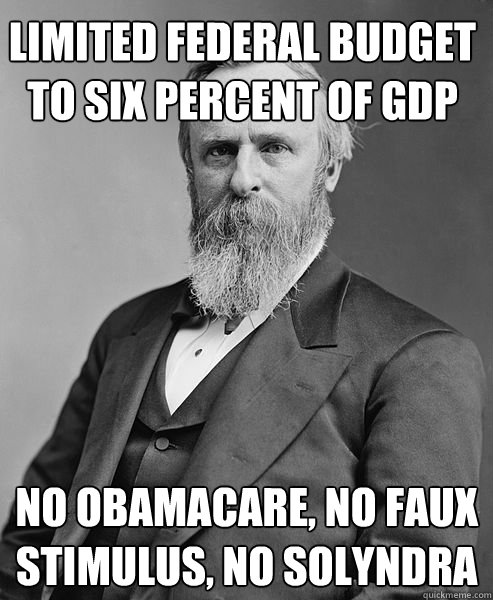
 You won’t be surprised to learn that I’m focused on the policy differences between Hayes and Obama.
 The Top 10 Percent of Earners Paid 70 Percent of Federal Income Taxes
 Federal Revenues by Source

 U.S. Corporate Tax Rate Is Uncompetitive
 National Debt Set to Skyrocket
 U.S. Debt on Track to Fuel Economic Crisis
 In One Year, Spending on Interest on the National Debt Is Greater Than Funding for Most Programs

 More Than Half of the President’s Budget Would Be Spent on Entitlement Programs
 Runaway Spending, Not Inadequate Tax Revenue, Is Responsible for Future Deficits


 The Daily Hatch