Category Archives: spending out of control

Open letter to President Obama (Part 111)

President Obama c/o The White House
1600 Pennsylvania Avenue NW
Washington, DC 20500

Dear Mr. President,

I know that you receive 20,000 letters a day and that you actually read 10 of them every day. I really do respect you for trying to get a pulse on what is going on out here.

If our country is the grow the economy and get our budget balanced it will not be by raising taxes!!! The recipe for success was followed by Ronald Reagan in the 1980’s when he cut taxes and limited spending. As far as limiting spending goes only Bill Clinton (with his Republican Congress) were ability to control the growth of government better than Reagan.

I had the pleasure of hearing Arthur Laffer speak in 1981 and he predicted all the economic growth that we would see because of the Reagan tax cuts and he was right. Unfortunately in California today they have forgotten all of those lessons!!!

President Obama’s fiscal policy is a dismal mixture. On spending, he wants a European-style welfare state. On taxes, he is fixated on class-warfare tax policy.

If we want to know the consequences of that approach, we can look at the ongoing collapse of Greece. Or, if we don’t like overseas examples, we can look at California.

If the (formerly) Golden State is any example, it turns out that having high tax rates doesn’t necessarily translate into high tax revenues. Here’s a blurb from an editorial in today’s Wall Street Journal.

California Controller John Chiang reported last week that April tax collections were a gigantic 20.2%, or $2.44 billion, below 2012-13 budget projections. …Among the biggest surprises is a 21.5% or nearly $2 billion decline in personal income tax payments from what Governor Jerry Brown had anticipated. This reinforces the point that when states rely too heavily on the top 1% of taxpayers to pay the bills, fiscal policy is a roller coaster ride. California is suffering this tax drought even as most other states enjoy a revenue rebound. State tax collections were up nationally by 8.9% last year, according to the Census Bureau, and this year revenues are up by double digits in many states. The state comptroller reports that Texas is enjoying 10.9% growth in its sales taxes (it has no income tax), while California can’t seem to keep up despite one of the highest tax rates in the land.

The WSJ editorial suggests a supply-side response, but you won’t be surprised to learn that the state’s kleptomaniac governor is pushing an Obama-style soak-the-rich tax hike.

This would seem to suggest that California should try cutting tax rates to keep more people and business in the state, but Sacramento is intent on raising them again. Governor Brown and the public-employee unions are sponsoring a ballot initiative in November to raise the state sales tax by a quarter point to 7.5% and to raise the top marginal income-tax rate to 13.3% from 10.3%. This will make the state even more reliant on the fickle revenue streams provided by the rich. Meanwhile, an analysis by Joseph Vranich, who studies migration of businesses from one state to another, finds that since 2009 the flight of businesses out of California “has increased fivefold due to high taxes and regulatory costs.”

I’ll be very curious to see what happens this November when the people of California vote in the referendum. Will they be like the morons in Oregon, who approved a class-warfare tax hike? Or will they be like the voters of Switzerland and reject class warfare?

Sadly, I suspect Oregon will be their role model – even though that decision hurt the Beaver State’s economy.

But while voters can impose higher taxes, they can’t repeal the laws of economics. So if California voters do the wrong thing, they will learn a hard lesson about the Laffer Curve.

And then, as this cartoon demonstrates, they’ll learn the ultimate lesson about not biting the hand that you mooch from.

___________

Thank you so much for your time. I know how valuable it is. I also appreciate the fine family that you have and your commitment as a father and a husband.

Sincerely,

Everette Hatcher III, 13900 Cottontail Lane, Alexander, AR 72002, ph 501-920-5733, lowcostsqueegees@yahoo.com

The Laffer Curve, Part III: Dynamic Scoring

Federal Spending Is Growing Faster Than Federal Revenue

Federal Spending Is Growing Faster Than Federal Revenue

Everyone wants to know more about the budget and here is some key information with a chart from the Heritage Foundation and a video from the Cato Institute.

Since 1965, spending has risen constantly. Federal revenues have dropped recently due to the economic recession, but spending has reached a record high.

INFLATION-ADJUSTED TRILLIONS OF DOLLARS (2010)

Download

Federal Spending Is Growing Faster Than Federal Revenue

Source: White House Office of Management and Budget.

Chart 2 of 42

In Depth

  • Policy Papers for Researchers

  • Technical Notes

    The charts in this book are based primarily on data available as of March 2011 from the Office of Management and Budget (OMB) and the Congressional Budget Office (CBO). The charts using OMB data display the historical growth of the federal government to 2010 while the charts using CBO data display both historical and projected growth from as early as 1940 to 2084. Projections based on OMB data are taken from the White House Fiscal Year 2012 budget. The charts provide data on an annual basis except… Read More

  • Authors

    Emily GoffResearch Assistant
    Thomas A. Roe Institute for Economic Policy StudiesKathryn NixPolicy Analyst
    Center for Health Policy StudiesJohn FlemingSenior Data Graphics Editor

James Gattuso of Heritage Foundation critical of auto bailout

Bankruptcy, Not a Bailout, Is a Better Option for Automakers

Uploaded by on Nov 18, 2008

James Gattuso, Senior Research Fellow in Regulatory Policy at The Heritage Foundation, explains why Congress should not bail out automakers.

________________

Why does our government feel the need to bail out industries. If we had not bailed out  GM then Ford would have benefitted and we would not suffered at all in the number of jobs in the USA making cars.

Amy Payne

June 13, 2012 at 9:02 am

President Obama told the United Auto Workers (UAW) in February not to listen to critics of the auto bailout who said union members “made out like bandits—that saving the auto industry was just about paying back the unions.” “Really?” Obama said. “I mean, even by the standards of this town [Washington], that’s a load of you-know-what.”

New research from Heritage labor economist James Sherk proves that it was, in fact, a load of truth.

The Treasury Department estimates that taxpayers will lose $23 billion on the auto bailout. Sherk and co-author Todd Zywicki find that none of these losses came from saving jobs, but instead went to prop up the compensation of some of the most highly paid workers in America. They write:

We estimate that the Administration redistributed $26.5 billion more to the UAW than it would have received had it been treated as it usually would in bankruptcy proceedings. Taxpayers lost between $20 billion and $23 billion on the auto programs. Thus, the entire loss to the taxpayers from the auto bailout comes from the funds diverted to the UAW.

The Obama campaign is touting the bailout in Michigan this week, crowing about saved-or-created jobs. What the bailout actually saved was the UAW’s heavily padded compensation packages; what it created was a massive taxpayer loss.

The UAW was a significant factor in the automakers’ decline: It had raised Detroit’s labor costs 50 percent to 80 percent above other automakers, such as Toyota and Nissan. In 2006, General Motors paid its unionized workers $70.51 an hour in wages and benefits. Chrysler paid $75.86 an hour. Added to mistakes by management, these labor costs were a major reason the automakers went bankrupt.

However, through the bailout, the Obama Administration insulated the UAW from most of the sacrifices unions usually make in a bankruptcy—at taxpayer expense.

GM and Chrysler owed billions to a trust fund they had created to provide UAW members with gold-plated retiree health benefits. In bankruptcy, these funds should have been paid proportional to other unsecured creditors. Instead, while the Administration paid other creditors only a fraction of what they were owed, it gave the UAW trust fund assets worth tens of billions—including partial ownership of both companies. The U.S. Treasury should have received these assets.

Bankruptcy law also enables reorganizing companies to improve their post-bankruptcy situation by renegotiating union contracts to competitive rates.

If the UAW had been treated normally under bankruptcy law, the automakers’ average labor costs would have fallen to the same levels as the foreign-based carmakers, approximately $47 an hour. While this is still 40 percent higher compensation than the average manufacturing worker, it would have reduced UAW members’ standard of living. And the Administration wouldn’t allow that. So while the UAW accepted huge pay cuts for new hires, the Administration kept the pay structure of existing UAW members at GM intact.

Even Stephen Rattner, President Obama’s “car czar,” has admitted that “We should have asked the UAW to do a bit more. We did not ask any UAW member to take a cut in their pay.”

As a result, even after the reorganization, GM still has higher labor costs ($56 an hour) than any of its foreign-based competitors.

The average American worker—whose taxes paid for the bailout—earns $30.15 an hour in wages and benefits. Few Americans have the ability, as UAW workers do, to retire in their mid-50s before they can collect Social Security. Fewer still receive retirement health benefits in addition to Medicare, as UAW workers do. Yet their tax dollars went to subsidize UAW pay and benefits.

Had the government treated the UAW in the manner required by bankruptcy law, taxpayers would have broken even. The program would have amounted to bankruptcy financing instead of an outright bailout. The Administration could have kept the automakers running without losing a dime.

Instead, more than $26 billion went out the door and into the UAW’s pockets. Let’s put that in perspective: The amount of the subsidy given directly to the UAW was bigger than the budget of the entire State Department. It was bigger than all U.S. foreign aid spending. It was 50 percent more than NASA’s budget.

None of that money kept factories running. Instead, it sustained the above-average compensation of members of an influential union, sparing them from most of the sacrifices typically made in bankruptcy—a bankruptcy they contributed to. President Obama engaged in special interest spending at its worst.

The Administration did not bail out GM and Chrysler. It bailed out the United Auto Workers.

Obama’s Budget Would Reduce National Defense Spending

Obama’s Budget Would Reduce National Defense Spending

Everyone wants to know more about the budget and here is some key information with a chart from the Heritage Foundation and a video from the Cato Institute.

Adequate funding for the core defense program is crucial for the military to fulfill its constitutional duty to provide for the common defense. Yet defense spending has fallen below its 45-year historical average despite ongoing operations in Iraq and Afghanistan.

DEFENSE SPENDING AS A PERCENTAGE OF GDP

Receive Information on Federal Budget Data
Download

Obama's Budget Would Reduce National Defense Spending

Source: White House Office of Management and Budget.

Chart 8 of 42

In Depth

  • Policy Papers for Researchers

  • Technical Notes

    The charts in this book are based primarily on data available as of March 2011 from the Office of Management and Budget (OMB) and the Congressional Budget Office (CBO). The charts using OMB data display the historical growth of the federal government to 2010 while the charts using CBO data display both historical and projected growth from as early as 1940 to 2084. Projections based on OMB data are taken from the White House Fiscal Year 2012 budget. The charts provide data on an annual basis except… Read More

  • Authors

    Emily GoffResearch Assistant
    Thomas A. Roe Institute for Economic Policy StudiesKathryn NixPolicy Analyst
    Center for Health Policy StudiesJohn FlemingSenior Data Graphics Editor

Republicans for more food stamps?

Eight Reasons Why Big Government Hurts Economic Growth

__________________

We got to cut spending and we must first start with food stamp program and we need some Senators that are willing to make the tough cuts.

Food Stamp Republicans

Posted by Chris Edwards

Newt Gingrich had fun calling President Obama the “food stamp president,” but many Republicans are just as responsible for the exploding costs of this welfare state program.

The chart shows that federal outlays for food stamps (officially the Supplemental Nutrition Assistance Program) roughly doubled under President Bush and then doubled again under President Obama.

Despite the quadrupling of food stamp spending, 13 Republicans in the Senate yesterday—including supposed conservatives Bob Corker and Rob Portman—joined Democrats to defeat reforms to the program sponsored by Senator Rand Paul.

(More on food stamps here, here, and here).

_________
Here is a good part of the solution:

Milton Friedman – The Negative Income Tax

Published on May 11, 2012 by

In this 1968 interview, Milton Friedman explained the negative income tax, a proposal that at minimum would save taxpayers the 72 percent of our current welfare budget spent on administration. http://www.LibertyPen.com

Source: Firing Line with William F Buckley Jr.

________________

Senator Pryor asks for Spending Cut Suggestions! Here are a few!(Part 155)

Senator Mark Pryor wants our ideas on how to cut federal spending. Take a look at this video clip below:

Senator Pryor has asked us to send our ideas to him at cutspending@pryor.senate.gov and I have done so in the past and will continue to do so in the future.

On May 11, 2011,  I emailed to this above address and I got this email back from Senator Pryor’s office:

Please note, this is not a monitored email account. Due to the sheer volume of correspondence I receive, I ask that constituents please contact me via my website with any responses or additional concerns. If you would like a specific reply to your message, please visit http://pryor.senate.gov/contact. This system ensures that I will continue to keep Arkansas First by allowing me to better organize the thousands of emails I get from Arkansans each week and ensuring that I have all the information I need to respond to your particular communication in timely manner.  I appreciate you writing. I always welcome your input and suggestions. Please do not hesitate to contact me on any issue of concern to you in the future.

Here are a few more I just emailed to Senator Pryor myself:

Government auditors spent the past five years examining all federal programs and found that 22 percent of them—costing taxpayers a total of $123 billion annually—fail to show any positive impact on the populations they serve.

  • Congress has ignored efficiency recommendations from the Department of Health and Human Services that would save $9 billionannually.
  • Taxpayers are funding paintings of high-ranking government officials at a cost of up to $50,000 apiece.
  • The state of Washington sent $1 food stamp checks to 250,000 households in order to raise state caseload figures and trigger $43 millionin additional federal funds.
  • Suburban families are receiving large farm subsidies for the grass in their backyards—subsidies that many of these families never requested and do not want.
  • Homeland Security employee purchases include 63-inch plasma TVs, iPods, and $230for a beer brewing kit.
  • The National Institutes of Health spends $1.3 millionper month to rent a lab that it cannot use.
  • Congress recently spent $2.4 billionon 10 new jets that the Pentagon insists it does not need and will not use.

Defense Spending Has Declined While Entitlement Spending Has Increased

Defense Spending Has Declined While Entitlement Spending Has Increased

Everyone wants to know more about the budget and here is some key information with a chart from the Heritage Foundation and a video from the Cato Institute.

Spending on national defense, a core constitutional function of government, has declined significantly over time, despite wars in Iraq and Afghanistan. Spending on the three major entitlements—Social SecurityMedicare, and Medicaid—has more than tripled.

PERCENTAGE OF GDP

Receive Information on Federal Budget Data
Download

Defense Spending Has Declined While Entitlement Spending Has Increased

Source: White House Office of Management and Budget.

Chart 7 of 42

In Depth

  • Technical Notes

    The charts in this book are based primarily on data available as of March 2011 from the Office of Management and Budget (OMB) and the Congressional Budget Office (CBO). The charts using OMB data display the historical growth of the federal government to 2010 while the charts using CBO data display both historical and projected growth from as early as 1940 to 2084. Projections based on OMB data are taken from the White House Fiscal Year 2012 budget. The charts provide data on an annual basis except… Read More

  • Authors

    Emily GoffResearch Assistant
    Thomas A. Roe Institute for Economic Policy StudiesKathryn NixPolicy Analyst
    Center for Health Policy StudiesJohn FlemingSenior Data Graphics Edito

Obama promotes food stamps but Milton Friedman had a better suggestion

Milton Friedman’s negative income tax explained by Friedman in 1968:

We need to cut back on the Food Stamp program and not try to increase it. What really upsets me is that when the government gets involved in welfare there is a welfare trap created for those who become dependent on the program. Once they go out and get a job then they are stripped away from the welfare program and that encourages them to avoid working and sit on the couch. (Milton Friedman’s negative income tax is a good solution.)

Now we have the government running ads trying to get people to join this type of lifestyle. I think it is the most cruel thing you can do to a struggling poor person. Working is the only way a person can climb up the ladder and falling in the welfare trap hurts the poor’s chance of succeeding in the future.

Obama’s Using Our Tax Dollars to Leverage More Food Stamp Dependency

June 26, 2012 by Dan Mitchell

In past posts, I’ve groused about food stamp abuse, including people using them to buy luxury coffee at Starbucks and to purchase steaks and lobster. I’ve complained about college kids scamming the program, the “Octo-Mom” mooching off the program, and the Obama Administration rewarding states that sign up more food stamp recipients.

Well, the Obama White House is doubling down on creating more dependency, spending tax dollars to increase the number of people on food stamps.

Here are some of disturbing details from a CNN report.

More than one in seven Americans are on food stamps, but the federal government wants even more people to sign up for the safety net program. The U.S. Department of Agriculture has been running radio ads for the past four months encouraging those eligible to enroll. …The department is spending between $2.5 million and $3 million on paid spots, and free public service announcements are also airing. The campaign can be heard in California, Texas, North Carolina, South Carolina, Ohio, and the New York metro area. …President Bush launched a recruitment campaign, which pushed average participation up by 63% during his eight years in office. The USDA began airing paid radio spots in 2004. President Obama’s stimulus act made it easier for childless, jobless adults to qualify for the program and increased the monthly benefit by about 15% through 2013.

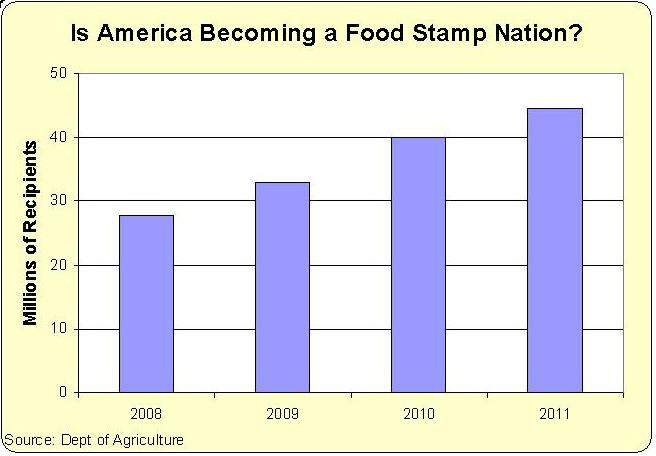
Last year, I semi-defended Newt Gingrich when he was attacked for calling Obama the “Food Stamp” President. Citing this chart, I wrote that, “It certainly looks like America is becoming a food stamp nation.”

But my bigger point is that welfare is bad for both taxpayers and the people who get trapped into relying on big government.

The ideal approach, as explained in this video, is to get the federal government out of the business of redistributing income. We are far more likely to get better results if we let states experiment with different approaches.

House Republicans, to their credit, already want to do this with Medicaid. So why not block grant all social welfare programs?

The icing on the cake is that no longer would the federal government be running ads to lure people into dependency.

Related posts:

We can no longer afford the welfare state (Part 7)

Ep. 4 – From Cradle to Grave [7/7]. Milton Friedman’s Free to Choose (1980) With the national debt increasing faster than ever we must make the hard decisions to balance the budget now. If we wait another decade to balance the budget then we will surely risk our economic collapse. The first step is to […]

We can no longer afford the welfare state (Part 6)

Ep. 4 – From Cradle to Grave [6/7]. Milton Friedman’s Free to Choose (1980) With the national debt increasing faster than ever we must make the hard decisions to balance the budget now. If we wait another decade to balance the budget then we will surely risk our economic collapse. The first step is to […]

We can no longer afford the welfare state (Part 5)

Ep. 4 – From Cradle to Grave [5/7]. Milton Friedman’s Free to Choose (1980) With the national debt increasing faster than ever we must make the hard decisions to balance the budget now. If we wait another decade to balance the budget then we will surely risk our economic collapse. The first step is to […]

We can no longer afford the welfare state (Part 4)

 Ep. 4 – From Cradle to Grave [4/7]. Milton Friedman’s Free to Choose (1980) With the national debt increasing faster than ever we must make the hard decisions to balance the budget now. If we wait another decade to balance the budget then we will surely risk our economic collapse. The first step is to […]

We can no longer afford the welfare state (Part 3)

Ep. 4 – From Cradle to Grave [3/7]. Milton Friedman’s Free to Choose (1980) With the national debt increasing faster than ever we must make the hard decisions to balance the budget now. If we wait another decade to balance the budget then we will surely risk our economic collapse. The first step is to […]

We can no longer afford the welfare state (Part 2)

With the national debt increasing faster than ever we must make the hard decisions to balance the budget now. If we wait another decade to balance the budget then we will surely risk our economic collapse. The first step is to remove all welfare programs and replace them with the negative income tax program that […]

We can no longer afford the welfare state (Part 1)

Milton Friedman – The Negative Income Tax Published on May 11, 2012 by LibertyPen In this 1968 interview, Milton Friedman explained the negative income tax, a proposal that at minimum would save taxpayers the 72 percent of our current welfare budget spent on administration. http://www.LibertyPen.com Source: Firing Line with William F Buckley Jr. ________________ Milton […]

Open letter to President Obama (Part 110)

The Rahn Curve and the Growth-Maximizing Level of Government

Uploaded by on Jun 29, 2010

Government spending can promote economic growth if money is used for core “public goods” such as rule of law and property rights. But the burden of government spending in the United States and other industrialized nations is far higher than needed to finance such activities. Citing scholarly studies, this CF&P Foundation video examines the Rahn Curve, which graphically illustrates the negative impact of excessive government spending. www.freedomandprosperity.org

___________

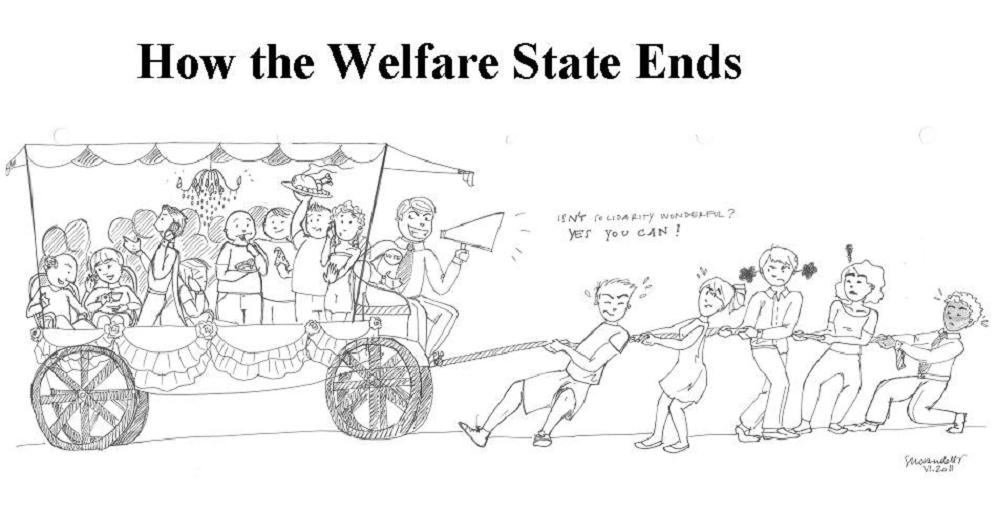
These images are remarkably accurate. The welfare state starts with small programs targeted at a handful of genuinely needy people. But as  politicians figure out the electoral benefits of expanding programs and people figure out the that they can let others work on their behalf, the ratio of producers to consumers begins to worsen.

_________

President Obama c/o The White House
1600 Pennsylvania Avenue NW
Washington, DC 20500

Dear Mr. President,

I know that you receive 20,000 letters a day and that you actually read 10 of them every day. I really do respect you for trying to get a pulse on what is going on out here.

When the government gets so big that it distorts the behavior of the private market then it is too big. The federal government is  now spending 24.8% of GDP and traditionally for the first 150 years of our nation’s history we spent under 5% unless in wartime. This massive spending now by the federal encourages people to lie in order to get money for the government too instead of trying to work hard to earn money in the private market.

Why is big government bad for an economy? The easy answer is that big government usually means high tax rates, and this penalizes work, saving, investment, and entrepreneurship. And perhaps some of the spending is financed by borrowing, and this diverts money from private investment.

That’s a correct answer, but it’s only part of the story. In most cases, there is added damage because politicians spend money in ways that further undermine incentives to produce.

For instance, let’s assume a government spends $1 billion on some sort of redistribution program. Extracting that money from the productive sector of the economy obviously will cause some damage, but it’s also important to estimate how the supposed beneficiaries of the money will react. What if they decide to earn less income in order to be eligible for the handouts, as even the statists at the OECD have recognized?

In other words, it hurts the economy when government collects money, and it often hurts the economy when government spends money. Sort of a perverse 2-for-1 special (though “Rahn Curve” analysis does show that some types of spending – on core public goods – is correlated with better economic performance)

Let’s look at an example from Greece, showing how handouts distort behavior and corrupt people. Here are some remarkable tidbits from a Wall Street Journal story.

The Greek health ministry is investigating on Zakynthos after local officials flagged records showing what they said is an implausibly high number of disability claims for blindness. About 1.8% of the island’s population of 39,000 claimed the benefit last year, according to the health ministry. That is around nine times the prevalence of blindness estimated for many European countries in a 2004 study published in a World Health Organization journal. Among those who put in for the blindness benefit on Zakynthos, a local official said, were a taxi driver and a bird hunter. …But the island is hardly alone, according to health ministry officials, who say fraudulent disability claims are a problem across the nation… Zakynthos Mayor Stelios Bozikis on a Greek television talk show said residents angry about the benefits crackdown and other financial overhauls pelted him with yogurt at a recent event.

Before sneering at the Greeks, keep in mind that “disability” claims also are rising in the United States, which is rather remarkable since jobs have become less arduous over time. Heck, the Social Security Administration decided to give disability payments to a grown man who gets his jollies by wearing diapers.

I’m not sure if that’s better or worse than the Greek government deciding to reward pedophiles with disability payments, but taxpayers are getting screwed in both examples.

Let’s go back to the story and look at a rough estimate of how much fraud exists.

In an attempt to root out fraud, the Greek health ministry recently required disability claimants nationwide to register in a centralized database, appearing in person or sending a representative. The registration resulted in 36,000 fewer disability claims than in 2011, the health ministry said. The ministry alleges these dropped claims were fraudulent, in many cases reflecting multiple claims for the same disability or payments in the name of dead beneficiaries. It also alleges that some doctors accepted money for false diagnoses and some local politicians signed off on the benefits to win support, and said it is giving public prosecutors information about areas where it suspects a high level of fraud. Only 190 of the nearly 700 people it says had been collecting the blindness benefit on Zakynthos participated in the registration, the ministry said.

I have no idea if Zakynthos is representative, but that’s an incredibly high fraud rate. And this is just a glimpse at the workings of one government program. Now multiply that by some large number and you’ll begin to understand the damage caused by government.

And America is not immune. When politicians make it easier to ride in the wagon than to pull the wagon (as this cartoon illustrates), society sooner or later gets in trouble.

____________

Thank you so much for your time. I know how valuable it is. I also appreciate the fine family that you have and your commitment as a father and a husband.

Sincerely,

Everette Hatcher III, 13900 Cottontail Lane, Alexander, AR 72002, ph 501-920-5733, lowcostsqueegees@yahoo.com

Jeb Bush and Lindsey Graham join small naive group of Republicans that want to raise taxes

Below is a speech by George W. Bush honoring Milton Friedman:

Milton Friedman Honored for Lifetime Achievements 2002/5/9

Milton Friedman said that getting George Bush I to be his vice president was his biggest mistake because he knew that Bush was not a true conservative and sure enough George Bush did raise taxes when he later became President. I wonder if Jeb Bush has the same genes as his father.

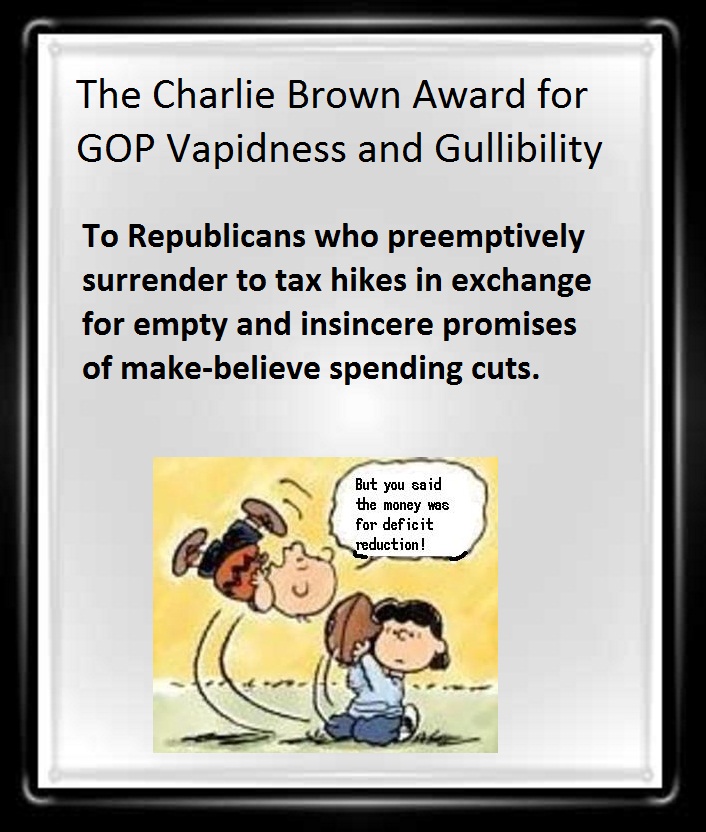
What we need is some people in Washington that are brave enough to say that we have taken too much of the american people’s money and we have to make the painful spending cuts in order to balance the budget and not ask for any more tax increases!!!! Arkansas’ congressman Rick Crawford has also made the Charlie Brown mistake.

Even though America’s fiscal problem is entirely the result of too much government spending, I wrote earlier this year that there were all sorts of scenarios where I would agree to a tax increase.

But I then pointed out that all of those scenarios were total fantasies and that it would be more realistic to envision me playing center field for the New York Yankees.

The fundamental problem is that politicians never follow through on promises to reduce spending – even if you use the dishonest Washington definition that a spending cut occurs whenever the budget doesn’t rise as fast as previously planned.

And to make matters worse, they always seem to want class-warfare tax hikes that do heavy economic damage rather than the loophole closers that at least get rid of some of the inefficient corruption in the tax code.

That’s why I like the anti-tax pledge of Americans for Tax Reform. You don’t solve America’s fiscal problems by saying no to all tax increases, but at least you don’t move in the wrong direction at a faster rate.

Notwithstanding the principled and pragmatic arguments against putting tax increases on the table, some Republicans – in a triumph of hope over experience – are preemptively acquiescing to tax hikes.

Here’s what Jeb Bush said.

Jeb Bush, the former Florida governor, said Friday that he could back a broad deficit plan that increased taxes, a stance that puts him at odds with other prominent Republicans. Bush told a House panel he could get behind a plan that combined 10 dollars in spending cuts for every dollar of new revenue… “The problem is the 10 never materializes,” [Congressman Paul] Ryan said after Bush said he could support a revenue-increasing deficit deal. Norquist also has criticized deficit deals crafted in 1982 and 1990 – the latter agreed to by then-President George H.W. Bush, Jeb’s father – for failing to deliver on the spending side.

Kudos to Paul Ryan for making the obvious point about make-believe spending cuts. And Grover is correct about the failure of previous budget deals.

Indeed, I cited a New York Times column that inadvertently revealed that the only budget deal that worked was the 1997 pact that cut taxes rather than raised them.

Jeb Bush isn’t the only apostate. Here’s what Senator Graham had to say.

Sen. Lindsey Graham (R-S.C.) said Tuesday he believed Republicans should consider eliminating loopholes in the tax code even if they aren’t replaced by additional tax cuts, a move that would break with an anti-tax pledge many GOP lawmakers have signed with activist Grover Norquist. “When you eliminate a deduction, it’s OK with me to use some of that money to get us out of debt. That’s where I disagree with the pledge,” Graham told ABC News. …”I’m willing to move my party, or try to, on the tax issue. I need someone on the Democratic side being willing to move their party on structural changes to entitlements.” Graham said, for instance, he would support a plan that included $4 in spending cuts for every $1 in tax increases. During a Republican debate last August, all eight Republican candidates in attendance said they would reject a proposal to trade $10 in spending cuts for even $1 in tax increases.

In some sense, Senator Graham’s comments are reasonable. With real spending cuts and less-damaging forms of tax hikes, an acceptable deal is possible. But only in Fantasia, not in Washington.

In the real world, all that Senator Graham has done is to move the debate slightly to the left.

I’ve noted that tax increases are political poison for the Republican Party, but I don’t lose sleep worrying about the GOP.

But I do have nightmares about government getting even bigger, and that’s why I don’t want tax increases on the table. I don’t even want them in the room. Or the house. Or the neighborhood.

That’s why Jeb Bush and Lindsey Graham are the newest winners of the Charlie Brown Award. They’ve put blood in the water. I wonder if they’ll act surprised when hungry sharks show up looking for a meal?