I even outlined several specific scenarios where that might occur, including giving the politicians more money in exchange for a flat tax or giving them additional revenue in exchange for real entitlement reform.
But I then pointed out that all of those options are unrealistic. And I’ve expanded on that thesis in a new article. Here’s some of what I wrote for The Blaze.
The no-tax pledge of Americans for Tax Reform generates a lot of controversy. With record levels of red ink, the political elite incessantly proclaims that all options must be “on the table.” This sounds reasonable. And when some Republicans say no tax hikes under any circumstances, there’s a lot of criticism about dogmatism. Theoretically, I agree with the elitists.
So does that make me a squish, the fiscal equivalent of Chief Justice John Roberts?
Nope, because I’m tethered to the real world. I know that there is zero chance of getting a good agreement. Once you put taxes “on the table,” any impetus for spending restraint evaporates.
But even though I’m theoretically open to a tax hike, I am a de facto opponent of tax increases for the simple reason that we will never get a good deal. We won’t get sustainable spending cuts. Not even in our dreams. We won’t get real entitlement reforms. Even if we hold our breath ‘til we turn blue. And we won’t get the “Simpson-Bowles” tax reform swap, where taxpayers give up $2 of deductions in exchange for $1 of lower tax rates. Let’s not kid ourselves. In other words, reality trumps theory. Yes, there are tax-hike deals that would be good, but they’re about as realistic as me speculating on whether I’d be willing to play for the New York Yankees, but only if they guarantee me $5 million per year.
I then point out that a budget deal inevitably would lead to bad policy – just as we saw in 1982 and 1990.
Here’s the bottom line: There is no practical way to get a good deal from either the Democrats in the Senate or the Obama Administration. Notwithstanding the good intentions of some people, any grand bargain would be a failure that leads to higher spending and more red ink, just as we saw after the 1982 and 1990 budget deals. The tax increases would not be relatively benign loophole closers. Instead, the economy would be hit by higher marginal tax rates on work, savings, investment, and entrepreneurship. And the entitlement reform would be unsustainable gimmicks rather than structural changes to fix the underlying programs. Ironically, when a columnist for the New York Times complained that Republicans were being unreasonable for opposing tax hikes, she inadvertently revealed that the only successful budget deal was the one in 1997 – the one that had no tax hikes!
The last sentence is worth some additional commentary. As I explained in a previous post, the only bipartisan budget agreement that generated a balanced budget was the 1997 pact – and that deal lowered taxes rather than increasing them.
In One Year, Spending on Interest on the National Debt Is Greater Than Funding for Most Programs
Everyone wants to know more about the budget and here is some key information with a chart from the Heritage Foundation and a video from the Cato Institute.
In 2010, the U.S. spent more on interest on the national debt than it spent on many federal departments, including Education and Veterans Affairs.
BILLIONS OF DOLLARS (2010)
Download
Source: White House Office of Management and Budget.
The charts in this book are based primarily on data available as of March 2011 from the Office of Management and Budget (OMB) and the Congressional Budget Office (CBO). The charts using OMB data display the historical growth of the federal government to 2010 while the charts using CBO data display both historical and projected growth from as early as 1940 to 2084. Projections based on OMB data are taken from the White House Fiscal Year 2012 budget. The charts provide data on an annual basis except… Read More
Authors
Emily GoffResearch Assistant
Thomas A. Roe Institute for Economic Policy StudiesKathryn NixPolicy Analyst
Center for Health Policy StudiesJohn FlemingSenior Data Graphics Editor
We need to cut back on the Food Stamp program and not try to increase it. What really upsets me is that when the government gets involved in welfare there is a welfare trap created for those who become dependent on the program. Once they go out and get a job then they are stripped away from the welfare program and that encourages them to avoid working and sit on the couch. (Milton Friedman’s negative income tax is a good solution.)
Now we have the government running ads trying to get people to join this type of lifestyle. I think it is the most cruel thing you can do to a struggling poor person. Working is the only way a person can climb up the ladder and falling in the welfare trap hurts the poor’s chance of succeeding in the future.
More than one in seven Americans are on food stamps, but the federal government wants even more people to sign up for the safety net program. The U.S. Department of Agriculture has been running radio ads for the past four months encouraging those eligible to enroll. …The department is spending between $2.5 million and $3 million on paid spots, and free public service announcements are also airing. The campaign can be heard in California, Texas, North Carolina, South Carolina, Ohio, and the New York metro area. …President Bush launched a recruitment campaign, which pushed average participation up by 63% during his eight years in office. The USDA began airing paid radio spots in 2004. President Obama’s stimulus act made it easier for childless, jobless adults to qualify for the program and increased the monthly benefit by about 15% through 2013.
Last year, I semi-defended Newt Gingrich when he was attacked for calling Obama the “Food Stamp” President. Citing this chart, I wrote that, “It certainly looks like America is becoming a food stamp nation.”
But my bigger point is that welfare is bad for both taxpayers and the people who get trapped into relying on big government.
The ideal approach, as explained in this video, is to get the federal government out of the business of redistributing income. We are far more likely to get better results if we let states experiment with different approaches.
House Republicans, to their credit, already want to do this with Medicaid. So why not block grant all social welfare programs?
Thank you so much for your time. I know how valuable it is. I also appreciate the fine family that you have and your commitment as a father and a husband.
Sincerely,
Everette Hatcher III, 13900 Cottontail Lane, Alexander, AR 72002, ph 501-920-5733, lowcostsqueegees@yahoo.com
Ep. 4 – From Cradle to Grave [7/7]. Milton Friedman’s Free to Choose (1980) With the national debt increasing faster than ever we must make the hard decisions to balance the budget now. If we wait another decade to balance the budget then we will surely risk our economic collapse. The first step is to […]
Ep. 4 – From Cradle to Grave [6/7]. Milton Friedman’s Free to Choose (1980) With the national debt increasing faster than ever we must make the hard decisions to balance the budget now. If we wait another decade to balance the budget then we will surely risk our economic collapse. The first step is to […]
Ep. 4 – From Cradle to Grave [5/7]. Milton Friedman’s Free to Choose (1980) With the national debt increasing faster than ever we must make the hard decisions to balance the budget now. If we wait another decade to balance the budget then we will surely risk our economic collapse. The first step is to […]
Ep. 4 – From Cradle to Grave [4/7]. Milton Friedman’s Free to Choose (1980) With the national debt increasing faster than ever we must make the hard decisions to balance the budget now. If we wait another decade to balance the budget then we will surely risk our economic collapse. The first step is to […]
Ep. 4 – From Cradle to Grave [3/7]. Milton Friedman’s Free to Choose (1980) With the national debt increasing faster than ever we must make the hard decisions to balance the budget now. If we wait another decade to balance the budget then we will surely risk our economic collapse. The first step is to […]
With the national debt increasing faster than ever we must make the hard decisions to balance the budget now. If we wait another decade to balance the budget then we will surely risk our economic collapse. The first step is to remove all welfare programs and replace them with the negative income tax program that […]
Milton Friedman – The Negative Income Tax Published on May 11, 2012 by LibertyPen In this 1968 interview, Milton Friedman explained the negative income tax, a proposal that at minimum would save taxpayers the 72 percent of our current welfare budget spent on administration. http://www.LibertyPen.com Source: Firing Line with William F Buckley Jr. ________________ Milton […]
Why not pass the Balanced Budget Amendment? As you know that federal deficit is at all time high (1.6 trillion deficit with revenues of 2.2 trillion and spending at 3.8 trillion).
On my blog www.HaltingArkansasLiberalswithTruth.com I took you at your word and sent you over 100 emails with specific spending cut ideas. However, I did not see any of them in the recent debt deal that Congress adopted. Now I am trying another approach. Every week from now on I will send you an email explaining different reasons why we need the Balanced Budget Amendment. It will appear on my blog on “Thirsty Thursday” because the government is always thirsty for more money to spend.
Abstract:Attempts at passing a balanced budget amendment (BBA) date back to the 1930s, and all have been unsuccessful. Both parties carry some of the blame: The GOP too often has been neglectful of the issue, and the Democratic Left, recognizing a threat to big government, has stalled and obfuscated, attempting to water down any proposals to mandate balanced budgets. On the occasion of the July 2011 vote on a new proposed BBA, former Representative from Oklahoma Ernest Istook presents lessons from history.
A proposed balanced budget amendment (BBA) to the Constitution is set to be considered by Congress this July—the first such vote since 1997.
The BBA is a powerful proposal that attracts great vitriol from the American Left, which recognizes it as an enormous threat to its big-government ways—perhaps the greatest threat. For that reason, the history of Congress’s work on a BBA is full of frustrations, high-profile defections, reversals, and betrayals.
This paper discusses that history. It also describes some of the milktoast versions and amendments that have been offered to gut the BBA while providing political cover for those who are unwilling to support a robust version.
Brief History
Thomas Jefferson wrote in 1798, “I wish it were possible to obtain a single amendment to our Constitution. I would be willing to depend on that alone for the reduction of the administration of our government; I mean an additional article taking from the Federal Government the power of borrowing.”[1] Yet according to the Congressional Research Service,[2] the first balanced budget amendment was not proposed until 1936, when Representative Harold Knutson (R–MN) introduced House Joint Resolution 579, proposing a per capita limit on federal debt.
No BBA measure passed either body of Congress until 1982, when the Senate took 11 days to consider it and mustered the necessary two-thirds majority on the version crafted by Senator Strom Thurmond (R–SC).[3] A companion measure received a vote of 236 to 187 in the House—short of the required two-thirds. Despite opposition from Speaker Thomas “Tip” O’Neill (D–MA), the floor vote was obtained by means of a discharge petition led by Representatives Barber Conable (R–NY) and Ed Jenkins (D–GA).[4]
Subsequently, continuing opposition from Speaker O’Neill and his successor, Jim Wright (D–TX), prompted creative use of discharge petitions to circumvent leadership opposition. Several House votes were held in the early 1990s, when Representative Charles Stenholm (D–TX) led bipartisan coalitions to force Democratic leaders to permit (unsuccessful) floor votes. At the time, even prominent Democrats such as Representative Joseph Kennedy (MA) openly supported the BBA and voted for it. There were multiple House and Senate votes, but all were unsuccessful.[5]
The first and only time the House gave two-thirds approval to a balanced budget amendment was in 1995, when Members voted for the “Contract with America” that helped Republicans win major congressional majorities. That was the last time the House held a floor or committee vote. Since then, the Senate has failed twice—each time by a single vote—to gather the two-thirds needed.[6]
Defections Block BBA Approval
Three Senators were the key defectors who prevented Congress from approving a balanced budget amendment in the 1990s. One actually had never supported it and bucked his party to oppose it. The other two flip-flopped in order to go along with their party in opposing the BBA.
First, in 1995, Senator Mark Hatfield (R–OR) took the heat when he would not join his party in support of a BBA. But Hatfield’s vote would have been unnecessary had Senator Tom Daschle (D–SD) not reversed years of prior support to oppose the BBA at President Bill Clinton’s urging.
Then, in 1997, the measure again failed by a single vote in the Senate when newly elected Senator Robert Torricelli (D–NJ) broke his campaign pledge and refused to support the same BBA that he had supported as a House member.[7]
More recently, many House Democrats who voted for the BBA in 1995 are now saying they will vote no in 2011. Most notable among these is House Democratic Whip Steny Hoyer (D–MD).
Senate Defections
Senator Hatfield called the BBA a “political gimmick,” and his high-profile defection broke GOP party unity. Less noticed was that his opposition could have been a moot point. Then-Senate Majority Leader Bob Dole (R–KS) told The New York Times that Hatfield offered to resign before the vote—a resignation that would have produced a 66-to-33 victory for the BBA—but Dole refused to accept the resignation offer.[8]
Still, with or without Hatfield’s vote or resignation, the BBA would have prevailed in the 1995 Senate vote were it not for Senator Daschle’s reversal. That flip-flop is described in a book about his later ousting from office by the voters:
Although the balanced budget amendment had not been a major issue nationally for several years, it provided a striking contrast between Daschle’s first campaign in 1978 and his early career in Congress, when he consistently promoted the amendment, and his later years in the Senate. During his last competitive Senate bid in 1986, Daschle ran a television ad saying that “in 1979, Tom Daschle saw the damage these deficits could do to our country. His first official act was to sponsor a Constitutional amendment to balance the budget.” In 1992, Daschle’s campaign literature touted the “Daschle Plan,” which included the balanced budget amendment: “In 1979, before it became popular, I was pushing a balanced budget amendment to the Constitution. It was my first official action, and I’ve authored or coauthored one every year.” In 1995, the amendment had the support of sixty-six of the sixty-seven senators needed for passage, but Daschle voted against it because of opposition from the Clinton administration…. When pressed on the amendment in the last [2004] television debate, Daschle said that he had opposed the bill in the 1990s because there were no provisions in the amendment allowing for emergencies such as war. But the record showed that there wasan emergency clause.[9]
In 2011, Daschle has penned several articles denouncing the BBA, complaining that it would make the country’s fiscal crisis even worse and would tie lawmakers’ hands.[10]
The 1997 effort to approve the BBA failed in the Senate by a single vote, just as it had in 1995. This time it was Senator Torricelli doing the political acrobatics. As the New York Daily News described it:
Sen. Robert Torricelli (D–N.J.) yesterday announced he will vote against the balanced budget amendment to the Constitution giving Democrats the one-vote margin they need to kill it. The freshman senator flipped on his campaign pledge to support the amendment and on his own past voting record in the House in favor of similar proposals. “I have struggled with this decision more than any I have ever made in my life,” Torricelli said…
Torricelli acknowledged that he had campaigned in support of the amendment to win his Senate seat last year and had voted three times in favor of similar amendments as a House member. But he said President Clinton’s efforts in bringing down annual budget deficits from $300 billion to $100 billion, and the President’s commitment to a balanced budget by 2002, had relieved the pressure for a constitutional amendment.[11]
Trying to give himself political cover, Torricelli tried but failed to get the Senate to support a loophole-riddled version.
House Reversals
Chief among Representatives who supported a BBA in 1995 but say they will actively oppose it in 2011 is Representative Hoyer. In 1995, he even helped to garner votes for the BBA. As the Baltimore Sun reported at the time, “‘The issue of a balanced budget is not a conservative one or a liberal one, and it is not an easy one,’ said Mr. Hoyer, who said he fears the consequences of a national debt that is headed toward $5 trillion. ‘But it is an essential one.’”[12] Arguing for the BBA on the House floor in 1995, Hoyer said:
[T]his country confronts a critical threat caused by the continuation of large annual deficits…. I am absolutely convinced that the long term consequences of refusing to come to grips with the necessity to balance our budget will be catastrophic…. [T]hose who will pay the highest price for our fiscal irresponsibility, should we fail, will be those least able to protect themselves, and the children of today and the generations of tomorrow.[13]
Hoyer reversed course after rising to high leadership within his party, as did Daschle. Daschle did a turnaround against the same language he previously had supported. Hoyer, however, argued that the latest 2011 version (with tax limitation and size-of-government limits) had gone beyond what he originally supported in 1995:
It would require drastic and harmful cuts to programs like Medicare, Medicaid, and Social Security, programs that form the heart of America’s social compact…. Unlike previous balanced budget amendments, this amendment would mean great pain for ordinary Americans, even as it shielded the most privileged from any comparable sacrifice. It is not a solution to our nation’s pressing fiscal challenges.[14]
It is an open question how other Democrats who supported the 1995 version of the BBA will vote on the tougher 2011 version.[15] They include another member of the current Democratic House leadership, James Clyburn (SC).
The GOP was also guilty of abandoning the BBA—by neglect. The BBA had been the number one item on its Contract with America legislative agenda in 1994, but after the single (and successful) 1995 House vote, House GOP leaders refused all entreaties to bring it up again. No House or Senate vote has been held since Torricelli’s dramatic about-face in 1997.
For part of the time while Republican leaders were dormant on a BBA, the budget was balanced. Rather than spotting an opportunity to cement that condition into a permanent requirement, however, some saw it as proving that a BBA is not needed.
During that time when the federal budget was balanced without a BBA requirement (fiscal years 1998–2001),[16] Congress had political incentives to maintain that balance. However, after 9/11, Washington not only ramped up national security spending, but also let other spending rise significantly. The prevailing notion seemed to be that if the budget was not balanced, then it mattered little just how far out of balance it was.
That experience illustrates not only the need for a proper BBA, but also the need for any national security exceptions to be drafted narrowly, to permit deficits only to the extent necessary to provide for non-routine defense circumstances and not to justify unrelated deficit spending.
Watering Down the BBA
The versions of the BBA to be voted on in 2011 are improvements over the Contract with America. Because of this strengthening, the current versions are described herein as “BBA-plus.”[17]
Simply put, the additional features require a supermajority to raise taxes; create limits on the level of federal spending (as a percentage of the national economy); tighten the permitted and limited exceptions to a balanced budget; and limit the potential for judicially imposed tax increases as a means of enforcement.
According to their strictness, different variations in proposed texts could be considered good, better, and best, with a full-featured BBA-plus being the best. But the greater the strictures, the more difficult passage becomes. Many pro-BBA lawmakers have therefore introduced and supported versions that were not as strong as they prefer but have greater likelihood of adoption.
These variations also create potential for mischief. Because they recognize the huge popular support for the BBA, many opponents have attempted to offer amendments and variations that would water down or emasculate the provisions of the BBA so that they could posture as supporters while justifying their “no” votes. The following is a historical synopsis of those tactics.
Taking Social Security Off-Budget. The most prominently advanced effort to weaken a BBA is a provision to separate Social Security payments and receipts from the requirements for a balanced budget. Amendments to do so were offered in both the House and Senate from 1995 to 1997. Senator Harry Reid (D–NV) was a principal leader of that effort in 1997.
Reid and others argued that removing Social Security from a BBA would protect the program from spending cuts. They argued that its funds do not actually constitute government spending since the program involves a trust fund. This ignored the fact that the entirety of the trust fund has been invested in federal bonds and that all of the borrowed money has been spent. Furthermore, during the 1990s, the Social Security program was producing annual surpluses ranging from $60 billion to $65 billion, which disguised deficit spending elsewhere. Today, Social Security runs an annual deficit.
If Social Security were removed from a BBA’s requirements, Congress would be approving major deficit spending while not counting it as a deficit. Politicians would only be pretending to have balanced the budget. As the Congressional Budget Office reported this past January, “Excluding interest, surpluses for Social Security become deficits of $45 billion in 2011 and $547 billion over the 2012–2021 period.”[18]
The Torricelli Ploy. As previously mentioned, the most transparent ploy to create an excuse for opposing the BBA came in 1997 from newly elected Senator Robert Torricelli. As a House member, he had voted for a substitute version and also voted “yea” on final passage of the Contract with America BBA in 1995. He campaigned for the Senate in 1996 as a BBA supporter.
As heads were counted for the 1997 Senate vote, it was apparent that Torricelli and Senator Mary Landrieu (D–LA), both previous BBA supporters, were the swing votes. If both voted “yea,” the necessary two-thirds would be achieved in the Senate. President Clinton lobbied both Senators to vote “nay.” Landrieu announced that she would vote yes, and Torricelli announced that he would vote no. Reporters openly asked him whether “he drew the short straw.”
In a move that was publicly derided, Torricelli offered an amendment to the BBA on the Senate floor and then announced he would vote no because the amendment failed. Then, minutes later in a news conference, he undercut his own explanation by stating that in the future, he would vote no on all Republican versions of a BBA and yes on all Democratic versions.
Torricelli’s unsuccessful amendment would have waived the balanced budget requirement whenever a simple majority in Congress declared “an imminent and serious military threat” or “a period of economic recession or significant economic hardship” or when Congress chose to approve deficit spending for “investments in major public physical capital that provides long-term economic benefits.”[19] The three-pronged nature of Torricelli’s effort was a lumping together of provisions that were also offered separately in both the House and Senate by others.
Other Diluting Amendments. The following is a sampling of other proposals offered on the House or Senate floors during the 1995–1997 considerations:[20]
Representative Robert Wise (D–WV) offered a multifaceted substitute that would have provided for separate federal capital and operating budgets; would have required that only the operating budget be balanced; would have exempted Social Security from balanced budget calculations; and would have permitted Congress to waive the balanced budget provisions in times of war, military conflict, or recession.
Senator Richard Durbin (D–IL) tried to insert the following languageinto the BBA: “The provisions of this article may be waived for any fiscal year in which there is an economic recession or serious economic emergency in the United States as declared by a joint resolution, adopted by a majority of the whole number of each House, which becomes law.”
Senator Barbara Boxer (D–CA) proposed, “The provisions of this article may be waived for any fiscal year in which there is a declaration made by the President (and a designation by the Congress) that a major disaster or emergency exists, adopted by a majority vote in each House of those present and voting.”
Representative Major Owens (D–NY) wanted “to allow a majority of Congress to waive the balanced budget provisions contained in the joint resolution in any fiscal year that the national unemployment rate exceeds 4 percent.”
Representative John Conyers (D–MI) wanted to require a detailed plan of spending cuts before balance could be required, proposing “to exempt Social Security from balanced budget calculations; and provide that before the constitutional amendment could take effect, Congress would be required to pass legislation showing what the budget will be for the fiscal years 1996 through 2002, containing aggregate levels of new budget authority, outlays, reserves, and the deficit and surplus, as well as new budget authority and outlays on an account-by-account basis.”
Representative David Bonior (D–MI) tried not only to exempt Social Security from the calculations, but also to require only a simple constitutional majority vote (218 in the House, 51 in the Senate) to allow deficit spending.
Additional amendments were more straightforward, such as whether a supermajority would or would not be required to raise taxes under the BBA. The House Rules Committee screened out 38 proposed floor amendments; only six were permitted.
Conclusion
History shows that the potency of a balanced budget amendment attracts fervent efforts to confuse the issues, especially by creating counterfeit versions and exceptions to provide political cover. Proponents of a BBA should prepare accordingly.
If not for high-profile political defections in the mid-1990s, the BBA would have been approved by Congress. Had it then been ratified by the requisite three-fourths of the states, today’s debates over borrowing limits, entitlements, and spending levels would be greatly different, if not absent.
However, the versions considered in the ’90s were notably weaker than both the House and Senate versions of the BBA-plus now being considered. Had an earlier version been adopted, today’s debate might be about efforts by Congress to evade the spirit of the BBA by exploiting loopholes in that earlier version. This is why vigilance is necessary to prevent the insertion of loopholes into the language of a BBA-plus.
Those who do not learn from the failures of history are doomed to repeat them.
—The Honorable Ernest J. Istook, Jr., a former Member of Congress, is Distinguished Fellow in Government Studies in the Department of Government Studies at The Heritage Foundation.
The medicine for the sickness of spending is real budget cuts but no one in liberal europe wants to hear that. Sadly we are on the same road in the USA.
I wrote a detailed blog post yesterday, showing that European governments have been very reluctant to restrain the burden of government spending.
Part of the problem is that the debate in Europe is a no-win exercise, pitting proponents of higher taxes (which is largely how Europe’s political elite defines “austerity”) against proponents of higher spending (notwithstanding a long track record of failure, the Keynesians have come out of woodwork and are claiming that bigger government stimulates “growth”).
Thank you so much for your time. I know how valuable it is. I also appreciate the fine family that you have and your commitment as a father and a husband.
Sincerely,
Everette Hatcher III, 13900 Cottontail Lane, Alexander, AR 72002, ph 501-920-5733, lowcostsqueegees@yahoo.com
Obama’s Budget Worsens Debt Problem, but The Heritage Plan Solves It
Everyone wants to know more about the budget and here is some key information with a chart from the Heritage Foundation and a video from the Cato Institute.
Spending in the President’s budget proposal for 2012 would drive the debt to 87 percent of the economy by 2021. In contrast, Saving the American Dream: The Heritage Plan to Fix the Debt, Cut Spending, and Restore Prosperity solves the debt problem through strong budget reforms, lowering debt to 58 percent of GDP in just 10 years.
DEBT AS A PERCENTAGE OF GDP
Download
Source: President’s Budget: Congressional Budget Office and White House Office of Management and Budget; Heritage Plan: Calculations by the Center for Data Analysis based on current projections, data provided by the Peter G. Peterson Foundation, and CDA policy models.
The charts in this book are based primarily on data available as of March 2011 from the Office of Management and Budget (OMB) and the Congressional Budget Office (CBO). The charts using OMB data display the historical growth of the federal government to 2010 while the charts using CBO data display both historical and projected growth from as early as 1940 to 2084. Projections based on OMB data are taken from the White House Fiscal Year 2012 budget. The charts provide data on an annual basis except… Read More
Authors
Emily GoffResearch Assistant
Thomas A. Roe Institute for Economic Policy StudiesKathryn NixPolicy Analyst
Center for Health Policy StudiesJohn FlemingSenior Data Graphics Editor
Your liberal agenda has not worked out too good in the last four years. I am deeply troubled that you have tried to pit one income class against another. Here are some themes of your presidency below:
Most people know that Ronald Reagan was an actor before he became a great President.
So I guess it makes sense for Barack Obama to do the same thing, but in reverse. He’s starting as a bad President, but then will become a Hollywood star.
Some clever person already has put together some potential starring roles. Let’s start with the Wizard of Oz, with some updated dialogue that captures the President’s approach to tax policy.
Bonnie and Clyde is another option, though this one is unfair. Obama supports TARP, which means he wants to rob taxpayers to subsidize banks.
Last but not least, we have a new version of “It’s a Wonderful Life.” Though, to be fair, the President seems to want entitlement checks for everybody.
If I was clever enough to manipulate pictures, I would do one from the scene in Braveheart where Mel Gibson is on horseback, motivating the Scots to fight against the English. But instead of Mel Gibson talking about freedom, we could have the President urging “dependency.”
Thank you so much for your time. I know how valuable it is. I also appreciate the fine family that you have and your commitment as a father and a husband.
Sincerely,
Everette Hatcher III, 13900 Cottontail Lane, Alexander, AR 72002, ph 501-920-5733, lowcostsqueegees@yahoo.com
Entitlements Will Consume All Tax Revenues by 2049
Everyone wants to know more about the budget and here is some key information with a chart from the Heritage Foundation and a video from the Cato Institute.
If the average historical level of tax revenue is extended, spending on Medicare, Medicaid and the Obamacare subsidy program, and Social Security will consume all revenues by 2049. Becauseentitlement spending is funded on autopilot, no revenue will be left to pay for other government spending, including constitutional functions such as defense.
The charts in this book are based primarily on data available as of March 2011 from the Office of Management and Budget (OMB) and the Congressional Budget Office (CBO). The charts using OMB data display the historical growth of the federal government to 2010 while the charts using CBO data display both historical and projected growth from as early as 1940 to 2084. Projections based on OMB data are taken from the White House Fiscal Year 2012 budget. The charts provide data on an annual basis except… Read More
Authors
Emily GoffResearch Assistant
Thomas A. Roe Institute for Economic Policy StudiesKathryn NixPolicy Analyst
Center for Health Policy StudiesJohn FlemingSenior Data Graphics Editor
I’m going to jump into the debate about austerity in Europe because it is being closely followed in Latin America, and many people are drawing the wrong conclusions about how austerity is strangling the European economies. But first, we have to be clear about what we mean by “austerity.”
As the debate between Veronique de Rugy of the Mercatus Center and Ryan Avent at The Economist shows, there are different definitions of austerity. The term could mean fiscal consolidation only by spending cuts. It could mean a mixture of spending cuts and tax increases (the so called “balanced approach”), and it could even be just tax increases. So when people blame “austerity” for Europe’s economic malaise, we could be talking about a very different set of policies in each country.
Let’s look at Britain, which just entered into a double dip recession because of, according to Paul Krugman, “the evident failure” of austerity policies. If we look at spending levels in the UK both in nominal and real terms, we can clearly see that despite the announcement of deep cuts, government spending continues to rise:
Source: European Commission, Economic and Financial Affairs.
It’s clear that, at least in nominal terms, the rate of growth of spending has declined, but that hardly constitutes brutal cuts as Krugman and others want us to believe. If we look at total government spending as a percentage of the economy, Britain reached a peak in 2009 at 51.5%, and that came down to 49.9% in 2011. Can anyone seriously argue that Britain is in a recession because of that tiny drop in spending as a share of the economy?
Now, let’s remember that the Conservative-Liberal Democrat coalition government that came to power in May 2010 adopted what The Economisthailed as a balanced approach of fiscal consolidation based on £1 of tax increases for £3 of spending cuts. To be fair, the British magazine also said that if economic recovery proved hard to achieve, the government should consider a reprieve in tax increases, but not on spending cuts. We all know that the tax increases already took place (the VAT rate went up from 17.5% to 20%, for example). But as we can see, spending cuts haven’t taken place at all. Thus, austerity in Britain consists only of tax increases.
It’s hard to estimate the impact of tax increases on the British economy. Certainly the economic turmoil in Continental Europe has played a role in taking the U.K. into a second recession. But those who claim that “austerity” is responsible for Britain’s economic malaise should be honest and acknowledge that by austerity they mean only tax increases, not spending cuts.
Thank you so much for your time. I know how valuable it is. I also appreciate the fine family that you have and your commitment as a father and a husband.
Sincerely,
Everette Hatcher III, 13900 Cottontail Lane, Alexander, AR 72002, ph 501-920-5733, lowcostsqueegees@yahoo.com
Balancing the Budget Without Cutting Spending Would Cause Taxes to Skyrocket
Everyone wants to know more about the budget and here is some key information with a chart from the Heritage Foundation and a video from the Cato Institute.
America is running massive deficits, and a balanced budget requirement is often considered a way to rein in red ink. Without serious entitlement and other spending reforms, the level of taxes required to balance the federal budget would reach economically stagnating levels.
PERCENTAGE OF GDP
Download
Source: Heritage Foundation calculations based on Congressional Budget Office data (Alternative Fiscal Scenario).
The charts in this book are based primarily on data available as of March 2011 from the Office of Management and Budget (OMB) and the Congressional Budget Office (CBO). The charts using OMB data display the historical growth of the federal government to 2010 while the charts using CBO data display both historical and projected growth from as early as 1940 to 2084. Projections based on OMB data are taken from the White House Fiscal Year 2012 budget. The charts provide data on an annual basis except… Read More
Authors
Emily GoffResearch Assistant
Thomas A. Roe Institute for Economic Policy StudiesKathryn NixPolicy Analyst
Center for Health Policy StudiesJohn FlemingSenior Data Graphics Editor

 Some people try to argue that Bill Clinton’s 1993 tax hike deserves some of the credit, but I previously showed that the Administration’s Office of Management and Budget admitted – 18 months later! – that the nation would have triple-digit budget deficits for the foreseeable future.
 Net Interest Spending Will More Than Triple Over the Next Decade
 Entitlements Will Consume All Tax Revenues by 2049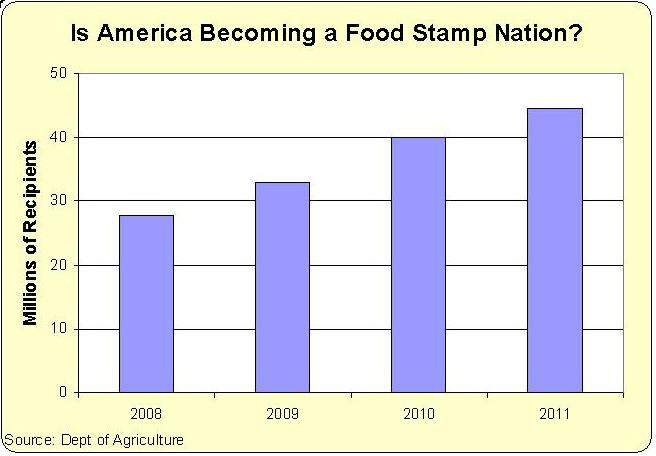

 Obama’s Budget Would Send Federal Debt to Levels Not Seen Since World War II
 Obama’s Budget Would Deepen Already Unprecedented Deficits


 In One Year, Spending on Interest on the National Debt Is Greater Than Funding for Most Programs
 Entitlement Spending Will More Than Double by 2050

 Taxing the Wealthy to Cover Future Deficits Won’t Work
 Discretionary Spending Cuts Alone Are Not an Adequate Substitute for Entitlement Reform


 The Daily Hatch