A satirical short film taking a look at the national debt and how it applies to just one family. Watch the guy from the Ferris Bueller Superbowl Spot! Produced by Seth William Meier, DP/Edited by Craig Evans, 1st AC Brian Andrews, Sound Mixer Gus Salazar, Written and Directed by Brian Stepanek. Help us spread the word by clicking ads or at www.debtlimitusa.org
_________________
President Obama c/o The White House
1600 Pennsylvania Avenue NW
Washington, DC 20500
You are the President of the United States and you need to take the bull by the horns and cut some spending now!!!! I read some wise words by Rep. Justin Amash (R-MI) and I wanted to pass them on. He sees how dangerous it is to keep kicking the can down the street: “The Budget Control Act trades $21 billion in cuts next year for a debt ceiling increase of $2.1 trillion. That’s one penny in cuts for each dollar of new debt. The bill does not seriously address the drivers of the federal government’s fiscal crisis. It does not improve entitlement programs. It does not include a balanced budget amendment to the Constitution.”
After all, despite all the sturm und drang about spending cuts as part of last year’s debt-ceiling deal, federal spending not only increased from 2011 to 2012, it rose faster than inflation and population growth combined.
We need some national statesmen (and ladies) who are willing to stop running up the nation’s credit card.
This week the Club for Growth released a study of votes cast in 2011 by the 87 Republicans elected to the House in November 2010. The Club found that “In many cases, the rhetoric of the so-called “Tea Party” freshmen simply didn’t match their records.” Particularly disconcerting is the fact that so many GOP newcomers cast votes against spending cuts.
The study comes on the heels of three telling votes taken last week in the House that should have been slam-dunks for members who possess the slightest regard for limited government and free markets. Alas, only 26 of the 87 members of the “Tea Party class” voted to defund both the Economic Development Administration and the president’s new Advanced Manufacturing Technology Consortia program (see my previous discussion of these votes here) and against reauthorizing the Export-Import Bank (see my colleague Sallie James’s excoriation of that vote here).
One of those Tea Party heroes was Justin Amash of Michigan. Last year I posted this below concerning his conservative views and his willingness to vote against the debt ceiling increase:
Washington, D.C. – Rep. Justin Amash (R-MI) issued the following statement after the vote on the Budget Control Act of 2011:
“The Budget Control Act trades $21 billion in cuts next year for a debt ceiling increase of $2.1 trillion. That’s one penny in cuts for each dollar of new debt. The bill does not seriously address the drivers of the federal government’s fiscal crisis. It does not improve entitlement programs. It does not include a balanced budget amendment to the Constitution. I cannot in good conscience vote for so little reform when so much is at stake.
“I had hoped that Democrats and Republicans would work together to develop a reasonable compromise that is fiscally responsible. I would favor a package that combines eliminating special tax breaks and subsidies with a well-structured balanced budget amendment. I believe that type of package would have broad-based support from the American people. Instead, Congress continues to kick the can down the road.
“We can do better. I look forward to working with my colleagues on both sides of the aisle over the next several months to adopt structural reforms that will put the government back on a sustainable path.”
Thank you so much for your time. I know how valuable it is. I also appreciate the fine family that you have and your commitment as a father and a husband.
Sincerely,
Everette Hatcher III, 13900 Cottontail Lane, Alexander, AR 72002, ph 501-920-5733, lowcostsqueegees@yahoo.com
But this progress didn’t last long. Thanks to George Bush’s reckless spending policies, the federal budget grew about twice as fast as the economy, jumping by nearly 90 percent in just eight years This pushed federal spending up to about 25 percent of GDP.
President Obama promised hope and change, but he has kept spending at this high level rather than undoing the mistakes of his predecessor.
This new video from the Center for Freedom and Prosperity Foundation uses examples of waste, fraud, and abuse to highlight President Obama’s failed fiscal policy.
This mini-documentary from the Center for Freedom and Prosperity Foundation highlights egregious examples of wasteful spending from the so-called stimulus legislation and explains why government spending hurts economic performance.
____________________
Good stuff, though the video actually understates the indictment against Obama. There is no mention, for instance, about all the new spending for Obamacare that will begin to take effect over the next few years.
But not everything can be covered in a 5-minute video. And I suspect the video is more effective because it closes instead with some discussion of the corrupt insider dealing of Obama’s so-called green energy programs.
More than two years ago, I explained in a TV interview that the looters and moochers should be careful that they don’t kill the geese that lay the golden eggs. After all, parasites need a healthy host.
The collapse of Europe’s welfare states should be a wake-up call for these people, but that hasn’t stopped the demands for more redistribution in Washington. As Michael Barone noted, the folks on the left assume that there will always be someone to plunder.
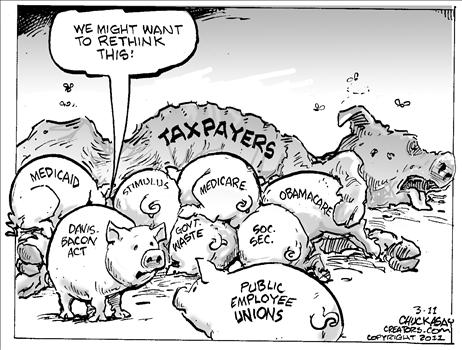
But at least the piglets in this Chuck Asay cartoon are finally waking up to reality.
Thank you so much for your time. I know how valuable it is. I also appreciate the fine family that you have and your commitment as a father and a husband.
Sincerely,
Everette Hatcher III, 13900 Cottontail Lane, Alexander, AR 72002, ph 501-920-5733, lowcostsqueegees@yahoo.com
With the national debt increasing faster than ever we must make the hard decisions to balance the budget now. If we wait another decade to balance the budget then we will surely risk our economic collapse.
The first step is to remove all welfare programs and replace them with the negative income tax program that Milton Friedman first suggested.
Milton Friedman points out that though many government welfare programs are well intentioned, they tend to have pernicious side effects. In Dr. Friedman’s view, perhaps the most serious shortcoming of governmental welfare activities is their tendency to strip away individual independence and dignity. This is because bureaucrats in welfare agencies are placed in positions of tremendous power over welfare recipients, exercising great influence over their lives. In addition, welfare programs tend to be self-perpetuating because they destroy work incentives. Dr. Friedman suggests a negative income tax as a way of helping the poor. The government would pay money to people falling below a certain income level. As they obtained jobs and earned money, they would continue to receive some payments from the government until their outside income reached a certain ceiling. This system would make people better off who sought work and earned income.
Participants: Robert McKenzie, Moderator; Milton Friedman; James R. Dumpson, Chief Administrator, Human Resources Admin., NYC; Thomas Sowell, Professor of Economics, UCLA; Robert Lampman, Professor of Economics, Institute of Poverty; Helen Bohen O’Bannon, Secretary of Welfare, State of Pennsylvania
FRIEDMAN: __ but political reality changes and that’s the important thing. I want to say one more thing about this, this whole problem that we’ve been talking about. And that is, going back to Bob Lampman’s comment, there is one thing that can be said in favor on the welfare program. Unaccustomed as I am to saying anything in favor of it; and that is, that it is the only social program I know of which at least, on the average, give money to people who are in lower income classes than those who pay the taxes. Every other welfare program, not only does a lot of money go to the people who are well off, but on the average the poor are taxed and the well-to-do are subsidized. We in the upper income classes have been very clever at conning the poor suckers at the bottom to pay us nice salaries as bureaucrats and to provide us with nice benefits at their expense, and at least the welfare program doesn’t do that.
MCKENZIE: And you stated with great confidence that it will come, the negative income tax, even though you recognize the hurdles. Why are you so sure it will come?
FRIEDMAN: Because the present system has within it the seeds of its own destruction. There is no way in which a system constructed like the present, in my opinion, can avoid creating more and more social problems, and something is going to have to be done. Nobody has proposed any alternative, so far as I know, there is no effective alternative to the negative income tax and so it gets knocked down and it keeps rising, it gets knocked down and it keeps rising.
MCKENZIE: He finally raised the question though whether in any modern industrial democracy like this one it’s conceivable system to be run without fairly elaborate welfare underpinning of some kind. What do you feel?
O’BANNON: I don’t think it can be because I think essentially the welfare __ set of welfare programs reflect the values of this society that if it didn’t there would have been revolt long before now. Yes, there are rumblings about its cost, and I think that’s primarily a function of rapid rates of inflation eroding real income earning power of the middle-class taxpayer, but I think on one level we wanted to give up the responsibility of caring, the responsibility of day-to-day actual caring and in a technical, modern, industrial society like we have the tax system and the government system is probably __ is a viable alternative. I don’t think we’re going to get out of it. I don’t think you’re going to see private charities who can take my money that I’m free to give, or not give, and essentially make a difference in people’s lives of any substance on any level.
SOWELL: I don’t think it has anything to do with the society being modern, technological or industrial, it has to do with an ideology and particularly an ideology that is very strong among academic intellectuals or in the media, and I think that as time goes on and more and more intelligent ideas replace the kinds of vague visions that dominate today, that the political climate will change and that’s the only thing that stands in the way of reform right now.
MCKENZIE: Jim Dumpson.
DUMPSON: I don’t think you’re going to get rid of the system but I’m interested __ welfare system, I’m interested in Tom’s last statement about academicians and theories and so forth, we forgot that we’re talking about people and we may sit in the ivory tower and talk about whether this system will work and either logically or illogically why it won’t work, at the same time there are masses of people outside who are locked out of the system that you and I are part of and somehow we’ve got to make sure those people are taken care of and the short of not doing it, of course, means that your safety and my safety and the vitality of this government and of our country is at stake. The Mayor of the city of New York asked me, when we had a strike, what would I do if I couldn’t get checks out to people when our workers were on strike and I said to him, “After the first month _ chaos.” And he said, “What do you mean?” I said, “No man or woman in this city of New York, you included Mr. Mayor, will be safe if we cannot take care of people…”
MCKENZIE: We leave this discussion and hope you’ll join us for the next episode of Free To Choose
____________
Thank you so much for your time. I know how valuable it is. I also appreciate the fine family that you have and your commitment as a father and a husband.
Sincerely,
Everette Hatcher III, 13900 Cottontail Lane, Alexander, AR 72002, ph 501-920-5733, lowcostsqueegees@yahoo.com
Social Security is a Ponzi Scheme but Blake who is a blogger said I was off base. Ark Times reader says Social Security is not Ponzi Scheme Social Security Disaster Walter E. Williams Columnist, Townhall.com Politicians who are principled enough to point out the fraud of Social Security, referring to it as a lie and […]
We got to do something soon about Social Security. The Case for Social Security Personal Accounts Posted by Daniel J. Mitchell There are two crises facing Social Security. First the program has a gigantic unfunded liability, largely caused by demographics. Second, the program is a very bad deal for younger workers, making them pay record […]
Senator Obama’s Social Security Tax Plan Uploaded by afq2007 on Jul 23, 2008 In addition to several other tax increases, Senator Barack Obama wants to increase the Social Security payroll tax burden by imposing the tax on income above $250,000. This would be a sharp departure from current law, which only requires that the tax […]
Saving Social Security with Personal Retirement Accounts Uploaded by afq2007 on Jan 10, 2011 There are two crises facing Social Security. First the program has a gigantic unfunded liability, largely thanks to demographics. Second, the program is a very bad deal for younger workers, making them pay record amounts of tax in exchange for comparatively meager benefits. This […]
“Saving the American Dream: The Heritage Plan to Fix the Debt, Cut Spending, and Restore Prosperity,” Heritage Foundation, May 10, 2011 by Stuart Butler, Ph.D. , Alison Acosta Fraser and William Beach is one of the finest papers I have ever read. Over the next few days I will post portions of this paper, but […]
Is Social Security a Ponzi Scheme? I just started a series on this subject. In this article below you will see where the name “Ponzi scheme” came from and if it should be applied to the Social Security System. Ponzi! Ponzi! Ponzi! 9/14/2011 | Email John Stossel | Columnist’s Archive Ponzi! Ponzi! Ponzi! There, I […]
Uploaded by LibertyPen on Jan 8, 2009 Professor Williams explains what’s ahead for Social Security Dan Mitchell on Social Security I have said that Social Security is a Ponzi scheme and sometimes you will hear someone in the public say the same thing. Yes, It Is a Ponzi Scheme by Michael D. Tanner Michael Tanner […]
With the national debt increasing faster than ever we must make the hard decisions to balance the budget now. If we wait another decade to balance the budget then we will surely risk our economic collapse.
The first step is to remove all welfare programs and replace them with the negative income tax program that Milton Friedman first suggested.
Milton Friedman points out that though many government welfare programs are well intentioned, they tend to have pernicious side effects. In Dr. Friedman’s view, perhaps the most serious shortcoming of governmental welfare activities is their tendency to strip away individual independence and dignity. This is because bureaucrats in welfare agencies are placed in positions of tremendous power over welfare recipients, exercising great influence over their lives. In addition, welfare programs tend to be self-perpetuating because they destroy work incentives. Dr. Friedman suggests a negative income tax as a way of helping the poor. The government would pay money to people falling below a certain income level. As they obtained jobs and earned money, they would continue to receive some payments from the government until their outside income reached a certain ceiling. This system would make people better off who sought work and earned income.
Participants: Robert McKenzie, Moderator; Milton Friedman; James R. Dumpson, Chief Administrator, Human Resources Admin., NYC; Thomas Sowell, Professor of Economics, UCLA; Robert Lampman, Professor of Economics, Institute of Poverty; Helen Bohen O’Bannon, Secretary of Welfare, State of Pennsylvania
LAMPMAN: I think it’s a viable approach to some part of the problems of poverty. It involves, first of all, cash payments rather than in kind payments as I understand it? It involves payments on a non-categorical basis.
MCKENZIE: What do you mean non-categorical?
LAMPMAN: That is to say, it doesn’t matter whether you’re a female-headed family or a male-headed family or whether you’re young or old, you’re sick or well.
MCKENZIE: If your income falls below a certain level you __
LAMPMAN: Pay some guaranteed income level for people based on family size and then it has a take-back rate which is modest, I suppose, by definition. Now, the question is: How many things you want to use that program to replace? How many things you want to replace with such a negative income tax program.
MCKENZIE: Would you replace everything with it __ just __ we clear that point up. Would you virtually wipe out the remaining forms of welfare if you got this program going?
FRIEDMAN: Yes, I would not __ I think its purpose is precisely to provide a transition between where we are now and where we would like to go because while __ because I agree with you, that given that we’ve corrupted the people on welfare and gotten them on there. We do have an obligation not to throw them out in the street and put them in the difficult adjustment you’ve made. We’ve got to ease the __
MCKENZIE: Yeah. Okay. Right.
FRIEDMAN: __ ease it off __
MCKENZIE: Sure. Yeah.
FRIEDMAN: __ and so __ but I would want to replace all __
MCKENZIE: Yeah. Okay.
FRIEDMAN: __ present welfare programs.
MCKENZIE: Let’s get reactions to this and then we’ll come back to you.
SOWELL: Well, I saw some figures recently which said that if you took all the money spent on poverty in the United States and divided it by all the poverty families you’d come out with a figure of $32,000 per family. Now, the average poverty family is apparently not getting the $32,000 and so clearly someone in between the treasury and those families is getting an awful lot of that money and I think if you simply eliminated the middle man, as they say in the commercials, that there’d be an awful lot of benefit both to the poor and to the taxpayers.
DUMPSON: I’m supportive of the negative income tax concept and the objective of it. I’d like to point out, however, that administratively we have another bureaucracy set up. Somebody has to take into account earnings. Someone has to decide when to pay back that which they’re entitled to. There’s a time lag between the paying back __ the earning and the paying back. There are a variety of problems in there that I will be prepared to accept but I want you to know that government intervention is not going to be eliminated.
O’BANNON: The issue that I have is: Where do children come in? What are their rights under a negative income tax? And are we, by building in a negative income tax, in fact subsidizing the illegitimacy that Tom Sowell is so concerned about?
FRIEDMAN: The major reason it is not feasible today to have a negative income tax is because the present welfare bureaucracy would be out of work. They are the major objectors and as Senator Pat __ he’s now a senator, Pat Moynihan demonstrated in his book on the Nixon program, the chief obstacle to getting it enacted was the welfare bureaucracy. So that I don’t believe these administrative problems, if you got it enacted, would be at all serious.
O’BANNON: I think the other assumption under the negative income tax, and it’s one that I’m not sure I can buy, is that everybody has a minimum level of understanding about how to spend money. In other words, how to use the marketplace to satisfy wishes. And I, as an economist, would say, yes, we do. We __ everybody from age four to a hundred knows how to use money to satisfy wants and that’s the __
FRIEDMAN: But they don’t. They don’t. There are all sorts of problems of people who are not going to be able to. But that’s a minority problem. That’s a problem for private activity and private charity. One thing is sure: They’re spending __ they would be spending their own money and that however knowledgeable you are about money __
O’BANNON: They would be spending my money.
FRIEDMAN: They would be spending my money, but it would be one stage less then. Right now, the welfare worker is spending Mr. A’s money to help Mr. C. And there’s a big takeoff in the middle as Tom Sowell said.
SOWELL: The question is not whether the people on welfare or low incomes can all spend their money effectively; the question is: How effectively do they spend it as compared to how effectively the bureaucrats spend it for them. Comparing anything to perfection or to some arbitrary standard settles nothing. The same thing is true in the education area. They’re saying “Would families be able to spend their __ select schools for their kids under a voucher system,” for example. Well, the question is: Could they possibly do much worse than the current bureaucrats are doing in the public school system.
O’BANNON: Oh __
MCKENZIE: We’ve run on education on another program. Bob Lampman.
(Laughing)
LAMPMAN: I want to quibble with something you said, Tom, about half of the money not going to the poor or something. That doesn’t __ shouldn’t leave the viewer to think that all the money is going to the administrators of programs. A lot of what you are talking about goes to non-poor recipients. For example, social security, as a program, pays a roughly half of its benefits to people who otherwise would not be poor. Unemployment insurance pays about two-thirds of its benefits or so to non-poor persons. And those are, in some definitions, welfare or anti-poverty programs and that’s how statisticians come up with this horrendous sounding discrepancy between the total amount of money spent and the total cash benefits that go to the poor.
SOWELL: Well, I think, I think it’s a perfectly valid point though, because supposedly we were not setting up unemployment benefits and social security in order to keep the affluent.
LAMPMAN: Well, this goes back to its big philosophy, debate we might have. I think that it’s easy to oversimplify things and say that all these programs, including the public schools are there to be a help to the poor and poor only.
FRIEDMAN: Yeah, but I was saying __
LAMPMAN: But let me mention that the negative income tax has some of its impetus in that it would be a way of confining benefit payments to people who are __
SOWELL: Yes. Yes.
LAMPMAN: __ and it would cut out benefits for an awful lot of people who now have expectations that they’re going to get them, not in the form of public assistance, but in the form of social insurance as we use the term.
SOWELL: Well, in order to be made for not disappointing the expectations on which people have built their lives for one generation, but not of continuing for eternity in order to avoid one generation of transition.
MCKENZIE: What are the other hurdles toward getting underway. Now, you said, I don’t know how seriously, the biggest almost the only hurdle is the welfare bureaucracy.
FRIEDMAN: No. Now, there’d be the biggest immediate group of lobbyists that will lobby against it.
MCKENZIE: Yep.
FRIEDMAN: The biggest hurdle in getting it over at the moment is that there is no way of constructing a sensible negative income tax system that will not hurt some people. There will be some people who will get less money than they are now getting under __ particularly those in the upper income groups. Particularly the affluent who are now being subsidized by the welfare and they, will make it politically difficult for the people to put it into effect. The attempt is to put a negative income tax in effect which costs less money, is easier to administer, and yet which doesn’t pay anybody in the society one dollar less than he’s now getting. There’s no way in which you can construct such a program. But, although it’s not politically feasible now, the force of history is on its side, it’s going to become political __
MCKENZIE: Dr. James Dumpson.
DUMPSON: Let’s not say that the __ give the impression that welfare administrators were against negative income tax, the fat program for example, as Moynihan says, because they would lose their jobs, for example. Many of us were opposed to it because of certain features in that program: A $24 __ $2,400 level for a family of four. We were opposed to that. And if one goes down the Congressional record, those who testified, will be shown to be saying, “Yes, we’re for it conceptually. But we’re against this piece and this piece, if you change that you’ll have our support.”
FRIEDMAN: I was in the same position. I first proposed the negative income tax twenty-five years ago but I testified against the final version of the Nixon plan. Why? Because the welfare bureaucrats had led them to introduce changes in it which converted it from a decent satisfactory negative income tax to one which would have been just as bad as what you have now. Would have been added on top of everything else.
O’BANNON: Cold reality.
FRIEDMAN: It’s political reality __
O’BANNON: That’s right.
_____________
Thank you so much for your time. I know how valuable it is. I also appreciate the fine family that you have and your commitment as a father and a husband.
Sincerely,
Everette Hatcher III, 13900 Cottontail Lane, Alexander, AR 72002, ph 501-920-5733, lowcostsqueegees@yahoo.com
How can Washington D. C. get enough money to balance the budget and not cut spending. The answer is that everyone’s taxes must go up. Don’t let anyone fool you. There is not enough money to just tax the rich. Instead, entitlements need to be reform and real spending cuts need to be made.
The Washington establishment loves talking about the “distribution” of income and taxes. The CBO has issued a new report on the topic that will no doubt keep the discussion rolling on.
The mindset of many people in government is encapsulated by this sentence in the CBO report: “Market income is very unevenly distributed.” But anyone with a decent appreciation of America’s economy knows that market income is in fact earned in a decentralized fashion by 140 million people and 25 million businesses spread across this vast land. It is not ”distributed” from a big vault in the capital by central-planning czars with a god-given preemptive right to decide how much everyone gets.
Yes, the huge subsidies that the federal government hands out each year are “distributed.” But CBO statisticians seem to be so used to thinking about the entire economy as a giant government-created pie that they say market income is also distributed.
That said, the CBO report has some interesting statistics to consider. Most important are calculations of average federal tax rates, which are total federal taxes paid as a share of income. The chart shows average tax rates by quintiles, which each contain one fifth of U.S. households grouped by income level. The households at the top are hit with the largest burdens by far. Elsewhere, I’ve discussed who some of these high-earning households are and the damage done by nailing them with such high taxes. (For example, see here and here).
Why not pass the Balanced Budget Amendment? As you know that federal deficit is at all time high (1.6 trillion deficit with revenues of 2.2 trillion and spending at 3.8 trillion).
On my blog www.HaltingArkansasLiberalswithTruth.com I took you at your word and sent you over 100 emails with specific spending cut ideas. However, I did not see any of them in the recent debt deal that Congress adopted. Now I am trying another approach. Every week from now on I will send you an email explaining different reasons why we need the Balanced Budget Amendment. It will appear on my blog on “Thirsty Thursday” because the government is always thirsty for more money to spend.
No objective is more important for the new Congress than putting America on course toward a balanced federal budget. We used to balance our budget regularly but, except for a short period during the late 1990’s, Congress has been unable to accomplish what should be a clear-cut mission. Americans understand that deficit spending may be unavoidable in wartime or in a Katrina-like emergency, but we also believe that in the absence of these events, there is no excuse for irresponsibly increasing our national debt.
Unfortunately, our national agenda no longer seems to include a balanced budget. President Obama established a national debt commission (whose report I will address in a future column), but that was only after cranking up federal expenditures and deficits to previously unseen levels.
We all know that the big enchiladas in the Federal budget are Social Security, Medicare and Medicaid, and national defense. That still leaves a lot of money to be saved elsewhere, yet even these opportunities are far too often belittled by elitists. For example, Jackie Calmes, a New York Times reporter, wrote that while there is general agreement on an earmark ban, “… [it] would hardly dent the projected annual deficits.” Paul Krugman, her colleague at the Times and the current economic guru of the left, routinely dismisses any savings at all, his most recent tantrum being Obama’s proposal for a two-year freeze on pay raises. He states “The actual savings, about $5 billion over two years, are chump change given the scale of the deficit.” These are two examples that occurred within days – and I could probably cite hundreds more, from both sides of the aisle.
The United States has a budget crisis that should be met by expenditure reductions, but our government has acted only with foolishness and cowardice. Let’s say your employer came to you and said “Look, the company is struggling, but I can keep you on if we reduce your annual salary from $80,000 to $70,000.” You would go home, sit down with your spouse, and figure out where you can start saving money. You could skip the Saturday night movies and join Netflix. You could learn to live without HBO. You could stop getting water delivered to the house. The bottom line is that you would adjust your expenditures because you have no choice; after all, you can’t print money or sell bonds to your neighbors. Not even to China.
What our government is doing has been going on for hundreds of years, ever since the Rothschilds made their fortune lending monies to the monarchies of Europe, and it has become an international problem of gargantuan proportions. Political leaders all over the world are making fiscal promises that they cannot keep, and this irresponsible practice has exploded in the past seventy-five years with the advent of left-wing, socialist governments. Overspending has become so pervasive that our society makes fun of it. In his recent HBO special, Dennis Miller spoke about not understanding the deficit. Miller said that he asked his son if he was upset that his generation would be saddled with the national debt. His son replied “Christ no Dad, I’m just going to saddle my kids with it.” It was good for a laugh – but Miller would never force his own kids to pay his credit card bills.
Virtually every parent I have ever met worries about what will be left for their children or grandchildren when they die. These people understand that it is immoral and sinful to leave their kids a pile of debt. Yet when it comes to the government – for which we are all responsible – people perceive it as some amorphous entity that can merrily spend more each year than it takes in without any consequences. They believe government, apparently, can pay for everything.
And unfortunately we do. Prodded by spineless and corrupt politicians who consider power far more important than responsibility, government has become the fixer of all our problems. People can live in a flood plain without insurance and then get paid by the government to rebuild in that same flood plain only to be wiped out again in the next flood. Every challenge that we have in this country is being discussed by a commission that lasts forever without ever solving the problem. Responsible Americans put their hand out when they hear of a government program because they rationalize they want their share, and if they don’t get it now someone else will. The sense of communal cost has disappeared.
The numbers are staggering. If the U.S. government had to employ the same accounting standards used by major corporations, it would report an annual deficit between $4 and $5 trillion. 41% of our current federal expenditures are paid for by borrowing money, and by 2015, America will be about $20 trillion in debt.
Our elected officials must face these facts, along with the immoral and pathetic aspects of their reckless behavior. Polls that say that taxpayers demand certain things need to be disregarded, and responsible leaders with some backbone must instead broadcast the simple truth: The jig is up and we need to reverse course. You cannot have everything you want. You can have Social Security, but you should expect less and start saving for yourself more. Medicare will help with your retirement healthcare, but you should have something saved for that as well. If you have a catastrophe, you’d better have an insurance policy because we cannot guarantee every one of your risks. And if your parents get ill in their old age, you’d better be prepared to take care of them just as they took care of you.
Saddling our kids with more and more debt is just plain wrong. The debt is bad enough now and we need to stop it from getting worse. The time is now and this Congress was elected to do just that thing.
Bruce Bialosky
Bruce Bialosky is the founder of the Republican Jewish Coalition of California and a former Presidential appointee.
With the national debt increasing faster than ever we must make the hard decisions to balance the budget now. If we wait another decade to balance the budget then we will surely risk our economic collapse.
The first step is to remove all welfare programs and replace them with the negative income tax program that Milton Friedman first suggested.
Milton Friedman points out that though many government welfare programs are well intentioned, they tend to have pernicious side effects. In Dr. Friedman’s view, perhaps the most serious shortcoming of governmental welfare activities is their tendency to strip away individual independence and dignity. This is because bureaucrats in welfare agencies are placed in positions of tremendous power over welfare recipients, exercising great influence over their lives. In addition, welfare programs tend to be self-perpetuating because they destroy work incentives. Dr. Friedman suggests a negative income tax as a way of helping the poor. The government would pay money to people falling below a certain income level. As they obtained jobs and earned money, they would continue to receive some payments from the government until their outside income reached a certain ceiling. This system would make people better off who sought work and earned income.
Participants: Robert McKenzie, Moderator; Milton Friedman; James R. Dumpson, Chief Administrator, Human Resources Admin., NYC; Thomas Sowell, Professor of Economics, UCLA; Robert Lampman, Professor of Economics, Institute of Poverty; Helen Bohen O’Bannon, Secretary of Welfare, State of Pennsylvania
O’BANNON: I think the other __ we have a program in Pennsylvania for essentially all of those who are not taken care of by the AFDC program. It’s called the General Assistance Program. And there less than 15 percent are on more than eighteen months. So we have a great turnover. We have essentially young males moving into the welfare system after unemployment compensation, and then moving out when a job opportunity comes along. This, you know, I think the notion of generations of people on welfare is a very small minority in the whole system. That doesn’t mean that the system as presently defined and as the set of programs that we have put together don’t often contradict each other and I’m the first to agree with Dr. Friedman that some of the programs are conflicting. However, I think it is overly broad to say that we turn people into helpless children.
SOWELL: I don’t remember talking to anyone who’s ever been on welfare who didn’t think they were being treated like children while they were on it.
DUMPSON: Of course, I think, you know, you __ one must make a difference, a distinction between a system that was set up to help people and the people who are employed in that system. Look at any public welfare system around the country and we have no, practically few trained people who to work with people. We employ them ill-trained, people who are not equipped to be helping people. We say they’re social workers. They’re not social workers, they have neither the skills, the attitudes, and some of them not even the concerns; so I think one has to separate how a conceptual framework of a system designed to help people and what the country and community puts into that system to implement those programs.
SOWELL: You mean to separate the hopes from the reality.
DUMPSON: I separate the skills that are available in order to implement what the objectives of the program are. I think we have to separate whether we are talking about program objectives, or we’re talking about how it operates. I would be the first to say that the system that I administered had ill-prepared people to do the job that we were set up to do, and I would not say that the system that we set up __
SOWELL: I talked to some social welfare people who think that in fact they were so hamstrung by the system that there was very little they could do to help people to get off welfare; that is to build up skills at jobs, do whatever was necessary to get off welfare. They felt it was the system.
MCKENZIE: Bob Lampman, your comment.
LAMPMAN: The system that we’re stereotyping is one of a great deal of paternalistic interference in individual family’s lives and in fact isn’t it true, Mr. Dumpson, that case load is so high for an individual welfare worker that they can’t do a lot of interfering in individual family lives. Moreover, in the last decade there’s been a real attempt to ease this welfare trap in AFDC by changing the take-back rate and by administering work expenses and child care expenses in such a way as to facilitate work by those who may want to do it; so it’s not quite as harsh a picture as we sometimes get that there is this omniscient welfare worker who’s right there in the living room with the family making all their decisions for them.
FRIEDMAN: I’ve never heard of a government program which was defective in which the people who ran it didn’t say, “If only we had more money to spend on what we’re not being able to accomplish with the amount we’re spending now.”
MCKENZIE: Milton, we’re going to move along now to some of your prescriptions in that film because I think it’s good ground for discussion. The most drastic one was when you said, speaking of an unemployed man, “Supposing you were cruel and took away welfare from this man, he would find a job at some wage, there’d always be a job he could get; he might need some charity on route, private charity, but he would get a job.” Now, I want you to react, those of you, before we come back to Milton on that. Is that a picture that seems plausible to you?
DUMPSON: He may get a job, and he may get a job in what we refer to as the underground economy, and that’s where a number of our youth are now going to get their jobs. Those activities that are illegal, the only opportunities they have for earning their part of a livelihood.
O’BANNON: I think the other issue is that you have a whole group of people who are the single, female head of the household; and yes, cut off welfare tomorrow: What will they do? What will be their immediate response? At what price to their small children and to their middle-aged children? Yes, they’ll get a job, in fact the statistics show that women, in fact, are the most successful through the employment program. But what has to supplement that typically is the provision of some kind of day care arrangement. Either the individual woman has to earn enough money to be able to pay privately for her day care, or in fact, she is quote “subsidized” through this insidious, corrupting program, set of programs, run by the federal government which, in fact, makes her employable and a taxpayer. It’s an interesting notion of trying to get people in a productive mode.
MCKENZIE: Tom Sowell.
SOWELL: It’s incredible the way you start the story in the middle as if there’s a predestined amount of poverty, a predestined amount of unemployment and that the welfare system is not itself in any way responsible for that __
O’BANNON: There is a predestined 20 percent of the bottom half of the population.
SOWELL: I have never __ well, that’s always been true __
(Everyone speaking at once)
O’BANNON: There’s going to be 20 percent at the bottom.
SOWELL: It’s also true that 20 percent of the bottom population doesn’t have to be living on the government and ruled by the government. You mentioned, for example, a female head of household. Many of those, in addition to the grown woman who has all the kids, are teenage pregnancies. There’s not a predestined amount of teenaged pregnancies. I grew up in an era when people, and particularly blacks, were a lot poorer than today, faced a lot more discrimination than today, and in which teenage pregnancy rate was a lot lower than today. I don’t believe there is a predestined amount of teenage pregnancy. A predestined amount of husband desertion. Gutman has done a study of a black family showing that this whole notion that the black family has always been disintegrating, that is nonsense. His studies go up to 1925, the great bulk of black families were intact two-parent families up to 1925 and going all the way back through the era of slavery, so it is now, only within our own time, that we suddenly see this inevitable tragedy which the welfare system says it’s going to rush in to solve.
O’BANNON: We’re talking to Tom about __
SOWELL: To which it is itself a point __
O’BANNON: We’re talking about a very small group. We’re talking about twelve percent of the families are not intact. Are not two-parent families at any one period __
SOWELL: Do you mean __ among welfare recipients __
O’BANNON: No.
SOWELL: __ or the public at large?
O’BANNON: Among the public at large. We’re talking about twelve percent of the families; twelve percent.
SOWELL: That’s right.
O’BANNON: That’s a small number. But __
SOWELL: We’ve got to build on welfare.
O’BANNON: We’re still talking about a significant component of the bottom twenty percent that are the bottom twenty percent. Whether they are above the poverty line or below the poverty line; they are still the bottom twenty percent. And the issue is: What is the responsibility of the other eighty percent; if any, towards those others?
SOWELL: There’s no program plan to eliminate there being a bottom twenty percent?
O’BANNON: No. But it intends to raise the bottom twenty percent so __
SOWELL: We’re raising them by having more __ by having more illegitimacy, more unemployment, by having __
O’BANNON: I’m not making them be __ have illegitimate children. I hope that’s clear.
SOWELL: Oh, I_I__ you don’t have to do that. You simply subsidize it.
FRIEDMAN: We, as human beings, don’t have a responsibility; but I hope we have a compassion and an interest in the bottom twenty percent. And I only want to say to you that the capitalist system, the private enterprise system in the 19th century did a far better job of expressing that sense of compassion than the governmental welfare programs are today. The 19th century, the period which people denigrate as the high tide of capitalism was the period of the greatest outpouring of Ella Mosner in charitable activity that the world has ever known. And one of the things I hold against the welfare system, most seriously, is that it has destroyed private charitable arrangements which are far more effective, far more compassionate, far more person-to-person in helping people who are really, for no fault of their own, in disadvantaged situations.
O’BANNON: I have to disagree with you though, because I think that the whole notion of private property was excluded, whole segments of society were excluded from the notion of private property in the 19th century; namely, women, idiots and imbeciles. And so, I don’t go back to the 19th century and hold it up as any paragon that we would want to replicate today.
MCKENZIE: Anyway. I want Milton now to come to your major prescription, which I know you don’t say is on the agenda for tomorrow, but it lies ahead; that is, the negative income tax. And I’m not sure people fully understand how it would work. We can’t, I think, go to the details of it, but I’d like to get a reaction around the panel first of all, is this a viable approach to the enduring problems of poverty? Negative income tax.
_________________
Thank you so much for your time. I know how valuable it is. I also appreciate the fine family that you have and your commitment as a father and a husband.
Sincerely,
Everette Hatcher III, 13900 Cottontail Lane, Alexander, AR 72002, ph 501-920-5733, lowcostsqueegees@yahoo.com
The Obama Administration came out swinging against its critics on welfare reform yesterday, with Press Secretary Jay Carney saying the charge that the Administration gutted the successful 1996 reform’s work requirements is “categorically false” and “blatantly dishonest.” Even former President Bill Clinton, who signed the reform into law, came out parroting the Obama team’s talking points and saying the charge was “not true.”
The Heritage Foundation’s Robert Rector and Kiki Bradley first broke the story on July 12 that Obama’s Health and Human Services Department (HHS) had rewritten the Clinton-era reform to undo the work requirements, in a move that legal experts Todd Gaziano and Robert Alt determined was patently illegal.
The Administration’s new argument has two parts: denying the Obama Administration’s actions and claiming that Republican governors, including Mitt Romney, tried to do the same thing. In essence, “We did not do what you’re saying, but even if we did, some Republicans did it, too.” Both parts of this argument are easily debunked.
Obama Administration Claim #1: We Didn’t Gut Work Requirements
Ever since the 1996 law passed, Democratic leaders have attempted (unsuccessfully) to repeal welfare’s work standards, blocking reauthorization of the Temporary Assistance for Needy Families program (TANF) and attempting to weaken the requirements. Unable to eliminate “workfare” legislatively, the Obama HHS claimed authority to grant waivers that allow states to get around the work requirements.
Humorously, HHS Secretary Kathleen Sebelius now asserts that the Administration abolished the TANF work requirements to increase work.
HHS now claims that states receiving a waiver must “commit that their proposals will move at least 20 percent more people from welfare to work compared to the state’s prior performance.” But given the normal turnover rate in welfare programs, the easiest way to increase the number of people moving from “welfare to work” is to increase the number entering welfare in the first place.
Bogus statistical ploys like these were the norm before the 1996 reform. The law curtailed use of sham measures of success and established meaningful standards: Participating in work activities meant actual work activities, not “bed rest” or “reading” or doing one hour of job search per month; reducing welfare dependence meant reducing caseloads. Now those standards are gone.
Obama’s HHS claims authority to overhaul every aspect of the TANF work provisions (contained in section 407), including “definitions of work activities and engagement, specified limitations, verification procedures and the calculation of participation rates.” In other words, the whole work program. Sebelius’s HHS bureaucracy declared the existing TANF law a blank slate on which it can design any policy it chooses.
Obama Administration Claim #2: Even If We Did, the Republicans Tried It, Too
Though the Obama Administration is claiming it is not trying to get around the work requirements, it is also claiming that a group of Republican governors tried to do the same thing in 2005. Clinton also said in his statement yesterday that “the recently announced waiver policy was originally requested” by Republican governors.
Heritage welfare expert Robert Rector addressed this claim back on July 19. As Rector explains:
But [the governors’] letter makes no mention at all of waiving work requirements under the Temporary Assistance for Needy Families (TANF) program. In fact, the legislation promoted in the letter—the Personal Responsibility and Individual Development for Everyone (PRIDE) Act—actually would have toughened the federal work standards. It proposed raising the mandatory participation rates imposed on states from 50 percent to 70 percent of the adult TANF caseload and increasing the hours of required work activity.
The governors’ letter actually contradicts the Administration’s main argument: If the law has always permitted HHS to waive the work requirements, then why didn’t the governors just request waivers from then-President George W. Bush? Why would legislation be needed?
Two reasons: First, it has been clear for 15 years that the TANF law did not permit HHS to waive the work requirements. Second, the Republican governors were not seeking to waive the work requirements in the first place.
Obama’s Evolution from Welfare to Work and Back
President Obama had a convenient change of heart regarding welfare reform when it was time to run for President. In 1998, when he was an Illinois state senator, Obama said:
I was not a huge supporter of the federal plan that was signed in 1996. Having said that, I do think that there is a potential political opportunity that arose out of welfare reform. And that is to desegregate the welfare population—meaning the undeserving poor, black folks in cities, from the working poor—deserving, white, rural as well as suburban.
The same year, he reiterated that “the 1996 legislation I did not entirely agree with and probably would have voted against at the federal level.”
But in 2008, when he was running for President, Obama said he had changed his mind about welfare reform: “I was much more concerned 10 years ago when President Clinton initially signed the bill that this could have disastrous results….It had—it worked better than, I think, a lot of people anticipated. And, you know, one of the things that I am absolutely convinced of is that we have to work as a centerpiece of any social policy.”
One of his 2008 campaign ads touted “the Obama record: moved people from welfare to work” and promised that as President, he would “never forget the dignity that comes from work.”
This evolution is unsurprising, considering the vast majority of Americans favor requiring welfare recipients to work.
President Obama has finally accomplished what Democrats have been trying to do for years. He has even gotten President Clinton to turn his back on one of the signature achievements of his Administration to give him political cover—which Clinton was quick to do. In 1996, Clinton had to compromise and allow the tough work requirements to get the legislation passed.
Both Presidents have now revealed their true feelings about welfare—and there’s no denying it.
Is President Obama gutting the welfare reform that Bill Clinton signed into law? Morning Bell: Obama Denies Gutting Welfare Reform Amy Payne August 8, 2012 at 9:15 am The Obama Administration came out swinging against its critics on welfare reform yesterday, with Press Secretary Jay Carney saying the charge that the Administration gutted the successful […]
Thomas Sowell – Welfare Welfare reform was working so good. Why did we have to abandon it? Look at this article from 2003. The Continuing Good News About Welfare Reform By Robert Rector and Patrick Fagan, Ph.D. February 6, 2003 Six years ago, President Bill Clinton signed legislation overhauling part of the nation’s welfare system. […]
Uploaded by ForaTv on May 29, 2009 Complete video at: http://fora.tv/2009/05/18/James_Bartholomew_The_Welfare_State_Were_In Author James Bartholomew argues that welfare benefits actually increase government handouts by ‘ruining’ ambition. He compares welfare to a humane mousetrap. —– Welfare reform was working so good. Why did we have to abandon it? Look at this article from 2003. In the controversial […]
Johan Norberg – Free or Equal – Free to Choose 30 years later 3/5 Published on Jun 10, 2012 by BasicEconomics In 1980 economist and Nobel laureate Milton Friedman inspired market reform in the West and revolutions in the East with his celebrated television series “Free To Choose.” Thirty years later, in this one-hour documentary, […]
I thought it was great when the Republican Congress and Bill Clinton put in welfare reform but now that has been done away with and no one has to work anymore it seems. In fact, over 40% of the USA is now on the government dole. What is going to happen when that figure gets over […]
Thomas Sowell If the welfare reform law was successful then why change it? Wasn’t Bill Clinton the president that signed into law? Obama Guts Welfare Reform Robert Rector and Kiki Bradley July 12, 2012 at 4:10 pm Today, the Obama Department of Health and Human Services (HHS) released an official policy directive rewriting the welfare […]
President Obama c/o The White House 1600 Pennsylvania Avenue NW Washington, DC 20500 Dear Mr. President, I know that you receive 20,000 letters a day and that you actually read 10 of them every day. I really do respect you for trying to get a pulse on what is going on out here. Dan Mitchell […]
I have been writing President Obama letters and have not received a personal response yet. (He reads 10 letters a day personally and responds to each of them.) However, I did receive a form letter in the form of an email on July 10, 2012. I don’t know which letter of mine generated this response so I have […]
Welfare reform was working so good. Why did we have to abandon it? Look at this article from 2003. The Continuing Good News About Welfare Reform By Robert Rector and Patrick Fagan, Ph.D. February 6, 2003 Six years ago, President Bill Clinton signed legislation overhauling part of the nation’s welfare system. The Personal Responsibility and […]



 The Daily Hatch