Category Archives: spending out of control

Senator Pryor asks for Spending Cut Suggestions! Here are a few!(Part 159)

Senator Pryor asks for Spending Cut Suggestions! Here are a few!(Part 159)

Senator Mark Pryor wants our ideas on how to cut federal spending. Take a look at this video clip below:

Senator Pryor has asked us to send our ideas to him at cutspending@pryor.senate.gov and I have done so in the past and will continue to do so in the future.

On May 11, 2011,  I emailed to this above address and I got this email back from Senator Pryor’s office:

Please note, this is not a monitored email account. Due to the sheer volume of correspondence I receive, I ask that constituents please contact me via my website with any responses or additional concerns. If you would like a specific reply to your message, please visit http://pryor.senate.gov/contact. This system ensures that I will continue to keep Arkansas First by allowing me to better organize the thousands of emails I get from Arkansans each week and ensuring that I have all the information I need to respond to your particular communication in timely manner.  I appreciate you writing. I always welcome your input and suggestions. Please do not hesitate to contact me on any issue of concern to you in the future.

I just did. I went to the Senator’s website and sent this below:

Below is an excellent plan to balance the budget through spending cuts from Chris Edwards of the Cato Institute written in April of 2011. Here is the second part.

A Plan to Cut Spending and Balance the Federal Budget

by Chris Edwards, Cato Institute

Introduction
Reducing Spending over 10 Years
Spending Cut Details
Subsidies to Individuals and Businesses
Aid to State and Local Governments
Military Expenses
Medicare, Medicaid, and Social Security
Privatization
Conclusions

Spending Cut Details

Table 1 lists the proposed annual cuts for the balanced budget plan. By 2021, these include $150 billion in defense cuts and $490 billion in cuts to Medicare, Medicaid, Social Security, and the 2010 health care law. The table also includes other discretionary and entitlement cuts valued at $445 billion in 2011. With the assumed revenues, all these spending cuts would be saving the government $260 billion in annual interest costs by 2021.7 All in all, total spending in 2021 under this plan would be about $1.4 trillion lower than under either the CBO baseline or the president’s budget.

As a technical note, most of the figures in Table 1 are outlays for fiscal 2011 from President Obama’s fiscal 2012 budget.8 These cuts are expressed in 2011 dollars, but I’ve assumed that the value of these cuts would grow over time at the same rate as discretionary spending in the CBO baseline. The cuts in Table 1 marked with an asterisk are expressed in 2021 dollars and are generally based on CBO estimates.

The reforms listed in the table are deeper than the “duplication” and “waste” items often mentioned by federal policymakers, such as earmarks. The reality is that the nation faces a fiscal emergency, and we need to cut hundreds of billions of dollars of “meat” from federal departments, not just the obvious “fat.” If the activities to be cut are useful to society, then state governments or private groups should fund them, and those entities would probably be more efficient at doing so.

The cuts in Table 1 are illustrative of how to begin getting the federal budget under control. Further reforms are needed in addition to these cuts, particularly structural changes to Medicare. But the important thing is to start cutting right away because the longer we wait, the deeper the pile of debt we will have to dig out from.

Table 1 includes cuts to individual and business subsidies, cuts to state aid, cuts to military expenses, cuts to the growth in entitlement programs, and privatization of federal activities. The sections following the table discuss these various types of cuts, and further analysis of the cuts is available at www.DownsizingGovernment.org.

Table 1
Proposed Federal Budget Cuts
Agency and Activity   Annual Savings
     
$ billion
Department of Agriculture    
  End farm subsidies   29.5
  Cut food subsidies by 50 percent   52.7
  End rural subsidies   4.2
  Total cuts   86.4
Department of Commerce    
  End telecom subsidies   2.3
  End economic development subsidies   0.6
  Total cuts   2.9
Department of Defense    
  Enact Preble/Friedman reforms**   150.0
Department of Education    
  End K-12 education subsidies   52.7
  End student aid and all other programs   33.1
  Total cuts (terminate the department)   85.8
Department of Energy    
  End subsidies for energy efficiency   10.2
  End subsidies for vehicle technologies   5.2
  End the technology loan program   1.2
  End electricity research subsidies   2.0
  End fossil energy research   1.1
  Privatize the power marketing administrations   0.5
  End nuclear energy subsidies   0.6
  Total cuts   20.8
Department of Health and Human Services    
  Block grant Medicaid and freeze spending**   226.0
  Repeal 2010 health care law**   87.0
  Increase Medicare premiums**   39.8
  Cut non-Medicaid state/local grants by 50%   37.7
  Cut Medicare payment error rate by 50%   28.6
  Increase Medicare deductibles**   12.6
  Tort reform   10.0
  Total cuts   441.7
Department of Housing and Urban Development    
  End rental assistance   28.6
  End community development subsidies   15.0
  End public housing subsidies   8.9
  End housing finance and all other programs   8.3
  Total cuts (terminate the department)   60.8
Department of Justice    
  End state and local grants   5.0
Department of Labor    
  End employment and training services   4.8
  End Job Corps   1.7
  End Community Service for Seniors   0.8
  End trade adjustment assistance   1.3
  Total cuts   8.6
Social Security    
  Price index initial benefits**   41.1
  Raise the normal retirement age**   31.4
  Cut Social Security disability program by 10%   13.2
  Total cuts   85.7
Department of Transportation    
  End urban transit grants (federal fund savings)   5.8
  Privatize air traffic control (federal fund savings)   5.8
  Privatize Amtrak and end rail subsidies   2.9
  Total cuts   14.5
Department of the Treasury    
  Cut earned income tax credit by 50%   22.5
  End refundable part of child tax credit   22.9
  Total cuts   45.4
Other Savings    
  Cut federal civilian compensation costs 10%   29.6
  Cut foreign development aid by 50%   5.2
  Cut NASA spending by 50%   9.8
  Privatize the Corps of Engineers (Civil Works)   10.6
  Repeal Davis-Bacon labor rules   9.0
  End EPA state and local grants   6.5
  End foreign military financing   5.4
  End subsidies for the Corp. for Nat. Comm. Srv.   0.6
  End subsidies to the Corp. for Public Broadcasting   0.5
  End the Neighborhood Reinvestment Corp.   0.2
  Total cuts   77.4
Grand total annual spending cuts   $1,084.9
Note: Data items are outlays for fiscal 2011, but items with ** refer to the value of savings in 2021.


Open letter to President Obama (Part 130 B)

President Obama c/o The White House
1600 Pennsylvania Avenue NW
Washington, DC 20500

Dear Mr. President,

I know that you receive 20,000 letters a day and that you actually read 10 of them every day. I really do respect you for trying to get a pulse on what is going on out here.

What future does our country have if we never even attempt to balance our budget. As President it is your duty to take the lead on getting our budget balanced.

I read some wise words by Congressman Jeff Landry (R, LA-03) regarding the  debt ceiling deal that was passed on August 1, 2011:”Throughout this debate, the American people have demanded a real cure to America’s spending addiction – a Balanced Budget Amendment to the U.S. Constitution. Unfortunately, today’s Washington deal transforms last week’s strong Balanced Budget requirement into a toothless suggestion.”

If we are going to get the budget to balance it will take a Balanced Budget Amendment to force us to do so. There is no other way around that fact!!!

Ted DeHaven noted his his article, “Freshman Republicans switch from Tea to Kool-Aid,”  Cato Institute Blog, May 17, 2012:

This week the Club for Growth released a study of votes cast in 2011 by the 87 Republicans elected to the House in November 2010. The Club found that “In many cases, the rhetoric of the so-called “Tea Party” freshmen simply didn’t match their records.” Particularly disconcerting is the fact that so many GOP newcomers cast votes against spending cuts.

The study comes on the heels of three telling votes taken last week in the House that should have been slam-dunks for members who possess the slightest regard for limited government and free markets. Alas, only 26 of the 87 members of the “Tea Party class” voted to defund both the Economic Development Administration and the president’s new Advanced Manufacturing Technology Consortia program (see my previous discussion of these votes here) and against reauthorizing the Export-Import Bank (see my colleague Sallie James’s excoriation of that vote here).

One of those Tea Party heroes was Congressman Jeff Landry (R, LA-03). Last year I posted this below concerning his conservative views and his willingness to vote against the debt ceiling increase:

Congressman Landry’s Statement on Today’s Debt Ceiling Deal

Millard Mulé
 

WASHINGTON, DC – Congressman Jeff Landry (R, LA-03) issued the following statement regarding today’s debt ceiling deal:

“I’m sure by Washington standards, today’s deal is a great accomplishment; but by American standards, it comes up short. Throughout this debate, the American people have demanded a real cure to America’s spending addiction – a Balanced Budget Amendment to the U.S. Constitution. Unfortunately, today’s Washington deal transforms last week’s strong Balanced Budget requirement into a toothless suggestion. And today’s Washington deal puts at risk the security and pay of our brave men and women in uniform. It’s disheartening that Washington continues skirting the problem, instead of passing long-term solutions to end it. As evident by my decision today, I stand with the American people and choose to put the next generation above my next election.”

___________

Thank you so much for your time. I know how valuable it is. I also appreciate the fine family that you have and your commitment as a father and a husband.

Sincerely,

Everette Hatcher III, 13900 Cottontail Lane, Alexander, AR 72002, ph 501-920-5733, lowcostsqueegees@yahoo.com

Spending cut suggestions sent to Senator Mark Pryor electronically every Monday and displayed here on the www.thedailyhatch.org

Senator Mark Pryor wants our ideas on how to cut federal spending. Take a look at this video clip below:

I have faithfully sent spending cut suggestions to Senator Mark Pryor every Monday for almost a year now and at the same time I have posted all of them on www.thedailyhatch.org every monday after they have been sent electronically.

I have suggested cutting out the complete Dept of Education on several occasions.

Here are a few more I just emailed to him myself:

GUIDELINE #4: Terminate failed, outdated, and irrelevant programs.
President Ronald Reagan once pointed out that “a government bureau is the closest thing to eternal life we’ll ever see on earth.” A large portion of the current federal bureaucracy was created during the 1900s, 1930s, and 1960s in attempts to solve the unique problems of those eras.
Instead of replacing the outdated programs of the past, however, each period of government activism has built new programs on top of them. Ford Motor Company would not waste money today by building outdated Model T’s alongside their current Mustangs and Explorers. However, in 2004, the federal government still refuses to close down old agencies such as the Rural Utilities Service (designed to bring phones to rural America) and the U.S. Geological Survey (created to explore and detail the nation’s geography).
Government must be made light and flexible, adaptable to the new challenges the country will face in the 21st century. Weeding out the failed and outdated bureaucracies of the past will free resources to modernize the government.
Status Quo Bias. Lawmakers often acknowledge that certain programs show no positive effects. Regrettably, they also refuse to terminate even the most irrelevant programs. The most obvious reason for this timidity is an aversion to fighting the special interests that refuse to let their pet programs end without a bloody fight.
A less obvious reason is that eliminating government programs seems reckless and bold to legislators who have never known a federal government without them. Although thousands of programs have come and gone in the nation’s 228-year history, virtually all current programs were created before most lawmakers came to Washington. For legislators who are charged with budgeting and implementing the same familiar programs year after year, a sense of permanency sets in, and termination seems unfathomable.7 No one even remembers when a non-government entity addressed the problems.
The Department of Energy, for example, has existed for just one-tenth of the country’s history, yet closing it down seems ridiculous to those who cannot remember the federal government before 1977 and for whom appropriating and overseeing the department has been an annual ritual for years. Lawmakers need a long-term perspective to assure them the sky does not fall when a program is terminated. For example, the Bureau of Mines and the U.S. Travel and Tourism Administration, both closed in 1996, are barely remembered today.8
Instead of just assuming that whoever created the programs decades ago must have been filling some important need that probably exists today, lawmakers should focus on the future by asking themselves the following question: If this program did not exist, would I vote to create it? Because the answer for scores of programs would likely be “no,” Congress should:
  • Close down failed or outdated agencies, programs, and facilities, including:
  1. The U.S. Geological Survey9 (2004 spending: $841 million, discretionary);10
  2. The Maritime Administration ($633 million, discretionary);
  3. The International Trade Commission ($61 million, discretionary);
  4. The Economic Development Administration ($417 million, discretionary);
  5. The Low-Income Home Energy Assistance Program ($1,892 million, discretionary);
  6. The Technology Opportunities Program ($12 million, discretionary);
  7. Obsolete military bases;
  8. The Appalachian Regional Commission ($94 million, discretionary);
  9. Obsolete Veterans Affairs facilities;
  10. The Rural Utilities Service (-$1,493 million,11 mandatory); and
  11. Repeal Public Law 480′s non-emergency international food programs ($127 million, discretionary)

This is how bad it is getting:

  • Discretionary spending is the portion of the annual budget that Congress actually determines.
  • Since 2000, discretionary outlays surged 79 percent faster than inflation, to $1,408 billion. The “stimulus” is responsible for $111 billion of 2010 discretionary spending.
  • Between 1990 and 2000, $80 billion annually in new domestic spending was more than fully offset by a $100 billion cut in annual defense and homeland security spending, leaving (inflation-adjusted) discretionary spending slightly lower.
  • Since 2000, all types of discretionary spending have grown rapidly.
  • Overall, since 1990, domestic discretionary spending has risen 104 percent faster than inflation and defense/security discretionary spending has risen 51 percent.

Check out some of the links below:

Senator Pryor asks for Spending Cut Suggestions! Here are a few!(Part 139)

Senator Mark Pryor wants our ideas on how to cut federal spending. Take a look at this video clip below: Senator Pryor has asked us to send our ideas to him at cutspending@pryor.senate.gov and I have done so in the past and will continue to do so in the future. On May 11, 2011,  I emailed to […]

Senator Pryor asks for Spending Cut Suggestions! Here are a few!(Part 138)

Senator Mark Pryor wants our ideas on how to cut federal spending. Take a look at this video clip below: Senator Pryor has asked us to send our ideas to him at cutspending@pryor.senate.gov and I have done so in the past and will continue to do so in the future. On May 11, 2011,  I emailed to […]

Senator Pryor asks for Spending Cut Suggestions! Here are a few!(Part 137)

Senator Mark Pryor wants our ideas on how to cut federal spending. Take a look at this video clip below: Senator Pryor has asked us to send our ideas to him at cutspending@pryor.senate.gov and I have done so in the past and will continue to do so in the future. On May 11, 2011,  I emailed to […]

Senator Pryor asks for Spending Cut Suggestions! Here are a few!(Part 136)

Senator Mark Pryor wants our ideas on how to cut federal spending. Take a look at this video clip below: Senator Pryor has asked us to send our ideas to him at cutspending@pryor.senate.gov and I have done so in the past and will continue to do so in the future. On May 11, 2011,  I emailed to […]

Senator Pryor asks for Spending Cut Suggestions! Here are a few!(Part 135)

Senator Mark Pryor wants our ideas on how to cut federal spending. Take a look at this video clip below: Senator Pryor has asked us to send our ideas to him at cutspending@pryor.senate.gov and I have done so in the past and will continue to do so in the future. On May 11, 2011,  I emailed to […]

Senator Pryor asks for Spending Cut Suggestions! Here are a few!(Part 134)

Senator Mark Pryor wants our ideas on how to cut federal spending. Take a look at this video clip below: Senator Pryor has asked us to send our ideas to him at cutspending@pryor.senate.gov and I have done so in the past and will continue to do so in the future. On May 11, 2011,  I emailed to […]

Senator Pryor asks for Spending Cut Suggestions! Here are a few!(Part 133)

  Senator Mark Pryor wants our ideas on how to cut federal spending. Take a look at this video clip below: Senator Pryor has asked us to send our ideas to him at cutspending@pryor.senate.gov and I have done so in the past and will continue to do so in the future. On May 11, 2011,  I emailed […]

Senator Pryor asks for Spending Cut Suggestions! Here are a few!(Part 132)

Senator Mark Pryor wants our ideas on how to cut federal spending. Take a look at this video clip below: Senator Pryor has asked us to send our ideas to him at cutspending@pryor.senate.gov and I have done so in the past and will continue to do so in the future. On May 11, 2011,  I emailed to […]

Senator Pryor asks for Spending Cut Suggestions! Here are a few!(Part 131)

Senator Mark Pryor wants our ideas on how to cut federal spending. Take a look at this video clip below: Senator Pryor has asked us to send our ideas to him at cutspending@pryor.senate.gov and I have done so in the past and will continue to do so in the future. On May 11, 2011,  I emailed to […]

Open letter to President Obama (Part 130)

President Obama c/o The White House
1600 Pennsylvania Avenue NW
Washington, DC 20500

Dear Mr. President,

I know that you receive 20,000 letters a day and that you actually read 10 of them every day. I really do respect you for trying to get a pulse on what is going on out here.

Why does the federal government have to take so much control of our lives? Back in 1929 the federal government spent 3% of GDP and now it spends 24.8%. Back then in 1929 there was 8.9% by State and local governments for a total of 11.9% and our freedom day was February 12th when we turn our attention to spending our money on the things we need. Now the government spends over 50% of our money and we don’t get our freedom day until sometime in July!!!

Milton Friedman on Tax Freedom Day

Posted by Chris Edwards

The Tax Foundation reported that Tuesday was Tax Freedom Day (TFD), which is the day that Americans stop “working for the government” through their tax payments and start working for themselves.

TFD is calculated by taking total federal, state, and local taxes and dividing by national income to get a ratio representing the share of income that the average person pays in all taxes. That ratio is applied to the 365-day calendar. This year the ratio is 29.2 percent, which translates into April 17 for TFD. Time to party!

But maybe not quite yet…

When I worked at Tax Foundation in 1993, I mailed a letter to Milton Friedman asking about his view on TFD. He kindly responded with a letter and a 1974 Newsweek article in which he proposed a “Personal Independence Day.” That day would be based on total government spending, which is larger than total taxes, and thus our day to celebrate freedom from the government hasn’t yet arrived this year.

In his letter to me, Friedman stressed that total spending is the important variable in assessing the burden of government: “If government spends an amount equal to 50 percent of the national income, only 50 percent is left to be available for private purposes, and that is true however the 50 percent that government spends is financed.” And while some economists focus on how government borrowing may “crowd out” private investment, Friedman said, “What does the crowding out is government spending, however financed, not government deficits.”

In its TFD report, Tax Foundation includes a supplemental calculation looking at spending. The thinktank figures that Americans will work until May 14 this year to be free from the burden of federal, state, and local spending. The Foundation is lacking a snappy name for that important day, but now we are reminded that Friedman has already suggested one.  

Friedman hoped that “Personal Independence Day” would complement our national Independence Day of July 4. The latter is the day we celebrate independence from the “Royal Brute of Britain,” as Tom Paine called him in Common Sense. But for Paine and the other Founders, the deeper goal of July 4, 1776 was to create a limited government to ensure the maximum space for the exercise of individual freedom. As Paine noted, private “society in every state is a blessing, but government, even in its best state, is but a necessary evil.”

So Milton Friedman’s Personal Independence Day can be our annual reminder that while our forefathers gave the boot to the “crowned ruffians” of Old Europe, we’ve still got work to do in limiting the power grabbing of our own elected ruffians in Washington.

__________

Thank you so much for your time. I know how valuable it is. I also appreciate the fine family that you have and your commitment as a father and a husband.

Sincerely,

Everette Hatcher III, 13900 Cottontail Lane, Alexander, AR 72002, ph 501-920-5733, lowcostsqueegees@yahoo.com

____________

Listing of transcripts and videos of “Free to Choose” episode 4 – From Cradle to Grave on www.theDailyHatch.org

In the last few years the number of people receiving Food Stamps has skyrocketed. President Obama has not cut any federal welfare programs but has increased them, and he  has used class warfare over and over the last few months and according to him equality at the finish line is the equality that we should all be talking about. However, socialism has never worked and it has always killed incentive to produce more. Milton Friedman shows in this film series below how so many people get caught in the “Welfare Trap.” Friedman also gives a great solution to this problem in the “negative income tax.” I am glad that I had the chance to be studying his work for over 30 years now.

In 1980 when I first sat down and read the book “Free to Choose” I was involved in Ronald Reagan’s campaign for president and excited about the race. Milton Friedman’s books and film series really helped form my conservative views. Take a look at one of my favorite films of his:

Friedman Friday:(“Free to Choose” episode 4 – From Cradle to Grave, Part 1 of 7)

Volume 4 – From Cradle to Grave
Abstract:

Since the Depression years of the 1930s, there has been almost continuous expansion of governmental efforts to provide for people’s welfare. First, there was a tremendous expansion of public works. The Social Security Act followed close behind. Soon other efforts extended governmental activities in all areas of the welfare sector. Growth of governmental welfare activity continued unabated, and today it has reached truly staggering proportions. Travelling in both Britain and the U.S., Milton Friedman points out that though many government welfare programs are well intentioned, they tend to have pernicious side effects. In Dr. Friedman’s view, perhaps the most serious shortcoming of governmental welfare activities is their tendency to strip away individual independence and dignity. This is because bureaucrats in welfare agencies are placed in positions of tremendous power over welfare recipients, exercising great influence over their lives. Because people never spend someone else’s money as carefully as they spend their own, inefficiency, waste, abuse, theft, and corruption are inevitable. In addition, welfare programs tend to be self-perpetuating because they destroy work incentives. Indeed, it is often in the welfare recipients’ best interests to remain unemployed. Dr. Friedman suggests a negative income tax as a way of helping the poor. The government would pay money to people falling below a certain income level. As they obtained jobs and earned money, they would continue to receive some payments from the government until their outside income reached a certain ceiling. This system would make people better off who sought work and earned income. This contrasts with many of today’s programs where one dollar earned means nearly one dollar lost in welfare payments.

Volume 4 – From Cradle to Grave
Transcript:
Friedman: After the 2nd World War, New York City authorities retained rent control supposedly to help their poorer citizens. The intentions were good. This in the Bronx was one result.
By the 50’s the same authorities were taxing their citizens. Including those who lived in the Bronx and other devastated areas beyond the East River to subsidize public housing. Another idea with good intentions yet poor people are paying for this, subsidized apartments for the well-to-do. When government at city or federal level spends our money to help us, strange things happen.
The idea that government had to protect us came to be accepted during the terrible years of the Depression. Capitalism was said to have failed. And politicians were looking for a new approach.
Franklin Delano Roosevelt was a candidate for the presidency. He was governor of New York State. At the governor’s mansion in Albany, he met repeatedly with friends and colleagues to try to find some way out of the Depression. The problems of the day were to be solved by government action and government spending. The measures that FDR and his associates discussed here derived from a long line of past experience. Some of the roots of these measures go back to Bismark’s Germany at the end of the 19th Century. The first modern state to institute old age pensions and other similar measures on the part of government. In the early 20th Century Great Britain followed suit under Lloyd George and Churchill. It too instituted old age pensions and similar plans.
These precursors of the modern welfare state had little effect on practice in the United States. But they did have a very great effect on the intellectuals on the campus like those who gathered here with FDR. The people who met here had little personal experience of the horrors of the Depression but they were confident that they had the solution. In their long discussions as they sat around this fireplace trying to design programs to meet the problems raised by the worst Depression in the history of the United States, they quite naturally drew upon the ideas that were prevalent at the time. The intellectual climate had become one in which it was taken for granted that government had to play a major role in solving the problems in providing what came later to be called Security from Cradle to Grave.
Roosevelt’s first priority after his election was to deal with massive unemployment. A Public Works program was started. The government financed projects to build highways, bridges and dams. The National Recovery Administration was set up to revitalize industry. Roosevelt wanted to see America move into a new era. The Social Security Act was passed and other measures followed. Unemployment benefits, welfare payments, distribution of surplus food. With these measures, of course, came rules, regulations and red tape as familiar today as they were novel then. The government bureaucracy began to grow and it’s been growing ever since.
This is just a small part of the Social Security empire today. Their headquarters in Baltimore has 16 rooms this size. All these people are dispensing our money with the best possible intentions. But at what cost?
In the 50 years since the Albany meetings, we have given government more and more control over our lives and our income. In New York State alone, these government buildings house 11,000 bureaucrats. Administering government programs that cost New York taxpayers 22 billion dollars. At the federal level, the Department of Health, Education and Welfare alone has a budget larger than any government in the world except only Russia and the United States.
Yet these government measures often do not help the people they are supposed to. Richard Brown’s daughter, Helema, needs constant medical attention. She has a throat defect and has to be connected to a breathing machine so that she’ll survive the nights. It’s expensive treatment and you might expect the family to qualify for a Medicaid grant.
Richard Brown: No, I don’t get it, cause I’m not eligible for it. I make a few dollars too much and the salary that I make I can’t afford to really live and to save anything is out of the question. And I mean, I live, we live from payday to payday. I mean literally from payday to payday.
Friedman: His struggle isn’t made any easier by the fact that Mr. Brown knows that if he gave up his job as an orderly at the Harlem Hospital, he would qualify for a government handout. And he’d be better off financially.
Hospital Worker: Mr. Brown, do me a favor please? There is a section patient.
Friedman: It’s a terrible pressure on him. But he is proud of the work that he does here and he’s strong enough to resist the pressure.
Richard Brown: I’m Mr. Brown. Your fully dilated and I’m here to take you to the delivery. Try not to push, please. We want to have a nice sterile delivery.
Friedman: Mr. Brown has found out the hard way that welfare programs destroy an individual’s independence.
Richard Brown: We’ve considered welfare. We went to see, to apply for welfare but, we were told that we were only eligible for $5.00 a month. And, to receive this $5.00 we would have to cash in our son’s savings bonds. And that’s not even worth it. I don’t believe in something for nothing anyway.
Mrs. Brown: I think a lot of people are capable of working and are willing to work, but it’s just the way it is set up. It, the mother and the children are better off if the husband isn’t working or if the husband isn’t there. And this breaks up so many poor families.
Friedman: One of the saddest things is that many of the children whose parents are on welfare will in their turn end up in the welfare trap when they grow up. In this public housing project in the Bronx, New York, 3/4’s of the families are now receiving welfare payments.
Well Mr. Brown wanted to keep away from this kind of thing for a very good reason. The people who get on welfare lose their human independence and feeling of dignity. They become subject to the dictates and whims of their welfare supervisor who can tell them whether they can live here or there, whether they may put in a telephone, what they may do with their lives. They are treated like children, not like responsible adults and they are trapped in the system. Maybe a job comes up which looks better than welfare but they are afraid to take it because if they lose it after a few months it maybe six months or nine months before they can get back onto welfare. And as a result, this becomes a self-perpetuating cycle rather than simply a temporary state of affairs.
Things have gone even further elsewhere. This is a huge mistake. A public housing project in Manchester, England.
Well we’re 3,000 miles away from the Bronx here but you’d never know it just by looking around. It looks as if we are at the same place. It’s the same kind of flats, the same kind of massive housing units, decrepit even though they were only built 7 or 8 years ago. Vandalism, graffiti, the same feeling about the place. Of people who don’t have a great deal of drive and energy because somebody else is taking care of their day to day needs because the state has deprived them of an incentive to find jobs to become responsible people to be the real support for themselves and their families.

Other segments:

Milton Friedman Friday:(“Free to Choose” episode 4 – From Cradle to Grave, Part 7 of 7)

I am currently going through his film series “Free to Choose” which is one the most powerful film series I have ever seen. TEMIN: We don’t think the big capital arose before the government did? VON HOFFMAN: Listen, what are we doing here? I mean __ defending big government is like defending death and taxes. […]

Milton Friedman Friday:(“Free to Choose” episode 4 – From Cradle to Grave, Part 6 of 7)

I am currently going through his film series “Free to Choose” which is one the most powerful film series I have ever seen worked pretty well for a whole generation. Now anything that works well for a whole generation isn’t entirely bad. From the fact __ from that fact, and the undeniable fact that things […]

Milton Friedman discusses Reagan and Reagan discusses Friedman

Uploaded by YAFTV on Aug 19, 2009 Nobel Laureate Dr. Milton Friedman discusses the principles of Ronald Reagan during this talk for students at Young America’s Foundation’s 25th annual National Conservative Student Conference MILTON FRIEDMAN ON RONALD REAGAN In Friday’s WSJ, Milton Friedman reflectedon Ronald Reagan’s legacy. (The link should work for a few more […]

Milton Friedman Friday:(“Free to Choose” episode 4 – From Cradle to Grave, Part 5 of 7)

 I am currently going through his film series “Free to Choose” which is one the most powerful film series I have ever seen. PART 5 of 7 MCKENZIE: Ah, well, that’s not on our agenda actually. (Laughter) VOICE OFF SCREEN: Why not? MCKENZIE: I boldly repeat the question, though, the expectation having been __ having […]

War on poverty is a failure in USA

Milton Friedman’s solution to limiting poverty Liberals just don’t get it. They should listen to Milton Friedman (who is quoted in this video below concerning the best way to limit poverty). New Video Shows the War on Poverty Is a Failure Posted by Daniel J. Mitchell The Center for Freedom and Prosperity has released another […]

Milton Friedman Friday: (“Free to Choose” episode 4 – From Cradle to Grave, Part 4 of 7)

 I am currently going through his film series “Free to Choose” which is one the most powerful film series I have ever seen. PART 4 of 7 The massive growth of central government that started after the depression has continued ever since. If anything, it has even speeded up in recent years. Each year there […]

Milton Friedman Friday: (“Free to Choose” episode 4 – From Cradle to Grave, Part 3 of 7)

 I am currently going through his film series “Free to Choose” which is one the most powerful film series I have ever seen. PART 3 OF 7 Worse still, America’s depression was to become worldwide because of what lies behind these doors. This is the vault of the Federal Reserve Bank of New York. Inside […]


Milton Friedman Friday:(“Free to Choose” episode 4 – From Cradle to Grave, Part 2 of 7)

 I am currently going through his film series “Free to Choose” which is one the most powerful film series I have ever seen. For the past 7 years Maureen Ramsey has had to buy food and clothes for her family out of a government handout. For the whole of that time, her husband, Steve, hasn’t […]

Friedman Friday:(“Free to Choose” episode 4 – From Cradle to Grave, Part 1 of 7)

Friedman Friday:(“Free to Choose” episode 4 – From Cradle to Grave, Part 1 of 7) Volume 4 – From Cradle to Grave Abstract: Since the Depression years of the 1930s, there has been almost continuous expansion of governmental efforts to provide for people’s welfare. First, there was a tremendous expansion of public works. The Social Security Act […]

Open letter to President Obama (Part 129 B)

President Obama c/o The White House
1600 Pennsylvania Avenue NW
Washington, DC 20500

Dear Mr. President,

I know that you receive 20,000 letters a day and that you actually read 10 of them every day. I really do respect you for trying to get a pulse on what is going on out here.

We need some austerity in the USA and I don’t mean tax increases. That never helps. However, just like many of the European countries we have run away federal government spending that needs to be cut. Why can’t we learn from others mistakes?

Looking at Austerity in Italy

Posted by Juan Carlos Hidalgo

The Italian economy contracted for a third quarter in a row, deepening the country’s recession and adding to the fire of the euro crisis. Italy is the third largest economy in the Eurozone, and many view it as the endgame of an eventual collapse of the common currency because it is too big to fail. Neither the EU nor the IMF have enough cash to rescue it. If the country defaults, that would probably spell the end of the euro.

Austerity is being blamed for Italy’s economic troubles. Chiara Corsa, an economist at UniCredit, wrote that “The key factor is austerity, which is weighing heavily on consumption and investment.” Recent local elections saw the rise of anti-austerity parties. Paul Krugman warned about this back in December when he described the austerity push of Prime Minister Mario Monti as “self-defeating” and “delusional.”

However, as is the case for Britain, France and Greece, commentators are unclear about what austerity means for Italy, although many seem to imply spending cuts. For example, if Krugman’s criticism about Italian austerity is consistent with his critiques about austerity elsewhere in Europe, we know he means spending cuts. So let’s take a look and see if there has been any:


* Using GDP deflator.
Source: European Commission, Economic and Financial Affairs.

Spending in nominal terms increased by a yearly average of 4.1% between 2000 and 2009, and then fell slightly the following year. In 2011 government spending was just 0.14% below its 2009 level. As for spending in real terms, there’s no cut whatsoever. And as a share of the economy, total spending reached a peak in 2009 at 51.6% of GDP, and it fell to 49.6% last year, a decline far from significant.

So what’s austerity all about in Italy so far? According to The Financial Times, the “government’s €30 billion austerity package, passed in December, was heavily oriented towards tax increases rather than spending cuts, an emphasis that is now widely recognized by ministers as having driven Italy deeper into recession.” The FT adds that the Monti administration is facing “intense pressure from business, politicians and the public to shift the burden of austerity away from heavy taxation towards cuts in public spending.” As a result, the Italian Prime Minister announced €4.2 billion in spending cuts starting in June, still less than 1% of total public spending. That doesn’t sound savage to me.

But it’s quite fascinating to see the hysteria surrounding non existent spending cuts and its supposedly negative impact on economic growth. For example, last December The Economist warned:

“But too great an emphasis on austerity in the short run risks sending the continent’s economy into a deep recession; the latest data on Italian industrial production showed an annual fall of 4.1% in October, even before budget cuts were introduced by the new government.”

Interestingly, according to The Economist, spending cuts were somehow responsible for a decline in economic output in Italy even before being implemented!

If austerity is to blame for Italy’s recession, we need to be clear that by austerity we mean mostly tax increases with almost no reduction in government spending.

_______________

Thank you so much for your time. I know how valuable it is. I also appreciate the fine family that you have and your commitment as a father and a husband.

Sincerely,

Everette Hatcher III, 13900 Cottontail Lane, Alexander, AR 72002, ph 501-920-5733, lowcostsqueegees@yahoo.com

Open letter to President Obama (Part 129)

Milton Friedman – The Welfare Establishment

Uploaded by on Apr 22, 2011

Professor Friedman looks at the dynamics of the welfare state.
http://www.LibertyPen.com

Source: Milton Friedman Speaks
Buy it: http://www.freetochoose.net/store/product_info.php?products_id=152

_______________

President Obama c/o The White House
1600 Pennsylvania Avenue NW
Washington, DC 20500

Dear Mr. President,

I know that you receive 20,000 letters a day and that you actually read 10 of them every day. I really do respect you for trying to get a pulse on what is going on out here.

Are we heading to Greece? It seems that a lot of people in Greece just sit around and wait for their government check to come in.

Christie the Prophet

by Michael D. Tanner

Michael Tanner is a senior fellow at the Cato Institute and author of Leviathan on the Right: How Big-Government Conservatism Brought Down the Republican Revolution.

Added to cato.org on April 18, 2012

This article appeared in National Review (Online) on April 18, 2012.

New Jersey governor Chris Christie recently warned that America is in danger of becoming a country of “people sitting on the couch waiting for their next government check.” Predictably, the Left was outraged, but Governor Christie wasn’t far off the mark.

During the 2011 debate over raising the debt ceiling, President Obama reminded Americans that the federal government sends out 70 million checks every month. That is probably an underestimate. According to the Washington Post, the president’s number included Social Security, veterans’ benefits, and spending on non-defense contractors and vendors, but not reimbursements to Medicare providers and vendors or electronic transfers to the 21 million households receiving food stamps. (Nor did he include most spending by the Defense Department, which has a payroll of 6.4 million active and retired employees and, on average, cuts checks for nearly 1 million invoices and 660,000 travel-expense claims per month.) The actual number might be closer to 200 million checks every month.

Of course it would be unfair to lump everyone who receives a check from the government in with the people Governor Christie was talking about (though it does say something about the size of government) but, nonetheless, we are becoming a society that relies on government to care for us.

[T]oday, every problem in society prompts calls for government action, response, or funding.

In 1965, just 22 percent of all federal spending was transfer payments. Today it has doubled to 44 percent. That means that nearly half of all federal spending is simply government taking money from one person and giving it to another.

Or look at it another way: In 1965, transfer payments from the federal government made up less than 10 percent of wages and salaries. As recently as 2000, that percentage was just 21 percent. Today, transfer payments are more than a third of salary and wages. Worse, if one includes salaries from government employment, more than half of Americans receive a substantial portion of their income from the government.

Conservatives often criticize transfer payments to the poor, and for good reason. At the federal and state levels combined, we spend nearly $1 trillion per year on anti-poverty or means-tested programs that do more to promote a permanent underclass than to eliminate poverty. But the modern welfare state is much more than programs for the poor. It includes middle-class welfare, such as Social Security and Medicare, which are the real drivers of our future national insolvency. We think of Medicaid as health care for the poor, but as much as two-thirds of Medicaid spending goes to pay for long-term care such as nursing homes for the elderly, much of it for middle-class people sheltering assets. And the modern welfare state also includes corporate welfare, the military-industrial complex, and others living off the taxpayer’s dime. The Export-Import Bank is as much welfare as TANF.

This is the road we are now on. The welfare state started with small programs targeted toward a small number of genuinely needy people. But as politicians figured out the electoral benefits of expanding programs and people realized they could let others work on their behalf, those programs grew until the point at which, today, every problem in society prompts calls for government action, response, or funding.

At the same time, as Governor Christie also noted, this implicitly tells people, “stop dreaming, stop striving.” We demonize those who do succeed, damning them as part of the evil “1 percent.”

This is the real danger of the welfare state. It’s not that it will bankrupt us — though it will. It is that it slowly and insidiously destroys our national character, saps our will to be great, and makes us content with the way things are rather than how they could be. We have seen where this road ends. As Governor Christie warns, it “will not just bankrupt us financially, it will bankrupt us morally.”

Biblical exegesis tells us that the Israelites needed to wander for 40 years in the desert after being released from bondage in Egypt because they couldn’t begin to build a new nation until a new generation grew up that hadn’t been raised in bondage. Those raised in slavery were not trained to think for themselves; they had become dependent on their masters to provide for them. Indeed, when they encountered hardships, many cried for a return to bondage.

Just look to Europe today. The welfare states of Europe are imploding, collapsing under the weight of promises that can no longer be met. Their citizens riot in the streets at the prospect that their government benefits might be reduced.

If anyone wants to know what this next election is really about, Governor Christie just told us.

_____________

Thank you so much for your time. I know how valuable it is. I also appreciate the fine family that you have and your commitment as a father and a husband.

Sincerely,

Everette Hatcher III, 13900 Cottontail Lane, Alexander, AR 72002, ph 501-920-5733, lowcostsqueegees@yahoo.com

Open letter to President Obama (Part 128 B)

President Obama c/o The White House
1600 Pennsylvania Avenue NW
Washington, DC 20500

Dear Mr. President,

I know that you receive 20,000 letters a day and that you actually read 10 of them every day. I really do respect you for trying to get a pulse on what is going on out here.

Have you tried to balance your personal financial budget in the past? Why shouldn’t the federal government balance their budget?

I read some wise comments by Idaho First District Congressman Raúl R. Labrador concerning the passage of the Budget Control Act on August 1, 2011 and I wanted to point them out: “The legislation  lacks a rock solid commitment to passage of a balanced budget amendment, which I believe is necessary to saving our nation.”

I just don’t understand why we don’t have a Balanced Budget Amendment in this country. In Arkansas we have balanced our budget every year because we have a Balanced Budget Law!!!

Michael Tanner of the Cato Institute in his article, “Hitting the Ceiling,” National Review Online, March 7, 2012 noted:

After all, despite all the sturm und drang about spending cuts as part of last year’s debt-ceiling deal, federal spending not only increased from 2011 to 2012, it rose faster than inflation and population growth combined.

We need some national statesmen (and ladies) who are willing to stop running up the nation’s credit card.

Ted DeHaven noted his his article, “Freshman Republicans switch from Tea to Kool-Aid,”  Cato Institute Blog, May 17, 2012:

This week the Club for Growth released a study of votes cast in 2011 by the 87 Republicans elected to the House in November 2010. The Club found that “In many cases, the rhetoric of the so-called “Tea Party” freshmen simply didn’t match their records.” Particularly disconcerting is the fact that so many GOP newcomers cast votes against spending cuts.

The study comes on the heels of three telling votes taken last week in the House that should have been slam-dunks for members who possess the slightest regard for limited government and free markets. Alas, only 26 of the 87 members of the “Tea Party class” voted to defund both the Economic Development Administration and the president’s new Advanced Manufacturing Technology Consortia program (see my previous discussion of these votes here) and against reauthorizing the Export-Import Bank (see my colleague Sallie James’s excoriation of that vote here).

One of those Tea Party heroes was Congressman Labrodor of Idaho. Last year I posted this below concerning his conservative views and his willingness to vote against the debt ceiling increase:

Labrador Statement on Budget Control Act

Aug 1, 2011 Issues: Budget and Spending


Washington, D.C.—Idaho First District Congressman Raúl R. Labrador today issued the following statement following the passage of the Budget Control Act of 2011.

“The debt ceiling agreement that was considered by Congress today represents a good plan to resolve the uncertainty surrounding the debt ceiling debate.  It immediately cuts federal spending and implements new spending caps to prevent government expansion when our economy begins to recover.  While this bill has the potential to reduce the size of our budget and the trajectory of government spending, this bill doesn’t go far enough to make the changes necessary to get us out of our fiscal mess.

“I promised my constituents that I would come to Congress to fundamentally change the way the federal government operates. While this legislation is a good first step towards that goal, it also relies on the time honored Washington tradition of delegating problems to commissions instead of solving them ourselves. It places more confidence in its Super Commission than is warranted.  The legislation also lacks a rock solid commitment to passage of a balanced budget amendment, which I believe is necessary to saving our nation. With the help of the new members of Congress, the standard operating procedure in Washington has begun to change from spending recklessly to cutting spending sensibly, but there is a lot more that needs to change.  ”

____________

Thank you so much for your time. I know how valuable it is. I also appreciate the fine family that you have and your commitment as a father and a husband.

Sincerely,

Everette Hatcher III, 13900 Cottontail Lane, Alexander, AR 72002, ph 501-920-5733, lowcostsqueegees@yahoo.com

Dear Senator Pryor, why not pass the Balanced Budget Amendment? (“Thirsty Thursday”, Open letter to Senator Pryor)

Dear Senator Pryor,

Why not pass the Balanced  Budget Amendment? As you know that federal deficit is at all time high (1.6 trillion deficit with revenues of 2.2 trillion and spending at 3.8 trillion).

On my blog www.HaltingArkansasLiberalswithTruth.com I took you at your word and sent you over 100 emails with specific spending cut ideas. However, I did not see any of them in the recent debt deal that Congress adopted. Now I am trying another approach. Every week from now on I will send you an email explaining different reasons why we need the Balanced Budget Amendment. It will appear on my blog on “Thirsty Thursday” because the government is always thirsty for more money to spend.

Balanced Budget Suddenly Looks More Appealing: Edward Glaeser


By Edward Glaeser Aug 1, 2011 7:00 PM CT 8 Comments

Q
 

About Edward Glaeser

Edward Glaeser, a professor of economics at Harvard, is the author of “Triumph of the City: How Our Greatest Invention Makes Us Richer, Smarter, Greener, Healthier and Happier.”

More about Edward Glaeser

U.S. Debt Plan and Debt-to-GDP Ratio


Aug. 1 (Bloomberg) — Under the current political compromise the U.S. debt ceiling will eventually be raised by $2.1 to $2.4 trillion dollars says Bloomberg Government analyst Scott Anchin. The cuts will only lower the nation’s debt to GDP ratio to 76.2% by 2020 says Bloomberg Government analyst Christopher Payne. (Source: Bloomberg)

We have stared hard into the abyss of a national default, and the close call with financial Armageddon is starting to make a balanced-budget amendment look good.

A stringent restriction on public borrowing, if properly crafted, offers the hope for more fiscal responsibility, less wasteful spending and a slightly less terrifying budgetary process. Yet while a well-crafted amendment looks a little better, there are enormous challenges in creating a sensible measure that balances fiscal restraint with the ability to adapt to new circumstances.

Balanced-budget amendments have been in circulation for decades; Minnesota Representative Harold Knutson proposed a constitutional limit on borrowing back in 1936. In 1982, the Senate approved an amendment requiring that “prior to each fiscal year, the Congress shall adopt a statement of receipts and outlays for that year in which total outlays are no greater than total receipts,” but that proposal died in the House. In 1995, the House passed an amendment requiring that “total outlays for any fiscal year shall not exceed total receipts for that fiscal year;” it failed in the Senate.

The possibility of a balanced-budget amendment is back, and the case today seems a lot stronger than it did in the 1980s and 1990s. I rarely favor changing the Constitution, which can lead to fits of folly like the 18th Amendment that brought about prohibition. Moreover, Congress can run a balanced budget any time it wants simply by cutting spending and raising taxes.

Broken Process

Throughout most of my life, the debt has seemed manageable and the budgetary process seemed to work, more or less. The robust deficits of the Reagan era were reduced with a bipartisan deal signed by President George H.W. Bush. During the Clinton years, the combination of a centrist Democrat who cared about bond markets and an empowered Republican House led to budget surpluses.

During those years, it seemed clear that deficits were rarely the real enemy. The big social costs from big government came from wasteful spending, not from financing that spending with taxes today or tomorrow. If you spend $100 million on a bridge to nowhere, it doesn’t much matter if that bridge is paid for with taxes or debt.

The best argument for balanced budgets is that forcing governments to pay for their spending with current taxes will produce less wasteful spending. The past decade has done much to illustrate the allure of spending without taxation in Washington. The rotation of the parties was supposed to cycle gently back and forth between Democratic generosity and Republican thrift, but that model disappeared in the 1980s. Instead, Democratic taxing and spending is succeeded by Republican spending and not taxing.

Political Pandering

And it’s hard to give any government much credit for cutting taxes without cutting spending. That’s not political courage; it’s pandering.

If we were confident that federal spending was delivering great bang for the buck and that the U.S. was going to be much richer in the future, then perhaps high interest payments could be accepted as the cost of a better tomorrow. But there is plenty of federal spending that could be cut, such as agricultural subsidies, new highway construction and subsidies for homebuilding inTexas. Surely, not every dollar of defense procurement is absolutely necessary.

State Beneficiaries

Another reason to favor more federal fiscal restraint is that we could use a better balance between state and federal spending. Over the past 50 years, the federal government has become heavily involved in financing infrastructure, even when those projects overwhelmingly serve in-state users and could be funded with user fees. Why is it so obvious that the federal government has a role in funding rail between Tampa and Orlando, or a big tunnel in Boston?

Washington’s prominence is explained primarily by the federal government’s ability to borrow, and not by any inherent edge it has in infrastructure development. Federalizing expenditures breaks the connection between the projects’ funders and the projects’ users. Any instance when we’re spending other people’s money is an invitation for waste.

States and localities saddled with balanced-budget rules are relatively parsimonious and spend a fair amount of time debating even relatively modest public investments. That’s far more desirable than the federal government’s freedom to distribute billions without imposing taxes on voters.

Responding to Downturns

The current system’s pathologies should leave us open to the possibility of a new budgeting procedure, but the literature on state balanced-budget rules teaches us that the devil is in the details. In many cases, the state rules have weak teeth, and do little. When they do work, they can seriously constrain a state’s ability to respond to downturns.

During the recent collapse, the federal ability to borrow has thrown a lifeline to local governments, leading to greater preservation of important local services, such as education. Although the federal government could benefit from a little less budgetary freedom, the states either need more ability to borrow during downturns or more investment in rainy-day funds.

Any federal balanced-budget amendment should allow the government to spend more than it collects in taxes during wars and recessions, with the understanding that it will spend less during peaceful times of plenty. If the budget is to be balanced, it should be balanced over the business cycle, not year by year.

State of Emergency

But the crafting of such an amendment won’t be easy. The most natural out, perhaps, is to allow Congress to declare an economic emergency, which would temporarily eliminate the budgetary straightjacket. But then what’s to prevent lawmakers from declaring a perpetual state of emergency?

Another worry is that freezing the federal ability to borrow will create more pseudo-borrowing through semi-public entities, such as the mortgage lenders Fannie Mae and Freddie Mac.

I dreaded the prospect of default and would love to see a system that ensures the books are regularly balanced except during extreme times. A balanced-budget amendment might make that happen, but it would have to be done right. It would be far better if we could just count on Congress to live within its means, but the fiscal experience of the last decade has made such optimism untenable.

(Edward Glaeser, an economics professor at Harvard University, is a Bloomberg View columnist. He is the author of “Triumph of the City.” The opinions expressed are his own.)

To contact the writer of this article: Edward L. Glaeser at eglaeser@harvard.edu.

To contact the editor responsible for this article: Max Berley at mberley@bloomberg.net.

Open letter to President Obama (Part 128)

Daniel J. Mitchell – USA: Drowning In Debt?

Uploaded by on Jun 1, 2009

Debating whether the United States has gone too far in accumulating debt, with Dan Mitchell, Cato Institute; Christian Weller, Center for American Progress; and CNBC’s Erin Burnett.

_______________

President Obama c/o The White House
1600 Pennsylvania Avenue NW
Washington, DC 20500

Dear Mr. President,

I know that you receive 20,000 letters a day and that you actually read 10 of them every day. I really do respect you for trying to get a pulse on what is going on out here.

Does anyone care about growing the economy anymore?

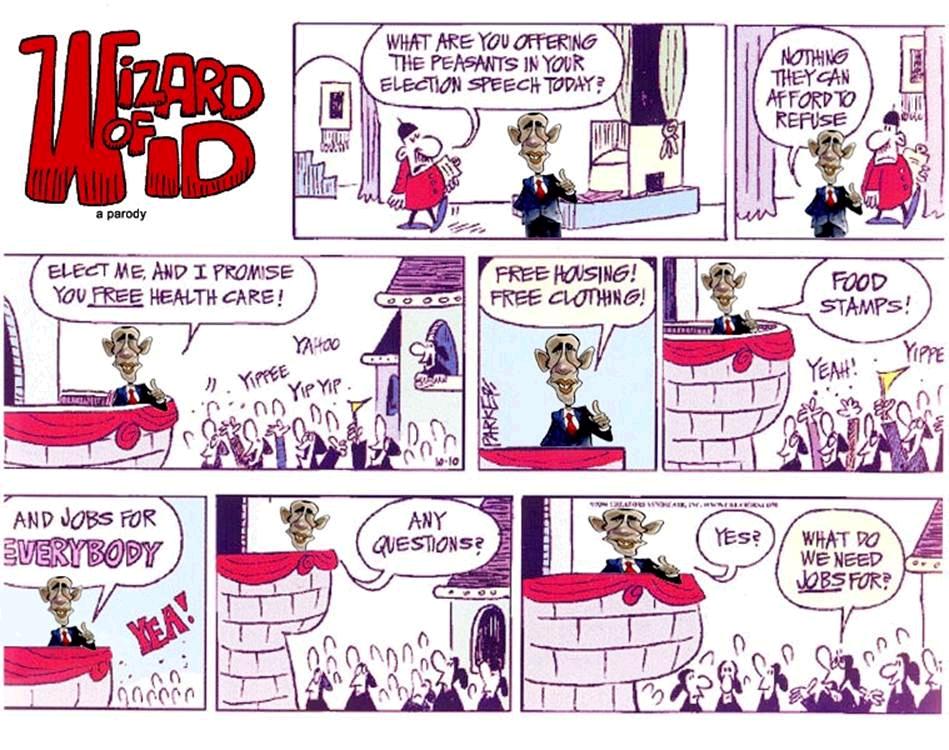
Economists often do a crummy job of teaching people about the impact of fiscal policy on the labor force, largely because we put people to sleep with boring discussions about “labor supply” decisions (my blog post from last year perhaps being an example of this tendency).

From now on, I will try to remember to use this cartoon. It’s a parody of Obama’s policies, but the last slide (or is it a panel?) is a great teaching tool about what happens when politicians turn the safety net into a hammock.

Thank you so much for your time. I know how valuable it is. I also appreciate the fine family that you have and your commitment as a father and a husband.

Sincerely,

Everette Hatcher III, 13900 Cottontail Lane, Alexander, AR 72002, ph 501-920-5733, lowcostsqueegees@yahoo.com