They’re right, though they probably don’t realize the seriousness of that looming crisis.
Here’s what you need to know: America’s fiscal crisis is actually a spending crisis, and that spending crisis is driven by entitlements.
More specifically, the vast majority of the problem is the result of Medicaid, Medicare, and Social Security, programs that are poorly designed and unsustainable.
The Medicaid program imposes high costs while generating poor results. This Center for Freedom and Prosperity Foundation video explains how block grants, such as the one proposed by Congressman Paul Ryan, will save money and improve healthcare by giving states the freedom to innovate and compete.
This Center for Freedom and Prosperity Foundation video explains how a “premium-support” plan would solve Medicare’s fiscal crisis and improve the overall healthcare system. This voucher-based system also would protect seniors from bureaucratic rationing. http://www.freedomandprosperity.org
There are two crises facing Social Security. First the program has a gigantic unfunded liability, largely thanks to demographics. Second, the program is a very bad deal for younger workers, making them pay record amounts of tax in exchange for comparatively meager benefits. This video explains how personal accounts can solve both problems, and also notes that nations as varied as Australia, Chile, Sweden, and Hong Kong have implemented this pro-growth reform. www.freedomandprosperity.org
_______________________
Regular readers know I’m fairly gloomy about the future of liberty, but this is one area where there is a glimmer of hope.
The Chairman of the House Budget Committee actually put together a plan that addresses the two biggest problems (Medicare and Medicaid) and the House of Representatives actually adopted the proposal.
The Senate didn’t act, of course, and Obama would veto any good legislation anyhow, so I don’t want to be crazy optimistic. Depending on how things play out politically in the next six years, I’ll say there’s actually a 20 percent chance to save America.
I have been writing President Obama letters and have not received a personal response yet. (He reads 10 letters a day personally and responds to each of them.) However, I did receive a form letter in the form of an email on July 30, 2012. I don’t know which letter of mine generated this response so I have linked several of the letters I sent to him below with the email that I received. However, I think it was probably this one below:
President Obama’s state of the union speech Jan 24, 2012
President Obama c/o The White House
1600 Pennsylvania Avenue NW
Washington, DC 20500
In a night of disappointments, the complete lack of any mention of Social Security other than as an excuse to raise taxes was one of the greatest. Although the Social Security trustees, several of whom are members of the President’s cabinet, has warned that the program faces perpetual deficits, the President evidently has no plan to protect the retirement security of millions of Americans who face a 25% benefit cut in less than 25 years. Most officeholders join the President in treating Social Security as an issue that can be discussed later – much later, but the reality is that just like a leaky roof, the longer that the President and Congress waits to fix the program, the more expensive the reforms will be.
Tax Reform? It’s Needed, but There’s A Better Way to Go – Emily Goff
President Obama says he is ready and willing to embark on tax reform. This is a welcome statement, as our current tax system is ripe for overhaul. However, instead of piecemeal approaches or solutions that give preferences to one industry or company over another, the President should look to the fundamental reforms that the New Flat Tax, as part of The Heritage Foundation’s Saving the American Dream, would bring.
Obama Doubles Down on the Worst U.S. Tax Policy – J.D. Foster
One of the universally acknowledged banes of the federal income tax has for years been the individual Alternative Minimum Tax. Borne in its current form in the 1986 tax reform act, this parallel system which runs in parallel to the regular income tax forces taxpayers to calculate their taxes twice and pay the larger of the two.
Today, this tax makes no sense, and most tax reform proposals of sufficient heft seek as a primary goal the repeal of the AMT. Tonight, President Obama proposed not merely to embrace the AMT in principle, but to extend the principle robustly to the business income tax – to create a new basic minimum tax for businesses. Once again, when it comes to tax policy, President Obama sees what needs to be done – and does the exact opposite.
___________________
Got to tackle entitlement reform but your speech did not mention that once.
Thank you so much for your time. I know how valuable it is. I also appreciate the fine family that you have and your committment as a father and a husband.
Sincerely,
Everette Hatcher III, 13900 Cottontail Lane, Alexander, AR 72002, ph 501-920-5733, lowcostsqueegees@yahoo.com
July 30, 2012
Dear Everette:
Thank you for sharing your thoughts with me. I have heard from many Americans who are worried about the future of their retirement savings, and I appreciate your perspective.
Retiring with dignity is a promise we must keep to all Americans, and I am working hard to strengthen our retirement system. That is why I am committed to protecting Social Security and addressing Americans’ concerns. Social Security cannot be subjected to risky privatization plans because the future of hard-working Americans should not be left to the fluctuations of financial markets.
To better secure their retirement and prepare for unforeseen circumstances, Americans must also save for their future in other ways. We are laying the foundation for all individuals to participate in workplace retirement accounts. Employees would be automatically enrolled in pension plans and could opt out if they choose. Simple and automatic enrollment makes it easier for people to plan for retirement. This would assist the 75 million working Americans—about half the workforce—who lack access to retirement plans through their employers. Please join me online to learn more at: www.whitehouse.gov/agenda/seniors-and-social-security.
6/6/12 Republican Leadership Press Conference Published on Jun 6, 2012 by HouseConference Today House Republican leaders, joined by Senate Republican Leader Mitch McConnell, discussed the importance of preventing any tax increase to provide certainty to America’s job creators. Even President Bill Clinton and Larry Summers agree — taxes should not be raised on anyone in […]
President Obama c/o The White House 1600 Pennsylvania Avenue NW Washington, DC 20500 Dear Mr. President, I know that you receive 20,000 letters a day and that you actually read 10 of them every day. I really do respect you for trying to get a pulse on what is going on out here. We need […]
I have been writing President Obama letters and have not received a personal response yet. (He reads 10 letters a day personally and responds to each of them.) However, I did receive a form letter in the form of an email on July 16, 2012. I don’t know which letter of mine generated this response so I have linked several […]
President Obama c/o The White House 1600 Pennsylvania Avenue NW Washington, DC 20500 Dear Mr. President, I know that you receive 20,000 letters a day and that you actually read 10 of them every day. I really do respect you for trying to get a pulse on what is going on out here. […]
Glenn Beck Presents: F.A. Hayek’s “The Road to Serfdom” (Part 2) President Obama c/o The White House 1600 Pennsylvania Avenue NW Washington, DC 20500 Dear Mr. President, I know that you receive 20,000 letters a day and that you actually read 10 of them every day. I really do respect you for trying to get […]
For nearly three decades Social Security produced big surpluses, collecting more in taxes from workers than it paid in benefits to retirees, disabled workers, spouses and children. The surpluses also helped mask the size of the budget deficit being generated by the rest of the federal government. Those days are over. Since 2010, Social Security has been paying out more in benefits than it collects in taxes… The projected shortfall in 2033 is $623 billion, according to the trustees’ latest report. It reaches $1 trillion in 2045 and nearly $7 trillion in 2086, the end of a 75-year period used by Social Security’s number crunchers because it covers the retirement years of just about everyone working today. Add up 75 years’ worth of shortfalls and you get an astonishing figure: $134 trillion. Adjusted for inflation, that’s $30.5 trillion in 2012 dollars, or eight times the size of this year’s entire federal budget.
My only complaint is that the story does include some analysis of the Social Security Trust Fund, even though that supposed Fund is nothing but a pile of IOUs – money that one part of the government promises to give to another part of the government.
But let’s set that aside. Another interesting tidbit from the story is this quote from one of the kleptocrats at the American Association of Retired Persons. Note that he implicitly rules out any changes other than those that enable the government to “pay the benefits we promised.” But that shouldn’t be a surprise. AARP is part of the left-wing coalition.
“I’m not suggesting we need to wait 20 years but we do have time to make changes to Social Security so that we can pay the benefits we promised,” said David Certner, AARP’s legislative policy director. “Let’s face it. Relative to a lot of other things right now, Social Security is in pretty good shape.”
But I will say that Mr. Certner is sort of correct about Social Security being in better shape than Medicare and Medicaid. But that’s like saying the guy with lung cancer who is 75 lbs overweight is in better shape than the two guys with brain tumors who are both 150 lbs overweight.
If you have to engage in fiscal triage, it would be smart to first address Medicare and Medicaid, but Social Security also needs reform. And not the kind of statist reform the folks at AARP would like to see.
By the way, you probably won’t be surprised to learn that President Obama’s approach is similar to the left-wingers at AARP. Here’s a video I narrated about his preferred policy.
It seems that the question doesn’t matter with this administration. The answer is always to impose more class-warfare tax policy.
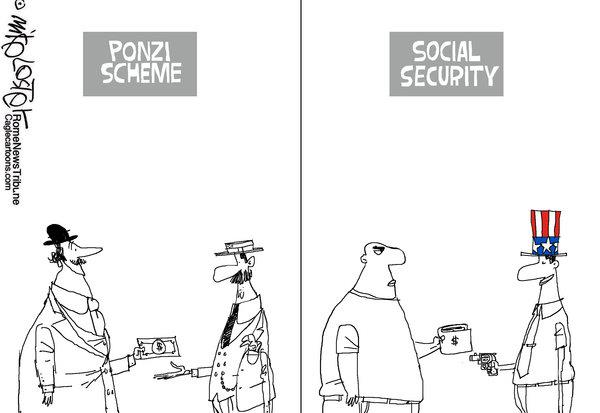
Social Security is a Ponzi Scheme but Blake who is a blogger said I was off base. Ark Times reader says Social Security is not Ponzi Scheme Social Security Disaster Walter E. Williams Columnist, Townhall.com Politicians who are principled enough to point out the fraud of Social Security, referring to it as a lie and […]
We got to do something soon about Social Security. The Case for Social Security Personal Accounts Posted by Daniel J. Mitchell There are two crises facing Social Security. First the program has a gigantic unfunded liability, largely caused by demographics. Second, the program is a very bad deal for younger workers, making them pay record […]
Senator Obama’s Social Security Tax Plan Uploaded by afq2007 on Jul 23, 2008 In addition to several other tax increases, Senator Barack Obama wants to increase the Social Security payroll tax burden by imposing the tax on income above $250,000. This would be a sharp departure from current law, which only requires that the tax […]
Saving Social Security with Personal Retirement Accounts Uploaded by afq2007 on Jan 10, 2011 There are two crises facing Social Security. First the program has a gigantic unfunded liability, largely thanks to demographics. Second, the program is a very bad deal for younger workers, making them pay record amounts of tax in exchange for comparatively meager benefits. This […]
“Saving the American Dream: The Heritage Plan to Fix the Debt, Cut Spending, and Restore Prosperity,” Heritage Foundation, May 10, 2011 by Stuart Butler, Ph.D. , Alison Acosta Fraser and William Beach is one of the finest papers I have ever read. Over the next few days I will post portions of this paper, but […]
Is Social Security a Ponzi Scheme? I just started a series on this subject. In this article below you will see where the name “Ponzi scheme” came from and if it should be applied to the Social Security System. Ponzi! Ponzi! Ponzi! 9/14/2011 | Email John Stossel | Columnist’s Archive Ponzi! Ponzi! Ponzi! There, I […]
Uploaded by LibertyPen on Jan 8, 2009 Professor Williams explains what’s ahead for Social Security Dan Mitchell on Social Security I have said that Social Security is a Ponzi scheme and sometimes you will hear someone in the public say the same thing. Yes, It Is a Ponzi Scheme by Michael D. Tanner Michael Tanner […]
Senator Kay Bailey Hutchison delivered remarks regarding her landmark proposal on entitlement reform, the Defend and Save Social Security Act at the Heritage Foundation’s “Saving Social Security” event. Sen. Hutchison announced that Senator Jon Kyl (R-AZ), member of Biden’s budget working group, has lent his support of her bill as the original cosponsor. At her press conference last week, Sen. Hutchison unveiled her Social Security proposal, and today she reiterated the urgency of putting Social Security on the table in the Biden budget group discussions. Sen. Hutchison sent a letter to Vice President Joe Biden last week urging him to incorporate Social Security reform in the ongoing deficit reduction debates that he is leading.
____________________
President Obama c/o The White House
1600 Pennsylvania Avenue NW
Washington, DC 20500
There are two serious problems with America’s Social Security system. Almost everyone knows about the first problem, which is that the system is bankrupt, with huge unfunded liabilities of about $30 trillion.
The other crisis is that the system gives workers a lousy level of retirement income compared to the amount of taxes they pay during their working years. Younger workers are particularly disadvantaged, as are African-Americans because of lower life expectancy.
These are critical issues, but perhaps looking at a couple of charts is the best way to illustrate why the Social Security system is inadequate.
This system, which was made universal by the Labor Party beginning in the 1980s, has turned every Australian worker into a capitalist and generated private wealth of nearly 100 percent of GDP. Here’s a chart, based on data from the Australian Prudential Regulation Authority.
Now let’s look at one of the key numbers generated by America’s tax-and-transfer entitlement system. Here’s a chart showing the projected annual cash-flow deficits for the Social Security system, based on the just-released Trustees’ Report.
By the way, the chart shows inflation-adjusted 2012 dollars. The numbers would look far worse if I used the nominal numbers.
The two charts aren’t analogous, of course, but that’s because there’s nothing to compare. The Social Security system has no savings. Indeed, it discourages people from setting aside income.
And Australia’s superannuation system doesn’t have anything akin to America’s unfunded liabilities. The closest thing to an analogy would be the safety net provision guaranteeing a basic pension to people with limited savings (presumably because of a spotty employment record).
So now ask yourself whether Australia should copy America or America should copy Australia? Seems like a no-brainer.
___________
Thank you so much for your time. I know how valuable it is. I also appreciate the fine family that you have and your commitment as a father and a husband.
Sincerely,
Everette Hatcher III, 13900 Cottontail Lane, Alexander, AR 72002, ph 501-920-5733, lowcostsqueegees@yahoo.com
Saving the American Dream is The Heritage Foundation’s plan to fix the debt, cut spending and, above all, restore prosperity. It balances the nation’s budget within a decade—and keeps it balanced. It reduces the debt and cuts government in half. It eliminates government-mandated health care and fully funds our national defense. It squarely confronts Social Security, Medicare, and Medicaid, the three so-called entitlement programs, which together account for 43 percent of federal spending today.
To encourage Americans to become more fiscally responsible, the Heritage plan redesigns our entire tax system into an expenditure tax that will have a single, flat rate. This is a structure that will promote savings, therefore benefiting individual Americans, our body politic, and the economy.
At the end of the day our plan, while economic in nature, has a higher moral purpose. If entitlements are not reformed, the next generation and future ones will have to pay punitive tax rates that will end liberty as we have known it. Our proposal, which was funded by a grant initiative set up by the Peter G. Peterson Foundation, aims to preserve America’s promise bequeathed to us by past generations.
Social Security
Summary
Social Security is the largest single federal program, paying out about $700 billion per year to some 60 million Americans. It is a major source of retirement income for millions of Americans. Yet Social Security went into the red in 2010, paying out more in benefits than people paid in as payroll taxes. The Congressional Budget Office says that these deficits will continue for at least the next 75 years and probably indefinitely.
What Is Social Security?
Social Security, today’s largest single federal program, provides (1) retirement income to workers and their spouses, (2) survivors benefits to the family members of deceased workers, and (3) disability benefits for workers who have been injured and are unable to work and to the families of those workers. The program is funded by a 12.4 percent payroll tax that is paid equally by both the worker (6.2 percent) and his or her employer (6.2 percent). Employers correctly see their contribution as a part of the employee’s total compensation.
In 2009, the most recent year for which data are available, Social Security spent a total of $685.8 billion providing these benefits. That was also the last year that Social Security collected more in payroll taxes than it paid out in benefits. Starting in 2010, the program started to run cash-flow deficits that the Congressional Budget Office says are unlikely ever to end. The annual Social Security deficit will increase every year until about 2030, when it will reach about $350 billion annually in 2010 dollars (without including any inflation), and stay at approximately that level permanently.
Social Security does have a $2.5 trillion trust fund from the surpluses that it collected between 1983 and 2009—but that money isn’t there. Rather than build up real assets in a real trust fund, Congress actually spent that money on everything from roads to corporate welfare. That trust fund is filled with special-issue Treasury bonds that the U.S. Treasury is required to finance when they are needed to fund Social Security’s deficits. As they are bonds not backed by any real assets, the government will have to either borrow or raise taxes to pay for them.
In essence, then, these bonds are really a demand on future tax collections—a lien. In 2010, the Treasury started to redeem these bonds, or tax liens, by tapping into other tax sources in order to cover Social Security’s deficits. Around 2037, even those special-issue bonds will run out. From that time on, under the provisions of current law, every retiree—no matter how wealthy or how poor—will have his or her Social Security benefits cut by about 22 percent.
Over the next 75 years, the program has promised to pay $7.8 trillion more in benefits than it will receive in payroll taxes. The only way that future retirees can collect all of the benefits promised to them is to make their children and grandchildren pay massive amounts of additional taxes.
Heritage proposes to solve these problems and strengthen the Social Security system by tightening its benefits and returning it to its original purpose: a guarantee that older Americans won’t fall into poverty. Heritage proposes to make Social Security “real insurance” for Americans as they reach retirement.
This reform means that Social Security’s promises in the future will change in several ways:
Social Security will gradually be transformed from an “income replacement” system back to its original purpose of guaranteeing seniors freedom from fear of poverty and assuring a decent retirement income. This means that Social Security benefits will evolve over time into a flat payment to those who work more than 35 years—a flat payment that is sufficient to keep them out of poverty throughout their retirement.
Because the new Social Security is a real insurance system, designed to protect seniors from poverty, retirees with high incomes from sources other than Social Security will receive a smaller check, and very affluent seniors will receive no check. This transparent way of income-adjusting benefit checks will replace the method used today, whereby the checks of even modest-income seniors are taxed and thus reduced.
To help make up the difference between the new Social Security benefit and what workers may desire for a more comfortable retirement, our plan will create greater incentives for workers of all income levels to save more for retirement. These savings will supplement their Social Security and create a more secure retirement.
Americans live much longer than they used to. While this is good news, it means that they are spending a much higher proportion of their lives in retirement. Regrettably, these longer retirements play a major role in Social Security’s financial problems. For this reason, the Social Security retirement ages will be raised gradually and then indexed to life expectancy. This will create a more reasonable balance between the number of years a person works and the number of years one receives Social Security benefits.
To encourage people to stay in the workforce longer, those who work beyond full retirement age will receive a higher level of after-tax income during the period when they are not claiming benefits.
This new Social Security system is reasonable, predictable, and affordable. It focuses resources on those who need the most help while providing complete protection against poverty for all seniors who qualify for full benefits.
The Details
A Predictable Benefit That Provides Economic Security. The centerpiece of the new Social Security system involves a gradual transition to a flat benefit that pays retirees who qualify for a full Social Security check. This amount is well above the income level that the Census Bureau says an American over the age of 65 needs to avoid poverty.
Thus, the new system will guarantee that no retiree falls into poverty because of insufficient income. Under today’s system, retirees can pay Social Security taxes for 35 years and still receive a benefit that is below the poverty level. Some of these seniors are forced to go on welfare. The new system corrects this serious flaw.
The flat benefit will be the equivalent of about $1,200 per month in 2010 dollars when the reform is complete. This is both higher than today’s average Social Security retirement benefit payment ($1,164 per month) and well above the 2009 poverty level for a single adult over age 65 ($857 per month). To ensure that future retirees do not slip back into poverty, the flat benefit level will be indexed for wage growth.
Slow Transition to the New Flat Benefit. The new flat benefit will be phased in slowly. Current retirees and those who are close to retirement will see only a minimal change in the basic design of their benefits. Those with a significantly longer time before retirement, who have more flexibility in planning their future, will see larger changes in their benefits. Workers born after 1985 will come under the new flat Social Security benefit system when they retire.
Limiting Social Security to Those Who Actually Need It. In addition to moving to a flat benefit over time, the plan makes Social Security a properly financed, true insurance program. It starts to do that immediately. This means that the program will concentrate on protecting the economic security of retirees rather than following the current approach of promising unaffordable benefits to all without regard to need.
This new approach means that retirees with substantial non–Social Security retirement income will start receiving a lower benefit on a sliding scale that gradually reduces Social Security checks to zero for those with the highest non–Social Security incomes. This transparent mechanism will apply to benefits received by affluent Americans under both the current system and the flat-rate system. This transparent, sliding-scale approach is a major improvement on today’s taxation of Social Security benefits.
Under the plan, income-adjusted benefits start in 2012 as individual retirees with non–Social Security incomes above $55,000 start to see a slight reduction in benefit payments. Those with higher non–Social Security income will see larger reductions in their checks. Individuals with more than $110,000 in non–Social Security income will receive no Social Security payments. Married couples who file taxes jointly would be subject to higher thresholds, with benefits beginning to phase out at a joint non–Social Security income of $110,000 and ending when income reaches $165,000. Married couples can decide whether they want to qualify for benefits as individuals or jointly as a couple. The income thresholds will be indexed for inflation.
Income-adjusting benefits is not new. It occurs in today’s Social Security system. But it is largely hidden today and hits lower-income seniors, not just the affluent. Seniors with as little as $15,000 in non–Social Security income, or even less in some cases, must pay tax on part of their benefits. Seniors with more income than that pay steadily higher rates of tax on more of their Social Security benefits. The Heritage approach, when fully phased in, would income-adjust benefits transparently and not tax the benefits a senior receives. It also would start income-adjusting at a much higher income. Today, about half of seniors have their checks eroded by taxation. Under the Heritage plan, only about 9 percent of seniors would see their checks reduced and only just over 3.5 percent of seniors would receive no check.
Real insurance also protects seniors from poverty if their financial situation changes. Retirees who suffer a sudden and permanent drop in non–Social Security income would find their benefits rapidly restored.
More Accurate Inflation Protection. The annual cost of living adjustment (COLA) for Social Security, which protects retirees against inflation, will be based on the Chained Consumer Price Index (C-CPI-U), a measure of inflation that is more accurate than the index used currently. The Bureau of Labor Statistics specifically designed this inflation measure to better reflect the way that consumers buy different items as the prices of various products fluctuate.
A More Reasonable Retirement Age. The plan adjusts the standard retirement age to reflect increases in life expectancy and those anticipated in the future. Under the plan, these changes are phased in gradually. Those nearing retirement are affected only slightly. Over the next 10 years, the age for full benefits rises to 68 for workers born in or after 1959. Over the next 18 years, the early retirement age rises to 65 for workers born in or after 1964. After that, both early and normal retirement ages will be indexed to longevity, which will add about one month every two years according to current projections.
The plan recognizes that a small proportion of workers will be physically unable to work until these ages. It therefore includes an improved disability system to protect them. The reformed disability system ensures that those who are unable to work longer receive a quick and accurate decision on their benefit application rather than facing today’s long delays, and improves today’s often arbitrary decision-making process.
Incentives to Work Longer. Starting immediately,those who work past their full-benefit age receive a special annual tax deduction of $10,000,regardless of income level. For instance, once the new system is completely phased in, a worker earning $50,000 per year who delays Social Security payments will see a $200 per month increase in spendable income.
An Improved Savings Plan to Supplement Social Security. As Social Security is transformed into a real insurance system that focuses scarce resources on those who need them most, the plan also creates better ways for workers to build savings for retirement.
Beginning in 2014, a new savings plan will be introduced over two years. Under this plan, 6 percent of each worker’s income is placed in a retirement savings plan that the worker owns and controls unless he or she explicitly declines to have such an account. (This approach is known as automatic enrollment.)
This new, additional retirement security system gives Americans another tool with which to secure their retirement standard of living. Savings are invested through an improved version of the IRA/401(k) employment-based retirement savings system already familiar to Americans. The money put into these savings accounts will not be double-taxed, unlike today’s Social Security payments and many other savings mechanisms.
In addition to this new savings plan, workers have two other important ways to save for retirement.
First, under the reformed tax system detailed below, all savings (without limit) will no longer be double-taxed. Savings remain completely free of taxation until they are actually spent.
Second, as benefit reforms drive the costs of Social Security below the level of taxes collected, those savings will go into the workers’ accounts.
The Bottom Line
The Heritage plan reforms Social Security to create a retirement security system that will be available for future generations. It will be one that provides a reasonable, predictable, and affordable benefit that ensures that no retiree who has worked for 35 years or more faces poverty or economic insecurity. At the same time, this new system protects our children and grandchildren from the massive tax increase that would be necessary to pay all of the Social Security benefits that Washington has irresponsibly promised.
They’re right, though they probably don’t realize the seriousness of that looming crisis.
Here’s what you need to know: America’s fiscal crisis is actually a spending crisis, and that spending crisis is driven by entitlements.
More specifically, the vast majority of the problem is the result of Medicaid, Medicare, and Social Security, programs that are poorly designed and unsustainable.
The Medicaid program imposes high costs while generating poor results. This Center for Freedom and Prosperity Foundation video explains how block grants, such as the one proposed by Congressman Paul Ryan, will save money and improve healthcare by giving states the freedom to innovate and compete.
This Center for Freedom and Prosperity Foundation video explains how a “premium-support” plan would solve Medicare’s fiscal crisis and improve the overall healthcare system. This voucher-based system also would protect seniors from bureaucratic rationing. http://www.freedomandprosperity.org
There are two crises facing Social Security. First the program has a gigantic unfunded liability, largely thanks to demographics. Second, the program is a very bad deal for younger workers, making them pay record amounts of tax in exchange for comparatively meager benefits. This video explains how personal accounts can solve both problems, and also notes that nations as varied as Australia, Chile, Sweden, and Hong Kong have implemented this pro-growth reform. www.freedomandprosperity.org
_______________________
Regular readers know I’m fairly gloomy about the future of liberty, but this is one area where there is a glimmer of hope.
The Chairman of the House Budget Committee actually put together a plan that addresses the two biggest problems (Medicare and Medicaid) and the House of Representatives actually adopted the proposal.
The Senate didn’t act, of course, and Obama would veto any good legislation anyhow, so I don’t want to be crazy optimistic. Depending on how things play out politically in the next six years, I’ll say there’s actually a 20 percent chance to save America.
Social Security is a Ponzi Scheme but Blake who is a blogger said I was off base. Ark Times reader says Social Security is not Ponzi Scheme Social Security Disaster Walter E. Williams Columnist, Townhall.com Politicians who are principled enough to point out the fraud of Social Security, referring to it as a lie and […]
We got to do something soon about Social Security. The Case for Social Security Personal Accounts Posted by Daniel J. Mitchell There are two crises facing Social Security. First the program has a gigantic unfunded liability, largely caused by demographics. Second, the program is a very bad deal for younger workers, making them pay record […]
Senator Obama’s Social Security Tax Plan Uploaded by afq2007 on Jul 23, 2008 In addition to several other tax increases, Senator Barack Obama wants to increase the Social Security payroll tax burden by imposing the tax on income above $250,000. This would be a sharp departure from current law, which only requires that the tax […]
Saving Social Security with Personal Retirement Accounts Uploaded by afq2007 on Jan 10, 2011 There are two crises facing Social Security. First the program has a gigantic unfunded liability, largely thanks to demographics. Second, the program is a very bad deal for younger workers, making them pay record amounts of tax in exchange for comparatively meager benefits. This […]
“Saving the American Dream: The Heritage Plan to Fix the Debt, Cut Spending, and Restore Prosperity,” Heritage Foundation, May 10, 2011 by Stuart Butler, Ph.D. , Alison Acosta Fraser and William Beach is one of the finest papers I have ever read. Over the next few days I will post portions of this paper, but […]
Is Social Security a Ponzi Scheme? I just started a series on this subject. In this article below you will see where the name “Ponzi scheme” came from and if it should be applied to the Social Security System. Ponzi! Ponzi! Ponzi! 9/14/2011 | Email John Stossel | Columnist’s Archive Ponzi! Ponzi! Ponzi! There, I […]
Uploaded by LibertyPen on Jan 8, 2009 Professor Williams explains what’s ahead for Social Security Dan Mitchell on Social Security I have said that Social Security is a Ponzi scheme and sometimes you will hear someone in the public say the same thing. Yes, It Is a Ponzi Scheme by Michael D. Tanner Michael Tanner […]
I have been writing President Obama letters and have not received a personal response yet. (He reads 10 letters a day personally and responds to each of them.) However, I did receive a form letter in the form of an email on July 18, 2012. I don’t know which letter of mine generated this response so I have linked several of the letters I sent to him below with the email that I received. However, I think it was probably this one below:
Sweden produced ABBA in the 1970’s, but now they are producing some pretty good economic policies.
One of my favorite groups growing up was ABBA. Here are some of my favorite songs:
_______________
President Obama c/o The White House
1600 Pennsylvania Avenue NW
Washington, DC 20500
Notwithstanding the many admirable features of Sweden, I never thought they would be moving in the right direction on fiscal policy while the United States was heading in the opposite direction.
When Europe’s finance ministers meet for a group photo, it’s easy to spot the rebel — Anders Borg has a ponytail and earring. What actually marks him out, though, is how he responded to the crash. While most countries in Europe borrowed massively, Borg did not. Since becoming Sweden’s finance minister, his mission has been to pare back government. His ‘stimulus’ was a permanent tax cut. …Three years on, it’s pretty clear who was right. ‘Look at Spain, Portugal or the UK, whose governments were arguing for large temporary stimulus,’ he says. ‘Well, we can see that very little of the stimulus went to the economy. But they are stuck with the debt.’ Tax-cutting Sweden, by contrast, had the fastest growth in Europe last year, when it also celebrated the abolition of its deficit. …‘Everybody was told “stimulus, stimulus, stimulus”,’ he says — referring to the EU, IMF and the alphabet soup of agencies urging a global, debt-fuelled spending splurge. Borg, an economist, couldn’t work out how this would help. ‘It was surprising that Europe, given what we experienced in the 1970s and 80s with structural unemployment, believed that short-term Keynesianism could solve the problem.’ …He continued to cut taxes and cut welfare-spending to pay for it; he even cut property taxes for the rich to lure entrepreneurs back to Sweden. The last bit was the most unpopular, but for Borg, economic recovery starts with entrepreneurs. If cutting taxes for the rich encouraged risk-taking, then it had to be done.
The article notes that government is still far too large in Sweden, but it’s also clear that moving in the right direction generates immediate benefits.
I posted a video back in 2010, narrated by a Swedish economics student, and asked a rhetorical question of why Obama wants to make America more like Sweden when the Swedes are moving in the other direction.
Unfortunately, there was no good answer then and there’s no good answer now.
Let’s close with some irony. Last year, I cited a study showing how large public sectors undermine economic performance. The study was written by two Swedish economists. In addition to trading Geithner for Borg, perhaps we can ship Krugman to Stockholm and bring those economists to America.
______________________
Thank you so much for your time. I know how valuable it is. I also appreciate the fine family that you have and your commitment as a father and a husband.
Sincerely,
Everette Hatcher III, 13900 Cottontail Lane, Alexander, AR 72002, ph 501-920-5733, lowcostsqueegees@yahoo.com
July 18, 2012
Dear Everette:
Thank you for writing. I have heard from many Americans about issues affecting seniors. Today’s economic climate further intensifies the unique challenges they face, and I appreciate your perspective.
My Administration continues to support older Americans encountering unfair treatment, financial hardship, or difficulty obtaining health care. The historic Affordable Care Act strengthens Medicare by not only preserving, but also expanding benefits for Americans who depend on Medicare every day. In 2010 and 2011, over 5.1 million seniors and people with disabilities on Medicare saved over $3.2 billion on prescription drugs thanks to the law. These savings include a one-time $250 rebate check to eligible seniors who fell into the prescription drug coverage gap known as the “donut hole” in 2010. And more than 32 million seniors have already received one or more free preventive services, including the new Annual Wellness Visit. To learn about help available through the Center for Medicare and Medicaid Services, visit www.CMS.gov.
The Affordable Care Act also helps prevent and eliminate elder abuse, neglect, and exploitation. Additionally, this law implements unprecedented measures to fight waste and fraud, and to improve the quality and outcomes of care for Medicare beneficiaries. It ends unwarranted subsidies to private insurance companies, and takes important steps to reduce unnecessary hospital admissions, improve patient safety, modernize payment systems, and streamline record-keeping. It also realigns incentives to reward medical providers for the value, not the volume, of their care. For resources and information on how to prevent, report, and stop Medicare fraud, visit www.StopMedicareFraud.gov. To learn more about the Affordable Care Act, please visit www.HealthCare.gov.
By protecting Social Security from risky privatization plans, we are preserving its solvency and maintaining it as a reliable income source for seniors. The American Recovery and Reinvestment Act included an additional payment to supplement Social Security benefits for seniors struggling to make ends meet, and I have called on Congress to extend this relief again. Together, we will ensure all our citizens—not just a privileged few—can retire with dignity and security.
Finally, as we work to keep America’s promises to senior citizens, we are helping make sure older Americans can continue to enrich communities across our Nation through service and community involvement. By expanding the Senior Corps and implementing the Edward M. Kennedy Serve America Act, we are creating more opportunities for seniors to share their knowledge and experience with younger generations. For more information regarding service opportunities in your area, or to share your story of service, please visit www.Serve.gov.
To find assistance for senior citizens and their families, visit www.Eldercare.gov or call 1-800-677-1116. For help with Medicare, visit www.Medicare.gov or call 1-800-MEDICARE. Additional information and resources are available at www.USA.gov/Topics/Seniors.shtml. For assistance using internet resources, I encourage you to visit your local library or community center.
Michael Cannon on Medicare and Healthcare President Obama c/o The White House 1600 Pennsylvania Avenue NW Washington, DC 20500 Dear Mr. President, I know that you receive 20,000 letters a day and that you actually read 10 of them every day. I really do respect you for trying to get a pulse on what is […]
Government Spending Doesn’t Create Jobs Uploaded by catoinstitutevideo on Sep 7, 2011 Share this on Facebook: http://on.fb.me/qnjkn9 Tweet it: http://tiny.cc/o9v9t In the debate of job creation and how best to pursue it as a policy goal, one point is forgotten: Government doesn’t create jobs. Government only diverts resources from one use to another, which doesn’t […]
In this post I have gathered several videos from the Cato Institute concerning the subject of failed stimulus plans. _____ Government Spending Doesn’t Create Jobs Uploaded by catoinstitutevideo on Sep 7, 2011 Share this on Facebook: http://on.fb.me/qnjkn9 Tweet it: http://tiny.cc/o9v9t In the debate of job creation and how best to pursue it as a policy […]
I have been writing President Obama letters and have not received a personal response yet. (He reads 10 letters a day personally and responds to each of them.) However, I did receive a form letter in the form of an email on June 22, 2012. I don’t know which letter of mine generated this response so I have […]
January 25, 2012 President Obama c/o The White House 1600 Pennsylvania Avenue NW Washington, DC 20500 Dear Mr. President, I know that you receive 20,000 letters a day and that you actually read 10 of them every day. I really do respect you for trying to get a pulse on what is going on out […]
Anyone who has followed this blog knows I have been writing letters to President Obama and he has actually responded 12 times now. Below are some videos and past posts about Obamacare and some of the open letters to the President are included with some of his responses: Dear Senator Pryor, why not pass the […]
Sadly Senator Pryor has voted against the Balanced Budget Amendment over and over in his long time in the Senate. Senator Pryor: “There are a lot of people who think a balanced-budget amendment solves all the fiscal problems. I completely disagree.” (Peter Urban, Pryor Tilts Balanced Budget, Southwest Times Record, 11/17/11) Dear Senator Pryor, Why […]
Religious Liberty: Obamacare’s First Casualty Uploaded by HeritageFoundation on Feb 22, 2012 http://blog.heritage.org/2012/02/22/morning-bell-religious-liberty-under-attack/ | The controversy over the Obama Administration’s anti-conscience mandate and the fight for religious liberty only serves to highlight the inherent flaws in Obamacare. This conflict is a natural result of the centralization laid out under Obamacare and will only continue until […]
I have been writing President Obama letters and have not received a personal response yet. (He reads 10 letters a day personally and responds to each of them.) However, I did receive a form letter in the form of an email on June 15, 2012. I don’t know which letter of mine generated this response so I have […]
Unfortunately, logically this argument fails because although we all benefit from roads, police, fire departments and education, it is not clear that the rich benefit from all the social welfare programs that Warren wants to keep running. Also how does the rich benefit from Social Security?
Elizabeth Warren’s recent remarks on class warfare, made during a campaign stop in her quest for a Massachusetts U.S. Senate seat, provide a nice microcosm of the broader philosophical views behind much contemporary political debate.
The relevant bit that has her supporters so fired up goes like this:
I hear all this, oh this is class warfare, no! There is nobody in this country who got rich on his own. Nobody. You built a factory out there–good for you.
But I want to be clear. You moved your goods to market on the roads the rest of us paid for. You hired workers the rest of us paid to educate. You were safe in your factory because of police forces and fire forces that the rest of us paid for. You didn’t have to worry that marauding bands would come and seize everything at your factory.
Now look. You built a factory and it turned into something terrific or a great idea–God Bless! Keep a Big Hunk of it. But part of the underlying social contract is you take a hunk of that and pay forward for the next kid who comes along.
Fully exploring the thinking behind Warren’s remarks would demand a book at least. We might point out that most of the rich got that way by creating value for others, meaning they gave back in the process of getting rich. Or we might wonder if her thinking implies that, because the state is responsible in part for the environment in which all of us earned what we have, the state is the actual owner of what we have.
To spare you having to read that book, however, I’m going to instead address just two points I find particularly interesting. First, we can tease out the theory of political obligation Warren advances and see if it holds up to scrutiny. Second, we can ask whether her argument, even if we accept it on its own terms, supports a tax increase on high income earners.
In a 1955 essay, H. L. A. Hart articulated what’s come to be known as the “fair play” principle of political obligation.
When a number of persons conduct any joint enterprise according to rules and thus restrict their liberty, those who have submitted to those restrictions when required have a right to a similar submission from those who have benefited by their submission.
Framed in Warren’s language, “the rest of us” restricted our liberty by paying taxes for the creation of roads, the formation of police forces, the funding of fire departments, and so on. And the rich benefited from our submission to taxes by getting rich (in part) because of the existence of roads, police, and fire departments. Therefore, we have a right to a similar submission from the rich in the form of them paying an increased amount in taxes to fund roads, police, and fire departments, too.
So by her account, this can’t be class warfare because it’s a simple matter of obligation. But is that true? Does the so-called “fair play” account of political obligation work?
Not really. Robert Nozick famously knocked it down in Anarchy, State, and Utopia with a thought experiment about a neighborhood public address system. And A. John Simmons went even further—and did so more persuasively—in his 1979 classic, Moral Principles and Political Obligations.
But the basic response to “fair play” is pretty simple: It seems awfully weird to demand that we repay benefits we never had a choice about accepting in the first place.
Nobody approached the rich before they were rich and said, “Hey, we’re all pitching in to pay for roads and police, which we all think are pretty valuable. If you’d like to benefit from those things like we would, we ask that you pay for them. Are you up for that?” A (pre-)rich person might very well say, “Yes, I’m game.” In that case the principle of fair play would apply. But it would only apply if he had a meaningful choice about the matter. On the other hand, he might say, “Yes, I think we do need roads and police, but I also think they’d be better provided by an alternative cooperative scheme (the market, a different government, a different voluntary group, etc.) to the one you’re offering.”
Simmons calls this the distinction between “receiving” benefits and “accepting” them. The fair play principle creates obligations when benefits are accepted, but not when merely received.
With that in mind, Warren would have a difficult time arguing that any of us genuinely accepted the particular roads and police provided by the particular scheme she supports. We’ve received them, yes, and may rather like what we received—but we were never presented with an actual choice.
There may, of course, be plenty of other good reasons to feel obligated to pay our taxes—or to even pay more taxes than our neighbors—but fair play, at least in the form Warren presents it, doesn’t quite get us there.
Still, let’s set such concerns aside and grant to Warren that, if the rich did benefit from the particular services paid for by the rest of us, they have a duty to pay (more) for them. Would that allow us to justify asking the rich to pay more taxes today?
Again, probably not. Just look at the beneficial services Warren draws our attention to.
Roads
Police
Fire departments
Education
She tacks an “and so on” to the list, but there’s something striking about the concrete examples she does give. Namely, they’re all the kinds of things you’d expect even from a much smaller state than the one we have today.
In other words, the need to raise taxes at the present moment (if such a need exists) is precisely not to pay for roads, police, fire departments, and education. We had those—and they were functioning quite nicely—for a good while before the explosion of federal spending under the last two administrations.
If Warren’s claim is that the rich got rich because of certain benefits they received from government and so should pay more to provide those benefits to others, then the overwhelming bulk of government spending is completely outside the scope of her argument.
It’s not obvious that many rich people got to be rich because of Medicare, Medicaid, Social Security, or military expenses. (Those who got rich because of subsidies are another matter, but she doesn’t draw that distinction, nor is she calling for an end to government handouts to the wealthy and politically connected.) But those are where we’ve seen so much of the spending increases that now demand, according to Warren and her peers, that all of us pony up more cash to the federal government.
This means that an easy response to Warren is to grant her general philosophical point but then add that what it leads to is not increased taxes but cutting government back to those programs that do make people rich and only then worry about how much of what remains the rich should pay for.
Of course we might also point out that, even with the bloated leviathan we have in Washington—one that does far more than provide roads, police, fire departments, and schools (which are, after all, chiefly state and local matters)—the rich still pay for most of it. Certainly more than “the rest of us” pay. As the Wall Street Journal pointed out back in May, “the highest-earning 10% of the U.S. population paid the largest share among 24 countries examined, even after adjusting for their relatively higher incomes.” The top 20% of American income earners pay over half the federal taxes. Which means that “the next kid who comes along” already is getting his federal benefits from the rich. To Warren and her supporters, I ask, “How much is enough?”
If Warren’s moral case for increasing the tax burden of the rich doesn’t hold up, can she still maintain her claim that this isn’t class warfare? Probably not. By her arguments, the rich are not obligated to pay more than they already are. Nor will their paying more do much of anything to ameliorate America’s fiscal woes. That means it’s rather difficult to see her speech as anything but a ploy to fire up her base by attacking a disfavored minority.
If that’s not class warfare, I don’t know what is.
Update: I just finished a podcast on the subject of this post with Caleb Brown.




 The Daily Hatch