Category Archives: Ronald Reagan

An open letter to President Obama

Barack Obama  (Photo by Saul Loeb-Pool/Getty Images)

 Milton Friedman’s Free to Choose (1980), episode 1 – Power of the Market. part 1

January 29, 2012

President Obama c/o The White House
1600 Pennsylvania Avenue NW
Washington, DC 20500

Dear Mr. President,

I know that you receive 20,000 letters a day and that you actually read 10 of them every day. I really do respect you for trying to get a pulse on what is going on out here.

I am a firm believer in economic freedom and I have got most of my philosophy from Milton Friedman. In this article you will see that Friedman influenced Ronald Reagan more than any other president and his policies were good the long term.

  • OPINION
  • JANUARY 25, 2012, 8:49 A.M. ET

Economics for the Long Run

Individuals should be free to decide what to produce and consume, and their decisions should be made within a predictable policy framework based on the rule of law.

By JOHN B. TAYLOR

As this election year begins, a lot of people are wondering what we can do to restore America’s prosperity and create more jobs. Republican presidential candidates are offering their ideas, and at his State of the Union message on Tuesday President Obama presented his. I believe the fundamental answer is simple: Government policies must adhere more closely to the principles of economic freedom upon which the country was founded.

At their most basic level, these principles are that families, individuals and entrepreneurs must be free to decide what to produce, what to consume, what to buy and sell, and how to help others. Their decisions are to be made within a predictable government policy framework based on the rule of law, with strong incentives derived from the market system, and with a clearly limited role for government.

Getty ImagesRonald Reagan: He and advisers such as George Shultz shunned the idea of stimulus and agreed on the need for a long-term point of view.

The history of American economic policy displays major movements between more and less economic freedom, more and less emphasis on rules-based policy in fiscal and monetary affairs, more and less expansive roles for government, more and less reliance on markets and incentives. Each of these swings has had enormous consequences. Taken together, they make for a historical proving ground to determine which policy direction is better for restoring prosperity.

A big move toward more interventionist policies started in the mid-1960s, after more activist Keynesian economists came to town in the Kennedy and Johnson administrations, and it lasted through the 1970s in the Nixon, Ford and Carter administrations. We saw short-term stimulus packages, temporary tax rebates or surcharges, go-stop monetary policy with inflationary overexpansion followed by severe contraction, wage-and-price guidelines and controls. The eventual result was high unemployment, high inflation and slow economic growth.

This was followed by a shift toward more predictable policies and a more limited role for government starting in the Reagan administration and largely continuing into the George H.W. Bush and Clinton administrations. The result was lower unemployment and higher economic growth with long expansions and few recessions.

More recently—beginning during the George W. Bush administration but really taking wings in the current Obama administration—policy has returned toward more and more government intervention, with results we are all experiencing.

How to move the country back toward the policies that sustain economic freedom and prosperity? To start, much can be learned from the stories of the politicians and economic officials who got us in and out of these messes, and remembering that the cast is bipartisan. Most pertinent to our current predicament is the story of how we got out of the economic mess of the late 1970s.

It’s difficult to recall now the seriousness of the U.S. economic slump at that time. Unemployment was high and persistent. Inflation had increased past the creeping stage to a trot. Confidence in U.S. economic leadership was plunging at home and abroad.

That changed when Ronald Reagan became president in 1981. Temporary, short-term Keynesian actions and interventions were out. Stable, permanent policy was in. Reagan proposed and Congress passed critical long-term reforms, especially across-the-board tax rate reductions.

The president was a firm believer in economic freedom, an avid reader and follower of economists like Milton Friedman and Friedrich Hayek. Between the time he failed to unseat President Gerald Ford in the 1976 Republican primaries and his announcement to run again in 1980, Reagan gave innumerable radio addresses putting forth his principles. He used down-home stories of economic freedom that he could tell in three minutes or less. There were no ghost writers—he wrote his stories in long hand on lined yellow paper as he traveled around the country. The failed policies of the 1970s made Reagan’s case appealing across the political spectrum. He based his winning election campaign on these principles.

Reagan appointed a large number of economic officials who also were firmly committed to moving away from interventionist policies. No members of the original Council of Economic Advisers under Reagan had come from the Keynesian school of thought, and most of them during the Reagan administrations were influenced by Milton Friedman.

In addition, the president appointed a group of outside economic advisers—originally including George Shultz, Milton Friedman, Alan Greenspan, Arthur Laffer, William Simon and Thomas Sowell—who helped him and others in the administration implement policies to move the country toward economic freedom and then stay the course.

As an example of Reagan’s firm commitment to principle, consider monetary policy. When he became president, Federal Reserve Chairman Paul Volcker, a Democrat appointed by President Carter, was determined to reduce inflation and end the go-stop interventions of the 1970s. That meant temporarily high interest rates, which contract the economy. One might have expected Reagan to pressure the Fed to lower interest rates to give a short-term boost to the economy. He did not, despite the political costs. In comparison with the political pressure put on Fed Chairman William McChesney Martin by the Johnson administration and on Arthur Burns by the Nixon administration to follow easy money policies, Reagan’s decision to support Mr. Volcker was remarkable.

The president’s economic strategy was ready to go as soon as the votes were counted in November 1980. That same month, George Shultz, along with many of the economists who had worked in the campaign, wrote an extraordinary memo to Reagan entitled “Economic Strategy for the Reagan Administration.” It began with a call for action: “Sharp change in present economic policy is an absolute necessity. The problems . . . an almost endless litany of economic ills, large and small, are severe. But they are not intractable. Having been produced by government policy, they can be redressed by a change in policy. . . . The need for a long-term point of view is essential to allow for the time, the coherence and the predictability so necessary for success.”

That predictable, long-term view continued well beyond the Reagan presidency, but it is no longer with us. The clear lesson is to find and select those leaders, regardless of political party, who along with their advisers are most firmly committed to the principles of economic freedom and who know how to implement and maintain them.

Mr. Taylor is a professor of economics at Stanford and a senior fellow at Stanford’s Hoover Institution. This op-ed is adapted from “First Principles: Five Keys to Restoring American Prosperity,” published this week by W.W. Norton.

Thank you so much for your time. I know how valuable it is. I also appreciate the fine family that you have and your committment as a father and a husband.

Sincerely,

Everette Hatcher III, 13900 Cottontail Lane, Alexander, AR 72002, ph 501-920-5733, lowcostsqueegees@yahoo.com

Does the movie “Iron Lady” do Margaret Thatcher justice?

Unfortunately Hollywood has their own agenda many times. Great article from the Heritage Foundation.

Morning Bell: The Real ‘Iron Lady’

Theodore Bromund

January 11, 2012 at 9:24 am

Streep referred to the challenge of portraying Lady Thatcher as “daunting and exciting,” and as requiring “as much zeal, fervour and attention to detail as the real Lady Thatcher possesses.” Her performance has already been widely praised by critics, but for those who respect Lady Thatcher, not all the omens are positive.

In an interview with The New York Times, Streep compared Lady Thatcher to King Lear and commented that what interested her about the role “was the part of someone who does monstrous things maybe, or misguided things. Where do they come from?” That doesn’t sound good.

Conservatives are used to unfair treatment from Hollywood–in fact, we’ve come to expect it–but we’ll withhold judgment on the film until we’ve actually seen it. Dr. Nile Gardiner, director of the Margaret Thatcher Center for Freedom at The Heritage Foundation, former foreign policy researcher to Lady Thatcher, and a regular commentator on films for Britain’s Telegraph newspaper, will review The Iron Lady for The Foundry next week.

But whether the film is good, bad, indifferent, or just misguided, you don’t have to rely on Hollywood for your history. The real Lady Thatcher, patron of The Heritage Foundation, has a record that stands on its own, and she would want–she would demand–nothing more than to be judged by her own deeds and words.

That’s why, throughout this week and next, we will highlight some of Lady Thatcher’s greatest speeches, from her 1983 reminder to Britain’s Conservative Party that “there is no such thing as public money” to her staunch support for the sovereign, democratic nation-state in 1988 to her eulogy in 2004 for her friend, the late President Ronald Reagan.

If you want more, it’s easy to find. The Margaret Thatcher Foundation offers free online access to thousands of historical documents–speeches, official government documents, commentary, and much more–covering Lady Thatcher’s entire career, including more than 8,000 statements by Lady Thatcher herself.

Any conservative, any friend of liberty, indeed anyone with an interest in the history of the 20th century will find much here to treasure. If The Iron Lady does less than justice to the reality of Lady Thatcher’s life, it won’t be because her record is hidden. On the contrary: it’s there for all to read.

We at Heritage are honored to have a close association not only with Lady Thatcher but with many of her friends and advisers. Dr. Robin Harris, Lady Thatcher’s biographer and her main policy adviser, is a senior visiting fellow at Heritage. For him, her outstanding achievement was rejecting the belief that the job of the British government was to manage Britain’s continued decline in an orderly way. That is a lesson that President Obama, with his new-look defense strategy that sacrifices capabilities in pursuit of another ‘peace dividend,’ should take to heart.

No blog could adequately summarize Lady Thatcher’s achievements, from her rise as one of Britain’s first female MPs to Number 10 Downing Street, from her decisive rejection of socialism to her victory in the Falklands War, from her firm comradeship with the United States to her steadily deepening concerns about the anti-democratic, supranational impulse behind the European Union. Like the life of one of her heroes, Winston Churchill, her career was unlikely, remarkable, and a mirror of the larger course of the West.

Similarly, no one who reads her speeches, or the official documents that are now steadily being released can fail to recognize her intelligence, her determination, and her incredible appetite for hard work and her desire to get onto the next challenge. But what is most inspiring in Lady Thatcher’s life and work is her willingness to make hard choices and to be clear about the value of making them. It wasn’t easy to reject the pervasive declinism of Britain in the 1970s. It required strength of mind and character to believe that Britain could and would do better.

Today, when politicians cut the defense budget, they promise it will make us stronger. When they borrow money to waste on make-work green-energy schemes, they say it will make us richer. When they impose new regulations, they tell us it is all about making us more free. Lady Thatcher believed in freedom, she faced the need for choices squarely, and she made them. Her opponents hated her for it, but their remedies were just more of the same, more of what had been tried past the point of destruction in Britain and around the world. They were condemned not just by Lady Thatcher’s stinging words but by the fact that they were failures.

We at The Heritage Foundation are honored to have Lady Margaret Thatcher as our patron. The verdict of Hollywood, whatever it may be, is passing. There will always be only one real Iron Lady.

March for Life in Little Rock 2pm Jan 22, 2012

34th Annual March For Life
Sunday, January 22, 2012
2:00 PM Capitol and Louisiana
Downtown Little Rock

Will your face appear in pictures at the next March for Life? We certainly hope that you will consider joining us each January for this important pro-life event. Hundreds of people from across the state make the annual march to remember the lives lost since the January 22, 1973 Supreme Court Roe v Wade decision that legalized abortion in our nation. Here’s what some past attendees have said about their experience at the March for Life:

“The most awesome part of the march is that moment when you get close enough to hear “Amazing Grace” coming from the steps of the capitol.”

“The thing that struck me most my first time was the number of youth and clergy that were marching with us.”

“I love to see the families, children in strollers and wagons, marching together for life.”

The March for Life is for everyone, those who are not able to walk the 13 blocks to the Capitol bring a lawn chair and watch the awesome sight of thousands of people marching peacefully and prayerfully to the sounds of Amazing Grace on bagpipes.”

“It always gives me chills and brings tears to my eyes to see the huge crowd peacefully remembering the lives that have been lost to abortion.”

_______________________

Ronald Reagan - The Best Of Speeches: Ronald Reagan

A Ronald Reagan radio address from 1975 addresses the topics of abortion and adoption. This comes from a collection of audio commentaries titled “Reagan in His Own Voice.”

I just wanted to share with you one of the finest prolife papers I have ever read, and it is by President Ronald Wilson Reagan.

I have a son named Wilson Daniel Hatcher and he is named after two of the most respected men I have ever read about : Daniel from the Old Testament and Ronald Wilson Reagan. I have studied that book of Daniel for years and have come to respect that author who was a saint who worked in two pagan governments but he never compromised. My favorite record was the album “No Compromise” by Keith Green and on the cover was a picture from the Book of Daniel.

One of the thrills of my life was getting to hear President Reagan speak in the beginning of November of 1984 at the State House Convention Center in Little Rock.  Immediately after that program I was standing outside on Markham with my girlfriend Jill Sawyer (now wife of 25 years) and we were alone on a corner and President was driven by and he waved at us and we waved back.

My former pastor from Memphis, Adrian Rogers, got the opportunity to visit with President Ronald Reagan on several occasions.

Take time to read this below and comment below and let me know what you thought of his words.

June 10, 2004, 10:30 a.m.
Abortion and the Conscience of the Nation
Ronald Reagan’s pro-life tract.

EDITOR’S NOTE: While president, Ronald Reagan penned this article for The Human Life Review, unsolicited. It ran in the Review‘s Spring 1983, issue and is reprinted here with permission.

The 10th anniversary of the Supreme Court decision in Roe v. Wade. Our nationwide policy of abortion-on-demand through all nine months of pregnancy was neither voted for by our people nor enacted by our legislators — not a single state had such unrestricted abortion before the Supreme Court decreed it to be national policy in 1973 is a good time for us to pause and reflect. But the consequences of this judicial decision are now obvious: since 1973, more than 15 million unborn children have had their lives snuffed out by legalized abortions. That is over ten times the number of Americans lost in all our nation’s wars.

Make no mistake, abortion-on-demand is not a right granted by the Constitution. No serious scholar, including one disposed to agree with the Court’s result, has argued that the framers of the Constitution intended to create such a right. Shortly after the Roe v. Wade decision, Professor John Hart Ely, now Dean of Stanford Law School, wrote that the opinion “is not constitutional law and gives almost no sense of an obligation to try to be.” Nowhere do the plain words of the Constitution even hint at a “right” so sweeping as to permit abortion up to the time the child is ready to be born. Yet that is what the Court ruled.

As an act of “raw judicial power” (to use Justice White’s biting phrase), the decision by the seven-man majority inRoev. Wade has so far been made to stick. But the Court’s decision has by no means settled the debate. Instead,Roe v. Wadehas become a continuing prod to the conscience of the nation.

Abortion concerns not just the unborn child, it concerns every one of us. The English poet, John Donne, wrote: “. . . any man’s death diminishes me, because I am involved in mankind; and therefore never send to know for whom the bell tolls; it tolls for thee.”

We cannot diminish the value of one category of human life — the unborn — without diminishing the value of all human life. We saw tragic proof of this truism last year when the Indiana courts allowed the starvation death of “Baby Doe” in Bloomington because the child had Down’s Syndrome.

Many of our fellow citizens grieve over the loss of life that has followed Roe v. Wade. Margaret Heckler, soon after being nominated to head the largest department of our government, Health and Human Services, told an audience that she believed abortion to be the greatest moral crisis facing our country today. And the revered Mother Teresa, who works in the streets of Calcutta ministering to dying people in her world-famous mission of mercy, has said that “the greatest misery of our time is the generalized abortion of children.”

Over the first two years of my Administration I have closely followed and assisted efforts in Congress to reverse the tide of abortion — efforts of Congressmen, Senators and citizens responding to an urgent moral crisis. Regrettably, I have also seen the massive efforts of those who, under the banner of “freedom of choice,” have so far blocked every effort to reverse nationwide abortion-on-demand.

Despite the formidable obstacles before us, we must not lose heart. This is not the first time our country has been divided by a Supreme Court decision that denied the value of certain human lives. The Dred Scott decision of 1857 was not overturned in a day, or a year, or even a decade. At first, only a minority of Americans recognized and deplored the moral crisis brought about by denying the full humanity of our black brothers and sisters; but that minority persisted in their vision and finally prevailed. They did it by appealing to the hearts and minds of their countrymen, to the truth of human dignity under God. From their example, we know that respect for the sacred value of human life is too deeply engrained in the hearts of our people to remain forever suppressed. But the great majority of the American people have not yet made their voices heard, and we cannot expect them to — any more than the public voice arose against slavery — until the issue is clearly framed and presented.

What, then, is the real issue? I have often said that when we talk about abortion, we are talking about two lives — the life of the mother and the life of the unborn child. Why else do we call a pregnant woman a mother? I have also said that anyone who doesn’t feel sure whether we are talking about a second human life should clearly give life the benefit of the doubt. If you don’t know whether a body is alive or dead, you would never bury it. I think this consideration itself should be enough for all of us to insist on protecting the unborn.

________________________________________________

I remember when President Carter and candidate Reagan debated in 1980 and the subject of abortion came up. Reagan said that if you were on a dusty area and you found someone laying down would you bury him without knowing for sure if he is alive or not? It is the same with the case of abortion.

Reagan and Clinton had good fiscal policies according to Cato Institute

Uploaded by on Dec 16, 2010

http://blog.heritage.org/2010/12/16/new-video-pork-filled-spending-bill-just-… Despite promises from President Obama last year and again last month that he opposed reckless omnibus spending bills and earmarks, the White House and members of Congress are now supporting a reckless $1.1 trillion spending bill reportedly stuffed with roughly 6,500 earmarks.

________________________

Below you see an article and videos by Dan Mitchell of the Cato Institute concerning Reagan and Clinton. First lets look at where we are now with Obama.

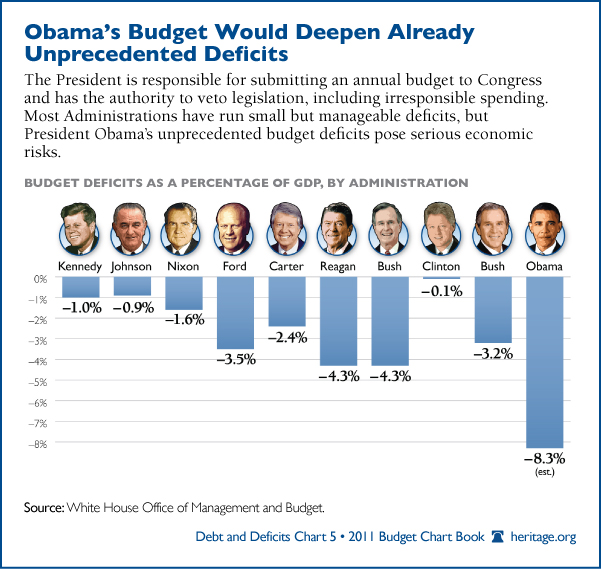
Over the last 10 presidents was have had 16.9% of GDP of deficits total from five Republican presidents and 12.7% total from Democratic presidents. However, what is most disturbing is that 8.3% of the 12.7% comes from the Obama administration who is currently in power and we are no longer in the cold war era. That is almost double the total of all the other four Democratic presidents combined under just one president. Take a look at the chart below from the Heritage Foundation:

Rob Bluey

January 1, 2012 at 9:56 am

Over the past 50 years, 10 U.S. presidents have made annual budget requests to Congress, projecting deficits both big and small. But no other president compares to Barack Obama when it comes to the size and scale of the current budget deficit facing the United States.

The country is facing an 8.3 percent estimated average national deficit of a two-term Obama administration — the biggest of the past 50 years. By comparison, the current estimate for Obama is nearly double the percentage under Presidents Ronald Reagan and George H.W. Bush — and they were fighting the Cold War.

Political party doesn’t tell the whole story, however. President Bill Clinton leads the pack of presidents since 1961, according to data from the White House Office of Management and Budget. Heritage put together this graphic as part of our Budget Chart Book.

So what does the current trajectory mean for the United States? We’re certainly no longer looking at a continuation of manageable deficits in the years to come. This is a dramatic change in the magnitude of annual shortfalls at the federal level. That’s one reason Heritage came up with a plan to fix the debt crisis.

If you have a suggestion for a chart we should feature in the future, please post a comment below, email us at scribe@heritage.org, or send me at tweet @RobertBluey.

_______________________
Here is a perspective from Dan Mitchell of the Cato Institute:

To Fix the Budget, Bring Back Reagan…or Even Clinton

Posted by Daniel J. Mitchell

President Obama unveiled his fiscal year 2012 budget today, and there’s good news and bad news. The good news is that there’s no major initiative such as the so-called stimulus scheme or the government-run healthcare proposal. The bad news, though, is that government is far too big and Obama’s budget does nothing to address this problem.

But perhaps the folks on Capitol Hill will be more responsible and actually try to save America from becoming a big-government, European-style welfare state. The solution may not be easy, but it is simple. Lawmakers merely need to restrain the growth of government spending so that it grows slower than the private economy.

Actual spending cuts would be the best option, of course, but limiting the growth of spending is all that’s needed to slowly shrink the burden of government spending relative to gross domestic product.

Fortunately, we have two role models from recent history that show it is possible to control the federal budget. This video from the Center for Freedom and Prosperity uses data from the Historical Tables of the Budget to demonstrate the fiscal policy achievements of both Ronald Reagan and Bill Clinton.

Spending Restraint, Part I: Lessons from Ronald Reagan and Bill Clinton

Uploaded by on Feb 14, 2011

Ronald Reagan and Bill Clinton both reduced the relative burden of government, largely because they were able to restrain the growth of domestic spending. The mini-documentary from the Center for Freedom and Prosperity uses data from the Historical Tables of the Budget to show how Reagan and Clinton succeeded and compares their record to the fiscal profligacy of the Bush-Obama years.

_____________________


Some people will want to argue about who gets credit for the good fiscal policy of the 1980s and 1990s.

Bill Clinton’s performance, for instance, may not have been so impressive if he had succeeded in pushing through his version of government-run healthcare or if he didn’t have to deal with a Republican Congress after the 1994 elections. But that’s a debate for partisans. All that matters is that the burden of government spending fell during Bill Clinton’s reign, and that was good for the budget and good for the economy. And there’s no question he did a much better job than George W. Bush.

Indeed, a major theme in this new video is that the past 10 years have been a fiscal disaster. Both Bush and Obama have dramatically boosted the burden of government spending — largely because of rapid increases in domestic spending.

This is one of the reasons why the economy is weak. For further information, this video looks at the theoretical case for small government and this video examines the empirical evidence against big government.

Another problem is that many people in Washington are fixated on deficits and debt, but that’s akin to focusing on symptoms and ignoring the underlying disease. To elaborate, this video explains that America’s fiscal problem is too much spending rather than too much debt.

Last but not least, this video reviews the theory and evidence for the “Rahn Curve,” which is the notion that there is a growth-maximizing level of government outlays. The bad news is that government already is far too big in the United States. This is undermining prosperity and reducing competitiveness.

Spending Restraint, Part II: Lessons from Canada, Ireland, Slovakia, and New Zealand

Uploaded by on Feb 22, 2011

Nations can make remarkable fiscal progress if policy makers simply limit the growth of government spending. This video, which is Part II of a series, uses examples from recent history in Canada, Ireland, Slovakia, and New Zealand to demonstrate how it is possible to achieve rapid improvements in fiscal policy by restraining the burden of government spending. Part I of the series examined how Ronald Reagan and Bill Clinton were successful in controlling government outlays — particularly the burden of domestic spending programs. http://www.freedomandprosperity.org


Bill Clinton’s welfare reform undone by Obama

.

 When the Republicans took over Congress in 1994 they were able to work with President Clinton and get Welfare reform passed which Clinton signed. However, since President Obama got in office he has been trying to stimulate the economy and he abandoned welfare reform.
  • President Ronald Reagan  after delivering a speech on television in this 1987 photo.By Doug Mills, APPresident Ronald Reagan after delivering a speech on television in this 1987 photo.
     

    Editor’s note: This article was co-authored by Susan A. Carleson and Robert Knight.

    We knew things weren’t good, but nearly one seventh of all Americans on food stamps? Forty-three million people?

    That’s the news this week from the U.S. Department of Agriculture, which noted that only 30 million were on food stamps as recently as 2008. For Big Government fans, this news should trigger a high five. But wait – many of those high fivers are lamenting the “epidemic of obesity” among the poor. Remember, liberalism need not be consistent or effective; it just has to be caring.

    For the average American this food stamp spike should be a wake up call. It exposes two things: One, Obamanomics’ massive government spending is not improving the economy; and, two, poorly designed welfare programs create ever more dependency. Food stamps and other welfare programs were meant to be a safety net for people down on their luck, not a way of life passed from one generation to the next.

    Over the years, the federal government has grown exponentially. The notable exception occurred in 1996 with the passage of welfare reform, which marked the first and only repeal of a Great Society entitlement program, Aid to Families with Dependent Children.

    That reform, which reversed the incentives for states to increase their welfare rolls, was an unqualified success by every measure. Caseloads dropped by more than two-thirds – from a record 5 million families in 1994 to just 1.6 million families in 2009. Recipients left welfare in droves — most of them to work — and earnings rose as child poverty fell.

    But, following the 2008 election, liberals in Congress and the White House began to dismantle this historic achievement. In the first “stimulus bill” they undermined the 1996 reform, made it easier for states to increase their welfare caseloads without having to meet federal work requirements, and added a host of new welfare programs. These destructive policies must be reversed.

    Ronald Reagan was the first modern president to truly appreciate the wisdom of America’s founders about the virtues of limited government. He understood the dynamics of spending and the inherent danger of overburdening taxpayers and free markets.

    In the early 1970s, when California was headed toward bankruptcy because of its profligate welfare spending, then-Gov. Reagan tapped Robert B. Carleson to design and implement a plan to salvage the state’s budget. And it worked. Welfare rolls plummeted and the state’s most needy received a long-delayed benefit increase. It was a true American success story.

    The ultimate triumph of these efforts was the historic welfare reform of 1996, which freed millions of Americans from the narcotic of dependency. While Bill Clinton deserves credit for ultimately signing this landmark legislation, it was in fact the product of 30 years of Ronald Reagan’s dream and Bob Carleson’s tenacity.

    Ronald Reagan was a man of strong beliefs, and he surrounded himself with policy experts who understood big bureaucracy and who knew how to roll back its overreach through common sense approaches. Sadly, people with those attitudes and know-how have not been in positions of power for many years. And the country has drifted, some would say lurched, leftward in its acceptance of big government.

    But as we all saw last November, complacency reached its limit. Americans now hunger for a return to sensible policies that instill individual responsibility, reduce government and taxes, increase prosperity and create real – not make-work – jobs.

    A new organization, the Carleson Center for Public Policy (CCPP), has been formed to assist this effort by serving as a proxy for “What Reagan would do.” Comprised exclusively of men and women who served under Ronald Reagan and who understand what works, the Center (www.theccpp.org) will offer public policy officials guidance and advice on welfare and entitlement reform.

    For a detailed look at the 25-year fight that truly reformed welfare, see Bob Carleson’s book Government Is the Problem: Memoirs of Ronald Reagan’s Welfare Reformer (American Civil Rights Union, 2010) www.governmentistheproblem.us.

    As we celebrate Ronald Reagan’s 100th birthday on February 6, it is appropriate to recall his words:

    “Freedom is never more than one generation away from extinction. We didn’t pass it to our children in the bloodstream. It must be fought for, protected, and handed on for them to do the same, or one day we will spend our sunset years telling our children and our children’s children what it was once like in the United States where men were free.”

    This is America. We can do better than offer our children more and more food stamps.

    Robert Knight

    Robert Knight is an author, columnist and frequent contributor to Townhall.

Reagan’s 1982 tax increase mentioned during the Republican debate of October 11, 2011 with video clip

Reagan’s statement concerning 1982 tax increase is responded to by Republican Candidates in this clip below:

Washington Could Learn a Lot from a Drug Addict

Concerning spending cuts Reagan believed, that members of Congress “wouldn’t lie to him when he should have known better.” However, can you believe a drug addict when he tells you he is not ever going to do his habit again? Congress is addicted to spending too much money.  Lee Edwards wrote in his article “Golden Years” about Ronald Reagan:

Sometimes Reagan went along with a pragamatist like chief of staff James Baker, who persuaded the president to accept the Tax Equity and Fiscal Responsibility Act of 1982 (TEFRA), which turned out to be the great tax increase of 1982 — $98 billion over the next three years. That was too much for eighty-nine House Republicans (including second-term Congressman Newt Gingrich of Georgia) or for prominent conservative organizations from the American Conservative Union like the Conservative Caucus and the U.S. Chamber of Commerce, which all opposed the measure.

Baker assured his boss that Congress would approve three dollars in spending cuts for every dollar of tax increase. To Reagan, TEFRA looked like a pretty good “70 percent” deal. But Congress wound up cutting less than twenty-seven cents for every new tax dollar. What had seemed to be an acceptable 70-30 compromise turned out to be a 30-70 surrender. Ed Meese described TEFRA as “the greatest domestic error of the Reagan administration,” although it did leave untouched the individual tax rate reductions approved the previous year. (TEFRA was built on a series of business and excise taxes plus the removal of business tax deductions.)[xxx]

The basic problem was that Reagan believed, as Lyn Nofziger put it, that members of Congress “wouldn’t lie to him when he should have known better.”[xxxi] As a result of TEFRA, Reagan learned to “trust but verify,” whether he was dealing with a Speaker of the House or a president of the Soviet Union.

Related posts:

Rick Perry’s answer in Republican debate of October 11, 2011 (with video clip)

I really like Rick Perry because he was right when he called Social Security a “Ponzi Scheme” which it is. How did he do in the last debate? You be the judge by watching his response above. Rick Perry’s Moment Posted by Roger Pilon Last night POLITICO Arena asked: Who won the Reagan debate? My […]

Romney attacked in Republican debate of October 11, 2011 (with video clip)

I am not too pleased with Mitt Romney and the article below shows one good reason to oppose him. Can Mitt Romney Escape His Romneycare Albatross? by Doug Bandow Doug Bandow is a senior fellow at the Cato Institute. A former special assistant to Ronald Reagan, he is the author of Foreign Follies: America’s New […]

Reagan’s 1982 tax increase mentioned during the Republican debate of October 11, 2011 with video clip

Reagan’s statement concerning 1982 tax increase is responded to by Republican Candidates in this clip below: Washington Could Learn a Lot from a Drug Addict Concerning spending cuts Reagan believed, that members of Congress “wouldn’t lie to him when he should have known better.” However, can you believe a drug addict when he tells you […]

Cain’s 9-9-9 plan center stage at Republican debate of October 11, 2011 (with video clip)

Herman Cain’s 9-9-9 plan did steal the show at the Republican debate of October 11, 2011. Take a look at this article below: The Republican presidential debate in Hanover, N.H. (AP) There was one clear winner from Tuesday’s Republican presidential debate, based on the simple metrics of name recognition: businessman Herman Cain’s “9-9-9 Plan.” Virtually […]

Ron Paul speaking at Values Voter Summit

Ron Paul speaking at Values Voter Summit In this speech above Ron Paul repeats his view that we should not have a Dept of Education and the article below does the same thing. Beating Back Big (Ed.) Brother? Posted by Neal McCluskey It certainly seems quixotic to try to reverse the federal invasion of American […]

Mitt Romney’s religion is becoming an issue

This issue concerning Mitt Romney’s religion is heating up. Baptist pastor taken to task Russ Jones and Chad Groening – OneNewsNow – 10/10/2011 11:05:00 am Popular radio and television commentator Glenn Beck wrapped up the Values Voter Summit in Washington, DC, Sunday in a wave of anti-Mormonism comments lodged towards GOP presidential hopeful Mitt Romney.   […]

Will the Republicans embrace an agenda that will get our country back on tract?

Will the Republicans embrace an agenda that will get our country back on tract? Republicans need to cut spending as the video above says. I wish the Republican candidates for president will embrace these policy positions: A Republican Agenda for Real Change by Doug Bandow This article appeared in Forbes on October 3, 2011 The desperate search […]

Lt Gov. Mark Darr endorses Romney

I think that many evangelical Christians may have a problem with supporting Mitt Romney who is a Mormon. I think that Romney is a very good speaker and will beat President Obama easily. He is not my favorite candidate though. John Brummett rightly noted that this endorsement by Lt. Governor was sought after by Romney […]

Ron Paul, Rick Perry and Mitt Romney have the money coming in

I really like Ron Paul and Rick Perry. Only three Republican presidential candidates are worth any money _ campaign money, that is. Mitt Romney, Rick Perry and Ron Paul have banked millions. But the other GOP candidates are struggling or broke, putting their candidacies in question four months before the first nominating contests take place. […]

Rick Perry says Social Security is a Ponzi scheme

Rick Perry says Social Security is a Ponzi scheme Rick Perry and Mitt Romney went after each other at the debate over this term “Ponzi scheme.” Over and over Rick Perry has said that Social Security is a Ponzi scheme and I agree with him. John Brummett asserted,”Rick Perry was last week’s savior, but then he […]

Milton Friedman discusses Reagan and Reagan discusses Friedman

Uploaded by on Aug 19, 2009

Nobel Laureate Dr. Milton Friedman discusses the principles of Ronald Reagan during this talk for students at Young America’s Foundation’s 25th annual National Conservative Student Conference

MILTON FRIEDMAN ON RONALD REAGAN

In Friday’s WSJ, Milton Friedman reflectedon Ronald Reagan’s legacy. (The link should work for a few more days.)

I first realized what a truly extraordinary person he was in early 1973 when I spent an unforgettable day with him barnstorming across California to promote his Proposition 1 — an amendment to the state constitution that would set a limit to the amount the state could spend in any year. We flew in a small private plane from place to place and at each stop held a press conference. In between, Gov. Reagan talked freely about his life and views. By the time we returned to our final press interview in Los Angeles, I was able to give an enthusiastic yes to a reporter’s question whether I would support Reagan for president. And, I may say, I have never been disappointed since.

As a good social scientist, Frieman also has data. It doesn’t make Bush I look too good, but it does bust the myth–popular among some libertarians–that Reagan did nothing real to shrink government.


_____________________

Image Detail

 Milton Friedman and Ronald Reagan
Related posts:

Free to Choose by Milton Friedman: Episode “Created Equal” (Part 1 of transcript and video)

 Milton Friedman and Ronald Reagan Liberals like President Obama (and John Brummett) want to shoot for an equality of outcome. That system does not work. In fact, our free society allows for the closest gap between the wealthy and the poor. Unlike other countries where free enterprise and other freedoms are not present.  This is a seven part series. […]

Milton Friedman Friday:(“Free to Choose” episode 4 – From Cradle to Grave, Part 2 of 7)

 I am currently going through his film series “Free to Choose” which is one the most powerful film series I have ever seen. For the past 7 years Maureen Ramsey has had to buy food and clothes for her family out of a government handout. For the whole of that time, her husband, Steve, hasn’t […]

The poor in the USA have best chance in the world to go up

I love Milton Friedman’s film series “Free to Choose.” In that film series over and over it is shown that the ability to move from poor to rich is more abundant here than any other country in the world. This article below reminded me of that that. Are Poor Really Helpless Without Government? By Michael […]

Despite Brantley’s view,Social Security really is a Ponzi scheme (Part 1) (jh1d)

Social Security is a Ponzi scheme (Part 1) Governor Rick Perry got in trouble for calling Social Security a Ponzi scheme and I totally agree with that. Max Brantley wants to keep insisting that this will be Perry’s downfall but  think that truth will win out this time around. This is a series of articles […]

Friedman Friday:(“Free to Choose” episode 4 – From Cradle to Grave, Part 1 of 7)

Volume 4 – From Cradle to Grave Abstract: Since the Depression years of the 1930s, there has been almost continuous expansion of governmental efforts to provide for people’s welfare. First, there was a tremendous expansion of public works. The Social Security Act followed close behind. Soon other efforts extended governmental activities in all areas of the welfare […]

“Friedman Friday” Tribute to Milton Friedman (Part 5)

 Milton Friedman: Life and ideas – Part 05 99th anniversary of Milton Friedman’s birth (Part 13) Milton Friedman was born on July 31, 1912 and he died November 16, 2006. I started posting tributes of him on July 31 and I hope to continue them until his 100th birthday. Here is another tribute below: Sheldon […]

Social Security a Ponzi scheme?

Uploaded by LibertyPen on Jan 8, 2009 Professor Williams explains what’s ahead for Social Security Dan Mitchell on Social Security I have said that Social Security is a Ponzi scheme and sometimes you will hear someone in the public say the same thing. Yes, It Is a Ponzi Scheme by Michael D. Tanner Michael Tanner […]

Famous Milton Friedman Quotes(“Friedman Friday” Part 4)

Milton Friedman on the Causes of Inflation (“Friedman Friday” Part 4) FRIEDMAN FRIDAY APPEARS EVERY FRIDAY AND IS HONOR OF THE NOBEL PRIZE WINNING ECONOMIST MILTON FRIEDMAN Famous Friedman Quotes By John Beagle Milton Friedman – University of Chicago School of Economics Professor As I read the comments by Milton Friedman, I can’t help but think […]

99th anniversary of Milton Friedman’s birth (Part 12)

Milton Friedman: Life and ideas – Part 04 99th anniversary of Milton Friedman’s birth (Part 12) Milton Friedman was born on July 31, 1912 and he died November 16, 2006. I started posting tributes of him on July 31 and I hope to continue them until his 100th birthday. Here is another tribute below:  Perspective […]

Milton Friedman on the power of choice (“Friedman Friday” Part 3)

FRIEDMAN FRIDAY APPEARS EVERY FRIDAY AND IS HONOR OF THE NOBEL PRIZE WINNING ECONOMIST MILTON FRIEDMAN. The Power Of Choice By John Beagle An interesting compilation of Milton Freeman as an economic freedom philosopher. Milton makes the case for economic freedom as a precondition for political freedom. The title of this video, The Power of Choice […]


Concerning spending cuts Reagan believed, that members of Congress “wouldn’t lie to him when he should have known better.”

Washington Could Learn a Lot from a Drug Addict

Concerning spending cuts Reagan believed, that members of Congress “wouldn’t lie to him when he should have known better.” However, can you believe a drug addict when he tells you he is not ever going to do his habit again? Congress is addicted to spending too much money.  Lee Edwards wrote in his article “Golden Years” about Ronald Reagan:

Sometimes Reagan went along with a pragamatist like chief of staff James Baker, who persuaded the president to accept the Tax Equity and Fiscal Responsibility Act of 1982 (TEFRA), which turned out to be the great tax increase of 1982 — $98 billion over the next three years. That was too much for eighty-nine House Republicans (including second-term Congressman Newt Gingrich of Georgia) or for prominent conservative organizations from the American Conservative Union like the Conservative Caucus and the U.S. Chamber of Commerce, which all opposed the measure.

Baker assured his boss that Congress would approve three dollars in spending cuts for every dollar of tax increase. To Reagan, TEFRA looked like a pretty good “70 percent” deal. But Congress wound up cutting less than twenty-seven cents for every new tax dollar. What had seemed to be an acceptable 70-30 compromise turned out to be a 30-70 surrender. Ed Meese described TEFRA as “the greatest domestic error of the Reagan administration,” although it did leave untouched the individual tax rate reductions approved the previous year. (TEFRA was built on a series of business and excise taxes plus the removal of business tax deductions.)[xxx]

The basic problem was that Reagan believed, as Lyn Nofziger put it, that members of Congress “wouldn’t lie to him when he should have known better.”[xxxi] As a result of TEFRA, Reagan learned to “trust but verify,” whether he was dealing with a Speaker of the House or a president of the Soviet Union.

Free to Choose by Milton Friedman: Episode “Created Equal” (Part 1 of transcript and video)

Image Detail

 Milton Friedman and Ronald Reagan

Liberals like President Obama (and John Brummett) want to shoot for an equality of outcome. That system does not work. In fact, our free society allows for the closest gap between the wealthy and the poor. Unlike other countries where free enterprise and other freedoms are not present.  This is a seven part series.

Created Equal [1/7]. Milton Friedman’s Free to Choose (1980)

Uploaded by on May 30, 2010

In this program, Milton Friedman visits India, the U.S., and Britain, examining the question of equality. He points out that our society traditionally has embraced two kinds of equality: equality before God and equality of opportunity. The first of these implies that human beings enjoy a certain dignity simply because they are members of the human community. The second suggests societies should allow the talents and inclinations of individuals to unfold, free from arbitrary barriers. Both of these concepts of equality are consistent with the goal of personal freedom.

In recent years, there has been growing support for a third type of equality, which Dr. Friedman calls “equality of outcome.” This concept of equality assumes that justice demands a more equal distribution of the economic fruits of society. While admitting the good intentions of those supporting the idea of equality of outcome, Dr. Friedman points out that government policies undertaken in support of this objective are inconsistent with the ideal of personal freedom. Advocates of equality of outcome typically argue that consumers must be protected by government from the insensitivities of the free market place.

Dr. Friedman demonstrates that in countries where governments have pursued the goal of equality of outcome, the differences in wealth and well being between the top and the bottom are actually much greater than in countries that have relied on free markets to coordinate economic activity. Indeed, says Dr. Friedman, it is the ordinary citizen who benefits most from the free market system. Dr. Friedman concludes that any society that puts equality ahead of freedom will end up with neither. But the society that puts freedom before equality will end up with both greater freedom and great equality.

___________________________

FREE TO CHOOSE 5: “Created Equal” (Milton Friedman)
Free to Choose ^ | 1980 | Milton Friedman

Posted on Friday, July 21, 2006 3:58:44 PM by Choose Ye This Day

FREE TO CHOOSE: Created Equal

Friedman: From the Victorian novelists to modern reformers, a favorite device to stir our emotions is to contrast extremes of wealth and of poverty. We are expected to conclude that the rich are responsible for the deprivations of the poor __ that they are rich at the expense of the poor.

Whether it is in the slums of New Delhi or in the affluence of Las Vegas, it simply isn’t fair that there should be any losers. Life is unfair __ there is nothing fair about one man being born blind and another man being born with sight. There is nothing fair about one man being born of a wealthy parent and one of an indigenous parent. There is nothing fair about Mohammed Ali having been born with a skill that enables him to make millions of dollars one night. There is nothing fair about Marleena Detrich having great legs that we all want to watch. There is nothing fair about any of that. But on the other hand, don’t you think a lot of people who like to look at Marleena Detrich’s legs benefited from nature’s unfairness in producing a Marleena Detrich. What kind of a world would it be if everybody was an absolute identical duplicate of anybody else. You might as well destroy the whole world and just keep one specimen left for a museum. In the same way, it’s unfair that Muhammed Ali should be a great fighter and should be able to earn millions. But would it not be even more unfair to the people who like to watch him if you said that in the pursuit of some abstract idea of equality we’re not going to let Muhammed Ali get more for one nights fight than the lowest man on the totem pole can get for a days unskilled work on the docks. You can do that but the result of that would be to deny people the opportunity to watch Mohammad Ali. I doubt very much he would be willing to subject himself to the kind of fights he’s gone through if he were to get the pay of an unskilled docker.

This beautiful estate, its manicured lawns, its trees, its shrubs, was built by men and women who were taken by force in Africa and sold as slaves in America. These kitchen gardens were planted and tended by them to furnish food for themselves and their master, Thomas Jefferson, the Squire of Monticello. It was Jefferson who wrote these words: We hold these truths to be self-evident that all men are created equal. That they are endowed by their creator with certain inalienable rights, that among these are life, liberty and the pursuit of happiness. These words penned by Thomas Jefferson at the age of 33 when he wrote the Declaration of Independence, have served to define a basic ideal of the United States throughout its history.

Much of our history has revolved about the definition and redefinition of the concept of equality, about the intent to translate it into practice. What did Thomas Jefferson mean by the words all men are created equal? He surely did not mean that they were equal and/or identical in what they could do and what they believed. After all, he was himself a most remarkable person. At the age of 26, he designed this beautiful house of Monticello, supervised its construction and indeed is said to have worked on it with his own hands. He was an inventor, a scholar, an author, a statesman, governor of Virginia, President of the United States, minister to France, he helped shape and create the United States. What he meant by the word “equal” can be seen in the phrase “endowed by their creator”. To Thomas Jefferson, all men are equal in the eyes of God. They all must be treated as individuals who have each separately a right to life, liberty and the pursuit of happiness.

Of course, practice did not conform to the ideals. In Jefferson’s life or in ours as a nation, he agonized repeatedly during his lifetime about the conflict between the institution of slavery and the fine words of the declaration. Yet, during his whole life, he was a slave owner.

This is the City Palace in Jaipur, the capitol of the Indian state of Rajasthan, is just one of the elegant houses that were built here 150 years ago by the prince who ruled this land. There are no more princes, no more Maharajas in India today. All titles were swept away by the government of India in its quest for equality. But as you can see, there are still some people here who live a very privileged life. The descendants of the Maharajas financed this kind of life partly by using other palaces as hotels for tourists __ tourists who come to India to see how the other half lives. This side of India, the exotic glamorous side, is still very real. Everywhere in the world there are gross inequalities of income and wealth. They offend most of us.

A myth has grown up that free market capitalism increases such inequalities, that the rich benefit at the expense of the poor. Nothing could be further from the truth. Wherever the free market has been permitted to operate, the ordinary man has been able to attain levels of living never dreamed of before. Nowhere is the gap between rich and poor. Nowhere are the rich richer and the poor poorer than in those societies that do not permit the free market to operate, whether they be feudal societies where status determines position, or modern, centrally-planned economies where access to government determines position.

Central planning was introduced in India in considerable part in the name of equality. The tragedy is that after 30 years, it is hard to see any significant improvement in the lot of the ordinary person.

__________________

Celebrating the Constitution with Heritage Foundation

Brandon Stewart wrote an excellent article on the founding of the constitution:

This weekend America will celebrate Constitution Day, created to honor the signing of the U.S. Constitution on September 17, 1787, by the Constitutional Convention. Earlier this week, former Attorney General Ed Meese reflected on the importance ordinary citizens can play in preserving our Constitution:

The Constitution of the United States of America has endured over two centuries. It remains the object of reverence for nearly all Americans and an object of admiration by peoples around the world. Unfortunately, the assault by 20th century liberal theorists and activist judges has seriously undermined respect for America’s core principles, denigrating some constitutional rights they disagree with and making up others. Fortunately, there has been a renewed interest in the Constitution in recent years, as Americans seek to understand the founding principles and enduring truths that form the bedrock of our chosen form of self-government. Clearly, the future of liberty depends on America reclaiming its constitutional first principles.

As Meese explains, this was something President Ronald Reagan keenly understood. In a 1981 proclamation, Reagan explained the paramount importance of an engaged public:

Daniel Webster once wrote, “We may be tossed upon an ocean where we can see no land — nor, perhaps, the sun or stars. But there is a chart and a compass for us to study, to consult, and to obey. The chart is the Constitution.” September 17, 1981, marks the 194th anniversary of our Constitution. Its Framers scarcely could have conceived of the timelessness of the document they so carefully drafted. They prepared a Constitution to meet the needs of a fledgling nation. Yet today, amid the complexities of the twentieth century, that same Constitution, with only several amendments, serves a nation whose territory spans a continent and whose population exceeds two hundred and twenty-five million. With the passing of each year, it becomes increasingly evident that, in the words of Chief Justice John Marshall, our Constitution will “endure for ages to come.”

The Constitution establishes the Congress, the Executive, and the Judiciary, and through a deliberate allocation of authority, it defines the limits of each upon the others. It particularizes the liberties which, as free men and women, we insist upon, and it constrains both Federal and State powers to ensure that those precious liberties are faithfully protected. It is our blueprint for freedom, our commitment to ourselves and to each other.

It is by choice, not by imposition, that the Constitution is the supreme law of our Land. As we approach the bicentennial of this charter, each of us has a personal obligation to acquaint ourselves with it and with its central role in guiding our Nation. While a constitution may set forth rights and liberties, only the citizens can maintain and guarantee those freedoms. Active and informed citizenship is not just a right; it is a duty.

So this weekend, take a moment to read the Constitution, watch and share our video, take our short quiz, and reflect on the ways we can all work to promote this amazing document.

Brandon Stewart

As digital communications associate, Brandon Stewart blogs for The Foundry, assists with social media efforts, and produces a wide variety of videos