Category Archives: Ronald Reagan

“The Failure of Socialism” episode of Free to Choose in 1990 by Milton Friedman (Part 1)

Milton Friedman: Free To Choose – The Failure Of Socialism With Ronald Reagan (Full)

Published on Mar 19, 2012 by

Milton Friedman’s writings affected me greatly when I first discovered them and I wanted to share with you. We must not head down the path of socialism like Greece has done.

Ronald Reagan introduces this program, and traces a line from Adam Smith’s “The Wealth of Nations” to Milton Friedman’s work, describing Free to Choose as “a survival kit for you, for our nation and for freedom.” Dr. Friedman travels to Hungary and Czechoslovakia to learn how Eastern Europeans are rebuilding their collapsed economies. His conclusion: they must accept the verdict of history that governments create no wealth. Economic freedom is the only source of prosperity. That means free, private markets. Attempts to find a “third way” between socialism and free markets are doomed from the start. If the people of Eastern Europe are given the chance to make their own choices they will achieve a high level of prosperity. Friedman tells us individual stories about how small businesses struggle to survive against the remains of extensive government control. Friedman says, “Everybody knows what needs to be done. The property that is now in the hands of the state, needs to be gotten into the hands of private people who can use it in accordance with their own interests and values.” Eastern Europe has observed the history of free markets in the United States and wants to copy our success. After the documentary, Dr. Friedman talks further about government and the economy with Gary Becker of the University of Chicago and Samuel Bowles of the University of Massachusetts. In a wide-ranging discussion, they disagree about the results of economic controls in countries around the world, with Friedman defending his thesis that the best government role is the smallest one.
___________
Below is a portion of the transcript of the program and above you will find the complete video of the program:
 

Ronald Reagan: In 1980, a friend of mine did something of rare importance that some historians might miss. Dr. Milton Friedman, a scientist, a careful thinker, and a great teacher first presented his TV series Free to Choose. His TV series was about choices, risks, freedom, equality, and making a better future for all of us.

In 1976, the 200th birth of our nation, Milton Friedman won the Nobel Peace Prize in economics. Two hundred years earlier, in the same year as the Declaration of Independence, Adam Smith, the Scotsman, published a book entitled The Wealth Of Nations. The United States was the first country to apply the ideas in Adam Smith’s book. Those ideas have led to our prosperity and given us our freedom.

In Free to Choose, Milton Friedman shows us how those ideas can help us today. In this program, Milton and his wife Rose, take us on a brief tour of Eastern Europe. They wanted to see if the Czechs, Hungarians and Poles were taking the steps needed to achieve prosperity and a lasting freedom. In fact, a member of the Polish Parliament has said that Milton Friedman’s Free to Choose was a major influence on the Polish drive for freedom.

I find it exciting to watch the rebirth of freedom in Eastern Europe. Being free to choose should be every person’s birthright. Everywhere in the world, and especially here in the United States, we need to keep government on the sidelines. Let the people develop their own skills, solve their own problems, better their own lives. I don’t think it is an exaggeration to call Milton Friedman’s Free to Choose, a survival kit for you, for our nation and for freedom.

Friedman: Those are the parliament buildings. This is the river Danube and I am in Budapest, the capitol of Hungary. Over there somewhere is Czechoslovakia, over there Poland, and farther away yet, the Soviet Union. Socialist states that started out with the very best of intentions, intending only to improve the lots of their citizens, they all ended up making the people poor, miserable and into slaves. And every one of them has been learning that lesson that socialism is a failure. They are all trying to move in the direction of a free, private market.

What happened here in Eastern Europe was a major event. The first time in history that the totalitarian countries decided to move toward free markets. Will they succeed? That is a question that brought my wife Rose and me here. As economists, we wanted to witness the most exciting experiment in political and economic organization that is likely to occur in our lifetime.

In the center of Prague, there is a famous cafe, a relic from the days when Czechoslovakia was one of the wealthiest countries in the world. Today, we find only faded elegance, a pale echo of a productive past that was created by market incentives. What happened? Communist central control __ that is what happened. The same culture, the same people, the same resources who wanted different outcomes of vastly lower standard of living, the result of substituting orders from the top for incentives from below. Who says economic institutions don’t matter?

A year ago, right outside that cafe, hundreds of thousands of Czechs massed in Wensisloss Square to demand their freedom. This is where it all happened. In three days they got political freedom. The hopes were high. They thought economic miracles would follow quickly. Yet now it is a year later and almost nothing has happened. Political freedom can be achieved rapidly; economic freedom and prosperity is a very different thing. That’s what is beginning to dawn on these people. In reality they are not yet free. They are still the victims of thousands of controls the communists put in place.

If the newly elected governments are going to keep the support of the people, they must give them real freedom and they’ve got to do it fast. That was the secret of Margaret Thatcher’s success in England. She had a well worked out program and she put it into effect right after coming into office. It was the secret of Ronald Reagan’s program. On the other hand, Manahem Began in Israel came in without any plans whatsoever, and he ended up a failure. If Czechoslovakia is going to achieve the objectives of its revolution, it must move rapidly to put into effect the economic institutions which alone can convert political freedom into economic and human freedom. Those institutions are the institutions of free, private markets.

There are examples all over the place of both the opportunities and the problems. Yuri Malick wants to publish a magazine for people who are trying to set up their own private businesses in Czechoslovakia. He runs it from his living room. It’s a small family enterprise. The magazine is packed with information for would-be businessmen on how to thread their way through the jungle of bureaucratic regulations that still exist. The irony is that some of those very regulations are preventing him from getting his business off the ground. For a start, he needs to obtain 15 separate government licenses before he can distribute the magazine. After nearly a year, he still hasn’t got them. He has had to come here again and again to this government licensing bureau to try to persuade a bureaucrat to allow him to do business.

Yet again, it’s not his lucky day. Yuri Malick doesn’t give in easily, but things are not looking too hopeful. The man he has got to see is not available and no one else is interested in his problem. The Cheque government owns all the newsstands, the book shops, the nationwide distribution system which is controlled from here. There is one way, and only one way, to put an end to all this nonsense, the government must get out of business and stay out. It must transfer these assets into private hands.

These are the kinds of forms you have to fill out in this country in a place like that if you want to start a business or get anything done. But if you think that only happens here, tell me when was the last time you stood in line to get a driver’s license or a registration plate, or do you know anybody in Britain, France, Germany or the United States who has built a house sometime in the last 10 years. Ask him what he went through.

Milton Friedman discusses Reagan and Reagan discusses Friedman “Friedman Friday”

Uploaded by on Aug 19, 2009

Nobel Laureate Dr. Milton Friedman discusses the principles of Ronald Reagan during this talk for students at Young America’s Foundation’s 25th annual National Conservative Student Conference

MILTON FRIEDMAN ON RONALD REAGAN

In Friday’s WSJ, Milton Friedman reflectedon Ronald Reagan’s legacy. (The link should work for a few more days.)

I first realized what a truly extraordinary person he was in early 1973 when I spent an unforgettable day with him barnstorming across California to promote his Proposition 1 — an amendment to the state constitution that would set a limit to the amount the state could spend in any year. We flew in a small private plane from place to place and at each stop held a press conference. In between, Gov. Reagan talked freely about his life and views. By the time we returned to our final press interview in Los Angeles, I was able to give an enthusiastic yes to a reporter’s question whether I would support Reagan for president. And, I may say, I have never been disappointed since.

As a good social scientist, Frieman also has data. It doesn’t make Bush I look too good, but it does bust the myth–popular among some libertarians–that Reagan did nothing real to shrink government.


_____________________

Image Detail

 Milton Friedman and Ronald Reagan
Related posts:

Free to Choose by Milton Friedman: Episode “Created Equal” (Part 1 of transcript and video)

 Milton Friedman and Ronald Reagan Liberals like President Obama (and John Brummett) want to shoot for an equality of outcome. That system does not work. In fact, our free society allows for the closest gap between the wealthy and the poor. Unlike other countries where free enterprise and other freedoms are not present.  This is a seven part series. […]

Milton Friedman Friday:(“Free to Choose” episode 4 – From Cradle to Grave, Part 2 of 7)

 I am currently going through his film series “Free to Choose” which is one the most powerful film series I have ever seen. For the past 7 years Maureen Ramsey has had to buy food and clothes for her family out of a government handout. For the whole of that time, her husband, Steve, hasn’t […]

The poor in the USA have best chance in the world to go up

I love Milton Friedman’s film series “Free to Choose.” In that film series over and over it is shown that the ability to move from poor to rich is more abundant here than any other country in the world. This article below reminded me of that that. Are Poor Really Helpless Without Government? By Michael […]

Despite Brantley’s view,Social Security really is a Ponzi scheme (Part 1) (jh1d)

Social Security is a Ponzi scheme (Part 1) Governor Rick Perry got in trouble for calling Social Security a Ponzi scheme and I totally agree with that. Max Brantley wants to keep insisting that this will be Perry’s downfall but  think that truth will win out this time around. This is a series of articles […]

Friedman Friday:(“Free to Choose” episode 4 – From Cradle to Grave, Part 1 of 7)

Volume 4 – From Cradle to Grave Abstract: Since the Depression years of the 1930s, there has been almost continuous expansion of governmental efforts to provide for people’s welfare. First, there was a tremendous expansion of public works. The Social Security Act followed close behind. Soon other efforts extended governmental activities in all areas of the welfare […]

“Friedman Friday” Tribute to Milton Friedman (Part 5)

 Milton Friedman: Life and ideas – Part 05 99th anniversary of Milton Friedman’s birth (Part 13) Milton Friedman was born on July 31, 1912 and he died November 16, 2006. I started posting tributes of him on July 31 and I hope to continue them until his 100th birthday. Here is another tribute below: Sheldon […]

Social Security a Ponzi scheme?

Uploaded by LibertyPen on Jan 8, 2009 Professor Williams explains what’s ahead for Social Security Dan Mitchell on Social Security I have said that Social Security is a Ponzi scheme and sometimes you will hear someone in the public say the same thing. Yes, It Is a Ponzi Scheme by Michael D. Tanner Michael Tanner […]

Famous Milton Friedman Quotes(“Friedman Friday” Part 4)

Milton Friedman on the Causes of Inflation (“Friedman Friday” Part 4) FRIEDMAN FRIDAY APPEARS EVERY FRIDAY AND IS HONOR OF THE NOBEL PRIZE WINNING ECONOMIST MILTON FRIEDMAN Famous Friedman Quotes By John Beagle Milton Friedman – University of Chicago School of Economics Professor As I read the comments by Milton Friedman, I can’t help but think […]

99th anniversary of Milton Friedman’s birth (Part 12)

Milton Friedman: Life and ideas – Part 04 99th anniversary of Milton Friedman’s birth (Part 12) Milton Friedman was born on July 31, 1912 and he died November 16, 2006. I started posting tributes of him on July 31 and I hope to continue them until his 100th birthday. Here is another tribute below:  Perspective […]

Milton Friedman on the power of choice (“Friedman Friday” Part 3)

FRIEDMAN FRIDAY APPEARS EVERY FRIDAY AND IS HONOR OF THE NOBEL PRIZE WINNING ECONOMIST MILTON FRIEDMAN. The Power Of Choice By John Beagle An interesting compilation of Milton Freeman as an economic freedom philosopher. Milton makes the case for economic freedom as a precondition for political freedom. The title of this video, The Power of Choice […]


Reagan’s accomplishments

Ronald Reagan was my favorite president. Read this excellent article on his accomplishments from the Heritage Foundation:

What Were Ronald Reagan’s Achievements?

Julia Shaw

February 3, 2012 at 1:00 pm

February 6 is Ronald Reagan’s birthday. While the right has long looked to Reagan as the standard-bearer of conservative leadership, over the past few years, even liberals are waxing Reaganesque.

For instance, before he was the class warrior in the mold of Teddy Roosevelt, President Obama invoked the Gipper to support his millionaire tax. As Reagan historian Steven Hayward remarked, “Ever so slowly, liberals are attempting a subtle revisionism” of our 40th President.

Let’s set the record straight. Just take a look at Ronald Reagan’s greatest achievements as evidence of his conservatism.

Every President is judged on his performance in two areas: peace and prosperity. By this standard, Ronald Reagan was one of our greatest Presidents, and this is why the last half of the 20th century is often described by historians as the Age of Reagan.

Reagan’s military buildup and competition with the Soviet Union not only kept America safe but also, in Margaret Thatcher’s memorable phrase, won the Cold War without firing a shot. At home, he persuaded Congress to pass an economic recovery program—centered on cutting marginal tax rates—that sparked an unprecedented period of peacetime prosperity. As important, Reagan lifted the country out of a great psychological depression induced by the assassinations of John F. Kennedy and Martin Luther King, Jr., and sustained by the Vietnam War, Watergate, and the Jimmy Carter malaise. He did so by appealing to the best in the American character.

As Reagan explained in his Farewell Address, quoting the Constitution, “We the People” was the underlying basis for everything he tried to do as President.

Click here to leave a tribute to Ronald Reagan

Posted in First Principles

Does the movie “Iron Lady” do Margaret Thatcher justice?

Unfortunately Hollywood has their own agenda many times. Great article from the Heritage Foundation.

Morning Bell: The Real ‘Iron Lady’

Theodore Bromund

January 11, 2012 at 9:24 am

Streep referred to the challenge of portraying Lady Thatcher as “daunting and exciting,” and as requiring “as much zeal, fervour and attention to detail as the real Lady Thatcher possesses.” Her performance has already been widely praised by critics, but for those who respect Lady Thatcher, not all the omens are positive.

In an interview with The New York Times, Streep compared Lady Thatcher to King Lear and commented that what interested her about the role “was the part of someone who does monstrous things maybe, or misguided things. Where do they come from?” That doesn’t sound good.

Conservatives are used to unfair treatment from Hollywood–in fact, we’ve come to expect it–but we’ll withhold judgment on the film until we’ve actually seen it. Dr. Nile Gardiner, director of the Margaret Thatcher Center for Freedom at The Heritage Foundation, former foreign policy researcher to Lady Thatcher, and a regular commentator on films for Britain’s Telegraph newspaper, will review The Iron Lady for The Foundry next week.

But whether the film is good, bad, indifferent, or just misguided, you don’t have to rely on Hollywood for your history. The real Lady Thatcher, patron of The Heritage Foundation, has a record that stands on its own, and she would want–she would demand–nothing more than to be judged by her own deeds and words.

That’s why, throughout this week and next, we will highlight some of Lady Thatcher’s greatest speeches, from her 1983 reminder to Britain’s Conservative Party that “there is no such thing as public money” to her staunch support for the sovereign, democratic nation-state in 1988 to her eulogy in 2004 for her friend, the late President Ronald Reagan.

If you want more, it’s easy to find. The Margaret Thatcher Foundation offers free online access to thousands of historical documents–speeches, official government documents, commentary, and much more–covering Lady Thatcher’s entire career, including more than 8,000 statements by Lady Thatcher herself.

Any conservative, any friend of liberty, indeed anyone with an interest in the history of the 20th century will find much here to treasure. If The Iron Lady does less than justice to the reality of Lady Thatcher’s life, it won’t be because her record is hidden. On the contrary: it’s there for all to read.

We at Heritage are honored to have a close association not only with Lady Thatcher but with many of her friends and advisers. Dr. Robin Harris, Lady Thatcher’s biographer and her main policy adviser, is a senior visiting fellow at Heritage. For him, her outstanding achievement was rejecting the belief that the job of the British government was to manage Britain’s continued decline in an orderly way. That is a lesson that President Obama, with his new-look defense strategy that sacrifices capabilities in pursuit of another ‘peace dividend,’ should take to heart.

No blog could adequately summarize Lady Thatcher’s achievements, from her rise as one of Britain’s first female MPs to Number 10 Downing Street, from her decisive rejection of socialism to her victory in the Falklands War, from her firm comradeship with the United States to her steadily deepening concerns about the anti-democratic, supranational impulse behind the European Union. Like the life of one of her heroes, Winston Churchill, her career was unlikely, remarkable, and a mirror of the larger course of the West.

Similarly, no one who reads her speeches, or the official documents that are now steadily being released can fail to recognize her intelligence, her determination, and her incredible appetite for hard work and her desire to get onto the next challenge. But what is most inspiring in Lady Thatcher’s life and work is her willingness to make hard choices and to be clear about the value of making them. It wasn’t easy to reject the pervasive declinism of Britain in the 1970s. It required strength of mind and character to believe that Britain could and would do better.

Today, when politicians cut the defense budget, they promise it will make us stronger. When they borrow money to waste on make-work green-energy schemes, they say it will make us richer. When they impose new regulations, they tell us it is all about making us more free. Lady Thatcher believed in freedom, she faced the need for choices squarely, and she made them. Her opponents hated her for it, but their remedies were just more of the same, more of what had been tried past the point of destruction in Britain and around the world. They were condemned not just by Lady Thatcher’s stinging words but by the fact that they were failures.

We at The Heritage Foundation are honored to have Lady Margaret Thatcher as our patron. The verdict of Hollywood, whatever it may be, is passing. There will always be only one real Iron Lady.

Reagan and Clinton had good fiscal policies according to Cato Institute

Uploaded by on Dec 16, 2010

http://blog.heritage.org/2010/12/16/new-video-pork-filled-spending-bill-just-… Despite promises from President Obama last year and again last month that he opposed reckless omnibus spending bills and earmarks, the White House and members of Congress are now supporting a reckless $1.1 trillion spending bill reportedly stuffed with roughly 6,500 earmarks.

________________________

Below you see an article and videos by Dan Mitchell of the Cato Institute concerning Reagan and Clinton. First lets look at where we are now with Obama.

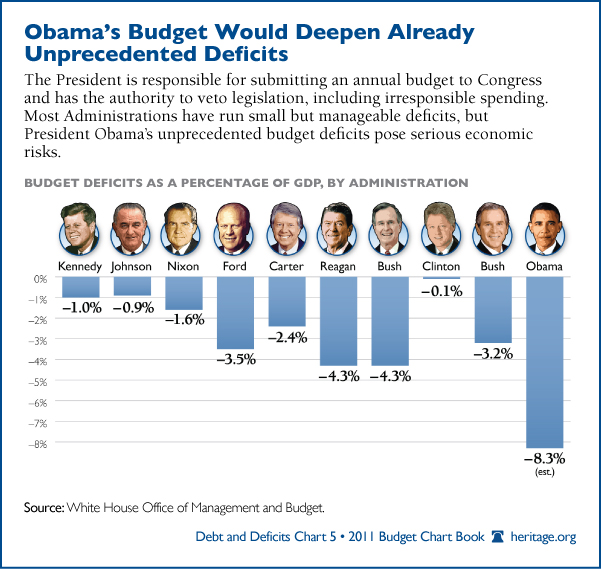
Over the last 10 presidents was have had 16.9% of GDP of deficits total from five Republican presidents and 12.7% total from Democratic presidents. However, what is most disturbing is that 8.3% of the 12.7% comes from the Obama administration who is currently in power and we are no longer in the cold war era. That is almost double the total of all the other four Democratic presidents combined under just one president. Take a look at the chart below from the Heritage Foundation:

Rob Bluey

January 1, 2012 at 9:56 am

Over the past 50 years, 10 U.S. presidents have made annual budget requests to Congress, projecting deficits both big and small. But no other president compares to Barack Obama when it comes to the size and scale of the current budget deficit facing the United States.

The country is facing an 8.3 percent estimated average national deficit of a two-term Obama administration — the biggest of the past 50 years. By comparison, the current estimate for Obama is nearly double the percentage under Presidents Ronald Reagan and George H.W. Bush — and they were fighting the Cold War.

Political party doesn’t tell the whole story, however. President Bill Clinton leads the pack of presidents since 1961, according to data from the White House Office of Management and Budget. Heritage put together this graphic as part of our Budget Chart Book.

So what does the current trajectory mean for the United States? We’re certainly no longer looking at a continuation of manageable deficits in the years to come. This is a dramatic change in the magnitude of annual shortfalls at the federal level. That’s one reason Heritage came up with a plan to fix the debt crisis.

If you have a suggestion for a chart we should feature in the future, please post a comment below, email us at scribe@heritage.org, or send me at tweet @RobertBluey.

_______________________
Here is a perspective from Dan Mitchell of the Cato Institute:

To Fix the Budget, Bring Back Reagan…or Even Clinton

Posted by Daniel J. Mitchell

President Obama unveiled his fiscal year 2012 budget today, and there’s good news and bad news. The good news is that there’s no major initiative such as the so-called stimulus scheme or the government-run healthcare proposal. The bad news, though, is that government is far too big and Obama’s budget does nothing to address this problem.

But perhaps the folks on Capitol Hill will be more responsible and actually try to save America from becoming a big-government, European-style welfare state. The solution may not be easy, but it is simple. Lawmakers merely need to restrain the growth of government spending so that it grows slower than the private economy.

Actual spending cuts would be the best option, of course, but limiting the growth of spending is all that’s needed to slowly shrink the burden of government spending relative to gross domestic product.

Fortunately, we have two role models from recent history that show it is possible to control the federal budget. This video from the Center for Freedom and Prosperity uses data from the Historical Tables of the Budget to demonstrate the fiscal policy achievements of both Ronald Reagan and Bill Clinton.

Spending Restraint, Part I: Lessons from Ronald Reagan and Bill Clinton

Uploaded by on Feb 14, 2011

Ronald Reagan and Bill Clinton both reduced the relative burden of government, largely because they were able to restrain the growth of domestic spending. The mini-documentary from the Center for Freedom and Prosperity uses data from the Historical Tables of the Budget to show how Reagan and Clinton succeeded and compares their record to the fiscal profligacy of the Bush-Obama years.

_____________________


Some people will want to argue about who gets credit for the good fiscal policy of the 1980s and 1990s.

Bill Clinton’s performance, for instance, may not have been so impressive if he had succeeded in pushing through his version of government-run healthcare or if he didn’t have to deal with a Republican Congress after the 1994 elections. But that’s a debate for partisans. All that matters is that the burden of government spending fell during Bill Clinton’s reign, and that was good for the budget and good for the economy. And there’s no question he did a much better job than George W. Bush.

Indeed, a major theme in this new video is that the past 10 years have been a fiscal disaster. Both Bush and Obama have dramatically boosted the burden of government spending — largely because of rapid increases in domestic spending.

This is one of the reasons why the economy is weak. For further information, this video looks at the theoretical case for small government and this video examines the empirical evidence against big government.

Another problem is that many people in Washington are fixated on deficits and debt, but that’s akin to focusing on symptoms and ignoring the underlying disease. To elaborate, this video explains that America’s fiscal problem is too much spending rather than too much debt.

Last but not least, this video reviews the theory and evidence for the “Rahn Curve,” which is the notion that there is a growth-maximizing level of government outlays. The bad news is that government already is far too big in the United States. This is undermining prosperity and reducing competitiveness.

Spending Restraint, Part II: Lessons from Canada, Ireland, Slovakia, and New Zealand

Uploaded by on Feb 22, 2011

Nations can make remarkable fiscal progress if policy makers simply limit the growth of government spending. This video, which is Part II of a series, uses examples from recent history in Canada, Ireland, Slovakia, and New Zealand to demonstrate how it is possible to achieve rapid improvements in fiscal policy by restraining the burden of government spending. Part I of the series examined how Ronald Reagan and Bill Clinton were successful in controlling government outlays — particularly the burden of domestic spending programs. http://www.freedomandprosperity.org


Obama wants to claim Reagan again

I have a son named Wilson Daniel Hatcher and he is named after two of the most respected men I have ever read about : Daniel from the Old Testament and Ronald Wilson Reagan.

One of the thrills of my life was getting to hear President Reagan speak in the beginning of November of 1984 at the State House Convention Center in Little Rock.  Immediately after that program I was standing outside on Markham with my girlfriend Jill Sawyer (now wife of 25 years) and we were alone on a corner and the President was driven by and he waved at us and we waved back.

My former pastor from Memphis, Adrian Rogers, got the opportunity to visit with President Ronald Reagan on several occasions and my St Senator Jeremy Hutchinson got to meet him too. I am very jealous.

This is not the first time,but President Obama is claiming that Reagan also would support his own position concerning raising taxes.

Leslie Grimard

April 12, 2012 at 1:00 pm

Yesterday President Obama tried to sell the “Buffett Rule” under a new moniker:

What Ronald Reagan was calling for then is the same thing that we’re calling for now: a return to basic fairness and responsibility; everybody doing their part. And if it will help convince folks in Congress to make the right choice, we could call it the Reagan Rule instead of the Buffett Rule.

Securing Ronald Reagan’s economic blessing is a new trend among liberals. And no wonder: Ronald Reagan is one of the most popular presidents in modern times.

But what did Reagan really say about the tax rates of the millionaire and the bus driver? Reagan proposed: “We’re going to close the unproductive tax loopholes that have allowed some of the truly wealthy to avoid paying their fair share, the loopholes” that “sometimes make it possible for millionaires to pay nothing.”

Reagan closed tax loopholes; President Obama wants to raise taxes.

President Obama does not acknowledge the profound difference between the “fair-share” solution Reagan sought in 1986 and the redistributionist tax hike he is proposing today. The 1986 law revolutionized the tax code by eliminating dozens of loopholes to make all incomes taxable (Like the Paul Ryan [R­–WI] tax reform plan). Reagan aimed to close tax loopholes, including the infamous three-martini lunch, but he never intended to take money from the small business owners who create the vast majority of American jobs.

It was Ronald Reagan who proposed the Economic Reform Tax Act [ERTA] of 1981, which cut marginal tax cuts by 25 percent across the board and reduced the highest marginal tax rate from 70 percent to 50 percent. Two years after ERTA was signed into law, America began almost two decades of robust economic growth.

Ronald Reagan knew from personal experience that if you raise taxes, you erect barriers to innovation and job creation. As a film star in the late ’40s and ’50s, Reagan was taxed at 91 percent, which caused him to remark: “Why should I have done [another] picture, even if it was Gone with the Wind?…What good would it have done me?” Reagan would’ve made only 9 cents on the dollar.

His rationale for cutting taxes across the board was based on more than just personal experience. Reagan believed—and was proven correct—that, “taken together, tax cuts and budget cuts…will put us back on the road to a sound economy, with lower inflation, more growth, and a government that lives within its means. Our goal is a very simple one: to rebuild this Nation so that individual Americans can once again be the masters of their own destiny.”

Obama is not honoring Reagan’s economic legacy. The President may see the same “Buffett” problem that Reagan saw, but he is proposing a radically different solution—one that will not work. Obama may not like it, but the real Reagan rule is that when you close loopholes and cut taxes for everyone—from the top to the bottom—everyone benefits.

Ronald Reagan’s videos and pictures displayed here on the www.thedailyhatch.org

https://i0.wp.com/www.reagan.utexas.edu/archives/photographs/large/C39192-3.jpg

President Reagan, Nancy Reagan, Bill Clinton and Hillary Clinton attending the Dinner Honoring the Nation’s Governors. 2/22/87.

Ronald Reagan is my favorite president and I have devoted several hundred looking at his ideas. Take a look at these links below:

https://i0.wp.com/www.reagan.utexas.edu/archives/photographs/large/c32275-30.jpg

President Reagan and Nancy Reagan attending “All Star Tribute to Dutch Reagan” at NBC Studios(from left to right sitting) Colleen Reagan, Neil Reagan, Maureen Reagan, President, Nancy Reagan, Dennis Revell. (From left to right standing) Emmanuel Lewis, Charlton Heston, Ben Vereen, Monty Hall, Frank Sinatra, Burt Reynolds, Dean Martin, Eydie Gorme, Vin Scully, Steve Lawrence, last 2 unidentified. Burbank, California 12/1/85.

Above you will see the picture of Charlton Heston. My wife actually got her picture taken with Heston in 1992 when he came in to try to jump start Mike Huckabee’s effort to beat Senator Dale Bumpers.

My favorite president!!!!!

My favorite president is Ronald Wilson Reagan. President Reagan with Nancy Reagan, William Wilson, Betty Wilson, Walter Annenberg, Leonore Annenberg, Earle Jorgensen, Marion Jorgensen, Harriet Deutsch and Armand Deutschat at a private birthday party in honor of President Reagan’s 75th Birthday in the White House Residence. 2/7/86. Milton Friedman’s book “Free to Choose” did influence […]

Ronald Wilson Reagan versus Barrack Obama

Government Spending Doesn’t Create Jobs Uploaded by catoinstitutevideo on Sep 7, 2011 Share this on Facebook: http://on.fb.me/qnjkn9 Tweet it: http://tiny.cc/o9v9t In the debate of job creation and how best to pursue it as a policy goal, one point is forgotten: Government doesn’t create jobs. Government only diverts resources from one use to another, which doesn’t […]

Reagan and Clinton had good fiscal policies according to Cato Institute

Uploaded by HeritageFoundation on Dec 16, 2010 http://blog.heritage.org/2010/12/16/new-video-pork-filled-spending-bill-just-… Despite promises from President Obama last year and again last month that he opposed reckless omnibus spending bills and earmarks, the White House and members of Congress are now supporting a reckless $1.1 trillion spending bill reportedly stuffed with roughly 6,500 earmarks. ________________________ Below you see an […]

Milton Friedman discusses Reagan and Reagan discusses Friedman

Uploaded by YAFTV on Aug 19, 2009 Nobel Laureate Dr. Milton Friedman discusses the principles of Ronald Reagan during this talk for students at Young America’s Foundation’s 25th annual National Conservative Student Conference MILTON FRIEDMAN ON RONALD REAGAN In Friday’s WSJ, Milton Friedman reflectedon Ronald Reagan’s legacy. (The link should work for a few more […]

Concerning spending cuts Reagan believed, that members of Congress “wouldn’t lie to him when he should have known better.”

Washington Could Learn a Lot from a Drug Addict Concerning spending cuts Reagan believed, that members of Congress “wouldn’t lie to him when he should have known better.” However, can you believe a drug addict when he tells you he is not ever going to do his habit again? Congress is addicted to spending too […]

Ronald Reagan’s pro-life tract (Part 100)

A Ronald Reagan radio address from 1975 addresses the topics of abortion and adoption. This comes from a collection of audio commentaries titled “Reagan in His Own Voice.” I just wanted to share with you one of the finest prolife papers I have ever read, and it is by President Ronald Wilson Reagan. I have […]

Ronald Wilson Reagan (Part 98)

Princess Diana dancing with John Travolta in the entrance hall at the White House. 11/9/85. From November of 1980, here is CBS’s coverage of Election Night. Taped from WJKW-TV8, Cleveland. This is part 3 of 3. Lee Edwards of the Heritage Foundation wrote an excellent article on Ronald Reagan and the events that transpired during the […]

Ronald Wilson Reagan (Part 97)

The Reagans have tea with Prince Charles and Princess Diana in the White House residence. 11/9/85 . I remember when I visited London in July of 1981 and the whole town was getting ready for the big royal wedding between Prince Charles and Princess Diana. Above you will see them pictured with President Reagan. From […]


My favorite president!!!!!

My favorite president is Ronald Wilson Reagan.

https://i0.wp.com/www.reagan.utexas.edu/archives/photographs/large/C33290-9.jpg

President Reagan with Nancy Reagan, William Wilson, Betty Wilson, Walter Annenberg, Leonore Annenberg, Earle Jorgensen, Marion Jorgensen, Harriet Deutsch and Armand Deutschat at a private birthday party in honor of President Reagan’s 75th Birthday in the White House Residence. 2/7/86.

Milton Friedman’s book “Free to Choose” did influence me a lot during the days leading up to the Reagan presidency. Take a look at his interview with Phil Donahue below. Did you know that Phil Donahue is married to the daughter of Danny Thomas. Marlo is in charge of raising funds for her father’s hospital in Memphis.

I am going to post portions of this article by Ronald Reagan the next few days.

June 10, 2004, 10:30 a.m.
Abortion and the Conscience of the Nation
Ronald Reagan’s pro-life tract.

EDITOR’S NOTE: While president, Ronald Reagan penned this article for The Human Life Review, unsolicited. It ran in the Review‘s Spring 1983, issue and is reprinted here with permission.

Abraham Lincoln recognized that we could not survive as a free land when some men could decide that others were not fit to be free

I have often said we need to join in prayer to bring protection to the unborn. Prayer and action are needed to uphold the sanctity of human life. I believe it will not be possible to accomplish our work, the work of saving lives, “without being a soul of prayer.” The famous British Member of Parliament, William Wilberforce, prayed with his small group of influential friends, the “Clapham Sect,” for decades to see an end to slavery in the British empire. Wilberforce led that struggle in Parliament, unflaggingly, because he believed in the sanctity of human life. He saw the fulfillment of his impossible dream when Parliament outlawed slavery just before his death.

Let his faith and perseverance be our guide. We will never recognize the true value of our own lives until we affirm the value in the life of others, a value of which Malcolm Muggeridge says:. . . however low it flickers or fiercely burns, it is still a Divine flame which no man dare presume to put out, be his motives ever so humane and enlightened.”

Abraham Lincoln recognized that we could not survive as a free land when some men could decide that others were not fit to be free and should therefore be slaves. Likewise, we cannot survive as a free nation when some men decide that others are not fit to live and should be abandoned to abortion or infanticide. My Administration is dedicated to the preservation of America as a free land, and there is no cause more important for preserving that freedom than affirming the transcendent right to life of all human beings, the right without which no other rights have any meaning.

1980 interview with Milton Friedman by Phil Donahue (part 4). Friedman greatly

Ronald Wilson Reagan versus Barrack Obama

Government Spending Doesn’t Create Jobs

Uploaded by on Sep 7, 2011

Share this on Facebook: http://on.fb.me/qnjkn9 Tweet it: http://tiny.cc/o9v9t

In the debate of job creation and how best to pursue it as a policy goal, one point is forgotten: Government doesn’t create jobs. Government only diverts resources from one use to another, which doesn’t create new employment.

Video produced by Caleb Brown and Austin Bragg.

___________________________

 I have a son named Wilson Daniel Hatcher and he is named after two of the most respected men I have ever read about : Daniel from the Old Testament and Ronald Wilson Reagan.

One of the thrills of my life was getting to hear President Reagan speak in the beginning of November of 1984 at the State House Convention Center in Little Rock.  Immediately after that program I was standing outside on Markham with my girlfriend Jill Sawyer (now wife of 25 years) and we were alone on a corner and the President was driven by and he waved at us and we waved back.

My former pastor from Memphis, Adrian Rogers, got the opportunity to visit with President Ronald Reagan on several occasions and my St Senator Jeremy Hutchinson got to meet him too. I am very jealous.

Today we are going to compare Reagan’s record to that of Obama:

On this day last year, I posted two charts that I developed using the Minneapolis Federal Reserve Bank’s interactive website.

Those two charts showed that the current recovery was very weak compared to the boom of the early 1980s.

But perhaps that was an unfair comparison. Maybe the Reagan recovery started strong and then hit a wall. Or maybe the Obama recovery was the economic equivalent of a late bloomer.

So let’s look at the same charts, but add an extra year of data. Does it make a difference?

Meh…not so much.

Let’s start with the GDP data. The comparison is striking. Under Reagan’s policies, the economy skyrocketed.  Heck, the chart prepared by the Minneapolis Fed doesn’t even go high enough to show how well the economy performed during the 1980s.

Under Obama’s policies, by contrast, we’ve just barely gotten back to where we were when the recession began. Unlike past recessions, we haven’t enjoyed a strong bounce. And this means we haven’t recovered the output that was lost during the downturn.

This is a damning indictment of Obamanomics

Indeed, I made this point several months ago when analyzing some work by Nobel laureate Robert Lucas. And it’s been highlighted more recently by James Pethokoukis of the American Enterprise Institute and the news pages of the Wall Street Journal.

Unfortunately, the jobs chart is probably even more discouraging. As you can see, employment is still far below where it started.

This is in stark contrast to the jobs boom during the Reagan years.

So what does this mean? How do we measure the human cost of the foregone growth and jobs that haven’t been created?

Writing in today’s Wall Street Journal, former Senator Phil Gramm and budgetary expert Mike Solon compare the current recovery to the post-war average as well as to what happened under Reagan.

If in this “recovery” our economy had grown and generated jobs at the average rate achieved following the 10 previous postwar recessions, GDP per person would be $4,528 higher and 13.7 million more Americans would be working today. …President Ronald Reagan’s policies ignited a recovery so powerful that if it were being repeated today, real per capita GDP would be $5,694 higher than it is now—an extra $22,776 for a family of four. Some 16.9 million more Americans would have jobs.

By the way, the Gramm-Solon column also addresses the argument that this recovery is anemic because the downturn was caused by a financial crisis. That’s certainly a reasonable argument, but they point out that Reagan had to deal with the damage caused by high inflation, which certainly wreaked havoc with parts of the financial system. They also compare today’s weak recovery to the boom that followed the financial crisis of 1907.

But I want to make a different point. As I’ve written before, Obama is not responsible for the current downturn. Yes, he was a Senator and he was part of the bipartisan consensus for easy money, Fannie/Freddie subsidies, bailout-fueled moral hazard, and a playing field tilted in favor of debt, but his share of the blame wouldn’t even merit an asterisk.

My problem with Obama is that he hasn’t fixed any of the problems. Instead, he has kept in place all of the bad policies – and in some cases made them worse. Indeed, I challenge anyone to identify a meaningful difference between the economic policy of Obama and the economic policy of Bush.

  • Bush increased government spending. Obama has been increasing government spending.
  • Bush adopted Keynesian “stimulus” policies. Obama adopted Keynesian “stimulus” policies.
  • Bush bailed out politically connected companies. Obama has been bailing out politically connected companies.
  • Bush supported the Fed’s easy-money policy. Obama has been supporting the Fed’s easy-money policy.
  • Bush created a new healthcare entitlement. Obama created a new healthcare entitlement.
  • Bush imposed costly new regulations on the financial sector. Obama imposed costly new regulations on the financial sector.

I could continue, but you probably get the  point. On economic issues, the only real difference is that Bush cut taxes and Obama is in favor of higher taxes. Though even that difference is somewhat overblown since Obama’s tax policies – up to this point – haven’t had a big impact on the overall tax burden (though that could change if his plans for higher tax rates ever go into effect).

This is why I always tell people not to pay attention to party labels. Bigger government doesn’t work, regardless of whether a politician is a Republican or Democrat. The problem isn’t Obamanomics, it’s Bushobamanomics. But since that’s a bit awkward, let’s just call it statism.

Reagan: “Only a constitutional amendment will do the job.”

Washington Spending 101: How to Stop the Explosion of Debt

Uploaded by on Jul 30, 2011

http://rsc.jordan.house.gov/ Follow us on Twitter @RepublicanStudy

Reagan: “Only a constitutional amendment will do the job. We’ve tried the carrot, and it failed. With the stick of a balanced budget amendment, we can stop government’s squandering, overtaxing ways, and save our economy.”

The growing momentum toward requiring Washington to actually balance its budget shows that House Republicans have connected with the American people. Leading Democrats are another story. Senator Reid and President Obama are still trying to fool the American people into thinking we can keep borrowing and spending like there is no tomorrow.

__________________

What we are doing now is not working. President Ronald Reagan said, “Only a constitutional amendment will do the job. We’ve tried the carrot, and it failed. With the stick of a balanced budget amendment, we can stop government’s squandering, overtaxing ways, and save our economy.”

Ericka Andersen

December 14, 2011 at 11:09 am

In case you’re not keeping track, it has been nearly 1,000 days since the United States Senate passed a budget. Meanwhile, America’s fiscal nightmare keeps growing, and those on the left—including Members of the Senate—keep advocating for even more spending despite America’s $15 trillion national debt. That’s an important record to keep in mind as the Senate votes today on two versions of the Balanced Budget Amendment (BBA).

A BBA is constructive, but it’s not the final answer to America’s fiscal woes despite the tools it offers—in large part because it fails to tackle entitlement reform, the most detrimental driver of spending in this country. A BBA is not a neatly packed solution, as no constitutional amendment can replace the hard work of true spending reforms.

However, Republicans ensured earlier this year that the 2011 Budget Control Act required a vote on a BBA. Their commitment to ending big government’s reckless behavior was well-meaning but flawed, and a BBA has already failed in the House.

The proposed amendment being debated in the Senate was chosen from several previous versions and is sponsored by Senators Orrin Hatch (R–UT), Mike Lee (R–UT), and John Cornyn (R–TX), among others. It is stricter and it fundamentally differs from its counterpart in the House, but it still lacks in several areas.

Cornyn spoke at The Heritage Foundation last month about the BBA, saying that the American people are “justifiably very skeptical of Washington” right now. “I think we need to prove to them that we are serious about solving the problem, not that we are just going through the motions,” Cornyn said. “I think [a BBA] is called for under the circumstances we are in.”

The proposed amendment addresses many key issues requiring disciplinary action on the $15 trillion federal debt. These include a spending cap of 18 percent of GDP, a three-fifths vote to raise the debt ceiling, and a two-thirds votes to raise taxes—all helpful actions to getting America back on the right path. It also requires that the President submit a balanced budget to Congress every year.

While the details of this proposal are an improvement to some of the previous, weaker BBA proposals, it still doesn’t solve America’s spending problem.

The Heritage Foundation has supported and covered extensively our ideas for a balanced budget in the Saving the American Dream plan. A major component of that plan would be to undertake entitlement reform by amending existing federal laws that provide permanent or indefinite appropriations to federal agencies or programs. This BBA does not provide this kind of essential direction for long-term budget maintenance.

As Heritage’s David Addington has noted, an appropriate BBA should be intentionally focused on driving down spending, taxation, and borrowing. Such focus is especially important right now because of the massive federal debt and these yet-to-be reformed entitlement programs.

Even more importantly, a supermajority must be able to temporarily waive a BBA if it is crucial to national security, as such is the first constitutional priority of the federal government.

The Lee version of the BBA permits only a partial waiver when the U.S. is engaged in a congressionally authorized “military conflict”—and the particulars can get sticky. The flexibility for national security is essential if a BBA is to be amended to the Constitution.

An acceptable BBA should also provide its own enforcement and prevent government from borrowing money to meet the balance requirement. Any loopholes that contradict the BBA’s overall purpose will serve only to push America further from fiscal prosperity.

As Heritage’s Matt Spalding explained just before the failed House vote last month, Congress should be taking every opportunity it has to first and foremost cut and cap federal spending:

A part of the long-term agenda to rein in government is an appropriate and sound amendment to the Constitution that would keep federal spending under control in subsequent years. Indeed, the principal reason for adopting a balanced budget constitutional amendment is to limit the size and scope of the federal government by limiting its spending.

Despite its weaknesses, the BBA retains worthy components, making it harder to raise taxes by requiring a two-thirds super-majority of both houses.

As Hatch said in conference call with bloggers on Monday, the BBA “will finally put a straightjacket on Washington’s ability to continue profligate spending of the American people’s money.”

He said that the failure of the congressional super committee to reach an agreement to cut between $1.2 and $1.6 trillion from the federal debt over the next 10 years demonstrated a need for a BBA.

But it’s important to be cautious when approaching what some have deemed the answer to America’s fiscal disaster.

In his post, Spalding highlighted the complications in passing a BBA:

While considerable work has been done to develop a robust amendment, questions of amendment language (both in terms of operational construction and enforcement) have not yet sufficiently been resolved to meet the high and deliberative standard of the United States Constitution.

Like the House version, the Senate BBA is not expected to pass today, which will leave more quality time for consideration of what is best for renewing America’s course to fiscal repair.

Amending the Constitution requires that the American people have sufficient time to converse and comprehend the implications such a change would bring. The Senate should consider carefully today all the factors involved now and in the future for a BBA.