Category Archives: Ronald Reagan

Milton Friedman helped get Reagan elected

Bob Chitester Discusses Milton Friedman and ‘Free to Choose’

Published on Jul 30, 2012 by

“There are very few people over the generations who have ideas that are sufficiently original to materially alter the direction of civilization. Milton is one of those very few people.”

That is how former Federal Reserve Chairman Alan Greenspan described the Nobel laureate economist Milton Friedman. But it is not for his technical work in monetary economics that Friedman is best known. Like mathematician Jacob Bronowski and astronomer Carl Sagan, Friedman had a gift for communicating complex ideas to a general audience.

It was this gift that brought him to the attention of filmmaker Bob Chitester. At Chitester’s urging, Friedman agreed to make a 10 part documentary series explaining the power of economic freedom. It was called “Free to Choose,” and became one of the most watched documentaries in history.

The series not only reached audiences in liberal democracies, but was smuggled behind the iron curtain where it played, in secret, to large audiences. Reflecting on its impact, Czech president Vaclav Klaus has said: “For us, who lived in the communist world, Milton Friedman was the greatest champion of freedom, of limited and unobtrusive government and of free markets. Because of him I became a true believer in the unrestricted market economy.”

July 31st, 2012 is the 100th anniversary of Friedman’s birth. To commemorate that occasion, we’d like to share an interview with “Free to Choose” producer Bob Chitester. Like this interview, the entire series can now be viewed on-line at no cost at http://www.freetochoose.tv/, thanks to the incredible technological progress brought about by the economic freedom that Milton Friedman celebrated.

Produced by Andrew Coulson, Caleb O. Brown, Austin Bragg, and Lou Richards, with help from the Free to Choose Network.

_____________

We got to stop spending so much money on the federal level. It will bankrupt us. I remember back in 1980 when I really started getting into the material of Milton Friedman as a result of reading his articles in Newsweek and reading his book “Free to Choose,” I really did get facts and figures to back on the view that we need more freedom giving back to us and the government needs to spend less.

As a result of Friedman’s writings I was able to discuss these issues with my fellow students at the university and by the time the 1980 election came around I had been attending political rallies and went out and worked hard for Ronald Reagan’s election. In this article below Dr. Thomas Sowell (who was featured twice in the film “Free to Choose”) notes how much influence Milton Friedman had on the election outcome in 1980:

Milton Friedman at 90

by Thomas Sowell

Thomas Sowell is a senior fellow at the Hoover Institute in Stanford, California.

Added to cato.org on July 25, 2002

This article originally appeared on TownHall.com, July 25, 2002.

Milton Friedman’s 90th birthday on July 31st provides an occasion to think back on his role as the pre-eminent economist of the 20th century. To those of us who were privileged to be his students, he also stands out as a great teacher.

When I was a graduate student at the University of Chicago, back in 1959, one day I was waiting outside Professor Friedman’s office when another graduate student passed by. He noticed my exam paper on my lap and exclaimed: “You got a B?”

“Yes,” I said. “Is that bad?”

Thomas Sowell is a senior fellow at the Hoover Institute in Stanford, California.


“There were only two B’s in the whole class,” he replied.

“How many A’s?” I asked.

“There were no A’s!”

Today, this kind of grading might be considered to represent a “tough love” philosophy of teaching. I don’t know about love, but it was certainly tough.

Professor Friedman also did not let students arrive late at his lectures and distract the class by their entrance. Once I arrived a couple of minutes late for class and had to turn around and go back to the dormitory.

All the way back, I thought about the fact that I would be held responsible for what was said in that lecture, even though I never heard it. Thereafter, I was always in my seat when Milton Friedman walked in to give his lecture.

On a term paper, I wrote that either (a) this would happen or (b) that would happen. Professor Friedman wrote in the margin: “Or (c) your analysis is wrong.”

“Where was my analysis wrong?” I asked him.

“I didn’t say your analysis was wrong,” he replied. “I just wanted you to keep that possibility in mind.”

Perhaps the best way to summarize all this is to say that Milton Friedman is a wonderful human being — especially outside the classroom. It has been a much greater pleasure to listen to his lectures in later years, after I was no longer going to be quizzed on them, and a special pleasure to appear on a couple of television programs with him and to meet him on social occasions.

Milton Friedman’s enduring legacy will long outlast the memories of his students and extends beyond the field of economics. John Maynard Keynes was the reigning demi-god among economists when Friedman’s career began, and Friedman himself was at first a follower of Keynesian doctrines and liberal politics.

Yet no one did more to dismantle both Keynesian economics and liberal welfare-state thinking. As late as the 1950s, those with the prevailing Keynesian orthodoxy were still able to depict Milton Friedman as a fringe figure, clinging to an outmoded way of thinking. But the intellectual power of his ideas, the fortitude with which he persevered, and the ever more apparent failures of Keynesian analyses and policies, began to change all that, even before Professor Friedman was awarded the Nobel Prize in economics in 1976.

A towering intellect seldom goes together with practical wisdom, or perhaps even common sense. However, Milton Friedman not only excelled in the scholarly journals but also on the television screen, presenting the basics of economics in a way that the general public could understand.

His mini-series “Free to Choose” was a classic that made economic principles clear to all with living examples. His good nature and good humor also came through in a way that attracted and held an audience.

Although Friedrich Hayek launched the first major challenge to the prevailing thinking behind the welfare state and socialism with his 1944 book “The Road to Serfdom,” Milton Friedman became the dominant intellectual force among those who turned back the leftward tide in what had seemed to be the wave of the future.

Without Milton Friedman’s role in changing the minds of so many Americans, it is hard to imagine how Ronald Reagan could have been elected president.

Nor was Friedman’s influence confined to the United States. His ideas reached around the world, not only among economists, but also in political circles which began to understand why left-wing ideas that sounded so good produced results that were so bad.

Milton Friedman rates a 21-gun salute on his birthday. Or perhaps a 90-gun salute would be more appropriate.

Harding,Kennedy and Reagan proved that the Laffer Curve works

 I enjoyed this article below because it demonstrates that the Laffer Curve has been working for almost 100 years now when it is put to the test in the USA. I actually got to hear Arthur Laffer speak in person in 1981 and he told us in advance what was going to happen the 1980’s and it all came about as he said it would when Ronald Reagan’s tax cuts took place. I wish we would lower taxes now instead of looking for more revenue through raised taxes. We have to grow the economy:

What Mitt Romney Said Last Night About Tax Cuts And The Deficit Was Absolutely Right. And What Obama Said Was Absolutely Wrong.

Mitt Romney repeatedly said last night that he would not allow tax cuts to add to the deficit.  He repeatedly said it because over and over again Obama blathered the liberal talking point that cutting taxes necessarily increased deficits.

Romney’s exact words: “I want to underline that — no tax cut that adds to the deficit.”

Meanwhile, Obama has promised to cut the deficit in half during his first four years – but instead gave America the highest deficits in the history of the entire human race.

I’ve written about this before.  Let’s replay what has happened every single time we’ve ever cut the income tax rate.

The fact of the matter is that we can go back to Calvin Coolidge who said very nearly THE EXACT SAME THING to his treasury secretary: he too would not allow any tax cuts that added to the debt.  Andrew Mellon – quite possibly the most brilliant economic mind of his day – did a great deal of research and determined what he believed was the best tax rate.  And the Coolidge administration DID cut income taxes and MASSIVELY increased revenues.  Coolidge and Mellon cut the income tax rate 67.12 percent (from 73 to 24 percent); and revenues not only did not go down, but they went UP by at least 42.86 percent (from $700 billion to over $1 billion).

That’s something called a documented fact.  But that wasn’t all that happened: another incredible thing was that the taxes and percentage of taxes paid actually went UP for the rich.  Because as they were allowed to keep more of the profits that they earned by investing in successful business, they significantly increased their investments and therefore paid more in taxes than they otherwise would have had they continued sheltering their money to protect themselves from the higher tax rates.  Liberals ignore reality, but it is simply true.  It is a fact.  It happened.

Then FDR came along and raised the tax rates again and the opposite happened: we collected less and less revenue while the burden of taxation fell increasingly on the poor and middle class again.  Which is exactly what Obama wants to do.

People don’t realize that John F. Kennedy, one of the greatest Democrat presidents, was a TAX CUTTER who believed the conservative economic philosophy that cutting tax rates would in fact increase tax revenues.  He too cut taxes, and he too increased tax revenues.

So we get to Ronald Reagan, who famously cut taxes.  And again, we find that Reagan cut that godawful liberal tax rate during an incredibly godawful liberal-caused economic recession, and he increased tax revenue by 20.71 percent (with revenues increasing from $956 billion to $1.154 trillion).  And again, the taxes were paid primarily by the rich:

“The share of the income tax burden borne by the top 10 percent of taxpayers increased from 48.0 percent in 1981 to 57.2 percent in 1988. Meanwhile, the share of income taxes paid by the bottom 50 percent of taxpayers dropped from 7.5 percent in 1981 to 5.7 percent in 1988.”

So we get to George Bush and the Bush tax cuts that liberals and in particular Obama have just demonized up one side and demagogued down the other.  And I can simply quote the New York Times AT the time:

Sharp Rise in Tax Revenue to Pare U.S. Deficit By EDMUND L. ANDREWS Published: July 13, 2005

WASHINGTON, July 12 – For the first time since President Bush took office, an unexpected leap in tax revenue is about to shrink the federal budget deficit this year, by nearly $100 billion.

A Jump in Corporate Payments On Wednesday, White House officials plan to announce that the deficit for the 2005 fiscal year, which ends in September, will be far smaller than the $427 billion they estimated in February.

Mr. Bush plans to hail the improvement at a cabinet meeting and to cite it as validation of his argument that tax cuts would stimulate the economy and ultimately help pay for themselves.

Based on revenue and spending data through June, the budget deficit for the first nine months of the fiscal year was $251 billion, $76 billion lower than the $327 billion gap recorded at the corresponding point a year earlier.

The Congressional Budget Office estimated last week that the deficit for the full fiscal year, which reached $412 billion in 2004, could be “significantly less than $350 billion, perhaps below $325 billion.”

The big surprise has been in tax revenue, which is running nearly 15 percent higher than in 2004. Corporate tax revenue has soared about 40 percent, after languishing for four years, and individual tax revenue is up as well
.

And of course the New York Times, as reliable liberals, use the adjective whenever something good happens under conservative policies and whenever something bad happens under liberal policies: ”unexpected.”   But it WASN’T ”unexpected.”  It was EXACTLY what Republicans had said would happen and in fact it was exactly what HAD IN FACT HAPPENED every single time we’ve EVER cut income tax rates.

The truth is that conservative tax policy has a perfect track record: every single time it has ever been tried, we have INCREASED tax revenues while not only exploding economic activity and creating more jobs, but encouraging the wealthy to pay more in taxes as well.  And liberals simply dishonestly refuse to acknowledge documented history.

Meanwhile, liberals also have a perfect record … of FAILUREThey keep raising taxes and keep not understanding why they don’t get the revenues they predicted.

The following is a section from my article, “Tax Cuts INCREASE Revenues; They Have ALWAYS Increased Revenues“, where I document every single thing I said above:

The Falsehood That Tax Cuts Increase The Deficit

Now let’s take a look at the utterly fallacious view that tax cuts in general create higher deficits.

Let’s take a trip back in time, starting with the 1920s.  From Burton Folsom’s book, New Deal or Raw Deal?:

In 1921, President Harding asked the sixty-five-year-old [Andrew] Mellon to be secretary of the treasury; the national debt [resulting from WWI] had surpassed $20 billion and unemployment had reached 11.7 percent, one of the highest rates in U.S. history.  Harding invited Mellon to tinker with tax rates to encourage investment without incurring more debt. Mellon studied the problem carefully; his solution was what is today called “supply side economics,” the idea of cutting taxes to stimulate investment.  High income tax rates, Mellon argued, “inevitably put pressure upon the taxpayer to withdraw this capital from productive business and invest it in tax-exempt securities. . . . The result is that the sources of taxation are drying up, wealth is failing to carry its share of the tax burden; and capital is being diverted into channels which yield neither revenue to the Government nor profit to the people” (page 128).

Mellon wrote, “It seems difficult for some to understand that high rates of taxation do not necessarily mean large revenue to the Government, and that more revenue may often be obtained by lower taxes.”  And he compared the government setting tax rates on incomes to a businessman setting prices on products: “If a price is fixed too high, sales drop off and with them profits.”

And what happened?

“As secretary of the treasury, Mellon promoted, and Harding and Coolidge backed, a plan that eventually cut taxes on large incomes from 73 to 24 percent and on smaller incomes from 4 to 1/2 of 1 percent.  These tax cuts helped produce an outpouring of economic development – from air conditioning to refrigerators to zippers, Scotch tape to radios and talking movies.  Investors took more risks when they were allowed to keep more of their gains.  President Coolidge, during his six years in office, averaged only 3.3 percent unemployment and 1 percent inflation – the lowest misery index of any president in the twentieth century.

Furthermore, Mellon was also vindicated in his astonishing predictions that cutting taxes across the board would generate more revenue.  In the early 1920s, when the highest tax rate was 73 percent, the total income tax revenue to the U.S. government was a little over $700 million.  In 1928 and 1929, when the top tax rate was slashed to 25 and 24 percent, the total revenue topped the $1 billion mark.  Also remarkable, as Table 3 indicates, is that the burden of paying these taxes fell increasingly upon the wealthy” (page 129-130).

Now, that is incredible upon its face, but it becomes even more incredible when contrasted with FDR’s antibusiness and confiscatory tax policies, which both dramatically shrunk in terms of actual income tax revenues (from $1.096 billion in 1929 to $527 million in 1935), and dramatically shifted the tax burden to the backs of the poor by imposing huge new excise taxes (from $540 million in 1929 to $1.364 billion in 1935).  See Table 1 on page 125 of New Deal or Raw Deal for that information.

FDR both collected far less taxes from the rich, while imposing a far more onerous tax burden upon the poor.

It is simply a matter of empirical fact that tax cuts create increased revenue, and that those [Democrats] who have refused to pay attention to that fact have ended up reducing government revenues even as they increased the burdens on the poorest whom they falsely claim to help.

Let’s move on to John F. Kennedy, one of the most popular Democrat presidents ever.  Few realize that he was also a supply-side tax cutter.

Kennedy said:

“It is a paradoxical truth that tax rates are too high and tax revenues are too low and the soundest way to raise the revenues in the long run is to cut the rates now … Cutting taxes now is not to incur a budget deficit, but to achieve the more prosperous, expanding economy which can bring a budget surplus.”

– John F. Kennedy, Nov. 20, 1962, president’s news conference


“Lower rates of taxation will stimulate economic activity and so raise the levels of personal and corporate income as to yield within a few years an increased – not a reduced – flow of revenues to the federal government.”

– John F. Kennedy, Jan. 17, 1963, annual budget message to the Congress, fiscal year 1964

“In today’s economy, fiscal prudence and responsibility call for tax reduction even if it temporarily enlarges the federal deficit – why reducing taxes is the best way open to us to increase revenues.”

– John F. Kennedy, Jan. 21, 1963, annual message to the Congress: “The Economic Report Of The President”


“It is no contradiction – the most important single thing we can do to stimulate investment in today’s economy is to raise consumption by major reduction of individual income tax rates.”

– John F. Kennedy, Jan. 21, 1963, annual message to the Congress: “The Economic Report Of The President”


“Our tax system still siphons out of the private economy too large a share of personal and business purchasing power and reduces the incentive for risk, investment and effort – thereby aborting our recoveries and stifling our national growth rate.”

– John F. Kennedy, Jan. 24, 1963, message to Congress on tax reduction and reform, House Doc. 43, 88th Congress, 1st Session.


“A tax cut means higher family income and higher business profits and a balanced federal budget. Every taxpayer and his family will have more money left over after taxes for a new car, a new home, new conveniences, education and investment. Every businessman can keep a higher percentage of his profits in his cash register or put it to work expanding or improving his business, and as the national income grows, the federal government will ultimately end up with more revenues.”

– John F. Kennedy, Sept. 18, 1963, radio and television address to the nation on tax-reduction bill

Which is to say that modern Democrats are essentially calling one of their greatest presidents a liar when they demonize tax cuts as a means of increasing government revenues.

So let’s move on to Ronald Reagan.  Reagan had two major tax cutting policies implemented: the Economic Recovery Tax Act (ERTA) of 1981, which was retroactive to 1981, and the Tax Reform Act of 1986.

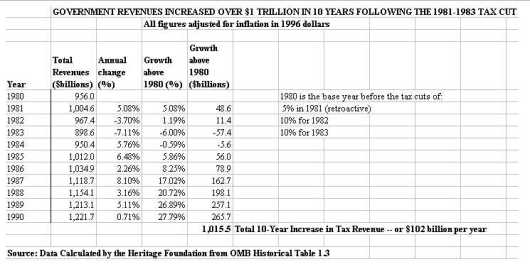
Did Reagan’s tax cuts decrease federal revenues?  Hardly:

We find that 8 of the following 10 years there was a surplus of revenue from 1980, prior to the Reagan tax cuts.  And, following the Tax Reform Act of 1986, there was a MASSIVE INCREASEof revenue.

So Reagan’s tax cuts increased revenue.  But who paid the increased tax revenue?  The poor?  Opponents of the Reagan tax cuts argued that his policy was a giveaway to the rich (ever heard that one before?) because their tax payments would fall.  But that was exactly wrong.  In reality:

“The share of the income tax burden borne by the top 10 percent of taxpayers increased from 48.0 percent in 1981 to 57.2 percent in 1988. Meanwhile, the share of income taxes paid by the bottom 50 percent of taxpayers dropped from 7.5 percent in 1981 to 5.7 percent in 1988.”

So Ronald Reagan a) collected more total revenue, b) collected more revenue from the rich, while c) reducing revenue collected by the bottom half of taxpayers, and d) generated an economic powerhouse that lasted – with only minor hiccups – for nearly three decades.  Pretty good achievement considering that his predecessor was forced to describe his own economy as a “malaise,” suffering due to a “crisis of confidence.” Pretty good considering that President Jimmy Carter responded to a reporter’s question as to what he would do about the problem of inflation by answering, “It would be misleading for me to tell any of you that there is a solution to it.”

Reagan whipped inflation.  Just as he whipped that malaise and that crisis of confidence.

________

The Laffer Curve, Part III: Dynamic Scoring

1980 Presidential Debate Reagan v. Carter video and transcript, 9th issue: Closing Statements

1980 Presidential Candidate Debate: Governor Ronald Reagan and President Jimmy Carter – 10/28/80

Above is the video of the complete debate. Below is the 9th part of the transcript that deals with the closing statements of both candidates. This segment begins at  1:28  minute mark.

October 28, 1980 Debate Transcript

October 28, 1980

The Carter-Reagan Presidential Debate

MR. SMITH: Gentlemen, each of you now has three minutes for a closing statement. President Carter, you’re first.

MR. CARTER: First of all, I’d like to thank the League of Women Voters for making this debate possible. I think it’s been a very constructive debate and I hope it’s helped to acquaint the American people with the sharp differences between myself and Governor Reagan. Also, I want to thank the people of Cleveland and Ohio for being such hospitable hosts during these last few hours in my life. I’ve been President now for almost four years. I’ve had to make thousands of decisions, and each one of those decisions has been a learning process. I’ve seen the strength of my nation, and I’ve seen the crises it approached in a tentative way. And I’ve had to deal with those crises as best I could. As I’ve studied the record between myself and Governor Reagan, I’ve been impressed with the stark differences that exist between us. I think the result of this debate indicates that that fact is true. I consider myself in the mainstream of my party. I consider myself in the mainstream even of the bipartisan list of Presidents who served before me. The United States must be a nation strong; the United States must be a nation secure. We must have a society that’s just and fair. And we must extend the benefits of our own commitment to peace, to create a peaceful world. I believe that since I’ve been in office, there have been six or eight areas of combat evolved in other parts of the world. In each case, I alone have had to determine the interests of my country and the degree of involvement of my country. I’ve done that with moderation, with care, with thoughtfulness; sometimes consulting experts. But, I’ve learned in this last three and a half years that when an issue is extremely difficult, when the call is very close, the chances are the experts will be divided almost 50-50. And the final judgment about the future of the nation – war, peace, involvement, reticence, thoughtfulness, care, consideration, concern – has to be made by the man in the Oval Office. It’s a lonely job, but with the involvement of the American people in the process, with an open Government, the job is a very gratifying one. The American people now are facing, next Tuesday, a lonely decision. Those listening to my voice will have to make a judgment about the future of this country. And I think they ought to remember that one vote can make a lot of difference. If one vote per precinct had changed in 1960, John Kennedy would never have been President of this nation. And if a few more people had gone to the polls and voted in 1968, Hubert Humphrey would have been President; Richard Nixon would not. There is a partnership involved in our nation. To stay strong, to stay at peace, to raise high the banner of human rights, to set an example for the rest of the world, to let our deep beliefs and commitments be felt by others in other nations, is my plan for the future. I ask the American people to join me in this partnership.

MR. SMITH: Governor Reagan?

MR. REAGAN: Yes, I would like to add my words of thanks, too, to the ladies of the League of Women Voters for making these debates possible. I’m sorry that we couldn’t persuade the bringing in of the third candidate, so that he could have been seen also in these debates. But still, it’s good that at least once, all three of us were heard by the people of this country. Next Tuesday is Election Day. Next Tuesday all of you will go to the polls, will stand there in the polling place and make a decision. I think when you make that decision, it might be well if you would ask yourself, are you better off than you were four years ago? Is it easier for you to go and buy things in the stores than it was four years ago? Is there more or less unemployment in the country than there was four years ago? Is America as respected throughout the world as it was? Do you feel that our security is as safe, that we’re as strong as we were four years ago? And if you answer all of those questions yes, why then, I think your choice is very obvious as to whom you will vote for. If you don’t agree, if you don’t think that this course that we’ve been on for the last four years is what you would like to see us follow for the next four, then I could suggest another choice that you have. This country doesn’t have to be in the shape that it is in. We do not have to go on sharing in scarcity with the country getting worse off, with unemployment growing. We talk about the unemployment lines. If all of the unemployed today were in a single line allowing two feet for each of them, that line would reach from New York City to Los Angeles, California. All of this can be cured and all of it can be solved. I have not had the experience the President has had in holding that office, but I think in being Governor of California, the most populous state in the Union – if it were a nation, it would be the seventh-ranking economic power in the world – I, too, had some lonely moments and decisions to make. I know that the economic program that I have proposed for this nation in the next few years can resolve many of the problems that trouble us today. I know because we did it there. We cut the cost – the increased cost of government – in half over the eight years. We returned $5.7 billion in tax rebates, credits and cuts to our people. We, as I have said earlier, fell below the national average in inflation when we did that. And I know that we did give back authority and autonomy to the people. I would like to have a crusade today, and I would like to lead that crusade with your help. And it would be one to take Government off the backs of the great people of this country, and turn you loose again to do those things that I know you can do so well, because you did them and made this country great. Thank you.

The whole industrialized world followed Reagan’s lead on taxes

The Laffer Curve, Part I: Understanding the Theory

Uploaded by on Jan 28, 2008

The Laffer Curve charts a relationship between tax rates and tax revenue. While the theory behind the Laffer Curve is widely accepted, the concept has become very controversial because politicians on both sides of the debate exaggerate. This video shows the middle ground between those who claim “all tax cuts pay for themselves” and those who claim tax policy has no impact on economic performance. This video, focusing on the theory of the Laffer Curve, is Part I of a three-part series. Part II reviews evidence of Laffer-Curve responses. Part III discusses how the revenue-estimating process in Washington can be improved. For more information please visit the Center for Freedom and Prosperity’s web site: http://www.freedomandprosperity.org

___________

After reading Milton Friedman’s book “Free to Choose” in 1980, I had the opportunity in 1981 to hear Arthur Laffer speak about what great economic expansion we were about to have in the USA because of Reagan’s 25% across the board tax cuts on income taxes and sure enough he was right. In fact, our economy expanded so much that the world took notice. Basically from 1980 to 2007 we dropped our top income tax rate from 73% to 39% which is a decrease of 34% and the world saw what we did and followed along. The drop of the industrialized countries during this same time was 26% (from 68% to 42% on average).

Take a look below at this chart:

Table 42.2
Top Individual Income Tax Rates in the OECD (percent)
Change
Country 1980 1985 1990 1995 2000 2005 2007 1980–2007
Australia 62 60 49 47 47 47 45 17
Austria 62 62 50 50 50 50 50 12
Belgium 76 76 58 61 60 53 53 24
Britain 83 60 40 40 40 40 40 43
Canada 64 57 49 49 48 44 44 20
Czech Rep. n.a. n.a. n.a. 43 32 32 32 11
Denmark 66 73 68 64 59 59 59 7
Finland 68 67 60 57 54 53 52 16
France 60 65 60 62 61 56 49 11
Germany 65 65 53 57 56 44 47 18
Greece 60 63 50 45 43 40 40 20
Hungary n.a. n.a. 50 44 40 38 36 14
Iceland 63 56 40 47 45 39 36 27
Ireland 60 65 58 48 42 42 41 19
Italy 72 81 66 67 51 44 44 28
Japan 75 70 65 65 50 50 50 25
Korea 89 65 64 48 44 39 39 50
Luxembourg 57 57 56 50 47 39 39 18
Mexico 55 55 40 35 40 30 28 27
Netherlands 72 72 60 60 52 52 52 20
New Zealand 62 66 33 33 39 39 39 23
Norway 75 64 51 42 48 40 40 35
Poland n.a. n.a. n.a. 45 40 40 40 5
Portugal 84 69 40 40 40 40 42 42
Slovakia n.a. n.a. n.a. 42 42 19 19 23
Spain 66 66 56 56 48 40 39 27
Sweden 87 80 65 50 55 56 56 32
Switzerland 38 40 38 37 36 34 34 4
Turkey 75 63 50 55 45 40 40 35
United States 73 55 38 43 43 39 39 34
Average 68 64 52 49 47 43 42 26
SOURCE: James Gwartney and Robert Lawson, Economic Freedom of the World (Vancouver: Fraser Institute,
2007), as updated to 2007 by the authors. Data includes the national and average subnational tax rates.
NOTE: n.a.  not applicable.

___________

I know that Max Brantley and many of his friends over the Arkansas Times like to say that the Reagan tax cuts increased the deficit but that clearly is not true.

Peter Sperry noted:

President Ronald Reagan’s record includes sweeping economic reforms and deep across-the-board tax cuts, market deregulation, and sound monetary policies to contain inflation. His policies resulted in the largest peacetime economic boom in American history and nearly 35 million more jobs. As the Joint Economic Committee reported in April 2000:2

In 1981, newly elected President Ronald Reagan refocused fiscal policy on the long run. He proposed, and Congress passed, sharp cuts in marginal tax rates. The cuts increased incentives to work and stimulated growth. These were funda-mental policy changes that provided the foundation for the Great Expansion that began in December 1982.

HOW DID THE REAGAN TAX CUTS AFFECT THE U.S. TREASURY?

Many critics of reducing taxes claim that the Reagan tax cuts drained the U.S. Treasury. The reality is that federal revenues increased significantly between 1980 and 1990:

  • Total federal revenues doubled from just over $517 billion in 1980 to more than $1 trillion in 1990. In constant inflation-adjusted dollars, this was a 28 percent increase in revenue.3
  • As a percentage of the gross domestic product (GDP), federal revenues declined only slightly from 18.9 percent in 1980 to 18 percent in 1990.4
  • Revenues from individual income taxes climbed from just over $244 billion in 1980 to nearly $467 billion in 1990.5 In inflation-adjusted dollars, this amounts to a 25 percent increase.
  • The Laffer Curve, Part II: Reviewing the EvidenceThis video is second installment of a three-part series. Part I reviews theoretical relationship between tax rates, taxable income, and tax revenue. Part III discusses how the revenue-estimating process in Washington can be improved. For more information please visit the Center for Freedom and Prosperity’s web site: http://www.freedomandprosperity.org.The Laffer Curve, Part III: Dynamic Scoring

Romney: “Milton Friedman understood…Government does not create prosperity. Free markets and free people create prosperity.”

Ronald Reagan – States’ Rights

Published on Sep 12, 2012 by

In 1967, newly elected California governor Ronald Reagan sat down with William F. Buckley Jr to discuss states’ rights.

___________

People should pay attention to the writings of Milton Friedman did. Ronald Reagan owes a lot of his success to the beliefs of Friedman. Reagan followed Friedman’s plan on curbing inflation and was able to bring inflation down from 12% in 1980 and came close to eliminating inflation altogether.

Mitt Romney rightly noted, “Milton Friedman understood what, frankly, our president, President Obama, I don’t think has learned even after three years and hundreds of billions of dollars in federal spending,” Mr. Romney said. “And that is: Government does not create prosperity. Free markets and free people create prosperity.”

Here is a fine paper written on Milton Friedman by Stephen Moore:

Stephen Moore: The Man Who Saved Capitalism

Milton Friedman, who would have turned 100 on Tuesday, helped to make free markets popular again in the 20th century. His ideas are even more important today.

By STEPHEN MOORE

It’s a tragedy that Milton Friedman—born 100 years ago on July 31—did not live long enough to combat the big-government ideas that have formed the core of Obamanomics. It’s perhaps more tragic that our current president, who attended the University of Chicago where Friedman taught for decades, never fell under the influence of the world’s greatest champion of the free market. Imagine how much better things would have turned out, for Mr. Obama and the country.

Friedman was a constant presence on these pages until his death in 2006 at age 94. If he could, he would surely be skewering today’s $5 trillion expansion of spending and debt to create growth—and exposing the confederacy of economic dunces urging more of it.

In the 1960s, Friedman famously explained that “there’s no such thing as a free lunch.” If the government spends a dollar, that dollar has to come from producers and workers in the private economy. There is no magical “multiplier effect” by taking from productive Peter and giving to unproductive Paul. As obvious as that insight seems, it keeps being put to the test. Obamanomics may be the most expensive failed experiment in free-lunch economics in American history.

Equally illogical is the superstition that government can create prosperity by having Federal Reserve Chairman Ben Bernanke print more dollars. In the very short term, Friedman proved, excess money fools people with an illusion of prosperity. But the market quickly catches on, and there is no boost in output, just higher prices.


Next to Ronald Reagan, in the second half of the 20th century there was no more influential voice for economic freedom world-wide than Milton Friedman. Small in stature but a giant intellect, he was the economist who saved capitalism by dismembering the ideas of central planning when most of academia was mesmerized by the creed of government as savior.

Friedman was awarded the Nobel Prize in economics for 1976—at a time when almost all the previous prizes had gone to socialists. This marked the first sign of the intellectual comeback of free-market economics since the 1930s, when John Maynard Keynes hijacked the profession. Friedman’s 1963 book “A Monetary History of the United States,” written with Anna Schwartz (who died on June 21), was a masterpiece and changed the way we think about the role of money.

More influential than Friedman’s scholarly writings was his singular talent for communicating the virtues of the free market to a mass audience. His two best-selling books, “Capitalism and Freedom” (1962) and “Free to Choose” (1980), are still wildly popular. His videos on YouTube on issues like the morality of capitalism are brilliant and timeless.

In the early 1990s, Friedman visited poverty-stricken Mexico City for a Cato Institute forum. I remember the swirling controversy ginned up by the media and Mexico’s intelligentsia: How dare this apostle of free-market economics be given a public forum to speak to Mexican citizens about his “outdated” ideas? Yet when Milton arrived in Mexico he received a hero’s welcome as thousands of business owners, students and citizen activists hungry for his message encircled him everywhere he went, much like crowds for a modern rock star.

Once in the early 1960s, Friedman wrote the then-U.S. ambassador to New Delhi, John Kenneth Galbraith, that he would be lecturing in India. By all means come, the witty but often wrong Galbraith replied: “I can think of nowhere your free-market ideas can do less harm than in India.” As fate would have it, India did begin to embrace Friedmanism in the 1990s, and the economy began to soar. China finally caught on too.

Friedman stood unfailingly and heroically with the little guy against the state. He used to marvel that the intellectual left, which claims to espouse “power to the people,” so often cheers as states suppress individual rights.

While he questioned almost every statist orthodoxy, he fearlessly gored sacred cows of both political parties. He was the first scholar to sound the alarm on the rotten deal of Social Security for young workers—forced to pay into a system that will never give back as much as they could have accumulated on their own. He questioned the need for occupational licenses—which he lambasted as barriers to entry—for everything from driving a cab to passing the bar to be an attorney, or getting an M.D. to practice medicine.

He loved turning the intellectual tables on liberals by making the case that regulation often does more harm than good. His favorite example was the Food and Drug Administration, whose regulations routinely delay the introduction of lifesaving drugs. “When the FDA boasts a new drug will save 10,000 lives a year,” he would ask, “how many lives were lost because it didn’t let the drug on the market last year?”

He supported drug legalization (much to the dismay of supporters on the right) and was particularly proud to be an influential voice in ending the military draft in the 1970s. When his critics argued that he favored a military of mercenaries, he would retort: “If you insist on calling our volunteer soldiers ‘mercenaries,’ I will call those who you want drafted into service involuntarily ‘slaves.'”

By the way, he rarely got angry and even when he was intellectually slicing and dicing his sparring partners he almost always did it with a smile. It used to be said that over the decades at the University of Chicago and across the globe, the only one who ever defeated him in a debate was his beloved wife and co-author Rose Friedman.

CorbisMilton and Rose Friedman

The issue he devoted most of his later years to was school choice for all parents, and his Friedman Foundation for Educational Choice is dedicated to that cause. He used to lament that “we allow the market, consumer choice and competition to work in nearly every industry except for the one that may matter most: education.”

As for congressional Republicans who are at risk of getting suckered into a tax-hike budget deal, they may want to remember another Milton Friedman adage: “Higher taxes never reduce the deficit. Governments spend whatever they take in and then whatever they can get away with.”


No doubt because of his continued popularity, the left has tried to tie Friedman and his principles of free trade, low tax rates and deregulation to the global financial meltdown in 2008. Economist Joseph Stiglitz charged that Friedman’s “Chicago School bears the blame for providing a seeming intellectual foundation” for the “idea that markets are self-adjusting and the best role for government is to do nothing.” Occupy Wall Street protesters were often seen wearing T-shirts which read: “Milton Friedman: Proud Father of Global Misery.”

The opposite is true: Friedman opposed the government spending spree in the 2000s. He hated the government-sponsored enterprises like housing lenders Fannie Mae and Freddie Mac.


In a recent tribute to Friedman in the Journal of Economic Literature, Harvard’s Andrei Shleifer describes 1980-2005 as “The Age of Milton Friedman,” an era that “witnessed remarkable progress of mankind. As the world embraced free-market policies, living standards rose sharply while life expectancy, educational attainment, and democracy improved and absolute poverty declined.”

Well over 200 million were liberated from poverty thanks to the rediscovery of the free market. And now as the world teeters close to another recession, leaders need to urgently rediscover Friedman’s ideas.

I remember asking Milton, a year or so before his death, during one of our semiannual dinners in downtown San Francisco: What can we do to make America more prosperous? “Three things,” he replied instantly. “Promote free trade, school choice for all children, and cut government spending.”

How much should we cut? “As much as possible.”

Mr. Moore is a member of the Journal’s editorial board.


Corrections & Amplifications
“A Monetary History of the United States, 1867-1960” by Milton Friedman and Anna Schwartz was first published in 1963. A previous version of this article said the publication date was 1971.

1980 Presidential Debate Reagan v. Carter video and transcript, 8th issue: Opponent’s greatest weakness

1980 Presidential Candidate Debate: Governor Ronald Reagan and President Jimmy Carter – 10/28/80

Above is the video of the complete debate. Below is the 8th part of the transcript that deals with the question of the opponent’s greatest weakness among other things. This segment begins at  1:20  minute mark.

October 28, 1980 Debate Transcript

October 28, 1980

The Carter-Reagan Presidential Debate

MR. SMITH: Thank you Mr. President, Governor Reagan. We now go to another question – a question to President Carter by Barbara Waiters.

MS. WALTERS: Thank you. You have addressed some of the major issues tonight, but the biggest issue in the mind of American voters is yourselves – your ability to lead this country. When many voters go into that booth just a week from today, they will be voting their gut instinct about you men. You have already given us your reasons why people should vote for you, now would you please tell us for this your final question, why they should not vote for your opponent, why his Presidency could be harmful to the nation and, having examined both your opponent’s record and the man himself, tell us his greatest weakness.

MR. CARTER: Barbara, reluctant as I am to say anything critical about Governor Reagan, I will try to answer your question. First of all, there is the historical perspective that I just described. This is a contest between a Democrat in the mainstream of my party, as exemplified by the actions that I have taken in the Oval Office the last four years, as contrasted with Governor Reagan, who in most cases does typify his party, but in some cases, there is a radical departure by him from the heritage of Eisenhower and others. The most important crucial difference in this election campaign, in my judgment, is the approach to the control of nuclear weaponry and the inclination to control or not to control the spread of atomic weapons to other nations who don’t presently have it, particularly terrorist nations. The inclination that Governor Reagan has exemplified in many troubled times since he has been running for President – I think since 1968 – to inject American military forces in places like North Korea, to put a blockade around Cuba this year, or in some instances, to project American forces into a fishing dispute against the small nation of Ecuador on the west coast of South America. This is typical of his long-standing inclination, on the use of American power, not to resolve disputes diplomatically and peacefully, but to show that the exercise of military power is best proven by the actual use of it. Obviously, no President wants war, and I certainly do not believe that Governor Reagan, if he were President, would want war, but a President in the Oval Office has to make a judgment on almost a daily basis about how to exercise the enormous power of our country for peace, through diplomacy, or in a careless way in a belligerent attitude which has exemplified his attitudes in the past.

MR. SMITH: Barbara, would you repeat the question for Governor Reagan?

MS. WALTERS: Yes, thank you. Realizing that you may be equally reluctant to speak ill of your opponent, may I ask why people should not vote for your opponent, why his Presidency could be harmful to the nation, and having examined both your opponent’s record and the man himself, could you tell us his greatest weakness?

MR. REAGAN: Well, Barbara, I believe that there is a fundamental difference – and I think it has been evident in most of the answers that Mr. Carter has given tonight – that he seeks the solution to anything as another opportunity for a Federal Government program. I happen to believe that the Federal Government has usurped powers of autonomy and authority that belong back at the state and local level. It has imposed on the individual freedoms of the people, and there are more of these things that could be solved by the people themselves, if they were given a chance, or by the levels of government that were closer to them. Now, as to why I should be and he shouldn’t be, when he was a candidate in 1976, President Carter invented a thing he called the misery index. He added the rate of unemployment and the rate of inflation, and it came, at that time, to 12.5% under President Ford. He said that no man with that size misery index has a right to seek reelection to the Presidency. Today, by his own decision, the misery index is in excess of 20%, and I think this must suggest something. But, when I had quoted a Democratic President, as the President says, I was a Democrat. I said many foolish things back in those days. But the President that I quoted had made a promise, a Democratic promise, and I quoted him because it was never kept. And today, you would find that that promise is at the very heart of what Republicanism represents in this country today. That’s why I believe there are going to be millions of Democrats that are going to vote with us this time around, because they too want that promise kept. It was a promise for less government and less taxes and more freedom for the people.

MR. SMITH: President Carter?

MR. CARTER: I mentioned the radical departure of Governor Reagan from the principles or ideals of historical perspective of his own party. I don’t think that can be better illustrated than in the case of guaranteeing women equal rights under the Constitution of our nation. For 40 years, the Republican Party platforms called for guaranteeing women equal rights with a constitutional amendment. Six predecessors of mine who served in the Oval Office called for this guarantee of women’s rights. Governor Reagan and his new Republican Party have departed from this commitment – a very severe blow to the opportunity for women to finally correct discrimination under which they have suffered. When a man and a women do the same amount of work, a man gets paid $1.00, a women only gets paid 59 cents. And the equal rights amendment only says that equality of rights shall not be abridged for omen b the Federal Government or by he state governments. That is all it says a simple guarantee of equality of opportunity which typifies the Democratic arty, and which is a very important commitment of mine, as contrasted with Governor Reagan’s radical departure from the long-standing policy of his own party.

MR. SMITH: Governor Reagan?

MR. REAGAN: Yes. Mr. President, once again, I happen to be against the amendment, because I think the amendment will take this problem out of the hands of elected legislators and put it in the hands f unelected judges. I am for equal rights, and while you have been in office for four ears and not one single state – and most f them have a majority of Democratic legislators – has added to the ratification r voted to ratify the equal rights amendment. While I was Governor, more than eight years ago, I found 14 separate instances where women were discriminated against in the body of California law, and I had passed and signed into law 14 statutes that eliminated those discriminations, including the economic ones that you have just mentioned – equal pay and so forth. I believe that if in all these years that we have spent trying to get the amendment, that we had spent as much time correcting these laws, as we did in California – and we were the first to do it. If I were President, I would also now take a look at the hundreds of Federal regulations which discriminate against women and which go right on while everyone is looking for an amendment. I would have someone ride herd on those regulations, and we would start eliminating those discriminations in the Federal Government against women.

MR. SMITH: President Carter?

MR. CARTER: Howard, I’m a Southerner, and I share the basic beliefs of my region that an excessive government intrusion into the private affairs of American citizens and also into the private affairs of the free enterprise system. One of the commitments that I made was to deregulate the major industries of this country. We’ve been remarkably successful, with the help of a Democratic Congress. We have deregulated the air industry, the rail industry, the trucking industry, financial institutions. We’re now working on the communications industry. In addition to that, I believe that this element of discrimination is something that the South has seen so vividly as a blight on our region of the country which has now been corrected – not only racial discrimination but discrimination against people that have to work for a living – because we have been trying to pick ourselves up by our bootstraps, since the long depression years, and lead a full and useful life in the affairs of this country. We have made remarkable success. It is part of my consciousness and of my commitment to continue this progress. So, my heritage as a Southerner, my experience in the Oval Office, convinces me that what I have just described is a proper course for the future.

MR. SMITH: Governor Reagan, yours is the last word.

MR. REAGAN: Well, my last word is again to say this: We were talking about this very simple amendment and women’s rights. And I make it plain again: I am for women’s rights. But I would like to call the attention of the people to the fact that that so-called simple amendment would be used by mischievous men to destroy discriminations that properly belong, by law, to women respecting the physical differences between the two sexes, labor laws that protect them against things that would be physically harmful to them. Those would all, could all be challenged by men. And the same would be true with regard to combat service in the military and so forth. I thought that was the subject we were supposed to be on. But, if we’re talking about how much we think about the working people and so forth, I’m the only fellow who ever ran for this job who was six times President of his own union and still has a lifetime membership in that union.

1980 Presidential Debate Reagan v. Carter video and transcript, seventh issue: Social Security

1980 Presidential Candidate Debate: Governor Ronald Reagan and President Jimmy Carter – 10/28/80

Above is the video of the complete debate. Below is the seventh part of the transcript that deals with the issue of Social Security among other things. This segment begins at  1:08  minute mark.

October 28, 1980 Debate Transcript

October 28, 1980

The Carter-Reagan Presidential Debate

MR. SMITH: Thank you Governor. Thank you, Mr. President. The next question goes to Governor Reagan from William Hilliard.

MR. HILLIARD: Governor Reagan, wage earners in this country – especially the young – are supporting a Social Security system that continues to affect their income drastically. The system is fostering a struggle between the young and the old, and is drifting the country toward a polarization of these two groups. How much longer can the young wage earner expect to bear the ever-increasing burden of the Social Security system?

MR. REAGAN: The Social Security system was based on a false premise, with regard to how fast the number of workers would increase and how fast the number of retirees would increase. It is actuarially out of balance, and this first became evident about 16 years ago, and some of us were voicing warnings then. Now, it is trillions of dollars out of balance, and the only answer that has come so far is the biggest single tax increase in our nation’s history – the payroll tax increase for Social Security – which will only put a band-aid on this and postpone the day of reckoning by a few years at most. What is needed is a study that I have proposed by a task force of experts to look into this entire problem as to how it can be reformed and made actuarially sound, but with the premise that no one presently dependent on Social Security is going to have the rug pulled out from under them and not get their check. We cannot frighten, as we have with the threats and the campaign rhetoric that has gone on in this campaign, our senior citizens – leave them thinking that in some way, they’re endangered and they would have no place to turn. They must continue to get those checks, and I believe that the system can be put on a sound actuarial basis. But it’s going to take some study and some work, and not just passing a tax increase to let the load – or the roof – fall in on the next administration.

MR. SMITH: Would you repeat that question for President Carter?

MR. HILLIARD: Yes. President Carter, wage earners in this country, especially the young, are supporting a Social Security System that continues to affect their income drastically. The system is fostering a struggle between young and old and is drifting the country toward a polarization of these two groups. How much longer can the young wage earner expect to bear the ever-increasing burden of the Social Security System?

MR. CARTER: As long as there is a Democratic President in the White House, we will have a strong and viable Social Security System, free of the threat of bankruptcy. Although Governor Reagan has changed his position lately, on four different occasions, he has advocated making Social Security a voluntary system, which would, in effect, very quickly bankrupt it. I noticed also in The Wall Street Journal early this week, that a preliminary report of his task force advocates making Social Security more sound by reducing the adjustment in Social Security for the retired people to compensate for the impact of inflation. These kinds of approaches are very dangerous to the security, the well being and the peace of mind of the retired people of this country and those approaching retirement age. But no matter what it takes in the future to keep Social Security sound, it must be kept that way. And although there was a serious threat to the Social Security System and its integrity during the 1976 campaign and when I became President, the action of the Democratic Congress working with me has been to put Social Security back on a sound financial basis. That is the way it will stay.

MR. SMITH: Governor Reagan?

MR. REAGAN: Well, that just isn’t true. It has, as I said, delayed the actuarial imbalance falling on us for just a few years with that increase in taxes, and I don’t believe we can go on increasing the tax, because the problem for the young people today is that they are paying in far more than they can ever expect to get out. Now, again this statement that somehow, I wanted to destroy it and I just changed my tune, that I am for voluntary Social Security, which would mean the ruin of it. Mr. President, the voluntary thing that I suggested many years ago was that with a young man orphaned and raised by an aunt who died, his aunt was ineligible for Social Security insurance because she was not his mother. And I suggested that if this is an insurance program, certainly the person who is paying in should be able to name his own beneficiary. That is the closest I have ever come to anything voluntary with Social Security. I, too, am pledged to a Social Security program that will reassure these senior citizens of ours that they are going to continue to get their money. There are some changes that I would like to make. I would like to make a change in the regulation that discriminates against a wife who works and finds that she then is faced with a choice between her father’s or her husband’s benefits, if he dies first, or what she has paid in; but it does not recognize that she has also been paying in herself, and she is entitled to more than she presently can get. I’d like to change that.

MR. SMITH: President Carter’s rebuttal now.

MR. CARTER: These constant suggestions that the basic Social Security System should be changed does call for concern and consternation among the aged of our country. It is obvious that we should have a commitment to them, that Social Security benefits should not be taxed and that there would be no peremptory change in the standards by which Social Security payments are made to retired people. We also need to continue to index Social Security payments, so that if inflation rises, the Social Security payments would rise a commensurate degree to let the buying power of a Social Security check continue intact. In the past, the relationship between Social Security and Medicare has been very important to providing some modicum of aid for senior citizens in the retention of health benefits. Governor Reagan, as a matter of fact, began his political career campaigning around this nation against Medicare. Now, we have an opportunity to move toward national health insurance, with an emphasis on the prevention of disease, an emphasis on out-patient care, not in-patient care; an emphasis on hospital cost containment to hold down the cost of hospital care far those who are ill, an emphasis on catastrophic health insurance, so that if a family is threatened with being wiped out economically because of a very high medical bill, then the insurance would help pay for it. These are the kinds of elements of a national health insurance, important to the American people. Governor Reagan, again, typically is against such a proposal.

MR. SMITH: Governor?

MR. REAGAN: When I opposed Medicare, there was another piece of legislation meeting the same problem before the Congress. I happened to favor the other piece of legislation and thought that it would be better for the senior citizens and provide better care than the one that was finally passed. I was not opposing the principle of providing care for them. I was opposing one piece of legislation versus another. There is something else about Social Security. Of course, it doesn’t come out of the payroll tax. It comes out of a general fund, but something should be done about it. I think it is disgraceful that the Disability Insurance Fund in Social Security finds checks going every month to tens of thousands of people who are locked up in our institutions for crime or for mental illness, and they are receiving disability checks from Social Security every month while a state institution provides for all of their needs and their care.

MR. SMITH: President Carter, you have the last word on this question.

MR. CARTER: I think this debate on Social Security, Medicare, national health insurance typifies, as vividly any other subject tonight, the basic historical differences between the Democratic Party and Republican Party. The allusions to basic changes in the minimum wage is another, and the deleterious comments that Governor Reagan has made about unemployment compensation. These commitments that the Democratic Party has historically made to the working families of this nation have been extremely important to the growth in their stature and in a better quality of life for them. I noticed recently that Governor Reagan frequently quotes Democratic presidents in his acceptance address. I have never heard a candidate for President, who is a Republican, quote a Republican president, but when they get in office, they try to govern like Republicans. So, it is good fo the American people to remember that there is a sharp basic historical difference between Governor Reagan and me on these crucial issues – also, between the two parties that we represent.

Milton Friedman was the man behind Reagan’s success

Ronald Reagan Describes Milton Friedman

Uploaded by on Oct 2, 2011

_________

Stephen Moore in the Wall Street Journal rightly noted:

In the 1960s, Friedman famously explained that “there’s no such thing as a free lunch.” If the government spends a dollar, that dollar has to come from producers and workers in the private economy.

Milton Friedman was my favorite economist and Ronald Reagan was my favorite President. I wish people would grasp the fact that there is no free lunch today. Here is a great article that described Milton Friedman. Ronald Reagan sought to put Friedman’s philosophy into practice in his eight years in office and as a result we had the biggest great in our economy in the history of our country.

The Genius of Milton Friedman — Capitalism Preserved

Milton & Rose Friedman / Photo: Corbis

Four days ago, The Wall Street Journal published an outstanding article by Stephen Moore titled, The Man Who Saved Capitalism. One of the reasons President Reagan’s economic policies were so successful was because he relied upon the advice and wisdom of Milton Friedman. The entire article is worth reading. I am convinced liberals will never understand the genius of Friedman. If you ever want to have some fun, look up the numerous YouTubes of Friedman eviscerating the brightest of liberals. Here are some excerpts of Moore’s excellent article (also, see a great video at the WSJ URL):

It’s a tragedy that Milton Friedman—born 100 years ago on July 31—did not live long enough to combat the big-government ideas that have formed the core of Obamanomics. It’s perhaps more tragic that our current president, who attended the University of Chicago where Friedman taught for decades, never fell under the influence of the world’s greatest champion of the free market. Imagine how much better things would have turned out, for Mr. Obama and the country.

Friedman was a constant presence on these pages until his death in 2006 at age 94. If he could, he would surely be skewering today’s $5 trillion expansion of spending and debt to create growth—and exposing the confederacy of economic dunces urging more of it.

In the 1960s, Friedman famously explained that “there’s no such thing as a free lunch.” If the government spends a dollar, that dollar has to come from producers and workers in the private economy. There is no magical “multiplier effect” by taking from productive Peter and giving to unproductive Paul. As obvious as that insight seems, it keeps being put to the test. Obamanomics may be the most expensive failed experiment in free-lunch economics in American history.

Equally illogical is the superstition that government can create prosperity by having Federal Reserve Chairman Ben Bernanke print more dollars. In the very short term, Friedman proved, excess money fools people with an illusion of prosperity. But the market quickly catches on, and there is no boost in output, just higher prices.

. Small in stature but a giant intellect, he was the economist who saved capitalism by dismembering the ideas of central planning when most of academia was mesmerized by the creed of government as savior.
[…]
More influential than Friedman’s scholarly writings was his singular talent for communicating the virtues of the free market to a mass audience. His two best-selling books, “Capitalism and Freedom” (1962) and “Free to Choose” (1980), are still wildly popular. His videos on YouTube on issues like the morality of capitalism are brilliant and timeless.

In the early 1990s, Friedman visited poverty-stricken Mexico City for a Cato Institute forum. I remember the swirling controversy ginned up by the media and Mexico’s intelligentsia: How dare this apostle of free-market economics be given a public forum to speak to Mexican citizens about his “outdated” ideas? Yet when Milton arrived in Mexico he received a hero’s welcome as thousands of business owners, students and citizen activists hungry for his message encircled him everywhere he went, much like crowds for a modern rock star.

Once in the early 1960s, Friedman wrote the then-U.S. ambassador to New Delhi, John Kenneth Galbraith, that he would be lecturing in India. By all means come, the witty but often wrong Galbraith replied: “I can think of nowhere your free-market ideas can do less harm than in India.” As fate would have it, India did begin to embrace Friedmanism in the 1990s, and the economy began to soar. China finally caught on too.

Friedman stood unfailingly and heroically with the little guy against the state. He used to marvel that the intellectual left, which claims to espouse “power to the people,” so often cheers as states suppress individual rights.
[…]
He loved turning the intellectual tables on liberals by making the case that regulation often does more harm than good. His favorite example was the Food and Drug Administration, whose regulations routinely delay the introduction of lifesaving drugs. “When the FDA boasts a new drug will save 10,000 lives a year,” he would ask, “how many lives were lost because it didn’t let the drug on the market last year?”

He supported drug legalization (much to the dismay of supporters on the right) and was particularly proud to be an influential voice in ending the military draft in the 1970s. When his critics argued that he favored a military of mercenaries, he would retort: “If you insist on calling our volunteer soldiers ‘mercenaries,’ I will call those who you want drafted into service involuntarily ‘slaves.'”

By the way, he rarely got angry and even when he was intellectually slicing and dicing his sparring partners he almost always did it with a smile. It used to be said that over the decades at the University of Chicago and across the globe, the only one who ever defeated him in a debate was his beloved wife and co-author Rose Friedman.

The issue he devoted most of his later years to was school choice for all parents, and his Friedman Foundation for Educational Choice is dedicated to that cause. He used to lament that “we allow the market, consumer choice and competition to work in nearly every industry except for the one that may matter most: education.”

As for congressional Republicans who are at risk of getting suckered into a tax-hike budget deal, they may want to remember another Milton Friedman adage: “Higher taxes never reduce the deficit. Governments spend whatever they take in and then whatever they can get away with.”

No doubt because of his continued popularity, the left has tried to tie Friedman and his principles of free trade, low tax rates and deregulation to the global financial meltdown in 2008. Economist Joseph Stiglitz charged that Friedman’s “Chicago School bears the blame for providing a seeming intellectual foundation” for the “idea that markets are self-adjusting and the best role for government is to do nothing.” Occupy Wall Street protesters were often seen wearing T-shirts which read: “Milton Friedman: Proud Father of Global Misery.”

The opposite is true: Friedman opposed the government spending spree in the 2000s. He hated the government-sponsored enterprises like housing lenders Fannie Mae and Freddie Mac.

In a recent tribute to Friedman in the Journal of Economic Literature, Harvard’s Andrei Shleifer describes 1980-2005 as “The Age of Milton Friedman,” an era that “witnessed remarkable progress of mankind. As the world embraced free-market policies, living standards rose sharply while life expectancy, educational attainment, and democracy improved and absolute poverty declined.”

Well over 200 million were liberated from poverty thanks to the rediscovery of the free market. And now as the world teeters close to another recession, leaders need to urgently rediscover Friedman’s ideas.

I remember asking Milton, a year or so before his death, during one of our semiannual dinners in downtown San Francisco: What can we do to make America more prosperous? “Three things,” he replied instantly. “Promote free trade, school choice for all children, and cut government spending.”

How much should we cut? “As much as possible.”

Ronald Reagan’s videos and pictures displayed here on the www.thedailyhatch.org

https://i0.wp.com/www.reagan.utexas.edu/archives/photographs/large/C39192-3.jpg

President Reagan, Nancy Reagan, Bill Clinton and Hillary Clinton attending the Dinner Honoring the Nation’s Governors. 2/22/87.

Ronald Reagan is my favorite president and I have devoted several hundred looking at his ideas. Take a look at these links below:

https://i0.wp.com/www.reagan.utexas.edu/archives/photographs/large/c32275-30.jpg

President Reagan and Nancy Reagan attending “All Star Tribute to Dutch Reagan” at NBC Studios(from left to right sitting) Colleen Reagan, Neil Reagan, Maureen Reagan, President, Nancy Reagan, Dennis Revell. (From left to right standing) Emmanuel Lewis, Charlton Heston, Ben Vereen, Monty Hall, Frank Sinatra, Burt Reynolds, Dean Martin, Eydie Gorme, Vin Scully, Steve Lawrence, last 2 unidentified. Burbank, California 12/1/85.

Above you will see the picture of Charlton Heston. My wife actually got her picture taken with Heston in 1992 when he came in to try to jump start Mike Huckabee’s effort to beat Senator Dale Bumpers.

My favorite president!!!!!

My favorite president is Ronald Wilson Reagan. President Reagan with Nancy Reagan, William Wilson, Betty Wilson, Walter Annenberg, Leonore Annenberg, Earle Jorgensen, Marion Jorgensen, Harriet Deutsch and Armand Deutschat at a private birthday party in honor of President Reagan’s 75th Birthday in the White House Residence. 2/7/86. Milton Friedman’s book “Free to Choose” did influence […]

Ronald Wilson Reagan versus Barrack Obama

Government Spending Doesn’t Create Jobs Uploaded by catoinstitutevideo on Sep 7, 2011 Share this on Facebook: http://on.fb.me/qnjkn9 Tweet it: http://tiny.cc/o9v9t In the debate of job creation and how best to pursue it as a policy goal, one point is forgotten: Government doesn’t create jobs. Government only diverts resources from one use to another, which doesn’t […]

Reagan and Clinton had good fiscal policies according to Cato Institute

Uploaded by HeritageFoundation on Dec 16, 2010 http://blog.heritage.org/2010/12/16/new-video-pork-filled-spending-bill-just-… Despite promises from President Obama last year and again last month that he opposed reckless omnibus spending bills and earmarks, the White House and members of Congress are now supporting a reckless $1.1 trillion spending bill reportedly stuffed with roughly 6,500 earmarks. ________________________ Below you see an […]

Milton Friedman discusses Reagan and Reagan discusses Friedman

Uploaded by YAFTV on Aug 19, 2009 Nobel Laureate Dr. Milton Friedman discusses the principles of Ronald Reagan during this talk for students at Young America’s Foundation’s 25th annual National Conservative Student Conference MILTON FRIEDMAN ON RONALD REAGAN In Friday’s WSJ, Milton Friedman reflectedon Ronald Reagan’s legacy. (The link should work for a few more […]

Concerning spending cuts Reagan believed, that members of Congress “wouldn’t lie to him when he should have known better.”

Washington Could Learn a Lot from a Drug Addict Concerning spending cuts Reagan believed, that members of Congress “wouldn’t lie to him when he should have known better.” However, can you believe a drug addict when he tells you he is not ever going to do his habit again? Congress is addicted to spending too […]

Ronald Reagan’s pro-life tract (Part 100)

A Ronald Reagan radio address from 1975 addresses the topics of abortion and adoption. This comes from a collection of audio commentaries titled “Reagan in His Own Voice.” I just wanted to share with you one of the finest prolife papers I have ever read, and it is by President Ronald Wilson Reagan. I have […]

Ronald Wilson Reagan (Part 98)

Princess Diana dancing with John Travolta in the entrance hall at the White House. 11/9/85. From November of 1980, here is CBS’s coverage of Election Night. Taped from WJKW-TV8, Cleveland. This is part 3 of 3. Lee Edwards of the Heritage Foundation wrote an excellent article on Ronald Reagan and the events that transpired during the […]

Ronald Wilson Reagan (Part 97)

The Reagans have tea with Prince Charles and Princess Diana in the White House residence. 11/9/85 . I remember when I visited London in July of 1981 and the whole town was getting ready for the big royal wedding between Prince Charles and Princess Diana. Above you will see them pictured with President Reagan. From […]


1980 Presidential Debate Reagan v. Carter video and transcript, fifth issue: Arms Control

1980 Presidential Candidate Debate: Governor Ronald Reagan and President Jimmy Carter – 10/28/80

Above is the video of the complete debate. Below is the fifth part of the transcript that deals with the issue of arms control among other things. This segment begins at  45  minute mark.

October 28, 1980 Debate Transcript

October 28, 1980

The Carter-Reagan Presidential Debate

MR. SMITH: Thank you gentlemen. That is the first half of the debate. Now, the rules for the second half are quite simple. They’re only complicated when I explain them. In the second half, the panelists with me will have no follow-up questions. Instead, after the panelists have asked a question, and the candidates have answered, each of the candidates will have two opportunities to follow up,. to question, to rebut, or just to comment on his opponent’s statement. Governor Reagan will respond, in this section, to the first question from Marvin Stone.

MR. STONE: Governor Reagan – arms control: The President said it was the single most important issue. Both of you have expressed the desire to end the nuclear arms race with Russia, but by methods that are vastly different. You suggest that we scrap the SALT II treaty already negotiated, and intensify the build-up of American power to induce the Soviets to sign a new treaty – one more favorable to us. President Carter, on the other hand, says he will again try to convince a reluctant Congress to ratify the present treaty on the grounds it’s the best we can hope to get. Now, both of you cannot be right. Will you tell us why you think you are?

MR. REAGAN: Yes. I think I’m right because I believe that we must have a consistent foreign policy, a strong America, and a strong economy. And then, as we build up our national security, to restore our margin of safety, we at the same time try to restrain the Soviet build-up, which has been going forward at a rapid pace, and for quite some time. The SALT II treaty was the result of negotiations that Mr. Carter’s team entered into after he had asked the Soviet Union for a discussion of actual reduction of nuclear strategic weapons. And his emissary, I think, came home in 12 hours having heard a very definite nyet. But taking that one no from the Soviet Union, we then went back into negotiations on their terms, because Mr. Carter had canceled the B-I bomber, delayed the MX, delayed the Trident submarine, delayed the cruise missile, shut down the Missile Man – the three – the Minuteman missile production line, and whatever other things that might have been done. The Soviet Union sat at the table knowing that we had gone forward with unilateral concessions without any reciprocation from them whatsoever. Now, I have not blocked the SALT II treaty, as Mr. Carter and Mr. Mondale suggest I have. It has been blocked by a Senate in which there is a Democratic majority. Indeed, the Senate Armed Services Committee voted 10 to 0, with seven abstentions, against the SALT II treaty, and declared that it was not in the national security interests of the United States. Besides which, it is illegal, because the law of the land, passed by Congress, says that we cannot accept a treaty in which we are not equal. And we are not equal in this treaty for one reason alone – our B-2 bombers are considered to be strategic weapons; their Backfire bombers are not.

MR. SMITH: Governor, I have to interrupt you at that point. The time is up for that. But the same question now to President Carter.

MR. STONE: Yes. President Carter, both of you have expressed the desire to end the nuclear arms race with Russia, but through vastly different methods. The Governor suggests we scrap the SALT II treaty which you negotiated in Vienna or signed in Vienna, intensify the build-up of American power to induce the Soviets to sign a new treaty, one more favorable to us. You, on the other hand, say you will again try to convince a reluctant Congress to ratify the present treaty on the grounds it is the best we can hope to get from the Russians. You cannot both be right. Will you tell us why you think you are?

MR. CARTER: Yes, I’d be glad to. Inflation. unemployment, the cities are all very important issues, but they pale into insignificance in the life and duties of a President when compared with the control of nuclear weapons. Every President who has served in the Oval Office since Harry Truman has been dedicated to the proposition of controlling nuclear weapons. To negotiate with the Soviet Union a balanced, controlled, observable, and then reducing levels of atomic weaponry, there is a disturbing pattern in the attitude of Governor Reagan. He has never supported any of those arms control agreements – the limited test ban, SALT I, nor the Antiballistic Missile Treaty, nor the Vladivostok Treaty negotiated with the Soviet Union by President Ford – and now he wants to throw into the wastebasket a treaty to control nuclear weapons on a balanced and equal basis between ourselves and the Soviet Union, negotiated over a seven-year period, by myself and my two Republican predecessors. The Senate has not voted yet on the Strategic Arms Limitation Treaty. There have been preliminary skirmishing in the committees of the Senate, but the Treaty has never come to the floor of the Senate for either a debate or a vote. It’s understandable that a Senator in the preliminary debates can make an irresponsible statement, or, maybe, an ill-advised statement. You’ve got 99 other senators to correct that mistake, if it is a mistake. But when a man who hopes to be President says, take this treaty, discard it, do not vote, do not debate, do not explore the issues, do not finally capitalize on this long negotiation – that is a very dangerous and disturbing thing.

MR. SMITH: Governor Reagan, you have an opportunity to rebut that. REAGAV: Yes, I’d like to respond very much. First of all, the Soviet Union if I have been critical of some of the previous agreements, it’s because we’ve been out-negotiated for quite a long time. And they have managed, in spite of all of our attempts at arms limitation, to go forward with the biggest military build-up in the history of man. Now, to suggest that because two Republican presidents tried to pass the SALT treaty – that puts them on its side – I would like to say that President Ford, who was within 90% of a treaty that we could be in agreement with when he left office, is emphatically against this SALT treaty. I would like to point out also that senators like Henry Jackson and Hollings of South Carolina – they are taking the lead in the fight against this particular treaty. I am not talking of scrapping. I am talking of taking the treaty back, and going back into negotiations. And I would say to the Soviet Union, we will sit and negotiate with you as long as it takes, to have not only legitimate arms limitation, but to have a reduction of these nuclear weapons to the point that neither one of us represents a threat to the other. That is hardly throwing away a treaty and being opposed to arms limitation.

MR. SMITH: President Carter?

MR. CARTER: Yes. Governor Reagan is making some very misleading and disturbing statements. He not only advocates the scrapping of this treaty – and I don’t know that these men that he quotes are against the treaty in its final form – but he also advocates the possibility, he said it’s been a missing element, of playing a trump card against the Soviet Union of a nuclear arms race, and is insisting upon nuclear superiority by our own nation, as a predication for negotiation in the future with the Soviet Union. If President Brezhnev said, we will scrap this treaty, negotiated under three American Presidents over a seven-year period of time, we insist upon nuclear superiority as a basis for future negotiations, and we believe that the launching of a nuclear arms race is a good basis for future negotiations, it’s obvious that I, as President, and all Americans, would reject such a proposition. This would mean the resumption of a very dangerous nuclear arms race. It would be very disturbing to American people. It would change the basic tone and commitment that our nation has experienced ever since the Second World War, with al Presidents, Democratic and Republican. And it would also be very disturbing to our allies, all of whom support this nuclear arms treaty. In addition to that, the adversarial relationship between ourselves and the Soviet Union would undoubtedly deteriorate very rapidly. This attitude is extremely dangerous and belligerent in its tone, although it’s said with a quiet voice.

MR. SMITH: Governor Reagan?

MR. REAGAN: I know the President’s supposed to be replying to me, but sometimes, I have a hard time in connecting what he’s saying, with what I have said or what my positions are. I sometimes think he’s like the witch doctor that gets mad when a good doctor comes along with a cure that’ll work. My point I have made already, Mr. President, with regard to negotiating: it does not call for nuclear superiority on the part of the United States. It calls for a mutual reduction of these weapons, as I say, that neither of us can represent a threat to the other. And to suggest that the SALT II treaty that your negotiators negotiated was just a continuation, and based on all of the preceding efforts by two previous Presidents, is just not true. It was a new negotiation because, as I say, President Ford was within about 10% of having a solution that could be acceptable. And I think our allies would be very happy to go along with a fair and verifiable SALT agreement.

MR. SMITH: President Carter, you have the last word on this question.

MR. CARTER: I think, to close out this discussion, it would be better to put into perspective what we’re talking about. I had a discussion with my daughter, Amy, the other day, before I came here, to ask her what the most important issue was. She said she thought nuclear weaponry – and the control of nuclear arms. This is a formidable force. Some of these weapons have 10 megatons of explosion. If you put 50 tons of TNT in each one of railroad cars, you would have a carload of TNT – a trainload of TNT stretching across this nation. That’s one major war explosion in a warhead. We have thousands, equivalent of megaton, or million tons, of TNT warheads. The control of these weapons is the single major responsibility of a President, and to cast out this commitment of all Presidents, because of some slight technicalities that can be corrected, is a very dangerous approach.