Category Archives: Ronald Reagan

President Obama praises Reagan

undefined
President Obama signs the Ronald Reagan Centennial Commission Act on June 2, 2009, as former first lady Nancy Reagan looks on.
REMARKS BY THE PRESIDENT
UPON SIGNING THE RONALD REAGAN CENTENNIAL COMMISSION ACT
I am going to include in my series on Ronald Wilson Reagan a group of articles from USA Today that deal with today’s politicians and what they appreciated about Reagan.
Ronald Wilson Reagan was a believer. As a husband, a father, an entertainer, a governor and a president, he recognized that each of us has the power — as individuals and as a nation — to shape our own destiny. He had faith in the American promise; in the importance of reaffirming values like hard work and personal responsibility; and in his own unique ability to inspire others to greatness.

No matter what political disagreements you may have had with President Reagan— and I certainly had my share — there is no denying his leadership in the world, or his gift for communicating his vision for America

President Reagan recognized the American people’s hunger for accountability and change — putting our nation on a bold new path toward both. And although he knew that conflicts between parties and political adversaries were inevitable, he also knew that they would never be strong enough to break the ties that bind us together. He understood that while we may see the world differently and hold different opinions about what’s best for our country, the fact remains that we are all patriots who put the welfare of our fellow citizens above all else.

It was a philosophy that President Reagan took to heart — famously saying that he and Democratic Speaker Tip O’Neill, with whom he sparred constantly, could be friends after 6 o’clock. It’s what led him to compromise on issues as contentious as Social Security and tax cuts. And it’s what allowed him to work with leaders of all political persuasions to advance the cause of freedom, democracy and security around the world, including reducing nuclear weapons and imagining a world, ultimately, without nuclear weapons.

But perhaps even more important than any single accomplishment was the sense of confidence and optimism President Reagan never failed to communicate to the American people. It was a spirit that transcended the most heated political arguments, and one that called each of us to believe that tomorrow will be better than today. At a time when our nation was going through an extremely difficult period, with economic hardship at home and very real threats beyond our borders, it was this positive outlook, this sense of pride, that the American people needed more than anything.

When the future looked darkest and the way ahead seemed uncertain, President Reagan understood both the hardships we faced and the hopes we held for the future. He understood that it is always “Morning in America.” That was his gift, and we remain forever grateful.


Frank Sinatra, Dean Martin, then California Gov. Ronald Reagan, Bob Hope and John Wayne attend a party to benefit Reagan’s gubernatorial campaign in 1970.
Its the Master of Venom’s turn to dish out the punishment, this time its Govenor Ronald Reagan.

Ronald Wilson Reagan pictured with Dr. C. Everett Koop

(normal size jpg)

(high resolution jpg) High resolution version (11,426,583 Bytes)

Description:
The photograph is signed by President Ronald Reagan with the inscription “To Chick Koop, With Best Wishes.” Chick, from chicken coop, was the nickname Koop gained will attending Dartmouth College in the mid-1930s. Koop maintained a cordial relationship with President Reagan, despite his disappointment over Reagan’s refusal to address the growing AIDS epidemic.
 

President Ronald Reagan’s accomplishments

Ronald Reagan was my favorite president. Read this excellent article on his accomplishments from the Heritage Foundation:

What Were Ronald Reagan’s Achievements?

Julia Shaw

February 3, 2012 at 1:00 pm

February 6 is Ronald Reagan’s birthday. While the right has long looked to Reagan as the standard-bearer of conservative leadership, over the past few years, even liberals are waxing Reaganesque.

For instance, before he was the class warrior in the mold of Teddy Roosevelt, President Obama invoked the Gipper to support his millionaire tax. As Reagan historian Steven Hayward remarked, “Ever so slowly, liberals are attempting a subtle revisionism” of our 40th President.

Let’s set the record straight. Just take a look at Ronald Reagan’s greatest achievements as evidence of his conservatism.

Every President is judged on his performance in two areas: peace and prosperity. By this standard, Ronald Reagan was one of our greatest Presidents, and this is why the last half of the 20th century is often described by historians as the Age of Reagan.

Reagan’s military buildup and competition with the Soviet Union not only kept America safe but also, in Margaret Thatcher’s memorable phrase, won the Cold War without firing a shot. At home, he persuaded Congress to pass an economic recovery program—centered on cutting marginal tax rates—that sparked an unprecedented period of peacetime prosperity. As important, Reagan lifted the country out of a great psychological depression induced by the assassinations of John F. Kennedy and Martin Luther King, Jr., and sustained by the Vietnam War, Watergate, and the Jimmy Carter malaise. He did so by appealing to the best in the American character.

As Reagan explained in his Farewell Address, quoting the Constitution, “We the People” was the underlying basis for everything he tried to do as President.

Click here to leave a tribute to Ronald Reagan

Posted in First Principles

Does government deserve all the credit for new business ideas?

Is the government the one that is coming up with great ideas for new businesses? Where does the credit go for all the new ideas that create new businesses?

Dylan DelliSanti

August 6, 2012 at 2:00 pm

President Obama’s “You didn’t build that” comment has drawn much attention. The reactions from both the President’s defenders and his critics illustrate a profound misunderstanding about how the market actually allows us to cooperate.

As Milton Friedman, echoing Foundation for Economic Freedom founder Leonard Reed, pointed out: “not a single person in the world can make [a] pencil.” This may sound strange at first, but the reality is that it takes many people, each with different skills, coordinating with each other from around the world to produce a single pencil. The graphite may have come from Italy, the wood from Oregon, and the rubber in the eraser from Malaysia.

Yet no government direction was needed to bring these people together.

It is the entrepreneur who brings these people and resources together, guided by a market system in which prices determine the most efficient use of resources. Government planners can never match the ability of the market process to facilitate an environment for cooperation and coordination—no matter how intelligent the bureaucrats or how benign the governing elite.

This is not simply theory; the Index of Economic Freedom proves that countries with higher levels of economic freedom are also the most prosperous.

Today, the world economy is much more complex than when Milton Friedman lectured about the production of pencils. Paper and pencil have been usurped by the computer, iPad, and smartphone. Yet as this video from the Institute for Faith, Work and Economics demonstrates, the market process is more important than ever.

A recent study found that for every $299 iPod sold in the U.S., our reported trade deficit with China increases by about $150; however, the value added via the assembly lines in China is only $10, and much of the value added of that so-called deficit is captured in the U.S. by designers, financiers, and owners of intellectual property. A variety of different producers and service providers from many countries contribute to the complex process that puts an iPod on the shelf in an American store. And all that effort is coordinated by Apple, not the U.S. government.

The government has a role in society, but it is only through the market process that individuals can cooperate effectively on a grand scale.

Dylan DelliSanti is currently a member of the Young Leaders Program at The Heritage Foundation.

__________

On July 3, 1981, I was in Prague, Czechoslovakia in the middle of a 20 country student tour. Our group of 48 American students had the opportunity to speak to a Communist government official for over an hour. We asked him several questions. My questions were quite direct and I will share some of them at a later time.
 
However, I did want to share one question that I asked. I told the official about an entrepreneur from Memphis named Fred Smith. Back in the early 1970′s we heard about how Smith had this crazy idea about delivering overnight packages from LA to San Francisco via Memphis. Sounded like it would not work, but Smith was able to invest all his money and eventually it paid off. His idea was successful.
 
I asked the simple question: Could something like this happen here in Communist Czechoslovakia? He responded, “No. That is because no private citizen is allowed to own that much capital. The government must do things like that.”
 
There was no chance for entrepreneurs to exist in communist countries. I was simply pointing out that economic freedom allows an environment for entrepreneurs. Why would someone put the time and energy in putting together a grand plan like Fed Ex when the benefit and reward would just go to a communist government?

The stimulus program did not help, but getting government out of the way would!!!!

Government Must Cut Spending

Uploaded by on Dec 2, 2010

The government can cut roughly $343 billion from the federal budget and they can do so immediately.

__________

The stimulus program did not help, but getting government out of the way would!!!! Take a look at this great article that goes over several examples through history.

The great Ronald Reagan famously said (and I am paraphrasing, since I do not remember the exact phrase) that the most dangerous words in the English language were “I am from Washington and I am here to help you.”

Those are very wise words, especially when we think of the damage politicians have done because of their impulse to “do something” when the economy stumbles. The problem is not that there is nothing that needs to be fixed. The problem is that the crowd in Washington is far more likely to make things worse rather than better.

And who better to explain this than Thomas Sowell.

Sowell starts his most recent column by explaining that politicians who want to “do something” almost always want to expand the burden of government spending, but he notes that this approach has meant deeper recessions and more economic suffering. And he cites Warren Harding as an example of a President who rejected the notion that bigger government was some sort of economic elixir.

…you might think that the economy requires government intervention to revive and create jobs. It is Beltway dogma that the government has to “do something.” History tells a different story. For the first 150 years of this country’s existence, the federal government felt no great need to “do something” when the economy turned down. Over that long span of time, the economic downturns were neither as deep nor as long lasting as they have been since the federal government decided that it had to “do something” in the wake of the stock market crash of 1929, which set a new precedent. One of the last of the “do nothing” presidents was Warren G. Harding. In 1921, under President Harding, unemployment hit 11.7 percent — higher than it has been under President Obama. Harding did nothing to get the economy stimulated. Far from spending more money to try to “jump start” the economy, President Harding actually reduced government spending.

Can we learn any lessons from Harding’s anti-Keynesian approach? Assuming we want more growth and less unemployment, the answer is yes (and we can also learn the lesson that Hoover was a moronic statist from the very beginning).

President Harding deliberately rejected the urging of his own Secretary of Commerce, Herbert Hoover, to intervene. The 11.7 percent unemployment rate in 1921 fell to 6.7 percent in 1922, and then to 2.4 percent in 1923. It is hard to think of any government intervention in the economy that produced such a sharp and swift reduction in unemployment as was produced by just staying out of the way and letting the economy rebound on its own. Bill Clinton loudly proclaimed to the delegates to the Democratic National Convention that no president could have gotten us out of the recession in just one term. But history shows that the economy rebounded out of a worse unemployment situation in just two years under Harding, who simply let the market revive on its own, as it had done before, time and time again for more than a century.

Allow me to actually quibble with what Sowell wrote. Harding didn’t “let the market revive on its own.” He helped the economy grow faster by shrinking the federal budget. As Jim Powell explained in National Review, “Federal spending was cut from $6.3 billion in 1920 to $5 billion in 1921 and $3.2 billion in 1922.”

That’s a stunning statistic, akin to cutting more than $1.5 trillion from today’s bloated federal budget.

Sowell  also cites the achievements of the Gipper. Since I’ve posted some powerful comparisons of Reaganomics and Obamanomics, this is music to my ears.

Something similar happened under Ronald Reagan. Unemployment peaked at 9.7 percent early in the Reagan administration. Like Harding and earlier presidents, Reagan did nothing, despite outraged outcries in the media. The economy once again revived on its own. Three years later, unemployment was down to 7.2 percent — and it kept on falling, as the country experienced twenty years of economic growth with low inflation and low unemployment. The Obama party line is that all the bad things are due to what he inherited from Bush, and the few signs of recovery are due to Obama’s policies beginning to pay off. But, if the economy has been rebounding on its own for more than 150 years, the question is why it has been so slow to recover under the Obama administration.

By the way, Sowell also could have mentioned what happened in the United States immediately after World War II. The Keynesians were predicting a return to depression because of big reductions in government spending and the demobilization of millions of troops. But as Richard Vedder and Jason Taylor explained for the Cato Institute, the economy quickly adjusted and rebounded precisely because politicians didn’t revive the New Deal (and, as you can see from this video, President Reagan understood this bit of economic history).

Sowell also explains how FDR made a bad situation worse in the 1930s.

A great myth has grown up that President Franklin D. Roosevelt saved the American economy with his interventions during the Great Depression of the 1930s. But a 2004 economic study concluded that government interventions had prolonged the Great Depression by several years. Obama is repeating policies that failed under FDR.

In previous posts, I have cited both Sowell and the Wall Street Journal to make this very point, but I also call your attention to this post referencing the seminal work of Robert Higgs, as well as this video on the pernicious role of government intervention in the 1930s.

Last but not least, check out this video to understand more about FDR and his malignant views.

P.S. Fans of Professor Sowell can read more of his work here, here, here, here, here, hereherehereherehereherehereherehereherehere, and here. And you can see him in action here.

Open letter to Speaker of the House John Boehner (Part 4 on ‘TEFRA Debacle of 1982’)


John Boehner, Speaker of the House

H-232, The Capital, Washington, DC 20515

Dear Mr. Speaker,

I know that you will have to meet with newly re-elected President Obama soon and he will probably be anxious for you to raise taxes and  federal spending, but he will want you to leave runaway entitlement programs alone. DO NOT TAKE THE BAIT AND RAISE TAXES IF THE DEMOCRATS PROMISE YOU THEY WILL CUT SPENDING SOMETIME IN THE FUTURE. Look at the history from 1982.

There they go again: Remembering the ‘TEFRA Debacle of 1982‘ | 

By: Gary Hoitsma | Op-Ed Contributor | 07/14/11 8:05 PM
It was the long hot summer of 1982, exactly 29 years ago. The worst economic recession since the Great Depression was in full flower. Unemployment was over 10 percent.The first phases of the 1981 Reagan tax cuts had kicked in, but Washington’s bipartisan ruling class was spooked by ominous deficit projections. The imperative of the moment then — like now — was that something had to be done.In their minds, that “something” boiled down to finding a way to convince the “fanatical” wing of the stupid(er) party — the Republicans — to accept the need to raise taxes.

Only in this case, the fanatic in chief, as present-day New York Times columnist David Brooks might have called him, was none other than the president of the United States.

Enter the “Gang of 17:” An ad-hoc bipartisan negotiating group made up of 17 members of Congress along with high-ranking presidential aides representing the president.

Off to Blair House and a variety of undisclosed locations they went over a period of weeks to work their magic. When they were through, out came TEFRA, the Tax Equity and Fiscal Responsibility Act, a legislative package sold to President Reagan as a grand compromise constituting a 3-to-1 rate of spending cuts to tax increases.

This is the same ratio that Brooks, in the current context, calls “an astonishing concession” on the part of Democrats, the framework of a deal Republicans should accept without hesitation as the “mother of all no-brainers.” That’s essentially what the Gang of 17 told Reagan in 1982.

Reagan reluctantly agreed, signing the bill into law, saying he was supporting “a limited loophole-closing tax increase to raise more than $98.3 billion over three years in return for … agreement to cut spending by $280 billion during the same period.”

While the tax provisions (including excise tax increases and various business tax adjustments) were promptly put in place, Reagan wrote years later that “the Democrats reneged on their pledge (to cut spending) and we never got those cuts.”

Indeed, spending by Congress increased in subsequent weeks (!) (not to mention years), and there was no discernible progress in reducing the deficit.

Reagan’s counselor and later attorney general, Edwin Meese III, who supported the TEFRA deal along with Reagan at the time, summed it up succinctly in hindsight in his 1992 book, “With Reagan: The Inside Story.”

“I believe that the TEFRA compromise — the ‘Debacle of 1982’ — was the greatest domestic error of the Reagan administration,” Meese wrote. “It was a complete departure from our tax-cutting mandate, failed to reduce the growth of government spending, (and) did not decrease the deficit. … Judged by the results, TEFRA was not only a mistake, it was an abject lesson in how not to reduce the deficit.”

The question for today is whether we are watching history repeating itself in the talks aimed at addressing the current debt crisis and whether the powers that be are going to show evidence of having learned the right lessons from that history.

Brooks suggests that accepting the “no-brainer” business-as-usual deal would be a sign of maturity (he says normality) on the part of Republicans. Others might wonder if acquiescing to doing the same thing that has so obviously been done before, and expecting a different result, might be a sign of something else.

Gary Hoitsma, a political appointee in the Reagan administration, is managing associate at Carmen Group, a Washington-based government relations firm.

_________

Sincerely,

Everette Hatcher, 13900 Cottontail Lane, Alexander, AR 72002, lowcostsqueegees@yahoo.com, www.thedailyhatch.org, ph 501-920-5733

___________

Related posts:

Government shutdown coming, will there be any tea party heroes available to stand up to Obama?

DEBT LIMIT – A GUIDE TO AMERICAN FEDERAL DEBT MADE EASY. Uploaded by debtlimitusa on Nov 4, 2011 A satirical short film taking a look at the national debt and how it applies to just one family. Watch the guy from the Ferris Bueller Superbowl Spot! Produced by Seth William Meier, DP/Edited by Craig Evans, […]

Some Tea Party heroes (Part 1)

DEBT LIMIT – A GUIDE TO AMERICAN FEDERAL DEBT MADE EASY. Uploaded by debtlimitusa on Nov 4, 2011 A satirical short film taking a look at the national debt and how it applies to just one family. Watch the guy from the Ferris Bueller Superbowl Spot! Produced by Seth William Meier, DP/Edited by Craig Evans, […]

Some Tea Party heroes (Part 8)

Rep Himes and Rep Schweikert Discuss the Debt and Budget Deal Michael Tanner of the Cato Institute in his article, “Hitting the Ceiling,” National Review Online, March 7, 2012 noted: After all, despite all the sturm und drang about spending cuts as part of last year’s debt-ceiling deal, federal spending not only increased from 2011 […]

Some Tea Party heroes (Part 7)

Michael Tanner of the Cato Institute in his article, “Hitting the Ceiling,” National Review Online, March 7, 2012 noted: After all, despite all the sturm und drang about spending cuts as part of last year’s debt-ceiling deal, federal spending not only increased from 2011 to 2012, it rose faster than inflation and population growth combined. […]

Who are the Tea Party Heroes from the 87 Freshmen Republicans?

Here is a study done on the votes of the 87 incoming freshman republicans frm the Club for Growth. Freshman Vote Study In the 2010 election, 87 freshmen House Republicans came to Washington pledging fealty to the Tea Party movement and the ideals of limited government and economic freedom. The mainstream media likes to say […]

Tea Party Conservative Senator Mike Lee interview

Tea Party Conservative Senator Mike Lee interview Here is an excellent interview above with Senator Lee with a fine article below from the Heritage Foundation. Sen. Mike Lee (R-UT) came to Washington as the a tea-party conservative with the goal of fixing the economy, addressing the debt crisis and curbing the growth of the federal […]

Some Tea Party heroes (Part 6)

I feel so strongly about the evil practice of running up our national debt. I was so proud of Rep. Todd Rokita who voted against the Budget Control Act of 2011 on August 11, 2011. He made this comment:   For decades now, we have spent too much money on ourselves and have intentionally allowed our […]

Some Tea Party heroes (Part 5)

Rep. Quayle on Fox News with Neil Cavuto __________________ We have to get people realize that the most important issue is the debt!!! Recently I read a comment by Congressman Ben Quayle (R-AZ) made  after voting against the amended Budget Control Act on August 1, 2011. He said it was important to compel “Congressional Democrats and […]

Some Tea Party heroes (Part 4)

What future does our country have if we never even attempt to balance our budget. I read some wise words by Congressman Jeff Landry (R, LA-03) regarding the  debt ceiling deal that was passed on August 1, 2011:”Throughout this debate, the American people have demanded a real cure to America’s spending addiction – a Balanced Budget […]

Some Tea Party heroes (Part 3)

I read some wise comments by Idaho First District Congressman Raúl R. Labrador concerning the passage of the Budget Control Act on August 1, 2011 and I wanted to point them out: “The legislation  lacks a rock solid commitment to passage of a balanced budget amendment, which I believe is necessary to saving our nation.” I just […]

Some Tea Party heroes (Part 2)

Congressmen Tim Huelskamp on the debt ceiling I just don’t understand why people think we can go on and act like everything is okay when we have a trillion dollar deficit. Sometimes you run across some very wise words like I did the other day. Kansas Congressman Tim Huelskamp made the following comment on the […]

Ronald Reagan’s videos and pictures displayed here on the www.thedailyhatch.org

https://i0.wp.com/www.reagan.utexas.edu/archives/photographs/large/C39192-3.jpg

President Reagan, Nancy Reagan, Bill Clinton and Hillary Clinton attending the Dinner Honoring the Nation’s Governors. 2/22/87.

Ronald Reagan is my favorite president and I have devoted several hundred looking at his ideas. Take a look at these links below:

https://i0.wp.com/www.reagan.utexas.edu/archives/photographs/large/c32275-30.jpg

President Reagan and Nancy Reagan attending “All Star Tribute to Dutch Reagan” at NBC Studios(from left to right sitting) Colleen Reagan, Neil Reagan, Maureen Reagan, President, Nancy Reagan, Dennis Revell. (From left to right standing) Emmanuel Lewis, Charlton Heston, Ben Vereen, Monty Hall, Frank Sinatra, Burt Reynolds, Dean Martin, Eydie Gorme, Vin Scully, Steve Lawrence, last 2 unidentified. Burbank, California 12/1/85.

Above you will see the picture of Charlton Heston. My wife actually got her picture taken with Heston in 1992 when he came in to try to jump start Mike Huckabee’s effort to beat Senator Dale Bumpers.

My favorite president!!!!!

My favorite president is Ronald Wilson Reagan. President Reagan with Nancy Reagan, William Wilson, Betty Wilson, Walter Annenberg, Leonore Annenberg, Earle Jorgensen, Marion Jorgensen, Harriet Deutsch and Armand Deutschat at a private birthday party in honor of President Reagan’s 75th Birthday in the White House Residence. 2/7/86. Milton Friedman’s book “Free to Choose” did influence […]

Ronald Wilson Reagan versus Barrack Obama

Government Spending Doesn’t Create Jobs Uploaded by catoinstitutevideo on Sep 7, 2011 Share this on Facebook: http://on.fb.me/qnjkn9 Tweet it: http://tiny.cc/o9v9t In the debate of job creation and how best to pursue it as a policy goal, one point is forgotten: Government doesn’t create jobs. Government only diverts resources from one use to another, which doesn’t […]

Reagan and Clinton had good fiscal policies according to Cato Institute

Uploaded by HeritageFoundation on Dec 16, 2010 http://blog.heritage.org/2010/12/16/new-video-pork-filled-spending-bill-just-… Despite promises from President Obama last year and again last month that he opposed reckless omnibus spending bills and earmarks, the White House and members of Congress are now supporting a reckless $1.1 trillion spending bill reportedly stuffed with roughly 6,500 earmarks. ________________________ Below you see an […]

Milton Friedman discusses Reagan and Reagan discusses Friedman

Uploaded by YAFTV on Aug 19, 2009 Nobel Laureate Dr. Milton Friedman discusses the principles of Ronald Reagan during this talk for students at Young America’s Foundation’s 25th annual National Conservative Student Conference MILTON FRIEDMAN ON RONALD REAGAN In Friday’s WSJ, Milton Friedman reflectedon Ronald Reagan’s legacy. (The link should work for a few more […]

Concerning spending cuts Reagan believed, that members of Congress “wouldn’t lie to him when he should have known better.”

Washington Could Learn a Lot from a Drug Addict Concerning spending cuts Reagan believed, that members of Congress “wouldn’t lie to him when he should have known better.” However, can you believe a drug addict when he tells you he is not ever going to do his habit again? Congress is addicted to spending too […]

Ronald Reagan’s pro-life tract (Part 100)

A Ronald Reagan radio address from 1975 addresses the topics of abortion and adoption. This comes from a collection of audio commentaries titled “Reagan in His Own Voice.” I just wanted to share with you one of the finest prolife papers I have ever read, and it is by President Ronald Wilson Reagan. I have […]

Ronald Wilson Reagan (Part 98)

Princess Diana dancing with John Travolta in the entrance hall at the White House. 11/9/85. From November of 1980, here is CBS’s coverage of Election Night. Taped from WJKW-TV8, Cleveland. This is part 3 of 3. Lee Edwards of the Heritage Foundation wrote an excellent article on Ronald Reagan and the events that transpired during the […]

Ronald Wilson Reagan (Part 97)

The Reagans have tea with Prince Charles and Princess Diana in the White House residence. 11/9/85 . I remember when I visited London in July of 1981 and the whole town was getting ready for the big royal wedding between Prince Charles and Princess Diana. Above you will see them pictured with President Reagan. From […]


Many in communist countries longed for the freedom that Milton Friedman and Ronald Reagan talked about

People all the world love freedom and those that had to live under the rule of communism hungered for freedom. When I think about the actions of Ronald Reagan and Milton Friedman during the 1980’s I am grateful for their love of freedom. Ronald Reagan is responsible for bringing down the Russian communist state and the ones in Eastern Europe.

Below you will read how the 1980 book and film series “Free to Choose” was being smuggled into these countries and was giving the people a hunger for freedom. I wish the USA would reduce the size of our federal government spending and regulations and return more freedom to our people too. Below is an article that talks about the making of that film series.

Celebrating Milton Friedman

by Andrew J. Coulson

Andrew Coulson directs the Cato Institute’s Center for Educational Freedom and is the author of Market Education: The Unknown History.

Added to cato.org on July 31, 2012

This article appeared in Cato.org on July 31, 2012.

For us, who lived in the communist world, Milton Friedman was the greatest champion of freedom, of limited and unobtrusive government and of free markets. Because of him I became a true believer in the unrestricted market economy.

Those are the words of Czech President Vaclav Klaus. Both Friedman’s writings and his landmark 1980 documentary series “Free to Choose”were smuggled into totalitarian communist states, inspiring a generation of future scholars, activists, and politicians.

July 31st, 2012 is the 100th anniversary of Friedman’s birth. To commemorate that occasion, the Cato Institute has put together a video interview with Bob Chitester, producer of “Free to Choose,” recounting how it came to be, its impact, and what it was like working with Milton Friedman.

Bob Chitester Discusses Milton Friedman and ‘Free to Choose’

Published on Jul 30, 2012 by

“There are very few people over the generations who have ideas that are sufficiently original to materially alter the direction of civilization. Milton is one of those very few people.”

That is how former Federal Reserve Chairman Alan Greenspan described the Nobel laureate economist Milton Friedman. But it is not for his technical work in monetary economics that Friedman is best known. Like mathematician Jacob Bronowski and astronomer Carl Sagan, Friedman had a gift for communicating complex ideas to a general audience.

It was this gift that brought him to the attention of filmmaker Bob Chitester. At Chitester’s urging, Friedman agreed to make a 10 part documentary series explaining the power of economic freedom. It was called “Free to Choose,” and became one of the most watched documentaries in history.

The series not only reached audiences in liberal democracies, but was smuggled behind the iron curtain where it played, in secret, to large audiences.

__________

Aside from those who lived under communism, there is another group for whom Friedman was and is a colossal figure: advocates of educational freedom. At a time when state-run schooling had been the norm for nearly a century, and had long ceased to be questioned by America’s elites, Friedman offered a modest observation: there was no good reason for the government of a free society to actually run schools and many good reasons for it not to do so.

He made this case in his essay “On the Role of Government in Education,” first published in 1955. The idea had been floated by others, including Adam Smith and Thomas Paine, but Friedman eloquently and powerfully introduced it to the American policy debate. In so doing, he, more than any other individual, can be credited with giving rise to the modern school choice movement.

Not only did Friedman spark the creation of this movement, he helped to fan the flame of educational freedom, writing popular commentaries and book chapters, speaking with and encouraging activists, founding a leading school choice institution, and dedicating the entire sixth episode of “Free to Choose” to this subject.

I had the good fortune to speak and correspond with Milton occasionally, starting in the late 1990s, and what struck me most about him was his personal integrity. He once told me that he never said anything negative about a person in private that he would not be willing to say openly in that person’s presence. So far as I know, he never violated that principle. And while he staunchly defended his conclusions as long as he remained convinced of their correctness, he would amend them if the weight of evidence shifted.

Indeed the rigorous empiricism that Friedman applied in his scholarly work is generally regarded as one of his most influential contributions to the field of economics—for a long time controversial but eventually the norm, at least in principle. His view, published in the 1953 collection Essays in Positive Economics, was that

the ultimate test of the validity of a theory is… the ability to deduce facts that have not yet been observed, that are capable of being contradicted by observation, and that subsequent observation does not contradict. [p. 300]

Equally wise, though not yet as widely accepted, is the long time horizon against which Friedman measured policy outcomes. Economist and philosopher of science James R. Wible notes that Friedman’s greatest contribution “may be his constant reminder not to forget the long run consequences of short run policies.”

In the 1982 edition of his book Capitalism and Freedom, Friedman observed that scholars cannot single-handedly bring about change. Their real role, he wrote, is to “keep the lights on”—to remind us which policies work and which do not, and to show us how to advance our understanding even further. His own unfailing empiricism and concern for the long term remain valuable beacons today, both for advocates of educational freedom and the broader policy community.

Comparing Obama’s job creation record to other presidents

You got to lower taxes on the job creators if you want to create jobs!!!

If it wasn’t for the fact that so many people are suffering and being seduced into empty lives of government dependency (symbolized by Julia, the world’s most disappointing daughter), I might feel sorry for President Obama.

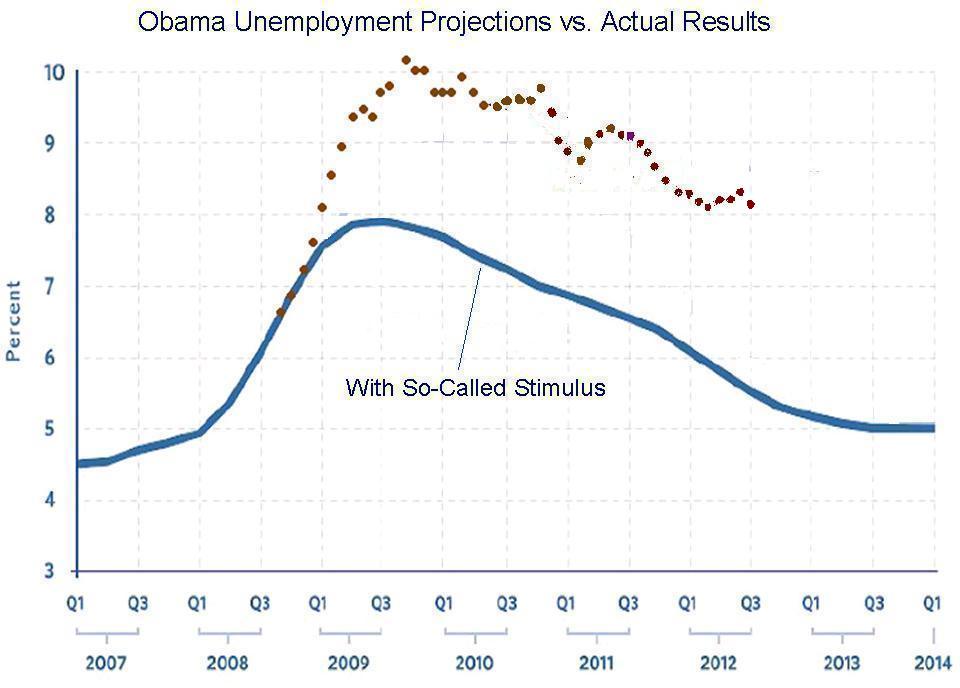
He promised unemployment would never climb above 8 percent if Congress squandered $800 billion on a Keynesian stimulus scheme.

Well, Congress said yes and the results have not been pretty. And every month we get new numbers to show us that the Administration’s policies have failed. It’s like Chinese water torture for the White House.

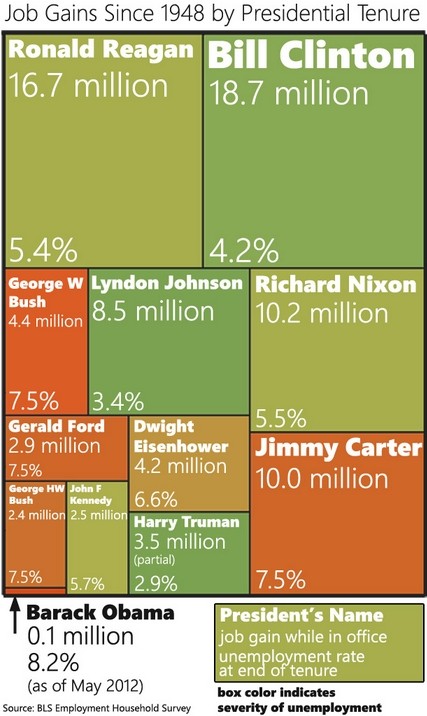
The numbers released this morning from the Department of Labor don’t change the narrative. The Republican and Democratic spin-doctors obviously will spit out their talking points, but here’s a visual put together by Political Math that trumps all the political maneuvering. If you’re wondering where Obama is, look at the lower left portion of the image.

This image is a couple of months old, but job creation has been so anemic that the naked eye wouldn’t be able to tell the difference if it was updated.

Since I normally show a graph with the actual unemployment rate compared to what Obama promised, I’ll add that as well. Not a pretty picture. I wrote that last month’s version would cause anxiety for Obama, and see no reason to change that assessment.

Yes, the official unemployment rate dropped to 8.1 percent, but that was because more Americans dropped out of the labor force.

Most important, the rate of joblessness is about 2-1/2 to 3 percentage points higher than what Obama promised. Now he wants a second term, yet all he’s promising is more of the same.

Actually, I retract that statement. He wants to maintain his current approach, but then add some class-warfare taxes to the mix.

Dear Senator Pryor, why not pass the Balanced Budget Amendment? (“Thirsty Thursday”, Open letter to Senator Pryor)

Remarks at a Rally Supporting the Proposed Constitutional Amendment for a Balanced Federal Budget

For more information on the ongoing works of President Reagan’s Foundation, please visit http://www.reaganfoundation.org

_______________

Dear Senator Pryor,

Why not pass the Balanced  Budget Amendment? As you know that federal deficit is at all time high (1.6 trillion deficit with revenues of 2.2 trillion and spending at 3.8 trillion).

On my blog www.HaltingArkansasLiberalswithTruth.com I took you at your word and sent you over 100 emails with specific spending cut ideas. However, I did not see any of them in the recent debt deal that Congress adopted. Now I am trying another approach. Every week from now on I will send you an email explaining different reasons why we need the Balanced Budget Amendment. It will appear on my blog on “Thirsty Thursday” because the government is always thirsty for more money to spend.

Ronald Reagan was a firm believer in the Balanced Budget Amendment and Milton Friedman was a key advisor to Reagan. Friedman’s 1980 film series taught the lesson of restraining growth of the federal budget.

UHLER: A better balanced budget amendment

Vital changes needed to keep road to further reforms open

There is a problem brewing in the House of Representatives of which most conservatives in and outside Congress are largely unaware. It has to do with H.J. Res. 1 – the balanced budget amendment – soon to be voted on per the debt-ceiling “deal” struck by Congress and the president. While H.J. Res. 1 is a solid first effort – and we have urged support for it as a symbolic vote – it is possibly fatally flawed and should be revised.

After years of indifference to constitutional fiscal discipline, Congress is once again stirring. In 1982, then-President Ronald Reagan, convened a federal amendment drafting committee led by Milton Friedman, Jim Buchanan, Bill Niskanen, Walter Williams and many others, and fashioned Senate Joint Resolution 58, a tax limitation-balanced budget amendment, which garnered 67 votes in the Senate under the able leadership of Sen. Orrin G. Hatch, Utah Republican. After a successful discharge petition forced a House vote, the amendment failed to achieve the two-thirds vote necessary in a Tip O’Neill-Jim Wright-controlled House. In 1996, Newt Gingrich and company came within one vote of passing a fiscal amendment in the House.

Currently, H.J. Res. 1 is designed as a classic balanced budget amendment in which outlays can be as great as, but no more than, receipts for that year. However, it requires an estimate of receipts, which is notoriously faulty, and it does not necessarily produce surpluses with which to pay down our massive debt. Furthermore, it contains a second limit on outlays – “not more than 18 percent of the economic output of the United States” – without defining such output or resolving the inevitable conflict between the outlay calculations in the two provisions.

This could be fixed by restructuring the amendment as a spending or outlay limit based on prior year receipts or outlays (known numbers), adjusted only for inflation and population changes. This will produce surpluses in most years with which to pay down debts and will reduce government spending as a share of gross domestic product over time, right-sizing government and increasing the rate of economic growth for the benefit of all citizens, especially those least able to compete.

Section 4 of H.J. Res. 1 might best be described as a supreme example of the law of unintended consequences. This section imposes on the president a constitutional responsibility to present a balanced budget. Surely, the drafters were saying to themselves “We’ll fix that guy in the White House. Now he will have to fess up and either propose specific tax increases or specific spending cuts. He won’t be able to duck reality any longer.” The only problem is that this section is at odds with our Constitution in that it gives the president a constitutional power over fiscal matters never intended by the Founders.

For much of our history, the president did not propose a budget. In the Budget and Accounting Act of 1921, which established the Bureau of the Budget, now the Office of Management and Budget and the General Accounting Office, the president was statutorily authorized to propose a budget. Presidents have always shaped the budget and spending using their negotiating opportunities and veto pen. Wearing their chief administrator hat, earlier presidents sought to save money from the amounts appropriated by Congress, getting things done for less, impounding funds they did not think essential to spend. Congress‘ ceiling on an appropriation was not also the spending floor for the president, as it is now.

Section 4 appears to give the president co-equal power with Congress not only to present a budget but to shape it, in conflict with congressional budget authority. At a minimum, it is likely to create a conflict over the amount of allowed annual spending. The president surely will be guided by his own Office of Management and Budget, whose budget and receipts calculations will undoubtedly differ from the Congressional Budget Office’s numbers that will direct Congress. We should not start the budget process each year with this kind of conflict.

It would be better to restore the historic role of the president to impound and otherwise reduce expenditures by repealing and revising appropriate portions of the Congressional Budget and Impoundment Control Act of 1974 so a fiscally conservative president is a revitalized partner in cutting the size of government.

Section 5 requires a supermajority vote for “a bill to increase revenues.” Whether one agrees or disagrees with making tax increases more difficult, this language is troublesome because it requires some government bureaucrat or bureaucracy to make a calculation or estimate of the effect of tax law changes on revenues. Proponents of a bill to increase cash flow to the government will argue that their tax law changes are “revenue neutral” and will likely persuade the Joint Committee on Taxation or Congressional Budget Office to back them up. Once again, estimators would be in control.

If we ever expect to convert our income-based tax system to a consumption tax, better not to require a two-thirds vote as liberals will use such a supermajority voting rule to stymie tax system reform.

There are other issues, as well, with debt limit and national emergency supermajority votes and definitions. While this balanced budget amendment – H.J. Res. 1 – has deserved a “yes” vote as a demonstration of commitment to constitutional fiscal discipline, it can and must be revised before the showdown vote in the House this fall.

Lewis K. Uhler is president of the National Tax Limitation Committee.