Ronald Reagan talks about balancing the budget on “The Tonight Show” in 1975.
_____________
Ronald Reagan was one of my favorite presidents. Mike Lee is one of my favorite lawmakers of today!!! Look at what he says about the Balanced Budget Amendment.
Washington must take aggressive steps to address our growing national debt, in order to reverse the damaging economic consequences we are experiencing as a result, and prevent the inevitable and difficult decisions that will have to be made if we do not change course. No single act of Congress would have greater impact on eliminating the country’s annual deficits and reducing our national debt than a balanced budget amendment to the Constitution.
Year after year, the federal government fails to make fiscally responsible choices. Despite overtaxing the American people, Washington routinely spends much more than it takes in. Statutory restraints, such as the failed Gramm-Rudman-Hollings legislation and “PAYGO” rules, have proven ineffective and impossible to enforce because simple majorities in Congress can alter, weaken, dismantle, and ultimately discard fiscal reforms.
Because the Constitution requires two-thirds of Congress and three-quarters of the states to amend, only a constitutional amendment will force Congress to make fiscally responsible decisions year after year, prioritize spending appropriately, use taxpayer money wisely, and eliminate future deficits. It is the only legislative tool that credibly guarantees permanent enforcement of spending restraints.
Why raise taxes when you are trying to expand the economy?
_________________
“Common sense told us that when you put a big tax on something, the people will produce less of it. So, we cut the people’s tax rates, and the people produced more than ever before.”In Reagan’s farewell address he touted the historic tax cuts passed under his administration in 1981.
Rep Dennis Ross noted on facebook:
While we all wrestle with the best solution for fiscal restraint, here is an article addressing the impact on the top taxpayers.
(Next Rep Ross provided the link to this story below.)
Chris Conover, ContributorI explode myths that pervade health policy debates.
The Congressional Budget Office (CBO) released its latest tax data this month. The report details who contributed how much to federal revenues in 2009. The figures raise the question: why do so many in this country seem so eager to berate the ‘one percent’ rather than thank them for their extraordinary contributions to federal coffers?
According to the report, those in the top one percent had an average pre-tax income of $1,219,700 in 2009. Of this, they paid $353,000 federal taxes. Despite having earned 13.4 percent of the nation’s income, these individuals paid 38.7 percent of federal income taxes that year. To put it more starkly, this group makes less than 16 times as much as the average household but pays more than 40 times as much in federal income taxes.
Sure, the picture looks a little different when all federal taxes are included. With payroll, corporate, and excise taxes thrown into the mix, the top one percent contribute “only” 22.3 percent of all federal taxes. But in raw dollar terms, the average one percent household pays 23 times as much in total federal taxes as the average household—a difference of $337,700. Despite this, some politicians and activists claim with a straight face that our country’s top earners don’t pay their “fair share.”
Consider a world without such individuals—a world in which we have so taxed and vilified the most prosperous Americans that they all elect to follow Denise Rich and foreswear their U.S. citizenship in search of greater economic freedom. French President François Hollande is already learning this the hard way, as many of his country’s wealthiest individuals pack up and leave as a result of his proposed tax hike on French millionaires. Indeed, the U.S. itself has seen an eightfold increase in the number of Americans abandoning their citizenship (most, apparently for tax-related reasons). Since U.S. lawmakers have yet to show any ability to curtailing their spending, Uncle Sam would be looking to the remaining 99 percent of taxpayers to make up what would be a massive gap in income tax revenues due to the sudden emigration of the top one percent.
As a matter of simple arithmetic, everyone’s federal income taxes would have to go up by at least 63 percent to compensate for this lost revenue should the top earners depart. Such a gargantuan increase in taxes would rather substantially reduce work effort among the remaining 99 percent. The best evidence suggests that the economy loses 52 cents in output (lost work effort) for every dollar increase in individual income taxes. That means Congress would need to nearly double the rates for everyone else in order to cover the revenue gap.
Moreover, there’s a major discrepancy between the one percent’s financial support of government and its consumption of the resulting services.
If our population lost the top one percent, government could theoretically shrink spending on defense, courts, etc. by one percent to account for reduced need for services. However, since most federal payments for individuals are means-tested (ie. entitlement programs such as Medicaid and food stamps), loss of America’s top earners wouldn’t translate to a proportional reduction in these areas of the budget. And those payments accounted for more than 60 percent of federal spending in 2010.
Of course, losing the top one percent would mean far more than the loss of hundreds of billions in tax revenue. According to Federal Reserve data, this group also accounts for 30 percent of philanthropic giving. Many in the top one percent are business owners who employ many workers. In fact, nearly two thirds of those making over half a million dollars a year personally bear the risks of owning a company on their own or with just a few other shareholders. And losing the top one percent would translate to the departure of nearly 200,000 physicians—something a nation facing a doctor shortage could ill afford.
Like most Americans, I do not expect to enter the ranks of the top one percent (which in 2009 included one-person households with incomes exceeding $282,900, two-person households above $400,100, etc.). Perhaps I am totally deluded, lacking in class consciousness, or simply a victim of the Stockholm syndrome. But the way I look at it, I’m eminently grateful for those who have worked to attain this lofty status. I wish the current political elite felt the same way.
Thank you so much for your time. I know how valuable it is. I also appreciate the fine family that you have and your commitment as a father and a husband.
Sincerely,
Everette Hatcher III, 13900 Cottontail Lane, Alexander, AR 72002, ph 501-920-5733, lowcostsqueegees@yahoo.com
(Emailed to White House on 12-21-12.) President Obama c/o The White House 1600 Pennsylvania Avenue NW Washington, DC 20500 Dear Mr. President, I know that you receive 20,000 letters a day and that you actually read 10 of them every day. I really do respect you for trying to get a pulse on […]
(Emailed to White House on 12-21-12.) President Obama c/o The White House 1600 Pennsylvania Avenue NW Washington, DC 20500 Dear Mr. President, I know that you receive 20,000 letters a day and that you actually read 10 of them every day. I really do respect you for trying to get a pulse on what is […]
(Emailed to White House on 12-21-12) President Obama c/o The White House 1600 Pennsylvania Avenue NW Washington, DC 20500 Dear Mr. President, I know that you receive 20,000 letters a day and that you actually read 10 of them every day. I really do respect you for trying to get a pulse on what is […]
The federal government has a spending problem and Milton Friedman came up with the negative income tax to help poor people get out of the welfare trap. It seems that the government screws up about everything. Then why is President Obama wanting more taxes? _______________ Milton Friedman – The Negative Income Tax Published on […]
I was sad to read that the Speaker John Boehner has been involved in punishing tea party republicans. Actually I have written letters to several of these same tea party heroes telling them that I have emailed Boehner encouraging him to listen to them. Rep. David Schweikert (R-AZ),Justin Amash (R-MI), and Tim Huelskamp (R-KS). have been contacted […]
Michael Tanner of the Cato Institute in his article, “Hitting the Ceiling,” National Review Online, March 7, 2012 noted: After all, despite all the sturm und drang about spending cuts as part of last year’s debt-ceiling deal, federal spending not only increased from 2011 to 2012, it rose faster than inflation and population growth combined. […]
Michael Tanner of the Cato Institute in his article, “Hitting the Ceiling,” National Review Online, March 7, 2012 noted: After all, despite all the sturm und drang about spending cuts as part of last year’s debt-ceiling deal, federal spending not only increased from 2011 to 2012, it rose faster than inflation and population growth combined. […]
Some of the heroes are Mo Brooks, Martha Roby, Jeff Flake, Trent Franks, Duncan Hunter, Tom Mcclintock, Devin Nunes, Scott Tipton, Bill Posey, Steve Southerland and those others below in the following posts. THEY VOTED AGAINST THE DEBT CEILING INCREASE IN 2011 AND WE NEED THAT TYPE OF LEADERSHIP NOW SINCE PRESIDENT OBAMA HAS BEEN […]
I hated to see that Allen West may be on the way out. ABC News reported: Nov 7, 2012 7:20am What Happened to the Tea Party (and the Blue Dogs?) Some of the Republican Party‘s most controversial House members are clinging to narrow leads in races where only a few votes are left to count. […]
Rep Himes and Rep Schweikert Discuss the Debt and Budget Deal Michael Tanner of the Cato Institute in his article, “Hitting the Ceiling,” National Review Online, March 7, 2012 noted: After all, despite all the sturm und drang about spending cuts as part of last year’s debt-ceiling deal, federal spending not only increased from 2011 […]
When I think of all of the problems we are having in our economy today then I think about the period of time from 1977 to 1980 when the economy was in bad shape. How did we get out of that mess? Maybe we should look at how Ronald Reagan got us out of that mess and he brought forth one of the best periods of economic expansion in our nation’s history. Reagan was right when he said if you tax something then you will get less of it. That is similar to what Rep Yoder says below.
This week, the talk in Washington, D.C. has focused on finding a long-term bipartisan resolution to the looming automatic spending cuts and tax increases that will hit all Americans on January 1, 2013 – called the Fiscal Cliff. There is a great amount of work to be done by both sides to come together on a resolution, but I continue to be optimistic that we will reach an agreement because I recognize how serious an issue this is. We cannot afford to continue kicking the can down the road with short-term fix after short-term fix. As a member of the House Appropriations Committee, I understand we can’t tax and spend our way out of our current fiscal situation, and we need a long-term deal.
____
Thank you so much for your time. I know how valuable it is. I also appreciate the fine family that you have and your commitment as a father and a husband.
Sincerely,
Everette Hatcher III, 13900 Cottontail Lane, Alexander, AR 72002, ph 501-920-5733, lowcostsqueegees@yahoo.com
(Emailed to White House on 12-21-12.) President Obama c/o The White House 1600 Pennsylvania Avenue NW Washington, DC 20500 Dear Mr. President, I know that you receive 20,000 letters a day and that you actually read 10 of them every day. I really do respect you for trying to get a pulse on […]
(Emailed to White House on 12-21-12.) President Obama c/o The White House 1600 Pennsylvania Avenue NW Washington, DC 20500 Dear Mr. President, I know that you receive 20,000 letters a day and that you actually read 10 of them every day. I really do respect you for trying to get a pulse on what is […]
(Emailed to White House on 12-21-12) President Obama c/o The White House 1600 Pennsylvania Avenue NW Washington, DC 20500 Dear Mr. President, I know that you receive 20,000 letters a day and that you actually read 10 of them every day. I really do respect you for trying to get a pulse on what is […]
The federal government has a spending problem and Milton Friedman came up with the negative income tax to help poor people get out of the welfare trap. It seems that the government screws up about everything. Then why is President Obama wanting more taxes? _______________ Milton Friedman – The Negative Income Tax Published on […]
I was sad to read that the Speaker John Boehner has been involved in punishing tea party republicans. Actually I have written letters to several of these same tea party heroes telling them that I have emailed Boehner encouraging him to listen to them. Rep. David Schweikert (R-AZ),Justin Amash (R-MI), and Tim Huelskamp (R-KS). have been contacted […]
Michael Tanner of the Cato Institute in his article, “Hitting the Ceiling,” National Review Online, March 7, 2012 noted: After all, despite all the sturm und drang about spending cuts as part of last year’s debt-ceiling deal, federal spending not only increased from 2011 to 2012, it rose faster than inflation and population growth combined. […]
Michael Tanner of the Cato Institute in his article, “Hitting the Ceiling,” National Review Online, March 7, 2012 noted: After all, despite all the sturm und drang about spending cuts as part of last year’s debt-ceiling deal, federal spending not only increased from 2011 to 2012, it rose faster than inflation and population growth combined. […]
Some of the heroes are Mo Brooks, Martha Roby, Jeff Flake, Trent Franks, Duncan Hunter, Tom Mcclintock, Devin Nunes, Scott Tipton, Bill Posey, Steve Southerland and those others below in the following posts. THEY VOTED AGAINST THE DEBT CEILING INCREASE IN 2011 AND WE NEED THAT TYPE OF LEADERSHIP NOW SINCE PRESIDENT OBAMA HAS BEEN […]
I hated to see that Allen West may be on the way out. ABC News reported: Nov 7, 2012 7:20am What Happened to the Tea Party (and the Blue Dogs?) Some of the Republican Party‘s most controversial House members are clinging to narrow leads in races where only a few votes are left to count. […]
Rep Himes and Rep Schweikert Discuss the Debt and Budget Deal Michael Tanner of the Cato Institute in his article, “Hitting the Ceiling,” National Review Online, March 7, 2012 noted: After all, despite all the sturm und drang about spending cuts as part of last year’s debt-ceiling deal, federal spending not only increased from 2011 […]
Ronald Reagan had a lot to say about taxes and he liked cutting them. Why not take a page out of his book instead of trying to harm our job creators like you are doing?
Unfortunately this has become a novel concept for some:(
Every evening, the same 10 friends eat dinner together, family style, at the same restaurant. The bill for all 10 comes to $100. They always pay it the way we pay taxes:
• The first four are poor and pay nothing.
• The fifth pays $1.
• The sixth pays $3.
• The seventh, $7
• The eighth, $12.
• The ninth, $18.
• The 10th, (the most well-to-do) pays $59.
One night the restaurant owner announces that because they’re such good customers, he’s dropping their group dinner bill to $80. Let’s call that a tax cut. They want to continue paying their bill as we pay taxes. So the four poorest men still eat free. But if the other six split the $20 tax cut evenly, each would save $3.33. That means the fifth and sixth men would end up being paid to eat. The restaurant owner works out a plan: The fifth man eats free; the sixth pays $2; the seventh, $5; the eighth, $9; the ninth, $12; and the 10th guy pays $52. All six are better off than before, and the four poor guys still eat for nothing. The trouble starts when they leave the restaurant and begin to compare what they reaped from the $20 cut. “I only got a dollar of it,” says the sixth man, “but he (pointing at No. 10) got $7.” The fifth guy, who also saved a dollar by getting his meal free, agrees that it’s not fair for the richest to get seven times the savings as he. No. 7, grousing that the wealthy get all the breaks, points out that he only got two bucks. “Wait a minute,” the first four poor guys yell in unison. “We didn’t get anything at all. The system exploits the poor!” The nine men jump the 10th and administer a severe beating. The next night he doesn’t come for dinner. They shrug it off and eat without him. The customary $80 bill comes. Surprise! They’re $52 short.
Yes, those who pay the most taxes get the most back from tax reductions. But tax them too much — punish them for the wealth they may have — and they just might stop bringing their money to the table.
I guess this is why American businesses have about $10 trillion in offshore deposits. You can’t blame them. After all, they got tired of getting beat up to forfeit their “fair share.”
________
Thank you so much for your time. I know how valuable it is. I also appreciate the fine family that you have and your commitment as a father and a husband.
Sincerely,
Everette Hatcher III, 13900 Cottontail Lane, Alexander, AR 72002, ph 501-920-5733, lowcostsqueegees@yahoo.com
(Emailed to White House on 12-21-12.) President Obama c/o The White House 1600 Pennsylvania Avenue NW Washington, DC 20500 Dear Mr. President, I know that you receive 20,000 letters a day and that you actually read 10 of them every day. I really do respect you for trying to get a pulse on […]
(Emailed to White House on 12-21-12.) President Obama c/o The White House 1600 Pennsylvania Avenue NW Washington, DC 20500 Dear Mr. President, I know that you receive 20,000 letters a day and that you actually read 10 of them every day. I really do respect you for trying to get a pulse on what is […]
(Emailed to White House on 12-21-12) President Obama c/o The White House 1600 Pennsylvania Avenue NW Washington, DC 20500 Dear Mr. President, I know that you receive 20,000 letters a day and that you actually read 10 of them every day. I really do respect you for trying to get a pulse on what is […]
The federal government has a spending problem and Milton Friedman came up with the negative income tax to help poor people get out of the welfare trap. It seems that the government screws up about everything. Then why is President Obama wanting more taxes? _______________ Milton Friedman – The Negative Income Tax Published on […]
I was sad to read that the Speaker John Boehner has been involved in punishing tea party republicans. Actually I have written letters to several of these same tea party heroes telling them that I have emailed Boehner encouraging him to listen to them. Rep. David Schweikert (R-AZ),Justin Amash (R-MI), and Tim Huelskamp (R-KS). have been contacted […]
Michael Tanner of the Cato Institute in his article, “Hitting the Ceiling,” National Review Online, March 7, 2012 noted: After all, despite all the sturm und drang about spending cuts as part of last year’s debt-ceiling deal, federal spending not only increased from 2011 to 2012, it rose faster than inflation and population growth combined. […]
Michael Tanner of the Cato Institute in his article, “Hitting the Ceiling,” National Review Online, March 7, 2012 noted: After all, despite all the sturm und drang about spending cuts as part of last year’s debt-ceiling deal, federal spending not only increased from 2011 to 2012, it rose faster than inflation and population growth combined. […]
Some of the heroes are Mo Brooks, Martha Roby, Jeff Flake, Trent Franks, Duncan Hunter, Tom Mcclintock, Devin Nunes, Scott Tipton, Bill Posey, Steve Southerland and those others below in the following posts. THEY VOTED AGAINST THE DEBT CEILING INCREASE IN 2011 AND WE NEED THAT TYPE OF LEADERSHIP NOW SINCE PRESIDENT OBAMA HAS BEEN […]
I hated to see that Allen West may be on the way out. ABC News reported: Nov 7, 2012 7:20am What Happened to the Tea Party (and the Blue Dogs?) Some of the Republican Party‘s most controversial House members are clinging to narrow leads in races where only a few votes are left to count. […]
Rep Himes and Rep Schweikert Discuss the Debt and Budget Deal Michael Tanner of the Cato Institute in his article, “Hitting the Ceiling,” National Review Online, March 7, 2012 noted: After all, despite all the sturm und drang about spending cuts as part of last year’s debt-ceiling deal, federal spending not only increased from 2011 […]
When I think of all of the problems we are having in our economy today then I think about the period of time from 1977 to 1980 when the economy was in bad shape. How did we get out of that mess? Maybe we should look at how Ronald Reagan got us out of that mess and he brought forth one of the best periods of economic expansion in our nation’s history.
Ronald Reagan’s 1980 Television Ad Campaign
_______________
Ronald Reagan cut taxes in a big way. Maybe we should head down that path. Here is speech from a Tea Party favorite that advocates that path. A concise and fine speech by Dr. Broun:
Click here to listen to Dr. Broun’s speech on C-SPAN.
“Mister Speaker, we’ve reached the fiscal cliff not because we tax too little, but because we spend too much. My Democrat colleagues want to focus on whom to raise taxes and by how much – but this debate should really be about our addiction to outrageous spending.
“Many in Congress don’t believe that what happened in Greece could happen here in the United States. But just think about it. Greece kept borrowing and spending more and more until eventually they couldn’t pay their public workers. They couldn’t take care of the elderly and the poor who depend on government programs. And they couldn’t deliver any of the retirement or healthcare services they promised its people. Sound familiar? It’s because the United States is headed down the same path today.
“The Democrats think we can tax our way out of this mess. But we’ll be right back here having this same debate very soon if we don’t cut spending.
“Today, the Democrats are talking about taxing the top two percent. Next time, it’ll be the top fifty percent. And so on, and so on, until we’re taxing everyone – but spending so much that we still can’t meet our obligations.
Mister Speaker, let’s shift the focus of this debate from taxing to spending so that we can give the American people what they want; a strong economy and a guarantee that programs like Medicare and Social Security will remain intact for them.
“I yield back.”
____________
Thank you so much for your time. I know how valuable it is. I also appreciate the fine family that you have and your commitment as a father and a husband.
Sincerely,
Everette Hatcher III, 13900 Cottontail Lane, Alexander, AR 72002, ph 501-920-5733, lowcostsqueegees@yahoo.com
(Emailed to White House on 12-21-12.) President Obama c/o The White House 1600 Pennsylvania Avenue NW Washington, DC 20500 Dear Mr. President, I know that you receive 20,000 letters a day and that you actually read 10 of them every day. I really do respect you for trying to get a pulse on […]
(Emailed to White House on 12-21-12.) President Obama c/o The White House 1600 Pennsylvania Avenue NW Washington, DC 20500 Dear Mr. President, I know that you receive 20,000 letters a day and that you actually read 10 of them every day. I really do respect you for trying to get a pulse on what is […]
(Emailed to White House on 12-21-12) President Obama c/o The White House 1600 Pennsylvania Avenue NW Washington, DC 20500 Dear Mr. President, I know that you receive 20,000 letters a day and that you actually read 10 of them every day. I really do respect you for trying to get a pulse on what is […]
The federal government has a spending problem and Milton Friedman came up with the negative income tax to help poor people get out of the welfare trap. It seems that the government screws up about everything. Then why is President Obama wanting more taxes? _______________ Milton Friedman – The Negative Income Tax Published on […]
I was sad to read that the Speaker John Boehner has been involved in punishing tea party republicans. Actually I have written letters to several of these same tea party heroes telling them that I have emailed Boehner encouraging him to listen to them. Rep. David Schweikert (R-AZ),Justin Amash (R-MI), and Tim Huelskamp (R-KS). have been contacted […]
Michael Tanner of the Cato Institute in his article, “Hitting the Ceiling,” National Review Online, March 7, 2012 noted: After all, despite all the sturm und drang about spending cuts as part of last year’s debt-ceiling deal, federal spending not only increased from 2011 to 2012, it rose faster than inflation and population growth combined. […]
Michael Tanner of the Cato Institute in his article, “Hitting the Ceiling,” National Review Online, March 7, 2012 noted: After all, despite all the sturm und drang about spending cuts as part of last year’s debt-ceiling deal, federal spending not only increased from 2011 to 2012, it rose faster than inflation and population growth combined. […]
Some of the heroes are Mo Brooks, Martha Roby, Jeff Flake, Trent Franks, Duncan Hunter, Tom Mcclintock, Devin Nunes, Scott Tipton, Bill Posey, Steve Southerland and those others below in the following posts. THEY VOTED AGAINST THE DEBT CEILING INCREASE IN 2011 AND WE NEED THAT TYPE OF LEADERSHIP NOW SINCE PRESIDENT OBAMA HAS BEEN […]
I hated to see that Allen West may be on the way out. ABC News reported: Nov 7, 2012 7:20am What Happened to the Tea Party (and the Blue Dogs?) Some of the Republican Party‘s most controversial House members are clinging to narrow leads in races where only a few votes are left to count. […]
Rep Himes and Rep Schweikert Discuss the Debt and Budget Deal Michael Tanner of the Cato Institute in his article, “Hitting the Ceiling,” National Review Online, March 7, 2012 noted: After all, despite all the sturm und drang about spending cuts as part of last year’s debt-ceiling deal, federal spending not only increased from 2011 […]
Sometimes you just have to turn it over to the people and let them put the heat on the lawmakers. That is what Ronald Reagan meant when he said, “When you can’t make them see the light, make them feel the heat.”
“When you can’t make them see the light, make them feel the heat.”
President Ronald Reagan’s sound advice rang true yesterday. Grassroots activists and conservative groups, led by Heritage Action for America, derailed a plan to raise taxes on some Americans and small businesses.
Lacking votes from his own party, Speaker John Boehner (R-OH) called off consideration of “Plan B” last night, sending lawmakers home for Christmas instead. When the dust settled, conservatives stuck to their principles: to cut spending without raising taxes.
When they return to work, all eyes will be on President Obama and Senate Majority Leader Harry Reid (D-NV). Their failure to act has left the nation on the brink of the fiscal cliff.
It didn’t have to come to this. Nearly five months ago, on August 1, the House of Representatives voted to prevent a tax hike on all Americans. The measure passed on a 256-to-171 vote, winning the support of 19 Democrats.
Heritage’s Patrick Louis Knudsen, the Grover M. Hermann Fellow in Federal Budgetary Affairs, wrote last month about the Senate’s failure to act:
Although the House passed legislation this year replacing the across-the-board cuts with specific policy changes, the Senate refused to act, forcing any resolution to wait until after this year’s election. Now this large problem joins with other unresolved issues, such as the “doc fix” (extending Medicare physicians’ payment rates) and extended unemployment benefits—and another debt-ceiling increase looms early next year as well.
Reid could have brought the House-passed measure to the Senate for an open debate and vote. He could have instructed Senate Budget Chairman Kent Conrad (D-ND) to produce a budget. Instead, Reid did neither. The Senate has now gone 3 years, 7 months, and 22 days without a budget.
Boehner, who oversaw passage of Republican-drafted budgets in 2011 and 2012, was right to place blame on the Senate for failing to act:
Now it is up to the president to work with Senator Reid on legislation to avert the fiscal cliff. The House has already passed legislation to stop all of the January 1 tax rate increases and replace the sequester with responsible spending cuts that will begin to address our nation’s crippling debt. The Senate must now act.
Heritage Action, our sister organization, has urged lawmakers to remain true to their principles. Earlier this week at a Capitol Hill press conference, Heritage Action chief executive Michael Needham led a group of conservative leaders, including Representative Tim Huelskamp (R-KS), to voice opposition to a tax increase.
In a statement last night, Needham commended the House for acting months ago and urged Obama and Reid to “reject the political gimmicks and demonstrate that same level of seriousness.”
Throughout the fiscal cliff negotiations, Obama has demonstrated a lack of seriousness. Heritage’s Alison Acosta Fraser recounted earlier this week that Obama initially wanted an $800 billion tax increase, only to later double that demand to $1.5 trillion. His plan lacks any substantive spending cuts, insisting on tax hikes first. And to top it off, the more concessions Republicans have made, the more Obama wants to take from the American people.
Enough is enough.
Conservatives stood their ground last night and sent a powerful message. Now it’s time for lawmakers to take the “least repugnant remaining resolution to the fiscal cliff,” as Heritage’s J.D. Foster wrote earlier this week, and pass a temporary measure that extends all tax rates and all spending policy without sequestration cuts through March 31, 2013.
That’s the best possible outcome in this unfortunate situation.
__________
It is obvious to me that if President Obama gets his hands on more money then he will continue to spend away our children’s future. He has already taken the national debt from 11 trillion to 16 trillion in just 4 years. Over, and over, and over, and over, and over and over I have written Speaker Boehner and the Congressmen (Griffin, Womack, Crawford) in Arkansas concerning this. I am hoping they will stand up against this reckless spending that our federal government has done and will continue to do if given the chance.
Back in 1980 Ronald Reagan was elected during a time where the economy of the USA was about what it is now. How did he get the economy to grow? He listened to his old friend Milton Friedman and he put in conservative principles to slow the growth of spending and he cut taxes.
We need to pass a Balanced Budget Amendment!!!! It is obvious to me that if President Obama gets his hands on more money then he will continue to spend away our children’s future. He has already taken the national debt from 11 trillion to 20 trillion in just 7 years. Over, and over, and over, and over, and over and over I have written Speaker Boehner and the Congressmen (Griffin, Womack, Crawford) in Arkansas concerning this. I am hoping they will stand up against this reckless spending that our federal government has done and will continue to do if given the chance.
Mark Levin “I feel that we can do great things.” Mark is excited by the proposed Balanced Budget Amendment. He states that this would be a great thing for America to pass. He believes the Balanced Budget Amendment will help bring the nation back to it’s Constitutional roots. Mark explains what the amendment is and how it will work. In his February 1983 classic essay, Nobel Prize-winning economist Milton Friedman gives his opinion on a balanced budget amendment that requires a super majority to raise taxes. Friedman states, “The purpose of the balanced-budget-and-tax-limitation amendment is to limit the government in order to free the people—this time from excessive taxation. Its passage would go a long way to remedy the defect that has developed in our budgetary process.” Part #1 3-25-2011
___________________
______________
Mark Levin and Senator Hatch discuss the balanced budget amendment and it’s importance.
Mark Levin interviews Senator Hatch 1/27/2011 about the balanced budget amendment. Mark is very excited about the balanced budget amendment being proposed by Senator Orin Hatch and John Cornyn and he discusses the amendment with Senator Hatch. Senator Hatch explains the bill it’s ramifications and limitations. Senator Hatch actually worked on this bill with renowned economist Milton Friedman. This ammendment is the first big step in saving our country.
Office of the Majority Whip | Balanced Budget Amendment Video
In 1995, Congress nearly passed a constitutional amendment mandating a balanced budget. The Balanced Budget Amendment would have forced the federal government to live within its means. This Balanced Budget Amendment failed by one vote. 16 years later, Congress has the chance to get it right. Our time is now.
________ Dan Mitchell quotes from Milton Friedman video on his blog!!! Wise Words on Regulation and Consumer Freedom from Milton Friedman December 26, 2014 by Dan Mitchell It’s time to correct a sin of omission. In five-plus years of blogging, I haven’t given nearly enough attention to the wisdom of the late (and great) Milton Friedman. […]
Milton Friedman’s FREE TO CHOOSE “How to Stay Free,” Transcript and Video (60 Minutes) In 1980 I read the book FREE TO CHOOSE by Milton Friedman and it really enlightened me a tremendous amount. I suggest checking out these episodes and transcripts of Milton Friedman’s film series FREE TO CHOOSE: “The Failure of Socialism” and “The Anatomy […]
Milton Friedman’s FREE TO CHOOSE “How to cure inflation” Transcript and Video (60 Minutes) In 1980 I read the book FREE TO CHOOSE by Milton Friedman and it really enlightened me a tremendous amount. I suggest checking out these episodes and transcripts of Milton Friedman’s film series FREE TO CHOOSE: “The Failure of Socialism” and “What is wrong […]
Milton Friedman’s FREE TO CHOOSE “Who protects the consumer?” Transcript and Video (60 Minutes) In 1980 I read the book FREE TO CHOOSE by Milton Friedman and it really enlightened me a tremendous amount. I suggest checking out these episodes and transcripts of Milton Friedman’s film series FREE TO CHOOSE: “The Failure of Socialism” and “What is wrong […]
Milton Friedman’s FREE TO CHOOSE “The Tyranny of Control” Transcript and Video (60 Minutes) In 1980 I read the book FREE TO CHOOSE by Milton Friedman and it really enlightened me a tremendous amount. I suggest checking out these episodes and transcripts of Milton Friedman’s film series FREE TO CHOOSE: “The Failure of Socialism” and […]
We got to give Milton Friedman’s voucher system a chance!!! Happy Birthday, Milton Friedman: Champion of Educational Freedom Brittany Corona July 31, 2013 at 11:30 am Newscom On the late, great, Nobel Prize–winning economist Milton Friedman’s 101st birthday, it is fitting to remember his legacy of school choice and continue the fight for educational opportunity […]
Milton Friedman – School Choice Professor Friedman spells out his recipe for fixing America’s broken educational system. http://www.LibertyPen.com Milton Friedman at 101: We Need His Ideas Now More Than Ever Anthony B. Kim July 31, 2013 at 3:49 pm Anthony B. Kim July 31, 2013 at 3:49 pm Free-market economics meets free-market policies at The […]
U2’s Bono Speaks at GU Global Social Enterprise Event Published on Nov 13, 2012 Musician and activist Bono spoke to more than 700 Georgetown students and leaders in the corporate, nonprofit and political sectors on Nov. 12 at an event hosted by the Global Social Enterprise Initiative (GSEI) at Georgetown’s McDonough School of Business. ______________________________ […]
In 1980 I read the book FREE TO CHOOSE by Milton Friedman and it really enlightened me a tremendous amount. I suggest checking out these episodes and transcripts of Milton Friedman’s film series FREE TO CHOOSE: “The Failure of Socialism” and “What is wrong with our schools?” and “Created Equal” and From Cradle to Grave, […]
In 1980 I read the book FREE TO CHOOSE by Milton Friedman and it really enlightened me a tremendous amount. I suggest checking out these episodes and transcripts of Milton Friedman’s film series FREE TO CHOOSE: “The Failure of Socialism” and “What is wrong with our schools?” and “Created Equal” and From Cradle to Grave, […]
Back in 1980 Ronald Reagan was elected during a time where the economy of the USA was about what it is now. How did he get the economy to grow? He listened to his old friend Milton Friedman and he put in conservative principles to slow the growth of spending and he cut taxes.
Great article below by Representative Tom McClintock on what we should do now.
Congressman Tom McClintock
House Chamber, Washington, D.C.
December 12, 2012
Mr. Speaker:
To understand the federal budget mess and the so-called fiscal cliff, it’s important to remember three numbers: 39, 37 and 64.
Thirty nine percent is the combined increase of inflation and population over the last ten years. Thirty nine percent.
Thirty seven percent is the increase in revenues during the same period. That’s despite the recession and tax cuts. Not quite keeping pace, but pretty close.
Sixty four is what’s killing us. Sixty four percent is the increase in federal spending in that period. That’s nearly twice the rate of inflation and population over the last ten years.
The spending side of the fiscal cliff is the so-called sequester: automatic cuts in federal spending. To hear some tell it, these cuts will mean the end of western civilization.
Hardly. After a 64 percent increase in expenditures this decade, the sequester doesn’t actually cut spending at all: it simply limits spending growth next year to about a half a percent.
I opposed the budget deal that created the sequester last year because it fell woefully short of what Standard and Poors clearly warned was necessary to preserve the nation’s triple-A credit rating. Sadly, that fear was born out. But now, the sequester is all we have.
It’s true that defense takes the brunt of it, but does our defense spending today really need to be higher – inflation adjusted — than it was at the height of the Vietnam War, when we faced down the Soviet Union and had 500,000 combat troops in the field?
The sequester isn’t stepping off a cliff – it’s taking one step back from the cliff.
The tax increases, however, are a different matter. Without intervention, the federal tax burden will balloon 21 percent at the stroke of midnight on New Year’s Eve, taking somewhere between two and three thousand dollars from an average family. This summer, the House passed legislation to protect our nation from such a calamity, but Mr. Obama vowed to veto it and the Senate blocked it.
Instead, Mr. Obama tells us that he will veto any plan that keeps taxes from going up on those very wealthy folks making over $200,000, who, he says, need to pay their fair share.
(I suppose fairness is in the eye of the beholder. The top one percent earns 17 percent of all income but pays 37 percent of all income taxes. But that’s beside the point).
The fine point of it is that a lot of those very wealthy folks making over $200,000 aren’t very wealthy and they aren’t even folks: they’re 1.3 million struggling small businesses filing under sub-chapter S. Our small businesses produce two-thirds of the new jobs in our economy.
This battle IS very much FOR the middle class. The Congressional Budget Office estimates that Mr. Obama’s tax increase on the so-called wealthy will actually throw some 200,000 middle and working class families into unemployment. Two hundred thousand. And that’s the optimistic estimate. An independent analysis by Ernst and Young puts that figure at closer to 700,000 lost jobs.
That’s because the President’s taxes would slam 84 percent of net small business income – that’s precisely the income used to support and expand the labor force.
In their blind pursuit of an “eat the rich” ideology, Mr. Obama and his acolytes are imposing a policy that would utterly devastate hundreds of thousands of middle class families who depend on the jobs these small businesses provide.
And for what? To wring enough money to fund Mr. Obama’s spending spree for a grand total of eight days. It’s telling that three-fourths of the new taxes he has proposed would be used to finance the new spending that he has also proposed.
Republicans don’t want to see taxes go up on anyone, period. We don’t want to see this government willfully throw hundreds of thousands of Americans out of work by this policy.
The President obviously believes that in the 11th hour, Republicans will have no choice but ultimately to protect as many taxpayers as we possibly can, since the only alternative will be tax increases on everyone, including the job creators. He may be right.
But that would mean a bleak and bitter new year for all those families who will watch helplessly as their jobs evaporate before their eyes.
Let us pray the President has a change of heart before setting this calamity in motion.
__________
Does Government Have a Revenue or Spending Problem?
People say the government has a debt problem. Debt is caused by deficits, which is the difference between what the government collects in tax revenue and the amount of government spending. Every time the government runs a deficit, the government debt increases. So what’s to blame: too much spending, or too little tax revenue? Economics professor Antony Davies examines the data and concludes that the root cause of the debt is too much government spending.
___________
Thank you so much for your time. I know how valuable it is. I also appreciate the fine family that you have and your commitment as a father and a husband.
Sincerely,
Everette Hatcher III, 13900 Cottontail Lane, Alexander, AR 72002, ph 501-920-5733, lowcostsqueegees@yahoo.com
(Emailed to White House on 12-21-12.) President Obama c/o The White House 1600 Pennsylvania Avenue NW Washington, DC 20500 Dear Mr. President, I know that you receive 20,000 letters a day and that you actually read 10 of them every day. I really do respect you for trying to get a pulse on […]
(Emailed to White House on 12-21-12.) President Obama c/o The White House 1600 Pennsylvania Avenue NW Washington, DC 20500 Dear Mr. President, I know that you receive 20,000 letters a day and that you actually read 10 of them every day. I really do respect you for trying to get a pulse on what is […]
(Emailed to White House on 12-21-12) President Obama c/o The White House 1600 Pennsylvania Avenue NW Washington, DC 20500 Dear Mr. President, I know that you receive 20,000 letters a day and that you actually read 10 of them every day. I really do respect you for trying to get a pulse on what is […]
The federal government has a spending problem and Milton Friedman came up with the negative income tax to help poor people get out of the welfare trap. It seems that the government screws up about everything. Then why is President Obama wanting more taxes? _______________ Milton Friedman – The Negative Income Tax Published on […]
I was sad to read that the Speaker John Boehner has been involved in punishing tea party republicans. Actually I have written letters to several of these same tea party heroes telling them that I have emailed Boehner encouraging him to listen to them. Rep. David Schweikert (R-AZ),Justin Amash (R-MI), and Tim Huelskamp (R-KS). have been contacted […]
Michael Tanner of the Cato Institute in his article, “Hitting the Ceiling,” National Review Online, March 7, 2012 noted: After all, despite all the sturm und drang about spending cuts as part of last year’s debt-ceiling deal, federal spending not only increased from 2011 to 2012, it rose faster than inflation and population growth combined. […]
Does Government Have a Revenue or Spending Problem?
People say the government has a debt problem. Debt is caused by deficits, which is the difference between what the government collects in tax revenue and the amount of government spending. Every time the government runs a deficit, the government debt increases. So what’s to blame: too much spending, or too little tax revenue? Economics professor Antony Davies examines the data and concludes that the root cause of the debt is too much government spending.
Rep Todd Rokita of Indiana noted on facebook:
Another on-point column byJohn Stossel. “It’s the spending, stupid” sums up the adult conversation Hoosiers are having about government spending and the true drivers of our debt.
“People will have to see the wisdom of giving up government benefits now — in exchange for something more abstract: a future free society in which our children won’t be burdened by debt and taxes.”
Listening to progressive media pundits, I’d think the most evil man in the universe is Grover Norquist, head of Americans for Tax Reform. His crime? He heads a movement that asks political candidates to pledge not to raise taxes.
I think Grover accomplished a lot. But I wish he’d convinced politicians to pledge not to increase spending.
President Obama says raising taxes to cut the deficit is a “balanced” approach.
Balanced …
But what’s “balanced” about raising taxes after vast increases in spending? Trillions for war, Medicare, “stimulus” and solar panels. Tax receipts rose — after tax-rate cuts — from $1.9 billion in 2003 to $2.3 billion in 2008, the year the recession started. That increase couldn’t keep up with the spending. The deficit doubled — actually, more than doubled — as politicians increased spending to nearly $4 trillion! Our debt, at more than $16 trillion, now exceeds our gross domestic product.
Ludicrous, irresponsible spending is why we’re in trouble. As columnist Ron Hart points out, Bill Clinton’s balanced budget spent $1.7 trillion. “Adjusted for inflation,” he writes, “our federal government would (have) a $200 billion surplus. But instead of increasing government spending in line with normal inflation, under Bush and Obama we are spending $3.8 trillion today. Democrats, who believe we have a ‘revenue’ problem instead of a ‘spending’ problem, must also think they have a bartender problem, not a drinking problem.”
The media obsess about tax rates, but spending is more important. As Milton Friedman taught us, spending is a far more accurate gauge of the government burden. If government spends a dollar, that dollar is taxed away from someone. If it’s borrowed, it’s removed from productive use, setting the stage for higher taxes later. If the government prints more dollars to fund spending, our purchasing power falls. Transferring purchasing power from the people to the government via inflation is a form of taxation.
If Republicans and Democrats reach a deal, the tax increases will be real — but spending “cuts” probably illusions. If they actually happen, they will only be reductions in already planned increases. The Wall Street Journal notes that when the two parties talk about cutting spending by $4 trillion over a decade, “those numbers have no real meaning because they are conjured in the wilderness of mirrors that is the federal budget process. Since 1974, Capitol Hill’s ‘baseline’ has automatically increased spending every year according to Congressional Budget Office projections … . Tax and spending changes are then measured off that inflated baseline.”
Given our growing debt, can’t they even slow the growth of government to the rate of inflation? Or inflation plus 1 percent? Or even inflation plus 2 percent? That might balance the budget within a decade.
But the spenders won’t even give me that. They want more. Always more.
Jonathan Bydlak, founder of the Coalition to Reduce Spending, has a good idea. “It’s important to do for spending what Norquist has done for taxes: create a means for voters to hold elected officials accountable when they break campaign promises of fiscal responsibility.”
Bydlak has no time for any politician who pledges not to raise taxes without pledging to cut spending. He praises Doug Collins, representative-elect from Georgia, and Ted Cruz, senator-elect from Texas, for signing the Reject the Debt pledge and thereby promising voters they would:
“ONE, not vote for any budget that is not balanced nor for any appropriations bill that increases total spending;
“and TWO, consider all spending open for reduction, and not vote to authorize or fund new programs without offsetting cuts in other programs.”
Well, sure. Good luck to him.
But people are reluctant to give up their favorite programs. Or any programs.
Let’s not fool ourselves about how dependent politicians have made people on government.
To succeed, the crusade to cut spending needs an ideological understanding of how unsustainable our current course is, not just a narrow appeal to short-term self-interest. People will have to see the wisdom of giving up government benefits now — in exchange for something more abstract: a future free society in which our children won’t be burdened by debt and taxes.
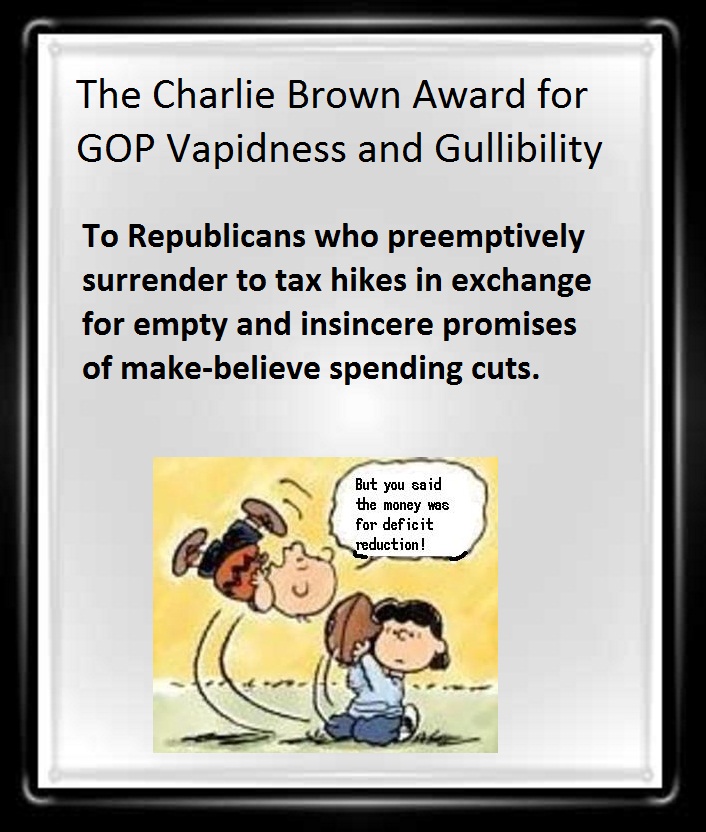
I truly do wonder how smart our elected representatives are in Washington. I got up on 12-20-12 and read this article below from the Heritage Foundation with the reference to Charlie Brown getting fooled by Lucy again when he runs up and tries to kick the football and of course she moves it again.
Liberals in Congress have always tried to fool conservatives by promising future cuts if they provide higher taxes now. (This article below appeared on www.heritage.org on 12-20-12.)
Obama’s “Lucy Move the Football” Fiscal Cliff Plan Still Not Balanced
Volleys of negotiating counter-offers are coming in faster now that Christmas break and the looming fiscal cliff are just around the corner.
While there is much unsatisfactory with Speaker of the House John Boehner’s (R–OH) Sunday night proposal, let us not forget that the reason we are watching this needless, high stakes drama unfold is due to President Obama’s intractable insistence on tax increases on America’s high earners. After all, he and Congress could simply and quickly pass a bill to extend all current policies and avoid the fiscal cliff entirely—if he wanted to. No, this is really about hiking taxes on high earners. Thus the charade of deficit reduction continues.
Obama’s latest counteroffer is no more acceptable than his first offer. Short on details concerning actual spending reductions, especially on entitlements, it is replete with his requisite tax hikes and (we are shocked) new stimulus spending. The cherry on top is an extension of the debt limit for two years, essentially handing over authority to raise it to the President.
Right.
The President originally called for around $800 billion in tax hikes on America’s “highest” earners—those earning $250,000 and up. A ridiculous demand when the economy is still struggling under his big spending and regulatory policies, and one which would squarely hit smaller businesses. You know, the ones who actually create jobs.
Yet, just like Lucy and the football, when Boehner and company offered up $800 billion in tax hikes, Obama quickly doubled his demand to $1.5 trillion in tax hikes—again, all from the highest earners. They, he tells us, can afford to pay a little more. Never mind, of course, that the top 1 percent of earners already pay 37 percent of all income taxes. Somehow we are to believe this is a “balanced approach.”
Obama pitches all this on the pretext that we can simply go back to the tax rates we had under Clinton. Wrong! His dirty little tax secret is that he has already hiked taxes on high earners under Obamacare. First the law added a surtax of 0.9 percent in addition to the Medicare payroll tax on those earning over $250,000. For the first time ever, Obamacare will apply this higher rate of 3.8 percent to investment income on January 1. Obama won’t tell you that going back to Clinton-era tax rates will actually result in higher taxes on wages, dividends, and capital gains.
They say if you want less of something, then tax it. For Obama, this works fine on financial transactions, carbon emissions, driving, and junk food. But evidently, for him, not so much on a strong vibrant economy. And those Clinton boom years? They weren’t ushered in after the Clinton tax hike—only after the Clinton–Gingrich tax cut!
Rather than working with Republicans on tax proposals that will actually grow the economy, Obama is now simply fighting over his definition of “high income” while we are left to wonder how much this $1.2 trillion tax hike will slow the economy.
As for the $1.2 trillion spending reductions, the only reason they are there is because Boehner insisted on them. But $100 billion in cuts would whack the defense budget, which is already reeling from earlier budget cuts. Yet the real spending and debt crisis comes from unaffordable entitlement programs. While Obama is insisting on balance on the tax side, he is sorely lacking in leadership here. As a recent Washington Post editorial opined:
Elections do have consequences, and Mr. Obama ran on a clear platform of increasing taxes on the wealthy. But he was clear on something else, too: Deficit reduction must be “balanced,” including spending cuts as well as tax increases. Since 60 percent of the federal budget goes to entitlement programs such as Medicare, Medicaid and Social Security, there’s no way to achieve balance without slowing the rate of increase of those programs.
We know Obama is open to changing the inflation calculation and slowing the benefit growth in Social Security. But what else? What about the proposals in his own budget, which would increase premiums on Medicare? He could easily broaden his proposals with additional uncontroversial steps to begin the process of strengthening and reining in Social Security and Medicare. All he needs to do is lead.
Some polls may show that Americans think taxes should be part of a deficit deal; but what the polls do not always show is their utter distrust that Washington would use new revenues to actually reduce the deficit. Here, Obama does not let them down. He reportedly wants $80 billion in new spending on infrastructure and unemployment benefits.
In exchange for all of this, he wants to raise the debt limit by enough to fuel his big spending goals for two years. This is utterly unacceptable. Americans know you cannot reduce the deficit when you plan to actually spend more. Americans also know that when Washington lifts the debt limit, it will not control spending. The debt limit puts the very pressure lawmakers need to account for out-of-control spending and make vital course corrections to bring spending under control, lest we face a Euro-style debt crisis in the future.
White House Press Secretary Jay Carney is actually insisting that “[t]he President’s proposal is the only proposal we have seen that achieves the balance that is so necessary.” Balance, evidently, is in the eyes of the beholder. As the Post noted, 60 percent of the budget stems from entitlements.
In just 13 short years—by the time today’s kindergarteners enter college—entitlements and interest on the debt will eat up all tax revenues. A truly balanced approach must start where the problem starts—with substantive reforms to entitlements. While the President maintains that you cannot cut your way to prosperity, you certainly cannot tax your way there.
_______________
Below is a speech by George W. Bush honoring Milton Friedman:
Milton Friedman Honored for Lifetime Achievements 2002/5/9
Milton Friedman said that getting George Bush I to be his vice president was his biggest mistake because he knew that Bush was not a true conservative and sure enough George Bush did raise taxes when he later became President. I wonder if Jeb Bush has the same genes as his father.
But I then pointed out that all of those scenarios were total fantasies and that it would be more realistic to envision me playing center field for the New York Yankees.
That’s why I like the anti-tax pledge of Americans for Tax Reform. You don’t solve America’s fiscal problems by saying no to all tax increases, but at least you don’t move in the wrong direction at a faster rate.
Notwithstanding the principled and pragmatic arguments against putting tax increases on the table, some Republicans – in a triumph of hope over experience – are preemptively acquiescing to tax hikes.
Jeb Bush, the former Florida governor, said Friday that he could back a broad deficit plan that increased taxes, a stance that puts him at odds with other prominent Republicans. Bush told a House panel he could get behind a plan that combined 10 dollars in spending cuts for every dollar of new revenue… “The problem is the 10 never materializes,” [Congressman Paul] Ryan said after Bush said he could support a revenue-increasing deficit deal. Norquist also has criticized deficit deals crafted in 1982 and 1990 – the latter agreed to by then-President George H.W. Bush, Jeb’s father – for failing to deliver on the spending side.
Kudos to Paul Ryan for making the obvious point about make-believe spending cuts. And Grover is correct about the failure of previous budget deals.
Indeed, I cited a New York Times column that inadvertently revealed that the only budget deal that worked was the 1997 pact that cut taxes rather than raised them.
Sen. Lindsey Graham (R-S.C.) said Tuesday he believed Republicans should consider eliminating loopholes in the tax code even if they aren’t replaced by additional tax cuts, a move that would break with an anti-tax pledge many GOP lawmakers have signed with activist Grover Norquist. “When you eliminate a deduction, it’s OK with me to use some of that money to get us out of debt. That’s where I disagree with the pledge,” Graham told ABC News. …”I’m willing to move my party, or try to, on the tax issue. I need someone on the Democratic side being willing to move their party on structural changes to entitlements.” Graham said, for instance, he would support a plan that included $4 in spending cuts for every $1 in tax increases. During a Republican debate last August, all eight Republican candidates in attendance said they would reject a proposal to trade $10 in spending cuts for even $1 in tax increases.
In some sense, Senator Graham’s comments are reasonable. With real spending cuts and less-damaging forms of tax hikes, an acceptable deal is possible. But only in Fantasia, not in Washington.
In the real world, all that Senator Graham has done is to move the debate slightly to the left.
But I do have nightmares about government getting even bigger, and that’s why I don’t want tax increases on the table. I don’t even want them in the room. Or the house. Or the neighborhood.
That’s why Jeb Bush and Lindsey Graham are the newest winners of the Charlie Brown Award. They’ve put blood in the water. I wonder if they’ll act surprised when hungry sharks show up looking for a meal?
_____________
In 1982 the Democrats promised future spending cuts if Ronald Reagan would agree to a tax increase, but you guessed it, the taxes were increased and the spending cuts never came. THE REAL PROBLEM IS NOT THAT WE DON’T HAVE ENOUGH TAXES BUT WE DON’T WANT TO CUT SPENDING!!!
Washington Could Learn a Lot from a Drug Addict
Concerning spending cuts Reagan believed, that members of Congress “wouldn’t lie to him when he should have known better.” However, can you believe a drug addict when he tells you he is not ever going to do his habit again? Congress is addicted to spending too much money. Lee Edwards wrote in his article “Golden Years” about Ronald Reagan:
Sometimes Reagan went along with a pragamatist like chief of staff James Baker, who persuaded the president to accept the Tax Equity and Fiscal Responsibility Act of 1982 (TEFRA), which turned out to be the great tax increase of 1982 — $98 billion over the next three years. That was too much for eighty-nine House Republicans (including second-term Congressman Newt Gingrich of Georgia) or for prominent conservative organizations from the American Conservative Union like the Conservative Caucus and the U.S. Chamber of Commerce, which all opposed the measure.
Baker assured his boss that Congress would approve three dollars in spending cuts for every dollar of tax increase. To Reagan, TEFRA looked like a pretty good “70 percent” deal. But Congress wound up cutting less than twenty-seven cents for every new tax dollar. What had seemed to be an acceptable 70-30 compromise turned out to be a 30-70 surrender. Ed Meese described TEFRA as “the greatest domestic error of the Reagan administration,” although it did leave untouched the individual tax rate reductions approved the previous year. (TEFRA was built on a series of business and excise taxes plus the removal of business tax deductions.)[xxx]
The basic problem was that Reagan believed, as Lyn Nofziger put it, that members of Congress “wouldn’t lie to him when he should have known better.”[xxxi] As a result of TEFRA, Reagan learned to “trust but verify,” whether he was dealing with a Speaker of the House or a president of the Soviet Union.
(Emailed to White House on 12-21-12.) President Obama c/o The White House 1600 Pennsylvania Avenue NW Washington, DC 20500 Dear Mr. President, I know that you receive 20,000 letters a day and that you actually read 10 of them every day. I really do respect you for trying to get a pulse on […]
(Emailed to White House on 12-21-12.) President Obama c/o The White House 1600 Pennsylvania Avenue NW Washington, DC 20500 Dear Mr. President, I know that you receive 20,000 letters a day and that you actually read 10 of them every day. I really do respect you for trying to get a pulse on what is […]
(Emailed to White House on 12-21-12) President Obama c/o The White House 1600 Pennsylvania Avenue NW Washington, DC 20500 Dear Mr. President, I know that you receive 20,000 letters a day and that you actually read 10 of them every day. I really do respect you for trying to get a pulse on what is […]
The federal government has a spending problem and Milton Friedman came up with the negative income tax to help poor people get out of the welfare trap. It seems that the government screws up about everything. Then why is President Obama wanting more taxes? _______________ Milton Friedman – The Negative Income Tax Published on […]
I was sad to read that the Speaker John Boehner has been involved in punishing tea party republicans. Actually I have written letters to several of these same tea party heroes telling them that I have emailed Boehner encouraging him to listen to them. Rep. David Schweikert (R-AZ),Justin Amash (R-MI), and Tim Huelskamp (R-KS). have been contacted […]
Michael Tanner of the Cato Institute in his article, “Hitting the Ceiling,” National Review Online, March 7, 2012 noted: After all, despite all the sturm und drang about spending cuts as part of last year’s debt-ceiling deal, federal spending not only increased from 2011 to 2012, it rose faster than inflation and population growth combined. […]
Ronald Reagan was a firm believer in the Balanced Budget Amendment and Milton Friedman was a key advisor to Reagan. Friedman’s 1980 film series taught the lesson of restraining growth of the federal budget.
Vital changes needed to keep road to further reforms open
There is a problem brewing in the House of Representatives of which most conservatives in and outside Congress are largely unaware. It has to do with H.J. Res. 1 – the balanced budget amendment – soon to be voted on per the debt-ceiling “deal” struck by Congress and the president. While H.J. Res. 1 is a solid first effort – and we have urged support for it as a symbolic vote – it is possibly fatally flawed and should be revised.
After years of indifference to constitutional fiscal discipline, Congress is once again stirring. In 1982, then-President Ronald Reagan, convened a federal amendment drafting committee led by Milton Friedman, Jim Buchanan, Bill Niskanen, Walter Williams and many others, and fashioned Senate Joint Resolution 58, a tax limitation-balanced budget amendment, which garnered 67 votes in the Senate under the able leadership of Sen. Orrin G. Hatch, Utah Republican. After a successful discharge petition forced a House vote, the amendment failed to achieve the two-thirds vote necessary in a Tip O’Neill-Jim Wright-controlled House. In 1996, Newt Gingrich and company came within one vote of passing a fiscal amendment in the House.
Currently, H.J. Res. 1 is designed as a classic balanced budget amendment in which outlays can be as great as, but no more than, receipts for that year. However, it requires an estimate of receipts, which is notoriously faulty, and it does not necessarily produce surpluses with which to pay down our massive debt. Furthermore, it contains a second limit on outlays – “not more than 18 percent of the economic output of the United States” – without defining such output or resolving the inevitable conflict between the outlay calculations in the two provisions.
This could be fixed by restructuring the amendment as a spending or outlay limit based on prior year receipts or outlays (known numbers), adjusted only for inflation and population changes. This will produce surpluses in most years with which to pay down debts and will reduce government spending as a share of gross domestic product over time, right-sizing government and increasing the rate of economic growth for the benefit of all citizens, especially those least able to compete.
Section 4 of H.J. Res. 1 might best be described as a supreme example of the law of unintended consequences. This section imposes on the president a constitutional responsibility to present a balanced budget. Surely, the drafters were saying to themselves “We’ll fix that guy in the White House. Now he will have to fess up and either propose specific tax increases or specific spending cuts. He won’t be able to duck reality any longer.” The only problem is that this section is at odds with our Constitution in that it gives the president a constitutional power over fiscal matters never intended by the Founders.
For much of our history, the president did not propose a budget. In the Budget and Accounting Act of 1921, which established the Bureau of the Budget, now the Office of Management and Budget and the General Accounting Office, the president was statutorily authorized to propose a budget. Presidents have always shaped the budget and spending using their negotiating opportunities and veto pen. Wearing their chief administrator hat, earlier presidents sought to save money from the amounts appropriated by Congress, getting things done for less, impounding funds they did not think essential to spend. Congress‘ ceiling on an appropriation was not also the spending floor for the president, as it is now.
Section 4 appears to give the president co-equal power with Congress not only to present a budget but to shape it, in conflict with congressional budget authority. At a minimum, it is likely to create a conflict over the amount of allowed annual spending. The president surely will be guided by his own Office of Management and Budget, whose budget and receipts calculations will undoubtedly differ from the Congressional Budget Office’s numbers that will direct Congress. We should not start the budget process each year with this kind of conflict.
It would be better to restore the historic role of the president to impound and otherwise reduce expenditures by repealing and revising appropriate portions of the Congressional Budget and Impoundment Control Act of 1974 so a fiscally conservative president is a revitalized partner in cutting the size of government.
Section 5 requires a supermajority vote for “a bill to increase revenues.” Whether one agrees or disagrees with making tax increases more difficult, this language is troublesome because it requires some government bureaucrat or bureaucracy to make a calculation or estimate of the effect of tax law changes on revenues. Proponents of a bill to increase cash flow to the government will argue that their tax law changes are “revenue neutral” and will likely persuade the Joint Committee on Taxation or Congressional Budget Office to back them up. Once again, estimators would be in control.
If we ever expect to convert our income-based tax system to a consumption tax, better not to require a two-thirds vote as liberals will use such a supermajority voting rule to stymie tax system reform.
There are other issues, as well, with debt limit and national emergency supermajority votes and definitions. While this balanced budget amendment – H.J. Res. 1 – has deserved a “yes” vote as a demonstration of commitment to constitutional fiscal discipline, it can and must be revised before the showdown vote in the House this fall.
Lewis K. Uhler is president of the National Tax Limitation Committee.




 The Daily Hatch