Today in the USA it seems we are losing some of our freedom because of increased federal government control of our lives.
People all the world love freedom and those that had to live under the rule of communism hungered for freedom. When I think about the actions of Ronald Reagan and Milton Friedman during the 1980’s I am grateful for their love of freedom. Ronald Reagan is responsible for bringing down the Russian communist state and the ones in Eastern Europe.
Below you will read how the 1980 book and film series “Free to Choose” was being smuggled into these countries and was giving the people a hunger for freedom. I wish the USA would reduce the size of our federal government spending and regulations and return more freedom to our people too. Below is an article that talks about the making of that film series.
Andrew Coulson directs the Cato Institute’s Center for Educational Freedom and is the author of Market Education: The Unknown History.
Added to cato.org on July 31, 2012
This article appeared in Cato.org on July 31, 2012.
For us, who lived in the communist world, Milton Friedman was the greatest champion of freedom, of limited and unobtrusive government and of free markets. Because of him I became a true believer in the unrestricted market economy.
Those are the words of Czech President Vaclav Klaus. Both Friedman’s writings and his landmark 1980 documentary series “Free to Choose”were smuggled into totalitarian communist states, inspiring a generation of future scholars, activists, and politicians.
July 31st, 2012 is the 100th anniversary of Friedman’s birth. To commemorate that occasion, the Cato Institute has put together a video interview with Bob Chitester, producer of “Free to Choose,” recounting how it came to be, its impact, and what it was like working with Milton Friedman.
Bob Chitester Discusses Milton Friedman and ‘Free to Choose’
“There are very few people over the generations who have ideas that are sufficiently original to materially alter the direction of civilization. Milton is one of those very few people.”
That is how former Federal Reserve Chairman Alan Greenspan described the Nobel laureate economist Milton Friedman. But it is not for his technical work in monetary economics that Friedman is best known. Like mathematician Jacob Bronowski and astronomer Carl Sagan, Friedman had a gift for communicating complex ideas to a general audience.
It was this gift that brought him to the attention of filmmaker Bob Chitester. At Chitester’s urging, Friedman agreed to make a 10 part documentary series explaining the power of economic freedom. It was called “Free to Choose,” and became one of the most watched documentaries in history.
The series not only reached audiences in liberal democracies, but was smuggled behind the iron curtain where it played, in secret, to large audiences.
__________
Aside from those who lived under communism, there is another group for whom Friedman was and is a colossal figure: advocates of educational freedom. At a time when state-run schooling had been the norm for nearly a century, and had long ceased to be questioned by America’s elites, Friedman offered a modest observation: there was no good reason for the government of a free society to actually run schools and many good reasons for it not to do so.
He made this case in his essay “On the Role of Government in Education,” first published in 1955. The idea had been floated by others, including Adam Smith and Thomas Paine, but Friedman eloquently and powerfully introduced it to the American policy debate. In so doing, he, more than any other individual, can be credited with giving rise to the modern school choice movement.
Not only did Friedman spark the creation of this movement, he helped to fan the flame of educational freedom, writing popular commentaries and book chapters, speaking with and encouraging activists, founding a leading school choice institution, and dedicating the entire sixth episode of “Free to Choose” to this subject.
I had the good fortune to speak and correspond with Milton occasionally, starting in the late 1990s, and what struck me most about him was his personal integrity. He once told me that he never said anything negative about a person in private that he would not be willing to say openly in that person’s presence. So far as I know, he never violated that principle. And while he staunchly defended his conclusions as long as he remained convinced of their correctness, he would amend them if the weight of evidence shifted.
Indeed the rigorous empiricism that Friedman applied in his scholarly work is generally regarded as one of his most influential contributions to the field of economics—for a long time controversial but eventually the norm, at least in principle. His view, published in the 1953 collection Essays in Positive Economics, was that
the ultimate test of the validity of a theory is… the ability to deduce facts that have not yet been observed, that are capable of being contradicted by observation, and that subsequent observation does not contradict. [p. 300]
Equally wise, though not yet as widely accepted, is the long time horizon against which Friedman measured policy outcomes. Economist and philosopher of science James R. Wible notes that Friedman’s greatest contribution “may be his constant reminder not to forget the long run consequences of short run policies.”
In the 1982 edition of his book Capitalism and Freedom, Friedman observed that scholars cannot single-handedly bring about change. Their real role, he wrote, is to “keep the lights on”—to remind us which policies work and which do not, and to show us how to advance our understanding even further. His own unfailing empiricism and concern for the long term remain valuable beacons today, both for advocates of educational freedom and the broader policy community.
__________
Thank you so much for your time. I know how valuable it is. I also appreciate the fine family that you have and your commitment as a father and a husband.
Sincerely,
Everette Hatcher III, 13900 Cottontail Lane, Alexander, AR 72002, ph 501-920-5733, lowcostsqueegees@yahoo.com
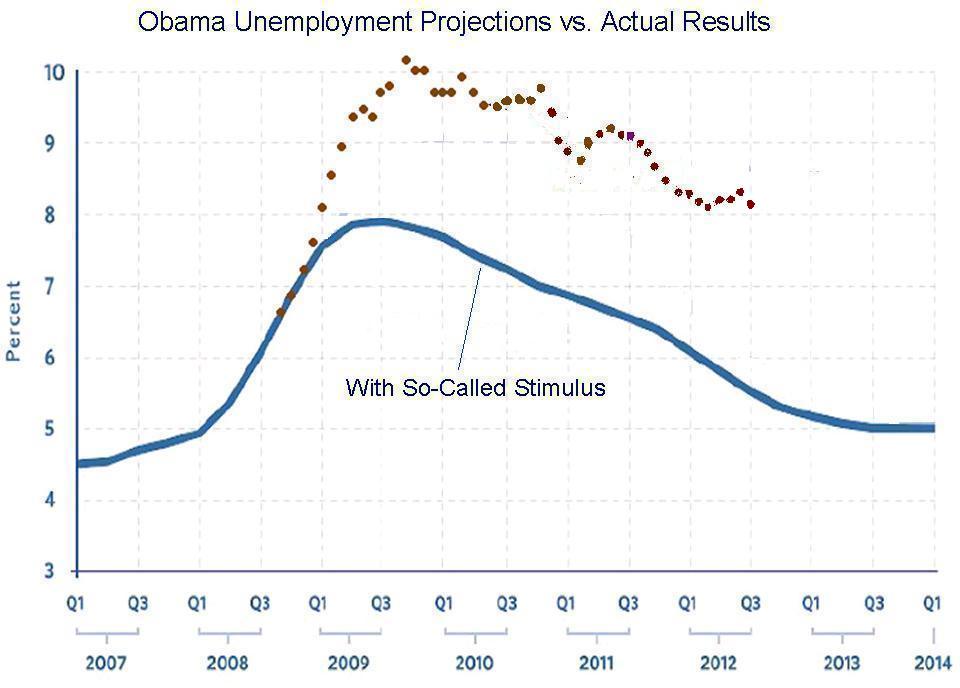
He promised unemployment would never climb above 8 percent if Congress squandered $800 billion on a Keynesian stimulus scheme.
Well, Congress said yes and the results have not been pretty. And every month we get new numbers to show us that the Administration’s policies have failed. It’s like Chinese water torture for the White House.
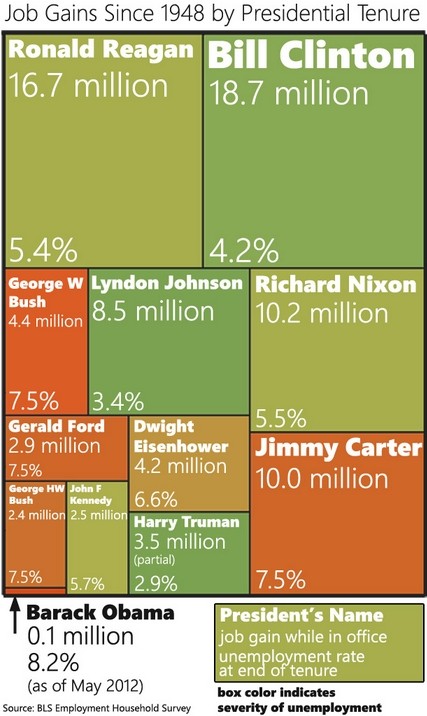
The numbers released this morning from the Department of Labor don’t change the narrative. The Republican and Democratic spin-doctors obviously will spit out their talking points, but here’s a visual put together by Political Math that trumps all the political maneuvering. If you’re wondering where Obama is, look at the lower left portion of the image.
This image is a couple of months old, but job creation has been so anemic that the naked eye wouldn’t be able to tell the difference if it was updated.
Since I normally show a graph with the actual unemployment rate compared to what Obama promised, I’ll add that as well. Not a pretty picture. I wrote that last month’s version would cause anxiety for Obama, and see no reason to change that assessment.
Yes, the official unemployment rate dropped to 8.1 percent, but that was because more Americans dropped out of the labor force.
Most important, the rate of joblessness is about 2-1/2 to 3 percentage points higher than what Obama promised. Now he wants a second term, yet all he’s promising is more of the same.
Actually, I retract that statement. He wants to maintain his current approach, but then add some class-warfare taxes to the mix.
________
Thank you so much for your time. I know how valuable it is. I also appreciate the fine family that you have and your commitment as a father and a husband.
Sincerely,
Everette Hatcher III, 13900 Cottontail Lane, Alexander, AR 72002, ph 501-920-5733, lowcostsqueegees@yahoo.com
Ronald Reagan said, “We will never compromise our principles and standards.”
Are the Republicans in Arkansas true Tea Party Ronald Reagan Republicans?
According to Americans for Prosperity in the last 5 years Arkansas’ current Medicaid program has run a deficit of a billion dollars. Why expand it willingly with Obama? The “Do Nothing” expansion plan increases spending by 5.9 billion with 158,000 new recipients when the Gov. Beebe Expansion plan increases spending by 21.99 billion with 247,000 new recipients.
Let me give you several reasons that Max Brantley of the Arkansas Times Blog may be right about the Arkansas Republicans giving in and expanding the failed medicaid program in Arkansas.
1. The Arkansas Republicans are becoming convinced that if you expand a failed program then it will work better.
Milton Friedman puts it this way:
Suppose a private group undertakes the project. Suppose it starts to lose money. The only way that they can keep it going is by digging into their own pockets. They have to bear the costs. That enterprise will not last long; people will shut it down. They will go on to something else.
Suppose government undertakes the same project and its initial experience is the same: it starts to lose money. What happens? The government officials could shut it down, but they have a very different alternative. With the best of intentions, they can believe that the only reason it has not done well is because it has not been operating on a large enough scale. They do not have to dig into their own pockets to finance an expansion. They can dig into the pockets of the taxpayers.
Indeed, financing an expansion will enable them to keep lucrative jobs. All they need to do is to persuade the taxpayer, or the legislators who control the purse that their project is a good one. And they are generally able to do so because, in turn, the people who vote on the expansion are not voting their own money; they are spending somebody else’s money. And nobody spends somebody else’s money as carefully as he spends his own.
The end result is that when a private enterprise fails, it is closed down; when a government enterprise fails, it is expanded.
Did I fail to mention that the current Medicaid program is running a deficit of a billion dollars in Arkansas, and some lawmakers in Arkansas want to expand this program?
2. The Arkansas Republicans came into office to cut the size of government but now they are joining all the 49 Democrats in the House in thinking that spending Washington’s money is spending someone else’s money when it really is expanding government and sticking it to the taxpayer ultimately.
Milton Friedman observed, “Nobody spends somebody else’s money as carefully as he spends his own.”
3. If the Arkansas Republicans line up with the Democrats and vote for expansion today then they have bought into the socialist policies the Democrats are pushing but ultimately this expansion of socialism will come crashing down and we will not even be able to meet the obligations to the sick and most vulnerable that we already are serving.
Milton Friedman’s final conclusion in this speech below is this, “There’s a general rule in government and bureaucratic enterprises: the more you put in, the less you get out.”
When John Fund of the Wall Street Journal came to Little Rock on 4-27-11 to speak he quoted Ronald Reagan in a speech to his campaign workers in 1976. Reagan said concerning socialism, “Whenever and wherever liberalism has been tried, it has always failed.”
This expansion of socialism in Arkansas is supported by the Democrats in Arkansas 100%. I never thought I would see the day that Republicans in Arkansas would consider expanding government with “somebody else’s money.” The sad fact is that is the taxpayer’s money!!!!!
By any reasonable measure, the United States today is a little over fifty percent socialist. That is to say, more than fifty percent of the total resources in the country, of the total input, is directly or indirectly controlled by governmental institutions at all levels-federal, state, and local. Yet we in the United States have the highest standard of living of any country in the world. We are a very rich and prosperous country. It is an extraordinary tribute to the productivity of the market system that, with less than fifty percent of the resources, it can produce the kind of standard of living and the kind of society we have.
You are working from January 1 to close to June 30, or maybe somewhere after June 30, to pay for the direct and indirect cost of government. What fraction of your well-being comes from those government-controlled expenditures? Is it anything like fifty percent? I doubt very much that many of you would say it is.
The question that my puzzle raises is why is it that private enterprises are successful and government enterprises are not? One common answer is that the difference is in the incentive, that somehow the incentive of profit is stronger than the incentive of public service. In one sense, that’s night; but in another, it’s wrong.
The people who run our private enterprises and the people who run our government enterprises have exactly the same incentive. In both cases, they want to promote their private interests. The people who go into our government, who operate our government, are the same kind of people as those who are in the private sector. They are just as smart, in general. They have just as much integrity. They have just as many altruistic and selfless interests. There is no difference in that way. But as Armen Alchian, an economist at UCLA, once put it, “The one thing you can depend on everybody to do is to put his interest above yours.” That is a very insightful comment. The Chinese who are on the mainland are not different people from the Chinese who are in Hong Kong. Yet, the Mainland is a morass of poverty and Hong Kong has been an oasis of relative well being. The people who occupied West Germany and East Germany before they were reunited had the same background, the same culture. They were the same people, but the results were drastically different.
The problem is not in the kind of people who run our governmental institutions versus those who run our private institutions. The trouble, as the Marxists used to say, is in the system. The system is what is at fault.
The difference is that the private interest of people is served in a different way in the private and the governmental spheres. Consider the bottom line they face.
Here’s a project that might be suggested, to begin with, by somebody in the private sector or by somebody in the government sphere, and appears equally promising in either case. However, all good ideas are conjectures; they are experiments. Most are going to fail. What happens? Suppose a private group undertakes the project. Suppose it starts to lose money. The only way that they can keep it going is by digging into their own pockets. They have to bear the costs. That enterprise will not last long; people will shut it down. They will go on to something else.
Suppose government undertakes the same project and its initial experience is the same: it starts to lose money. What happens? The government officials could shut it down, but they have a very different alternative. With the best of intentions, they can believe that the only reason it has not done well is because it has not been operating on a large enough scale. They do not have to dig into their own pockets to finance an expansion. They can dig into the pockets of the taxpayers.
Indeed, financing an expansion will enable them to keep lucrative jobs. All they need to do is to persuade the taxpayer, or the legislators who control the purse that their project is a good one. And they are generally able to do so because, in turn, the people who vote on the expansion are not voting their own money; they are spending somebody else’s money. And nobody spends somebody else’s money as carefully as he spends his own.
The end result is that when a private enterprise fails, it is closed down; when a government enterprise fails, it is expanded. Isn’t that exactly what has been happening with drugs? With schooling? With medical care?
We are all aware of the deterioration in schooling. But are you aware that we are now spending per pupil, on the average, three times as much as we were thirty years ago, after adjustment for inflation? There’s a general rule in government and bureaucratic enterprises: the more you put in, the less you get out.
CATO Institute Michael Cannon on the OReilly Factor Published on Mar 19, 2013 The CATO Institute’s Michael Cannon spoke at the Arkansas Conservative Caucus on Tuesday March 19th. Several conservatives were present. Cannon talked about how to defeat Obamacare in Arkansas & how the states can stop Obamacare on a national level. __________________ CATO Institute […]
Jacque Martin asks CATO Institute Michael Cannon about Obamacare Published on Mar 19, 2013 The CATO Institute’s Michael Cannon spoke at the Arkansas Conservative Caucus on Tuesday March 19th. Several conservatives were present. Cannon talked about how to defeat Obamacare in Arkansas & how the states can stop Obamacare on a national level. Jacque Martin […]
After a visit to Arkansas on March 19, 2013 the Cato Institute’s Michael Cannon published another article claiming that “To date, 34 states, accounting for roughly two-thirds of the U.S. population, have refused to create Exchanges. Under the statute, this shields employers in those states from a $2,000 per worker tax that will apply […]
Representative Doug House asks CATO Institute Michael Cannon about Obamacare Published on Mar 19, 2013 The CATO Institute’s Michael Cannon spoke at the Arkansas Conservative Caucus on Tuesday March 19th. Several conservatives were present. Cannon talked about how to defeat Obamacare in Arkansas & how the states can stop Obamacare on a national level. Representative […]
Representative Bollinger asks CATO Institute Michael Cannon about Obamacare Published on Mar 19, 2013 The CATO Institute’s Michael Cannon spoke at the Arkansas Conservative Caucus on Tuesday March 19th. Several conservatives were present. Cannon talked about how to defeat Obamacare in Arkansas & how the states can stop Obamacare on a national level. Representative Bollinger […]
An ObamaCare Debate Challenge (Michael F. Cannon) CATO Institute Michael Cannon at the Arkansas Conservative Caucus Published on Mar 19, 2013 The CATO Institute’s Michael Cannon spoke at the Arkansas Conservative Caucus on Tuesday March 19th. Several conservatives were present. Cannon talked about how to defeat Obamacare in Arkansas & how the states can stop […]
Max Brantley of the Ark Times takes on Michael Cannon of the Cato Institute today concerning Obamacare. I have posted many links to Cannon’s articles in the past on my blog and on the Arkansas Times liberal blog. The finest article written in my estimation was written on Nov 20, 2012 and here is a […]
Cato’s Michael F. Cannon Discusses ObamaCare’s Individual Mandate Is Michael Cannon of the Cato Institute right about states blocking Obamacare, factchecker says he is wrong. I Have Been False* Posted by Michael F. Cannon *According to PolitiFact. In an unconscious parody of everything that’s wrong with the “fact-checker” movement in journalism, PolitiFact Georgia (a project of […]
Obamacare is a poorly written and because of that the majority of states may never have to put into practice. February 28, 2013 2:13PM ObamaCare Debate Challenge: Lawrence Wasden Edition By Michael F. Cannon Share Tweet Like Google+1 Congress empowered states to block major provisions of ObamaCare, including its subsidies and employer mandate. All […]
I was glad to see that the true Tea Party Conservatives won the first round in the medicaid expansion debate. According to AFP in the last 5 years Arkansas’ current Medicaid program has run a deficit of a billion dollars. Why expand it willingly with Obama? The “Do Nothing” expansion plan increases spending by […]
Sanders v Greenberg on KARN Published on Apr 12, 2013 Sen. David Sanders takes on former Rep. Dan Greenberg on the private option health care plan – audio from KARN Newsradio 102.9 FM in Little Rock ____________ Here is what Jason Tolbert had to say about it. If you missed KARN’s Dave Elswick Show on Friday […]
Some very good points by Dan Mitchell of the Cato Institute on Obamacare: Why We Should Be Optimistic about Repealing Obamacare and Fixing the Healthcare System April 10, 2013 by Dan Mitchell I’m going to make an assertion that seems utterly absurd. The enactment of Obamacare may have been good news. Before sending a team of medical […]
CATO Institute Michael Cannon on the OReilly Factor Published on Mar 19, 2013 The CATO Institute’s Michael Cannon spoke at the Arkansas Conservative Caucus on Tuesday March 19th. Several conservatives were present. Cannon talked about how to defeat Obamacare in Arkansas & how the states can stop Obamacare on a national level. Max Brantley of […]
Nic Horton Medicaid Expansion will “Cost Almost Double than Doing Nothing” part II _______ I am hopeful that the Arkansas Republican state lawmakers will not expand the broken medicaid program. Evidently Congressman Rick Crawford feels strongly about this too. Crawford: Even With Arkansas Plan, ObamaCare Is Unaffordable Crawford urges state legislators to reject ObamaCare, because […]
Mike Maharrey talks AR Medicaid Expansion on the PHP ______________ This article from the Heritage Foundation mentions that the lawmakers in Arkansas are getting ready to make a big mistake if they think they will get flexibility from Obamacare on Medicaid expansion. Administration Rules Out “Deals” on Medicaid Expansion Edmund Haislmaier April 3, 2013 at […]
Medicaid Expansion in AR Nic Horton Talks on Paul Harrell Program Chicago style politics from the Obama administration. If I was an Arkansas lawmaker I would not believe a word out of his mouth. March 27, 2013 10:15AM Issa: IRS Is Violating ObamaCare by Illegally Taxing Employers in 33 States By Michael F. Cannon […]
Nic Horton Medicaid Expansion will “Cost Almost Double than Doing Nothing” part I It is amazing to me that Repubican lawmakers are considering taking President Obama’s advice on anything in light of this article below. March 25, 2013 4:26PM Here’s Your Free Health Care. Would You Care to Vote? By Michael F. Cannon Share Tweet […]
Nic Horton Medicaid Expansion will “Cost Almost Double than Doing Nothing” part II ______________ I am hoping that Arkansas lawmakers don’t fall into Obama’s trap and believe any of his empty promises, and I really think that the Republicans are making a mistake if they think a failed government program that doesn’t work should […]
A Red-Ink Train Wreck: The Real Fiscal Cost of Government-Run Healthcare Uploaded on Nov 9, 2009 This CF&P Foundation video explains why healthcare proposals in Washington will result in bloated government and higher deficits. This mini-documentary exposes the pervasive inaccuracy of congressional forecasts and succinctly lists 12 reasons why Obamacare will be a budget […]
A Red-Ink Train Wreck: The Real Fiscal Cost of Government-Run Healthcare Uploaded on Nov 9, 2009 This CF&P Foundation video explains why healthcare proposals in Washington will result in bloated government and higher deficits. This mini-documentary exposes the pervasive inaccuracy of congressional forecasts and succinctly lists 12 reasons why Obamacare will be a budget buster. […]
A Red-Ink Train Wreck: The Real Fiscal Cost of Government-Run Healthcare Uploaded on Nov 9, 2009 This CF&P Foundation video explains why healthcare proposals in Washington will result in bloated government and higher deficits. This mini-documentary exposes the pervasive inaccuracy of congressional forecasts and succinctly lists 12 reasons why Obamacare will be a budget buster. […]
Enlarge image Credit Nathan Vandiver / KUAR Michael Cannon of the Cato Institute told lawmakers March 19, 2013 that abandoning plans to partner with the federal government on a health insurance exchange would both benefit the state and reduce the power of the Affordable Care Act. __________________ I am very pleased with the Republican lawmakers in […]
Nor is there any evidence that he has fundamentally changed the attitudes of the American people.
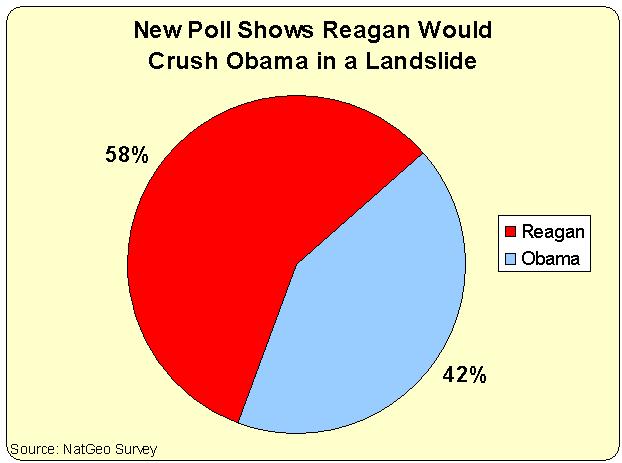
That may sound like a bold – and overly optimistic – assertion, but check out the amazing results from a new poll. According to a survey of 1,000 adults, Reagan would kick the you-know-what out of Obama, winning a hypothetical contest by a staggering 58-42 margin.
By the way, the margin might be even bigger than I’m reporting. As you can see fromthis press excerpt, all we know is that 58 percent of respondents said they would vote for Reagan. I’m assuming that 42 percent would vote for Obama, but it’s possible there was also a “don’t know” or “other” category, so maybe Obama would be under 40 percent!
…just about everything about the era — from the politics, leaders and safety to the music, TV shows and blockbuster movies — are seen as being better than they are today. In fact, 3 in 4 Americans (74%) thought that our country was better off then and even safer (76%). The same amount (76%) believe that government ran better in the 1980s than it does today. And if a presidential election were held today, 58 percent would vote for Ronald Reagan over Barack Obama. Americans ages 18 to 34 were evenly split, with 51 percent favoring Reagan and 49 percent Obama.
Even young people preferred Reagan over Obama, which is remarkable since they didn’t experience the Reagan years and largely have learned about the Gipper from the media and schools, both of which are very hostile to Reagan.
We shouldn’t be too surprised by these polling results. Just take a look atthis amazing infographic, which shows Obama’s horrible record on jobs compared to Reagan and other Presidents. Michael Ramirez makes the same point inthis very funny cartoon.
In other words, good policy leads to good outcomes, and good outcomes yield political rewards. That simple lesson has been lost on theweak gaggle of big-government GOPerswho followed Reagan.
But our hypothetical polling results show that Americans today are still ready to rally behind a candidate who offers a compelling message of freedom and prosperity. That’syet another reasonwhy I’m still optimistic about the fight for liberty.
Below is a discussion from Milton Friedman on Bill Clinton and Ronald Reagan. February 10, 1999 | Recorded on February 10, 1999 audio, video, and blogs » uncommon knowledge PRESIDENTIAL REPORT CARD: Milton Friedman on the State of the Union with guest Milton Friedman Milton Friedman, Senior Research Fellow, Hoover Institution and Nobel Laureate in […]
Below is a discussion from Milton Friedman on Bill Clinton and Ronald Reagan. February 10, 1999 | Recorded on February 10, 1999 audio, video, and blogs » uncommon knowledge PRESIDENTIAL REPORT CARD: Milton Friedman on the State of the Union with guest Milton Friedman Milton Friedman, Senior Research Fellow, Hoover Institution and Nobel Laureate in […]
I really enjoyed this article. A Constitutional President: Ronald Reagan and the Founding By Edwin Meese III , Lee Edwards, Ph.D. , James C. Miller III and Steven Hayward January 26, 2012 Abstract: Throughout his presidency, Ronald Reagan was guided by the principles of the American founding, especially the idea of ordered liberty. In the opening of his first inaugural address in 1981, […]
Ronald Reagan was the greatest pro-life president ever. He appointed Dr. C. Everett Koop to his administration and Dr. Koop was responsible for this outstanding pro-life film below: I was thinking about the March for Life that is coming up on Jan 20, 2013 in Little Rock and that is why I posted this today. […]
1/30/84 Part 1 of a speech to the National Religious Broadcasters. June 10, 2004, 10:30 a.m. Abortion and the Conscience of the Nation Ronald Reagan’s pro-life tract. EDITOR’S NOTE: While president, Ronald Reagan penned this article for The Human Life Review, unsolicited. It ran in the Review‘s Spring 1983, issue and is reprinted here with permission. The case […]
President Reagan, Nancy Reagan, Bill Clinton and Hillary Clinton attending the Dinner Honoring the Nation’s Governors. 2/22/87. Ronald Reagan is my favorite president and I have devoted several hundred looking at his ideas. Take a look at these links below: President Reagan and Nancy Reagan attending “All Star Tribute to Dutch Reagan” at NBC Studios(from […]
Ronald Reagan Talks About Balancing the Budget on “The Tonight Show” Uploaded by johnnycarson on Jul 30, 2011 Ronald Reagan talks about balancing the budget on “The Tonight Show” in 1975. _____________ Ronald Reagan was one of my favorite presidents. Mike Lee is one of my favorite lawmakers of today!!! Look at what he says about […]
I always liked both Robert Bork and Ronald Reagan. They had a lot in common. Lee Edwards noted concerning Bork and Reagan: Reagan’s most dramatic defeat came in 1987 when he nominated Judge Robert Bork to the Supreme Court.[xli] Bork’s confirmation became an ugly battle against liberal organizations like the American Civil Liberties Union, the […]
Obama finds himself answering for a vote he made back in the Illinois state Senate. See Barack Obama’s exclusive interview with CBN New’s David Brody, and what he says about his views on abortion and the Born Alive Infant Protection Act. June 10, 2004, 10:30 a.m. Abortion and the Conscience of the Nation Ronald Reagan’s […]
The world lost one of its greatest champions of freedom in Lady Margaret Thatcher. Ed Feulner, Edwin Meese III, and Becky Norton Dunlop remember her contributions as a great leader and friend of The Heritage Foundation.
________________
Great post from the Heritage Foundation on Margaret Thatcher’s legacy. She truly believed in freedom and a limited government.
Margaret Thatcher — a woman of character, leadership and a convicted spirit. A woman dedicated to individual freedom. The Heritage Foundation is proud of our special friendship with Lady Thatcher.
At a time when the Soviet Empire was still a powerful force, oppressing millions of people, Lady Thatchertackled communism head onas prime minister of Great Britain.
She believed in the crucial need for America to exert international leadership in the cause of freedom and partnered with conservative American leaders like Ronald Reagan and The Heritage Foundation to ensure individual liberty.
Her commitment to the principles of free enterprise,limited government,and individual freedom lace the eternal friendship between The Heritage Foundation and Lady Thatcher.
Lady Thatcher visited Heritage several times throughout her life and received theClare Boothe Luce Award, Heritage’s highest honor for contributions to the conservative movement.
She often referred to Heritage as the leader for conservative principles and said Heritage flew “the flag for conservatism over this last quarter-century with pride and distinction” during a1997 visit.
When Lady Thatcher chose Heritage to house theThatcher Center for Freedom, an institution faithful to carrying forward her legacy in the United States, Heritage was honored.
In anopen letterto Heritage members, Lady Thatcher said she selected Heritage because of its commitment “to defending and restoring sound conservative principles.”
In 2006, Lady Thatcher became the “patron” of Heritage. Her new title recognized Lady Thatcher’s “singular contributions as a leader of the free world and to the improvement of the life of her nation and people.”
Through blog posts, reports, videos, lectures and special events, Heritage remains a strong support system for the important lessons to be learned from Lady Thatcher and her legacy.
We’ve compiled some of our favorite moments of the Heritage–Lady Thatcher friendship. Read, watch and learn more below.
Heritage has lost one of her greatest friends, and the world has lost one of its greatest champions of freedom.
Margaret Thatcher led Great Britain courageously for more than a decade. During that time, she rolled back the suffocating blanket of Big Government, sparking an economic revival. And she implemented a foreign policy based on the principle that British sovereignty and the freedom of all those under the protection of Great Britain shall not be violated.
But it is her partnership with Ronald Reagan that we Americans think of first. It was characterized by loyalty, commitment and a jauntiness that proclaimed success was inevitable. As, indeed, it proved to be—both in domestic policy and in bringing down the Evil Empire of the Soviets without firing a shot.
Mrs. Thatcher spoke constantly of freedom, and the absolute need for America to exert international leadership in the cause of freedom. Her conviction that liberty could spread globally only with strong American leadership led her to become the Patron of Heritage and inspired the founding of our Margaret Thatcher Center for Freedom.
The Center is just a small part of this remarkable woman’s legacy. We are grateful for it, just as we are grateful for her leadership, her inspiration and her “special relationship” with Heritage.
Great speech by Margaret Thatcher on socialism. It was not helpful to the people of eastern europe and it will not be helpful to us today. Defining Socialism Marion Smith December 10, 2012 at 5:25 pm Margaret Thatcher on Socialism For those who failed to recognize the ideological stakes of the recent election, […]
Uploaded by mynameiswhatever on Jan 18, 2009 Margaret Thatcher’s last House of Commons Speech on November 22, 1990. ________________ Prime Minister Margaret Thatcher: People on all levels of income are better off than they were in 1979. The hon. Gentleman is saying that he would rather that the poor were poorer, provided that the rich […]
Unfortunately Hollywood has their own agenda many times. Great article from the Heritage Foundation. Morning Bell: The Real ‘Iron Lady’ Theodore Bromund January 11, 2012 at 9:24 am Streep referred to the challenge of portraying Lady Thatcher as “daunting and exciting,” and as requiring “as much zeal, fervour and attention to detail as the real […]
Margaret Thatcher is one of my heroes and I have a three part series on her I am posting. “What We Can Learn from Margaret Thatcher,”By Sir Rhodes Boyson and Antonio Martino, Heritage Foundation, November 24, 1999, is an excellent article and here is a portion of it below: What Can We Learn from Thatcher? […]
Margaret Thatcher is one of my heroes and I have a three part series on her I am posting. “What We Can Learn from Margaret Thatcher,”By Sir Rhodes Boyson and Antonio Martino, Heritage Foundation, November 24, 1999, is an excellent article and here is a portion of it below: Thatcher This was the background […]
Margaret Thatcher is one of my heroes and I have a three part series on her I am posting. “What We Can Learn from Margaret Thatcher,”By Sir Rhodes Boyson and Antonio Martino, Heritage Foundation, November 24, 1999, is an excellent article and here is a portion of it below: The Role of Ideas 6 The […]
Margaret Thatcher (Part 2) Margaret Thatcher is one of my heroes and I have a three part series on her I am posting. “What We Can Learn from Margaret Thatcher,”By Sir Rhodes Boyson and Antonio Martino, Heritage Foundation, November 24, 1999, is an excellent article and here is a portion of it below: Foreign Policy […]
Margaret Thatcher (Part 1) Margaret Thatcher is one of my heroes and I have a three part series on her I am posting. “What We Can Learn from Margaret Thatcher,”By Sir Rhodes Boyson and Antonio Martino, Heritage Foundation, November 24, 1999, is an excellent article and here is a portion of it below: Margaret Thatcher […]
“There are very few people over the generations who have ideas that are sufficiently original to materially alter the direction of civilization. Milton is one of those very few people.”
That is how former Federal Reserve Chairman Alan Greenspan described the Nobel laureate economist Milton Friedman. But it is not for his technical work in monetary economics that Friedman is best known. Like mathematician Jacob Bronowski and astronomer Carl Sagan, Friedman had a gift for communicating complex ideas to a general audience.
It was this gift that brought him to the attention of filmmaker Bob Chitester. At Chitester’s urging, Friedman agreed to make a 10 part documentary series explaining the power of economic freedom. It was called “Free to Choose,” and became one of the most watched documentaries in history.
The series not only reached audiences in liberal democracies, but was smuggled behind the iron curtain where it played, in secret, to large audiences. Reflecting on its impact, Czech president Vaclav Klaus has said: “For us, who lived in the communist world, Milton Friedman was the greatest champion of freedom, of limited and unobtrusive government and of free markets. Because of him I became a true believer in the unrestricted market economy.”
July 31st, 2012 is the 100th anniversary of Friedman’s birth. To commemorate that occasion, we’d like to share an interview with “Free to Choose” producer Bob Chitester. Like this interview, the entire series can now be viewed on-line at no cost at http://www.freetochoose.tv/, thanks to the incredible technological progress brought about by the economic freedom that Milton Friedman celebrated.
Produced by Andrew Coulson, Caleb O. Brown, Austin Bragg, and Lou Richards, with help from the Free to Choose Network.
_____________
President Obama c/o The White House
1600 Pennsylvania Avenue NW
Washington, DC 20500
We got to stop spending so much money on the federal level. It will bankrupt us. I remember back in 1980 when I really started getting into the material of Milton Friedman as a result of reading his articles in Newsweek and reading his book “Free to Choose,” I really did get facts and figures to back on the view that we need more freedom giving back to us and the government needs to spend less.
As a result of Friedman’s writings I was able to discuss these issues with my fellow students at the university and by the time the 1980 election came around I had been attending political rallies and went out and worked hard for Ronald Reagan’s election. In this article below Dr. Thomas Sowell (who was featured twice in the film “Free to Choose”) notes how much influence Milton Friedman had on the election outcome in 1980:
Thomas Sowell is a senior fellow at the Hoover Institute in Stanford, California.
Added to cato.org on July 25, 2002
This article originally appeared on TownHall.com, July 25, 2002.
Milton Friedman’s 90th birthday on July 31st provides an occasion to think back on his role as the pre-eminent economist of the 20th century. To those of us who were privileged to be his students, he also stands out as a great teacher.
When I was a graduate student at the University of Chicago, back in 1959, one day I was waiting outside Professor Friedman’s office when another graduate student passed by. He noticed my exam paper on my lap and exclaimed: “You got a B?”
“Yes,” I said. “Is that bad?”
Thomas Sowell is a senior fellow at the Hoover Institute in Stanford, California.
“There were only two B’s in the whole class,” he replied.
“How many A’s?” I asked.
“There were no A’s!”
Today, this kind of grading might be considered to represent a “tough love” philosophy of teaching. I don’t know about love, but it was certainly tough.
Professor Friedman also did not let students arrive late at his lectures and distract the class by their entrance. Once I arrived a couple of minutes late for class and had to turn around and go back to the dormitory.
All the way back, I thought about the fact that I would be held responsible for what was said in that lecture, even though I never heard it. Thereafter, I was always in my seat when Milton Friedman walked in to give his lecture.
On a term paper, I wrote that either (a) this would happen or (b) that would happen. Professor Friedman wrote in the margin: “Or (c) your analysis is wrong.”
“Where was my analysis wrong?” I asked him.
“I didn’t say your analysis was wrong,” he replied. “I just wanted you to keep that possibility in mind.”
Perhaps the best way to summarize all this is to say that Milton Friedman is a wonderful human being — especially outside the classroom. It has been a much greater pleasure to listen to his lectures in later years, after I was no longer going to be quizzed on them, and a special pleasure to appear on a couple of television programs with him and to meet him on social occasions.
Milton Friedman’s enduring legacy will long outlast the memories of his students and extends beyond the field of economics. John Maynard Keynes was the reigning demi-god among economists when Friedman’s career began, and Friedman himself was at first a follower of Keynesian doctrines and liberal politics.
Yet no one did more to dismantle both Keynesian economics and liberal welfare-state thinking. As late as the 1950s, those with the prevailing Keynesian orthodoxy were still able to depict Milton Friedman as a fringe figure, clinging to an outmoded way of thinking. But the intellectual power of his ideas, the fortitude with which he persevered, and the ever more apparent failures of Keynesian analyses and policies, began to change all that, even before Professor Friedman was awarded the Nobel Prize in economics in 1976.
A towering intellect seldom goes together with practical wisdom, or perhaps even common sense. However, Milton Friedman not only excelled in the scholarly journals but also on the television screen, presenting the basics of economics in a way that the general public could understand.
His mini-series “Free to Choose” was a classic that made economic principles clear to all with living examples. His good nature and good humor also came through in a way that attracted and held an audience.
Although Friedrich Hayek launched the first major challenge to the prevailing thinking behind the welfare state and socialism with his 1944 book “The Road to Serfdom,” Milton Friedman became the dominant intellectual force among those who turned back the leftward tide in what had seemed to be the wave of the future.
Without Milton Friedman’s role in changing the minds of so many Americans, it is hard to imagine how Ronald Reagan could have been elected president.
Nor was Friedman’s influence confined to the United States. His ideas reached around the world, not only among economists, but also in political circles which began to understand why left-wing ideas that sounded so good produced results that were so bad.
Milton Friedman rates a 21-gun salute on his birthday. Or perhaps a 90-gun salute would be more appropriate.
________
Thank you so much for your time. I know how valuable it is. I also appreciate the fine family that you have and your commitment as a father and a husband.
Sincerely,
Everette Hatcher III, 13900 Cottontail Lane, Alexander, AR 72002, ph 501-920-5733, lowcostsqueegees@yahoo.com
Ronald Reagan was a firm believer in the Balanced Budget Amendment and Milton Friedman was a key advisor to Reagan. Friedman’s 1980 film series taught the lesson of restraining growth of the federal budget.
Vital changes needed to keep road to further reforms open
There is a problem brewing in the House of Representatives of which most conservatives in and outside Congress are largely unaware. It has to do with H.J. Res. 1 – the balanced budget amendment – soon to be voted on per the debt-ceiling “deal” struck by Congress and the president. While H.J. Res. 1 is a solid first effort – and we have urged support for it as a symbolic vote – it is possibly fatally flawed and should be revised.
After years of indifference to constitutional fiscal discipline, Congress is once again stirring. In 1982, then-President Ronald Reagan, convened a federal amendment drafting committee led by Milton Friedman, Jim Buchanan, Bill Niskanen, Walter Williams and many others, and fashioned Senate Joint Resolution 58, a tax limitation-balanced budget amendment, which garnered 67 votes in the Senate under the able leadership of Sen. Orrin G. Hatch, Utah Republican. After a successful discharge petition forced a House vote, the amendment failed to achieve the two-thirds vote necessary in a Tip O’Neill-Jim Wright-controlled House. In 1996, Newt Gingrich and company came within one vote of passing a fiscal amendment in the House.
Currently, H.J. Res. 1 is designed as a classic balanced budget amendment in which outlays can be as great as, but no more than, receipts for that year. However, it requires an estimate of receipts, which is notoriously faulty, and it does not necessarily produce surpluses with which to pay down our massive debt. Furthermore, it contains a second limit on outlays – “not more than 18 percent of the economic output of the United States” – without defining such output or resolving the inevitable conflict between the outlay calculations in the two provisions.
This could be fixed by restructuring the amendment as a spending or outlay limit based on prior year receipts or outlays (known numbers), adjusted only for inflation and population changes. This will produce surpluses in most years with which to pay down debts and will reduce government spending as a share of gross domestic product over time, right-sizing government and increasing the rate of economic growth for the benefit of all citizens, especially those least able to compete.
Section 4 of H.J. Res. 1 might best be described as a supreme example of the law of unintended consequences. This section imposes on the president a constitutional responsibility to present a balanced budget. Surely, the drafters were saying to themselves “We’ll fix that guy in the White House. Now he will have to fess up and either propose specific tax increases or specific spending cuts. He won’t be able to duck reality any longer.” The only problem is that this section is at odds with our Constitution in that it gives the president a constitutional power over fiscal matters never intended by the Founders.
For much of our history, the president did not propose a budget. In the Budget and Accounting Act of 1921, which established the Bureau of the Budget, now the Office of Management and Budget and the General Accounting Office, the president was statutorily authorized to propose a budget. Presidents have always shaped the budget and spending using their negotiating opportunities and veto pen. Wearing their chief administrator hat, earlier presidents sought to save money from the amounts appropriated by Congress, getting things done for less, impounding funds they did not think essential to spend. Congress‘ ceiling on an appropriation was not also the spending floor for the president, as it is now.
Section 4 appears to give the president co-equal power with Congress not only to present a budget but to shape it, in conflict with congressional budget authority. At a minimum, it is likely to create a conflict over the amount of allowed annual spending. The president surely will be guided by his own Office of Management and Budget, whose budget and receipts calculations will undoubtedly differ from the Congressional Budget Office’s numbers that will direct Congress. We should not start the budget process each year with this kind of conflict.
It would be better to restore the historic role of the president to impound and otherwise reduce expenditures by repealing and revising appropriate portions of the Congressional Budget and Impoundment Control Act of 1974 so a fiscally conservative president is a revitalized partner in cutting the size of government.
Section 5 requires a supermajority vote for “a bill to increase revenues.” Whether one agrees or disagrees with making tax increases more difficult, this language is troublesome because it requires some government bureaucrat or bureaucracy to make a calculation or estimate of the effect of tax law changes on revenues. Proponents of a bill to increase cash flow to the government will argue that their tax law changes are “revenue neutral” and will likely persuade the Joint Committee on Taxation or Congressional Budget Office to back them up. Once again, estimators would be in control.
If we ever expect to convert our income-based tax system to a consumption tax, better not to require a two-thirds vote as liberals will use such a supermajority voting rule to stymie tax system reform.
There are other issues, as well, with debt limit and national emergency supermajority votes and definitions. While this balanced budget amendment – H.J. Res. 1 – has deserved a “yes” vote as a demonstration of commitment to constitutional fiscal discipline, it can and must be revised before the showdown vote in the House this fall.
Lewis K. Uhler is president of the National Tax Limitation Committee.
_________________
Thank you so much for your time. I know how valuable it is. I also appreciate the fine family that you have and your commitment as a father and a husband.
Sincerely,
Everette Hatcher III, 13900 Cottontail Lane, Alexander, AR 72002, ph 501-920-5733, lowcostsqueegees@yahoo.com
Milton Friedman, Senior Research Fellow, Hoover Institution and Nobel Laureate in Economic Sciences grades the achievements of the Clinton administration and evaluates the programs the President proposed in his 1999 State of the Union address.
ROBINSON Just the last eight years, or would you give high marks to Volcker as well, Greenspan’s predecessor?
FRIEDMAN That’s an interesting case, because you have to give the credit there really to Reagan. There’s no other President who would have stood by while the Fed followed the policy it did. If you remember— you don’t remember that period but if you go back…
ROBINSON I do actually, I had just started at the White House in those days…
FRIEDMAN …if you go back to that period, stopping the inflation that was raging which reached double-digit levels at the end of the ’70s and early ’80s required stepping on the brakes hard and produced a recession. And if you remember, Reagan’s popular ranking went way down in…
ROBINSON Down into the thirties.
FRIEDMAN …thirties, right. No other President would have stood by and said to the Fed, keep doing what you’re doing, you’re doing the right thing. But Reagan did do that. And that’s what enabled Volcker to do what Volcker did.
ROBINSON Back to the present to find out what Milton Friedman thinks of President Clinton’s legislative goals for the rest of his term.
THE SUNSHINE PLOYS
ROBINSON Let me ask you to apply your thinking to the principle points of Bill Clinton’s program for the remaining couple of years in office. The President’s program is intended— we’ll take old folks first— to, I quote now, “Address the challenge of a senior boom by using the budget surplus to help save Social Security.”
FRIEDMAN Well, the proposal, if you look at it in detail, is a complete fake.
ROBINSON A complete fake?
FRIEDMAN Absolutely.
ROBINSON He wants to take sixty percent— a little more than sixty percent of budget surplus over the next fifteen years…
FRIEDMAN Where does that come from? He’s counting that twice. That comes from the proceeds of the payroll taxes that are now in, which, in principle, though not in practice, are supposed to be used for Social Security, but which have indeed been financing every regular event. If he doesn’t do a thing about the surplus, that would still end up in bonds in the hands of the Social Security so-called Trust Fund.
ROBINSON You say he’s guilty of a little bit of a flim-flam game with the books.
FRIEDMAN Absolutely.
ROBINSON Within forty-eight hours of that State of the Union Address in which he made this proposal, Alan Greenspan, whom you have just praised, endorsed the proposal— in general terms, not specific terms, but he endorsed the proposal— and the Republicans in Congress said yep, that’s a good idea, sign us up for that too. How is it that he’s able to get everybody to go for what you call a flim-flam game?
FRIEDMAN Look, do you need to ask that question now after six years of Clinton? How he’s been able to get one flim-flam game after another. How he’s been able to bamboozle the people into thinking that he deserves higher ratings because he lies. Clinton is a superb politician who has a most extraordinary capacity to exude sincerity. He’s an incredible phenomenon. I think he’s a genius. But go back to the Social Security program. The first thing to be said is that all this nonsense about saving something for Social Security is pure fiction. It’s wrong to think that what people are paying into Social Security, what people are paying in the form of wage taxes, is what they’re paying for their own security. [
ROBINSON That’s nonsense.] There is no relationship whatsoever. We have a system under which you have a set of taxes for Social Security— named for Social Security, but it doesn’t matter, they’re payroll taxes, terrible taxes, regressive taxes. Nobody… you could not get a legislature to vote such a tax on its own. Can you imagine proposing a tax that would impose — let’s say sixteen percent tax— on all wages from the first dollar up to the maximum and nothing beyond that. Can you imagine voting that? Similarly, the other side of the picture is that we have made a series of commitments to people like me— I receive Social Security payments…
ROBINSON Oh so, it’s my payroll tax that goes to…
FRIEDMAN Absolutely. Absolutely. It’s not only your payroll tax, it’s your income tax, it’s whatever taxes you pay. I get them. And if you think you’re going to get ’em, you’re kidding yourself.
ROBINSON It is a fundamental deceit hoisted upon the American people and sustained for lo these six decades.
FRIEDMAN Absolutely. If you read the Social Security brochures, they say this is a system under which you are putting aside money now for your retirement.
ROBINSON And that’s nonsense.
FRIEDMAN That is utterly fake. But let’s suppose it were true…
ROBINSON All-right.
FRIEDMAN …for a moment. Why is it that it’s appropriate for government to come and tell me what fraction of my income I should save for my old age? If that’s okay, why can’t it come in and tell me exactly what fraction of my income I have to spend for food, what fraction for housing, what fraction for clothing. Let me show you the absurdity of this.
ROBINSON All-right.
FRIEDMAN Consider a young man of thirty-five who has AIDS for whom the expected length of life is ten years at the most maybe. Maybe there’ll be a cure. But his expected length of life is not very long. Is it really intelligent for him to put aside fifteen percent of his income for retirement at age sixty-five?
ROBINSON It’s outrageous.
FRIEDMAN It’s outrageous.
ROBINSON Outrageous.
FRIEDMAN Exactly. The only word you can give to it. And in my opinion, the whole Social Security system is an outrage.
ROBINSON If Social Security is ‘an outrage,’ what would Milton Friedman do about it? A Bonding Experience
ROBINSON How would you get rid of it?
FRIEDMAN Very simply. Here I am, I’m entire to a certain number of payments in the future. Have the government give me a bond equal to the current present value of— expected value of what I’m entitled to. You have already accumulated some rights. And so have the government give you a bond which will be due when you’re sixty-five which will be the present value of what you’ve already accumulated under the law. And then close the whole thing up.
ROBINSON And just close the books.
FRIEDMAN Everybody gets what he’s entitled to— what he’s been promised. The unfunded debt under Social Security is funded, it’s made open and above-board. There’s not a penny of transition cost, and everybody is… In my world, the payroll tax would be abolished, would be eliminated. It’s the worst tax we have on the books. And everybody would be free to do what he wanted about his own retirement.
ROBINSON Okay.
FRIEDMAN And on the whole he would do very well. Now undoubtedly, people who argue against that say, well what are you going to do about these people who are so careless and so unprudent that they don’t accumulate anything for retirement. That’s a general problem. What do you do about people who are poor, whether for their own fault or not for their own fault? You and I and society in general is not willing to see ’em starve to death.
ROBINSON Correct.
FRIEDMAN Well, I have always been in favor of having a program under which (a negative income tax) under which you will have some income minimum you will provide for people whether they are indigent because they’re wastrels or whether they’re indigent because they’re in bad health…
ROBINSON Even if it’s their own fault, they don’t starve.
FRIEDMAN The problem is, it’s always seemed to me absurd that you make a hundred percent of the people do something in order to make sure that one or two percent of the people don’t behave badly.
ROBINSON Milton, that negative income tax proposal actually started to go someplace, if I remember my history correctly, that actually started to go someplace during the Nixon years, didn’t it? Didn’t Cap Weinberger…
FRIEDMAN Yes, it did… No, Moynihan, Pat Moynihan…
ROBINSON Moynihan. And what happened to it? Why did it die?
FRIEDMAN Because the public pressure was converted into a program that I testified against. It’s what happens in Washington all the time.
ROBINSON Right, right, okay.
ROBINSON Next question. What would Milton Friedman do with the mounting budget surplus?
SAVING PRIVATE EARNING
ROBINSON We’ve got seventy-nine, eighty billion dollars more coming in this year than the government…
FRIEDMAN I am in favor of reducing taxes under any circumstances, for any excuse, with any reason whatsoever because that’s the only way you’re ever going to get effective control over government spending. Sooner or later [
ROBINSON Choke off the supply.] if you don’t reduce taxes to get rid of that surplus, it’s going to be spent. The rule from not only the last few years, hundreds of years, is that governments will spend whatever the tax system will raise plus as much more as they can get away with.
ROBINSON The Republicans are calling for a ten percent…
FRIEDMAN It’s not enough.
ROBINSON …cut. Not enough. What is… Now Dan Quayle, who’s running for President— this is the most extreme- extreme may be the wrong word but this is the most dramatic proposal I’m aware of that’s on the table anywhere at the moment— he’s called for a thirty percent cut. Is that enough?
FRIEDMAN I don’t know. I would cut it as much as you can get away with.
ROBINSON So you’d run the numbers and give back virtually all the surplus.
FRIEDMAN What do you mean give back? Not take.
ROBINSON Excuse me. It’s not take. You’d lower taxes…
FRIEDMAN You know, this idea of giving back, which is a word you use, assumes…
ROBINSON I take back my words, but go ahead and ram them down my throat.
FRIEDMAN …it assumes that every individual is a property of the government and that all of the income that you earn is really the government’s, and it decides how much you can keep and how much it gets. I’ve always said, it treats people as if they were running around with an IBM card on their back which says ‘do not mutilate, punch, or disturb.’
ROBINSON Right. You’ve got more money coming in at the moment than is going out.
FRIEDMAN You ought to reduce taxes by enough to generate…
ROBINSON You don’t want to pay down the debt.
FRIEDMAN Oh no. No, I want to generate a deficit because I want pressure on to get the government to spend less.
ROBINSON You like a federal deficit.
FRIEDMAN No, I don’t like a federal deficit, but I like lower government spending.
ROBINSON All-right. President Clinton has another proposal for using that surplus, and he calls them USA accounts. He’s proposing to use about eleven percent of the surplus over the next fifteen years or so to establish, I quote now from his speech, “universal savings accounts, USA accounts, to give all Americans the means to save,” again quotation here, “with extra help for the least able to save.” Details to follow. You like that idea?
FRIEDMAN No, I think it’s a terrible idea. You know, the idea is saying, I’m going to take your money, but then I’ll give it back to you if you do with it what I tell you to do. Is that a way you have a free society of free, self-reliant individuals who are responsible for themselves? It’s a terrible…
ROBINSON Do you even agree with the premise that the savings rate is too low in this country?
FRIEDMAN I don’t agree with that premise. What is the right savings rate?
ROBINSON Well, gee, you’re the Nobel Prize winner, I thought you’d be able to clue me in.
FRIEDMAN The right savings rate… In a world in which you did not have distortions, in which you did not have government stepping in and distorting the rate at which people save or not, the right saving rate is whatever all the people of the community simply want to save. How much you want to save, how much I want to save. Why shouldn’t people be free to save what they want?
ROBINSON Let’s move to a more theoretical question. Why do we end up with so many stupid government programs when we’re supposed to be so smart in our own private affairs?
THINK LOCALLY, ACT GLOBALLY
ROBINSON How is it, you credit great intelligence, shrewdness, on the part of individuals when they’re spending their own money and managing their own property in the marketplace, how can we all be so dumb when we give up being players in the marketplace and become citizens participating in the political process? We get hoodwinked by Clinton, we go for this crazy sham of Social Security, how can we be so dumb?
FRIEDMAN Because it’s always so attractive to be able to do good at somebody else’s expense. That the real problem of our government. Government is a way by which every individual believes he can live at the expense of everybody else. That’s— I’m just repeating what Bastiat said two centuries ago, more than two centuries ago. You know, the thing that people don’t really understand is that free societies of the kind we’ve been lucky enough to experience for the last hundred-hundred and fifty years are a very rare exception in human history. Most people, most of history, and at any one time, most people at any one time, have lived in tyranny and misery. And it’s only for a brief period, and why? It is precisely because once you get some government program in— may have been a very good idea, it’s always proposed for good reasons— once it gets in, it becomes a special privilege of a small group which has an enormously strong interest to maintain it, and you do not have any comparable group that has the interest to get rid of it. And therefore, the hardest thing in the world is to get rid of any government program, however badly it works. In fact, try to name any government programs that have been eliminated.
ROBINSON The draft. Well, that’s not a…
FRIEDMAN Yes, the draft is an example, it’s one of the rare examples of a program that has been eliminated. One of the others was Postal Savings. It used to be that the postal system had a savings system which became very popular as a result of the Great Depression. But it disappeared. Why? Because by accident when they set it up, they limited the interest they could pay on postal savings to two percent, and when the market rate got higher than that, all the money was taken out of postal savings and postal savings came to an end. But aside from that, can you name programs that have been eliminated because they failed? And so how will we set a limit on government, and keep it coming back, and the only thing I can see on the horizon that offers a real chance are term-limits.
ROBINSON Term limits?
FRIEDMAN Right now, being a politician is a lifetime career. Being a Congressman is a lifetime career.
ROBINSON Do we have any evidence in the states where term-limits apply that it has worked as you would like to see it work? Term-limits have been in effect here in California for about a decade now… They may have been enacted a decade ago, so they’ve been in effect for perhaps six years…
FRIEDMAN It’s a little early. We don’t really have any very good… However, it so happened, I had occasion to have a conversation the other day with a former Governor of Virginia: Allen, George Allen.
ROBINSON Who, everybody says he’s going to be running for the Senate. Against Chuck Robb.
FRIEDMAN Yes, that’s what he intends to do.
ROBINSON He intends to do. All-right.
FRIEDMAN However, he had, Virginia has a one-term four-year term for the Governor. And he said, you know, he said, if we had had a two-year term, if we had had the situation in most states, that you can run for a second term, I would have spent the third and fourth year of my term working for re-election. I would never have been able to get done what I got done. It was the first real hands-on testimonial I’ve seen to a term-limit. It’s not a good idea for being a legislator to be a lifetime profession. The founders of our country had the idea of legislation as a part-time activity. It is in many states today. But at the federal government level, it’s a full-time profession. And that is very unhealthy because the legislature— it’s not a criticism of the individual— but any human being in that position, he’s going to sit in committee meetings, and day after day he’s going to hear arguments, good arguments, worthy arguments for new programs. He’s going to get very few arguments for getting rid of programs. And the evidence is clear: the longer people are in Congress, the more willing they are to vote government spending.
ROBINSON The polls all show the American people are very concerned about our public schools. What does Milton Friedman think of President Clinton’s proposals to improve those public schools? Hire Learning
ROBINSON President Clinton on public schools. According to the White House fact sheet, he wants to, I quote, “raise standards and increase accountability in public schools (I’ve got to take a deep breath to get through this) through proposals to end social promotion, bring high-quality teachers into the classroom, intervene in failing schools, provide school report cards to parents, strengthen our commitment to smaller class-sizes, and boost our efforts for school modernization.” What grade do you give that proposal?
FRIEDMAN F.
ROBINSON F.
FRIEDMAN What does it mean? It means more government control of schools. What do we really need in schools? We need competition. What we have is a monopoly, and like every monopoly, it’s producing a low-quality product at a very high cost. The way to improve that is to have competition, to make it possible for parents to have a choice of the schools their children attend. All high-income people have that choice now. They can choose their residence for a place with good schools, or they can send their children to private schools, pay twice for schooling: once in taxes and once in tuition. But the lower income classes can’t.
ROBINSON They’re stuck. Milton, didn’t public schools used to work?
FRIEDMAN Yes. When I graduated from high-school in 1928, there were 150,000 school districts in this country. Today, there are 15,000 and the population is twice as great. In the early day, you had local control of schools, and there was effective competition between a large number of local areas. But school districts got consolidated. They got run not by local people but by the professional educators. And most important of all, in the 1960s you began to have the emergence of teachers’ unions taking control of the schools. And since 1960, since the teachers’ unions started emerging, you have had on the whole a rather steady decline in the quality of schooling. If you want to improve automobiles, do you have government step in and tell people what brakes to put on, and so on, or do you rely on the fact that General Motors is going to try to beat Ford, is going to try to beat Toyota? Competition is the most effective way to improve quality, whether in computers, in automobiles, in suits, or in schooling.
ROBINSON Let me ask you to close, if I may, with a prediction. It’s 2009, ten years from today. Is the government of the United States bigger, or smaller?
FRIEDMAN Smaller.
ROBINSON Your ideas are winning?
FRIEDMAN No. The Internet is going to make it harder and harder to collect taxes.
ROBINSON How come?
FRIEDMAN Because you’ll be able to evade taxes, you’ll be able to do your deals in the Cayman Islands.
ROBINSON So the Internet…
FRIEDMAN At the moment I see the Internet as the most likely source of the smaller government.
ROBINSON But in your mind it really will have an effect. That’s not speculative…
FRIEDMAN No, no, no. I believe it will and I believe it’s having it now.
ROBINSON I see. Okay. Milton Friedman— Bill Clinton I hope you’re taking notes, we’ll send a tape of this to the White House— Milton Friedman, thank you very much.
FRIEDMAN That’s all-right. I assure you they won’t look at it. Thank you.
ROBINSON Doctor Friedman believes the government should be smaller and that it will become so. Maybe some future President will preside over such a small government that he can shrink up the State of the Union Address enough to get rid of the Teleprompter and deliver the speech from memory. I’m Peter Robinson. Thanks for joining us.
Triggered by an appearance on Canadian TV, I asked yesterday why we should believe anti-sequester Keynesians. They want us to think that a very modest reduction in the growth of government spending will hurt the economy, yet Canada enjoyed rapid growth in the mid-1990s during a period of substantial budget restraint.
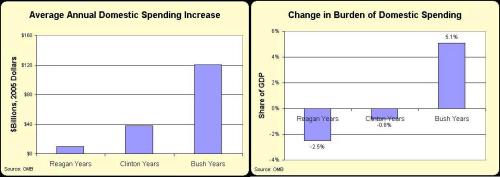
I make a similar point in this debate with Robert Reich, noting that the burden of government spending was reduced as a share of economic output during the relatively prosperous Reagan years and Clinton years.
Dan Mitchell Debating Robert Reich on Keynesian Sequester Hysteria
Being a magnanimous person, I even told Robert he should take credit for the Clinton years since he was in the cabinet as Labor Secretary. Amazingly, he didn’t take me up on my offer.
Anyhow, these two charts show the stark contrast between the fiscal policy of Reagan and Clinton compared to Bush..
And there’s lots of additional information comparing the fiscal performance of various presidents here, here, and here.
For more information on Reagan and Clinton, this video has the details.
But government spending grew much slower under Reagan and Clinton than it has during the Bush-Obama years, yet I don’t think anybody would claim the economy in recent years has been more robust than it was in the 1980s and 1990s.
He was no Reagan, to be sure, and the anti-government Congress that took power after the 1994 elections may deserve much of the credit for the good news during the Clinton years. Regardless, we had good economic performance during that period – unlike what we’ve seen during the Obama years.
Which makes this Michael Ramirez cartoon both amusing (in a tragic way) and economically accurate.
Since we’ve had relatively weak numbers for both jobs and growth this entire century, it would have been even better if the cartoon showed Bush and Obama both trying to raise the bar.
The real lesson is that big government is bad for jobs and growth, regardless of whether politicians have an “R” or “D” after their names.
I really enjoyed this article. A Constitutional President: Ronald Reagan and the Founding By Edwin Meese III , Lee Edwards, Ph.D. , James C. Miller III and Steven Hayward January 26, 2012 Abstract: Throughout his presidency, Ronald Reagan was guided by the principles of the American founding, especially the idea of ordered liberty. In the opening of his first inaugural address in 1981, […]
Ronald Reagan was the greatest pro-life president ever. He appointed Dr. C. Everett Koop to his administration and Dr. Koop was responsible for this outstanding pro-life film below: I was thinking about the March for Life that is coming up on Jan 20, 2013 in Little Rock and that is why I posted this today. […]
1/30/84 Part 1 of a speech to the National Religious Broadcasters. June 10, 2004, 10:30 a.m. Abortion and the Conscience of the Nation Ronald Reagan’s pro-life tract. EDITOR’S NOTE: While president, Ronald Reagan penned this article for The Human Life Review, unsolicited. It ran in the Review‘s Spring 1983, issue and is reprinted here with permission. The case […]
President Reagan, Nancy Reagan, Bill Clinton and Hillary Clinton attending the Dinner Honoring the Nation’s Governors. 2/22/87. Ronald Reagan is my favorite president and I have devoted several hundred looking at his ideas. Take a look at these links below: President Reagan and Nancy Reagan attending “All Star Tribute to Dutch Reagan” at NBC Studios(from […]
Ronald Reagan Talks About Balancing the Budget on “The Tonight Show” Uploaded by johnnycarson on Jul 30, 2011 Ronald Reagan talks about balancing the budget on “The Tonight Show” in 1975. _____________ Ronald Reagan was one of my favorite presidents. Mike Lee is one of my favorite lawmakers of today!!! Look at what he says about […]
I always liked both Robert Bork and Ronald Reagan. They had a lot in common. Lee Edwards noted concerning Bork and Reagan: Reagan’s most dramatic defeat came in 1987 when he nominated Judge Robert Bork to the Supreme Court.[xli] Bork’s confirmation became an ugly battle against liberal organizations like the American Civil Liberties Union, the […]
President Reagan, Nancy Reagan, Bill Clinton and Hillary Clinton attending the Dinner Honoring the Nation’s Governors. 2/22/87. Ronald Reagan is my favorite president and I have devoted several hundred looking at his ideas. Take a look at these links below: President Reagan and Nancy Reagan attending “All Star Tribute to Dutch Reagan” at NBC Studios(from […]
Obama finds himself answering for a vote he made back in the Illinois state Senate. See Barack Obama’s exclusive interview with CBN New’s David Brody, and what he says about his views on abortion and the Born Alive Infant Protection Act. June 10, 2004, 10:30 a.m. Abortion and the Conscience of the Nation Ronald Reagan’s […]
Secret Service agents react after President Reagan is shot as he exits a side doorway of the Washington Hilton on March 30, 1981. A great moment in modern conservatism. 1980 Republican National Convention speech by Ronald Reagan. But there are advantages to being elected President. The day after I was elected, I had […]





 The Daily Hatch