Category Archives: Ronald Reagan

Milton Friedman: “Nothing is so permanent as a temporary government program”

______________________________________

Milton Friedman On Charlie Rose (Part One)

The late Milton Friedman discusses economics and otherwise with Charlie Rose.

_________________________________________

Milton Friedman: Life and ideas – Part 01

Milton Friedman: Life and ideas

A brief biography of Milton Friedman

_____________________________________

Stossel – “Free to Choose” (Milton Friedman) 1/6

6-10-10. pt.1 of 6. Stossel discusses Milton Friedman’s 1980 book, “Free to Choose”, which was smuggled in and read widely in Eastern Europe during the Cold War by many countries under Soviet rule. Read and admired the world over by the likes of Margaret Thatcher and Ronald Reagan, this book served as the inspiration for many of the Soviet sattellite countries’ economies once they achieved freedom after the fall of the Soviet Union.

_________________________________________

Milton Friedman on Medical Care [1/6]

Milton Friedman and Ronald Reagan  were two of my heroes and I know that you can learn a great deal from their lives and their economic philosophies.  I suggest checking out these episodes of Milton Friedman’s film series FREE TO CHOOSE: “The Failure of Socialism” and “What is wrong with our schools?”  and “Created Equal”  and  From Cradle to Grave, and – Power of the Market.

What’s the Half-Life of a “Temporary” Tax Increase?

July 1, 2013 by Dan Mitchell

Milton Friedman famously noted that, “Nothing is so permanent as a temporary government program”and Ronald Reagan sagely observed that “a government bureau is the nearest thing to eternal life we’ll ever see on this earth.”

Two great Americans

They’re both right, but they should have included the other half of the fiscal equation. Repealing a tax, even a “temporary tax,” is just as difficult as getting rid of wasteful spending.

Simply stated, once politicians get access to a source of additional revenue, it’s feeding time at the zoo and good luck getting them to give the money back. Here’s a sobering example from Philadelphia.

Skeptics say there’s no such thing as a “temporary” tax. Like the two-year property tax increase City Council passed in 2010 that, lo and behold, is still with us. Or another dreaded levy: the wage tax. It was passed in 1939 as a short-term fix for the city’s finances, but succeeding generations have nonetheless been forced to accept its bite in their paychecks. The latest tax under consideration for immortality is the 1 percent sales-tax increase the state allowed Philadelphia to impose in 2009 as a bridge through the recession.The increase – which raised the tax on most goods and services in Philadelphia from 7 percent to 8 percent – is slated to expire next June. City and state leaders are now talking about making the increase permanent, with the extra money being put toward one or both of the city’s greatest needs: the struggling School District and the vastly underfunded public employee pension fund.

The bulk of that excerpt is a straightforward recitation of how temporary tax hikes become permanent tax hikes, but I have to object to the final sentence. The “city’s greatest needs” are replacing the failed government education monopoly with school choice and reducing the excessive pensions for over-compensated government bureaucrats – such as the city’s former “managing director” (whatever that is), Camille Cates Barnett.

I also can’t resist commenting on the craven behavior of the city’s Chamber of Commerce. I though the national Chamber of Commerce was bad when it endorsed TARP and the faux stimulus, but the local Chamber may be even worse.

Joe Grace, director of public policy at the Greater Philadelphia Chamber of Commerce, said, “We have not seen any evidence that extending the 1 percent is going to have any negative impact on the local businesses.” The chamber is also backing a $2-a-pack cigarette tax dedicated to the schools. “Our belief is the School District needs resources,” Grace said. “We’re working, along with many others, to close the school-funding gap, really by any means necessary.”

So Mr. Grace thinks more funding for a failed education bureaucracy should be achieved by “any means necessary.” Well, I think a 100 percent tax rate on Mr. Grace should be at the top of the list.

Heck, if France can tax at 100 percent, then so can the City of Philadelphia, and Mr. Grace is a deserving recipient of such a levy.

But there are some opponents of the tax, though they’re not exactly libertarian heroes.

…members of the nearly all-Democratic Philadelphia delegation have raised concerns about using the 1 percent to help fund the schools because it lets the state off the hook for its share of education funding. Danilo Burgos, president of the Dominican Grocers Association, argued that giving sales-tax revenue to the schools was “a Band-Aid.” The state, which has control of the city’s schools, should be responsible for devising “a real solution for our schools.”

In other words, they want more money to waste, but they want to take it from people in the rest of the state.

Sort of reminds me of what the great Frederic Bastiat wrote more than 150 years ago, “The state is that great fiction by which everyone tries to live at the expense of everyone else.”

But if enough people act as if that fiction is reality, then you get too many people riding in the wagon and not enough people pulling the wagon. That’s a good description of what’s happening in places such as Philadelphia and Greece.

Related posts:Milton Friedman’s “Free to Choose” film transcripts and videos here on http://www.thedailyhatch.org

I have many posts on my blog that include both the transcript and videos of Milton Friedman’s film series “Free to Choose” and here are the episodes that I have posted.

_____________

Here are the posts and you can find the links in order below this.

The Power of the Market from 1990

The Failure of Socialism from 1990

The Anatomy of a Crisis from 1980

What is wrong with our schools?  from 1980

Created Equal from 1980

From Cradle to Grave from 1980

The Power of the Market 1980

Debate on Inflation from 1980

Milton Friedman is the short one!!!

Milton Friedman’s Free to Choose (1980), episode 3 – Anatomy of a Crisis. part 1

“The Power of the Market” episode of Free to Choose in 1990 by Milton Friedman (Part 5)

Milton Friedman The Power of the Market 5-5 How can we have personal freedom without economic freedom? That is why I don’t understand why socialists who value individual freedoms want to take away our economic freedoms.  I wanted to share this info below with you from Milton Friedman who has influenced me greatly over the […]

“The Power of the Market” episode of Free to Choose in 1990 by Milton Friedman (Part 4)

Milton Friedman The Power of the Market 4-5 How can we have personal freedom without economic freedom? That is why I don’t understand why socialists who value individual freedoms want to take away our economic freedoms.  I wanted to share this info below with you from Milton Friedman who has influenced me greatly over the […]

“The Power of the Market” episode of Free to Choose in 1990 by Milton Friedman (Part 3)

Milton Friedman The Power of the Market 3-5 How can we have personal freedom without economic freedom? That is why I don’t understand why socialists who value individual freedoms want to take away our economic freedoms.  I wanted to share this info below with you from Milton Friedman who has influenced me greatly over the […]

“The Power of the Market” episode of Free to Choose in 1990 by Milton Friedman (Part 2)

Milton Friedman The Power of the Market 2-5 How can we have personal freedom without economic freedom? That is why I don’t understand why socialists who value individual freedoms want to take away our economic freedoms.  I wanted to share this info below with you from Milton Friedman who has influenced me greatly over the […]

“The Power of the Market” episode of Free to Choose in 1990 by Milton Friedman (Part 1)

Milton Friedman The Power of the Market 1-5 How can we have personal freedom without economic freedom? That is why I don’t understand why socialists who value individual freedoms want to take away our economic freedoms.  I wanted to share this info below with you from Milton Friedman who has influenced me greatly over the […]

Milton Friedman’s Free to Choose (1980), episode 3 – Anatomy of a Crisis. part 1

“Friedman Friday” EPISODE “The Failure of Socialism” of Free to Choose in 1990 by Milton Friedman (Part 5)

Milton Friedman: Free To Choose – The Failure Of Socialism With Ronald Reagan (Full) Published on Mar 19, 2012 by NoNationalityNeeded Milton Friedman’s writings affected me greatly when I first discovered them and I wanted to share with you. Abstract: Ronald Reagan introduces this program, and traces a line from Adam Smith’s “The Wealth of […]

“Friedman Friday” EPISODE “The Failure of Socialism” of Free to Choose in 1990 by Milton Friedman (Part 4)

Milton Friedman: Free To Choose – The Failure Of Socialism With Ronald Reagan (Full) Published on Mar 19, 2012 by NoNationalityNeeded Milton Friedman’s writings affected me greatly when I first discovered them and I wanted to share with you. Abstract: Ronald Reagan introduces this program, and traces a line from Adam Smith’s “The Wealth of […]

“Friedman Friday” EPISODE “The Failure of Socialism” of Free to Choose in 1990 by Milton Friedman (Part 3)

Milton Friedman: Free To Choose – The Failure Of Socialism With Ronald Reagan (Full) Published on Mar 19, 2012 by NoNationalityNeeded Milton Friedman’s writings affected me greatly when I first discovered them and I wanted to share with you. Abstract: Ronald Reagan introduces this program, and traces a line from Adam Smith’s “The Wealth of […]

“Friedman Friday” EPISODE “The Failure of Socialism” of Free to Choose in 1990 by Milton Friedman (Part 2)

Milton Friedman: Free To Choose – The Failure Of Socialism With Ronald Reagan (Full) Published on Mar 19, 2012 by NoNationalityNeeded Milton Friedman’s writings affected me greatly when I first discovered them and I wanted to share with you. Abstract: Ronald Reagan introduces this program, and traces a line from Adam Smith’s “The Wealth of […]

“Friedman Friday,” EPISODE “The Failure of Socialism” of Free to Choose in 1990 by Milton Friedman (Part 1)

Milton Friedman: Free To Choose – The Failure Of Socialism With Ronald Reagan (Full) Published on Mar 19, 2012 by NoNationalityNeeded Milton Friedman’s writings affected me greatly when I first discovered them and I wanted to share with you. We must not head down the path of socialism like Greece has done. Abstract: Ronald Reagan […]

________________

“Friedman Friday” (“Free to Choose” episode 3 – Anatomy of a Crisis. part 7of 7)

TEMIN: We don’t think the big capital arose before the government did? VON HOFFMAN: Listen, what are we doing here? I mean __ defending big government is like defending death and taxes. When was the last time you met anybody that was in favor of big government? FRIEDMAN: Today, today I met Bob Lekachman, I […]

By Everette Hatcher III | Also posted in Current Events | Edit | Comments (0)

“Friedman Friday” (“Free to Choose” episode 3 – Anatomy of a Crisis. part 6of 7)

worked pretty well for a whole generation. Now anything that works well for a whole generation isn’t entirely bad. From the fact __ from that fact, and the undeniable fact that things are working poorly now, are we to conclude that the Keynesian sort of mixed regulation was wrong __ FRIEDMAN: Yes. LEKACHMAN: __ or […]

By Everette Hatcher III | Also posted in Current Events | Edit | Comments (0)

“Friedman Friday” (“Free to Choose” episode 3 – Anatomy of a Crisis. part 5 of 7)

MCKENZIE: Ah, well, that’s not on our agenda actually. (Laughter) VOICE OFF SCREEN: Why not? MCKENZIE: I boldly repeat the question, though, the expectation having been __ having been raised in the public mind, can you reverse this process where government is expected to produce the happy result? LEKACHMAN: Oh, no way. And it would […]

By Everette Hatcher III | Also posted in Current Events | Edit | Comments (0)

“Friedman Friday” (“Free to Choose” episode 3 – Anatomy of a Crisis. part 4 of 7)

The massive growth of central government that started after the depression has continued ever since. If anything, it has even speeded up in recent years. Each year there are more buildings in Washington occupied by more bureaucrats administering more laws. The Great Depression persuaded the public that private enterprise was a fundamentally unstable system. That […]

By Everette Hatcher III | Also posted in Current Events | Edit | Comments (0)

“Friedman Friday” (“Free to Choose” episode 3 – Anatomy of a Crisis. part 3 of 7)

Worse still, America’s depression was to become worldwide because of what lies behind these doors. This is the vault of the Federal Reserve Bank of New York. Inside is the largest horde of gold in the world. Because the world was on a gold standard in 1929, these vaults, where the U.S. gold was stored, […]

By Everette Hatcher III | Also posted in Current Events | Edit | Comments (0)

“Friedman Friday” (Part 16) (“Free to Choose” episode 3 – Anatomy of a Crisis. part 2 of 7)

  George Eccles: Well, then we called all our employees together. And we told them to be at the bank at their place at 8:00 a.m. and just act as if nothing was happening, just have a smile on their face, if they could, and me too. And we have four savings windows and we […]

By Everette Hatcher III | Also posted in Current Events | Edit | Comments (0)

“Friedman Friday” (“Free to Choose” episode 3 – Anatomy of a Crisis. part 1of 7)

Milton Friedman’s Free to Choose (1980), episode 3 – Anatomy of a Crisis. part 1 FREE TO CHOOSE: Anatomy of Crisis Friedman Delancy Street in New York’s lower east side, hardly one of the city’s best known sites, yet what happened in this street nearly 50 years ago continues to effect all of us today. […]

By Everette Hatcher III | Also posted in Current Events | Edit | Comments (0)

____________________________

_____________


________________________________________________

_____________________________________________

Friedman Friday” Free to Choose by Milton Friedman: Episode “What is wrong with our schools?” (Part 6 of transcript and video)

Here is the video clip and transcript of the film series FREE TO CHOOSE episode “What is wrong with our schools?” Part 6 of 6.   Volume 6 – What’s Wrong with our Schools Transcript: FRIEDMAN: But I personally think it’s a good thing. But I don’t see that any reason whatsoever why I shouldn’t have been required […]

By Everette Hatcher III | Also posted in Vouchers | Edit | Comments (0)

Friedman Friday” Free to Choose by Milton Friedman: Episode “What is wrong with our schools?” (Part 5 of transcript and video)

Here is the video clip and transcript of the film series FREE TO CHOOSE episode “What is wrong with our schools?” Part 5 of 6.   Volume 6 – What’s Wrong with our Schools Transcript: Are your voucher schools  going to accept these tough children? COONS: You bet they are. (Several talking at once.) COONS: May I answer […]

By Everette Hatcher III | Also posted in Vouchers | Edit | Comments (0)

Free to Choose by Milton Friedman: Episode “What is wrong with our schools?” (Part 4 of transcript and video)

Here is the video clip and transcript of the film series FREE TO CHOOSE episode “What is wrong with our schools?” Part 4 of 6.   Volume 6 – What’s Wrong with our Schools Transcript: It seems to me that if one is truly interested in liberty, which I think is the ultimate value that Milton Friedman talks […]

By Everette Hatcher III | Also posted in Vouchers | Edit | Comments (0)

Friedman Friday” Free to Choose by Milton Friedman: Episode “What is wrong with our schools?” (Part 3 of transcript and video)

Friedman Friday” Free to Choose by Milton Friedman: Episode “What is wrong with our schools?” (Part 3 of transcript and video) Here is the video clip and transcript of the film series FREE TO CHOOSE episode “What is wrong with our schools?” Part 3 of 6.   Volume 6 – What’s Wrong with our Schools Transcript: If it […]

Friedman Friday” Free to Choose by Milton Friedman: Episode “What is wrong with our schools?” (Part 2 of transcript and video)

Here is the video clip and transcript of the film series FREE TO CHOOSE episode “What is wrong with our schools?” Part 2 of 6.   Volume 6 – What’s Wrong with our Schools Transcript: Groups of concerned parents and teachers decided to do something about it. They used private funds to take over empty stores and they […]

By Everette Hatcher III | Also posted in Vouchers | Edit | Comments (1)

Friedman Friday” Free to Choose by Milton Friedman: Episode “What is wrong with our schools?” (Part 1 of transcript and video)

Here is the video clip and transcript of the film series FREE TO CHOOSE episode “What is wrong with our schools?” Part 1 of 6.   Volume 6 – What’s Wrong with our Schools Transcript: Friedman: These youngsters are beginning another day at one of America’s public schools, Hyde Park High School in Boston. What happens when […]

By Everette Hatcher III | Also posted in Vouchers | Tagged  | Edit | Comments (0)

Free to Choose by Milton Friedman: Episode “Created Equal” (Part 7 of transcript and video)

Liberals like President Obama want to shoot for an equality of outcome. That system does not work. In fact, our free society allows for the closest gap between the wealthy and the poor. Unlike other countries where free enterprise and other freedoms are not present.  This is a seven part series. Created Equal [7/7]. Milton Friedman’s Free to Choose […]

Free to Choose by Milton Friedman: Episode “Created Equal” (Part 6 of transcript and video)

Liberals like President Obama want to shoot for an equality of outcome. That system does not work. In fact, our free society allows for the closest gap between the wealthy and the poor. Unlike other countries where free enterprise and other freedoms are not present.  This is a seven part series. Created Equal [6/7]. Milton Friedman’s Free to Choose […]

“Friedman Friday” Free to Choose by Milton Friedman: Episode “Created Equal” (Part 5 of transcript and video)

Liberals like President Obama want to shoot for an equality of outcome. That system does not work. In fact, our free society allows for the closest gap between the wealthy and the poor. Unlike other countries where free enterprise and other freedoms are not present.  This is a seven part series. Created Equal [5/7]. Milton Friedman’s Free to Choose […]

Free to Choose by Milton Friedman: Episode “Created Equal” (Part 4 of transcript and video)

Liberals like President Obama want to shoot for an equality of outcome. That system does not work. In fact, our free society allows for the closest gap between the wealthy and the poor. Unlike other countries where free enterprise and other freedoms are not present.  This is a seven part series. Created Equal [4/7]. Milton Friedman’s Free to Choose […]

Friedman Friday” Free to Choose by Milton Friedman: Episode “Created Equal” (Part 3 of transcript and video)

Friedman Friday” Free to Choose by Milton Friedman: Episode “Created Equal” (Part 3 of transcript and video) Liberals like President Obama want to shoot for an equality of outcome. That system does not work. In fact, our free society allows for the closest gap between the wealthy and the poor. Unlike other countries where free enterprise and other […]

Free to Choose by Milton Friedman: Episode “Created Equal” (Part 2 of transcript and video)

Free to Choose by Milton Friedman: Episode “Created Equal” (Part 2 of transcript and video) Liberals like President Obama want to shoot for an equality of outcome. That system does not work. In fact, our free society allows for the closest gap between the wealthy and the poor. Unlike other countries where free enterprise and other freedoms are […]

Free to Choose by Milton Friedman: Episode “Created Equal” (Part 1 of transcript and video)

 Milton Friedman and Ronald Reagan Liberals like President Obama (and John Brummett) want to shoot for an equality of outcome. That system does not work. In fact, our free society allows for the closest gap between the wealthy and the poor. Unlike other countries where free enterprise and other freedoms are not present.  This is a seven part series. […]

Milton Friedman The Power of the Market 2-5

Milton Friedman Friday:(“Free to Choose” episode 4 – From Cradle to Grave, Part 7 of 7)

I am currently going through his film series “Free to Choose” which is one the most powerful film series I have ever seen. TEMIN: We don’t think the big capital arose before the government did? VON HOFFMAN: Listen, what are we doing here? I mean __ defending big government is like defending death and taxes. […]

Milton Friedman Friday:(“Free to Choose” episode 4 – From Cradle to Grave, Part 6 of 7)

I am currently going through his film series “Free to Choose” which is one the most powerful film series I have ever seen worked pretty well for a whole generation. Now anything that works well for a whole generation isn’t entirely bad. From the fact __ from that fact, and the undeniable fact that things […]

Milton Friedman Friday:(“Free to Choose” episode 4 – From Cradle to Grave, Part 5 of 7)

 I am currently going through his film series “Free to Choose” which is one the most powerful film series I have ever seen. PART 5 of 7 MCKENZIE: Ah, well, that’s not on our agenda actually. (Laughter) VOICE OFF SCREEN: Why not? MCKENZIE: I boldly repeat the question, though, the expectation having been __ having […]

Milton Friedman Friday: (“Free to Choose” episode 4 – From Cradle to Grave, Part 4 of 7)

 I am currently going through his film series “Free to Choose” which is one the most powerful film series I have ever seen. PART 4 of 7 The massive growth of central government that started after the depression has continued ever since. If anything, it has even speeded up in recent years. Each year there […]

By Everette Hatcher III | Edit | Comments (0)

Milton Friedman Friday: (“Free to Choose” episode 4 – From Cradle to Grave, Part 3 of 7)

 I am currently going through his film series “Free to Choose” which is one the most powerful film series I have ever seen. PART 3 OF 7 Worse still, America’s depression was to become worldwide because of what lies behind these doors. This is the vault of the Federal Reserve Bank of New York. Inside […]

By Everette Hatcher III | Edit | Comments (0)

Milton Friedman Friday:(“Free to Choose” episode 4 – From Cradle to Grave, Part 2 of 7)

 I am currently going through his film series “Free to Choose” which is one the most powerful film series I have ever seen. For the past 7 years Maureen Ramsey has had to buy food and clothes for her family out of a government handout. For the whole of that time, her husband, Steve, hasn’t […]

Friedman Friday:(“Free to Choose” episode 4 – From Cradle to Grave, Part 1 of 7)

Friedman Friday:(“Free to Choose” episode 4 – From Cradle to Grave, Part 1 of 7) Volume 4 – From Cradle to Grave Abstract: Since the Depression years of the 1930s, there has been almost continuous expansion of governmental efforts to provide for people’s welfare. First, there was a tremendous expansion of public works. The Social Security Act […]

By Everette Hatcher III | Edit | Comments (0)

“Friedman Friday” (“Free to Choose” episode 1 – Power of the Market. part 7 of 7)

  Michael Harrington:  If you don’t have the expertise, the knowledge technology today, you’re out of the debate. And I think that we have to democratize information and government as well as the economy and society. FRIEDMAN: I am sorry to say Michael Harrington’s solution is not a solution to it. He wants minority rule, I […]

“Friedman Friday” (“Free to Choose” episode 1 – Power of the Market. part 6 of 7)

PETERSON: Well, let me ask you how you would cope with this problem, Dr. Friedman. The people decided that they wanted cool air, and there was tremendous need, and so we built a huge industry, the air conditioning industry, hundreds of thousands of jobs, tremendous earnings opportunities and nearly all of us now have air […]

“Friedman Friday” (“Free to Choose” episode 1 – Power of the Market. part 5 of 7)

Part 5 Milton Friedman: I do not believe it’s proper to put the situation in terms of industrialist versus government. On the contrary, one of the reasons why I am in favor of less government is because when you have more government industrialists take it over, and the two together form a coalition against the ordinary […]

“Friedman Friday” (“Free to Choose” episode 1 – Power of the Market. part 4 of 7)

The fundamental principal of the free society is voluntary cooperation. The economic market, buying and selling, is one example. But it’s only one example. Voluntary cooperation is far broader than that. To take an example that at first sight seems about as far away as you can get __ the language we speak; the words […]

“Friedman Friday” (“Free to Choose” episode 1 – Power of the Market. part 3 of 7)

  _________________________   Pt3  Nowadays there’s a considerable amount of traffic at this border. People cross a little more freely than they use to. Many people from Hong Kong trade in China and the market has helped bring the two countries closer together, but the barriers between them are still very real. On this side […]

“Friedman Friday” (“Free to Choose” episode 1 – Power of the Market. part 2 of 7)

  Aside from its harbor, the only other important resource of Hong Kong is people __ over 4_ million of them. Like America a century ago, Hong Kong in the past few decades has been a haven for people who sought the freedom to make the most of their own abilities. Many of them are […]

“Friedman Friday” (“Free to Choose” episode 1 – Power of the Market. part 1of 7)

“FREE TO CHOOSE” 1: The Power of the Market (Milton Friedman) Free to Choose ^ | 1980 | Milton Friedman Posted on Monday, July 17, 2006 4:20:46 PM by Choose Ye This Day FREE TO CHOOSE: The Power of the Market Friedman: Once all of this was a swamp, covered with forest. The Canarce Indians […]

By Everette Hatcher III | Posted in Current EventsMilton Friedman | Edit | Comments (0)

Milton Friedman The Power of the Market 1-5

Debate on Milton Friedman’s cure for inflation

If you would like to see the first three episodes on inflation in Milton Friedman’s film series “Free to Choose” then go to a previous post I did. Ep. 9 – How to Cure Inflation [4/7]. Milton Friedman’s Free to Choose (1980) Uploaded by investbligurucom on Jun 16, 2010 While many people have a fairly […]

By Everette Hatcher III | Also posted in Current Events | Tagged  | Edit | Comments (0)

“Friedman Friday” Milton Friedman believed in liberty (Interview by Charlie Rose of Milton Friedman part 1)

Charlie Rose interview of Milton Friedman My favorite economist: Milton Friedman : A Great Champion of Liberty  by V. Sundaram   Milton Friedman, the Nobel Prize-winning economist who advocated an unfettered free market and had the ear of three US Presidents – Nixon, Ford and Reagan – died last Thursday (16 November, 2006 ) in San Francisco […]

What were the main proposals of Milton Friedman?

Stearns Speaks on House Floor in Support of Balanced Budget Amendment Uploaded by RepCliffStearns on Nov 18, 2011 Speaking on House floor in support of Balanced Budget Resolution, 11/18/2011 ___________ Below are some of the main proposals of Milton Friedman. I highly respected his work. David J. Theroux said this about Milton Friedman’s view concerning […]

“Friedman Friday,” EPISODE “The Failure of Socialism” of Free to Choose in 1990 by Milton Friedman (Part 1)

Milton Friedman: Free To Choose – The Failure Of Socialism With Ronald Reagan (Full) Published on Mar 19, 2012 by NoNationalityNeeded Milton Friedman’s writings affected me greatly when I first discovered them and I wanted to share with you. We must not head down the path of socialism like Greece has done. Abstract: Ronald Reagan […]

Defending Milton Friedman

What a great defense of Milton Friedman!!!!   Defaming Milton Friedman by Johan Norberg This article appeared in Reason Online on September 26, 2008  PRINT PAGE  CITE THIS      Sans Serif      Serif Share with your friends: ShareThis In the future, if you tell a student or a journalist that you favor free markets and limited government, there is […]

Milton and Rose Friedman “Two Lucky People”

Milton Friedman on Hayek’s “Road to Serfdom” 1994 Interview 2 of 2 Uploaded by PenguinProseMedia on Oct 26, 2011 2nd half of 1994 interview. ________________ I have a lot of respect for the Friedmans.Two Lucky People by Milton and Rose Friedman reviewed by David Frum — October 1998. However, I liked this review below better. It […]

Video clip:Milton Friedman discusses his view of numerous political figures and policy issues in (Part 2)

Milton Friedman on Hayek’s “Road to Serfdom” 1994 Interview 1 of 2 Uploaded by PenguinProseMedia on Oct 25, 2011 Says Federal Reserve should be abolished, criticizes Keynes. One of Friedman’s best interviews, discussion spans Friedman’s career and his view of numerous political figures and public policy issues. ___________________ Here is a review of “Two Lucky People.” […]

Milton Friedman believed in liberty (Interview by Charlie Rose of Milton Friedman part 1)

Charlie Rose interview of Milton Friedman My favorite economist: Milton Friedman : A Great Champion of Liberty  by V. Sundaram   Milton Friedman, the Nobel Prize-winning economist who advocated an unfettered free market and had the ear of three US Presidents – Nixon, Ford and Reagan – died last Thursday (16 November, 2006 ) in San Francisco […]

“The Failure of Socialism” episode of Free to Choose in 1990 by Milton Friedman (Part 1)

Milton Friedman: Free To Choose – The Failure Of Socialism With Ronald Reagan (Full) Published on Mar 19, 2012 by NoNationalityNeeded Milton Friedman’s writings affected me greatly when I first discovered them and I wanted to share with you. We must not head down the path of socialism like Greece has done. Abstract: Ronald Reagan […]

Volume 1: Power of the Market Volume 2: The Tyranny of Control
Volume 3: Anatomy of a Crisis 
Volume 4: From Cradle to Grave
Volume 5: Created Equal
Volume 6: What’s Wrong With Our Schools?
Volume 7: Who Protects the Consumer?
Volume 8: Who Protects the Worker?
Volume 9: How to Cure Inflation
Volume 10: How to Stay Free

Updated 1990 Series:
Volume 1: The Power of the Market
Volume 2: The Tyranny of Control
Volume 3: Freedom & Prosperity
Volume 4: The Failure of Socialism
Volume 5: Created Equal


“Friedman Friday” Milton Friedman – Power of Choice (Biography) Part 3

Milton Friedman – Power of Choice (Biography) Part 3 Published on May 21, 2012 by BasicEconomics Tribute to Milton Friedman English Pages, 8. 9. 2008 Dear colleagues, dear friends, (1) It is a great honor for me to be asked to say a few words to this distinguished and very knowledgeable audience about one of our greatest […]

“Friedman Friday” Milton Friedman – Power of Choice (Biography) Part 2

Milton Friedman – Power of Choice (Biography) Part 2 Published on May 21, 2012 by BasicEconomics My Tribute to Milton Friedman: The Little Giant of Free Market Economics By: admin- 11/17/2006 09:49 AM RESIZE: AAA  Milton Friedman, the intellectual architect of the free-market reforms of the post-World War II era, was a dear friend. I […]

“Friedman Friday” Milton Friedman – Power of Choice – Biography (Part 1)

Milton Friedman – Power of Choice – Biography (Part 1) Published on May 20, 2012 by BasicEconomics   David R. Henderson The Pursuit of Happiness ~ Milton Friedman: A Personal Tribute May 2007 • Volume: 57 • Issue: 4 David Henderson (davidrhenderson1950@gmail.com) is a research fellow with the Hoover Institution and an economics professor at […]

Milton Friedman’s Chicago Boys started the Chilean Miracle and it is still helping ordinary people today!!!

Milton Friedman and Chile – The Power of Choice Uploaded on May 13, 2011 In this excerpt from Free To Choose Network’s “The Power of Choice (2006)”, we set the record straight on Milton Friedman’s dealings with Chile — including training the Chicago Boys and his meeting with Augusto Pinochet. Was the tremendous prosperity unleashed […]

Margaret Thatcher admired Milton Friedman

RARE Friedman Footage – On Keys to Reagan and Thatcher’s Success Margaret Thatcher and Milton Friedman were two of my heroes. Thatcher praises Friedman, her freedom fighter By George Jones, Political Editor 12:01AM GMT 17 Nov 2006 A tireless champion of the free market Let’s not get misty eyed over the Friedman legacy Milton Friedman, […]

Milton Friedman and Chile an update

Milton Friedman was a great economist and a fine speaker. ___________________ I have written before about Milton Friedman’s influence on the economy of Chile. Now I saw this fine article below fromhttp://www.heritage.org  and below that article I have included an article from the Wall Street Journal that talks about Milton Friedman’s influence on Chile. I […]

“Friedman Friday” Milton Friedman explains negative income tax to William F. Buckley in 1968

December 06, 2011 03:54 PM Milton Friedman Explains The Negative Income Tax – 1968 0 comments By Gordonskene enlarge Milton Friedman and friends.DOWNLOADS: 36 PLAYS: 35 Embed   The age-old question of Taxes. In the early 1960′s Economist Milton Friedman adopted an idea hatched in England in the 1950′s regarding a Negative Income Tax, to […]

Milton Friedman admired Margaret Thatcher

RARE Friedman Footage – On Keys to Reagan and Thatcher’s Success Margaret Thatcher and Milton Friedman were two of my heroes. Milton Friedman on How Francois Mitterrand (and Failed Lefty Economics) Helped Re-elect Margaret Thatcher Matt Welch|Apr. 10, 2013 9:37 am Yesterday I wrote a column about how Margaret Thatcher liberated Western Europe from the […]

Milton Friedman had a solution to today’s welfare mentality!!!

  I have written about the tremendous increase in the food stamp program the last 9 years before and that means that both President Obama and Bush were guilty of not trying to slow down it’s growth. Furthermore, Republicans have been some of the biggest supporters of the food stamp program. Milton Friedman had a […]

“Friedman Friday” Milton Friedman on “Firing Line” in 1968

Milton Friedman, Ronald Reagan And William F. Buckley Jr. Peter Robinson, 12.12.08, 12:01 AM EST In a time of crisis, don’t forget what they had to say. As the federal deficit surpasses $1 trillion, Congress debates a bailout for the Detroit automakers and President-elect Barack Obama draws up plans for a vast new stimulus package, […]

Open letter to President Obama (Part 348)

Does Government Have a Revenue or Spending Problem?

People say the government has a debt problem. Debt is caused by deficits, which is the difference between what the government collects in tax revenue and the amount of government spending. Every time the government runs a deficit, the government debt increases. So what’s to blame: too much spending, or too little tax revenue? Economics professor Antony Davies examines the data and concludes that the root cause of the debt is too much government spending.

Ronald Reagan on our ability to solve our problems

_________

(This letter was emailed to White House on 12-12-12.)

President Obama c/o The White House
1600 Pennsylvania Avenue NW
Washington, DC 20500

Dear Mr. President,

I know that you receive 20,000 letters a day and that you actually read 10 of them every day. I really do respect you for trying to get a pulse on what is going on out here.

Great article on what has happened in the past fiscal cliff deals. Patrick Louis Knudsen rightly points out, “… history shows that broad bipartisan compromises between the White House and Congress have typically just yielded higher taxes, while … deficit reduction have failed to materialize.”

It seems to me that we need to cut spending and avoid slowing the economy with tax increases. In the past we just raised taxes most of the time and never got around to cuttng spending.

The Fiscal Cliff and the Perils of Grand Budget Deals

By
December 10, 2012

One of the major complications in the current fiscal cliff debate is that both sides are overreaching, trying to tie a near-term resolution to a sweeping deficit reduction plan that would address the longer-term budgetary crisis looming in the years ahead. They see the cliff negotiations as a stage for a “grand bargain” on the budget between the President and Congress.

The tight time frame of the cliff’s approach makes such an aim increasingly impractical. Furthermore, history shows that broad bipartisan compromises between the White House and Congress have typically just yielded higher taxes, while the promised spending restraint (except in national defense) and deficit reduction have failed to materialize. Given the current state of divided government, these risks prevail today. More broadly, they also offer a warning to budget process reformers who seek to institutionalize regular budget negotiations between Capitol Hill and the President.

Experience of the Reagan Administration

After his inauguration in January 1981, President Ronald Reagan moved assertively to enact his budget plan, cutting taxes, boosting defense spending, and seeking to gain control of entitlements. With the economy still reeling from the prior years’ stagflation, however, deficits widened initially, leading Congress to push for a series of budget “summits,” as they were called then, to close the gap.

First came the 1982 Tax Equity and Fiscal Responsibility Act, “a $98 billion tax increase which supporters claimed would reduce the deficit from $128 billion in 1982 to $104 billion in 1983.” It did not. “Spending restraints never materialized…and the actual deficit jumped to $208 billion.”[1] (In today’s dollars, that tax hike would have totaled $204 billion and the deficit $432 billion—roughly a third of this year’s red ink.)

In 1984, the President agreed to yet another tax hike totaling $49 billion, which was supposed to reduce the deficit from $185 billion to $181 billion. Once again, however, the deficit increased—to $212 billion.[2]

The 1987 budget summit repeated the pattern. President Reagan swallowed a tax hike of $28 billion, but the result was the same: “The deficit, which was supposed to remain at $150 billion, jumped to $155 billion in 1988.”[3]

The 1990 Budget Agreement

Despite these failures, 1990 produced another major exercise in budget summitry. With deficits having swollen well beyond target amounts written in law at the time, the government by mid-year faced automatic spending cuts (called “sequestration”) that would slash defense spending by 42 percent and non-defense spending by 38 percent.[4] So President George H. W. Bush and the Democratic Congress agreed to a plan that was estimated to reduce deficits by $482 billion over five years.

Though the President had famously pledged never to raise taxes, his Administration by mid-1990 conceded to adding “revenue” as part of the deficit reduction plan. Predictably, this crack in the door widened during the arduous negotiations at Andrews Air Force Base. In the end, fully one-third of the package—$158 billion—consisted of tax hikes. The next largest savings came from cutting national defense by $91 billion over five years, which proponents rationalized by arguing that the Cold War had ended. Meanwhile, non-defense discretionary spending in the plan actually increased by $45 billion, offset by an empty promise of $144 billion in additional, unspecified discretionary cuts.[5]

The plan’s outcomes were no more satisfying. Even after the defense cuts, total outlays (excluding interest payments) increased by 13 percent from 1990 through 1993, and even with the tax hikes, the deficit worsened by 17 percent in the first two years of the plan.[6] When President Bill Clinton took office in January 1993, he promptly called for another deficit reduction plan, this one with $241 billion in tax increases over five years.[7]

The 1997 Balanced Budget Agreement

Even genuinely successful deficit reduction can lead to expanded government, allowing both parties to declare victory. Such was the case with the 1997 balanced budget agreement between a Republican Congress and President Clinton.

Although it cut taxes by $80 billion over five years—or perhaps because it did—the plan produced surpluses within a year of enactment. This was largely due to real growth in gross domestic product (GDP) that was greater than 4 percent per year from 1997 through 2000, which boosted tax revenue to 20.6 percent of GDP.

The problem was that the plan also increased spending. Though officially estimated to reduce outlays by $198 billion over five years,[8] the legislation contained a number of entitlement spending increases sought by President Clinton, including the creation of the State Children’s Health Insurance Program and expansions of food stamps, Supplemental Security Income, and welfare. Consequently, total “programmatic” spending (excluding interest) grew by nearly 3 percent to 4 percent per year faster than inflation and exploded by a total of nearly 14 percent from 1997 through 2001.[9] The effect was hidden because with the government running budget surpluses, interest payments declined, reducing the total spending increases.

Learn from History

The background outlined above should give pause to advocates of a grand budget deal between the President and Congress—especially those who are seeking to limit the size and scope of government. Such agreements tend to produce higher taxes and higher spending with little or no deficit reduction. Congress and the President should dispel any visions of a “grand bargain” and focus on the task at hand: avoiding the fiscal cliff.

This history also warns against budget process reforms that would institutionalize summitry by requiring the President to sign or veto the congressional budget resolution. Advocates argue that this change would create a forum for regular, early White House–congressional negotiations on broad budget levels, presumably making it easier to settle on specific spending and tax legislation later.

Some analysts, however, doubt whether the practice would actually produce agreements as often as its advocates think.[10] Equally important, the process could produce higher spending and higher taxes even more often. Thus, a reform aimed at budgeting more “efficiently” might only be more efficient at expanding government.

Patrick Louis Knudsen is the Grover M. Hermann Fellow in Federal Budgetary Affairs in the Thomas A. Roe Institute for Economic Policy Studies at The Heritage Foundation. Kaitlyn Evans and Paul Bremmer, members of the Young Leaders Program at Heritage, contributed to this report.

____________

___________

Thank you so much for your time. I know how valuable it is. I also appreciate the fine family that you have and your commitment as a father and a husband.

Sincerely,

Everette Hatcher III, 13900 Cottontail Lane, Alexander, AR 72002, ph 501-920-5733, lowcostsqueegees@yahoo.com

Dan Mitchell of the Cato Institute gives overview of economic policy and he praises Clinton and Reagan

__________

President Reagan, Nancy Reagan, Tom Selleck, Dudley Moore, Lucille Ball at a Tribute to Bob Hope’s 80th birthday at the Kennedy Center. 5/20/83.

__________________________

Dan Mitchell is very good at giving speeches and making it very simple to understand economic policy and how it affects a nation. Mitchell also talks about slowing the growth of government and he gives credit to Clinton and Reagan.

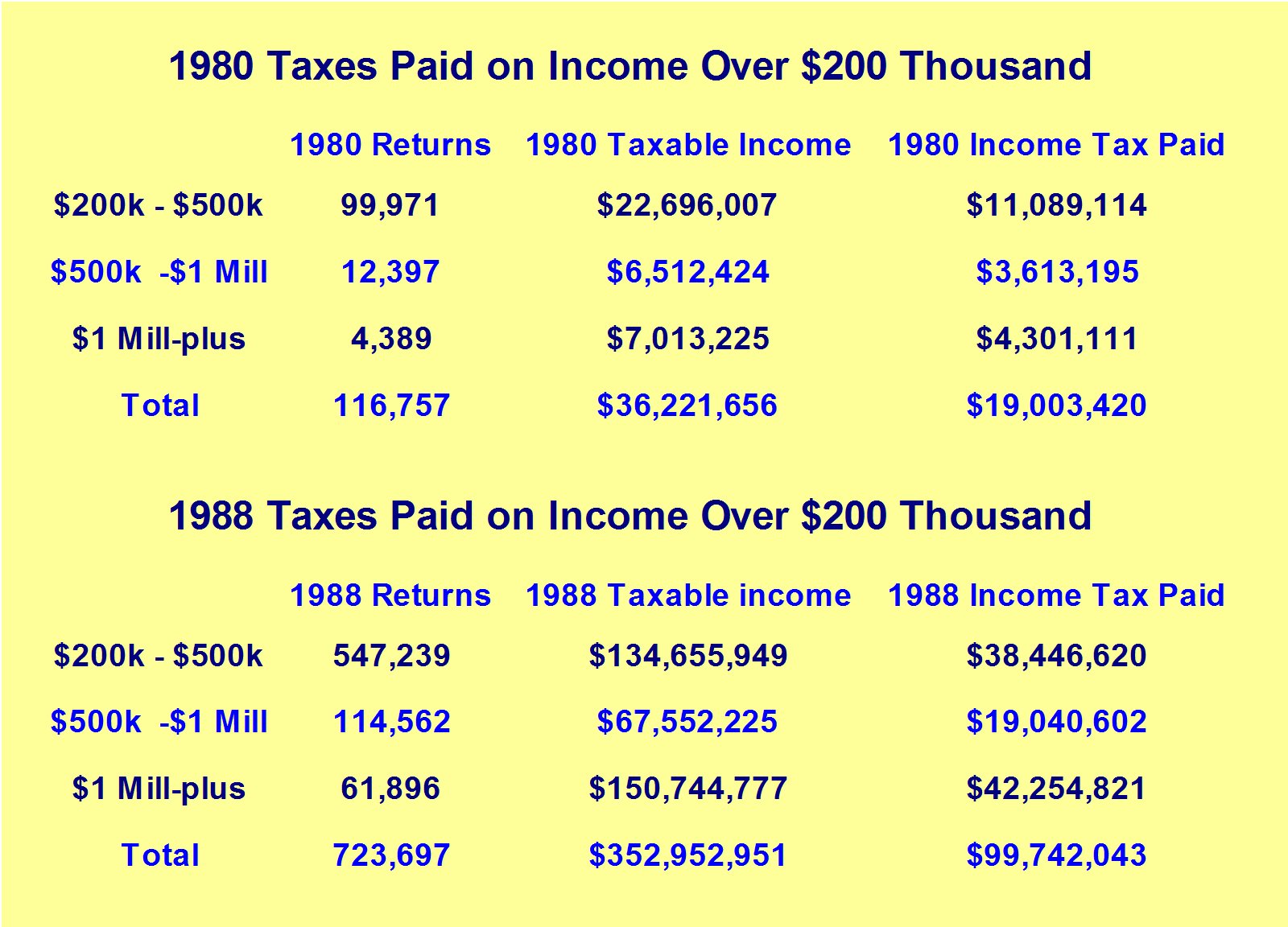
Probably my favorite subject that Dan has covered is the Laffer Curve. I got a chance to hear Arthur Laffer speak at Memphis St University in 1981 and Laffer actually predicted what would happen in the next 7 years because of the Reagan Tax Cuts and all of his predictions came true. What did we learn from the Laffer Curve in the 1980′s? Lowering top tax rate from 70% to 28% from 1980 to 1988 and those earning over $200,000 paid 99 billion in taxes instead of 19 billion!!!! The funny thing is that the world saw what we did and followed along. The drop of the industrialized countries during this same time was 26% (from 68% to 42% on average). It reminded me of Milton Friedman 1980 book “Free to Choose” and his answer to the 11% inflation that President Carter was dealing with in 1980. Reagan put Friedman’s solution into action and 5 years later inflation was under control.

Below is a fine article and video from Dan Mitchell.

(R Row, from front to rear) Milton Friedman, George Shultz, Pres. Ronald Reagan, Arthur Burns, William Simon and Walter Wriston & unknown at a meeting of White House economic advisers.
(R Row, from front to rear) Milton Friedman, George Shultz, Pres. Ronald Reagan, Arthur Burns, William Simon and Walter Wriston & unknown at a meeting of White House economic


I’ve narrated a video that cites Economic Freedom of the World data to explain the five major factors that determine economic performance.

But that video is only six minutes long, so I only skim the surface. For those of you who feel that you’re missing out, you can listen to me pontificate on public policy and growth for more than sixty minutes in this video of a class I taught at the Citadel in South Carolina (and if you’re a glutton for punishment, there’s also nearly an hour of Q&A).

Cato Institute Senior Fellow Daniel J. Mitchell

Published on Apr 2, 2012

Cato Institute Senior Fellow Daniel J. Mitchell speaks to cadets economics and conservatism. This is the 10th lecture in the seminar series titled “The Conservative Intellectual Tradition in America.”

_______________

There are two points that are worth some additional attention.

1. In my discussion of regulation, I mention that health and safety rules can actually cause needless deaths by undermining economic performance. I elaborated on this topic when I waded into the election-season debateabout whether Obama supporters were right to accuse Romney of causing a worker’s premature death.

2. In my discussion of deficits and debt, I criticize the Congressional Budget Office for assuming that government fiscal balance is the key determinant of economic growth. And since CBO assumes you maximize growth by somehow having large surpluses, the bureaucrats actually argue that higher taxes are good for growth and their analysis implies that the growth-maximizing tax rate is 100 percent.

P.S. If you prefer much shorter doses of Dan Mitchell, you can watch my one-minute videos on tax reform that were produced by the Heartland Institute.

Related posts:

Lowering top tax rate from 70% to 28% from 1980 to 1988 and those earning over $200,000 paid 99 billion in taxes instead of 19 billion!!!!

What did we learn from the Laffer Curve in the 1980′s? Lowering top tax rate from 70% to 28% from 1980 to 1988 and those earning over $200,000 paid 99 billion in taxes instead of 19 billion!!!! A Lesson on the Laffer Curve for Barack Obama November 6, 2011 by Dan Mitchell One of my frustrating missions […]

Two Lessons from Coolidge: Small government is the best way to achieve competent and effective government and Higher tax rates don’t automatically lead to more tax revenue

Will Rogers has a great quote that I love. He noted, “Lord, the money we do spend on Government and it’s not one bit better than the government we got for one-third the money twenty years ago”(Paula McSpadden Love, The Will Rogers Book, (1972) p. 20.) Dan Mitchell praises Calvin Coolidge for keeping the federal government small. […]

Open letter to President Obama (Part 296) (Laffer curve strikes again!!)

President Obama c/o The White House 1600 Pennsylvania Avenue NW Washington, DC 20500 Dear Mr. President, I know that you receive 20,000 letters a day and that you actually read 10 of them every day. I really do respect you for trying to get a pulse on what is going on out here. The way […]

Open letter to President Obama (Part 282, How the Laffer Curve worked in the 20th century over and over again!!!)

Dan Mitchell does a great job explaining the Laffer Curve President Obama c/o The White House 1600 Pennsylvania Avenue NW Washington, DC 20500 Dear Mr. President, I know that you receive 20,000 letters a day and that you actually read 10 of them every day. I really do respect you for trying to get a […]

Laffer curve hits tax hikers pretty hard (includes cartoon)

I have put up lots of cartoons from Dan Mitchell’s blog before and they have got lots of hits before. Many of them have dealt with the economy, eternal unemployment benefits, socialism,  Greece,  welfare state or on gun control. Today’s cartoon deals with the Laffer curve. Revenge of the Laffer Curve…Again and Again and Again March 27, 2013 […]

Portugal and the Laffer Curve

Class Warfare just don’t pay it seems. Why can’t we learn from other countries’ mistakes? Class Warfare Tax Policy Causes Portugal to Crash on the Laffer Curve, but Will Obama Learn from this Mistake? December 31, 2012 by Dan Mitchell Back in mid-2010, I wrote that Portugal was going to exacerbate its fiscal problems by raising […]

President Obama ignores warnings about Laffer Curve

The Laffer Curve – Explained Uploaded by Eddie Stannard on Nov 14, 2011 This video explains the relationship between tax rates, taxable income, and tax revenue. The key lesson is that the Laffer Curve is not an all-or-nothing proposition, where we have to choose between the exaggerated claim that “all tax cuts pay for themselves” […]

Harding,Kennedy and Reagan proved that the Laffer Curve works

 I enjoyed this article below because it demonstrates that the Laffer Curve has been working for almost 100 years now when it is put to the test in the USA. I actually got to hear Arthur Laffer speak in person in 1981 and he told us in advance what was going to happen the 1980′s […]

The Laffer Curve Wreaks Havoc in the United Kingdom

I got to hear Arthur Laffer speak back in 1981 and he predicted what would happen in the next few years with the Reagan tax cuts and he was right with every prediction. The Laffer Curve Wreaks Havoc in the United Kingdom July 1, 2012 by Dan Mitchell Back in 2010, I excoriated the new […]

Liberals act like the Laffer Curve does not exist.

Raising taxes will not work. Liberals act like the Laffer Curve does not exist. The Laffer Curve Shows that Tax Increases Are a Very Bad Idea – even if They Generate More Tax Revenue April 10, 2012 by Dan Mitchell The Laffer Curve is a graphical representation of the relationship between tax rates, tax revenue, and […]


Ronald Reagan Republicans will win big in 2014 like they did in 1980’s

Some people doubt that Ronald Reagan conservatism still works today like it did in the 1980’s and that those kind of conservatives can still win today but they can!!!!

Among the right-leaning policy wonks and intellectuals in Washington, there’s a lot of attention being given to the something called “reform conservatism.”

Underlying this school of thought is the notion that the Reagan-era message no longer works since Republicans have lost the popular vote in five out of the last six elections.

A few people have asked my opinion about this movement, and since Ross Douthat of the New York Times just put together a good description of this school of thought, it makes it easy for me to offer my thoughts.

But before digging into his column, I think that some of the angst on the right is misplaced. Why blame a Reagan-era message for GOP electoral problems when all the Republicans presidential nominees in recent years have favored big government? Does anybody really think that Bush 41, Dole, Bush 43, McCain, and Romney were Reaganites?!?

Could any of those candidates have given these remarks, at least with any credibility?

President Reagan on Big Government and Personal Freedom

Uploaded on Dec 23, 2010

The surge in nostalgia for President Reagan over the past two years is no surprise. When the American people are faced with tyrannical government, arrogant leadership, and failed policies, they tend to cling to good memories (along with their guns and religion). They also tend to take action, hence the Tea Party movement and the 2010 revolution. Watch this clip from 1982 and remember.

_____________________

Or made these comments in a sincere fashion?

Ronald Reagan on Individual Freedom

Uploaded on Mar 6, 2010

The Founding Fathers fought tyranny, we must come together to fight again. Ronald Reagan believed that it was individual freedom that made America great

___________________________

It’s much more plausible to say that Republicans have lagged because they didn’t have candidates with a Reagan-style message.

But let’s assume, for the sake of argument, that Republicans would have fared poorly even if Reaganites had been nominated. Does “reform conservatism” offer a path to electoral salvation.

Here’s what Douthat identifies as the “two major premises” of reform conservatism.

1. First, he writes that the “core economic challenge facing the American experiment is not income inequality per se, but rather stratification and stagnation — weak mobility from the bottom of the income ladder and wage stagnation for the middle class.” Conservatives, he says, should strive to make “family life more affordable, upward mobility more likely, and employment easier to find.”

2. Second, he warns that the “existing welfare-state institutions we’ve inherited from the New Deal and the Great Society, however, often make these tasks harder rather than easier: Their exploding costs crowd out every other form of spending, require middle class tax increases and threaten to drag on economic growth.”

I’m not an expert on income mobility, so I’m not sure I would identify stratification and stagnation as the nation’s core economic challenge, but he may be right. Regardless, it’s definitely a good idea to have more mobility.

And I definitely agree that the welfare state hinders upward mobility by creating dependency. And he’s right that this is a drag on growth. That being said, I disagree with his assertion that rising entitlement expenditures crowd out other spending and lead to middle class tax hikes. Those things may happen at some point, particularly once we get into the peak years for retiring baby boomers, but they haven’t happened yet.

The more important question, at least to me, is what sort of policies do reform conservatives embrace? Here’s Douthat’s list, bolded, followed by my thoughts.

a. A tax reform that caps deductions and lowers rates, but also reduces the burden on working parents and the lower middle class, whether through an expanded child tax credit or some other means of reducing payroll tax liability. Tax Distribution CBOI obviously like the idea of lowering rates and reducing deductions since that moves the system closer to a flat tax. That being said, it’s difficult to reduce the tax burden on the lower middle class since they pay very little income tax under the current system (see accompanying table from CBO). But I like the idea of addressing the payroll tax, though I disagree with their approach (see section “c” below).

b. A repeal or revision of Obamacare that aims to ease us toward a system of near-universal catastrophic health insurance, and includes some kind of flat tax credit or voucher explicitly designed for that purpose. I fully agree with repeal of Obamacare, and I think an unfettered marketplace would evolve into a system of near-universal catastrophic insurance, but I don’t want the federal government subsidizing or coercing that approach (though current healthcare policy has far more subsidies and coercion, so Douthat’s plan would be a big improvement over the status quo).

c. A Medicare reform along the lines of the Wyden-Ryan premium support proposal, and a Social Security reform focused on means testing and extending work lives rather than a renewed push for private accounts. I’m glad they embrace Medicare reform, but I’m puzzled by the hostility to personal retirement accounts.  If you increase the retirement age and/or means test, youforce people to pay more and get less, yet Social Security already is a bad deal for younger workers. So why make it worse? How can that be good for those with low mobility? Personal accounts would be akin to a tax cut for such workers since the payroll tax would be transformed into something much closer to deferred compensation.

d. An immigration reform that tilts much more toward Canadian-style recruitment of high-skilled workers, and that doesn’t necessarily seek to accelerate the pace of low-skilled immigration. As I noted in this interview, I very much favor bringing more high-skilled people into the country.

e. A “market monetarist” monetary policy as an alternative both to further fiscal stimulus and to the tight money/fiscal austerity combination advanced by many Republicans today. I try to avoid monetary policy. That being said, I’m a bit skeptical of “market monetarism.” No nation has ever tried this system, so it’s uncharted territory, and I’m reluctant to embrace an approach which is premised on the notion that bubbles can’t exist (what about the tech bubble of the late 1990s or the housing bubble last decade?!?). I’m also suspicious of a system which requires an activist central bank. Watch this George Selgin video if you want to know why.

f. An attack not only on explicit subsidies for powerful incumbents (farm subsidies, etc.) but also other protections and implicit guarantees, in arenas ranging from copyright law to the problem of “Too Big To Fail.” Amen. I fully agree.

Since I’m a tax policy wonk, let me address in greater detail some of the tax reform proposals put forward by reform conservatives.

Jim Pethokoukis of the American Enterprise Institute is identified in the column as a reform conservative, and he recently expressed skepticism about the flat tax in a column for National Review.

It’s an elegant, compelling model that might work  splendidly if you were creating a tax code ex nihilo. …America, however, is in a much different place. Millions of individuals and businesses have made long-term plans based on expectations that the tax code will remain more or less the same. Half the nation, thanks to all those deductions and credits, pays no income tax. …it’s unlikely the U.S. can keep spending down at historical levels of 20 percent to 21 percent of GDP while also maintaining a floor for defense spending at 4 percent of output. The best a group of AEI scholars could manage was limiting spending to 23 percent of GDP by 2035.

The clear implication of his column is that we need a tax system that raises more revenue. I obviously disagree. We should never “feed the beast” by giving politicians more money to spend.

Pethokoukis also says the flat tax is politically unrealistic. Since I’m not expecting a flat tax in my lifetime, I obviously can’t argue with that statement. But he then proposes another plan that would be far less popular – and far more dangerous.

One solution is to take the essentially flat consumption tax devised by economists Robert Hall and Alvin Rabushka and give it a progressive rate structure. Or we could combine a consumption tax with a flat income tax on wealthier Americans, as suggested by Yale’s Michael Graetz.

So we should keep the income tax as a vehicle for class warfare and augment it with a VAT?!? Yeah, good luck trying to sell that idea. And Heaven help us if it ever succeeded since politicians would have another major source of tax revenue.

Another plan, which Douthat explicitly cites in his paper, was put together by Robert Stein, a former Bush Treasury official. He thinks traditional supply-side policies today are either irrelevant or unpopular.

Lowering tax rates today could still enhance the incentives to invest, particularly in the corporate sector. But the distortions caused by marginal tax rates are not nearly as great as they were in 1980. And attempts to solve other problems caused by the tax code itself — like the biases in favor of consumption over saving, or home building over business investment — could never in themselves garner the public support necessary for a major overhaul.

As I noted, I’m not holding my breath for a flat tax, so I can’t disagree with Stein’s prognostication.

He also has a very novel way of defining the problem we should be trying to fix.

…it is time to rethink how the tax code treats ­parents. …raising children is hardly just another pastime: It is one of the most important services any American can perform for our country. …even as Social Security and Medicare depend on large numbers of future workers, they have created an enormous fiscal bias against procreation, undermining an important motive for raising children: to safeguard against poverty in old age. ……our system of taxes and entitlements not only fails to reward parents — it actively discourages Americans from having children. …Recent studies (especially work by Michele Boldrin, ­Mariacristina De Nardi, and Larry Jones and by Isaac Ehrlich and Jinyoung Kim) show that Social Security and Medicare actually reduce the fertility rate by about 0.5 children per woman. In European countries, where retirement systems are larger, the effect is closer to one child per woman.

As a libertarian, the beginning section of that passage grated on me. My children are individuals, not a “service” to prop up entitlement programs. I agree with Stein that these programs are a problem, but the solution is to reform entitlements, not to rejigger the tax code in hopes of pumping out more taxpayers.

Stein disagrees.

Unfortunately, these negative effects on fertility cannot be cured simply by converting old-age entitlement programs into mandatory savings programs, as the Bush administration proposed for Social Security in 2005. After all, requiring workers to save for retirement through private financial instruments would also crowd out the traditional motive to raise kids.

Instead, he wants to change the tax system based on the notion that today’s kids are tomorrow’s taxpayers.

…the present value of future Social Security and Medicare contributions for a typical worker born today is about $150,000. Rewarding parents for creating these future contributions suggests annual tax relief of about $8,500 per child. To correct for this inadequate treatment of households with ­children, the existing dependent exemption for children, the child credit, the ­child-care credit, and the adoption credit should be replaced with one new $4,000 credit per child that can be used to offset both income and payroll taxes. (This amount is set much closer to the $3,250 figure than the $8,500 one mostly to reduce the plan’s negative impact on federal revenue.)

I have no philosophical objection to some form of exemption – or even credit – based on family size. Almost all flat tax systems, for instance, have some sort of family allowance.

But it’s also important to realize that bigger family allowances generally don’t have pro-growth effects. It’s the marginal tax rate that impacts incentives.

And Stein, unfortunately, would “pay” for his credits by raising marginal tax rates on a significant share of taxpayers.

Some of these costs would be offset by eliminating itemized deductions (other than mortgage interest and charitable contributions). The rest would have to be offset by ­allowing the top rate of 35% to touch more taxpayers than it currently affects. …who pays more? Primarily high-income workers, but also upper-middle-class taxpayers who do not have children in the home (either because they have decided not to raise children at all, or because their children have already turned 18). To be blunt, the plan is a tax hike on the rich and makes the tax code even more progressive than it is today.

To be fair, Stein also proposes some good policies such as AMT repeal and reductions in double taxation, so he’s definitely not in the Obama class-warfare camp. But it’s also fair to say that his plan won’t do much for growth. Some tax rates are lowered but others are increased.

Yet if you really want families to be in stronger shape, more growth is the only long-run solution.

Moreover, it’s not clear that Stein’s agenda would be terribly popular. Though I confess that’s just a guess since no politician has latched onto the idea in the years since the proposal was unveiled.

Returning to the broader issue of “reform conservatism,” it’s difficult to assign an overall grade to the movement since I’m not sure whether we’re supposed to interpret it as a political strategy or an economic plan.

Regardless, I guess I’m generally sympathetic. I assume the RCers want government to be smaller than it is today and I don’t think you have to be a 100 percent libertarian to be my ally in the fight to restrain excessive government. And I also think it’s a good idea for people to be thinking of how to best articulate a message of smaller government. Heck, I do that every time I go on TV or give a speech.

So I reserve the right to object to any of the specific proposals that reform conservatives put forward (such as the tax plans discussed above), but I like the project.


Related:

Are the Republicans in Arkansas true Tea Party Ronald Reagan Republicans?

Ronald Reagan said, “We will never compromise our principles and standards.” Are the Republicans in Arkansas true Tea Party Ronald Reagan Republicans? According to Americans for Prosperity in the last 5 years Arkansas’ current Medicaid program has run a deficit of a billion dollars. Why expand it willingly with Obama? The “Do Nothing” expansion plan increases […]

Barack Obama would lose badly to Ronald Reagan!!!

Barack Obama would lose badly to Ronald Reagan!!! The Spirit of Reagan Is Still With Us: The Gipper Crushes Obama in Hypothetical Matchup April 13, 2013 by Dan Mitchell Barack Obama has stated that he wants to be like Reagan, at least in the sense of wanting to be a transformational figure. But almost certainly he has […]

“Friedman Friday” Transcript and video of Milton Friedman on Bill Clinton and Ronald Reagan (Part 2)

Below is a discussion from Milton Friedman on Bill Clinton and Ronald Reagan. February 10, 1999 | Recorded on February 10, 1999 audio, video, and blogs » uncommon knowledge PRESIDENTIAL REPORT CARD: Milton Friedman on the State of the Union with guest Milton Friedman Milton Friedman, Senior Research Fellow, Hoover Institution and Nobel Laureate in […]

“Friedman Friday” Transcript and video of Milton Friedman on Bill Clinton and Ronald Reagan (Part 1)

Below is a discussion from Milton Friedman on Bill Clinton and Ronald Reagan. February 10, 1999 | Recorded on February 10, 1999 audio, video, and blogs » uncommon knowledge PRESIDENTIAL REPORT CARD: Milton Friedman on the State of the Union with guest Milton Friedman Milton Friedman, Senior Research Fellow, Hoover Institution and Nobel Laureate in […]

Ronald Reagan and the Founding Fathers

I really enjoyed this article. A Constitutional President: Ronald Reagan and the Founding By Edwin Meese III , Lee Edwards, Ph.D. , James C. Miller III and Steven Hayward January 26, 2012 Abstract: Throughout his presidency, Ronald Reagan was guided by the principles of the American founding, especially the idea of ordered liberty. In the opening of his first inaugural address in 1981, […]

March for Life March in Little Rock on Jan 20, 2013!!!Ronald Reagan’s videos and pictures displayed here on the www.thedailyhatch.org

Ronald Reagan was the greatest pro-life president ever. He appointed Dr. C. Everett Koop to his administration and Dr. Koop was responsible for this outstanding pro-life film below: I was thinking about the March for Life that is coming up on Jan 20, 2013 in Little Rock and that is why I posted this today. […]

Ronald Reagan’s pro-life tract

1/30/84 Part 1 of a speech to the National Religious Broadcasters. June 10, 2004, 10:30 a.m. Abortion and the Conscience of the Nation Ronald Reagan’s pro-life tract. EDITOR’S NOTE: While president, Ronald Reagan penned this article for The Human Life Review, unsolicited. It ran in the Review‘s Spring 1983, issue and is reprinted here with permission. The case […]

Ronald Reagan’s videos and pictures displayed here on the www.thedailyhatch.org

President Reagan, Nancy Reagan, Bill Clinton and Hillary Clinton attending the Dinner Honoring the Nation’s Governors. 2/22/87. Ronald Reagan is my favorite president and I have devoted several hundred looking at his ideas. Take a look at these links below: President Reagan and Nancy Reagan attending “All Star Tribute to Dutch Reagan” at NBC Studios(from […]

Ronald Reagan and Johnny Carson discussing Balanced Budget Amendment on “Tonight Show”

Ronald Reagan Talks About Balancing the Budget on “The Tonight Show” Uploaded by johnnycarson on Jul 30, 2011 Ronald Reagan talks about balancing the budget on “The Tonight Show” in 1975. _____________ Ronald Reagan was one of my favorite presidents. Mike Lee is one of my favorite lawmakers of today!!! Look at what he says about […]

Ronald Reagan and Milton Friedman supported Balanced Budget Amendment

Remarks at a Rally Supporting the Proposed Constitutional Amendment for a Balanced Federal Budget For more information on the ongoing works of President Reagan’s Foundation, please visit http://www.reaganfoundation.org _______________ Ronald Reagan was a firm believer in the Balanced Budget Amendment and Milton Friedman was a key advisor to Reagan. Friedman’s 1980 film series taught the […]

Lowering top tax rate from 70% to 28% from 1980 to 1988 and those earning over $200,000 paid 99 billion in taxes instead of 19 billion!!!!

What did we learn from the Laffer Curve in the 1980’s? Lowering top tax rate from 70% to 28% from 1980 to 1988 and those earning over $200,000 paid 99 billion in taxes instead of 19 billion!!!!

One of my frustrating missions in life is to educate policy makers on the Laffer Curve.

This means teaching folks on the left that tax policy affects incentives to earn and report taxable income. As such, I try to explain, this means it is wrong to assume a simplistic linear relationship between tax rates and tax revenue. If you double tax rates, for instance, you won’t double tax revenue.

But it also means teaching folks on the right that it is wildly wrong to claim that “all tax cuts pay for themselves” or that “tax increases always mean less revenue.” Those results occur in rare circumstances, but the real lesson of the Laffer Curve is that some types of tax policy changes will result in changes to taxable income, and those shifts in taxable income will partially offset the impact of changes in tax rates.

However, even though both sides may need some education, it seems that the folks on the left are harder to teach – probably because the Laffer Curve is more of a threat to their core beliefs.

If you explain to a conservative politician that a goofy tax cut (such as a new loophole to help housing) won’t boost the economy and that the static revenue estimate from the bureaucrats at the Joint Committee on Taxation is probably right, they usually understand.

But liberal politicians get very agitated if you tell them that higher marginal tax rates on investors, entrepreneurs, and small business owners probably won’t generate much tax revenue because of incentives (and ability) to reduce taxable income.

To be fair, though, some folks on the left are open to real-world evidence. And this IRS data from the 1980s is particularly effective at helping them understand the high cost of class-warfare taxation.

There’s lots of data here, but pay close attention to the columns on the right and see how much income tax was collected from the rich in 1980, when the top tax rate was 70 percent, and how much was collected from the rich in 1988, when the top tax rate was 28 percent.

The key takeaway is that the IRS collected fives times as much income tax from the rich when the tax rate was far lower. This isn’t just an example of the Laffer Curve. It’s the Laffer Curve on steroids and it’s one of those rare examples of a tax cut paying for itself.

Folks on the right, however, should be careful about over-interpreting this data. There were lots of factors that presumably helped generate these results, including inflation, population growth, and some of Reagan’s other policies. So we don’t know whether the lower tax rates on the rich caused revenues to double, triple, or quadruple. Ask five economists and you’ll get nine answers.

But we do know that the rich paid much more when the tax rate was much lower.

This is an important lesson because Obama wants to run this experiment in reverse. He hasn’t proposed to push the top tax rate up to 70 percent, thank goodness, but the combined effect of his class-warfare policies would mean a substantial increase in marginal tax rates.

We don’t know the revenue-maximizing point of the Laffer Curve, but Obama seems determined to push tax rates so high that the government collects less revenue. Not that we should be surprised. During the 2008 campaign, he actually said he would like higher tax rates even if the government collected less revenue.

That’s class warfare on steroids, and it definitely belong on the list of the worst things Obama has ever said.

But I don’t care about the revenue-maximizing point of the Laffer Curve. Policy makers should set tax rates so we’re at the growth-maximizing level instead.

To broaden the understanding of the Laffer Curve, share these three videos with your friends and colleagues.

This first video explains the theory of the Laffer Curve.

The Laffer Curve, Part I: Understanding the Theory

Uploaded on Jan 28, 2008

The Laffer Curve charts a relationship between tax rates and tax revenue. While the theory behind the Laffer Curve is widely accepted, the concept has become very controversial because politicians on both sides of the debate exaggerate. This video shows the middle ground between those who claim “all tax cuts pay for themselves” and those who claim tax policy has no impact on economic performance. This video, focusing on the theory of the Laffer Curve, is Part I of a three-part series. Part II reviews evidence of Laffer-Curve responses. Part III discusses how the revenue-estimating process in Washington can be improved. For more information please visit the Center for Freedom and Prosperity’s web site: http://www.freedomandprosperity.org

  • Category

    News & Politics

    _____________________________________

    This second video reviews some of the real-world evidence.

    The Laffer Curve, Part II: Reviewing the Evidence

    Uploaded on Feb 24, 2008

    This video reviews real-world evidence showing that changes in marginal tax rates can have a significant impact on taxable income, thus leading to substantial amounts of revenue feedback. In a few cases, tax-rate reductions even “pay for themselves,” though the key lesson is the more modest point that pro-growth changes in tax policy will have a positive impact on economic performance and that good tax cuts therefore do not “cost” the government much in terms of foregone tax revenue.

    This video is second installment of a three-part series. Part I reviews theoretical relationship between tax rates, taxable income, and tax revenue. Part III discusses how the revenue-estimating process in Washington can be improved. For more information please visit the Center for Freedom and Prosperity’s web site: http://www.freedomandprosperity.org.

    ___________________

    And this video exposes the biased an inaccurate “static scoring” of the Joint Committee on Taxation.

    The Laffer Curve, Part III: Dynamic Scoring

    Uploaded on May 28, 2008

    A video by CF&P Foundation that builds on the discussion of theory in Part I and evidence in Part II, this concluding video in the series on the Laffer Curve explains how the Joint Committee on Taxation’s revenue-estimating process is based on the absurd theory that changes in tax policy – even dramatic reforms such as a flat tax – do not effect economic growth. In other words, the current system assumes the Laffer Curve does not exist. Because of congressional budget rules, this leads to a bias for tax increases and against tax cuts. The video explains that “static scoring” should be replaced with “dynamic scoring” so that lawmakers will have more accurate information when making decisions about tax policy. For more information please visit the Center for Freedom and Prosperity’s web site: http://www.freedomandprosperity.org.

    ________________

    And once we educate everybody about the Laffer Curve, we can then concentrate on teaching them about the equivalent relationship on the spending side of the fiscal ledger, the Rahn Curve.

Related posts:

Open letter to President Obama (Part 296) (Laffer curve strikes again!!)

President Obama c/o The White House 1600 Pennsylvania Avenue NW Washington, DC 20500 Dear Mr. President, I know that you receive 20,000 letters a day and that you actually read 10 of them every day. I really do respect you for trying to get a pulse on what is going on out here. The way […]

Open letter to President Obama (Part 282, How the Laffer Curve worked in the 20th century over and over again!!!)

Dan Mitchell does a great job explaining the Laffer Curve President Obama c/o The White House 1600 Pennsylvania Avenue NW Washington, DC 20500 Dear Mr. President, I know that you receive 20,000 letters a day and that you actually read 10 of them every day. I really do respect you for trying to get a […]

Laffer curve hits tax hikers pretty hard (includes cartoon)

I have put up lots of cartoons from Dan Mitchell’s blog before and they have got lots of hits before. Many of them have dealt with the economy, eternal unemployment benefits, socialism,  Greece,  welfare state or on gun control. Today’s cartoon deals with the Laffer curve. Revenge of the Laffer Curve…Again and Again and Again March 27, 2013 […]

Portugal and the Laffer Curve

Class Warfare just don’t pay it seems. Why can’t we learn from other countries’ mistakes? Class Warfare Tax Policy Causes Portugal to Crash on the Laffer Curve, but Will Obama Learn from this Mistake? December 31, 2012 by Dan Mitchell Back in mid-2010, I wrote that Portugal was going to exacerbate its fiscal problems by raising […]

President Obama ignores warnings about Laffer Curve

The Laffer Curve – Explained Uploaded by Eddie Stannard on Nov 14, 2011 This video explains the relationship between tax rates, taxable income, and tax revenue. The key lesson is that the Laffer Curve is not an all-or-nothing proposition, where we have to choose between the exaggerated claim that “all tax cuts pay for themselves” […]

Harding,Kennedy and Reagan proved that the Laffer Curve works

 I enjoyed this article below because it demonstrates that the Laffer Curve has been working for almost 100 years now when it is put to the test in the USA. I actually got to hear Arthur Laffer speak in person in 1981 and he told us in advance what was going to happen the 1980′s […]

The Laffer Curve Wreaks Havoc in the United Kingdom

I got to hear Arthur Laffer speak back in 1981 and he predicted what would happen in the next few years with the Reagan tax cuts and he was right with every prediction. The Laffer Curve Wreaks Havoc in the United Kingdom July 1, 2012 by Dan Mitchell Back in 2010, I excoriated the new […]

Liberals act like the Laffer Curve does not exist.

Raising taxes will not work. Liberals act like the Laffer Curve does not exist. The Laffer Curve Shows that Tax Increases Are a Very Bad Idea – even if They Generate More Tax Revenue April 10, 2012 by Dan Mitchell The Laffer Curve is a graphical representation of the relationship between tax rates, tax revenue, and […]

Open letter to President Obama (Part 328)

(This letter was emailed to White House on 11-21-11.) President Obama c/o The White House 1600 Pennsylvania Avenue NW Washington, DC 20500 Dear Mr. President, I know that you receive 20,000 letters a day and that you actually read 10 of them every day. I really do respect you for trying to get a pulse […]

Two Lessons from Coolidge: Small government is the best way to achieve competent and effective government and Higher tax rates don’t automatically lead to more tax revenue

Will Rogers has a great quote that I love. He noted, “Lord, the money we do spend on Government and it’s not one bit better than the government we got for one-third the money twenty years ago”(Paula McSpadden Love, The Will Rogers Book, (1972) p. 20.) Dan Mitchell praises Calvin Coolidge for keeping the federal government small. […]

States should vote down federal spending on farm bill and return more control to states!!!!

States should vote down federal spending on farm bill and return more control to states!!!!

Some say here in Arkansas that we have to do whatever it takes to support Riceland Foods, but in other states they try to protect federal government handouts to their biggest companies. We need politicians to stop looking out for just their states selfishness wants and vote for what is good for the country. It is in the best interest of all 50 states that we cut back on excessive federal spending and return more dollars to the local states for them to spend. Ronald Reagan rightly pointed out that the founding fathers favored more local control and a more limited federal government for good reason.

The Rich and Famous at the Farm Bill Trough

May 29, 2013 at 1:00 pm

Joe Sohm Visions of America/Newscom

Joe Sohm Visions of America/Newscom

Congress is considering the renewal of massive agriculture subsidies that proponents characterize as a crucial “safety net” for struggling family farms. In fact, most of the taxpayer support is actually pocketed by the well-to-do, including former President Jimmy Carter, the current Secretary of the U.S. Department of Agriculture (USDA), and the families of members currently serving on the House and Senate Agriculture Committees.

Subsidies flowing to the likes of Carter, USDA Secretary Tom Vilsack, and other relatively wealthy farm owners demonstrate just how incoherent the subsidy regime has become. New legislation in both the House and the Senate would eliminate some long-standing “direct” payments, but both bills would also establish new, potentially more costly revenue and price “protections.”

Despite record-high farm income and record-low debt, farm-state politicians and agriculture lobbyists insist that taxpayers continue to forfeit their earnings to highly successful agricultural enterprises such as Carter’s Farms, Inc., of Plains, Georgia. According to government data compiled by the Environmental Working Group (EWG), the farm owned by former President Carter and his family collected $272,288 in subsidy payments from 1995 through 2012.

During that same period, Vilsack received $82,874 in USDA benefits for his 592-acre farm in Davis County, Iowa. And USDA Under Secretary Michael T. Scuse owns 20.8 percent of a farm in New Castle County, Delaware, upon which taxpayers have lavished $1,051,107 from 1995 through 2012.

There are no farms in Manhattan, but residents there have collected subsidies totaling nearly $9 million in the past seven years. Recipients also include Mark F. Rockefeller ($356,018) and David Rockefeller ($591,057). Yes, the Rockefeller family (Standard Oil, Chase Manhattan Bank, etc.).

Over on the West Coast, in Beverly Hills 90210, the estate of comedian Jack Benny has collected $18,120 for a farm in Madera County, California, while $142,933 was paid to Mary Ann Mobley (Miss America of 1959) for a farm in Madison County, Mississippi.

These examples are not exceptions but the norm. The USDA’s Economic Research Service reports that two-thirds of the farms with income exceeding $1 million annually received government payments averaging $54,745 in 2011. Meanwhile, just 27 percent of farms with income of less than $100,000 received payments—averaging just $4,420 in 2011.

The top recipient of subsidies in the EWG data base is Riceland Foods, Inc., self-described as “the world’s largest miller and marketer of rice.” It collected $554,343,039 between 1995 and 2012. According to news reports, Riceland reported sales of $1.16 billion during 2011–2012, the fifth consecutive year of billion-plus revenues for the company.

The subsidies collected by large enterprises make it more difficult for small farms to stay in business. The flow of free dollars to big farms increases demand for farmland, which, in turn, raises the price of property. Smaller players and newcomers are priced out or left to compete in niche markets.

Members of Congress and their families routinely collect subsidies as well. For example, Lynda L. Lucas, the wife of House Agriculture Committee chairman Frank Lucas (R–OK), collected $40,613 in payments for their farm in Roger Mills County, Oklahoma. (Lucas has served on the Agriculture Committee since he was first elected in 1994. He became chairman in 2011. Lynda Lucas has received four payments between 1999 and 2003, a fifth in 2007, a sixth in 2011, and a seventh in 2012.)

Likewise, the Iowa family farm of Senator Charles Grassley (R–IA) has collected $955,192 in taxpayer subsidies from 1995 through 2012. (Grassley served on the Agriculture Committee since 1992. The Grassley farm has received payments each year from 1995 to 2012, according to the EWG.)

The payments have proved irresistible even to environmental groups that openly criticize the impact of subsidies on land use. For example, the Nature Conservancy accumulated a whopping $4,795,786 from 1995 through 2012 despite its own findings that such payments promote the conversion of natural habitat to cropland—threatening wildlife in the process. The National Audubon Society collected $932,801 from 1995 through 2012, according to the EWG.

Serious reform is obviously needed, and the time for an overhaul is ripe. The USDA forecasts that net farm income will reach $128.2 billion this year, the highest level in four decades. At the same time, farmers’ debt levels have dropped to historic lows. This means agriculture is well insulated against the risks associated with commodity production, including adverse weather and economic fluctuations.

There are a host of nongovernmental methods with which farmers can manage risk, including futures contracts and hedging, crop diversification, credit reserves, and private insurance. Given the enormous burdens already shouldered by taxpayers, there is no justification for robbing millions of middle-class Peters to subsidize Jimmy, Tom, David, and all the other hugely successful owners of farmland.

Related posts:

Congress needs to remove subsidies from the farm bill, not expand them

Congress needs to remove subsidies from the farm bill, not expand them Farm Bill Wastes More Taxpayer Money on Green Subsidies Nicolas Loris May 13, 2013 at 11:27 am Design Pics / Dave Reede/Dave Reede/Newscom Slapping the word rural in front of a bunch of green subsidies does not mean they’re not subsidies. But that’s […]

If increase in food stamps was just because of recession then why spending go from $19.8 billion in 2000 to $37.9 billion in 2007?

If the increase in food stamps was just because of the recession then why did the spending go from $19.8 billion in 2000 to $37.9 billion in 2007? The Facts about Food Stamps Everyone Should Hear Rachel Sheffield and T. Elliot Gaiser May 27, 2013 at 12:00 pm (7) Newscom A recent US News & […]

Food stamp spending has doubled under the Obama Administration

The sad fact is that Food stamp spending has doubled under the Obama Administration. A Bumper Crop of Food Stamps Amy Payne May 21, 2013 at 7:01 am Tweet this Where do food stamps come from? They come from taxpayers—certainly not from family farms. Yet the “farm” bill, a recurring subsidy-fest in Congress, is actually […]

Agriculture Dept is bloated

Agriculture: Downsizing The Federal Government Uploaded on Dec 19, 2008 Agriculture is easily the most distorted sector, with high tariffs and, in developed countries at least, large amounts of government subsidies through price supports and direct payments. On the other hand, developing countries, who have a comparative advantage in these products, cannot afford to subsidize […]

Which states are the leaders in food stamp consumption?

I am glad that my state of Arkansas is not the leader in food stamps!!! Mirror, Mirror, on the Wall, Which State Has the Highest Food Stamp Usage of All? March 19, 2013 by Dan Mitchell The food stamp program seems to be a breeding ground of waste, fraud, and abuse. Some of the horror stories […]

Open letter to President Obama (Part 255)

Government Must Cut Spending Uploaded by HeritageFoundation on Dec 2, 2010 The government can cut roughly $343 billion from the federal budget and they can do so immediately. __________   President Obama c/o The White House 1600 Pennsylvania Avenue NW Washington, DC 20500 Dear Mr. President, I know that you receive 20,000 letters a day […]

Mission accomplished!!! Rick Crawford joins Tea Party Republicans and votes against kick the can down the road “fiscal cliff deal”

  _________________ President Ronald Reagan wisely said: “The federal government has taken too much tax money from the people, too much authority from the states, and too much liberty with the Constitution.” You would think that the Republicans who talk so much of cutting spending would try to get a plan that cuts spending 3 […]

Representative Crawford reads and responds to my letter

  I recently wrote an open letter to Congressman Rick Crawford and I put it on his facebook page. I personally do not have a facebook page so I used my son Wilson’s facebook page and here is what Congressman Crawford said: Wilson- I agree with you that we have a spending problem and not […]

Reagan quote is a warning to us today (complete list of previous cartoons)

I have put up lots of cartoons and posters from Dan Mitchell’s blog before and they have got lots of hits before. Many of them have dealt with the economy, eternal unemployment benefits, socialism,  Greece,  welfare state or on gun control.

I got to see Ronald Reagan in person speak in Nov of 1984 in Little Rock and after the speech I went outside with my girlfriend ( wife today) and stood on the corner waiting for the light to change. Then a car came by with Reagan and he waved at us. I turned around afterwards and saw that we were the only two on the corner and a warm feeling came over me. I just had the President of the USA just wave at me!!! WHAT A GREAT MAN HE WAS!!!

I love this poster with a Ronald Reagan quote on it that shows why socialism may take care of all our physical needs from birth to death but it doesn’t let us have the freedom to reach our true potential.

If you want some inspiration from Ronald Reagan, these brief remarks reveal his understanding of both economics of history (especially with regards to the other great president of the 20th century).

And this short video excerpt also gets me fired up to fight big government.

But maybe it’s also time to share a warning from the Gipper. Here’s a quote (which I’ve verified since not everything that lands in my inbox is necessarily accurate) about the perils of government dependency.

Reagan Slave Quote

This actually overstates the competence of government.

Communist nations, after all, didn’t do a very good job at providing food, shelter, and healthcare. Though, to be fair, there were quite proficient at turning people into slaves and prisoners.

We have a reverse problem in today’s welfare states. The people who produce the most are being coerced into turning over 50 percent of their earnings, which is sort of akin to the way the nobility treated serfs in medieval times.

Meanwhile, the “slaves” and “prisoners” wind up living rather comfortable lives, oftentimes bribed into government dependency because they can enjoy higher living standards by mooching rather than working.

Related posts:

Remembering Dr. C. Everett Koop with pictures and quotes Part 2 (Doonesbury cartoon by Gary Trudeau included)

Dr. Koop On 2-25-13 we lost a great man when we lost Dr. C. Everett Koop. I have written over and over the last few years quoting Dr. C. Everett Koop and his good friend Francis Schaeffer. They both came together for the first time in 1973 when Dr. Koop operated on Schaeffer’s daughter and […]

Sequester Cartoons from Dan Mitchell’s blog Part 2

I have put up lots of cartoons from Dan Mitchell’s blog before and they have got lots of hits before. Many of them have dealt with the economy, eternal unemployment benefits, socialism,  Greece,  welfare state or on gun control. What a bunch of wimps we have on Capitol Hill. They can’t even cut 2% out of this […]

Cartoons from Dan Mitchell’s blog that demonstrate what Obama is doing to our economy Part 3.2 (Two Social Security Cartoons)

I have put up lots of cartoons from Dan Mitchell’s blog before and they have got lots of hits before. Many of them have dealt with the economy, eternal unemployment benefits, socialism,  Greece,  welfare state or on gun control.   Two Social Security Cartoons April 27, 2012 by Dan Mitchell Since we recently learned Social Security is even […]

Sequester Cartoons from Dan Mitchell’s blog Part 1

I have put up lots of cartoons from Dan Mitchell’s blog before and they have got lots of hits before. Many of them have dealt with the economy, eternal unemployment benefits, socialism,  Greece,  welfare state or on gun control. Here is a couple of cartoons below I thought you would enjoy. Debunking Sequester Hysteria from the Big […]

Cartoons from Dan Mitchell’s blog that demonstrate what Obama is doing to our economy Part 3.1 (Solyndra investment cartoon)

  I have put up lots of cartoons from Dan Mitchell’s blog before and they have got lots of hits before. Many of them have dealt with the economy, eternal unemployment benefits, socialism,  Greece,  welfare state or on gun control. Al Gore spoke in Little Rock yesterday at the Clinton Library Max Brantley of the Arkansas Times […]

Ilya Shapiro’s Feb 8, 2013 testimony before Senate subcommittee on proposals to reduce gun violence (gun control cartoon)

  Max Brantley of The Arkansas Times again on 2-18-13 is complaining about those who believe strongly in the 2nd amendment. Another good cartoon from Dan Mitchell’s blog on gun control. It seems that Colorado is the only state that has passed sensible gun control laws after a gun tragedy and that was after the […]

Ark Times blogger claims California is better than Texas but facts don’t bear that out (3 great political cartoons)

I got on the Arkansas Times Blog and noticed that a person on there was bragging about the high minimum wage law in San Francisco and how everything was going so well there. On 2-15-13 on the Arkansas Times Blog I posted: Couldn’t be better (the person using the username “Couldn’t be better)  is bragging […]

Cartoons from Dan Mitchell’s blog that demonstrate what Obama is doing to our economy Part 3.1 (Obama’s Valentine’s Day Card to USA)

  I have put up lots of cartoons from Dan Mitchell’s blog before and they have got lots of hits before. Many of them have dealt with the economy, eternal unemployment benefits, socialism,  Greece,  welfare state or on gun control. Valentine’s Day is a happy day but if you look at what President Obama has done for […]

Cartoons from Dan Mitchell’s blog that demonstrate what Obama is doing to our economy Part 3 (Obamacare is a snake)

I have put up lots of cartoons from Dan Mitchell’s blog before and they have got lots of hits before. Many of them have dealt with the economy, eternal unemployment benefits, socialism,  Greece,  welfare state or on gun control. Some advocates of Obamacare are proud of the slow down of medical spending recently but that is to […]

Cartoons from Dan Mitchell’s blog that demonstrate what Obama is doing to our economy Part 2

Max Brantley is wrong about Tom Cotton’s accusation concerning the rise of welfare spending under President Obama. Actually welfare spending has been increasing for the last 12 years and Obama did nothing during his first four years to slow down the rate of increase of welfare spending. Rachel Sheffield of the Heritage Foundation has noted: […]

Open letter to President Obama (Part 318)

Government Must Cut Spending

Uploaded by on Dec 2, 2010

The government can cut roughly $343 billion from the federal budget and they can do so immediately.

__________

President Obama c/o The White House
1600 Pennsylvania Avenue NW
Washington, DC 20500

Dear Mr. President,

I know that you receive 20,000 letters a day and that you actually read 10 of them every day. I really do respect you for trying to get a pulse on what is going on out here.

The stimulus program did not help, but getting government out of the way would!!!! Take a look at this great article that goes over several examples through history.

The great Ronald Reagan famously said (and I am paraphrasing, since I do not remember the exact phrase) that the most dangerous words in the English language were “I am from Washington and I am here to help you.”

Those are very wise words, especially when we think of the damage politicians have done because of their impulse to “do something” when the economy stumbles. The problem is not that there is nothing that needs to be fixed. The problem is that the crowd in Washington is far more likely to make things worse rather than better.

And who better to explain this than Thomas Sowell.

Sowell starts his most recent column by explaining that politicians who want to “do something” almost always want to expand the burden of government spending, but he notes that this approach has meant deeper recessions and more economic suffering. And he cites Warren Harding as an example of a President who rejected the notion that bigger government was some sort of economic elixir.

…you might think that the economy requires government intervention to revive and create jobs. It is Beltway dogma that the government has to “do something.” History tells a different story. For the first 150 years of this country’s existence, the federal government felt no great need to “do something” when the economy turned down. Over that long span of time, the economic downturns were neither as deep nor as long lasting as they have been since the federal government decided that it had to “do something” in the wake of the stock market crash of 1929, which set a new precedent. One of the last of the “do nothing” presidents was Warren G. Harding. In 1921, under President Harding, unemployment hit 11.7 percent — higher than it has been under President Obama. Harding did nothing to get the economy stimulated. Far from spending more money to try to “jump start” the economy, President Harding actually reduced government spending.

Can we learn any lessons from Harding’s anti-Keynesian approach? Assuming we want more growth and less unemployment, the answer is yes (and we can also learn the lesson that Hoover was a moronic statist from the very beginning).

President Harding deliberately rejected the urging of his own Secretary of Commerce, Herbert Hoover, to intervene. The 11.7 percent unemployment rate in 1921 fell to 6.7 percent in 1922, and then to 2.4 percent in 1923. It is hard to think of any government intervention in the economy that produced such a sharp and swift reduction in unemployment as was produced by just staying out of the way and letting the economy rebound on its own. Bill Clinton loudly proclaimed to the delegates to the Democratic National Convention that no president could have gotten us out of the recession in just one term. But history shows that the economy rebounded out of a worse unemployment situation in just two years under Harding, who simply let the market revive on its own, as it had done before, time and time again for more than a century.

Allow me to actually quibble with what Sowell wrote. Harding didn’t “let the market revive on its own.” He helped the economy grow faster by shrinking the federal budget. As Jim Powell explained in National Review, “Federal spending was cut from $6.3 billion in 1920 to $5 billion in 1921 and $3.2 billion in 1922.”

That’s a stunning statistic, akin to cutting more than $1.5 trillion from today’s bloated federal budget.

Sowell  also cites the achievements of the Gipper. Since I’ve posted some powerful comparisons of Reaganomics and Obamanomics, this is music to my ears.

Something similar happened under Ronald Reagan. Unemployment peaked at 9.7 percent early in the Reagan administration. Like Harding and earlier presidents, Reagan did nothing, despite outraged outcries in the media. The economy once again revived on its own. Three years later, unemployment was down to 7.2 percent — and it kept on falling, as the country experienced twenty years of economic growth with low inflation and low unemployment. The Obama party line is that all the bad things are due to what he inherited from Bush, and the few signs of recovery are due to Obama’s policies beginning to pay off. But, if the economy has been rebounding on its own for more than 150 years, the question is why it has been so slow to recover under the Obama administration.

By the way, Sowell also could have mentioned what happened in the United States immediately after World War II. The Keynesians were predicting a return to depression because of big reductions in government spending and the demobilization of millions of troops. But as Richard Vedder and Jason Taylor explained for the Cato Institute, the economy quickly adjusted and rebounded precisely because politicians didn’t revive the New Deal (and, as you can see from this video, President Reagan understood this bit of economic history).

Sowell also explains how FDR made a bad situation worse in the 1930s.

A great myth has grown up that President Franklin D. Roosevelt saved the American economy with his interventions during the Great Depression of the 1930s. But a 2004 economic study concluded that government interventions had prolonged the Great Depression by several years. Obama is repeating policies that failed under FDR.

In previous posts, I have cited both Sowell and the Wall Street Journal to make this very point, but I also call your attention to this post referencing the seminal work of Robert Higgs, as well as this video on the pernicious role of government intervention in the 1930s.

Last but not least, check out this video to understand more about FDR and his malignant views.

P.S. Fans of Professor Sowell can read more of his work here, here, here, here, here, hereherehereherehereherehereherehereherehere, and here. And you can see him in action here.

______

Thank you so much for your time. I know how valuable it is. I also appreciate the fine family that you have and your commitment as a father and a husband.

Sincerely,

Everette Hatcher III, 13900 Cottontail Lane, Alexander, AR 72002, ph 501-920-5733, lowcostsqueegees@yahoo.com

Six great economic crossroads of the 20th and 21st centuries examined by Michael Reagan

I found this article very interesting.

The Kennedy-Reagan Truth vs. the Obama Delusion

by Jim Denney

In his book The New Reagan Revolution, Michael Reagan examined six great economic crossroads of the 20th and 21st centuries. These six critical junctures in the history of the United States serve as economic laboratories to test two contrasting economic theories. One theory consistently produced economic expansion and sustained growth. The other theory invariably produced failure and misery. Here are Michael Reagan findings:

1. The “Forgotten Depression” of January 1920. During the last year of Woodrow Wilson’s presidency, the economy nosedived. GNP fell 17 percent; unemployment soared from 4 to almost 12 percent. This was the “Forgotten Depression” of 1920. Wilson’s successor, Warren G. Harding, came into office and immediately cut tax rates for all income brackets, slashed federal spending, and balanced the budget. Long before the world ever heard of Ronald Reagan, Harding practiced “Reaganomics.”

“President Harding applied the principles of Reaganomics,” Michael Reagan observed, “even though Ronald Reagan was at that time a nine-year-old boy living in Dixon, Illinois. Harding was not following an economic theory. He was following common sense. He treated the federal budget as you would treat the family budget: When times are tough, cut spending and stay out of debt. Harding also treated his fellow citizens with commonsense compassion: If folks are going through tough times, government should ease their burden and cut their taxes.”

The Harding recovery was astonishingly rapid, beginning just half a year into his presidency. Unemployment fell to 6.7 percent by 1922, and to 2.4 percent by 1923. Harding’s successor, Calvin Coolidge, maintained Harding’s program of low tax rates, balanced budgets, and limited government. The Harding-Coolidge era of prosperity became known as “the Roaring Twenties”—a time of soaring prosperity, stable prices, and boundless optimism.

Obvious conclusion based on the evidence: Reaganomics works.

2. The Great Depression. Coolidge was succeeded by Herbert Hoover. In the eighth month of Hoover’s presidency, the stock market crashed—the infamous Crash of 1929. Many factors led to the Great Depression, but the Crash was the precipitating event. Hoover had failed to learn the lessons of the Harding-Coolidge years, so he responded by raising taxes (hiking the top marginal rate from 25 to 63 percent), imposing protectionism (the Smoot-Hawley Tariff Act), and boosting government spending by 47 percent, driving America deep into debt. Hoover’s actions worsened the Depression. A defeated Herbert Hoover bequeathed a ruined economy to Franklin Delano Roosevelt

FDR took office at a time when 25 percent of the nation’s workforce was unemployed. He, too, ignored the lessons of the “Forgotten Depression,” and doubled down on Hoover’s failed tax-and-spend policies, applying the economic theory known as Keynesianism (after British economist John Maynard Keynes). The Keynes-FDR approach involved deficit spending, soak-the-rich tax policies, and big-government make-work programs (the New Deal). FDR and a compliant Congress hiked personal and corporate income tax rates, estate taxes, and excise taxes.

Michael Reagan wrote, “From 1937 to 1939, the stock market lost almost half its value, car sales fell by one-third, and business failures increased by one-half. From 1932 to 1939, the U.S. racked up more debt than in all the preceding 150 years of America’s existence. By early 1939, as the Great Depression was in its tenth year, unemployment again climbed past the 20 percent mark.”

Many Americans credit FDR with “getting America through the Depression.” In reality, FDR’s policies prolonged the Depression. In a time of catastrophic unemployment, Roosevelt made it prohibitively expensive to hire people, making a terrible human tragedy even worse. While thousands of U.S banks failed under FDR’s policies, across the border in Canada, not one bank failed—because Canadian banks were not hamstrung by FDR’s foolish over-regulation. In FDR’s Folly, historian Jim Powell questions the disturbing FDR legacy:

Why did New Dealers make it more expensive for employers to hire people? Why did FDR’s Justice Department file some 150 lawsuits threatening big employers? Why did New Deal policies discourage private investment without which private employment was unlikely to revive? Why so many policies to push up the cost of living? Why did New Dealers destroy food while people went hungry? To what extent did New Deal labor laws penalize blacks? Why did New Dealers break up the strongest banks? . . . Why didn’t New Deal public works projects bring about a recovery? Why was so much New Deal relief spending channeled away from the poorest people?

In May 1939, a demoralized and defeated Henry Morgenthau, FDR’s treasury secretary, told the House Ways and Means Committee, “We are spending more than we have ever spent before and it does not work. . . . I want to see people get a job. I want to see people get enough to eat. We have never made good on our promises. . . . After eight years of this administration we have just as much unemployment as when we started. . . . And an enormous debt to boot!”

Many people mistakenly believe that World War II lifted America out of the Great Depression. Not true. What WWII did was take 12 million men out of the workforce and send them into war, which ended unemployment. But all the other signs of a damaged economy remained during the war: low stock prices, depressed private investment, and depressed consumer demand.

Roosevelt and his successor, Harry Truman, had a post-war plan to impose an even bigger Second New Deal after the war. Fortunately, Congress refused, and chose instead to cut taxes and cut spending—the same commonsense “Reaganomics” approach that had produced prosperity during the 1920s. The result: a post-war economic boom from the late 1940s through the 1950s. Had FDR and Truman gotten their way, the country would have slipped right back into recession if not a second Great Depression.

Obvious conclusion based on the evidence: Keynesianomics fails, prolonging economic hardship and misery, while Reaganomics works again.

3. The Recession of 1960 and 1961. When John F. Kennedy came into office, he faced a jobless figure of 7.1 percent. Wanting the economy to keep up with the growing workforce, JFK addressed the Economic Club of New York in December 1962 and proposed a bold notion: “It is a paradoxical truth that tax rates are too high today and tax revenues are too low and the soundest way to raise the revenues in the long run is to cut the rates now. . . . The purpose of cutting taxes now is not to incur a budget deficit, but to achieve the more prosperous, expanding economy which can bring a budget surplus.”

Those are the words of John F. Kennedy—and he was preaching Reaganomics. Kennedy was assassinated less than a year later, but his successor, Lyndon Johnson, lobbied hard for the JFK tax cuts, and he signed them into law in 1964. As a result of JFK’s Reaganesque economic plan, the economy experienced a dramatic 5 percent expansion and personal income increased by 7 percent. Gross national product grew from $628 billion to $672 billion, corporate profits by an explosive 21 percent, auto production rose by 22 percent, steel production grew by 6 percent, and unemployment plummeted to 4.2 percent—an eight-year low. The Kennedy-Johnson tax rate cuts produced a sustained economic expansion for nearly a decade.

Obvious conclusion based on the evidence: Reaganomics works again.

4. The Recession of the 1970s. This recession began in November 1973 under Nixon and ended (technically) in March 1975 under Gerald Ford—a 16-month recession. According to the graphs and charts of the economists, real GDP was on the rise by the spring of 1975, yet unemployment and inflation remained painfully high throughout rest of the 1970s. Americans continue to suffer joblessness amid spiraling prices after the recession officially ended.

In 1976, Ronald Reagan narrowly lost the primary race against Gerald Ford. Reagan was convinced that he knew how to solve the long and painful recession of the 1970s, but he was forced to watch from the sidelines as Gerald Ford and Jimmy Carter—two befuddled, clueless Keynesians!—battled each other for the White House. On October 8, 1976, at the height of the presidential race between Carter and Ford, Reagan outlined the principles of Reaganomics in a syndicated newspaper column entitled “Tax Cuts and Increased Revenue.” He wrote:

Warren Harding did it. John Kennedy did it. But Jimmy Carter and President Ford aren’t talking about it. The ‘it’ that Harding and Kennedy had in common was to cut the income tax. In both cases, federal revenues went up instead of down. . . . Since the idea worked under both Democratic and Republican administrations before, who’s to say it couldn’t work again?”

Reagan had majored in economics at Eureka College and had spent years studying the great free market economists such as Adam Smith (The Wealth of Nations), Friedrich Hayek (The Road to Serfdom), and Milton Friedman (Capitalism and Freedom). While Reagan’s opponents ignorantly wrote him off as an “amiable dunce,” it is clear that Reagan correctly and insightfully diagnosed the ailing economy of the 1970s. Unfortunately, Reagan would have to wait more than four years for the opportunity to put his prescription into practice.

Obvious conclusion based on the evidence: Keynesianism fails again.

5. The Jimmy Carter Stagflation Recession of 1980. After Jimmy Carter was inaugurated in January 1977, he inflicted the failed FDR-style Keynesian approach on the country—an approach which says the federal government can spend its way to prosperity. The result of Carter’s policies was an economic disaster called “stagflation”—slow economic growth coupled with the misery of rampant inflation and high unemployment.

By the 1980 election, America under Carter was in a full-blown recession. The American people had suffered years of double-digit interest rates, double-digit inflation, and double-digit unemployment, plus blocks-long lines at the gas station. Ronald Reagan defeated Carter in a landslide. Newsweek observed: “When Ronald Reagan steps into the White House . . . he will inherit the most dangerous economic crisis since Franklin Roosevelt took office 48 years ago.”

Reagan moved confidently and quickly to slash tax rates and domestic spending. Under his leadership, the top marginal tax rate dropped from 70 percent to 28 percent. Michael Reagan described the results:

Tax cuts generated 4 million jobs in 1983 alone and 16 million jobs over the course of Ronald Reagan’s presidency. Unemployment among African-Americans dropped dramatically, from 19.5 percent in 1983 to 11.4 percent in 1989. . . .

The inflation rate fell from 13.5 percent in 1980 . . . to 3.2 percent in 1983. . . .

The Reagan tax cuts nearly doubled federal revenue. After his 25 percent across-the-board tax rate cuts went into effect, receipts from both individual and corporate income taxes rose dramatically. According to the White House Office of Management and Budget, revenue from individual income taxes went from $244.1 billion in 1980 to $445.7 billion in 1989, an increase of over 82 percent. Revenue from corporate income taxes went from $64.6 billion to $103.3 billion, a 60 percent jump.

This was the fulfillment of the “paradoxical truth” that John F. Kennedy spoke of in his 1962 speech: “Cutting taxes now . . . can bring a budget surplus.” Both JFK and Ronald Reagan predicted that lower tax rates would generate more revenue. This “paradoxical truth” worked exactly as predicted.

At a White House press conference in 1981, President Reagan took reporters to school, explaining that the principles of Reaganomics have been known for centuries. Lower tax rates invariably bring more money into the treasury, he explained, “because of the almost instant stimulant to the economy.” This principle, Reagan added, “goes back at least, I know, as far as the fourteenth century, when a Moslem philosopher named Ibn Khaldun said, ‘In the beginning of the dynasty, great tax revenues were gained from small assessments. At the end of the dynasty, small tax revenues were gained from large assessments.’”

The principles of Reaganomics have been proved true—and Keynesian theory has been exposed as a fraud once more.

6. The Obama Recession. To be fair, what I call “The Obama Recession” actually began under George W. Bush, triggered by the collapse of the housing bubble. I think it’s fair to call it The Obama Recession because, when Barack Obama took office, he threw $814 billion of stimulus money at the recession (plus billions more in corporate bailouts, “Cash for Clunkers,” Solyndra-style green energy boondoggles, and other prime-the-pump schemes). He promised to jump-start the economy and hold unemployment below 8 percent. This was weapons-grade Keynesianism, practiced on a scale never before witnessed in human history. After spending so much money on the “cure,” Obama now owned that recession.

If Keynesian theory works at all, the Obama stimulus plan should have completely turned the economy around. But the stimulus plan—officially known as the American Recovery and Reinvestment Act of 2009—not only failed to make a splash, it didn’t make a ripple. Even after the government pumped nearly a trillion dollars of borrowed money into the economy, unemployment nudged up toward the 10 percent mark. Today, unemployment is officially below 9 percent—but the actual jobless rate is much higher.

In 2010, the Population Reference Bureau calculated the workforce to be at just over 157 million people. The Bureau of Labor Statistics reports that there are 131 million jobs in America. That would leave 26 million people jobless—or about 16 percent of the total workforce. But it gets worse: Many of those jobs are just part-time jobs, and many people hold two or more of those jobs, so the actual jobless number is certainly far higher than 16 percent—maybe 20 percent or higher.

Obvious conclusion based on the evidence: Keynesianomics fails catastrophically.

Unfortunately, the high priests of the Keynesian religion refuse to see the light. President Obama clings to his delusional Keynesian faith, insisting that all we have to do is throw more money at the economy with another stimulus bill! That is economic insanity. Former Reagan aide Peter Ferrara wrote in the Wall Street Journal:

The fallacies of Keynesian economics were exposed decades ago by Friedrich Hayek and Milton Friedman. Keynesian thinking was then discredited in practice in the 1970s, when the Keynesians could neither explain nor cure the double-digit inflation, interest rates, and unemployment that resulted from their policies. Ronald Reagan’s decision to dump Keynesianism in favor of supply-side policies—which emphasize incentives for investment — produced a 25-year economic boom. That boom ended as the Bush administration abandoned every component of Reaganomics one by one, culminating in Treasury Secretary Henry Paulson’s throwback Keynesian stimulus in early 2008.

Mr. Obama showed up in early 2009 with the dismissive certitude that none of this history ever happened, and suddenly national economic policy was back in the 1930s. Instead of the change voters thought they were getting, Mr. Obama quintupled down on Mr. Bush’s 2008 Keynesianism.

Keynesian theory is every bit as superstitious as believing in astrology or a flat Earth or the good-luck powers of a rabbit’s foot. The facts of history are beyond dispute. The old Keynesian superstition has failed every time it was tried. But Keynesian fundamentalists like Barack Obama continue to live in a state of denial.

We know what works. Nearly a century of economic history proves it. Now we need a president and a Congress with the common sense to apply the lessons of history to the economic crisis of today.

______

The Laffer Curve, Part III: Dynamic Scoring

Pictures and videos of 5 presidents together at one time

Nixon’s funeral

Richard Nixon Funeral (7): President Bill Clinton’s eulogy

Five Surviving US Presidents Meet

Battle Hymn of the Republic from the 2004 funeral of President Reagan

5 U.S. Presidents Meet

Gerald R. Ford Funeral – President George W. Bush Speech

________________

Max Brantley of the Arkansas Times Blog put this picture up on 4-25-13:

FIVE PRESIDENTS: At Bush Library opening.

  • @billclinton/Twitter
  • FIVE PRESIDENTS: At Bush Library opening.

_____________

bush library presidents
(Photo credit: Jewel Samad/AFP/Getty Images)

______________________

Here is the link for a picture of President Nixon’s funeral that has a picture of Reagan, Clinton, Bush, Ford and Carter.

http://americanfreedom1776.tripod.com/presidents5.bmp

__________________

_______________

________________

___________________

_____________

From 1981 we have 4 presidents together.

_______________

If you prefer color:


______________