Category Archives: President Obama

Mike Huckabee’s solution to debt ceiling crisis: Let the Democrats have their way

Cut Cap Balance Debt Ceiling Republicans

On Saturday’s Huckabee Show (July 16, 2011) Mike Huckabee opened up the show with the following statement: 

The Republicans ought to put forth their plan and advance it as far as it will go and then make clear where they stand. If they can’t get the “Cut, Cap and Balance” through the Senate and the White House, then at least they have made their stand. Then it is going to be up the the President and the Democrats to put a real plan on the table. Let them propose it and support and send it to the House.The House ought to pass it, not because they like it, but to give the Democrats full ownership of their plan.The government will then operate and we will not lose our credit rating, but then the constrast is set between two very clear directions for the next eletions. Spend and tax more or “Cut, Cap and Balance”. As a Republican I would glad to run on that platform instead of spend and tax anyday. What do you think? Well you can let me know at MikeHuckabee.com

I did take Mike Huckabee’s suggestion and email my thoughts on his statement. Below is the email. 

Dear Governor Huckabee,

I have supported you since 1992 when you ran for Senator in Arkansas against Dale Bumpers. My close friends and relatives of mine have been on the street campaigning for you even to following you to Iowa in 2008 and going door to door for you. 

Since 2008 we have been tuning in to see your show every week and have been telling our friends about that. I have especially enjoyed the first part of every program where you give your take on the current political talk of the day. Occasionally I do disagree with you on some things and today I find it is one of those days. 

The problem with your suggestion that Republicans vote for the Democrat plan in the House is what I would consider an “epic cave in.” There are two reasons this would not be a good course of action.

First, Republican primary voters will hold Republicans accountable for voting to hand over our future to the Democrats. How can a Democrat or a Republican turn their back on their core beliefs just to allow the other side the opportunity to mess up? 

Second, if Republicans hold firm then the Democrats will come to deal concerning serious budget cuts. I do admit that they may instead try McConnell’s alternative where President Obama becomes basically a dictator. If that does occur then it will truly become the election issue that you talk about. That is much different than caving into what they want by voting for it.  Chris Edwards of the Cato Institute had an excellent article along these lines. 

McConnell’s Cave-In and Boehner’s Opportunity

Posted by Chris Edwards

Senate Minority Leader Mitch McConnell has offered the president a way to raise the debt ceiling by $2.5 trillion without having to cut spending. The WaPo reports that “McConnell’s strategy makes no provision for spending cuts to be enacted.”

This appears to be an epic cave-in and completely at odds with McConnell’s own pronouncements in recent months that major budget reforms must be tied to any debt-limit increase.

House Republicans should obviously reject McConnell’s surrender, and they should do what they should have done months ago. They should put together a package of $2 trillion in real spending cuts taken straight from the Obama fiscal commission report and pass it through the House tied to a debt-limit increase of $2 trillion. Then they shouldn’t budge unless the White House and/or the Senate produce their own $2 trillion packages of real spending cuts, which could be the basis of negotiating a final spending-cut deal.

For those who say that House tea party members won’t vote for a debt increase, I’d say that $2 trillion in spending cuts looks a lot better than the alternative of having Democrats and liberal Republicans doing an end-run around them with McConnell’s no-cut plan.

For those who say that House members are scared of voting for specific spending cuts, I’d say that they’ve already done it by passing the Paul Ryan budget plan. I’d also say that you can’t claim to be the party of spending cuts without voting for spending cuts.

Obama’s Fiscal Commission handed Republicans ready-made spending cuts on a silver platter—Republicans will never get better political cover for insisting on spending cuts than now.
Osama bin Laden wanted to take down Air Force One

Osama bin Laden hit list: aspired to kill Obama on Air Force One

July 15, 2011 |  2:06 pm


Obama

Osama Bin Laden had a hit list and on top was a plan to celebrate the 10th anniversary of the Sept. 11 terror attacks by shooting down Air Force One with President Obama aboard it, officials say. He was also hoping to fly a small plane into a U.S. sporting event and attack Gen. David Petraeus’ plane.

The airplane-obsessed terrorist was killed when Navy SEALs helicoptered into Pakistan and raided his hideout. In the “treasure trove” of documents discovered in Bin Laden’s compound were newly released plans the Al Qaeda leader was crafting to assassinate Obama on his plane or helicopter with a missile or grenade, officials told ABC News.

The documents were part of the discoveries that included the much ballyhooed “fairly extensive” collection of pornography found at the Bin Laden “mansion.”

“It’s difficult, but not impossible, to shoot down either Gen. Petraeus or the president’s plane. But the reality is because of the countermeasures and other planes and helicopters in the air, it’s not a likely scenario,” Brad Garrett, former FBI special agent who now works for ABC, said of the proposed attack.

The plane into the sporting event scenario, however, possibly could have been executed, Garrett said.

“We have so many small airports, you could fly below radar,” he said. “That’s possibly doable.”

Oh great.

Other related Posts:

Mike Huckabee to Osama bin Laden: “Welcome to Hell” (Part 6)Woody Allen’s movie “Crimes and Misdemeanors” is a perfect example of why hell the only “enforcement factor”

Crimes and Misdemeanors: A Discussion: Part 1 Adrian Rogers – Crossing God’s Deadline Part 2 Jason Tolbert provided this recent video from Mike Huckabee: John Brummett in his article “Huckabee speaks for bad guy below,” Arkansas News Bureau, May 5, 2011 had to say: Are we supposed to understand and accept that Mike Huckabee is […]

Osama bin Laden knew big body count on level of 9/11 was needed to get U.S. forces to withdraw

    Next Back BroadcastAs the U.S. fought wars in Iraq and Afghanistan, bin Laden periodically released audio and video recordings (like this one, from 2007) calling for the destruction of America and its allies. Kimberly Dozier of the Associated Press reported today in her article, “Bin Laden’s diary shows he eyed new targets, big […]

2007 Interview with Jane Felix-Browne concerning her husband Omar bin Laden (pictures included)

  Jane Felix-Browne, a 51-year-old grandmother and parish councillor from Cheshire has married a son of Osama bin Laden after a holiday romance       A British divorcee said Wednesday she has married Omar bin Laden, the al-Qaida leader’s fourth son, after they met in Egypt last fall.Jane Felix-Browne, a 51-year-old grandmother from Moulton, […]

Hamza bin Laden wants to keep his father’s family business of terror going

AP Osama’s youngest son, Hamza, is believed to have escaped the compound where his terror fiend dad was killed by SEALs. Chuck Bennett of the NY Post in his article “Osama’s youngest son escaped capture,” wrote this morning: Osama bin Laden’s youngest known son — a budding teen terrorist groomed since childhood to wage jihad […]

Osama bin Laden’s sons think U.S. broke international law

  Omar bin Laden, son of Osama bin Laden, in his apartment in Al-Rahad city near Cairo in 2008 The New York Times reported today: The adult sons of Osama bin Laden have lashed out at President Obama over their father’s death, accusing the United States of violating its basic legal principles by killing an […]

 
By Everette Hatcher III, on July 15, 2011 at 7:37 am, under Current Events. No Comments

Dan Mitchell discusses Republican’s possible responses to Debt Ceiling Crisis

House Republican Leaders gather after a GOP Conference meeting to discuss the growing need for a resolution to the continued debt crisis that America is facing. The president and previous Congress have been on a spending binge and House Republicans are putting forth a plan- “Cut, Cap and Balance” in order to save our economy for future generations.

_____________________________________

I am really upset that the Republicans seem to be suggesting stupid alternatives like the one that Mitch McConnell suggested. Dan Mitchell of the Cato Institute seems to hold the same negative views that I do. Take a look at the article below:

I Hope I’m Wrong, But Here’s Why Republicans Will Lose the Debt-Limit Fight

Posted by Daniel J. Mitchell

There are three reasons why I’m not very hopeful about the outcome of the debt-limit battle.

1. There is no unity in the GOP camp.

Republicans have been all over the map during this fight. Some of them want a balanced budget amendment. Some want a one-for-one deal of $2 trillion of spending cuts in exchange for a $2 trillion increase in the debt limit. Others want some sort of spending cap, akin to Senator Corker’s CAP Act. Some want to mix all these ideas together in a cut-cap-balance package. Others want Obamacare repeal.  And the latest proposal is Sen. McConnell’s proposal to let Obama unilaterally raise the debt limit.

These are mostly good ideas, but the failure to coalesce around one proposal – preferably one that is easy to understand – has made the Republican position difficult to define, defend, or advance.

2. The fear of demagoguery is high.

As I explained months ago, Fed Chairman Ben Bernanke and Treasury Secretary Tim Geithner are trying to spook financial markets with hyperbolic warnings about a risk of default. This is blatant dishonesty and demagoguery, but Republicans are nervous that this tactic might be successful if there is a high-stakes showdown as the government’s borrowing authority runs out.

For those with short memories, this is what happened with TARP back in 2008. The initial bailout proposal was rejected, leading to short-run market gyrations, and many Republicans panicked and switched their votes to yes.

3. Republicans don’t control the Senate or the White House.

I’m stating the obvious, of course, but people seem to forget that any debt limit increase will need to get through the Senate and get signed by Obama.

Imagine you are Harry Reid or Barack Obama. Is there any reason why you would acquiesce to Republican demands? Yes, you need to at least pretend to care about big government, wasteful spending, and red ink, but why not hold firm and then strike a deal based on make-believe spending cuts? That’s exactly what happened during the “government-shutdown” debate earlier this year.

This post, incidentally, is not an attack on Republicans. I’m very willing to attack GOPers when they do the wrong thing, but I’m not sure they deserve to get hammered in this case.

Simply stated, I don’t think there’s a winning strategy, so I don’t see any point in going nuclear.

If nothing else, at least Republicans resisted the siren song of tax increases, which is not a trivial achievement since Democrats clearly were hoping to trick GOPers into giving up one of their strongest political positions.

President Obama July 15, 2011 Press Conference with Video Clip

WASHINGTON (Reuters) – President Barack Obama and Republicans traded demands for a serious deficit plan on Friday, underscoring the lack of progress and acrimony plaguing negotiations to avert a looming government default.

Obama used a White House news conference to keep the pressure on leaders of Congress to produce a framework for a deficit-reduction plan that will head off a default on August 2.

Five rounds of White House talks this week produced no agreement and much partisan bickering. The talks may resume over the weekend.

“Show me a plan in terms of what you’re doing in terms of debt and deficit reduction. If they show me a serious plan I’m ready to move even if it requires me to make some tough decisions,” Obama said.”

House of Representatives Speaker John Boehner, the top Republican, said Obama and Democrats had still not put a serious deficit plan on the table.

“They’ve been unwilling to put a real plan on the table. Without serious spending cuts … this problem is not going to be solved,” Boehner said after a meeting of House Republicans.

Congress must raise the $14.3 trillion limit on America’s borrowing by August 2 or the government will run out of money to pay its bills. Republicans have insisted the government commit to cutting the deficit before they sign on for more debt.

But talks have been deadlocked over spending and taxes. Obama said he has agreed to large spending cuts and wants Republicans to accept some tax increases on wealthier Americans to help bring down America’s record $1.4 trillion budget deficit. Republicans refuse.

Obama suspended budget negotiations for Friday, telling congressional leaders to come up with a “plan of action” on how to unblock talks meant to cut deficits and avert a U.S. debt default.

Republican leaders on Friday said they will pass legislation next week that would link a debt-ceiling increase with deep, immediate spending cuts, a cap on future spending levels and a constitutional amendment that would require Washington to balance its budget each year.

The balanced-budget amendment has little chance of reaching the two-thirds vote needed to pass the Senate.

TIME RUNNING SHORT

House Democratic Leader Nancy Pelosi called it “outrageous.”

With time running short, the House and Senate seem to be coalescing around sharply contrasting legislation.

Democratic and Republican leaders in the Senate are working on a plan that would allow Democrats to raise the debt ceiling without Republican support. Democrats were working to add measures that would give them some political cover, such as spending cuts and a special deficit-reduction committee.

Obama, who warned earlier in the week that senior citizens might not receive Social Security checks if the country goes into default, said interest rates would also be affected in a default, increasing costs to Americans for home and car loans and beyond.

It would be, he said, “effectively a tax increase on everybody.”

Financial markets are starting to worry that Republicans and Democrats are too far apart to reach a major budget agreement by the August 2 deadline.

Ratings agencies Moody’s and Standard & Poor’s have signaled they may cut the gold-plated U.S. credit rating if the borrowing limit is not raised and bills are not paid. Even if the United States does not default, its rating will be under pressure if negotiators do not agree to long-term deficit reduction.

Failure to seal a deal by then would cause turmoil in global financial markets and could force the United States into another recession.

(Additional reporting by Jeff Mason, Deborah Charles, David Morgan and Lesley Wroughton; writing by Steve Holland; Editing by Eric Beech)

Mitch McConnell’s alternate plan on debt ceiling not going to work

Rory Cooper of the Heritage Foundation took McConnell to task on July 12, 2012:

Earlier today, Senate Minority Leader Mitch McConnell floated a proposal that, essentially, cedes the authority for raising the debt limit from the Congress to the president.

Under McConnell’s plan, President Obama would propose three incremental debt limit increases between now and the end of 2012.  Congress could only vote to disapprove these requests, which President Obama could then veto. Without a 2/3 majority in Congress to override that veto, which is very unlikely, the debt limit increase would become automatic.

This plan is insufficient and is obviously a non-starter. At a time of record deficits and an ever-worsening economy, it would be the height of irresponsibility to raise the federal debt ceiling $2.5 trillion without at the same time implementing sweeping systemic reforms that would restore our nation’s economy.

First, this plan effectively eliminates Congress’ authority and responsibility for the federal budget.  We won’t know if real cuts will even exist, rather than the smoke and mirrors Americans have been suckered by in the past.

It’s obvious the President’s has very liberal spending priorities, meaning defense would be cut while Obamacare and stimulus projects continued to be fully funded.

But the plan is also based on small hopes for future cuts in spending, with no hope for systemic reform and virtually guarantees $2.5 trillion will be added to our federal deficit.

Regardless, this proposal raises several serious constitutional concerns.  Depending on exactly how the legislative language is drafted, it well might violate the Bicameralism and Presentment Clauses for the making of law, the separation of powers regarding Congress’s control over the budget and spending, the legislative Recommendations Clause, and it might also be struck down as an attempt to grant the President the equivalent of a line-item veto.  It is also unclear whether the unconstitutional portion would be struck down by the courts and severed from the rest of the statute (which would eliminate Congress’s ability to veto the cuts) or if the entire scheme would be struck down.  But, at a minimum, the proposal is highly dubious as a matter of constitutional law.

The American people sent this Congress to Washington last November with a mandate to get government under control, not do their best to place blame for its insolvency. We cannot kick this problem down the road, and we cannot spend time developing escape hatches rather than solutions.

The only bipartisan agreement in Washington right now is that the debt ceiling cannot be raised without real and tangible spending cuts. Let’s not retreat from that important position.

We understand that the plan, by design, puts the onus on liberals in Washington to finally propose some way to address out of control spending. They have not passed a budget in more than 800 days.  Unfortunately  political maneuvering in a time of such high stakes is not sufficient.

Jason Tolbert noted:

Arkansas Republican Sen. John Boozman’s office spokesman tells the Tolbert Report that he has “yet to see a plan” and declined to comment specifically whether Boozman may ultimately support McConnell’s proposal.  Spokesman Patrick Creamer said that Boozman is committed to only supporting a compromise that includes spending cuts and will oppose any tax increases. 

“Boozman’s position continues to be that Washington does not have a revenue problem, but a spending problem,” said Creamer

Debt Ceiling problem solved by taxing rich more?

President Obama is constantly saying that the rich are not paying their fair share. However, the  figures actually show something else. Take a look at this article by Patrick Tyrrell of the Heritage Foundation. 

Soaking the Rich to Raise the Debt Ceiling Won’t Solve Spending Problem

July 7, 2011 at 4:57 pm

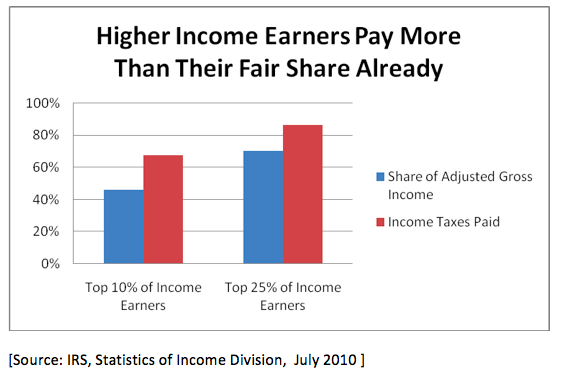
In the debate about raising the debt ceiling, the reality is often lost that the top 10 percent of income earners—those making more than $113,799 in 2008 (the latest year available from the IRS)—already pay 69.9 percent of the income taxes. The same top 10 percent, however, earn only 45.8 percent of the income.

The IRS also reports that in 2008, the top 25 percent of income earners—those earning $67,280 or more—pay 86.34 percent of the income taxes, yet earn only 67.38 percent of all income in the U.S. (See chart below)

In addition to their large and some would say “unfair” share of income taxes paid, the “rich” also are scheduled to pay more taxes starting in 2013 as a result of changes to Medicare made in the Patient Protection and Affordable Care Act (PPACA). This change will add an additional .9 percent tax on incomes above $200,000 for an unmarried person and $250,000 for a couple. People making under those limits already pay 1.45 percent of their wages for the Medicare tax, and their employers pay another 1.45 percent, which in effect is a tax on their income of 2.9 percent for Medicare. Those who have to pay the added .9 percent of income tax will be paying 3.8 percent of their income for Medicare beginning in 2013.

So taxes on the “rich” are already scheduled to go up under PPACA in 2013, which translates into less money available for new hires and less business growth. Those are businesses that would make investments in capital and people, likely boosting economic performance and helping everyone.

The bottom line is that the next time President Obama or someone in Washington says, “We just want the rich to pay their fair share,” he should think about how much the top 25 percent of income earners already pay. Making them pay more to increase the debt ceiling won’t control Washington’s spending problem, but it will translate into fewer jobs, lower wages, and diminished opportunities for all.

Posted in Entitlements
 

The Stimulus Failed, (Part 1), Do you want your grandchildren to pay for your walking bridge?

TWO RIVERS BRIDGE: Opening nears.

People just don’t understand how wasteful government can be and how giving government more control of our lives destroys much of the freedom that we should have. This series on the stimulus demostrates these points. This whole series started because of a post I did on July 6, 2011 about an post in the Arkansas Times Blog.

On July 6, 2011 on the Arkansas Times Blog I posted concerning the walking bridge in Little Rock that stimulus funds help build:

Tim Griffin spoke in Central Arkansas recently at a townhall meeting and mentioned that a couple of million of stimulus money went to build the walking bridge in Little Rock that will be opening this summer. Then he went on to show how it was silly for our government to try to stimulate the economy with our national credit card.
Steve Chapman rightly noted in his article “Stimulus to Nowhere” noted:

The federal government took out loans that it will have to cover with future tax increases … so states don’t have to. It’s like paying your Visa bill with your MasterCard.

The person using the username “Arkansas Panic Fan” responded:

Bridge = good stuff for Central Arkansas. Not sure why it is a bad thing. It is your money at work here being used for your benefit. I applaud this type of government activity. This is the type of project and progress you can see, touch, smell, hear.

That being said, Saline Republican, is this a waste of your money? You can use it as you wish.

________________________________

Let me respond with several points:

1. If the bridge is such a good thing then why can’t those who are excited about it get the funds to build it?

2. If you applaud the government for spending money for every good idea out there, ultimately where does all the money come from? Our grandchildren will be paying off this bridge in about 50 years if our country survives.

3. Building things with the government involvement is the most wasteful thing that you can do. How long does it take them to get the highway work done?  Turn the highways over to private enterprise and things would change radically for the good. Do you get great service from Fed Ex or the U.S.Post Office? I had two relatives tell me stories of working part time at the post office and each time they were told to “slow down or you will get us all fired.”

4. The stimulus approach taken by President Obama has been to blow up our deficit when he should have sought to cut spending because the signs were there at the end of the Bush era that the recession was deepening. Instead, he decided to increase the spending even more than Bush had.

J.D. Foster’s testimony on Feb 16, 2011 before Congress shows how stupid the spending stimulus was:

My name is J.D. Foster. I am the Norman B. Ture Senior Fellow in the Economics of Fiscal Policy at The Heritage Foundation. The views I express in this testimony are my own, and should not be construed as representing any official position of The Heritage Foundation.

At best, stimulus efforts based on government spending and tax cuts with little or no incentive effects have done no harm. At best. It is quite possible most of these efforts over the past couple of years have slowed the recovery while adding hundreds of billions of dollars to the national debt.

The record is all the more unfortunate because it is possible for a President and Congress to work together to stimulate the economy to faster growth during and after a recession. They can do so by improving incentives to produce and to work: for example, by reducing regulations and tax distortions. They can do so by reducing the uncertainties surrounding future policy. They can do so by expanding foreign markets for domestic goods and services. Recent efforts to stimulate the economy have been unsuccessful because they did little or none of these things. Regulations have increased. Uncertainty has increased. Tax distortions have been left in place or even increased in some areas. And efforts toward free trade have been anemic, at best.

Stimulus can work, but it has not worked because the Administration took another approach, emphasizing tax relief with little or no incentive effects combined with massive increases in spending. The President inherited a ballooning budget deficit and opted to grow it further. At best, this would be expected to be ineffectual. At best, because the resulting increased deficits infused economic decision-making with even more uncertainty about the consequences of massive deficit spending and how and when government will act to restore fiscal sanity.

Fortunately, the economy is showing clear signs of sustained recovery; uneven recovery to be sure, stronger in some areas than others both geographically and by industry, but recovery nonetheless. Despite the tremendous blows from the financial crisis and all that it entailed, the underlying strengths of our free market system once again are at work, giving expression to the vitality, energy, and innovation of the American people. Make no mistake: Our economy is recovering despite—not because of—the actions taken in Washington to grow it.

What does the Heritage Foundation have to say about potential tax reform:Study released May 10, 2011 (Part 2)

Obama’s Tax Hike: The Movie

“Saving the American Dream: The Heritage Plan to Fix the Debt, Cut Spending, and Restore Prosperity,” Heritage Foundation, May 10, 2011 by  Stuart Butler, Ph.D. , Alison Acosta Fraser and William Beachis one of the finest papers I have ever read. Over the next few days I will post portions of this paper, but I will start off with the section on tax reform.

The Details

A Unified Single Tax Rate. The Heritage tax reform plan is far more
comprehensive than previous well-known tax reform proposals. Typical of many tax
reform proposals, our plan replaces today’s individual and corporate income tax
systems and eliminates the death tax. In lieu of the current motley collection
of taxes, this plan institutes a simple, single-rate tax on individuals and
businesses. It also folds today’s federal payroll taxes financing Social
Security and Medicare into the new system, establishing a single tax rate for
all taxpayers. In addition, it replaces all federal excise taxes except those
dedicated to specific trust funds, such as the gasoline tax, which would be
retained until that tax and its associated highway program are devolved to the
states.

Tax Rate. The tax system is designed to raise a permanent revenue
stream of up to 18.5 percent of the economy as measured by GDP. With the design
characteristics of this new tax system, we estimate that the statutory
individual and business tax rate will likely eventually be between 25 percent
and about 28 percent under traditional scoring methods. This is comparable to or
significantly below the typical rate facing an individual or family today. Most
working families today are subject to a 15.3 percent payroll tax rate on wages
and salaries plus a 10 percent, 15 percent, 25 percent, or 28 percent individual
income tax rate for a combined rate of 25.3 percent, 30.3 percent, 40.3 percent,
or 43.3 percent.

A Simplified System. The basic structure of this tax plan is simple.
With its single rate, it taxes uniformly all income sources that are spent on
consumption. This means that taxable income includes all labor compensation and
all net borrowings. The net amount put aside in savings is then subtracted to
determine net taxable income. Thus, the more individuals or families save, the
lower their taxes; they pay tax on savings only when savings are used to pay for
goods and services.

However, the new tax system does not tax government transfers explicitly
associated with low-income citizens, such as welfare, health care assistance,
and similar programs. Ultimately, when the Social Security and Medicare programs
are fully reformed, the Social Security checks and premium support that seniors
receive will not be taxed either. In the Social Security and Medicare transition
periods, a portion of the benefits of some seniors will be taxed if their income
is above a certain amount, just as many seniors’ Social Security is taxed
today.

Thus, the new tax system offers individuals and families a comparable or
lower tax rate and vastly improves their savings incentives to build wealth and
ensure their own financial security. It simultaneously improves the ability of
the economy to raise wages and provide more job opportunities. And filling out
tax forms will be a lot simpler.

An Alternative Option for Savings. For some purposes, many taxpayers
today prefer to save after-tax dollars as permitted through the current-law Roth
IRA rather than paying tax when funds are withdrawn as under today’s traditional
IRA. This Roth-style alternative maintains the principle of a single incidence
of taxation but may result in further increased saving by giving savers an
additional option. To allow such accounts for those who feel they need them, the
plan permits taxpayers to contribute after-tax dollars to an account,
contributing as they choose until the account balance reaches $100,000, with a
limit of one account per adult taxpayer. The income earned on the account is
tax-free, and disbursements from the account are tax-free for any purpose.

Few Deductions or Credits. Under the Heritage tax plan, the individual
income tax has only three deductions instead of the legion of deductions under
current law:

  • Higher education. Recognizing the role of higher
    education as a form of saving and investment in human capital, a deduction is
    allowed for tuition and expenses for higher education up to the average annual
    cost at a four-year public college or university.
  • Charitable donations and other gifts. Since the tax is
    levied on consumption, gifts are not taxable until they are spent by the
    recipient. Thus, per current law, gifts to nonprofit organizations are tax
    deductible if the organization is recognized as tax-exempt for tax purposes.
    Gifts to individuals and transfers through inheritance are deductible and become
    taxable to the recipient only when spent on consumption. And there is no death
    tax.
  • Mortgage interest. As under current law, homeowners can
    deduct mortgage interest while the lender continues to be taxed on mortgage
    interest income. Homeowners are also given the option of forgoing the deduction,
    in which case the lender is not taxed on mortgage interest income and market
    pressure would encourage the lender to offer a lower mortgage interest rate.

Protections for Low-Income Working Households. Current law hits
low-income workers and others with the full weight of today’s payroll taxes,
whatever their wage and salary income may be. The Heritage tax plan folds all
payroll taxes—or FICA—into the single tax system. It then eliminates all income
tax on low-income workers through the health insurance tax credit described
above (a $3,500 nonrefundable tax credit for families and $2,000 credit for
individuals). In addition, the Earned Income Credit is retained as part of the
overall system of financial support for low-income Americans. Further, the
calculation of taxable income excludes all other cash and noncash benefits
provided by the federal government through its anti-poverty programs, such as
food stamps. The net effect is that, compared to current law, this plan provides
substantial tax relief to low-income workers and families.

Protecting Low-Income Seniors. For Medicare-eligible senior citizens,
the measure of taxable income is modified to ensure that the flat benefit
amounts for Social Security and the Medicare defined contribution are tax-free.
Thus, lower-income seniors will not be pushed back into poverty by the tax
system after Social Security and Medicare have lifted them out of poverty. As
noted earlier, during the lengthy transition period for the Heritage plan’s
Social Security reform, some seniors above certain incomes with relatively high
benefits will pay tax on part of those benefits, but they will pay less than
many do today.

President Obama’s press conference June 29, 2011, a Conservative Response Part 3

President Obama Press Conference pt.4

The Stimulus was a stupid idea, but President Obama wants to keep going down that  path.

Steve Chapman  rightly noted in his article “Stimulus to Nowhere” noted:

Mired in excruciating negotiations over the budget and the debt ceiling, President Barack Obama might reflect that things didn’t have to turn out this way. The impasse grows mainly out of one major decision he made early on: pushing through a giant stimulus.

When he took office in January 2009, this was his first priority. The following month, Obama signed the American Recovery and Reinvestment Act, with a price tag eventually put at $862 billion.

It was, he said at the time, the most sweeping economic recovery package in our history,” and would “create or save three and a half million jobs over the next two years.”

The president was right about the first claim. As a share of gross domestic output, it was the largest fiscal stimulus program ever tried in this country. But the second claim doesn’t stand up so well. Today, total nonfarm employment is down by more than a million jobs.

What Obama didn’t foresee is that his program would spark a populist backlash and give rise to the tea party. Where would Michele Bachmann be if the stimulus had never been enacted — or if it had been a brilliant success?

To say it has not been is to understate the obvious. The administration says the results look meager because the economy was weaker than anyone realized. Maybe so, but fiscal policy is a clumsy and uncertain tool for stimulating growth, which the past two years have not vindicated.

The package had three main components: tax cuts, aid to state governments and spending on infrastructure projects. Tax cuts would induce consumers to buy stuff. State aid would prop up spending by keeping government workers employed. Infrastructure outlay would generate hiring to build roads, bridges and other public works.

That was the alluring theory, which vaporized on contact with reality. The evidence amassed so far by economists indicates that the stimulus has come up empty in every possible way.

Consider the tax cuts. Wage-earners saw their take-home pay rise as the IRS reduced withholding. But as with past rebates and one-time tax cuts, consumers proved reluctant to perform their assigned role.

Claudia Sahm of the Federal Reserve Board and Joel Slemrod and Matthew Shapiro of the University of Michigan found that only 13 percent of households indicated they would spend most of the windfall. The rest said they preferred to put it in the bank or pay off debts — neither of which boosts the sale of goods and services.

This puny yield was even worse than that of the 2008 tax rebate devised by President George W. Bush. Neither attempt, the study reported, “was very effective in stimulating spending in the near term.”

The idea behind channeling money to state governments is that it would reduce the paring of government payrolls, thus preserving the spending power of public employees. But the plan went awry, according to a paper by Dartmouth College economists James Feyrer and Bruce Sacerdote published by the National Bureau of Economic Research.

“Transfers to the states to support education and law enforcement appear to have little effect,” they concluded. Most likely, they said, states used the money to avoid raising taxes or borrowing money.

That’s right: The federal government took out loans that it will have to cover with future tax increases … so states don’t have to. It’s like paying your Visa bill with your MasterCard.

The public works component could have been called public non-works. It sounds easy for Washington to pay contractors to embark on “shovel-ready projects” that needed only money to get started. The administration somehow forgot that even when the need is urgent, the government moves at the speed of a glacier.

John Cogan and John Taylor, affiliated with Stanford University and the Hoover Institution, reported earlier this year that out of that $862 billion, a microscopic $4 billion has been used to finance infrastructure. Even Obama has been chagrined.

“There’s no such thing as shovel-ready projects,” he complained last year.

Even if jobs were somehow created or saved by this ambitious effort, they came at a prohibitive price. Feyrer and Sacerdote say the costs may have been as high as $400,000 perjob.

Based on all this evidence, we don’t really know whether the federal government can use fiscal policy to engineer a recovery. We do know it can go broke trying.

President Obama’s press conference June 29, 2011, a Conservative Response Part 2

President Obama Press Conference pt.2

Will President Obama have the will power to make the tough spending cuts? The answer  is clear. He will not, but he will be willing to promise that he will. The Democrats promised Ronald Reagan that they would cut 3 dollars for every 1 dollar of tax increase, but it never happened.

Michael Reagan noted:

If the GOP is really serious about winning back the presidency, they need to win the deficit debate. The government of these United States is broke — flat broke — and if the nation is to survive as the prosperous nation it has long been, Republicans must restore fiscal sanity and call a halt to spending money we don’t have!

That’s what the Republicans promised us they would do last November, and largely on the strength of that pledge we let them take back the House. After all, it’s obvious that we can’t trust the Democrats to spend the public’s money wisely and well.

President Obama is promising to seek $3 in spending cuts for every $1 of new taxes, exactly as my father Ronald Reagan sought to do. When he passed away in 2004 he was still waiting for that $3. Barack Obama can expect the same dismal outcome.

Ask the first President George Bush how it worked out when he cut a deal with the Democrats in 1991 to reduce the deficit by $500 billion. All he had to do was go back a little on his “Read my lips — NO NEW TAXES” pledge and raise taxes just a little bit.

The Democrats promised not to use the tax issue in the 1992 elections. They promptly hung President Bush with it. So I say to the Republican leadership, as Margaret Thatcher once said to GHW Bush, “Now is not the time to go wobbly.” Stick to your guns and call a halt to spending nonexistent dollars.

Unlike the Democrats, who have long been able to win elections by buying votes with lavish government programs paid for with phantom dollars, Republicans have for the most part demanded that fiscal sanity play a large part in determining the wisdom of enacting new programs or financing existing ones.

Democrats have no problem with spending what I like to call “tomorrow money,” big bucks stolen from future generations, who aren’t around to protest having enormous debt loads placed on their shoulders even before many of them have even been born.

Tragically, we have now reached the point where it’s time for Peter –that’s this generation — to pay Paul, yet unborn, by paying for the cost of government programs with today’s dollars. That would require that we stop spending tomorrow’s dollars. Of course, in that case Democrats would start losing elections.

In this era of the Obama recession, Republicans had better stiffen their spines, stand erect and challenge Obamanomics before the president drags us over an economic cliff.

As I said, for the GOP, this is no time to go wobbly.

__________________________________________

President Obama Press Conference pt.3