Category Archives: President Obama

An open letter to President Obama (Part 19 of my response to State of Union Speech 1-24-12)

Leader Cantor On CNN Responding To President Obama’s State of the Union Address

Uploaded by  on Jan 25, 2012

President Obama’s state of the union speech Jan 24, 2012

Barack Obama  (Photo by Saul Loeb-Pool/Getty Images)

President Obama c/o The White House
1600 Pennsylvania Avenue NW
Washington, DC 20500

Dear Mr. President,

I know that you receive 20,000 letters a day and that you actually read 10 of them every day. I really do respect you for trying to get a pulse on what is going on out here.

The Heritage Foundation website (www.heritage.org ) has lots of good articles and one that caught my attention was concerning your State of Union Speech on January 24, 2012 and here is a short portion of that article:

The Truth About the Economic Ladder Bill Beach

One of the best analysts of economic mobility and the income distribution in Washington today, Scott Winship at the liberal Brookings Institution, found little evidence to support the argument that changes in the income distribution has hurt the ability of Americans to move up the economic ladder. The President made this argument several times over the past several weeks and tonight in the State of the Union speech.

Rather, this wonderful country is nearly as mobile today as it was two generations ago when our fathers were working. True, we’re challenged today by a rapidly changing economic world…one that’s much more global and service based that in Dad’s days. And, true: the future of economic mobility is greatly threatened by growing debt that shows no sign of decreasing. Even so, the promise of American life remains alive for nearly everyone who lives and works here.

“Routine Business”? How About Passing A Budget? Emily Goff

The President called on Congress to change the way it does its business, making mention of how difficult it is to conduct “routine business” in the Senate. Passing a budgeting comes to mind as something that should be routine. Yet in the past 1,000 days, the Senate has failed to pass a single budget.

A Failure to Understand Fundamental Rights Hans von Spakovsky

President Obama showed once again that he does not understand the First Amendment or understand his obligation as the executive to help protect the rights of Americans to engage in political activity and political speech, as well as to “petition the Government for a redress of grievances,” i.e., lobby the government.  In his state of the union speech, Obama proposed that “people who bundle campaign contributions for Congress” should be barred from lobbying Congress and vice versa.  This would be a restriction of fundamental political rights that could not be implemented by Congress without a constitutional amendment.  It is shameful that the President, who swears an oath to defend the Constitution, has chosen to attack First Amendment rights for a second consecutive State of the Union address.

Do Teacher Pay Recommendations Make Sense? Jason Richwine

Deciding how much to pay teachers is properly a matter for state and local governments, not Congress. But federalism issues aside, do the president’s recommendations on teacher pay make sense? He calls for rewarding the best teachers with higher pay and for removing ineffective teachers from the classroom. This kind of merit-based system would be ideal, but the president also says that teacher pay is currently “modest,” and he implies that schools do not have the resources to reward high-quality teachers.

Public school teachers are, in fact, very well compensated. They receive more compensation, particularly in the form of pension and health benefits, than they would receive in the private sector. Before increasing spending on teacher salaries, public school districts should use their existing resources more efficiently. Unfortunately, union rules often severely limit payroll flexibility-stipulating, among other senseless things, that gym teachers must be on the same pay scale as math teachers.

The president also repeats a misleading argument about job security for teachers. He notes that thousands have recently been laid off, but he does not mention that the unemployment rate for public school teachers has been considerably lower than that of comparable white collar occupations.

.

Slinging Arrows at Non-Bank Businesses – Diane Katz

In a single sentence, the president dismissed as corrupt an entire industry of financial services that serves tens of millions of people annually. While the CFPB has yet to undertake a single examination of the non-bank industry, and its director has pledged to give the industry a fair hearing, the administration obviously has concluded that all nonbank businesses can’t be trusted and  consumers are too stupid to decide for themselves what types of services suit their needs. What consumers really ought to be worried about is the absence of accountability that marks the administration’s new consumer bureau. To the extent the bureau excessively constrains financial services, consumers will be the big losers.

______________________

The economic ladder is still alive and well in the USA. The answer is the free market and not more government spending. You need to check out the film series “Free to Choose” by Milton Friedman. The first episode is the best.

Thank you so much for your time. I know how valuable it is. I also appreciate the fine family that you have and your committment as a father and a husband.

Sincerely,

Everette Hatcher III, 13900 Cottontail Lane, Alexander, AR 72002, ph 501-920-5733, lowcostsqueegees@yahoo.com

Is Buffett getting misquoted by the Obama administration?

Addington, McConaghy Debate Obama’s Jobs Plan

Published on Sep 9, 2011 by

Sept. 9 (Bloomberg) — David Addington, vice president at the Heritage Foundation, and Ryan McConaghy, economic director at Third Way, discuss President Barack Obama’s $447 billion jobs plan. They speak with Deirdre Bolton and Erik Schatzker on Bloomberg Television’s “InsideTrack.” (Source: Bloomberg)

__________________

Is Buffet getting misquoted by the Obama administration?

Did Warren Buffett really disagree with Obama’s tax plan?

(Scott Eeels/Bloomberg)
September 30, 2011|By James Oliphant
Republicans are getting a great deal of mileage out of an interview investor Warren Buffett gave Friday morning, contending that the billionaire failed to endorse President Obama’s jobs plan or the proposed tax hike that bears his name.The Republican National Committee, for example, e-blasted a mailer that claimed Buffett had disagreed in a CNBC interview with Andrew Ross Sorkin with Obama’s plan to raise taxes on America’s top earners.

But did Buffett actually say that? More than anything, while interviewed on the floor of the New York Stock Exchange, he took a pass on commenting on Obama’s plan at all. As they used to say in the 20th century, let’s go to the videotape:

Andrew Ross Sorkin: “Let’s talk about the Buffett Rule for a moment. Talk to me about how it came about in terms of the White House getting in touch with you and you putting your name to this?”

Warren Buffett:  “Well, [National Economic Council Director] Gene Sperling called and said, ’Can we use your name?’ And I said, yes.”

Sorkin: “Are you happy you said yes?”

Buffett: “Sure, I mean I wrote about it.”

Sorkin: “Are you happy with the way it’s been described? Is the program that the White House has presented — a million dollars and over — your program?”

Buffett: “Well, the precise program, I don’t know what their program will be. My program would be on the very high incomes that are taxed very low — not just high incomes. Some guy making $50 million playing baseball, his taxes won’t change. If you make 50 million dollars a year appearing on television, his income won’t change, but if they make a lot of money and they pay a very low tax rate, like me, it would be changed by a minimum tax that would only bring them up to what the other people pay .”

Sorkin: “Does that mean you disagree with the president’s new jobs proposal, which would be paid for by raising taxes on households with incomes of over $250,000?”

Buffett: “That’s another program that I won’t be discussing, but my program is to have a tax on ultra-rich people who are paying very low tax rates. Not just all the rich people. It probably would apply to 50,000 people in a population of 310 million.”

Sorkin: “That means you disagree with the president on the 250,000?”

Buffett: “No, no, you may disagree –“

Sorkin: “I’m asking, you agree that 250,000 is the right number?”

Buffett: “I will look at the overall plan that gets submitted to Congress, which they are voting on, and decide, net, do I like it or do I not like it? There’s no question there will be parts I’ll disagree with.”  (Watch the video of the interview at the end of this article.)

Part of the confusion stems from Obama’s use of Buffett’s name in recent speeches as promoting the idea the rich “pay their fair share.”  The Buffett Rule, as Buffett described in the interview and as he has proposed elsewhere, would affect a small percentage (less than 1) of America’s wealthiest citizens and would elevate the rate they pay on capital gains to be comparable to middle-class tax rates.

Essentially, the proposal was boiled down to a metaphor that has billionaires such as Buffett paying taxes at a lower rate than their “secretaries.”

When Obama rolled out his version of the rule, it was described as a tax on millionaires, but in truth, it wouldn’t affect most people who earn more than $1 million a year unless they derived most of their income from investments.

Along with that proposal, Obama has advocated letting the George W. Bush-era tax cuts expire for families making more than $250,000 a year—something which has nothing to do with Warren Buffett or the “Buffett Rule.”

Here’s what Buffett told the Fox Business Network Friday:

“I didn’t say the wealthy should pay more. I said the ultra-wealthy who are paying very low tax rates should pay more and the figures show that the 400 top tax payers who earned an average of almost $230 million apiece were paying 21% in a combined payroll tax and income tax, which is well below what all the people in my office pay now. What I’m talking about would not apply to someone that made $5 million a year as a baseball player or $10 million a year on media. It would apply only to probably 50,000 people out of 309 million who have huge incomes pay very low taxes. If you have a country with a deficit of over a trillion dollars and you think it can be solved by voluntary tax payments then you believe in the tooth fairy. There should be a policy that applies to people with money who earn lots of money and pay very low rates. If they earn it by normal jobs what I say would not hit them at all.”

Related posts:

Do the rich avoid the taxes that we all pay?

Do the rich avoid the taxes that we all pay? Do the Rich Avoid Taxes? Posted by David Boaz President Obama says the rich should pay higher tax rates, citing billionaire Warren Buffett, who says he pays a lower tax rate than his secretary. Various analysts have pointed out that Buffett takes very little salary […]

President Obama’s plan and the Heritage Foundation response

Addington, McConaghy Debate Obama’s Jobs Plan Published on Sep 9, 2011 by Bloomberg Sept. 9 (Bloomberg) — David Addington, vice president at the Heritage Foundation, and Ryan McConaghy, economic director at Third Way, discuss President Barack Obama’s $447 billion jobs plan. They speak with Deirdre Bolton and Erik Schatzker on Bloomberg Television’s “InsideTrack.” (Source: Bloomberg) […]

President Obama and Alternative Minimum Tax

President Obama and Alternative Minimum Tax Dan Mitchell does it again. He is always right on the mark. CPAs Celebrate as Obama Proposes to Create a Turbo-Charged Alternative Minimum Tax Posted by Daniel J. Mitchell Wow, this is remarkable. The alternative minimum tax (AMT) is one of the most-hated features of the tax code. It […]

Brantley, Buffett and Obama: “Stop coddling the rich”

Brantley, Buffett and Obama: “Stop coddling the rich” The Laffer Curve, Part I: Understanding the Theory Max Brantley is fond of accusing Republicans of coddling the rich and here comes Warren Buffett and validates both what President Obama and Brantley have been saying. However, will the increase in taxes have the desired result that they […]

Buffett wants the rich soaked but that will not solve our problem in the budget

Max Brantley on the Arkansas Times Blog, August 15, 2011, asserted: Billionaire Warren Buffett laments, again, in a New York Times op-ed how the rich don’t share the sacrifices made by others in the U.S.. He notes his effectiie tax rate of 17 percent is lower than that of many of the working people in his office on account of preferences for […]

Brummett touts Buffett’s math, but it is wrong

Five Key Reasons to Reject Class-Warfare Tax Policy Max Brantley on the Arkansas Times Blog, August 15, 2011, asserted:   Billionaire Warren Buffett laments, again, in a New York Times op-ed how the rich don’t share the sacrifices made by others in the U.S.. He notes his effectiie tax rate of 17 percent is lower than […]

The Top 10 Percent of Earners Paid 70 Percent of Federal Income Taxes

Dan Mitchell on Taxing the Rich Max Brantley this morning on the Arkansas Times Blog, August 15, 2011, asserted:   Billionaire Warren Buffett laments, again, in a New York Times op-ed how the rich don’t share the sacrifices made by others in the U.S.. He notes his effectiie tax rate of 17 percent is lower than […]

An open letter to President Obama (Part 18 of my response to State of Union Speech 1-24-12)

Sen. Toomey responds to State of the Union address 2012

President Obama’s state of the union speech Jan 24, 2012

Barack Obama  (Photo by Saul Loeb-Pool/Getty Images)

President Obama c/o The White House
1600 Pennsylvania Avenue NW
Washington, DC 20500

Dear Mr. President,

I know that you receive 20,000 letters a day and that you actually read 10 of them every day. I really do respect you for trying to get a pulse on what is going on out here.

The Heritage Foundation website (www.heritage.org ) has lots of good articles and one that caught my attention was concerning your State of Union Speech on January 24, 2012 and here is a short portion of that article:

Obama’s Failed Job Creation Logic – Emily Goff

To justify its job creation proposals, especially in the energy or transportation sectors, the Obama Administration is fond of highlighting individual Americans who were unemployed but now have a job. Tonight the President referenced a worker who once made furniture, was laid off, and then found a job with a wind turbine manufacturer. Keep in mind that the wind energy market, like many other energy markets, is highly subsidized. By the president’s logic, that worker got a job thanks to Washington’s spending, so what is needed is more spending.

It’s convenient to put a camera in front of a few newly-employed persons and then say “job well done, our policies worked”. But unemployment numbers in the aggregate tell another story. The unemployment rate currently stands at 8.5 percent. In December there were 200,000 jobs added, which indeed is encouraging amid the current economic doldrums. However, as The Heritage Foundation’s James Sherk writes, “At that pace, the unemployment rate will not return to normal levels (or 5.2 percent) for four and a half years—not until September 2016.”

It’s time for the President to recognize that the government doesn’t create jobs. The private sector does, and it does it well. Mr. President, help lead in getting Washington out of the way. Let the economy heal and create jobs on its own.

A PR Gesture on Financial Crimes – David John

No one wants financial crimes to go unpunished, but the President’s announced new Financial Crimes Unit is little more than a PR gesture.  Almost all of the crimes it will consider ranging from insider trading to fraud to stealing are now crimes and have been for many years.  And it is not like the Justice Department has been sitting on its hands since 2008.  Late last year, a very high profile insider trader was convicted as have a number of others.  Still more trials and indictments are pending.  State, local and federal governments have been working together with great success.

The newly announced task force may be worth a few minutes of new TV time, but it is really just doing what hard working professionals have been doing for some time.  The implication that it will do even more is an insult to the prosecutors who have been doing the same thing.

________________________

The answer to our problems is encouraging the private market and not more government spending but your answers seem to involve more government spending.

Thank you so much for your time. I know how valuable it is. I also appreciate the fine family that you have and your committment as a father and a husband.

Sincerely,

Everette Hatcher III, 13900 Cottontail Lane, Alexander, AR 72002, ph 501-920-5733, lowcostsqueegees@yahoo.com

An open letter to President Obama (Part 17 of my response to State of Union Speech 1-24-12)

Rep Michael Burgess response

Uploaded by  on Jan 25, 2012

This week Dr. Burgess provides an update from Washington and responds to President Obama’s State of the Union address.

President Obama’s state of the union speech Jan 24, 2012

Barack Obama  (Photo by Saul Loeb-Pool/Getty Images)

President Obama c/o The White House
1600 Pennsylvania Avenue NW
Washington, DC 20500

Dear Mr. President,

I know that you receive 20,000 letters a day and that you actually read 10 of them every day. I really do respect you for trying to get a pulse on what is going on out here.

The Heritage Foundation website (www.heritage.org ) has lots of good articles and one that caught my attention was concerning your State of Union Speech on January 24, 2012 and here is a short portion of that article:

Obama’s Policies Have Exacerbated Increases in College Costs – Lindsey Burke

President Obama is right to call on colleges to work to drive down college costs. Unfortunately his administration’s move last year to  forgive student loan debt after 20 years was reckless, and won’t help achieve that goal.

Taxpayers who worked hard to pay off their own college debt should not be penalized by having to pay off the loans of those who, irresponsibly, took out more debt than they can handle paying. Moreover, the three-quarters of American taxpayers who did not graduate from college should not be penalized by having to finance the college student who took out $100,000 in loans to pay for a degree of questionable value.

The Success of A Few Not An Excuse for Obama’s Economic Failures Bill Beach

The President uses the success of a few as excuse for the economic policy failures of his administration. Changes in the distribution of income are due to three well known developments: the recession, failed economic policies of the past eight years, and the aging of the working population. The President has also been badly served by his economists:

  • If the President’s economists were to account for these three factors, they would find almost no change in the distribution of labor income over the past twenty years.
  • If these economists would use data from 2008 through 2010 rather than stopping their analysis at 2007, they would find that the hated rich have lost 40 percent of their wealth, thus massively decreasing the differences in income between the bottom and top earners.
  • Finally, the President’s analyst should remember that population change is still the biggest force in our society. The Baby Boomers (nearly 71 million are still in the labor force) are at their top earning years, which is a major factor why the top 40 percent of the income distribution is wealthier today than 20 years ago.

_______________________________

Starting a class warfare is not the way to go.

Thank you so much for your time. I know how valuable it is. I also appreciate the fine family that you have and your committment as a father and a husband.

Sincerely,

Everette Hatcher III, 13900 Cottontail Lane, Alexander, AR 72002, ph 501-920-5733, lowcostsqueegees@yahoo.com

Obama praises GM when actually it was a bad deal for taxpayers

When you look at the details then they tell a different story than the president wants you to believe.

GM’s Profits Don’t Mean Taxpayers Will Be Off the Hook

The company’s cash cushion might go to unions, not investors.

| February 22, 2012

Three years after being rescued by a taxpayer bailout, General Motors recently announced some rather ambitious profit targets for 2012. But even if it meets these targets—a big if—taxpayers should not wait on one foot to recover their remaining “investment” in the company.

There is no doubt that GM has returned from the brink. It made $8 billion last year, a record high, and regained enough global market share to once again become the world’s biggest automaker, a title it had lost to Toyota. More impressive, it is planning to bump its profit margins from 6 percent last year to 10 percent this year, on par with its best-in-class rivals such as Hyundai and BMW. This, it hopes, will allow it to post $10 billion in profits this year, something that only 17 public companies managed to do in 2010.

How did investors react to all this hope and cheer? With a giant yawn: GM’s stock price, which has been hovering around $25 for months, barely budged. That’s $8 below GM’s IPO price. And it’s $30 below what’s needed for taxpayers to recover the $30 billion they still have stuck in the company.

If investors aren’t buying GM’s rosy scenarios, it’s for some good reasons. Peter De Lorenzo, editor of Auto Extremist, notes that GM is facing the most competitive market in history and investors are dubious that it can deliver. GM’s $8 billion in profits last year resulted partly from the tsunami in Japa that disrupted Toyota and Honda’s global supply chain.

Both are back this year and more formidable than ever. While GM reported a 6 percent drop in January sales in North America from a year earlier, its foreign competitors posted impressive gains. GM will have a hard time matching last year’s performance, let alone upping it if it has even one more month like January, De Lorenzo notes.

Tougher competition in North America is not GM’s only worry. Its sales in China are slowing. Also, Europe will probably remain a trouble spot. GM suffered $2 billion in losses in Europe last year, thanks to Opel, its hopelessly bloated German brand. But GM has been unable to obtain permission from the German government to restructure its labor costs, even as European sales plummet in an economic meltdown.

Toyota and Honda don’t have the same exposure in Europe and hence have less to worry about. What’s more, GM’s global pension obligations are underfunded to the tune of $22 billion, about $10 billion in the United States alone.

If GM manages to address all these issues, notes Sean McAlinden of the Center for Automotive Research, its share price might go up $40 to $45, leaving taxpayers still $5 billion to $8 billion in the red. But that’s under the best scenario. If stock prices remain at the current $25 level, the losses could mount up to $15 billion. That’s not counting the $15 billion in tax write-offs that GM got as part of the bankruptcy deal. All in all, taxpayers are facing somewhere from $20 billion to $30 billion in losses.

That’s not all the exposure that taxpayers will have going forward. The GM bailout has distorted the playing field so badly that its competitors are demanding their own handouts to even things out.

For example, McAlinden notes, the administration gave GM about $10 billion more than was strictly necessary to finance its bankruptcy. The money contributed to GM’s nice $33 billion cash cushion right now. GM could use this money to buy its own stock and bid up prices, mitigating taxpayer losses—or pay dividends. But McAlinden doesn’t believe that’s what GM will do. It could use the money to pay off its obligations to the union health-care trust fund, making this a direct infusion of cash from taxpayers to unions.

Or it will use the money toward product development, putting its competitors at a disadvantage. Moreover, because all but $10 billion of the bailout money GM got was in the form of equity, the company has no debt service costs. Ford by contrast, is still servicing the $23 billion in debt it took to avoid a bailout.

This is unfair, and the Obama administration knows it, which is perhaps one reason it quickly approved a $5.6 billion retooling loan for Ford. That, in turn, elicited howls of protest from Chrysler’s Sergio Marchionne. The administration gave Marchionne’s parent company, Fiat, the majority stake in Chrysler without asking Fiat to contribute a single euro of its own.

Yet Marchionne complains that the administration hasn’t been generous enough. In contrast with GM, it forced Chrysler to service the bailout loan. Now it’s dragging its feet in approving Chrysler’s new retooling loans, he claims.

Bailout supporters maintain that it was a one-time deal necessary to shore up companies in acute economic times. In reality, the rush for the bailout’s spoils has produced ripple effects that may well haunt the economy for a long time.

As President Barack Obama campaigns to keep his job, he will spin the bailout as a success story that saved millions of American jobs. But taxpayers should bear in mind that the hit to their wallets will be substantial and will probably grow in years to come.

Shikha Dalmia is a senior analyst at Reason Foundation and a columnist at The Daily. This colum originally appeared in Bloomberg news.


An open letter to President Obama (Part 16 of my response to State of Union Speech 1-24-12)

Congressman Rick Crawford State of the Union Response 2012

Uploaded by  on Jan 24, 2012

Rep. Rick Crawford responds to the State of the Union address January 24, 2012


President Obama’s state of the union speech Jan 24, 2012

Barack Obama  (Photo by Saul Loeb-Pool/Getty Images)

President Obama c/o The White House
1600 Pennsylvania Avenue NW
Washington, DC 20500

Dear Mr. President,

I know that you receive 20,000 letters a day and that you actually read 10 of them every day. I really do respect you for trying to get a pulse on what is going on out here.

The Heritage Foundation website (www.heritage.org ) has lots of good articles and one that caught my attention was concerning your State of Union Speech on January 24, 2012 and here is a short portion of that article:

Want to Bring Back Jobs? Avoid Overcriminalization – Joe Luppino-Esposito

President Obama claims that he wants to bring more manufacturing jobs back into the United States and wants to encourage small business and entrepreneurship by tearing down regulations.

He can start by avoiding the criminalization of American businesses by means of outrageous statutes such as the Lacey Act.  Just ask the workers at the Gibson Guitar plant in Tennessee, who were confronted by armed federal agents because of allegations that they imported wood from India that wasn’t properly finished with Indian labor.  That’s right: the administration is seeking to enforce protectionist labor laws for other countries. Thanks to the Lacey Act, violation of environmental regulations of a foreign nation becomes a federal crime.  Gibson’s CEO has come out swinging against the Lacey Act, but if the President meant what he said about protecting US jobs, then after tonight, he should find an ally in Obama, who can tell his Department of Justice to stop pursuing Gibson.

Entrepreneurs such as Abner Schoenwetter, would also like to get some relief from regulations: Honduran regulations, that is.  He too was found guilty under the Lacey Act because of using plastic bags instead of cardboard boxes to ship lobsters for his seafood importing business.  Schoenwetter spent five years in a U.S. federal prison for his regulatory errors.

So if Obama wants to encourage American jobs, he would do well to stop making it a crime to engage in business here.

______________________

My own business ran up against some regulations for some imports that we brought in and the delay was blamed on the Lacey Act. Reasonableness has gone out of the window it seems.

Thank you so much for your time. I know how valuable it is. I also appreciate the fine family that you have and your committment as a father and a husband.

Sincerely,

Everette Hatcher III, 13900 Cottontail Lane, Alexander, AR 72002, ph 501-920-5733, lowcostsqueegees@yahoo.com

Beware of Obama’s corporate tax reform

Obama’s corporate tax plan will backfire.

J.D. Foster, Ph.D.

February 22, 2012 at 1:03 pm

With his corporate tax reform “framework,” President Obama today added another element to his ultimately harmful economic agenda.

Previously announced anti-growth policies include massive budget deficits, a huge tax hike on individuals and small businesses in 2013, and his proposal to nearly triple the dividend tax rate.

His new proposal starts strong by reducing the federal corporate income tax rate to 28 percent from the current 35 percent. This is a good and long-overdue policy change. Regrettably, he marries rate reduction to a net corporate tax hike based in part on extending his policy to hammer and ultimately deconstruct U.S. multinational companies. The net effect is that his corporate tax reform would do more harm than good, representing yet another missed opportunity to help American workers.

The U.S. corporate tax rate is the world’s second highest—and soon to be highest in the world by far. The average of the OECD nations (nations considered to have developed economies) excluding the U.S. is just over 25 percent. The combined state and federal U.S. rate is nearly 40 percent. It is miraculous that U.S. companies can compete at all in the global economy with such a tremendous handicap.

At the same time, economists and policymakers increasingly understand that while the tax is paid almost exclusively out of profits that would otherwise go to the shareholders, the true economic burden falls primarily on workers. The reason is simply that the higher the effective corporate tax burden, the higher the hurdle rate on corporate investment. (The hurdle rate is the minimum rate a business must earn on investment to make the investment.) The higher the hurdle rate, the less investment takes place. The less investment takes place, the slower labor productivity grows, and the slower labor productivity grows, the slower wages grow.

This may seem a long chain of events, but every link in the chain is solid steel. In the end, it means the higher the corporate tax is, the lower workers’ wages are. This is why Democrats like President Obama and Senator Ron Wyden (D–OR) are now joining with Republicans anxious to see a lower corporate income tax rate. It’s certainly not to reward corporate executives or shareholders but to protect workers from further degradation of their wages.

Unfortunately, President Obama marries this extremely important policy to two very bad policies. He calls this corporate tax reform. But tax reform is revenue neutral. His policy is to expand the tax base—the measure of income subject to tax—by closing “loopholes and subsidies” so that the net effect is to increase corporate taxes substantially. That’s not tax reform. That’s just another tax hike in disguise. So Obama argues that we need corporate tax reform for economic growth and then proposes corporate tax hikes that would inhibit growth. Go figure.

There’s no doubt the corporate income tax code is laden with loopholes and subsidies, just as there is no doubt the President’s recently released budget adds to the list some of his own. His framework lists a handful of minor proposals carried over from his budget and then references three areas for reform without providing any details. Specifically, he references depreciation schedules, suggesting significantly higher taxes on business investment. He suggests paring back the deduction for interest expense, again raising the hurdle rate on business investment. And he suggests “establishing greater parity between large corporations and large non-corporate counterparts,” which is generally assumed to be code for levying a dividend tax on distributed profits of these non-corporate businesses.

Debating tax deductions is a Washington parlor game. However, suppose Obama chose wisely and that every such subsidy or loophole mentioned is a valid target for repeal. Rather than raising tax burdens, he should then cut the corporate tax rate further. Recall that the average of the OECD (excluding the U.S.) is just over 25 percent. At a 28 percent federal rate, the combined federal and state tax rate would then be nearly 33 percent, still well above that of the nation’s competitors. The U.S. federal rate needs to come down further, and Obama’s additional base broadening would permit it. But instead, Obama takes a pass on further rate reduction in favor of taking the cash for the federal government.

Raising corporate taxes is his first big mistake. Targeting U.S. multinationals specifically for higher taxes is his second. The issue is complicated, but it boils down to some simple points. U.S. multinationals compete on a global stage, earning income at home and abroad. Income earned abroad is taxed by the foreign government. The U.S. also taxes income earned abroad and employs some complex rules to prevent double taxation. In contrast, most of the rest of the world now recognizes the folly of adding domestic tax to the tax their companies pay overseas. This would just make their companies and their workers less competitive at home and abroad, as it does for U.S. companies today.

President Obama, however, wants to make an economically harmful policy worse by taxing U.S. companies’ foreign earnings even more heavily. The vision Obama outlines is to punish firms that outsource jobs and incentivize “insourcing.” The net effect, however, would be quite different. The net effect is to put a “for sale” sign on every profitable U.S. multinational company. The buyers, however, won’t be U.S. companies. The buyers will all be foreign companies.

The reason for this tax-induced fire sale is fairly simple: The reach of U.S. tax policy into income earned overseas extends only when it applies to U.S. companies. The U.S. has no taxing jurisdiction when it comes to the foreign earnings of foreign companies. For example, the U.S. taxes Toyota on what Toyota earns in the U.S. But the U.S. does not tax Toyota on what Toyota earns in Japan.

Suppose a U.S. company like HP earned all of its foreign income through a single foreign subsidiary called Globalsub. Now suppose Globalsub were taxed under Obama’s plan. Globalsub’s foreign profits would then be subject to foreign tax and an even more punitive U.S. tax.

If a foreign company like Sony were to buy HP, shifting Globalsub out of HP into its own foreign operations, then all of Globalsub’s profits would immediately be exempt from U.S. taxes. This sort of tax arbitrage would be very big business. It would also substantially reduce U.S. tax revenues.

Sound far-fetched? It isn’t. Remember when Mercedes-Benz bought Chrysler in 1998? Had Chrysler bought Mercedes instead, all of the German company’s profits would have been subject to U.S. tax, rendering the entire operation uncompetitive. This was all laid bare by John Loffredo, then the tax counsel for Chrysler, in testimony before the House Ways and Means Committee.

Another high-profile example occurred when the Belgian company InBev bought Anheuser-Busch in 2008 for $52 billion. The more U.S. tax policy in this area gets out of step with worldwide norms, the more U.S. companies become natural targets for foreign acquirers. President Obama’s tax policies would make matters much, much worse.

The right solution is to pursue a revenue-neutral corporate tax reform, reducing the corporate tax rate as far as sound base broadening will allow. At the same time, in international matters the U.S. should move in exactly the opposite direction from what President Obama proposes so that U.S. companies can compete globally and not become tax-induced targets for foreign acquirers

Raising taxes on rich may not get more money, look at Britain

Uploaded by on May 3, 2011

This Economics 101 video from the Center for Freedom and Prosperity gives seven reasons why the political elite are wrong to push for more taxes. If allowed to succeed, the hopelessly misguided pushing to raise taxes would only worsen our fiscal mess while harming the economy.

The seven reasons provided by the video against this approach are as follows:

1) Tax increases are not needed;
2) Tax increases encourage more spending;
3) Tax increases harm economic performance;
4) Tax increases foment social discord;
5) Tax increases almost never raise as much revenue as projected;
6) Tax increases encourage more loopholes; and,
7) Tax increases undermine competitiveness

_____________________

Obama just doesn’t get it.

Curtis Dubay

February 22, 2012 at 3:49 pm

President Obama is insistent that taxes must go up to close the deficit. He says it’s just common sense that taxes must go up, because the math says so. But if he gets his way, the numbers won’t add up the way he says they will.

President Obama wants to raise taxes on “the rich.” But the Treasury will never collect the revenue he says will come from such hikes, because the rich will change their behavior to escape the punitive levies.

Case in point from Britain, where Parliament recently implemented a 50 percent tax rate on the rich:

The Treasury received £10.35 billion in income tax payments from those paying by self-assessment last month, a drop of £509 million compared with January 2011. Most other taxes produced higher revenues over the same period. Senior sources said that the first official figures indicated that there had been “manoeuvring” by well-off Britons to avoid the new higher rate. The figures will add to pressure on the Coalition to drop the levy amid fears it is forcing entrepreneurs to relocate abroad.

This should be no surprise. When governments raise taxes on the rich, the rich change their behavior to avoid the higher taxes. Liberals understand this phenomenon when they raise taxes on cigarettes to discourage smoking, but they never seem to apply the same principle to income. If you tax income more heavily, you’ll end up with less income to tax, just like if you raise taxes on cigarettes, smokers purchase fewer packs.

When tax rates on the rich go up, the rich can respond in a number of ways:

  • Work less. They can work less, thereby earning less income to tax. This makes sense for high earners when their rate hits or exceeds 50 percent. Who wants to work when you take home half or less of the additional money you earn?
  • Earn differently. They can also change the composition of their income. In the U.S., capital gains and dividends are properly taxed at a lower rate than wage and salary income (ideally, they wouldn’t be taxed at all). Since the rich are often business owners, they can shift their compensation from wages and salaries to these less-taxed forms. They can also take compensation in forms that are excluded from taxation, like more comprehensive health insurance plans.
  • Seek shelter. Lastly, when the IRS comes calling for more, the rich can pay high-priced lawyers and accountants to scrounge the tax code for every last deduction, credit, and exemption to minimize their tax liability. This diverts resources that could’ve gone into creating jobs in other areas of the economy.

Taxing the rich more heavily distracts from the real cause of our debt and deficit woes: entitlements like Social Security and Medicare driving overspending. Washington has an overspending problem, not an under-taxing one. It would be better for Congress and the President to focus on the true cause of the problem than to waste time on counterproductive tax hikes that would never raise the expected revenue and would slow the already stagnant economy to boot.

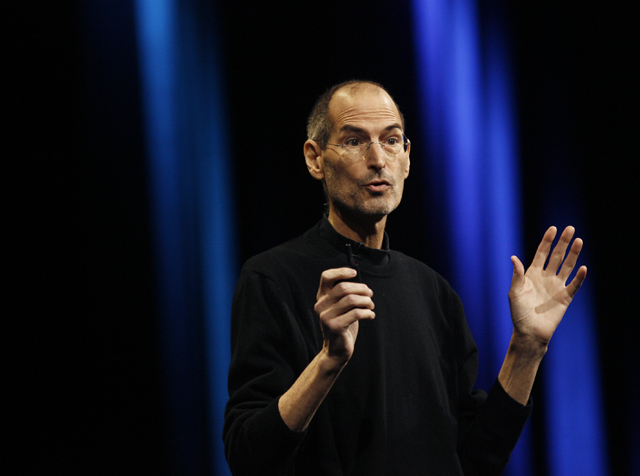
Steve Jobs to the President: “You’re headed for a one-term presidency,”

I have posted a lot about Steve Jobs and I have the links below after this fine aricle:

Lachlan Markay

October 21, 2011 at 12:04 pm

Steve Jobs, the late Apple founder and digital pioneer, told President Obama in a 2010 meeting that his anti-business attitude and enthusiasm for federal regulations could spell doom for his re-election bid, according to an upcoming biography of the iconic entrepreneur.

Jobs specifically cited a number of impediments to job creation and future economic growth, including onerous business regulations and stubborn teachers’ unions preventing reform of the country’s education system.

The Huffington Post, which obtained an advance copy of the book – titled “Steve Jobs” – said the man “seemed to have transformed from a liberal into a conservative.”

“You’re headed for a one-term presidency,” he told Obama at the start of their meeting, insisting that the administration needed to be more business-friendly. As an example, Jobs described the ease with which companies can build factories in China compared to the United States, where “regulations and unnecessary costs” make it difficult for them.

Jobs also criticized America’s education system, saying it was “crippled by union work rules,” noted Isaacson. “Until the teachers’ unions were broken, there was almost no hope for education reform.” Jobs proposed allowing principals to hire and fire teachers based on merit, that schools stay open until 6 p.m. and that they be open 11 months a year.

If Obama did not become more business friendly, Jobs warned, he would be “headed for a one-term presidency.”

Jobs’s legacy, wrote Heritage President Ed Feulner, is antithetical to the president’s approach to governing. The man “was a living refutation of all that liberals constantly tell us about our country,” Feulner wrote.

Related posts:

Steve Jobs left conservative Lutheran upbringing behind

Steve Jobs was raised as a conservative Lutheran but he chose to leave those beliefs behind. Below is a very good article on his life. COVER STORY ARTICLE | Issue: “Steve Jobs 1955-2011″ October 22, 2011 A god of our age Who was Steve Jobs? A revered technology pioneer and a relentless innovator, the Apple […]

Occupy Wall Street vs. Steve Jobs

COUNTER-DEMONSTRATION: At Kappa Sigma house in Fayetteville. The Drew Wilson photo above went viral last night — at least in Arkansas e-mail and social media users — after the Fayetteville Flyer posted it in coverage of an Occupy Northwest Arkansas demonstration in Fayetteville. The 1 percent banner was unfurled briefly on the Kappa Sigma frat […]

Steve Jobs’ Father

(If you want to check out other posts I have done about about Steve Jobs:Some say Steve Jobs was an atheist , Steve Jobs and Adoption , What is the eternal impact of Steve Jobs’ life? ,Steve Jobs versus President Obama: Who created more jobs? ,Steve Jobs’ view of death and what the Bible has to say about it ,8 things you might not know about Steve Jobs ,Steve […]

Steve Jobs at Stanford

(If you want to check out other posts I have done about about Steve Jobs:Some say Steve Jobs was an atheist , Steve Jobs and Adoption , What is the eternal impact of Steve Jobs’ life? ,Steve Jobs versus President Obama: Who created more jobs? ,Steve Jobs’ view of death and what the Bible has to say about it ,8 things you might not know about Steve Jobs ,Steve […]

Steve Jobs depicted at pearly gates with Saint Peter

It is strange that the New Yorker Magazine did no research. (If you want to check out other posts I have done about about Steve Jobs:Some say Steve Jobs was an atheist , Steve Jobs and Adoption , What is the eternal impact of Steve Jobs’ life? ,Steve Jobs versus President Obama: Who created more jobs? ,Steve Jobs’ view of death and what the Bible […]

___________________________

Some say Steve Jobs was an atheist

According to published reports Steve Jobs was a Buddhist and he had a very interesting quote on death which I discussed in another post. Back in 1979 I saw the film series HOW SHOULD WE THEN LIVE? by Francis Schaeffer and I also read the book. Francis Schaeffer observes in How Should We Then Live: The Rise […]

Steve Jobs and Adoption

Steve Jobs’ 2005 Stanford Commencement Address Uploaded by StanfordUniversity on Mar 7, 2008 It was a quite moving story to hear about Steve Jobs’ adoption. Ryan Scott Bomberger (www.toomanyaborted.com), co-founder of The Radiance Foundation, an adoptee and adoptive father: “As a creative professional, [Jobs’] visionary work has helped my own visions become reality. But his […]

What is the eternal impact of Steve Jobs’ life?

I have written several posts on Steve Jobs and they are listed below. Today I want to look at the eternal impact of Steve Jobs’ life. Below are the words of – R. Albert Mohler Jr., president of Southern Baptist Theological Seminary in Louisville, Ky.: “Christians cannot leave the matter where the secular world will […]

Steve Jobs versus President Obama: Who created more jobs?

I loved reading this article below. (Take a look at the link to other posts I have done on Steve Jobs.) David Boaz makes some great observations: How much value is the Post Office creating this year? Or Amtrak? Or Solyndra? And if you point out that the Post Office does create value for its […]

Steve Jobs’ view of death and what the Bible has to say about it

Steve Jobs’ 2005 Stanford Commencement Address Uploaded by StanfordUniversity on Mar 7, 2008 Drawing from some of the most pivotal points in his life, Steve Jobs, chief executive officer and co-founder of Apple Computer and of Pixar Animation Studios, urged graduates to pursue their dreams and see the opportunities in life’s setbacks — including death […]

8 things you might not know about Steve Jobs

Things you may not know about Steve Jobs: Steve Jobs leans against his wife, Laurene Powell Jobs (Lea Suzuki/San Francisco Chronicle/Corbis) For all of his years in the spotlight at the helm of Apple, Steve Jobs in many ways remains an inscrutable figure — even in his death. Fiercely private, Jobs concealed most specifics about […]

Steve Jobs was a Buddhist: What is Buddhism?

Steve Jobs passed away on October 5, 2011. I personally am very grateful to him for helping the world so much with his ideas and I have written about that before. Dan Mitchell of the Cato Institute noted: He’s built a $360 billion company. That presumably means at least $352 billion of wealth in the […]

  Did Steve Jobs help people even though he did not give away a lot of money? (I just finished a post concerning Steve’s religious beliefs and a post about 8 things you may not know about Steve Jobs) Uploaded by UM0kusha0kusha on Sep 16, 2010 clip from The First Round Up *1934* ~~enjoy!! ______________________________________________ In the short film […]

Obama has taken us past most bankrupt European countries already

Over the last 20 or 30 years I have heard conservatives say that it is  a real shame that we are headed towards a bankrupt European liberal socialist kind of state. However, we are now there.

We’re Already Europe

by Michael D. Tanner

Michael Tanner is a senior fellow at the Cato Institute and author of Leviathan on the Right: How Big-Government Conservatism Brought Down the Republican Revolution.

Added to cato.org on February 22, 2012

This article appeared in National Review (Online) on February 22, 2012.

With seemingly every day bringing more bad news from Europe, many are beginning to ask how much longer the United States has before our welfare state follows the European model into bankruptcy. The bad news is: It may already have.

This year, the fourth straight year that we borrowed more than $1 trillion to support the U.S. government, our budget deficit will top $1.3 trillion, 8.7 percent of our GDP. If you think that sounds bad, it’s because it is. In fact, only two European countries, Greece and Ireland, have larger budget deficits as a percentage of GDP. Things are only slightly better when you look at the size of our national debt, which now exceeds $15.3 trillion, 102 percent of GDP. Just four European countries have larger national debts than we do — Greece and Ireland again, plus Portugal and Italy. That means the U.S. government is actually less fiscally responsible than countries like France, Belgium, or Spain.

And as bad as things are right now, we are on an even worse course for the future. If one adds the unfunded liabilities of Social Security and Medicare to our official national debt, we really owe $72 trillion, by the Obama administration’s projections for future Medicare savings under Obamacare, and as much as $137 trillion if you use more realistic projections. Under the best-case scenario, then, this amounts to more than 480 percent of GDP. And, under more realistic projections, we owe an astounding 911 percent of GDP.

At that point does the United States cease being the United States as we have known it?

Meanwhile, counting both official debt and unfunded pension and health-care liabilities, the most indebted nation in Europe is Greece, which owes 875 percent of GDP. That’s right, the United States potentially owes more than Greece. France, the second most insolvent nation in Europe, owes just 549 percent of GDP. Even under the most optimistic scenario, we owe more than such fiscal basket cases as Ireland, Italy, Portugal, and Spain.

So far we have been able to avoid the consequences of our profligate ways because the very public turmoil in Europe has helped prop us up as the world’s safe haven for foreign investment. Compared to the euro’s problems, the dollar looks pretty safe. This means that others are still willing to lend us money at absurdly low rates. But that won’t last forever. In fact, already seven European countries, including Germany and Sweden, have better credit ratings than the U.S.

Perhaps we can take some solace in the fact that our welfare state is not yet as big as Europe’s. But the key word here is “yet.” Today, our federal government spends more than 24 percent of GDP. Throw in state and local spending, and government at all levels consumes over 43 percent of everything produced in this country over the course of a year. As bad as that is, it’s still less than Europe, where the average of government spending at all levels is slightly more than 50 percent of GDP. But the Congressional Budget Office projects that federal-government spending in this country is currently on a path to exceed 42 percent of GDP by 2050. Government spending at all levels will exceed 59 percent of GDP. And CBO assumes state and local spending will decline in the future, which seems unlikely.

By way of comparison, today, Ireland is the only country in Europe with a bigger government than the U.S.’s will be in 2050. That’s right, one can look at countries like France and Greece, or even Denmark and Sweden, and realize that we will eventually have bigger governments than those quintessential welfare states have today.

At that point does the United States cease being the United States as we have known it? At the very least, can our economy survive such a crushing burden of government spending, and its attendant level of taxes and debt?

Given this looming disaster, President Obama has just submitted a budget that explicitly rejects “austerity,” avoids any reform of Medicare or Social Security, and adds some $7 trillion to the national debt over the next ten years….