I wonder what the people would have said if Rutherford Hayes had spent 24.7% of GDP a year? Obama laughs at the thought of Rutherford on Mount Rushmore, but with the economic mess we have now I don’t there is much of a chance that President Obama will end up on there either. Here is an excellent article by Dan Mitchell of the Cato Institute:
But I feel the need to rise to the defense of Rutherford B. Hayes, who was mocked recently by the current President. This Mark Steyn column is a deliciously vicious commentary on Obama’s speech, so no need for me to delve into the details.
Instead, I want to jump on the bandwagon and produce some posters comparing the 19th President and the 44th President (if you’re not aware, posters of Pres. Hayes with self-created captions have been all over the Internet).
You won’t be surprised to learn that I’m focused on the policy differences between Hayes and Obama.
Most important, Hayes largely was true to the Founding Fathers’ vision of a limited central government. Government spending averaged only about 6 percent of economic output during his tenure (probably less, the data are not very robust, so I took the worst-case numbers) and America was blessedly free of the income tax.
The President’s remarks in his State of the Union Address on foreign policy were formulaic. This Address was about domestic policy and, ultimately, about the 2012 election, which the President clearly believes will be won or lost on the basis of his record at home. Unfortunately, that does not absolve him of his responsibility to do more than slot token references on events abroad into his remarks.
All Americans will agree that the death of Osama bin Laden at the hands of American forces is an event to be welcomed and cheered. But bin Laden was not the be all and end all of al Qaeda, and drone strikes – no matter how tactically effective – are not the same thing as a counter-insurgency strategy that works for the long haul. And under Obama, the long haul has gone AWOL. Our departure from Iraq and our impending bug-out from Afghanistan are not events to be celebrated: they are signs of exactly the kind of short-termism that he criticizes in the rest of his address.
Nowhere is this clearer than in Obama’s celebration of the war in Libya, where the improvised U.S. intervention – against the disgusting Qaddafi, a man who met the end he merited – stumbled through to an outcome that its conduct of the war did not deserve. And contrary to the President’s depiction of Libya as a triumph, the war in North Africa is not over: we’re just not paying attention to it any more. As with the President’s condemnation of Iran’s nuclear program, stirring words are standing in for meaningful actions.
What is really striking about the Address is how much it left unsaid. There was a quick mention of the free trade agreements with South Korea, Panama, and Colombia, one of last year’s genuine accomplishments, but no mention of the long opposition to them from the President’s own party. The fraudulent elections in Russia and the on-going collapse of the Euro were similarly missing, except for a brief reference to the President’s determination to make sure that Russia’s abusive behavior doesn’t affect his support for its admission into the World Trade Organization. The President praised the steadfast support of America’s allies in Berlin, Tokyo, and Rio, but his list was telling: Germany didn’t support the NATO mission in Libya, Japan has not so far supported the boycott of Iranian oil, and Brazil has been a stick in the wheel impeding action on Iran.
And, finally, the United Nations and the treaties in which the President invested so much hope in earlier years have disappeared completely. For that we can be thankful, but it points out what the Address as whole conclusively demonstrates: from its start to its end, this Administration has always emphasized domestic policy, and has taken only a sporadic and unserious interest in international affairs.
Thank you so much for your time. I know how valuable it is. I also appreciate the fine family that you have and your committment as a father and a husband.
Sincerely,
Everette Hatcher III, 13900 Cottontail Lane, Alexander, AR 72002, ph 501-920-5733, lowcostsqueegees@yahoo.com
Obama’s Energy Budget: The Antithesis of a Market-Driven Energy Economy – Nicolas Loris
If only entrepreneurs had President Obama’s vision of what technologies are going to be successful and profitable in the future. Sadly, the President’s vision seems to suggest that America’s innovators lack the ingenuity and expertise to meet our country’s needs, leaving the taxpayer to pick up the dropped ball. In a nutshell, that’s President Obama’s fiscal year 2013 Department of Energy (DOE) budget. It completely rejects the notion of a market-based energy industry and wastes taxpayer dollars at a time when we desperately need to curtail out-of-control spending. Whether it’s renewable energy, energy efficiency, nuclear, or fossil fuels, the President’s blueprint is all wrong. Not the Government’s Role to Make Energy Technologies Cost Competitive Each year, the President’s budget has moved further away from basic research and more into commercializing politically preferred technologies.
For instance, the 2013 budget proposes to spend $310 million on the SunShot Initiative, a program to make solar energy cost-competitive without subsidies by 2020. The oxymoronic part of this proposal is that the program itself is a $310 million subsidy. And it’s a perfect example of the President’s attempt to hand over America’s energy economy to the DOE. This is an attempt that’s been tried and failed. And it’s not just solar getting a handout—there’s money for wind, geothermal, biofuels, advanced vehicles, energy efficiency, nuclear energy, and even natural gas. Government has no business trying to make private-sector projects cost-competitive. It’s neither appropriate nor necessary. There’s a robust demand for energy domestically and globally that is met with a wide variety of energy sources. According to analysis by HSBC Holdings PLC, the global market for low-carbon energy and energy efficiency will reach $2.2 trillion in the next decade. That’s all the incentive solar needs. If a technology or a company cannot capture part of that market, it doesn’t deserve to be in business, and it certainly needs no help from the taxpayer. Consumers and Businesses Know How to Save Money Energy efficiency spending programs and legislation have largely enjoyed bipartisan support because the practices of being resourceful and saving money are inherently desired. But it’s because they’re inherently good things that we don’t need government mandates, rebate programs, or spending initiatives to make businesses and homeowners more energy efficient. The President’s overview highlights that “the Budget provides DOE with $290 million to expand R&D on innovative manufacturing processes and advanced industrial materials that will enable U.S. companies to cut the costs of manufacturing by using less energy, while improving product quality and accelerating product development.”
Businesses do not need taxpayer dollars to improve efficiency and cut costs; they make those investments all the time with their own money. Nestle’s newest water bottle uses 60 percent less plastic than the one they first introduced in mid-1990s. Businesses make these investments every day to be more competitive and pass the savings onto consumers to capture a larger market share. Energy efficiency programs take an overly simplistic view of how our economy works and fail to take into account the tradeoffs energy consumers and businesses consider when making decisions. Subsidize One Fossil Fuel, Punish Another? In his State of Union speech, President Obama claimed that our country’s natural gas boom came largely as a result of public funding. While nothing could be further from the truth, the President wants to unnecessarily dump money into an already-booming industry. The budget proposal includes $421 million in fossil energy research and development, including $12 million “aimed at advancing technology and methods to safely and responsibly develop America’s natural gas resources.” Much of the $421 million is subsidies for the fossil fuel industry for research and spending that can be done by the private sector. Most of this funding focuses on technologies that will reduce carbon dioxide emissions. The program includes a clean coal power initiative, research on fuels and power systems to reduce fossil power plant emissions, innovations for existing plants, integrated gasification combined cycle, advanced turbines, carbon sequestration, and natural gas technologies. All of these programs need to go. The Administration proposed a phase-out of fossil fuel subsidies, significantly cutting funding for the Office of Fossil Energy. But the Administration is doing so less because it is good economic policy (which it is) and more to promote an environmental policy of Administration-preferred clean energy sources. When the Administration does talk about eliminating fossil fuel subsidies, they’re not actually removing subsidies but imposing targeted tax hikes on the oil industry by removing broadly available tax deductions. The President’s anti-subsidy rhetoric is on track, but actually defining what’s a subsidy is a different story.
Unsurprisingly, President Obama’s budget proposal for energy is largely a carbon copy of last year’s, with an even stronger government push for renewable energy and energy efficiency programs. It hands DOE unprecedented control over America’s energy economy, which has successfully been driven by the private sector. The DOE budget proposal doesn’t need a scalpel taken to it; it needs a hatchet.
__________________
I believe in the free market and basically if an industry is successful then it will grow and if it is not then it will disappear. It is no place for the federal government to try and re-arrange everything.
On March 19, 2012 Jason Tolbert pointed out that the Democrats in Little Rock were using Obama’s talking points concerning Obamacare, but it appears to me that they go down with the ship according to the mood in the country. Take a look at this fine article from the Cato Institute.
In this article below you will see that the American people do not want Obamacare but yet it is being crammed down their throats and all the regulations that go with that too.
Michael Tanner is a senior fellow at the Cato Institute and author of Leviathan on the Right: How Big-Government Conservatism Brought Down the Republican Revolution.
Never underestimate the brilliance of our federal bureaucracy.
The Department of Health and Human Services has announced that it must delay implementation of new reimbursement codes for Medicare. Those new regulations would have increased the total number of reimbursement codes from the current 18,000 to more than 140,000 separate codes. The delay will undoubtedly come as a relief for physicians who will have additional time to try to understand the bureaucratic complexity of rules that, for example, apply 36 different codes for treating a snake bite, depending on the type of snake, its geographical region, and whether the incident was accidental, intentional self-harm, assault, or undetermined. The new codes also thoroughly differentiate between nine different types of hang-gliding injuries, four different types of alligator attacks, and the important difference between injuries sustained by walking into a wall and those resulting from walking into a lamppost.
And Democrats wonder why Americans still resist having the government control our health care?
Less than a month before the Supreme Court hears arguments on the constitutionality of Obamacare, the American people have already reached their judgment. According to the latest USA Today poll, fully 75 percent of Americans believe the new health-care law’s individual mandate is unconstitutional. And if the Court doesn’t throw Obamacare out, Americans want Congress to do so: Half of voters want the law repealed, compared to 44 percent who want it retained. Moreover, those who want it repealed feel much more intensely about it. Fully 32 percent “strongly support” repeal, compared to just 18 percent who “strongly oppose” it. This is consistent with other polls — for example, the latest Rasmussen poll has 53 percent of likely voters supporting repeal, with just 38 percent opposed — and virtually unchanged since the law passed.
[F]ully 75 percent of Americans believe the new health-care law’s individual mandate is unconstitutional.
Despite constant predictions by the media and the laws supporters, Obamacare is not becoming more popular.
The public seems to understand that government intervention does not generally make things less expensive. And there are good reasons for the public’s skepticism. For example, the Congressional Budget Office reported in December that at least six programs that were supposed to save money under Obamacare not only don’t, but some actually are increasing costs. And Jonathan Gruber, one of the architects of both Obamacare and its precursor Romneycare, now says that premiums are likely to rise under the new health-care law. In fact, Gruber warns that, even after receiving government subsidies, some individuals will end up paying more than they would have without the reform. Gee, thanks, Mr. President.
And the public understands that imposing new taxes, mandates, and regulations will do nothing to create jobs in a struggling economy. In fact, a poll released last month by the Chamber of Commerce showed that for 74 percent of small businesses they’re “causing an impediment to job creation.”
At the same time, the controversy over the administration’s contraception mandate has brought home to voters just how coercive the health-care law really is.
Most of all, Americans understand that, from the beginning, the debate over health-care reform has been about control. The Obama administration believes that decisions about health care are simply too important and too complex for the average American and his doctor to make for themselves. Only the experts in Washington can get those decisions right. After all, only Washington can understand the difference between a burn from a hot toaster (Code No. X15.1) and a burn from an electronic-game keyboard (Code No. Y93.C1).
Unfortunately for the Obama administration, the American people just don’t believe them.
I am an avid reader of the National Review and I remember watching those famous debates at Harvard between John Kenneth Galbraith and William Buckley. You probably were at some of those debates. Below is a portion of an article that talks about your recent State of the Union address:
RICHARD VEDDER
While it took President Obama only five minutes into the State of the Union address before he started bashing the rich, Wall Street, and the Chinese, he actually muted his confrontational approach as compared with other recent efforts. Still, it was a typical overlong speech, overstating accomplishments and ignoring negatives. Five examples of the latter: he misstated and dramatically downplayed his failure to stimulate the economy, claiming 3 million new jobs when in fact employment is lower than when he took office.
Second, there was hardly a word about health care, given fierce public opposition to Obamacare.
Third, he spoke about student-loan debt before even mentioning the national debt, where he renewed his tired and empirically indefensible solution of taxing the rich.
Fourth, he announced the Defense Department would push clean energy and somehow we would produce lots of clean energy on federal lands, but ignored the damage created by bowing to environmental Know-Nothing policies that have nixed the Keystone pipeline project and other energy initiatives.
Lastly, he uttered not a word about the huge long-term unfunded liabilities arising from unsustainable entitlement commitments like Social Security and Medicare. In short, it was a tale full of sound and fury, signifying nothing.
— Richard Vedder directs the Center for College Affordability and Productivity, is an adjunct scholar at the American Enterprise Institute, and teaches at Ohio University
Thank you so much for your time. I know how valuable it is. I also appreciate the fine family that you have and your committment as a father and a husband.
Sincerely,
Everette Hatcher III, 13900 Cottontail Lane, Alexander, AR 72002, ph 501-920-5733, lowcostsqueegees@yahoo.com
In the debate of job creation and how best to pursue it as a policy goal, one point is forgotten: Government doesn’t create jobs. Government only diverts resources from one use to another, which doesn’t create new employment.
Video produced by Caleb Brown and Austin Bragg.
___________________________
I have said that the stimulus did not work, but the liberals always responded that it needed to be bigger. Who was right? Now the most liberal paper in the country has weighed in on this.
Does unprecedented deficit-spending such as on highways stimulate the economy? For the last few years, some have argued it could. Some have argued it might. Some have argued it would if done right.
We have consistently argued that deficit spending on highways or anything else intended to lift aggregate demand, and therefore jobs, must and would fail. The economic evidence that we were right has now been joined by the illustrious trio of The Washington Post, the Associated Press, and the esteemed Alice Rivlin, former director of the Congressional Budget Office and the Office of Management and Budget.
Notice especially the subject of the piece: federal highway spending. If ever there was a sympathetic topic for stimulus, it is infrastructure spending, especially highway funding. Remember, these were some of President Obama’s “shovel-ready” projects that turned out to be not so shovel ready, as he later admitted.
So what went wrong? Why is this not short-term stimulus? The widely respected Rivlin explained it clearly and succinctly: “Investments in infrastructure, if well designed, should be viewed as investments in future productivity growth.”
Exactly right—future productivity growth.
She went on to say that if investments in infrastructure “speed the delivery of goods and people, they will certainly do that. They will also create jobs, but not necessarily more jobs than the same money spent in other ways.”
Exactly right—a dollar spent is a dollar spent. A job gained here, a job lost there.
This speaks to a longstanding flaw of highway spending arguments. Proponents argue that this spending creates tens of thousands of jobs, and they are half right. The other half is the tens of thousands of jobs not created (or saved) by shifting spending to highways from other areas in the economy. The valid argument about infrastructure spending is: If done right, it will lift future productivity growth, not current job growth.
The central failing—the essential fiscal alchemy of Keynesian stimulus—is the belief that government can increase total spending in the economy by borrowing and spending. What Keynesians ignore is that we have financial markets whose job in good times and bad is first and foremost to shift funds from savers to investors, from those who have money they do not wish to spend today to those who have a need to borrow to spend as much as they’d like, whether on new business equipment, a home, or a car.
There are no vast sums of “excess funds” just sitting around in bank tellers’ drawers waiting for government to borrow and spend them. Government borrowing means less money available to the private sector to spend. So government deficit spending goes up, and dollar-for-dollar private spending goes down. America’s resources are generally speaking spent less wisely, and the federal debt is unequivocally higher.
If past is prologue, the current infatuation with Keynesian deficit spending as stimulus will fade, just as it always has in the past, in this country as elsewhere. Perhaps this simple WaPo article marks the beginning of the end for the latest incarnation of this fiscal folly.
http://blog.heritage.org | Today marks the 1,000th day since the United States Senate has passed a budget. While the House has put forth (and passed) its own budget, the Senate has failed to do the same. To help illustrate how extraordinary this failure has been, our new video highlights a few of impressive feats in history that have been accomplished in less time.
President Obama c/o The White House
1600 Pennsylvania Avenue NW
Washington, DC 20500
I have to be frank and it seems that this budget proposal presented on 2-13-2012 to Congress was just an attempt by a President to get himself re-elected by promising a lot of free lunches to a lot of special interest groups.
In his recent State of the Union address, President Obama said that he wanted an American economy that is “built to last.” Today’s release of his fiscal 2013 budget proposal shows that the president still thinks he can build economic prosperity with more spending, taxes, and debt. Those are the building materials for an economic time-bomb that will explode on future generations.
The following charts show that federal spending and debt as a share of the economy would remain at elevated levels under the president’s budget proposal:
Given that policymakers always seem to find an excuse to spend more money than was planned – and that there are virtually no limits on what the government can spend money on – these figures could prove to be optimistic.
So forget about the president’s cheap sloganeering about “investing in our future.” And ignore the double-talk about “re-establish[ing] fiscal responsibility.” The fact is the president is proposing to spend $47 trillion dollars over the next ten years – almost $6 trillion of which would go toward interest on the debt alone. This budget isn’t about creating an economy that’s built to last – it’s about keeping the president’s Democratic constituencies satisfied in November and selling voters on the impossible promise of more free lunches.
Thank you so much for your time. I know how valuable it is. I also appreciate the fine family that you have and your committment as a father and a husband.
Sincerely,
Everette Hatcher III, 13900 Cottontail Lane, Alexander, AR 72002, ph 501-920-5733, lowcostsqueegees@yahoo.com
Source of Slow Recovery: Obama and His Policies – J.D. Foster
Once again we are reminded — President Obama inherited an economy in recession. Right. But the recession ended in June of 2009. This fact leads to three important conclusions.
First, it means the recession’s end occurred independent the big stimulus bill Obama signed in the previous February. Three months of a gradually implemented stimulus is insufficient time to have a noticeable effect.
Second, thirty one months have passed since recession’s end, which leads to, third, an economy that is muddling along at around 2 percent growth should by this time be expanding nearly twice that rate.
No, special circumstances cannot explain the anemic recovery. Yes, the housing sector is still struggling. Yes, the Japanese tsunami disrupted our economy and theirs. But the real reason for the weak recovery is the debilitating uncertainty permeating the economy, much of it emanating from the White House. This uncertainty is captured well in the Economic Policy Uncertainty Index.
As its name implies, the Index reflects the extent of uncertainty about federal economic policy and its consequences. The Index value today of 277 is almost twice what it averaged in the past decade. That means there’s a lot of uncertainty dragging on the economy.
The prescription for a stronger economy is simple – do less harm, and so cut the policy uncertainty: don’t raise or threaten to raise taxes; call time out on new regulations; cut spending; and begin to turn unaffordable, inadequate entitlement programs into affordable, reliable, enduring systems.
_____________________
Mr. Foster has it right. If you want the economy to improve then don’t raise taxes and stop new regulations and CUT SPENDING!!!!!
Thank you so much for your time. I know how valuable it is. I also appreciate the fine family that you have and your committment as a father and a husband.
Sincerely,
Everette Hatcher III, 13900 Cottontail Lane, Alexander, AR 72002, ph 501-920-5733, lowcostsqueegees@yahoo.com
In a night of disappointments, the complete lack of any mention of Social Security other than as an excuse to raise taxes was one of the greatest. Although the Social Security trustees, several of whom are members of the President’s cabinet, has warned that the program faces perpetual deficits, the President evidently has no plan to protect the retirement security of millions of Americans who face a 25% benefit cut in less than 25 years. Most officeholders join the President in treating Social Security as an issue that can be discussed later – much later, but the reality is that just like a leaky roof, the longer that the President and Congress waits to fix the program, the more expensive the reforms will be.
Tax Reform? It’s Needed, but There’s A Better Way to Go – Emily Goff
President Obama says he is ready and willing to embark on tax reform. This is a welcome statement, as our current tax system is ripe for overhaul. However, instead of piecemeal approaches or solutions that give preferences to one industry or company over another, the President should look to the fundamental reforms that the New Flat Tax, as part of The Heritage Foundation’s Saving the American Dream, would bring.
Obama Doubles Down on the Worst U.S. Tax Policy – J.D. Foster
One of the universally acknowledged banes of the federal income tax has for years been the individual Alternative Minimum Tax. Borne in its current form in the 1986 tax reform act, this parallel system which runs in parallel to the regular income tax forces taxpayers to calculate their taxes twice and pay the larger of the two.
Today, this tax makes no sense, and most tax reform proposals of sufficient heft seek as a primary goal the repeal of the AMT. Tonight, President Obama proposed not merely to embrace the AMT in principle, but to extend the principle robustly to the business income tax – to create a new basic minimum tax for businesses. Once again, when it comes to tax policy, President Obama sees what needs to be done – and does the exact opposite.
___________________
Got to tackle entitlement reform but your speech did not mention that once.
Thank you so much for your time. I know how valuable it is. I also appreciate the fine family that you have and your committment as a father and a husband.
Sincerely,
Everette Hatcher III, 13900 Cottontail Lane, Alexander, AR 72002, ph 501-920-5733, lowcostsqueegees@yahoo.com
I wondered why President Obama was claiming that he was not increasing regulations as much as Bush did. However, the real truth coming out in this article below:
President Obama famously declared in this year’s State of the Union: “I’ve approved fewer regulations in the first three years of my presidency than my Republican predecessor did in his.” Heritage’s James Gattuso and Diane Katz have run the numbers. And Obama shouldn’t be bragging.
Obama’s comparison encompassed all regulations, including federal rules for such things as Medicare rates, migratory birds and fireworks safety. And on that point, he was telling the truth.
This week’s chart tests Obama’s claim by looking at the number of major regulations imposed by each administration. Major regulations, as defined by the government, are regulations that cost up to $100 million or more each year.
In his first three years of presidency, President George W. Bush imposed 28 major regulations at a cost of $8.1 billion. Obama imposed 106 major regulations at a cost of $46 billion.
“This is almost four times the number—and more than five times the cost—of the major regulations issued by George W. Bush during his first three years,” according to the report.
Gattuso and Katz’s report, Red Tape Rising, documents how the Obama administration has greatly increased government regulations.
A few notable findings from the report:
A majority of the major regulations came as a consequence of the Dodd-Frank financial regulation law, Obamacare and the EPA’s global warming crusade.
The report used information given by the agencies that have no incentive to report accurately, so the costs estimated are understated, giving agencies the benefit of the doubt.
More regulations are looming. Obamacare is imposing rules faster than the regulators can write them.
In order to help the economy and put a stop to regulations, Katz and Gattuso suggest three prongs of strong oversight: approval of new major regulations by Congress, a congressional Office of Regulatory Analysis, and sunset dates for existing regulations.
Katz spoke about the report at The Bloggers Briefing, which is available on Livestream and BlogTalkRadio.

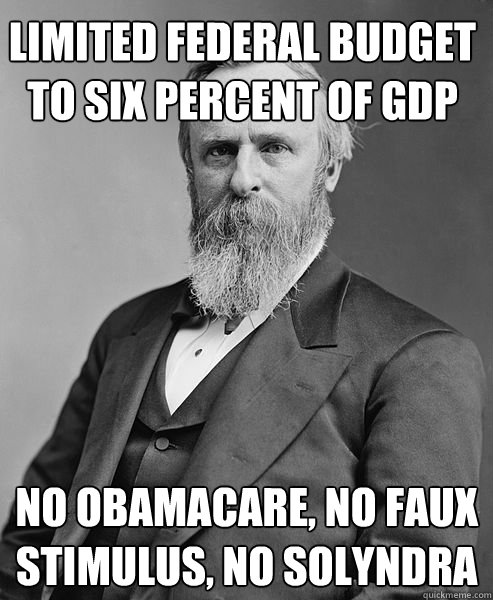
 You won’t be surprised to learn that I’m focused on the policy differences between Hayes and Obama.


