Category Archives: President Obama

Dan Mitchell: Rex Nutting’s recent claim that Obama is not a big spender is false

Dan Mitchell explains in the above video that Europe can grow and prosper, but only if politicians are willing to reduce the burden of government spending and lower tax rates.

_____________

I have a lot of respect for Tea Party heroes like Tim Huelskamp , Idaho First District Congressman Raúl R. Labrador, and Justin Amash who are willing to propose deep spending cuts so we can eventually balance our budget.  

It is a fact that we must balance the budget soon. I do not believe that we can wait to balance the budget at some distant time in the future. The financial markets will not allow us a long time to get our house in order. Look at how things have been going the last four years and no matter how anyone tries to spin it, we are going down the financial drain fast.

A financial columnist named Rex Nutting recently triggered a firestorm of controversy by claiming that Barack Obama is not a big spender.
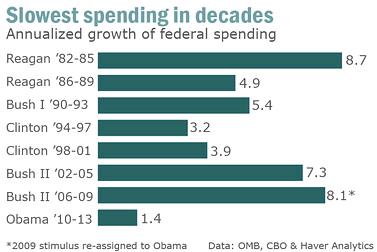
Here’s the chart he prepared, which certainly seems to indicate that Obama is a fiscal conservative. Not only that, it shows that Republicans generally are the big spenders, while Democrats are frugal with other people’s money.

In some ways, these numbers don’t surprise me. I’ve explained before that Bush bears a lot of blame for the big expansion in the burden of government this century, and I’ve specifically pointed out that he deserves the blame for most of the higher spending from the 2009 fiscal year (which began October 1, 2008).

That being said, Nutting’s numbers seemed a bit nutty. Sorry, couldn’t resist. Nutting’s numbers actually seem accurate, including the fact that he decided that Obama should be responsible for $140 billion of the spending in Bush’s last fiscal year (a number he may have taken from one of my posts).

But sometimes accurate can be misleading, so I decided to dig into the data.

I went to the Historical Tables of the Budget from the Office of Management and Budget, and I calculated all the numbers for every President since LBJ (with the exception of Gerald Ford, whose 2-year reign didn’t seem worth including).

But I corrected a big mistake in Nutting’s analysis. I adjusted the numbers for inflation, using OMB’s GDP deflator.

As you can see, this changes the results. My chart isn’t as pretty, but based on the inflation-adjusted average annual growth of outlays, it shows that Clinton was the most frugal president, followed by the first President Bush and Obama.

With his guns-n-butter Keynesianism, it’s no big surprise that LBJ ranks last. And “W” also gets a very low grade.

But then I figured we should take interest payments out of the budget and focus on inflation-adjusted “primary spending.” After all, Presidents shouldn’t be held responsible for the national debt that existed before they took office.

Looking at these numbers, it turns out that Obama does win the prize for being the most fiscally conservative president in recent memory. Reagan jumps to second place. Clinton is in third place, which won’t surprise people who watched this video, while W and LBJ again are in last place.

But I don’t want my Republican friends to get too angry with me, so let’s expand our analysis. Just as we don’t want to blame Presidents for net interest payments on debt that was accrued before their tenure, perhaps we should make sure they don’t get credit or blame for defense outlays that often are dictated by external events.

There’s obviously room for disagreement, but most people will agree that the Cold War and 9/11 meant higher defense spending, regardless of which party controlled the White House. Similarly, the collapse of the Soviet Empire inevitably meant lower military expenditures, regardless of whether Republicans or Democrats were in charge.
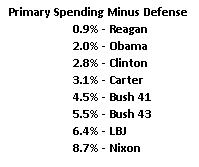
So let’s now look at primary spending after subtracting defense outlays (still adjusting for inflation, of course). All of a sudden, Reagan jumps to the top of the list by a comfortable margin. LBJ and W continue to score poorly, but Nixon takes over last place.

But it’s also worth noting that Obama still scores relatively well, beating Clinton for second place. Inflation-adjusted domestic spending (which is mostly what we’re measuring) has grown by 2.0 percent annually during his three years in office.

So does that mean Obama deserves re-election? Well, before you answer, I want to make one final calculation. Just as there are good reasons to exclude interest payments because they’re not something a president can control, we also should take a look at what spending would be if we don’t count the cost of bailouts.

To be sure, these types of expenditures can be controlled, but if we go with the assumption that the federal government was going to re-capitalize the banking system (whether using the good FDIC-resolution approach or the corrupt TARP approach), then it seems that Presidents shouldn’t get arbitrary blame or credit simply because some financial institutions failed during their tenure.

So let’s take the preceding set of numbers and subtract out the long-run numbers for deposit insurance, as well as the TARP outlays since 2009. And keep in mind that repayments of TARP monies (as well as deposit insurance premiums) show up in the budget as “negative spending.”

As you can see, this produces a remarkable result. All of a sudden, Obama drops from second to second-to-last.

This is because there was a lot of TARP spending in Bush’s last fiscal year (FY2009), which created an artificially high benchmark. And then repayments by banks during Obama’s fiscal years counted as negative spending.

When you subtract out the big TARP spending surge, as well as the repayments, then Bush 43 doesn’t look quite as bad (though still worse than Carter and Clinton), while Obama takes a big fall.

In other words, Obama’s track record does show that he favors an expanding social welfare state. Outlays on those programs have jumped by 7.0 percent annually. And that’s after adjusting for inflation! Not as bad as Nixon, but that’s not saying much since he was one of America’s most statist presidents.

Allow me to conclude with some caveats. None of the tables perfectly captures what any president’s fiscal record. Even my first table may be wrong if you want to blame or credit presidents for the inflation that occurs on their watch. And there certainly are strong arguments that bailout spending and defense spending are affected by presidential policies rather than external events.

And keep in mind that presidents don’t have full power over fiscal policy. The folks on Capitol Hill are the ones who actually enact the bills and appropriate the money.

Moreover, the federal government is akin to a big rusty cargo ship that is traveling in a certain direction, and presidents are like tugboats trying to nudge the boat one way or the other.

But enough equivocating. The four different tables at least show more clearly which presidents presided over faster-growing government or slower-growing government. More importantly, the various tables provide a good idea of where most of the new spending was taking place.

We can presumably say Reagan and Clinton were comparatively frugal, and we can also say that Nixon, LBJ, and Bush 43 were relatively profligate. As for Obama, I think his tugboat is pushing in the wrong direction, but it’s only apparent when you strip out the distorting budgetary impact of TARP.

Related posts:

Some Tea Party heroes (Part 1)

DEBT LIMIT – A GUIDE TO AMERICAN FEDERAL DEBT MADE EASY. Uploaded by debtlimitusa on Nov 4, 2011 A satirical short film taking a look at the national debt and how it applies to just one family. Watch the guy from the Ferris Bueller Superbowl Spot! Produced by Seth William Meier, DP/Edited by Craig Evans, […]

Some Tea Party heroes (Part 2)

Congressmen Tim Huelskamp on the debt ceiling I just don’t understand why people think we can go on and act like everything is okay when we have a trillion dollar deficit. Sometimes you run across some very wise words like I did the other day. Kansas Congressman Tim Huelskamp made the following comment on the […]

 

California has forgotten the lessons of Ronald Reagan

If our country is the grow the economy and get our budget balanced it will not be by raising taxes!!! The recipe for success was followed by Ronald Reagan in the 1980’s when he cut taxes and limited spending. As far as limiting spending goes only Bill Clinton (with his Republican Congress) were ability to control the growth of government better than Reagan.

I had the pleasure of hearing Arthur Laffer speak in 1981 and he predicted all the economic growth that we would see because of the Reagan tax cuts and he was right. Unfortunately in California today they have forgotten all of those lessons!!!

President Obama’s fiscal policy is a dismal mixture. On spending, he wants a European-style welfare state. On taxes, he is fixated on class-warfare tax policy.

If we want to know the consequences of that approach, we can look at the ongoing collapse of Greece. Or, if we don’t like overseas examples, we can look at California.

If the (formerly) Golden State is any example, it turns out that having high tax rates doesn’t necessarily translate into high tax revenues. Here’s a blurb from an editorial in today’s Wall Street Journal.

California Controller John Chiang reported last week that April tax collections were a gigantic 20.2%, or $2.44 billion, below 2012-13 budget projections. …Among the biggest surprises is a 21.5% or nearly $2 billion decline in personal income tax payments from what Governor Jerry Brown had anticipated. This reinforces the point that when states rely too heavily on the top 1% of taxpayers to pay the bills, fiscal policy is a roller coaster ride. California is suffering this tax drought even as most other states enjoy a revenue rebound. State tax collections were up nationally by 8.9% last year, according to the Census Bureau, and this year revenues are up by double digits in many states. The state comptroller reports that Texas is enjoying 10.9% growth in its sales taxes (it has no income tax), while California can’t seem to keep up despite one of the highest tax rates in the land.

The WSJ editorial suggests a supply-side response, but you won’t be surprised to learn that the state’s kleptomaniac governor is pushing an Obama-style soak-the-rich tax hike.

This would seem to suggest that California should try cutting tax rates to keep more people and business in the state, but Sacramento is intent on raising them again. Governor Brown and the public-employee unions are sponsoring a ballot initiative in November to raise the state sales tax by a quarter point to 7.5% and to raise the top marginal income-tax rate to 13.3% from 10.3%. This will make the state even more reliant on the fickle revenue streams provided by the rich. Meanwhile, an analysis by Joseph Vranich, who studies migration of businesses from one state to another, finds that since 2009 the flight of businesses out of California “has increased fivefold due to high taxes and regulatory costs.”

I’ll be very curious to see what happens this November when the people of California vote in the referendum. Will they be like the morons in Oregon, who approved a class-warfare tax hike? Or will they be like the voters of Switzerland and reject class warfare?

Sadly, I suspect Oregon will be their role model – even though that decision hurt the Beaver State’s economy.

But while voters can impose higher taxes, they can’t repeal the laws of economics. So if California voters do the wrong thing, they will learn a hard lesson about the Laffer Curve.

And then, as this cartoon demonstrates, they’ll learn the ultimate lesson about not biting the hand that you mooch from.

The Laffer Curve, Part III: Dynamic Scoring

Don’t fear the Free Market like Obama wants you to

Michael Savage May 17 2012 hr 3 segment 3.wmv

Published on May 17, 2012 by

The Savage Nation

Savage guest Mark Calabria from the Cato Institute discusses J P Morgan in this segment.

www.cato.org

_________________

The free market works much better than federal officials do. Take a look at how how our money is managed every year by the federal government. The federal government has 2.1 trillion coming in and 3.6 trillion going out!! I sincerely hope the federal government will stay out of Wall Street business!!! TARP was a joke and it ended up with a government takeover of GM.

Mike Brownfield

May 15, 2012 at 8:55 am

The lingering headline on the front pages this week is that JP Morgan Chase suffered a massive loss on a hedging strategy, costing them $2 billion. That’s no small mistake, and it’s an example of how bad decisions in the free market can cost big money. But just because mistakes have consequences doesn’t mean that the mighty hand of government needs to step in to save us from ourselves. However, that’s what some on the left are now calling for.

The news of this blunder hit last week when JP Morgan CEO Jamie Dimon revealed that the bank took a $2 billion loss over the past six weeks in a strategy intended to hedge against risks to the bank’s assets that could come from market volatility caused by the Euro crisis. On Sunday’s Meet the Press, Dimon admitted, “In hindsight, we took far too much risk. The strategy we had was badly vetted. It was badly monitored. It should never have happened.”

The company is certainly paying the price in losses, as are those responsible for the bad decision making. The Los Angeles Times reports that the bank’s stock fell 12% since it disclosed the loss last week, the executive who oversaw the department responsible for the loss retired on Monday, and JP Morgan’s reputation as an extremely well managed bank has been damaged.

But does the flawed strategy and the resulting loss mean that Washington should step in with more regulation of Wall Street? Yesterday, White House press secretary Jay Carney used the news of JP Morgan’s loss to call for more regulations, remarking, “The president fought very hard against Republicans and Wall Street lobbyists to get Wall Street reform passed . . . I think that this event merely reinforces why the President was right to take on this fight and why we still need to make sure it’s implemented.”

Likewise, former Obama adviser Elizabeth Warren called for Dimon to resign from the New York Federal Reserve Board and slammed Wall Street. “What happened here is not just about JP Morgan case, it’s about the kind of attitudes, that the bank should be regulating themselves instead of having real oversight,” Warren said. “We have to say as a country, no, the banks cannot regulate themselves.”

What’s needed is some perspective, not more regulation from Washington. Heritage’s David C. John explains that while JP Morgan’s loss represents a clear failure of management, it’s not a systemic problem that requires or would be fixed by additional regulation. For starters, JP Morgan is a $2.3 trillion bank with a net worth of $189 billion, meaning that this loss reduced the bank’s capital ratio from 8.4 percent to 8.2 percent. In other words, the bank can absorb the loss, and it’s nowhere close to needing any form of federal intervention.

Some more perspective could be gleaned by examining the $3.2 billion loss the U.S. Post Office experienced in the most recent quarter, or the billions lost on risky green energy bets made by President Obama and Energy Secretary Steven Chu. Only those losses weren’t incurred by private investors, but by you the taxpayer.

What’s more, John explains, the regulations that are now being called for — particularly the so-called Volcker Rule — would not have prevented the losses since it would not have affected this transaction. Finally, John writes, the system worked as is. “JPMorgan Chase losses were not discovered by regulators; they were discovered by the bank itself conducting its own management reviews.”

What America is witnessing is the left using the news of JP Morgan’s bad judgment as an excuse for more government regulation. But as even Carney acknowledged, regulations “can’t prevent bad decisions from being made on Wall Street.”

For all the wrangling over JP Morgan’s loss, John points out that the bank is still expected to make a healthy profit for all of 2012. Yes, it made a mistake, and yes, that mistake cost a lot of money. But risks, mistakes and costs are part of capitalism. They’re the price we pay for all the benefits that a free market affords us.

Open letter to President Obama (Part 84.3)

President Obama c/o The White House
1600 Pennsylvania Avenue NW
Washington, DC 20500

Dear Mr. President,

I know that you receive 20,000 letters a day and that you actually read 10 of them every day. I really do respect you for trying to get a pulse on what is going on out here.

Great post from Dan Mitchell:

This image really captures the essence of the issue. Share this with your statist friends and maybe they’ll begin to understand.

Thank you so much for your time. I know how valuable it is. I also appreciate the fine family that you have and your commitment as a father and a husband.

Sincerely,

Everette Hatcher III, 13900 Cottontail Lane, Alexander, AR 72002, ph 501-920-5733, lowcostsqueegees@yahoo.com

Review of Carl Sagan book (Part 4 of series on Evolution)

Review of Carl Sagan book (Part 4 of series on Evolution)

The Long War against God-Henry Morris, part 5 of 6

Uploaded by  on Aug 30, 2010

I got this from a blogger in April of 2008 concerning candidate Obama’s view on evolution:

Q: York County was recently in the news for a lawsuit involving the teaching of intelligent design. What’s your attitude regarding the teaching of evolution in public schools?

A: “I’m a Christian, and I believe in parents being able to provide children with religious instruction without interference from the state. But I also believe our schools are there to teach worldly knowledge and science. I believe in evolution, and I believe there’s a difference between science and faith. That doesn’t make faith any less important than science. It just means they’re two different things. And I think it’s a mistake to try to cloud the teaching of science with theories that frankly don’t hold up to scientific inquiry.”

This is a review I did a few years ago.

THE DEMON-HAUNTED WORLD: Science as a Candle in the Dark by Carl Sagan. New York: Random House, 1995. 457 pages, extensive references, index. Hardcover; $25.95.
PSCF 48 (December 1996): 263.
Sagan is the David Duncan Professor of Astronomy and Space Sciences at Cornell University. He is author of many best sellers, including Cosmos, which became the most widely read science book ever published in the English language.
In this book Sagan discusses the claims of the paranormal and fringe-science. For instance, he examines closely such issues as astrology (p. 303), crop circles (p. 75), channelers (pp. 203-206), UFO abductees (pp. 185-186), faith-healing fakes (p. 229), and witch-hunting (p. 119). Readers of The Skeptical Inquirer will notice that Sagan’s approach is very similar.
Sagan writes:
The Committee for the Scientific Investigation of Claims of the Paranormal is an organization of scientists, academics, magicians, and others dedicated to skeptical scrutiny of emerging or full-blown pseudo-sciences. It was founded by the University of Buffalo philosopher Paul Kurtz in 1976. I’ve been affiliated with it since its beginning. Its acronym, CSICOP, is pronounced Asci-cop C as if it’s an organization of scientists performing a police function Y CSICOP publishes a bimonthly periodical called AThe Skeptical Inquirer. On the day it arrives, I take it home from the office and pore through its pages, wondering what new misunderstandings will be revealed (p. 299).
Sagan points out that in 1991 two pranksters in England admitted that they had been making crop figures for 15 years. They flattened the wheat with a heavy steel bar. Later on they used planks and ropes, but the media paid brief attention to the confession of these hoaxers. Why? Sagan concludes, ‘Demons sell; hoaxers are boring and in bad taste’ (p. 76).
Christians must admire Sagan’s commitment to critical thinking, logic, and freedom of thought. He takes on many subjects in this book, and the vast majority of his analysis is exceptional. However, his opinions on religious matters are affected by his devotion to scientism. Sagan believes only that which can be proved by science is true. He disputes psychologist Charles Tart’s assertion that scientism is ‘dehumanizing, despiritualizing’ (p. 267). Sagan comments, ‘There is very little doubt that, in the everyday world, matter (and energy) exist. The evidence is all around us. In contrast, as I’ve mentioned earlier the evidence for something non-material called `spirit’ or `soul’ is very much in doubt’ (p. 267).
Science can only prove things about the physical world, and it cannot prove anything about the spiritual world. Does that mean that the mind and soul don’t exist? Of course not! First, we must realize that science is not the only way to truth. Even Sagan must admit that he must justify values like ‘be objective’ or ‘report data honestly’. Where do those values come from? They came from outside science, but they must be in place for science to work.
Sagan gives an illustration that contrasts physics and metaphysics. He shows that the physicist’s idea will have to be discarded if tests fail in the laboratory. Therefore, the main difference between physics and metaphysics is that the metaphysicist has no laboratory. This is a cute story, but can science answer the basic questions that underline all knowledge? Metaphysics is necessary for science to take place. It is not true that science is superior to metaphysics like Sagan would have us believe. The presuppositions of science can only be validated by philosophy. J. P. Moreland has correctly said, ‘The validation of science is a philosophical issue, not a scientific one, and any claim to the contrary will be a self-refuting philosophical claim’ (Scaling the Secular City, p. 197).
Second, the absence of scientific evidence for the soul does not mean the soul does not exist. Sagan himself states,’Absence of evidence is not evidence of absence’ (p. 213).
I was impressed with the way Sagan put his inner thoughts on the table. For instance, he comments, ‘Plainly, there’s something within me that’s ready to believe in life after death…If some good evidence for life after death was announced, I’d be eager to examine it; but it would have to be real scientific data, not mere anecdote’ (pp. 203-204). What kind of evidence is Sagan looking for? It certainly is not vague prophecies. He states, ‘Think of how many religions attempt to validate themselves with prophecy…Think of how many people rely on these prophecies, however vague, however unfulfilled, to support or prop up their beliefs…Yet has there ever been a religion with the prophetic accuracy and reliability of science? (p. 30). The answer to that question is yes. Christianity can point to very clear passages such as Isaiah 53 and Daniel 11 written hundreds of years before the events occurred.
While comparing science to religion, Sagan comments, ‘Science is far from a perfect instrument of knowledge. It’s just the best we have (pp. 27-28). Here Sagan is only half right. Science is imperfect, but it is not better than the Bible.’
The Demon-Haunted Worldis a thought-provoking book that I thoroughly enjoyed. Some of Sagan’s anti-Christian views come through, but on the whole, this book uses critical thinking and logic and applies them to the claims of the paranormal and fringe-science of our day.
Reviewed by Everette Hatcher III, P.O. Box 23416, Little Rock, AR 72221.

Other posts that relate to Carl Sagan:

Atheist says “It’s not about having a purpose in life..” (Arkansas Atheist, Part 1)

The Bible and Archaeology (1/5) The Bible maintains several characteristics that prove it is from God. One of those is the fact that the Bible is accurate in every one of its details. The field of archaeology brings to light this amazing accuracy. _________________________- I want to make two points today. 1. There is no […]

Ancient Sea Monsters (A Creationist point of view Part 3)

Leviathan: the Fire-Breathing Dragon: Kent Hovind [6 of 7] Everybody is trying to get info on this subject. Here is what the Bible has to say about it. Mace Baker wrote the aritcle, “Sea Dragons – The Institute for Creation Research,” and here is the third portion of that article:  Pterosaurs were the flying reptiles of the ancient world. Why […]

By Everette Hatcher III | Posted in Current Events | Edit | Comments (0)Other posts concerning Carl Sagan:

Atheists confronted: How I confronted Carl Sagan the year before he died

In today’s news you will read about Kirk Cameron taking on the atheist Stephen Hawking over some recent assertions he made concerning the existence of heaven. Back in December of 1995 I had the opportunity to correspond with Carl Sagan about a year before his untimely death. Sarah Anne Hughes in her article,”Kirk Cameron criticizes […]

Should Christians support Obama’s re-election?

1 Of 5 / The Bible’s Influence In America / American Heritage Series / David Barton

2 Of 5 / The Bible’s Influence In America / American Heritage Series / David Barton

We need to see more Christian values in our government.

SBC leader questions judgment of Christians who support Obama

By Bob Allen

1-30-12

NASHVILLE, Tenn. (ABP) – The Southern Baptist Convention’s top public-policy expert says that Christians who still support President Obama are not using their heads.

Richard Land, president of the SBC Ethics and Religious Liberty Commission, said on the Jan. 28 broadcast of Richard Land Live that while he believes Obama faces an uphill battle for re-election, he is surprised that so many Christians still back the president.

“I know Christians who support Obama,” Land said. “I don’t question their faith, but I do question their judgment.”

Land said the Obama administration has waged a “full-fledged war to move us from freedom of religion to merely freedom of worship, implying that one’s faith is only a private matter and that exercising that faith in public is not a protected right.”

Land called a new rule requiring insurance plans to cover birth control — including those paid for by religious employers that believe artificial birth control is a sin — a “horrible decision” that poses a problem not just for faiths that object to birth control.

“Will our religious affiliated groups be forced to hire people who oppose our faith?” he asked. “Will the government force a curriculum on our schools and our homeschoolers? Just a few years ago these possibilities seemed beyond the realm of possibility. Now they seem very real.”

Land said people who claim to be conservative, evangelical Christians “are exercising very poor judgment” if “they continue to support a president who is squelching their religious freedoms.” The reason it happens, he said, is that “people are not terribly rational.”

“We have what are called compartmentalized attitude structures,” Land said. “Jimmy Carter is a good example. Jimmy Carter went around campaigning for president in 1976 and said ‘I believe in the basic goodness of the American people,’ and ‘I’m a born-again Christian.’ Well, if you’re a born-again Christian you don’t believe in the basic goodness of anybody, because you believe in original sin. But, you see, he was holding these two contradictory attitudes in the same brain.”

“Many of us of a certain age know people — who when we were children they were adults — who gave every evidence of being really pious Christians but who were racists, and didn’t see any contradiction between their racism and their Christian faith,” he continued.

Land said those people supported candidates like four-time presidential candidate George Wallace and segregationist Mississippi Gov. Ross Barnett “because they failed to see the contradiction between what they were voting and what they believed.”

“I don’t question those people’s faith,” Land said. “I knew some of them. Some of them were older men when I was younger, when I was a boy, and they gave every evidence of being Christians, but they had a huge blind spot on race. So I question their judgment, and I would in fact say that their racism was a sin, but that doesn’t mean they weren’t Christian. So I don’t question their faith; I question their faith understanding when it came to certain issues.”

Land said the Obama administration “has shown from the very beginning that it is hostile to free religious expression.”

“There’s no question about that,” he said. “They have done thing after thing after thing after thing.”

“This is really serious,” Land said. “You’ll hear the Obama administration; they are disciplined in their talking about this. They talk about freedom of worship. They talk about freedom of worship overseas and they talk about freedom of worship at home. We do not have a guarantee of freedom of worship. We have a guarantee to freedom of religion.”

Land said the free-exercise of religion protected by the Constitution “will involve us in much more than just worship.”

“And the government under the Obama administration wants to curtail that and to restrict it to the private sector only,” Land said. “There can be no other explanation for what they have done the last three and a half years.”

Land urged Christians concerned about religious liberty to sign the Manhattan Declaration, a 4,700-word manifesto that has garnered nearly 500,000 online signatures. The document, drafted by Catholic scholar Robert George and Southern Baptists Chuck Colson and Timothy George, says Christians are to respect and obey those who are in authority but not required to obey laws that are “gravely unjust or require those subject to them to do something unjust or otherwise immoral.”

Land said a prime example of effective civil disobedience was Martin Luther King Jr.’s famous letter written from the Birmingham, Ala., jail. “That’s what gave it moral stature,” Land said. “If he had written it from an Atlanta hotel room, it wouldn’t have had the impact it had.”

Land said the question of when civil disobedience becomes a moral option hinges on whether other means of protest are available. “The threshold was lower for Dr. King than it is for us, and the reason is that he and most of the people he was seeking to free couldn’t vote,” Land said.

“We have the right to vote. We have the right to file suit in court,” Land said. “I would argue that there are certain means that need to be exhausted before we reach civil disobedience, but that civil disobedience must always remain the ultimate option if the government forces us to choose between obeying God or man.”

“What I’ve argued is that if we all say we’re going to obey God rather than man — we’re going to not allow them to restrict our religious freedom — if we all hang together, then none of us will have to go to jail,” he said. “If we don’t, we may all end up in jail.”

-30-

Bob Allen is managing editor of Associated Baptist Press.

_______________

3 Of 5 / The Bible’s Influence In America / American

Heritage Series / David Barton

Got to avoid raising taxes if we want the economy to grow and eventually balance the budget

Dan Mitchell on Austerity in Europe 2012

In order to balance the budget we must make deep cuts. Take a look at the study refers to below by Dan Mitchell of the Cato Institute in his fine article on the French mess. Raising taxes has not worked in the thirty countries studied.

Having written several times about crazy French statism, you will understand why I like this cartoon.

Though, to be fair, France hasn’t gotten to the point where it’s being bailed out (it’s probably just a matter of time).

If you want some good analysis of the situation in Europe, Veronique de Rugy of the Mercatus Center hits the nail on the head in her column in today’s Washington Examiner.

France has yet to cut spending. In fact, to the extent that the French are frustrated with “budget cuts,” it’s only because the increase in future spending won’t be as large as they had planned. The same can be said about the United Kingdom. Spain, Italy and Greece have had no choice to cut some spending. However, in the case of these particular countries, the cuts were implemented alongside large tax increases. …This approach to austerity, also known in the United States as the “balanced approach,” has unfortunately proven a recipe for disaster. In a 2009 paper, Harvard University’s Alberto Alesina and Silvia Ardagna looked at 107 attempts to reduce the ratio of debt to gross domestic product over 30 years in countries in the Organisation for Economic Co-operation and Development. They found fiscal adjustments consisting of both tax increases and spending cuts generally failed to stabilize the debt and were also more likely to cause economic contractions. On the other hand, successful austerity packages resulted from making spending cuts without tax increases. They also found this form of austerity is more likely associated with economic expansion rather than with recession. …While the debate over austerity continues, the evidence seems to point to the conclusion that austerity can be successful, if it isn’t modeled after the “balanced approach.” It’s a lesson for the French and other European countries, as well as for American lawmakers who often seem tempted by the lure of closing budget gaps with higher taxes.

This is similar to my recent analysis, and Veronique also is kind enough to cite my analysis of how the Baltic nations have done the right thing and cut spending.

There are obvious lessons from Europe for the United States. If politicians don’t reform entitlement programs, we’re doomed to have our own fiscal crisis at some point in the not-too-distant future.

Only there won’t be anybody there to bail us out.

Obama’s stupid idea that did not work!!!


Why did Obama’s idea not work in 2009?

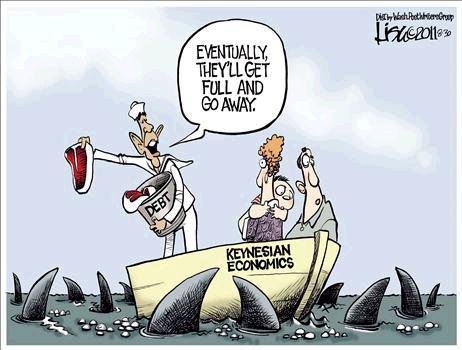
Keynesian Economics in a Cartoon

September 1, 2011 by Dan Mitchell

I’ve written extensively about the flaws of Keynesian economics, and I’ve even narrated a video on the flaws of Keynesian theory.

But this clever cartoon may be more effective than anything I’ve ever done.

If you like cartoons that teach economics, check out this gem. It’s not on Keynesianism, but it’s very good.

Review of Carl Sagan book (Part 3 of series on Evolution)

Review of Carl Sagan book (Part 3 of series on Evolution)

The Long War against God-Henry Morris, part 4 of 6

Uploaded by  on Aug 30, 2010

http://www.icr.org/
http://store.icr.org/prodinfo.asp?number=BLOWA2
http://store.icr.org/prodinfo.asp?number=BLOWASG
http://www.fliptheworldupsidedown.com/blog

______________________________________

I got this from a blogger in April of 2008 concerning candidate Obama’s view on evolution:

Q: York County was recently in the news for a lawsuit involving the teaching of intelligent design. What’s your attitude regarding the teaching of evolution in public schools?

A: “I’m a Christian, and I believe in parents being able to provide children with religious instruction without interference from the state. But I also believe our schools are there to teach worldly knowledge and science. I believe in evolution, and I believe there’s a difference between science and faith. That doesn’t make faith any less important than science. It just means they’re two different things. And I think it’s a mistake to try to cloud the teaching of science with theories that frankly don’t hold up to scientific inquiry.”

I was really enjoyed this review of Carl Sagan’s book “Pale Blue Dot.”

Carl Sagan’s Pale Blue Dot

by Larry Vardiman, Ph.D. *

On December 6, 1994, Carl Sagan, author of Cosmos, well-known astronomer and speaker, appeared before the Commonwealth Club of California in San Francisco to introduce his new book, Pale Blue Dot.1

Earlier in the day I had the opportunity to briefly talk with him during a break in presentations at the fall meeting of the American Geophysical Union. I introduced myself and found him very cordial but extremely animated and energetic in attempting to convince me that the Bible is not a valid source of truth and that science has proven it wrong.

I was puzzled at his enthusiasm until I purchased and read his book. In it he presents the case that the earth and man are not at the center of the universe or God’s attention. In fact, he stresses that science has disproved the Bible and that man is an insignificant species on a remote planet whirling through the vast reaches of space. He suggests space exploration and colonization as a vision for developing anew meaning in life to replace that given historically by religion.

Since Carl Sagan is such an effective spokesman for the naturalistic world view which prevails in the modern scientific community, and for his concept that a creator God is an outdated “geocentrist conceit” concocted by our less enlightened forefathers and foisted upon the human culture, I felt a review and rebuttal of his new book was in order.

REVIEWAt the heart of Dr. Sagan’s argument for a universe without a creator is the progressive disillusionment he believes science has handed those who believe in religion. This he calls “The Great Demotions.” He suggests that observation of the night-time sky by our ancestors led to a misplaced sense of importance of man:

And if the lights in the sky rise and set around us, isn’t it evident that we’re at the center of the Universe? These celestial bodies—so clearly reveals that we are special. The Universe seems designed for human beings. It’s difficult to contemplate these circumstances without experiencing stirrings of pride and reassurance. The entire Universe, made for us! We must really be something.

This satisfying demonstration of our importance, buttressed by daily observations of the heavens, made the geocentrist conceit a transcultural truth—taught in the schools, built into the language, part and parcel of great literature and sacred scripture. Dissenters were discouraged, sometimes with torture and death. It is no wonder that for the vast bulk of human history, no one questioned it.

Over the past 300 years, Sagan says, science began to strip away this “geocentrist conceit” starting with Copernicus’ finding that the earth revolved around the sun rather than the sun around the earth. Next it was determined that our earth is only one of a myriad of worlds, the sun is only one of our galaxy, and our galaxy is only one of a myriad of galaxies in the universe. Apparently, there is nothing special about our position in the universe. Einstein’s theory of relativity then discredited the view held by Newton and all other great classical physicists that the velocity of the earth in space constituted a “privileged frame of reference.” Next, the age of the solar system was calculated to be about 4.5 billion years old and the universe about 15 billion. The final demotion was the conclusion by Darwin that man is not a special creation but, rather, evolved in the primordial ooze from simple, single-celled organisms. Man is simply the end-product in a long chain of evolutionary change.

These “great demotions” lead to the conclusion that there is no meaning or purpose in our existence. Sagan bemoans this loss of meaning by lampooning the Biblical story of the Garden of Eden:

There was a particular tree of which we were not to partake, a tree of knowledge. Knowledge and understanding and wisdom were forbidden to us in this story. We were to be kept ignorant. But we couldn’t help ourselves. We were starving forknowledge—created hungry, you might say. This was the origin of all our troubles. In particular, it is why we no longer live in a garden: We found out too much. So long as we were incurious and obedient, I imagine, we could console ourselves with our importance and centrality, and tell ourselves that we were the reason the Universe was made. As we began to indulge our curiosity, though, to explore, to learn how the Universe really is, we expelled ourselves from Eden. Angels with a flaming sword were set as sentries at the gates of Paradise to bar our return. The gardeners became exiles and wanderers. Occasionally we mourn that lost world, but that, it seems to me, is maudlin and sentimental. We could not happily have remained ignorant forever.

Sagan admits several times in his book that “there is in this Universe much of what seems to be design.” Yet, he can not bring himself to attribute this design to a Designer. He does go so far as to say in one place that, “Maybe there is one [a designer] hiding, maddeningly unwilling to be revealed.” However, he finally concludes that the evidence does not require a Designer. He also admits that without a Designer there is no purpose and without purpose man cannot survive. Sagan has been building a justification for the remainder of his book. He now states in egotistical terms his agenda for the human race:

The significance of our lives and our fragile planet is then determined only by our own wisdom and courage. We are the custodians of life’s meaning. We long for a Parent to care for us, to forgive us our errors, to save us from our childish mistakes. But knowledge is preferable to ignorance. Better by far to embrace the hard truth than a reassuring fable. If we crave some cosmic purpose, then let us find ourselves a worthy goal. On behalf of Earthlife, I urge that, with full knowledge of our limitations, we vastly increase our knowledge of the Solar System and then begin to settle other worlds.

REBUTTALThe crux of Sagan’s arguments is the validity of his “great demotions.” Has science shown the Bible to be untrue and that the earth and man are insignificant random combinations of molecules near a remote star in a vast, uncaring universe? I do not believe that the sun revolves around the earth. However, I strongly hold to the view that man is at the center of God’s care and concern, if not very near the center of His creation.

The Bible nowhere says that the sun revolves around the earth. It simply uses the common everyday reference system we are all familiar with when referring to the motions of the sun. References to sunrise and sunset appear in the newspaper each day, and there is no difficulty in understanding their meaning. Similar terms are used in surveying, nautical navigation, even orbital mechanics. They communicate information just as does the Bible.

In the covenant with Abraham God implied that there is a myriad of stars in the universe. He said, “look now toward heaven, and tell the stars, if thou be able to number them….”Sagan believes some of these stars may have planets circling them with life on them. However, Sagan recently admitted in a radio interview that after 25 years of searching for intelligent life, he has been unable to find evidence of life anywhere else in the universe. (Sagan has stated that he would even be happy to find stupid life.) He went so far as to say, “there must be something unique about the earth.” Einstein’s theories of relativity and the great ages of our solar system and universe both have yet to be proven. If relativity can be shown to be true, some believe the effect could possibly explain the apparent great times of light traveling from distant stars.2

The theory of evolution is the greatest house of cards of all. It flies in the face of the well-founded Second Law of Thermodynamics, cannot be supported by the fossil record, violates common sense in the development of complex systems, and could not even occur in 15 billion years.

These “great demotions” then are the result of misapplying faulty theories rather than validating God’s statements in Scripture regarding our position and purpose.

God has declared our standing as follows:

“In the beginning God created the heavens and the earth” (Genesis 1:1).

“The heavens declare the glory of God; and the firmament sheweth His handiwork” (Psalm 19:1).

“And God said, Let us make man in our image, after our likeness” (Genesis 1:26).

“For God so loved the world, that He gave His only begotten Son, that whosoever believeth in Him should not perish, but have everlasting life” (John 3:16).

It is evident from only these few selected Scripture passages that God created the universe and cares for us to the point of providing His own Son as a sacrifice for our sins. In our finiteness we don’t fully understand an infinite God, but how dare we arrogantly deny such a God.

REACTIONSDr. Sagan is an excellent writer and public speaker. He has a very engaging writing style and dares to discuss controversial issues. His Cosmos series and book sold more copies than any science book ever written in English. He has won the Pulitzer Prize for his writing. However, he is wrong. Carl Sagan is blinded to the evidence that God exists and created man as His special object of love and concern.

This point of view among so many scientists today is described in Romans 1:20: “For the invisible things of Him from the creation of the world are clearly seen, being understood by the things that are made, even His eternal power and Godhead; so that they are without excuse.” Dr. Sagan has rejected out of hand the evidences he has clearly seen for design in the universe. Although he has expressed a reluctant need to find a Designer, he has given up on the search and has constructed his own “Tower of Babel.”

A recurrent theme throughout the book is his allegorizing of the Biblical account and an assumption that it is a transcription of man’s uninformed experiences. No place is given to the possibility that Scripture is inspired by the Creator. Dr. Sagan’s goal in Pale Blue Dot is to substitute his “creation myth” and purpose for “Earthlife” for the creation account and dominion mandate found in Genesis. Sagan even raises the specter of “becoming like the Most High.” I fear for men who would place themselves in such opposition to God and His Word.

CONCLUSIONSBecause of the kinship I feel toward scientists like Carl Sagan, I am saddened greatly by their actions. Scientists have the greatest opportunities of all to see the evidence of God’s marvelous provision for man in His creation. Those who can’t see God’s hand in the universe around them should be encouraged to ask God to reveal Himself to them. God is not hiding. He is waiting for us to see Him. Please pray for Carl Sagan and others like him who, in their conceit declare, “There is no God!” (Psalm 14:1).

REFERENCES

1. C. Sagan. Pale Blue Dot (Random House, 1994), 429 pp.
2. R. Humphries. Starlight and Time (Master Books, 1994), 133 pp.

* Dr. Vardiman is Administrative Vice President and Chairman of the Astro/Geophysics Department at ICR.

Other posts that relate to Carl Sagan:

Atheist says “It’s not about having a purpose in life..” (Arkansas Atheist, Part 1)

The Bible and Archaeology (1/5) The Bible maintains several characteristics that prove it is from God. One of those is the fact that the Bible is accurate in every one of its details. The field of archaeology brings to light this amazing accuracy. _________________________- I want to make two points today. 1. There is no […]

Ancient Sea Monsters (A Creationist point of view Part 3)

Leviathan: the Fire-Breathing Dragon: Kent Hovind [6 of 7] Everybody is trying to get info on this subject. Here is what the Bible has to say about it. Mace Baker wrote the aritcle, “Sea Dragons – The Institute for Creation Research,” and here is the third portion of that article:  Pterosaurs were the flying reptiles of the ancient world. Why […]

By Everette Hatcher III | Posted in Current Events | Edit | Comments (0)Other posts concerning Carl Sagan:

Atheists confronted: How I confronted Carl Sagan the year before he died

In today’s news you will read about Kirk Cameron taking on the atheist Stephen Hawking over some recent assertions he made concerning the existence of heaven. Back in December of 1995 I had the opportunity to correspond with Carl Sagan about a year before his untimely death. Sarah Anne Hughes in her article,”Kirk Cameron criticizes […]

Obama brags of progress in USA on economy to G-8 audience

1,000 Days Without A Budget

Uploaded by on Jan 24, 2012

http://blog.heritage.org | Today marks the 1,000th day since the United States Senate has passed a budget. While the House has put forth (and passed) its own budget, the Senate has failed to do the same. To help illustrate how extraordinary this failure has been, our new video highlights a few of impressive feats in history that have been accomplished in less time.

________________

It seems ironic to me that we have not had a budget passed by the Senate for over three years yet we have President Obama bragging to the G-8 audience that he has made a lot of progress getting measures passed that have helped the U.S. economy.

Mike Brownfield

May 21, 2012 at 3:39 pm

Europe is in bad shape, there’s no doubt about it. The sovereign debt crisis continues to roil the continent, Greece may leave the euro, Spain may have to revise its budget deficit upward for the second time because of bad loans, and France has a new socialist president pledging more spending instead of austerity. So when the G8 leaders met last week, President Obama had some words of advice to offer — “Look at me and learn from my stellar example!”

OK, that’s a paraphrase, but his actual words aren’t all that much different. No joke, the president who has presided over a downgraded credit rating, three years without a budget, an exploding deficit, an entitlement system desperately in need of reform, and an unemployment rate still over 8 percent has painted himself as a model for others to follow.

Quite remarkably, the president bragged that he has worked to “bring down our deficits and debt over the longer term” while staying “focused on growing the economy and creating jobs in the immediate term.” Though he acknowledges that “Of course, we still have a lot of work to do,” he says that now there’s “room to take a balanced approach to reducing our deficit and debt, while preserving our investments in the drivers of growth and job creation over the long term — education, innovation, and infrastructure for the 21st century.”

In other words, because of his supposed successes, America can afford to spend even more money on stimulus.

It’s hard to say whether the president’s intended audience was the leaders of the G8 or the American electorate, but regardless of who it was, there’s not much for Obama to brag about.

In the past four years, unemployment has gone up, more people are unemployed longer, gas prices are higher, the cost of health care insurance has increased, the national debt is higher, federal spending has increased, more Americans are on food stamps, regulatory costs are higher, home values have declined, America’s economic recovery is historically slow, and while federal spending on education has increased, results remain flat. You can see for yourself just how bad America’s fiscal outlook is in Heritage’s 2012 edition of the Federal Budget in Pictures.

Though Europe needs solutions, they certainly shouldn’t be looking at President Obama for the answers.