Category Archives: President Obama

Dan Mitchell of the Cato Institute:Unemployment check or a job

The private sector does such a better job than the public sector at everything. We need to seriously consider looking at every aspect of the philosophy of our government. It is my view that we can no longer have programs that give incentives to people not to work.

The continuing weakness in the job market, which I wrote about this morning, means that the debate over unemployment benefits will get more heated.

I’ve already noted that even left-wing academics like Paul Krugman and Larry Summers have admitted that you get more unemployment when you subsidize joblessness.

And I’ve cited some good research on the topic from the San Francisco Federal Reserve Bank, as well as other studies by academic economists.

But none of this evidence seems to matter, as I discovered in this debate with a former Obama Labor Department official.

Published on Jun 1, 2012 by

No description available.

To better understand the points I was making, here are two good anecdotes from Ohio and Michigan.

Last but not least, this cartoon does a very good who of teaching about the economics of unemployment insurance. And if you want to understand the absurdity of the left, this post shows Nancy Pelosi is a train wreck of economic illiteracy.

Fast and Furious: The real story

Published on Apr 19, 2012 by

Cam Edwards talks to Katie Pavlich from Townhall about her new book, Fast and Furious: Barack Obama’s Bloodiest Scandal and the Shameless Cover-Up – NRA News – April 18, 2012.

_______________

Katie Pavlich

Rob Bluey

April 28, 2012 at 9:32 am

(3)

Katie Pavlich’s new book, “Fast and Furious,” assembles the devastating evidence that implicates the Obama administration for its ill-advised gun-walking operation and ensuing scandal to mislead Congress and the American people.

Few journalists have devoted as much time reporting on Fast and Furious as Pavlich. As the news editor of Townhall, she has asked questions the mainstream media ignored. Now her book pieces the story together for a complete picture of how a government-run operation turned deadly. 

Operation Fast and Furious began in 2009 as an effort to eliminate high-level arms trafficking networks. Guns were allowed to “walk,” and rather than arresting straw purchasers and cartel buyers, hundreds were used to commit crimes in the United States and Mexico. Border Patrol Agent Brian Terry was killed with one in 2010 and an estimated 1,400 guns remain missing.

The book details President Obama’s lifelong mission to subvert the Second Amendment, long before he was seeking federal office. Pavlich also documents how Fast and Furious plays into his administration’s anti-gun agenda. She cites a Washington Post story from Dec. 15, 2010, before details of Fast and Furious had emerged, in which federal authorities attempt to blame the rise in gun violence on U.S. gun shops.

The podcast runs about eight minutes. It was produced with the help of Hannah Sternberg. Listen to previous interviews on Scribecast or subscribe to future episodes. Photo by Don Irvine

Got to hold down spending but are we serious about it?

Senator Tom Coburn on the “Debt Bomb”

Published on May 24, 2012 by

http://www.foundry.org |

_____________

I have a lot of respect for Tea Party heroes like Tim Huelskamp , Idaho First District Congressman Raúl R. Labrador, and Justin Amash who are willing to vote against proposals that increase our spending,  and they want to pass the Balanced Budget Amendment.    

It is a fact that we must balance the budget soon. I do not believe that we can wait to balance the budget at some distant time in the future. The financial markets will not allow us a long time to get our house in order. Look at how things have been going the last four years and no matter how anyone tries to spin it, we are going down the financial drain fast and headed to Greece!!!

J.D. Foster, Ph.D.

May 24, 2012 at 6:13 pm

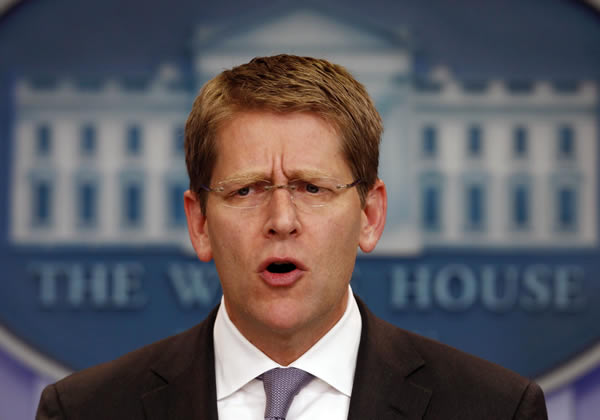
White House Press Secretary Jay Carney

It’s hardly rare for politicians in Washington to say things that make one wonder what color the sky is in their world. Vice President Joe Biden has offered a steady stream of examples, demonstrating again that sometimes an old dog can’t unlearn old tricks. But in the press gaggle yesterday, White House spokesperson Jay Carney dropped a doozy, suggesting anew that the Obama Administration is living in a fantasyland all its own.

Carney broke off answering a question about Baghdad to insert the following: The rate at which spending has increased is lower under President Obama than all of his predecessors since Dwight Eisenhower.

Carney went on to observe that “this President has been—has demonstrated significant fiscal restraint and acted with great fiscal responsibility.”

Well, well, let’s just look at the figures. Federal spending as a share of the economy will average over 24 percent during Obama’s term, and each and every year of that term will see a higher share than during any year since the Second World War. That apparently qualifies as “significant fiscal restraint” Obama-style.

Fiscal responsibility? Obama has had by far the largest budget deficits, driven in large part by the eruption in spending.

Obama’s Budget Continues Unprecedented Deficits

The President is responsible for submitting an annual budget to Congress and has the authority to veto legislation, including irresponsible spending. Most Administrations have run small but manageable deficits, but President Obama’s unprecedented budget deficits pose serious economic risks.

BUDGET DEFICITS AS A PERCENTAGE OF GDP, BY ADMINISTRATION

Obama's Budget Continues Unprecedented Deficits


Source: Office of Management and Budget.

It is, of course, the job of the chief White House flak to spin answers in response to questions. But in this case, there was no question. There was only the flak attempting to inject utter nonsense into the national debate. More Kool-Aid, Mr. Carney?

Lots of wasteful spending by federal government

I wish the federal government would go back to spending less than 5% of GDP like they did the first 150 years of our country’s history. We could cut down on a lot of wasteful spending if we did that.

Mike Brownfield

April 19, 2012 at 8:57 am

In a speech yesterday in Elyria, Ohio — a small town just outside Cleveland sitting at the forks of the Black River — President Barack Obama delivered a politically charged speech in which he hearkened back to the country’s roots, saying that his opponents “don’t seem to remember how America was built.” In his view, taxpayers want their money spent in ways that will help further “the larger project we call America.” In other words, more spending and bigger government paid for with higher taxes.

In a city quite unlike Elyria, thousands of miles west, sprawling forth from the desert just east of Death Valley, officials from this federal government provided the latest example of what happens when the president’s philosophy succeeds — when layer upon layer of government grows so big that it begins to serve the interests of a ruling class, rather than the people from whom it derives its power. Two years ago in Las Vegas, the General Services Administration (GSA) — a little-known federal agency that helps manage other federal agencies — blew through $820,000 in taxpayer funds for a lavish, booze-fueled conference for 300 employees, complete with magic shows, margaritas, and a self-produced rap video making fun of the spending. (It’s worth mentioning that in 2009, Senate Majority Leader Harry Reid (D-NV) asked White House Chief of Staff Rahm Emanuel for help in encouraging government meetings to be held in Nevada.)

That’s just the giant tip of the iceberg for this wasteful behemoth, as reports have emerged of other taxpayer-financed “business trips,” including junkets to Hawaii, South Pacific islands, California’s Napa Valley and Palm Springs. A hotline has been set up for employee tips on wrongdoing, and this week the House is conducting hearings on the GSA’s gross abuse of taxpayer funds.

Sadly, government waste, fraud and abuse isn’t limited to just one agency. Look no further than the Department of Energy (DOE) whose inspector general said yesterday that he’s overseeing 250 to 300 open criminal investigations into the “entire spectrum of DOE activities,” including 100 reviews involving more than $35 billion in stimulus dollars, according to Politico. In addition, it was reported that the investigators are looking into the “use of thousands of outside contractors, federal money being diverted for personal use, false data in grant and loan applications, conflicts of interest and incomplete and inferior work from DOE weatherization grant winners.” To date, those investigations have led to eight criminal prosecutions and the recovery of $2.3 million.

How commonplace is this waste? Given the sheer size and scope of the government — which is set to spend $6.3 trillion this year — it’s impossible to say. But just as pernicious as the countless billions that have been squandered is the cancerous attitude that has taken hold in Washington and that is metastasizing across the land. It’s one of thoughtless entitlement in which individuals who live off the bureaucratic beast reflexively take and spend more all while doing less, giving no consideration to those who fuel their appetites.

Of course, that mindset is not exclusive to the federal level, and examples abound of government employees taking from the public coffers. Just this week in our nation’s capital, 90 city employees were suspended for receiving unemployment benefits while still holding city jobs, and 40 former city workers cashed unemployment checks that they weren’t entitled to. All told, the city paid out some $800,000 in illegitimate benefits. But it’s not just about outright theft. It’s also about out-of-whack expectations that one is entitled to receive without doing. In Michigan, for example, a public school teacher is advising her students not to become teachers because under a new state law, she won’t be able to retire at age 47 as she hoped.

Contrary to what those on the left might believe, this swollen government is not what was intended.

Flowing from the  Declaration of Independence and embodied in the Constitution, the federal government was designed on the principle that the ultimate authority of a legitimate government depends on the consent of a free people. As Former Attorney General Edwin Meese III writes in The Heritage Guide to the Constitution, “Nature does not single out who is to govern and who is to be governed; there is no divine right of kings. Nor are rights a matter of legal privilege or the benevolence of some ruling class.” Yet in this government, a privileged few are acting outside those bounds with the expectation that they have the right to do as they please, unfettered by any obligation to the people.

Under the Obama Administration, the situation has gotten worse. The president turns to bigger government and higher taxes as a solution to every problem. On health care, unemployment, education and energy, Obama has reflexively pursued a policy of more is more — more spending paid for with more taxes. This week served up another prime example when the president called for increased regulations and $52 million in spending to combat high gas prices — even though he admitted that the measures wouldn’t have any immediate impact on the price at the pump.

As the people lose control over this unrestrained government, those with the most cash are the ones with a voice. In an interview last week with The New York Times, former Democratic congressman Patrick Kennedy revealed that access to the Obama White House is a “quid pro quo” based on how much money one contributes to the president’s campaign. That news, though, likely is not a shock to an American people who have come to expect the worst, not the best, from Washington. However, that is not how America was built, it’s not the government we must have, nor is it the one that the Founders envisioned.

Leave the private market place alone

 Cronyism in the Solyndra Scandal

We have to encourage the private market to do it’s thing without interference from Washington. However,  President Obama has dished out billions of dollars to politically favored companies in pursuit of job creation and a new “green” economy as the article below points out. That is simply “taxpayer-funded crony capitalism that has neither created new jobs nor produced the green-energy payout that the president was looking for. In fact, it’s a policy that has failed miserably, leading to bankruptcy after bankruptcy. Yet despite all the failures — and zero successes — the president and his Administration are defending the indefensible and standing by a policy that has squandered taxpayer money.”

The best policy is to leave the private market alone!!! 

Morning Bell: The White House Defends Public Equity

Mike Brownfield

May 30, 2012 at 9:03 am

Up is down, left is right, good is bad, and day is night. If you wander inside the Washington, D.C., beltway, you’ll enter a bizarro world where, at times, commonsense is replaced by a localized logic that is completely divorced from the reality.

The latest example of political gobbledygook comes courtesy of White House press secretary Jay Carney, who yesterday lapsed into rambling rhetoric when asked to explain how President Obama can defend the failed Solyndra solar boondoggle, yet attack private sector investments that sometimes fail but oftentimes succeed. Here’s his response:

Look…there, there, there is the…the…difference in that, your overall view of what…huh, your responsibilities are as president and what your view of the economic future is.

And the president believes as he’s made clear that a president’s responsibility is not just to, ah, those who win but those who, for example in a company where ah, there have been layoffs or a company that has gone bankrupt, that we have to ah make sure that those folks have the means to find other employment, that they have the ability to train for other kinds of work and that’s part of the overall responsibility a president has.

Got all that?

For the duration of his Administration, President Obama has dished out billions of dollars to politically favored companies in pursuit of job creation and a new “green” economy. It’s taxpayer-funded crony capitalism that has neither created new jobs nor produced the green-energy payout that the president was looking for. In fact, it’s a policy that has failed miserably, leading to bankruptcy after bankruptcy. Yet despite all the failures — and zero successes — the president and his Administration are defending the indefensible and standing by a policy that has squandered taxpayer money.

In one instance, President Obama committed $465 million of taxpayer money to Tesla, which was founded by a campaign mega-donor and the 63rd richest man in the world, Elon Musk, to build a $130,000 battery-powered sports car that becomes permanently inoperable if left uncharged for 30 days.

It’s gotten so bad that Congress is launching probes of federal green energy programs, including the Energy Department loan program, over concerns that lawmakers fast-tracked approval for politically connected companies. Heritage’s Lachlan Markay reports that according to a Republican aide on the Senate Budget Committee, “Politically favored, and often connected, renewable energy plans [receive] less rigorous review than traditional energy projects.” In one program, of the $20.5 billion in loans granted, $16.4 billion went to companies linked to donors who contributed to Obama and the Democratic Party.

At the same time the president is defending his taxpayer-funded failures, he’s attacking free enterprise, including in private equity and venture capitalism — enterprises in which investors voluntarily put up their own money to invest in new ideas and rescue existing companies. Sometimes those ventures fail, sometimes their inevitable failure is delayed but temporarily saves jobs amid restructuring, but many times they succeed — generating profits and producing new jobs.

When Carney was asked to justify the president’s defense of one, but criticism of the other, he just couldn’t do it. That’s no surprise, in that the two positions are logically inconsistent.

This episode calls to mind a quote from George Orwell, a frequent and pointed critic of modern political discourse:

In our time, political speech and writing are largely the defence of the indefensible… Thus political language has to consist largely of euphemism, question-begging and sheer cloudy vagueness… the great enemy of clear language is insincerity. Where there is a gap between one’s real and one’s declared aims, one turns as it were instinctively to long words and exhausted idioms …

Maybe Jay Carney’s confused speech is the result of the unbearable heat and humidity that has descended on Washington all too early this year. Or maybe it’s a bad case of Potomac fever. But no matter the cause, the results are the same. In Washington, the Obama Administration is hard at work defending the crony capitalist machine while lambasting the free market system — and it shows no signs of letting up.

High tax states losing out to low tax states

States that are cutting taxes are getting a lot of population growth because people will seek to open up their businesses in low tax states versus high ones. Why can’t the federal government learn from this states and lower federal taxes in order to encourage business creation?

The fiscal nightmare in Europe should be all the proof that’s needed about the dangers of wasteful spending and punitive tax rates. Unfortunately, if his proposals for bigger government and class-warfare tax policy are any indication, President Obama still seems to think those policies would be good for America.

“Let’s mimic California and France!”

American states also are a laboratory, showing that states with better tax policy create more jobs and grow much faster. And many state policy makers have learned the right lesson.

Here’s some of what the Wall Street Journal said in an editorial this morning.

Last week Governor Sam Brownback continued the post-2010 reform trend among GOP Governors by signing the biggest tax cut in Kansas history. The plan chops the state income tax rate to 4.9% from 6.45% and eliminates income taxes on about 190,000 Kansas small businesses. …Mr. Brownback says the income tax cut will put Kansas “on a road to faster growth.” Although no one in Europe or the White House agrees with the philosophy, tax-cut initiatives have been spreading in the states. Already this year Tennessee has eliminated its gift and estate tax, Arizona has cut its capital gains tax (to 3.4% from 4.54%), and Idaho and Nebraska have cut income tax rates. Oklahoma is expected to cut tax rates. The tax cutting Governors all say they hope to be more like no-income-tax Texas, which has far outpaced other states in job creation.

Sadly, the folks in the White House aren’t hopping on the tax cut bandwagon.

Instead, they want America to be more like the President’s home state of Illinois, a fiscal basket case. But it’s not just Illinois that’s in trouble because of a bloated and expensive public sector.

It turns out that millions of Americans are voting with their feet to escape states with excessive taxes.

Here are some passages from a CNS report on some fascinating data from the Tax Foundation.

New York State accounted for the biggest migration exodus of any state in the nation between 2000 and 2010, with 3.4 million residents leaving over that period, according to the Tax Foundation. Over that decade the state gained 2.1 million, so net migration amounted to 1.3 million, representing a loss of $45.6 billion in income. Where are they escaping to?  The Tax Foundation found that more than 600,000 New York residents moved to Florida over the decade – opting perhaps for the Sunshine State’s more lenient tax system – taking nearly $20 billion in adjusted gross income with them. Over that same time period, 208,794 Pennsylvanians moved to Florida, taking $8 billion in income. …California is also known for more onerous taxes and regulations, and the foundation shows similar trends of migration from there to other states like Texas and Arizona. The Tax Foundation ranked the Golden State sixth highest in the nation for state and local tax burden in 2009. Between 2000 and 2010, the most recent data available, 551,914 people left California for Texas, taking $14.3 billion in income.  Texas has no state income tax or estate tax. …Another 28,088 from California relocated to Nevada and 30,663 to Arizona, a loss of  $699.1 million and $707.8 million in income respectively.

While these are remarkable numbers, they shouldn’t be a surprise. I’ve written about the failures of New York and California, and I’ve also commented on the success of Texas.

And for those who prefer international evidence, I’ve cited the differences between successful low-tax jurisdictions such as Hong Kong and Singapore and decrepit high-tax nations such as France.

This doesn’t mean that fiscal policy is a silver bullet. There are reasonably successful nations with big governments, but they compensate with ultra-free markets in other areas. And there are also low-tax nations that languish because of mistakes such as excessive regulation and failure to protect property rights.

But all other things being equal, big government and high tax rates are a recipe for decline. Yet that’s the only item on the White House menu.

P.S. If you think people should have the right to lower their tax burdens by moving from California to Nevada, shouldn’t they also have the right to do the same thing by moving from the United States to Singapore?

Charlie Collins and Milton Friedman versus John Brummett on taxes and job growth

https://i0.wp.com/www.freetochoosemedia.org/production/POC/presskit2/milton-president-reagan.jpg

Milton Friedman served as economic advisor for two American Presidents – Richard Nixon and Ronald Reagan. Although Friedman was inevitably drawn into the national political spotlight, he never held public office.

Milton Friedman’s Free to Choose (1980), episode 1 – Power of the Market. part 1

I know that Charlie Collins is a big Milton Friedman fan like I am. Therefore, I put this post together with both Collins and Friedman in mind.

John Brummett is one of the liberals in Arkansas that does write very interesting articles and  I make a point of reading them regularly. I don’t agree with many of them though. For instance, the other day Brummett made the statement that President Obama was not a big spender. That was not too difficult to debunk.

On June 3, 2012 in the Arkansas Democrat-Gazette Brummett asserted, “I’d like to rearrange these rates, exempting more of the lowest income from them altogether and hitting the rich folks a little more steeply than the 7 percent that kicks in way too early at $31,000 or so.”

I think this would drive away the job creators from Arkansas. I was thrilled that  Republican state Rep. Charlie Collins of Fayetteville was a given a chance to respond to Brummett in the June 7, 2012 edition of the Arkansas Democrat-Gazette. Here are some portions of his response:

Brummett said that, overall, taxes in Arkansas aren’t that high. Using federal numbers, total Arkansas state tax revenue on everything from income to fishing licenses in 2011 was $2,634 per person, which ranked us 35th of 50. However, as a percentage of personal income, Arkansas had the ninth-highest taxation rate in the country! States with higher percentages included special cases like Alaska (energy tax revenue included), North Dakota (energy taxes) and Hawaii (tropical island). Even California and New York took a lower share of personal income than Arkansas.

Our top income-tax rate is 7 percent on earned income above $33,200. My plan would give all workers tax relief and simplify the system. We eliminate two of the six tax brackets—the 2.5 percent and 7 percent rates—which drops the new top rate to 6 percent. We then phase in higher income levels (six-figure earners) for the 6 percent rate over time.

The result is a dramatic tax break for low-income workers (60 percent reduction from 2.5 percent to 1 percent), strong relief for middle-class working families (35 percent cut from 7 percent to 4.5 percent), and a modest drop for high-income workers and job creators (14 percent from 7 percent to 6 percent).

We can phase in tax relief at a pace that maintains state government spending, keeps the budget balanced, and includes other priorities such as eliminating the grocery sales tax and targeted spending increases. We do it by slowing the growth in state spending.

_______

Today President Obama is telling us that we must raise taxes in order for us to prosper and grow our economy and that sounds like the same think that Brummett and his liberal friend are saying. I have heard that before and it has never worked!!!!

Liberals like Ernie Dumas and Max Brantley who write for the Arkansas Times have always bragged on the 7% state income tax that Dale Bumpers raised in 1971 and how Arkansas has grown economically since then. However, the facts are quite different.

Ernie Dumas in his article “Arkansas” A tax myth-maker too,” Arkansas Times, April 13, 2011 asserts:

Until Gov. Dale Bumpers raised income-tax rates and other taxes in 1971, Arkansas had by far the lowest per-capita state and local taxes in the United States. Afterward, we were still 50th but within shouting distance of 49th.

Here are the real facts  according to Greg Kaza of the Arkansas Policy Foundation:

(June 2006) Democratic Gov. Dale Bumpers and the General Assembly raised Arkansas’ top income tax rate to “broaden the tax base” in 1971(1). Yet Arkansas’ per capita income, expressed as a percentage of the U.S. total, has barely improved, moving from 71 (1971) to 77.7 percent (2005) over the 34-year period, according to data from the U.S. Bureau of Economic Analysis. The 1971 income tax increase reversed a decades-long strong growth trend and left Arkansas with the highest income tax rate among bordering states (Mississippi, Missouri, Louisiana, Oklahoma, Tennessee and Texas).

Income Stagnation: The 1930s

One has to turn to the 1930s-the decade of the Great Depression-to find weaker income growth than in recent years.

Arkansas per capita personal income was 44 percent of the U.S. in 1929, the first year data was compiled in the BEA time series. The Great Depression started that year, and by the time it ended in 1933 Arkansas per capita income had fallen to 41 percent of the U.S. By decade’s end (1939) it had returned to 44 percent.

Growth Decades: The 1940s, 1950s & 1960s
Arkansas per capita income increased as a percentage of the U.S. in the next three decades.
In 1941, at the onset of World War II, Arkansas per capita income was 47 percent of the U.S. It was 59 percent at war’s end in 1945 and again in 1949. It was 56 percent in 1950, 62 percent a decade later in 1960, and 68 percent in 1969. If this growth rate had continued Arkansas would have exceeded 100 percent of the U.S. average in the current decade (2000-2009).

To summarize, Arkansas per capita income increased from 44 to 71 percent of the U.S. total between 1939 and 1971.

Anemic Income Growth (1971-2005)

The trend in recent decades is anemic growth in Arkansas per capita personal income. Fiscal policy changes effect economic behavior with a time lag. Arkansas per capita income was 71 percent of the U.S. in 1971 and 76 percent in 1973. Income growth stagnated for the rest of the decade, reaching 77 percent of the U.S. in 1979. It fell to 75 percent in 1989, and was 76 percent in 1999. Today, Arkansas per capita income, at 77.7 percent of the U.S., is barely above its high point of the 1970s.

_____________

We can look at other states and see what their experience is too.

I’ve done a couple of posts comparing Reaganomics and Obamanomics, mostly based on data from the Minneapolis Federal Reserve on employment and economic output.

I even did a TV interview on the subject, which generated some comments on my taste in clothing, and also cited a Richard Rahn column that got Paul Krugman and Ezra Klein upset.

Some of the best evidence about high tax rates vs. low tax rates comes from inside America. Art Laffer (yes, that Art Laffer) and Steve Moore have a great column in today’s Wall Street Journal. It’s sort of Reaganomics vs. Obamanomics, looking at evidence from the states.

Barack Obama is asking Americans to gamble that the U.S. economy can be taxed into prosperity. …Mr. Obama needs a refresher course on the 1920s, 1960s, 1980s and even the 1990s, when government spending and taxes fell and employment and incomes grew rapidly. But if the president wants to see fresher evidence of how taxes matter, he can look to what’s happening in the 50 states. In our new report “Rich States, Poor States,” prepared for the American Legislative Exchange Council, we compare the economic performance of states with no income tax to that of states with high rates. It’s like comparing Hong Kong with Greece… Every year for the past 40, the states without income taxes had faster output growth (measured on a decadal basis) than the states with the highest income taxes. In 1980, for example, there were 10 zero-income-tax states. Over the decade leading up to 1980, those states grew 32.3 percentage points faster than the 10 states with the highest tax rates. Job growth was also much higher in the zero-tax states. The states with the nine highest income tax rates had no net job growth at all, and seven of those nine managed to lose jobs.

Tax rates also lead people to “vote with their feet.” Laffer and Moore look at migration patterns.

Over the past decade, states without an income tax have seen 58% higher population growth than the national average, and more than double the growth of states with the highest income tax rates. …Illinois, Oregon and California are state practitioners of Obamanomics. All have passed soak-the-rich laws like the Buffett Rule (plus economically harmful regulations, like California’s cap-and-trade scheme), and all face big deficits because their economies continue to sink. Illinois has lost one resident every 10 minutes since hiking tax rates in January. California has 10.9% unemployment, having lost 4.8% of its jobs over the past decade. …Every time California, Illinois or New York raises taxes on millionaires, Florida, Texas and Tennessee see an influx of rich people who buy homes, start businesses and shop in the local economy.

Competition among the states is leading some states to make further improvements. Some are even trying to get rid of their income taxes.

Republican governors in Florida, Georgia, Idaho, North Dakota, South Carolina, Ohio, Tennessee, Wisconsin and even Michigan and New Jersey are cutting taxes to lure new businesses and jobs. Asked why he wants to reduce the cost of doing business in Wisconsin, Gov. Scott Walker replies: “I’ve never seen a store get more customers by raising its prices, but I’ve seen customers knock down the doors when they cut prices.” Georgia, Kansas, Missouri and Oklahoma are now racing to become America’s 10th state without an income tax.

I like the quote from Governor Walker. He seems to know what he’s talking about, so it will be interesting to see whether he survives the upcoming recall election. I guess it depends whether voters understand that big government and high tax rates is a recipe for continued decline.

Some states, such as Illinois and California, are filled with voters who refuse to recognize reality. Think of them as the Greece and Spain of America, perhaps because the number of tax-consumers is greater than the number of tax-producers.

And even though parasites should understand it doesn’t make sense to kill their host animals, this cartoon illustrates how the welfare states lures a growing number of people to ride in the wagon. And this cartoon shows the consequences of too many moochers and not enough producers.

______________

Take a look at all the Milton Friedman clips that I have posted today. These liberals I mentioned above have truly forgotten how powerful the market is if not interferred with by the government.

Milton Friedman’s Free to Choose (1980), episode 1 – Power of the Market. part 2

Related posts:


Why do people move to other states to avoid Arkansas’ high state income tax? (If you love Milton Friedman then you will love this post)

Milton Friedman served as economic advisor for two American Presidents – Richard Nixon and Ronald Reagan. Although Friedman was inevitably drawn into the national political spotlight, he never held public office. Milton Friedman’s Free to Choose (1980), episode 1 – Power of the Market. part 1 Mike Huckabee recently moved to Florida? Why? The answer […]

Milton Friedman’s Free to Choose (1980), episode 1 – Power of the Market. part 3

“The Failure of Socialism” episode of Free to Choose in 1990 by Milton Friedman (Part 2)

Milton Friedman: Free To Choose – The Failure Of Socialism With Ronald Reagan (Full)

Published on Mar 19, 2012 by

Milton Friedman’s writings affected me greatly when I first discovered them and I wanted to share with you.

Ronald Reagan introduces this program, and traces a line from Adam Smith’s “The Wealth of Nations” to Milton Friedman’s work, describing Free to Choose as “a survival kit for you, for our nation and for freedom.” Dr. Friedman travels to Hungary and Czechoslovakia to learn how Eastern Europeans are rebuilding their collapsed economies. His conclusion: they must accept the verdict of history that governments create no wealth. Economic freedom is the only source of prosperity. That means free, private markets. Attempts to find a “third way” between socialism and free markets are doomed from the start. If the people of Eastern Europe are given the chance to make their own choices they will achieve a high level of prosperity. Friedman tells us individual stories about how small businesses struggle to survive against the remains of extensive government control. Friedman says, “Everybody knows what needs to be done. The property that is now in the hands of the state, needs to be gotten into the hands of private people who can use it in accordance with their own interests and values.” Eastern Europe has observed the history of free markets in the United States and wants to copy our success. After the documentary, Dr. Friedman talks further about government and the economy with Gary Becker of the University of Chicago and Samuel Bowles of the University of Massachusetts. In a wide-ranging discussion, they disagree about the results of economic controls in countries around the world, with Friedman defending his thesis that the best government role is the smallest one.
___________
Below is a portion of the transcript of the program and above you will find the complete video of the program:
 

Here is another real success story, this time in Czechoslovakia. Martin was a rock musician. Today he makes documentary films. Some years ago, he did a concert tour of the United States and brought back secondhand recording equipment. The communist government let him bring it back, after paying a hefty import tax, because he said he wanted to record folk music __ something the government was not doing and did not plan to do.

In the past year, since things have opened up, his business has exploded. Along with music and films, he now duplicates video cassettes. He also makes audio cassettes for other Czech producers and has devised his own English language course on tape. He is on his way and many more will follow if the government just gets out of their way. You just can’t keep good people like that down.

The guests at this party aren’t much interested in self-driving entrepreneurs like Martin. High powered business executives from North America and West Europe __ they are interested in bigger game. They are here to do business and make good profits for their firms. They’ll do it by arranging joint ventures between their western companies and government enterprises. To succeed, they have to get on the right side of the politicians and the bureaucrats who are in charge. It is large scale lobbying, very much in the western manner. The danger is that in the process, local government bureaucrats and big foreign business will end up freezing out local entrepreneurs.

Friedman: The assets of Hungary belong to the people of Hungary. I do not believe they should be sold. You are a citizen of Hungary, who owns the state enterprises?

Unknown: Okay, the society as a whole.

Friedman: Not the society, the people.

Unknown: Well, give it to the people.

Friedman: In finance ministries all over Eastern Europe, the talk is all about privatization, but rhetoric is one thing __ action sometimes very different.

One example is in Prague where Vacla Klouse, the finance minister, is desperately trying to free the Czech economy.

Vacla Klouse: The people who were the reformers at that time were done after the Russian invasion, they were fired from their jobs and they return to politics with their own extremely obsolete ideas, and now they are trying . . .

Friedman: But he is up against political planners that aren’t ready to give up control. They are all anticommunists, all in favor of markets, but many are still beguiled by the idea of market socialism. A third way between capitalism and socialism, Klouse and I believe that is a mirage __ that a third way will take Czechoslovakia straight to the third world. It must either move directly to a pure free market, or it will get stuck just as Yugoslavia has.

Klouse: . . . I think intellectuals tend to underestimate the intelligence of the ordinary people . . .

Friedman: Poland and Hungary have exactly the same problem. Some, like Klouse, want to move to free markets right away. Others still hanker after socialist control of the markets.

Klouse: . . . use the word naive citizens. They are the interventionist economies and the other, so this is my speech in the parliament . . . . . .

Friedman: Political power is limited, but economic power is not limited and you can have, if you have one millionaire, you can have another millionaire, another millionaire, without anybody else being worse off. In fact, everybody else will be better off. It seems to me again, the people understand that. I can’t believe that your ordinary people here don’t. They know overnight you can make a change if you could only get the government off the back of the people.

Where are we headed __ we are heading all the way up here __ we’ll get there. Let’s not get any more gas than we need to. What is it? It is about $1.00 a liter which makes it about $4.00 a gallon of gas.

In these countries, the hardest problem is to transform their heavy industries. This is Novahoota, a vast collection of steel mills in Poland and a disaster in every sense. It is inefficient, costly, and above all, a major polluter. The best thing to do with places like this would be to bulldoze them, but that is almost impossible. They are too well shielded by special interests: the unions, the bureaucrats, and all the other political interests on the fringes.

The communists socialize the means of production. They tried to run everything from the center. It didn’t work. It was a mess and a failure. We in the United States, on the other hand, have been socializing the fruits of production. That is, the government has been taking money from some people, the people who produce the goods and services, and giving it to other people who do not produce goods and services. The end result is likely to be the same loss of incentive and organization if we carry it too far. That is one lesson we should learn from these countries.

A year ago, the cornucopia of fruits and vegetables and other things in this street market were simply not obtainable. It is one of the first signs of the flowering of enterprise under the new regime. This market is in Krakow, Poland. Goods are readily available now, only because the government eliminated price controls allowing the market to set the prices. Like a miracle, overnight the stalls had goods for sale. This gentleman sells bulbs and seeds. He is happy in the market, but many traders would like to set up in stores and develop on a larger scale. At the moment, they can’t. The stores are all owned by the state. The traders are stymied unless and until the stores become private property. When they do, the market will get another boost.

This youngster is 16. He is still in high school, but this is Saturday and he is in the market selling jeans from Thailand, making a little money for himself. He is studying to be a gardener. But when I asked him what he was going to do when he left school, he had no hesitation __ he was going to be a businessman. There is the hope of Poland.

Everybody knows what needs to be done. The property that is now in the hands of the state need to be gotten into the hands of the private people who can use it in accordance with their own interests and values. The problem is how to do it. Now that you have some degree of political freedom, there is an awful fight going on about who is going to get what share of the total pie. Everybody wants a little bigger piece. It is a political mine field, but unless that mine field can be gotten through, the game is up. It will be a failure. If it can be gotten through, then you will have an opportunity for these resources to be used the right way for the right things.

We in the West know only too well how hard it is to get the government out of something once they have been in it. Here in Poland they have been in it for 50 years and in a much bigger way than the United States. So they have a real job on their hands.

It would be silly of us, on the basis of a brief trip, to try to judge how successful these countries will be in doing what no country has yet been able to do __ transform a totalitarian state into a prosperous, free society. If this experiment is successful, it will not only transform Eastern Europe __ it will also offer an invaluable blueprint for the economic development of many poor countries.

You know, nothing is more striking than the wide differences in the standard of life of people who live in different parts of the world. Why? Not because of race or religion or culture or natural resources. After all, the Chinese who live in Hong Kong and in Taiwan are of the same race and background as those who live in Red China, yet their standards of living are vastly different. The same thing is true of East Germany and West Germany; of South Korea and North Korea; of Japan before the major restoration and Japan after the major restoration. The real explanation are the economic institutions that they adopt __free private markets versus central planning.

The countries of Eastern Europe have finally overthrown their communist masters who foisted central control on them. They have the rare opportunity to write on a clean slate; to create the institutions of private property and free markets that are the only ones that have ever achieved widespread prosperity and human freedom. We in the United States, on the basis of our experience of the last 10 years, know how hard it is to cut a government down to size. We hope they succeed better than we did. If they do, we will learn as much from them as they have learned from our example.

Should the 10 Commandments be banned from public life?(Part 6, David Barton’s Affidavit in support on 10 Commandments)

I read back on Dec 8, 2011 that Tony Perkins, president of Family Research Council, a social conservative advocacy organization, said in 2011 that President Obama has been “hostile” and “disdainful” toward Christianity. Rick Perry actually said President Obama had a war on religion. One of the most basic things that our founding fathers did is base our laws on the ten commandments. At the Supreme Court there is one depiction showing Moses sitting, holding two blank stone tablets. There is one depiction showing Moses standing holding one stone tablet. There are two stone tablets depicted with Roman Numbers I-X carved in the oak doors. 

David Barton has studied the history of the founding of our country for many years and I wanted to share a portion of adocument he wrote concerning the 10 Commandments:

David Barton – 01/03/2001
(View the footnoted version on Liberty Council’s website)

UNITED STATES DISTRICT COURT

EASTERN DISTRICT OF KENTUCKY

LONDON DIVISION

SARAH DOE and THOMAS DOE, on behalf

of themselves and their minor child, JAN DOE

Plaintiffs,

v Civil Action No. 99-508

HARLAN COUNTY SCHOOL DISTRICT;

DON MUSSELMAN, in his official capacity

as Superintendent of the Harlan Country

School District,

Defendents.

______________________________________________

AFFIDAVIT OF DAVID BARTON IN SUPPORT OF DEFENDANTS’ OPPOSITION TO PLAINTIFFS’ MOTION FOR CONTEMPT, OR, IN THE ALTERNATIVE, FOR SUPPLEMENTAL PRELIMINARY INJUNCTION

STATE OF TEXAS

COUNTY OF PARKER

HOW THE TEN COMMANDMENTS ARE EXPRESSED

IN CIVIL LAW IN AMERICAN HISTORY

Honor God’s name.

33. Judge Zephaniah Swift, author in 1796 of the first legal text published in America, explained why civil authorities enforced the Decalogue prohibition against blasphemy and profane swearing:

Crimes of this description are not punishable by the civil arm merely because they are against religion. Bold and presumptuous must he be who would attempt to wrest the thunder of heaven from the hand of God and direct the bolts of vengeance where to fall. The Supreme Deity is capable of maintaining the dignity of His moral government and avenging the violations of His holy laws. His omniscient mind estimates every act by the standard of perfect truth and His impartial justice inflicts punishments that are accurately proportioned to the crimes. But short-sighted mortals cannot search the heart and punish according to the intent. They can only judge by overt acts and punish them as they respect the peace and happiness of civil society. This is the rule to estimate all crimes against civil law and is the standard of all human punishments. It is on this ground only that civil tribunals are authorized to punish offences against religion.

34. In 1824, the Supreme Court of Pennsylvania (in a decision subsequently invoked authoritatively and endorsed by the U. S. Supreme Court ) reaffirmed that the civil laws against blasphemy were derived from divine law:

The true principles of natural religion are part of the common law; the essential principles of revealed religion are part of the common law; so that a person vilifying, subverting or ridiculing them may be prosecuted at common law.

The court then noted that its State’s laws against blasphemy had been drawn up by James Wilson, a signer of the Constitution and original Justice on the U. S. Supreme Court:

The late Judge Wilson, of the Supreme Court of the United States, Professor of Law in the College in Philadelphia, was appointed in 1791, unanimously by the House of Representatives of this State to “revise and digest the laws of this commonwealth. . . . “ He had just risen from his seat in the Convention which formed the Constitution of the United States, and of this State; and it is well known that for our present form of government we are greatly indebted to his exertions and influence. With his fresh recollection of both constitutions, in his course of Lectures (3d vol. of his works, 112), he states that profaneness and blasphemy are offences punishable by fine and imprisonment, and that Christianity is part of the common law. It is vain to object that the law is obsolete; this is not so; it has seldom been called into operation because this, like some other offences, has been rare. It has been retained in our recollection of laws now in force, made by the direction of the legislature, and it has not been a dead letter.

35. The Decalogue’s influence on profanity and blasphemy laws was reaffirmed by subsequent courts, such as the 1921 Supreme Court of Maine, the 1944 Supreme Court of Florida, and others.

36. Many additional sources may be cited, but it is clear that the civil laws against both profanity and blasphemy-many of which are still in force today-were originally derived from the divine law and the Ten Commandments. These examples unquestionably demonstrate that the third commandment of the Decalogue was an historical part of American civil law and jurisprudence.

Videos by Cato Institute on failed stimulus plans

In this post I have gathered several videos from the Cato Institute concerning the subject of failed stimulus plans.

_____

Government Spending Doesn’t Create Jobs

Uploaded by on Sep 7, 2011

Share this on Facebook: http://on.fb.me/qnjkn9 Tweet it: http://tiny.cc/o9v9t

In the debate of job creation and how best to pursue it as a policy goal, one point is forgotten: Government doesn’t create jobs. Government only diverts resources from one use to another, which doesn’t create new employment.

Video produced by Caleb Brown and Austin Bragg.

___________________________

Keynesian Catastrophe: Big Money, Big Government & Big Lies

Uploaded by on Jan 19, 2012

The Cato Institute’s Dan Mitchell explains why Obama’s stimulus was a flop! With Glenn Reynolds.

See more at http://www.pjtv.com and http://www.cato.org

___________________

Keynesian Economics Is Wrong: Bigger Gov’t Is Not Stimulus

Uploaded by on Dec 15, 2008

Based on a theory known as Keynesianism, politicians are resuscitating the notion that more government spending can stimulate an economy. This mini-documentary produced by the Center for Freedom and Prosperity Foundation examines both theory and evidence and finds that allowing politicians to spend more money is not a recipe for better economic performance.

___________________

Obama’s So-Called Stimulus: Good For Government, Bad For the Economy

Uploaded by on Jan 26, 2009

President Obama wants Congress to dramatically expand the burden of government spending. This CF&P Foundation mini-documentary explains why such a policy, based on the discredited Keynesian theory of economics, will not be successful. Indeed, the video demonstrates that Obama is proposing – for all intents and purposes – to repeat Bush’s mistakes. Government will be bigger, even though global evidence shows that nations with small governments are more prosperous.

____________

Big Government Is Not Stimulus: Why Keynes Was Wrong (The Condensed Version)

Uploaded by on Jan 13, 2009

The CF&P Foundation has released a condensed version of our successful mini-documentary explaining why so-called stimulus schemes do not work. Based on a theory known as Keynesianism, politicians are resuscitating the notion that more government spending can stimulate an economy. This mini-documentary produced by the Center for Freedom and Prosperity Foundation examines both theory and evidence and finds that allowing politicians to spend more money is not a recipe for better economic performance.

_________________

Eight Reasons Why Big Government Hurts Economic Growth

Uploaded by on Aug 17, 2009

This Center for Freedom and Prosperity Foundation video analyzes how excessive government spending undermines economic performance. While acknowledging that a very modest level of government spending on things such as “public goods” can facilitate growth, the video outlines eight different ways that that big government hinders prosperity. This video focuses on theory and will be augmented by a second video looking at the empirical evidence favoring smaller government.

___________________

Keynesian Economics Is Wrong: Economic Growth Causes Consumer Spending, Not the Other Way

Uploaded by on Nov 29, 2010

Politicians and journalists who fixate on consumer spending are putting the cart before the horse. Consumer spending generally is a consequence of growth, not the cause of growth. This Center for Freedom and Prosperity video helps explain how to achieve more prosperity by looking at the differences between gross domestic product and gross domestic income. www.freedomandprosperity.org

_____________

Deficits, Debts and Unfunded Liabilities: The Consequences of Excessive Government Spending

Uploaded by on May 10, 2010

Huge budget deficits and record levels of national debt are getting a lot of attention, but this video explains that unfunded liabilities for entitlement programs are Americas real red-ink challenge. More important, this CF&P mini-documentary reveals that deficits and debt are symptoms of the real problem of an excessive burden of government spending. www.freedomandprosperity.org

___________

Now that I have been critical of the Democrat President, I wanted to show that I am not concerned about taking up for Republicans but looking at the facts. President Clinton did increase government spending at a slower rate than many other presidents. Here are two  videos that praise both Reagan and Clinton for both accomplished this feat.

Spending Restraint, Part I: Lessons from Ronald Reagan and Bill Clinton

Uploaded by on Feb 14, 2011

Ronald Reagan and Bill Clinton both reduced the relative burden of government, largely because they were able to restrain the growth of domestic spending. The mini-documentary from the Center for Freedom and Prosperity uses data from the Historical Tables of the Budget to show how Reagan and Clinton succeeded and compares their record to the fiscal profligacy of the Bush-Obama years.

______________

Spending Restraint, Part II: Lessons from Canada, Ireland, Slovakia, and New Zealand

Uploaded by on Feb 22, 2011

Nations can make remarkable fiscal progress if policy makers simply limit the growth of government spending. This video, which is Part II of a series, uses examples from recent history in Canada, Ireland, Slovakia, and New Zealand to demonstrate how it is possible to achieve rapid improvements in fiscal policy by restraining the burden of government spending. Part I of the series examined how Ronald Reagan and Bill Clinton were successful in controlling government outlays — particularly the burden of domestic spending programs. www.freedomandprosperity.org

______________

It seems that liberals will never wake up. On 3-8-12 a Arkansas Times blogger pointed out that Obama’s stimulus in 2009 was not made up of just increased but also tax cuts. That is true but the real truth is that there have been about 1/2 dozen stimulus efforts by President Obama and all of them have failed.  Over and over they have tried stimulus plans but they don’t work. Take a look at this excellent article from the Cato Institute:

Keynesian Policies Have Failed

by Chris Edwards

Chris Edwards is the director of tax policy studies at the Cato Institute and the editor of Downsizing Government.org.

Added to cato.org on December 2, 2011

This article appeared on U.S. News & World Report Online on December 2, 2011

Lawmakers are considering extending temporary payroll tax cuts. But the policy is based on faulty Keynesian theories and misplaced confidence in the government’s ability to micromanage short-run growth.

In textbook Keynesian terms, federal deficits stimulate growth by goosing “aggregate demand,” or consumer spending. Since the recession began, we’ve had a lot of goosing — deficits were $459 billion in 2008, $1.4 trillion in 2009, $1.3 trillion in 2010, and $1.3 trillion in 2011. Despite that huge supposed stimulus, unemployment remains remarkably high and the recovery has been the slowest since World War II.

Policymakers should ignore the Keynesians and their faulty models, and instead focus on reforms to aid long-run growth…

Yet supporters of extending payroll tax cuts think that adding another $265 billion to the deficit next year will somehow spur growth. That “stimulus” would be on top of the $1 trillion in deficit spending that is already expected in 2012. Far from helping the economy, all this deficit spending is destabilizing financial markets, scaring businesses away from investing, and imposing crushing debt burdens on young people.

For three years, policymakers have tried to manipulate short-run economic growth, and they have failed. They have put too much trust in macroeconomists, who are frankly lousy at modeling the complex workings of the short-run economy. In early 2008, the Congressional Budget Office projected that economic growth would strengthen in subsequent years, and thus completely missed the deep recession that had already begun. And then there was the infamously bad projection by Obama’s macroeconomists that unemployment would peak at 8 percent and then fall steadily if the 2009 stimulus plan was passed.

Chris Edwards is the director of tax policy studies at the Cato Institute and the editor of Downsizing Government.org.


More by Chris Edwards

Some of the same Keynesian macroeconomists who got it wrong on the recession and stimulus are now claiming that a temporary payroll tax break would boost growth. But as Stanford University economist John Taylor has argued, the supposed benefits of government stimulus have been “built in” or predetermined by the underlying assumptions of the Keynesian models.

Policymakers should ignore the Keynesians and their faulty models, and instead focus on reforms to aid long-run growth, which economists know a lot more about. Cutting the corporate tax rate, for example, is an overdue reform with bipartisan support that would enhance America’s long-run productivity and competitiveness.

If Congress is intent on cutting payroll taxes, it should do so within the context of long-run fiscal reforms. One idea is to allow workers to steer a portion of their payroll taxes into personal retirement accounts, as Chile and other nations have done. That reform would feel like a tax cut to workers because they would retain ownership of the funds, and it would begin solving the long-term budget crisis that looms over the economy.

Related posts:

Stimulus plans do not work (part 2)

Dan Mitchell discusses the effectiveness of the stimulus Uploaded by catoinstitutevideo on Nov 3, 2009 11-2-09 When I think of all our hard earned money that has been wasted on stimulus programs it makes me sad. It has never worked and will not in the future too. Take a look at a few thoughts from […]

Stimulus plans do not work (Part 1)

Government Spending Doesn’t Create Jobs Uploaded by catoinstitutevideo on Sep 7, 2011 Share this on Facebook: http://on.fb.me/qnjkn9 Tweet it: http://tiny.cc/o9v9t In the debate of job creation and how best to pursue it as a policy goal, one point is forgotten: Government doesn’t create jobs. Government only diverts resources from one use to another, which doesn’t […]

Dumas thinks we don’t need Balanced Budget Amendment but should balance it on our own

In his recent article Ernie Dumas sticks to his guns that we should balance the budget without being forced to with a “Balanced Budget Amendment,” but I wonder how well that has worked so far? I have made this a key issue for this blog in the past as you can tell below: Dear Senator […]

Maybe the “Occupy Wall Street” crowd should be angry at Obama

(Picture from Arkansas Times Blog) When I think about all the anger and hate coming from the Occupy Wall Street crowd, I wonder if they have read this story below? Solyndra: Crooked Politics or Just Bad Economics? Posted by David Boaz Amy Harder has a good take on the Solyndra issue in National Journal Daily […]

Dear Senator Pryor, why not pass the Balanced Budget Amendment? (Part 13 Thirsty Thursday, Open letter to Senator Pryor)

Dear Senator Pryor, why not pass the Balanced Budget Amendment? (Part 13 Thirsty Thursday, Open letter to Senator Pryor) Office of the Majority Whip | Balanced Budget Amendment Video In 1995, Congress nearly passed a constitutional amendment mandating a balanced budget. The Balanced Budget Amendment would have forced the federal government to live within its […]

Mark Pryor not for President’s job bill even though he voted for it

Andrew Demillo pointed this out  and also Jason Tolbert noted: PRYOR OPPOSES THE OBAMA JOBS BILL THAT HE VOTED TO ADVANCE  Sen. Mark Pryor has been traveling around the state touting a six-part jobs plan that he says “includes a number of bipartisan initiatives, is aimed at creating jobs by setting the table for growth, encouraging new […]

Is a lack of money the problem for our public schools?

Is a lack of money the problem for our public schools? Everything You Need to Know About Public School Spending in Less Than 2½ Minutes Posted by Adam Schaeffer Neal McCluskey gutted the President’s new “Save the Teachers” American Jobs Act sales pitch a good while back, as did Andrew Coulson here. Thankfully, it seems […]