Category Archives: President Obama

Open letter to President Obama (Part 150)

President Obama c/o The White House
1600 Pennsylvania Avenue NW
Washington, DC 20500

Dear Mr. President,

I know that you receive 20,000 letters a day and that you actually read 10 of them every day. I really do respect you for trying to get a pulse on what is going on out here.

I have a son named Wilson Daniel Hatcher and he is named after two of the most respected men I have ever read about : Daniel from the Old Testament and Ronald Wilson Reagan.

One of the thrills of my life was getting to hear President Reagan speak in the beginning of November of 1984 at the State House Convention Center in Little Rock.  Immediately after that program I was standing outside on Markham with my girlfriend Jill Sawyer (now wife of 25 years) and we were alone on a corner and the President was driven by and he waved at us and we waved back.

My former pastor from Memphis, Adrian Rogers, got the opportunity to visit with President Ronald Reagan on several occasions and my St Senator Jeremy Hutchinson got to meet him too. I am very jealous.

This is not the first time,but you are claiming that Reagan also would support your own position concerning raising taxes.

Leslie Grimard

April 12, 2012 at 1:00 pm

Yesterday President Obama tried to sell the “Buffett Rule” under a new moniker:

What Ronald Reagan was calling for then is the same thing that we’re calling for now: a return to basic fairness and responsibility; everybody doing their part. And if it will help convince folks in Congress to make the right choice, we could call it the Reagan Rule instead of the Buffett Rule.

Securing Ronald Reagan’s economic blessing is a new trend among liberals. And no wonder: Ronald Reagan is one of the most popular presidents in modern times.

But what did Reagan really say about the tax rates of the millionaire and the bus driver? Reagan proposed: “We’re going to close the unproductive tax loopholes that have allowed some of the truly wealthy to avoid paying their fair share, the loopholes” that “sometimes make it possible for millionaires to pay nothing.”

Reagan closed tax loopholes; President Obama wants to raise taxes.

President Obama does not acknowledge the profound difference between the “fair-share” solution Reagan sought in 1986 and the redistributionist tax hike he is proposing today. The 1986 law revolutionized the tax code by eliminating dozens of loopholes to make all incomes taxable (Like the Paul Ryan [R­–WI] tax reform plan). Reagan aimed to close tax loopholes, including the infamous three-martini lunch, but he neverintended to take money from the small business owners who create the vast majority of American jobs.

It was Ronald Reagan who proposed the Economic Reform Tax Act [ERTA] of 1981, which cut marginal tax cuts by 25 percent across the board and reduced the highest marginal tax rate from 70 percent to 50 percent. Two years after ERTA was signed into law, America began almost two decades of robust economic growth.

Ronald Reagan knew from personal experience that if you raise taxes, you erect barriers to innovation and job creation. As a film star in the late ’40s and ’50s, Reagan was taxed at 91 percent, which caused him to remark: “Why should I have done [another] picture, even if it was Gone with the Wind?…What good would it have done me?” Reagan would’ve made only 9 cents on the dollar.

His rationale for cutting taxes across the board was based on more than just personal experience. Reagan believed—and was proven correct—that, “taken together, tax cuts and budget cuts…will put us back on the road to a sound economy, with lower inflation, more growth, and a government that lives within its means. Our goal is a very simple one: to rebuild this Nation so that individual Americans can once again be the masters of their own destiny.”

Obama is not honoring Reagan’s economic legacy. The President may see the same “Buffett” problem that Reagan saw, but he is proposing a radically different solution—one that will not work. Obama may not like it, but the real Reagan rule is that when you close loopholes and cut taxes for everyone—from the top to the bottom—everyone benefits.

_____________

Thank you so much for your time. I know how valuable it is. I also appreciate the fine family that you have and your commitment as a father and a husband.

Sincerely,

Everette Hatcher III, 13900 Cottontail Lane, Alexander, AR 72002, ph 501-920-5733, lowcostsqueegees@yahoo.com

The real truth about Obamacare can be seen on the www.thedailyhatch.org

Michael Cannon on Medicare and Healthcare

You want to know the real truth about Obamacare then check out these videos and articles linked below:

American people do not want Obamacare and the regulations that go with it

In this article below you will see that the American people do not want Obamacare but yet it is being crammed down their throats and all the regulations that go with that too. Sickening Regulation by Michael D. Tanner Michael Tanner is a senior fellow at the Cato Institute and author of Leviathan on the […]

Arkansas Times praises good results of Obamacare

Gerard Matthews wrote on March 21, 2012 in the Arkansas Times: Children cannot be denied coverage because of a pre-existing condition. Young people can stay on their parents’ health insurance plan until they are 26 years old. Preventive services, which will ultimately help control health care costs, have been added to some plans at no […]

Brummett is arguing over the chairs on the Titanic as Obamacare will surely bankrupt state

Michael Cannon on Medicare and Healthcare In his article, “Medicaid and the consequences,” Arkansas Democrat-Gazette, March 20, 2012, (paywall), Brummett admits, “Medicaid will break the bank of state government if we don’t do something.” However, he never gets around to saying that Obamacare is going to ruin the state financially. It will expand this failing […]

If the Democrats want to back Obamacare then let them go down with the ship

On March 19, 2012 Jason Tolbert pointed out that the Democrats in Little Rock were using Obama’s talking points concerning Obamacare, but it appears to me that they go down with the ship according to the mood in the country. Take a look at this fine article from the Cato Institute. In this article below […]

Setting Biden Straight on Obamacare’s Anti-Conscience Mandate

Setting Biden Straight on Obamacare’s Anti-Conscience Mandate Uploaded by HeritageFoundation on Mar 3, 2012 Vice President Biden didn’t get the story quite straight. As the Obama Administration reels from the backlash for Obamacare’s anti-conscience mandate that forces religious employers to provide coverage and pay for abortion-inducing drugs, Biden yesterday set out to convince America that […]

Obama’s affordable lightbulb

It seems that government was in control of the desert then we would have a shortage of sand as Milton Friedman used to quip. You Keep Using the Word ‘Affordable.’ I Do Not Think It Means What You Think It Means. Posted by Michael F. Cannon The federal government gave a $10 million “affordability” prize […]

Brummett misses the boat on Obamacare again

Uploaded by HarrysRetroArchive on Aug 7, 2010 The stooges join the “Women Haters” club and vow to have nothing to do with the fair sex. Larry marries a girl anyway and attempts to hide the fact from Moe and Curly as they take a train trip. Director: Archie Gottler Cast: Marjorie White, A.R. Haysel, Monte […]

Brantley is wrong about Republicans losing debate on Obamacare and conscience

Religious Liberty: Obamacare’s First Casualty Uploaded by HeritageFoundation on Feb 22, 2012 http://blog.heritage.org/2012/02/22/morning-bell-religious-liberty-under-attack/ | The controversy over the Obama Administration’s anti-conscience mandate and the fight for religious liberty only serves to highlight the inherent flaws in Obamacare. This conflict is a natural result of the centralization laid out under Obamacare and will only continue until […]

“War on Women?”

Religious Liberty: Obamacare’s First Casualty Uploaded by HeritageFoundation on Feb 22, 2012 http://blog.heritage.org/2012/02/22/morning-bell-religious-liberty-under-attack/ | The controversy over the Obama Administration’s anti-conscience mandate and the fight for religious liberty only serves to highlight the inherent flaws in Obamacare. This conflict is a natural result of the centralization laid out under Obamacare and will only continue until […]

Is anything “free?”: According to Obama there is

Somebody will pay. You can bet on that. Obama’s Political Prophylactic Posted by Roger Pilon “White House compromise still guarantees contraceptive coverage for women,” reads theWashington Post headline coming out of President Obama’s press conference this afternoon. Trying to tamp down the escalating political storm his administration created three weeks ago when it ruled that, under Obamacare, employers with […]

Single-Payer healthcare system work? (Free Market response, Part 2)

_____________________________________________________ I would like to respond the idea of a single payer healthcare system by quoting from David Hogberg’s article “Free Market Cure – The Myths of Single-Payer Health Care.” He notes: A single-payer health care system is one in which a single-entity — the government — collects almost all of the revenue for and pays almost all of […]


Open letter to President Obama (Part 149B)

Milton Friedman: Free To Choose – The Failure Of Socialism With Ronald Reagan (Full)

Published on Mar 19, 2012 by

______________

President Obama c/o The White House
1600 Pennsylvania Avenue NW
Washington, DC 20500

Dear Mr. President,

I know that you receive 20,000 letters a day and that you actually read 10 of them every day. I really do respect you for trying to get a pulse on what is going on out here.

Milton Friedman’s writings affected me greatly when I first discovered them and I wanted to share with you. I also got a lot out of the words by Gary Becker below.

Ronald Reagan introduces this program, and traces a line from Adam Smith’s “The Wealth of Nations” to Milton Friedman’s work, describing Free to Choose as “a survival kit for you, for our nation and for freedom.” Dr. Friedman travels to Hungary and Czechoslovakia to learn how Eastern Europeans are rebuilding their collapsed economies. His conclusion: they must accept the verdict of history that governments create no wealth. Economic freedom is the only source of prosperity. That means free, private markets. Attempts to find a “third way” between socialism and free markets are doomed from the start. If the people of Eastern Europe are given the chance to make their own choices they will achieve a high level of prosperity. Friedman tells us individual stories about how small businesses struggle to survive against the remains of extensive government control. Friedman says, “Everybody knows what needs to be done. The property that is now in the hands of the state, needs to be gotten into the hands of private people who can use it in accordance with their own interests and values.” Eastern Europe has observed the history of free markets in the United States and wants to copy our success. After the documentary, Dr. Friedman talks further about government and the economy with Gary Becker of the University of Chicago and Samuel Bowles of the University of Massachusetts. In a wide-ranging discussion, they disagree about the results of economic controls in countries around the world, with Friedman defending his thesis that the best government role is the smallest one.
___________
Below is a portion of the transcript of the program and above you will find the complete video of the program:
 

DISCUSSION

Hello, I am Linda Chavez and welcome to Free to Choose. Joining Dr. Friedman for a discussion of the failure of socialism are Gary Becker from the University of Chicago and Samuel Bowles of the University of Massachusetts. Dr. Bowles, I think we can all agree that socialism has failed Eastern Europe. Dr. Friedman believes that the path out of that is the free market and I think he thinks there are lessons for the United States. What do you think?

Bowles: The homeless people are homeless because they are poor and they are out of work. They are not homeless because of rent control.

Friedman: I beg your pardon. All of them aren’t. Of course there are some like that, but the existence of rent control has certainly increased the number of homeless.

Becker: Many people are homeless because they are mentally ill. But the homeless is a tiny fraction. Housing policy in the United States should not be oriented around the homeless because that is a tiny part of the problem in any major city, and certainly outside of major cities. If you look at the bulk of housing in the United States, I see no evidence that it cannot be adequately provided by the private sector.

Bowles: Let’s talk about incentives because I know both of you like to talk about incentives a lot. I think incentives are terribly important. Milton says in the show, and I agree with him, that we have to choose between taking orders from the top down, or incentives at the bottom. Now Milton’s idea of how do you get the incentives down at the bottom is essentially a view of an economy in which individuals, through their ownership of property, can own the results of their hard work and their innovation. It is a great idea. It doesn’t exist anywhere and it can’t exist. When I read your stuff Milton and when I watch you on TV, I think, you know, Milton has this idea of, Charlie Brown and Linus are going to have a lemonade stand and Lucy is going to have another lemonade stand and that is your idea of capitalism. But that is a myth. That is not what capitalism is. We don’t have thousands and millions of little firms competing on a level playing field. We have giant industrial corporations that use their power to their own advantage and to the disadvantage of others. That is what you have to be able to deal with you if you want to be relevant to the modern world. That is what the countries that I talked about, Sweden, Korea, Norway, Japan, are very good at doing __ dealing with the problem of economic power so that the power of those institutions can be used by and large for public good. If you ignore them with this lemonade stand capitalism myth, you are simply giving those powerful spenders of wealth and affluence free rein.

Friedman: Gary, it is a strange thing that not a single one of the countries that you have described has a standard of living as high as that of the United States with respect to the bulk of its population.

Bowles: Yes and the United States got its standard of living through precisely the policies that you have opposed such as protecting our industrial base from . . . . . .

Becker: I would be very happy to go back to the 19th century U.S. policy. It was a tiny part. The government, sure they did some things, but as a tiny part of the economy and let’s go back to a resource that went through the government at that time what was it? Ten percent of the maximum. The largest employer of the government was the postal system. That is the main thing the government was doing. Some tariff policies probably hurt us and a few other activities. Let me come back to the other issue raised then. There are millions and millions of companies in the United States. It is true that in some sectors these are very large companies like in manufacturing. But what I think has happened, particularly in the modern world, is these large companies are now having to compete with large countries from elsewhere. It is not capitalism. It is the political sector that is limiting that competition, partly at the behest of these companies, but also at the behest of the employees of these companies to limit the competition from abroad, but most industries, it would be hard put for you to argue now that even the large companies aren’t facing significant competition in the United States markets, not only from domestic companies, but from large companies based abroad.

Bowles: Oh, I agree with that completely. But what I am concerned about is this. If you work at General Motors or IBM and you are a secretary or you are a production worker, what you are getting there is you are getting orders from the top down. You don’t own your work. You don’t own the results of your work. When you talk about incentives from the bottom, if you want to get incentives from the bottom, you have to get the people who work at the bottom to own the results of their work and to have a say in how their work is going to be used. You can do that if you . . . like employee ownership and employee control. That is what made Wierton Steel from almost bankruptcy to one of the most successful steel companies in the United States __ employee ownership and control. The same with Columbia Aluminum, one of the most efficient aluminum companies in the United States. It went from shutdown to being a very successful company through employee ownership and employee control over their production processes. That is what I call putting incentives at the bottom where they belong, but you never advocate that.

Becker: I am not against employee ownership, but you have to permit employee ownership to compete on a level playing field against other forms. We permitted that in the United States, up until 1975, when you had trivial employee ownership in the United States. That to me suggests that workers didn’t want it.

Chavez: Dr. Friedman, who owns companies now? Are these in the hands of a small number of people or is it stockholders?

Friedman: No, it is the stockholders who own it and a very large fraction of that is owned in pension plans which are for the benefit of the employees. But of course, Gary is right, what produced the spate of employee ownership was government subsidy through ESOP’s since 1975.

Friedman: I think that is disgraceful.

Becker: That is the only reason you have gotten the growth of employee ownership in the United States. We have 5,000 or 6,000 employee owned companies now in the United States, and you take away these subsidies and they think that would go down to 1,000 or so, and let them be there, that is fine. Let the market determine which form is most desired and which form is most efficient.

Chavez: Gentlemen, obviously we have not exhausted this subject, but we are out of time. Thank you for watching Free to Choose. Next week we will be discussing the failure of our schools. We send our kids to school hoping that they will receive something that will benefit them in the future for when they go out here and compete in the job market. Unfortunately, none of that is taking place out of Hyde Park.

____________________

Thank you so much for your time. I know how valuable it is. I also appreciate the fine family that you have and your committment as a father and a husband.

Sincerely,

Everette Hatcher III, 13900 Cottontail Lane, Alexander, AR 72002, ph 501-920-5733, lowcostsqueegees@yahoo.com
Open letter to President Obama (Part 149)

President Obama c/o The White House
1600 Pennsylvania Avenue NW
Washington, DC 20500

Dear Mr. President,

I know that you receive 20,000 letters a day and that you actually read 10 of them every day. I really do respect you for trying to get a pulse on what is going on out here.

Max Brantley of the Arkansas Times Blog and other liberals like him  brag about the Social Security fund lasting till 2033, but here are the cold hard facts and why don’t you support the best solution to the problem which is private accounts?

Sometimes, Governments Lie (6th Anniversary Ed.)

Posted by Michael F. Cannon

(This blog post first appeared at Cato@Liberty following the release of the 2006 Medicare and Social Security trustees’ reports. I repost it, with updated links and “exhaustion dates” because sadly nothing else has changed.)

Sometimes, Governments Lie

Year after year, federal officials speak of the Social Security and Medicare trust funds as if they were real.  Yesterday Today, the government announced that the Social Security trust fund will be exhausted in 2040 2033 and that the Medicare hospital insurance trust fund will be exhausted in 2018 2024— projections that the media dutifully reported.

But those dates are meaningless, because there are no assets for these “trust funds” to exhaust.  The Bush administration wrote in its FY2007 budget proposal:

These balances are available to finance future benefit payments and other trust fund expenditures—but only in a bookkeeping sense. These funds…are not assets…that can be drawn down in the future to fund benefits…When trust fund holdings are redeemed to pay benefits, Treasury will have to finance the expenditure in the same way as any other Federal expenditure: out of current receipts, by borrowing from the public, or by reducing benefits or other expenditures. The existence of large trust fund balances, therefore, does not, by itself, increase the Government’s ability to pay benefits.

This is similar to language in the Clinton administration’s FY2000 budget, which noted that the size of the trust fund “does not…have any impact on the Government’s ability to pay benefits” (emphasis added).

I offer the following proposition:

If the government knows that there are no assets in the Social Security and Medicare “trust funds,” and yet projects the interest earned on those non-assets and the date on which those non-assets will be exhausted, then the government is lying.

If that’s the case, then these annual trustees reports constitute an institutionalized, ritualistic lie.  Also ritualistic is the media’s uncritical repetition of the lie.

______________

Thank you so much for your time. I know how valuable it is. I also appreciate the fine family that you have and your commitment as a father and a husband.

Sincerely,

Everette Hatcher III, 13900 Cottontail Lane, Alexander, AR 72002, ph 501-920-5733, lowcostsqueegees@yahoo.com

Open letter to President Obama (Part 148B)

Milton Friedman: Free To Choose – The Failure Of Socialism With Ronald Reagan (Full)

Published on Mar 19, 2012 by

_________

President Obama c/o The White House
1600 Pennsylvania Avenue NW
Washington, DC 20500

Dear Mr. President,

I know that you receive 20,000 letters a day and that you actually read 10 of them every day. I really do respect you for trying to get a pulse on what is going on out here.

Milton Friedman’s writings affected me greatly when I first discovered them and I wanted to share with you. Pay attention to the words of Gary Becker too. He is very good.

Ronald Reagan introduces this program, and traces a line from Adam Smith’s “The Wealth of Nations” to Milton Friedman’s work, describing Free to Choose as “a survival kit for you, for our nation and for freedom.” Dr. Friedman travels to Hungary and Czechoslovakia to learn how Eastern Europeans are rebuilding their collapsed economies. His conclusion: they must accept the verdict of history that governments create no wealth. Economic freedom is the only source of prosperity. That means free, private markets. Attempts to find a “third way” between socialism and free markets are doomed from the start. If the people of Eastern Europe are given the chance to make their own choices they will achieve a high level of prosperity. Friedman tells us individual stories about how small businesses struggle to survive against the remains of extensive government control. Friedman says, “Everybody knows what needs to be done. The property that is now in the hands of the state, needs to be gotten into the hands of private people who can use it in accordance with their own interests and values.” Eastern Europe has observed the history of free markets in the United States and wants to copy our success. After the documentary, Dr. Friedman talks further about government and the economy with Gary Becker of the University of Chicago and Samuel Bowles of the University of Massachusetts. In a wide-ranging discussion, they disagree about the results of economic controls in countries around the world, with Friedman defending his thesis that the best government role is the smallest one.
___________
Below is a portion of the transcript of the program and above you will find the complete video of the program:
 

DISCUSSION

Hello, I am Linda Chavez and welcome to Free to Choose. Joining Dr. Friedman for a discussion of the failure of socialism are Gary Becker from the University of Chicago and Samuel Bowles of the University of Massachusetts. Dr. Bowles, I think we can all agree that socialism has failed Eastern Europe. Dr. Friedman believes that the path out of that is the free market and I think he thinks there are lessons for the United States.

Chavez: I would like to bring this discussion back to the United States for a moment. What about socialism in the United States. There has been one area where we have tried to redistribute wealth. We have done that through our welfare policies and social security. Has that worked?

Friedman: For some people, it benefited, but taken as a whole, I think it has been a failure.

Becker: I agree with that. I think the big problem in the United States has been, of course, some of the welfare programs have been successful. But by trying to do too many things, the government is no longer doing the things that it should be doing. We all agree there are many things government should be doing. I agree with Milton __ he is a strong man to be say this is an issue between no government and 100% government. The question is what are the tasks that government should be doing. I believe the tasks are, of course, defense against outside aggression, internal protection, some infrastructure, protection of the people can’t make it. In every one of these areas, we are not doing very well. I think we are not doing well mainly because we are trying to do a lot of things we shouldn’t be doing. They can’t do all of them.

Chavez: I couldn’t help but think, Dr. Bowles, as I watched that film that the public housing area that we saw in Eastern Europe and the problems that we have here in the United States. Aren’t there some lessons to be learned?

Bowles: There is absolutely no reason why housing shouldn’t be privately owned. That does not mean that the government has no role in housing. It seems to me that housing is precisely something that ought to be a matter of private property. But we also know, from the experience of this country, that the market itself doesn’t provide housing that the rest of the public thinks is adequate for the vast majority of poor people in this country. Now that doesn’t mean it has to be done by government building the houses, but it certainly does mean that something has to be done or we are going to have the kind of homeless crisis that we have in this country and they are getting one in Eastern Europe too.

Becker: The homeless crisis is a tiny fraction of the population of the United States. Let’s not make that a major part of the housing problem in the United States. I am not at all convinced that there is any evidence suggesting that the private system cannot provide adequate housing. I think there is a good case to be made that there are poor people in this country and the government obviously has to help them out. We all agree on that. But should they be doing it by building housing or by giving them income and permitting them to spend as they see fit. I see no evidence from the U.S. or any other country who were better off when then government takes a major role in housing or any of these other particular activities that allocate resources.

Friedman: What role has been played in the difficulty of getting housing by government interventions? By rent control? By excessive building code regulations, many of which are designed to protect the interests of special groups. Government played a very large role.

______________

Thank you so much for your time. I know how valuable it is. I also appreciate the fine family that you have and your committment as a father and a husband.

Sincerely,

Everette Hatcher III, 13900 Cottontail Lane, Alexander, AR 72002, ph 501-920-5733, lowcostsqueegees@yahoo.com

Videos by Cato Institute on failed stimulus plans

In this post I have gathered several videos from the Cato Institute concerning the subject of failed stimulus plans.

_____

Government Spending Doesn’t Create Jobs

Uploaded by on Sep 7, 2011

Share this on Facebook: http://on.fb.me/qnjkn9 Tweet it: http://tiny.cc/o9v9t

In the debate of job creation and how best to pursue it as a policy goal, one point is forgotten: Government doesn’t create jobs. Government only diverts resources from one use to another, which doesn’t create new employment.

Video produced by Caleb Brown and Austin Bragg.

___________________________

Keynesian Catastrophe: Big Money, Big Government & Big Lies

Uploaded by on Jan 19, 2012

The Cato Institute’s Dan Mitchell explains why Obama’s stimulus was a flop! With Glenn Reynolds.

See more at http://www.pjtv.com and http://www.cato.org

___________________

Keynesian Economics Is Wrong: Bigger Gov’t Is Not Stimulus

Uploaded by on Dec 15, 2008

Based on a theory known as Keynesianism, politicians are resuscitating the notion that more government spending can stimulate an economy. This mini-documentary produced by the Center for Freedom and Prosperity Foundation examines both theory and evidence and finds that allowing politicians to spend more money is not a recipe for better economic performance.

___________________

Obama’s So-Called Stimulus: Good For Government, Bad For the Economy

Uploaded by on Jan 26, 2009

President Obama wants Congress to dramatically expand the burden of government spending. This CF&P Foundation mini-documentary explains why such a policy, based on the discredited Keynesian theory of economics, will not be successful. Indeed, the video demonstrates that Obama is proposing – for all intents and purposes – to repeat Bush’s mistakes. Government will be bigger, even though global evidence shows that nations with small governments are more prosperous.

____________

Big Government Is Not Stimulus: Why Keynes Was Wrong (The Condensed Version)

Uploaded by on Jan 13, 2009

The CF&P Foundation has released a condensed version of our successful mini-documentary explaining why so-called stimulus schemes do not work. Based on a theory known as Keynesianism, politicians are resuscitating the notion that more government spending can stimulate an economy. This mini-documentary produced by the Center for Freedom and Prosperity Foundation examines both theory and evidence and finds that allowing politicians to spend more money is not a recipe for better economic performance.

_________________

Eight Reasons Why Big Government Hurts Economic Growth

Uploaded by on Aug 17, 2009

This Center for Freedom and Prosperity Foundation video analyzes how excessive government spending undermines economic performance. While acknowledging that a very modest level of government spending on things such as “public goods” can facilitate growth, the video outlines eight different ways that that big government hinders prosperity. This video focuses on theory and will be augmented by a second video looking at the empirical evidence favoring smaller government.

___________________

Keynesian Economics Is Wrong: Economic Growth Causes Consumer Spending, Not the Other Way

Uploaded by on Nov 29, 2010

Politicians and journalists who fixate on consumer spending are putting the cart before the horse. Consumer spending generally is a consequence of growth, not the cause of growth. This Center for Freedom and Prosperity video helps explain how to achieve more prosperity by looking at the differences between gross domestic product and gross domestic income. www.freedomandprosperity.org

_____________

Deficits, Debts and Unfunded Liabilities: The Consequences of Excessive Government Spending

Uploaded by on May 10, 2010

Huge budget deficits and record levels of national debt are getting a lot of attention, but this video explains that unfunded liabilities for entitlement programs are Americas real red-ink challenge. More important, this CF&P mini-documentary reveals that deficits and debt are symptoms of the real problem of an excessive burden of government spending. www.freedomandprosperity.org

___________

Now that I have been critical of the Democrat President, I wanted to show that I am not concerned about taking up for Republicans but looking at the facts. President Clinton did increase government spending at a slower rate than many other presidents. Here are two  videos that praise both Reagan and Clinton for both accomplished this feat.

Spending Restraint, Part I: Lessons from Ronald Reagan and Bill Clinton

Uploaded by on Feb 14, 2011

Ronald Reagan and Bill Clinton both reduced the relative burden of government, largely because they were able to restrain the growth of domestic spending. The mini-documentary from the Center for Freedom and Prosperity uses data from the Historical Tables of the Budget to show how Reagan and Clinton succeeded and compares their record to the fiscal profligacy of the Bush-Obama years.

______________

Spending Restraint, Part II: Lessons from Canada, Ireland, Slovakia, and New Zealand

Uploaded by on Feb 22, 2011

Nations can make remarkable fiscal progress if policy makers simply limit the growth of government spending. This video, which is Part II of a series, uses examples from recent history in Canada, Ireland, Slovakia, and New Zealand to demonstrate how it is possible to achieve rapid improvements in fiscal policy by restraining the burden of government spending. Part I of the series examined how Ronald Reagan and Bill Clinton were successful in controlling government outlays — particularly the burden of domestic spending programs. www.freedomandprosperity.org

______________

It seems that liberals will never wake up. On 3-8-12 a Arkansas Times blogger pointed out that Obama’s stimulus in 2009 was not made up of just increased but also tax cuts. That is true but the real truth is that there have been about 1/2 dozen stimulus efforts by President Obama and all of them have failed.  Over and over they have tried stimulus plans but they don’t work. Take a look at this excellent article from the Cato Institute:

Keynesian Policies Have Failed

by Chris Edwards

Chris Edwards is the director of tax policy studies at the Cato Institute and the editor of Downsizing Government.org.

Added to cato.org on December 2, 2011

This article appeared on U.S. News & World Report Online on December 2, 2011

Lawmakers are considering extending temporary payroll tax cuts. But the policy is based on faulty Keynesian theories and misplaced confidence in the government’s ability to micromanage short-run growth.

In textbook Keynesian terms, federal deficits stimulate growth by goosing “aggregate demand,” or consumer spending. Since the recession began, we’ve had a lot of goosing — deficits were $459 billion in 2008, $1.4 trillion in 2009, $1.3 trillion in 2010, and $1.3 trillion in 2011. Despite that huge supposed stimulus, unemployment remains remarkably high and the recovery has been the slowest since World War II.

Policymakers should ignore the Keynesians and their faulty models, and instead focus on reforms to aid long-run growth…

Yet supporters of extending payroll tax cuts think that adding another $265 billion to the deficit next year will somehow spur growth. That “stimulus” would be on top of the $1 trillion in deficit spending that is already expected in 2012. Far from helping the economy, all this deficit spending is destabilizing financial markets, scaring businesses away from investing, and imposing crushing debt burdens on young people.

For three years, policymakers have tried to manipulate short-run economic growth, and they have failed. They have put too much trust in macroeconomists, who are frankly lousy at modeling the complex workings of the short-run economy. In early 2008, the Congressional Budget Office projected that economic growth would strengthen in subsequent years, and thus completely missed the deep recession that had already begun. And then there was the infamously bad projection by Obama’s macroeconomists that unemployment would peak at 8 percent and then fall steadily if the 2009 stimulus plan was passed.

Chris Edwards is the director of tax policy studies at the Cato Institute and the editor of Downsizing Government.org.


More by Chris Edwards

Some of the same Keynesian macroeconomists who got it wrong on the recession and stimulus are now claiming that a temporary payroll tax break would boost growth. But as Stanford University economist John Taylor has argued, the supposed benefits of government stimulus have been “built in” or predetermined by the underlying assumptions of the Keynesian models.

Policymakers should ignore the Keynesians and their faulty models, and instead focus on reforms to aid long-run growth, which economists know a lot more about. Cutting the corporate tax rate, for example, is an overdue reform with bipartisan support that would enhance America’s long-run productivity and competitiveness.

If Congress is intent on cutting payroll taxes, it should do so within the context of long-run fiscal reforms. One idea is to allow workers to steer a portion of their payroll taxes into personal retirement accounts, as Chile and other nations have done. That reform would feel like a tax cut to workers because they would retain ownership of the funds, and it would begin solving the long-term budget crisis that looms over the economy.

Related posts:

Stimulus plans do not work (part 2)

Dan Mitchell discusses the effectiveness of the stimulus Uploaded by catoinstitutevideo on Nov 3, 2009 11-2-09 When I think of all our hard earned money that has been wasted on stimulus programs it makes me sad. It has never worked and will not in the future too. Take a look at a few thoughts from […]

Stimulus plans do not work (Part 1)

Government Spending Doesn’t Create Jobs Uploaded by catoinstitutevideo on Sep 7, 2011 Share this on Facebook: http://on.fb.me/qnjkn9 Tweet it: http://tiny.cc/o9v9t In the debate of job creation and how best to pursue it as a policy goal, one point is forgotten: Government doesn’t create jobs. Government only diverts resources from one use to another, which doesn’t […]

Dumas thinks we don’t need Balanced Budget Amendment but should balance it on our own

In his recent article Ernie Dumas sticks to his guns that we should balance the budget without being forced to with a “Balanced Budget Amendment,” but I wonder how well that has worked so far? I have made this a key issue for this blog in the past as you can tell below: Dear Senator […]

Maybe the “Occupy Wall Street” crowd should be angry at Obama

(Picture from Arkansas Times Blog) When I think about all the anger and hate coming from the Occupy Wall Street crowd, I wonder if they have read this story below? Solyndra: Crooked Politics or Just Bad Economics? Posted by David Boaz Amy Harder has a good take on the Solyndra issue in National Journal Daily […]

Dear Senator Pryor, why not pass the Balanced Budget Amendment? (Part 13 Thirsty Thursday, Open letter to Senator Pryor)

Dear Senator Pryor, why not pass the Balanced Budget Amendment? (Part 13 Thirsty Thursday, Open letter to Senator Pryor) Office of the Majority Whip | Balanced Budget Amendment Video In 1995, Congress nearly passed a constitutional amendment mandating a balanced budget. The Balanced Budget Amendment would have forced the federal government to live within its […]

Mark Pryor not for President’s job bill even though he voted for it

Andrew Demillo pointed this out  and also Jason Tolbert noted: PRYOR OPPOSES THE OBAMA JOBS BILL THAT HE VOTED TO ADVANCE  Sen. Mark Pryor has been traveling around the state touting a six-part jobs plan that he says “includes a number of bipartisan initiatives, is aimed at creating jobs by setting the table for growth, encouraging new […]

Is a lack of money the problem for our public schools?

Is a lack of money the problem for our public schools? Everything You Need to Know About Public School Spending in Less Than 2½ Minutes Posted by Adam Schaeffer Neal McCluskey gutted the President’s new “Save the Teachers” American Jobs Act sales pitch a good while back, as did Andrew Coulson here. Thankfully, it seems […]

Open letters to President Obama displayed here on www.thedailyhatch.org

I have been writing letters to President Obama almost all of 2012. I have received several responses from the White House but none of the responses have been personal responses from the President.

Below is a letter I wrote to the President and a form letter response that I got followed by links to other letters I have written him.

KIreland.jpg

Science Matters #2: Former supermodel Kathy Ireland tells Mike Huckabee about how she became pro-life after reading what the science books have to say.

President Obama c/o The White House
1600 Pennsylvania Avenue NW
Washington, DC 20500

Dear Mr. President,

I know that you receive 20,000 letters a day and that you actually read 10 of them every day. I really do respect you for trying to get a pulse on what is going on out here.

I wanted to talk to you today about your views on abortion. Everyone remembers Kathy Ireland from her Sports Illustrated days and actually she has became a very successful business person.  However, I wanted to talk about her pro-life views.

_____________

Back on April 27, 2009 Fox News ran a story by Hollie McKay(Supermodel Kathy Ireland Lashes Out Against Pro Choice,”) on  Ireland.

It’s no secret that the majority of Hollywood stars are strong advocates for a woman’s right to choose whether or not she wants to terminate a pregnancy, however former “Sports Illustrated” supermodel-turned-entrepreneur-turned-author Kathy Ireland has gone against the grain of the glitterati and spoken out against abortion.

“My entire life I was pro-choice — who was I to tell another woman what she could or couldn’t do with her body? But when I was 18, I became a Christian and I dove into the medical books, I dove into science,” Ireland told Tarts while promoting her insightful new book “Real Solutions for Busy Mom: Your Guide to Success and Sanity.”

“What I read was astounding and I learned that at the moment of conception a new life comes into being. The complete genetic blueprint is there, the DNA is determined, the blood type is determined, the sex is determined, the unique set of fingerprints that nobody has had or ever will have is already there.”

However Ireland admitted that she did everything she could to avoid becoming a believer in pro-life.

“I called Planned Parenthood and begged them to give me their best argument and all they could come up with that it is really just a clump of cells and if you get it early enough it doesn’t even look like a baby. Well, we’re all clumps of cells and the unborn does not look like a baby the same way the baby does not look like a teenager, a teenager does not look like a senior citizen. That unborn baby looks exactly the way human beings are supposed to look at that stage of development. It doesn’t suddenly become a human being at a certain point in time,” Ireland argued. “I’ve also asked leading scientists across our country to please show me some shred of evidence that the unborn is not a human being. I didn’t want to be pro-life, but this is not a woman’s rights issue but a human rights issue.”

My good friend Dr. Kevin R. Henke is a scientist and also an atheistic evolutionist. I had a lot of discussions with Kevin over religious views. I remember going over John 7:17 with him one day. It says:

John 7:17 (Amplified Bible)

17If any man desires to do His will (God’s pleasure), he will know (have the needed illumination to recognize, and can tell for himself) whether the teaching is from God or whether I am speaking from Myself and of My own accord and on My own authority.

I challenged Kevin to read a chapter a day of the Book of John and pray to God and ask God, “Dear God, if you are there then reveal yourself to me, and I pledge to serve you the rest of my life.”

Kevin did that and he even wrote down the thoughts that came to his mind and sent it to me and these thoughts filled a notebook.

Kevin did not become a Christian, but I am still praying for him. I do respect Kevin because he is an honest man. Interestingly enough he  told me that he was pro-life because the unborn baby has all the genetic code at  the time of conception that they will have for the rest of their life. Below are some other comments by other scientists:

Dr. Hymie Gordon (Mayo Clinic): “By all criteria of modern molecular biology, life is present from the moment of conception.”

Dr. Micheline Matthews-Roth (Harvard University Medical School): “It is scientifically correct to say that an individual human life begins at conception.”

Dr. Alfred Bongioanni (University of Pennsylvania): “I have learned from my earliest medical education that human life begins at the time of conception.”

Dr. Jerome LeJeune, “the Father of Modern Genetics” (University of Descartes, Paris): “To accept the fact that after fertilization has taken place a new human has come into being is no longer a matter of taste or opinion . . . it is plain experimental evidence.”

__

Thank you so much for your time. I know how valuable it is. I also appreciate the fine family that you have and your committment as a father and a husband.

Sincerely,

Everette Hatcher III, 13900 Cottontail Lane, Alexander, AR 72002, ph 501-920-5733, lowcostsqueegees@yahoo.com

_______________

I actually mailed this to President Obama about a week ago and got this email back:

The White House, Washington

April 16, 2012

Dear Everette:

Thank you for taking the time to share your views on abortion.  This is a heart-wrenching issue, and I appreciate your input and thoughts.

I am committed to making my Administration the most open and transparent in history, and part of delivering on that promise is hearing from people like you.  I take seriously your opinions and respect your point of view on this issue.  Please know that your concerns will be on my mind in the days ahead.

Thank you, again, for writing.  I encourage you to visit www.WhiteHouse.gov to learn more about my Administration or to contact me in the future.

Sincerely,

Barack Obama

An open letter to President Obama (Part 65)

Leader Cantor On CNN Responding To President Obama’s State of the Union Address Uploaded by EricCantor on Jan 25, 2012 ______________ President Obama c/o The White House 1600 Pennsylvania Avenue NW Washington, DC 20500 Dear Mr. President, I know that you receive 20,000 letters a day and that you actually read 10 of them every day. I […]

“Feedback Friday” Letter to White House generated form letter response March 7, 2011 (part 3)

I have been writing President Obama letters and have not received a personal response yet.  (He reads 10 letters a day personally and responds to each of them.) However, I did receive a form letter in the form of an email on March 7, 2011. I don’t know which letter of mine generated this response so I have […]

An open letter to President Obama (Part 58) “Our national debt threatens our security”

Liam Fox Issues a Warning to America Uploaded by HeritageFoundation on Feb 28, 2012 Britain’s Liam Fox has a warning for America: Fix the debt problem now or suffer the consequences of less power on the world stage. The former U.K. secretary of state for defense visited Heritage to explain why the America’s debt is […]

“Feedback Friday” Letter to White House generated form letter response Jan 27, 2011 (part 2)

I have been writing President Obama letters and have not received a personal response yet.  (He reads 10 letters a day personally and responds to each of them.) However, I did receive a form letter in the form of an email on January 27, 2011. I don’t know which letter of mine generated this response so I have […]

“Feedback Friday” Letter to White House generated form letter response Jan 25, 2011 (part 1)

I have been writing President Obama letters and have not received a personal response yet.  (He reads 10 letters a day personally and responds to each of them.) However, I did receive a form letter in the form of an email on January 25, 2011. I don’t know which letter of mine generated this response so I have […]

An open letter to President Obama (Part 48 of my response to State of Union Speech 1-24-12)

An open letter to President Obama (Part 48 of my response to State of Union Speech 1-24-12) Rep Michael Burgess response Uploaded by MichaelCBurgessMD on Jan 25, 2012 This week Dr. Burgess provides an update from Washington and responds to President Obama’s State of the Union address. President Obama’s state of the union speech Jan 24, 2012 […]

An open letter to President Obama (Part 47, A response to your budget)

Corker Says President’s 2012 Budget Proposal Shows “Lack of Urgency” on Spending Uploaded by senatorcorker on Feb 14, 2011 In remarks on the Senate floor today, U.S. Senator Bob Corker, R-Tenn., expressed disappointment in President Obama’s 2012 budget proposal, saying it displayed a “lack of urgency” to get federal spending under control. Corker has introduced […]

An open letter to President Obama (Part 1 of State of Union Speech 1-24-12)

President Obama’s state of the union speech Jan 24, 2012 Feb 6, 2012 President Obama c/o The White House 1600 Pennsylvania Avenue NW Washington, DC 20500 Dear Mr. President, I know that you receive 20,000 letters a day and that you actually read 10 of them every day. I really do respect you for trying […]

An open letter to President Obama

  January 25, 2012 President Obama c/o The White House 1600 Pennsylvania Avenue NW Washington, DC 20500 Dear Mr. President, I know that you receive 20,000 letters a day and that you actually read 10 of them every day. I really do respect you for trying to get a pulse on what is going on […]

Open letter to President Obama (Part 148)

Welfare Can And Must Be Reformed

Uploaded by on Jun 29, 2010

If America does not get welfare reform under control, it will bankrupt America. But the Heritage Foundation’s Robert Rector has a five-step plan to reform welfare while protecting our most vulnerable.

__________________________

President Obama c/o The White House
1600 Pennsylvania Avenue NW
Washington, DC 20500

Dear Mr. President,

I know that you receive 20,000 letters a day and that you actually read 10 of them every day. I really do respect you for trying to get a pulse on what is going on out here.

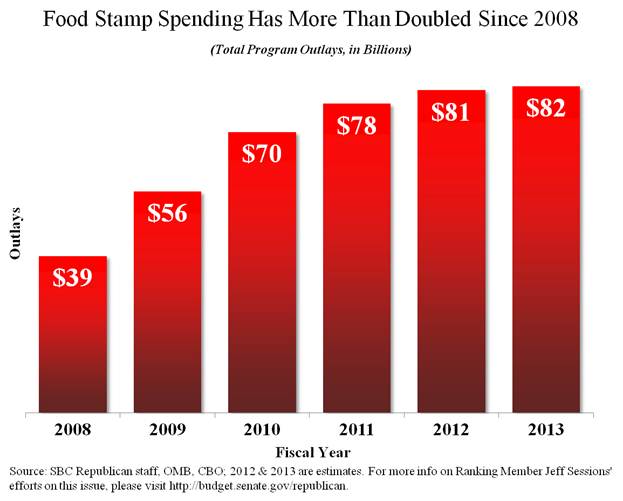
If welfare increases as much as it has in the last decade then it will ruin our country soon. Not only does it hurt the incentive to work since many get caught in the welfare trap, but we can no longer pay for increases like this one for the food stamp budget (up 400% since 2000).

Rachel Sheffield

April 23, 2012 at 11:39 am

The number of Americans on food stamps (or, as it is now called, the Supplemental Nutrition Assistance Program, or SNAP) is higher than ever before, according to a new Congressional Budget Office report. Since 2007, rolls have grown by 70 percent. And participation rates are expected to increase over the next two years.

While some of the growth can be attributed to the recession, participation rates were steadily climbing prior to the recession. Since 2000, the number of Americans on food stamps has jumped by roughly 260 percent, from 17.2 million to 44.7 million in 2011.

Naturally, government spending on food stamps has also jumped, from approximately $20 billion in 2000 to a whopping $78 billion last year, a nearly 400 percent increase.

The growth in participation rates seems to be part of the federal government’s goal, as a report from the U.S. Department of Agriculture released just this month explains.

The food stamps program is just one part of an ever-expanding government welfare system that includes not only 12 food assistance welfare programs but a total of 79 federal welfare programs. These programs provide not only food assistance but cash, housing, energy and utility assistance, education services, child care, medical care, and so forth.

The total cost of these programs reached $927 billion last year. Welfare is now the fastest growing part of government spending, and despite welfare costs increasing 16-fold since the War on Poverty began in the 1960s—and total spending on cash, food, and housing assistance now twice the amount necessary to pull all Americans out of poverty—President Obama wants to spend more. Aggregate welfare costs are projected to reach over $1.5 trillion in 2022.

As Heritage senior fellow Robert Rector said last week at a House Budget Committee hearing, out of control welfare costs are contributing to “ruinous and unsustainable future budget deficits.”

To get spending under control, Congress can roll back current welfare spending to pre-recession levels (adjusted for inflation) once the current recession ends and then capping aggregate welfare spending at the rate of inflation going forward. Doing so would save American taxpayers more than $2.7 trillion during the first decade.

America’s growing welfare state is creating a system of increased dependence and contributing to a growing federal debt. Helping the poor should mean promoting individual freedom through self-reliance rather than creating dependence through an unsustainable government dole.

___________

Thank you so much for your time. I know how valuable it is. I also appreciate the fine family that you have and your commitment as a father and a husband.

Sincerely,

Everette Hatcher III, 13900 Cottontail Lane, Alexander, AR 72002, ph 501-920-5733, lowcostsqueegees@yahoo.com

Open letter to President Obama (Part 147B)

Milton Friedman: Free To Choose – The Failure Of Socialism With Ronald Reagan (Full)

Published on Mar 19, 2012 by

_____________

President Obama c/o The White House
1600 Pennsylvania Avenue NW
Washington, DC 20500

Dear Mr. President,

I know that you receive 20,000 letters a day and that you actually read 10 of them every day. I really do respect you for trying to get a pulse on what is going on out here.

Milton Friedman’s writings affected me greatly when I first discovered them and I wanted to share with you. Also pay attention to the comments of Gary Becker who was one of Milton’s students.

Ronald Reagan introduces this program, and traces a line from Adam Smith’s “The Wealth of Nations” to Milton Friedman’s work, describing Free to Choose as “a survival kit for you, for our nation and for freedom.” Dr. Friedman travels to Hungary and Czechoslovakia to learn how Eastern Europeans are rebuilding their collapsed economies. His conclusion: they must accept the verdict of history that governments create no wealth. Economic freedom is the only source of prosperity. That means free, private markets. Attempts to find a “third way” between socialism and free markets are doomed from the start. If the people of Eastern Europe are given the chance to make their own choices they will achieve a high level of prosperity. Friedman tells us individual stories about how small businesses struggle to survive against the remains of extensive government control. Friedman says, “Everybody knows what needs to be done. The property that is now in the hands of the state, needs to be gotten into the hands of private people who can use it in accordance with their own interests and values.” Eastern Europe has observed the history of free markets in the United States and wants to copy our success. After the documentary, Dr. Friedman talks further about government and the economy with Gary Becker of the University of Chicago and Samuel Bowles of the University of Massachusetts. In a wide-ranging discussion, they disagree about the results of economic controls in countries around the world, with Friedman defending his thesis that the best government role is the smallest one.
___________
Below is a portion of the transcript of the program and above you will find the complete video of the program:
 
 
 DISCUSSIONHello, I am Linda Chavez and welcome to Free to Choose. Joining Dr. Friedman for a discussion of the failure of socialism are Gary Becker from the University of Chicago and Samuel Bowles of the University of Massachusetts. Dr. Bowles, I think we can all agree that socialism has failed Eastern Europe. Dr. Friedman believes that the path out of that is the free market and I think he thinks there are lessons for the United States. What do you think?Chavez: I would like to bring this discussion back to the United States for a moment. What about socialism in the United States. There has been one area where we have tried to redistribute wealth. We have done that through our welfare policies and social security. Has that worked?

Bowles: Well, there is much to celebrate in Eastern Europe __ not only the elimination of dictatorial rule. I go back on that a long time. I was in the Soviet Union in the late 50’s (1958 and 1959) as a musician and I met many Russian musicians and made friends with a lot of Russian people who found themselves harassed and victimized by the police. In fact, my own musical group was prevented from singing a couple of times by the police. That is all on the way out and I hope it is gone for good. Equally welcome is the end of this myth of a centrally planned society. That is gone too and I hope that basically the lesson is learned. But Milton seems to think that we have to choose between either a centrally planned society or a society in which we have markets which are basically unregulated. So the choice is really between all or nothing.

I don’t think that is the choice. I think what Milton is posing for us is a model which is as unrealistic as a centrally planned model. It is outdated, it won’t work, it is extreme, and I think it is undemocratic. I think that we have choices in between, what Milton called the third way, a way that he said wouldn’t work, has been shown to work around the world. I think that Eastern Europe would be very ill-advised to take Milton’s advise on this. Yet, the last time anybody took Milton’s advise on economic policy was Ronald Reagan and Ronald Reagan has put the U.S. economy into a situation where it can’t pay its bills and is facing mounting economic instability and difficulties.

Chavez: Dr. Friedman, what about this midway path?

Friedman: First of all, I utterly reject what Sam says about the results of Ronald Reagan’s changes. We had a decade of extraordinary growth, increased employment in which inflation was brought down sharply. Ronald Reagan came into office at a period of very high inflation, and so on. But this program is not about the Reagan administration. This program is about Eastern Europe and I want to go to Eastern Europe.

I believe Sam is completely wrong in saying that the model I propose is outdated. I believe that what he calls obsolete is something very different. You have had the third way __ you have had it in the United States; you have had it in Sweden; you have had it in Britain; you’ve had it elsewhere. In every case it has been built on the foundation of a long period of what I call the first way. The United States had 150 years of essentially a free private market before it launched on this period of the welfare state. The same thing was true in Britain, the same thing was true in Sweden. I believe he will find it very difficult to site any example of a country which started from a very low level and immediately adopted that combination of policies.

Becker: Let me add something on that. I think the lesson that we learned from what happened in Eastern Europe goes beyond simply that central planning doesn’t work. I think we all agree that it doesn’t work. But it is more than that __ it is the role of private property in the system and the incentives provided by private property.

I don’t know what socialism means anymore, but I remember when I was in Poland I asked the head of the ideology department is private property consistent with socialism? He said, it may be. Then I asked him, well what is the difference between socialism and capitalism. His answer was, we are still working on that. I think what we have seen is a rejection of the ideas associated with traditional socialism which are suppression of private property, government ownership of property, and so on.

Now, how far should we move in the other direction? I think that is question you are asking Sam, and is there a middle way. I think the middle ways that have been successful have all been largely reliant on private property, private ownership, private incentives. The difficult question is one that Milton raised in the documentary. How far can you redistribute income and make it consistent with effective incentives?

I don’t think we know the boundary point, whether 30% of the income being redistributed is too much, 40%, 50% __ my own feeling is that we have gone much too far in Sweden and some of the other Scandinavian countries, and they are beginning to step back from this. They are lowering maximum tax rates to 50% now __ they were up to 80%. So I think there is a third way, but that third way is going to be a lot closer to unregulated market than toward a socialist organization of resources and a suppression of private property.

Bowles: Let’s get back to the particulars though. You talk about Sweden and you talk about the third way failing, and Milton says nobody has ever really gotten rich on the third way __ they have only benefited from that. Let’s talk about the United States. The period you described included a very long period in which the United States was a highly protectionist country in which our industrial base was developed from Alexander Hamilton on for some time, and then during the late 19th and early 20th century. To call that a free market solution would be against everything you have taught. Or, if one wants to go back into the 19th century, the huge subsidies of the railroads were, of course, an intervention in the market.

In the case of England that you talk about, the same is true. The role of the British Navy and for example the Parliament in actually establishing the private property which is what you favor. This was done by a government intervention. We talk about the other cases. Talk about Sweden or about Korea. These are two countries which I think are justly admired for their economic performance. Both countries have income distributions far more equal than the United States.

In Sweden, over the half the GNP is taxed. Now, people in this country would say that obviously they have gone too far. But let’s look at the test of the market. Sweden and Korea have been defeating the United States in world markets. Exports have grown five percent per year during the Reagan/Bush years in Sweden. In the United States, they have grown one percent per year. In Korea we know they have grown much better. If you want to go on to Norway, where much of the investing is done by the government, they have grown their exports even faster than Sweden. Meanwhile, we can’t compete in world markets.

So the lesson of these countries is if you look at the facts Milton, a combination of government regulation and the market works. I agree with Gary. I think private property is extremely important because the incentives associated with owning the results of your work is essential. But private property does not mean that we have to let the market go unregulated and all the evidence says that the countries that are beating us in the world market today don’t do it. They are not that dumb. Japan doesn’t do it; Korea doesn’t do it; Sweden doesn’t do it.

Friedman: Let’s not throw straw men around. Obviously I am not in favor of no government. Government has some very important roles to play. Those are very limited. You take the case of the United States during the 19th century and of Britain in the 19th century. At the time of Queen Victoria’s jubilee in 1899, total government spending in Britain was 10% of the national income. Up until 1929 in the United States, except for periods of great war, total government spending in the United States was about 10% of national income. Now that is a very far cry from a government which spends over half of the national income . . . . and a little less than half in the United States.

Bowles: You are opposed to capital controls. You are opposed to telling people they can’t move their money internationally. That is what Korea does. You are opposed to . . .

Friedman: I think Korea makes a mistake by doing it.

Bowles: Korea has beaten us by exactly the policies you are posing.

Friedman: So has Hong Kong. Hong Kong has beaten us by the policies I am proposing.

Bowles: . . . if Korea is not a middle way and if Sweden is not a middle way, then I would like to know what you call it.

Becker: Korea is a lot closer to a market-oriented economy than any of the economies we have been talking about.

Bowles: The government approves the heads of the banks in Korea. They have nationalized their steel industry and have one of the most efficient plants in the world at Palhang. If you call that a private economy . . .

Becker: What fraction of resources in Korea goes through the government?

Bowles: A tremendous fraction if you take account of the fact that the banks are centrally run and they control the credit allocations there and they don’t let people take their money out of the . . .

_____________ 

Thank you so much for your time. I know how valuable it is. I also appreciate the fine family that you have and your commitment as a father and a husband.

Sincerely,

Everette Hatcher III, 13900 Cottontail Lane, Alexander, AR 72002, ph 501-920-5733, lowcostsqueegees@yahoo.com

Open letter to President Obama (Part 147)

President Obama c/o The White House
1600 Pennsylvania Avenue NW
Washington, DC 20500

Dear Mr. President,

I know that you receive 20,000 letters a day and that you actually read 10 of them every day. I really do respect you for trying to get a pulse on what is going on out here.

If you lowered the spending of the federal government and lowered taxes then things would be better for families. Instead your big government views make it necessary for people to have two incomes in order to pay for all the oppressive taxes we have to pay now.

Max Brantley of the Arkansas Times Blog rightly noted that Hilary Rosen is not the Democratic Party, but she does voice some their views. Here is a good response to her view:

Valuing Mothers’ Work

Rachel Sheffield

April 12, 2012 at 4:12 pm

Yesterday, Hilary Rosen, a Democratic strategist and Democratic National Convention advisor, said that Ann Romney “never worked a day in her life.”

By Rosen’s standard, raising children—five boys, in Mrs. Romney’s case—apparently doesn’t count as work. The nation’s 85.4 million mothers would likely disagree.

Rosen has since apologized for her remarks, saying her words “were poorly chosen.”

Yet, as Carrie Lukas, managing director of Independent Women’s Forum notes:

It’s tempting, of course, to hold this remark up as evidence of the very low opinion that many on the Left hold of stay-at-home moms. Feminists like Linda Hirshman, author of Get to Work … and Get a Life Before It’s Too Late have helped create the sense that many on the Left consider women who take time out of the workforce as letting down the sisterhood, and failing to contribute to society in any meaningful way.

And as Penny Nance, president and CEO of Concerned Women for America, asserts, Rosen’s remarks are evidence of “a deeper problem with the values of this administration and even sometimes society at large.” She went on:

We say raising kids is the hardest and most important work in the world. How does this administration not get how important stay-at-home moms are to our nation? Haven’t they heard the saying, “The hand that rocks the cradle rules the world”?

And if women had it their way, they would spend more time at home with their children. A 2007 Pew Survey reveals that 70 percent of full-time working mothers with children under 18 would prefer to work either part-time or not at all. The number of women who prefer to stay at home has grown since the late 1990s. As the Pew report shows, today just 21 percent of all working mothers say that full-time work is the most ideal situation for them, compared to 32 percent who said that in 1997.

However, the Obama Administration’s big government policies make it more difficult for families to make ends meet, restricting mothers’ ability to choose their ideal work situations. Burdensome taxes along with a rising national debt not only mean that families have less economic freedom today and that future generations will be strapped with the debt created by their predecessors.

Mothers are a priceless resource to their children, families, and the nation. Policies should support mothers—and fathers—who work hard every day to nurture the next generation of Americans.

______________

Thank you so much for your time. I know how valuable it is. I also appreciate the fine family that you have and your commitment as a father and a husband.

Sincerely,

Everette Hatcher III, 13900 Cottontail Lane, Alexander, AR 72002, ph 501-920-5733, lowcostsqueegees@yahoo.com