Category Archives: President Obama

Political arguments against higher taxes from Dan Mitchell

Republicans would be stupid to raise taxes.

The politicians claim that they are negotiating about how best to reduce the deficit. That irks me because our fiscal problem is excessive government spending. Red ink is merely a symptom of that underlying problem.

But that’s a rhetorical gripe. My bigger concern is that politicians are prevaricating. They’re really talking about higher taxes in order to enable a bigger burden of government spending, not less red ink. I make this point in an interview on Fox Business Network.

This is the point where I often elaborate on issues raised in the interview, but let’s instead build on the discussion to look at policy and political reasons why the GOP  should not surrender to Obama’s tax demands as part of fight over the fiscal cliff.

Here are the policy arguments against higher taxes.

1. There is no need for higher taxes since the budget can be balanced merely by restraining spending so that it grows 2.5 percent each year.

According to the most recent Congressional Budget Office fiscal estimate, the 2001 and 2003 tax cuts can be made permanent and red ink can be wiped out in just 10 years so long as politicians simply control the growth of federal spending so that outlays don’t grow faster than 2.5 percent each year. Other nations have shown that this type of spending restraint is very successful, while no nation has ever taxed its way to fiscal success.

2. Since the tax increases stick and the supposed spending cuts quickly evaporate, budget deals that raise taxes have a long history of failure.

Last year, in an article that was designed to browbeat Republicans for being unreasonable about tax hikes, a New York Times columnist inadvertently revealed that the only budget deal that actually led to a fiscal surplus was the 1997 agreement that lowered taxes instead of increasing them. None of the tax-hike budget deals ever resulted in a balanced budget.

3. America’s short-run fiscal problem is the result of too much government spending, not inadequate tax revenue.

Because of large spending increases during the Bush-Obama years, the burden of federal spending has doubled in just 11 years. This is why today’s fiscal numbers look so grim. Some argue that tax revenues are below their long-run average of 18 percent of GDP, but CBO estimates show that tax collections will be above the long-run average by the end of the decade even if all the 2001 and 2003 tax cuts are made permanent. And the White House recently admitted this was true as well.

4. America’s long-run fiscal problem is the result of too much government spending, not inadequate tax revenue.

In the absence of entitlement reform, the burden of federal spending will double, measured as a share of GDP, and the overall burden of government will exceed the levels that currently exist in every single European welfare state. Tax revenues also will climb as a share of GDP thanks to “real-bracket creep,” so there is no plausible argument that the long-run problem is inadequate revenue.

5. The European evidence shows that genuine spending cuts are the only effective way of solving a fiscal crisis.

Nations such as Italy, Greece, France, Spain, Ireland, Portugal, and the United Kingdom have imposed massive tax increases, yet their fiscal problems remain. Indeed, in some cases, these nations are in worse shape because the tax hikes contributed to anemic economic performances.  Some of these countries have belatedly begun to trim their spending burdens, but generally by relying on transitory savings rather than permanent reductions in the obligations of the welfare state. The only relative success stories on the continent are Switzerland, which never got into trouble in the first place thanks to a spending cap, and the Baltic nations, which imposed genuine spending cuts when the crisis first began and now are reaping the rewards of that fiscal discipline.

And here are the political arguments against higher taxes.

1. With Republicans easily retaining control of the House of Representatives, the election was not a mandate to raise taxes.

Nobody argued that there was a mandate to raise taxes before the election, when Republicans controlled the House and Democrats controlled the White House and Senate, so how can there be a mandate to raise taxes today since the election didn’t change anything? Some assert that Obama has a mandate since he campaigned in favor of his soak-the-rich tax plan. That’s true, but House Republicans prevailed after campaigning against class-warfare taxes, so that’s a wash.

2. The GOP prevailed in the exact same tax battle back in 2010, before they controlled the House and when they had fewer seats in the Senate.

This is not the first fiscal cliff battle. The same fight took place at the end of 2010. At the time, Democrats has an overwhelming majority in the House and even stronger control of the Senate than they do today. But by holding firm and staying united, Republicans prevailed. If they lose today, when they have far more political power, it will be a damning indictment of their incompetence.

3. Acquiescing to tax hikes would set a tone of weakness for 2013 and 2014, much as the 2011 “shutdown fight” needlessly gave Obama the upper hand on fiscal battles in 2011 and 2012.

Back in early 2011, the GOP had a pivotal battle with Barack Obama over spending levels for the remainder of the fiscal year. Being a thoughtful guy, I gave them some unsolicited advice on how to prevail, explaining for National Review how Republicans basically won the shutdown fight of 1995-1996. Sadly, they didn’t take my advice and they wound up with a crummy deal. And that paved the way for subsequent defeats, such as the debt limit debacle that planted the seeds for the current tax-hike dilemma. The GOP needs to stop this carousel of capitulation. The fiscal cliff, while bad, is not as bad as a tax deal imposed on them by Obama.

4. If Republicans give up on taxes, they will get nothing in exchange.

I’ve actually written that I would accept higher taxes if we got some real fiscal reform to restrain the growth of government. There is zero chance, however, of any meaningful changes on the spending side of the fiscal ledger, such as program terminations or real entitlement reform. Heck, Obama even proposed more spending for additional Keynesian faux stimulus. Republicans will be laughingstocks if they get suckered…again.

5. Integrity matters, so politicians who promised the people that they wouldn’t raise taxes should honor those commitments.

I realize that it is silly to make an argument about honor and integrity when we’re discussing the actions of politicians, but I’m old fashioned. A promise should mean something. And even if promises don’t mean anything to these guys, they should remember that voters don’t like dishonesty.
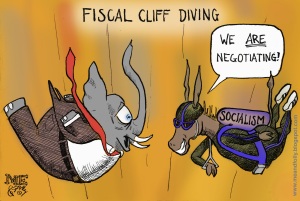
Fiscal Cliff Parachute CartoonI’m not terribly hopeful that any of my advice will be followed, so let’s close this post with some gallows humor.

This cartoon has the same message as the seven classics I posted over the weekend.

Simply stated, Republicans are caught between a rock and hard place, and it looks like taxpayers are going to get screwed.

But they do have a choice about whether their fingerprints should be on the screw.
Is President Obama going to bankrupt our country by going from 10 trillion to 22 trillion in debt? (Part 22)

Government Spending Doesn’t Create Jobs

Uploaded by on Sep 7, 2011

Share this on Facebook: http://on.fb.me/qnjkn9 Tweet it: http://tiny.cc/o9v9t

In the debate of job creation and how best to pursue it as a policy goal, one point is forgotten: Government doesn’t create jobs. Government only diverts resources from one use to another, which doesn’t create new employment.

Video produced by Caleb Brown and Austin Bragg.

_____________

These posts are all dealing with issues that President Obama did not help on in his first term. I am hopeful that he will continue to respond to my letters that I have written him and that he will especially reconsider his view on the following import issue which deals with holding down federal spending. Is President Obama going to bankrupt our country by going from 10 trillion to 22 trillion in debt?

I have a lot of respect for Tea Party heroes like Tim Huelskamp , Idaho First District Congressman Raúl R. Labrador, and Justin Amash who are willing to vote against proposals that increase our spending. They all favor balancing the budget.   

It is a fact that we must balance the budget soon. I do not believe that we can wait to balance the budget at some distant time in the future. The financial markets will not allow us a long time to get our house in order. Look at how things have been going the last four years and no matter how anyone tries to spin it, we are going down the financial drain fast.

Brian Darling

May 24, 2012 at 2:51 pm

Spending has skyrocketed under President Obama, but of late some are claiming that the opposite is true. Case in point: MarketWatch columnist Rex Nutting wrote, “Obama spending binge never happened,” and Politifact rated this statement “mostly true.”

But Mitt Romney this week said that “Since President Obama assumed office three years ago, federal spending has accelrated at a pace without precedent in recent history.” So who has it right? Mitt Romney.

What Politifact must have missed is a very important data point: President Obama signed most of the spending attributed to President George W. Bush’s last year in office, which was assigned wrongly to Bush in Nutting’s piece. (Heritage’s Emily Goff and Alison Fraser set the record straight on The Foundry.)

Nutting argues that President G.W. Bush’s second term spending bills from Fiscal Year 2006-2009 averaged 8.1% and President Obama’s annualized growth averaged 1.4%.  The reason why Nutting included FY 2009 is because it was “the last of George W. Bush’s presidency — federal spending rose by 17.9% from $2.98 trillion to $3.52 trillion.”  This assumption is incorrect and dishonest.  This flaw in Nutting’s analysis is the reason why the Obama numbers are wrong and Nutting’s whole piece is based on flawed data.

Nutting operates under the flawed assumption that President Obama is not responsible for FY 2009 spending.  Under normal circumstances Nutting would be correct.  If Congress were a functioning body that passed appropriations bills on time, then this analysis would be correct.  The fact of the matter is that in recent history Congress has not done appropriations bills on time and in FY 2009, President Obama signed these spending bills into law that President Bush would have under different circumstances.

Usually, the president in office prior to a new president would have helped craft and sign into law government spending bills applied to the first 9 months of spending the next year and a president’s new term.  A fiscal year starts on October 1 of the year prior to the calendar year to September 30th of the calendar year.  In other words the fiscal year starts three months early.

In FY2009, Congress did not complete work by September 30, 2008.  President Bush did sign some appropriations bills and a continuing resolution to keep the government running into President Obama’s first term, yet a Democrat controlled Congress purposely held off on the big spending portions of the appropriations bills until Obama took office.  They did so for the purposes of jacking up spending.  President Obama signed the final FY2009 spending bills on March 11, 2009.

Congressional Quarterly (subscription required) maps out a history of the FY 2009 final appropriations bills (H.R. 1105 and PL 111-8), that would lead one to attribute most of the accelerated spending in FY 2009 to President Obama in a piece titled “2009 Legislative Summary: Fiscal 2009 Omnibus.” From CQ, “the omnibus provided a total of $1.05 trillion — $410 billion of it for discretionary programs — and included many of the domestic spending increases Democrats were unable to get enacted while George W. Bush was president.”  If accepted as true, this statement alone undercuts Nutting’s whole premise that FY 2009 is wholly Bush spending.

President Bush signed only three of the twelve appropriations bills for FY 2009:  Defense; Military Construction/Veterans Affairs; and, Homeland Security.  President Bush also signed a continuing resolution that kept the government running until March 6, 2009 that level of funding the remaining nine appropriations bills at FY 2008 levels.  President Bush and his spending should only be judged on these three appropriations bills and FY 2008 levels of funding for the remaining nine appropriations bills.  Bush never consented to the dramatic increase in spending for FY 2009 and he should not be blamed for that spending spree.

The Democrats purposely held off on the appropriations process because they hoped they could come into 2009 with a new Democrat-friendly Congress and a President who would sign bloated spending bills.  Remember, President Obama was in the Senate when these bills were crafted and he was part of this process to craft bloated spending bills.  CQ reported that “in delaying the nine remaining bills until 2009, Democrats gambled that they would come out of the November 2008 elections with bigger majorities in both chambers and a Democrat in the White House who would support more funding for domestic programs.”  And they did.

If you trust CQ’s reporting, and I do, then this is damning.  Democrats in Congress purposely held off on pushing bloated appropriations bills because they knew President Bush would not sign the bill and Republicans in the Senate would block consideration of it.  You have to remember that the Senate went from 51-49 Democrat control under President Bush’s last year to 59-41 in the early days of President Obama.  On April 28, 2009, Senator Arlen Specter switched parties from Republican to Democrat to give the Democrats a 60 vote filibuster proof majority in the Senate.  The House had a similar conversion from a 233-202 Democrat majority to 257-178 Democrat majority. Democrats were banking on a big enough majorities in the Senate and House that they could pass the bloated spending bill and they got it.

Bush issued a veto threat on the bloated spending bills pending in Congress in late 2008.  CQ estimated that the final spending bill “provided about $31 billion more in discretionary funding than was included in the fiscal 2008 versions of the nine bills” which is “about $19 billion more than Bush sought.”  I would argue that Obama gets credit for the whole $31 billion in new spending.  The most damning fact from the CQ piece is that “Bush had threatened to veto spending bills that exceeded his request.”

Now one can argue that even $31 billion is a drop in the bucket when one considers that spending went from $2.98 trillion to $3.52 trillion.  Much of the spike in increased spending is on the mandatory spending side, and much of it can be attributed to President Obama.  Look at OMB Tables on FY 2008 spending versus FY 2009 spending and you can see why the numbers spiked between those two years.

Overall spending, mandatory and discretionary spending went from $2.98 trillion in FY 2008 to $3.52 trillion in FY 2009.  There were two of the big spikes in spending from FY’08 to ’09.  One was in Federal Payments for Individuals not including Social Security and Medicare from $758 billion in FY’08 to 918 billion in FY’09.  President Obama’s Stimulus spending bill included an increase in food stamps and an extension of unemployment benefits that should not be attributable to President Bush.  Also, the category of “Other Federal” spending spiked from $261 billion to $540 billion.  This includes TARP spending that was recovered on the back end by President Obama further distorting the Nutting analysis.

So how can Nutting attribute spending to President Bush that he expressly vowed to veto?  Also, some of the mandatory spending has been wrongly attributed to President Bush in Nutting’s analysis.  Finally, TARP spending under Bush and the recovery of TARP money under Obama further distorts these numbers.

This is unethical and fuzzy math.  The Truth-O-Meter may want to consider these facts when further analyzing the complications and distortions in analysis used by Nutting to argue that Obama is more fiscally responsible than his predecessors.

Open letter to President Obama (Part 190)


President Obama c/o The White House
1600 Pennsylvania Avenue NW
Washington, DC 20500

Dear Mr. President,

I know that you receive 20,000 letters a day and that you actually read 10 of them every day. I really do respect you for trying to get a pulse on what is going on out here.

People need to try to better their own lives instead of asking the government to treat them like kids for the rest of their lives.

The Obama campaign’s “Life of Julia” ad is a disturbing sign. It suggests that political strategists, pollsters, and campaign advisers must think that the people living off government are getting to the point where they can out-vote the people paying for government.

If that’s true, America is doomed to become another Greece – which would be an appropriate fate since, for all intents and purposes, Julia is the fictional twin of a real-life Greek woman who thought it was government’s job to give her things.

In general, I think the best response to Julia is mockery, which is why I shared this Iowahawk parody and this Ramirez cartoon.

But we also need a serious discussion of why dependency is a bad thing, which is why I’m glad the Center for Freedom and Prosperity has produced this new “Economics 101″ video.

It’s narrated by Emily O’Neill, who contrasts the moocher mentality of Julia with how she wants her life to develop. To give away the message, she wants the kind of fulfillment that only exists when you earn things.

Emily’s view could be considered Randian libertarianism, conventional conservatism, or both. That’s because there’s a common moral belief in both philosophies that government-imposed coercion and redistribution erode the social capital of a people.

This is perhaps the key issue for America’s future, which is why I hope you’ll share this video widely. Otherwise, we my face a future where this Chuck Asay cartoon becomes reality. Speaking of Asay, this cartoon is a pretty good summary of what the Julia ad is really saying.

___________

Thank you so much for your time. I know how valuable it is. I also appreciate the fine family that you have and your commitment as a father and a husband.

Sincerely,

Everette Hatcher III, 13900 Cottontail Lane, Alexander, AR 72002, ph 501-920-5733, lowcostsqueegees@yahoo.com

Open letter to President Obama (Part 189)

Uploaded by on Dec 14, 2008

Thomas Sowell discusses his concerns with the unconstrained vision of Barack Obama. http://www.LibertyPen.com

_______________


President Obama c/o The White House
1600 Pennsylvania Avenue NW
Washington, DC 20500

Dear Mr. President,

I know that you receive 20,000 letters a day and that you actually read 10 of them every day. I really do respect you for trying to get a pulse on what is going on out here.

____________

Government does not have the answer to all of our problems. I wish people would stop looking to it for every answer.

A couple of years ago, Newt Gingrich accused Obama of being a socialist, causing some squawking and grousing about incivility from the more sensitive types in Washington.

I jumped to the President’s defense, pointing out that Obama is a different type of statist.

I’m gratified that Thomas Sowell of Stanford University’s Hoover Institution agrees with me.

It bothers me a little when conservatives call Barack Obama a “socialist.” He certainly is an enemy of the free market, and wants politicians and bureaucrats to make the fundamental decisions about the economy. But that does not mean that he wants government ownership of the means of production, which has long been a standard definition of socialism. What President Obama has been pushing for, and moving toward, is more insidious: government control of the economy, while leaving ownership in private hands. That way, politicians get to call the shots but, when their bright ideas lead to disaster, they can always blame those who own businesses in the private sector. Politically, it is heads-I-win when things go right, and tails-you-lose when things go wrong. This is far preferable, from Obama’s point of view, since it gives him a variety of scapegoats for all his failed policies… Thus the Obama administration can arbitrarily force insurance companies to cover the children of their customers until the children are 26 years old. Obviously, this creates favorable publicity for President Obama. But if this and other government edicts cause insurance premiums to rise, then that is something that can be blamed on the “greed” of the insurance companies.

So what is the right technical description of what Obama is proposing? Well, if you allow nominal private property, but impose government control, it’s called fascism. Sowell agrees, and also adds some history for the unenlightened.

One of the reasons why both pro-Obama and anti-Obama observers may be reluctant to see him as fascist is that both tend to accept the prevailing notion that fascism is on the political right, while it is obvious that Obama is on the political left. Back in the 1920s, however, when fascism was a new political development, it was widely — and correctly — regarded as being on the political left. Jonah Goldberg’s great book “Liberal Fascism” cites overwhelming evidence of the fascists’ consistent pursuit of the goals of the left, and of the left’s embrace of the fascists as one of their own during the 1920s.Mussolini, the originator of fascism, was lionized by the left, both in Europe and in America, during the 1920s. Even Hitler, who adopted fascist ideas in the 1920s, was seen by some, including W.E.B. Du Bois, as a man of the left. …What socialism, fascism and other ideologies of the left have in common is an assumption that some very wise people — like themselves — need to take decisions out of the hands of lesser people, like the rest of us, and impose those decisions by government fiat. …Only our own awareness of the huge stakes involved can save us from the rampaging presumptions of our betters, whether they are called socialists or fascists. So long as we buy their heady rhetoric, we are selling our birthright of freedom.

All this being said, I want to reiterate something else that I wrote back in 2010. It is counterproductive to call Obama a fascist because that term is now linked to the specific form of evil produced by Hitler and the National Socialist Party.

So if you disapprove of Obama’s policies, call him a statist or a corporatist. Heck, you can say he believes in cronyism or maybe even collectivism. Those terms get across that he wants more government without causing needless controversy that distracts from the main message.

But make sure you apply the same term to Republicans who impose the same types of policies, such as Bush and Nixon.

_____________

Thank you so much for your time. I know how valuable it is. I also appreciate the fine family that you have and your commitment as a father and a husband.

Sincerely,

Everette Hatcher III, 13900 Cottontail Lane, Alexander, AR 72002, ph 501-920-5733, lowcostsqueegees@yahoo.com

Open letter to President Obama (Part 188)


President Obama c/o The White House
1600 Pennsylvania Avenue NW
Washington, DC 20500

Dear Mr. President,

I know that you receive 20,000 letters a day and that you actually read 10 of them every day. I really do respect you for trying to get a pulse on what is going on out here.

____________

If we don’t cut spending then we will end up at Greece. We have to tackle entitlement reforms.

Will America Face a Greek-Style Fiscal Crisis?

June 14, 2012 by Dan Mitchell

Since I’ve written several times that the United States will face a fiscal crisis if entitlement programs aren’t reformed, you won’t be surprised to see that I repeat those points in this CNBC debate.

But I’m not happy with my performance.

Not because my leftist opponent grabbed more air time (mostly because the host started challenging him, which also happens periodically when I’m on Kudlow’s show), but because he gave me a giant opening to completely destroy his arguments and I failed to seize the opportunity.

He kept arguing that America is more dynamic and innovative than Europe, which generally is true, but then he argued that we should copy Europe’s fiscal policy by increasing the burden of government spending.

I think the points I made to wrap up the debate were fine, but I would be much happier with my performance if I had pointed out this huge hole in his position.

As shown in this amusing and clever poster, you don’t solve the problems created by government with more government.

_______________

_______________________________

Thank you so much for your time. I know how valuable it is. I also appreciate the fine family that you have and your commitment as a father and a husband.

Sincerely,

Everette Hatcher III, 13900 Cottontail Lane, Alexander, AR 72002, ph 501-920-5733, lowcostsqueegees@yahoo.com

Speaker Boehner’s office responds to my emails

I do appreciate the fact that Speaker Boehner’s office took time to respond to my many emails to his office recently concerning the runaway spending in our country by the federal government. In this email below Speaker Boehner says he is committed to cutting spending but if that is true then why is he punishing Tea Party Republicans ( Rep. David Schweikert (R-AZ),Justin Amash (R-MI), and Tim Huelskamp (R-KS). ) for voting against new spending.

It is obvious to me that if President Obama gets his hands on more money then he will continue to spend away our children’s future. He has already taken the national debt from 11 trillion to 16 trillion in just 4 years. Over, and over, and over, and over, and over and over I have written Speaker Boehner and the Congressmen (Griffin, Womack, Crawford) in Arkansas concerning this. I am hoping they will stand up against this reckless spending that our federal government has done and will continue to do if given the chance.

I have written and emailed Senator Pryor over, and over again with spending cut suggestions but he has ignored all of these good ideas in favor of keeping the printing presses going as we plunge our future generations further in debt. I am convinced if he does not change his liberal voting record that he will no longer be our senator in 2014.

I have written hundreds of letters and emails to President Obama and I must say that I have been impressed that he has had the White House staff answer so many of my letters. However, his policies have not changed. He is committed to cutting nothing from the budget that I can tell.

This morning I got this email back:

Speaker John Boehner
 

December 6, 2012
 
 
Mr. Everette Hatcher
13900 Cottontail Lane
Alexander, AR 72002-7217
 
Dear Mr. Hatcher:
 

Thank you for taking the time to contact me. It’s good to hear from you.

Your ideas, comments, and questions help make possible my goal of leading a House of Representatives that listens and reflects the will of the American people. That’s why I’d like to ask you to keep speaking out by:

I made a Pledge to America to focus on removing government barriers to private-sector job creation and economic growth – that includes cutting spending to help end the uncertainty facing job creators; repealing the job-crushing health care law and replacing it with common sense reforms that lower costs; reining in excessive regulations; and promoting an American Energy Initiative that increases energy production to create jobs and lower energy prices. I also pledged to lead an effort to reform Congress and rebuild the bonds of trust between the American people and their representatives in Washington. I hope you’ll stay engaged and keep me updated on your thoughts as we work to keep this pledge.

Thank you again for contacting me and please stay in touch.

JOHN BOEHNER
Speaker of the House

Mail Rss Google+ Facebook Twitter Speaker Boehner’s Press Office | H-232 The Capitol | 202-225-0600 
Sent from an unattended mailbox, please do not reply.
Contact the Office of Speaker Boehner. | Privacy Policy

Related posts:

Open letter to Speaker of the House John Boehner (Part 53)

Open letter to Speaker of the House John Boehner (Part 53) John Boehner, Speaker of the House H-232, The Capital, Washington, DC 20515 Dear Mr. Speaker, I know that you will have to meet with newly re-elected President Obama soon and he will probably be anxious for you to raise taxes and  federal spending, but […]

Open letter to Speaker of the House John Boehner (Part 52)

Open letter to Speaker of the House John Boehner (Part 52) John Boehner, Speaker of the House H-232, The Capital, Washington, DC 20515 Dear Mr. Speaker, I know that you will have to meet with newly re-elected President Obama soon and he will probably be anxious for you to raise taxes and  federal spending, but […]

Open letter to Speaker of the House John Boehner (Part 51)

Open letter to Speaker of the House John Boehner (Part 51) John Boehner, Speaker of the House H-232, The Capital, Washington, DC 20515 Dear Mr. Speaker, I know that you will have to meet with newly re-elected President Obama soon and he will probably be anxious for you to raise taxes and  federal spending, but […]

Open letter to Speaker of the House John Boehner (Part 50)

Open letter to Speaker of the House John Boehner (Part 50) John Boehner, Speaker of the House H-232, The Capital, Washington, DC 20515 Dear Mr. Speaker, I know that you will have to meet with newly re-elected President Obama soon and he will probably be anxious for you to raise taxes and  federal spending, but […]

Open letter to Speaker of the House John Boehner (Part 49)

Open letter to Speaker of the House John Boehner (Part 49) John Boehner, Speaker of the House H-232, The Capital, Washington, DC 20515 Dear Mr. Speaker, I know that you will have to meet with newly re-elected President Obama soon and he will probably be anxious for you to raise taxes and  federal spending, but […]

Open letter to Speaker of the House John Boehner (Part 48)

Open letter to Speaker of the House John Boehner (Part 48) John Boehner, Speaker of the House H-232, The Capital, Washington, DC 20515 Dear Mr. Speaker, I know that you will have to meet with newly re-elected President Obama soon and he will probably be anxious for you to raise taxes and  federal spending, but […]

Open letter to Speaker of the House John Boehner (Part 47)

Open letter to Speaker of the House John Boehner (Part 47) John Boehner, Speaker of the House H-232, The Capital, Washington, DC 20515 Dear Mr. Speaker, I know that you will have to meet with newly re-elected President Obama soon and he will probably be anxious for you to raise taxes and  federal spending, but […]

Open letter to Speaker of the House John Boehner (Part 46)

Open letter to Speaker of the House John Boehner (Part 46) John Boehner, Speaker of the House H-232, The Capital, Washington, DC 20515 Dear Mr. Speaker, I know that you will have to meet with newly re-elected President Obama soon and he will probably be anxious for you to raise taxes and  federal spending, but […]

Open letter to Speaker of the House John Boehner (Part 45)

Open letter to Speaker of the House John Boehner (Part 45) John Boehner, Speaker of the House H-232, The Capital, Washington, DC 20515 Dear Mr. Speaker, I know that you will have to meet with newly re-elected President Obama soon and he will probably be anxious for you to raise taxes and  federal spending, but […]

Open letter to Speaker of the House John Boehner (Part 44)

Open letter to Speaker of the House John Boehner (Part 44) John Boehner, Speaker of the House H-232, The Capital, Washington, DC 20515 Dear Mr. Speaker, I know that you will have to meet with newly re-elected President Obama soon and he will probably be anxious for you to raise taxes and  federal spending, but […]

Open letter to Speaker of the House John Boehner (Part 43)

Open letter to Speaker of the House John Boehner (Part 43) John Boehner, Speaker of the House H-232, The Capital, Washington, DC 20515 Dear Mr. Speaker, I know that you will have to meet with newly re-elected President Obama soon and he will probably be anxious for you to raise taxes and  federal spending, but […]

Open letter to Speaker of the House John Boehner (Part 42)

Open letter to Speaker of the House John Boehner (Part 42) John Boehner, Speaker of the House H-232, The Capital, Washington, DC 20515 Dear Mr. Speaker, I know that you will have to meet with newly re-elected President Obama soon and he will probably be anxious for you to raise taxes and  federal spending, but […]

Open letter to Speaker of the House John Boehner (Part 41)

Open letter to Speaker of the House John Boehner (Part 41) John Boehner, Speaker of the House H-232, The Capital, Washington, DC 20515 Dear Mr. Speaker, I know that you will have to meet with newly re-elected President Obama soon and he will probably be anxious for you to raise taxes and  federal spending, but […]

Open letter to Speaker of the House John Boehner (Part 40)

Open letter to Speaker of the House John Boehner (Part 40) John Boehner, Speaker of the House H-232, The Capital, Washington, DC 20515 Dear Mr. Speaker, I know that you will have to meet with newly re-elected President Obama soon and he will probably be anxious for you to raise taxes and  federal spending, but […]

Open letter to Speaker of the House John Boehner (Part 39)

Open letter to Speaker of the House John Boehner (Part 39) John Boehner, Speaker of the House H-232, The Capital, Washington, DC 20515 Dear Mr. Speaker, I know that you will have to meet with newly re-elected President Obama soon and he will probably be anxious for you to raise taxes and  federal spending, but […]

Open letter to Speaker of the House John Boehner (Part 38)

Open letter to Speaker of the House John Boehner (Part 38) John Boehner, Speaker of the House H-232, The Capital, Washington, DC 20515 Dear Mr. Speaker, I know that you will have to meet with newly re-elected President Obama soon and he will probably be anxious for you to raise taxes and  federal spending, but […]

Open letter to Speaker of the House John Boehner (Part 37)

Open letter to Speaker of the House John Boehner (Part 37) John Boehner, Speaker of the House H-232, The Capital, Washington, DC 20515 Dear Mr. Speaker, I know that you will have to meet with newly re-elected President Obama soon and he will probably be anxious for you to raise taxes and  federal spending, but […]

Open letter to Speaker of the House John Boehner (Part 36)

Open letter to Speaker of the House John Boehner (Part 36) John Boehner, Speaker of the House H-232, The Capital, Washington, DC 20515 Dear Mr. Speaker, I know that you will have to meet with newly re-elected President Obama soon and he will probably be anxious for you to raise taxes and  federal spending, but […]

Open letter to Speaker of the House John Boehner (Part 35)

Open letter to Speaker of the House John Boehner (Part 35) John Boehner, Speaker of the House H-232, The Capital, Washington, DC 20515 Dear Mr. Speaker, I know that you will have to meet with newly re-elected President Obama soon and he will probably be anxious for you to raise taxes and  federal spending, but […]

Open letter to Speaker of the House John Boehner (Part 34)

Open letter to Speaker of the House John Boehner (Part 34) John Boehner, Speaker of the House H-232, The Capital, Washington, DC 20515 Dear Mr. Speaker, I know that you will have to meet with newly re-elected President Obama soon and he will probably be anxious for you to raise taxes and  federal spending, but […]

Open letter to Speaker of the House John Boehner (Part 33)

Open letter to Speaker of the House John Boehner (Part 33) John Boehner, Speaker of the House H-232, The Capital, Washington, DC 20515 Dear Mr. Speaker, I know that you will have to meet with newly re-elected President Obama soon and he will probably be anxious for you to raise taxes and  federal spending, but […]

Open letter to Speaker of the House John Boehner (Part 32)

Open letter to Speaker of the House John Boehner (Part 32) John Boehner, Speaker of the House H-232, The Capital, Washington, DC 20515 Dear Mr. Speaker, I know that you will have to meet with newly re-elected President Obama soon and he will probably be anxious for you to raise taxes and  federal spending, but […]

Open letter to Speaker of the House John Boehner (Part 31)

Open letter to Speaker of the House John Boehner (Part 31) John Boehner, Speaker of the House H-232, The Capital, Washington, DC 20515 Dear Mr. Speaker, I know that you will have to meet with newly re-elected President Obama soon and he will probably be anxious for you to raise taxes and  federal spending, but […]

Open letter to Speaker of the House John Boehner (Part 30)

Open letter to Speaker of the House John Boehner (Part 30) John Boehner, Speaker of the House H-232, The Capital, Washington, DC 20515 Dear Mr. Speaker, I know that you will have to meet with newly re-elected President Obama soon and he will probably be anxious for you to raise taxes and  federal spending, but […]

Open letter to Speaker of the House John Boehner (Part 29)

Open letter to Speaker of the House John Boehner (Part 29) John Boehner, Speaker of the House H-232, The Capital, Washington, DC 20515 Dear Mr. Speaker, I know that you will have to meet with newly re-elected President Obama soon and he will probably be anxious for you to raise taxes and  federal spending, but […]

Open letter to Speaker of the House John Boehner (Part 28)

Open letter to Speaker of the House John Boehner (Part 28) John Boehner, Speaker of the House H-232, The Capital, Washington, DC 20515 Dear Mr. Speaker, I know that you will have to meet with newly re-elected President Obama soon and he will probably be anxious for you to raise taxes and  federal spending, but […]

Open letter to Speaker of the House John Boehner (Part 27)

Open letter to Speaker of the House John Boehner (Part 27) John Boehner, Speaker of the House H-232, The Capital, Washington, DC 20515 Dear Mr. Speaker, I know that you will have to meet with newly re-elected President Obama soon and he will probably be anxious for you to raise taxes and  federal spending, but […]

Open letter to Speaker of the House John Boehner (Part 26)

Open letter to Speaker of the House John Boehner (Part 26) John Boehner, Speaker of the House H-232, The Capital, Washington, DC 20515 Dear Mr. Speaker, I know that you will have to meet with newly re-elected President Obama soon and he will probably be anxious for you to raise taxes and  federal spending, but […]

Open letter to Speaker of the House John Boehner (Part 25)

Open letter to Speaker of the House John Boehner (Part 25) John Boehner, Speaker of the House H-232, The Capital, Washington, DC 20515 Dear Mr. Speaker, I know that you will have to meet with newly re-elected President Obama soon and he will probably be anxious for you to raise taxes and  federal spending, but […]

Open letter to Speaker of the House John Boehner (Part 24)

Open letter to Speaker of the House John Boehner (Part 24) John Boehner, Speaker of the House H-232, The Capital, Washington, DC 20515 Dear Mr. Speaker, I know that you will have to meet with newly re-elected President Obama soon and he will probably be anxious for you to raise taxes and  federal spending, but […]


Is President Obama going to bankrupt our country by going from 10 trillion to 22 trillion in debt?(Part 21)

Cronyism in the Solyndra Scandal

These posts are all dealing with issues that President Obama did not help on in his first term. I am hopeful that he will continue to respond to my letters that I have written him and that he will especially reconsider his view on the following import issue which deals with holding down federal spending!!! (We can not throw money out the window on stupid give-away programs like this below. Is President Obama going to bankrupt our country by going from 10 trillion to 22 trillion in debt? Getting more taxes in will not help cure our spending addiction.

We have to encourage the private market to do it’s thing without interference from Washington. However,  you have  dished out billions of dollars to politically favored companies in pursuit of job creation and a new “green” economy as the article below points out. That is simply “taxpayer-funded crony capitalism that has neither created new jobs nor produced the green-energy payout that the president was looking for. In fact, it’s a policy that has failed miserably, leading to bankruptcy after bankruptcy. Yet despite all the failures — and zero successes — the president and his Administration are defending the indefensible and standing by a policy that has squandered taxpayer money.”

The best policy is to leave the private market alone!!! 

Morning Bell: The White House Defends Public Equity

Mike Brownfield

May 30, 2012 at 9:03 am

Up is down, left is right, good is bad, and day is night. If you wander inside the Washington, D.C., beltway, you’ll enter a bizarro world where, at times, commonsense is replaced by a localized logic that is completely divorced from the reality.

The latest example of political gobbledygook comes courtesy of White House press secretary Jay Carney, who yesterday lapsed into rambling rhetoric when asked to explain how President Obama can defend the failed Solyndra solar boondoggle, yet attack private sector investments that sometimes fail but oftentimes succeed. Here’s his response:

Look…there, there, there is the…the…difference in that, your overall view of what…huh, your responsibilities are as president and what your view of the economic future is.

And the president believes as he’s made clear that a president’s responsibility is not just to, ah, those who win but those who, for example in a company where ah, there have been layoffs or a company that has gone bankrupt, that we have to ah make sure that those folks have the means to find other employment, that they have the ability to train for other kinds of work and that’s part of the overall responsibility a president has.

Got all that?

For the duration of his Administration, President Obama has dished out billions of dollars to politically favored companies in pursuit of job creation and a new “green” economy. It’s taxpayer-funded crony capitalism that has neither created new jobs nor produced the green-energy payout that the president was looking for. In fact, it’s a policy that has failed miserably, leading to bankruptcy after bankruptcy. Yet despite all the failures — and zero successes — the president and his Administration are defending the indefensible and standing by a policy that has squandered taxpayer money.

In one instance, President Obama committed $465 million of taxpayer money to Tesla, which was founded by a campaign mega-donor and the 63rd richest man in the world, Elon Musk, to build a $130,000 battery-powered sports car that becomes permanently inoperable if left uncharged for 30 days.

It’s gotten so bad that Congress is launching probes of federal green energy programs, including the Energy Department loan program, over concerns that lawmakers fast-tracked approval for politically connected companies. Heritage’s Lachlan Markay reports that according to a Republican aide on the Senate Budget Committee, “Politically favored, and often connected, renewable energy plans [receive] less rigorous review than traditional energy projects.” In one program, of the $20.5 billion in loans granted, $16.4 billion went to companies linked to donors who contributed to Obama and the Democratic Party.

At the same time the president is defending his taxpayer-funded failures, he’s attacking free enterprise, including in private equity and venture capitalism — enterprises in which investors voluntarily put up their own money to invest in new ideas and rescue existing companies. Sometimes those ventures fail, sometimes their inevitable failure is delayed but temporarily saves jobs amid restructuring, but many times they succeed — generating profits and producing new jobs.

When Carney was asked to justify the president’s defense of one, but criticism of the other, he just couldn’t do it. That’s no surprise, in that the two positions are logically inconsistent.

This episode calls to mind a quote from George Orwell, a frequent and pointed critic of modern political discourse:

In our time, political speech and writing are largely the defence of the indefensible… Thus political language has to consist largely of euphemism, question-begging and sheer cloudy vagueness… the great enemy of clear language is insincerity. Where there is a gap between one’s real and one’s declared aims, one turns as it were instinctively to long words and exhausted idioms …

Maybe Jay Carney’s confused speech is the result of the unbearable heat and humidity that has descended on Washington all too early this year. Or maybe it’s a bad case of Potomac fever. But no matter the cause, the results are the same. In Washington, the Obama Administration is hard at work defending the crony capitalist machine while lambasting the free market system — and it shows no signs of letting up.

Open letter to President Obama (Part 187)

President Obama c/o The White House
1600 Pennsylvania Avenue NW
Washington, DC 20500Dear Mr. President,I know that you receive 20,000 letters a day and that you actually read 10 of them every day.I really do respect you for trying to get a pulse on what is going on out here.

I read back on Dec 8, 2011 that Tony Perkins, president of Family Research Council, a social conservative advocacy organization, said in 2011 that President Obama has been “hostile” and “disdainful” toward Christianity. Rick Perry actually said President Obama had a war on religion. One of the most basic things that our founding fathers did is base our laws on the ten commandments. At the Supreme Court there is one depiction showing Moses sitting, holding two blank stone tablets. There is one depiction showing Moses standing holding one stone tablet. There are two stone tablets depicted with Roman Numbers I-X carved in the oak doors. 

David Barton has studied the history of the founding of our country for many years and I wanted to share a portion of adocument he wrote concerning the 10 Commandments:

David Barton – 01/03/2001
(View the footnoted version on Liberty Council’s website)

UNITED STATES DISTRICT COURT

EASTERN DISTRICT OF KENTUCKY

LONDON DIVISION

SARAH DOE and THOMAS DOE, on behalf

of themselves and their minor child, JAN DOE

Plaintiffs,

v Civil Action No. 99-508

HARLAN COUNTY SCHOOL DISTRICT;

DON MUSSELMAN, in his official capacity

as Superintendent of the Harlan Country

School District,

Defendents.

______________________________________________

AFFIDAVIT OF DAVID BARTON IN SUPPORT OF DEFENDANTS’ OPPOSITION TO PLAINTIFFS’ MOTION FOR CONTEMPT, OR, IN THE ALTERNATIVE, FOR SUPPLEMENTAL PRELIMINARY INJUNCTION

STATE OF TEXAS

COUNTY OF PARKER

HOW THE TEN COMMANDMENTS ARE EXPRESSED

IN CIVIL LAW IN AMERICAN HISTORY

Do not murder.

56. The next several commands form much of the heart of our criminal laws, and, as noted by Noah Webster, one of the first founders to call for the Constitutional Convention, the divine law is the original source of several of those criminal laws:

The opinion that human reason left without the constant control of Divine laws and commands will . . . give duration to a popular government is as chimerical as the most extravagant ideas that enter the head of a maniac. . . . Where will you find any code of laws among civilized men in which the commands and prohibitions are not founded on Christian principles? I need not specify the prohibition of murder, robbery, theft, [and] trespass.

57. The early civil laws against murder substantiate the influence of the Decalogue and divine laws on American criminal laws. For example, a 1641 Massachusetts law declared:

4. Ex. 21.12, Numb. 35.13, 14, 30, 31. If any person commit any willful murder, which is manslaughter committed upon premeditated malice, hatred, or cruelty, not in a man’s necessary and just defense nor by mere casualty against his will, he shall be put to death.

5. Numb. 25.20, 21. Lev. 24.17. If any person slayeth another suddenly in his anger or cruelty of passion, he shall be put to death.

6. Ex. 21.14. If any person shall slay another through guile, either by poisoning or other such devilish practice, he shall be put to death.

58. Perhaps the point is too obvious to belabor, but similar provisions can be found in the Connecticut laws of 1642, the New Hampshire laws of 1680, etc.

59. Courts, too, have been very candid in tracing civil murder laws back to the Decalogue. For example, a 1932 Kentucky appeals court declared:

The rights of society as well as those of appellant are involved and are also to be protected, and to that end all forms of governments following the promulgation of Moses at Mt. Sinai has required of each and every one of its citizens that “Thou shalt not murder.” If that law is violated, the one guilty of it has no right to demand more than a fair trial, and if, as a result thereof, the severest punishment for the crime is visited upon him, he has no one to blame but himself.

60. Even the “severest punishment for the crime” is traced back to divine laws. As first Chief Justice John Jay explained:

There were several divine, positive ordinances . . . of universal obligation, as . . . the particular punishment for murder.

61. There certainly exist more than sufficient cases with declarations similar to that made by the Kentucky court above to demonstrate that the sixth commandment of the Decalogue exerted substantial force on American civil law and jurisprudence.

___________________

Thank you so much for your time. I know how valuable it is. I also appreciate the fine family that you have and your commitment as a father and a husband.

Sincerely,

Everette Hatcher III, 13900 Cottontail Lane, Alexander, AR 72002, ph 501-920-5733, lowcostsqueegees@yahoo.com

“Friedman Friday,” EPISODE “The Failure of Socialism” of Free to Choose in 1990 by Milton Friedman (Part 1)

Milton Friedman: Free To Choose – The Failure Of Socialism With Ronald Reagan (Full)

Published on Mar 19, 2012 by

Milton Friedman’s writings affected me greatly when I first discovered them and I wanted to share with you. We must not head down the path of socialism like Greece has done.

Ronald Reagan introduces this program, and traces a line from Adam Smith’s “The Wealth of Nations” to Milton Friedman’s work, describing Free to Choose as “a survival kit for you, for our nation and for freedom.” Dr. Friedman travels to Hungary and Czechoslovakia to learn how Eastern Europeans are rebuilding their collapsed economies. His conclusion: they must accept the verdict of history that governments create no wealth. Economic freedom is the only source of prosperity. That means free, private markets. Attempts to find a “third way” between socialism and free markets are doomed from the start. If the people of Eastern Europe are given the chance to make their own choices they will achieve a high level of prosperity. Friedman tells us individual stories about how small businesses struggle to survive against the remains of extensive government control. Friedman says, “Everybody knows what needs to be done. The property that is now in the hands of the state, needs to be gotten into the hands of private people who can use it in accordance with their own interests and values.” Eastern Europe has observed the history of free markets in the United States and wants to copy our success. After the documentary, Dr. Friedman talks further about government and the economy with Gary Becker of the University of Chicago and Samuel Bowles of the University of Massachusetts. In a wide-ranging discussion, they disagree about the results of economic controls in countries around the world, with Friedman defending his thesis that the best government role is the smallest one.
___________
Below is a portion of the transcript of the program and above you will find the complete video of the program:
 

Ronald Reagan: In 1980, a friend of mine did something of rare importance that some historians might miss. Dr. Milton Friedman, a scientist, a careful thinker, and a great teacher first presented his TV series Free to Choose. His TV series was about choices, risks, freedom, equality, and making a better future for all of us.

In 1976, the 200th birth of our nation, Milton Friedman won the Nobel Peace Prize in economics. Two hundred years earlier, in the same year as the Declaration of Independence, Adam Smith, the Scotsman, published a book entitled The Wealth Of Nations. The United States was the first country to apply the ideas in Adam Smith’s book. Those ideas have led to our prosperity and given us our freedom.

In Free to Choose, Milton Friedman shows us how those ideas can help us today. In this program, Milton and his wife Rose, take us on a brief tour of Eastern Europe. They wanted to see if the Czechs, Hungarians and Poles were taking the steps needed to achieve prosperity and a lasting freedom. In fact, a member of the Polish Parliament has said that Milton Friedman’s Free to Choose was a major influence on the Polish drive for freedom.

I find it exciting to watch the rebirth of freedom in Eastern Europe. Being free to choose should be every person’s birthright. Everywhere in the world, and especially here in the United States, we need to keep government on the sidelines. Let the people develop their own skills, solve their own problems, better their own lives. I don’t think it is an exaggeration to call Milton Friedman’s Free to Choose, a survival kit for you, for our nation and for freedom.

Friedman: Those are the parliament buildings. This is the river Danube and I am in Budapest, the capitol of Hungary. Over there somewhere is Czechoslovakia, over there Poland, and farther away yet, the Soviet Union. Socialist states that started out with the very best of intentions, intending only to improve the lots of their citizens, they all ended up making the people poor, miserable and into slaves. And every one of them has been learning that lesson that socialism is a failure. They are all trying to move in the direction of a free, private market.

What happened here in Eastern Europe was a major event. The first time in history that the totalitarian countries decided to move toward free markets. Will they succeed? That is a question that brought my wife Rose and me here. As economists, we wanted to witness the most exciting experiment in political and economic organization that is likely to occur in our lifetime.

In the center of Prague, there is a famous cafe, a relic from the days when Czechoslovakia was one of the wealthiest countries in the world. Today, we find only faded elegance, a pale echo of a productive past that was created by market incentives. What happened? Communist central control __ that is what happened. The same culture, the same people, the same resources who wanted different outcomes of vastly lower standard of living, the result of substituting orders from the top for incentives from below. Who says economic institutions don’t matter?

A year ago, right outside that cafe, hundreds of thousands of Czechs massed in Wensisloss Square to demand their freedom. This is where it all happened. In three days they got political freedom. The hopes were high. They thought economic miracles would follow quickly. Yet now it is a year later and almost nothing has happened. Political freedom can be achieved rapidly; economic freedom and prosperity is a very different thing. That’s what is beginning to dawn on these people. In reality they are not yet free. They are still the victims of thousands of controls the communists put in place.

If the newly elected governments are going to keep the support of the people, they must give them real freedom and they’ve got to do it fast. That was the secret of Margaret Thatcher’s success in England. She had a well worked out program and she put it into effect right after coming into office. It was the secret of Ronald Reagan’s program. On the other hand, Manahem Began in Israel came in without any plans whatsoever, and he ended up a failure. If Czechoslovakia is going to achieve the objectives of its revolution, it must move rapidly to put into effect the economic institutions which alone can convert political freedom into economic and human freedom. Those institutions are the institutions of free, private markets.

There are examples all over the place of both the opportunities and the problems. Yuri Malick wants to publish a magazine for people who are trying to set up their own private businesses in Czechoslovakia. He runs it from his living room. It’s a small family enterprise. The magazine is packed with information for would-be businessmen on how to thread their way through the jungle of bureaucratic regulations that still exist. The irony is that some of those very regulations are preventing him from getting his business off the ground. For a start, he needs to obtain 15 separate government licenses before he can distribute the magazine. After nearly a year, he still hasn’t got them. He has had to come here again and again to this government licensing bureau to try to persuade a bureaucrat to allow him to do business.

Yet again, it’s not his lucky day. Yuri Malick doesn’t give in easily, but things are not looking too hopeful. The man he has got to see is not available and no one else is interested in his problem. The Cheque government owns all the newsstands, the book shops, the nationwide distribution system which is controlled from here. There is one way, and only one way, to put an end to all this nonsense, the government must get out of business and stay out. It must transfer these assets into private hands.

These are the kinds of forms you have to fill out in this country in a place like that if you want to start a business or get anything done. But if you think that only happens here, tell me when was the last time you stood in line to get a driver’s license or a registration plate, or do you know anybody in Britain, France, Germany or the United States who has built a house sometime in the last 10 years. Ask him what he went through.

Open letter to Speaker of the House John Boehner (Part 53)

Open letter to Speaker of the House John Boehner (Part 53)

John Boehner, Speaker of the House

H-232, The Capital, Washington, DC 20515

Dear Mr. Speaker,

I know that you will have to meet with newly re-elected President Obama soon and he will probably be anxious for you to raise taxes and  federal spending, but he will want you to leave runaway entitlement programs alone. When that happens then you have one thing you can hold over his head and that is the debt ceiling.

You must stand up to him and tell him that you can not raise it. In December of 2012 or January of 2013 at the latest we will be shutting down the government if we don’t increase the debt limit according to the LA Times. You got to listen to the Tea Party heroes like Rep. Todd Rokita, Ben Quayle (R-AZ), Jeff Landry (R, LA-03), Raúl R. Labrador , Tim HuelskampRep. Justin Amash (R-MI),  , Brooks, Mo (AL – 5), Buerkle, Ann Marie (NY – 25),Chabot, Steven (OH – 1),Duncan, Jeff (SC – 3), Fleischmann, Chuck (TN – 3) ,Gowdy, Trey (SC – 4) ,Griffith, H. Morgan (VA – 9) , Harris, Andy (MD – 1) ,Huizenga, Bill (MI – 2) , Mulvaney, Mick (SC – 5) , Pompeo, Mike (KS – 4) , Ribble, Reid (WI – 8), Rigell, E. Scott (VA – 2) , Ross, Dennis (FL – 12) ,Schweikert, David (AZ – 5), Scott, Austin (GA – 8) , Scott, Tim (SC – 1) , Southerland, Steve (FL – 2) , Stutzman, Marlin (IN – 3) , Walberg, Timothy (MI – 7) , Walsh, Joe (IL – 8),and Woodall, Rob (GA – 7) .

__________

Here is another Tea Party hero you need to listen to:

Congressman Flake Votes Against Debt Deal
Greater Congressional Spending Restraints Needed
Washington, D.C. , Aug 1 –

Republican Congressman Jeff Flake, who represents Arizona’s Sixth District, today voted against the revised version of the Budget Control Act of 2011. 
          
“I don’t think that this deal takes into account the severity of the budget crisis we face.  The age-old trick in Washington is to produce a ten-year budget with serious cuts only taking effect in later years.  This deal continues that practice.  Additionally, the requirement for a balanced budget amendment, which was included in the Boehner bill, was excluded from the final legislation.”

Congressman Flake: So Just How Broke Are We?
Mesa, Arizona, Aug 2 – Republican Congressman Jeff Flake, who represents Arizona’s Sixth District, today illustrated the size and scope of the growing national debt.          The Washington Times reports that Vice President Joe Biden collects rent from the Secret Service for use of a cottage on a property he owns in a Wilmington, Delaware suburb. The Secret Service pays the vice president $2,200 each month in rent.
 
          The U.S. is so broke that Vice President Biden would have to rent his cottage to the Secret Service for 545.8 million years – long after he’s left office – to have the money to pay down our debt of more than $14.4 trillion.
 
          “Biden’ our time clearly isn’t solving the debt problem,” said Flake.          Along with Senators McCain and Rubio, Congressman Flake introduced in the 112th Congress the Debt Buy-Down Act, which allows taxpayers to designate up to 10 percent of their federal income tax liability to reduce the national debt.  The bill then requires Congress to reduce federal spending by that amount.  More information on the Debt Buy-Down Act can be found here.

Print version of this document

Sincerely,

Everette Hatcher, 13900 Cottontail Lane, Alexander, AR 72002, lowcostsqueegees@yahoo.com, www.thedailyhatch.org, ph 501-920-5733

___________

Related posts:

Government shutdown coming, will there be any tea party heroes available to stand up to Obama?

DEBT LIMIT – A GUIDE TO AMERICAN FEDERAL DEBT MADE EASY. Uploaded by debtlimitusa on Nov 4, 2011 A satirical short film taking a look at the national debt and how it applies to just one family. Watch the guy from the Ferris Bueller Superbowl Spot! Produced by Seth William Meier, DP/Edited by Craig Evans, […]

Some Tea Party heroes (Part 1)

DEBT LIMIT – A GUIDE TO AMERICAN FEDERAL DEBT MADE EASY. Uploaded by debtlimitusa on Nov 4, 2011 A satirical short film taking a look at the national debt and how it applies to just one family. Watch the guy from the Ferris Bueller Superbowl Spot! Produced by Seth William Meier, DP/Edited by Craig Evans, […]

Some Tea Party heroes (Part 8)

Rep Himes and Rep Schweikert Discuss the Debt and Budget Deal Michael Tanner of the Cato Institute in his article, “Hitting the Ceiling,” National Review Online, March 7, 2012 noted: After all, despite all the sturm und drang about spending cuts as part of last year’s debt-ceiling deal, federal spending not only increased from 2011 […]

Some Tea Party heroes (Part 7)

Michael Tanner of the Cato Institute in his article, “Hitting the Ceiling,” National Review Online, March 7, 2012 noted: After all, despite all the sturm und drang about spending cuts as part of last year’s debt-ceiling deal, federal spending not only increased from 2011 to 2012, it rose faster than inflation and population growth combined. […]

Who are the Tea Party Heroes from the 87 Freshmen Republicans?

Here is a study done on the votes of the 87 incoming freshman republicans frm the Club for Growth. Freshman Vote Study In the 2010 election, 87 freshmen House Republicans came to Washington pledging fealty to the Tea Party movement and the ideals of limited government and economic freedom. The mainstream media likes to say […]

Tea Party Conservative Senator Mike Lee interview

Tea Party Conservative Senator Mike Lee interview Here is an excellent interview above with Senator Lee with a fine article below from the Heritage Foundation. Sen. Mike Lee (R-UT) came to Washington as the a tea-party conservative with the goal of fixing the economy, addressing the debt crisis and curbing the growth of the federal […]

Some Tea Party heroes (Part 6)

I feel so strongly about the evil practice of running up our national debt. I was so proud of Rep. Todd Rokita who voted against the Budget Control Act of 2011 on August 11, 2011. He made this comment:   For decades now, we have spent too much money on ourselves and have intentionally allowed our […]

Some Tea Party heroes (Part 5)

Rep. Quayle on Fox News with Neil Cavuto __________________ We have to get people realize that the most important issue is the debt!!! Recently I read a comment by Congressman Ben Quayle (R-AZ) made  after voting against the amended Budget Control Act on August 1, 2011. He said it was important to compel “Congressional Democrats and […]

Some Tea Party heroes (Part 4)

What future does our country have if we never even attempt to balance our budget. I read some wise words by Congressman Jeff Landry (R, LA-03) regarding the  debt ceiling deal that was passed on August 1, 2011:”Throughout this debate, the American people have demanded a real cure to America’s spending addiction – a Balanced Budget […]

Some Tea Party heroes (Part 3)

I read some wise comments by Idaho First District Congressman Raúl R. Labrador concerning the passage of the Budget Control Act on August 1, 2011 and I wanted to point them out: “The legislation  lacks a rock solid commitment to passage of a balanced budget amendment, which I believe is necessary to saving our nation.” I just […]

Some Tea Party heroes (Part 2)

Congressmen Tim Huelskamp on the debt ceiling I just don’t understand why people think we can go on and act like everything is okay when we have a trillion dollar deficit. Sometimes you run across some very wise words like I did the other day. Kansas Congressman Tim Huelskamp made the following comment on the […]