Category Archives: President Obama

Jay Leno has been going after President Obama in his one-liners lately!!!

Jay Leno has been going after President Obama in his one-liners lately!!!

I’ve been sharing one-liners from the late-night talk shows for a long time, mostly because I enjoy mocking politicians (and also because the folks at News-max are very good at compiling them).

So I think I have at least a vague sense of where they are coming from. Well, ever since Jay Leno announced that he’s retiring, it sure seems like his jokes have veered in an anti-Obama direction.

Enjoy his latest, as well as contributions from others.

Jay Leno

  • Time magazine found a picture of President Obama at his high school prom back in 1979. Let me tell you how long ago that was. Back then, Obama had to ask a girl for her phone number. He couldn’t illegally obtain it through the Justice Department.
  • It is not looking good for President Obama. Today, his teleprompter took the Fifth. In fact, the White House has changed its slogan from “Yes, we can” to “No, I can’t remember.”
  • The latest scandal in Washington, of course, is raising questions about the IRS. You know, I have a question. Why is it called the Internal Revenue Service? How is having your money confiscated a service?
  • A Democratic congressman said that he worries that the IRS scandal might have a chilling effect on the IRS and that they might be afraid to audit people. So finally some good is coming out of all of this.
  • White House officials continue to insist that President Obama knew nothing about the IRS scandal until we all heard about it in the news last week. They said because there was an investigation under way, it would have been inappropriate to tell him. And besides, Obama was too busy not knowing anything about Benghazi.
  • Anthony Weiner has formally announced he is running for mayor of New York City. He posted a video announcing it just after midnight — and traditionally, being online in the middle of the night has always worked so well for Mr. Weiner.
  • President Obama gave the commencement address at Morehouse College over the weekend. Great speech, very inspiring. He told the young graduates their future is bright — unless, of course, they want jobs.
  • The White House admitted President Obama’s chief of staff had advance warning that the IRS was targeting conservative groups. President Obama says the first time he heard about the IRS and AP scandals was from the media. See, that’s why President Obama holds press conferences. It’s not to explain what’s going on. It’s to find out what’s going on.
  • These White House scandals are not going away any time soon. I’ll tell you how bad it’s looking for President Obama: People in Kenya are now saying he’s 100 percent American.
  • This week will mark the 37th time House Republicans have tried to repeal Obamacare. If Republicans really wanted to do away with Obamacare they should just endorse it as a conservative non-profit and let the IRS take it down.
  • President Obama announced the appointment of a new acting commissioner of the IRS — the other guy was fired. See, they’re called “acting commissioner” because you have to act like the scandal doesn’t involve the White House.
  • A lot of critics are now comparing President Obama to President Nixon. The good news for Obama? At least he’s no longer being compared to President Carter.
  • This week marks the 40th anniversary of the Watergate hearings. For those of you too young to remember, back then the administration had an enemies list. They were spying on reporters, and they used the IRS to harass groups they didn’t like. Thank God those days are gone forever.
  • A lot of critics are comparing President Obama to President Richard Nixon, which is unfair. Nixon’s unemployment rate was only 5 percent.
  • Today the White House unveiled its latest high-tech weapon: the IRS audit.
  • I love what IRS commissioner Steve Miller said today about this whole targeting conservative groups thing. He said, “Mistakes were made, but they were in no way made with a political or partisan motivation.” Yeah, “Mistakes were made” — try saying THAT during your next IRS audit.

Related posts:

IRS cartoons from Dan Mitchell’s blog

Get Ready to Be Reamed May 17, 2013 by Dan Mitchell With so many scandals percolating, there are lots of good cartoons being produced. But I think this Chip Bok gem deserves special praise. It manages to weave together both the costly Obamacare boondoggle with the reprehensible politicization of the IRS. So BOHICA, my friends. If […]

Dan Mitchell on Texas v. California (includes editorial cartoon)

We should lower federal taxes because jobs are going to states like Texas that have low taxes. What Can We Learn by Comparing the Employment Situation in Texas vs. California? April 3, 2013 by Dan Mitchell One of the great things about federalism, above and beyond the fact that it both constrains the power of governments […]

Sequester Cartoons from Dan Mitchell’s blog Part 2

I have put up lots of cartoons from Dan Mitchell’s blog before and they have got lots of hits before. Many of them have dealt with the economy, eternal unemployment benefits, socialism,  Greece,  welfare state or on gun control. What a bunch of wimps we have on Capitol Hill. They can’t even cut 2% out of this […]

Cartoons from Dan Mitchell’s blog that demonstrate what Obama is doing to our economy Part 3.2 (Two Social Security Cartoons)

I have put up lots of cartoons from Dan Mitchell’s blog before and they have got lots of hits before. Many of them have dealt with the economy, eternal unemployment benefits, socialism,  Greece,  welfare state or on gun control.   Two Social Security Cartoons April 27, 2012 by Dan Mitchell Since we recently learned Social Security is even […]

Cartoons from Dan Mitchell’s blog that demonstrate what Obama is doing to our economy Part 3.1 (Obama’s Valentine’s Day Card to USA)

  I have put up lots of cartoons from Dan Mitchell’s blog before and they have got lots of hits before. Many of them have dealt with the economy, eternal unemployment benefits, socialism,  Greece,  welfare state or on gun control. Valentine’s Day is a happy day but if you look at what President Obama has done for […]

Cartoons from Dan Mitchell’s blog that demonstrate what Obama is doing to our economy Part 1

  I have put up lots of cartoons from Dan Mitchell’s blog before and they have got lots of hits before. Many of them have dealt with the economy, eternal unemployment benefits, socialism,  Greece,  welfare state or on gun control. I think Max Brantley of the Arkansas Times Blog was right to point out on 2-6-13 that Hillary […]

Several scholars have pointed out that Lois Lerner waived her right to invoke the 5th!!!!

Several scholars have pointed out that Lois Lerner waived her right to invoke the 5th!!!! The Heritage Foundation, The Washington Post, and The Week, all have articles on this issue. Here is one below I found on Townhall.com: Issa: Lois Lerner Waived Her Right to Invoke the Fifth Amendment Kate Hicks | May 22, 2013 […]

New video from Heritage Foundation on Benghazi Scandal

New video from Heritage Foundation on Benghazi Scandal. White House Spins Obama’s Role in Benghazi: From Competence to Irrelevance (VIDEO) Helle Dale May 21, 2013 at 5:04 pm Benghazi: Demand the Truth Published on May 21, 2013 President Obama has dismissed questions about the Benghazi debacle as a political “side show.” Demand the truth. The American […]

The IRS has thuggish employees and the President was right to condemn their latest actions

The IRS has thuggish employees and the President  was right to condemn their latest actions. Let’s Thank President Obama for Reminding Americans that They Should Distrust the IRS May 14, 2013 by Dan Mitchell Last week, while writing about the latest IRS scandal, I noted that the IRS has a long record of abusive actions. It has thieving employees. […]

Moocher’s Hall of Fame is a hall of shame

  The Dangers of Government Dependency   Published on Jun 10, 2012 This video from the Center for Freedom and Prosperity Foundation contrasts the dependency mentality in the President’s “Life of Julia” campaign with the traditional American approach of self reliance and individual achievement. _____________________ Moocher’s Hall of Fame is a hall of shame. The Moocher […]

Open letter to President Obama (Part 326)

(This letter was emailed to White House on 11-21-11.)

President Obama c/o The White House
1600 Pennsylvania Avenue NW
Washington, DC 20500

Dear Mr. President,

I know that you receive 20,000 letters a day and that you actually read 10 of them every day. I really do respect you for trying to get a pulse on what is going on out here.

We got to balance the budget and get entitlements under control.

Federal Spending by the Numbers – 2012

By
October 16, 2012

Introduction

The federal government has closed out its fourth straight year of trillion-dollar-plus deficits, and the imperative to rein in spending has never been greater. Because all government spending gets paid for through either taxes or borrowing—both of which burden the economy—spending reduction is an essential condition for promoting economic growth.

As this 2012 edition of Federal Spending by the Numbers shows, total federal spending for fiscal year 2012[1] reached $3.6 trillion, or 22.9 percent the size of the entire U.S. economy. In the past 20 years, federal outlays have grown 71 percent faster than inflation. The average American household’s share of this spending is $29,691, roughly two-thirds of median household income. This relentless growth is projected to continue, pushing total government outlays to $5.5 trillion a decade from now, and to about 36 percent of gross domestic product (GDP) in the next 25 years.

Federal entitlements are driving this spending growth, having increased from less than half of total federal outlays just 20 years ago to nearly 62 percent in 2012. Three major programs—Medicare, Medicaid, and Social Security—dominate in size and growth, soaking up about 44 percent of the budget. All three programs are growing faster than inflation, and—when joined with $1.7 trillion in new Obamacare spending—will drain about 18.5 percent of the nation’s total economic output by mid-century. Because that is about the historical annual average of total federal tax revenue, it means all other government programs—national defense, veterans health care, transportation, federal law enforcement, and others—would effectively have to be financed on borrowed money.

Other entitlements continue growing as well. Anti-poverty programs have surged by 49 percent in just the past decade, even after adjusting for inflation. Spending for food stamps alone has more than tripled since 2002. Health programs, including Medicaid, have increased by 38 percent, and housing assistance by 48 percent.

Although these entitlement programs have dominated the government’s spending growth, discretionary spending—spending authorized by annual appropriations bills—also has grown by 40 percent more than inflation, to $1.289 trillion. Spending on non-defense programs has grown 29 percent. These outlays peaked in 2010 due to the stimulus bill, but remain 7 percent higher than their pre-stimulus level of 2008.

The result of this increasing deficit spending—which is financed by borrowing—is growing debt. If current policies continue, debt held by the public will approach 90 percent of total economic output by 2022, and will be twice the size of the entire economy 25 years from now.

There is still time to change course—but that time is growing short. The Heritage Foundation’s budget plan, Saving the American Dream,[2] reforms entitlements to make them affordable and sustainable, reins in other spending while adequately funding defense, and balances the budget in 10 years. The budget can be put on a stable, sustainable course if policymakers act soon.

Overall Budget Trends

  • Over the past 20 years, federal spending grew 71 percent faster than inflation.
  • Entitlement spending more than doubled over the past 20 years, growing by 110 percent (after adjusting for inflation). Discretionary spending grew by 60 percent.
  • Deficits have pushed up the debt each year since 2002 as federal spending exceeded revenue. Fiscal year 2012 marked the fourth consecutive year of $1 trillion deficits.
  • Although debt held by the public surged from 33.6 percent of gross domestic product in 2002 to 73 percent in 2012, net interest costs have held below 2 percent of GDP because interest rates have fallen to all-time lows.
  • In 1962, defense spending was nearly half the total federal budget (49 percent); Social Security and other mandatory programs were less than one-third of the budget (31 percent). Two major entitlement programs, Medicaid and Medicare, were signed into law by President Johnson in 1965.
  • In 2012 entitlements were nearly 62 percent of total spending, while defense dropped to less than one-fifth (18.7 percent) of the budget.

Overall Spending Trends

  • Federal spending per household reached $29,691 in 2012, a 29 percent increase (adjusted for inflation) from $23,010 in 2002. The government collected $20,293 per household in taxes in 2012.
  • The excess of spending over taxes produced a budget deficit of $9,398 per household in 2012.
  • For every $6.80 the federal government collected in taxes in 2012, it spent $10. Consequently, $3.20 out of every $10 spent was borrowed.
  • Major entitlements (Social Security, Medicare, Medicaid, Children’s Health Insurance Program, Obamacare) will increase from 44 percent of federal spending in 2012 to 57 percent in 2022.
  • Entitlement programs and net interest costs will reach 67 percent of federal spending in 2022, crowding out spending on national defense and all other programs.

Where the Money Goes

  • Total federal spending has grown 43 percent faster than inflation in just the past 10 years.
  • Some of the largest growth in federal spending has been in K–12 education, a state and local priority.
  • Food stamps and other nutrition programs also have more than doubled in the past 10 years. Food stamp participation rates also more than doubled, growing from 19.096 million recipients in 2002 to 44.709 million by 2011.
  • In 1993, Social Security surpassed national defense as the largest federal spending category, and remains first today.
  • Federal energy spending has increased steadily over the past decade with the government increasingly subsidizing activities like energy efficiency, energy supply, and technology commercialization. An unprecedented $42 billion was spent in 2009 as part of the stimulus, a nine-fold increase over the 2008 spending level.
  • Interest on the debt is the fifth largest federal spending category, even at today’s low interest rates.

Spending Is Causing Damaging, Structural Budget Deficits

  • The budget deficit results from the government spending more than it collects in taxes during a given year. The government must borrow to cover the excess spending.
  • The $1.1 trillion deficit in 2012 marked the fourth consecutive year the deficit exceeded $1 trillion.
  • The 2012 $1.1 trillion deficit was $953 billion (in inflation-adjusted dollars), or 547 percent, greater than the pre-recession and financial contagion deficit in 2007 of $174 billion.
  • The 2012 deficit was an estimated 7.3 percent of GDP; the historical average is 2.1 percent of GDP.
  • Deficits will not fall below $760 billion (in inflation-adjusted dollars) over the next 10 years and have only been higher in the period immediately after World War II.

Spending Increases Driving Debt Growth

  • Structural budget deficits—driven largely by increased spending—are causing increasingly high levels of debt, which will threaten the economy.
  • Debt held by the public reached 73 percent of GDP in Fiscal Year 2012. The historical average is 37 percent of GDP.
  • Debt will reach nearly 90 percent of GDP by 2022. Levels this high damage the economy.
  • Debt will surge to 200 percent of GDP in 25 years.
  • Debt at the end of Fiscal Year 2012 was twice its 2007 pre-recession and pre-stimulus level of 36 percent of GDP.
  • Debt in 2022 will be 90 percent of GDP. The highest level recorded previously—96.2 percent of GDP—was in 1947.
  • Debt climbed from just over half of GDP in 2009 to nearly three-fourths in 2012.

Discretionary Spending

  • Discretionary spending is set annually by Congress through appropriations. Today, it constitutes about one-third of total federal spending.
  • Since 2002, discretionary outlays surged 40 percent faster than inflation.
  • In 2012, the federal government spent $1.289 trillion on discretionary programs. Of that amount, $669 billion went to national defense (including operations in Iraq and Afghanistan) and the remaining $620 billion funded nearly all other federal programs including education and transportation.
  • Stimulus spending caused discretionary spending to peak in 2010. It is still 7 percent higher than its pre-stimulus level of $1,205 billion in 2008.
  • Budget surpluses in the late 1990s were fed largely by deep defense cuts that gutted the military, while non-defense discretionary spending continued growing.
  • After 9/11, the Bush Administration began replenishing base defense spending, as well as funding the war against terrorism.
  • Recent declines in defense spending are due to reductions in war spending and cuts to the core defense budget.

Base Spending Continues Growing

  • In 2009, Washington spent $440 billion on temporary measures, such as the financial bailouts, the economic stimulus, and the global war on terrorism.
  • In 2012, this temporary spending fell to $211 billion as the stimulus and financial bailouts waned.
  • Base spending was 13 percent higher, adjusted for inflation, in 2012 than in 2008, before the financial bailouts and the stimulus.
  • Even after the temporary spending ends, base spending (excluding the war on terrorism) will grow by 33 percent, adjusted for inflation, over the next decade.

The Major Entitlement Programs

  • Entitlements run on autopilot, with annual spending determined by benefit formulas, caseloads, and economic factors. They are not budgeted annually, which makes entitlement spending difficult to control.
  • All entitlements (excluding net interest) total nearly 62 percent of all federal spending today.
  • Spending on the largest, Social Security, Medicare, and Medicaid, will leap from 10.4 percent of GDP in 2012 to 18.2 percent by 2048.
  • The big three entitlements alone will absorb all tax revenues by 2048. Other spending, such as national defense or interest on the debt would have to be financed completely on borrowed money.
  • Medicare is the fastest-growing major entitlement, growing 68 percent since 2002. Medicaid grew 38 percent and Social Security 37 percent.

Obamacare’s Spending

  • Obamacare will spend $1.7 trillion (over 10 years) on its coverage expansion provisions alone, including a massive expansion of Medicaid and federal subsidies for the new health insurance exchanges.
  • Obamacare will increase federal health spending by 15 percent, bringing it to 44 percent of all mandatory spending.
  • Obamacare’s 18 new or increased taxes and penalties raise $836 billion in new taxes between 2013 and 2022.
  • Obamacare also includes $716 billion in spending cuts to Medicare, which are used to help offset new spending on non-Medicare provisions.
  • The Medicare chief actuary warns that these cuts are unrealistic and unsustainable. Therefore, Obamacare will likely add billions to the budget deficit.
  • Under Obamacare, all government health spending (including state and local) is projected to be nearly 50 percent of all health spending by 2021. Federal spending will account for two-thirds of total government health care spending.
  • Thank you so much for your time. I know how valuable it is. I also appreciate the fine family that you have and your commitment as a father and a husband.Sincerely,

    Everette Hatcher III, 13900 Cottontail Lane, Alexander, AR 72002, ph 501-920-5733, lowcostsqueegees@yahoo.com

Why is President Obama reluctant to talk about terrorism?

Why is President Obama reluctant to talk about terrorism?

Obama Administration Refuses to Label London Attack as Terrorism

May 23, 2013 at 4:00 pm

Newscom

Newscom

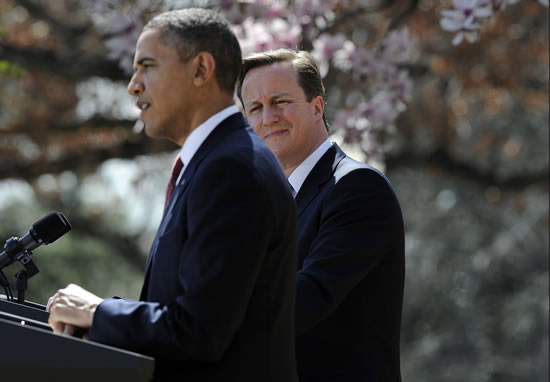
Yesterday’s appalling attack on a London street in the middle of the day, which left a British solider dead, was a barbaric act of terrorism perpetrated by Islamist fundamentalists. British Prime Minister David Cameron acknowledged the motivations behind yesterday’s cowardly act by saying:

This country will be absolutely resolute in its stand against violent extremism and terror. We will never give in to terror—or terrorism—in any of its forms. Second, this view is shared by every community in our country. This was not just an attack on Britain—and on our British way of life. It was also a betrayal of Islam—and of the Muslim communities who give so much to our country. There is nothing in Islam that justifies this truly dreadful act. We will defeat violent extremism by standing together.

In stark contrast, the Obama Administration’s response has been to avoid calling the attack terrorism, let alone terrorism motivated by a radical Islamic ideology. Instead the Administration, via the State Department, said it stood with the U.K. in the face of “such senseless violence.”

Senseless violence? One can hardly term a targeted attack on a U.K. soldier in broad daylight — where the assailants gleefully admit the radical motivation behind their attack — “senseless violence.”

Yet, use of this terminology is nothing new for the Obama Administration. “Senseless violence” is the Administration’s catch-all phrase loyally called upon whenever motivations for a despicable act should not be ascribed, lest someone take offense.

Particularly troubling is that “senseless violence” is the same terminology the Administration used when describing the terrorist attack in Benghazi that killed the American Ambassador and three other U.S. citizens.

The terrorist attack in London was indeed a senseless act of violence; however, in refusing to admit the nature and motivations behind the attack, the Obama Administration does disservice to the men and women killed in terrorist attacks. As Heritage’s Nile Gardiner advises in The Telegraph:

It’s time for President Obama to acknowledge reality. This is a global war between the free world and the forces of Islamist terror. These are not acts of “senseless violence.” They are acts of brutal terrorism aimed against Great Britain, the United States and all who defend the principles of liberty, freedom and Western-style democracy. It is important that political leaders on both sides of the Atlantic identify exactly who the enemy is, what their aims are, and why they must be emphatically defeated.

For the Administration to do otherwise would be, well, senseless.


Related posts:

Muslim Maj. Nidal Hasan has drawn $278,000.00 since 2009 killing of 13 people at Ft Hood

American Family Radio reported that Fox News said: The Army psychiatrist accused of killing 13 people and wounding 32 others during a shooting at Fort Hood has reportedly been paid more than $278,000 since the 2009 incident. U.S. Department of Defense officials confirmed to NBCDFW.com that Maj. Nidal Hasan’s salary cannot be suspended unless he […]

Was Ft Hood killing workplace violence?

In Little Rock just a few feet away from where we went shopping the night before a National Guard recruiter was killed by a muslim extremist.  President Obama does not want to admit that terrorists have killed anybody on U.S. soil. Take a look at this article about the Ft Hood killing.   Debra J. Saunders, Feb 14, […]

Taking on Ark Times bloggers on the issue of “gun control” (Part 1) “Bill Clinton responsible some for Ft Hood gun control policy?”

Will “CARRYING HANDGUN IS PROHIBITED” poster work? Dan Mitchell of the Cato Institute on gun control On 1-13-13 on the Arkansas Times Blog the person with the username “ArkDemocrat” stated, “I visited a church in another state that allows guns, and there was a sign similar to the “No Smoking” signs (i.e. smoking cigarette with […]


Muslim Maj. Nidal Hasan has drawn $278,000.00 since 2009 killing of 13 people at Ft Hood

American Family Radio reported that Fox News said:

The Army psychiatrist accused of killing 13 people and wounding 32 others during a shooting at Fort Hood has reportedly been paid more than $278,000 since the 2009 incident.

U.S. Department of Defense officials confirmed to NBCDFW.com that Maj. Nidal Hasan’s salary cannot be suspended unless he is proven guilty in the Nov. 5, 2009, shooting in Texas, citing the Uniform Code of Military Justice. Jury selection in his trial is scheduled to begin May 30.

If Hasan, 42, had been a civilian Defense Department employee, Army officials could have suspended his pay after just seven days, NBCDFW.com reports.

A military judge refused to delay Hasan’s trial earlier this month after his attorneys sought to postpone the court-martial to Sept. 1. Hasan’s attorneys claimed military jurors may be influenced by national media coverage of the Boston Marathon bombings that compared the two Muslim suspects — Dzhokhar and Tamerlan Tsarnaev – to Hasan.

Prosecutors countered that the delay was unnecessary because Hasan was mentioned only briefly in some news reports about the April 15 attacks in Boston.
Hasan faces the death penalty or life in prison without parole if convicted of 13 counts of premeditated murder and 32 counts of attempted premeditated murder.

The White House and Pentagon have refused to characterize Hasan’s attack as terrorism, instead terming it “workplace violence.” The victims have been denied Purple Hearts and are suing the military because they claim the “workplace violence” designation gives them diminished access to medical care and financial benefits normally available to those whose wounds are designated as “combat related.

Related post:

Was Ft Hood killing workplace violence?

In Little Rock just a few feet away from where we went shopping the night before a National Guard recruiter was killed by a muslim extremist.  President Obama does not want to admit that terrorists have killed anybody on U.S. soil. Take a look at this article about the Ft Hood killing.   Debra J. Saunders, Feb 14, […]

Open letter to President Obama (Part 325)

(This letter was emailed to White House on 11-21-11.)

President Obama c/o The White House
1600 Pennsylvania Avenue NW
Washington, DC 20500

Dear Mr. President,

I know that you receive 20,000 letters a day and that you actually read 10 of them every day. I really do respect you for trying to get a pulse on what is going on out here.

Look at the figures from 2007 and compare them to now and you will see that if had held spending at 2007 levels we would have a balanced budget now (or very close to it). The problem is that spending has skyrocketed. Why then do we want to get more revenue in when obviously the problem is spending. I have posted on this before and even given more figures.

Wikipedia reports:

2007 (2007) Budget of the United States federal government
2006 ·  · 2008
Submitted by George W. Bush
Submitted to 109th Congress
Total revenue $2.57 trillion
Total expenditures $2.73 trillion
Deficit $161 billion
Debt $8.95 trillion
Website Congressional Budget Office

The budget of the United States government for fiscal year 2007 was produced through a budget process involving both the legislative and executive branches of the federal government. While the Congress has the constitutional “power of the purse,” the President and his appointees play a major role in budget deliberations. Since 1976, the federal fiscal year has started on October 1 of each year.

Contents

 [hide

[edit] Total receipts

Receipts for fiscal year 2007 were $2.4 trillion. FY2007 on-budget receipts were $1.7 trillion. FY2007 off-budget receipts were $608 billion. Off-budget receipts include Social Security and Medicare payroll taxes, as well as the net profit or loss of the U.S. Postal Service.

Source: preliminary FY2007 year-end estimate from the U.S. Treasury Dept.

The IRS estimated that there were about $345 billion in uncollected taxes, which is sometimes referred to as the “tax gap.”.[1]

[edit] Total spending

A pie chart representing spending by category for the US budget for 2007

The President’s actual budget for 2007 totals $2.8 trillion. Percentages in parentheses indicate percentage change compared to 2006. This budget request is broken down by the following expenditures:

  • $586.1 billion (+7.0%) – Social Security
  • $548.8 billion (+9.0%) – Defense[2]
  • $394.5 billion (+12.4%) – Medicare
  • $294.0 billion (+2.0%) – Unemployment and welfare
  • $276.4 billion (+2.9%) – Medicaid and other health related
  • $243.7 billion (+13.4%) – Interest on debt
  • $89.9 billion (+1.3%) – Education and training
  • $76.9 billion (+8.1%) – Transportation
  • $72.6 billion (+5.8%) – Veterans’ benefits
  • $43.5 billion (+9.2%) – Administration of justice
  • $33.1 billion (+5.7%) – Natural resources and environment
  • $32.5 billion (+15.4%) – Foreign affairs
  • $27.0 billion (+3.7%) – Agriculture
  • $26.8 billion (+28.7%) – Community and regional development
  • $25.0 billion (+4.0%) – Science and technology
  • $20.5 billion (+0.8%) – Energy
  • $20.1 billion (+11.4%) – General government
  • 2011 United States federal budget

    From Wikipedia, the free encyclopedia


    Jump to: navigation, search

    2011 (2011) Budget of the United States federal government
    2010 ·  · 2012
    Submitted February 1, 2010
    Submitted by Barack Obama
    Submitted to 111th Congress
    Passed April 15, 2011 (Pub.L. 112-10)
    Total revenue $2.567 trillion (requested)[1]
    $2.314 trillion (enacted)[2]
    Total expenditures $3.834 trillion (requested)[1]
    $3.630 trillion (enacted)[2]
    Debt payment $0.25 trillion (requested)
    Deficit $1.56 trillion (requested)
    Website Library of Congress

    The 2011 United States federal budget is the United States federal budget to fund government operations for the fiscal year 2011, which is October 2010 – September 2011. The budget is the subject of a spending request by President Barack Obama.[3][4] The actual appropriations for Fiscal Year 2011 had to be authorized by the full Congress before it could take effect, according to the United States budget process.

    No budget was passed by the September 30 deadline, and the government was funded by a series of seven continuing resolutions continuing funding at or near 2010 levels. The budget negotiations culminated in early April 2011, with a tense legislative standoff leading to speculation that the nation would face its first government shutdown since 1995. However, a deal containing $38.5 billion in cuts from 2010 funding levels was reached with just hours remaining before the deadline. The 2011 budget was enacted on April 15, 2011, as Public Law 112-10, the Department of Defense and Full-Year Continuing Appropriations Act, 2011.[5]

    Contents

     [hide

    [edit] History

    President Barack Obama proposed his 2011 budget during February 2010. He has indicated that jobs, health care, clean energy, education, and infrastructure will be priorities. Total requested spending is $3.83 trillion and the federal deficit is forecast to be $1.56 trillion in 2010 and $1.27 trillion in 2011. Total debt is budgeted to increase from $11.9 trillion in FY2009, to $13.8 trillion in FY2010, and $15.1 trillion in FY2011.[6][7]

    It was widely anticipated that a government shutdown on April 8, 2011 was possible if a budget resolution or a seventh continuing resolution was not passed by the expiration of the sixth continuing resolution on April 8, 2011,[8] which would have caused the furlough of 800,000 out of 2 million civilian federal employees.[9][10] However, a deal was reached with just hours remaining before the deadline, averting the shutdown. The deal included $38.5 billion in cuts from what had been budgeted for 2010, in addition to another $10 billion in cuts that had been imposed in some of the continuing resolutions.[11][12] However, the April 13 Congressional Budget Office estimate showed that, compared with then-current spending rates, the spending bill would cut federal outlays from non-war accounts by just $352 million through Sept. 30. About $8 billion in immediate cuts to domestic programs and foreign aid were offset by nearly equal increases in defense spending.[13]

    [edit] Continuing resolutions

    Beginning in September 2010, Congress passed a series of continuing resolutions to fund the government.[14]

    • 1st Continuing Resolution, funding from October 1, 2010 through December 3, 2010, passed on September 29, 2010. (Pub.L. 111-242)
    • 2nd Continuing Resolution, funding through December 18, 2010, passed on December 2, 2010. (Pub.L. 111-290)[15]
    • 3rd Continuing Resolution, funding through December 21, 2010, passed on December 17, 2010. (Pub.L. 111-317)
    • 4th Continuing Resolution, funding through March 4, 2011, passed on December 21, 2010. (Pub.L. 111-322)[16]
    • 5th Continuing Resolution, funding through March 18, 2011, passed on March 2, 2011. (Pub.L. 112-4) This resolution cut $4 billion from 2010 spending levels.[17]
    • 6th Continuing Resolution, funding through April 8, 2011, passed on March 16, 2011. (Pub.L. 112-6) This resolution cut an additional $6 billion from 2010 spending levels.[18]
    • 7th Continuing Resolution, funding through April 15, 2011, passed on April 9, 2011. (Pub.L. 112-8) This continuing resolution followed a deal on the full annual budget which was made with just hours remaining before a government shutdown.[11] It itself contains an additional $2 billion in cuts.[12] Democrats had previously rejected a Republican-backed resolution passed by the House before the deal, which would have funded the government for another week and cut an additional $12 billion from 2010 levels.[19]

    [edit] Major initiatives

    The following initiatives were enacted in the final budget legislation:

    The following major changes were proposed to federal programs, but not necessarily enacted:

    • The proposed budget contains $4 billion for the creation of a national infrastructure bank called the “National Infrastructure Innovation and Finance Fund.”[23] This proposal is similar to the National Infrastructure Reinvestment Bank initiative previously proposed by Congress.
    • The budget would cut $40 billion of tax subsidies for oil, gas and coal companies over the next decade.[24]
    • Banks would face a $90 billion tax in total over 10 years.[citation needed]
    • The Research & Experimentation Tax Credit would be made permanent.[25]
    • Appropriates $36 billion to the Department of Energy to distribute in loan guarantees for construction of new nuclear power plants and reactors. As part of the Energy Policy Act of 2005, this appropriation is to provide funding for 80% of the total cost of construction at approved nuclear sites in the coming years www.world-nuclear.org.[26]

    [edit] Total revenues and spending

    In the Obama administration’s initial spending request, the federal budget for 2011 was originally projected at $3.83 trillion in total spending.[27]

    The projected 2011 gross domestic product is listed at $13.519 trillion (in 2005 dollars).[28]

    As of January 2011, the Congressional Budget Office (CBO) projected that if current laws remain unchanged, the federal budget will show a deficit of close to $1.5 trillion, or 9.8 percent of GDP. The CBO projects total revenues of $2.228 trillion and total outlays of $3.708 trillion for a deficit of $1.48 trillion for 2011. The deficits in CBO’s baseline projections drop markedly over the next few years as a share of output and average 3.1 percent of GDP from 2014 to 2021. Those projections, however, are based on the assumption that tax and spending policies unfold as specified in current law. Consequently, they understate the budget deficits that would occur if many policies currently in place were continued, rather than allowed to expire as scheduled under current law.[29]

    On February 14, 2011, President Obama released his 2012 federal budget request. The report updated the projected 2011 deficit to $1.590 trillion. This is based on estimated revenues of $2.228 trillion and outlays of $3.818 trillion.[30]

    The enacted 2011 budget called for $2.314 trillion in receipts and $3.630 trillion in outlays, according to the September 1, 2011 Mid-Session Review.[2]

    The 2011 Financial Report of the United States Government was released on December 23, 2011, showing a net operating cost and cash-based budget deficit for the year of $1.3 trillion.[31] According to the Government Accountability Office, the ‘accrual deficit provides more information on the longer-term implications of the government’s annual operations’.[32] Gross costs fell from $4,472 billion in 2010 to $3,998 billion, largely due to the release of accounting provisions (estimates of future liabilities), while total taxes and other revenues rose from $2,217 billion to $2,364 billion.[33] The GAO was unable to provide an audit opinion on the 2011 financial statements due to ‘widespread material internal control weaknesses, significant uncertainties, and other limitations’.[34] As in 2010, the GAO cited as the principal obstacle to its provision of an audit opinion ‘serious financial management problems at the Department of Defense that made its financial statements unauditable’, highlighting also recurrent issues at the Department of Homeland Security.[34][35]

    Thank you so much for your time. I know how valuable it is. I also appreciate the fine family that you have and your commitment as a father and a husband.

    Sincerely,

    Everette Hatcher III, 13900 Cottontail Lane, Alexander, AR 72002, ph 501-920-5733, lowcostsqueegees@yahoo.com

New video from Heritage Foundation on Benghazi Scandal

New video from Heritage Foundation on Benghazi Scandal.

White House Spins Obama’s Role in Benghazi: From Competence to Irrelevance (VIDEO)

Benghazi: Demand the Truth

Published on May 21, 2013

President Obama has dismissed questions about the Benghazi debacle as a political “side show.” Demand the truth. The American people deserve answers.

__________________

With the weekend’s grand slam appearance on the Sunday talk shows by yet another official unqualified to talk about Benghazi, the Obama Administration has again shot itself in the foot.

White House Communications Director Dan Pfeiffer attempted to defend U.N. Ambassador Susan Rice’s mischaracterization of the Benghazi terrorist attack, which she blamed on the now infamous anti-Islam video. It was a poor show.

All of this stands in stark contrast with White House’s handling of the Navy SEAL Team Six raid that killed Osama bin Laden on May 2, 2011. We have all seen the images of President Obama and Secretary of State Hillary Clinton huddled in the White House situation room with the national security staff, riveted to live images of the nighttime raid. It was hardly over before President Obama, speaking proudly as commander in chief, went on national television to announce the death of the enemy of the American people. The Administration even cooperated with the producers of the movie Zero Dark Thirty about the mission to kill bin Laden.

But now, “irrelevant” is the word chosen by Dan Pfeiffer over and over to describe some of the most pressing questions regarding the White House’s role in the Benghazi affair. Instantaneously, “irrelevant” became the word of the day on social media.

Where was President Obama the night of the terrorist attack? Unlike the Osama bin Laden raid, the President was disturbingly disconnected from the attack on an American ambassador. After the five o’clock intelligence briefing in which Obama was informed that the U.S. diplomatic facility was under attack and the U.S. ambassador to Libya missing, the President’s whereabouts remain unaccounted for the rest of the evening. The next day, Obama flew to Las Vegas for a fundraiser. “I don’t remember what room the President was in on that night, and that’s a largely irrelevant fact,” Pfeiffer snapped at Fox’s Chris Wallace.

Or who doctored the talking points, served up to the media and the American people by Rice on September 16 with such conviction? That also, according to Pfeiffer, is “irrelevant.”

Contrary to the election-time narrative that “al-Qaeda is on the run,” defeated by the Obama Administration, President Obama and his staff are now pleading ignorance across the board. Pfeiffer’s problematic media appearance could fit into an emerging narrative that the Obama Administration may have been more incompetent, than Machiavellian in its handling of the Benghazi terrorist attack. Administration officials spoke to CBS News on condition of anonymity, proffering the line that bungling, ignorance, and inexperience may have been at the root of the debacle that left four Americans dead in Benghazi.

It is not likely, though, that Members of Congress will be satisfied with being told that their questions are “irrelevant” when hearings to unearth the truth resume this week.

Related posts:

How long will President Obama ignore my letters on Benghazi?

HILLARY SMIRKS AT REPORTERS – Still Not Sure What to Call the Benghazi Terrorist Attack Published on Oct 24, 2012 by jackohoft Secretary of State Hillary Clinton held a press conference this morning and addressed the Benghazi Consulate attack and cover-up. The Secretary of State would not call the massacre a terrorist attack despite the […]


Obama jokes about audit of Ohio St by IRS then IRS scandal breaks!!!!!

You want to talk about irony then look at President Obama’s speech a few days ago when he joked about a potential audit of Ohio St by the IRS then a few days later the IRS scandal breaks!!!! The I.R.S. Abusing Americans Is Nothing New Published on May 15, 2013 The I.R.S. targeting of tea party […]


The IRS has thuggish employees and the President was right to condemn their latest actions

The IRS has thuggish employees and the President  was right to condemn their latest actions. Let’s Thank President Obama for Reminding Americans that They Should Distrust the IRS May 14, 2013 by Dan Mitchell Last week, while writing about the latest IRS scandal, I noted that the IRS has a long record of abusive actions. It has thieving employees. […]


Was Ft Hood killing workplace violence?

In Little Rock just a few feet away from where we went shopping the night before a National Guard recruiter was killed by a muslim extremist.  President Obama does not want to admit that terrorists have killed anybody on U.S. soil. Take a look at this article about the Ft Hood killing.   Debra J. Saunders, Feb 14, […]


The White House ignores questions about Libya until election is over

I have been writing to the White House about Libya over and over, but I have not got a response yet.  The funny thing is that I have not got over 40 responses in the past to my letters, but this time around I have got even one response. President Obama’s belief that he can […]


Open letter to President Obama (Part 158B)(Libya comments by President at 2nd debate discussed, part Q)

Know The TRUTH ~ Step By Step ~ Bret Baier’s ~ ‘Death and Deceit in Benghazi’ Published on Oct 19, 2012 by MamaBarracuda Second Presidential Debate 2012- Obama and Romney on Foreign Policy Published on Oct 16, 2012 by AussieNews1 With just 21 days to go until the presidential election in the United States, President […]


Open letter to President Obama (Part 158B)(Libya comments by President at 2nd debate discussed, part P)

  Know The TRUTH ~ Step By Step ~ Bret Baier’s ~ ‘Death and Deceit in Benghazi’ Published on Oct 19, 2012 by MamaBarracuda Second Presidential Debate 2012- Obama and Romney on Foreign Policy Published on Oct 16, 2012 by AussieNews1 With just 21 days to go until the presidential election in the United States, […]


Open letter to President Obama (Part 158B)(Libya comments by President at 2nd debate discussed, part O)

President Barack Obama speaks in the Rose Garden of the White House in Washington, Thursday, Oct. 20, 2011, to comment on the death of Libyan leader Moammar Gadhafi. (AP Photo/Pablo Martinez Monsivais)  Secretary of State Hillary Rodham Clinton speaking ondeadly attack in Libya, during a speech to the Center for Strategic and International Studies in […]


Open letter to President Obama (Part 158B)(Libya comments by President at 2nd debate discussed, part N)

Know The TRUTH ~ Step By Step ~ Bret Baier’s ~ ‘Death and Deceit in Benghazi’ Published on Oct 19, 2012 by MamaBarracuda Second Presidential Debate 2012- Obama and Romney on Foreign Policy Published on Oct 16, 2012 by AussieNews1 With just 21 days to go until the presidential election in the United States, President […]


Open letter to President Obama (Part 158B)(Libya comments by President at 2nd debate discussed, part M)

Know The TRUTH ~ Step By Step ~ Bret Baier’s ~ ‘Death and Deceit in Benghazi’ Published on Oct 19, 2012 by MamaBarracuda Second Presidential Debate 2012- Obama and Romney on Foreign Policy Published on Oct 16, 2012 by AussieNews1 With just 21 days to go until the presidential election in the United States, President […]


Open letter to President Obama (Part 324) Higher Taxes Mean Bigger Government, not Lower Deficits

(This letter was emailed to White House on 11-21-11.)

President Obama c/o The White House
1600 Pennsylvania Avenue NW
Washington, DC 20500

Dear Mr. President,

I know that you receive 20,000 letters a day and that you actually read 10 of them every day. I really do respect you for trying to get a pulse on what is going on out here.

It is obvious to me that if you get your hands on more money then you will continue to spend away our children’s future. You have already taken the national debt from 11 trillion to 16 trillion in just 4 years. Over, and over, and over, and over, and over and over I have written Speaker Boehner and the Congressmen (Griffin, Womack, Crawford) in Arkansas concerning this. I am hoping they will stand up against this reckless spending that our federal government has done and will continue to do if given the chance.

I have written and emailed Senator Pryor over, and over again with spending cut suggestions but he has ignored all of these good ideas in favor of keeping the printing presses going as we plunge our future generations further in debt. I am convinced if he does not change his liberal voting record that he will no longer be our senator in 2014.

Here is another fine article below from Dan Mitchell that shows what will happen to the increased revenue if the Republicans are dumb enough to give it to President Obama. He will surely waste it on increased government spending. Milton Friedman rightly noted that we are truly blessed that the federal government is so inefficient so at least they will not be able to hurt us as much as they could if it ran efficiently. Here is the exact quote:

The only reason there’s any chance of keeping government limited is because government is so inefficient and does so poorly.

President Obama and other statists in Washington want a big class-warfare tax hike. They claim the additional revenue is necessary to reduce red ink.

But their ideological crusade is based on some blatant distortions.

In other words, the Obama tax hike will make government bigger, even if some naively support the tax hike because they want smaller deficits.

That being said, I’m not overly optimistic that Obama’s divisive proposal can be stopped, largely because I don’t think Republicans will take my advice on how to win this fight.

But at least the American people have an appropriately jaundiced view about what will happen if Obama does prevail.

Here are the results of a recent poll showing that a strong majority understand that more revenue will lead to an expansion in the burden of government spending.

Though I suppose these numbers don’t necessarily show that people are against higher taxes. Perhaps some of the 57 percent want higher taxes because they want more government.

After all, that’s the most logical interpretation of the election results in California, where voters approved a referendum to rape and pillage upper-income taxpayers.

But I suspect – and definitely hope – that most of the 57 percent understand that making America more like Europe is not a desirable outcome.

By the way, I shared some polling data last week showing that CPAs think that changes in tax rates lead to substantial Laffer Curve effects.

They were also asked their opinion on whether higher taxes will be used for deficit reduction.

As you can see, they were even more skeptical than the general public, with more than 60 percent definitely thinking that more revenue in Washington will lead to more spending.

To be sure, there’s no particular reason to think that CPAs have any special insight on this issue. On the Laffer Curve question, by contrast, they presumably do have insider knowledge of how taxpayers respond when tax policy changes.

But I’m digressing. The point of this post is to explain that higher taxes will lead to bigger government.

And if you don’t believe me, then why did the New York Times unintentionally admit that the only budget deal that actually resulted in a budget surplus was the one that cut taxes instead of raising them?

____________


Thank you so much for your time. I know how valuable it is. I also appreciate the fine family that you have and your commitment as a father and a husband.

Sincerely,

Everette Hatcher III, 13900 Cottontail Lane, Alexander, AR 72002, ph 501-920-5733, lowcostsqueegees@yahoo.com


Related posts:

Open letter to Speaker of the House John Boehner (Part 13)

John Boehner, Speaker of the House H-232, The Capital, Washington, DC 20515 Dear Mr. Speaker, I know that you will have to meet with newly re-elected President Obama soon and he will probably be anxious for you to raise taxes and  federal spending, but he will want you to leave runaway entitlement programs alone. When that happens then you […]

Open letter to Speaker of the House John Boehner (Part 12)

John Boehner, Speaker of the House H-232, The Capital, Washington, DC 20515 Dear Mr. Speaker, I know that you will have to meet with newly re-elected President Obama soon and he will probably be anxious for you to raise taxes and  federal spending, but he will want you to leave runaway entitlement programs alone. If we want the economy […]

Open letter to Speaker of the House John Boehner (Part 11)

John Boehner, Speaker of the House H-232, The Capital, Washington, DC 20515 Dear Mr. Speaker, I know that you will have to meet with newly re-elected President Obama soon and he will probably be anxious for you to raise taxes and  federal spending, but he will want you to leave runaway entitlement programs alone. When that happens then you […]

Open letter to Speaker of the House John Boehner (Part 10)

John Boehner, Speaker of the House H-232, The Capital, Washington, DC 20515 Dear Mr. Speaker, I know that you will have to meet with newly re-elected President Obama soon and he will probably be anxious for you to raise taxes and  federal spending, but he will want you to leave runaway entitlement programs alone. Dan Mitchell of the Cato […]

Open letter to Speaker of the House John Boehner (Part 9)

John Boehner, Speaker of the House H-232, The Capital, Washington, DC 20515 Dear Mr. Speaker, I know that you will have to meet with newly re-elected President Obama soon and he will probably be anxious for you to raise taxes and  federal spending, but he will want you to leave runaway entitlement programs alone. When that happens then you […]

Open letter to Speaker of the House John Boehner (Part 8)

Government Must Cut Spending Uploaded by HeritageFoundation on Dec 2, 2010 The government can cut roughly $343 billion from the federal budget and they can do so immediately. __________ John Boehner, Speaker of the House H-232, The Capital, Washington, DC 20515 Dear Mr. Speaker, I know that you will have to meet with newly re-elected […]

Open letter to Speaker of the House John Boehner (Part 7)

John Boehner, Speaker of the House H-232, The Capital, Washington, DC 20515 Dear Mr. Speaker, I know that you will have to meet with newly re-elected President Obama soon and he will probably be anxious for you to raise taxes and  federal spending, but he will want you to leave runaway entitlement programs alone. When that happens then you […]

Open letter to Speaker of the House John Boehner (Part 6)

John Boehner, Speaker of the House H-232, The Capital, Washington, DC 20515 Dear Mr. Speaker, I know that you will have to meet with newly re-elected President Obama soon and he will probably be anxious for you to raise taxes and  federal spending, but he will want you to leave runaway entitlement programs alone. DON’T LET THEM RAISE THAT […]

Open letter to Speaker of the House John Boehner (Part 5 on debt ceiling)

John Boehner, Speaker of the House H-232, The Capital, Washington, DC 20515 Dear Mr. Speaker, I know that you will have to meet with newly re-elected President Obama soon and he will probably be anxious for you to raise taxes and  federal spending, but he will want you to leave runaway entitlement programs alone. When that happens then you […]

Open letter to Speaker of the House John Boehner (Part 4 on ‘TEFRA Debacle of 1982′)

  John Boehner, Speaker of the House H-232, The Capital, Washington, DC 20515 Dear Mr. Speaker, I know that you will have to meet with newly re-elected President Obama soon and he will probably be anxious for you to raise taxes and  federal spending, but he will want you to leave runaway entitlement programs alone. DO NOT TAKE THE […]

Open letter to Speaker of the House John Boehner (Part 3 on debt ceiling)

John Boehner, Speaker of the House H-232, The Capital, Washington, DC 20515 Dear Mr. Speaker, I know that you will have to meet with newly re-elected President Obama soon and he will probably be anxious for you to raise taxes and  federal spending, but he will want you to leave runaway entitlement programs alone. When that happens then you […]

Open letter to Speaker of the House John Boehner (Part 2 on raising taxes)

 Open letter to Speaker of the House John Boehner (Part 2 on raising taxes) John Boehner, Speaker of the House H-232, The Capital, Washington, DC 20515 Dear Mr. Speaker, I know that you will have to meet with newly re-elected President Obama soon and he will probably be anxious for you to raise taxes and  federal spending, but […]

Open letter to Speaker of the House John Boehner (Part 1 on debt ceiling)

John Boehner, Speaker of the House H-232, The Capital, Washington, DC 20515 Dear Mr. Speaker, I know that you will have to meet with newly re-elected President Obama soon and he will probably be anxious for you to raise taxes and  federal spending, but he will want you to leave runaway entitlement programs alone. When that happens then you […]

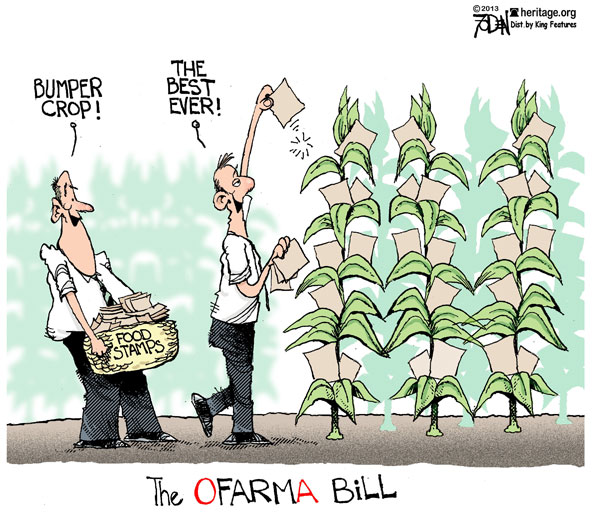
Food stamp spending has doubled under the Obama Administration

The sad fact is that Food stamp spending has doubled under the Obama Administration.

May 21, 2013 at 7:01 am

Cartoon by Glenn Foden

Tweet this

Where do food stamps come from?

They come from taxpayers—certainly not from family farms. Yet the “farm” bill, a recurring subsidy-fest in Congress, is actually 80 percent food stamps and other government nutrition programs.

The food stamps sweeten the farm deal for lawmakers, who admit that the combination works for their political purposes. As Heritage experts Daren Bakst and Diane Katz explain:

The food stamp portion creates a reason for urban representatives to support farm subsidies, and for farm-state lawmakers to support food stamps.

Talk of de-politicizing agriculture programs and welfare policy is met with stiff resistance. For example, Senator Thad Cochran (R–MS), ranking Republican on the Senate Agriculture Committee, recently told the North American Agricultural Journalists group that food stamps should continue to be included in the farm bill “purely from a political perspective. It helps get the farm bill passed.”

Food stamps are there to help “get the farm bill passed.” And the relation of the rest of the farm bill to farming is also questionable. Bakst and Katz note that “Congress has expanded the farm bill over time into a costly compilation of disparate programs. Along with agriculture and food stamps, the legislation includes dozens of forestry, conservation, energy, and rural development programs.”

It has become the norm that Congress lumps billions—even trillions—of dollars in taxpayer-funded programs together into huge bills. This allows them to sneak in plenty of special-interest pork.

Each of these programs deserves to be evaluated on its own, and taxpayers deserve transparency from Congress about how it plans to spend our money.

For example, food stamps are a massive program that needs a careful look. Food stamp spending has doubled under the Obama Administration, and participation is at historic highs. Recruiters hold bingo games and other “parties” to try to get more people on the food stamp rolls.

Farm commodity programs are also a major concern and in dire need of reform. Congress may eliminate the egregious direct payment program, which pays farmers for doing nothing. However, instead of stopping there, both the House and Senate farm bills would replace direct payments with programs that could wind up being even costlier.

Food stamps and farming ultimately have to do with food, but that’s about all they have in common. Making the farm bill 80 percent food stamps just doesn’t make sense.

Related posts:


Tell the 48 million food stamps users to eat more broccoli!!!!

Welfare Can And Must Be Reformed             Uploaded on Jun 29, 2010 If America does not get welfare reform under control, it will bankrupt America. But the Heritage Foundation’s Robert Rector has a five-step plan to reform welfare while protecting our most vulnerable. __________________________ We got to slow down the growth of Food Stamps. One […]

Republicans for more food stamps?

Eight Reasons Why Big Government Hurts Economic Growth __________________ We got to cut spending and we must first start with food stamp program and we need some Senators that are willing to make the tough cuts. Food Stamp Republicans Posted by Chris Edwards Newt Gingrich had fun calling President Obama the “food stamp president,” but […]

Obama promotes food stamps but Milton Friedman had a better suggestion

Milton Friedman’s negative income tax explained by Friedman in 1968: We need to cut back on the Food Stamp program and not try to increase it. What really upsets me is that when the government gets involved in welfare there is a welfare trap created for those who become dependent on the program. Once they […]

400% increase in food stamps since 2000

Welfare Can And Must Be Reformed Uploaded by HeritageFoundation on Jun 29, 2010 If America does not get welfare reform under control, it will bankrupt America. But the Heritage Foundation’s Robert Rector has a five-step plan to reform welfare while protecting our most vulnerable. __________________________ If welfare increases as much as it has in the […]

Which states are the leaders in food stamp consumption?

I am glad that my state of Arkansas is not the leader in food stamps!!! Mirror, Mirror, on the Wall, Which State Has the Highest Food Stamp Usage of All? March 19, 2013 by Dan Mitchell The food stamp program seems to be a breeding ground of waste, fraud, and abuse. Some of the horror stories […]

Why not cancel the foodstamp program and let the churches step in?

Government Must Cut Spending Uploaded by HeritageFoundation on Dec 2, 2010 The government can cut roughly $343 billion from the federal budget and they can do so immediately. __________ We are becoming a country filled with people that dependent on the federal government when we should be growing our economy by lowering taxes and putting […]

Food Stamp Program is constantly ripped off and should be discontinued

Uploaded by oversightandreform on Mar 6, 2012 Learn More at http://oversight.house.gov The Oversight Committee is examining reports of food stamp merchants previously disqualified who continue to defraud the program. According to a Scripps Howard News Service report, food stamp fraud costs taxpayers hundreds of millions every year. Watch the Oversight hearing live tomorrow at 930 […]

Welfare state may drag England down the tubes!!!!

Welfare state may drag England down the tubes!!!! Very Funny but Very Un-PC British Video on Welfare and Immigration May 19, 2013 by Dan Mitchell I’ve shared this bit of political incorrect terrorism humor from England, as well asthis somewhat un-PC bit of tax humor. But perhaps motivated by the scandal of giving welfare to terrorists, this new video is […]

Open letter to President Obama (Part 321)

Government Must Cut Spending Uploaded by HeritageFoundation on Dec 2, 2010 The government can cut roughly $343 billion from the federal budget and they can do so immediately. __________   President Obama c/o The White House 1600 Pennsylvania Avenue NW Washington, DC 20500 Dear Mr. President, I know that you receive 20,000 letters a day […]

Agriculture Dept is bloated

Agriculture: Downsizing The Federal Government Uploaded on Dec 19, 2008 Agriculture is easily the most distorted sector, with high tariffs and, in developed countries at least, large amounts of government subsidies through price supports and direct payments. On the other hand, developing countries, who have a comparative advantage in these products, cannot afford to subsidize […]

Open letter to President Obama (Part 323)

(This letter was emailed to White House on 11-21-11.)

President Obama c/o The White House
1600 Pennsylvania Avenue NW
Washington, DC 20500

Dear Mr. President,

I know that you receive 20,000 letters a day and that you actually read 10 of them every day. I really do respect you for trying to get a pulse on what is going on out here.

The post office is running a huge deficit and it is time to privatize it. Don’t you agree?

Postal Reform in the Lame Duck?

Posted by Tad DeHaven

According to the Hill, policymakers are “scrambling” to do something about the U.S. Postal Service in the current lame-duck session of Congress. The USPS’s recently announced $15.9 billion loss for 2012 apparently inspired policymakers to act.

It’s hardly a surprise that Congress has waited as long as it can to do something about the USPS. Interest in postal issues for most members probably doesn’t go beyond naming post offices and franking. And regardless of whether Congress passes “reform” legislation in the lame-duck or next year, it will end up just kicking the can down the road. (Policy analysts who are frustrated with the inability of Congress to tackle entitlement reform would be wise to stay away from postal policy issue for mental health purposes.)

To get an idea of how absurd the current negotiations are, take this line from the article:

[S]ome liberal lawmakers and postal unions have pushed back against any attempts to limit six-day delivery, saying it would make bad business sense for the Postal Service to give up any competitive advantage as it moves forward.

Competitive advantage? By law, private carriers can’t compete with the USPS on the delivery of first class mail. To the degree that first class mail “competes” with the private sector, it’s with the internet. Going from six-day to five-day delivery won’t change the fact that the demand for the USPS’s flagship monopoly product is in permanent decline as more and more people decide to click “send” instead. What makes “bad business sense” for the USPS is to leave politicians in charge of it.

[See this essay for more on privatizing the U.S. Postal Service.]

_____________

Thank you so much for your time. I know how valuable it is. I also appreciate the fine family that you have and your commitment as a father and a husband.

Sincerely,

Everette Hatcher III, 13900 Cottontail Lane, Alexander, AR 72002, ph 501-920-5733, lowcostsqueegees@yahoo.com

Open letter to President Obama (Part 322)

Sen. Max Baucus admits the PPACA conditions tax credits on state compliance

Published on Sep 21, 2012 by

____________

(This letter was emailed to White House on 11-21-11.)

President Obama c/o The White House
1600 Pennsylvania Avenue NW
Washington, DC 20500

Dear Mr. President,

I know that you receive 20,000 letters a day and that you actually read 10 of them every day. I really do respect you for trying to get a pulse on what is going on out here.

I really don’t know the answer to this question and would love it if you would  would enlighten me. I can think of no one in a better position to know the answer to this question than you Mr. President. This article below from the Cato Institute makes the case that States can stop Obamacare from becoming law in their states.

Why ‘Obamacare’s Critics Refuse to Give Up’

Posted by Michael F. Cannon

Jonathan Adler and I have a paper titled, “Taxation Without Representation: The Illegal IRS Rule to Expand Tax Credits Under the PPACA.” Our central claims are:

  1. The Patient Protection and Affordable Care Act explicitly restricts its “premium-assistance tax credits” (and thus the “cost-sharing subsidies” and employer- and individual-mandate penalties those tax credits trigger) to health insurance “exchanges” established by states;
  2. The IRS has no authority to offer those entitlements or impose those taxes in states that opt not to create Exchanges; and
  3. The IRS’s ongoing attempt to impose those taxes and issue those entitlements through Exchanges established by the federal government is contrary to congressional intent and the clear language of the Act.

Over at The New Republic’s blog The Plank, my friend Jonathan Cohn says this is “preposterous“:

No sentient being following the health care debate could argue, in good faith, that Obamacare’s architects intended for the federal government to set up exchanges without subsidies. It would completely subvert the law’s intent.

It appears my friend does not know the statute, the legislative history, or what Congress’ intent was.

Cohn writes that the statute is “a little fuzzy” on this issue. Quite the contrary: the statute is crystal clear. It explicitly and laboriously restricts tax credits to those who buy health insurance in Exchanges “established by the State under section 1311.” There is no parallel language – none whatsoever – granting eligibility through Exchanges established by the federal government (section 1321). The tax-credit eligibility rules are so tightly worded, they seem designed to prevent precisely what the IRS is trying to do.

ObamaCare supporters just know that can’t be right. It must have been an oversight. Congress could not have written the law that way. It doesn’t make any sense. Those provisions must take effect in federal Exchanges for the law to work. Why would Congress give states the power to blow the whole thing up??

The answer is that Congress didn’t have any choice. Congress intended for ObamaCare to work this way because this was the only way that ObamaCare could become law.

  • The Senate bill had to have state-run Exchanges in order to win the essential votes of moderate Democrats. Without state-run Exchanges, it would not have passed.
  • In order to have state-run Exchanges, the bill needed some way to encourage states to create them without “commandeering” the states. In early 2009, well before House and Senate Democrats introduced their bills, an influential law professor named Timothy Jost advised congressional Democrats of one way to get around the commandeering problem: “Congress could invite state participation…by offering tax subsidies for insurance only in states that complied with federal requirements…”. Both the Finance bill and the HELP bill made premium assistance conditional on state compliance. Senate Democrats settled on the Finance language, which passed without a vote to spare. (Emphasis added.)
  • The Finance Committee had even more reason to condition tax credits on state compliance: it doesn’t have direct jurisdiction over health insurance. Conditioning the tax credits on state compliance was the only way the Committee could even consider legislation directing states to establish Exchanges. Committee chairman Max Baucus admitted this during mark-up.
  • Then something funny happened. Massachusetts voters sent Republican Scott Brown to the Senate, partly due to his pledge to prevent any compromise between the House and Senate bills from passing the Senate. With no other options, House Democrats swallowed hard and passed Senate bill. (They made limited amendments through the reconciliation process. These amendments did not touch the tax-credit eligibility rules, and indeed strengthen the case against the IRS.)

A law limiting tax credits to state-created Exchanges, therefore, is exactly what Congress intended, because Congress had no other choice. On the day Scott Brown took office, any and all other approaches to Exchanges ceased to embody congressional intent. If Congress had intended for some other approach to become law, there would be no law. What made it all palatable was that it never occurred to ObamaCare supporters that states would refuse to comply. The New York Times reports, “Mr. Obama and lawmakers assumed that every state would set up its own exchange.”

Oops.

The only preposterous parts of this debate are the legal theories that the IRS and its defenders have offered to support the Obama administration’s unlawful attempt to create entitlements and impose taxes that Congress clearly and intentionally did not authorize. (But don’t take my word for it. Read the statute. Read our paper. Read this, and this. Watch this video and our debate with Jost. Click on our links to all the stuff the IRS and Treasury and Jost have written.) I wonder if Cohn would tolerate such lawlessness from a Republican administration.

Cohn further claims the many states that are refusing to create Exchanges are “totally sticking it to their own citizens” and people who encourage them “are essentially calling upon states to block their citizens from receiving federal tax breaks, worth as much as several thousand dollars per person. Aren’t conservatives and libertarians supposed to be the party that likes giving tax money back to the people?” Seriously?

  • Fourteen states have enacted statutes or constitutional amendments — often by referendum, often by huge margins — that prohibit state employees from directly or indirectly participating in an essential Exchange function: implementing employer or individual mandates. In those instances, the voters have spoken.
  • Only 22 percent of the budgetary impact of these credits and subsidies is actual tax reduction, and the employer- and individual-mandate penalties triggered by those tax “credits” wipe out most of that. The other 78 percent is new deficit spending. So what we’re really talking about here is $700 billion of new deficit spending.
  • When states refuse to establish Exchanges, they block that new spending, which reduces the deficit and the overall burden of government.
  • In addition, those states exempt their employers from the employer mandate (a tax of $2,000 per worker) and exempt millions of taxpayers from the individual mandate (a tax of $2,085 on families of four earning as little as $24,000).

Who’s for tax cuts now?

Here’s what I think is really bothering Cohn and other ObamaCare supporters. The purpose of those credits and subsidies is to shift the cost of ObamaCare’s community-rating price controls and individual mandate to taxpayers, so that consumers don’t notice them. When states prevent such cost-shifting, they’re not increasing the cost of ObamaCare — they’re revealing it.

And that’s what worries Cohn. If the full cost of ObamaCare appears in people’s health insurance premiums, people will rise up and demand that Congress get rid of it. Cohn isn’t worried about states “sticking it to their citizens.” He’s worried about states sticking it to ObamaCare.

The title of Cohn’s blog post is, “Obamacare’s Critics Refuse to Give Up.” At least we can agree on that much.

Thank you so much for your time. I know how valuable it is. I also appreciate the fine family that you have and your commitment as a father and a husband.

Sincerely,

Everette Hatcher III, 13900 Cottontail Lane, Alexander, AR 72002, ph 501-920-5733, lowcostsqueegees@yahoo.com