Category Archives: Milton Friedman

Republicans need to stand up to President Obama on fiscal cliff


No one could communicate better than Milton Friedman the principles of freedom and liberty. When taxes are raised then it cuts down our freedom. I am hoping the Republicans will stand up to President Obama on this issue of the fiscal cliff and raising the debt limit.

There’s No Good Outcome to the Fiscal Cliff Fight

December 26, 2012 by Dan Mitchell

We’ve opened all our presents, spent time with family, and enjoyed some tasty food.

Notwithstanding all this good cheer, there’s a a cloud of doom on the horizon. And that horizon is Washington, DC, America’s work-free drug city.

It appears that there’s no way of avoiding a tax increase. Either we go over the cliff, meaning across-the-board hikes for those who pay federal income tax, or Republicans acquiesce to Obama’s class-warfare tax agenda.

No wonder Santa left one unwanted present.

Santa Higher Taxes

I explain the grim outlook for Fox Business News, though my display of sartorial Christmas splendor somewhat offsets the dour topic.

In the interview, I don’t say what should happen, though I’ve previously argued that it’s better to go over the cliff rather than give Obama a victory that will set the stage for further defeats over the next two years.

Better to have a bigger tax hike now, in other words, than to create a precedent that will lead to even larger losses in 2013 and 2014.

Besides, it’s quite possible that Obama is bluffing and this is the right way to get all the tax cuts extended.

But I admit there’s lots of guessing and speculation in those sentences.

There is one thing, however, that I can say with complete confidence. We don’t need a tax increase to balance the budget. We can get rid of red ink in just 10 years simply restraining spending so that it grows by only 2.5 percent per year.

P.S. Notwithstanding the last sentence, our main fiscal goal should be smaller government, not a balanced budget.

P.P.S. I was glad to have an opportunity in the interview to defend Robin Hood’s reputation. As I’ve explained, he was a Tea Party guy, helping to reclaim and return money that was taken by the tax collectors of Prince John and the Sheriff of Nottingham. Here’s another Ken Catalino cartoon that sort of makes this point.

Obama Reverse Robin Hood

I’ve also had to correct Cal Thomas on Robin Hood’s philosophical bona fides, so this is a very common mistake.

P.P.P.S. This is my second attempt at creating a video in the absence of the Cato expert. There’s a hiccup around the 2:25 mark, but I think the picture quality is much better than my first effort.

P.P.P.P.S. If you like the red jacket, previous attempts to be on the cutting edge of fashion can be seen here and here.

Listing of transcripts and videos of “Free to Choose” episode 4 – From Cradle to Grave on www.theDailyHatch.org

In the last few years the number of people receiving Food Stamps has skyrocketed. President Obama has not cut any federal welfare programs but has increased them, and he  has used class warfare over and over the last few months and according to him equality at the finish line is the equality that we should all be talking about. However, socialism has never worked and it has always killed incentive to produce more. Milton Friedman shows in this film series below how so many people get caught in the “Welfare Trap.” Friedman also gives a great solution to this problem in the “negative income tax.” I am glad that I had the chance to be studying his work for over 30 years now.

In 1980 when I first sat down and read the book “Free to Choose” I was involved in Ronald Reagan’s campaign for president and excited about the race. Milton Friedman’s books and film series really helped form my conservative views. Take a look at one of my favorite films of his:

Friedman Friday:(“Free to Choose” episode 4 – From Cradle to Grave, Part 1 of 7)

Volume 4 – From Cradle to Grave
Abstract:
Since the Depression years of the 1930s, there has been almost continuous expansion of governmental efforts to provide for people’s welfare. First, there was a tremendous expansion of public works. The Social Security Act followed close behind. Soon other efforts extended governmental activities in all areas of the welfare sector. Growth of governmental welfare activity continued unabated, and today it has reached truly staggering proportions. Travelling in both Britain and the U.S., Milton Friedman points out that though many government welfare programs are well intentioned, they tend to have pernicious side effects. In Dr. Friedman’s view, perhaps the most serious shortcoming of governmental welfare activities is their tendency to strip away individual independence and dignity. This is because bureaucrats in welfare agencies are placed in positions of tremendous power over welfare recipients, exercising great influence over their lives. Because people never spend someone else’s money as carefully as they spend their own, inefficiency, waste, abuse, theft, and corruption are inevitable. In addition, welfare programs tend to be self-perpetuating because they destroy work incentives. Indeed, it is often in the welfare recipients’ best interests to remain unemployed. Dr. Friedman suggests a negative income tax as a way of helping the poor. The government would pay money to people falling below a certain income level. As they obtained jobs and earned money, they would continue to receive some payments from the government until their outside income reached a certain ceiling. This system would make people better off who sought work and earned income. This contrasts with many of today’s programs where one dollar earned means nearly one dollar lost in welfare payments.

Volume 4 – From Cradle to Grave
Transcript:
Friedman: After the 2nd World War, New York City authorities retained rent control supposedly to help their poorer citizens. The intentions were good. This in the Bronx was one result.
By the 50’s the same authorities were taxing their citizens. Including those who lived in the Bronx and other devastated areas beyond the East River to subsidize public housing. Another idea with good intentions yet poor people are paying for this, subsidized apartments for the well-to-do. When government at city or federal level spends our money to help us, strange things happen.
The idea that government had to protect us came to be accepted during the terrible years of the Depression. Capitalism was said to have failed. And politicians were looking for a new approach.
Franklin Delano Roosevelt was a candidate for the presidency. He was governor of New York State. At the governor’s mansion in Albany, he met repeatedly with friends and colleagues to try to find some way out of the Depression. The problems of the day were to be solved by government action and government spending. The measures that FDR and his associates discussed here derived from a long line of past experience. Some of the roots of these measures go back to Bismark’s Germany at the end of the 19th Century. The first modern state to institute old age pensions and other similar measures on the part of government. In the early 20th Century Great Britain followed suit under Lloyd George and Churchill. It too instituted old age pensions and similar plans.
These precursors of the modern welfare state had little effect on practice in the United States. But they did have a very great effect on the intellectuals on the campus like those who gathered here with FDR. The people who met here had little personal experience of the horrors of the Depression but they were confident that they had the solution. In their long discussions as they sat around this fireplace trying to design programs to meet the problems raised by the worst Depression in the history of the United States, they quite naturally drew upon the ideas that were prevalent at the time. The intellectual climate had become one in which it was taken for granted that government had to play a major role in solving the problems in providing what came later to be called Security from Cradle to Grave.
Roosevelt’s first priority after his election was to deal with massive unemployment. A Public Works program was started. The government financed projects to build highways, bridges and dams. The National Recovery Administration was set up to revitalize industry. Roosevelt wanted to see America move into a new era. The Social Security Act was passed and other measures followed. Unemployment benefits, welfare payments, distribution of surplus food. With these measures, of course, came rules, regulations and red tape as familiar today as they were novel then. The government bureaucracy began to grow and it’s been growing ever since.
This is just a small part of the Social Security empire today. Their headquarters in Baltimore has 16 rooms this size. All these people are dispensing our money with the best possible intentions. But at what cost?
In the 50 years since the Albany meetings, we have given government more and more control over our lives and our income. In New York State alone, these government buildings house 11,000 bureaucrats. Administering government programs that cost New York taxpayers 22 billion dollars. At the federal level, the Department of Health, Education and Welfare alone has a budget larger than any government in the world except only Russia and the United States.
Yet these government measures often do not help the people they are supposed to. Richard Brown’s daughter, Helema, needs constant medical attention. She has a throat defect and has to be connected to a breathing machine so that she’ll survive the nights. It’s expensive treatment and you might expect the family to qualify for a Medicaid grant.
Richard Brown: No, I don’t get it, cause I’m not eligible for it. I make a few dollars too much and the salary that I make I can’t afford to really live and to save anything is out of the question. And I mean, I live, we live from payday to payday. I mean literally from payday to payday.
Friedman: His struggle isn’t made any easier by the fact that Mr. Brown knows that if he gave up his job as an orderly at the Harlem Hospital, he would qualify for a government handout. And he’d be better off financially.
Hospital Worker: Mr. Brown, do me a favor please? There is a section patient.
Friedman: It’s a terrible pressure on him. But he is proud of the work that he does here and he’s strong enough to resist the pressure.
Richard Brown: I’m Mr. Brown. Your fully dilated and I’m here to take you to the delivery. Try not to push, please. We want to have a nice sterile delivery.
Friedman: Mr. Brown has found out the hard way that welfare programs destroy an individual’s independence.
Richard Brown: We’ve considered welfare. We went to see, to apply for welfare but, we were told that we were only eligible for $5.00 a month. And, to receive this $5.00 we would have to cash in our son’s savings bonds. And that’s not even worth it. I don’t believe in something for nothing anyway.
Mrs. Brown: I think a lot of people are capable of working and are willing to work, but it’s just the way it is set up. It, the mother and the children are better off if the husband isn’t working or if the husband isn’t there. And this breaks up so many poor families.
Friedman: One of the saddest things is that many of the children whose parents are on welfare will in their turn end up in the welfare trap when they grow up. In this public housing project in the Bronx, New York, 3/4’s of the families are now receiving welfare payments.
Well Mr. Brown wanted to keep away from this kind of thing for a very good reason. The people who get on welfare lose their human independence and feeling of dignity. They become subject to the dictates and whims of their welfare supervisor who can tell them whether they can live here or there, whether they may put in a telephone, what they may do with their lives. They are treated like children, not like responsible adults and they are trapped in the system. Maybe a job comes up which looks better than welfare but they are afraid to take it because if they lose it after a few months it maybe six months or nine months before they can get back onto welfare. And as a result, this becomes a self-perpetuating cycle rather than simply a temporary state of affairs.
Things have gone even further elsewhere. This is a huge mistake. A public housing project in Manchester, England.
Well we’re 3,000 miles away from the Bronx here but you’d never know it just by looking around. It looks as if we are at the same place. It’s the same kind of flats, the same kind of massive housing units, decrepit even though they were only built 7 or 8 years ago. Vandalism, graffiti, the same feeling about the place. Of people who don’t have a great deal of drive and energy because somebody else is taking care of their day to day needs because the state has deprived them of an incentive to find jobs to become responsible people to be the real support for themselves and their families.

Other segments:

Milton Friedman Friday:(“Free to Choose” episode 4 – From Cradle to Grave, Part 7 of 7)

I am currently going through his film series “Free to Choose” which is one the most powerful film series I have ever seen. TEMIN: We don’t think the big capital arose before the government did? VON HOFFMAN: Listen, what are we doing here? I mean __ defending big government is like defending death and taxes. […]

Milton Friedman Friday:(“Free to Choose” episode 4 – From Cradle to Grave, Part 6 of 7)

I am currently going through his film series “Free to Choose” which is one the most powerful film series I have ever seen worked pretty well for a whole generation. Now anything that works well for a whole generation isn’t entirely bad. From the fact __ from that fact, and the undeniable fact that things […]

Milton Friedman discusses Reagan and Reagan discusses Friedman

Uploaded by YAFTV on Aug 19, 2009 Nobel Laureate Dr. Milton Friedman discusses the principles of Ronald Reagan during this talk for students at Young America’s Foundation’s 25th annual National Conservative Student Conference MILTON FRIEDMAN ON RONALD REAGAN In Friday’s WSJ, Milton Friedman reflectedon Ronald Reagan’s legacy. (The link should work for a few more […]

Milton Friedman Friday:(“Free to Choose” episode 4 – From Cradle to Grave, Part 5 of 7)

 I am currently going through his film series “Free to Choose” which is one the most powerful film series I have ever seen. PART 5 of 7 MCKENZIE: Ah, well, that’s not on our agenda actually. (Laughter) VOICE OFF SCREEN: Why not? MCKENZIE: I boldly repeat the question, though, the expectation having been __ having […]

War on poverty is a failure in USA

Milton Friedman’s solution to limiting poverty Liberals just don’t get it. They should listen to Milton Friedman (who is quoted in this video below concerning the best way to limit poverty). New Video Shows the War on Poverty Is a Failure Posted by Daniel J. Mitchell The Center for Freedom and Prosperity has released another […]

Milton Friedman Friday: (“Free to Choose” episode 4 – From Cradle to Grave, Part 4 of 7)

 I am currently going through his film series “Free to Choose” which is one the most powerful film series I have ever seen. PART 4 of 7 The massive growth of central government that started after the depression has continued ever since. If anything, it has even speeded up in recent years. Each year there […]

Milton Friedman Friday: (“Free to Choose” episode 4 – From Cradle to Grave, Part 3 of 7)

 I am currently going through his film series “Free to Choose” which is one the most powerful film series I have ever seen. PART 3 OF 7 Worse still, America’s depression was to become worldwide because of what lies behind these doors. This is the vault of the Federal Reserve Bank of New York. Inside […]


Milton Friedman Friday:(“Free to Choose” episode 4 – From Cradle to Grave, Part 2 of 7)

 I am currently going through his film series “Free to Choose” which is one the most powerful film series I have ever seen. For the past 7 years Maureen Ramsey has had to buy food and clothes for her family out of a government handout. For the whole of that time, her husband, Steve, hasn’t […]

Friedman Friday:(“Free to Choose” episode 4 – From Cradle to Grave, Part 1 of 7)

Friedman Friday:(“Free to Choose” episode 4 – From Cradle to Grave, Part 1 of 7) Volume 4 – From Cradle to Grave Abstract: Since the Depression years of the 1930s, there has been almost continuous expansion of governmental efforts to provide for people’s welfare. First, there was a tremendous expansion of public works. The Social Security Act […]

Listing of transcripts and videos of Free to Choose by Milton Friedman: Episode “Created Equal” on www.theDailyHatch.org


Milton Friedman in his series “Free to Choose” used a pencil as a simple example to should have the “invisible hand” of the freemarket works (phrase originally used by Adam Smith).
 
 
Milton Friedman congratulated by President Ronald Reagan. © 2008 Free To Choose Media, courtesy of the Power of Choice press kit

Here are some great quotes about Milton Friedman:

“Milton Friedman is a scholar of first rank whose original contributions to economic science have made him one of the greatest thinkers in modern history.”
President Ronald Reagan

“How grateful I have been over the years for the cogency of Friedman’s ideas which have influenced me. Cherishers of freedom will be indebted to him for generations to come.”
Alan Greenspan, former Chairman, Federal Reserve System

“Right at this moment there are people all over the land, I could put dots on the map, who are trying to prove Milton wrong. At some point, somebody else is trying to prove he’s right That’s what I call influence.”
Paul Samuelson, Nobel Laureate in Economic Science

“Friedman’s influence reaches far beyond the academic community and the world of economics. Rather than lock himself in an ivory tower, he has joined the fray to fight for the survival of this great country of ours.”
William E. Simon, former Secretary of the Treasury

“Milton Friedman is the most original social thinker of the era.”
John Kenneth Galbraith, former Professor of Economics, Harvard University

Perhaps Friedman’s greatest success began in 1979 when he and his wife Rose authored the book, Free to Choose, based on the famous ten-part TV series for PBS by the same title. Both the TV program and the book were drawn from an earlier series of lectures presented by Friedman. Because it aired during a period of critical economic distress during the Carter Administration and in the aftermath of the Vietnam War, Watergate scandal, and Richard Nixon’s resignation as President, the program is widely regarded as being a major factor in shifting American public opinion toward appreciating the need to dismantle government largess. The series was shown in England, Japan, Italy, Australia, Germany, Canada, and many other countries, and the book was translated for distribution around the world, selling more than one million copies.

__________

No other issue is more misunderstood today than equality. President Obama has used class warfare over and over the last few months and according to him equality at the finish line is the equality that we should all be talking about. However, socialism has never worked and it has always killed incentive to produce more. Milton Friedman expressed the conversative’s best and I am glad that I had the chance to be studying his work for over 30 years now.

In 1980 when I first sat down and read the book “Free to Choose” I was involved in Ronald Reagan’s campaign for president and excited about the race. Milton Friedman’s books and film series really helped form my conservative views. Take a look at one of my favorite films of his:

Created Equal [1/7]. Milton Friedman’s Free to Choose (1980)

Uploaded by on May 30, 2010

In this program, Milton Friedman visits India, the U.S., and Britain, examining the question of equality. He points out that our society traditionally has embraced two kinds of equality: equality before God and equality of opportunity. The first of these implies that human beings enjoy a certain dignity simply because they are members of the human community. The second suggests societies should allow the talents and inclinations of individuals to unfold, free from arbitrary barriers. Both of these concepts of equality are consistent with the goal of personal freedom.

In recent years, there has been growing support for a third type of equality, which Dr. Friedman calls “equality of outcome.” This concept of equality assumes that justice demands a more equal distribution of the economic fruits of society. While admitting the good intentions of those supporting the idea of equality of outcome, Dr. Friedman points out that government policies undertaken in support of this objective are inconsistent with the ideal of personal freedom. Advocates of equality of outcome typically argue that consumers must be protected by government from the insensitivities of the free market place.

Dr. Friedman demonstrates that in countries where governments have pursued the goal of equality of outcome, the differences in wealth and well being between the top and the bottom are actually much greater than in countries that have relied on free markets to coordinate economic activity. Indeed, says Dr. Friedman, it is the ordinary citizen who benefits most from the free market system. Dr. Friedman concludes that any society that puts equality ahead of freedom will end up with neither. But the society that puts freedom before equality will end up with both greater freedom and great equality.

___________________________

FREE TO CHOOSE 5: “Created Equal” (Milton Friedman)
Free to Choose ^ | 1980 | Milton Friedman

Posted on Friday, July 21, 2006 3:58:44 PM by Choose Ye This Day

FREE TO CHOOSE: Created Equal

Friedman: From the Victorian novelists to modern reformers, a favorite device to stir our emotions is to contrast extremes of wealth and of poverty. We are expected to conclude that the rich are responsible for the deprivations of the poor __ that they are rich at the expense of the poor.

Whether it is in the slums of New Delhi or in the affluence of Las Vegas, it simply isn’t fair that there should be any losers. Life is unfair __ there is nothing fair about one man being born blind and another man being born with sight. There is nothing fair about one man being born of a wealthy parent and one of an indigenous parent. There is nothing fair about Mohammed Ali having been born with a skill that enables him to make millions of dollars one night. There is nothing fair about Marleena Detrich having great legs that we all want to watch. There is nothing fair about any of that. But on the other hand, don’t you think a lot of people who like to look at Marleena Detrich’s legs benefited from nature’s unfairness in producing a Marleena Detrich. What kind of a world would it be if everybody was an absolute identical duplicate of anybody else. You might as well destroy the whole world and just keep one specimen left for a museum. In the same way, it’s unfair that Muhammed Ali should be a great fighter and should be able to earn millions. But would it not be even more unfair to the people who like to watch him if you said that in the pursuit of some abstract idea of equality we’re not going to let Muhammed Ali get more for one nights fight than the lowest man on the totem pole can get for a days unskilled work on the docks. You can do that but the result of that would be to deny people the opportunity to watch Mohammad Ali. I doubt very much he would be willing to subject himself to the kind of fights he’s gone through if he were to get the pay of an unskilled docker.

This beautiful estate, its manicured lawns, its trees, its shrubs, was built by men and women who were taken by force in Africa and sold as slaves in America. These kitchen gardens were planted and tended by them to furnish food for themselves and their master, Thomas Jefferson, the Squire of Monticello. It was Jefferson who wrote these words: We hold these truths to be self-evident that all men are created equal. That they are endowed by their creator with certain inalienable rights, that among these are life, liberty and the pursuit of happiness. These words penned by Thomas Jefferson at the age of 33 when he wrote the Declaration of Independence, have served to define a basic ideal of the United States throughout its history.

Much of our history has revolved about the definition and redefinition of the concept of equality, about the intent to translate it into practice. What did Thomas Jefferson mean by the words all men are created equal? He surely did not mean that they were equal and/or identical in what they could do and what they believed. After all, he was himself a most remarkable person. At the age of 26, he designed this beautiful house of Monticello, supervised its construction and indeed is said to have worked on it with his own hands. He was an inventor, a scholar, an author, a statesman, governor of Virginia, President of the United States, minister to France, he helped shape and create the United States. What he meant by the word “equal” can be seen in the phrase “endowed by their creator”. To Thomas Jefferson, all men are equal in the eyes of God. They all must be treated as individuals who have each separately a right to life, liberty and the pursuit of happiness.

Of course, practice did not conform to the ideals. In Jefferson’s life or in ours as a nation, he agonized repeatedly during his lifetime about the conflict between the institution of slavery and the fine words of the declaration. Yet, during his whole life, he was a slave owner.

This is the City Palace in Jaipur, the capitol of the Indian state of Rajasthan, is just one of the elegant houses that were built here 150 years ago by the prince who ruled this land. There are no more princes, no more Maharajas in India today. All titles were swept away by the government of India in its quest for equality. But as you can see, there are still some people here who live a very privileged life. The descendants of the Maharajas financed this kind of life partly by using other palaces as hotels for tourists __ tourists who come to India to see how the other half lives. This side of India, the exotic glamorous side, is still very real. Everywhere in the world there are gross inequalities of income and wealth. They offend most of us.

A myth has grown up that free market capitalism increases such inequalities, that the rich benefit at the expense of the poor. Nothing could be further from the truth. Wherever the free market has been permitted to operate, the ordinary man has been able to attain levels of living never dreamed of before. Nowhere is the gap between rich and poor. Nowhere are the rich richer and the poor poorer than in those societies that do not permit the free market to operate, whether they be feudal societies where status determines position, or modern, centrally-planned economies where access to government determines position.

Central planning was introduced in India in considerable part in the name of equality. The tragedy is that after 30 years, it is hard to see any significant improvement in the lot of the ordinary person.

__________________

Other segments:

Free to Choose by Milton Friedman: Episode “Created Equal” (Part 7 of transcript and video)

Liberals like President Obama want to shoot for an equality of outcome. That system does not work. In fact, our free society allows for the closest gap between the wealthy and the poor. Unlike other countries where free enterprise and other freedoms are not present.  This is a seven part series. Created Equal [7/7]. Milton Friedman’s Free to Choose […]

Liberals’ solution for the poor is more welfare, but that will not work

Milton Friedman’s solution to limiting poverty Liberals like Michael Cook just don’t get it. They should listen to Milton Friedman (who is quoted in this video below concerning the best way to limit poverty). New Video Shows the War on Poverty Is a Failure Posted by Daniel J. Mitchell The Center for Freedom and Prosperity has […]

Free to Choose by Milton Friedman: Episode “Created Equal” (Part 6 of transcript and video)

Liberals like President Obama want to shoot for an equality of outcome. That system does not work. In fact, our free society allows for the closest gap between the wealthy and the poor. Unlike other countries where free enterprise and other freedoms are not present.  This is a seven part series. Created Equal [6/7]. Milton Friedman’s Free to Choose […]

“Friedman Friday” Free to Choose by Milton Friedman: Episode “Created Equal” (Part 5 of transcript and video)

Liberals like President Obama want to shoot for an equality of outcome. That system does not work. In fact, our free society allows for the closest gap between the wealthy and the poor. Unlike other countries where free enterprise and other freedoms are not present.  This is a seven part series. Created Equal [5/7]. Milton Friedman’s Free to Choose […]

Republican debate Oct 18, 2011 (last part) with video clips and transcript

Republican debate Oct 18, 2011 (last part) with video clips and transcript Below are video clips and the transcript. pt 5 pt 6 pt 7 COOPER: We’re going to move on to an issue very important here in the state of Nevada and throughout the West. We have a question from the hall. QUESTION: Yeah, […]

Milton Friedman discusses Reagan and Reagan discusses Friedman

Uploaded by YAFTV on Aug 19, 2009 Nobel Laureate Dr. Milton Friedman discusses the principles of Ronald Reagan during this talk for students at Young America’s Foundation’s 25th annual National Conservative Student Conference MILTON FRIEDMAN ON RONALD REAGAN In Friday’s WSJ, Milton Friedman reflectedon Ronald Reagan’s legacy. (The link should work for a few more […]

Free to Choose by Milton Friedman: Episode “Created Equal” (Part 4 of transcript and video)

Liberals like President Obama want to shoot for an equality of outcome. That system does not work. In fact, our free society allows for the closest gap between the wealthy and the poor. Unlike other countries where free enterprise and other freedoms are not present.  This is a seven part series. Created Equal [4/7]. Milton Friedman’s Free to Choose […]

Friedman Friday” Free to Choose by Milton Friedman: Episode “Created Equal” (Part 3 of transcript and video)

Friedman Friday” Free to Choose by Milton Friedman: Episode “Created Equal” (Part 3 of transcript and video) Liberals like President Obama want to shoot for an equality of outcome. That system does not work. In fact, our free society allows for the closest gap between the wealthy and the poor. Unlike other countries where free enterprise and other […]

Free to Choose by Milton Friedman: Episode “Created Equal” (Part 2 of transcript and video)

Free to Choose by Milton Friedman: Episode “Created Equal” (Part 2 of transcript and video) Liberals like President Obama want to shoot for an equality of outcome. That system does not work. In fact, our free society allows for the closest gap between the wealthy and the poor. Unlike other countries where free enterprise and other freedoms are […]

Free to Choose by Milton Friedman: Episode “Created Equal” (Part 1 of transcript and video)

 Milton Friedman and Ronald Reagan Liberals like President Obama (and John Brummett) want to shoot for an equality of outcome. That system does not work. In fact, our free society allows for the closest gap between the wealthy and the poor. Unlike other countries where free enterprise and other freedoms are not present.  This is a seven part series. […]


Open letter to President Obama (Part 201)Tea Party favorite Representative links article “Prescott and Ohanian: Taxes Are Much Higher Than You Think”


(Emailed to White House on 12-21-12.)

President Obama c/o The White House
1600 Pennsylvania Avenue NW
Washington, DC 20500

Dear Mr. President,

I know that you receive 20,000 letters a day and that you actually read 10 of them every day. I really do respect you for trying to get a pulse on what is going on out here.

Mr. President I have written you over and over and quoted Milton Friedman so many times. He helped Ronald Reagan get the economy going back in the early 1980’s when it was sluggish like it is now. This Friedman fellow was a very a wise man indeed.  For instance, Milton Friedman said that getting George Bush I to be his vice president was Reagan’s biggest mistake because he knew that Bush was not a true conservative and sure enough George Bush did raise taxes when he later became President. Below is a speech by George W. Bush honoring Milton Friedman:

Milton Friedman Honored for Lifetime Achievements 2002/5/9


  • William F. Buckley Jr. and Milton Friedman on the set of Firing Line; Box 132, Firing Line Broadcast Records, Hoover Institution Archives – Image credit: Leland Stanford Junior University
  • William Buckley is pictured sitting down watching Milton Friedman speak on the tv set. Both men were friends of Ronald Reagan who cut taxes in the early 198o’s which caused a great period of economic growth in the USA.

How Raising Taxes Will Not Balance the Budget: More Evidence

Published on Nov 15, 2012

Although it may seem counterintuitive, raising taxes on the rich does not actually increase the amount of taxes the government collects. How could this possibly be the case? According to Professor Antony Davies, it is because the many loopholes in federal income taxes, capital gains taxes, and many other taxes, enable people to partially avoid these taxes. Perhaps instead of discussing how to raise tax revenues, we should spend our energy simplifying the tax code. This would make it more difficult for people to avoid taxes and, Davies says, “The less time and money we spend trying to work around a complex tax code, the more time and money we will have available to put to more productive uses.”

Do you think that the tax code is too complicated? Let us know in the comments!

___________
 
Tea Party favorite Congressman Trenk Franks shared a link on facebook on Dec 13, 2012.
Wall Street Journal:
  • December 11, 2012, 6:47 p.m. ET

Prescott and Ohanian: Taxes Are Much Higher Than You Think

The combined levies on labor income and consumer spending have seriously reduced the hours that Europeans work. The U.S. isn’t too far behind.

By EDWARD C. PRESCOTT
AND LEE E OHANIAN

President Obama argues that the election gave him a mandate to raise taxes on high earners, and the White House indicates that he won’t compromise on this issue as the so-called fiscal cliff approaches.

But tax rates are already high—much higher than is commonly understood—and increasing them will likely further depress the economy, especially by affecting the number of hours Americans work.

Taking into account all taxes on earnings and consumer spending—including federal, state and local income taxes, Social Security and Medicare payroll taxes, excise taxes, and state and local sales taxes—Edward Prescott has shown (especially in the Quarterly Review of the Federal Reserve Bank of Minneapolis, 2004) that the U.S. average marginal effective tax rate is around 40%. This means that if the average worker earns $100 from additional output, he will be able to consume only an additional $60.

Research by others (including Lee Ohanian, Andrea Raffo and Richard Rogerson in the Journal of Monetary Economics, 2008, and Edward Prescott in the American Economic Review, 2002) indicates that raising tax rates further will significantly reduce U.S. economic activity and by implication will increase tax revenues only a little.

David Klein

High tax rates—on both labor income and consumption—reduce the incentive to work by making consumption more expensive relative to leisure, for example. The incentive to produce goods for the market is particularly depressed when tax revenue is returned to households either as government transfers or transfers-in-kind—such as public schooling, police and fire protection, food stamps, and health care—that substitute for private consumption.

In the 1950s, when European tax rates were low, many Western Europeans, including the French and the Germans, worked more hours per capita than did Americans. Over time, tax rates that affect earnings and consumption rose substantially in much of Western Europe. Over the decades, these have accounted for much of the nearly 30% decline in work hours in several European countries—to 1,000 hours per adult per year today from around 1,400 in the 1950s.

Changes in tax rates are also important in accounting for the increase in the number of hours worked in the Netherlands in the late 1980s, following the enactment of lower marginal income-tax rates.

In Japan, the tax rate on earnings and consumption is about the same as it is in the U.S., and the average Japanese worker in 2007 (the last nonrecession year) worked 1,363 hours—or about the same as the 1,336 worked by the average American.

All this has major implications for the U.S. Consider California, which just enacted higher rates of income and sales tax. The top California income-tax rate will be 13.3%, and the top sales-tax rate in some areas may rise as high as 10%. Combine these state taxes with a top combined federal rate of 44%, plus federal excise taxes, and the combined marginal tax rate for the highest California earners is likely to be around 60%—as high as in France, Germany and Italy.

Higher labor-income and consumption taxes also have consequences for entrepreneurship and risk-taking. A key factor driving U.S. economic growth has been the remarkable impact of entrepreneurs such as Bill Gates of Microsoft, MSFT +1.38% Steve Jobs of Apple, Fred Smith of FedEx FDX +1.60% and others who took substantial risk to implement new ideas, directly and indirectly creating new economic sectors and millions of new jobs.

Entrepreneurship is much lower in Europe, suggesting that high tax rates and poorly designed regulation discourage new business creation. The Economist reports that between 1976 and 2007 only one continental European startup, Norway’s Renewable Energy Corporation, achieved a level of success comparable to that of Microsoft, Apple and other U.S. giants making the Financial Times Index of the world’s 500 largest companies.

U.S. growth is currently weak, and overall output is 13.5% lower than what it would be had we continued on the pre-2008 trend.

The economy now faces two serious risks: the risk of higher marginal tax rates that will depress the number of hours of work, and the risk of continuing policies such as Dodd-Frank, bailouts, and subsidies to specific industries and technologies that depress productivity growth by protecting inefficient producers and restricting the flow of resources to the most productive users.

If these two risks are realized, the U.S. will face a much more serious problem than a 2013 recession. It will face a permanent and growing decline in relative living standards.

These risks loom as the level of U.S. economic activity gradually moves closer to that of the 1930s, when for a decade during the Great Depression output per working-age person declined by nearly 25% relative to trend. The last two quarters of GDP growth—1.3% and 2.7%—have been below trend, which means the U.S. economy is continuing to sink relative to its historical trend.

We have lost more than three years of growth since 2007, and our underachievement will continue unless pro-productivity policies are adopted and marginal tax rates are stabilized or lowered to prevent a decrease in work effort across the board. That means lifting crushing regulatory burdens such as those imposed by Dodd-Frank, and it means reforming immigration policies so that we can substantially increase our base of entrepreneurs by attracting the best and brightest creators from other countries.

Economic growth requires new ideas and new businesses, which in turn require a large group of talented young workers who are willing to take on the considerable risk of starting a business. This requires undoing the impediments that stand in the way of creating new economic activity—and increasing the after-tax returns to succeeding.

Mr. Prescott, co-winner of the 2004 Nobel Prize in Economics, is director of the Center for the Advanced Study in Economic Efficiency at Arizona State University. Mr. Ohanian, the associate director of the center, is a professor of economics at UCLA and a senior fellow at Stanford University’s Hoover Institution.

A version of this article appeared December 11, 2012, on page A19 in the U.S. edition of The Wall Street Journal, with the headline: Taxes Are Much Higher Than You Think.

___________

____________

Thank you so much for your time. I know how valuable it is. I also appreciate the fine family that you have and your commitment as a father and a husband.

Sincerely,

Everette Hatcher III, 13900 Cottontail Lane, Alexander, AR 72002, ph 501-920-5733, lowcostsqueegees@yahoo.com

Related posts:

Open letter to President Obama (Part 201)Tea Party favorite Representative links article “Prescott and Ohanian: Taxes Are Much Higher Than You Think”

    (Emailed to White House on 12-21-12.) President Obama c/o The White House 1600 Pennsylvania Avenue NW Washington, DC 20500 Dear Mr. President, I know that you receive 20,000 letters a day and that you actually read 10 of them every day. I really do respect you for trying to get a pulse on […]

Open letter to President Obama (Part 200.2)Tea Party Republican Representative takes on the President concerning fiscal cliff

(Emailed to White House on 12-21-12.) President Obama c/o The White House 1600 Pennsylvania Avenue NW Washington, DC 20500 Dear Mr. President, I know that you receive 20,000 letters a day and that you actually read 10 of them every day. I really do respect you for trying to get a pulse on what is […]

Open letter to President Obama (Part 200.1)Tea Party favorite Representative shares link on facebook

 (Emailed to White House on 12-21-12) President Obama c/o The White House 1600 Pennsylvania Avenue NW Washington, DC 20500 Dear Mr. President, I know that you receive 20,000 letters a day and that you actually read 10 of them every day. I really do respect you for trying to get a pulse on what is […]

Open letter to President Obama (Part 199) Tea Party favorite takes on President

  The federal government has a spending problem and Milton Friedman came up with the negative income tax to help poor people get out of the welfare trap. It seems that the government screws up about everything. Then why is President Obama wanting more taxes? _______________ Milton Friedman – The Negative Income Tax Published on […]

Tea Party Heroes Rep. David Schweikert (R-AZ),Justin Amash (R-MI), Tim Huelskamp (R-KS) have been punished by Boehner

I was sad to read that the Speaker John Boehner has been involved in punishing tea  party republicans. Actually I have written letters to several of these same tea party heroes telling them that I have emailed Boehner encouraging him to listen to them. Rep. David Schweikert (R-AZ),Justin Amash (R-MI), and Tim Huelskamp (R-KS). have been contacted […]

Some Tea Party heroes (Part 10)

Michael Tanner of the Cato Institute in his article, “Hitting the Ceiling,” National Review Online, March 7, 2012 noted: After all, despite all the sturm und drang about spending cuts as part of last year’s debt-ceiling deal, federal spending not only increased from 2011 to 2012, it rose faster than inflation and population growth combined. […]


Open letter to President Obama (Part 200.2)Tea Party Republican Representative takes on the President concerning fiscal cliff

(Emailed to White House on 12-21-12.)

President Obama c/o The White House
1600 Pennsylvania Avenue NW
Washington, DC 20500

Dear Mr. President,

I know that you receive 20,000 letters a day and that you actually read 10 of them every day. I really do respect you for trying to get a pulse on what is going on out here.

Back in 1980 Ronald Reagan was elected during a time where the economy of the USA was about what it is now. How did he get the economy to grow? He listened to his old friend Milton Friedman and he put in conservative principles to slow the growth of spending and he cut taxes.

Great article below by Representative Tom McClintock on what we should do now.

The Fiscal Cliff

By Tom McClintock on December 12, 2012

Congressman Tom McClintock 
House Chamber, Washington, D.C.
December 12, 2012

Mr. Speaker:

To understand the federal budget mess and the so-called fiscal cliff, it’s important to remember three numbers: 39, 37 and 64. 

Thirty nine percent is the combined increase of inflation and population over the last ten years. Thirty nine percent. 

Thirty seven percent is the increase in revenues during the same period. That’s despite the recession and tax cuts. Not quite keeping pace, but pretty close.

Sixty four is what’s killing us. Sixty four percent is the increase in federal spending in that period. That’s nearly twice the rate of inflation and population over the last ten years. 

The spending side of the fiscal cliff is the so-called sequester: automatic cuts in federal spending. To hear some tell it, these cuts will mean the end of western civilization. 

Hardly. After a 64 percent increase in expenditures this decade, the sequester doesn’t actually cut spending at all: it simply limits spending growth next year to about a half a percent. 

I opposed the budget deal that created the sequester last year because it fell woefully short of what Standard and Poors clearly warned was necessary to preserve the nation’s triple-A credit rating. Sadly, that fear was born out. But now, the sequester is all we have. 

It’s true that defense takes the brunt of it, but does our defense spending today really need to be higher – inflation adjusted — than it was at the height of the Vietnam War, when we faced down the Soviet Union and had 500,000 combat troops in the field? 

The sequester isn’t stepping off a cliff – it’s taking one step back from the cliff. 

The tax increases, however, are a different matter. Without intervention, the federal tax burden will balloon 21 percent at the stroke of midnight on New Year’s Eve, taking somewhere between two and three thousand dollars from an average family. This summer, the House passed legislation to protect our nation from such a calamity, but Mr. Obama vowed to veto it and the Senate blocked it. 

Instead, Mr. Obama tells us that he will veto any plan that keeps taxes from going up on those very wealthy folks making over $200,000, who, he says, need to pay their fair share. 

(I suppose fairness is in the eye of the beholder. The top one percent earns 17 percent of all income but pays 37 percent of all income taxes. But that’s beside the point). 

The fine point of it is that a lot of those very wealthy folks making over $200,000 aren’t very wealthy and they aren’t even folks: they’re 1.3 million struggling small businesses filing under sub-chapter S. Our small businesses produce two-thirds of the new jobs in our economy. 

This battle IS very much FOR the middle class. The Congressional Budget Office estimates that Mr. Obama’s tax increase on the so-called wealthy will actually throw some 200,000 middle and working class families into unemployment. Two hundred thousand. And that’s the optimistic estimate. An independent analysis by Ernst and Young puts that figure at closer to 700,000 lost jobs. 

That’s because the President’s taxes would slam 84 percent of net small business income – that’s precisely the income used to support and expand the labor force. 

In their blind pursuit of an “eat the rich” ideology, Mr. Obama and his acolytes are imposing a policy that would utterly devastate hundreds of thousands of middle class families who depend on the jobs these small businesses provide. 

And for what? To wring enough money to fund Mr. Obama’s spending spree for a grand total of eight days. It’s telling that three-fourths of the new taxes he has proposed would be used to finance the new spending that he has also proposed. 

Republicans don’t want to see taxes go up on anyone, period. We don’t want to see this government willfully throw hundreds of thousands of Americans out of work by this policy. 

The President obviously believes that in the 11th hour, Republicans will have no choice but ultimately to protect as many taxpayers as we possibly can, since the only alternative will be tax increases on everyone, including the job creators. He may be right. 

But that would mean a bleak and bitter new year for all those families who will watch helplessly as their jobs evaporate before their eyes. 

Let us pray the President has a change of heart before setting this calamity in motion.

__________

Does Government Have a Revenue or Spending Problem?

People say the government has a debt problem. Debt is caused by deficits, which is the difference between what the government collects in tax revenue and the amount of government spending. Every time the government runs a deficit, the government debt increases. So what’s to blame: too much spending, or too little tax revenue? Economics professor Antony Davies examines the data and concludes that the root cause of the debt is too much government spending.

___________

Thank you so much for your time. I know how valuable it is. I also appreciate the fine family that you have and your commitment as a father and a husband.

Sincerely,

Everette Hatcher III, 13900 Cottontail Lane, Alexander, AR 72002, ph 501-920-5733, lowcostsqueegees@yahoo.com

Related  posts:

Related posts:

Open letter to President Obama (Part 201)Tea Party favorite Representative links article “Prescott and Ohanian: Taxes Are Much Higher Than You Think”

    (Emailed to White House on 12-21-12.) President Obama c/o The White House 1600 Pennsylvania Avenue NW Washington, DC 20500 Dear Mr. President, I know that you receive 20,000 letters a day and that you actually read 10 of them every day. I really do respect you for trying to get a pulse on […]

Open letter to President Obama (Part 200.2)Tea Party Republican Representative takes on the President concerning fiscal cliff

(Emailed to White House on 12-21-12.) President Obama c/o The White House 1600 Pennsylvania Avenue NW Washington, DC 20500 Dear Mr. President, I know that you receive 20,000 letters a day and that you actually read 10 of them every day. I really do respect you for trying to get a pulse on what is […]

Open letter to President Obama (Part 200.1)Tea Party favorite Representative shares link on facebook

 (Emailed to White House on 12-21-12) President Obama c/o The White House 1600 Pennsylvania Avenue NW Washington, DC 20500 Dear Mr. President, I know that you receive 20,000 letters a day and that you actually read 10 of them every day. I really do respect you for trying to get a pulse on what is […]

Open letter to President Obama (Part 199) Tea Party favorite takes on President

  The federal government has a spending problem and Milton Friedman came up with the negative income tax to help poor people get out of the welfare trap. It seems that the government screws up about everything. Then why is President Obama wanting more taxes? _______________ Milton Friedman – The Negative Income Tax Published on […]

Tea Party Heroes Rep. David Schweikert (R-AZ),Justin Amash (R-MI), Tim Huelskamp (R-KS) have been punished by Boehner

I was sad to read that the Speaker John Boehner has been involved in punishing tea  party republicans. Actually I have written letters to several of these same tea party heroes telling them that I have emailed Boehner encouraging him to listen to them. Rep. David Schweikert (R-AZ),Justin Amash (R-MI), and Tim Huelskamp (R-KS). have been contacted […]

Some Tea Party heroes (Part 10)

Michael Tanner of the Cato Institute in his article, “Hitting the Ceiling,” National Review Online, March 7, 2012 noted: After all, despite all the sturm und drang about spending cuts as part of last year’s debt-ceiling deal, federal spending not only increased from 2011 to 2012, it rose faster than inflation and population growth combined. […]

Can you blame the rich for moving when you raise taxes up too high? Milton Friedman weighes in!!!

Will Taxing the Rich Fix the Deficit?

Published on Jul 2, 2012

The government’s budget deficit in 2009 was $1.5 trillion. Many have suggested raising taxes on the rich to cover the difference between what the government collected in revenue and what it spent. Is that a realistic solution? Economics professor Antony Davies uses data to demonstrate why taxing the rich will not be sufficient to make the budget deficit disappear. He says, “The budget deficit is so large that there simply aren’t enough rich people to tax to raise enough to balance the budget.” Instead, it’s time to work on legitimate solutions, like cutting spending.

___________

Can you blame the rich for moving when you raise taxes up too high? Milton Friedman rightly noted that people will seek their own self interest. He asked, “Is it really true that political self-interest is nobler somehow than economic self-interest?” The obvious answer is no. Take a look at this exchange between Friedman and Phil Donahue and then look at this article below that discusses what is going on now in France. No wonder that people are fleeing California for Texas too.

Phil Donohue: When you see around the globe the maldistribution of wealth, the desperate plight of millions of people in underdeveloped countries, when you see so few haves and so many have-nots, when you see the greed and the concentration of power, did you ever have a moment of doubt about capitalism? And whether greed is a good idea to run on?

Milton Friedman: Well first of all tell me, is there some society you know that doesn’t run on greed? You think Russia doesn’t run on greed? You think China doesn’t run on greed? What is greed? Of course none of us are greedy. It’s only the other fella that’s greedy. The world runs on individuals pursuing their separate interests. The greatest achievements of civilization have not come from government bureaus. Einstein didn’t construct his theory under order from a bureaucrat. Henry Ford didn’t revolutionize the automobile industry that way. In the only cases in which the masses have escaped from the kind of grinding poverty that you are talking about, the only cases in recorded history are where they have had capitalism and largely free trade. If you want to know where the masses are worst off, it’s exactly in the kind of societies that depart from that. So that the record of history is absolutely crystal clear, there is no alternative way, so far discovered, of improving the lot of the ordinary people that can hold a candle to the productive activities that are unleashed by a free enterprise system.

Phil Donohue: Seems to reward not virtue as much as the ability to manipulate the system.

Milton Friedman: And what does reward virtue? You think the Communist commissar rewards virtue? You think a Hitler rewards virtue? Do you think… American presidents reward virtue? Do they choose their appointees on the basis of the virtue of the people appointed or on the basis of political clout? Is it really true that political self-interest is nobler somehow than economic self-interest? You know I think you are taking a lot of things for granted. And just tell me where in the world you find these angels that are going to organize society for us? Well, I don’t even trust you to do that.

Atlas is shrugging and Dan Mitchell is laughing.

I predicted back in May that well-to-do French taxpayers weren’t fools who would meekly sit still while the hyenas in the political class confiscated ever-larger shares of their income.

But the new President of France, Francois Hollande, doesn’t seem overly concerned by economic rationality and decided (Obama must be quite envious) that a top tax rate of 75 percent is fair.” And patriotic as well!

French Prime Minister: “I’m upset that the wildebeest aren’t remaining still for their disembowelment.”

So I was pleased – but not surprised – when the news leaked out that France’s richest man was saying au revoir and moving to Belgium.

But he’s not the only one. The nation’s top actor also decided that he doesn’t want to be a fatted calf. Indeed, it appears that there are entire communities of French tax exiles living just across the border in Belgium.

Best of all, the greedy politicians are throwing temper tantrums that the geese have found a better place for their golden eggs.

France’s Prime Minister seems particularly agitated about this real-world evidence for the Laffer Curve. Here are some excerpts from a story in the UK-based Telegraph.

“No fair!”

France’s prime minister has slammed wealthy citizens fleeing the country’s punitive tax on high incomes as greedy profiteers seeking to “become even richer”. Jean-Marc Ayrault’s outburst came after France’s best-known actor, Gerard Dépardieu, took up legal residence in a small village just over the border in Belgium, alongside hundreds of other wealthy French nationals seeking lower taxes. “Those who are seeking exile abroad are not those who are scared of becoming poor,” the prime minister declared after unveiling sweeping anti-poverty measures to help those hit by the economic crisis. These individuals are leaving “because they want to get even richer,” he said. “We cannot fight poverty if those with the most, and sometimes with a lot, do not show solidarity and a bit of generosity,” he added.

In the interests of accuracy, let’s re-write Monsieur Ayrault’s final quote from the excerpt. What he’s really saying is: “We cannot buy votes and create dependency if those that produce, and sometimes produce a lot, do not act like morons and let us rape and pillage without consequence.”

So what’s going to happen? Well, I wrote in September that France was going to suffer a fiscal crisis, and I followed up in October with a post explaining how a bloated welfare state was a form of economic suicide.

Yet French politicians don’t seem to care. They don’t seem to realize that a high burden of government spending causes economic weakness by misallocating labor and capital. They seem oblivious  to basic tax policy matters, even though there is plenty of evidence that the Laffer Curve works even in France.

So as France gets ever-closer to fiscal collapse, part of me gets a bit of perverse pleasure from the news. Not because of dislike for the French. The people actually are very nice, in my experience, and France is a very pleasant place to visit. And it was even listed as the best place in the world to live, according to one ranking.

But it helps to have bad examples. And just as I’ve used Greece to help educate American lawmakers about the dangers of statism, I’ll also use France as an example of what not to do.

P.S. France actually is much better than the United States in that rich people actually are free to move across the border without getting shaken down with exit taxes that are reminiscent of totalitarian regimes.

P.P.S. This Chuck Asay cartoon seems to capture the mentality of the French government.

“Friedman Friday” EPISODE “The Failure of Socialism” of Free to Choose in 1990 by Milton Friedman (Part 3)

Milton Friedman: Free To Choose – The Failure Of Socialism With Ronald Reagan (Full)

Published on Mar 19, 2012 by

Milton Friedman’s writings affected me greatly when I first discovered them and I wanted to share with you.

Ronald Reagan introduces this program, and traces a line from Adam Smith’s “The Wealth of Nations” to Milton Friedman’s work, describing Free to Choose as “a survival kit for you, for our nation and for freedom.” Dr. Friedman travels to Hungary and Czechoslovakia to learn how Eastern Europeans are rebuilding their collapsed economies. His conclusion: they must accept the verdict of history that governments create no wealth. Economic freedom is the only source of prosperity. That means free, private markets. Attempts to find a “third way” between socialism and free markets are doomed from the start. If the people of Eastern Europe are given the chance to make their own choices they will achieve a high level of prosperity. Friedman tells us individual stories about how small businesses struggle to survive against the remains of extensive government control. Friedman says, “Everybody knows what needs to be done. The property that is now in the hands of the state, needs to be gotten into the hands of private people who can use it in accordance with their own interests and values.” Eastern Europe has observed the history of free markets in the United States and wants to copy our success. After the documentary, Dr. Friedman talks further about government and the economy with Gary Becker of the University of Chicago and Samuel Bowles of the University of Massachusetts. In a wide-ranging discussion, they disagree about the results of economic controls in countries around the world, with Friedman defending his thesis that the best government role is the smallest one.
___________
Below is a portion of the transcript of the program and above you will find the complete video of the program:
 
 
 DISCUSSIONHello, I am Linda Chavez and welcome to Free to Choose. Joining Dr. Friedman for a discussion of the failure of socialism are Gary Becker from the University of Chicago and Samuel Bowles of the University of Massachusetts. Dr. Bowles, I think we can all agree that socialism has failed Eastern Europe. Dr. Friedman believes that the path out of that is the free market and I think he thinks there are lessons for the United States. What do you think?Chavez: I would like to bring this discussion back to the United States for a moment. What about socialism in the United States. There has been one area where we have tried to redistribute wealth. We have done that through our welfare policies and social security. Has that worked?

Bowles: Well, there is much to celebrate in Eastern Europe __ not only the elimination of dictatorial rule. I go back on that a long time. I was in the Soviet Union in the late 50’s (1958 and 1959) as a musician and I met many Russian musicians and made friends with a lot of Russian people who found themselves harassed and victimized by the police. In fact, my own musical group was prevented from singing a couple of times by the police. That is all on the way out and I hope it is gone for good. Equally welcome is the end of this myth of a centrally planned society. That is gone too and I hope that basically the lesson is learned. But Milton seems to think that we have to choose between either a centrally planned society or a society in which we have markets which are basically unregulated. So the choice is really between all or nothing.

I don’t think that is the choice. I think what Milton is posing for us is a model which is as unrealistic as a centrally planned model. It is outdated, it won’t work, it is extreme, and I think it is undemocratic. I think that we have choices in between, what Milton called the third way, a way that he said wouldn’t work, has been shown to work around the world. I think that Eastern Europe would be very ill-advised to take Milton’s advise on this. Yet, the last time anybody took Milton’s advise on economic policy was Ronald Reagan and Ronald Reagan has put the U.S. economy into a situation where it can’t pay its bills and is facing mounting economic instability and difficulties.

Chavez: Dr. Friedman, what about this midway path?

Friedman: First of all, I utterly reject what Sam says about the results of Ronald Reagan’s changes. We had a decade of extraordinary growth, increased employment in which inflation was brought down sharply. Ronald Reagan came into office at a period of very high inflation, and so on. But this program is not about the Reagan administration. This program is about Eastern Europe and I want to go to Eastern Europe.

I believe Sam is completely wrong in saying that the model I propose is outdated. I believe that what he calls obsolete is something very different. You have had the third way __ you have had it in the United States; you have had it in Sweden; you have had it in Britain; you’ve had it elsewhere. In every case it has been built on the foundation of a long period of what I call the first way. The United States had 150 years of essentially a free private market before it launched on this period of the welfare state. The same thing was true in Britain, the same thing was true in Sweden. I believe he will find it very difficult to site any example of a country which started from a very low level and immediately adopted that combination of policies.

Becker: Let me add something on that. I think the lesson that we learned from what happened in Eastern Europe goes beyond simply that central planning doesn’t work. I think we all agree that it doesn’t work. But it is more than that __ it is the role of private property in the system and the incentives provided by private property.

I don’t know what socialism means anymore, but I remember when I was in Poland I asked the head of the ideology department is private property consistent with socialism? He said, it may be. Then I asked him, well what is the difference between socialism and capitalism. His answer was, we are still working on that. I think what we have seen is a rejection of the ideas associated with traditional socialism which are suppression of private property, government ownership of property, and so on.

Now, how far should we move in the other direction? I think that is question you are asking Sam, and is there a middle way. I think the middle ways that have been successful have all been largely reliant on private property, private ownership, private incentives. The difficult question is one that Milton raised in the documentary. How far can you redistribute income and make it consistent with effective incentives?

I don’t think we know the boundary point, whether 30% of the income being redistributed is too much, 40%, 50% __ my own feeling is that we have gone much too far in Sweden and some of the other Scandinavian countries, and they are beginning to step back from this. They are lowering maximum tax rates to 50% now __ they were up to 80%. So I think there is a third way, but that third way is going to be a lot closer to unregulated market than toward a socialist organization of resources and a suppression of private property.

Bowles: Let’s get back to the particulars though. You talk about Sweden and you talk about the third way failing, and Milton says nobody has ever really gotten rich on the third way __ they have only benefited from that. Let’s talk about the United States. The period you described included a very long period in which the United States was a highly protectionist country in which our industrial base was developed from Alexander Hamilton on for some time, and then during the late 19th and early 20th century. To call that a free market solution would be against everything you have taught. Or, if one wants to go back into the 19th century, the huge subsidies of the railroads were, of course, an intervention in the market.

In the case of England that you talk about, the same is true. The role of the British Navy and for example the Parliament in actually establishing the private property which is what you favor. This was done by a government intervention. We talk about the other cases. Talk about Sweden or about Korea. These are two countries which I think are justly admired for their economic performance. Both countries have income distributions far more equal than the United States.

In Sweden, over the half the GNP is taxed. Now, people in this country would say that obviously they have gone too far. But let’s look at the test of the market. Sweden and Korea have been defeating the United States in world markets. Exports have grown five percent per year during the Reagan/Bush years in Sweden. In the United States, they have grown one percent per year. In Korea we know they have grown much better. If you want to go on to Norway, where much of the investing is done by the government, they have grown their exports even faster than Sweden. Meanwhile, we can’t compete in world markets.

So the lesson of these countries is if you look at the facts Milton, a combination of government regulation and the market works. I agree with Gary. I think private property is extremely important because the incentives associated with owning the results of your work is essential. But private property does not mean that we have to let the market go unregulated and all the evidence says that the countries that are beating us in the world market today don’t do it. They are not that dumb. Japan doesn’t do it; Korea doesn’t do it; Sweden doesn’t do it.

Friedman: Let’s not throw straw men around. Obviously I am not in favor of no government. Government has some very important roles to play. Those are very limited. You take the case of the United States during the 19th century and of Britain in the 19th century. At the time of Queen Victoria’s jubilee in 1899, total government spending in Britain was 10% of the national income. Up until 1929 in the United States, except for periods of great war, total government spending in the United States was about 10% of national income. Now that is a very far cry from a government which spends over half of the national income . . . . and a little less than half in the United States.

Bowles: You are opposed to capital controls. You are opposed to telling people they can’t move their money internationally. That is what Korea does. You are opposed to . . .

Friedman: I think Korea makes a mistake by doing it.

Bowles: Korea has beaten us by exactly the policies you are posing.

Friedman: So has Hong Kong. Hong Kong has beaten us by the policies I am proposing.

Bowles: . . . if Korea is not a middle way and if Sweden is not a middle way, then I would like to know what you call it.

Becker: Korea is a lot closer to a market-oriented economy than any of the economies we have been talking about.

Bowles: The government approves the heads of the banks in Korea. They have nationalized their steel industry and have one of the most efficient plants in the world at Palhang. If you call that a private economy . . .

Becker: What fraction of resources in Korea goes through the government?

Bowles: A tremendous fraction if you take account of the fact that the banks are centrally run and they control the credit allocations there and they don’t let people take their money out of the . . .


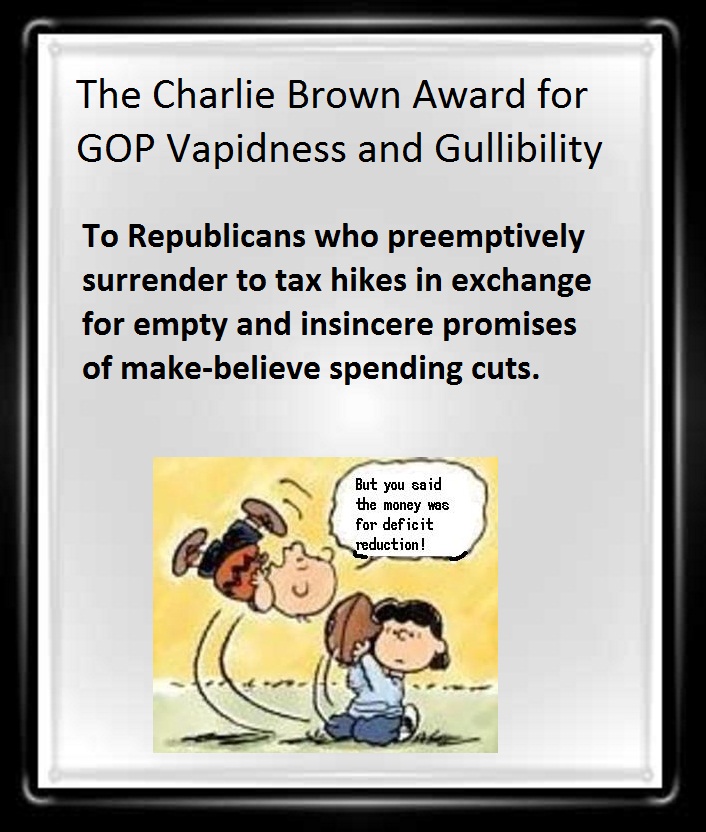
Why does the “Lucy move the football” reference apply to Republicans on the fiscal cliff?

I truly do wonder how smart our elected representatives are in Washington. I got up on 12-20-12 and read this article below from the Heritage Foundation with the reference to Charlie Brown getting fooled by Lucy again when he runs up and tries  to kick the football and of course she moves it again.

Liberals in Congress have always tried to fool conservatives by promising future cuts if they provide higher taxes now. (This article below appeared on www.heritage.org on 12-20-12.)

Obama’s “Lucy Move the Football” Fiscal Cliff Plan Still Not Balanced

Alison Acosta Fraser

December 18, 2012 at 3:25 pm

Volleys of negotiating counter-offers are coming in faster now that Christmas break and the looming fiscal cliff are just around the corner.

While there is much unsatisfactory with Speaker of the House John Boehner’s (R–OH) Sunday night proposal, let us not forget that the reason we are watching this needless, high stakes drama unfold is due to President Obama’s intractable insistence on tax increases on America’s high earners. After all, he and Congress could simply and quickly pass a bill to extend all current policies and avoid the fiscal cliff entirely—if he wanted to. No, this is really about hiking taxes on high earners. Thus the charade of deficit reduction continues.

Obama’s latest counteroffer is no more acceptable than his first offer. Short on details concerning actual spending reductions, especially on entitlements, it is replete with his requisite tax hikes and (we are shocked) new stimulus spending. The cherry on top is an extension of the debt limit for two years, essentially handing over authority to raise it to the President.

Right.

The President originally called for around $800 billion in tax hikes on America’s “highest” earners—those earning $250,000 and up. A ridiculous demand when the economy is still struggling under his big spending and regulatory policies, and one which would squarely hit smaller businesses. You know, the ones who actually create jobs.

Yet, just like Lucy and the football, when Boehner and company offered up $800 billion in tax hikes, Obama quickly doubled his demand to $1.5 trillion in tax hikes—again, all from the highest earners. They, he tells us, can afford to pay a little more. Never mind, of course, that the top 1 percent of earners already pay 37 percent of all income taxes. Somehow we are to believe this is a “balanced approach.”

Obama pitches all this on the pretext that we can simply go back to the tax rates we had under Clinton. Wrong! His dirty little tax secret is that he has already hiked taxes on high earners under Obamacare. First the law added a surtax of 0.9 percent in addition to the Medicare payroll tax on those earning over $250,000. For the first time ever, Obamacare will apply this higher rate of 3.8 percent to investment income on January 1. Obama won’t tell you that going back to Clinton-era tax rates will actually result in higher taxes on wages, dividends, and capital gains.

They say if you want less of something, then tax it. For Obama, this works fine on financial transactions, carbon emissions, driving, and junk food. But evidently, for him, not so much on a strong vibrant economy. And those Clinton boom years? They weren’t ushered in after the Clinton tax hikeonly after the Clinton–Gingrich tax cut!

Rather than working with Republicans on tax proposals that will actually grow the economy, Obama is now simply fighting over his definition of “high income” while we are left to wonder how much this $1.2 trillion tax hike will slow the economy.

As for the $1.2 trillion spending reductions, the only reason they are there is because Boehner insisted on them. But $100 billion in cuts would whack the defense budget, which is already reeling from earlier budget cuts. Yet the real spending and debt crisis comes from unaffordable entitlement programs. While Obama is insisting on balance on the tax side, he is sorely lacking in leadership here. As a recent Washington Post editorial opined:

Elections do have consequences, and Mr. Obama ran on a clear platform of increasing taxes on the wealthy. But he was clear on something else, too: Deficit reduction must be “balanced,” including spending cuts as well as tax increases. Since 60 percent of the federal budget goes to entitlement programs such as Medicare, Medicaid and Social Security, there’s no way to achieve balance without slowing the rate of increase of those programs.

We know Obama is open to changing the inflation calculation and slowing the benefit growth in Social Security. But what else? What about the proposals in his own budget, which would increase premiums on Medicare? He could easily broaden his proposals with additional uncontroversial steps to begin the process of strengthening and reining in Social Security and Medicare. All he needs to do is lead.

Some polls may show that Americans think taxes should be part of a deficit deal; but what the polls do not always show is their utter distrust that Washington would use new revenues to actually reduce the deficit. Here, Obama does not let them down. He reportedly wants $80 billion in new spending on infrastructure and unemployment benefits.

In exchange for all of this, he wants to raise the debt limit by enough to fuel his big spending goals for two years. This is utterly unacceptable. Americans know you cannot reduce the deficit when you plan to actually spend more. Americans also know that when Washington lifts the debt limit, it will not control spending. The debt limit puts the very pressure lawmakers need to account for out-of-control spending and make vital course corrections to bring spending under control, lest we face a Euro-style debt crisis in the future.

White House Press Secretary Jay Carney is actually insisting that “[t]he President’s proposal is the only proposal we have seen that achieves the balance that is so necessary.” Balance, evidently, is in the eyes of the beholder. As the Post noted, 60 percent of the budget stems from entitlements.

In just 13 short years—by the time today’s kindergarteners enter college—entitlements and interest on the debt will eat up all tax revenues. A truly balanced approach must start where the problem starts—with substantive reforms to entitlements. While the President maintains that you cannot cut your way to prosperity, you certainly cannot tax your way there.

_______________

Below is a speech by George W. Bush honoring Milton Friedman:

Milton Friedman Honored for Lifetime Achievements 2002/5/9

Milton Friedman said that getting George Bush I to be his vice president was his biggest mistake because he knew that Bush was not a true conservative and sure enough George Bush did raise taxes when he later became President. I wonder if Jeb Bush has the same genes as his father.

What we need is some people in Washington that are brave enough to say that we have taken too much of the american people’s money and we have to make the painful spending cuts in order to balance the budget and not ask for any more tax increases!!!! Arkansas’ congressman Rick Crawford has also made the Charlie Brown mistake but he has backed off it since.

Even though America’s fiscal problem is entirely the result of too much government spending, I wrote earlier this year that there were all sorts of scenarios where I would agree to a tax increase.

But I then pointed out that all of those scenarios were total fantasies and that it would be more realistic to envision me playing center field for the New York Yankees.

The fundamental problem is that politicians never follow through on promises to reduce spending – even if you use the dishonest Washington definition that a spending cut occurs whenever the budget doesn’t rise as fast as previously planned.

And to make matters worse, they always seem to want class-warfare tax hikes that do heavy economic damage rather than the loophole closers that at least get rid of some of the inefficient corruption in the tax code.

That’s why I like the anti-tax pledge of Americans for Tax Reform. You don’t solve America’s fiscal problems by saying no to all tax increases, but at least you don’t move in the wrong direction at a faster rate.

Notwithstanding the principled and pragmatic arguments against putting tax increases on the table, some Republicans – in a triumph of hope over experience – are preemptively acquiescing to tax hikes.

Here’s what Jeb Bush said.

Jeb Bush, the former Florida governor, said Friday that he could back a broad deficit plan that increased taxes, a stance that puts him at odds with other prominent Republicans. Bush told a House panel he could get behind a plan that combined 10 dollars in spending cuts for every dollar of new revenue… “The problem is the 10 never materializes,” [Congressman Paul] Ryan said after Bush said he could support a revenue-increasing deficit deal. Norquist also has criticized deficit deals crafted in 1982 and 1990 – the latter agreed to by then-President George H.W. Bush, Jeb’s father – for failing to deliver on the spending side.

Kudos to Paul Ryan for making the obvious point about make-believe spending cuts. And Grover is correct about the failure of previous budget deals.

Indeed, I cited a New York Times column that inadvertently revealed that the only budget deal that worked was the 1997 pact that cut taxes rather than raised them.

Jeb Bush isn’t the only apostate. Here’s what Senator Graham had to say.

Sen. Lindsey Graham (R-S.C.) said Tuesday he believed Republicans should consider eliminating loopholes in the tax code even if they aren’t replaced by additional tax cuts, a move that would break with an anti-tax pledge many GOP lawmakers have signed with activist Grover Norquist. “When you eliminate a deduction, it’s OK with me to use some of that money to get us out of debt. That’s where I disagree with the pledge,” Graham told ABC News. …”I’m willing to move my party, or try to, on the tax issue. I need someone on the Democratic side being willing to move their party on structural changes to entitlements.” Graham said, for instance, he would support a plan that included $4 in spending cuts for every $1 in tax increases. During a Republican debate last August, all eight Republican candidates in attendance said they would reject a proposal to trade $10 in spending cuts for even $1 in tax increases.

In some sense, Senator Graham’s comments are reasonable. With real spending cuts and less-damaging forms of tax hikes, an acceptable deal is possible. But only in Fantasia, not in Washington.

In the real world, all that Senator Graham has done is to move the debate slightly to the left.

I’ve noted that tax increases are political poison for the Republican Party, but I don’t lose sleep worrying about the GOP.

But I do have nightmares about government getting even bigger, and that’s why I don’t want tax increases on the table. I don’t even want them in the room. Or the house. Or the neighborhood.

That’s why Jeb Bush and Lindsey Graham are the newest winners of the Charlie Brown Award. They’ve put blood in the water. I wonder if they’ll act surprised when hungry sharks show up looking for a meal?

_____________

In 1982 the Democrats promised future spending cuts if Ronald Reagan would agree to a tax increase, but you guessed it, the taxes were increased and the spending cuts never came. THE REAL PROBLEM IS NOT THAT WE DON’T HAVE ENOUGH TAXES BUT WE DON’T WANT TO CUT SPENDING!!!

Washington Could Learn a Lot from a Drug Addict

Concerning spending cuts Reagan believed, that members of Congress “wouldn’t lie to him when he should have known better.” However, can you believe a drug addict when he tells you he is not ever going to do his habit again? Congress is addicted to spending too much money.  Lee Edwards wrote in his article “Golden Years” about Ronald Reagan:

Sometimes Reagan went along with a pragamatist like chief of staff James Baker, who persuaded the president to accept the Tax Equity and Fiscal Responsibility Act of 1982 (TEFRA), which turned out to be the great tax increase of 1982 — $98 billion over the next three years. That was too much for eighty-nine House Republicans (including second-term Congressman Newt Gingrich of Georgia) or for prominent conservative organizations from the American Conservative Union like the Conservative Caucus and the U.S. Chamber of Commerce, which all opposed the measure.

Baker assured his boss that Congress would approve three dollars in spending cuts for every dollar of tax increase. To Reagan, TEFRA looked like a pretty good “70 percent” deal. But Congress wound up cutting less than twenty-seven cents for every new tax dollar. What had seemed to be an acceptable 70-30 compromise turned out to be a 30-70 surrender. Ed Meese described TEFRA as “the greatest domestic error of the Reagan administration,” although it did leave untouched the individual tax rate reductions approved the previous year. (TEFRA was built on a series of business and excise taxes plus the removal of business tax deductions.)[xxx]

The basic problem was that Reagan believed, as Lyn Nofziger put it, that members of Congress “wouldn’t lie to him when he should have known better.”[xxxi] As a result of TEFRA, Reagan learned to “trust but verify,” whether he was dealing with a Speaker of the House or a president of the Soviet Union.

_________

Related posts:

Open letter to President Obama (Part 201)Tea Party favorite Representative links article “Prescott and Ohanian: Taxes Are Much Higher Than You Think”

    (Emailed to White House on 12-21-12.) President Obama c/o The White House 1600 Pennsylvania Avenue NW Washington, DC 20500 Dear Mr. President, I know that you receive 20,000 letters a day and that you actually read 10 of them every day. I really do respect you for trying to get a pulse on […]

Open letter to President Obama (Part 200.2)Tea Party Republican Representative takes on the President concerning fiscal cliff

(Emailed to White House on 12-21-12.) President Obama c/o The White House 1600 Pennsylvania Avenue NW Washington, DC 20500 Dear Mr. President, I know that you receive 20,000 letters a day and that you actually read 10 of them every day. I really do respect you for trying to get a pulse on what is […]

Open letter to President Obama (Part 200.1)Tea Party favorite Representative shares link on facebook

 (Emailed to White House on 12-21-12) President Obama c/o The White House 1600 Pennsylvania Avenue NW Washington, DC 20500 Dear Mr. President, I know that you receive 20,000 letters a day and that you actually read 10 of them every day. I really do respect you for trying to get a pulse on what is […]

Open letter to President Obama (Part 199) Tea Party favorite takes on President

  The federal government has a spending problem and Milton Friedman came up with the negative income tax to help poor people get out of the welfare trap. It seems that the government screws up about everything. Then why is President Obama wanting more taxes? _______________ Milton Friedman – The Negative Income Tax Published on […]

Tea Party Heroes Rep. David Schweikert (R-AZ),Justin Amash (R-MI), Tim Huelskamp (R-KS) have been punished by Boehner

I was sad to read that the Speaker John Boehner has been involved in punishing tea  party republicans. Actually I have written letters to several of these same tea party heroes telling them that I have emailed Boehner encouraging him to listen to them. Rep. David Schweikert (R-AZ),Justin Amash (R-MI), and Tim Huelskamp (R-KS). have been contacted […]

Some Tea Party heroes (Part 10)

Michael Tanner of the Cato Institute in his article, “Hitting the Ceiling,” National Review Online, March 7, 2012 noted: After all, despite all the sturm und drang about spending cuts as part of last year’s debt-ceiling deal, federal spending not only increased from 2011 to 2012, it rose faster than inflation and population growth combined. […]

Ronald Reagan and Milton Friedman supported Balanced Budget Amendment

Remarks at a Rally Supporting the Proposed Constitutional Amendment for a Balanced Federal Budget

For more information on the ongoing works of President Reagan’s Foundation, please visit http://www.reaganfoundation.org

_______________

Ronald Reagan was a firm believer in the Balanced Budget Amendment and Milton Friedman was a key advisor to Reagan. Friedman’s 1980 film series taught the lesson of restraining growth of the federal budget.


UHLER: A better balanced budget amendment

Vital changes needed to keep road to further reforms open

There is a problem brewing in the House of Representatives of which most conservatives in and outside Congress are largely unaware. It has to do with H.J. Res. 1 – the balanced budget amendment – soon to be voted on per the debt-ceiling “deal” struck by Congress and the president. While H.J. Res. 1 is a solid first effort – and we have urged support for it as a symbolic vote – it is possibly fatally flawed and should be revised.

After years of indifference to constitutional fiscal discipline, Congress is once again stirring. In 1982, then-President Ronald Reagan, convened a federal amendment drafting committee led by Milton Friedman, Jim Buchanan, Bill Niskanen, Walter Williams and many others, and fashioned Senate Joint Resolution 58, a tax limitation-balanced budget amendment, which garnered 67 votes in the Senate under the able leadership of Sen. Orrin G. Hatch, Utah Republican. After a successful discharge petition forced a House vote, the amendment failed to achieve the two-thirds vote necessary in a Tip O’Neill-Jim Wright-controlled House. In 1996, Newt Gingrich and company came within one vote of passing a fiscal amendment in the House.

Currently, H.J. Res. 1 is designed as a classic balanced budget amendment in which outlays can be as great as, but no more than, receipts for that year. However, it requires an estimate of receipts, which is notoriously faulty, and it does not necessarily produce surpluses with which to pay down our massive debt. Furthermore, it contains a second limit on outlays – “not more than 18 percent of the economic output of the United States” – without defining such output or resolving the inevitable conflict between the outlay calculations in the two provisions.

This could be fixed by restructuring the amendment as a spending or outlay limit based on prior year receipts or outlays (known numbers), adjusted only for inflation and population changes. This will produce surpluses in most years with which to pay down debts and will reduce government spending as a share of gross domestic product over time, right-sizing government and increasing the rate of economic growth for the benefit of all citizens, especially those least able to compete.

Section 4 of H.J. Res. 1 might best be described as a supreme example of the law of unintended consequences. This section imposes on the president a constitutional responsibility to present a balanced budget. Surely, the drafters were saying to themselves “We’ll fix that guy in the White House. Now he will have to fess up and either propose specific tax increases or specific spending cuts. He won’t be able to duck reality any longer.” The only problem is that this section is at odds with our Constitution in that it gives the president a constitutional power over fiscal matters never intended by the Founders.

For much of our history, the president did not propose a budget. In the Budget and Accounting Act of 1921, which established the Bureau of the Budget, now the Office of Management and Budget and the General Accounting Office, the president was statutorily authorized to propose a budget. Presidents have always shaped the budget and spending using their negotiating opportunities and veto pen. Wearing their chief administrator hat, earlier presidents sought to save money from the amounts appropriated by Congress, getting things done for less, impounding funds they did not think essential to spend. Congress‘ ceiling on an appropriation was not also the spending floor for the president, as it is now.

Section 4 appears to give the president co-equal power with Congress not only to present a budget but to shape it, in conflict with congressional budget authority. At a minimum, it is likely to create a conflict over the amount of allowed annual spending. The president surely will be guided by his own Office of Management and Budget, whose budget and receipts calculations will undoubtedly differ from the Congressional Budget Office’s numbers that will direct Congress. We should not start the budget process each year with this kind of conflict.

It would be better to restore the historic role of the president to impound and otherwise reduce expenditures by repealing and revising appropriate portions of the Congressional Budget and Impoundment Control Act of 1974 so a fiscally conservative president is a revitalized partner in cutting the size of government.

Section 5 requires a supermajority vote for “a bill to increase revenues.” Whether one agrees or disagrees with making tax increases more difficult, this language is troublesome because it requires some government bureaucrat or bureaucracy to make a calculation or estimate of the effect of tax law changes on revenues. Proponents of a bill to increase cash flow to the government will argue that their tax law changes are “revenue neutral” and will likely persuade the Joint Committee on Taxation or Congressional Budget Office to back them up. Once again, estimators would be in control.

If we ever expect to convert our income-based tax system to a consumption tax, better not to require a two-thirds vote as liberals will use such a supermajority voting rule to stymie tax system reform.

There are other issues, as well, with debt limit and national emergency supermajority votes and definitions. While this balanced budget amendment – H.J. Res. 1 – has deserved a “yes” vote as a demonstration of commitment to constitutional fiscal discipline, it can and must be revised before the showdown vote in the House this fall.

Lewis K. Uhler is president of the National Tax Limitation Committee.

Open letter to Senator Boozman: Copy of my letter to President Obama on Socialism (Part 116.7)

Senator John Boozman, 320 Hart Senate Office Building Washington, DC 20510 Phone: (202) 224-4843 Fax: (202) 228-1371
Dear Senator Boozman,

I want to thank you for taking the time out of your busy day to respond to my earlier letter to you on this same subject.

It is obvious to me that if President Obama gets his hands on more money then he will continue to spend away our children’s future. He has already taken the national debt from 11 trillion to 16 trillion in just 4 years. Over, and over, and over, and over, and over and over I have written Speaker Boehner and written every Republican that represents Arkansans in Arkansas before (Griffin, Womack, Crawford, and only Senator Boozman got a chance to respond) concerning this. I am hoping they will stand up against this reckless spending that our federal government has done and will continue to do if given the chance.

I have written and emailed Senator Pryor over, and over again with spending cut suggestions but he has ignored all of these good ideas in favor of keeping the printing presses going as we plunge our future generations further in debt. I am convinced if he does not change his liberal voting record that he will no longer be our senator in 2014.

I have written hundreds of letters and emails to President Obama and I must say that I have been impressed that he has had the White House staff answer so many of my letters. However, his policies have not changed. He is committed to cutting nothing from the budget that I can tell.

Evidently the Republicans have proposed raising tax rates as a possible compromise to avoid going over the fiscal cliff. Let me make a few comments about that.

First, if raising the debt ceiling is part of this agreement then we are losing our leverage over President Obama. We have enough votes to block a debt ceiling increase. We want a balanced budget but if President Obama does not get a debt ceiling increase then he will have to balance the budget immediately.

Second, spending is our problem and it is not tax revenue. The problem in Washington is not lack of revenue but our lack of spending restraint. We almost had a balanced budget in 2007 and if we had frozen spending at 2007 levels then we would be close to a balanced budget now. Instead of controlling spending our spending has gone from 2.7 trillion to 3.8 trillion in just 5 short years!!!

Third, my blog has exploded the last few days with clicks on past posts I have done like the one below. Take a look at this post below and see why it is one of my most popular. You will notice that it is an open letter  that I sent to President Obama about socialism.

Fourth, I have included some wise words from a fellow Tea Party favorite like you below. Mo Brooks’ words are true now like they were in August of 2011 when he voted against the debt ceiling increase then.

Fifth, let me share these two videos with you that make very good points concerning this issue:

This video belows shows how silly the federal government is when they pass “spending cuts.”

The problem in Washington is not lack of revenue but our lack of spending restraint. This video below makes that point.

Please take the time to read Mo Brooks’ words and respond to me and tell me if you will vote against the debt ceiling increase. It is the only leverage we have on President Obama. Others have responded to me in the past including you and for that I am very grateful.

Thank you for your time.

Sincerely,

Everette Hatcher, 13900 Cottontail Lane, Alexander, AR 72002, cell ph 501-920-5733, lowcostsqueegees@yahoo.com, www.thedailyhatch.org

________________

Hayek on Socialism

Uploaded by on Aug 21, 2009

Friedrich Hayek talks about socialism.

________________

President Obama c/o The White House
1600 Pennsylvania Avenue NW
Washington, DC 20500

Dear Mr. President,

I know that you receive 20,000 letters a day and that you actually read 10 of them every day. I really do respect you for trying to get a pulse on what is going on out here. 

Socialism tries to plan out everything and it hurts the free market. We can see how this has played out especially in the last four years in the USA.

Glenn Beck Presents F A Hayek’s “The Road to Serfdom” Part 1

Uploaded by on Jun 13, 2010

This video via user TheConservatube; thank you!

What F.A. Hayek saw, and what most all his contemporaries missed, was that every step away from the free market and toward government planning represented a compromise of human freedom generally and a step toward a form of dictatorship–and this is true in all times and places. He demonstrated this against every claim that government control was really only a means of increasing social well-being. Hayek said that government planning would make society less liveable, more brutal, more despotic. Socialism in all its forms is contrary to freedom.

Nazism, he wrote, is not different in kind from Communism. Further, he showed that the very forms of government that England and America were supposedly fighting abroad were being enacted at home, if under a different guise. Further steps down this road, he said, can only end in the abolition of effective liberty for everyone.

Capitalism, he wrote, is the only system of economics compatible with human dignity, prosperity, and liberty. To the extent we move away from that system, we empower the worst people in society to manage what they do not understand.

__________

Thank you so much for your time. I know how valuable it is. I also appreciate the fine family that you have and your commitment as a father and a husband.

Sincerely,

Everette Hatcher III, 13900 Cottontail Lane, Alexander, AR 72002, ph 501-920-5733, lowcostsqueegees@yahoo.com

_______________

__________

Here is another Tea Party hero you need to listen to:
Rep. Brooks on Fox Business: BBA and the Debt Ceiling Vote

Print

Share


Rep. Mo Brooks To Vote No On Obama-Reid-Boehner Debt Ceiling Bill

08/01/11

Washington, D.C. – Today Congressman Mo Brooks (R-AL) made the following statement concerning his vote on the Budget Control Act of 2011:

Summary

The Obama-Reid-Boehner Debt Ceiling Bill is bad for America, bad political process, bad for national defense, does not prevent unsustainable budget deficits, kicks the debt ceiling crises down the road to 2013 (when America will have more debt and less financial strength with which to fix the problem), and fails to satisfactorily decrease the risk of an American credit rating downgrade.

Overview

America must, and will, raise the debt ceiling.  The question is not whether Congress will raise the debt ceiling; the question is when and how.  Regardless of when the debt ceiling is raised, every bill and obligation of America to its citizens and creditors will be paid in full (albeit, with the exception of creditors, some payments may be delayed).

I have voted to raise the debt ceiling provided the debt ceiling bill makes America’s financial condition better, not worse.

I voted to raise the debt ceiling on July 22, 2011, when I voted for the Cut, Cap and Balance Plan (cutting FY 2012 expenditures by a modest $111 billion in the context of a $1.5 trillion deficit; capping federal government expenditures within historically justifiable 18-20% ranges; and passing a Balanced Budget Constitutional Amendment that protect future generations of Americans from revisiting the financial mess we face).

I voted to raise the debt ceiling on July 29, 2011, when I voted for the Boehner Plan (which included a Balanced Budget Constitutional Amendment requirement).

I will not vote for the Obama-Reid-Boehner Debt Bill (herein the “Debt Bill”) because it is not up to the financial challenges America faces. 

Background:  The Problem

Years of spending binges by the federal government have come home to roost.  America’s debt exceeds $14 trillion.  America has suffered three consecutive years of trillion dollar deficits (and faces trillion dollar deficits into the foreseeable future).

Annual deficits and accumulated debt force America to confront two major financial threats, both with one common cause: unsustainable budget deficits.

In the short term, America faces a debt ceiling crisis.  Over the longer term, America faces a debt crisis. 

If trillion dollar deficits continue indefinitely, America’s insolvency and bankruptcy is certain, thereby risking America’s national defense, Social Security, Medicare, Medicaid, NASA, and everything else the federal government does.

Debt Bill Deficiencies That Compel a “No” Vote

The accumulative deficiencies in the Debt Bill compel me to vote “No.”  The deficiencies are:

1. Minimal Time for Consideration and Deliberation.

The Debt Bill is 74 pages of interwoven, complicated legal and budgetary terms.  I have read and studied the Debt Bill in the limited time available.  The Debt Bill forces onto our children and grandchildren another $2.4 trillion in debt burden, yet we are expected to vote on it with less than 24 hours notice.

This is insufficient time to thoroughly understand the Debt Bill’s nuances, for budget experts to digest the Debt Bill and offer their insights, for the public to analyze the legislation and share their insight, and for Congress to make a wise and deliberative decision.

While some argue the Debt Bill must pass by the White House’s August 2 deadline; I believe it is better to act wisely than in haste.  The economy will be much worse if Congress, in haste, makes a $2.4 trillion error. 

2. Significant Defense Cuts in FY 2012 & 2013.

In FY 2012, the Debt Bill cuts national defense by $2 to $17 billion (the variance is due to different Debt Bill interpretations by the House Armed Services Committee).

The Debt Bill creates a 12-member Joint Select Committee (six Senators and six Congressmen; six Republicans and six Democrats).  By November 23, the Committee must recommend $1.2 trillion in deficit reduction measures (spending cuts and/or tax increases).  If the Committee makes a recommendation, Congress must vote on the recommendation on or before January 15

If the Committee splits 6-6 and makes no recommendation, or if either House of Congress rejects the Committee’s recommendation, then the Debt Bill mandates that the Defense budget be cut $60 Billion in FY 2013 (i.e. – in the fiscal year beginning 14 months from now, on October 1, 2013).

National defense is the top priority of the federal government.  If the Debt Bill passes, there is an unnecessary and substantial risk that it will trigger risky defense cuts in just 14 months that undermine the defense capabilities of America.

3. The Bill Does Not Fix the Underlying Problem.

The Bill makes America’s financial challenges worse by inadequately addressing unsustainable deficits that threaten America with insolvency and bankruptcy and force debt ceiling increases.

The Debt Bill’s “cuts” bind no future Congresses.  Hence, the only “cuts” that count are those for Fiscal Years 2012 and 2013.

In FY 2012, the Debt Bill cuts discretionary federal government spending by only $7 billion (versus FY 2011 levels), while overall federal government spending actually increases (“discretionary spending” is less than 30% of total federal government spending). 

In FY 2013, the Debt Bill increases discretionary federal government spending by $4 billion (over FY 2012 levels).  Overall federal government spending again increases significantly.

Hence, in both FY 2012 and 2013, the federal government deficit is estimated to exceed $1 trillion/year if the Debt Bill passes and, under the best of scenarios, the Debt Bill’s “solution” increases America’s debt by $2.4 trillion in less than two years, which makes America’s debt problem much worse, not better.

4. Balanced Budget Constitutional Amendment. 

The Debt Bill requires a vote of Congress on a Balanced Budget Constitutional Amendment but does not require that Congress pass a Balanced Budget Amendment. 

The July 29 Boehner Bill required passage of a Balanced Budget Amendment before the Phase II debt ceiling increase would occur.  The Debt Bill eliminates the requirement for a Balanced Budget Amendment, thereby eliminating the only long-term fix to America’s unsustainable deficits. 

5. Punting the Debt Ceiling Crisis to 2013. 

Because of 2012 election considerations, the Debt Bill “kicks the can down the road” to 2013, when a financially weaker America will be less capable of facing yet another debt ceiling crisis. 

America will be weaker because debt service burdens will be $2.4 trillion more and the total debt of $16.7 trillion will likely be subject to higher interest rates and more onerous payment obligations.

America must face its unsustainable deficit issue while it is stronger, not weaker.  The longer America waits, the worse the economic outcome will be.

6. Credit Rating Cuts.

In my judgment, the Debt Bill substantially increases the long-term risk of a cut in America’s credit rating. 

Standard & Poor stated on July 14, 2011, that America’s credit rating is at risk if Washington has “not achieved a credible solution to the rising U.S. government debt burden and [is] not likely to achieve one in the foreseeable future.”  Standard & Poor president Deven Sharma reiterated this concern on July 27, 2011 when he testified before the House Financial Services Committee that, “The more important issue is really the long-term growth rate of the debt… that is the more important issue at hand.”

Similarly, Moody’s stated on July 13, 2011 that, if the debt ceiling is raised, America’s credit rating outlook “would very likely be changed to negative… unless [there is a] substantial and credible agreement [on] long-term deficit reduction.”

The Debt Bill does not cut America’s short or long-term deficits enough to minimize the risk of downgrade in America’s credit rating… a downgrade that will, in turn, drive up America’s debt service cost and reduce funding for all other federal government programs.  To make matters worse, if America’s interest rates go up; state, local and private interest rates are likely to also go up… thereby hurting all Americans at every level.

The Solution

The best solution that protects America from the short term debt ceiling and long term insolvency threats is a debt ceiling increase coupled with a Balanced Budget Constitutional Amendment that is phased in over a 5 year period.

Inasmuch as constitutional amendments often take years to pass, time that America may not have, the debt ceiling should be raised in a two-step process.  The first step partially raises the debt ceiling when Congress passes a substantive and effective Balanced Budget Amendment.  If the Senate and House concur, this can be done in as little as a week.

The second step raises the rest of the debt ceiling requirement when the states ratify the proposed Balanced Budget Amendment.  This process gives the states an incentive to ratify the Balanced Budget Amendment in less than one year (or trigger the effects of not raising the debt ceiling).