Category Archives: Milton Friedman

Listing of transcripts and videos of Free to Choose by Milton Friedman: Episode “Created Equal” on www.theDailyHatch.org


Milton Friedman in his series “Free to Choose” used a pencil as a simple example to should have the “invisible hand” of the freemarket works (phrase originally used by Adam Smith).
 
 
Milton Friedman congratulated by President Ronald Reagan. © 2008 Free To Choose Media, courtesy of the Power of Choice press kit

Here are some great quotes about Milton Friedman:

“Milton Friedman is a scholar of first rank whose original contributions to economic science have made him one of the greatest thinkers in modern history.”
President Ronald Reagan

“How grateful I have been over the years for the cogency of Friedman’s ideas which have influenced me. Cherishers of freedom will be indebted to him for generations to come.”
Alan Greenspan, former Chairman, Federal Reserve System

“Right at this moment there are people all over the land, I could put dots on the map, who are trying to prove Milton wrong. At some point, somebody else is trying to prove he’s right That’s what I call influence.”
Paul Samuelson, Nobel Laureate in Economic Science

“Friedman’s influence reaches far beyond the academic community and the world of economics. Rather than lock himself in an ivory tower, he has joined the fray to fight for the survival of this great country of ours.”
William E. Simon, former Secretary of the Treasury

“Milton Friedman is the most original social thinker of the era.”
John Kenneth Galbraith, former Professor of Economics, Harvard University

Perhaps Friedman’s greatest success began in 1979 when he and his wife Rose authored the book, Free to Choose, based on the famous ten-part TV series for PBS by the same title. Both the TV program and the book were drawn from an earlier series of lectures presented by Friedman. Because it aired during a period of critical economic distress during the Carter Administration and in the aftermath of the Vietnam War, Watergate scandal, and Richard Nixon’s resignation as President, the program is widely regarded as being a major factor in shifting American public opinion toward appreciating the need to dismantle government largess. The series was shown in England, Japan, Italy, Australia, Germany, Canada, and many other countries, and the book was translated for distribution around the world, selling more than one million copies.

__________

No other issue is more misunderstood today than equality. President Obama has used class warfare over and over the last few months and according to him equality at the finish line is the equality that we should all be talking about. However, socialism has never worked and it has always killed incentive to produce more. Milton Friedman expressed the conversative’s best and I am glad that I had the chance to be studying his work for over 30 years now.

In 1980 when I first sat down and read the book “Free to Choose” I was involved in Ronald Reagan’s campaign for president and excited about the race. Milton Friedman’s books and film series really helped form my conservative views. Take a look at one of my favorite films of his:

Created Equal [1/7]. Milton Friedman’s Free to Choose (1980)

Uploaded by on May 30, 2010

In this program, Milton Friedman visits India, the U.S., and Britain, examining the question of equality. He points out that our society traditionally has embraced two kinds of equality: equality before God and equality of opportunity. The first of these implies that human beings enjoy a certain dignity simply because they are members of the human community. The second suggests societies should allow the talents and inclinations of individuals to unfold, free from arbitrary barriers. Both of these concepts of equality are consistent with the goal of personal freedom.

In recent years, there has been growing support for a third type of equality, which Dr. Friedman calls “equality of outcome.” This concept of equality assumes that justice demands a more equal distribution of the economic fruits of society. While admitting the good intentions of those supporting the idea of equality of outcome, Dr. Friedman points out that government policies undertaken in support of this objective are inconsistent with the ideal of personal freedom. Advocates of equality of outcome typically argue that consumers must be protected by government from the insensitivities of the free market place.

Dr. Friedman demonstrates that in countries where governments have pursued the goal of equality of outcome, the differences in wealth and well being between the top and the bottom are actually much greater than in countries that have relied on free markets to coordinate economic activity. Indeed, says Dr. Friedman, it is the ordinary citizen who benefits most from the free market system. Dr. Friedman concludes that any society that puts equality ahead of freedom will end up with neither. But the society that puts freedom before equality will end up with both greater freedom and great equality.

___________________________

FREE TO CHOOSE 5: “Created Equal” (Milton Friedman)
Free to Choose ^ | 1980 | Milton Friedman

Posted on Friday, July 21, 2006 3:58:44 PM by Choose Ye This Day

FREE TO CHOOSE: Created Equal

Friedman: From the Victorian novelists to modern reformers, a favorite device to stir our emotions is to contrast extremes of wealth and of poverty. We are expected to conclude that the rich are responsible for the deprivations of the poor __ that they are rich at the expense of the poor.

Whether it is in the slums of New Delhi or in the affluence of Las Vegas, it simply isn’t fair that there should be any losers. Life is unfair __ there is nothing fair about one man being born blind and another man being born with sight. There is nothing fair about one man being born of a wealthy parent and one of an indigenous parent. There is nothing fair about Mohammed Ali having been born with a skill that enables him to make millions of dollars one night. There is nothing fair about Marleena Detrich having great legs that we all want to watch. There is nothing fair about any of that. But on the other hand, don’t you think a lot of people who like to look at Marleena Detrich’s legs benefited from nature’s unfairness in producing a Marleena Detrich. What kind of a world would it be if everybody was an absolute identical duplicate of anybody else. You might as well destroy the whole world and just keep one specimen left for a museum. In the same way, it’s unfair that Muhammed Ali should be a great fighter and should be able to earn millions. But would it not be even more unfair to the people who like to watch him if you said that in the pursuit of some abstract idea of equality we’re not going to let Muhammed Ali get more for one nights fight than the lowest man on the totem pole can get for a days unskilled work on the docks. You can do that but the result of that would be to deny people the opportunity to watch Mohammad Ali. I doubt very much he would be willing to subject himself to the kind of fights he’s gone through if he were to get the pay of an unskilled docker.

This beautiful estate, its manicured lawns, its trees, its shrubs, was built by men and women who were taken by force in Africa and sold as slaves in America. These kitchen gardens were planted and tended by them to furnish food for themselves and their master, Thomas Jefferson, the Squire of Monticello. It was Jefferson who wrote these words: We hold these truths to be self-evident that all men are created equal. That they are endowed by their creator with certain inalienable rights, that among these are life, liberty and the pursuit of happiness. These words penned by Thomas Jefferson at the age of 33 when he wrote the Declaration of Independence, have served to define a basic ideal of the United States throughout its history.

Much of our history has revolved about the definition and redefinition of the concept of equality, about the intent to translate it into practice. What did Thomas Jefferson mean by the words all men are created equal? He surely did not mean that they were equal and/or identical in what they could do and what they believed. After all, he was himself a most remarkable person. At the age of 26, he designed this beautiful house of Monticello, supervised its construction and indeed is said to have worked on it with his own hands. He was an inventor, a scholar, an author, a statesman, governor of Virginia, President of the United States, minister to France, he helped shape and create the United States. What he meant by the word “equal” can be seen in the phrase “endowed by their creator”. To Thomas Jefferson, all men are equal in the eyes of God. They all must be treated as individuals who have each separately a right to life, liberty and the pursuit of happiness.

Of course, practice did not conform to the ideals. In Jefferson’s life or in ours as a nation, he agonized repeatedly during his lifetime about the conflict between the institution of slavery and the fine words of the declaration. Yet, during his whole life, he was a slave owner.

This is the City Palace in Jaipur, the capitol of the Indian state of Rajasthan, is just one of the elegant houses that were built here 150 years ago by the prince who ruled this land. There are no more princes, no more Maharajas in India today. All titles were swept away by the government of India in its quest for equality. But as you can see, there are still some people here who live a very privileged life. The descendants of the Maharajas financed this kind of life partly by using other palaces as hotels for tourists __ tourists who come to India to see how the other half lives. This side of India, the exotic glamorous side, is still very real. Everywhere in the world there are gross inequalities of income and wealth. They offend most of us.

A myth has grown up that free market capitalism increases such inequalities, that the rich benefit at the expense of the poor. Nothing could be further from the truth. Wherever the free market has been permitted to operate, the ordinary man has been able to attain levels of living never dreamed of before. Nowhere is the gap between rich and poor. Nowhere are the rich richer and the poor poorer than in those societies that do not permit the free market to operate, whether they be feudal societies where status determines position, or modern, centrally-planned economies where access to government determines position.

Central planning was introduced in India in considerable part in the name of equality. The tragedy is that after 30 years, it is hard to see any significant improvement in the lot of the ordinary person.

__________________

Other segments:

Free to Choose by Milton Friedman: Episode “Created Equal” (Part 7 of transcript and video)

Liberals like President Obama want to shoot for an equality of outcome. That system does not work. In fact, our free society allows for the closest gap between the wealthy and the poor. Unlike other countries where free enterprise and other freedoms are not present.  This is a seven part series. Created Equal [7/7]. Milton Friedman’s Free to Choose […]

Liberals’ solution for the poor is more welfare, but that will not work

Milton Friedman’s solution to limiting poverty Liberals like Michael Cook just don’t get it. They should listen to Milton Friedman (who is quoted in this video below concerning the best way to limit poverty). New Video Shows the War on Poverty Is a Failure Posted by Daniel J. Mitchell The Center for Freedom and Prosperity has […]

Free to Choose by Milton Friedman: Episode “Created Equal” (Part 6 of transcript and video)

Liberals like President Obama want to shoot for an equality of outcome. That system does not work. In fact, our free society allows for the closest gap between the wealthy and the poor. Unlike other countries where free enterprise and other freedoms are not present.  This is a seven part series. Created Equal [6/7]. Milton Friedman’s Free to Choose […]

“Friedman Friday” Free to Choose by Milton Friedman: Episode “Created Equal” (Part 5 of transcript and video)

Liberals like President Obama want to shoot for an equality of outcome. That system does not work. In fact, our free society allows for the closest gap between the wealthy and the poor. Unlike other countries where free enterprise and other freedoms are not present.  This is a seven part series. Created Equal [5/7]. Milton Friedman’s Free to Choose […]

Republican debate Oct 18, 2011 (last part) with video clips and transcript

Republican debate Oct 18, 2011 (last part) with video clips and transcript Below are video clips and the transcript. pt 5 pt 6 pt 7 COOPER: We’re going to move on to an issue very important here in the state of Nevada and throughout the West. We have a question from the hall. QUESTION: Yeah, […]

Milton Friedman discusses Reagan and Reagan discusses Friedman

Uploaded by YAFTV on Aug 19, 2009 Nobel Laureate Dr. Milton Friedman discusses the principles of Ronald Reagan during this talk for students at Young America’s Foundation’s 25th annual National Conservative Student Conference MILTON FRIEDMAN ON RONALD REAGAN In Friday’s WSJ, Milton Friedman reflectedon Ronald Reagan’s legacy. (The link should work for a few more […]

Free to Choose by Milton Friedman: Episode “Created Equal” (Part 4 of transcript and video)

Liberals like President Obama want to shoot for an equality of outcome. That system does not work. In fact, our free society allows for the closest gap between the wealthy and the poor. Unlike other countries where free enterprise and other freedoms are not present.  This is a seven part series. Created Equal [4/7]. Milton Friedman’s Free to Choose […]

Friedman Friday” Free to Choose by Milton Friedman: Episode “Created Equal” (Part 3 of transcript and video)

Friedman Friday” Free to Choose by Milton Friedman: Episode “Created Equal” (Part 3 of transcript and video) Liberals like President Obama want to shoot for an equality of outcome. That system does not work. In fact, our free society allows for the closest gap between the wealthy and the poor. Unlike other countries where free enterprise and other […]

Free to Choose by Milton Friedman: Episode “Created Equal” (Part 2 of transcript and video)

Free to Choose by Milton Friedman: Episode “Created Equal” (Part 2 of transcript and video) Liberals like President Obama want to shoot for an equality of outcome. That system does not work. In fact, our free society allows for the closest gap between the wealthy and the poor. Unlike other countries where free enterprise and other freedoms are […]

Free to Choose by Milton Friedman: Episode “Created Equal” (Part 1 of transcript and video)

 Milton Friedman and Ronald Reagan Liberals like President Obama (and John Brummett) want to shoot for an equality of outcome. That system does not work. In fact, our free society allows for the closest gap between the wealthy and the poor. Unlike other countries where free enterprise and other freedoms are not present.  This is a seven part series. […]


“Friedman Friday” EPISODE “The Power of the Market” of Free to Choose in 1990 by Milton Friedman (Part 2)

Milton Friedman The Power of the Market 2-5

How can we have personal freedom without economic freedom? That is why I don’t understand why socialists who value individual freedoms want to take away our economic freedoms.  I wanted to share this info below with you from Milton Friedman who has influenced me greatly over the last 30 plus years. Here is part two.

Friedman: Of course she didn’t stay here a long time, she stayed here while she learned the language, while she developed some feeling for the country, and gradually she was able to make a better life for herself.Similarly, the people who are here now, they are like my mother. Most of the immigrants from the distant countries __ they came here because they liked it here better and had more opportunities. A place like this gives them a chance to get started. They are not going to stay here very long or forever. On the contrary, they and their children will make a better life for themselves as they take advantage of the opportunities that a free market provides to them.The irony is that this place violates many of the standards that we now regard as every worker’s right. It is poorly ventilated, it is overcrowded, the workers accept less than union rate __ it breaks every rule in the book. But if it were closed down, who would benefit? Certainly not the people here. Their life may seem pretty tough compared to our own, but that is only because our parents or grandparents went through that stage for us. We have been able to start at a higher point.Frank Visalli’s father was 12 years old when he arrived all alone in the United States. He had come from Sicily. That was 53 years ago. Frank is a successful dentist with a wife and family. They live in Lexington, Massachusetts. There is no doubt in Frank’s mind what freedom combined with opportunity meant to his father and then to him, or what his Italian grandparents would think if they could see how he lives now.

Frank Visalli: They would not believe what they would see __ that a person could immigrate from a small island and make such success out of their life because to them they were mostly related to the fields, working in the field as a peasant. My father came over, he made something for himself and then he tried to build a family structure. Whatever he did was for his family. It was for a better life for his family. And I can always remember him telling me that the number one thing in life is that you should get an education to become a professional person.

Friedman: The Visalli family, like all of us who live in the United States today, owe much to the climate of freedom we inherited from the founders of our country. The climate that gave full scope to the poor from other lands who came here and were able to make better lives for themselves and their children.

But in the past 50 years, we’ve been squandering that inheritance by allowing government to control more and more of our lives, instead of relying on ourselves. We need to rediscover the old truths that the immigrants knew in their bones; what economic freedom is and the role it plays in preserving personal freedom.

That’s why I came here to the South China Sea. It’s a place where there is an almost laboratory experiment in what happens when government is limited to its proper function and leaves people free to pursue their own objectives. If you want to see how the free market really works this is the place to come. Hong Kong, a place with hardly any natural resources. About the only one you can name is a great harbor, yet the absence of natural resources hasn’t prevented rapid economic development. Ships from all nations come here to trade because there are no duties, no tariffs on imports or exports. The power of the free market has enabled the industrious people of Hong Kong to transform what was once barren rock into one of the most thriving and successful places in Asia. Aside from its harbor, the only other important resource of Hong Kong is people __ over 4_ million of them.

Like America a century ago, Hong Kong in the past few decades has been a haven for people who sought the freedom to make the most of their own abilities. Many of them are refugees from countries that don’t allow the economic and political freedom that is taken for granted in Hong Kong.

Despite rapid population growth, despite the lack of natural resources, the standard of living is one of the highest in all of Asia. People work hard, but Hong Kong’s success is not based on the exploitation of workers. Wages in Hong Kong have gone up fourfold since the War, and that’s after allowing for inflation. The workers are free. Free to work what hours they choose, free to move to other jobs if they wish. The market gives them that choice. It also determines what they make. You can be sure that somebody somewhere is willing to pay for these cheap, plastic toys. Otherwise they simply wouldn’t be made.

Competition from places like South Korea and Taiwan has made cheap products less profitable, so Hong Kong businessmen have been adapting. They have been developing more sophisticated products and new technology that can match anything in the West or East and their employees have been developing new skills.

Hong Kong never stops. There’s always some business to be done, some opportunity to be seized. Its long been a tourist center and a shoppers paradise and it’s now one of the business centers of the East. It’s the ordinary people of Hong Kong who benefit from all this effort and enterprise.

This thriving, bustling, dynamic city, has been made possible by the free market __ indeed the freest market in the world. The free market enables people to go into any industry that they want; to trade with whomever they want; to buy in the cheapest market around the world; to sell in the dearest around the world. But most important of all, if they fail, they bear the cost. If they succeed, they get the benefit and it’s that atmosphere of incentive that has induced them to work, to adjust, to save, to produce a miracle. This miracle hasn’t been achieved by government action __ by someone sitting in one of those tall buildings and telling people what to do. It’s been achieved by allowing the market to work. Walk down any street in Hong Kong and you will see the impersonal forces of the market in operation.

Mr. Chung makes metal containers. Nobody has ordered him to. He does it because he has found that he can do better for himself that way than by making anything else. But if demand for metal containers went down, or somebody found a way of making them cheaper, Mr. Chung would soon get that message.

A few doors away, Mr. Yu’s firm has been making traditional Cantonese wedding gowns for 42 years. But the demand for these elaborate garments is falling. The firm has already gotten that message and is now looking for another product. The market tells producers not only what to produce, but how best to produce it through another set of prices __ the cost of materials, the wages of labor, and so on. For example, if these workers could earn more doing something else, Mr. Ho would soon find a way to mechanize his picture frame production.

Inside this Chinese medicine shop, a market transaction is going on. The customer’s confidence that this painful looking ordeal will help him doesn’t rest on any official certification of the bone doctor’s qualifications __ it comes from experience __ his own or his friends. In his turn, the doctor treats him not because he has been ordered to, but because he gets paid. The transaction is voluntary so both parties must expect to benefit or it will not take place.

Believe it or not, this backyard is an entrance to a factory. The workers here are some of the best paid in Hong Kong. It’s hot, sticky, and extremely noisy. The workers are highly skilled so they can command high wages. They could induce their employer to improve working conditions by offering to work for less, but they would rather accept the conditions, take the high wages, and spend them as they wish. That’s their choice. The best known statement of the principles of a free market, the kind of free market that operates in Hong Kong, was written on the other side of the world.

Milton Friedman tells us why our government spends out money so foolishly

The 4 Ways to Spend Money by Milton Friedman

Uploaded by on Aug 26, 2006

1. You spend your own money on yourself.
2. You spend your own money on someone else.
3. You spend someone else’s money on yourself.
4. You spend someone else’s money on someone else.

___________

We need a Balanced Budget Amendment today so we can limit the amount of money the federal government can spend. Why does the government spend our money so foolishly? Milton Friedman has the answer below.

Friedman’s Four Ways

By on 10.5.11 @ 6:08AM

Who’s spending whose money? That’s the crucial question.

Sometimes the explanation for vexing problems is clear as can be after you see it. A perfect example is an observation made by the late Milton Friedman in a 2004 interview with Fox News:

There are four ways to spend money. You can spend your own money on yourself. When you do that, why you really watch out for what you’re doing, and you try to get the most for your money. Then you can spend your own money on somebody else. For example, I buy a birthday present for someone. Well then, I’m not so careful about the content of the present, but I’m very careful about the cost. Then, I can spend somebody else’s money on myself. And if I spend somebody else’s money on myself, then I’m going to have a good lunch! Finally, I can spend somebody else’s money on somebody else. And if I spend somebody else’s money on somebody else, I’m not concerned about how much it costs, and I’m not concerned about what I get. And that’s government. And that’s close to 40 percent of our national income.

It would be nearly impossible to exaggerate how many of our current economic problems are explained by Friedman’s four ways of spending money. Think of the four ways in the order they’re presented as S1, S2, S3, and S4. As Friedman explains, the effectiveness of how money is spent declines inexorably as you move from S1 to S4.

The important demarcation line in ways money can be spent is between S2 and S3. In other words, the issue that matters most is your money versus someone else’s money. If you’re spending your own money on someone else, your spouse or children, for example, you still take the expenditure seriously. You still pay a price if you don’t look for bargains.

A new Gallup survey finds that “Americans believe, on average, that the federal government wastes 51 cents of every tax dollar, similar to a year ago, but up significantly from 46 cents a decade ago and from an average 43 cents three decades ago.” This is a good example of “the wisdom of crowds.” The trend shows that the crowd is wising up regarding the implications of gargantuan government.

The survey respondents are correct in their assessment of how government spends money, and you need go no further than Friedman’s distinctions of how to spend money in understanding the source of the problem.

My guess would be that many of the respondents would think the government doesn’t necessarily need to waste half the public’s money. The problem, however, is it’s the nature of the beast. Because of the realities Friedman refers to, the government will never be able to spend money as effectively as the private sector.

The problems associated with how the government spends money are not the result of who’s running the government. The problems are systemic. Unless government is seriously downsized, waste and inefficiency will remain problems no matter which party is in power.

The source of the problem can be further clarified by keeping in mind the observations of another economist, Steven Landsburg: “Most of economics can be summarized in four words: People respond to incentives.” (That’s the first sentence in his excellent book, The Armchair Economist.)

The incentives for spending money wisely and efficiently are simply too weak when it’s not your own money. It’s no skin off your nose if the benefits of the expenditure are a small fraction of the costs. When it’s your own funds being used, you will not only restrict your expenditures to things having more benefits than costs, you will choose the ones you think will have the highest ratio of benefits to costs.

When it’s your own money you’re spending, it costs you something when you spend it foolishly. That’s not to say that we never spend our own money foolishly, but it comes out of our own hides when we do. When we spend our own money foolishly, we’re left with less money to spend well. It’s a self-policing structure. Of course, your incentives are even stronger when you worked hard for the money in question.

When a politician or bureaucrat spends taxpayer money it’s treated essentially a freebie. It’s only natural that taxpayer money gets treated like monopoly money. Politicians and bureaucrats have virtually no incentive to care about the value of an expenditure or its cost. This is a profound disadvantage of public spending that will never, ever go away.

Contrary to the straw-man accusations of some liberals, conservatives do not advocate zero government expenditures. Conservatives definitely are not anarchists. Nevertheless, the inherent and inescapable inferiority of spending someone else’s money on someone else is a strong argument for minimizing the size of government. The public’s opinion that the amount of government waste has been increasing parallels the exponential growth of government.

The Solyndra fiasco is another recent confirmation of Friedman’s observations. Despite alarm bells going off, the Obama administration pushed the doomed endeavor forward. Why not? It wasn’t their money, after all. Because it has now becoming so notorious, it appears the administration may pay a political price. Nevertheless, half a billion dollars of taxpayer money has gone down a rat hole. Unfortunately, Solyndra is the rule, not the exception. Absurdly generous public employee pension plans are another predictable result of spending someone else’s money.

Friedman said that the fourth spending alternative is how we spend forty percent of GDP. He was, I think, referring only to budgetary expenditures. Forty percent is a lot. Unfortunately, it understates the full extent of the problem.

The vast regulatory apparatus of the government is basically a system of spending someone else’s money on someone else. It is estimated that government regulations currently cost the economy $1.7 trillion a year. For example, requiring a private business owner to spend hundreds of thousands of dollars to comply with the American with Disabilities Act is a clear case of spending someone else’s money on someone else. Requiring a private business to spend a million dollars doing an “environmental impact report” is a clear example of spending someone else’s money on someone else. Spending a million dollars or more on an EIR, in fact, is an example of spending someone else’s money for no one and for nothing. Minimum wage laws likewise are a case of spending someone else’s money on someone else.

The billions of hours Americans spend each year preparing their tax returns is a case of spending someone else’s time on someone else. Time is money, as they say, and most people I know complain a lot more about a scarcity of time than they do of money.

When you spend your own money (or time) on yourself, or for your loved ones, the process is essentially self-regulating. The incentives are automatically aligned with waste minimization. When such incentives are not present, elaborate and complex systems of rules and artificial punishments must be put in their place. There can never be enough rules and regulations to match the effectiveness and elegance of the self-regulating market.

Socialism steals our freedom

Milton Friedman – Socialism is Force

Uploaded by on May 21, 2010

Milton Friedman discusses the moral values encouraged by economic systems and explains that a primary difference between capitalism and socialism is the difference between free choice and compulsory force.

________________

Do we want freedom or may we don’t?  It seems to me those who want more of our private money to be given over to government control are limiting our freedom greatly.

Every so often, you read something so ridiculously stupid and absurd that you assume that you’re being pranked. So you look to the date of the article to see if it says April 1. Or you look at the Internet address to see if it’s a parody of a real website.

So when I read a column suggesting that the United States should become more like Italy, I thought this must be some sort of practical joke. After all, Italy is teetering on the edge of bankruptcy, kept afloat by bailouts and subsidies. Its economy is in the toilet, with pervasively high unemployment, almost no growth for a decade, and living standards that are only about two-thirds of U.S. levels.

The Italian government is also famously incompetent (naming the wrong people to high-level posts), with stifling levels of regulation, a dysfunctional fiscal system, and a corrupt legal system (and when it’s not crooked, it’s inane).

Notwithstanding all these crippling flaws, Italy has something akin to catnip for the left. It has a punitive tax burden, and that means it must be a nation worth emulating.

Here’s some of what Eduardo Porter wrote for the New York Times.

Italy may be in a funk, with a shrinking economy and a high unemployment rate, but the United States can learn a lot from it, and not just about the benefits of public health care. Italians live longer. Their poverty rate is much lower than ours. If they lose their jobs or suffer some other misfortune, they can turn to a more generous social safety net. …The reason is not difficult to figure out: rich though we are, we can’t afford the policies needed to improve our record. …But though the nation’s fiscal challenge has taken center stage in the presidential election campaign, raising more taxes from American families remains stubbornly off the table.

I’m willing to believe Italians live longer, but every other assertion in that passage is upside down. Yes, they have more subsidies for joblessness, but that’s one of the reasons they have higher unemployment (as even Paul Krugman and Larry Summers have acknowledged).

And the claim about less poverty is laughable. I’m guessing the author naively relied upon the slipshod analysis from the statists at the Organization for Economic Cooperation and Development. Those bureaucrats put together a moving-goalposts measure of income distribution and falsely categorized it as a tool for measuring poverty.

Setting aside these mistakes, the column is designed to convince people that we should give more money to Washington.

Citizens of most industrial countries have demanded more public services as they have become richer. And they have been by and large willing to pay more taxes to finance them. Since 1965, tax revenue raised by governments in the developed world have risen to 34 percent of their gross domestic product from 25 percent, on average. The big exception has been the United States. …the United States raises less tax revenue, as a share of the economy, than every other industrial country. No wonder we can’t afford to keep more children alive. In 2007, the most recent year for which figures are available, the United States government spent about 16 percent of its output on social programs — things like public health, food and housing for the poor. In Italy, that figure was 25 percent. …Every other industrial country has a national consumption tax, which can be used to raise a lot of money.

I will give the author credit. If you read the entire column, it’s clear he wants all Americans to pay higher taxes, not just the so-called rich. So at least he’s being honest, unlike a lot of statists (click here for a list of honest leftists who admit you can’t finance big government without screwing the middle class).

But honesty about goals doesn’t mean desirability of policy. If America becomes more like Italy, it will mean Italian-style stagnation and joblessness.

And it’s particularly worrisome to see that the author wants a value-added tax, which is a sure-fire way of giving politicians a big pile of money that will be used to expand the burden of government spending.

I have nothing against copying other nations, either when they get one policy right (such as Estonia’s flat tax or Australia’s system of personal retirement accounts), or when they get a bunch of policies right and routinely rank at the top for economic freedom and prosperity (such as Hong Kong and Singapore).

But I’m mystified by those who look at failure and conclude America should do likewise.

P.S. The Italians have a bad tax system, but they don’t meekly comply. Whether they’re firebombing tax offices or sailing yachts to other countries, they are a powerful example of the Laffer Curve insight that higher tax rates don’t necessarily translate into higher tax revenues.

Is the no new tax pledge going to work?

Milton and Rose Friedman with President Bush.

Milton Friedman on Donahue 1979 (2/5)

I believe the “no new tax pledge” ultimately will work. Milton Friedman believed we should starve the beast and that is good enough for me. “If taxes are raised in order to keep down the deficit, the result is likely to be a higher norm for government spending.” Milton Friedman

There’s a debate among policy wonks about whether a no-tax-hike policy is an effective way of restraining the burden of government spending.

At the risk of over-simplifying, the folks who support the “starve the beast” theory argue that there are political and/or economic limits to government borrowing, so if you don’t let politicians tax more, you indirectly impose a cap on total spending (outlays = tax revenue + borrowing limit). We’ll call this the STB approach, for obvious reasons.

Critics of the theory, by contrast, say that a low-tax policy creates fiscal illusion by making government spending seem artificially cheap. After all, standard microeconomic analysis tells us that people will demand more of something when the perceived price is low (get a $1 of spending for 80 cents of tax = recipe for higher outlays). We’ll call this the “pay for government” approach, or PFG.

There’s almost surely some truth to both arguments, but the real issue if whether one effect is dominant – particularly in the long run. In other words, should supporters of small government fight tax increases? Or welcome them?

I’ve never studied this issue, but my gut instinct has been on the “STB” side of the debate. Here are a few of the reasons.

  1. The politicians and interest groups that favor bigger government seem especially anxious to convince anti-tax lawmakers to change their minds. If nothing else, that suggests higher taxes would “feed the beast.” I suppose this could be a clever example of reverse psychology, but something tells me that Harry Reid and Nancy Pelosi lack the cleverness and subtlety to pull off that kind of trick.
  2. The people who pay for government generally aren’t the ones who reap the benefits. And if you keep increasing taxes on the “rich,” as Obama proposes, why would that affect the preferences of the rest of the population? Especially the huge chunk of the population that doesn’t pay income tax? Simply stated, the PFG approach incorrectly assumes that payers and payees are the same.
  3. Casual empiricism certainly suggests that higher taxes are associated with more government, not less red ink. We see this, for instance, in the evidence I recently shared from Europe. Taxes have jumped in recent decades, but government debt also has climbed, which implies all additional revenue was spent, and then some.
  4. Just look at the real world, specifically the fiscal crisis in nations such as Greece. At the risk of stating the obvious, the recent events in Europe confirm that there does come a point when governments lose the ability to borrow. So if taxpayers somehow can prevent politicians from seizing more money, there is a de facto limit on government spending.

Seems like the STB approach makes sense, but not everyone thinks my theoretical musings and generic observations are all that’s needed to settle an argument.

Particularly when there are some very sensible people on the other side. The late Bill Niskanen wrote in the 2006 Cato Journal that:

There are three major problems with the starve-the-beast argument: (1) it is not a plausible economic theory; (2) it is inconsistent with the facts; and (3) it has diverted attention away from the political reforms needed to limit government growth.

I fully agree with Bill that there should be much more focus on restraining the growth of government, so there’s no disagreement on his third point. I think he’s wrong on the first point because half the population no longer pays federal income tax and the top 20 percent pay the lion’s share, but that’s a bit of a judgment call.

What about the facts? Bill does some regression analysis for the 1949-2005 period, where he looks at the change in federal spending as a share of GDP and tests its relationship with the level of tax receipts as a share of GDP, the change in the unemployment rate, and the change in interest payments (the latter two variables are there to hopefully wash out the effects of the business cycle and to limit the analysis to the spending that lawmakers actually can control).

Bill crunches the numbers and concludes:

For no extended period did these estimates reveal a significant positive relation between the change in federal spending as a percent of GDP and the level of federal receipts as a percent of GDP, the necessary condition for the starve-the-beast hypothesis to be confirmed.

Moreover, Bill even found evidence for the PFG approach when he looked solely at the 1981-2005 period.

A 1 percentage point increase in current federal receipts as a share of GDP apparently reduces the change in current federal spending as a share of GDP by about one-seventh of 1 percent a year indefinitely.

I don’t doubt that Bill’s numbers are sound. Indeed, Cato Adjunct Scholar Michael New re-crunched the numbers for the Cato Journal in 2009 and produced similar findings, even when looking only at non-defense discretionary spending.

But I don’t find this research very compelling, and it’s not just because I’m from Austrian school, which sometimes has a reputation for being skeptical about empirical analysis.

Here are some reasons why I’m not convinced, and even the biggest quant jocks in the world should share these concerns.

  1. Is 57 years of data (1949-2005) or 25 years of data (1981-2005) really enough to draw any sweeping conclusions, particularly when there could be many other factors involved? We would be very reluctant to jump to conclusions about the demand for Big Macs by interviewing a handful of customers and looking at just three variables.
  2. More important, why didn’t Bill measure changes in spending against legislated tax changes? After all, lawmakers rarely pay attention to tax receipts as a share of GDP, and that variable rarely if ever is part of the lawmaking process. But politicians are acutely aware of whether they are voting to either reduce taxes or increase them.
  3. And why use spending as a share of GDP rather than nominal spending or inflation-adjusted spending, particularly since Congress votes to spend specific amounts of money, not for outlays as a percent of economic output.
  4. Equally perplexing, why didn’t Bill include lags in his research? I’m not aware of any STB proponents who claim that there’s an instantaneous impact. Instead, they argue that long-term limits on revenue can impose long-run restraints on spending.

To be fair, Bill was breaking some new ground. There was not a lot of empirical analysis to that point, so there was no right or wrong way to test the relationship between taxing and spending. Niskanen picked one approach, and it’s the role of subsequent researchers to poke and prod the results and contemplate alternatives.

That’s exactly what Christina Romer and David Romer did in their article that appeared in the 2009 Brookings Papers on Economic Activity. They investigated the data from several angles and decided it made the most sense to look at legislated tax changes and look at the long-run impact on spending. And, in an attempt to test the STB hypothesis, they looked solely at major tax bills designed to reduce government revenue.

That’s the good news. The bad news is that this gave them only four pieces of data – the Revenue Act of 1948, the Kennedy tax cuts, the Reagan tax cuts, and the 2001/2003 Bush tax cuts.

Setting aside this problem of limited data, what did Romer and Romer discover? Their headline results were similar to Niskanen’s.

The results provide no support for the hypothesis that tax cuts restrain government spending.

That sounds like bad news for STB advocates. But if you dig into their findings, you find out that the real problem is that politicians can’t resist the temptation to feed the beast.

…roughly three-quarters of a long-run tax cut is typically undone by legislated tax increases of various sorts within five years. …The fact that policymakers have been able to largely reverse tax cuts helps to explain why the cuts have not reduced spending.

In other words, you can’t starve the beast if you don’t maintain the diet.

Which is basically what other economists concluded when analyzing the work of Romer and Romer. Here’s what Steven Davis of the University of Chicago wrote.

…if it takes 5 years for a new policymaker to reverse a previous tax cut, so that it remains in effect for 10 years rather than 5, the starve-thebeast effect roughly doubles. In the extreme case where tax cuts cannot be reversed, government spending cuts must eventually absorb the entire adjustment. Clearly, then, tax cuts can produce large starve-the-beast effects if they are sufficiently sticky.

And Jeffrey Miron of Harvard University had a similar interpretation.

…concerns over letting children play with matches—that is, giving politicians access to increased tax revenue—are valid. Thus, advocates of small government would seem to have good reason to oppose tax increases.

All things considered, I think that STB is correct.

But I’ll close by returning to one of Bill Niskanen’s points. He warned that the focus on tax limitation was harmful because it “diverted attention away from the political reforms needed to limit government growth.”

I fully agree. Too many politicians focus on the easy – and more politically popular – job of fighting tax increases. But then they fail to support measures to restrain the burden of government spending.

Or, as we saw during the Bush years, they cut taxes and then opened the spigot on the spending side of the fiscal equation. No wonder Romer and Romer found that tax cuts generally are reversed. Tax cuts are difficult to maintain and preserve if they are simply gimmicks put in place by feckless politicians.

P.S. Another interesting tidbit is that Romer and Romer acknowledge the Laffer Curve.

We also find that the overall rebound in revenue exceeds the portion due to legislated changes. The key source of the nonlegislated change in revenue is almost certainly the effect of the tax cut on economic activity.

Too bad Christina Romer didn’t share that insight with the President when she was at the Council of Economic Advisers.

Open letter to President Obama (Part 221 C)

Milton Friedman from the film series “Free to Choose” in 1980.

Johan Norberg: Naomi Klein on Milton Friedman

President Obama c/o The White House
1600 Pennsylvania Avenue NW
Washington, DC 20500

Dear Mr. President,

I know that you receive 20,000 letters a day and that you actually read 10 of them every day. I really do respect you for trying to get a pulse on what is going on out here.

I do not believe that equality at the finish line should be our goal. That is a big difference between liberals and conservatives.

I have enjoyed reading this series of reviews by T. Kurt Jaros on Milton and Rose Friedman’s book “Free to Choose.” I hope you enjoy it as much as I did.

I have posted several transcripts and videos of the FREE TO CHOOSE film series on my blog. My favorite episodes are the “Failure of Socialism” and  “Power of the Market.” (This is the 1990 version but the 1980 version is good too.) Today with the increase of the welfare state maybe people should take a long look again at the episode “From Cradle to Grave.” 

Milton Friedman’s  view on vouchers for the schools needs to be heeded now more than ever too. “Created Equal” is probably the episode that I want  you to see the most and I wrote several letters to you suggesting that.

T. Kurt Jaros is currently a Master’s student studying Systematic Theology at King’s College in London.  He holds a B.A. in Philosophy and Political Science cum laude and an M.A. in Christian Apologetics high honors from Biola University, an evangelical Christian university outside of Los Angeles.

He enjoys learning and thinking about theology, specifically historical theology, philosophical theology and philosophy of religion, and issues pertaining to monergism and synergism.  Additionally, he enjoys learning and thinking about political philosophy, economics, American political history, and campaigns.

Created Equal

T. Kurt Jaros on Society

This is part of a series on Milton Friedman’s “Free to Choose.”

In the fifth chapter of his book “Free to Choose,” Milton Friedman discusses the three different ways that humans are considered to be equal. Yes, for those that have been faithfully following along, we are only in the fifth chapter.

Friedman has three categories for human equality: equality before God, equality of opportunity and equality of outcome. He thinks the first is the Founders’ use, the second is compatible with liberty, and the third is socialism.

Equality before God was not something the Founders took literally. “They did not regard ‘men’—or as we would say today, ‘persons’—as equal in physical characteristics, emotional reactions, mechanical and intellectual abilities.” Jefferson himself was a remarkable man: He designed and built his own house, was an inventor, scholar, statesman, founder of the University of Virginia, governor of Virginia, and became the president of the U.S. Hardly equal in all senses to a white-collar, working class man.

So what did Jefferson mean when he wrote that, “all men are created equal?” The answer is found in the proceeding phrase, “endowed by their Creator with certain unalienable rights.” This is how all persons are created equal, because God created us and gave us intrinsic value that we speak of in terms of ‘rights’ language.

Equality of opportunity more simply describes some of our rights and how we are all equal before the law. This type of equality is not inconsistent with liberty, but “an essential component of liberty.” Friedman notes that if someone is denied a job they are qualified for based on their ethnic background, color or religion, then they are being denied equal opportunity.

Equality of outcome is the problematic view. This is the idea that everybody should literally be equal. There are many problems with this idea.

First of all, ‘fairness’ is not an objective concept when dealing with wealth. One man’s garbage is another man’s treasure. Second, the passion behind this idea is that it isn’t fair for some kids to have advantages over others just because of the socioeconomic status of their parents. The focus against those who are advantaged is based on one’s property such as home or business values. However, property can also take the form of talents: musical ability, strength and intelligence. From an ethical standpoint, is there really any difference between the two? Many people resent the inheritance of property like houses and businesses, but don’t resent the inheritance of talents. I wish I could play basketball as well as Kobe Bryant. I’d be a multi-millionaire if I had that type of talent.

But let’s consider where this leads. If we were to really try and equal the outcomes, then less advantaged kids would be given the greatest amount of training and the advantaged kids would be given the least amount of training. That’s fair, right? Not for the advantaged kids. The fact is, life is not fair. It is important to realize how we benefit from things being unfair. I take great pleasure in watching the best of the best play against the best of the best. That’s why we pay money to go to sporting events or watch movies with the best actors. “What kind of world would it be if everyone were a duplicate of everyone else?”

To close, I want to take up a point with Friedman. It’s true today that religion is something that you cannot judge an applicant on. But why think this? Couldn’t someone’s religious beliefs disqualify them? Why can’t we judge someone based upon the values that they uphold and praise? For example, if religion X holds that laziness is a great virtue, why would an employer want to hire someone who strives to become lazy? But let’s take this a next step further. Suppose there is a Christian family who owns a small business. And suppose there is an applicant who is a Satanist, something that Christians believe is evil. In fact, Satanism distorts the true Christian message, and that is insulting to this family. The Christians have a right to call evil by its name and to have no part of it. Government policies must protect employers, too.

_____________

Thank you so much for your time. I know how valuable it is. I also appreciate the fine family that you have and your commitment as a father and a husband.

Sincerely,

Everette Hatcher III, 13900 Cottontail Lane, Alexander, AR 72002, ph 501-920-5733, lowcostsqueegees@yahoo.com

Related posts:

Open letter to President Obama (Part 201)Tea Party favorite Representative links article “Prescott and Ohanian: Taxes Are Much Higher Than You Think”

    (Emailed to White House on 12-21-12.) President Obama c/o The White House 1600 Pennsylvania Avenue NW Washington, DC 20500 Dear Mr. President, I know that you receive 20,000 letters a day and that you actually read 10 of them every day. I really do respect you for trying to get a pulse on […]

Open letter to President Obama (Part 200.2)Tea Party Republican Representative takes on the President concerning fiscal cliff

(Emailed to White House on 12-21-12.) President Obama c/o The White House 1600 Pennsylvania Avenue NW Washington, DC 20500 Dear Mr. President, I know that you receive 20,000 letters a day and that you actually read 10 of them every day. I really do respect you for trying to get a pulse on what is […]

Open letter to President Obama (Part 200.1)Tea Party favorite Representative shares link on facebook

 (Emailed to White House on 12-21-12) President Obama c/o The White House 1600 Pennsylvania Avenue NW Washington, DC 20500 Dear Mr. President, I know that you receive 20,000 letters a day and that you actually read 10 of them every day. I really do respect you for trying to get a pulse on what is […]

Open letter to President Obama (Part 199) Tea Party favorite takes on President

  The federal government has a spending problem and Milton Friedman came up with the negative income tax to help poor people get out of the welfare trap. It seems that the government screws up about everything. Then why is President Obama wanting more taxes? _______________ Milton Friedman – The Negative Income Tax Published on […]

Tea Party Heroes Rep. David Schweikert (R-AZ),Justin Amash (R-MI), Tim Huelskamp (R-KS) have been punished by Boehner

I was sad to read that the Speaker John Boehner has been involved in punishing tea  party republicans. Actually I have written letters to several of these same tea party heroes telling them that I have emailed Boehner encouraging him to listen to them. Rep. David Schweikert (R-AZ),Justin Amash (R-MI), and Tim Huelskamp (R-KS). have been contacted […]

Some Tea Party heroes (Part 10)

Michael Tanner of the Cato Institute in his article, “Hitting the Ceiling,” National Review Online, March 7, 2012 noted: After all, despite all the sturm und drang about spending cuts as part of last year’s debt-ceiling deal, federal spending not only increased from 2011 to 2012, it rose faster than inflation and population growth combined. […]


Let’s spend someone else’s money to solve our problems!!! That is the number one reason we have a national debt so high!!!

President Barack Obama speaks about the debt limit in the East Room of the White House in Washington. | AP Photo

“The credit of the United States ‘is not a bargaining chip,’ Obama said on 1-14-13. However, President Obama keeps getting our country’s credit rating downgraded as he raises the debt ceiling higher and higher!!!!

Washington Could Learn a Lot from a Drug Addict

Just spend more, don’t know how to cut!!! Really!!! That is not living in the real world is it?

Making more dependent on government is not the way to go!!

Why is our government in over 16 trillion dollars in debt? There are many reasons for this but the biggest reason is people say “Let’s spend someone else’s money to solve our problems.” Liberals like Max Brantley have talked this way for years. Brantley will say that conservatives are being harsh when they don’t want the government out encouraging people to be dependent on the government. The Obama adminstration has even promoted a plan for young people to follow like Julia the Moocher.  

David Ramsey demonstrates in his Arkansas Times Blog post of 1-14-13 that very point:

Arkansas Politics / Health Care Arkansas’s share of Medicaid expansion and the national debt

Posted by on Mon, Jan 14, 2013 at 1:02 PM

Baby carrot Arkansas Medicaid expansion image

Imagine standing a baby carrot up next to the 25-story Stephens building in Little Rock. That gives you a picture of the impact on the national debt that federal spending in Arkansas on Medicaid expansion would have, while here at home expansion would give coverage to more than 200,000 of our neediest citizens, create jobs, and save money for the state.

Here’s the thing: while more than a billion dollars a year in federal spending would represent a big-time stimulus for Arkansas, it’s not even a drop in the bucket when it comes to the national debt.

Currently, the national debt is around $16.4 trillion. In fiscal year 2015, the federal government would spend somewhere in the neighborhood of $1.2 billion to fund Medicaid expansion in Arkansas if we say yes. That’s about 1/13,700th of the debt.

It’s hard to get a handle on numbers that big, so to put that in perspective, let’s get back to the baby carrot. Imagine that the height of the Stephens building (365 feet) is the $16 trillion national debt. That $1.2 billion would be the length of a ladybug. Of course, we’re not just talking about one year if we expand. Between now and 2021, the federal government projects to contribute around $10 billion. The federal debt is projected to be around $25 trillion by then, so we’re talking about 1/2,500th of the debt. Compared to the Stephens building? That’s a baby carrot.

______________

Here is how it will all end if everyone feels they should be allowed to have their “baby carrot.”

How sad it is that liberals just don’t get this reality.

Here is what the Founding Fathers had to say about welfare. David Weinberger noted:

While living in Europe in the 1760s, Franklin observed: “in different countries … the more public provisions were made for the poor, the less they provided for themselves, and of course became poorer. And, on the contrary, the less was done for them, the more they did for themselves, and became richer.”

Alexander Fraser Tytler, Lord Woodhouselee (15 October 1747 – 5 January 1813) was a Scottish lawyer, writer, and professor. Tytler was also a historian, and he noted, “A democracy cannot exist as a permanent form of government. It can only exist until the majority discovers it can vote itself largess out of the public treasury. After that, the majority always votes for the candidate promising the most benefits with the result the democracy collapses because of the loose fiscal policy ensuing, always to be followed by a dictatorship, then a monarchy.”

Thomas Jefferson to Joseph Milligan

April 6, 1816

[Jefferson affirms that the main purpose of society is to enable human beings to keep the fruits of their labor. — TGW]
 

To take from one, because it is thought that his own industry and that of his fathers has acquired too much, in order to spare to others, who, or whose fathers have not exercised equal industry and skill, is to violate arbitrarily the first principle of association, “the guarantee to every one of a free exercise of his industry, and the fruits acquired by it.” If the overgrown wealth of an individual be deemed dangerous to the State, the best corrective is the law of equal inheritance to all in equal degree; and the better, as this enforces a law of nature, while extra taxation violates it.

[From Writings of Thomas Jefferson, ed. Albert E. Bergh (Washington: Thomas Jefferson Memorial Association, 1904), 14:466.]

_______

Jefferson pointed out that to take from the rich and give to the poor through government is just wrong. Franklin knew the poor would have a better path upward without government welfare coming their way. Milton Friedman’s negative income tax is the best method for doing that and by taking away all welfare programs and letting them go to the churches for charity.

_____________

Related Posts:

Related posts:

Welfare Spending Shattering All-Time Highs

  We got to act fast and get off this path of socialism. Morning Bell: Welfare Spending Shattering All-Time Highs Robert Rector and Amy Payne October 18, 2012 at 9:03 am It’s been a pretty big year for welfare—and a new report shows welfare is bigger than ever. The Obama Administration turned a giant spotlight […]

We need more brave souls that will vote against Washington welfare programs

We need to cut Food Stamp program and not extend it. However, it seems that people tell the taxpayers back home they are going to Washington and cut government spending but once they get up there they just fall in line with  everyone else that keeps spending our money. I am glad that at least […]

Welfare programs are not the answer for the poor

Government Must Cut Spending Uploaded by HeritageFoundation on Dec 2, 2010 The government can cut roughly $343 billion from the federal budget and they can do so immediately. __________ Liberals argue that the poor need more welfare programs, but I have always argued that these programs enslave the poor to the government. Food Stamps Growth […]

Private charities are best solution and not government welfare

Milton Friedman – The Negative Income Tax Published on May 11, 2012 by LibertyPen In this 1968 interview, Milton Friedman explained the negative income tax, a proposal that at minimum would save taxpayers the 72 percent of our current welfare budget spent on administration. http://www.LibertyPen.com Source: Firing Line with William F Buckley Jr. ________________ Milton […]

The book “After the Welfare State”

Dan Mitchell Commenting on Obama’s Failure to Propose a Fiscal Plan Published on Aug 16, 2012 by danmitchellcato No description available. ___________ After the Welfare State Posted by David Boaz Cato senior fellow Tom G. Palmer, who is lecturing about freedom in Slovenia and Tbilisi this week, asked me to post this announcement of his […]

President Obama responds to Heritage Foundation critics on welfare reform waivers

Is President Obama gutting the welfare reform that Bill Clinton signed into law? Morning Bell: Obama Denies Gutting Welfare Reform Amy Payne August 8, 2012 at 9:15 am The Obama Administration came out swinging against its critics on welfare reform yesterday, with Press Secretary Jay Carney saying the charge that the Administration gutted the successful […]

Welfare reform part 3

Thomas Sowell – Welfare Welfare reform was working so good. Why did we have to abandon it? Look at this article from 2003. The Continuing Good News About Welfare Reform By Robert Rector and Patrick Fagan, Ph.D. February 6, 2003 Six years ago, President Bill Clinton signed legislation overhauling part of the nation’s welfare system. […]

Welfare reform part 2

Uploaded by ForaTv on May 29, 2009 Complete video at: http://fora.tv/2009/05/18/James_Bartholomew_The_Welfare_State_Were_In Author James Bartholomew argues that welfare benefits actually increase government handouts by ‘ruining’ ambition. He compares welfare to a humane mousetrap. —– Welfare reform was working so good. Why did we have to abandon it? Look at this article from 2003. In the controversial […]

Why did Obama stop the Welfare Reform that Clinton put in?

Thomas Sowell If the welfare reform law was successful then why change it? Wasn’t Bill Clinton the president that signed into law? Obama Guts Welfare Reform Robert Rector and Kiki Bradley July 12, 2012 at 4:10 pm Today, the Obama Department of Health and Human Services (HHS) released an official policy directive rewriting the welfare […]

“Feedback Friday” Letter to White House generated form letter response July 10,2012 on welfare, etc (part 14)

I have been writing President Obama letters and have not received a personal response yet.  (He reads 10 letters a day personally and responds to each of them.) However, I did receive a form letter in the form of an email on July 10, 2012. I don’t know which letter of mine generated this response so I have […]

Open letter to President Obama (Part 220)

President Obama c/o White House
1600 Pennsylvania Avenue NW
Washington, DC 20500

Dear Mr. President,

I know that you receive 20,000 letters a day and that you actually read 10 of them every day. I really do respect you for trying to get a pulse on what is going on out here.

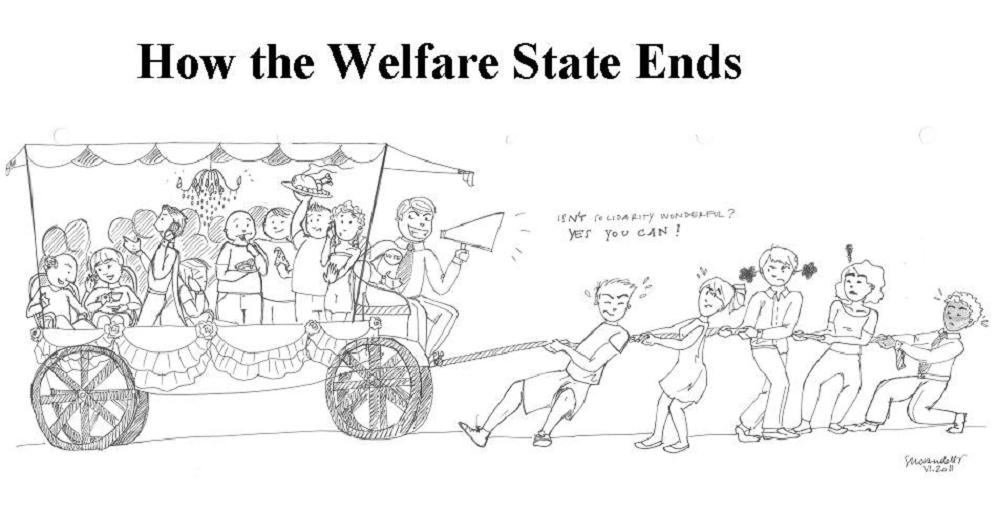
I thought it was great when the Republican Congress and Bill Clinton put in welfare reform but now that has been done away with and no one has to work anymore it seems. In fact, over 40% of the USA is now on the government dole. What is going to happen when that figure gets over 50%? Maybe this cartoon below will be true.  

The all-time, most-viewed post on this blog is this set of cartoons showing how the welfare state begins and how it eventually becomes an unsustainable mess.

The great Chuck Asay has a cartoon that takes the next step, showing what happens when the looters and moochers who ride in the wagon get pitted against those who are pulling the wagon.

Since I’m not a Romney fan (for a bunch of reasons outlined here), I would have preferred if the cartoon didn’t imply anything about the current election and instead focused on the rhetorical question of what happens to a society when those living off the government outnumber those who get stuck picking up the tab.

It also would have been more accurate to have the two slave drivers somehow identified as “politicians” and the “IRS.”

But it’s a very clever cartoon, so it’s worth sharing even if I’m nitpicking.

You can see my favorite Asay cartoons here, here, herehere, here, here, here, here, here, here, herehereherehere, and here.

____________________

Thank you so much for your time. I know how valuable it is. I also appreciate the fine family that you have and your commitment as a father and a husband.

Sincerely,

Everette Hatcher III, 13900 Cottontail Lane, Alexander, AR 72002, ph 501-920-5733, lowcostsqueegees@yahoo.com

Milton Friedman

Related posts:

Open letter to President Obama (Part 120)

President Obama c/o The White House 1600 Pennsylvania Avenue NW Washington, DC 20500 Dear Mr. President, I know that you receive 20,000 letters a day and that you actually read 10 of them every day. I really do respect you for trying to get a pulse on what is going on out here.  Dan Mitchell […]

“Feedback Friday” Letter to White House generated form letter response July 10,2012 on welfare, etc (part 14)

I have been writing President Obama letters and have not received a personal response yet.  (He reads 10 letters a day personally and responds to each of them.) However, I did receive a form letter in the form of an email on July 10, 2012. I don’t know which letter of mine generated this response so I have […]

Welfare reform part 1

Welfare reform was working so good. Why did we have to abandon it? Look at this article from 2003. The Continuing Good News About Welfare Reform By Robert Rector and Patrick Fagan, Ph.D. February 6, 2003 Six years ago, President Bill Clinton signed legislation overhauling part of the nation’s welfare system. The Personal Responsibility and […]

Open letter to President Obama (Part 119B)

Ep. 4 – From Cradle to Grave [3/7]. Milton Friedman’s Free to Choose (1980) President Obama c/o The White House 1600 Pennsylvania Avenue NW Washington, DC 20500 Dear Mr. President, I know that you receive 20,000 letters a day and that you actually read 10 of them every day. I really do respect you for […]

Open letter to President Obama (Part 118B)

President Obama c/o The White House 1600 Pennsylvania Avenue NW Washington, DC 20500 Dear Mr. President, I know that you receive 20,000 letters a day and that you actually read 10 of them every day. I really do respect you for trying to get a pulse on what is going on out here. With the […]

40% of USA on government dole, need to eliminate welfare and put in Friedman’s negative income tax

Eight Reasons Why Big Government Hurts Economic Growth We got to cut these welfare programs before everyone stops working and wants to get the free stuff. The Bible says if you don’t work then you should not eat. It also says that churches should help the poor but it doesn’t say that the government should […]


Listing of transcripts and videos of Free to Choose by Milton Friedman: Episode “What is wrong with our schools?” on www.theDailyHatch.org

Everywhere school vouchers have been tried they have been met with great success. Why do you think President Obama got rid of them in Washington D.C.? It was a political disaster for him because the school unions had always opposed them and their success made Obama’s allies look bad.

In 1980 when I first sat down and read the book “Free to Choose” I was involved in Ronald Reagan’s campaign for president and excited about the race. Milton Friedman’s books and film series really helped form my conservative views. Take a look at one of my favorite films of his and this one deals with school vouchers:

Here is the video clip and transcript of the film series FREE TO CHOOSE episode “What is wrong with our schools?” Part 1 of 6.

 
Volume 6 – What’s Wrong with our Schools
Transcript:
Friedman: These youngsters are beginning another day at one of America’s public schools, Hyde Park High School in Boston. What happens when they pass through those doors is a vivid illustration of some of the problems facing America’s schools.
They have to pass through metal detectors. They are faced by security guards looking for hidden weapons. They are watched over by armed police. Isn’t that awful. What a way for kids to have to go to school, through metal detectors and to be searched. What can they conceivably learn under such circumstances. Nobody is happy with this kind of education. The taxpayers surely aren’t. This isn’t cheap education. After all, those uniformed policemen, those metal detectors have to be paid for.
What about the broken windows, the torn school books, and the smashed school equipment. The teachers who teach here don’t like this kind of situation. The students don’t like to come here to go to school, and most of all, the parents __ they are the ones who get the worst deal __ they pay taxes like the rest of us and they are just as concerned about the kind of education that their kids get as the rest of us are. They know their kids are getting a bad education but they feel trapped. Many of them can see no alternative but to continue sending their kids to schools like this.
To go back to the beginning, it all started with the fine idea that every child should have a chance to learn his three R’s. Sometimes in June when it gets hot, the kids come out in the yard to do their lessons, all 15 of them, ages 5 to 13, along with their teacher. This is the last one-room schoolhouse still operating in the state of Vermont. That is the way it used to be. Parental control, parents choosing the teacher, parents monitoring the schooling, parents even getting together and chipping in to paint the schoolhouse as they did here just a few weeks ago. Parental concern is still here as much in the slums of the big cities as in Bucolic, Vermont. But control by parents over the schooling of their children is today the exception, not the rule.
Increasingly, schools have come under the control of centralized administration, professional educators deciding what shall be taught, who shall do the teaching, and even what children shall go to what school. The people who lose most from this system are the poor and the disadvantaged in the large cities. They are simply stuck. They have no alternative.
Of course, if you are well off you do have a choice. You can send your child to a private school or you can move to an area where the public schools are excellent, as the parents of many of these students have done. These students are graduating from Weston High School in one of Boston’s wealthier suburbs. Their parents pay taxes instead of tuition and they certainly get better value for their money than do the parents in Hyde Park. That is partly because they have kept a good deal of control over the local schools, and in the process, they have managed to retain many of the virtues of the one-room schoolhouse.
Students here, like Barbara King, get the equivalent of a private education. They have excellent recreational facilities. They have a teaching staff that is dedicated and responsive to parents and students. There is an atmosphere which encourages learning, yet the cost per pupil here is no higher than in many of our inner city schools. The difference is that at Weston, it all goes for education that the parents still retain a good deal of control.
Unfortunately, most parents have lost control over how their tax money in spent. Avabelle goes to Hyde Park High. Her parents too want her to have a good education, but many of the students here are not interested in schooling, and the teachers, however dedicated, soon lose heart in an atmosphere like this. Avabelle’s parents are certainly not getting value for their tax money.
Caroline Bell, Parent: I think it is a shame, really, that parents are being ripped off like we are. I am talking about parents like me that work every day, scuffle to try to make ends meet. We send our kids to school hoping that they will receive something that will benefit them in the future for when they go out here and compete in the job market. Unfortunately, none of that is taking place at Hyde Park.
Friedman: Children like Ava are being shortchanged by a system that was designed to help. But there are ways to help give parents more say over their children’s schooling.
This is a fundraising evening for a school supported by a voluntary organization, New York’s Inner City Scholarship Fund. The prints that have brought people here have been loaned by wealthy Japanese industrialist. Events like this have helped raise two million dollars to finance Catholic parochial schools in New York. The people here are part of a long American tradition. The results of their private voluntary activities have been remarkable.
This is one of the poorest neighborhoods in New York City: the Bronx. Yet this parochial school, supported by the fund, is a joy to visit. The youngsters here from poor families are at Saint John Christians because their parents have picked this school and their parents are paying some of the costs from their own pockets. The children are well behaved, eager to learn, the teachers are dedicated. The cost per pupil here is far less than in the public schools, yet on the average the children are two grades ahead. That is because teachers and parents are free to choose how the children shall be taught. Private money has replaced the tax money and so control has been taken away from the bureaucrats and put back where it belongs.
This doesn’t work just for younger children. In the 60’s, Harlem was devastated by riots. It was a hot bed of trouble. Many teenagers dropped out of school.
_____
 
 
Milton Friedman congratulated by President Ronald Reagan. © 2008 Free To Choose Media, courtesy of the Power of Choice press kit

Here are some great jobs about Milton Friedman:

“Milton Friedman is a scholar of first rank whose original contributions to economic science have made him one of the greatest thinkers in modern history.”
President Ronald Reagan

“How grateful I have been over the years for the cogency of Friedman’s ideas which have influenced me. Cherishers of freedom will be indebted to him for generations to come.”
Alan Greenspan, former Chairman, Federal Reserve System

“Right at this moment there are people all over the land, I could put dots on the map, who are trying to prove Milton wrong. At some point, somebody else is trying to prove he’s right That’s what I call influence.”
Paul Samuelson, Nobel Laureate in Economic Science

“Friedman’s influence reaches far beyond the academic community and the world of economics. Rather than lock himself in an ivory tower, he has joined the fray to fight for the survival of this great country of ours.”
William E. Simon, former Secretary of the Treasury

“Milton Friedman is the most original social thinker of the era.”
John Kenneth Galbraith, former Professor of Economics, Harvard University

Other segments: 

Friedman Friday” Free to Choose by Milton Friedman: Episode “What is wrong with our schools?” (Part 6 of transcript and video)

Here is the video clip and transcript of the film series FREE TO CHOOSE episode “What is wrong with our schools?” Part 6 of 6.   Volume 6 – What’s Wrong with our Schools Transcript: FRIEDMAN: But I personally think it’s a good thing. But I don’t see that any reason whatsoever why I shouldn’t have been required […]

Friedman Friday” Free to Choose by Milton Friedman: Episode “What is wrong with our schools?” (Part 5 of transcript and video)

Here is the video clip and transcript of the film series FREE TO CHOOSE episode “What is wrong with our schools?” Part 5 of 6.   Volume 6 – What’s Wrong with our Schools Transcript: Are your voucher schools  going to accept these tough children? COONS: You bet they are. (Several talking at once.) COONS: May I answer […]


Friedman Friday” Free to Choose by Milton Friedman: Episode “What is wrong with our schools?” (Part 3 of transcript and video)

Friedman Friday” Free to Choose by Milton Friedman: Episode “What is wrong with our schools?” (Part 3 of transcript and video) Here is the video clip and transcript of the film series FREE TO CHOOSE episode “What is wrong with our schools?” Part 3 of 6.   Volume 6 – What’s Wrong with our Schools Transcript: If it […]

Friedman Friday” Free to Choose by Milton Friedman: Episode “What is wrong with our schools?” (Part 2 of transcript and video)

Here is the video clip and transcript of the film series FREE TO CHOOSE episode “What is wrong with our schools?” Part 2 of 6.   Volume 6 – What’s Wrong with our Schools Transcript: Groups of concerned parents and teachers decided to do something about it. They used private funds to take over empty stores and they […]

Friedman Friday” Free to Choose by Milton Friedman: Episode “What is wrong with our schools?” (Part 1 of transcript and video)

Here is the video clip and transcript of the film series FREE TO CHOOSE episode “What is wrong with our schools?” Part 1 of 6.   Volume 6 – What’s Wrong with our Schools Transcript: Friedman: These youngsters are beginning another day at one of America’s public schools, Hyde Park High School in Boston. What happens when […]

“Friedman Friday” EPISODE “The Power of the Market” of Free to Choose in 1990 by Milton Friedman (Part 1)

Milton Friedman

Milton Friedman The Power of the Market 1-5

How can we have personal freedom without economic freedom? That is why I don’t understand why socialists who value individual freedoms want to take away our economic freedoms.  I wanted to share this info below with you from Milton Friedman who has influenced me greatly over the last 30 plus years. Here is part one.
Volume 1 The Power of the Market
Abstract:
Finding examples in his visits to Hong Kong, the U.S. and Scotland, Dr. Friedman says that free markets are the fundamental engines of economic progress. In free markets, individuals can go into any business they want, trade with whomever they want, buy as cheap as they can, and sell at the highest price they can get. In truly free markets, governments do not interfere with any of these privileges. Individuals are free to enter the marketplace to do business, and they, and they alone, enjoy the fruits of their successes and the consequences of their failures. In free markets, producers of goods and services respond to signals they receive from buyers in the marketplace. They key production to their understanding of what people are buying and, apparently, wish to continue to buy. Using this information, they decide what to produce and in what quantity. Competitive forces in free markets promote efficiency. Because there is free entry of new producers into the market, individual producers must keep costs down in order to price their products at competitive levels. This means the resources they consume tend to be used efficiently. If they are not, costs of production rise, selling prices go up, and the producer may not be able to sell his product because it is not priced competitively. Free markets promote voluntary cooperation among a great diversity of people. As Milton Friedman points out, even making something as simple as a pencil requires the cooperation of thousands of people largely unknown to one another. Because the pencil manufacturer needs paint, graphite, wood, glue, and other components, widely separated groups of individuals have an incentive to produce these items and ship them to the pencil plant. This cooperation is not accomplished by any government. Individual freedom and economic freedom are tightly linked. It is difficult to conceive of personal freedom existing in isolation from economic freedom. Thus, the free market system not only promotes economic progress, but also buttresses our cherished individual freedoms.
___________

Hi, I am Arnold Schwarzenegger. I would like a moment of your time because I wanted you to know something. I wanted you to know about Dr. Milton Friedman’s TV series, Free to Choose. I truly believe that the series has changed my life. When you have such a powerful experience as that, I think you shouldn’t keep it to yourself, I wanted to share it with you.

Being free to choose for me means being free to make your own decisions; free to live your own life; pursue your own goals; chase your own rainbow; without the government breathing down on your neck or standing on your shoes. For me that meant coming here to America. Because I came from a socialistic country in which the government controls the economy. It is a place where you can hear 18 year old kids already talking about their pension. But me __ I wanted more. I wanted to be the best __ individualism like that is incompatible with socialism. So I felt I had to come to America. I had no money in my pocket, but here I had the freedom to get it. I have been able to parlay my big muscles into big business and a big movie career. Along the way I was able to save and invest and I watched America change and I noticed this __ that the more the government interfered and intervened and inserted itself into the free market, the worse the country did. But when the government stepped back and let the free enterprise system do its work, then the better we did, the more robust our economy grew, the better I did, and the better my business grew, and the more I was able to hire and help others.

Okay. So there I was in Palm Springs, waiting for Maria to get ready so we could go out for a game of mixed doubles. I started flipping through the television dial and I caught a glimpse of Nobel Prize winner, Economist Dr. Milton Friedman. I recognized him from the studying of my own degree of economics in business, but I didn’t know I was watching Free to Choose __ it knocked me out. Dr. Friedman expressed, validated and explained everything I ever thought or experienced or observed about the way the economy works. I guess I was really ready to hear it. He said, the economic race should not be arranged so that everyone ends at the finish line at the same time, but so that everyone starts at the starting line at the same time. Wow! I would like to write that one home to Austria. He said, that society that puts equality before freedom winds up with neither, but that society puts freedom before equality, we will end up with a great measure of both. Boy, if I would have come up with that one myself, I maybe wouldn’t have had to get into body building.

When I did beef up my body building, at business school, of course it started with what Thomas Jefferson believed and what Adam Smith thought, even what Milton Friedman had to say __ I would be free to choose __ it all came together. Their economic thought with my own personal experience, and in a way I felt that I had come home. I sought out Dr. Friedman and had great pleasure and privilege of meeting him and his economist wife, Rose, and we have all become friends, and now I call him Milton. Then I became a big pain in the neck about Free to Choose.

All my friends and acquaintances got the tapes and the books for Christmas after Christmas, all the way through the Reagan years when I was able to tell them all __ you see, Milton is right. And I think it’s crucial that we all keep moving in the same direction, away from socialism and to its greater freedom and opportunity. That is why I am so excited that Milton Friedman is updating Free to Choose, bringing it into the 90’s by discussing how to deal with the drug disaster, the chabain phenomenon, and of course, the miserable failure of communism. By the way, there are plans now to translate Free to Choose into the languages of the Soviet Union and Eastern Europe. And you know, they really need it to guide them through it __ to take the first walk toward freedom. But we need it too.

I commend to you the new television series Free to Choose and encourage you to walk into the 21st century in freedom, in opportunity and in success, with Dr. Milton Friedman.

Thanks for listening.

 
Friedman: Once all of this was a swamp, covered with forest. The Canarce Indians who lived here traded the 22 square miles of soggy Manhattan Island to the Dutch for $24.00 worth of cloth and trinkets. The newcomers founded a city, New Amsterdam at the edge of an empty continent. In the years that followed, it proved a magnet for millions of people from across the Atlantic; people who were driven by fear and poverty; who were attracted by the promise of freedom and plenty. They fanned out over the continent and built a new nation with their sweat, their enterprise and their vision of a better future.For the first time in their lives, many were truly free to pursue their own objectives. That freedom released the human energies which created the United States. For the immigrants who were welcomed by this statue, America was truly a land of opportunity.They poured ashore in their best clothes, eager and expectant, carrying what little they owned. They were poor, but they all had a great deal of hope. Once they arrived, they found, as my parents did, not an easy life, but a very hard life. But for many there were friends and relatives to help them get started __ to help them make a home, get a job, settle down in the new country. There were many rewards for hard work, enterprise and ability. Life was hard, but opportunity was real. There were few government programs to turn to and nobody expected them. But also, there were few rules and regulations. There were no licenses, no permits, no red tape to restrict them. They found in fact, a free market, and most of them thrived on it.Many people still come to the United States driven by the same pressures and attracted by the same promise. You can find them in places like this. It’s China Town in New York, one of the centers of the garment industry __ a place where hundreds of thousands of newcomers have had their first taste of life in the new country. The people who live and work here are like the early settlers. They want to better their lot and they are prepared to work hard to do so.Although I haven’t often been in factories like this, it’s all very familiar to me because this is exactly the same kind of a factory that my mother worked in when she came to this country for the first time at the age of 14, almost 90 years ago. And if there had not been factories like this here then at which she could have started to work and earn a little money, she wouldn’t have been able to come. And if I existed at all, I’d be a Russian or Hungarian today, instead of an American.