Category Archives: Milton Friedman

Listing of transcripts and videos of Free to Choose by Milton Friedman: Episode “What is wrong with our schools?” on www.theDailyHatch.org

Everywhere school vouchers have been tried they have been met with great success. Why do you think President Obama got rid of them in Washington D.C.? It was a political disaster for him because the school unions had always opposed them and their success made Obama’s allies look bad.

In 1980 when I first sat down and read the book “Free to Choose” I was involved in Ronald Reagan’s campaign for president and excited about the race. Milton Friedman’s books and film series really helped form my conservative views. Take a look at one of my favorite films of his and this one deals with school vouchers:

Here is the video clip and transcript of the film series FREE TO CHOOSE episode “What is wrong with our schools?” Part 1 of 6.

 
Volume 6 – What’s Wrong with our Schools
Transcript:
Friedman: These youngsters are beginning another day at one of America’s public schools, Hyde Park High School in Boston. What happens when they pass through those doors is a vivid illustration of some of the problems facing America’s schools.
They have to pass through metal detectors. They are faced by security guards looking for hidden weapons. They are watched over by armed police. Isn’t that awful. What a way for kids to have to go to school, through metal detectors and to be searched. What can they conceivably learn under such circumstances. Nobody is happy with this kind of education. The taxpayers surely aren’t. This isn’t cheap education. After all, those uniformed policemen, those metal detectors have to be paid for.
What about the broken windows, the torn school books, and the smashed school equipment. The teachers who teach here don’t like this kind of situation. The students don’t like to come here to go to school, and most of all, the parents __ they are the ones who get the worst deal __ they pay taxes like the rest of us and they are just as concerned about the kind of education that their kids get as the rest of us are. They know their kids are getting a bad education but they feel trapped. Many of them can see no alternative but to continue sending their kids to schools like this.
To go back to the beginning, it all started with the fine idea that every child should have a chance to learn his three R’s. Sometimes in June when it gets hot, the kids come out in the yard to do their lessons, all 15 of them, ages 5 to 13, along with their teacher. This is the last one-room schoolhouse still operating in the state of Vermont. That is the way it used to be. Parental control, parents choosing the teacher, parents monitoring the schooling, parents even getting together and chipping in to paint the schoolhouse as they did here just a few weeks ago. Parental concern is still here as much in the slums of the big cities as in Bucolic, Vermont. But control by parents over the schooling of their children is today the exception, not the rule.
Increasingly, schools have come under the control of centralized administration, professional educators deciding what shall be taught, who shall do the teaching, and even what children shall go to what school. The people who lose most from this system are the poor and the disadvantaged in the large cities. They are simply stuck. They have no alternative.
Of course, if you are well off you do have a choice. You can send your child to a private school or you can move to an area where the public schools are excellent, as the parents of many of these students have done. These students are graduating from Weston High School in one of Boston’s wealthier suburbs. Their parents pay taxes instead of tuition and they certainly get better value for their money than do the parents in Hyde Park. That is partly because they have kept a good deal of control over the local schools, and in the process, they have managed to retain many of the virtues of the one-room schoolhouse.
Students here, like Barbara King, get the equivalent of a private education. They have excellent recreational facilities. They have a teaching staff that is dedicated and responsive to parents and students. There is an atmosphere which encourages learning, yet the cost per pupil here is no higher than in many of our inner city schools. The difference is that at Weston, it all goes for education that the parents still retain a good deal of control.
Unfortunately, most parents have lost control over how their tax money in spent. Avabelle goes to Hyde Park High. Her parents too want her to have a good education, but many of the students here are not interested in schooling, and the teachers, however dedicated, soon lose heart in an atmosphere like this. Avabelle’s parents are certainly not getting value for their tax money.
Caroline Bell, Parent: I think it is a shame, really, that parents are being ripped off like we are. I am talking about parents like me that work every day, scuffle to try to make ends meet. We send our kids to school hoping that they will receive something that will benefit them in the future for when they go out here and compete in the job market. Unfortunately, none of that is taking place at Hyde Park.
Friedman: Children like Ava are being shortchanged by a system that was designed to help. But there are ways to help give parents more say over their children’s schooling.
This is a fundraising evening for a school supported by a voluntary organization, New York’s Inner City Scholarship Fund. The prints that have brought people here have been loaned by wealthy Japanese industrialist. Events like this have helped raise two million dollars to finance Catholic parochial schools in New York. The people here are part of a long American tradition. The results of their private voluntary activities have been remarkable.
This is one of the poorest neighborhoods in New York City: the Bronx. Yet this parochial school, supported by the fund, is a joy to visit. The youngsters here from poor families are at Saint John Christians because their parents have picked this school and their parents are paying some of the costs from their own pockets. The children are well behaved, eager to learn, the teachers are dedicated. The cost per pupil here is far less than in the public schools, yet on the average the children are two grades ahead. That is because teachers and parents are free to choose how the children shall be taught. Private money has replaced the tax money and so control has been taken away from the bureaucrats and put back where it belongs.
This doesn’t work just for younger children. In the 60’s, Harlem was devastated by riots. It was a hot bed of trouble. Many teenagers dropped out of school.
_____
 
 
Milton Friedman congratulated by President Ronald Reagan. © 2008 Free To Choose Media, courtesy of the Power of Choice press kit

Here are some great jobs about Milton Friedman:

“Milton Friedman is a scholar of first rank whose original contributions to economic science have made him one of the greatest thinkers in modern history.”
President Ronald Reagan

“How grateful I have been over the years for the cogency of Friedman’s ideas which have influenced me. Cherishers of freedom will be indebted to him for generations to come.”
Alan Greenspan, former Chairman, Federal Reserve System

“Right at this moment there are people all over the land, I could put dots on the map, who are trying to prove Milton wrong. At some point, somebody else is trying to prove he’s right That’s what I call influence.”
Paul Samuelson, Nobel Laureate in Economic Science

“Friedman’s influence reaches far beyond the academic community and the world of economics. Rather than lock himself in an ivory tower, he has joined the fray to fight for the survival of this great country of ours.”
William E. Simon, former Secretary of the Treasury

“Milton Friedman is the most original social thinker of the era.”
John Kenneth Galbraith, former Professor of Economics, Harvard University

Other segments: 

Friedman Friday” Free to Choose by Milton Friedman: Episode “What is wrong with our schools?” (Part 6 of transcript and video)

Here is the video clip and transcript of the film series FREE TO CHOOSE episode “What is wrong with our schools?” Part 6 of 6.   Volume 6 – What’s Wrong with our Schools Transcript: FRIEDMAN: But I personally think it’s a good thing. But I don’t see that any reason whatsoever why I shouldn’t have been required […]

Friedman Friday” Free to Choose by Milton Friedman: Episode “What is wrong with our schools?” (Part 5 of transcript and video)

Here is the video clip and transcript of the film series FREE TO CHOOSE episode “What is wrong with our schools?” Part 5 of 6.   Volume 6 – What’s Wrong with our Schools Transcript: Are your voucher schools  going to accept these tough children? COONS: You bet they are. (Several talking at once.) COONS: May I answer […]


Friedman Friday” Free to Choose by Milton Friedman: Episode “What is wrong with our schools?” (Part 3 of transcript and video)

Friedman Friday” Free to Choose by Milton Friedman: Episode “What is wrong with our schools?” (Part 3 of transcript and video) Here is the video clip and transcript of the film series FREE TO CHOOSE episode “What is wrong with our schools?” Part 3 of 6.   Volume 6 – What’s Wrong with our Schools Transcript: If it […]

Friedman Friday” Free to Choose by Milton Friedman: Episode “What is wrong with our schools?” (Part 2 of transcript and video)

Here is the video clip and transcript of the film series FREE TO CHOOSE episode “What is wrong with our schools?” Part 2 of 6.   Volume 6 – What’s Wrong with our Schools Transcript: Groups of concerned parents and teachers decided to do something about it. They used private funds to take over empty stores and they […]

Friedman Friday” Free to Choose by Milton Friedman: Episode “What is wrong with our schools?” (Part 1 of transcript and video)

Here is the video clip and transcript of the film series FREE TO CHOOSE episode “What is wrong with our schools?” Part 1 of 6.   Volume 6 – What’s Wrong with our Schools Transcript: Friedman: These youngsters are beginning another day at one of America’s public schools, Hyde Park High School in Boston. What happens when […]

“Friedman Friday” EPISODE “The Power of the Market” of Free to Choose in 1990 by Milton Friedman (Part 4)

Milton Friedman The Power of the Market 4-5

How can we have personal freedom without economic freedom? That is why I don’t understand why socialists who value individual freedoms want to take away our economic freedoms.  I wanted to share this info below with you from Milton Friedman who has influenced me greatly over the last 30 plus years. Here is part four which consists of a lively discussion between Friedman and several other interested scholars concerning his film.
To take an example that at first sight seems about as far away as you can get __ the language we speak; the words we use; the complex structure of our grammar; no government bureau designed that. It arose out of the voluntary interactions of people seeking to communicate with one another. Or consider some of the great scientific achievements of our time __ the discoveries of an Einstein or Newton __ the inventions of Thomas Alva Edison or an Alexander Graham Bell or even consider the great charitable activities of a Florence Nightingale or an Andrew Carnegie. These weren’t done under orders from a government office. They were done by individuals deeply interested in what they were doing, pursing their own interests, and cooperating with one another.This kind of voluntary cooperation is built so deeply into the structure of our society that we tend to take it for granted. Yet the whole of our Western civilization is the unintended consequence of that kind of a voluntary cooperation of people cooperating with one another to pursue their own interests, yet in the process, building a great society.DISCUSSIONI’m Linda Chavez. Welcome to Free to Choose. Joining Dr. Friedman in a discussion of the power of the market are David Brooks of the Wall Street Journal, and James Galbraith of the University of Texas at Austin. Dr. Galbraith, should we follow the example of Hong Kong and simply allow an unregulated free market?

Galbraith: I think we do better in this country whereas the combination of a free market and its advantages, and a well regulated, carefully thought out structure of government, which provides a chance to pick up some of the losers from the market process and give them a second start. It provides us with a chance to make the economic process a little safer, a little healthier, a little more environmentally sound and protective, than you might get from a strict adherence to the free market such as Professor Friedman has described in the case of Hong Kong.

Chavez: Dr. Friedman, is there any such thing as a well-regulated market?

Friedman: No. He is begging the question. Obviously he is right. If you could have a well-regulated, carefully thought out, properly done market, benevolent dictatorship is the best of all forms of government.

Galbraith: Oh, I don’t agree with that at all.

Friedman: Neither do I.

Galbraith: Constitutional democracy is the best of all forms of government.

Friedman: No. Constitutional democracy is the least bad of all forms of government. But you beg all the questions when you talk about well-regulated, carefully thought out __ if you look at the actual programs that governments follow, they most always have effects that are the opposite of those that were intended by their well-meaning advocates.

Galbraith: Let me tell you what troubles me.

Friedman: I will tell you something. Matching the invisible hand of the market is the invisible foot of government.

Galbraith: You make the point in the program that in every case where you have a smaller role of government and a freer market, you have a higher standard of living.

Friedman: No. I didn’t say that. I didn’t say that. I said there are better conditions for the poorer people.

Galbraith: Okay. Better conditions for the poorer people. Fine, I will accept that. At the same time you are making the argument in the program that the conditions in Hong Kong are better, for example, than in the United States, which is manifestly not true. You are making the argument that Hong Kong is more free than we are.

Friedman: It is more free.

Galbraith: Does it then follow that the conditions for poor people in Hong Kong are better than they are in the United States? That I don’t believe is true.

Friedman: I said in there where you compare like with like.

Galbraith: Okay this is an important qualification.

Friedman: Hong Kong obviously started out from a much lower position. If I were to compare conditions in Hong Kong in 1945 or 1950 with conditions in the United States in 1820 or 1830, you would have a much closer comparison.

Galbraith: Are you then saying, a position which I would find much more congenial, that where you have a country which has developed a base of material wealth, a degree of comfort for the average citizen, that it is then legitimate for the government of that country to step in and provide some guarantees and some security for poor people and old people.

Friedman: No. I am not saying that at all. Every time they step in and try to do that, they end up doing the opposite.

Galbraith: This discussion reflects a feature of the program that I found to be most troubling which is the failure to make a distinction between governments of the kind that we have developed in this country over 200 years, and governments of the kind that you described in the People’s Republic of China. It’s perfectly clear that one can have, and many countries do have, the curse of repressive dictatorships. It is also perfectly clear that an economy that is organized by Commissars is going to fail. We have certainly seen laid out before us over the last several years, the ashes of those failed economies. But is it possible to take the example of the Soviet Union, Poland, Hungary, and to say that because their governments, which were after all dictatorships modeled after the system of government installed in the Soviet Union by Stalin, are in fact parallel to the actions of our government which is a government which operates on many different federal levels, and where fundamentally what you have is the ability of the ordinary citizen whose power is not weighted by the amount of money he or she has, to use the vote in order to make some collective decisions. Granted, after ten years of Reagan’s Washington, you’ve got a serious problem of corruption. Does that mean we should abandon the idea that you have a democratic process that should be entrusted with certain important decisions __ I don’t think so.

Friedman: You don’t have a democratic process in the sense in which you mean it. We have a democracy. We have a majority rule, but the majority that rules is a collection of minorities. It is a collection of special interests. You cannot tell me that the consumers in this country would vote for a sugar quota that makes the price of sugar three times the world price. When you say you can’t compare it to Russia, you are quite right, but only because they are 100% and we are 50%. If our system, if our present regulations and rules had prevailed, our scope of government had prevailed 100 years ago, we wouldn’t be where we are today.

Chavez: Let me understand you Dr. Friedman. Do you believe that there should be no role at all, whatsoever, for government?

Friedman: Of course there should be a role for government __ a very important role for government.

Chavez: What is that role?

Friedman: The role for government is first of all, to protect people from physical coercion by their neighbors or by foreign countries, that is to protect the national defense and to protect law and order at home. There is a role for government enabling us to have a mechanism whereby we decide on the rules which we want to run, how we define private property, what we mean by private property. There is a role for government in adjudicating disputes between us. There is a role for government. A very important role and I believe our government played that role quite well for about 100 years until the Great Depression.

Brooks: I would go a little further. I think there is a health and safety role as well. The problem is that you have to keep your regulations simple and minimal. You have to realize that there are costs and often the costs outweigh the benefits. In fact, in Washington there are interests who want to divert costs to themselves, so there is sort of a built in structure, a dynamic to make costs outweigh the benefits.

Galbraith: We are making progress here. I would add that the government has a role to protect the environment. I would say the government has a role to set standards for products, where information is very costly for the individual consumer to obtain. I like very much the fact that the steaks that the dentist was eating were inspected by the USDA. Their purity was guaranteed by a rather well-functioning aspect of our government.

Brooks: On the other hand, you have the FDA which has these long delays, 10 years to get a drug approved so that the effect is that you have to be a big drug company to get any kind of dent of the market. Basically you are closing off the market.

Galbraith: On the other hand, you have had a set of regulations which have disappeared without any well-justified regrets. For example, the regulations that govern the entry into interstate trucking; the regulations that govern entry and rates in the airlines.

Friedman: Don’t tell me that that was done under the Reagan administration.

Galbraith: Oh no. Those reforms were done under the Carter administration.

Brooks: There is no doubt that Carter did the heavy lifting on deregulation.

Milton Friedman warned the computer industry!!!

Milton Friedman was a man of common sense and great foresight. What he said in 1999 has come to pass and the Cato Institute article on 1-28-13 pointed that out.  

  • Updated January 28, 2013, 1:05 a.m. ET

Silicon Valley’s ‘Suicide Impulse’

The industry’s affection for Washington keeps growing. Facebook had 38 lobbyists working in 2012.

It’s a measure of how far Silicon Valley has strayed from its entrepreneurial roots that a top regulator is calling on technology companies to do less lobbying and more competing.In a letter to the editor responding to a report in this column on how Google GOOG -0.39%spent $25 million lobbying to stop an antitrust case against it, Federal Trade Commission Chairman Jon Leibowitz wrote that companies should not draw the lesson that lobbying pays. Instead, he urged: “Stop! Invest your money in expansion and innovation.” Mr. Leibowitz asserted in his letter, published Jan. 18, that “Google’s lobbying expenses had no effect on the care, diligence or analysis of the agency’s incredibly hard-working staff or the decisions reached by any of the FTC’s five commissioners.”Whatever the effect of Google’s big-ticket lobbying, regulators deserve much of the blame for companies calculating that lobbying is a good investment. Still, Mr. Leibowitz has a point: Tech executives should think twice before again lobbying government to get involved in their industry.The precedent for the potential antitrust case against Google was the massive prosecution in the 1990s of Microsoft, MSFT +0.14%the giant of the desktop era. Competitors such as Netscape, Oracle ORCL +0.45%and Sun Microsystems lobbied hard to get regulators to bring the case that did end up paralyzing Microsoft.

Getty ImagesMilton Friedman, a model of prescience regarding tech-industry lobbying.

In 1999, economist Milton Friedman issued a warning to technology executives at a Cato Institute conference: “Is it really in the self-interest of Silicon Valley to set the government on Microsoft? Your industry, the computer industry, moves so much more rapidly than the legal process that by the time this suit is over, who knows what the shape of the industry will be? Never mind the fact that the human energy and the money that will be spent in hiring my fellow economists, as well as in other ways, would be much more productively employed in improving your products. It’s a waste!”

He predicted: “You will rue the day when you called in the government. From now on, the computer industry, which has been very fortunate in that it has been relatively free of government intrusion, will experience a continuous increase in government regulation. Antitrust very quickly becomes regulation. Here again is a case that seems to me to illustrate the suicide impulse of the business community.”

Friedman was right. The Internet undermined Microsoft’s market power years before the litigation ended. Alas, his warning fell on deaf ears—and ironically, it was Microsoft that led the recent lobbying to investigate Google’s dominance of the search industry. Microsoft funded lobbyists under names such as FairSearch.org.

The FTC hired outside lawyers to prepare a case, but after a lengthy investigation concluded what was obvious from the start: There was no case against Google’s practice of delivering answers as well as just links in its search results. It may harm Google’s competitors, but it benefits consumers, whom the antitrust laws are supposed to protect.

Silicon Valley has long prided itself on avoiding the lumbering relationship between big government and most industries, but somehow it has become one of the top lobbyists in Washington. The Center for Responsive Politics reported last year: “Tech firms have doled out more and more lobbying money even as the amount spent on lobbying by all industries has decreased since 2010.”

Google has a former congresswoman, Susan Molinari, running its Washington office. Facebook FB +2.92%employed 38 lobbyists last year, up from 23 in 2011. Over the past few years, Microsoft, Apple, Google and Intel have all hired former top FTC staffers, spinning the revolving door that fuels the growth of lobbying.

The growth in tech lobbying reflects the eagerness of the Obama administration and its regulators to get involved in the industry. FTC and Justice Department investigations into antitrust cases are just part of the problem. The FTC has also involved itself in the core business operations of the Internet.

During the past few years, the FTC has extracted consent decrees from Google, Facebook and Twitter on how they generate advertising revenues by using information about their visitors. These decrees include vague standards such as that the companies must have “privacy controls and procedures appropriate to respondent’s size and complexity, the nature and scope of respondent’s activities, and the sensitivity of the covered information.”

Under this broad privacy umbrella, the FTC thus oversees the key revenue stream for several of the largest companies on the Internet. These consent decrees apply for 20 years, an absurd length of time in the fast-changing technology industry. Internet companies staffed up their Washington offices in part to fend off regulations that would undermine the ad-supported services they provide to consumers.

Rather than lobby government to go after one another, Silicon Valley lobbyists should unite to go after overreaching government. Instead of the “suicide impulse” of lobbying for more regulation, Silicon Valley should seek deregulation and a long-overdue freedom to return to its entrepreneurial roots.

A version of this article appeared January 28, 2013, on page A13 in the U.S. edition of The Wall Street Journal, with the headline: Silicon Valley’s ‘Suicide Impulse’.

Listing of transcripts and videos of “Free to Choose” episode 4 – From Cradle to Grave on www.theDailyHatch.org

In the last few years the number of people receiving Food Stamps has skyrocketed. President Obama has not cut any federal welfare programs but has increased them, and he  has used class warfare over and over the last few months and according to him equality at the finish line is the equality that we should all be talking about. However, socialism has never worked and it has always killed incentive to produce more. Milton Friedman shows in this film series below how so many people get caught in the “Welfare Trap.” Friedman also gives a great solution to this problem in the “negative income tax.” I am glad that I had the chance to be studying his work for over 30 years now.

In 1980 when I first sat down and read the book “Free to Choose” I was involved in Ronald Reagan’s campaign for president and excited about the race. Milton Friedman’s books and film series really helped form my conservative views. Take a look at one of my favorite films of his:

Friedman Friday:(“Free to Choose” episode 4 – From Cradle to Grave, Part 1 of 7)

Volume 4 – From Cradle to Grave
Abstract:

Since the Depression years of the 1930s, there has been almost continuous expansion of governmental efforts to provide for people’s welfare. First, there was a tremendous expansion of public works. The Social Security Act followed close behind. Soon other efforts extended governmental activities in all areas of the welfare sector. Growth of governmental welfare activity continued unabated, and today it has reached truly staggering proportions. Travelling in both Britain and the U.S., Milton Friedman points out that though many government welfare programs are well intentioned, they tend to have pernicious side effects. In Dr. Friedman’s view, perhaps the most serious shortcoming of governmental welfare activities is their tendency to strip away individual independence and dignity. This is because bureaucrats in welfare agencies are placed in positions of tremendous power over welfare recipients, exercising great influence over their lives. Because people never spend someone else’s money as carefully as they spend their own, inefficiency, waste, abuse, theft, and corruption are inevitable. In addition, welfare programs tend to be self-perpetuating because they destroy work incentives. Indeed, it is often in the welfare recipients’ best interests to remain unemployed. Dr. Friedman suggests a negative income tax as a way of helping the poor. The government would pay money to people falling below a certain income level. As they obtained jobs and earned money, they would continue to receive some payments from the government until their outside income reached a certain ceiling. This system would make people better off who sought work and earned income. This contrasts with many of today’s programs where one dollar earned means nearly one dollar lost in welfare payments.

Volume 4 – From Cradle to Grave
Transcript:
Friedman: After the 2nd World War, New York City authorities retained rent control supposedly to help their poorer citizens. The intentions were good. This in the Bronx was one result.
By the 50’s the same authorities were taxing their citizens. Including those who lived in the Bronx and other devastated areas beyond the East River to subsidize public housing. Another idea with good intentions yet poor people are paying for this, subsidized apartments for the well-to-do. When government at city or federal level spends our money to help us, strange things happen.
The idea that government had to protect us came to be accepted during the terrible years of the Depression. Capitalism was said to have failed. And politicians were looking for a new approach.
Franklin Delano Roosevelt was a candidate for the presidency. He was governor of New York State. At the governor’s mansion in Albany, he met repeatedly with friends and colleagues to try to find some way out of the Depression. The problems of the day were to be solved by government action and government spending. The measures that FDR and his associates discussed here derived from a long line of past experience. Some of the roots of these measures go back to Bismark’s Germany at the end of the 19th Century. The first modern state to institute old age pensions and other similar measures on the part of government. In the early 20th Century Great Britain followed suit under Lloyd George and Churchill. It too instituted old age pensions and similar plans.
These precursors of the modern welfare state had little effect on practice in the United States. But they did have a very great effect on the intellectuals on the campus like those who gathered here with FDR. The people who met here had little personal experience of the horrors of the Depression but they were confident that they had the solution. In their long discussions as they sat around this fireplace trying to design programs to meet the problems raised by the worst Depression in the history of the United States, they quite naturally drew upon the ideas that were prevalent at the time. The intellectual climate had become one in which it was taken for granted that government had to play a major role in solving the problems in providing what came later to be called Security from Cradle to Grave.
Roosevelt’s first priority after his election was to deal with massive unemployment. A Public Works program was started. The government financed projects to build highways, bridges and dams. The National Recovery Administration was set up to revitalize industry. Roosevelt wanted to see America move into a new era. The Social Security Act was passed and other measures followed. Unemployment benefits, welfare payments, distribution of surplus food. With these measures, of course, came rules, regulations and red tape as familiar today as they were novel then. The government bureaucracy began to grow and it’s been growing ever since.
This is just a small part of the Social Security empire today. Their headquarters in Baltimore has 16 rooms this size. All these people are dispensing our money with the best possible intentions. But at what cost?
In the 50 years since the Albany meetings, we have given government more and more control over our lives and our income. In New York State alone, these government buildings house 11,000 bureaucrats. Administering government programs that cost New York taxpayers 22 billion dollars. At the federal level, the Department of Health, Education and Welfare alone has a budget larger than any government in the world except only Russia and the United States.
Yet these government measures often do not help the people they are supposed to. Richard Brown’s daughter, Helema, needs constant medical attention. She has a throat defect and has to be connected to a breathing machine so that she’ll survive the nights. It’s expensive treatment and you might expect the family to qualify for a Medicaid grant.
Richard Brown: No, I don’t get it, cause I’m not eligible for it. I make a few dollars too much and the salary that I make I can’t afford to really live and to save anything is out of the question. And I mean, I live, we live from payday to payday. I mean literally from payday to payday.
Friedman: His struggle isn’t made any easier by the fact that Mr. Brown knows that if he gave up his job as an orderly at the Harlem Hospital, he would qualify for a government handout. And he’d be better off financially.
Hospital Worker: Mr. Brown, do me a favor please? There is a section patient.
Friedman: It’s a terrible pressure on him. But he is proud of the work that he does here and he’s strong enough to resist the pressure.
Richard Brown: I’m Mr. Brown. Your fully dilated and I’m here to take you to the delivery. Try not to push, please. We want to have a nice sterile delivery.
Friedman: Mr. Brown has found out the hard way that welfare programs destroy an individual’s independence.
Richard Brown: We’ve considered welfare. We went to see, to apply for welfare but, we were told that we were only eligible for $5.00 a month. And, to receive this $5.00 we would have to cash in our son’s savings bonds. And that’s not even worth it. I don’t believe in something for nothing anyway.
Mrs. Brown: I think a lot of people are capable of working and are willing to work, but it’s just the way it is set up. It, the mother and the children are better off if the husband isn’t working or if the husband isn’t there. And this breaks up so many poor families.
Friedman: One of the saddest things is that many of the children whose parents are on welfare will in their turn end up in the welfare trap when they grow up. In this public housing project in the Bronx, New York, 3/4’s of the families are now receiving welfare payments.
Well Mr. Brown wanted to keep away from this kind of thing for a very good reason. The people who get on welfare lose their human independence and feeling of dignity. They become subject to the dictates and whims of their welfare supervisor who can tell them whether they can live here or there, whether they may put in a telephone, what they may do with their lives. They are treated like children, not like responsible adults and they are trapped in the system. Maybe a job comes up which looks better than welfare but they are afraid to take it because if they lose it after a few months it maybe six months or nine months before they can get back onto welfare. And as a result, this becomes a self-perpetuating cycle rather than simply a temporary state of affairs.
Things have gone even further elsewhere. This is a huge mistake. A public housing project in Manchester, England.
Well we’re 3,000 miles away from the Bronx here but you’d never know it just by looking around. It looks as if we are at the same place. It’s the same kind of flats, the same kind of massive housing units, decrepit even though they were only built 7 or 8 years ago. Vandalism, graffiti, the same feeling about the place. Of people who don’t have a great deal of drive and energy because somebody else is taking care of their day to day needs because the state has deprived them of an incentive to find jobs to become responsible people to be the real support for themselves and their families.

Other segments:

Milton Friedman Friday:(“Free to Choose” episode 4 – From Cradle to Grave, Part 7 of 7)

I am currently going through his film series “Free to Choose” which is one the most powerful film series I have ever seen. TEMIN: We don’t think the big capital arose before the government did? VON HOFFMAN: Listen, what are we doing here? I mean __ defending big government is like defending death and taxes. […]

Milton Friedman Friday:(“Free to Choose” episode 4 – From Cradle to Grave, Part 6 of 7)

I am currently going through his film series “Free to Choose” which is one the most powerful film series I have ever seen worked pretty well for a whole generation. Now anything that works well for a whole generation isn’t entirely bad. From the fact __ from that fact, and the undeniable fact that things […]

Milton Friedman discusses Reagan and Reagan discusses Friedman

Uploaded by YAFTV on Aug 19, 2009 Nobel Laureate Dr. Milton Friedman discusses the principles of Ronald Reagan during this talk for students at Young America’s Foundation’s 25th annual National Conservative Student Conference MILTON FRIEDMAN ON RONALD REAGAN In Friday’s WSJ, Milton Friedman reflectedon Ronald Reagan’s legacy. (The link should work for a few more […]

Milton Friedman Friday:(“Free to Choose” episode 4 – From Cradle to Grave, Part 5 of 7)

 I am currently going through his film series “Free to Choose” which is one the most powerful film series I have ever seen. PART 5 of 7 MCKENZIE: Ah, well, that’s not on our agenda actually. (Laughter) VOICE OFF SCREEN: Why not? MCKENZIE: I boldly repeat the question, though, the expectation having been __ having […]

War on poverty is a failure in USA

Milton Friedman’s solution to limiting poverty Liberals just don’t get it. They should listen to Milton Friedman (who is quoted in this video below concerning the best way to limit poverty). New Video Shows the War on Poverty Is a Failure Posted by Daniel J. Mitchell The Center for Freedom and Prosperity has released another […]

Milton Friedman Friday: (“Free to Choose” episode 4 – From Cradle to Grave, Part 4 of 7)

 I am currently going through his film series “Free to Choose” which is one the most powerful film series I have ever seen. PART 4 of 7 The massive growth of central government that started after the depression has continued ever since. If anything, it has even speeded up in recent years. Each year there […]

Milton Friedman Friday: (“Free to Choose” episode 4 – From Cradle to Grave, Part 3 of 7)

 I am currently going through his film series “Free to Choose” which is one the most powerful film series I have ever seen. PART 3 OF 7 Worse still, America’s depression was to become worldwide because of what lies behind these doors. This is the vault of the Federal Reserve Bank of New York. Inside […]


Milton Friedman Friday:(“Free to Choose” episode 4 – From Cradle to Grave, Part 2 of 7)

 I am currently going through his film series “Free to Choose” which is one the most powerful film series I have ever seen. For the past 7 years Maureen Ramsey has had to buy food and clothes for her family out of a government handout. For the whole of that time, her husband, Steve, hasn’t […]

Friedman Friday:(“Free to Choose” episode 4 – From Cradle to Grave, Part 1 of 7)

Friedman Friday:(“Free to Choose” episode 4 – From Cradle to Grave, Part 1 of 7) Volume 4 – From Cradle to Grave Abstract: Since the Depression years of the 1930s, there has been almost continuous expansion of governmental efforts to provide for people’s welfare. First, there was a tremendous expansion of public works. The Social Security Act […]

Open letter to President Obama (Part 227)

Milton Friedman – Socialism is Force

Uploaded by on May 21, 2010

Milton Friedman discusses the moral values encouraged by economic systems and explains that a primary difference between capitalism and socialism is the difference between free choice and compulsory force.


________________

President Obama c/o The White House
1600 Pennsylvania Avenue NW
Washington, DC 20500

Dear Mr. President,

I know that you receive 20,000 letters a day and that you actually read 10 of them every day. I really do respect you for trying to get a pulse on what is going on out here.

Do we want freedom or may we don’t?  It seems to me those who want more of our private money to be given over to government control are limiting our freedom greatly.

Every so often, you read something so ridiculously stupid and absurd that you assume that you’re being pranked. So you look to the date of the article to see if it says April 1. Or you look at the Internet address to see if it’s a parody of a real website.

So when I read a column suggesting that the United States should become more like Italy, I thought this must be some sort of practical joke. After all, Italy is teetering on the edge of bankruptcy, kept afloat by bailouts and subsidies. Its economy is in the toilet, with pervasively high unemployment, almost no growth for a decade, and living standards that are only about two-thirds of U.S. levels.

The Italian government is also famously incompetent (naming the wrong people to high-level posts), with stifling levels of regulation, a dysfunctional fiscal system, and a corrupt legal system (and when it’s not crooked, it’s inane).

Notwithstanding all these crippling flaws, Italy has something akin to catnip for the left. It has a punitive tax burden, and that means it must be a nation worth emulating.

Here’s some of what Eduardo Porter wrote for the New York Times.

Italy may be in a funk, with a shrinking economy and a high unemployment rate, but the United States can learn a lot from it, and not just about the benefits of public health care. Italians live longer. Their poverty rate is much lower than ours. If they lose their jobs or suffer some other misfortune, they can turn to a more generous social safety net. …The reason is not difficult to figure out: rich though we are, we can’t afford the policies needed to improve our record. …But though the nation’s fiscal challenge has taken center stage in the presidential election campaign, raising more taxes from American families remains stubbornly off the table.

I’m willing to believe Italians live longer, but every other assertion in that passage is upside down. Yes, they have more subsidies for joblessness, but that’s one of the reasons they have higher unemployment (as even Paul Krugman and Larry Summers have acknowledged).

And the claim about less poverty is laughable. I’m guessing the author naively relied upon the slipshod analysis from the statists at the Organization for Economic Cooperation and Development. Those bureaucrats put together a moving-goalposts measure of income distribution and falsely categorized it as a tool for measuring poverty.

Setting aside these mistakes, the column is designed to convince people that we should give more money to Washington.

Citizens of most industrial countries have demanded more public services as they have become richer. And they have been by and large willing to pay more taxes to finance them. Since 1965, tax revenue raised by governments in the developed world have risen to 34 percent of their gross domestic product from 25 percent, on average. The big exception has been the United States. …the United States raises less tax revenue, as a share of the economy, than every other industrial country. No wonder we can’t afford to keep more children alive. In 2007, the most recent year for which figures are available, the United States government spent about 16 percent of its output on social programs — things like public health, food and housing for the poor. In Italy, that figure was 25 percent. …Every other industrial country has a national consumption tax, which can be used to raise a lot of money.

I will give the author credit. If you read the entire column, it’s clear he wants all Americans to pay higher taxes, not just the so-called rich. So at least he’s being honest, unlike a lot of statists (click here for a list of honest leftists who admit you can’t finance big government without screwing the middle class).

But honesty about goals doesn’t mean desirability of policy. If America becomes more like Italy, it will mean Italian-style stagnation and joblessness.

And it’s particularly worrisome to see that the author wants a value-added tax, which is a sure-fire way of giving politicians a big pile of money that will be used to expand the burden of government spending.

I have nothing against copying other nations, either when they get one policy right (such as Estonia’s flat tax or Australia’s system of personal retirement accounts), or when they get a bunch of policies right and routinely rank at the top for economic freedom and prosperity (such as Hong Kong and Singapore).

But I’m mystified by those who look at failure and conclude America should do likewise.

P.S. The Italians have a bad tax system, but they don’t meekly comply. Whether they’re firebombing tax offices or sailing yachts to other countries, they are a powerful example of the Laffer Curve insight that higher tax rates don’t necessarily translate into higher tax revenues.

_________

Thank you so much for your time. I know how valuable it is. I also appreciate the fine family that you have and your commitment as a father and a husband.

Sincerely,

Everette Hatcher III, 13900 Cottontail Lane, Alexander, AR 72002, ph 501-920-5733, lowcostsqueegees@yahoo.com

Related posts:

Open letter to President Obama (Part 201)Tea Party favorite Representative links article “Prescott and Ohanian: Taxes Are Much Higher Than You Think”

    (Emailed to White House on 12-21-12.) President Obama c/o The White House 1600 Pennsylvania Avenue NW Washington, DC 20500 Dear Mr. President, I know that you receive 20,000 letters a day and that you actually read 10 of them every day. I really do respect you for trying to get a pulse on […]

Open letter to President Obama (Part 200.2)Tea Party Republican Representative takes on the President concerning fiscal cliff

(Emailed to White House on 12-21-12.) President Obama c/o The White House 1600 Pennsylvania Avenue NW Washington, DC 20500 Dear Mr. President, I know that you receive 20,000 letters a day and that you actually read 10 of them every day. I really do respect you for trying to get a pulse on what is […]

Open letter to President Obama (Part 200.1)Tea Party favorite Representative shares link on facebook

 (Emailed to White House on 12-21-12) President Obama c/o The White House 1600 Pennsylvania Avenue NW Washington, DC 20500 Dear Mr. President, I know that you receive 20,000 letters a day and that you actually read 10 of them every day. I really do respect you for trying to get a pulse on what is […]

Open letter to President Obama (Part 199) Tea Party favorite takes on President

  The federal government has a spending problem and Milton Friedman came up with the negative income tax to help poor people get out of the welfare trap. It seems that the government screws up about everything. Then why is President Obama wanting more taxes? _______________ Milton Friedman – The Negative Income Tax Published on […]

Tea Party Heroes Rep. David Schweikert (R-AZ),Justin Amash (R-MI), Tim Huelskamp (R-KS) have been punished by Boehner

I was sad to read that the Speaker John Boehner has been involved in punishing tea  party republicans. Actually I have written letters to several of these same tea party heroes telling them that I have emailed Boehner encouraging him to listen to them. Rep. David Schweikert (R-AZ),Justin Amash (R-MI), and Tim Huelskamp (R-KS). have been contacted […]

Some Tea Party heroes (Part 10)

Michael Tanner of the Cato Institute in his article, “Hitting the Ceiling,” National Review Online, March 7, 2012 noted: After all, despite all the sturm und drang about spending cuts as part of last year’s debt-ceiling deal, federal spending not only increased from 2011 to 2012, it rose faster than inflation and population growth combined. […]


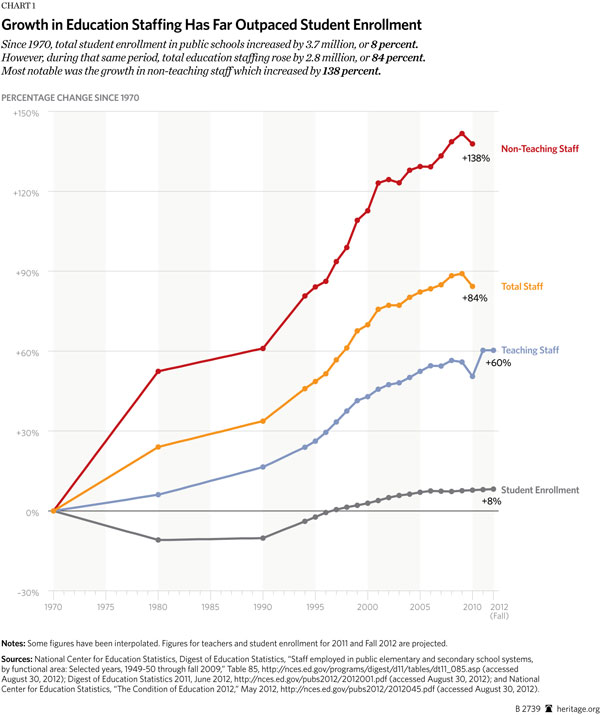
Public school staffing has skyrocketed, we must turn to voucher system

Milton Friedman – Public Schools / Voucher System (Q&A) Part 2

Published on May 7, 2012 by

__________

Max Brantley of the Arkansas Times Blog is always critical of the voucher system but has he taken a closer look at what has been going on in the public schools the last few decades with their costs?

Since 1950 the staffing of public schools has skyrocketed but are we getting a good return on our money? We need to turn to the voucher system that Milton Friedman proposed.

Lindsey Burke

October 24, 2012 at 7:00 pm

The Friedman Foundation has published an excellent report detailing the administrative bloat plaguing our nation’s public schools. The School Staffing Surge: Decades of Employment Growth in America’s Public Schools shows dramatic increases in teaching and non-teaching staff over the past five decades despite modest increases in student enrollment.

As we detailed in a recent report on growth in non-teaching positions in public schools across the country, student enrollment has increased just 8 percent since 1970, while the number of teachers has increased 60 percent, and the number of non-teaching administrative and other staff has increased 138 percent. (continues below chart)

The Friedman report, authored by Ben Scafidi, PhD, takes an even longer look, demonstrating that since 1950, public school enrollment has increased 96 percent, while the number of teachers has increased 252 percent and the number of non-teaching personnel (administrators and other staff) has increased an astonishing 702 percent. “Put differently,” Scafidi notes, “the rise in non-teaching staff was more than seven times faster than the increase in students”:

Between 1950 and 2009, the pupil-staff ratio declined to 7.8 students per public school employee from 19.3 students per public school employee. By 2009, there were fewer than eight public school students per adult employed in the public school system. The drop in the pupil-teacher ratio also was large—the pupil-teacher ratio was 27.5 students per teacher in 1950 and only 15.4 in 2009.

Scafidi also shows how this administrative bloat has affected schools on a state-by-state basis (and uses an interactive map to make the point). Of note: “Nine states with declining student populations had significant increases in public school personnel—D.C., Iowa, Louisiana, Maine, Mississippi, North Dakota, South Dakota, Wyoming, and Vermont.”

The Friedman report notes that the dramatic reduction in class size over the decades has not led to increases in student achievement. Why? As Scafidi reports, an increase in teacher quantity has not produced an increase in teacher quality:

As public schools have reduced class sizes continually since at least 1950, they have had to hire more teachers. And, the evidence is in—the disparity in effectiveness across teachers is considerable. Accordingly, state governments and local public school boards should have been more concerned with improving teacher effectiveness than lowering class sizes.

Continuing a trend of growing staff positions in our nation’s public schools won’t create the types of improvements that the system so desperately needs.

Instead, public school districts should trim bureaucracy and work on long-term reform options for better targeting of taxpayer resources. And decision making should be decentralized, placing staffing and other decisions in the hands of principals, teachers, and parents.

Finally, parents—and teachers—should have options. We’ll never see improvement in our nation’s education system without providing students with a choice about which schools—public, private, virtual, or homeschooling—will best meet their unique learning needs.

Related posts:

Milton Friedman on school voucher system

Max Brantley of the Arkansas Times Blog reports today that Mitt Romney is for school vouchers. I am glad to hear that. Over and over we hear that the reason private schools are better is because they don’t have to keep the troubling making kids. It reminds me of this short film that I saw many […]

The school voucher system is the best way to get competition between schools

Milton Friedman – Public Schools / Voucher System (Q&A) Part 2 Published on May 7, 2012 by BasicEconomics __________ We need to get competition back again among schools and the voucher system is the best way to do that. D.C. Public Schools Spend Almost $30,000 Per Student Ericka Andersen July 25, 2012 at 10:00 am […]

School voucher system in Chili

Milton Friedman – Public Schools / Voucher System (Q&A) Part 1 Published on May 7, 2012 by BasicEconomics ___________ We have to turn to the school voucher system if we want competition between schools and want to lower the cost of education. Chile’s Amazing School Choice Revolution September 29, 2012 by Dan Mitchell I wrote back […]

Free or equal? 30 years after Milton Friedman’s Free to Choose (Part 5)

Johan Norberg – Free or Equal – Free to Choose 30 years later 5/5 Published on Jun 10, 2012 by BasicEconomics In 1980 economist and Nobel laureate Milton Friedman inspired market reform in the West and revolutions in the East with his celebrated television series “Free To Choose.” Thirty years later, in this one-hour documentary, […]

Listing of transcripts and videos of Free to Choose by Milton Friedman: Episode “What is wrong with our schools?” on www.theDailyHatch.org

Everywhere school vouchers have been tried they have been met with great success. Why do you think President Obama got rid of them in Washington D.C.? It was a political disaster for him because the school unions had always opposed them and their success made Obama’s allies look bad. In 1980 when I first sat […]

Free or equal? 30 years after Milton Friedman’s Free to Choose (Part 4)

Johan Norberg – Free or Equal – Free to Choose 30 years later 4/5 Published on Jun 10, 2012 by BasicEconomics In 1980 economist and Nobel laureate Milton Friedman inspired market reform in the West and revolutions in the East with his celebrated television series “Free To Choose.” Thirty years later, in this one-hour documentary, […]

Free or equal? 30 years after Milton Friedman’s Free to Choose (Part 3)

Johan Norberg – Free or Equal – Free to Choose 30 years later 3/5 Published on Jun 10, 2012 by BasicEconomics In 1980 economist and Nobel laureate Milton Friedman inspired market reform in the West and revolutions in the East with his celebrated television series “Free To Choose.” Thirty years later, in this one-hour documentary, […]

Milton Friedman’s passion was to make a difference in the lives of young people

The Machine: The Truth Behind Teachers Unions Published on Sep 4, 2012 by ReasonTV America’s public education system is failing. We’re spending more money on education but not getting better results for our children. That’s because the machine that runs the K-12 education system isn’t designed to produce better schools. It’s designed to produce more […]

Milton and Rose Friedman “Two Lucky People”

Milton Friedman on Hayek’s “Road to Serfdom” 1994 Interview 2 of 2 Uploaded by PenguinProseMedia on Oct 26, 2011 2nd half of 1994 interview. ________________ I have a lot of respect for the Friedmans.Two Lucky People by Milton and Rose Friedman reviewed by David Frum — October 1998. However, I liked this review below better. It […]

Free or equal? 30 years after Milton Friedman’s Free to Choose (Part 2)

Johan Norberg – Free or Equal – Free to Choose 30 years later 2/5 Published on Jun 10, 2012 by BasicEconomics In 1980 economist and Nobel laureate Milton Friedman inspired market reform in the West and revolutions in the East with his celebrated television series “Free To Choose.” Thirty years later, in this one-hour documentary, […]

“Friedman Friday” Milton Friedman – The Proper Role of Government

Milton Friedman – The Proper Role of Government

Milton Friedman did a great job of explaining things in a simple way.

Capitalism and Freedom(1962)

  • To the free man, the country is the collection of individuals who compose it, not something over and above them.He is proud of a common heritage and loyal to common traditions. But he regards government as a means, an instrumentality, neither a grantor of favors and gifts, nor a master or god to be blindly worshipped and served.
    • Introduction
  • The free man will ask neither what his country can do for him nor what he can do for his country. He will ask rather “What can I and my compatriots do through government” to help us discharge our individual responsibilities, to achieve our several goals and purposes, and above all, to protect our freedom? And he will accompany this question with another: How can we keep the government we create from becoming a Frankenstein that will destroy the very freedom we establish it to protect? Freedom is a rare and delicate plant. Our minds tell us, and history confirms, that the great threat to freedom is the concentration of power. Government is necessary to preserve our freedom, it is an instrument through which we can exercise our freedom; yet by concentrating power in political hands, it is also a threat to freedom. Even though the men who wield this power initially be of good will and even though they be not corrupted by the power they exercise, the power will both attract and form men of a different stamp.
    • Introduction
  • There is enormous inertia—a tyranny of the status quo—in private and especially governmental arrangements. Only a crisis—actual or perceived—produces real change. When that crisis occurs, the actions that are taken depend on the ideas that are lying around.That, I believe, is our basic function: to develop alternatives to existing policies, to keep them alive and available until the politically impossible becomes politically inevitable.
    • Preface (1982 edition), p. ix
  • Because we live in a largely free society, we tend to forget how limited is the span of time and the part of the globe for which there has ever been anything like political freedom: the typical state of mankind is tyranny, servitude, and misery. The nineteenth century and early twentieth century in the Western world stand out as striking exceptions to the general trend of historical development. Political freedom in this instance clearly came along with the free market and the development of capitalist institutions. So also did political freedom in the golden age of Greece and in the early days of the Roman era.
    History suggests only that capitalism is a necessary condition for political freedom. Clearly it is not a sufficient condition.

    • Ch. 1 “The Relation Between Economic Freedom and Political Freedom”, 2002 edition, page 10
  • Political freedom means the absence of coercion of a man by his fellow men. The fundamental threat to freedom is power to coerce, be it in the hands of a monarch, a dictator, an oligarchy, or a momentary majority.The preservation of freedom requires the elimination of such concentration of power to the fullest possible extent and the dispersal and distribution of whatever power cannot be eliminated — a system of checks and balances.
    • Ch. 1 “The Relation Between Economic Freedom and Political Freedom”
  • The existence of a free market does not of course eliminate the need for government. On the contrary, government is essential both as a forum for determining the “rule of the game” and as an umpire to interpret and enforce the rules decided on.
    • Ch. 1 “The Relation Between Economic Freedom and Political Freedom”, 2002 edition, page 15
  • A major source of objection to a free economy is precisely that it … gives people what they want instead of what a particular group thinks they ought to want. Underlying most arguments against the free market is a lack of belief in freedom itself.
    • Ch. 1 “The Relation Between Economic Freedom and Political Freedom”, 2002 edition, page 15
  • With respect to teachers’ salaries …. Poor teachers are grossly overpaid and good teachers grossly underpaid. Salary schedules tend to be uniform and determined far more by seniority.
    • Ch. 6 “The Role of Government in Education”

Every Friday you need to click on www.theDailyHatch.org for “Friedman Friday”

Every Friday you need to click on www.theDailyHatch.org if you would like to see a video clip of Milton Friedman as he shares his common sense conservative economic views. Many of his articles are posted too. I remember growing up and reading those great articles every week in Newsweek. They are just as relevant today as they were then.

So many points brought up by liberals sound so good at first but really are easy to answer logically. Take the example below.

I remember like yesterday when I saw Milton Friedman on the Phil Donahue Show. Donahue had thrown up one of those liberal accusations against the free enterprise system. Below is the exchange that I saw that day:

Phil Donahue: When you see around the globe, the mal-distribution of wealth, a desperate plight of millions of people in underdeveloped countries. When you see so few “haves” and so many “have-nots.” When you see the greed and the concentration of power. Did you ever have a moment of doubt about capitalism and whether greed is a good idea to run on?

Milton Friedman: Well first of all tell me is there some society you know that doesn’t run on Greed? You think Russia doesn’t run on greed? You think China doesn’t run on greed? What is greed? Of course none of us are greedy, it’s only the other fellow who is greedy. The world runs on individuals pursuing their separate interests.

The great achievements of civilization have not come from government bureaus. Einstein didn’t construct his theory under order from a bureaucrat. Henry Ford didn’t revolutionize the automobile industry that way.

In the only cases in which the masses have escaped from the kind of grinding poverty you’re talking about – the only cases in recorded history – are where they have had capitalism and largely free trade.

If you want to know where the masses are worst off, it’s exactly in the kinds of societies that depart from that. So that the record of history is absolutely crystal clear that there is no alternative way so far discovered of improving the lot of the ordinary people that can hold a candle to the productive activities that are unleashed by a free enterprise system.

Donahue: But it seems to reward not virtue as much as ability to manipulate the system…

Friedman: And what does reward virtue? You think the Communist commissar rewarded virtue? You think a Hitler rewarded virtue? You think – excuse me – if you’ll pardon me – do you think American Presidents reward virtue ?

Do they choose their appointees on the basis of the virtue of the people appointed or on the basis of their political clout ?

Is it really true that political self-interest is nobler somehow than economic self-interest ? You know, I think you’re taking a lot of things for granted. Just tell me where in the world you find these angels who are going to organize society for us ? Well, I don’t even trust you to do that.

Below are links to some of the past posts:

Discussion on Equality from Milton Friedman and Bradley Gitz

Milton Friedman – Redistribution of Wealth Uploaded by LibertyPen on Feb 12, 2010 Milton Friedman clears up misconceptions about wealth redistribution, in general, and inheritance tax, in particular. http://www.LibertyPen.com __________________ Check out this excellent article below on equality from today’s Arkansas Democrat-Gazette (paywall): What is equality? By Bradley Gitz This article was published today at 3:00 […]

“Friedman Friday” Tribute to Milton Friedman (Part 5)

 Milton Friedman: Life and ideas – Part 05 99th anniversary of Milton Friedman’s birth (Part 13) Milton Friedman was born on July 31, 1912 and he died November 16, 2006. I started posting tributes of him on July 31 and I hope to continue them until his 100th birthday. Here is another tribute below: Sheldon […]

Famous Milton Friedman Quotes(“Friedman Friday” Part 4)

Milton Friedman on the Causes of Inflation (“Friedman Friday” Part 4) FRIEDMAN FRIDAY APPEARS EVERY FRIDAY AND IS HONOR OF THE NOBEL PRIZE WINNING ECONOMIST MILTON FRIEDMAN Famous Friedman Quotes By John Beagle Milton Friedman – University of Chicago School of Economics Professor As I read the comments by Milton Friedman, I can’t help but think […]

Milton Friedman on the power of choice (“Friedman Friday” Part 3)

FRIEDMAN FRIDAY APPEARS EVERY FRIDAY AND IS HONOR OF THE NOBEL PRIZE WINNING ECONOMIST MILTON FRIEDMAN. The Power Of Choice By John Beagle An interesting compilation of Milton Freeman as an economic freedom philosopher. Milton makes the case for economic freedom as a precondition for political freedom. The title of this video, The Power of Choice […]

The stimulus did not work, Milton Friedman knew that 40 yrs ago (“Friedman Friday” Part 2)

Happy Birthday, Milton Friedman! Author: Jonathan Wood Milton Friedman, one of the greatest minds of the 20th century, would have turned 99 on Sunday.  Though few individuals have been as deserving of praise, Milton Friedman was “much more interested in having people thinking about the ideas” than the person having them.  In that spirit, we […]

John Fund’s talk in Little Rock 4-27-11(Part 2):Arkansas is a right to work state and gets new businesses because of it, Obama does not get that, but Milton Friedman does!!!(Royal Wedding Part 18)

Ep. 8 – Who Protects the Worker [1/7]. Milton Friedman’s Free to Choose (1980) Speakers at the First Richmond Tea Party, October 8-9, 2010 John Fund   John Fund is a columnist for The Wall Street Journal and its OpinionJournal.com and an on-air contributor to 24-hour cable news networks CNBC and MSNBC. He is the […]

Balanced Budget Amendment the answer? Boozman says yes, Pryor no (Part 13, Milton Friedman’s view is yes)(The Conspirator Part 18, Lewis Powell Part A)

Dallas Fed president and CEO Richard W. Fisher sat down with economist Milton Friedman on October 19, 2005, as part of ongoing discussions with the Nobel Prize winner. In this clip, Friedman argues for a reduction in government spending. I really wish that Senator Pryor would see the wisdom of supporting the Balanced Budget amendment. […]

Senator Pryor asks for Spending Cut Suggestions! Here are a few!(Part 14)(“The Conspirator” movie, part 1)

  Senator Mark Pryor wants our ideas on how to cut federal spending. Take a look at this video clip below: Senator Pryor has asked us to send our ideas to him at cutspending@pryor.senate.gov and I have done so in the past and will continue to do so in the future. Here are a few […]


Dear Senator Pryor, why not pass the Balanced Budget Amendment? (“Thirsty Thursday”, Open letter to Senator Pryor)

Rand Paul A balanced Budget Amendment is the only way (29-Jul-11)(GLOBAL FOCUS series – US)

Uploaded by on Jul 31, 2011

_______________

Dear Senator Pryor,

Why not pass the Balanced  Budget Amendment? As you know that federal deficit is at all time high (1.6 trillion deficit with revenues of 2.2 trillion and spending at 3.8 trillion).

On my blog www.HaltingArkansasLiberalswithTruth.com I took you at your word and sent you over 100 emails with specific spending cut ideas. However, I did not see any of them in the recent debt deal that Congress adopted. Now I am trying another approach. Every week from now on I will send you an email explaining different reasons why we need the Balanced Budget Amendment. It will appear on my blog on “Thirsty Thursday” because the government is always thirsty for more money to spend.

The main reason we need a Balanced Budget Amendment is to control spending. Milton Friedman was right about that. Notice below that Ron Paul quotes Friedman on this issue.

Ron Paul: Constitutional Amendment Needed to Limit Taxes and Spending

Submitted by bobbyw24 on Wed, 07/20/2011– 07:09

Congressman Ron Paul (R-Texas) says merely scaling back to 2008 spending levels is nowhere near enough to fix the massive government debt problems.

“As Milton Friedman famously argued, what we really need is a constitutional amendment to limit taxes and spending, not simply to balance the budget,” Paul said in a speech to the House of Representatives made prior to the vote on the “Cut, Cap and Balance” bill. The bill is expected to pass the House tonight, but President Barack Obama has said he will veto it if it clears the Senate and reaches his desk.

What is needed is a dramatically smaller federal government, says Paul. “If we achieve this, a balanced budget will take care of itself,” he says. “We need to cut back at least to where spending was a decade ago.”

________

__________

Thank you again for your time and for this opportunity to share my ideas with you.

Sincerely,

Everette Hatcher

Listing of transcripts and videos of “Free to Choose” episode 1 – Power of the Market on www.theDailyHatch.org

Milton Friedman’s books and film series really helped form my conservative views. Take a look at one of my favorite films of his:

“FREE TO CHOOSE” 1: The Power of the Market (Milton Friedman)
Free to Choose ^ | 1980 | Milton Friedman

Posted on Monday, July 17, 2006 4:20:46 PM by Choose Ye This Day

FREE TO CHOOSE: The Power of the Market

Friedman: Once all of this was a swamp, covered with forest. The Canarce Indians who lived here traded the 22 square miles of soggy Manhattan Island to the Dutch for $24.00 worth of cloth and trinkets. The newcomers founded a city, New Amsterdam at the edge of an empty continent. In the years that followed, it proved a magnet for millions of people from across the Atlantic; people who were driven by fear and poverty; who were attracted by the promise of freedom and plenty. They fanned out over the continent and built a new nation with their sweat, their enterprise and their vision of a better future.

For the first time in their lives, many were truly free to pursue their own objectives. That freedom released the human energies which created the United States. For the immigrants who were welcomed by this statue, America was truly a land of opportunity.

They poured ashore in their best clothes, eager and expectant, carrying what little they owned. They were poor, but they all had a great deal of hope. Once they arrived, they found, as my parents did, not an easy life, but a very hard life. But for many there were friends and relatives to help them get started __ to help them make a home, get a job, settle down in the new country. There were many rewards for hard work, enterprise and ability. Life was hard, but opportunity was real. There were few government programs to turn to and nobody expected them. But also, there were few rules and regulations. There were no licenses, no permits, no red tape to restrict them. They found in fact, a free market, and most of them thrived on it.

Many people still come to the United States driven by the same pressures and attracted by the same promise. You can find them in places like this. It’s China Town in New York, one of the centers of the garment industry __ a place where hundreds of thousands of newcomers have had their first taste of life in the new country. The people who live and work here are like the early settlers. They want to better their lot and they are prepared to work hard to do so.

Although I haven’t often been in factories like this, it’s all very familiar to me because this is exactly the same kind of a factory that my mother worked in when she came to this country for the first time at the age of 14, almost 90 years ago. And if there had not been factories like this here then at which she could have started to work and earn a little money, she wouldn’t have been able to come. And if I existed at all, I’d be a Russian or Hungarian today, instead of an American. Of course she didn’t stay here a long time, she stayed here while she learned the language, while she developed some feeling for the country, and gradually she was able to make a better life for herself.

Similarly, the people who are here now, they are like my mother. Most of the immigrants from the distant countries __ they came here because they liked it here better and had more opportunities. A place like this gives them a chance to get started. They are not going to stay here very long or forever. On the contrary, they and their children will make a better life for themselves as they take advantage of the opportunities that a free market provides to them.

The irony is that this place violates many of the standards that we now regard as every worker’s right. It is poorly ventilated, it is overcrowded, the workers accept less than union rate __ it breaks every rule in the book. But if it were closed down, who would benefit? Certainly not the people here. Their life may seem pretty tough compared to our own, but that is only because our parents or grandparents went through that stage for us. We have been able to start at a higher point.

Frank Visalli’s father was 12 years old when he arrived all alone in the United States. He had come from Sicily. That was 53 years ago. Frank is a successful dentist with a wife and family. They live in Lexington, Massachusetts. There is no doubt in Frank’s mind what freedom combined with opportunity meant to his father and then to him, or what his Italian grandparents would think if they could see how he lives now.

Frank Visalli: They would not believe what they would see __ that a person could immigrate from a small island and make such success out of their life because to them they were mostly related to the fields, working in the field as a peasant. My father came over, he made something for himself and then he tried to build a family structure. Whatever he did was for his family. It was for a better life for his family. And I can always remember him telling me that the number one thing in life is that you should get an education to become a professional person.

Friedman: The Visalli family, like all of us who live in the United States today, owe much to the climate of freedom we inherited from the founders of our country. The climate that gave full scope to the poor from other lands who came here and were able to make better lives for themselves and their children.

But in the past 50 years, we’ve been squandering that inheritance by allowing government to control more and more of our lives, instead of relying on ourselves. We need to rediscover the old truths that the immigrants knew in their bones; what economic freedom is and the role it plays in preserving personal freedom.

That’s why I came here to the South China Sea. It’s a place where there is an almost laboratory experiment in what happens when government is limited to its proper function and leaves people free to pursue their own objectives. If you want to see how the free market really works this is the place to come. Hong Kong, a place with hardly any natural resources. About the only one you can name is a great harbor, yet the absence of natural resources hasn’t prevented rapid economic development. Ships from all nations come here to trade because there are no duties, no tariffs on imports or exports. The power of the free market has enabled the industrious people of Hong Kong to transform what was once barren rock into one of the most thriving and successful places in Asia.

If you enjoyed that then take a look at the other segments:

“Friedman Friday” (“Free to Choose” episode 1 – Power of the Market. part 6 of 7)

PETERSON: Well, let me ask you how you would cope with this problem, Dr. Friedman. The people decided that they wanted cool air, and there was tremendous need, and so we built a huge industry, the air conditioning industry, hundreds of thousands of jobs, tremendous earnings opportunities and nearly all of us now have air […]

“Friedman Friday” (“Free to Choose” episode 1 – Power of the Market. part 5 of 7)

Part 5 Milton Friedman: I do not believe it’s proper to put the situation in terms of industrialist versus government. On the contrary, one of the reasons why I am in favor of less government is because when you have more government industrialists take it over, and the two together form a coalition against the ordinary […]

“Friedman Friday” (“Free to Choose” episode 1 – Power of the Market. part 4 of 7)

The fundamental principal of the free society is voluntary cooperation. The economic market, buying and selling, is one example. But it’s only one example. Voluntary cooperation is far broader than that. To take an example that at first sight seems about as far away as you can get __ the language we speak; the words […]

“Friedman Friday” (“Free to Choose” episode 1 – Power of the Market. part 3 of 7)

  _________________________   Pt3  Nowadays there’s a considerable amount of traffic at this border. People cross a little more freely than they use to. Many people from Hong Kong trade in China and the market has helped bring the two countries closer together, but the barriers between them are still very real. On this side […]

“Friedman Friday” (“Free to Choose” episode 1 – Power of the Market. part 2 of 7)

  Aside from its harbor, the only other important resource of Hong Kong is people __ over 4_ million of them. Like America a century ago, Hong Kong in the past few decades has been a haven for people who sought the freedom to make the most of their own abilities. Many of them are […]

“Friedman Friday” (“Free to Choose” episode 1 – Power of the Market. part 1of 7)

“FREE TO CHOOSE” 1: The Power of the Market (Milton Friedman) Free to Choose ^ | 1980 | Milton Friedman Posted on Monday, July 17, 2006 4:20:46 PM by Choose Ye This Day FREE TO CHOOSE: The Power of the Market Friedman: Once all of this was a swamp, covered with forest. The Canarce Indians […]