Category Archives: Milton Friedman

“Friedman Friday” Milton Friedman at Hillsdale College 2006 (part 2)

Milton Friedman at Hillsdale College 2006

July 2006

Free to Choose: A Conversation with Milton Friedman

Milton Friedman
Economist

Milton Friedman is a senior research fellow at the Hoover Institution at Stanford University and a professor emeritus of economics at the University of Chicago, where he taught from 1946-1976. Dr. Friedman received the Nobel Memorial Prize for Economic Science in 1976, and the National Medal of Science and the Presidential Medal of Freedom in 1988. He served as an unofficial adviser to presidential candidate Barry Goldwater and Presidents Nixon and Reagan. He is the author of numerous books, including Two Lucky People (with Rose Friedman).

The following is an edited transcript of a conversation between Hillsdale College President Larry Arnn and Milton Friedman, which took place on May 22, 2006, at the Ritz-Carlton Hotel in San Francisco, California, during a two-day Hillsdale College National Leadership Seminar celebrating the 25th anniversary of Milton and Rose Friedman’s book, Free to Choose: A Personal Statement.

_______

LA: In Free to Choose you discuss Abraham Lincoln’s “House Divided” speech, which you relate to the great task that the American people face. Like Lincoln, you argue that a house divided against itself cannot stand: America is going to be a government intervention country or it’s going to be a free market country, but it cannot continue indefinitely as a mixture of both. Do you still believe that?

MF: Yes, I very much believe that, and I believe that we’ve been making some headway since Free to Choose appeared. However, even though it is real headway compared to what was happening before, we are mostly holding ground.

LA: What do you think are the major factors behind the economic growth we have experienced since the publication of Free to Choose?

MF: Economic growth since that time has been phenomenal, which has very little to do with most of what we’ve been talking about in terms of the conflict between government and private enterprise. It has much more to do with the technical problem of establishing sound monetary policy. The economic situation during the past 20 years has been unprecedented in the history of the world. You will find no other 20-year period in which prices have been as stable—relatively speaking—in which there has been as little variability in price levels, in which inflation has been so well-controlled, and in which output has gone up as regularly. You hear all this talk about economic difficulties, when the fact is we are at the absolute peak of prosperity in the history of the world. Never before have so many people had as much as they do today. I believe a large part of that is to be attributed to better monetary policy. The improved policy is a result of the acceptance of the view that inflation is a monetary phenomenon, not a real phenomenon. We have accepted the view that central banks are primarily responsible for maintaining stable prices and nothing else.

LA: Do you think the Great Depression was triggered by bad monetary policy at a crucial moment?

MF: Absolutely. Unfortunately, it is still the case that if you ask people what caused the Great Depression, nine out of ten will probably tell you it was a failure of business. But it’s absolutely clear that the Depression was a failure of government and not a failure of business.

LA: You don’t think the Smoot-Hawley tariff caused the Depression?

MF: No. I think the Smoot-Hawley tariff was a bad law. I think it did harm. But the Smoot-Hawley tariff by itself would not have made one quarter of the labor force unemployed. However, reducing the quantity of money by one third did make a quarter of the labor force unemployed. When I graduated from undergraduate college in 1932, I was baffled by the fact that there were idle machines and idle men and you couldn’t get them together. Those men wanted to cooperate; they wanted to work; they wanted to produce what they wore; and they wanted to produce the food they ate. Yet something had gone wrong: The government was mismanaging the money supply.

LA: Do you think our government has learned its lesson about how to manage the money supply?

MF: I think that the lesson has been learned, but I don’t think it will last forever. Sooner or later, government will want to raise funds without imposing taxes. It will want to spend money it does not have. So I hesitate to join those who are predicting two percent inflation for the next 20 years. The temptation for government to lay its hands on that money is going to be very hard to resist. The fundamental problem is that you shouldn’t have an institution such as the Federal Reserve, which depends for its success on the abilities of its chairman. My first preference would be to abolish the Federal Reserve, but that’s not going to happen.

LA: I want to talk now about education and especially about vouchers, because I know they are dear to your heart. Why do you think teachers unions oppose vouchers?

MF: The president of the National Education Association was once asked when his union was going to do something about students. He replied that when the students became members of the union, the union would take care of them. And that was a correct answer. Why? His responsibility as president of the NEA was to serve the members of his union, not to serve public purposes. I give him credit: The trade union has been very effective in serving its members. However, in the process, they’ve destroyed American education. But you see, education isn’t the union’s function. It’s our fault for allowing the union to pursue its agenda. Consider this fact: There are two areas in the United States that suffer from the same disease—education is one and health care is the other. They both suffer from the disease that takes a system that should be bottom-up and converts it into a system that is top-down. Education is a simple case. It isn’t the public purpose to build brick schools and have students taught there. The public purpose is to provide education. Think of it this way: If you want to subsidize the production of a product, there are two ways you can do it. You can subsidize the producer or you can subsidize the consumer. In education, we subsidize the producer—the school. If you subsidize the student instead—the consumer—you will have competition. The student could choose the school he attends and that would force schools to improve and to meet the demands of their students.

LA: Although you discuss many policy issues in Free to Choose, you have turned much of your attention to education, and to vouchers as a method of education reform. Why is that your focus?

MF: I don’t see how we can maintain a decent society if we have a world split into haves and have-nots, with the haves subsidizing the have-nots. In our current educational system, close to 30 percent of the youngsters who start high school never finish. They are condemned to low-income jobs. They are condemned to a situation in which they are going to be at the bottom. That leads in turn to a divisive society; it leads to a stratified society rather than one of general cooperation and general understanding. The effective literacy rate in the United States today is almost surely less than it was 100 years ago. Before government had any involvement in education, the majority of youngsters were schooled, literate, and able to learn. It is a disgrace that in a country like the United States, 30 percent of youngsters never graduate from high school. And I haven’t even mentioned those who drop out in elementary school. It’s a disgrace that there are so many people who can’t read and write. It’s hard for me to see how we can continue to maintain a decent and free society if a large subsection of that society is condemned to poverty and to handouts.

LA: Do you think the voucher campaign is going well?

MF: No. I think it’s going much too slowly. What success we have had is almost entirely in the area of income-limited vouchers. There are two kinds of vouchers: One is a charity voucher that is limited to people below a certain income level. The other is an education voucher, which, if you think of vouchers as a way of transforming the educational industry, is available to everybody. How can we make vouchers available to everybody? First, education ought to be a state and local matter, not a federal matter. The 1994 Contract with America called for the elimination of the Department of Education. Since then, the budget for the Department of Education has tripled. This trend must be reversed. Next, education ought to be a parental matter. The responsibility for educating children is with parents. But in order to make it a parental matter, we must have a situation in which parents are Free to Choose the schools their children attend. They aren’t free to do that now. Today the schools pick the children. Children are assigned to schools by geography—by where they live. By contrast, I would argue that if the government is going to spend money on education, the money ought to travel with the children. The objective of such an expenditure ought to be educated children, not beautiful buildings. The way to accomplish this is to have a universal voucher. As I said in 1955, we should take the amount of money that we’re now spending on education, divide it by the number of children, and give that amount of money to each parent. After all, that’s what we’re spending now, so we might as well let parents spend it in the form of vouchers.

LA: I have one more question for you. You describe a society in which people look after themselves because they know the most about themselves, and they will flourish if you let them. You, however, are a crusader for the rights of others. For example, you say in Free to Choose—and it’s a very powerful statement—a tiny minority is what matters. So is it one of the weaknesses of the free market that it requires certain extremely talented and disinterested people who can defend it?

MF: No, that’s not right. The self-interest of the kind of people you just described is promoting public policy. That’s what they’re interested in doing. For example, what was my self-interest in economics? My self-interest to begin with was to understand the real mystery and puzzle that was the Great Depression. My self-interest was to try to understand why that happened, and that’s what I enjoyed doing—that was my self-interest. Out of that I grew to learn some things—to have some knowledge. Following that, my self-interest was to see that other people understood the same things and took appropriate action.

LA: Do you define self-interest as what the individual wants?

MF: Yes, self-interest is what the individual wants. Mother Teresa, to take one example, operated on a completely self-interested basis. Self-interest does not mean narrow self-interest. Self-interest does not mean monetary self-interest. Self-interest means pursuing those things that are valuable to you but which you can also persuade others to value. Such things very often go beyond immediate material interest.

LA: Does that mean self-interest is a synonym for self-sacrifice?

MF: If you want to see how pervasive this sort of self-interest is that I’m describing, look at the enormous amount of money contributed after Hurricane Katrina. That was a tremendous display of self-interest: The self-interest of people in that case was to help others. Self-interest, rightly understood, works for the benefit of society as a whole.


What were the main proposals of Milton Friedman?

Stearns Speaks on House Floor in Support of Balanced Budget Amendment

Uploaded by on Nov 18, 2011

Speaking on House floor in support of Balanced Budget Resolution, 11/18/2011

___________

Below are some of the main proposals of Milton Friedman. I highly respected his work.

David J. Theroux said this about Milton Friedman’s view concerning the Balanced Budget Amendment:

Balancing the Budget: Since deficit spending is simply a device for hiding tax increases, thereby lowering taxpayer resistance to government spending and impairing economic growth, all government spending should be handled according to the merits of each specific proposal in a pay-as-you-go basis. Fiscal policy should never be used to affect business cycles, and the Balanced Budget Amendment should be adopted.

Here is some more about Friedman’s life:

Milton Friedman (1912-2006)
By David J. Theroux  |  Posted: Sat. November 18, 2006

“Milton Friedman is a scholar of first rank whose original contributions to economic science have made him one of the greatest thinkers in modern history.”
President Ronald Reagan

“How grateful I have been over the years for the cogency of Friedman’s ideas which have influenced me. Cherishers of freedom will be indebted to him for generations to come.”
Alan Greenspan, former Chairman, Federal Reserve System

“Right at this moment there are people all over the land, I could put dots on the map, who are trying to prove Milton wrong. At some point, somebody else is trying to prove he’s right That’s what I call influence.”
Paul Samuelson, Nobel Laureate in Economic Science

“Friedman’s influence reaches far beyond the academic community and the world of economics. Rather than lock himself in an ivory tower, he has joined the fray to fight for the survival of this great country of ours.”
William E. Simon, former Secretary of the Treasury

“Milton Friedman is the most original social thinker of the era.”
John Kenneth Galbraith, former Professor of Economics, Harvard University

“There are various ways to describe Friedman’s influence. But one way is to ask, ‘Has he helped many people—poor people in the world?’ And I would just take India and China, 37% of the world’s population. Hundreds of millions of people in these two countries, who used to live on less than one dollar a day or two dollars a day, are now able to live at a much more decent standard of living as a result of the reform of their economic policies toward more free-market policies, less regulation, less government and the like. There was one person who they are more indebted to than anybody else for their great improvement in their situation. In my judgment, that person is Milton Friedman.”
Gary S. Becker, Nobel Laureate in Economic Science

Economist and former Newsweek columnist Henry Wallich has credited Milton Friedman with having “almost single-handedly” changed economic thinking on the subject of money.1 Indeed, Milton Friedman, the 1976 Nobel Laureate in Economic Science, was a world-renowned economist and an academician of the finest caliber. But he was much more. He was an articulate and persuasive advocate of individual freedom, and the private property, voluntary exchange economy, which is based upon and sustains that freedom. British Prime Minister Margaret Thatcher has stated, “Professor Friedman is usually referred to as a monetarist, but his basic belief is not in money. It’s in people’s inherent right and ability to choose how they will live.”

Among his proposals were the following:

Negative Income Tax: To eliminate the massive welfare system’s disincentives and enormous waste, abolish all welfare programs and replace them with a program of direct cash payments to those actually in need simply by adding a new income tax bracket (one for negative values of taxable income) to the tax code.

Educational Vouchers: To provide a competitive climate for public and private education, all parents of primary and secondary school children would be issued government vouchers to be spent at the school of their choice. Government’s only role would be to provide the vouchers; competition for clients would assure quality and innovation.

Flat Income Tax: To streamline the tax system and to lower its enormous direct costs to the general public and the indirect inefficiencies imposed on the economy, abolish the corporate income tax. In addition, tax individuals only at a non-progressive, low, flat rate, raising personal exemptions to some minimum income level, and ending all loopholes.

Stable Money Growth: To eliminate the recurring problems of inflation, unemployment, and decreased productivity, abolish the Federal Reserve System, legalize private monies, and peg the increase of the government money supply to the growth in GNP, perhaps 0 to 3 percent per year.

Floating Exchange Rates: To solve the nation’s balance-of-payments problems and to open the possibility of unilaterally eliminating anti-consumer protectionist measures, abolish exchange controls and let national and private currencies seek their own price levels in the market.

Balancing the Budget: Since deficit spending is simply a device for hiding tax increases, thereby lowering taxpayer resistance to government spending and impairing economic growth, all government spending should be handled according to the merits of each specific proposal in a pay-as-you-go basis. Fiscal policy should never be used to affect business cycles, and the Balanced Budget Amendment should be adopted.

Volunteer Army: To create a more efficient, better motivated, and morally tenable defense system, abolish the compulsory servitude of the draft and draft registration and maintain a voluntary system of enlistment based on competitive benefits and professional, career-oriented training.

No Victimless Crime Laws: To direct limited police and legal resources to the problems of violent crime, eliminate all laws creating “crimes with no victims.” More specifically, where consent is present between two or more adults no criminal injustice can be possible; hence, for Friedman government has no place in proscribing or regulating such areas as prostitution, profanity, pornography, drugs, and so forth. In this regard, Friedman was not condoning any such behavior, but instead noting that these and all non-invasive matters are best regulated by property owners via private-property agreements and institutions, as opposed to government command-and-control. Moreover, Friedman agreed with the late Harvard philosopher Robert Nozick’s position that such practices should be equally legal along with all “capitalist acts between consenting adults.”13

As a result of his devotion to individual freedom, Friedman was an early and vocal supporter of California’s Proposition 13 to reduce property taxes across-the-board, as well as President Ronald Reagan’s original proposal to cut individual and corporate income tax rates. He was opposed to price controls, farm subsidies, securities and exchange controls, tariffs, and, in fact, all government interventions into the peaceful pursuits of individuals. To Friedman, government’s role should be stringently restricted to defending the nation from foreign enemies, defending persons from force and fraud, providing a forum for decisions of the general rules determining property and similar rights, and providing a means to mediate disputes about the rules.

Perhaps Friedman’s greatest success began in 1979 when he and his wife Rose authored the book, Free to Choose, based on the famous ten-part TV series for PBS by the same title. Both the TV program and the book were drawn from an earlier series of lectures presented by Friedman. Because it aired during a period of critical economic distress during the Carter Administration and in the aftermath of the Vietnam War, Watergate scandal, and Richard Nixon’s resignation as President, the program is widely regarded as being a major factor in shifting American public opinion toward appreciating the need to dismantle government largess. The series was shown in England, Japan, Italy, Australia, Germany, Canada, and many other countries, and the book was translated for distribution around the world, selling more than one million copies.

As a result of his impact on academic and public opinion, Friedman was an economic advisor to 1964 Republican presidential candidate Barry Goldwater; Presidents Ronald Reagan, Gerald Ford, and Richard Nixon; as well as British Prime Minister Margaret Thatcher. But throughout this time, he consistently turned down full-time positions in government, preferring to continue his scientific work and leave public activities to full-time policymakers.

In addition, Friedman’s ideas were critically influential in the economic liberalization reforms in such countries as Estonia, Chile, Ireland, China, New Zealand, Czech Republic, and India. In the process, he was accused of complicity in the repressive regimes of Chilean dictator Augusto Pinochet and in Communist China. However, Friedman maintained that in advising any government, in no way was he supporting any policies that run counter to the principles of individual liberty. Indeed, he indicated that he instead sought to end all policies of oppression.

In short, Friedman believed that government’s sole functions should be to provide civil policing and justice plus national defense. For the latter however, he went further than merely supporting the protection of national borders from invaders. In the aftermath of World War II, Friedman became a supporter of the Cold War and the Wilsonian legacy of U.S. military interventionism around the world. This led him to support the Vietnam War and other overt and covert U.S. policies. However, in the process, he noted that, “I’m anti-interventionist, but I’m not an isolationist,”14 and upon reading the 1987 landmark book by Independent Institute Senior Fellow Robert Higgs, Crisis and Leviathan, which shows that war “crises” are the major engine of the very neo-mercantilism and Big Government he long opposed, Friedman became an increasing critic of “wars of choice,” including the war in Iraq.

The Friedman’s were married for 68 years and had two children: David, who teaches law and economics at Santa Clara University, and Janet, who practices law in California.

To recognize the enormous contributions of this man, I had the distinct pleasure and privilege to organize the gala National Dinner to Honor Milton Friedman on October 4, 1983, at the Fairmont Hotel in San Francisco, at which then struggling actor Arnold Schwarzenegger, who had been inspired by the “Free to Choose” TV series, first met Friedman in person.

In addition to the Nobel Prize, Friedman was the recipient of the Grand Cordon of the First Class Order of the Sacred Treasure of Japan (1987), National Medal of Science (1988), and Presidential Medal of Freedom (1988), and he was a member of the American Philosophical Society and the National Academy of Sciences.

In 1998, Milton and Rose Friedman penned their autobiography, Two Lucky People: Memoirs, which traces their remarkable personal journey and life experiences, and they both spent recent years working together pursuing their dream of educational choice for all parents throughout the U.S.

Milton Friedman died on November 16, 2006, from heart failure, in San Francisco. Unlike any other intellectual figure of the twentieth century, he transformed public debate away from the suicidal path of command economies and toward economies based on individual choice, free markets, and personal responsibility. Friedman was brilliant, creative, resilient, and effective. In his career, including the thirty years that I had the pleasure of knowing him, he was a champion who sought to facilitate greater opportunity for all, especially those most in need. In economics, education, finance, business, civil liberties, welfare, and a host of other areas, he has left a powerful legacy for the benefit of humanity.

Notes

1. John Davenport. “The Radical Economics of Milton Friedman,” Fortune, 1 June 1967, p. 131.

2. “Milton Friedman,” Current Biography 1969 (Bronx, NY: H.W. Wilson Company), p. 151.

3. “Milton Friedman,” Les Prix Nobel en 1976 (Stockholm: The Nobel Foundation, 1977), p. 239.

4. Karl Brunner. “The 1976 Nobel Prize in Economics,” Science 194 (November 5, 1976), p. 595.

5. Current Biography, p. 152.

6. Les Prix Nobel en 1976, pp. 240-41.

7. Current Biography, p. 152.

8. Les Prix Nobel en 1976, p. 241.

9. Ibid.

10. Current Biography, p. 152.

11. Milton Friedman. “He Has Set a Standard.” Wall Street Journal (June 31, 2006).

12. Milton Friedman. “Introduction.” New Individualist Review (Indianapolis: Liberty Press, 1981), pp. ix-xiv.

13. “Portrait: Milton Friedman,” Challenge (May-June 1978), p. 69; Milton Friedman, Capitalism and Freedom (Chicago: University of Chicago Press, 1962); and Milton and Rose Friedman, Free to Choose (New York: Harcourt Brace Jovanovich, 1980).

14. “Best of Both Worlds: Milton Friedman reminisces about his career as an economist and his lifetime ‘avocation’ as a spokesman for freedom,” Reason (June 1995).


David J. Theroux is the Founder, President and Chief Executive Officer of The Independent Institute and Publisher of The Independent Review.

“Friedman Friday” Milton Friedman at Hillsdale College 2006 (part 1)

Milton Friedman at Hillsdale College 2006

July 2006

Free to Choose: A Conversation with Milton Friedman

Milton Friedman
Economist

Milton Friedman is a senior research fellow at the Hoover Institution at Stanford University and a professor emeritus of economics at the University of Chicago, where he taught from 1946-1976. Dr. Friedman received the Nobel Memorial Prize for Economic Science in 1976, and the National Medal of Science and the Presidential Medal of Freedom in 1988. He served as an unofficial adviser to presidential candidate Barry Goldwater and Presidents Nixon and Reagan. He is the author of numerous books, including Two Lucky People (with Rose Friedman).

The following is an edited transcript of a conversation between Hillsdale College President Larry Arnn and Milton Friedman, which took place on May 22, 2006, at the Ritz-Carlton Hotel in San Francisco, California, during a two-day Hillsdale College National Leadership Seminar celebrating the 25th anniversary of Milton and Rose Friedman’s book, Free to Choose: A Personal Statement.


LARRY ARNN: In Free to Choose, in the chapter on “The Tyranny of Controls,” you argue that protectionism and government intervention in general breed conflict and that free markets breed cooperation. How do you reconcile this statement with the fact that we think of free markets as being competitive?

MILTON FRIEDMAN: They are competitive, but they are competitive over a broad range. The question is, how do you make money in a free market? You only make money if you can provide someone with something he or she is willing to pay for. You can’t make money any other way. Therefore, in order to make money, you have to promote cooperation. You have to do something that your customer wants you to do. You don’t do it because he orders you to. You don’t do it because he threatens to hit you over the head if you don’t. You do it because you offer him a better deal than he can get anywhere else. Now that’s promoting cooperation. But there are other people who are trying to sell to him, too. They’re your competitors. So there is competition among sellers, but cooperation between sellers and buyers.

LA: In the chapter on “The Tyranny of Controls,” you seem gloomy about the prospects for India. Why?

MF: I was in India in 1955 on behalf of the American government to serve as an economic adviser to the minister of finance. I concluded then that India had tremendous potential, but none of it was being achieved. That fact underlies the passage you are referring to in Free to Choose. Remember, Free to Choose aired in January 1980, and as of that time there had been no progress in India. The population had grown, but the standard of living was as low as it had been in 1955. Now, in the past ten or fifteen years, there has been movement in India, and maybe those hidden potentials I saw in 1955 will finally be achieved. But, there is still great uncertainty there.

LA: In that same chapter, you wrote the following about China: “Letting the genie of…initiative out of the bottle even to this limited extent will give rise to political problems that, sooner or later, are likely to produce a reaction toward greater authoritarianism. The opposite outcome, the collapse of communism and its replacement by a market system, seems far less likely.” What do you think about that statement today?

MF: I’m much more optimistic about China today than I was then. China has made great progress since that time. It certainly has not achieved complete political freedom, but it has come closer. It certainly has a great deal more economic freedom. I visited China for the first time in 1980 right after the publication of Free to Choose. I had been invited by the government to lecture on how to stop inflation, among other things. China at that time was in a pretty poor state. The hotel we stayed in showed every sign of being run by a communist regime. We returned to China twice, and each time, the changes were tremendous. In 1980, everybody was wearing the dull and drab Mao costume; there were bicycles all over the place and very few cars. Eight years later, we started to see some color in the clothes, there were things available for sale that hadn’t been available before, and free markets were breaking out all over the place. China has continued to grow at a dramatic rate. But in the section of Free to Choose you refer to, I talked about the political conflict that was coming—and that broke out in Tiananmen Square. The final outcome in China will not be decided until there is a showdown between the political tyranny on the one hand and economic freedom on the other—they cannot coexist.

LA: Let me ask you about demographic trends. Columnist Mark Steyn writes that in ten years, 40 percent of young men in the world are going to be living in oppressed Muslim countries. What do you think the effect of that is going to be?

MF: What happens will depend on whether we succeed in bringing some element of greater economic freedom to those Muslim countries. Just as India in 1955 had great but unrealized potential, I think the Middle East is in a similar situation today. In part this is because of the curse of oil. Oil has been a blessing from one point of view, but a curse from another. Almost every country in the Middle East that is rich in oil is a despotism.

LA: Why do you think that is so?

MF: One reason, and one reason only—the oil is owned by the governments in question. If that oil were privately owned and thus someone’s private property, the political outcome would be freedom rather than tyranny. This is why I believe the first step following the 2003 invasion of Iraq should have been the privatization of the oil fields. If the government had given every individual over 21 years of age equal shares in a corporation that had the right and responsibility to make appropriate arrangements with foreign oil companies for the purpose of discovering and developing Iraq’s oil reserves, the oil income would have flowed in the form of dividends to the people—the shareholders—rather than into government coffers. This would have provided an income to the whole people of Iraq and thereby prevented the current disputes over oil between the Sunnis, Shiites and Kurds, because oil income would have been distributed on an individual rather than a group basis.

LA: Many Middle Eastern societies have a kind of tribal or theocratic basis and long-held habits of despotic rule that make it difficult to establish a system of contract between strangers. Is it your view that the introduction of free markets in such places could overcome those obstacles?

MF: Eventually, yes. I think that nothing is so important for freedom as recognizing in the law each individual’s natural right to property, and giving individuals a sense that they own something that they’re responsible for, that they have control over, and that they can dispose of.

LA: Is there an area here in the United States in which we have not been as aggressive as we should in promoting property rights and free markets?

MF: Yes, in the field of medical care. We have a socialist-communist system of distributing medical care. Instead of letting people hire their own physicians and pay them, no one pays his or her own medical bills. Instead, there’s a third party payment system. It is a communist system and it has a communist result. Despite this, we’ve had numerous miracles in medical science. From the discovery of penicillin, to new surgical techniques, to MRIs and CAT scans, the last 30 or 40 years have been a period of miraculous change in medical science. On the other hand, we’ve seen costs skyrocket. Nobody is happy: physicians don’t like it, patients don’t like it. Why? Because none of them are responsible for themselves. You no longer have a situation in which a patient chooses a physician, receives a service, gets charged, and pays for it. There is no direct relation between the patient and the physician. The physician is an employee of an insurance company or an employee of the government. Today, a third party pays the bills. As a result, no one who visits the doctor asks what the charge is going to be—somebody else is going to take care of that. The end result is third party payment and, worst of all, third party treatment.

LA: Following the recent expansion in prescription drug benefits and Medicare, what hope is there for a return to the free market in medical care?

MF: It does seem that markets are on the defensive, but there is hope. The expansion of drug benefits was accompanied by the introduction of health savings accounts—HSAs. That’s the one hopeful sign in the medical area, because it’s a step in the direction of making people responsible for themselves and for their own care. No one spends somebody else’s money as carefully as he spends his own.

LA: On the subject of Social Security, let me read to you a passage from Free to Choose: “As we have gone through the literature on Social Security, we have been shocked at the arguments that have been used to defend the program. Individuals who would not lie to their children, their friends, their colleagues, whom all of us would trust implicitly in the most important personal dealings, have propagated a false view of Social Security. Their intelligence and exposure to contrary views make it hard to believe that they have done so unintentionally and innocently. Apparently they have regarded themselves as an elite group within society that knows what is good for other people better than those people do for themselves.” What do you think of these words today?

MF: I stick by every word there. But there has been progress since then. Let me explain: Free to Choose was produced and shown on television for the first time in January 1980. President Reagan was elected in November 1980. To get a clear picture of what has happened since the publication of Free to Choose, we really need to look at what happened before and after the election of Ronald Reagan. Before Reagan, non-defense government spending—on the federal, state and local levels—as a percentage of national income was rising rapidly. Between the early 1950s and 1980, we were in a period of what I would call galloping socialism that showed no signs of slowing. Following the election of Ronald Reagan, there was an abrupt and immediate halt to this expansion of government. But even under Reagan, government spending as a percentage of national income didn’t come down: It has held constant from that time to now. Although the early years of the current Bush presidency did see spending increases, national income has risen, too. We have achieved some success at our first task: stopping the growth of government. The second task is to shrink government spending and make government smaller. We haven’t done that yet, but we are making some progress. I should also mention as a cautionary tale that, prior to Reagan, the number of pages in the Federal Register was on the rise, but Reagan succeeded in reducing this number substantially. However, once Reagan was out of office, the number of pages in the Register began to rise even more quickly. We have not really succeeded in that area.

There have been real changes in our society since Free to Choose was published. I’m not attributing them to Free to Choose—I’m not saying that’s the reason—but in general, there has been a complete change in public opinion. This change is probably due as much to the collapse of the Soviet Union as it is to what Friedrich Hayek or Milton Friedman or somebody else wrote. Socialism used to mean the ownership and operation of the means of production, but nobody gives it that meaning today. There is no country in the world attempting to be socialist in that sense except North Korea. And perhaps Russia is moving in that direction. Conversely, opinion has not shifted far enough in terms of the dangers of big government and the deleterious effects it can have, and that’s where we’re facing future problems. This clarifies the task facing institutions such as Hillsdale College: We must make clear that the only reason we have our freedom is because government is so inefficient. If the government were efficient in spending the approximately 40 percent of our income that it currently manages, we would enjoy less freedom than we do today.

Milton Friedman discusses Voucher System

The Machine: The Truth Behind Teachers Unions

Published on Sep 4, 2012 by

America’s public education system is failing. We’re spending more money on education but not getting better results for our children.

That’s because the machine that runs the K-12 education system isn’t designed to produce better schools. It’s designed to produce more money for unions and more donations for politicians.

For decades, teachers’ unions have been among our nation’s largest political donors. As Reason Foundation’s Lisa Snell has noted, the National Education Association (NEA) alone spent $40 million on the 2010 election cycle (source: http://reason.org/news/printer/big-education-and-big-labor-electio). As the country’s largest teachers union, the NEA is only one cog in the infernal machine that robs parents of their tax dollars and students of their futures.

Students, teachers, parents, and hardworking Americans are all victims of this political machine–a system that takes money out of taxpayers’ wallets and gives it to union bosses, who put it in the pockets of politicians.

Our kids deserve better.

“The Machine” is 4:17 minutes.

Written and narrated by Evan Coyne Maloney. Produced by the Moving Picture Institute in partnership with Reason TV.

Visit http://www.MovingPictureInstitute.org to learn more.

________________

Milton Friedman: Education (Part One)

Milton Friedman with Ronald Reagan

If you want to change this nation in a big way then you will at the fact that in the last 40 years we have increased our educational spending every year and our test scores have dropped. The problem is not money but education competition. We don’t need to spend over $29,000 per kid in the Washington D.C. district when we could give vouchers out (under $9000 per kid) and have better results. Take a look at this article from Milton Friedman.

Milton Friedman on Vouchers

CNBC interview, March 24, 2003.

Michelle: you are the grandfather of school vouchers do you feel victorious?

Mr. Friedman: Far from victorious, but very optimistic and hopeful. We are at the beginning of the task because as of the moment vouchers are available to only a very small amount of children. Our goal is to have a system in which every family in the U.S. will be able to choose for itself the school to which its children go we are far from that ultimate result. If we had that a system of free choice we would also have a system of competition, innovation which would change the character of education. You know our educational system is one of the most backwards things in our society in the may we teach people they did 200 years ago there is a person in the front of the room there are children sitting down at the bottom and they are being talked to can you name any other industry in the U.S. which is as technologically backward I can name one and only one..the legislature for the same reason. Both are monopolies the elementary and secondary school system is the single most Socialist industry in the U.S. leaving aside the military, but aside from the military its a major socialist industry, it is centralized and the control comes from the center and the difficulty of having a monopoly in which people cannot choose has been exacerbated by the fact that it has been largely taken over by teachers unions, the national education association and the american federation of teachers and the unions. Understandably I do not blame them but they are interested in the welfare of their members not the welfare of the children and the result is they have introduced a degree of rigidity which makes it impossible to reform the public school system from within. Reform has to come through competition from the outside and the only way you can get competition is by making it possible for parents to have the ability to choose.

Michelle: Give to me a model, an example of how it would work

Mr. Friedman: Very simple, take the extreme the government says we are willing to finance schooling for every child. The government compels children. If you look at the role of government in education there are 3 different levels there is a level of compulsory the government says every child must go to school until such and such and age. That is the equivalent of saying if you are going to drive a car you must have a license. The second stage is funding not only do we require you to have an education but the government is willing to pay for that schooling. That would be equivalent to saying the government is willing to pay for your car that you drive. The third level is running the educational industry that would be the equivalent of the government manufacturing the automobile or to put it in a different image consider food stamps today. Food stamps are funds provided by the government but if that were to be runned like the schools they would say everybody has to use these food stamps at a government grocery and each person with food stamps is assigned to a particular government grocers so the only way you can get your food stamps is by going to that grocer do you think those groceries would be very good? We know what the situation is in schooling people say why now and not 50-75 years ago? Well, when I went to high school t hat was a long time ago in the 1920s there were a 150,000 school districts in the U.S and the population was half what it is now. Today, there are fewer than 15,000 school districts. So it used to be that you really did have competition cause you had small school districts and parents had a good deal of control over those school districts, but increasingly we have shifted to very large school districts, to centralized control, to a system in which the governmental officials in which the educational professionals control it and like every socialist industry it produces a product that is very expensive and of very low quality. Of course it is not uniform there are some very good schools do not misunderstand me, but there are also some very bad ones.

Michelle: I interviewed some folks who are against school vouchers and they say that if you really want to help out a school what you should do is provide high quality early childhood education, small classes, small schools, summer school available to children who want it. Put money to those items which they claim would work.

Mr. Friedman: They don’t, we have been doing that. The amount of money spent per child adjusted for inflation has something like doubled or tripled over the last 20 years. Twenty years ago we had this report A Nation at Risk that pointed out all of the difficulties I just referred to and which pointed out this was a first generation that was going to be less schooled then its parents. We are now in the next generation and will be even less well schooled. We have had every possible effort you could have from reform from within. It is not just in schools it is in any area reform has to come from outside it has to come from competition. Let me illustrate that from within the school system. the united states from all accounts ranks #1 in higher education people from all over the world regard the United States colleges and universities the best and most varied. On the other hand in every other international comparison we rank near the bottom in elementary and secondary education why the difference?…one word..choice. The elementary and secondary education the school picks the child it picks its customer. In higher education the customer picks its school, you have choice that makes all the difference in the world. It means competition forces product. Look over the rest of the economy is there any area in the u.s. in which progress has not required progress from the outside. Look at the telephone industry when it was broken down into the little bells and opened up the competition it started a period of rapid innovation and development the key word is competition and the question is how can you get competition. only by having the customer choosing.

Michelle: There is concern that money is going to religious schools. That the majority of the students in voucher programs that exist use them to attend schools with religious affiliation?

Mr. Friedman: Why? Because the vouchers are so small in some cases. It is true that of the private schools in the u.s the great bulk of them are religious. that is for one simple reason here is someone selling something for nothing somebody down the street is giving away chocolate and you want to get into the business of selling chocolate that is kind of tough isn’t it here at schools children can attend them they are not free they are paying for it in the form of taxes but there is no specific charge for going to that school somebody else is going to offer it. The churches, the religious organizations have had a real advantage in that they were the only ones around who were in a position to subsidize the education and keep the fees down low. If you open it wide the most recent case was Ohio, cleveland case. The voucher that they had had a max value of $2,500 now it is not easy to provide a decent education at $2,500 and make money at it make it pay at the same time the state of Ohio was spending something like over $7,000 per child on schooling if that voucher had been $7,000 instead of $2,500 I have no doubt that there would have been a whole raft of new private, non-profit both profit and non-profit schools. That is what has happened in Milwaukee. Milwaukee has a voucher system and today the fraction of the voucher users in Milwaukee going to religious schools is less than the fraction going to religious schools was before this system started because there have been new schools developed and some of them have been religious but many of them are not. In any event, the Supreme Court has settled that issue they have said that if it is the choice of the parent if there are alternatives available there are government schools, charter schools, private non-denominational schools, private denominational schools so long as the choice is in the hands of the parent that is not a violation of the 1st amendment.

Michelle: You have a friend and an ally in the White House when it comes to vouchers

Mr. Friedman: I should say. Mr. Bush has always been in favor. He is in favor of free choice. Remember vouchers are a means not an end the purpose of vouchers is to enable parents to have free choice and the purpose of having free choice is to provide competition and allow the educational industry to get out of the 17th century and get into the 21st century and have more innovation and more evolvement. There is no reason why you cannot have the same kind of change in the provision of education as you have had in industries like the computer industry, the television industry and other things.

Michelle: Is it refreshing to have a President that, Bill Clinton was firmly against vouchers.

Mr. Friedman: No, it is a case of circumstances when he was Governor of Arkansas he was not against vouchers. He was in favor, but when he became President he came out against vouchers. I should say he did not oppose vouchers as Governor and he did as President and that was for political reasons. People don’t recognize how powerful politically the teachers unions are. Something like a quarter of all the delegates at the democratic national convention are from the teachers union. They are probably the most powerful pressure group in the U.S… very large funds, very large number of people and very active politically.

Michelle: We talk in the office about how President Bush has some very Friedmanesq ideas.

Mr. Friedman: They are not freidmanesq they are just good ideas. I hope that is true anyway. I think very highly of President Bush and I think in these areas don’t misunderstand me that is not a blanket statement there are some things he has done that I disagree with, but taken as a whole he has been moving in the right direction of trying to move toward a smaller more limited government trying to provide more freedom and more initiative in all areas. His philosophy on Medicare is the same as his philosophy in schools.

Michelle: Is that refreshing?

Mr. Friedman: It is an interesting thing, if you look at the facts the one area the area in which the low income people of this country, the blacks and the minority are most disadvantaged is with respect with the kinds of schools they can send their children to. The people who live in Harlem or the slums or the corresponding areas in LA or San Francisco they can go to the same stores, shop in the same stores everybody else can, they can buy the same automobiles, they can go to supermarket but they have very limited choice of schools everybody agrees that the schools in those areas are the worst they are poor. Yet, here you have a Democrat who allege their interest is to help the poor and the low income people here you have to take a different point every poll has shown that the strongest supporters of vouchers are the low income blacks and yet hardly a single black leader has been willing to come out for vouchers there were some exceptions Paul Williams in Milwaukee who was responsible for that…and a few others

Michelle: Why do you think that is?

Mr. Friedman: For obvious reasons, political. It has been to the self interest to the leaders the school system as long as its governmental its a source of power and jobs to hand around and funds to dispose of. If it is privatized that disappears and the other aspect of it is the power of the teachers unions. Right now those of us that are in the upper income classes have freedom of choice for our children in various ways we can decide where to live and we can choose places to live that have good schools or we can afford to pay twice for schooling once by taxes and once by paying tuition at a private school. It seems to me utterly unfair that those opportunities should not be open to everybody at all levels of income. If you had a system the kind I would like to see the government would say we require every child to get a certain number of years of schooling and in order to make that possible we are going to provide for every parent a voucher equal to a certain number of dollars which they can use only for schooling can’t use it for anything else. They can add to it, but they cannot subtract from it. Those will be those can be used in government schools let the government run the school but force them to be in competition so that all government schools charge tuition, but can be paid for by that voucher but that same voucher can also be used in private schools of all kinds and then you would have an open the teachers union complained and they insist they are doing a good job. if they are doing a good job then why are they so afraid of some competition?

Copyright: MSNBC, Inc. 2003

Milton Friedman On Education (Part Six)

Uploaded by on Sep 2, 2007

Milton Friedman on education.
freetochoose.com

Related posts:

Milton Friedman’s passion was to make a difference in the lives of young people

No one did more to advance the cause of school vouchers than Milton and Rose Friedman. Friedman made it clear in his film series “Free to Choose” how sad he was that young people who live in the inner cities did not have good education opportunities available to them. Remembering Milton Friedman’s School Choice Legacy […]

Listing of transcripts and videos of Free to Choose by Milton Friedman: Episode “What is wrong with our schools?” on www.theDailyHatch.org

Everywhere school vouchers have been tried they have been met with great success. Why do you think President Obama got rid of them in Washington D.C.? It was a political disaster for him because the school unions had always opposed them and their success made Obama’s allies look bad. In 1980 when I first sat […]

Milton Friedman remembered at 100 years from his birth (Part 4)

I ran across this very interesting article about Milton Friedman from 2002: Friedman: Market offers poor better learningBy Tamara Henry, USA TODAY By Doug Mills, AP President Bush honors influential economist Milton Friedman for his 90th birthday earlier this month. About an economist Name:Milton FriedmanAge: 90Background: Winner of the 1976 Nobel Prize for economic science; […]

Open letter to President Obama (Part 117.3)

A Taxing Distinction for ObamaCare Published on Jun 28, 2012 by catoinstitutevideo http://www.cato.org/publications/commentary/it-now-falls-congress http://www.cato.org/publications/commentary/taxing-decision http://www.cato-at-liberty.org/supreme-court-unlawfully-rewrites-obamacare-to… http://www.cato-at-liberty.org/congress-its-not-a-tax-scotus-yes-it-is/ The Cato Institute’s Roger Pilon, Ilya Shapiro, Michael F. Cannon, Michael D. Tanner and Trevor Burrus evaluate today’s ruling on ObamaCare at the Supreme Court. Video produced by Caleb O. Brown and Austin Bragg. ____________ President Obama c/o The […]

Dan Mitchell’s article on Chili and video clip on Milton Friedman’s influence

Milton Friedman and Chile – The Power of Choice Uploaded by FreeToChooseNetwork on May 13, 2011 In this excerpt from Free To Choose Network’s “The Power of Choice (2006)”, we set the record straight on Milton Friedman’s dealings with Chile — including training the Chicago Boys and his meeting with Augusto Pinochet. Was the tremendous […]

Lack of Confidence in Public Schools at an All-Time High

The True Cost of Public Education Uploaded by catoinstitutevideo on Mar 5, 2010 What is the true cost of public education? According to a new study by the Cato Institute, some of the nation’s largest public school districts are underreporting the true cost of government-run education programs. http://www.cato.org/pub_display.php?pub_id=11432 Cato Education Analyst Adam B. Schaeffer explains […]

Obama’s solution to our healthcare problems: MORE FEDERAL OVERSIGHT!!!

A Taxing Distinction for ObamaCare Published on Jun 28, 2012 by catoinstitutevideo http://www.cato.org/publications/commentary/it-now-falls-congress http://www.cato.org/publications/commentary/taxing-decision http://www.cato-at-liberty.org/supreme-court-unlawfully-rewrites-obamacare-to… http://www.cato-at-liberty.org/congress-its-not-a-tax-scotus-yes-it-is/ The Cato Institute’s Roger Pilon, Ilya Shapiro, Michael F. Cannon, Michael D. Tanner and Trevor Burrus evaluate today’s ruling on ObamaCare at the Supreme Court. Video produced by Caleb O. Brown and Austin Bragg. ____________ When I think about […]

Milton Friedman on school voucher system

Max Brantley of the Arkansas Times Blog reports today that Mitt Romney is for school vouchers. I am glad to hear that. Over and over we hear that the reason private schools are better is because they don’t have to keep the troubling making kids. It reminds me of this short film that I saw many […]

Brummett wants Charter schools to show public schools how to do it”Friedman Friday”

John Brummett (10-26-11, Arkansas Democrat-Gazette online edition) does not want charter schools to put public schools out of business but he wants them to show public schools how to do it. (Paywall) I seek in these matters a kind of Clintonian third-way finesse: I support charter schools only to the extent that they should be […]

Dear Senator Pryor, why not pass the Balanced Budget Amendment? (“Thirsty Thursday”, Open letter to Senator Pryor)

Mark Levin and Senator Hatch discuss the balanced budget amendment and it’s importance.

Uploaded by on Jan 28, 2011

Mark Levin interviews Senator Hatch 1/27/2011 about the balanced budget amendment. Mark is very excited about the balanced budget amendment being proposed by Senator Orin Hatch and John Cornyn and he discusses the amendment with Senator Hatch. Senator Hatch explains the bill it’s ramifications and limitations. Senator Hatch actually worked on this bill with renowned economist Milton Friedman. This ammendment is the first big step in saving our country.

_______________

Dear Senator Pryor,

Why not pass the Balanced  Budget Amendment? As you know that federal deficit is at all time high (1.6 trillion deficit with revenues of 2.2 trillion and spending at 3.8 trillion).

On my blog www.HaltingArkansasLiberalswithTruth.com I took you at your word and sent you over 100 emails with specific spending cut ideas. However, I did not see any of them in the recent debt deal that Congress adopted. Now I am trying another approach. Every week from now on I will send you an email explaining different reasons why we need the Balanced Budget Amendment. It will appear on my blog on “Thirsty Thursday” because the government is always thirsty for more money to spend.

I really wish we would restraint the growth of the federal budget and the only way to do that is to pass the Balanced Budget Amendment. My favorite economist was Milton Friedman and he discusses that below:


Written By : John Hawkins
February 25, 2012


Yesterday, I did a twenty minute interview by phone with Milton Friedman. Of course, Mr. Friedman has an INCREDIBLE resume. He won the 1976 Nobel Memorial Prize for economic science, won the “Presidential Medal of Freedom in 1988 and received the National Medal of Science the same year”.

He was also an “economic adviser to Senator Barry Goldwater in his unsuccessful campaign for the presidency in 1964, to Richard Nixon in his successful 1968 campaign, to President Nixon subsequently, and to Ronald Reagan in his 1980 campaign.”

There is much, much, more I could add. But I think the fact that Mr. Friedman finished in a tie for the 15 slot when RWN had conservative bloggers select, “The Greatest Figures Of The 20th Century gives you some idea of Mr. Friedman’s stature.

Enjoy the interview!

John Hawkins: Slate’s Chris Suellentrop has pointed out that Howard Dean has said “that he would demand that other countries adopt the exact same labor, environmental, health, and safety standards as the United States” if they wanted trade agreements with us (Dean said something similar to the WAPO). If that policy were ever implemented, what sort of damage do you think it would cause to the US economy?

Milton Friedman: I think it would cause immense damage, not to the US economy, but to other economies around the world — much more to the others than to us.

John Hawkins: Really? So you don’t really think it would hurt the US economy that much?

Milton Friedman: It would hurt the US economy, but it would be disastrous for the countries that are smaller than we are. World trade depends on differences among countries, not similarities. Different countries are in different stages of development. It is appropriate for them to have different patterns, different policies for ecology, labor standards, and so forth.

From my point of view, we in the United States have gone overboard in respect to the extent of regulation and detailed control of labor standards, industry, and the like. It’s bad for us, but fortunately we had two hundred years of relatively free development to provide a strong basis to sustain the cost. But to impose this on other countries that are not at that stage would be a disgraceful thing to do.

John Hawkins: Because it would keep them from ever getting to the point we’re at?

Milton Friedman: That’s right.

John Hawkins: Do you think George Bush, with the economy being as it was, did the right thing by cutting taxes?

Milton Friedman: I am in favor of cutting taxes under any circumstances and for any excuse, for any reason, whenever it’s possible. The reason I am is because I believe the big problem is not taxes, the big problem is spending. The question is, “How do you hold down government spending?” Government spending now amounts to close to 40% of national income not counting indirect spending through regulation and the like. If you include that, you get up to roughly half. The real danger we face is that number will creep up and up and up. The only effective way I think to hold it down, is to hold down the amount of income the government has. The way to do that is to cut taxes.

John Hawkins: Now let me ask you about that. In the Reagan years, we cut taxes and it ended up leading to economic growth which increased the amount of revenue that came into the government.

Milton Friedman: Well, economic growth will inevitably increase the amount of revenue coming into the government. But so far as the Reagan years were concerned, we have to be careful there. There were initial cuts in 1981-1982 and then there was a very good income tax law in 1986. But in between that, there were increases in taxes as well. So it’s not an entirely clear picture that you can attribute the growth in revenue entirely to the tax reductions. But it’s a hard thing to disentangle the effects of several things happening at the same time. In particular, there’s no doubt that growth is very favorable to government revenue.

John Hawkins: Well let me ask you a related question about holding down the deficit. Really, I’m not seeing much political will on either side of the aisle to hold down costs. Do you think we should consider a Balanced Budget Amendment?

Milton Friedman: What we should consider and what has been considered is a Tax And Spending Limitation Amendment, an amendment to hold down total spending. I don’t think it needs to be in the form of a Balanced Budget Amendment, but that’s one form it can take.

John Hawkins: So would you favor for example a 3/5th’s majority to raise taxes like they suggested in the “Contract with America”?

Milton Friedman: Yes, but the example that comes to mind really is the Colorado Tax And Expenditure Limitation Amendment that requires the spending to increase no more from year to year than population and inflation. Also, it requires that any revenues in excess of spending have to be returned to the taxpayers.

We need school choice and the voucher program that Milton Friedman envisioned

 Funding Government by the Minute

Published on Mar 28, 2012

At the rate the federal government spends, it runs out of money on July 31. What programs should be cut to balance the budget and fund the government for the remaining five months of the year? Cutting NASA might buy two days; cutting the Navy could buy fifteen. It seems that balancing the budget may require more than just cutting government programs. What should be done?

_____________

We need school choice and the voucher program that Milton Friedman envisioned.

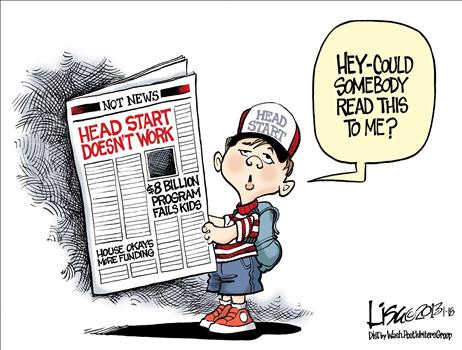
Head Start: Another Costly Government Failure

January 24, 2013 by Dan Mitchell

What’s more realistic: A unicorn, Bigfoot, the Loch Ness Monster, or a successful government program?

This isn’t a trick question. Even though I’ve presented both theoretical and empirical arguments against government spending, that doesn’t mean every government program is a failure.

I suppose the answer depends on the definition of success.

Government roads do enable me to get from Virginia to Washington every day. And the Post Office usually gets mail from one side of the country to another. By that standard, many government programs and activities yield positive results.

But if the question is whether government achieves anything in a cost-efficient manner, you’re probably better off searching under your bed for unicorns.

If you pose this question to someone on the left, however, don’t be surprised if they point to Head Start. The conventional wisdom in Washington is that this program gives low-income kids a critical leg up before they start school.

I would like this to be true. I may not be fond of big and bloated government, but the best interests of these kids are more important than my desire for a talking point against the welfare state.

So what does the evidence say?

Head Start CartoonHere’s what the Washington Examiner wrote about the program, starting with an explanation of what the program is supposed to accomplish.

There are few institutions more sacrosanct in Washington than President Johnson’s Head Start program. The federal government spent more than $7.9 billion on the program in 2012 alone to provide preschool services for nearly 1 million low-income Americans. The program represents everything that is supposedly great about the liberal welfare state. It redistributes resources from wealthy to poor. It uses the power of the federal government to combat inequality by giving poor and minority students an educational boost before they fall behind their wealthier peers. There’s just one problem: It doesn’t work.

Is that an empty assertion? Nope, it’s the evidence from the government’s own research.

The ongoing randomized study of Head Start was based on a nationally representative sample of 5,000 children who applied for the program in 2002. Approximately half of the subjects received Head Start services, while the other half did not. The students were then tested on their language, literacy, math and school performance skills. …the 2010 Head Start Impact Study report notes, “the benefits of access to Head Start at age four are largely absent by 1st grade for the program population as a whole.” Specifically, the language, literacy, math and school performance skills of the Head Start children all failed to improve. …Now, the HHS has finally published a follow-up to its 2010 study that follows the same children through the end of third grade. And again, the HHS has concluded that Head Start is ineffective, concluding that Heat Start resulted in “very few impacts … in any of the four domains of cognitive, social-emotional, health and parenting practices.” And those impacts that were found “did not show a clear pattern of favorable or unfavorable impacts for children.”

So what’s this costing the nation (above and beyond the failure to improve the lives of children)?

Since 1965, the federal government has spent $180 billion on Head Start. …Does that sound like a program you’d want to spend $8 billion on next year?

Now imagine the good things that would have happened if that money was left in the economy’s productive sector.

Or, if you like government, but at least want good results, imagine the good things that would have happened if state and local governments shifted $180 billion from the failed school monopoly into genuine school choice programs.

But let’s close on an optimistic note. As far as I know, there’s no evidence that Head Start actually damages children. It’s just wasted money.

That’s a much better track record than other welfare state programs.

Related posts:

Milton Friedman’s views on vouchers have not been tried?

On the Arkansas Times Blog the person using the username “Jake da Snake” noted, “Friedman also railed long and hard for school vouchers to be adopted, to little avail…” (June 11, 2011). Milton Friedman firmly believed, “competition is a way in which both public and private schools can be required to satisfy their customers.” Here […]

Listing of transcripts and videos of Free to Choose by Milton Friedman: Episode “What is wrong with our schools?” on www.theDailyHatch.org

Everywhere school vouchers have been tried they have been met with great success. Why do you think President Obama got rid of them in Washington D.C.? It was a political disaster for him because the school unions had always opposed them and their success made Obama’s allies look bad. In 1980 when I first sat […]

The Welfare trap can be destroyed by Milton Friedman’s negative income tax

The best way to destroy the welfare trap is to put in Milton Friedman’s negative income tax. A Picture of How Redistribution Programs Trap the Less Fortunate in Lives of Dependency I wrote last year about the way in which welfare programs lead to very high implicit marginal tax rates on low-income people. More specifically, they […]

Listing of transcripts and videos of Free to Choose by Milton Friedman: Episode “What is wrong with our schools?” on www.theDailyHatch.org

Everywhere school vouchers have been tried they have been met with great success. Why do you think President Obama got rid of them in Washington D.C.? It was a political disaster for him because the school unions had always opposed them and their success made Obama’s allies look bad. In 1980 when I first sat […]

Dear Senator Pryor, why not pass the Balanced Budget Amendment? (“Thirsty Thursday”, Open letter to Senator Pryor, quotes Milton Friedman)

Broun Introduces Balanced Budget Amendment Uploaded by RepPaulBroun on Feb 23, 2010 No description available. _______________ Dear Senator Pryor, Why not pass the Balanced  Budget Amendment? As you know that federal deficit is at all time high (1.6 trillion deficit with revenues of 2.2 trillion and spending at 3.8 trillion). On my blog http://www.HaltingArkansasLiberalswithTruth.com I took […]

Listing of transcripts and videos of Free to Choose by Milton Friedman: Episode “What is wrong with our schools?” on www.theDailyHatch.org

Everywhere school vouchers have been tried they have been met with great success. Why do you think President Obama got rid of them in Washington D.C.? It was a political disaster for him because the school unions had always opposed them and their success made Obama’s allies look bad. In 1980 when I first sat […]


Listing of transcripts and videos of “Free to Choose” episode 4 – From Cradle to Grave on www.theDailyHatch.org

In the last few years the number of people receiving Food Stamps has skyrocketed. President Obama has not cut any federal welfare programs but has increased them, and he  has used class warfare over and over the last few months and according to him equality at the finish line is the equality that we should all be talking about. However, socialism has never worked and it has always killed incentive to produce more. Milton Friedman shows in this film series below how so many people get caught in the “Welfare Trap.” Friedman also gives a great solution to this problem in the “negative income tax.” I am glad that I had the chance to be studying his work for over 30 years now.

In 1980 when I first sat down and read the book “Free to Choose” I was involved in Ronald Reagan’s campaign for president and excited about the race. Milton Friedman’s books and film series really helped form my conservative views. Take a look at one of my favorite films of his:

Friedman Friday:(“Free to Choose” episode 4 – From Cradle to Grave, Part 1 of 7)

Volume 4 – From Cradle to Grave
Abstract:

Since the Depression years of the 1930s, there has been almost continuous expansion of governmental efforts to provide for people’s welfare. First, there was a tremendous expansion of public works. The Social Security Act followed close behind. Soon other efforts extended governmental activities in all areas of the welfare sector. Growth of governmental welfare activity continued unabated, and today it has reached truly staggering proportions. Travelling in both Britain and the U.S., Milton Friedman points out that though many government welfare programs are well intentioned, they tend to have pernicious side effects. In Dr. Friedman’s view, perhaps the most serious shortcoming of governmental welfare activities is their tendency to strip away individual independence and dignity. This is because bureaucrats in welfare agencies are placed in positions of tremendous power over welfare recipients, exercising great influence over their lives. Because people never spend someone else’s money as carefully as they spend their own, inefficiency, waste, abuse, theft, and corruption are inevitable. In addition, welfare programs tend to be self-perpetuating because they destroy work incentives. Indeed, it is often in the welfare recipients’ best interests to remain unemployed. Dr. Friedman suggests a negative income tax as a way of helping the poor. The government would pay money to people falling below a certain income level. As they obtained jobs and earned money, they would continue to receive some payments from the government until their outside income reached a certain ceiling. This system would make people better off who sought work and earned income. This contrasts with many of today’s programs where one dollar earned means nearly one dollar lost in welfare payments.

Volume 4 – From Cradle to Grave
Transcript:
Friedman: After the 2nd World War, New York City authorities retained rent control supposedly to help their poorer citizens. The intentions were good. This in the Bronx was one result.
By the 50’s the same authorities were taxing their citizens. Including those who lived in the Bronx and other devastated areas beyond the East River to subsidize public housing. Another idea with good intentions yet poor people are paying for this, subsidized apartments for the well-to-do. When government at city or federal level spends our money to help us, strange things happen.
The idea that government had to protect us came to be accepted during the terrible years of the Depression. Capitalism was said to have failed. And politicians were looking for a new approach.
Franklin Delano Roosevelt was a candidate for the presidency. He was governor of New York State. At the governor’s mansion in Albany, he met repeatedly with friends and colleagues to try to find some way out of the Depression. The problems of the day were to be solved by government action and government spending. The measures that FDR and his associates discussed here derived from a long line of past experience. Some of the roots of these measures go back to Bismark’s Germany at the end of the 19th Century. The first modern state to institute old age pensions and other similar measures on the part of government. In the early 20th Century Great Britain followed suit under Lloyd George and Churchill. It too instituted old age pensions and similar plans.
These precursors of the modern welfare state had little effect on practice in the United States. But they did have a very great effect on the intellectuals on the campus like those who gathered here with FDR. The people who met here had little personal experience of the horrors of the Depression but they were confident that they had the solution. In their long discussions as they sat around this fireplace trying to design programs to meet the problems raised by the worst Depression in the history of the United States, they quite naturally drew upon the ideas that were prevalent at the time. The intellectual climate had become one in which it was taken for granted that government had to play a major role in solving the problems in providing what came later to be called Security from Cradle to Grave.
Roosevelt’s first priority after his election was to deal with massive unemployment. A Public Works program was started. The government financed projects to build highways, bridges and dams. The National Recovery Administration was set up to revitalize industry. Roosevelt wanted to see America move into a new era. The Social Security Act was passed and other measures followed. Unemployment benefits, welfare payments, distribution of surplus food. With these measures, of course, came rules, regulations and red tape as familiar today as they were novel then. The government bureaucracy began to grow and it’s been growing ever since.
This is just a small part of the Social Security empire today. Their headquarters in Baltimore has 16 rooms this size. All these people are dispensing our money with the best possible intentions. But at what cost?
In the 50 years since the Albany meetings, we have given government more and more control over our lives and our income. In New York State alone, these government buildings house 11,000 bureaucrats. Administering government programs that cost New York taxpayers 22 billion dollars. At the federal level, the Department of Health, Education and Welfare alone has a budget larger than any government in the world except only Russia and the United States.
Yet these government measures often do not help the people they are supposed to. Richard Brown’s daughter, Helema, needs constant medical attention. She has a throat defect and has to be connected to a breathing machine so that she’ll survive the nights. It’s expensive treatment and you might expect the family to qualify for a Medicaid grant.
Richard Brown: No, I don’t get it, cause I’m not eligible for it. I make a few dollars too much and the salary that I make I can’t afford to really live and to save anything is out of the question. And I mean, I live, we live from payday to payday. I mean literally from payday to payday.
Friedman: His struggle isn’t made any easier by the fact that Mr. Brown knows that if he gave up his job as an orderly at the Harlem Hospital, he would qualify for a government handout. And he’d be better off financially.
Hospital Worker: Mr. Brown, do me a favor please? There is a section patient.
Friedman: It’s a terrible pressure on him. But he is proud of the work that he does here and he’s strong enough to resist the pressure.
Richard Brown: I’m Mr. Brown. Your fully dilated and I’m here to take you to the delivery. Try not to push, please. We want to have a nice sterile delivery.
Friedman: Mr. Brown has found out the hard way that welfare programs destroy an individual’s independence.
Richard Brown: We’ve considered welfare. We went to see, to apply for welfare but, we were told that we were only eligible for $5.00 a month. And, to receive this $5.00 we would have to cash in our son’s savings bonds. And that’s not even worth it. I don’t believe in something for nothing anyway.
Mrs. Brown: I think a lot of people are capable of working and are willing to work, but it’s just the way it is set up. It, the mother and the children are better off if the husband isn’t working or if the husband isn’t there. And this breaks up so many poor families.
Friedman: One of the saddest things is that many of the children whose parents are on welfare will in their turn end up in the welfare trap when they grow up. In this public housing project in the Bronx, New York, 3/4’s of the families are now receiving welfare payments.
Well Mr. Brown wanted to keep away from this kind of thing for a very good reason. The people who get on welfare lose their human independence and feeling of dignity. They become subject to the dictates and whims of their welfare supervisor who can tell them whether they can live here or there, whether they may put in a telephone, what they may do with their lives. They are treated like children, not like responsible adults and they are trapped in the system. Maybe a job comes up which looks better than welfare but they are afraid to take it because if they lose it after a few months it maybe six months or nine months before they can get back onto welfare. And as a result, this becomes a self-perpetuating cycle rather than simply a temporary state of affairs.
Things have gone even further elsewhere. This is a huge mistake. A public housing project in Manchester, England.
Well we’re 3,000 miles away from the Bronx here but you’d never know it just by looking around. It looks as if we are at the same place. It’s the same kind of flats, the same kind of massive housing units, decrepit even though they were only built 7 or 8 years ago. Vandalism, graffiti, the same feeling about the place. Of people who don’t have a great deal of drive and energy because somebody else is taking care of their day to day needs because the state has deprived them of an incentive to find jobs to become responsible people to be the real support for themselves and their families.

Other segments:

Milton Friedman Friday:(“Free to Choose” episode 4 – From Cradle to Grave, Part 7 of 7)

I am currently going through his film series “Free to Choose” which is one the most powerful film series I have ever seen. TEMIN: We don’t think the big capital arose before the government did? VON HOFFMAN: Listen, what are we doing here? I mean __ defending big government is like defending death and taxes. […]

Milton Friedman Friday:(“Free to Choose” episode 4 – From Cradle to Grave, Part 6 of 7)

I am currently going through his film series “Free to Choose” which is one the most powerful film series I have ever seen worked pretty well for a whole generation. Now anything that works well for a whole generation isn’t entirely bad. From the fact __ from that fact, and the undeniable fact that things […]

Milton Friedman discusses Reagan and Reagan discusses Friedman

Uploaded by YAFTV on Aug 19, 2009 Nobel Laureate Dr. Milton Friedman discusses the principles of Ronald Reagan during this talk for students at Young America’s Foundation’s 25th annual National Conservative Student Conference MILTON FRIEDMAN ON RONALD REAGAN In Friday’s WSJ, Milton Friedman reflectedon Ronald Reagan’s legacy. (The link should work for a few more […]

Milton Friedman Friday:(“Free to Choose” episode 4 – From Cradle to Grave, Part 5 of 7)

 I am currently going through his film series “Free to Choose” which is one the most powerful film series I have ever seen. PART 5 of 7 MCKENZIE: Ah, well, that’s not on our agenda actually. (Laughter) VOICE OFF SCREEN: Why not? MCKENZIE: I boldly repeat the question, though, the expectation having been __ having […]

War on poverty is a failure in USA

Milton Friedman’s solution to limiting poverty Liberals just don’t get it. They should listen to Milton Friedman (who is quoted in this video below concerning the best way to limit poverty). New Video Shows the War on Poverty Is a Failure Posted by Daniel J. Mitchell The Center for Freedom and Prosperity has released another […]

Milton Friedman Friday: (“Free to Choose” episode 4 – From Cradle to Grave, Part 4 of 7)

 I am currently going through his film series “Free to Choose” which is one the most powerful film series I have ever seen. PART 4 of 7 The massive growth of central government that started after the depression has continued ever since. If anything, it has even speeded up in recent years. Each year there […]

Milton Friedman Friday: (“Free to Choose” episode 4 – From Cradle to Grave, Part 3 of 7)

 I am currently going through his film series “Free to Choose” which is one the most powerful film series I have ever seen. PART 3 OF 7 Worse still, America’s depression was to become worldwide because of what lies behind these doors. This is the vault of the Federal Reserve Bank of New York. Inside […]


Milton Friedman Friday:(“Free to Choose” episode 4 – From Cradle to Grave, Part 2 of 7)

 I am currently going through his film series “Free to Choose” which is one the most powerful film series I have ever seen. For the past 7 years Maureen Ramsey has had to buy food and clothes for her family out of a government handout. For the whole of that time, her husband, Steve, hasn’t […]

Friedman Friday:(“Free to Choose” episode 4 – From Cradle to Grave, Part 1 of 7)

Friedman Friday:(“Free to Choose” episode 4 – From Cradle to Grave, Part 1 of 7) Volume 4 – From Cradle to Grave Abstract: Since the Depression years of the 1930s, there has been almost continuous expansion of governmental efforts to provide for people’s welfare. First, there was a tremendous expansion of public works. The Social Security Act […]

“Friedman Friday” EPISODE “The Power of the Market” of Free to Choose in 1990 by Milton Friedman (Part 5)

Milton Friedman The Power of the Market 5-5


How can we have personal freedom without economic freedom? That is why I don’t understand why socialists who value individual freedoms want to take away our economic freedoms.  I wanted to share this info below with you from Milton Friedman who has influenced me greatly over the last 30 plus years. Here is part five which consists of a lively discussion between Friedman and several other interested scholars concerning his film.
____________
 
I’m Linda Chavez. Welcome to Free to Choose. Joining Dr. Friedman in a discussion of the power of the market are David Brooks of the Wall Street Journal, and James Galbraith of the University of Texas at Austin.

Friedman: In any event, I am not trying to defend one political party or another. As David says, a major enemy of a free market is a business interest. The business community is a major enemy and the problem in this society is to have the public at large understand the importance of free markets so as to protect themselves against the depredation of the business community with their tariffs, their quotas, their special provisions, and so on. But you cover all of these good things that society is supposed to do, you have to look at how many of them have been perverse in their influences and their effect. You mentioned the FDA and that is a very important case because that’s cost tens of thousands of lives over the course of time.

Brooks: You can start with the AIDS virus where the FDA tries again __ recently there have been reforms but they were very slow, even people who knew they were going to die and were going to die without any drug to try experimental drugs.

Chavez: Let me ask another question.

Galbraith: You have to establish that those experimental drugs would have, in fact, saved their lives.

Brooks: They couldn’t have done worse __ they were going to die.

Chavez: Let me give you another hypothetical. What if you have a social need, say a disease which is very lethal but effects very few people and you don’t have a company who has an interest because it is not going to make very much money, there is not a large market for the good to produce a drug, does the government have any role there to step in and try to stimulate certain social purposes?

Brooks: It’s hard for me to imagine how the government would, in the first place.

Friedman: In any event, you must realize that government isn’t the only recourse. The great period, when were the nonprofit hospitals of the United States founded? Almost all of them were in the 19th century, during the hay day of laissez faire. There are private charitable activities which are essentially the most effective way of handling the kinds of things you have described.

Galbraith: A little bit of faithfulness to history surely would cause you to concede that in 1937, when we inaugurated social security, 1965 when we inaugurated Medicare, we did so because the private charitable systems, the private insurance systems to care for people when they were old and when they were sick were failing in a gross way to meet the needs of the American people. And those programs, which are government programs, have at least had the virtue of extending the access to health care and extending income security when you are old to a very large part of the population that never had it before.

I would argue too that in addition to the regulatory functions and the judicial functions that we certainly agree on, that there is, in a rich society which can afford to take care of people who fell out of the market process, who aren’t lucky or gifted or fortunate in their economic lives, to take care of those people when they are old and when they are sick.

Friedman: What about the extent to which the same society that you described, the same logic you described, makes them poor. What about the minimum wage which prevents many people from getting employment. What about the rent controls which destroy housing in the cities.

Brooks: To switch over, you can point to the minimum wage which everybody agrees increases unemployment among the poor especially, but what about the environment. If you have a simple environmental law __ the reason the West is cleaner than the Eastern Bloc, the main reason is that we are richer. We can afford to do it.

Friedman: The problem, so far as the environment is concerned, the real function of the government is to define the property rights and it is quite clear that if I force you to take bad water for good water, then I ought to pay you. I am not quarreling with that. But if you look at the actual environmental measures that government takes, they often have harmful effects and not positive effects. The new Clean Air Bill that has just been passed, for example, is going to cost an enormous amount of money.

Brooks: Nobody knows how much.

Galbraith: It is in principle, of course, your argument is one which many economists are sympathetic to and I have some sympathy for it, but the technical facts of environmental control are such that it is often very costly to define the property rights in a way in which you can generate a efficiently functioning market. That is why you don’t have a private and organized market. The information cost of those transactions is extremely high. So, in some cases, what you want to have the government do is say, if there is mercury in the water, you find out who is putting it in and . . . . . that is the reasonable way to proceed because the alternative is extremely costly.

Friedman: Let’s look at what the government actually does. In the United States today, the federal government spends an amount of money which is 25% of the national income. State and local governments spend an additional 17% of the national income. That is 42% all together. Now, some of that is doing good, of course. It would be very hard to spend that amount of money. But an enormous amount of that is simply taking money from some and giving it to others and very often taking it from poor, giving it to well-to-do, . . . .

Galbraith: . . . social security in that which is taking money from the payroll tax from working people . . .

Friedman: On the whole, as far as social security is concerned, the people who pay are poorer than the people who benefit.

Chavez: Gentlemen, we are out of time. Thank you for watching Free to Choose. Next week we will be discussing what happens when government enters the marketplace.

Dear Senator Pryor, why not pass the Balanced Budget Amendment? (“Thirsty Thursday”, Open letter to Senator Pryor)

House Republicans for a Balanced Budget Amendment

Uploaded by on Nov 17, 2011

This week, House Republican freshmen Members held a press conference to discuss the importance of passing a balanced budget amendment to the United States Constitution and how now is the time for a permanent solution to our nation’s spending-driven debt crisis. We need a balanced budget amendment to ensure a prosperous future for our children and grandchildren. It’s the right thing to do.

______________

Dear Senator Pryor,

Why not pass the Balanced  Budget Amendment? As you know that federal deficit is at all time high (1.6 trillion deficit with revenues of 2.2 trillion and spending at 3.8 trillion).

On my blog www.HaltingArkansasLiberalswithTruth.com I took you at your word and sent you over 100 emails with specific spending cut ideas. However, I did not see any of them in the recent debt deal that Congress adopted. Now I am trying another approach. Every week from now on I will send you an email explaining different reasons why we need the Balanced Budget Amendment. It will appear on my blog on “Thirsty Thursday” because the government is always thirsty for more money to spend.

Over and over in the past Milton Friedman pleaded for restraint in our federal spending. Below you will see a fine article supporting the Balanced Budget Amendment and it points out that Friedman favored this mechanism to control our spending.

The Answer Is a Balanced Budget Amendment

By from the October 2011 issue

The question is how to solve our problem of unsustainable debt.

The United States of America is on the road to bankruptcy, with a federal debt of more than $14.2 trillion, almost half of which is owned by foreign countries. (Communist China alone owns fully a quarter of the foreign-held portion). The problem is so well known that it almost came as an anticlimax when Standard & Poor’s recently downgraded U.S. debt from its coveted AAA rating to an unheard-of AA+. As for the budget deficit, it is expected to total $1.3 trillion for this year alone, with tax revenues of about $2.3 trillion and total expenditures of about $3.6 trillion. If a household ran its budget like that, we would say it was headed for a rude shock.

Making matters worse is that our debt is structural rather than cyclical: the federal budget is in deficit both in good economic times and bad. When George W. Bush took office in 2001, the gross federal debt was $5.76 trillion. When he left eight years later, the debt was up to $10.626 trillion, an increase of $607 billion a year. During Barack Obama’s presidency it has risen by $1.7 trillion a year and now almost 40 percent higher than when he took office. Deficits of this size are quite simply unsustainable.

The only way to fix this mess is to radically cut federal spending, cap the budget with pay-as-you-go spending rules, and then enact a balanced budget amendment (BBA).

The most important point is that we need to cut spending, not raise taxes. Total federal spending as a percentage of Gross Domestic Product (GDP) has skyrocketed from around 18 percent, when George W. Bush became president, to more than 25 percent today. This shows that our current deficit problem is entirely due to overspending. If tomorrow we cut spending back to the levels of January 20, 2001, when Bush took office, the deficit would almost disappear.

Then we need to cap and balance the budget, once we’ve cut overall spending back to 2001 levels. To do this effectively, we need to enact a federal BBA to the U.S. Constitution. This amendment should have several features.

First, it should require that the president submit to Congress each year a balanced federal budget with no fiscal gimmicks. Presidential failure to do so would be an impeachable offense. Congress should be constitutionally required to hold a vote in both houses on the president’s proposed budget within three months, with the president and Congress having up to six months to adopt a final budget in any given calendar year (this requirement should be waivable during any time of declared war for up to two years). If they fail to do that, all federal spending except for payments on the debt should be frozen at levels 10 percent lower than in the preceding fiscal year. To help impose this, any one of the several states should have standing to sue in the Supreme Court’s original jurisdiction for enforcement of this requirement.

Second, the BBA should cap federal spending at 18 percent of GDP. A spending cap of this proportion would keep the federal government at the size it was under President Bill Clinton — hardly onerous or severe. The amendment should require a two-thirds vote of both houses of Congress to enact any new taxes or to raise tax rates. Votes to raise the national debt limit should also require a two-thirds majority. These provisions are essential to prevent a BBA from becoming just an excuse to raise taxes.

THE USUAL RESPONSE to calls for such an amendment is that we ought not tamper with the Constitution. Critics of a BBA also claim it is not needed since a majority of Congress could balance the budget today if it really wanted to. There are at least five reasons why those critics are dead wrong.

First, it is a core principle of American constitutionalism that there be no taxation without representation. The American Revolution was fought in part to prevent taxation by a British Parliament in which Americans were not represented. When Congress borrows 40 cents of every dollar it spends, as it is doing today, it passes the burden of paying for current spending on to our children and grandchildren who cannot vote right now — nothing less than taxation without representation.

Second, a core purpose of the Constitution is to protect fundamental principles like freedom of speech and of the press from being whittled away during moments of legislative passion. Exactly the same argument holds true with respect to spending more money than the government collects in tax revenue. Constitutionalizing the balanced budget requirement is as necessary as constitutionalizing the protection of freedom of speech and of the press. This is an argument that was first made more than 30 years ago by Noble Prize laureate Milton Friedman. It is just as true today as it was then.

Third, there is an economic reason why it is easier to assemble lobbies for government spending than it is to assemble a nationwide lobby for a balanced budget. Consider the farm lobby that argues for agricultural price supports, or the AARP that lobbies for benefits for the elderly. It is cheaper and easier for small groups with a shared common interest to lobby Congress than for a large, diffuse majority of the American population to do the same. That’s why the silent majority is silent. A BBA in the Constitution would prevent the special interests from ripping off the children and grandchildren of the silent majority. James Madison wrote in The Federalist No. 51 that the secret of constitutional government was to make ambition counteract ambition. The way to check and balance over-spending is to constitutionalize a pay-as-you-go rule while making tax increases hard to enact.

Fourth, yet another economic reason for a BBA is that it would reduce risk and thereby promote investment. When people are looking for a place to invest, one of their first questions is how risky is the investment and how large is the potential reward. Foreign and American investors since World War II have invested in the U.S. and in its debt because our Constitution of checks and balances makes it hard to do crazy things like nationalize industries or set up a single payer health insurance monopoly.

A BBA would reduce further the risk of investing in the U. S., and that would promote investment and economic growth by constitutionally committing itself not to overspend. The risk of inflationary devaluation of the dollar would thus go way down. This in turn would bolster the dollar as the world’s reserve currency. It would also prevent federal borrowing from crowding out private sector borrowing in the U.S. This would free up a capital for investment in job-creating ventures.

A fifth argument for the BBA paradoxically grows out of one of the arguments commonly made against it: it would be purely symbolic. Or as James Madison would have said, “a mere parchment barrier” against overspending.

This criticism fails for many reasons. A BBA of the kind I argue for would have enforcement teeth. Presidential failure to submit a good-faith balanced budget would be a specific ground for impeachment. Then too, if Congress failed to enact a balanced budget, state governments could sue for an across theboard spending cut of 10 percent.

But suppose Congress wimps out and enacts a BBA without teeth. Would such a symbolic victory be worth anything? The answer again is clearly yes. Almost every state has some form of a balanced budget requirement in its constitution or law. The fact is that balanced budget requirements actually do work at the state level. This strongly suggests they would work at the federal level as well.

CONSTITUTIONAL PROVISIONS, even symbolic ones, set the agenda of political debate. The Second and Tenth Amendments clearly do that in the U.S. today, even though the federal courts almost never enforce them. A BBA would work very much the same way.

The case for a BBA is so powerful that Germany and Switzerland — both models of fiscal sobriety — actually require a balanced budget in their own constitutions. And now Germany and France have actually proposed requiring that all Eurozone countries amend their national constitutions to require a balanced budget. What is good enough for almost every state in the Union and for many countries of Europe is certainly worth trying at the federal level here.

So what harm could come from enacting a BBA to the U.S. Constitution? Is there any argument against such an amendment that outweighs the arguments in favor of it?

One concern conservatives have is that it might lead to tax increases. I share that concern and therefore would couple it with a super-majority requirement for tax increases. That should make a BBA clearly appealing to conservatives of all stripes. But what if such an amendment gets ratified that does not protect against tax increases? Would we then be worse off?

I think the answer is no. It is harder politically for Congress to tax real people living today than it is to borrow money from the children and grandchildren of the silent majority. People living today will mobilize in many ways against tax increases. The correct solution is to cut, cap, and balance, but I would not let concerns about tax increases stop us from doing what virtually every state constitution does.

Another real concern for conservatives is that a BBA could lead to dangerous cuts in spending on national defense. This concern I share. The U.S. is a world leader and the greatest force for liberty and economic opportunity in history. We must always be ready to defend liberty worldwide.

The problem is, however, that current levels of deficit spending — almost half of which is financed by foreign countries — is itself a threat to U.S. global might. We simply cannot defend liberty in Asia, for example, if we continue to borrow massively from the Chinese. We cannot defend freedom in Arab countries while being so dependent on Saudi Arabia and others for imported oil and purchases of our debt. The status quo is at least as threatening to America’s military might as is living under a BBA, for the status quo is not sustainable.

Finally, some conservatives argue that the solution to congressional deficit spending is a line item veto amendment giving the president the same power over spending enjoyed by a majority of state governors. I am quite skeptical about such an amendment because of the enormous power it would shift from Congress to the president. Imagine for a moment that President Obama could threaten senators or representatives with line item vetoes of locally important spending projects unless they voted his way on socialized medicine. Or on a card check law reform making it easy to fraudulently form a union. Do we really want to cede that much power from Congress to the president? I do not think so.

In sum, we need to cut, cap, and balance. To do that permanently, we must enact a BBA. Nothing less than the future of government of the people, by the people, and for the people is at stake.

Listing of transcripts and videos of Free to Choose by Milton Friedman: Episode “Created Equal” on www.theDailyHatch.org


Milton Friedman in his series “Free to Choose” used a pencil as a simple example to should have the “invisible hand” of the freemarket works (phrase originally used by Adam Smith).
 
 
Milton Friedman congratulated by President Ronald Reagan. © 2008 Free To Choose Media, courtesy of the Power of Choice press kit

Here are some great quotes about Milton Friedman:

“Milton Friedman is a scholar of first rank whose original contributions to economic science have made him one of the greatest thinkers in modern history.”
President Ronald Reagan

“How grateful I have been over the years for the cogency of Friedman’s ideas which have influenced me. Cherishers of freedom will be indebted to him for generations to come.”
Alan Greenspan, former Chairman, Federal Reserve System

“Right at this moment there are people all over the land, I could put dots on the map, who are trying to prove Milton wrong. At some point, somebody else is trying to prove he’s right That’s what I call influence.”
Paul Samuelson, Nobel Laureate in Economic Science

“Friedman’s influence reaches far beyond the academic community and the world of economics. Rather than lock himself in an ivory tower, he has joined the fray to fight for the survival of this great country of ours.”
William E. Simon, former Secretary of the Treasury

“Milton Friedman is the most original social thinker of the era.”
John Kenneth Galbraith, former Professor of Economics, Harvard University

Perhaps Friedman’s greatest success began in 1979 when he and his wife Rose authored the book, Free to Choose, based on the famous ten-part TV series for PBS by the same title. Both the TV program and the book were drawn from an earlier series of lectures presented by Friedman. Because it aired during a period of critical economic distress during the Carter Administration and in the aftermath of the Vietnam War, Watergate scandal, and Richard Nixon’s resignation as President, the program is widely regarded as being a major factor in shifting American public opinion toward appreciating the need to dismantle government largess. The series was shown in England, Japan, Italy, Australia, Germany, Canada, and many other countries, and the book was translated for distribution around the world, selling more than one million copies.

__________

No other issue is more misunderstood today than equality. President Obama has used class warfare over and over the last few months and according to him equality at the finish line is the equality that we should all be talking about. However, socialism has never worked and it has always killed incentive to produce more. Milton Friedman expressed the conversative’s best and I am glad that I had the chance to be studying his work for over 30 years now.

In 1980 when I first sat down and read the book “Free to Choose” I was involved in Ronald Reagan’s campaign for president and excited about the race. Milton Friedman’s books and film series really helped form my conservative views. Take a look at one of my favorite films of his:

Created Equal [1/7]. Milton Friedman’s Free to Choose (1980)

Uploaded by on May 30, 2010

In this program, Milton Friedman visits India, the U.S., and Britain, examining the question of equality. He points out that our society traditionally has embraced two kinds of equality: equality before God and equality of opportunity. The first of these implies that human beings enjoy a certain dignity simply because they are members of the human community. The second suggests societies should allow the talents and inclinations of individuals to unfold, free from arbitrary barriers. Both of these concepts of equality are consistent with the goal of personal freedom.

In recent years, there has been growing support for a third type of equality, which Dr. Friedman calls “equality of outcome.” This concept of equality assumes that justice demands a more equal distribution of the economic fruits of society. While admitting the good intentions of those supporting the idea of equality of outcome, Dr. Friedman points out that government policies undertaken in support of this objective are inconsistent with the ideal of personal freedom. Advocates of equality of outcome typically argue that consumers must be protected by government from the insensitivities of the free market place.

Dr. Friedman demonstrates that in countries where governments have pursued the goal of equality of outcome, the differences in wealth and well being between the top and the bottom are actually much greater than in countries that have relied on free markets to coordinate economic activity. Indeed, says Dr. Friedman, it is the ordinary citizen who benefits most from the free market system. Dr. Friedman concludes that any society that puts equality ahead of freedom will end up with neither. But the society that puts freedom before equality will end up with both greater freedom and great equality.

___________________________

FREE TO CHOOSE 5: “Created Equal” (Milton Friedman)
Free to Choose ^ | 1980 | Milton Friedman

Posted on Friday, July 21, 2006 3:58:44 PM by Choose Ye This Day

FREE TO CHOOSE: Created Equal

Friedman: From the Victorian novelists to modern reformers, a favorite device to stir our emotions is to contrast extremes of wealth and of poverty. We are expected to conclude that the rich are responsible for the deprivations of the poor __ that they are rich at the expense of the poor.

Whether it is in the slums of New Delhi or in the affluence of Las Vegas, it simply isn’t fair that there should be any losers. Life is unfair __ there is nothing fair about one man being born blind and another man being born with sight. There is nothing fair about one man being born of a wealthy parent and one of an indigenous parent. There is nothing fair about Mohammed Ali having been born with a skill that enables him to make millions of dollars one night. There is nothing fair about Marleena Detrich having great legs that we all want to watch. There is nothing fair about any of that. But on the other hand, don’t you think a lot of people who like to look at Marleena Detrich’s legs benefited from nature’s unfairness in producing a Marleena Detrich. What kind of a world would it be if everybody was an absolute identical duplicate of anybody else. You might as well destroy the whole world and just keep one specimen left for a museum. In the same way, it’s unfair that Muhammed Ali should be a great fighter and should be able to earn millions. But would it not be even more unfair to the people who like to watch him if you said that in the pursuit of some abstract idea of equality we’re not going to let Muhammed Ali get more for one nights fight than the lowest man on the totem pole can get for a days unskilled work on the docks. You can do that but the result of that would be to deny people the opportunity to watch Mohammad Ali. I doubt very much he would be willing to subject himself to the kind of fights he’s gone through if he were to get the pay of an unskilled docker.

This beautiful estate, its manicured lawns, its trees, its shrubs, was built by men and women who were taken by force in Africa and sold as slaves in America. These kitchen gardens were planted and tended by them to furnish food for themselves and their master, Thomas Jefferson, the Squire of Monticello. It was Jefferson who wrote these words: We hold these truths to be self-evident that all men are created equal. That they are endowed by their creator with certain inalienable rights, that among these are life, liberty and the pursuit of happiness. These words penned by Thomas Jefferson at the age of 33 when he wrote the Declaration of Independence, have served to define a basic ideal of the United States throughout its history.

Much of our history has revolved about the definition and redefinition of the concept of equality, about the intent to translate it into practice. What did Thomas Jefferson mean by the words all men are created equal? He surely did not mean that they were equal and/or identical in what they could do and what they believed. After all, he was himself a most remarkable person. At the age of 26, he designed this beautiful house of Monticello, supervised its construction and indeed is said to have worked on it with his own hands. He was an inventor, a scholar, an author, a statesman, governor of Virginia, President of the United States, minister to France, he helped shape and create the United States. What he meant by the word “equal” can be seen in the phrase “endowed by their creator”. To Thomas Jefferson, all men are equal in the eyes of God. They all must be treated as individuals who have each separately a right to life, liberty and the pursuit of happiness.

Of course, practice did not conform to the ideals. In Jefferson’s life or in ours as a nation, he agonized repeatedly during his lifetime about the conflict between the institution of slavery and the fine words of the declaration. Yet, during his whole life, he was a slave owner.

This is the City Palace in Jaipur, the capitol of the Indian state of Rajasthan, is just one of the elegant houses that were built here 150 years ago by the prince who ruled this land. There are no more princes, no more Maharajas in India today. All titles were swept away by the government of India in its quest for equality. But as you can see, there are still some people here who live a very privileged life. The descendants of the Maharajas financed this kind of life partly by using other palaces as hotels for tourists __ tourists who come to India to see how the other half lives. This side of India, the exotic glamorous side, is still very real. Everywhere in the world there are gross inequalities of income and wealth. They offend most of us.

A myth has grown up that free market capitalism increases such inequalities, that the rich benefit at the expense of the poor. Nothing could be further from the truth. Wherever the free market has been permitted to operate, the ordinary man has been able to attain levels of living never dreamed of before. Nowhere is the gap between rich and poor. Nowhere are the rich richer and the poor poorer than in those societies that do not permit the free market to operate, whether they be feudal societies where status determines position, or modern, centrally-planned economies where access to government determines position.

Central planning was introduced in India in considerable part in the name of equality. The tragedy is that after 30 years, it is hard to see any significant improvement in the lot of the ordinary person.

__________________

Other segments:

Free to Choose by Milton Friedman: Episode “Created Equal” (Part 7 of transcript and video)

Liberals like President Obama want to shoot for an equality of outcome. That system does not work. In fact, our free society allows for the closest gap between the wealthy and the poor. Unlike other countries where free enterprise and other freedoms are not present.  This is a seven part series. Created Equal [7/7]. Milton Friedman’s Free to Choose […]

Liberals’ solution for the poor is more welfare, but that will not work

Milton Friedman’s solution to limiting poverty Liberals like Michael Cook just don’t get it. They should listen to Milton Friedman (who is quoted in this video below concerning the best way to limit poverty). New Video Shows the War on Poverty Is a Failure Posted by Daniel J. Mitchell The Center for Freedom and Prosperity has […]

Free to Choose by Milton Friedman: Episode “Created Equal” (Part 6 of transcript and video)

Liberals like President Obama want to shoot for an equality of outcome. That system does not work. In fact, our free society allows for the closest gap between the wealthy and the poor. Unlike other countries where free enterprise and other freedoms are not present.  This is a seven part series. Created Equal [6/7]. Milton Friedman’s Free to Choose […]

“Friedman Friday” Free to Choose by Milton Friedman: Episode “Created Equal” (Part 5 of transcript and video)

Liberals like President Obama want to shoot for an equality of outcome. That system does not work. In fact, our free society allows for the closest gap between the wealthy and the poor. Unlike other countries where free enterprise and other freedoms are not present.  This is a seven part series. Created Equal [5/7]. Milton Friedman’s Free to Choose […]

Republican debate Oct 18, 2011 (last part) with video clips and transcript

Republican debate Oct 18, 2011 (last part) with video clips and transcript Below are video clips and the transcript. pt 5 pt 6 pt 7 COOPER: We’re going to move on to an issue very important here in the state of Nevada and throughout the West. We have a question from the hall. QUESTION: Yeah, […]

Milton Friedman discusses Reagan and Reagan discusses Friedman

Uploaded by YAFTV on Aug 19, 2009 Nobel Laureate Dr. Milton Friedman discusses the principles of Ronald Reagan during this talk for students at Young America’s Foundation’s 25th annual National Conservative Student Conference MILTON FRIEDMAN ON RONALD REAGAN In Friday’s WSJ, Milton Friedman reflectedon Ronald Reagan’s legacy. (The link should work for a few more […]

Free to Choose by Milton Friedman: Episode “Created Equal” (Part 4 of transcript and video)

Liberals like President Obama want to shoot for an equality of outcome. That system does not work. In fact, our free society allows for the closest gap between the wealthy and the poor. Unlike other countries where free enterprise and other freedoms are not present.  This is a seven part series. Created Equal [4/7]. Milton Friedman’s Free to Choose […]

Friedman Friday” Free to Choose by Milton Friedman: Episode “Created Equal” (Part 3 of transcript and video)

Friedman Friday” Free to Choose by Milton Friedman: Episode “Created Equal” (Part 3 of transcript and video) Liberals like President Obama want to shoot for an equality of outcome. That system does not work. In fact, our free society allows for the closest gap between the wealthy and the poor. Unlike other countries where free enterprise and other […]

Free to Choose by Milton Friedman: Episode “Created Equal” (Part 2 of transcript and video)

Free to Choose by Milton Friedman: Episode “Created Equal” (Part 2 of transcript and video) Liberals like President Obama want to shoot for an equality of outcome. That system does not work. In fact, our free society allows for the closest gap between the wealthy and the poor. Unlike other countries where free enterprise and other freedoms are […]

Free to Choose by Milton Friedman: Episode “Created Equal” (Part 1 of transcript and video)

 Milton Friedman and Ronald Reagan Liberals like President Obama (and John Brummett) want to shoot for an equality of outcome. That system does not work. In fact, our free society allows for the closest gap between the wealthy and the poor. Unlike other countries where free enterprise and other freedoms are not present.  This is a seven part series. […]