Category Archives: Milton Friedman

Milton Friedman’s Chicago Boys started the Chilean Miracle and it is still helping ordinary people today!!!

Milton Friedman and Chile – The Power of Choice

Uploaded on May 13, 2011

In this excerpt from Free To Choose Network’s “The Power of Choice (2006)”, we set the record straight on Milton Friedman’s dealings with Chile — including training the Chicago Boys and his meeting with Augusto Pinochet. Was the tremendous prosperity unleashed after the Chicago Boys reforms worth the free-market therapy Friedman suggested? You be the judge. But when doing so, just remember the policies leading up to liberalization (land seizures, industry nationalizations and price controls).

_______________


I have discussed Milton Friedman and Chile before and it an amazing story. Evidently what Milton Friedman’s Chicago Boys started many years ago in the 1970’s is still working today.

I’m in Vienna, Austria, for the annual European Resource Bank meeting.

I had the pleasure last night of listening to Jose Pinera speak about economic reform in Chile, particularly the system of personal retirement accounts.

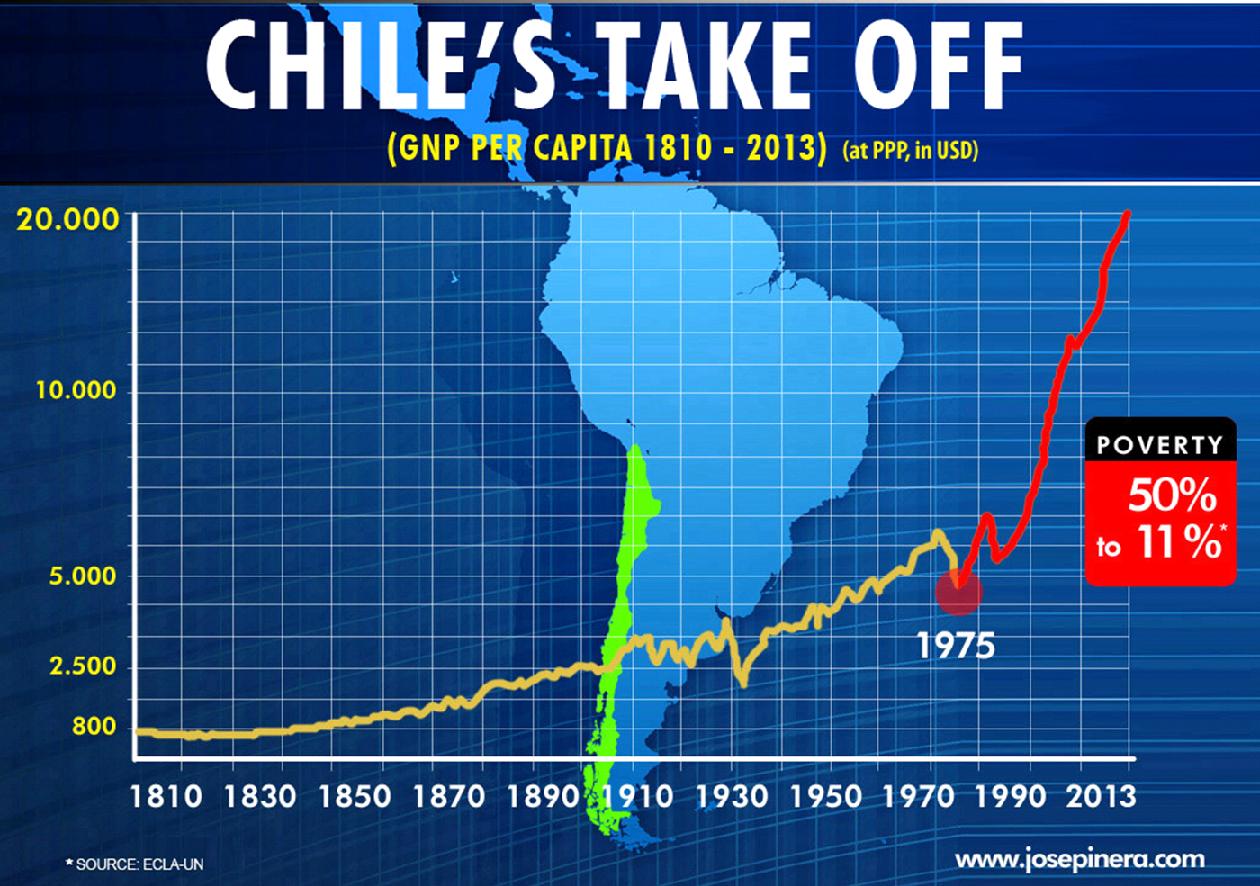
He shared a chart that conclusively shows why good economic policy makes a difference.

Chile Miracle

Wow. Look at how much faster the economy has grown since the communists were ousted in 1975 and replaced by a pro-market government.* And the poverty rate has plummeted from 50 percent to 11 percent!

Simply stated, economic reform has been hugely beneficial to poor and middle-class people in Chile. Something to remember as we try to rein in the welfare state in America.

Let’s look at some more data. A couple of years ago, I shared this chart showing how Chile had out-paced Argentina and Venezuela. In other words, Chile’s performance is ultra-impressive, whether examined in isolation or in comparison with other nations in the region.

The reason for all this success is that Chile didn’t just reform its pension system. As you can see from this Economic Freedom of the World data, Chile has made improvements in virtually all areas of public policy.

The nationwide school choice system, for instance, is another example of very beneficial reform.

It’s not quite Hong Kong or Singapore, but Chile is definitely a huge success story.

*The Pinochet government that took power in the 1970s may have been pro-economic liberty, but it also was authoritarian. Fortunately, Chile made a successful and peaceful transition to democracy in the late 1980s and has generally continued on a pro-free market path.


Related posts:

Milton Friedman and Chile an update

Milton Friedman was a great economist and a fine speaker. ___________________ I have written before about Milton Friedman’s influence on the economy of Chile. Now I saw this fine article below from http://www.heritage.org  and below that article I have included an article from the Wall Street Journal that talks about Milton Friedman’s influence on Chile. I […]


Open letter to President Obama (Part 300) (Chile’s Amazing School Choice Revolution)

Milton Friedman – Public Schools / Voucher System (Q&A) Part 1 Published on May 7, 2012 by BasicEconomics ___________ President Obama c/o The White House 1600 Pennsylvania Avenue NW Washington, DC 20500 Dear Mr. President, I know that you receive 20,000 letters a day and that you actually read 10 of them every day. I […]


Milton Friedman discusses Voucher System

The Machine: The Truth Behind Teachers Unions Published on Sep 4, 2012 by ReasonTV America’s public education system is failing. We’re spending more money on education but not getting better results for our children. That’s because the machine that runs the K-12 education system isn’t designed to produce better schools. It’s designed to produce more […]


“Friedman Friday” Transcript and video of Milton Friedman on Bill Clinton and Ronald Reagan (Part 1)

Below is a discussion from Milton Friedman on Bill Clinton and Ronald Reagan. February 10, 1999 | Recorded on February 10, 1999 audio, video, and blogs » uncommon knowledge PRESIDENTIAL REPORT CARD: Milton Friedman on the State of the Union with guest Milton Friedman Milton Friedman, Senior Research Fellow, Hoover Institution and Nobel Laureate in […]


What were the main proposals of Milton Friedman?

Stearns Speaks on House Floor in Support of Balanced Budget Amendment Uploaded by RepCliffStearns on Nov 18, 2011 Speaking on House floor in support of Balanced Budget Resolution, 11/18/2011 ___________ Below are some of the main proposals of Milton Friedman. I highly respected his work. David J. Theroux said this about Milton Friedman’s view concerning […]


Free or equal? 30 years after Milton Friedman’s Free to Choose (Part 5)

Johan Norberg – Free or Equal – Free to Choose 30 years later 5/5 Published on Jun 10, 2012 by BasicEconomics In 1980 economist and Nobel laureate Milton Friedman inspired market reform in the West and revolutions in the East with his celebrated television series “Free To Choose.” Thirty years later, in this one-hour documentary, […]


Free or equal? 30 years after Milton Friedman’s Free to Choose (Part 4)

Johan Norberg – Free or Equal – Free to Choose 30 years later 4/5 Published on Jun 10, 2012 by BasicEconomics In 1980 economist and Nobel laureate Milton Friedman inspired market reform in the West and revolutions in the East with his celebrated television series “Free To Choose.” Thirty years later, in this one-hour documentary, […]


Margaret Thatcher admired Milton Friedman

RARE Friedman Footage – On Keys to Reagan and Thatcher’s Success

Margaret Thatcher and Milton Friedman were two of my heroes.

Thatcher praises Friedman, her freedom fighter

Milton Friedman, the free market economist who inspired Margaret Thatcher’s economic reforms of the 1980s, died yesterday aged 94.

His theory that inflation resulted from too much money chasing too few goods inspired a generation of central bankers and played a pivotal role in forming the governing philosophies of Lady Thatcher and President Ronald Reagan in the US.

Lady Thatcher said last night: “Milton Friedman revived the economics of liberty when it had been all but forgotten. He was an intellectual freedom fighter. Never was there a less dismal practitioner of a dismal science.

“I shall greatly miss my old friend’s lucid wisdom and mordant humour.”

Mr Friedman, winner of a 1976 Nobel Prize, died in hospital in San Francisco of heart failure, according to his family. He was born in Brooklyn on July 31 1912, the son of a merchant and a seamstress who were immigrants from Austria-Hungary.

His teachings at the University of Chicago helped foster the “Chicago School” of economics, known for theories associated with free-market libertarianism.

When he first came to prominence in the late 1940s, he was one of a tiny minority who ventured to question the prevailing wisdom of Keynesianism, that economies could and should be managed by manipulation of taxes and government spending.

But by the mid-1970s — as inflation took off and state-dominated economies slid into decline — Friedman’s ideas influenced Sir Keith Joseph, who advised the new Tory leader, Margaret Thatcher, to reject the interventionist policies of her predecessor Edward Heath.

He served as an adviser to the Thatcher government from 1979 to 1990 as it developed a free-market economy, low taxation, and the sale of state-owned industries.

Mr Friedman believed that tax-funded government spending was appropriate only to the most limited set of “public goods”, such as national defence.

Related posts:

Remembering Margaret Thatcher, 1925-2013

Remembering Margaret Thatcher, 1925-2013 Published on Apr 8, 2013 The world lost one of its greatest champions of freedom in Lady Margaret Thatcher. Ed Feulner, Edwin Meese III, and Becky Norton Dunlop remember her contributions as a great leader and friend of The Heritage Foundation. ________________ Great post from the Heritage Foundation on Margaret Thatcher’s legacy. […]

Margaret Thatcher and the Battle of the 364 Keynesians (includes editorial cartoon)

The stimulus program was a failure here in America and President Obama should have known better than to try that. He should have been a better student of history like Margaret Thatcher was. APRIL 9, 2013 3:24PM Margaret Thatcher and the Battle of the 364 Keynesians By  STEVE H. HANKE SHARE With the death of Margaret […]

Margaret Thatcher’s best quote?

Margaret Thatcher was right about socialism when she said, “The problem with socialism is that you eventually run out of other people’s money.” That is exactly what we are seeing in Europe now and it will happen to the USA too if we don’t cut back on excessive government spending. April 8, 2013 12:32PM Thatcher: Anecdotes From […]

Dan Mitchell’s tribute to Margaret Thatcher

Very well said by Dan Mitchell. A Tribute to Margaret Thatcher April 8, 2013 by Dan Mitchell The woman who saved the United Kingdom has died. A Great Woman I got to meet Margaret Thatcher a couple of times and felt lucky each time that I was in the presence of someone who put her nation’s […]

Margaret Thatcher was a great lady

  Margaret Thatcher was a great lady. Jim DeMint on Margaret Thatcher: “The World Has Lost One of Its Greatest Champions of Freedom” Jim DeMint April 8, 2013 at 9:05 am Heritage has lost one of her greatest friends, and the world has lost one of its greatest champions of freedom. Margaret Thatcher led Great […]

Margaret Thatcher defines socialism

  Great speech by Margaret Thatcher on socialism. It was not helpful to the people of eastern europe and it will not be helpful to us today. Defining Socialism Marion Smith December 10, 2012 at 5:25 pm   Margaret Thatcher on Socialism For those who failed to recognize the ideological stakes of the recent election, […]

Margaret Thatcher exposed the real liberal agenda

Uploaded by mynameiswhatever on Jan 18, 2009 Margaret Thatcher’s last House of Commons Speech on November 22, 1990. ________________ Prime Minister Margaret Thatcher: People on all levels of income are better off than they were in 1979. The hon. Gentleman is saying that he would rather that the poor were poorer, provided that the rich […]

Does the movie “Iron Lady” do Margaret Thatcher justice?

Unfortunately Hollywood has their own agenda many times. Great article from the Heritage Foundation. Morning Bell: The Real ‘Iron Lady’ Theodore Bromund January 11, 2012 at 9:24 am Streep referred to the challenge of portraying Lady Thatcher as “daunting and exciting,” and as requiring “as much zeal, fervour and attention to detail as the real […]

Margaret Thatcher (Part 5)

Margaret Thatcher is one of my heroes and I have a three part series on her I am posting. “What We Can Learn from Margaret Thatcher,”By Sir Rhodes Boyson and Antonio Martino, Heritage Foundation, November 24, 1999, is an excellent article and here is a portion of it below: What Can We Learn from Thatcher? […]

Margaret Thatcher (Part 4)

  Margaret Thatcher is one of my heroes and I have a three part series on her I am posting. “What We Can Learn from Margaret Thatcher,”By Sir Rhodes Boyson and Antonio Martino, Heritage Foundation, November 24, 1999, is an excellent article and here is a portion of it below: Thatcher This was the background […]

Margaret Thatcher (Part 3)

Margaret Thatcher is one of my heroes and I have a three part series on her I am posting. “What We Can Learn from Margaret Thatcher,”By Sir Rhodes Boyson and Antonio Martino, Heritage Foundation, November 24, 1999, is an excellent article and here is a portion of it below: The Role of Ideas 6 The […]

Margaret Thatcher (Part 2)

Margaret Thatcher (Part 2) Margaret Thatcher is one of my heroes and I have a three part series on her I am posting. “What We Can Learn from Margaret Thatcher,”By Sir Rhodes Boyson and Antonio Martino, Heritage Foundation, November 24, 1999, is an excellent article and here is a portion of it below: Foreign Policy […]

Margaret Thatcher (Part 1)

Margaret Thatcher (Part 1) Margaret Thatcher is one of my heroes and I have a three part series on her I am posting. “What We Can Learn from Margaret Thatcher,”By Sir Rhodes Boyson and Antonio Martino, Heritage Foundation, November 24, 1999, is an excellent article and here is a portion of it below: Margaret Thatcher […]

“Friedman Friday” Milton Friedman believed in liberty (Interview by Charlie Rose of Milton Friedman part 1)

Charlie Rose interview of Milton Friedman My favorite economist: Milton Friedman : A Great Champion of Liberty  by V. Sundaram   Milton Friedman, the Nobel Prize-winning economist who advocated an unfettered free market and had the ear of three US Presidents – Nixon, Ford and Reagan – died last Thursday (16 November, 2006 ) in San Francisco […]

What were the main proposals of Milton Friedman?

Stearns Speaks on House Floor in Support of Balanced Budget Amendment Uploaded by RepCliffStearns on Nov 18, 2011 Speaking on House floor in support of Balanced Budget Resolution, 11/18/2011 ___________ Below are some of the main proposals of Milton Friedman. I highly respected his work. David J. Theroux said this about Milton Friedman’s view concerning […]

“Friedman Friday,” EPISODE “The Failure of Socialism” of Free to Choose in 1990 by Milton Friedman (Part 1)

Milton Friedman: Free To Choose – The Failure Of Socialism With Ronald Reagan (Full) Published on Mar 19, 2012 by NoNationalityNeeded Milton Friedman’s writings affected me greatly when I first discovered them and I wanted to share with you. We must not head down the path of socialism like Greece has done. Abstract: Ronald Reagan […]

Defending Milton Friedman

What a great defense of Milton Friedman!!!!   Defaming Milton Friedman by Johan Norberg This article appeared in Reason Online on September 26, 2008  PRINT PAGE  CITE THIS      Sans Serif      Serif Share with your friends: ShareThis In the future, if you tell a student or a journalist that you favor free markets and limited government, there is […]

Milton and Rose Friedman “Two Lucky People”

Milton Friedman on Hayek’s “Road to Serfdom” 1994 Interview 2 of 2 Uploaded by PenguinProseMedia on Oct 26, 2011 2nd half of 1994 interview. ________________ I have a lot of respect for the Friedmans.Two Lucky People by Milton and Rose Friedman reviewed by David Frum — October 1998. However, I liked this review below better. It […]

Video clip:Milton Friedman discusses his view of numerous political figures and policy issues in (Part 2)

Milton Friedman on Hayek’s “Road to Serfdom” 1994 Interview 1 of 2 Uploaded by PenguinProseMedia on Oct 25, 2011 Says Federal Reserve should be abolished, criticizes Keynes. One of Friedman’s best interviews, discussion spans Friedman’s career and his view of numerous political figures and public policy issues. ___________________ Here is a review of “Two Lucky People.” […]

Milton Friedman believed in liberty (Interview by Charlie Rose of Milton Friedman part 1)

Charlie Rose interview of Milton Friedman My favorite economist: Milton Friedman : A Great Champion of Liberty  by V. Sundaram   Milton Friedman, the Nobel Prize-winning economist who advocated an unfettered free market and had the ear of three US Presidents – Nixon, Ford and Reagan – died last Thursday (16 November, 2006 ) in San Francisco […]

“The Failure of Socialism” episode of Free to Choose in 1990 by Milton Friedman (Part 1)

Milton Friedman: Free To Choose – The Failure Of Socialism With Ronald Reagan (Full) Published on Mar 19, 2012 by NoNationalityNeeded Milton Friedman’s writings affected me greatly when I first discovered them and I wanted to share with you. We must not head down the path of socialism like Greece has done. Abstract: Ronald Reagan […]

Milton Friedman and Chile an update

Milton Friedman was a great economist and a fine speaker.
___________________

I have written before about Milton Friedman’s influence on the economy of Chile. Now I saw this fine article below from www.heritage.org  and below that article I have included an article from the Wall Street Journal that talks about Milton Friedman’s influence on Chile. I wish we would follow their lead more and ALLOW THE PRIVATE ECONOMY TO GROW FASTER THAN  GOVERNMENT SPENDING!!!!:

T. Elliot Gaiser

January 23, 2013 at 11:01 am

Chile continues to lead Latin America in 2013 in both economic growth and economic freedom. These positive outcomes reflect well on the solid policy choices being implemented by the Chilean government of President Sebastián Piñera.

Making it onto the 2013 Index of Economic Freedom’s list of top 10 freest countries in the world for the second year in a row, Chile was also ranked No. 1 on Forbes India’s list of 7 Hottest Emerging Markets.

And at the beginning of the year, Bloomberg confirmed that Chile’s economy grew by 5.5 percent in last year—faster than predicted, and significant growth during a period when much of the world has seen only paltry economic expansion.

Chile has seen booming exports, particularly in the mining sector of the economy. But unlike other nations with significant exports of commodities, Chile has successfully diversified its economy away from over-dependence on those exports while using property rights to avoid the destabilizing corruption and over-regulation that have afflicted “oil-cursed” neighbors such as Venezuela. According to Caiman Valores, a prominent Latin American investment consultant,

Chile is an interesting investment location. It is stable, has solid regulations and low levels of corruption coupled with a particularly strong banking and finance sector…Chile is an important addition to any investor’s portfolio, providing geographic diversification along with access to probably the most advanced economy in Latin America.

With such ringing endorsements, the mining industry alone now predicts it will see the addition of $100 billion in foreign investments in the next decade and plans to sell an estimated $55 billion in copper in 2013. The government’s outstanding management of the mining sector, combined with a stable currency, led Standard & Poor’s to upgrade Chile’s bond rating to AA- last month, a rating considered to be on par with nations like Japan and China, according to The Financial Times.

In short, Chile’s economy is on the rise, and policy is the reason. Commenting on the upgrade, S&P said that they “expect the government to continue making gradual progress on microeconomic reforms to bolster the long-term competitiveness of the economy.”

Preliminary data released January 8 showed that due to President Piñera’s continued budgetary restraint, the private economy has been growing faster than government spending. As the Index notes, “Chile continues to be a global leader in economic freedom. With the rule of law strongly maintained by an independent and efficient judicial system, prudent public finance management has kept public debt and recent budget deficits under control.”

Chile’s continued growth is a stark contrast with David Frum’s description of South American neighbor (and fellow commodity exporter) Venezuela’s “life support” economy. As cited in a recent Heritage report:

Despite vast oil wealth, the Venezuelan economy has tumbled into terrible straits. Inflation roars at 25%, unemployment exceeds 8%, the non-oil economy stagnates, electricity flickers on and off irregularly, and basic commodities such as rice and beans have become scarce in the marketplaces and must be obtained as rations from government-controlled stores.

While Chile’s economic freedom rose in the 2013 Index, Venezuela’s score fell by 2.0 points to 36.1, to a rank of 174th. Now, “corruption is prevalent, and the rule of law is weak across the country.” Venezuela’s “regulatory encroachment on private businesses continues to increase, with heavy government control and intervention discouraging entrepreneurship.”

Contrast that bleak outlook with Chile’s entrepreneur-friendly environment, which attracted hundreds of new start-ups since 2010. Business start-ups are a crucial indicator of job creation and freedom in any economy, including the United States. Recent reports about technology start-ups in Latin America’s industry, led by Chile, indicate that the high-tech sector in South America could soon rival that of the U.S.

For the second year in a row, Chile (7th) has outpaced the United States (10th) in economic freedom. U.S. policymakers would be well advised to study the policy differences between the two, and take the better path.

__________

Milton Friedman has been dead for more than three years. But his spirit was surely hovering protectively over Chile in the early morning hours of Saturday. Thanks largely to him, the country has endured a tragedy that elsewhere would have been an apocalypse.

Earthquake magnitudes are measured on a logarithmic scale. The earthquake that hit Northridge in 1994 measured 6.7 on the Richter scale. But its seismic-energy yield was only half that of the 7.0 quake that hit Haiti in January, which was the equivalent of 2,000 Hiroshima-sized bombs exploding all at once.

By contrast, Saturday’s earthquake in Chile measured 8.8. That’s nearly 500 times more powerful than Haiti’s, or about one million Hiroshimas. Yet Chile’s reported death toll—711 as of this writing—was a tiny fraction of the 230,000 believed to have perished in Haiti.

Top: Getty Images Bottom: Associated PressChile’s presidential palace survived the quake intact. Haiti’s did not.

It’s not by chance that Chileans were living in houses of brick—and Haitians in houses of straw—when the wolf arrived to try to blow them down. In 1973, the year the proto-Chavista government of Salvador Allende was overthrown by Gen. Augusto Pinochet, Chile was an economic shambles. Inflation topped out at an annual rate of 1000%, foreign-currency reserves were totally depleted, and per capita GDP was roughly that of Peru and well below Argentina’s.

What Chile did have was intellectual capital, thanks to an exchange program between its Catholic University and the economics department of the University of Chicago, then Friedman’s academic home. Even before the 1973 coup, several of Chile’s “Chicago Boys” had drafted a set of policy proposals which amounted to an off-the-shelf recipe for economic liberalization: sharp reductions to government spending and the money supply; privatization of state-owned companies; the elimination of obstacles to free enterprise and foreign investment, and so on.

In left-wing mythology—notably Naomi Klein’s tedious 2007 screed “The Shock Doctrine”—the Chicago Boys weren’t just strange bedfellows to Pinochet’s dictatorship. They were complicit in its crimes. “If the pure Chicago economic theory can be carried out in Chile only at the price of repression, should its authors feel some responsibility?” wrote New York Times columnist Anthony Lewis in October 1975. In fact, Pinochet had been mostly indifferent to the Chicago Boys’ advice until the continuing economic crisis forced him to look for some policy alternatives. In March 1975, he had a 45-minute meeting with Friedman and asked him to write a letter proposing some remedies. Friedman responded a month later with an eight-point proposal that largely mirrored the themes of the Chicago Boys.

For his trouble, Friedman would spend the rest of his life being defamed as an accomplice to evil: at his Nobel Prize ceremony the following year, he was met by protests and hecklers. Friedman himself couldn’t decide whether to be amused or annoyed by the obloquies; he later wryly noted that he had given communist dictatorships the same advice he gave Pinochet, without raising leftist hackles.

As for Chile, Pinochet appointed a succession of Chicago Boys to senior economic posts. By 1990, the year he ceded power, per capita GDP had risen by 40% (in 2005 dollars) even as Peru and Argentina stagnated. Pinochet’s democratic successors—all of them nominally left-of-center—only deepened the liberalization drive. Result: Chileans have become South America’s richest people. They have the continent’s lowest level of corruption, the lowest infant-mortality rate, and the lowest number of people living below the poverty line.

Chile also has some of the world’s strictest building codes. That makes sense for a country that straddles two massive tectonic plates. But having codes is one thing, enforcing them is another. The quality and consistency of enforcement is typically correlated to the wealth of nations. The poorer the country, the likelier people are to scrimp on rebar, or use poor quality concrete, or lie about compliance. In the Sichuan earthquake of 2008, thousands of children were buried under schools also built according to code.

In “The Shock Doctrine,” Ms. Klein titles one of her sub-chapters “The Myth of the Chilean Miracle.” In her reading, the only thing Friedman and the Chicago Boys accomplished was to “hoover wealth up to the top and shock much of the middle class out of existence.” Actual Chileans of all classes—living in the aftermath of an actual shock—may take a different view of Friedman, who helped give them the wherewithal first to survive the quake, and now to build their lives anew.

Write to bstephens@wsj.com

Related posts:

Milton Friedman discusses Voucher System

The Machine: The Truth Behind Teachers Unions Published on Sep 4, 2012 by ReasonTV America’s public education system is failing. We’re spending more money on education but not getting better results for our children. That’s because the machine that runs the K-12 education system isn’t designed to produce better schools. It’s designed to produce more […]

Free or equal? 30 years after Milton Friedman’s Free to Choose (Part 5)

Johan Norberg – Free or Equal – Free to Choose 30 years later 5/5 Published on Jun 10, 2012 by BasicEconomics In 1980 economist and Nobel laureate Milton Friedman inspired market reform in the West and revolutions in the East with his celebrated television series “Free To Choose.” Thirty years later, in this one-hour documentary, […]

Free or equal? 30 years after Milton Friedman’s Free to Choose (Part 4)

Johan Norberg – Free or Equal – Free to Choose 30 years later 4/5 Published on Jun 10, 2012 by BasicEconomics In 1980 economist and Nobel laureate Milton Friedman inspired market reform in the West and revolutions in the East with his celebrated television series “Free To Choose.” Thirty years later, in this one-hour documentary, […]

Free or equal? 30 years after Milton Friedman’s Free to Choose (Part 3)

Johan Norberg – Free or Equal – Free to Choose 30 years later 3/5 Published on Jun 10, 2012 by BasicEconomics In 1980 economist and Nobel laureate Milton Friedman inspired market reform in the West and revolutions in the East with his celebrated television series “Free To Choose.” Thirty years later, in this one-hour documentary, […]

Milton Friedman’s passion was to make a difference in the lives of young people

The Machine: The Truth Behind Teachers Unions Published on Sep 4, 2012 by ReasonTV America’s public education system is failing. We’re spending more money on education but not getting better results for our children. That’s because the machine that runs the K-12 education system isn’t designed to produce better schools. It’s designed to produce more […]

Defending Milton Friedman

What a great defense of Milton Friedman!!!!   Defaming Milton Friedman by Johan Norberg This article appeared in Reason Online on September 26, 2008  PRINT PAGE  CITE THIS      Sans Serif      Serif Share with your friends: ShareThis In the future, if you tell a student or a journalist that you favor free markets and limited government, there is […]

Free or equal? 30 years after Milton Friedman’s Free to Choose (Part 2)

Johan Norberg – Free or Equal – Free to Choose 30 years later 2/5 Published on Jun 10, 2012 by BasicEconomics In 1980 economist and Nobel laureate Milton Friedman inspired market reform in the West and revolutions in the East with his celebrated television series “Free To Choose.” Thirty years later, in this one-hour documentary, […]

Free or equal? 30 years after Milton Friedman’s Free to Choose (Part 1)

Free or Equal?: Johan Norberg Updates Milton & Rose Friedman’s Free to Choose I got this below from Reason Magazine: Swedish economist Johan Norberg is the host of the new documentary Free or Equal, which retraces and updates the 1980 classic Free to Choose, featuring Milton and Rose Friedman. Like the Friedmans, Norberg travels the globe […]

Transcript and video of Milton Friedman on Bill Clinton and Ronald Reagan (Part 1)

Below is a discussion from Milton Friedman on Bill Clinton and Ronald Reagan. February 10, 1999 | Recorded on February 10, 1999 audio, video, and blogs » uncommon knowledge PRESIDENTIAL REPORT CARD: Milton Friedman on the State of the Union with guest Milton Friedman Milton Friedman, Senior Research Fellow, Hoover Institution and Nobel Laureate in […]

Dan Mitchell’s article on Chili and video clip on Milton Friedman’s influence

Milton Friedman and Chile – The Power of Choice Uploaded by FreeToChooseNetwork on May 13, 2011 In this excerpt from Free To Choose Network’s “The Power of Choice (2006)”, we set the record straight on Milton Friedman’s dealings with Chile — including training the Chicago Boys and his meeting with Augusto Pinochet. Was the tremendous […]

“Friedman Friday” Milton Friedman explains negative income tax to William F. Buckley in 1968

Milton-Friedman-and-Friends.jpgMilton Friedman and friends.DOWNLOADS: 36
WMV

PLAYS: 35
Embed
 

The age-old question of Taxes. In the early 1960’s Economist Milton Friedman adopted an idea hatched in England in the 1950’s regarding a Negative Income Tax, to replace the current system of Welfare. During the election year of 1968 the concept of the Negative Income Tax came up again and Friedman was on hand to champion it’s acceptance. 

Here is an interview he did for the News Magazine Program Newsfront from NET (precursor to PBS) from May of 1968 where Friedman is asked to explain just what the Negative Tax idea is.

Milton Friedman: “Under present law we have a positive Income Tax that everybody knows about, particularly now, a couple weeks after they’ve paid their income taxes. And under the Positive Income Tax if you happen to be the head of a family of four, for example, and you have $3,000 of income, you neither pay a tax nor receive any benefit from it. You’re just on the break-even point. Suppose you have an income of $4,000. Then you have $1,000 of positive taxable income, on which at current rates (14%) you pay $140.00 in tax. Suppose today you had an income of $2,000. Well then you’re entitled to deductions and exemptions of $3,000, you have an income of $2,000. You have a negative income taxable income -$1,000. But currently under present law you get no benefit of those unused deductions. The idea of a Negative Income Tax is that, when your income is below the break-even point, you would get a fraction of it as a payment “from” the government. You would receive the funds instead of paying them.”

To a lot of people that idea sounded pretty good, especially to those who wanted “less government” floating around. The big problem, it was soon discovered, was that it was a system that could very easily to manipulated by the unscrupulous and whatever benefits it portended to have, were evaporated by the amount of large gaping holes the plan inherently had in it.

Friedman was adamant until a proposal came along to fold the Negative Tax scheme in with the present one and Friedman dropped it rather quickly.

But at the time, it was the “next big thing”

Milton Friedman interviewed by Mitchell Kraus on the NET program Newsfront for May 8, 1968

Milton Friedman “The Economic Crisis” (Part 3) 1968

Milton Friedman “The Economic Crisis” (Part 4) 1968

Dan Mitchell of the Cato Institute gives overview of economic policy and he praises Clinton and Reagan

__________

President Reagan, Nancy Reagan, Tom Selleck, Dudley Moore, Lucille Ball at a Tribute to Bob Hope’s 80th birthday at the Kennedy Center. 5/20/83.

__________________________

Dan Mitchell is very good at giving speeches and making it very simple to understand economic policy and how it affects a nation. Mitchell also talks about slowing the growth of government and he gives credit to Clinton and Reagan.

Probably my favorite subject that Dan has covered is the Laffer Curve. I got a chance to hear Arthur Laffer speak at Memphis St University in 1981 and Laffer actually predicted what would happen in the next 7 years because of the Reagan Tax Cuts and all of his predictions came true. What did we learn from the Laffer Curve in the 1980′s? Lowering top tax rate from 70% to 28% from 1980 to 1988 and those earning over $200,000 paid 99 billion in taxes instead of 19 billion!!!! The funny thing is that the world saw what we did and followed along. The drop of the industrialized countries during this same time was 26% (from 68% to 42% on average). It reminded me of Milton Friedman 1980 book “Free to Choose” and his answer to the 11% inflation that President Carter was dealing with in 1980. Reagan put Friedman’s solution into action and 5 years later inflation was under control.

Below is a fine article and video from Dan Mitchell.

(R Row, from front to rear) Milton Friedman, George Shultz, Pres. Ronald Reagan, Arthur Burns, William Simon and Walter Wriston & unknown at a meeting of White House economic advisers.
(R Row, from front to rear) Milton Friedman, George Shultz, Pres. Ronald Reagan, Arthur Burns, William Simon and Walter Wriston & unknown at a meeting of White House economic


I’ve narrated a video that cites Economic Freedom of the World data to explain the five major factors that determine economic performance.

But that video is only six minutes long, so I only skim the surface. For those of you who feel that you’re missing out, you can listen to me pontificate on public policy and growth for more than sixty minutes in this video of a class I taught at the Citadel in South Carolina (and if you’re a glutton for punishment, there’s also nearly an hour of Q&A).

Cato Institute Senior Fellow Daniel J. Mitchell

Published on Apr 2, 2012

Cato Institute Senior Fellow Daniel J. Mitchell speaks to cadets economics and conservatism. This is the 10th lecture in the seminar series titled “The Conservative Intellectual Tradition in America.”

_______________

There are two points that are worth some additional attention.

1. In my discussion of regulation, I mention that health and safety rules can actually cause needless deaths by undermining economic performance. I elaborated on this topic when I waded into the election-season debateabout whether Obama supporters were right to accuse Romney of causing a worker’s premature death.

2. In my discussion of deficits and debt, I criticize the Congressional Budget Office for assuming that government fiscal balance is the key determinant of economic growth. And since CBO assumes you maximize growth by somehow having large surpluses, the bureaucrats actually argue that higher taxes are good for growth and their analysis implies that the growth-maximizing tax rate is 100 percent.

P.S. If you prefer much shorter doses of Dan Mitchell, you can watch my one-minute videos on tax reform that were produced by the Heartland Institute.

Related posts:

Lowering top tax rate from 70% to 28% from 1980 to 1988 and those earning over $200,000 paid 99 billion in taxes instead of 19 billion!!!!

What did we learn from the Laffer Curve in the 1980′s? Lowering top tax rate from 70% to 28% from 1980 to 1988 and those earning over $200,000 paid 99 billion in taxes instead of 19 billion!!!! A Lesson on the Laffer Curve for Barack Obama November 6, 2011 by Dan Mitchell One of my frustrating missions […]

Two Lessons from Coolidge: Small government is the best way to achieve competent and effective government and Higher tax rates don’t automatically lead to more tax revenue

Will Rogers has a great quote that I love. He noted, “Lord, the money we do spend on Government and it’s not one bit better than the government we got for one-third the money twenty years ago”(Paula McSpadden Love, The Will Rogers Book, (1972) p. 20.) Dan Mitchell praises Calvin Coolidge for keeping the federal government small. […]

Open letter to President Obama (Part 296) (Laffer curve strikes again!!)

President Obama c/o The White House 1600 Pennsylvania Avenue NW Washington, DC 20500 Dear Mr. President, I know that you receive 20,000 letters a day and that you actually read 10 of them every day. I really do respect you for trying to get a pulse on what is going on out here. The way […]

Open letter to President Obama (Part 282, How the Laffer Curve worked in the 20th century over and over again!!!)

Dan Mitchell does a great job explaining the Laffer Curve President Obama c/o The White House 1600 Pennsylvania Avenue NW Washington, DC 20500 Dear Mr. President, I know that you receive 20,000 letters a day and that you actually read 10 of them every day. I really do respect you for trying to get a […]

Laffer curve hits tax hikers pretty hard (includes cartoon)

I have put up lots of cartoons from Dan Mitchell’s blog before and they have got lots of hits before. Many of them have dealt with the economy, eternal unemployment benefits, socialism,  Greece,  welfare state or on gun control. Today’s cartoon deals with the Laffer curve. Revenge of the Laffer Curve…Again and Again and Again March 27, 2013 […]

Portugal and the Laffer Curve

Class Warfare just don’t pay it seems. Why can’t we learn from other countries’ mistakes? Class Warfare Tax Policy Causes Portugal to Crash on the Laffer Curve, but Will Obama Learn from this Mistake? December 31, 2012 by Dan Mitchell Back in mid-2010, I wrote that Portugal was going to exacerbate its fiscal problems by raising […]

President Obama ignores warnings about Laffer Curve

The Laffer Curve – Explained Uploaded by Eddie Stannard on Nov 14, 2011 This video explains the relationship between tax rates, taxable income, and tax revenue. The key lesson is that the Laffer Curve is not an all-or-nothing proposition, where we have to choose between the exaggerated claim that “all tax cuts pay for themselves” […]

Harding,Kennedy and Reagan proved that the Laffer Curve works

 I enjoyed this article below because it demonstrates that the Laffer Curve has been working for almost 100 years now when it is put to the test in the USA. I actually got to hear Arthur Laffer speak in person in 1981 and he told us in advance what was going to happen the 1980′s […]

The Laffer Curve Wreaks Havoc in the United Kingdom

I got to hear Arthur Laffer speak back in 1981 and he predicted what would happen in the next few years with the Reagan tax cuts and he was right with every prediction. The Laffer Curve Wreaks Havoc in the United Kingdom July 1, 2012 by Dan Mitchell Back in 2010, I excoriated the new […]

Liberals act like the Laffer Curve does not exist.

Raising taxes will not work. Liberals act like the Laffer Curve does not exist. The Laffer Curve Shows that Tax Increases Are a Very Bad Idea – even if They Generate More Tax Revenue April 10, 2012 by Dan Mitchell The Laffer Curve is a graphical representation of the relationship between tax rates, tax revenue, and […]


Milton Friedman admired Margaret Thatcher

RARE Friedman Footage – On Keys to Reagan and Thatcher’s Success

Margaret Thatcher and Milton Friedman were two of my heroes.

Milton Friedman on How Francois Mitterrand (and Failed Lefty Economics) Helped Re-elect Margaret Thatcher

I have read so much drivel from this exact mindset over the past couple of days. Have you read that Russell Brand piece, for instance. Seriously, have you? People are like recommending it to me on Twitter, in all seriousness, as if it is a net contribution to the human condition. I have a four-year-old daughter who exhibits more critical thinking than Russell Brand, and is better with crayons, too. |||Yesterday I wrote a column about how Margaret Thatcher liberated Western Europe from the ills of Francois Mitterrand-style nationalization of industry, in part by “creating a world in which the French Socialist’s objections [to privatization] could be overcome.”

Proving that people born on July 31 think alike, the Hoover Institution has reprinted a July 1983 Newsweek column from Milton Friedman making largely the same point, one that also has resonance to the American experience with Ronald Reagan. Excerpt:

France was suffering from the same ills when Mitterrand was elected president as Britain when Mrs. Thatcher became prime minister and the United States when Ronald Reagan became president—high and rising inflation, high unemployment and slow economic growth. Mitterrand’s attack on those ills was precisely the reverse of Mrs. Thatcher’s. On coming into office, Thatcher reduced taxes; Mitterrand increased them. Thatcher reduced controls over prices and wages; Mitterrand expanded them. Thatcher eliminated foreign-exchange controls; Mitterrand made them tighter. Thatcher moved to denationalize enterprises and reduce regulation, Mitterrand nationalized private banks and other enterprises and increased government intervention into the remaining private enterprise. Thatcher tried to hold down government spending, albeit with little success; Mitterrand went on a spending binge.

Had the Mitterrand policies succeeded, even if for only a year or so, Thatcher’s opposition in Britain would have been enormously strengthened. The Labor Party would have had a real alternative to offer—one that was consistent with its ideological propensities and that had worked on the other side of the Channel. The cry that Thatcher’s “monetarism” was a tragic failure could not have been dismissed as mere campaign rhetoric.

Instead, the Mitterrand policy was a clear failure. Inflation remained high. Unemployment went up. The government’s budget deficit soared. So did the deficit in the balance of payments. The franc had to be devalued three times in the past two years, despite massive government borrowing in a vain attempt to prop the franc up. Worst of all for Thatcher’s opposition, Mitterrand was forced to reverse course. The U-turn occurred across the Channel as the French government was driven to adopt the much-derided Thatcher policies.

Thatcher’s opposition was left intellectually bankrupt. It had no credible alternative policy to offer. The claim that she was an irresponsible demagogue imposing unnecessary costs on the British people rang hollow. Her persistence in the main lines of her policy was perceived by the voters as a realistic recognition that there was no easy cure for ills that had accumulated during decades.

Related posts:

Remembering Margaret Thatcher, 1925-2013

Remembering Margaret Thatcher, 1925-2013 Published on Apr 8, 2013 The world lost one of its greatest champions of freedom in Lady Margaret Thatcher. Ed Feulner, Edwin Meese III, and Becky Norton Dunlop remember her contributions as a great leader and friend of The Heritage Foundation. ________________ Great post from the Heritage Foundation on Margaret Thatcher’s legacy. […]

Margaret Thatcher and the Battle of the 364 Keynesians (includes editorial cartoon)

The stimulus program was a failure here in America and President Obama should have known better than to try that. He should have been a better student of history like Margaret Thatcher was. APRIL 9, 2013 3:24PM Margaret Thatcher and the Battle of the 364 Keynesians By  STEVE H. HANKE SHARE With the death of Margaret […]

Margaret Thatcher’s best quote?

Margaret Thatcher was right about socialism when she said, “The problem with socialism is that you eventually run out of other people’s money.” That is exactly what we are seeing in Europe now and it will happen to the USA too if we don’t cut back on excessive government spending. April 8, 2013 12:32PM Thatcher: Anecdotes From […]

Dan Mitchell’s tribute to Margaret Thatcher

Very well said by Dan Mitchell. A Tribute to Margaret Thatcher April 8, 2013 by Dan Mitchell The woman who saved the United Kingdom has died. A Great Woman I got to meet Margaret Thatcher a couple of times and felt lucky each time that I was in the presence of someone who put her nation’s […]

Margaret Thatcher was a great lady

  Margaret Thatcher was a great lady. Jim DeMint on Margaret Thatcher: “The World Has Lost One of Its Greatest Champions of Freedom” Jim DeMint April 8, 2013 at 9:05 am Heritage has lost one of her greatest friends, and the world has lost one of its greatest champions of freedom. Margaret Thatcher led Great […]

Margaret Thatcher defines socialism

  Great speech by Margaret Thatcher on socialism. It was not helpful to the people of eastern europe and it will not be helpful to us today. Defining Socialism Marion Smith December 10, 2012 at 5:25 pm   Margaret Thatcher on Socialism For those who failed to recognize the ideological stakes of the recent election, […]

Margaret Thatcher exposed the real liberal agenda

Uploaded by mynameiswhatever on Jan 18, 2009 Margaret Thatcher’s last House of Commons Speech on November 22, 1990. ________________ Prime Minister Margaret Thatcher: People on all levels of income are better off than they were in 1979. The hon. Gentleman is saying that he would rather that the poor were poorer, provided that the rich […]

Does the movie “Iron Lady” do Margaret Thatcher justice?

Unfortunately Hollywood has their own agenda many times. Great article from the Heritage Foundation. Morning Bell: The Real ‘Iron Lady’ Theodore Bromund January 11, 2012 at 9:24 am Streep referred to the challenge of portraying Lady Thatcher as “daunting and exciting,” and as requiring “as much zeal, fervour and attention to detail as the real […]

Margaret Thatcher (Part 5)

Margaret Thatcher is one of my heroes and I have a three part series on her I am posting. “What We Can Learn from Margaret Thatcher,”By Sir Rhodes Boyson and Antonio Martino, Heritage Foundation, November 24, 1999, is an excellent article and here is a portion of it below: What Can We Learn from Thatcher? […]

Margaret Thatcher (Part 4)

  Margaret Thatcher is one of my heroes and I have a three part series on her I am posting. “What We Can Learn from Margaret Thatcher,”By Sir Rhodes Boyson and Antonio Martino, Heritage Foundation, November 24, 1999, is an excellent article and here is a portion of it below: Thatcher This was the background […]

Milton Friedman had a solution to today’s welfare mentality!!!


I have written about the tremendous increase in the food stamp program the last 9 years before and that means that both President Obama and Bush were guilty of not trying to slow down it’s growth. Furthermore, Republicans have been some of the biggest supporters of the food stamp program. Milton Friedman had a good solution to help end the welfare state and wish more people would pay attention to it.   Growing government also encourages waste and hurt growth but more importantly it causes people to become dependent on the government as this article and cartoon below show.

My great fear is that the “social capital” of self reliance in America will slowly disappear and that the United States will turn into a European-style welfare state.

That’s the message in the famous “riding in the wagon” cartoons that went viral and became the most-viewed post on this blog.

Well, this Glenn McCoy cartoon has a similar theme.

Obama Voter Cartoon

The only thing I would change is that the rat would become a “pro-government voter” or “left-wing voter” instead of an “Obama voter.” Just like I wasn’t satisfied with an otherwise very good Chuck Asay cartoon showing the struggle between producers and moochers.

That’s for two reasons. First, I’m not partisan. My goal is to spread a message of liberty, not encourage people to vote for or against any candidate.

Second, I’ve been very critical of Obama, but I was also very critical of Bush. Indeed, Bush was a bigger spender than Obama! And Clinton was quite good, so party labels often don’t matter.

But I’m getting wonky. Enjoy the cartoon and feel free to share it widely.


Eight Reasons Why Big Government Hurts Economic Growth

Uploaded on Aug 17, 2009

This Center for Freedom and Prosperity Foundation video analyzes how excessive government spending undermines economic performance. While acknowledging that a very modest level of government spending on things such as “public goods” can facilitate growth, the video outlines eight different ways that that big government hinders prosperity. This video focuses on theory and will be augmented by a second video looking at the empirical evidence favoring smaller government.


Related posts:

If increase in food stamps was just because of recession then why spending go from $19.8 billion in 2000 to $37.9 billion in 2007?

If the increase in food stamps was just because of the recession then why did the spending go from $19.8 billion in 2000 to $37.9 billion in 2007? The Facts about Food Stamps Everyone Should Hear Rachel Sheffield and T. Elliot Gaiser May 27, 2013 at 12:00 pm (7) Newscom A recent US News & […]

Tell the 48 million food stamps users to eat more broccoli!!!!

Welfare Can And Must Be Reformed             Uploaded on Jun 29, 2010 If America does not get welfare reform under control, it will bankrupt America. But the Heritage Foundation’s Robert Rector has a five-step plan to reform welfare while protecting our most vulnerable. __________________________ We got to slow down the growth of Food Stamps. One […]

Republicans for more food stamps?

Eight Reasons Why Big Government Hurts Economic Growth __________________ We got to cut spending and we must first start with food stamp program and we need some Senators that are willing to make the tough cuts. Food Stamp Republicans Posted by Chris Edwards Newt Gingrich had fun calling President Obama the “food stamp president,” but […]

Obama promotes food stamps but Milton Friedman had a better suggestion

Milton Friedman’s negative income tax explained by Friedman in 1968: We need to cut back on the Food Stamp program and not try to increase it. What really upsets me is that when the government gets involved in welfare there is a welfare trap created for those who become dependent on the program. Once they […]

400% increase in food stamps since 2000

Welfare Can And Must Be Reformed Uploaded by HeritageFoundation on Jun 29, 2010 If America does not get welfare reform under control, it will bankrupt America. But the Heritage Foundation’s Robert Rector has a five-step plan to reform welfare while protecting our most vulnerable. __________________________ If welfare increases as much as it has in the […]

Food stamp spending has doubled under the Obama Administration

The sad fact is that Food stamp spending has doubled under the Obama Administration. A Bumper Crop of Food Stamps Amy Payne May 21, 2013 at 7:01 am Tweet this Where do food stamps come from? They come from taxpayers—certainly not from family farms. Yet the “farm” bill, a recurring subsidy-fest in Congress, is actually […]

Which states are the leaders in food stamp consumption?

I am glad that my state of Arkansas is not the leader in food stamps!!! Mirror, Mirror, on the Wall, Which State Has the Highest Food Stamp Usage of All? March 19, 2013 by Dan Mitchell The food stamp program seems to be a breeding ground of waste, fraud, and abuse. Some of the horror stories […]

Why not cancel the foodstamp program and let the churches step in?

Government Must Cut Spending Uploaded by HeritageFoundation on Dec 2, 2010 The government can cut roughly $343 billion from the federal budget and they can do so immediately. __________ We are becoming a country filled with people that dependent on the federal government when we should be growing our economy by lowering taxes and putting […]

Food Stamp Program is constantly ripped off and should be discontinued

Uploaded by oversightandreform on Mar 6, 2012 Learn More at http://oversight.house.gov The Oversight Committee is examining reports of food stamp merchants previously disqualified who continue to defraud the program. According to a Scripps Howard News Service report, food stamp fraud costs taxpayers hundreds of millions every year. Watch the Oversight hearing live tomorrow at 930 […]


“Friedman Friday” Milton Friedman on “Firing Line” in 1968

Milton Friedman, Ronald Reagan And William F. Buckley Jr.

Peter Robinson, 12.12.08, 12:01 AM EST

In a time of crisis, don’t forget what they had to say.

pic

As the federal deficit surpasses $1 trillion, Congress debates a bailout for the Detroit automakers and President-elect Barack Obama draws up plans for a vast new stimulus package, we Americans are being asked to do something odd: Ignore the lessons of more than half a century.

Limit government spending? Resist the creation of bureaucracies? Take a skeptical view of the experts, academics and other elites who are always ready to argue that they know more about what’s good for us than we do?

Forget it.

How long this great forgetting will last, nobody can say. But if you’re reluctant to participate, permit me to suggest a small act of civil disobedience.

Print the three quotations below, put them on your refrigerator and read them once in awhile.

Remember.

Milton Friedman: The political system “tends to give undue political power to small groups that have highly concentrated interests; to give greater weight to obvious, direct and immediate effects of government action than to possibly more important but concealed, indirect and delayed effects; to set in motion a process that sacrifices the general interest to serve special interests rather than the other way around. There is, as it were, an invisible hand in politics that operates in precisely the opposite direction to Adam Smith’s invisible hand.”

The general interest, sacrificed to the special interests: This is the iron law of government spending, the fundamental and everlasting equation.

Stroll down K Street, the home of Washington lobbying firms, any night this coming month; no matter how late the hour, you’ll see lights on in all the office buildings. Inside, highly paid professionals will be working with the feverish intensity of Santa’s elves. Only instead of producing gifts for good children, they’ll be scheming to grab goodies from the Obama stimulus package–billions of dollars’ worth of goodies–on behalf of the naughty adults who employ them.

Ronald Reagan: “A government bureau is the closest thing to eternal life we’ll ever see on this earth.”

Like so much Reagan material, this aphorism isn’t merely amusing, it makes a vital point. The New Deal, the Square Deal, the Great Society–overwhelmingly, the programs that each of these expansions of the federal government entailed remain in place today. Why?

Because federal programs not only respond to special interests (see Milton Friedman, above), they create them–each new act of largesse calling into being a new group with enough at stake to become politically organized–paying lobbyists and consultants handsome sums to keep the government dollars coming.

The Obama administration’s huge new spending package might or might not stimulate the growth of economy. It will certainly stimulate the growth of government.

William F. Buckley Jr.: “I’d rather be governed by the first 2,000 names in the Boston telephone directory than by the faculty of Harvard.”

Ordinary Americans vs. the high priests of knowledge and culture. It would only make sense, you might think, to put the country in the hands of the priests. After examining the record of the closing decades of the 20th century, you’d think again.

Bigger government, higher taxes, modest defenses, détente with the Soviets–by and large, these were the policies of the intellectual establishment. During the 1970s, such policies nearly brought down the country. Limited government, tax cuts, rebuilding our defenses, standing up to the Soviets–by and large, these were the policies of ordinary Americans. During the 1980s, such policies brought down the Soviet Union.

“Jan. 20, 2009,” the New York Times columnist David Brooks recently wrote, “will be a historic day. Barack Obama (Columbia, Harvard Law) will take the oath of office as his wife, Michelle (Princeton, Harvard Law) looks on proudly. Nearby, his foreign policy advisers will stand beaming, including perhaps Hillary Clinton (Wellesley, Yale Law), Jim Steinberg (Harvard, Yale Law) and Susan Rice (Stanford, Oxford D. Phil.).”

The Obama administration, Brooks asserts, will represent “a valedictocracy.”

The rest of us may be forgiven for failing to share his enthusiasm.

Peter Robinson, a research fellow at the Hoover Institutionand contributor to RobinsonandLong.com, writes a weekly column for Forbes.com.

“Friedman Friday” Milton Friedman honored by George Bush at White House Tribute (2002)

Milton Friedman – White House Tribute (2002)

Published on May 31, 2012 by

President Bush spoke about the life and career of Milton Friedman at a ceremony honoring him for his work and impact in the field of economics. Friedman was awarded a Nobel Prize in 1976

___________

Milton Friedman – Biography

From Milton and Rose D. Friedman Foundation Web Site

Friedman at Cato
Milton Friedman, recipient of the 1976 Nobel Prize for Economic Science, was a Senior Research Fellow at the Hoover Institution, Stanford University, from 1977 to 2006. He was also Paul Snowden Russell Distinguished Service Professor Emeritus of Economics at the University of Chicago, where he taught from 1946 to 1976, and was a member of the research staff of the National Bureau of Economic Research from 1937 to 1981.

Professor Friedman was awarded the Presidential Medal of Freedom in 1988 and received the National Medal of Science the same year. He is widely regarded as the leader of the Chicago School of monetary economics, which stresses the importance of the quantity of money as an instrument of government policy and as a determinant of business cycles and inflation.

In addition to his scientific work, Professor Friedman had also written extensively on public policy, always with primary emphasis on the preservation and extension of individual freedom. His most important books in this field are (with Rose D. Friedman) Capitalism and Freedom (University of Chicago Press, 1962); Bright Promises, Dismal Performance (Thomas Horton and Daughters, 1983), which consists mostly of reprints of tri-weekly columns that he wrote for Newsweek from 1966 to 1983; and (with Rose Friedman) Free to Choose (Harcourt Brace Jovanovich, 1980), which complements a ten-part TV series of the same name, shown over PBS in early 1980, and (with Rose D. Friedman) Tyranny of the Status Quo (Harcourt Brace Jovanovich, 1984), which complements a three-part TV series of the same name, shown over PBS in early 1984.

He was a member of the President’s Commission on an All-Volunteer Armed Force (1969-70) and of the President’s Commission on White House Fellows (1971-73). He was a member of President Reagan’s Economic Policy Advisory Board, a group of experts outside the government, named in early 1981 by President Reagan.

He had also been active in public affairs, serving as an informal economic adviser to Senator Goldwater in his unsuccessful campaign for the presidency in 1964, to Richard Nixon in his successful campaign in 1968, to President Nixon subsequently, and to Ronald Reagan in his 1980 campaign.

Milton Friedman
Cato President Ed Crane and Milton Friedman at the
2004 Milton Friedman Prize for Advancing Liberty

He had published many books and articles, most notably A Theory of the Consumption Function (University of Chicago Press, 1957), The Optimum Quantity of Money and Other Essays (Aldine, 1969), and (with A. J. Schwartz) A Monetary History of the United States (Princeton University Press, 1963), Monetary Statistics of the United States (Columbia University Press, 1970), and Monetary Trends in the United States and the United Kingdom (University of Chicago Press, 1982).

Professor Friedman was a past president of the American Economic Association, the Western Economic Association, and the Mont Pelerin Society, and is a member of the American Philosophical Society and of the National Academy of Sciences.

He also had been awarded honorary degrees by universities in the United States, Japan, Israel, and Guatemala, as well as the Grand Cordon of the First Class Order of the Sacred Treasure by the Japanese government in 1986.

Friedman received a B.A. in 1932 from Rutgers University, an M.A. in 1933 from the University of Chicago, and a Ph.D. in 1946 from Columbia University.

He and his wife established the Milton and Rose D. Friedman Foundation, for the purpose of promoting parental choice of the schools their children attend. The Foundation is based in Indianapolis and its president and chief operating officer is Gordon St Angelo.

He and his wife published their memoirs: Milton and Rose D. Friedman, Two Lucky People: Memoirs (University of Chicago Press, 1998).

On November 16, 2006, Dr. Friedman passed away at the age of 94 in San Francisco.

CURRICULUM VITAE

Academic Degrees

  • B.A., Rutgers University, 1932
  • M.A., University of Chicago, 1933
  • Ph.D., Columbia University, 1946

Honorary Degrees

  • LL.D., St. Paul’s University (Tokyo, Japan), 1963
  • LL.D., Kalamazoo College, 1968
  • LL.D., Rutgers University, 1968L.H.D., Rockford College, 1969
  • LL.D., Lehigh University, 1969
  • D.Sc., University of Rochester, 1971
  • Litt.D., Bethany College, 1971
  • LL.D., Loyola University (Chicago), 1971
  • L.H.D., Roosevelt University, 1975
  • LL.D., University of New Hampshire, 1975
  • (Hon.) Ph.D., The Hebrew University of Jerusalem, 1977
  • D.C.S., Francisco Marroquín University (Guatemala), 1978
  • LL.D., Harvard University, 1979
  • LL.D., Brigham Young University, 1980
  • LL.D., Dartmouth College, 1980
  • L.H.D., Hebrew Union College (Los Angeles), 1981
  • LL.D., Gonzaga University, 1981
  • L.H.D., Jacksonville University, 1993
  • H.C.D., Economics University of Prague, 1997

PROFESSIONAL CAREER

Academic Appointments

  • Paul Snowden Russell Distinguished Service Professor Emeritus of Economics, University of Chicago.
  • Part-time Lecturer, Columbia University, 1937-40
  • Visiting Professor of Economics, University of Wisconsin, 1940-41
  • Associate Professor of Economics and Business Administration,
  • University of Minnesota, 1945- 46
  • University of Chicago: Associate Professor of Economics, 1946-48;
  • Professor of Economics, 1948-63;
  • Paul Snowden Russell Distinguished Service Professor of Economics, 1963-82
  • Visiting Fulbright Lecturer, Cambridge University, 1953-54
  • Wesley Clair Mitchell Visiting Research Professor, Columbia University, 1964-65
  • Visiting Professor, U.C.L.A., Winter Quarter, 1967
  • Visiting Professor, University of Hawaii, Winter Quarter, 1972

Research Positions

  • Senior Research Fellow, Hoover Institution (Stanford University); 1977-2006
  • Research Assistant, Social Science Research Committee, University of Chicago, 1934-35
  • Associate Economist, National Resources Committee, Washington, D.C., 1935-37
  • Member of Research Staff, National Bureau of Economic Research, New York, 1937-45 (on leave 1940-45), 1948-81
  • Principal Economist, Division of Tax Research, U.S. Department of the Treasury, 1941-43
  • Associate Director, Statistical Research Group, Division of War
  • Research, Columbia University, 1943-45
  • Visiting Scholar, Federal Reserve Bank of San Francisco, January-March 1977

Other Positions

  • Consultant, Economic Co-operation Administration (Paris), Fall 1950
  • Consultant, International Co-operation Administration (India), Fall 1955
  • Fellow, Center for Advanced Study in the Behavioral Sciences (Stanford, California), 1957-58
  • Ford Faculty Research Fellow (from the University of Chicago), 1962-63
  • Columnist and Contributing Editor, Newsweek, September 1966-June 1984

Professional Societies

  • Member, American Economic Association (Board of Editors, American
  • Economic Review, 1951- 53; Executive Committee, 1955-57; President, 1967)
  • Member, Mont Pelerin Society (American Secretary, 1957-62; Member of Council, 1962-65; Vice President, 1967-70; President, 1970-72; Vice President, 1972-80)
  • Member, The Philadelphia Society (Board of Trustees, 1965-67, 1970-72, 1976-78)
  • Member, Royal Economic Society
  • Member, Western Economic Association (Vice President, 1982-83; President-elect, 1983-84; President, 1984-85)

Elected Societies

  • Fellow, American Statistical Association
  • Fellow, Econometric Society (Board of Editors, Econometrica, 1957-69)
  • Fellow, Institute of Mathematical Statistics
  • Member, American Philosophical Society, 1957-
  • Associate Member, Belgian Royal Academy of Science, Letters and Fine Arts, 1971-
  • Member, National Academy of Sciences, 1973-
  • Foreign Member, Accademia Nazionale dei Lincei (Italy), 1978-
  • Fellow, Jewish Academy of Arts and Sciences, 1986-
  • Fellow, National Association of Business Economists, 1989-
  • Active Member, Academia Scientiarum et Artium Europaea (European Academy of Sciences and Arts), 1992-

Other Activities

  • Council of Academic Advisers, American Enterprise Institute, 1956-79
  • Member, Board of Directors, Aldine Publishing Company, 1961-76
  • Policy-holder Elected Trustee, CREF, 1964-68
  • Advisory Board, Journal of Money, Credit, and Banking, 1968-94
  • Member, The President’s Commission on an All-Volunteer Armed Force, 1969-70
  • Member, The President’s Commission on White House Fellows, 1971-73
  • Member, Advisory Committee on Monetary Statistics, Federal Reserve System 1974
  • Member, The President’s Economic Policy Advisory Board, 1981-88
  • Honorary Adviser, Institute for Monetary and Economic Studies of the Bank of Japan, October 1982-86
  • Presenter of a ten-part TV series on PBS called “Free to Choose,” January-March 1980. The same series in shortened form (six parts) was also aired on BBC in England, February-March 1980. “Free to Choose” was also shown in other countries, including Australia, Holland, Japan, and Singapore. An updated tenth anniversary edition of “Free to Choose,” consisting of five parts, was aired on CNBC early in 1991.
  • Presenter of three one-half hour TV programs called “Tyranny of the Status Quo” on PBS in March and April 1984
  • Founding Member, National Coalition for Drug Policy Change, 1993
  • Chairman, Board of Directors, Milton and Rose D. Friedman Foundation, 1996-2006. (The mission of the foundation is to promote public understanding of the need for major reform in K-12 education and the role that competition through educational choice can play in achieving that reform.

Awards and Honors

  • John Bates Clark medallist (American Economic Association), 1951
  • Chicagoan of the Year (Chicago Press Club), 1972
  • Educator of the Year (Chicago Jewish United Fund), 1973
  • Nobel Prize for Economic Science, 1976
  • Scopus Award (American Friends of The Hebrew University), 1977
  • Private Enterprise Exemplar Medal (Freedoms Foundation at Valley Forge), 1978
  • Valley Forge Honor Certificate for speech on “The Future of Capitalism” (Freedoms Foundation at Valley Forge), 1978
  • George Washington Honor Medal (Freedoms Foundation at Valley Forge), 1978 and 1980
  • Gold Medal (National Institute of Social Sciences, New York), 1978
    Statesman of the Year Award (Sales & Marketing Executives International), 1981
  • Ohio State Award for “Free to Choose” TV Series, 1981
  • New Perspectives Award for “Free to Choose” TV Series (Touche Ross & Co.), 1981
  • One of the 1980 Tuck Media Awards for Economic Understanding, for “Free to Choose” TV Series (Amos Tuck School of Business Administration, Dartmouth College), awarded in 1981
  • Grand Cordon of the First Class Order of the Sacred Treasure (Japanese Government), 1986
  • National Medal of Science, 1988
  • Presidential Medal of Freedom, 1988
  • Institution of World Capitalism Prize (Jacksonville University), 1993
  • Goldwater Award (Goldwater Institute), 1997
  • Robert Maynard Hutchins History Maker Award for Distinction in Education (Chicago Historical Society), 1997
  • Source Award for Lifetime Achievement (The Primary Source, Tufts University), 1997
  • Templeton Honor Rolls Lifetime Achievement Award, 1997

Underperforming schools are built on the backs of our nation’s most vulnerable children


 We got to put in school choice because the current underperforming schools are built on the backs of our nation’s most vulnerable children.

Who’s Afraid of School Profits?

Should there be a separation of school and profit? Many opponents of education reform seem to think so.

Case in point, a blog post at the Washington Post yesterday decried “outside forces that want to make big profits on the backs of our nation’s most vulnerable children.” Setting aside that the vast majority of private schools are nonprofit, the author apparently misses the fact that parents choose to send their kids to these schools. (Does it make sense to complain that other businesses are profiting “on the backs” of their paying customers?) In order to persuade parents to switch to private schools, they must offer parents something that the free-to-attend government schools do not. Even when a school choice program covers the full cost of private school tuition, the parents would merely be financially indifferent. To motivate parents to choose something other than the default government school option, private schools still must offer something better.

Moreover, it is absurd to think that profit—in the sense of financial gain—is limited only to the for-profit sector. Do teachers, principals, and other school staff from janitors to bus drivers “profit” from their salaries or wages? What of the profits made by the corporations that publish the textbooks that students read? Or construct school buildings? Or manufacture desks, whiteboards, pens, pencils, and playgrounds? Whether government- or privately-run, nearly every adult involved in the formal education process is earning a “profit” short of the parents who volunteer to chaperone the high school dance.

Those who denounce “profits” in education simply don’t understand the role of profits in a market. Perhaps they are confused because in the government-run education system with which they are familiar, there is little connection between financial gain and meeting the needs of students. In a competitive market, by contrast, profits (and, just as importantly, losses) provide valuable information. As explained in Herbert Walberg and Joseph Bast’s excellent book, Education and Capitalism: How Overcoming Our Fear of Markets and Economics Can Improve America’s Schools (which is celebrating its 10th anniversary):

In a capitalist economy, profits are the reward earned by firms that maximize the quality of services and goods, minimize overhead and bureaucracy, motivate their workers to achieve high and consistent levels of productivity, and avoid unnecessary expenditures. Successful firms sell better, cheaper, or better and cheaper products and services than do other firms. Customers notice, and business gradually shifts from inefficient to efficient firms. […]

Low-performing government schools don’t gradually lose customers and face the threat of closure, the way an inefficiently run business does. As a result, there is little urgency for reform. Their assets do not move from the control of those who have misused them into the hands of others who could do a better job. (Pages 98-9)

In our existing education system, only the financially well-off can afford to live in the expensive districts with high-performing government schools or to pay for private schooling. Without school choice programs, low-income families are locked out of these markets. Instead, their only option is the local, assigned, government school. If I blogged for WaPo, I might say that these underperforming schools are built on “the backs of our nation’s most vulnerable children.”

Related posts:

Open letter to Republican Presidential Candidate Mitt Romney on school vouchers

The Machine: The Truth Behind Teachers Unions Published on Sep 4, 2012 by ReasonTV America’s public education system is failing. We’re spending more money on education but not getting better results for our children. That’s because the machine that runs the K-12 education system isn’t designed to produce better schools. It’s designed to produce more […]

Public schools need more competition and vouchers is the answer

Public schools need more competition and vouchers is the answer. Related posts: Powerful Evidence for School Choice April 22, 2013 by Dan Mitchell I expressed pessimism a few days ago about the possibility of replacing the corrupt internal revenue code with a flat tax. Either now or in the future. But that’s an exception to my […]

Brummett still resistant to vouchers because he wants us to save public schools at all cost

John Brummett in his article, “A new civil rights struggle in Little Rock?” Arkansas News Burea, August 25, 2011, asserted the main role vouchers should have is  “providing new models for regular public schools to emulate, not about replacing regular public schools.” The Heritage Foundation cares nothing about saving the public schools. If the public […]

The Empirical Evidence on School Choice

Milton Friedman on School Vouchers _______________ Just the facts Mam. APRIL 18, 2013 5:17PM School Choice Works By  JASON BEDRICK SHARE The evidence is in: school choice works. Yesterday, the Friedman Foundation for Educational Choice released their third edition of their report “A Win-Win Solution: The Empirical Evidence on School Choice.” The report provides a literature […]

Open letter to President Obama (Part 290) (Vouchers)

Milton Friedman – Public Schools / Voucher System Published on May 9, 2012 by BasicEconomics The Machine: The Truth Behind Teachers Unions Published on Sep 4, 2012 by ReasonTV America’s public education system is failing. We’re spending more money on education but not getting better results for our children. That’s because the machine that runs […]

Open letter to President Obama (Part 287) (on vouchers)

(This letter was mailed before Oct 25, 2012.) President Obama c/o The White House 1600 Pennsylvania Avenue NW Washington, DC 20500 Dear Mr. President, I know that you receive 20,000 letters a day and that you actually read 10 of them every day. I really do respect you for trying to get a pulse on […]

Open letter to President Obama (Part 254) (on vouchers)

The Machine: The Truth Behind Teachers Unions Published on Sep 4, 2012 by ReasonTV America’s public education system is failing. We’re spending more money on education but not getting better results for our children. That’s because the machine that runs the K-12 education system isn’t designed to produce better schools. It’s designed to produce more […]

Listing of transcripts and videos of Free to Choose by Milton Friedman: Episode “What is wrong with our schools?” on www.theDailyHatch.org

Everywhere school vouchers have been tried they have been met with great success. Why do you think President Obama got rid of them in Washington D.C.? It was a political disaster for him because the school unions had always opposed them and their success made Obama’s allies look bad. In 1980 when I first sat […]

Public school staffing has skyrocketed, we must turn to voucher system

Milton Friedman – Public Schools / Voucher System (Q&A) Part 2 Published on May 7, 2012 by BasicEconomics __________ Max Brantley of the Arkansas Times Blog is always critical of the voucher system but has he taken a closer look at what has been going on in the public schools the last few decades with […]

Listing of transcripts and videos of Free to Choose by Milton Friedman: Episode “What is wrong with our schools?” on www.theDailyHatch.org

Everywhere school vouchers have been tried they have been met with great success. Why do you think President Obama got rid of them in Washington D.C.? It was a political disaster for him because the school unions had always opposed them and their success made Obama’s allies look bad. In 1980 when I first sat […]