From the original Free To Choose series Milton asks: “Who Protects the Consumer?”. Many government agencies have been created for this purpose, yet they do so by restricting freedom and stifling beneficial innovation, and eventually become agents for the groups they have been created to regulate.
Milton Friedman rightly noted, “The most anti-consumer measures on our statute books are restrictions on foreign trade.”
Pt 5
MCKENZIE: Milton, I don’t quite understand your position on this. Are you saying, though, that there’s no place for government to test consumer product safety at all?
FRIEDMAN: I am saying, lets separate issues. I am saying there is no place for government to prohibit consumers from buying products, the effect of which will be to harm themselves. There is, of course, a place __
MCKENZIE: But how do they know that effect?
FRIEDMAN: Well, for a moment I’m trying to separate the issues. There is a place for government to protect third parties. If we go to your automobile case __
CLAYBROOK: Well, how about children? Children don’t __ aren’t choosers.
FRIEDMAN: No, no.
CLAYBROOK: They don’t make choices because they ride in the cars.
FRIEDMAN: The parents make their choices. But let’s go __
O’REILLY: But if the industry has it there’s no choice.
FRIEDMAN: We can only take one issue at a time. We’re a little difficult to take them all at once. Let’s take one at a time. I say there is no place for government to require me to do something to protect myself.
(Applause)
FRIEDMAN: Now if government has information __
MCKENZIE: Has of obtains?
FRIEDMAN: __ for a moment, suppose it has information, then it should make that public and available. The next question is: are there circumstances under which it’s appropriate for government to collect information? There may be some such circumstances. They have to be considered one at a time. Sometimes there is and sometimes there isn’t. But you see, I want to get back. Take your area Miss Claybrook, you are now involved on the airbag problem.
CLAYBROOK: That’s right.
FRIEDMAN: If I understand the situation, I don’t know anything about the technical aspects of it, but the airbag, in a car, is there to protect me as a driver. It doesn’t prevent me from having an accident, hurting somebody else because it’s only activated by an accident. All right then, why shouldn’t I make that decision? Who are you to tell me that I have to spend whatever it is, two hundred, three hundred, four hundred dollars on that airbag.
CLAYBROOK: Well we don’t tell you that. What we say is that when a car crashes into a brick wall at 30 miles an hour, the front seat occupants have to have automatic protection built into that car.
FRIEDMAN: Have to, why have to?
CLAYBROOK: And it’s a very __ it’s a very minimal __
FRIEDMAN: Why have to? I don’t care whether it’s an airbag or a seatbelt.
CLAYBROOK: The reason why __ well, there are two reasons why. One is that the sanctity of life is a fairly precious entity in this country.
FRIEDMAN: It’s more precious to me than it is to you. My life is more precious to me than to you.
MCKENZIE: Well, you know.
CLAYBROOK: Do you wear you seatbelt?
FRIEDMAN: Sometimes I do and sometimes I don’t.
CLAYBROOK: I see. Well then it couldn’t be too precious to you because if it were you’d wear it all the time.
FRIEDMAN: I beg you pardon.
CLAYBROOK: Yes.
FRIEDMAN: Other things are precious too.
CLAYBROOK: Yes. Okay, but wearing your seatbelt is a relatively simple thing to go into.
FRIEDMAN: But now my question is __ but I want an answer, a direct answer.
CLAYBROOK: But there is a very __ there’s a very basic reason why.
FRIEDMAN: Yes.
CLAYBROOK: And it’s because a person does not know when they buy a car what that car is gonna do when it performs in various and sundry different ways. That’s number one. Number two, there’s a basic minimum standard, it’s performance standard. It’s not a requirement that you have certain pieces of products in your cars, but it’s a basic performance standard built into your car that when you buy it no one’s going to have less than that. So that you don’t have people needlessly injured on the highway, the cost to society, the cost to the individuals, the trauma to their families and so on. You’re suggesting theoretically that it’s much better to let people go out and kill themselves even though they really don’t know that that’s what’s gonna happen to them when they have that crash.
FRIEDMAN: Excuse me. You’re evading the fundamental issue. If you have the information, give it to them. The question is not a question of giving them the information. The question is what is your right to force somebody to spend money to protect his own life, not anybody else, but only himself and the next question I’m gonna ask you: do you doubt for a moment that prohibiting alcohol would save far more lives on the highways than an airbag, seatbelts and everything else, and on what grounds are you opposed to prohibition on grounds of principle or only because you don’t think you can get it by the legislature?
CLAYBROOK: I’m opposed to prohibition because I don’t think it’s gonna work. That’s the reason I’m opposed to it.
FRIEDMAN: But suppose it would work? I want to get to the __ I want to get to the principle.
CLAYBROOK: Can I answer you __ sure.
FRIEDMAN: I want to __ suppose you could believe it would work. Suppose you could believe__
MCKENZIE: Prohibition?
FRIEDMAN: Prohibition could work. Would you be in favor of it?
CLAYBROOK: No. What I am in favor of is building products __ I am in favor of building products so that at least they service the public.
FRIEDMAN: I was fascinated by some of the initial comments. Everybody agrees that the old agencies are bad, but the new agencies that we haven’t had a chance ___
MCKENZIE: No. You’re trying to sweep them into your net. They didn’t agree to that. But anyway __ hole on to your point.
O’REILLY: When you talk about __ the basic principle is: give me the information. Let me choose for myself. If that’s the ultimate goal, why is it that in any hearings that you’ve every gone to and I beg anyone to find me an exception, whether it’s airbags or DES, saccharine, whatever, you never; you never have the victims of the injury who lost their arm because of a lawnmower, standing up and saying “thank God that you gave me the right to become incapacitated.” Never do you hear a victim thanking the government for backing off. Never do you hear the victim of an anti-competitive action thanking the Justice Department for not bring a suit.
MCKENZIE: Dr. Landau, I promised you could make an observation on that without going into great detail.
LANDAU: Now, when DES was used to preserve pregnancies in women 25 and 30 years ago, there was absolutely zero evidence that it would cause cancer in anybody, certainly not in the children of the women who were pregnant and for you to say that it is __
O’REILLY: Then you’re ignoring the 1941 studies that show just that.
LANDAU: There is no 1941 study. This happens to be my area of expertise, I’m an endocrinologist. There was nothing.
O’REILLY: Well, there are a lot __
MCKENZIE: Now let’s not go any further down that road.
CRANDALL: Let me ask you __ yeah, let me ask Miss O’Reilly a question. I don’t see __ if the problem in drugs is that there is a lack of competition, there are a number of drug companies in the United States __
O’REILLY: That’s one of them.
CRANDALL: __ and around the world; and a lack of innovation, how regulation, which is designed to keep products off the market, that is further restrict the supply of drugs is going to enhance either competition or innovation; as a matter of fact, everything that I have learned in economics would tell me that that is likely to reduce innovation and reduce competition. And one of the great benefits of drug regulation is that if I’m a pharmaceutical company with an old tried and true drug on the market, I really want the FDA to keep new drugs off the market. It will enhance the market value of that drug. I think that’s the lesson that you learn from government regulation, whether it’s National Highway Traffic Safety Administration regulation of fuel economy standards, be it drugs, be it pollution controls, their effect is anti-competitive, it’s not pro-competitve at all.
FRIEDMAN: It I go on with Bob’s point for just a moment. He and I, I’m sure, and all economists would agree that the most effective way to stimulate competition would be to have complete free trade and eliminate tariffs. The most anti-consumer measures on our statute books are restrictions on foreign trade.
MCKENZIE: Milton __
FRIEDMAN: Has the Consumer Federation of America testified against tariffs?
Milton Friedman The Power of the Market 1-5 How can we have personal freedom without economic freedom? That is why I don’t understand why socialists who value individual freedoms want to take away our economic freedoms. I wanted to share this info below with you from Milton Friedman who has influenced me greatly over the […]
Milton Friedman: Free To Choose – The Failure Of Socialism With Ronald Reagan (Full) Published on Mar 19, 2012 by NoNationalityNeeded Milton Friedman’s writings affected me greatly when I first discovered them and I wanted to share with you. We must not head down the path of socialism like Greece has done. Abstract: Ronald Reagan […]
Worse still, America’s depression was to become worldwide because of what lies behind these doors. This is the vault of the Federal Reserve Bank of New York. Inside is the largest horde of gold in the world. Because the world was on a gold standard in 1929, these vaults, where the U.S. gold was stored, […]
George Eccles: Well, then we called all our employees together. And we told them to be at the bank at their place at 8:00 a.m. and just act as if nothing was happening, just have a smile on their face, if they could, and me too. And we have four savings windows and we […]
Milton Friedman’s Free to Choose (1980), episode 3 – Anatomy of a Crisis. part 1 FREE TO CHOOSE: Anatomy of Crisis Friedman Delancy Street in New York’s lower east side, hardly one of the city’s best known sites, yet what happened in this street nearly 50 years ago continues to effect all of us today. […]
Friedman Friday” Free to Choose by Milton Friedman: Episode “What is wrong with our schools?” (Part 3 of transcript and video) Here is the video clip and transcript of the film series FREE TO CHOOSE episode “What is wrong with our schools?” Part 3 of 6. Volume 6 – What’s Wrong with our Schools Transcript: If it […]
Here is the video clip and transcript of the film series FREE TO CHOOSE episode “What is wrong with our schools?” Part 2 of 6. Volume 6 – What’s Wrong with our Schools Transcript: Groups of concerned parents and teachers decided to do something about it. They used private funds to take over empty stores and they […]
Here is the video clip and transcript of the film series FREE TO CHOOSE episode “What is wrong with our schools?” Part 1 of 6. Volume 6 – What’s Wrong with our Schools Transcript: Friedman: These youngsters are beginning another day at one of America’s public schools, Hyde Park High School in Boston. What happens when […]
Friedman Friday” Free to Choose by Milton Friedman: Episode “Created Equal” (Part 3 of transcript and video) Liberals like President Obama want to shoot for an equality of outcome. That system does not work. In fact, our free society allows for the closest gap between the wealthy and the poor. Unlike other countries where free enterprise and other […]
Free to Choose by Milton Friedman: Episode “Created Equal” (Part 2 of transcript and video) Liberals like President Obama want to shoot for an equality of outcome. That system does not work. In fact, our free society allows for the closest gap between the wealthy and the poor. Unlike other countries where free enterprise and other freedoms are […]
Milton Friedman and Ronald Reagan Liberals like President Obama (and John Brummett) want to shoot for an equality of outcome. That system does not work. In fact, our free society allows for the closest gap between the wealthy and the poor. Unlike other countries where free enterprise and other freedoms are not present. This is a seven part series. […]
I am currently going through his film series “Free to Choose” which is one the most powerful film series I have ever seen. PART 3 OF 7 Worse still, America’s depression was to become worldwide because of what lies behind these doors. This is the vault of the Federal Reserve Bank of New York. Inside […]
I am currently going through his film series “Free to Choose” which is one the most powerful film series I have ever seen. For the past 7 years Maureen Ramsey has had to buy food and clothes for her family out of a government handout. For the whole of that time, her husband, Steve, hasn’t […]
Friedman Friday:(“Free to Choose” episode 4 – From Cradle to Grave, Part 1 of 7) Volume 4 – From Cradle to Grave Abstract: Since the Depression years of the 1930s, there has been almost continuous expansion of governmental efforts to provide for people’s welfare. First, there was a tremendous expansion of public works. The Social Security Act […]
_________________________ Pt3 Nowadays there’s a considerable amount of traffic at this border. People cross a little more freely than they use to. Many people from Hong Kong trade in China and the market has helped bring the two countries closer together, but the barriers between them are still very real. On this side […]
Aside from its harbor, the only other important resource of Hong Kong is people __ over 4_ million of them. Like America a century ago, Hong Kong in the past few decades has been a haven for people who sought the freedom to make the most of their own abilities. Many of them are […]
“FREE TO CHOOSE” 1: The Power of the Market (Milton Friedman) Free to Choose ^ | 1980 | Milton Friedman Posted on Monday, July 17, 2006 4:20:46 PM by Choose Ye This Day FREE TO CHOOSE: The Power of the Market Friedman: Once all of this was a swamp, covered with forest. The Canarce Indians […]
Milton Friedman: Free To Choose – The Failure Of Socialism With Ronald Reagan (Full) Published on Mar 19, 2012 by NoNationalityNeeded Milton Friedman’s writings affected me greatly when I first discovered them and I wanted to share with you. We must not head down the path of socialism like Greece has done. Abstract: Ronald Reagan […]
Milton Friedman: Free To Choose – The Failure Of Socialism With Ronald Reagan (Full) Published on Mar 19, 2012 by NoNationalityNeeded Milton Friedman’s writings affected me greatly when I first discovered them and I wanted to share with you. We must not head down the path of socialism like Greece has done. Abstract: Ronald Reagan […]
From the original Free To Choose series Milton asks: “Who Protects the Consumer?”. Many government agencies have been created for this purpose, yet they do so by restricting freedom and stifling beneficial innovation, and eventually become agents for the groups they have been created to regulate.
Milton Friedman correctly noted, “It’s time all of us stopped being fooled by those well-meaning bureaucrats who claim to protect us because they say we can’t protect ourselves.”
Pt 4
Nowadays, there are Corvair fan clubs throughout the country. Corvair’s have become collector items. Consumers have given their verdict on Ralph Nader and the government regulations. As Abraham Lincoln said, you can’t fool all of the people all of the time. It’s time all of us stopped being fooled by those well-meaning bureaucrats who claim to protect us because they say we can’t protect ourselves. The men and women who have fostered this movement have been sincere. They believe that we as consumers are not able to protect ourselves. That we need the help of a wise and effervescent government. But as so often happens the results have been very different from the intentions. Not only have our pockets been picked of billions of dollars, but also we are left less well protected than we were before.
DISCUSSION
Participants: Robert McKenzie, Moderator; Milton Friedman; Kathleen O’Reilly, Consumer Federation of America; Richard Landau, Professor of Medicine, University of Chicago; Joan Claybrook, National Highway Traffic Safety Administration; Robert Crandall, Brookings Institute
MCKENZIE: Now back at the University of Chicago the consumerists, themselves, get their chance to argue their case.
O’REILLY: I agree with Mr. Friedman with respect to those agencies which have had the major purpose of economically propping up a certain industry which is why consumer advocates like myself advocate the elimination of the ICC, the CAB, the Maritime Commission. But when you’re talking about consumer protection in the marketplace and when you’re talking about government watchdog in competition, consumers need and as every poll is showing, they’re demanding more and more protection. And to give just two examples of how information is simply not enough to protect the consumer, five years ago I could not have bought a child’s crib in this country that would have had the slats sufficiently close together that I did not have to worry about the child strangling. Not until the government and the Consumer Product Safety Commission stepped in did consumers then have the choice to buy that type of a crib, strangulation’s down 50 percent. And in 1975, if I had wanted to lease a Xerox machine, I could not have done it. And not until the Federal Trade Commission antitrust stepped in and forced competition into that marketplace did I have that choice and in one year the price went from 14,000 dollars to 5,000 dollars. Those are dollars back in our pocketbooks to say nothing of minimized emotional trauma.
MCKENZIE: Well, before we ask Milton Friedman to come back on that, lets establish the viewpoint of our other participants and experts. Dr. Richard Landau, what’s your reaction?
LANDAU: Well I think the cost is certainly outrageously large and the benefits are trivial if any. I think that perhaps Milton overstates it slightly to make his point, but basically I would have to agree with it in the area that I know best, which is the regulation of new drug development.
MCKENZIE: And Joan Claybrook.
CLAYBROOK: Well in the auto safety field we’ve saved about 55,000 lives and millions of injuries because of auto safety regulations since the mid_1960s. I might also comment that the cost of auto crashes each year, the American public is 48 billion dollars a year, fairly substantial when you compare it to other things, much less, again, the human trauma.
MCKENZIE: Bob Crandall.
CRANDALL: Well I think it’s impossible to disagree with Milton Friedman on the effects of economic rate regulation of the sort that the railroads and the trucking industry have been through. The intent of that legislation was, of course, to protect the railroad and to protect the trucks, and the same thing is true for maritime regulation. What sustains regulation is sort of a populist theory that somehow through government we will redistribute wealth from people who own business firms to consumers. In fact it doesn’t work that way. It doesn’t work that way in economic regulation and there’s very little evidence that it works that way in any kind of regulation. As to whether we get any value from health and safety regulation, I think much of it is too new to know.
MCKENZIE: Well now that’s the area I want to start with because remember that was the first part of his argument. The whole idea of consumer product safety action by the state. Now, is that so far working? Very close to your interest I know. What’s your reaction, Kathleen O’Reilly?
O’REILLY: Well in product safety in the state of that, the lawnmower industry had said for twenty years they could not design a safe lawnmower. Only when the Consumer Product Safety Commission forced them with the new standard suddenly their creative genius was overnight. They came up with net whips that were made out of plastic and they came up with very innovative forces. Which is why __ where that government presence actually triggered innovation that otherwise would have been left uncovered.
FRIEDMAN: It’s very easy to see the good results. The bad result it’s very much harder to see. You haven’t mentioned the products that aren’t there because the extra cost imposed by Consumer Product Safety Commission have prevented them from existing. You haven’t mentioned the case of the triss (phonetic) problem on the flammable garments. Here you had a clear case where the __ regulation of the CPSC essentially had the effect of requiring all manufacturers of children’s sleepwear to impregnate them with triss.
O’REILLY: Oh, but that’s not true at all.
FRIEDMAN: Three years __ five years later the regulation required that garments to be nonflammable and as it happened, triss was the most readily available chemical which could do it.
MCKENZIE: Kathleen O’Reilly.
O’REILLY: It’s absolutely not true.
FRIEDMAN: But let me finish the story first. Because the second half of the story is the important part of it. It turned out that triss was a carcinogen. And five years later or three years later, I’m not sure the exact time, the same agency had to prohibit the use of those sleepwear garments forcing them to be disposed of at great cost to everybody concerned.
O’REILLY: All right, lets look at the real interesting history here. In 1968, when Congress passed the Flammable Fabric Act, they did not tell the CPSC what chemicals would comply with that and what would not. And so initially when industry said, “we’re going to use triss,” the Consumer Product Safety Commission, from their initial tests, were disturbed by it and had announced informally to industry that they were not going to allow triss to be used. Industry balked and said, “we’re gonna to take you to court because the Act only says it has to be flame retardant.” You, the government, cannot tell us how to comply. And it was the industry that forced the hand of CPSC away. And they don’t even deny that now.
FRIEDMAN: I’m not trying to defend the industry. Go slowly. I am not pro-industry. I am pro-consumer. I’m like you. I’m not pro-industry. and, of course, industry will do a lot of bad things. The whole question at issue is what mechanism is more effective in protecting the interests of the consumers, the disbursed, widespread forces of the market. Take the case of the flammable fabrics, suppose you had not had the requirements.
MCKENZIE: But you believe it was right to test them, don’t you? For a government agency to test it?
FRIEDMAN: No, not at all.
MCKENZIE: No, no.
FRIEDMAN: There are private consumer testing agencies. There’s the Consumers Research. There’s Consumers Union. You speak about a widespread demand for more protection, those agencies have never __ those organizations __
CLAYBROOK: Oh, of course, they have all these publications on cars __
FRIEDMAN: Of course.
CLAYBROOK:__ but what they do is they test the brakes and steering. They never crash test them and the most important thing to know about a car when you buy it is if the car crashes are you going to be killed unnecessarily?
FRIEDMAN: The reason they __
CLAYBROOK: You can’t even get that information.
FRIEDMAN: But the reason they don’t test __
CLAYBROOK: It’s too expensive, that’s the reason why.
FRIEDMAN: Of course. Anyway it is too expensive for them because the number of consumers who are willing to buy their service and take it is very, very small.
CLAYBROOK: That is not why. The reason why is because it’s enormously expensive.
FRIEDMAN: Of course, but if they had a large enough number of customers, if there were enough customers, enough consumers who wanted the __
CLAYBROOK: Yes, but that’s a chicken and egg situation which is ridiculous.
FRIEDMAN: It’s not a chicken and egg situation. The whole situation __
CLAYBROOK: If you believe that technological information is important for consumer to have, which is that basis ad the thesis of your argument, surely that you would say that one of the things that society does as it groups together to provide basic services to the public; police, traffic services, all sorts of basic kinds of things, the mail service and the fire service and all the rest of it. Why is that they shouldn’t even do testing of technological subjects which the public has no way of knowing?
MCKENZIE: Before you reply, I want one or two others in on this, Bob Crandall.
CRANDALL: It seems to me that Professor Friedman could give a little bit on this ground. Certainly in the dissemination of information there’s a free rider problem. And one of the problems is that while you and I might value the results from a Consumer Union rather highly, we don’t have to pay for it. We can look over the shoulder of someone else, borrow the magazine from the library and so forth. I wouldn’t go so far as to say that the government should not at all be in the business of generating information though I am concerned about exactly the same forces, this evil industry that Miss O’Reilly talks about, having its influence on how this information is prepared. I don’t see how we guard ourselves against that.
FRIEDMAN: We don’t
CRANDALL: But it seems to me that there is a case to be made that the market does not supply enough information.
FRIEDMAN: It may not. But the market supplies a great deal and there is also a free rider problem in the negative sense on government provision of information because people who have no use for that information are required to pay for it.
Milton Friedman The Power of the Market 1-5 How can we have personal freedom without economic freedom? That is why I don’t understand why socialists who value individual freedoms want to take away our economic freedoms. I wanted to share this info below with you from Milton Friedman who has influenced me greatly over the […]
Milton Friedman: Free To Choose – The Failure Of Socialism With Ronald Reagan (Full) Published on Mar 19, 2012 by NoNationalityNeeded Milton Friedman’s writings affected me greatly when I first discovered them and I wanted to share with you. We must not head down the path of socialism like Greece has done. Abstract: Ronald Reagan […]
Worse still, America’s depression was to become worldwide because of what lies behind these doors. This is the vault of the Federal Reserve Bank of New York. Inside is the largest horde of gold in the world. Because the world was on a gold standard in 1929, these vaults, where the U.S. gold was stored, […]
George Eccles: Well, then we called all our employees together. And we told them to be at the bank at their place at 8:00 a.m. and just act as if nothing was happening, just have a smile on their face, if they could, and me too. And we have four savings windows and we […]
Milton Friedman’s Free to Choose (1980), episode 3 – Anatomy of a Crisis. part 1 FREE TO CHOOSE: Anatomy of Crisis Friedman Delancy Street in New York’s lower east side, hardly one of the city’s best known sites, yet what happened in this street nearly 50 years ago continues to effect all of us today. […]
Friedman Friday” Free to Choose by Milton Friedman: Episode “What is wrong with our schools?” (Part 3 of transcript and video) Here is the video clip and transcript of the film series FREE TO CHOOSE episode “What is wrong with our schools?” Part 3 of 6. Volume 6 – What’s Wrong with our Schools Transcript: If it […]
Here is the video clip and transcript of the film series FREE TO CHOOSE episode “What is wrong with our schools?” Part 2 of 6. Volume 6 – What’s Wrong with our Schools Transcript: Groups of concerned parents and teachers decided to do something about it. They used private funds to take over empty stores and they […]
Here is the video clip and transcript of the film series FREE TO CHOOSE episode “What is wrong with our schools?” Part 1 of 6. Volume 6 – What’s Wrong with our Schools Transcript: Friedman: These youngsters are beginning another day at one of America’s public schools, Hyde Park High School in Boston. What happens when […]
Friedman Friday” Free to Choose by Milton Friedman: Episode “Created Equal” (Part 3 of transcript and video) Liberals like President Obama want to shoot for an equality of outcome. That system does not work. In fact, our free society allows for the closest gap between the wealthy and the poor. Unlike other countries where free enterprise and other […]
Free to Choose by Milton Friedman: Episode “Created Equal” (Part 2 of transcript and video) Liberals like President Obama want to shoot for an equality of outcome. That system does not work. In fact, our free society allows for the closest gap between the wealthy and the poor. Unlike other countries where free enterprise and other freedoms are […]
Milton Friedman and Ronald Reagan Liberals like President Obama (and John Brummett) want to shoot for an equality of outcome. That system does not work. In fact, our free society allows for the closest gap between the wealthy and the poor. Unlike other countries where free enterprise and other freedoms are not present. This is a seven part series. […]
I am currently going through his film series “Free to Choose” which is one the most powerful film series I have ever seen. PART 3 OF 7 Worse still, America’s depression was to become worldwide because of what lies behind these doors. This is the vault of the Federal Reserve Bank of New York. Inside […]
I am currently going through his film series “Free to Choose” which is one the most powerful film series I have ever seen. For the past 7 years Maureen Ramsey has had to buy food and clothes for her family out of a government handout. For the whole of that time, her husband, Steve, hasn’t […]
Friedman Friday:(“Free to Choose” episode 4 – From Cradle to Grave, Part 1 of 7) Volume 4 – From Cradle to Grave Abstract: Since the Depression years of the 1930s, there has been almost continuous expansion of governmental efforts to provide for people’s welfare. First, there was a tremendous expansion of public works. The Social Security Act […]
_________________________ Pt3 Nowadays there’s a considerable amount of traffic at this border. People cross a little more freely than they use to. Many people from Hong Kong trade in China and the market has helped bring the two countries closer together, but the barriers between them are still very real. On this side […]
Aside from its harbor, the only other important resource of Hong Kong is people __ over 4_ million of them. Like America a century ago, Hong Kong in the past few decades has been a haven for people who sought the freedom to make the most of their own abilities. Many of them are […]
“FREE TO CHOOSE” 1: The Power of the Market (Milton Friedman) Free to Choose ^ | 1980 | Milton Friedman Posted on Monday, July 17, 2006 4:20:46 PM by Choose Ye This Day FREE TO CHOOSE: The Power of the Market Friedman: Once all of this was a swamp, covered with forest. The Canarce Indians […]
Milton Friedman: Free To Choose – The Failure Of Socialism With Ronald Reagan (Full) Published on Mar 19, 2012 by NoNationalityNeeded Milton Friedman’s writings affected me greatly when I first discovered them and I wanted to share with you. We must not head down the path of socialism like Greece has done. Abstract: Ronald Reagan […]
Milton Friedman: Free To Choose – The Failure Of Socialism With Ronald Reagan (Full) Published on Mar 19, 2012 by NoNationalityNeeded Milton Friedman’s writings affected me greatly when I first discovered them and I wanted to share with you. We must not head down the path of socialism like Greece has done. Abstract: Ronald Reagan […]
Please explain to me if you ever do plan to balance the budget while you are President? I have written these things below about you and I really do think that you don’t want to cut spending in order to balance the budget. It seems you ever are daring the Congress to stop you from spending more.
“The credit of the United States ‘is not a bargaining chip,’ Obama said on 1-14-13. However, President Obama keeps getting our country’s credit rating downgraded as he raises the debt ceiling higher and higher!!!!
Washington Could Learn a Lot from a Drug Addict
Just spend more, don’t know how to cut!!! Really!!! That is not living in the real world is it?
Making more dependent on government is not the way to go!!
Why is our government in over 16 trillion dollars in debt? There are many reasons for this but the biggest reason is people say “Let’s spend someone else’s money to solve our problems.” Liberals like Max Brantley have talked this way for years. Brantley will say that conservatives are being harsh when they don’t want the government out encouraging people to be dependent on the government. The Obama adminstration has even promoted a plan for young people to follow like Julia the Moocher.
Imagine standing a baby carrot up next to the 25-story Stephens building in Little Rock. That gives you a picture of the impact on the national debt that federal spending in Arkansas on Medicaid expansion would have, while here at home expansion would give coverage to more than 200,000 of our neediest citizens, create jobs, and save money for the state.
Here’s the thing: while more than a billion dollars a year in federal spending would represent a big-time stimulus for Arkansas, it’s not even a drop in the bucket when it comes to the national debt.
Currently, the national debt is around $16.4 trillion. In fiscal year 2015, the federal government would spend somewhere in the neighborhood of $1.2 billion to fund Medicaid expansion in Arkansas if we say yes. That’s about 1/13,700th of the debt.
It’s hard to get a handle on numbers that big, so to put that in perspective, let’s get back to the baby carrot. Imagine that the height of the Stephens building (365 feet) is the $16 trillion national debt. That $1.2 billion would be the length of a ladybug. Of course, we’re not just talking about one year if we expand. Between now and 2021, the federal government projects to contribute around $10 billion. The federal debt is projected to be around $25 trillion by then, so we’re talking about 1/2,500th of the debt. Compared to the Stephens building? That’s a baby carrot.
______________
Here is how it will all end if everyone feels they should be allowed to have their “baby carrot.”
How sad it is that liberals just don’t get this reality.
While living in Europe in the 1760s, Franklin observed: “in different countries … the more public provisions were made for the poor, the less they provided for themselves, and of course became poorer. And, on the contrary, the less was done for them, the more they did for themselves, and became richer.”
Alexander Fraser Tytler, Lord Woodhouselee(15 October 1747 – 5 January 1813) was a Scottish lawyer, writer, and professor. Tytler was also a historian, and he noted, “A democracy cannot exist as a permanent form of government. It can only exist until the majority discovers it can vote itself largess out of the public treasury. After that, the majority always votes for the candidate promising the most benefits with the result the democracy collapses because of the loose fiscal policy ensuing, always to be followed by a dictatorship, then a monarchy.”
[Jefferson affirms that the main purpose of society is to enable human beings to keep the fruits of their labor.— TGW]
To take from one, because it is thought that his own industry and that of his fathers has acquired too much, in order to spare to others, who, or whose fathers have not exercised equal industry and skill, is to violate arbitrarily the first principle of association, “the guarantee to every one of a free exercise of his industry, and the fruits acquired by it.” If the overgrown wealth of an individual be deemed dangerous to the State, the best corrective is the law of equal inheritance to all in equal degree; and the better, as this enforces a law of nature, while extra taxation violates it.
[From Writings of Thomas Jefferson, ed. Albert E. Bergh (Washington: Thomas Jefferson Memorial Association, 1904), 14:466.]
_______
Jefferson pointed out that to take from the rich and give to the poor through government is just wrong. Franklin knew the poor would have a better path upward without government welfare coming their way. Milton Friedman’s negative income tax is the best method for doing that and by taking away all welfare programs and letting them go to the churches for charity.
_____________
_________
Thank you so much for your time. I know how valuable it is. I also appreciate the fine family that you have and your commitment as a father and a husband.
Sincerely,
Everette Hatcher III, 13900 Cottontail Lane, Alexander, AR 72002, ph 501-920-5733, lowcostsqueegees@yahoo.com
We got to act fast and get off this path of socialism. Morning Bell: Welfare Spending Shattering All-Time Highs Robert Rector and Amy Payne October 18, 2012 at 9:03 am It’s been a pretty big year for welfare—and a new report shows welfare is bigger than ever. The Obama Administration turned a giant spotlight […]
We need to cut Food Stamp program and not extend it. However, it seems that people tell the taxpayers back home they are going to Washington and cut government spending but once they get up there they just fall in line with everyone else that keeps spending our money. I am glad that at least […]
Government Must Cut Spending Uploaded by HeritageFoundation on Dec 2, 2010 The government can cut roughly $343 billion from the federal budget and they can do so immediately. __________ Liberals argue that the poor need more welfare programs, but I have always argued that these programs enslave the poor to the government. Food Stamps Growth […]
Milton Friedman – The Negative Income Tax Published on May 11, 2012 by LibertyPen In this 1968 interview, Milton Friedman explained the negative income tax, a proposal that at minimum would save taxpayers the 72 percent of our current welfare budget spent on administration. http://www.LibertyPen.com Source: Firing Line with William F Buckley Jr. ________________ Milton […]
Dan Mitchell Commenting on Obama’s Failure to Propose a Fiscal Plan Published on Aug 16, 2012 by danmitchellcato No description available. ___________ After the Welfare State Posted by David Boaz Cato senior fellow Tom G. Palmer, who is lecturing about freedom in Slovenia and Tbilisi this week, asked me to post this announcement of his […]
Is President Obama gutting the welfare reform that Bill Clinton signed into law? Morning Bell: Obama Denies Gutting Welfare Reform Amy Payne August 8, 2012 at 9:15 am The Obama Administration came out swinging against its critics on welfare reform yesterday, with Press Secretary Jay Carney saying the charge that the Administration gutted the successful […]
Thomas Sowell – Welfare Welfare reform was working so good. Why did we have to abandon it? Look at this article from 2003. The Continuing Good News About Welfare Reform By Robert Rector and Patrick Fagan, Ph.D. February 6, 2003 Six years ago, President Bill Clinton signed legislation overhauling part of the nation’s welfare system. […]
Uploaded by ForaTv on May 29, 2009 Complete video at: http://fora.tv/2009/05/18/James_Bartholomew_The_Welfare_State_Were_In Author James Bartholomew argues that welfare benefits actually increase government handouts by ‘ruining’ ambition. He compares welfare to a humane mousetrap. —– Welfare reform was working so good. Why did we have to abandon it? Look at this article from 2003. In the controversial […]
Thomas Sowell If the welfare reform law was successful then why change it? Wasn’t Bill Clinton the president that signed into law? Obama Guts Welfare Reform Robert Rector and Kiki Bradley July 12, 2012 at 4:10 pm Today, the Obama Department of Health and Human Services (HHS) released an official policy directive rewriting the welfare […]
I have been writing President Obama letters and have not received a personal response yet. (He reads 10 letters a day personally and responds to each of them.) However, I did receive a form letter in the form of an email on July 10, 2012. I don’t know which letter of mine generated this response so I have […]
No one did more to advance the cause of school vouchers than Milton and Rose Friedman. Friedman made it clear in his film series “Free to Choose” how sad he was that young people who live in the inner cities did not have good education opportunities available to them.
Let us imagine we have the power to rebuild our education system from the ground up—an appropriate mental exercise as we remember the late Nobel Prize–winning economist Milton Friedman on his 100th birthday tomorrow.
If we could rebuild our education system from scratch, it’s unlikely we would create a system that assigns children to government-run schools based on their parents’ zip codes. After all, geography and income shouldn’t determine a child’s educational opportunity. If we rebuilt our education system to reflect Friedman’s philosophy, parents would be free to choose an education that best met their children’s needs, with money following the children to any schools of their choice: public, private, charter, virtual, or home school.
Friedman pioneered the idea of educational vouchers, and more than a half century later, that vision is taking hold at a rapid pace. State leaders across the country are making school choice a reality for hundreds of thousands of American families. In 2011 alone, 13 states enacted or expanded school choice programs, prompting The Wall Street Journalto deem 2011 “The Year of School Choice.”
While school choice momentum has been building dramatically in the last two years, most children still attend assigned public schools. For too many families, school choice remains out of reach.
Poor families are most affected by this lack of choice. As Friedman noted, “There is no respect in which inhabitants of a low-income neighborhood are so disadvantaged as in the kind of schooling they can get for their children.” It is a sad statement quantified by data on low levels of academic achievement and attainment.
In Denver, just 44 percent of students graduate. In Philadelphia, a mere 46 percent of students complete high school. And in Detroit, just 33 percent of children graduate.
And if they are persistent enough to graduate, what have they learned? Nine percent of Baltimore fourth-graders are proficient in reading. Just 11 percent of their eighth-grade peers can read proficiently. A devastating 7 percent of Cleveland fourth-graders are proficient in reading. In Detroit, just 6 percent can read proficiently.
These low levels of academic achievement and attainment aren’t confined to low-income students or urban school districts. Across the country, for all children, just one-third can read proficiently. Graduation rates have hovered around 74 percent since the 1970s, and math and reading achievement has been virtually flat over the same time period. On international assessments, American students rank in the middle of the pack, outperformed in math by the Czech Republic, Slovakia, and Estonia.
Friedman had a strong belief in the power of markets to improve education, and he didn’t mince words about school choice: We will only see improvements in education, he said, “by privatizing a major segment of the educational system—i.e., by enabling a private, for-profit industry to develop that will provide a wide variety of learning opportunities and offer effective competition to public schools.”
That’s certainly going big on school choice. But what exactly did Friedman mean by “privatizing a major segment of the educational system”? Just because we have agreed to the public financing of education does not mean government should be the sole provider of that education and dictate where children go to school.
As we remember Friedman on his 100th birthday, we need to rethink what “public” education means, thinking instead in terms of educating the public, not in terms of government-run schools—that is, as publicly financed but operated by many different providers. If we consider public education in those terms, we can start to think through funding mechanisms at the state level that will bring about widespread school choice.
Today, we have a growing number of innovative school choice options—charters, vouchers, tax credits, online learning, and education savings accounts, to name a few. These options were conceived in the mind of Friedman and are being brought to life by reform-oriented governors and legislators across the country.
While these reforms have been a long time in the making, Friedman would no doubt be proud of the progress that has been made on school choice over the past few years. And thanks to his formational work, children across the country are increasingly gaining access to customized education that meets their unique needs.
I ran across this very interesting article about Milton Friedman from 2002: Friedman: Market offers poor better learningBy Tamara Henry, USA TODAY By Doug Mills, AP President Bush honors influential economist Milton Friedman for his 90th birthday earlier this month. About an economist Name:Milton FriedmanAge: 90Background: Winner of the 1976 Nobel Prize for economic science; […]
Milton Friedman videos and transcripts Part 11 On my blog http://www.thedailyhatch.org I have an extensive list of posts that have both videos and transcripts of MiltonFriedman’s interviews and speeches. Here below is just small list of those and more can be accessed by clicking on “Milton Friedman” on the side of this page or searching […]
Milton Friedman videos and transcripts Part 10 On my blog http://www.thedailyhatch.org I have an extensive list of posts that have both videos and transcripts of MiltonFriedman’s interviews and speeches. Here below is just small list of those and more can be accessed by clicking on “Milton Friedman” on the side of this page or searching […]
Milton Friedman videos and transcripts Part 9 On my blog http://www.thedailyhatch.org I have an extensive list of posts that have both videos and transcripts of MiltonFriedman’s interviews and speeches. Here below is just small list of those and more can be accessed by clicking on “Milton Friedman” on the side of this page or searching […]
Biography Part 2 In 1977, when I reached the age of 65, I retired from teaching at the University of Chicago. At the invitation of Glenn Campbell, Director of the Hoover Institution at Stanford University, I shifted my scholarly work to Hoover where I remain a Senior Research Fellow. We moved to San Francisco, purchasing […]
Milton Friedman at Hillsdale College 2006 July 2006 Free to Choose: A Conversation with Milton Friedman Milton Friedman Economist Milton Friedman is a senior research fellow at the Hoover Institution at Stanford University and a professor emeritus of economics at the University of Chicago, where he taught from 1946-1976. Dr. Friedman received the Nobel Memorial […]
Milton Friedman videos and transcripts Part 8 On my blog http://www.thedailyhatch.org I have an extensive list of posts that have both videos and transcripts of MiltonFriedman’s interviews and speeches. Here below is just small list of those and more can be accessed by clicking on “Milton Friedman” on the side of this page or searching […]
Testing Milton Friedman – Preview Uploaded by FreeToChooseNetwork on Feb 21, 2012 2012 is the 100th anniversary of Milton Friedman’s birth. His work and ideas continue to make the world a better place. As part of Milton Friedman’s Century, a revival of the ideas featured in the landmark television series Free To Choose are being […]
Charlie Rose interview of Milton Friedman My favorite economist: Milton Friedman : A Great Champion of Liberty by V. Sundaram Milton Friedman, the Nobel Prize-winning economist who advocated an unfettered free market and had the ear of three US Presidents – Nixon, Ford and Reagan – died last Thursday (16 November, 2006 ) in San Francisco […]
Free or Equal?: Johan Norberg Updates Milton & Rose Friedman’s Free to Choose I got this below from Reason Magazine: Swedish economist Johan Norberg is the host of the new documentary Free or Equal, which retraces and updates the 1980 classic Free to Choose, featuring Milton and Rose Friedman. Like the Friedmans, Norberg travels the globe […]
I must say that I have lots of respect for Reason Magazine and for their admiration of Milton Friedman. However, I do disagree with one phrase below. At the end of this post I will tell you what sentence it is. Uploaded by ReasonTV on Jul 28, 2011 There’s no way to appreciate fully the […]
Milton Friedman on Hayek’s “Road to Serfdom” 1994 Interview 1 of 2 Uploaded by PenguinProseMedia on Oct 25, 2011 Says Federal Reserve should be abolished, criticizes Keynes. One of Friedman’s best interviews, discussion spans Friedman’s career and his view of numerous political figures and public policy issues. ___________________ Two Lucky People by Milton and Rose Friedman […]
What a great man Milton Friedman was. The Legacy of Milton Friedman November 18, 2006 Alexander Tabarrok Great economist by day and crusading public intellectual by night, Milton Friedman was my hero. Friedman’s contributions to economics are profound, the permanent income hypothesis, the resurrection of the quantity theory of money, and his magnum opus with […]
Milton Friedman videos and transcripts Part 7 On my blog http://www.thedailyhatch.org I have an extensive list of posts that have both videos and transcripts of MiltonFriedman’s interviews and speeches. Here below is just small list of those and more can be accessed by clicking on “Milton Friedman” on the side of this page or searching […]
Below is a discussion from Milton Friedman on Bill Clinton and Ronald Reagan. February 10, 1999 | Recorded on February 10, 1999 audio, video, and blogs » uncommon knowledge PRESIDENTIAL REPORT CARD: Milton Friedman on the State of the Union with guest Milton Friedman Milton Friedman, Senior Research Fellow, Hoover Institution and Nobel Laureate in […]
Milton Friedman and Chile – The Power of Choice Uploaded by FreeToChooseNetwork on May 13, 2011 In this excerpt from Free To Choose Network’s “The Power of Choice (2006)”, we set the record straight on Milton Friedman’s dealings with Chile — including training the Chicago Boys and his meeting with Augusto Pinochet. Was the tremendous […]
From the original Free To Choose series Milton asks: “Who Protects the Consumer?”. Many government agencies have been created for this purpose, yet they do so by restricting freedom and stifling beneficial innovation, and eventually become agents for the groups they have been created to regulate.
Milton Friedman noted, “The men and women who have fostered this movement… believe that we as consumers are not able to protect ourselves… But as so often happens the results have been very different from the intentions. Not only have our pockets been picked of billions of dollars, but also we are left less well protected than we were before.”
Part 3
Friedman: The implications for the patients are that therapeutic decisions that used to be the preserve of the doctor and the patient are increasingly becoming made at a national level by committees of experts. And these committees and the agencies for whom they are acting, FDA, are highly skewed to avoid risks. So there is a tendency for us to have drugs that are safer but not to have those that are effective. Now, I’ve heard some remarkable statement from these advisory committees in considering drugs. One has seen the statement, there are not enough patients with the disease of this severity to warrant marketing this drug for general use. Now that’s fine if what you are trying to do is to minimize drug toxicity for the whole population. But if you happen to be one of these “not enough patients” and you have a disease that’s of high severity or a disease that’s very rare than that’s just tough luck on you.
For ten years Mrs. Esther Usdane suffered from severe asthma. The medication she received had serious side effects. Her condition was getting worse. But the drug her doctor preferred is prohibited by the FDA. So, twice a year Mrs. Usdane had to set out on a journey.
Mrs. Usdane: I had been very sick. I had been in and out of the hospital several times and they couldn’t seem to find a way to control the asthma and I had to change my lifestyle once I was out even for a short time, mainly because the cortisone derivatives were softening the bones and causing a puffiness of the face and other changes in my body. The doctors were pretty anxious to get me off the cortisone derivative.
Friedman: The drug her doctor wanted her to have had been available for use for five years in Canada. Once across the boarder of Niagara Falls, Mrs. Usdane could make use of the prescription that she obtained from a Canadian doctor. All she had to do was go to any pharmacy. There she could buy the drug that was totally prohibited in her own country. The drug worked immediately.
Mrs. Usdane: This one made such a difference in my life both because of the shortness of breath being resolved and also because now we don’t have to worry so much about the softening of the bones. Fortunately, once I got that medicine, very quickly, everything sort of reverted back to a much more the normal lifestyle and I’m very grateful that I was able to find relief.
Friedman: It was easy for Mrs. Usdane to get around the FDA regulations because she happens to live near the Canadian boarder. Not everyone is so lucky. It’s no accident that despite the best of intentions, the Food and Drug Administration operates so as to discourage the development and prevent the marketing of new and potentially useful drugs. Put yourself in the position of a bureaucrat who works over there. Suppose you approve a drug that turns out to be dangerous, a thalidomide. Your name is going to be on the front page of every newspaper. You will be in deep disgrace. On the other hand, what if you make the mistake of failing to approve a drug that could have saved thousands of lives. Who will know? The people whose lives might have been saved will not be around. Their relatives are unlikely to know that there was something that could have saved their lives. A few doctors, a few research workers, they will be disgruntled, they will know. You or I, if we were in the position of that bureaucrat, we’d behave exactly the same way. Our own interests would demand that we take any chance, whatsoever, almost, of refusing to approve a good drug in order to be sure that we never approve a bad one.
Drug companies can no longer afford to develop new drugs in the United States for patients with rare diseases. Increasing, they must rely on drugs with high volume sales. Four drug firms have already gone out of business and the number of new drugs introduced is going down.
Where will it all lead? We simply haven’t learned from experience. Remember Prohibition? In a burst of moral righteousness at the end of the first world war, when many young men were oversees, the non-drinkers imposed on all of us prohibition of alcohol. They did it for our own good. And there is no doubt that alcohol is a dangerous substance. Unquestionably, more lives are lost each year through alcohol and also the smoking of cigarettes than through all the dangerous substances the FDA controls. But where did it lead?
This place is today a legitimate business. It’s the oldest bar in Chicago. But during Prohibition days it was a speakeasy. Al Capone, Buggs Moran, and many of the other gangsters of the day sat around this very bar planning the exploits that made them so notorious; murder, extortion, highjacking, bootlegging. Who were the customers who came here? They were people who regarded themselves as respectable individuals, who would never had approved of the activities that Al Capone and Moran were engaged in. They wanted a drink but in order to have a drink they had to break the law. Prohibition didn’t stop drinking, but it did convert a lot of otherwise law obedient citizens into law breakers. Fortunately, we’re a very long way from that today with the Prohibition on cyclamate and DDT. But make no mistake about it, there is already something of a gray market in drugs that are prohibited by the FDA. Many a conscientious physicians fees himself in a dilemma caught between what he regards as the welfare of his patient and strict obedience to the law. If we continue down this path, there is no doubt where it will end. After all, if it is appropriate for the government to protect us from using dangerous guns and bicycles for logic calls for prohibiting still more dangerous activities such as hand gliding, motorcycling, skiing. If the government is to protect us from ingesting dangerous substances, the logic calls for prohibiting alcohol and tobacco. Even the people who administered the regulatory agencies are appalled at this prospect and withdrawal from it. As for the rest of us, we want no part of it. Let the government give us information but let us decide for ourselves what chances we want to take with our own lives.
As you can see all sorts of silly things happen when government starts to regulate our lives. Setting up agencies to tell us what we can buy, what we can’t buy, what we can do.
Remember, we started out this program with a Corvair and on the bill that was castigated by Ralph Nader as unsafe at any speed. The reaction to his crusade led to the establishment of a whole series of agencies designed to protect us from ourselves. Well, some ten years later, one of the agencies that was set up in response to that, now finally got around to testing the Corvair that started the whole thing off. What do you suppose they found? They spent a year and a half comparing the performance of the Corvair with the performance of other comparable vehicles and they concluded and I quote “The 1960_63 Corvair compared favorably with the other contemporary vehicles used in the test.”
Milton Friedman The Power of the Market 1-5 How can we have personal freedom without economic freedom? That is why I don’t understand why socialists who value individual freedoms want to take away our economic freedoms. I wanted to share this info below with you from Milton Friedman who has influenced me greatly over the […]
Milton Friedman: Free To Choose – The Failure Of Socialism With Ronald Reagan (Full) Published on Mar 19, 2012 by NoNationalityNeeded Milton Friedman’s writings affected me greatly when I first discovered them and I wanted to share with you. We must not head down the path of socialism like Greece has done. Abstract: Ronald Reagan […]
Worse still, America’s depression was to become worldwide because of what lies behind these doors. This is the vault of the Federal Reserve Bank of New York. Inside is the largest horde of gold in the world. Because the world was on a gold standard in 1929, these vaults, where the U.S. gold was stored, […]
George Eccles: Well, then we called all our employees together. And we told them to be at the bank at their place at 8:00 a.m. and just act as if nothing was happening, just have a smile on their face, if they could, and me too. And we have four savings windows and we […]
Milton Friedman’s Free to Choose (1980), episode 3 – Anatomy of a Crisis. part 1 FREE TO CHOOSE: Anatomy of Crisis Friedman Delancy Street in New York’s lower east side, hardly one of the city’s best known sites, yet what happened in this street nearly 50 years ago continues to effect all of us today. […]
Friedman Friday” Free to Choose by Milton Friedman: Episode “What is wrong with our schools?” (Part 3 of transcript and video) Here is the video clip and transcript of the film series FREE TO CHOOSE episode “What is wrong with our schools?” Part 3 of 6. Volume 6 – What’s Wrong with our Schools Transcript: If it […]
Here is the video clip and transcript of the film series FREE TO CHOOSE episode “What is wrong with our schools?” Part 2 of 6. Volume 6 – What’s Wrong with our Schools Transcript: Groups of concerned parents and teachers decided to do something about it. They used private funds to take over empty stores and they […]
Here is the video clip and transcript of the film series FREE TO CHOOSE episode “What is wrong with our schools?” Part 1 of 6. Volume 6 – What’s Wrong with our Schools Transcript: Friedman: These youngsters are beginning another day at one of America’s public schools, Hyde Park High School in Boston. What happens when […]
Friedman Friday” Free to Choose by Milton Friedman: Episode “Created Equal” (Part 3 of transcript and video) Liberals like President Obama want to shoot for an equality of outcome. That system does not work. In fact, our free society allows for the closest gap between the wealthy and the poor. Unlike other countries where free enterprise and other […]
Free to Choose by Milton Friedman: Episode “Created Equal” (Part 2 of transcript and video) Liberals like President Obama want to shoot for an equality of outcome. That system does not work. In fact, our free society allows for the closest gap between the wealthy and the poor. Unlike other countries where free enterprise and other freedoms are […]
Milton Friedman and Ronald Reagan Liberals like President Obama (and John Brummett) want to shoot for an equality of outcome. That system does not work. In fact, our free society allows for the closest gap between the wealthy and the poor. Unlike other countries where free enterprise and other freedoms are not present. This is a seven part series. […]
I am currently going through his film series “Free to Choose” which is one the most powerful film series I have ever seen. PART 3 OF 7 Worse still, America’s depression was to become worldwide because of what lies behind these doors. This is the vault of the Federal Reserve Bank of New York. Inside […]
I am currently going through his film series “Free to Choose” which is one the most powerful film series I have ever seen. For the past 7 years Maureen Ramsey has had to buy food and clothes for her family out of a government handout. For the whole of that time, her husband, Steve, hasn’t […]
Friedman Friday:(“Free to Choose” episode 4 – From Cradle to Grave, Part 1 of 7) Volume 4 – From Cradle to Grave Abstract: Since the Depression years of the 1930s, there has been almost continuous expansion of governmental efforts to provide for people’s welfare. First, there was a tremendous expansion of public works. The Social Security Act […]
_________________________ Pt3 Nowadays there’s a considerable amount of traffic at this border. People cross a little more freely than they use to. Many people from Hong Kong trade in China and the market has helped bring the two countries closer together, but the barriers between them are still very real. On this side […]
Aside from its harbor, the only other important resource of Hong Kong is people __ over 4_ million of them. Like America a century ago, Hong Kong in the past few decades has been a haven for people who sought the freedom to make the most of their own abilities. Many of them are […]
“FREE TO CHOOSE” 1: The Power of the Market (Milton Friedman) Free to Choose ^ | 1980 | Milton Friedman Posted on Monday, July 17, 2006 4:20:46 PM by Choose Ye This Day FREE TO CHOOSE: The Power of the Market Friedman: Once all of this was a swamp, covered with forest. The Canarce Indians […]
Milton Friedman: Free To Choose – The Failure Of Socialism With Ronald Reagan (Full) Published on Mar 19, 2012 by NoNationalityNeeded Milton Friedman’s writings affected me greatly when I first discovered them and I wanted to share with you. We must not head down the path of socialism like Greece has done. Abstract: Ronald Reagan […]
Milton Friedman: Free To Choose – The Failure Of Socialism With Ronald Reagan (Full) Published on Mar 19, 2012 by NoNationalityNeeded Milton Friedman’s writings affected me greatly when I first discovered them and I wanted to share with you. We must not head down the path of socialism like Greece has done. Abstract: Ronald Reagan […]
I believe the “no new tax pledge” ultimately will work. Milton Friedman believed we should starve the beast and that is good enough for me. “If taxes are raised in order to keep down the deficit, the result is likely to be a higher norm for government spending.” Milton Friedman
There’s a debate among policy wonks about whether a no-tax-hike policy is an effective way of restraining the burden of government spending.
At the risk of over-simplifying, the folks who support the “starve the beast” theory argue that there are political and/or economic limits to government borrowing, so if you don’t let politicians tax more, you indirectly impose a cap on total spending (outlays = tax revenue + borrowing limit). We’ll call this the STB approach, for obvious reasons.
Critics of the theory, by contrast, say that a low-tax policy creates fiscal illusion by making government spending seem artificially cheap. After all, standard microeconomic analysis tells us that people will demand more of something when the perceived price is low (get a $1 of spending for 80 cents of tax = recipe for higher outlays). We’ll call this the “pay for government” approach, or PFG.
There’s almost surely some truth to both arguments, but the real issue if whether one effect is dominant – particularly in the long run. In other words, should supporters of small government fight tax increases? Or welcome them?
I’ve never studied this issue, but my gut instinct has been on the “STB” side of the debate. Here are a few of the reasons.
The politicians and interest groups that favor bigger government seem especially anxious to convince anti-tax lawmakers to change their minds. If nothing else, that suggests higher taxes would “feed the beast.” I suppose this could be a clever example of reverse psychology, but something tells me that Harry Reid and Nancy Pelosi lack the cleverness and subtlety to pull off that kind of trick.
The people who pay for government generally aren’t the ones who reap the benefits. And if you keep increasing taxes on the “rich,” as Obama proposes, why would that affect the preferences of the rest of the population? Especially the huge chunk of the population that doesn’t pay income tax? Simply stated, the PFG approach incorrectly assumes that payers and payees are the same.
Casual empiricism certainly suggests that higher taxes are associated with more government, not less red ink. We see this, for instance, in the evidence I recently shared from Europe. Taxes have jumped in recent decades, but government debt also has climbed, which implies all additional revenue was spent, and then some.
Just look at the real world, specifically the fiscal crisis in nations such as Greece. At the risk of stating the obvious, the recent events in Europe confirm that there does come a point when governments lose the ability to borrow. So if taxpayers somehow can prevent politicians from seizing more money, there is a de facto limit on government spending.
Seems like the STB approach makes sense, but not everyone thinks my theoretical musings and generic observations are all that’s needed to settle an argument.
Particularly when there are some very sensible people on the other side. The late Bill Niskanen wrote in the 2006 Cato Journal that:
There are three major problems with the starve-the-beast argument: (1) it is not a plausible economic theory; (2) it is inconsistent with the facts; and (3) it has diverted attention away from the political reforms needed to limit government growth.
I fully agree with Bill that there should be much more focus on restraining the growth of government, so there’s no disagreement on his third point. I think he’s wrong on the first point because half the population no longer pays federal income tax and the top 20 percent pay the lion’s share, but that’s a bit of a judgment call.
What about the facts? Bill does some regression analysis for the 1949-2005 period, where he looks at the change in federal spending as a share of GDP and tests its relationship with the level of tax receipts as a share of GDP, the change in the unemployment rate, and the change in interest payments (the latter two variables are there to hopefully wash out the effects of the business cycle and to limit the analysis to the spending that lawmakers actually can control).
Bill crunches the numbers and concludes:
For no extended period did these estimates reveal a significant positive relation between the change in federal spending as a percent of GDP and the level of federal receipts as a percent of GDP, the necessary condition for the starve-the-beast hypothesis to be confirmed.
Moreover, Bill even found evidence for the PFG approach when he looked solely at the 1981-2005 period.
A 1 percentage point increase in current federal receipts as a share of GDP apparently reduces the change in current federal spending as a share of GDP by about one-seventh of 1 percent a year indefinitely.
I don’t doubt that Bill’s numbers are sound. Indeed, Cato Adjunct Scholar Michael New re-crunched the numbers for the Cato Journal in 2009 and produced similar findings, even when looking only at non-defense discretionary spending.
But I don’t find this research very compelling, and it’s not just because I’m from Austrian school, which sometimes has a reputation for being skeptical about empirical analysis.
Here are some reasons why I’m not convinced, and even the biggest quant jocks in the world should share these concerns.
Is 57 years of data (1949-2005) or 25 years of data (1981-2005) really enough to draw any sweeping conclusions, particularly when there could be many other factors involved? We would be very reluctant to jump to conclusions about the demand for Big Macs by interviewing a handful of customers and looking at just three variables.
More important, why didn’t Bill measure changes in spending against legislated tax changes? After all, lawmakers rarely pay attention to tax receipts as a share of GDP, and that variable rarely if ever is part of the lawmaking process. But politicians are acutely aware of whether they are voting to either reduce taxes or increase them.
And why use spending as a share of GDP rather than nominal spending or inflation-adjusted spending, particularly since Congress votes to spend specific amounts of money, not for outlays as a percent of economic output.
Equally perplexing, why didn’t Bill include lags in his research? I’m not aware of any STB proponents who claim that there’s an instantaneous impact. Instead, they argue that long-term limits on revenue can impose long-run restraints on spending.
To be fair, Bill was breaking some new ground. There was not a lot of empirical analysis to that point, so there was no right or wrong way to test the relationship between taxing and spending. Niskanen picked one approach, and it’s the role of subsequent researchers to poke and prod the results and contemplate alternatives.
That’s exactly what Christina Romer and David Romer did in their article that appeared in the 2009 Brookings Papers on Economic Activity. They investigated the data from several angles and decided it made the most sense to look at legislated tax changes and look at the long-run impact on spending. And, in an attempt to test the STB hypothesis, they looked solely at major tax bills designed to reduce government revenue.
That’s the good news. The bad news is that this gave them only four pieces of data – the Revenue Act of 1948, the Kennedy tax cuts, the Reagan tax cuts, and the 2001/2003 Bush tax cuts.
Setting aside this problem of limited data, what did Romer and Romer discover? Their headline results were similar to Niskanen’s.
The results provide no support for the hypothesis that tax cuts restrain government spending.
That sounds like bad news for STB advocates. But if you dig into their findings, you find out that the real problem is that politicians can’t resist the temptation to feed the beast.
…roughly three-quarters of a long-run tax cut is typically undone by legislated tax increases of various sorts within five years. …The fact that policymakers have been able to largely reverse tax cuts helps to explain why the cuts have not reduced spending.
In other words, you can’t starve the beast if you don’t maintain the diet.
Which is basically what other economists concluded when analyzing the work of Romer and Romer. Here’s what Steven Davis of the University of Chicago wrote.
…if it takes 5 years for a new policymaker to reverse a previous tax cut, so that it remains in effect for 10 years rather than 5, the starve-thebeast effect roughly doubles. In the extreme case where tax cuts cannot be reversed, government spending cuts must eventually absorb the entire adjustment. Clearly, then, tax cuts can produce large starve-the-beast effects if they are sufficiently sticky.
And Jeffrey Miron of Harvard University had a similar interpretation.
…concerns over letting children play with matches—that is, giving politicians access to increased tax revenue—are valid. Thus, advocates of small government would seem to have good reason to oppose tax increases.
All things considered, I think that STB is correct.
But I’ll close by returning to one of Bill Niskanen’s points. He warned that the focus on tax limitation was harmful because it “diverted attention away from the political reforms needed to limit government growth.”
I fully agree. Too many politicians focus on the easy – and more politically popular – job of fighting tax increases. But then they fail to support measures to restrain the burden of government spending.
Or, as we saw during the Bush years, they cut taxes and then opened the spigot on the spending side of the fiscal equation. No wonder Romer and Romer found that tax cuts generally are reversed. Tax cuts are difficult to maintain and preserve if they are simply gimmicks put in place by feckless politicians.
P.S. Another interesting tidbit is that Romer and Romer acknowledge the Laffer Curve.
We also find that the overall rebound in revenue exceeds the portion due to legislated changes. The key source of the nonlegislated change in revenue is almost certainly the effect of the tax cut on economic activity.
Too bad Christina Romer didn’t share that insight with the President when she was at the Council of Economic Advisers.
_________
Thank you so much for your time. I know how valuable it is. I also appreciate the fine family that you have and your commitment as a father and a husband.
Sincerely,
Everette Hatcher III, 13900 Cottontail Lane, Alexander, AR 72002, ph 501-920-5733, lowcostsqueegees@yahoo.com
(Emailed to White House on 12-21-12.) President Obama c/o The White House 1600 Pennsylvania Avenue NW Washington, DC 20500 Dear Mr. President, I know that you receive 20,000 letters a day and that you actually read 10 of them every day. I really do respect you for trying to get a pulse on […]
(Emailed to White House on 12-21-12.) President Obama c/o The White House 1600 Pennsylvania Avenue NW Washington, DC 20500 Dear Mr. President, I know that you receive 20,000 letters a day and that you actually read 10 of them every day. I really do respect you for trying to get a pulse on what is […]
(Emailed to White House on 12-21-12) President Obama c/o The White House 1600 Pennsylvania Avenue NW Washington, DC 20500 Dear Mr. President, I know that you receive 20,000 letters a day and that you actually read 10 of them every day. I really do respect you for trying to get a pulse on what is […]
The federal government has a spending problem and Milton Friedman came up with the negative income tax to help poor people get out of the welfare trap. It seems that the government screws up about everything. Then why is President Obama wanting more taxes? _______________ Milton Friedman – The Negative Income Tax Published on […]
I was sad to read that the Speaker John Boehner has been involved in punishing tea party republicans. Actually I have written letters to several of these same tea party heroes telling them that I have emailed Boehner encouraging him to listen to them. Rep. David Schweikert (R-AZ),Justin Amash (R-MI), and Tim Huelskamp (R-KS). have been contacted […]
Michael Tanner of the Cato Institute in his article, “Hitting the Ceiling,” National Review Online, March 7, 2012 noted: After all, despite all the sturm und drang about spending cuts as part of last year’s debt-ceiling deal, federal spending not only increased from 2011 to 2012, it rose faster than inflation and population growth combined. […]
Michael Tanner of the Cato Institute in his article, “Hitting the Ceiling,” National Review Online, March 7, 2012 noted: After all, despite all the sturm und drang about spending cuts as part of last year’s debt-ceiling deal, federal spending not only increased from 2011 to 2012, it rose faster than inflation and population growth combined. […]
Some of the heroes are Mo Brooks, Martha Roby, Jeff Flake, Trent Franks, Duncan Hunter, Tom Mcclintock, Devin Nunes, Scott Tipton, Bill Posey, Steve Southerland and those others below in the following posts. THEY VOTED AGAINST THE DEBT CEILING INCREASE IN 2011 AND WE NEED THAT TYPE OF LEADERSHIP NOW SINCE PRESIDENT OBAMA HAS BEEN […]
I hated to see that Allen West may be on the way out. ABC News reported: Nov 7, 2012 7:20am What Happened to the Tea Party (and the Blue Dogs?) Some of the Republican Party‘s most controversial House members are clinging to narrow leads in races where only a few votes are left to count. […]
Rep Himes and Rep Schweikert Discuss the Debt and Budget Deal Michael Tanner of the Cato Institute in his article, “Hitting the Ceiling,” National Review Online, March 7, 2012 noted: After all, despite all the sturm und drang about spending cuts as part of last year’s debt-ceiling deal, federal spending not only increased from 2011 […]
In the future, if you tell a student or a journalist that you favor free markets and limited government, there is a risk that they will ask you why you support dictatorships, torture, and corporate welfare. The reason for the confusion will be Naomi Klein’s book The Shock Doctrine: The Rise of Disaster Capitalism.
In a very short time, the book has become a 21st-century bible for anticapitalists. It has also drawn praise from mainstream reviewers: “There are very few books that really help us understand the present,” gushed The Guardian.“The Shock Doctrine is one of those books.” Writing in The New York Times, the Nobel-winning economist Joseph Stiglitz called it “a rich description of the political machinations required to force unsavory economic policies on resisting countries.”
Klein’s basic argument is that economic liberalization is so unpopular that it can only win through deception or coercion. In particular, it relies on crises. During a natural disaster, a war, or a military coup, people are disoriented, confused, and preoccupied with their own immediate survival, allowing regimes to liberalize trade, to privatize, and to reduce public spending with little opposition. According to Klein, “neoliberal” economists have welcomed Hurricane Katrina, the Southeast Asian tsunami, the Iraq war, and the South American military coups of the 1970s as opportunities to introduce radical free market policies. The chief villain in her story is Milton Friedman, the economist who did more than anyone in the 20th century to popularize free market ideas.
To make her case, Klein exaggerates the market reforms in question, often ignoring central events and rewriting chronologies. She confuses libertarianism with the quite different concepts of corporatism and neoconservatism. And she subjects Milton Friedman to one of the most malevolent distortions of a thinker’s ideas in recent history.
Exhibit A against Friedman is a quote from what Klein calls “one of his most influential essays”: “Only a crisis-actual or perceived-produces real change. When that crisis occurs, the actions that are taken depend on the ideas that are lying around. That, I believe, is our basic function: to develop alternatives to existing policies, to keep them alive and available until the politically impossible becomes politically inevitable.” This, says Klein, is “the shock doctrine.” In a not-very-subtle short film based on the book, the quote appears over images of prisoners being tortured.
The quote is not, in fact, from one of Friedman’s most influential essays; it’s from a very brief introduction to a reprint of his book Capitalism and Freedom. And it is not a rationale for welcoming disasters; it’s about the uncontroversial fact that people change their minds when the old ways seem to fail. Friedman provides a telling example, which Klein neglects to quote: Young Americans joined him in opposing the military draft after the Vietnam War forced them to risk their lives on another continent.
She also distorts other Friedman quotes to support her case. She pretends that Friedman’s concept of “the tyranny of the status quo” refers the tyranny of voters, and that he believed crises were needed to bypass the democratic process. But for Friedman, the tyranny was something entirely different: an iron triangle of politicians, bureaucrats, and special interest groups (businesses, for example) that deceive voters.
Discussing Friedman’s proposal to reduce inflation through sweeping market reforms, Klein writes, “Friedman predicted that the speed, suddenness and scope of the economic shifts would provoke psychological reactions in the public that ‘facilitate the adjustment.'” This gives the impression that Friedman wanted to disorient people through pain in order to push through his reforms. But the quote in its entirety shows that Friedman had something very different in mind. If a government chooses to attack inflation in this way, he wrote, “it should be announced publicly in great detail….The more fully the public is informed, the more will its reactions facilitate the adjustment.” In other words, if voters are not ignorant and not disoriented, but fully informed of the reform steps, they will facilitate the adjustment by changing their saving, consuming, and bargaining behavior. Friedman’s view was the opposite of what Klein claims.
Not content to misrepresent Friedman’s opinions, Klein blames him for various crimes committed around the world. Most notably, she links him to Augusto Pinochet’s brutal military dictatorship in Chile in the 1970s, writing that Friedman acted as “adviser to the Chilean dictator.”
In fact, Friedman never worked as an adviser to, and never accepted a penny from, the Chilean regime. He even turned down two honorary degrees from Chilean universities that received government funding, because he did not want to be seen as endorsing a dictatorship he considered “terrible” and “despicable.” He did spend six days in Chile in March 1975 to give public lectures, at the invitation of a private foundation. When he was there he met with Pinochet for about 45 minutes and wrote him a letter afterward, arguing for a plan to end hyperinflation and liberalize the economy. He gave the same kind of advice to communist dictatorships as well, including the Soviet Union, China, and Yugoslavia.
Klein twists this relationship beyond recognition, claiming Pinochet’s 1973 coup was executed to allow free market economists (“the Chicago Boys,” as the economists from Friedman’s University of Chicago were called) to enact their reforms. This false link is crucial for giving the impression that the Friedmanites have blood on their hands, since the most violent period of the regime came right after the coup. But Friedman’s visit, which Klein claims started the real transformation, came two years later. Klein insists on having it both ways.
The reality was that Chile’s military officials were initially in charge of the economy. They were corporatist and paternalist, and they opposed the Chicago Boys’ ideas. The air force controlled social policy, for example, and it blocked market reforms until 1979. It wasn’t until this approach led to runaway inflation that Pinochet belatedly threw his weight behind liberalization and gave civilians ministerial positions. Their success in fighting inflation impressed Pinochet, so they were given a larger role.
Klein could have used the real chronology to attack Friedman for visiting a dictatorship that tortured its opponents — a commonly heard criticism of the economist — but that’s not enough for her. To find support for her central thesis that economic liberalism requires violence, she has to make it look like torture and violence were the direct outcome of Friedman’s ideas.
Klein also blames Friedmanite economics for the Iraq war, for the International Monetary Fund’s actions during the Asian economic crisis of the late 1990s, and for the Sri Lankan government’s confiscation of fishermen’s property to build luxury hotels after the deadly tsunami of 2005. In a 576-page book about such evils, why wasn’t there room to mention that Milton Friedman opposed the Iraq war, thought the IMF shouldn’t be involved in Asia, and believed governments should be prohibited from expropriating property to give it to private developers? Klein quotes from some interviews in which Friedman voiced these views, but she declines to mention Friedman’s long held positions that directly undermine her thesis.
Even though Klein is dead wrong about Friedman, she may well be right in her broader thesis that it’s easier to liberalize in times of crisis, and that there is a close connection between economic liberalization and political violence. It’s true that several dictators have liberalized their economies in recent years and that some of them have tortured their opponents.
But how strong is this connection? If we look at the Economic Freedom of the World statistics assembled by the Fraser Institute, a Canadian free market think tank, we find only four economies on the planet that haven’t liberalized at all since 1980, so obviously reform has taken place in all sorts of countries. But the statistics clearly show that most classical liberal reforms happen in democracies, not dictatorships. Klein never talks about such rapidly liberalizing democracies as Iceland, Ireland, Estonia, or Australia, where reforms were given renewed support in several elections. Presumably these countries just aren’t undemocratic and brutal enough. She does discuss Britain under Margaret Thatcher, but only to argue that Thatcher too relied on shocks and violence.
The Iron Lady won re-election in 1983, Klein says, because of the boost she got from the Falklands War. She doesn’t mention another reason for Thatcher’s growing popularity: The British economy was improving rapidly at the time. A 1987 study in the British Journal of Political Science looked in detail at the timing of events and British voters’ perception of them, and made a strong case that the Tories gained only three percentage points from the war; the vast majority of the gain came from improved economic prospects. And the Falklands War certainly cannot explain why Tories won two more elections after that, nor why Tony Blair’s New Labour had to dress itself in Thatcherite clothes to be elected.
Naomi Klein usually exaggerates the economic liberalization that has been carried out by brutal dictators. She needs to demonstrate that Pinochet’s interest in market reforms was typical of authoritarian regimes — otherwise, her arch-villain Friedman might have been right when he said that the surprising thing in Chile was not that the market worked but that the generals allowed it to work. So Klein ropes in the Argentinean dictatorship of 1976-1983. Based on those two examples, she claims the southern part of Latin America is where “contemporary capitalism was born.” She even calls the countries “Chicago School juntas.”
There were indeed advisers from the University of Chicago in Argentina; since there is strong global demand for Chicago economists, they have visited many countries. But their influence in Argentina was barely noticeable. In the Fraser Institute index of economic freedom, which gives scores from 1 (the least free) to 10 (the most), Argentina moved from 3.25 in 1975 to 3.86 in 1985. Compare this with the countries Klein mentions as superior alternatives to the Chicago Boys’ brutal “neoliberal” models: Sweden went from 5.62 in 1975 to 6.63 in 1985; Malaysia, one of the “mixed, managed economies” Klein prefers, went from 6.43 to 7.13. In 1985, after Argentina allegedly applied Friedman’s ideas, the country’s economy was less market oriented than all the Eastern European communist economies tracked by Fraser, including Poland, Hungary, and Romania. But Argentina tortured people, so in Klein’s mind it must have been on the fast track to free markets.
By Klein’s account, China is another country that violently imposed Friedmanite reforms. To make this case, she rewrites the history of the Tiananmen Square massacre of 1989, claiming the protesters were primarily opposed to economic liberalization, instead of one-party dictatorship. According to Klein, the Communist Party, led by Deng Xiaoping, attacked them to save its free market program and advance yet more sweeping reforms while people were still in shock.
If the students were indeed protesting economic reform, they seldom expressed that grievance at the time. Instead, they demonstrated in favor of democracy, government transparency, and equality before the law, and against bureaucracy and violence. The protesters first gathered to mourn former Secretary General Hu Yaobang, one of China’s most important economic reformers. The protests soon grew to include everybody who wanted liberal democracy — both those who wanted more economic reform and those who wanted less. Klein equates the second element with the whole protest.
Chinese officials suppressed the demonstrations because they wanted to protect the party’s power, not because they wanted to liberalize the economy. The majority were economic conservatives who were skeptical of markets; some even refused to visit Chinese free trade zones on principle. And the economic reforms did not accelerate after the massacre, as Klein claims. For the first time since their inception, they stalled.
The most consistent free marketeer in the leadership, General Secretary Zhao Ziyang, was purged because he supported the protesters, and he spent the rest of his life under house arrest. (Friedman had met him in Beijing in 1988 and wrote him a letter of advice. For Klein, this is yet another meeting with a tyrant.) Zhao’s rivals — including Premier Li Peng, who was pushing for a violent crackdown on the protesters — then tried to roll the market reforms back and reintroduce economic controls. The conservatives blamed the unrest on the openness associated with economic liberalization, and Deng’s position in the party was weakened. Far from being the start of “shock therapy,” Tiananmen Square was almost the end of China’s economic liberalization. Klein writes that “Tiananmen paved the way for a radical transformation free from fear of rebellion,” but according to the Fraser statistics, China was actually less economically open in 1990 than it was in 1985.
Klein writes that Deng opened the Chinese economy “in the three years immediately following the bloodbath.” This is true only if “immediately” means “three years later.” Reform faltered so much in the years following the crackdown that Deng felt he needed to go outside normal channels and jump-start liberalization in the spring of 1992, even though he was 87 years old and had formally retired. His “southern tour” was a trip filled with speeches and networking aimed at saving the reform program. The tour was not initially reported in the national media, since they were controlled by Deng’s rivals. Deng even found himself forced to write articles supporting his agenda under a pen name to get access. But he was eventually successful in winning local support and building alliances with provincial governors who favored liberalization. Only then did President Jiang Zemin reluctantly support Deng’s reforms.
To show that radical economic liberalization can happen only in dictatorships, Klein compares China to democratic Poland in the late 1980s and early ’90s: “In China, where the state used the gloves-off method of terror, torture and assassination, the result was, from a market perspective, an unqualified success. In Poland, where only the shock of economic crisis and rapid change was harnessed — and there was no overt violence — the effects of the shock eventually wore off, and the results were far more ambiguous.” Once again, the statistics tell a different story. According to the Fraser data, Poland actually took reform farther and faster. In 1985 its economy was much less open, with a score of 3.93 versus China’s 5.11. In 1995, both scored 5.3. In 2005 Poland was way ahead, with 6.83 to China’s 5.9.
Klein also exaggerates the free market elements in anything she can associate with a crisis. She writes that politicians used Hurricane Katrina to introduce “a fundamentalist version of capitalism” in New Orleans. The “fundamentalist” reform in question? The introduction of more charter schools. Not satisfied to exaggerate just the nature of the change, Klein also stretches its extent: She writes that the school board used to run 123 public schools but after the hurricane ran only four, whereas the number of charter schools increased from seven to 31. She doesn’t mention that these figures date to the period immediately after the hurricane, when the school board was much slower to reopen its schools. As of September 2007, ordinary public schools again outnumbered charter schools, 47 to 44.
The strangest thing about Klein’s suggestion that crises benefit free markets and limited government is that there is such a long record of the exact opposite. World War I led to communism in Russia; economic depression gave us Nazi Germany. Wars and other disasters are rarely friends of freedom. On the contrary, politicians and government officials often use crises as an opportunity to increase their budgets and powers. As one prominent economist put it while explaining his opposition to war in Iraq: “War is a friend of the state….In time of war, government will take powers and do things that it would not ordinarily do.” The economist? Milton Friedman.
Friedman was right about the Iraq war: The Bush administration has used that conflict and the larger War on Terror to dramatically expand the federal government’s powers and expenditures. Bizarrely, Klein points to the U.S. after 9/11 as a major illustration of her thesis. She claims the terrorist attacks gave the Bush administration an opportunity to implement Friedman’s ideas by benefiting friends in the defense and security industries with new contracts and unprecedented sums of money. Klein never clearly explains how this could possibly be Friedmanite. In the real world, Friedman “had always emphasized waste in defense spending and the danger to political freedom posed by militarism,” in the words of his biographer Lanny Ebenstein. Somehow, Klein has confused Friedman’s limited-government liberalism with corporatism.
As Klein sees it, in Bush’s America “you have corporatism: big business and big government combining their formidable power to regulate and control the citizenry.” This sounds like a healthy libertarian critique of the administration — something Friedman himself might say. But Klein thinks that Bush-style corporatism is the “pinnacle of the counterrevolution launched by Friedman” and that the team that implemented it is “Friedmanite to the core.”
So even when the U.S. government breaks all the rules in Milton Friedman’s book, Klein blames Friedman. At one point she writes about the lack of openness in the Iraqi economy: “All the…U.S. corporations that were in Iraq to take advantage of the reconstruction were part of a vast protectionist racket whereby the U.S. government had created their markets with war, barred their competitors from even entering the race, then paid them to do the work, while guaranteeing them a profit to boot — all at taxpayer expense.” This would be an excellent Friedmanite critique of how governments enrich their friends at the expense of competitors and taxpayers — if it weren’t for the conclusion to the paragraph: “The Chicago School crusade…had finally reached its zenith in this corporate New Deal.”
For Klein, tax-funded corporate welfare is the zenith of Chicago’s free market revolution. The idea seems to be that Milton Friedman likes corporations, so if governments give corporations contracts, subsidies, protection, and privileges, that must be Friedmanite. At times it seems like Klein thinks any policy is Friedmanite if private companies are involved. But you would have a hard time finding an economist more persistent than Friedman in warning how corporations and capitalists conspire against the public to obtain special privileges. As Friedman wrote inReason in 1978: “Business corporations in general are not defenders of free enterprise. On the contrary, they are one of the chief sources of danger….Every businessman is in favor of freedom for everybody else, but when it comes to himself that’s a different question. We have to have that tariff to protect us against competition from abroad. We have to have that specialprovision in the tax code. We have to have that subsidy.”
In the absence of serious arguments against free markets, we are left with Klein’s reasonable critiques of torture, dictatorships, corruption, and corporate welfare. In essence, her book says that Milton Friedman’s limited government ideals are bad because governments are incompetent, corrupt, and cruel. If there is a disaster here, it is not one of Friedman’s making.
From the original Free To Choose series Milton asks: “Who Protects the Consumer?”. Many government agencies have been created for this purpose, yet they do so by restricting freedom and stifling beneficial innovation, and eventually become agents for the groups they have been created to regulate.
Milton Friedman noted how the government usually messes up things when they start regulating: “When governments do intervene in business, innovation is stifled. Railroads have been regulated for nearly a century and they are one of our most backward industries.”
Part 2
When governments do intervene in business, innovation is stifled. Railroads have been regulated for nearly a century and they are one of our most backward industries. The railroad story shows what so often results from the good intentions of consumer protection groups. In the 1860’s railroad rates were lower in the United States than anywhere else in the world. Yet many customers thought they were too high. They complained bitterly about the profits of the railroads.
Now the railway men of the time had their problems too. Problems that arose out of the fierce competitiveness among them. Many railroads all trying to get their share of the market, all trying to make a name for themselves. If you want to see what their problems were as they saw them, come and have a look at this.
From inside this private railroad car it may not look as if the people who ran the railroads had any real problems. Some, like the owner of this private car, had done very well. This was the equivalent of the private jet of today’s business tycoons. But for each one who succeeded, many didn’t survive the cutthroat competition.
What we have here is a railroad map of the United States for the year 1882. It shows every railroad then in existence. The country was literally crisscrossed with railroads going to every remote hamlet and covering the nation from coast to coast. Between points far distant like for example New York and Chicago, there might be a half a dozen lines that would be running between those two points. Each of the half dozen trying to get business would cut rates and rates would get very low. The people who benefited most from this competition were the customers shipping goods on a long trip.
On the other hand, between some segments of that trip, say for example, Harrisburg and Pittsburgh, there might be only a single line that was running and that line would take full advantage of its monopoly position. It would charge all that the traffic would bear. The result was that the sum of the fares charged for the short haul was typically larger than the total sum charged for the long haul between the two distant points. Of course, none of the consumers complained about the low price for the long haul, but the consumer certainly did complain about the higher prices for the short hauls. And that was one of the major sources of agitation leading ultimately to the establishment of the Interstate Commerce Commission.
The cartoonists of the day delighted in pointing out that railroads had tremendous political instinct. As indeed they did. They used the consumer’s complaints to get the government to establish a commission that would protect the railroad’s interest. It took about a decade to get the commission into full operation. By that time, needless to say, the consumer advocates had moved on to their next crusade. But the railway men were still there. They had soon learned how to use the commission to their own advantage. They solved the long haul/short haul problem, by raising the long haul rates. The customers ended up paying more, some protection. The first commissioner was Thomas Cooley, a lawyer who had represented the railroads for many years. The railroads continued to dominate the Commission.
In the 1920’s and 30’s when trucks emerged as serious competitors for long distance hauling, the railroads induced the Commission to extend control over trucking. Truckers, in their turn, learned how to use the Commission to protect themselves from competition. This firm carries freight to and from the Dayton, Ohio International Airport. Its the only one serving some routes and its customers depend on it. But Dayton Airfreight has real problems. Its ICC license only permits it to carry freight from Dayton to Detroit. To serve other routes it’s had to buy rights from other ICC license holders including one who doesn’t own a single truck. It’s paid as much as $100,000 a year for the privilege.
Secretary: Our company is in the process of trying to get rights to go there now. Yes, we’ll do that and thank you for calling sir.
The owners of the firm have been trying for years to get their license extended to cover more routes.
Air freight company: Now I don’t have any argument with the people who already have ICC permits except for the fact that this is a big country and since the inception of the ICC in 1936, there has been very few entrants into the business. They do not allow new entrants to come in and compete with those who are already in.
Unnamed individual: Of course, Dayton Airfreight suffers but so do the customers who pay higher freight charges. Quite frankly, I don’t know why the ICC is sitting on its hands doing nothing. This is the third time to my knowledge that we’ve support the application of Dayton Airfreight to help us save money, help free enterprise, help the country save energy, help, help, help. It all comes down to consumers ultimately going to pay for all of this and they are the blame. The ICC has to be the blame.
Friedman: Dayton Airfreight now has many of its trucks lying idle. Trucks that could be providing a valuable service. Far from protecting consumers, the ICC has ended up making them worse off.
As far as I’m concerned, there is no free enterprise in interstate commerce. It no longer exists in this country. You have to pay the price and you have to pay the price very dearly and I don’t mean we have to pay the price, it means that the consumer is paying that price.
The price consumers pay when it comes to medicine could be their lives. In the 19th Century pharmacies contained an impressive array of pills and potions. Most were ineffective and some were deadly. There was an outcry about drugs that maimed or killed. The Food and Drug Administration in response to consumer pressure succeeded in banning a whole range of medicines. The tonics and lotions with their excessive claims disappeared from the market. In 1962 the Kefauver Amendment gave the FDA power to regulate all drugs for effectiveness as well as for safety. Today, every drug marketed in the United States must pass the FDA. It’s clear that this has protected us from some drugs with horrific side effects like thalidomide. And we all know of people who have benefited from modern drugs. What we don’t hear much about however, are the beneficial drugs that the FDA has prohibited.
Well, if you examine the therapeutic benefits of significant drugs that haven’t arrived in the U.S. but are available somewhere in the rest of the world, such as in Britain, you can come across numerous examples where the patient has suffered. For example, there are one or two drugs called beta blockers which now can prevent death after heart attack, we call it secondary prevention of coronary death after myocardial infarction, which if available here, could be saving about 10,000 lives a year in the United States. In the ten years after the 1962 amendments no drug was approved for hypertension. That’s for the control the blood pressure in the United States, where as several were approve in Britain. In the entire cardiovascular area, only one drug was approved in the five year period from 67 to 72. And this can be correlated with known organizational problems at FDA.
These carts are taking to an FDA official the documents required to get just one drug approved.
Worker: Well, hi there, must be the new one they called me about.
Friedman: It took six years work by the drug company to get this drug passed.
Milton Friedman The Power of the Market 1-5 How can we have personal freedom without economic freedom? That is why I don’t understand why socialists who value individual freedoms want to take away our economic freedoms. I wanted to share this info below with you from Milton Friedman who has influenced me greatly over the […]
Milton Friedman: Free To Choose – The Failure Of Socialism With Ronald Reagan (Full) Published on Mar 19, 2012 by NoNationalityNeeded Milton Friedman’s writings affected me greatly when I first discovered them and I wanted to share with you. We must not head down the path of socialism like Greece has done. Abstract: Ronald Reagan […]
Worse still, America’s depression was to become worldwide because of what lies behind these doors. This is the vault of the Federal Reserve Bank of New York. Inside is the largest horde of gold in the world. Because the world was on a gold standard in 1929, these vaults, where the U.S. gold was stored, […]
George Eccles: Well, then we called all our employees together. And we told them to be at the bank at their place at 8:00 a.m. and just act as if nothing was happening, just have a smile on their face, if they could, and me too. And we have four savings windows and we […]
Milton Friedman’s Free to Choose (1980), episode 3 – Anatomy of a Crisis. part 1 FREE TO CHOOSE: Anatomy of Crisis Friedman Delancy Street in New York’s lower east side, hardly one of the city’s best known sites, yet what happened in this street nearly 50 years ago continues to effect all of us today. […]
Friedman Friday” Free to Choose by Milton Friedman: Episode “What is wrong with our schools?” (Part 3 of transcript and video) Here is the video clip and transcript of the film series FREE TO CHOOSE episode “What is wrong with our schools?” Part 3 of 6. Volume 6 – What’s Wrong with our Schools Transcript: If it […]
Here is the video clip and transcript of the film series FREE TO CHOOSE episode “What is wrong with our schools?” Part 2 of 6. Volume 6 – What’s Wrong with our Schools Transcript: Groups of concerned parents and teachers decided to do something about it. They used private funds to take over empty stores and they […]
Here is the video clip and transcript of the film series FREE TO CHOOSE episode “What is wrong with our schools?” Part 1 of 6. Volume 6 – What’s Wrong with our Schools Transcript: Friedman: These youngsters are beginning another day at one of America’s public schools, Hyde Park High School in Boston. What happens when […]
Friedman Friday” Free to Choose by Milton Friedman: Episode “Created Equal” (Part 3 of transcript and video) Liberals like President Obama want to shoot for an equality of outcome. That system does not work. In fact, our free society allows for the closest gap between the wealthy and the poor. Unlike other countries where free enterprise and other […]
Free to Choose by Milton Friedman: Episode “Created Equal” (Part 2 of transcript and video) Liberals like President Obama want to shoot for an equality of outcome. That system does not work. In fact, our free society allows for the closest gap between the wealthy and the poor. Unlike other countries where free enterprise and other freedoms are […]
Milton Friedman and Ronald Reagan Liberals like President Obama (and John Brummett) want to shoot for an equality of outcome. That system does not work. In fact, our free society allows for the closest gap between the wealthy and the poor. Unlike other countries where free enterprise and other freedoms are not present. This is a seven part series. […]
I am currently going through his film series “Free to Choose” which is one the most powerful film series I have ever seen. PART 3 OF 7 Worse still, America’s depression was to become worldwide because of what lies behind these doors. This is the vault of the Federal Reserve Bank of New York. Inside […]
I am currently going through his film series “Free to Choose” which is one the most powerful film series I have ever seen. For the past 7 years Maureen Ramsey has had to buy food and clothes for her family out of a government handout. For the whole of that time, her husband, Steve, hasn’t […]
Friedman Friday:(“Free to Choose” episode 4 – From Cradle to Grave, Part 1 of 7) Volume 4 – From Cradle to Grave Abstract: Since the Depression years of the 1930s, there has been almost continuous expansion of governmental efforts to provide for people’s welfare. First, there was a tremendous expansion of public works. The Social Security Act […]
_________________________ Pt3 Nowadays there’s a considerable amount of traffic at this border. People cross a little more freely than they use to. Many people from Hong Kong trade in China and the market has helped bring the two countries closer together, but the barriers between them are still very real. On this side […]
Aside from its harbor, the only other important resource of Hong Kong is people __ over 4_ million of them. Like America a century ago, Hong Kong in the past few decades has been a haven for people who sought the freedom to make the most of their own abilities. Many of them are […]
“FREE TO CHOOSE” 1: The Power of the Market (Milton Friedman) Free to Choose ^ | 1980 | Milton Friedman Posted on Monday, July 17, 2006 4:20:46 PM by Choose Ye This Day FREE TO CHOOSE: The Power of the Market Friedman: Once all of this was a swamp, covered with forest. The Canarce Indians […]
Milton Friedman: Free To Choose – The Failure Of Socialism With Ronald Reagan (Full) Published on Mar 19, 2012 by NoNationalityNeeded Milton Friedman’s writings affected me greatly when I first discovered them and I wanted to share with you. We must not head down the path of socialism like Greece has done. Abstract: Ronald Reagan […]
Milton Friedman: Free To Choose – The Failure Of Socialism With Ronald Reagan (Full) Published on Mar 19, 2012 by NoNationalityNeeded Milton Friedman’s writings affected me greatly when I first discovered them and I wanted to share with you. We must not head down the path of socialism like Greece has done. Abstract: Ronald Reagan […]
I have a lot of respect for the Friedmans.Two Lucky People by Milton and Rose Friedman reviewed by David Frum — October 1998. However, I liked this review below better. It is pointed out that Milton and Rose became known by the common man after their book and film series “Free to Choose” came out. In that book the Friedman’s demonstrate that the free market and not socialism is the answer to our problems in the USA and around the world. No wonder we now have such a large budget deficit in the USA and Europe is having so many problems since we have allowed government to spend so much of our money.
When interviewing student candidates for prestigious national scholarships, my favorite question runs something like: “If you had unlimited funds for planning the perfect dinner party consisting of any ten people you choose, whom would you invite? And why?” Their responses tell me volumes about the students’ range of interests, knowledge, verbal talent, and ability to think on their feet.
Like solitaire, the “ideal dinner party” game can be played alone, and I often play it when I am bored. Although my guest list changes slightly from time to time, depending on my mood and current interests, invariably at the very top of my roster are Milton and Rose Friedman. The Friedmans are my automatic selection not only for my perfect dinner party but as the persons I would most like to accompany on a long journey. Reading their revealing and stimulating memoirs is the next best thing to taking that voyage. They place the reader in the company of two of the most remarkable people of our time.
The memoirs extend from the Friedmans’ early years to 1997. The earliest times are recounted in separate voices by Rose and Milton, each telling her or his own story seriatim. For the later years, their narrative voices are presented sometimes jointly and sometimes in tandem. This method adds a great deal to the readability and interest of their story. It allows the reader to get different impressions of the same people and places and brings out the (rare) disagreements between the two authors. It provides more information and presents a more vivid picture than is typically the case in memoirs by a single author.
Rarely and after a long interval there emerges an economist whose name is destined to become associated with a whole epoch of economic thought and policy. In the period since 1930 only two such names have surfaced: John Maynard Keynes is one of them. His ideas about the causes and cures of unemployment dominated the teaching and research of economists during the period roughly from 1936 to 1970.
Milton Friedman is the other name in the pantheon of recent greats for whom epochs are designated. By one empirical measure he is by far the most influential economist in America, as John Huston and I have shown (“Reputation versus Influence: The Evidence from Textbook References,” Eastern Economic Journal 23 [Fall 1997]: 451–56). But how did he reach this pinnacle? And by what criteria might we judge his achievement? There are two major rubrics under which one might place Friedman’s most important work.
First are the contributions he made to the development of economic theory, what Alfred Marshall, in an earlier century, referred to as the “engine of analysis.” The committee that selected Friedman for the Nobel Memorial Prize in Economic Science in 1976 placed great emphasis on that aspect of his output.
The second criterion is harder to characterize and yet is of paramount importance. It might be referred to as the influence Friedman had in affecting the intellectual and social currents of his era. That influence would include not only his impact on economic and social policy by inspiring legislation and court decisions, but his role in determining the very issues that would be debated.
Of course the two categories are not mutually exclusive and often are so intertwined as to be inseparable. Keynes, for instance, developed a new “box of tools” (in Joan Robinson’s phrase)consisting of such technical arcana as the consumption function, the investment multiplier, the liquidity-preference function, and the marginal efficiency of capital, among othersthat changed the vocabulary and way of thinking of economists who deal with aggregate income and employment problems. But Keynes did more than provide a new arsenal of weapons to be used in what later came to be called macroeconomics. For his ideas had enormous consequences for the practical policy debates of his time. Without his ability to impress his fellow economists with his talents for theoretical abstraction, it is highly unlikely that Keynes would have had much impact on the economics profession and ultimately on public officials.
Like Keynes, Friedman developed new theories (and ingenious ways of testing old ones). His work led to an exhaustive reevaluation of the efficacy of fiscal and monetary policy and to a revisionist view of America’s monetary history, especially in relation to the Great Depression. His statistical testing of Keynes’s consumption function resulted in an alternative view of the relation between consumption and income; and his famous Workshop in Money and Banking at the University of Chicago eventuated in a more sophisticated version of the quantity theory of money, a theory that in its more naive formulation had led Keynes and his disciples to underestimate the potency of monetary factors in economic change. These contributions have become part of the modern economist’s vocabulary and way of dealing with economic issues. One chapter of the memoirs is devoted to a lucid discussion of Milton’s scientific scholarly work in a manner that laymen should be able to follow without difficulty. In this illuminating discussion Friedman commands a very simple and straightforward style of saying very complicated things.
But far more important than his abstract theorizing and statistical techniques has been his impact on the agenda of economic debate. There is hardly a major controversy among economists in the post–World War II period that hasn’t taken Friedman’s work as its point of departure: fixed versus flexible exchange rates; the relationship between political and economic freedom; an all-volunteer army versus a conscripted army; positive versus normative economics; the deregulation of industry; fixed rules versus fine-tuning in economic policy; the causes of the Great Depression; a flat tax versus a progressive income tax; the legalization of drugs versus prohibition; a voucher system versus socialized schoolsall of these debates were initiated by a provocative article or book by Friedman. No other economist in his day, or perhaps in the twentieth century, has broken ground in so many areas later tilled by others.
Many of these ideas were developed in collaboration with Rose Director Friedman, his co-thinker and wife, whom he met when both were graduate students at the University of Chicago in the 1930s. One of their professors seated the students alphabetically so that Milton and Rose found themselves next to each otherjust one example of the good luck they have enjoyed throughout their lives, which gave their joint autobiography its title. A friendship developed between Rose and Milton, eventually leading to marriage in 1938. Although a well-trained economist herself, Rose decided from the beginning that Milton’s career should come first. She would be a mother first and an economist second. In Rose’s words, “I have never had the desire to compete with Milton professionally (perhaps because I was smart enough to recognize that I couldn’t). On the other hand, he has always made me feel that his achievement is my achievement” (p. 87). And with good reason. After her children were grown, Rose began collaborating with Milton on some of his most important projects.
The fruit of their first collaboration was published in 1962 (Capitalism and Freedom [Chicago: University of Chicago Press]). It contains the essence of Milton Friedman’s economic policy counsel and shows the interconnection between much of his earlier work in pure theory and his espousal of a coherent classical liberal philosophy that holds individual freedom to be paramount. Because Friedman’s ideas were out of keeping with the left-liberal dominance of economics and politics at the time, the book was not reviewed by any major national publication. Eventually, however, it sold over a half-million copies, was translated into eighteen languages, and became one of a small handful of books that “along with books and writings by Ludwig von Mises and Friedrich Hayek played a major role in spreading and keeping alive an understanding of the meaning of a free society” (p. 340). In the fullness of time the royalties from the book paid for the Friedmans’ hexagonal dream house in rural Vermont, which they named “Capitaf.” (Some of the most delightful parts of their memoirs are descriptions of their life in that idyllic setting).
The academic year 1962–63 gave evidence of astonishing industry on Friedman’s part. In addition to Capitalism and Freedom, he published Price Theory: A Provisional Text (Chicago: Aldine, 1962) and his magnum opus, co-authored with Anna Jacobson Schwartz, A Monetary History of the United States, 1867–1960 (Princeton, N.J.: Princeton University Press, 1963). Those works and the output of the previous decade were beginning to bear fruit all over the world. Consequently he began to have an impact on politics, which changed his life from the relative simple one of a typical academic to that of an international celebrity. He was the subject of a Time cover story in late 1969, and the New York Times Magazine followed with a Friedman cover soon afterward. He became a columnist for Newsweek, was the subject of an interview in Playboy, and appeared regularly on television talk shows. Eventually he hosted his own ten-part TV series called “Free to Choose.” The book that accompanied that project was co-authored with Rose and became a best-seller. Milton’s name and face became instantly recognizable by large segments of the general public.
In 1976 Milton Friedman was awarded the Nobel prize in economics. His fame was to carry the Friedmans around the globe many times. Milton lectured, studied, met with top-notch scholars and high-level government officials the world over, all the while working on material for articles and books.
But the Friedmans always seemed to find time for sight-seeing and recording their impressions in lengthy informative letters to family and friends. Because neither kept a diary, they found those letters invaluable for refreshing their memories for their joint autobiography. Large segments of the book consist of their reactions to many of the people and places they visited. Here the reader will be grateful for the authors’ perceptiveness, their shrewd insights, and their acute generalizations based on keen powers of observation. They record their impressions in a way that makes vivid almost everything of interest that they encountered. Thus, the reader will be treated to fascinating accounts of politicians for whom Milton became an unofficial adviser: Barry Goldwater, Richard Nixon, and Ronald Reagan. Friedman also consulted with foreign leaders, including Margaret Thatcher and Menachem Begin, among others. On a visit to China in 1988 he engaged in a lengthy dialogue with Zhao Ziyang, at the time the general secretary of the Communist Party. That dialogue, along with a memorandum Friedman sent to Zhao, appears as an appendix (pp. 607–16).
The self-confidence that Friedman displayed in his meetings with powerful world leaders helps explain his amazing career. To this factor I would add his seemingly unlimited energy, uncommon brilliance, creative mind, andas he and Rose would insistluck.
To read Two Lucky People is to get on intimate terms with a wholly delightful and wholly admirable couple. Here is a book to savor. Instructive and endlessly entertaining, it brings to life a whole era from the Great Depression to the present day.
1. You spend your own money on yourself.
2. You spend your own money on someone else.
3. You spend someone else’s money on yourself.
4. You spend someone else’s money on someone else.
You can spend your own money on yourself. When you do that, why then you really watch out what you’re doing, and you try to get the most for your money.
You can spend your own money on somebody else. For example, I buy a birthday present for someone. Well, then I’m not so careful about the content of the present, but I’m very careful about the cost.
I can spend somebody else’s money on myself. And if I spend somebody else’s money on myself, then I’m sure going to have a good lunch!
I can spend somebody else’s money on somebody else. And if I spend somebody else’s money on somebody else, I’m not concerned about how much it is, and I’m not concerned about what I get.
Jason Fried wrote this on Mar 03 2010 There are43 comments.
About Jason Fried
Jason co-founded 37signals back in 1999. He also co-authored REWORK, the New York Times bestselling book on running a “right-sized” business. Co-founded, co-authored… Can he do anything on his own?
In 1980 I read the book FREE TO CHOOSE by Milton Friedman and it really enlightened me a tremendous amount. I suggest checking out these episodes and transcripts of Milton Friedman’s film series FREE TO CHOOSE: “The Failure of Socialism” and “What is wrong with our schools?” and “Created Equal” and From Cradle to Grave, […]
Milton Friedman’s FREE TO CHOOSE “How to Stay Free,” Transcript and Video (60 Minutes) In 1980 I read the book FREE TO CHOOSE by Milton Friedman and it really enlightened me a tremendous amount. I suggest checking out these episodes and transcripts of Milton Friedman’s film series FREE TO CHOOSE: “The Failure of Socialism” and […]
Milton Friedman’s FREE TO CHOOSE “How to cure inflation” Transcript and Video (60 Minutes) In 1980 I read the book FREE TO CHOOSE by Milton Friedman and it really enlightened me a tremendous amount. I suggest checking out these episodes and transcripts of Milton Friedman’s film series FREE TO CHOOSE: “The Failure of Socialism” and […]
Milton Friedman’s FREE TO CHOOSE “Who protects the consumer?” Transcript and Video (60 Minutes) In 1980 I read the book FREE TO CHOOSE by Milton Friedman and it really enlightened me a tremendous amount. I suggest checking out these episodes and transcripts of Milton Friedman’s film series FREE TO CHOOSE: “The Failure of Socialism” and […]
We got to give Milton Friedman’s voucher system a chance!!! Happy Birthday, Milton Friedman: Champion of Educational Freedom Brittany Corona July 31, 2013 at 11:30 am Newscom On the late, great, Nobel Prize–winning economist Milton Friedman’s 101st birthday, it is fitting to remember his legacy of school choice and continue the fight for educational opportunity […]
Milton Friedman – School Choice Professor Friedman spells out his recipe for fixing America’s broken educational system. http://www.LibertyPen.com Milton Friedman at 101: We Need His Ideas Now More Than Ever Anthony B. Kim July 31, 2013 at 3:49 pm Anthony B. Kim July 31, 2013 at 3:49 pm Free-market economics meets free-market policies at The […]
Milton Friedman’s FREE TO CHOOSE “The Tyranny of Control” Transcript and Video (60 Minutes) In 1980 I read the book FREE TO CHOOSE by Milton Friedman and it really enlightened me a tremendous amount. I suggest checking out these episodes and transcripts of Milton Friedman’s film series FREE TO CHOOSE: “The Failure of Socialism” and […]
Johan Norberg – Free or Equal – Free to Choose 30 years later 5/5 Published on Jun 10, 2012 by BasicEconomics In 1980 economist and Nobel laureate Milton Friedman inspired market reform in the West and revolutions in the East with his celebrated television series “Free To Choose.” Thirty years later, in this one-hour documentary, […]
Johan Norberg – Free or Equal – Free to Choose 30 years later 4/5 Published on Jun 10, 2012 by BasicEconomics In 1980 economist and Nobel laureate Milton Friedman inspired market reform in the West and revolutions in the East with his celebrated television series “Free To Choose.” Thirty years later, in this one-hour documentary, […]
Johan Norberg – Free or Equal – Free to Choose 30 years later 3/5 Published on Jun 10, 2012 by BasicEconomics In 1980 economist and Nobel laureate Milton Friedman inspired market reform in the West and revolutions in the East with his celebrated television series “Free To Choose.” Thirty years later, in this one-hour documentary, […]


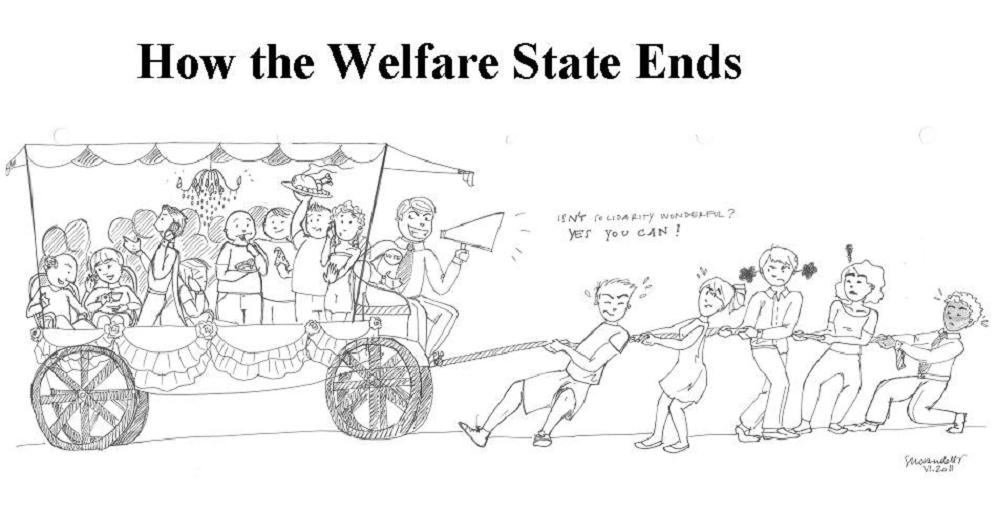



 Casual empiricism certainly suggests that higher taxes are associated with more government, not less red ink. We see this, for instance, in the
  What about the facts? Bill does some regression analysis for the 1949-2005 period, where he looks at the change in federal spending as a share of GDP and tests its relationship with the level of tax receipts as a share of GDP, the change in the unemployment rate, and the change in interest payments (the latter two variables are there to hopefully wash out the effects of the business cycle and to limit the analysis to the spending that lawmakers actually can control).
 PRINT PAGE
 CITE THIS


 The Daily Hatch
Jason Fried wrote this on Mar 03 2010 There are 43 comments.