Category Archives: Milton Friedman

“Friedman Friday” Milton Friedman warned the computer industry!!!

Milton Friedman was a man of common sense and great foresight. What he said in 1999 has come to pass and the Cato Institute article on 1-28-13 pointed that out.  

  • Updated January 28, 2013, 1:05 a.m. ET

Silicon Valley’s ‘Suicide Impulse’

The industry’s affection for Washington keeps growing. Facebook had 38 lobbyists working in 2012.

It’s a measure of how far Silicon Valley has strayed from its entrepreneurial roots that a top regulator is calling on technology companies to do less lobbying and more competing.In a letter to the editor responding to a report in this column on how Google GOOG -0.39%spent $25 million lobbying to stop an antitrust case against it, Federal Trade Commission Chairman Jon Leibowitz wrote that companies should not draw the lesson that lobbying pays. Instead, he urged: “Stop! Invest your money in expansion and innovation.” Mr. Leibowitz asserted in his letter, published Jan. 18, that “Google’s lobbying expenses had no effect on the care, diligence or analysis of the agency’s incredibly hard-working staff or the decisions reached by any of the FTC’s five commissioners.”Whatever the effect of Google’s big-ticket lobbying, regulators deserve much of the blame for companies calculating that lobbying is a good investment. Still, Mr. Leibowitz has a point: Tech executives should think twice before again lobbying government to get involved in their industry.

The precedent for the potential antitrust case against Google was the massive prosecution in the 1990s of Microsoft, MSFT +0.14%the giant of the desktop era. Competitors such as Netscape, Oracle ORCL +0.45%and Sun Microsystems lobbied hard to get regulators to bring the case that did end up paralyzing Microsoft.

Getty ImagesMilton Friedman, a model of prescience regarding tech-industry lobbying.

In 1999, economist Milton Friedman issued a warning to technology executives at a Cato Institute conference: “Is it really in the self-interest of Silicon Valley to set the government on Microsoft? Your industry, the computer industry, moves so much more rapidly than the legal process that by the time this suit is over, who knows what the shape of the industry will be? Never mind the fact that the human energy and the money that will be spent in hiring my fellow economists, as well as in other ways, would be much more productively employed in improving your products. It’s a waste!”

He predicted: “You will rue the day when you called in the government. From now on, the computer industry, which has been very fortunate in that it has been relatively free of government intrusion, will experience a continuous increase in government regulation. Antitrust very quickly becomes regulation. Here again is a case that seems to me to illustrate the suicide impulse of the business community.”

Friedman was right. The Internet undermined Microsoft’s market power years before the litigation ended. Alas, his warning fell on deaf ears—and ironically, it was Microsoft that led the recent lobbying to investigate Google’s dominance of the search industry. Microsoft funded lobbyists under names such as FairSearch.org.

The FTC hired outside lawyers to prepare a case, but after a lengthy investigation concluded what was obvious from the start: There was no case against Google’s practice of delivering answers as well as just links in its search results. It may harm Google’s competitors, but it benefits consumers, whom the antitrust laws are supposed to protect.

Silicon Valley has long prided itself on avoiding the lumbering relationship between big government and most industries, but somehow it has become one of the top lobbyists in Washington. The Center for Responsive Politics reported last year: “Tech firms have doled out more and more lobbying money even as the amount spent on lobbying by all industries has decreased since 2010.”

Google has a former congresswoman, Susan Molinari, running its Washington office. Facebook FB +2.92%employed 38 lobbyists last year, up from 23 in 2011. Over the past few years, Microsoft, Apple, Google and Intel have all hired former top FTC staffers, spinning the revolving door that fuels the growth of lobbying.

The growth in tech lobbying reflects the eagerness of the Obama administration and its regulators to get involved in the industry. FTC and Justice Department investigations into antitrust cases are just part of the problem. The FTC has also involved itself in the core business operations of the Internet.

During the past few years, the FTC has extracted consent decrees from Google, Facebook and Twitter on how they generate advertising revenues by using information about their visitors. These decrees include vague standards such as that the companies must have “privacy controls and procedures appropriate to respondent’s size and complexity, the nature and scope of respondent’s activities, and the sensitivity of the covered information.”

Under this broad privacy umbrella, the FTC thus oversees the key revenue stream for several of the largest companies on the Internet. These consent decrees apply for 20 years, an absurd length of time in the fast-changing technology industry. Internet companies staffed up their Washington offices in part to fend off regulations that would undermine the ad-supported services they provide to consumers.

Rather than lobby government to go after one another, Silicon Valley lobbyists should unite to go after overreaching government. Instead of the “suicide impulse” of lobbying for more regulation, Silicon Valley should seek deregulation and a long-overdue freedom to return to its entrepreneurial roots.

A version of this article appeared January 28, 2013, on page A13 in the U.S. edition of The Wall Street Journal, with the headline: Silicon Valley’s ‘Suicide Impulse’.

Open letter to President Obama (Part 528) Milton Friedman discussing Margaret Thatcher’s success

Open letter to President Obama (Part 528)

(Emailed to White House on 6-10-13.)

President Obama c/o The White House 1600 Pennsylvania Avenue NW Washington, DC 20500

Dear Mr. President,

I know that you receive 20,000 letters a day and that you actually read 10 of them every day. I really do respect you for trying to get a pulse on what is going on out here. Milton Friedman and Margaret Thatcher were two of my heroes and I know that you can learn a great deal from their lives and their economic philosophies. Ronald Reagan and Margaret Thatcher were both were influenced by Milton Friedman. I suggest checking out these episodes of Milton Friedman’s film series FREE TO CHOOSE: “The Failure of Socialism” and “What is wrong with our schools?”  and “Created Equal”  and  From Cradle to Grave, and – Power of the Market.

______________________

RARE Friedman Footage – On Keys to Reagan and Thatcher’s Success

Margaret Thatcher and Milton Friedman were two of my heroes.

Milton on Maggie

From the archives, we reproduce below two columns by Milton Friedman on the late Margaret Thatcher. Both columns appeared in Newsweek.


“Hooray for Margaret Thatcher” (Newsweek, 9 July 1979)

We have become so accustomed to politicians making extravagant campaign promises and then forgetting about them once elected that the first major act of Margaret Thatcher’s government— the budget unveiled on June 12—was a surprise. It did precisely what she had promised to do.

Margaret Thatcher campaigned on a platform of reversing the trend toward an ever more intrusive government—a trend that had carried government spending in Great Britain to somewhere between 50 per cent and 60 per cent of the nation’s income. Ever since the end of World War II, both Labor and Tory governments have added to government-provided social services as well as to government-owned and -operated industry. Foreign-exchange transactions have been rigidly controlled. Taxes have been punitive, yet have not yielded enough to meet costs. Excessive money created to finance deficits sparked an inflation that hit a rate of over 30 per cent a year in mid-1975. Only recently was inflation brought down to the neighborhood of 10 per cent, and it is once again on the rise.

  milton friedman and margaret thatcher
Photo credit: Robert Huffstutter

Most important of all, the persistent move to a centralized and collectivist economy produced economic stagnation. Before World War II, the British citizen enjoyed a real income that averaged close to twice that of the Frenchman or German. Today, the ratio is nearly reversed. The Frenchman or German enjoys a real income close to twice that of the ordinary Briton.

Margaret Thatcher declared in no uncertain terms that the long British experiment was a failure. She urged greater reliance on private enterprise and on market incentives. She promised to reduce the fraction of the people’s income that government spends on their behalf, and to cut sharply government control over the lives of British citizens. Her government’s budget is a major first step. It reduces the top marginal tax rate on so-called “earned” income from 83 per cent to 60 per cent, on “unearned” income from a confiscatory 98 per cent to 75 per cent. At the same time, it raises the level of income exempt from income tax and cuts the bottom rate from 33 per cent to 30 per cent. It proposes to cut government spending significantly, to sell some of the government’s industrial holdings and to promote the sale of government-owned housing units to their occupants. It loosens foreign-exchange controls substantially as a first step toward their elimination.

One retrograde step, in my opinion, is an increase in indirect taxes—the British general sales taxes, or VAT. This increase, which partly offsets the decrease in direct taxes, combined with lower spending will reduce government borrowing, facilitating a restrained monetary policy and releasing funds for private investment. The purpose is admirable. However, once taxes are imposed, it is hard to cut them. From the long-run point of view, it seems to me preferable to resort to a temporarily higher level of borrowing rather than to a possibly permanently higher level of indirect taxes.

I would also have preferred to see exchange controls eliminated completely rather than by degrees. The controls serve no constructive purpose. Eliminating them gradually only prolongs the harm and preserves a mischievous bureaucracy.

But these are quibbles. I salute Margaret Thatcher and her government for their courage and wisdom in moving firmly and promptly to cut Britain’s bureaucratic straitjacket. Britain has enormous latent strength—in human capacities, industrial traditions, financial institutions, social stability. If these can be released from bondage, if incentive can be restored, Britain could once again become a vibrant, dynamic, increasingly productive economy.

In the United States, when the President proposes a budget, that is only the beginning. Congress disposes, and it may take many months before the final result is determined. In Britain, the situation is different. What the Prime Minister and Cabinet propose in effect becomes law as of that day—subject only to a vote of no-confidence in the government and a new national election. However, when the party in power has a majority in the House of Commons as large as the Tories now have, that is a purely hypothetical possibility.

What happens in Britain is of great importance to us. Ever since the founding of the colonies in the New World, Britain has been a major source of our economic and political thought. In the past few decades, we have been moving in the same direction as Britain and many other countries, though at a slower pace. If Britain’s change of direction succeeds, it will surely reinforce the pressures in the United States to cut our own government down to size.

“Mitterrand Elects Thatcher” (Newsweek, 4 July 1983)

In 1981, as Britain slid into a deepening recession and unemployment mounted above the 2 million mark, the conventional political wisdom was that Margaret Thatcher’s days as prime minister were numbered unless she could manage to foster a prompt recovery in the economy that sharply reduced unemployment. Talk about a U-turn was the order of the day.

Margaret Thatcher stuck to her guns—proclaiming that U-turn was not in her vocabulary. The recession continued and unemployment kept going up. Yet three weeks ago, with more than 3 million unemployed, she was re-elected in a landslide, achieving the largest majority in Parliament since the postwar Labor landslide in 1945.

One source of her victory was a sharp decline in inflation, from 22 percent in early 1980 to 4 percent currently—fully realizing a major campaign promise. Yet, by itself, that could hardly have produced a landslide. The postmortems have stressed two other factors: the Falklands war and the disintegration of the Labor Party. The Falklands war enabled Mrs. Thatcher to demonstrate in a dramatic way a quality of leadership and a firmness of purpose that had been conspicuously lacking in her predecessors. The “Iron Lady” became an accolade, not an epithet.

The sharp left turn by the official Labor Party, the resulting formation of the Social Democratic Party and the alliance between the new party and the Liberals certainly played a major part in fragmenting the opposition to Mrs. Thatcher. As matters developed, there was simply no responsible alternative to Mrs. Thatcher, no credible alternative government.

However, this explanation lacks one essential ingredient: it omits the role of President Mitterrand.

France was suffering from the same ills when Mitterrand was elected president as Britain when Mrs. Thatcher became prime minister and the United States when Ronald Reagan became president—high and rising inflation, high unemployment and slow economic growth. Mitterrand’s attack on those ills was precisely the reverse of Mrs. Thatcher’s. On coming into office, Thatcher reduced taxes; Mitterrand increased them. Thatcher reduced controls over prices and wages; Mitterrand expanded them. Thatcher eliminated foreign-exchange controls; Mitterrand made them tighter. Thatcher moved to denationalize enterprises and reduce regulation, Mitterrand nationalized private banks and other enterprises and increased government intervention into the remaining private enterprise. Thatcher tried to hold down government spending, albeit with little success; Mitterrand went on a spending binge.

Had the Mitterrand policies succeeded, even if for only a year or so, Thatcher’s opposition in Britain would have been enormously strengthened. The Labor Party would have had a real alternative to offer—one that was consistent with its ideological propensities and that had worked on the other side of the Channel. The cry that Thatcher’s “monetarism” was a tragic failure could not have been dismissed as mere campaign rhetoric.

Instead, the Mitterrand policy was a clear failure. Inflation remained high. Unemployment went up. The government’s budget deficit soared. So did the deficit in the balance of payments. The franc had to be devalued three times in the past two years, despite massive government borrowing in a vain attempt to prop the franc up. Worst of all for Thatcher’s opposition, Mitterrand was forced to reverse course. The U-turn occurred across the Channel as the French government was driven to adopt the much-derided Thatcher policies.

Thatcher’s opposition was left intellectually bankrupt. It had no credible alternative policy to offer. The claim that she was an irresponsible demagogue imposing unnecessary costs on the British people rang hollow. Her persistence in the main lines of her policy was perceived by the voters as a realistic recognition that there was no easy cure for ills that had accumulated during decades.

The British experience is being repeated in the United States. The Democratic leaders attack Reaganomics as a failure, yet they, too, are intellectually bankrupt. They, too, have no credible alternative to offer, and many of them continue to attack the label while adopting the substance. Mitterrand has made no sharper U-turn than longtime New Dealers who have always praised deficits as a way to prime the pump and stimulate the economy but are now preaching the virtues of balancing the budget.


Click here to see the Hoover project showcasing the works of Milton and Rose Friedman.

Milton Friedman, recipient of the 1976 Nobel Memorial Prize for economic science, was a senior research fellow at the Hoover Institution from 1977 to 2006. He passed away on Nov. 16, 2006. He was also the Paul Snowden Russell Distinguished Service Professor Emeritus of Economics at the University of Chicago, where he taught from 1946 to 1976, and a member of the research staff of the National Bureau of Economic Research from 1937 to 1981.


Letters to the editor may be sent to definingideas@stanford.edu. Editors reserve the right to reject or publish (and edit) letters.

__________________


Thank you so much for your time. I know how valuable it is. I also appreciate the fine family that you have and your commitment as a father and a husband.

Sincerely,

Everette Hatcher III, 13900 Cottontail Lane, Alexander, AR 72002, ph 501-920-5733, lowcostsqueegees@yahoo.com

Related posts:

Remembering Margaret Thatcher, 1925-2013

Remembering Margaret Thatcher, 1925-2013 Published on Apr 8, 2013 The world lost one of its greatest champions of freedom in Lady Margaret Thatcher. Ed Feulner, Edwin Meese III, and Becky Norton Dunlop remember her contributions as a great leader and friend of The Heritage Foundation. ________________ Great post from the Heritage Foundation on Margaret Thatcher’s legacy. […]

Margaret Thatcher and the Battle of the 364 Keynesians (includes editorial cartoon)

The stimulus program was a failure here in America and President Obama should have known better than to try that. He should have been a better student of history like Margaret Thatcher was. APRIL 9, 2013 3:24PM Margaret Thatcher and the Battle of the 364 Keynesians By  STEVE H. HANKE SHARE With the death of Margaret […]

Margaret Thatcher’s best quote?

Margaret Thatcher was right about socialism when she said, “The problem with socialism is that you eventually run out of other people’s money.” That is exactly what we are seeing in Europe now and it will happen to the USA too if we don’t cut back on excessive government spending. April 8, 2013 12:32PM Thatcher: Anecdotes From […]

Dan Mitchell’s tribute to Margaret Thatcher

Very well said by Dan Mitchell. A Tribute to Margaret Thatcher April 8, 2013 by Dan Mitchell The woman who saved the United Kingdom has died. A Great Woman I got to meet Margaret Thatcher a couple of times and felt lucky each time that I was in the presence of someone who put her nation’s […]

Margaret Thatcher was a great lady

  Margaret Thatcher was a great lady. Jim DeMint on Margaret Thatcher: “The World Has Lost One of Its Greatest Champions of Freedom” Jim DeMint April 8, 2013 at 9:05 am Heritage has lost one of her greatest friends, and the world has lost one of its greatest champions of freedom. Margaret Thatcher led Great […]

Margaret Thatcher defines socialism

  Great speech by Margaret Thatcher on socialism. It was not helpful to the people of eastern europe and it will not be helpful to us today. Defining Socialism Marion Smith December 10, 2012 at 5:25 pm   Margaret Thatcher on Socialism For those who failed to recognize the ideological stakes of the recent election, […]

Margaret Thatcher exposed the real liberal agenda

Uploaded by mynameiswhatever on Jan 18, 2009 Margaret Thatcher’s last House of Commons Speech on November 22, 1990. ________________ Prime Minister Margaret Thatcher: People on all levels of income are better off than they were in 1979. The hon. Gentleman is saying that he would rather that the poor were poorer, provided that the rich […]

Does the movie “Iron Lady” do Margaret Thatcher justice?

Unfortunately Hollywood has their own agenda many times. Great article from the Heritage Foundation. Morning Bell: The Real ‘Iron Lady’ Theodore Bromund January 11, 2012 at 9:24 am Streep referred to the challenge of portraying Lady Thatcher as “daunting and exciting,” and as requiring “as much zeal, fervour and attention to detail as the real […]

Margaret Thatcher (Part 5)

Margaret Thatcher is one of my heroes and I have a three part series on her I am posting. “What We Can Learn from Margaret Thatcher,”By Sir Rhodes Boyson and Antonio Martino, Heritage Foundation, November 24, 1999, is an excellent article and here is a portion of it below: What Can We Learn from Thatcher? […]

Margaret Thatcher (Part 4)

  Margaret Thatcher is one of my heroes and I have a three part series on her I am posting. “What We Can Learn from Margaret Thatcher,”By Sir Rhodes Boyson and Antonio Martino, Heritage Foundation, November 24, 1999, is an excellent article and here is a portion of it below: Thatcher This was the background […]

Margaret Thatcher (Part 3)

Margaret Thatcher is one of my heroes and I have a three part series on her I am posting. “What We Can Learn from Margaret Thatcher,”By Sir Rhodes Boyson and Antonio Martino, Heritage Foundation, November 24, 1999, is an excellent article and here is a portion of it below: The Role of Ideas 6 The […]

Margaret Thatcher (Part 2)

Margaret Thatcher (Part 2) Margaret Thatcher is one of my heroes and I have a three part series on her I am posting. “What We Can Learn from Margaret Thatcher,”By Sir Rhodes Boyson and Antonio Martino, Heritage Foundation, November 24, 1999, is an excellent article and here is a portion of it below: Foreign Policy […]

Margaret Thatcher (Part 1)

Margaret Thatcher (Part 1) Margaret Thatcher is one of my heroes and I have a three part series on her I am posting. “What We Can Learn from Margaret Thatcher,”By Sir Rhodes Boyson and Antonio Martino, Heritage Foundation, November 24, 1999, is an excellent article and here is a portion of it below: Margaret Thatcher […]

“Friedman Friday” Milton Friedman believed in liberty (Interview by Charlie Rose of Milton Friedman part 1)

Charlie Rose interview of Milton Friedman My favorite economist: Milton Friedman : A Great Champion of Liberty  by V. Sundaram   Milton Friedman, the Nobel Prize-winning economist who advocated an unfettered free market and had the ear of three US Presidents – Nixon, Ford and Reagan – died last Thursday (16 November, 2006 ) in San Francisco […]

What were the main proposals of Milton Friedman?

Stearns Speaks on House Floor in Support of Balanced Budget Amendment Uploaded by RepCliffStearns on Nov 18, 2011 Speaking on House floor in support of Balanced Budget Resolution, 11/18/2011 ___________ Below are some of the main proposals of Milton Friedman. I highly respected his work. David J. Theroux said this about Milton Friedman’s view concerning […]

“Friedman Friday,” EPISODE “The Failure of Socialism” of Free to Choose in 1990 by Milton Friedman (Part 1)

Milton Friedman: Free To Choose – The Failure Of Socialism With Ronald Reagan (Full) Published on Mar 19, 2012 by NoNationalityNeeded Milton Friedman’s writings affected me greatly when I first discovered them and I wanted to share with you. We must not head down the path of socialism like Greece has done. Abstract: Ronald Reagan […]

Defending Milton Friedman

What a great defense of Milton Friedman!!!!   Defaming Milton Friedman by Johan Norberg This article appeared in Reason Online on September 26, 2008  PRINT PAGE  CITE THIS      Sans Serif      Serif Share with your friends: ShareThis In the future, if you tell a student or a journalist that you favor free markets and limited government, there is […]

Milton and Rose Friedman “Two Lucky People”

Milton Friedman on Hayek’s “Road to Serfdom” 1994 Interview 2 of 2 Uploaded by PenguinProseMedia on Oct 26, 2011 2nd half of 1994 interview. ________________ I have a lot of respect for the Friedmans.Two Lucky People by Milton and Rose Friedman reviewed by David Frum — October 1998. However, I liked this review below better. It […]

Video clip:Milton Friedman discusses his view of numerous political figures and policy issues in (Part 2)

Milton Friedman on Hayek’s “Road to Serfdom” 1994 Interview 1 of 2 Uploaded by PenguinProseMedia on Oct 25, 2011 Says Federal Reserve should be abolished, criticizes Keynes. One of Friedman’s best interviews, discussion spans Friedman’s career and his view of numerous political figures and public policy issues. ___________________ Here is a review of “Two Lucky People.” […]

Milton Friedman believed in liberty (Interview by Charlie Rose of Milton Friedman part 1)

Charlie Rose interview of Milton Friedman My favorite economist: Milton Friedman : A Great Champion of Liberty  by V. Sundaram   Milton Friedman, the Nobel Prize-winning economist who advocated an unfettered free market and had the ear of three US Presidents – Nixon, Ford and Reagan – died last Thursday (16 November, 2006 ) in San Francisco […]

“The Failure of Socialism” episode of Free to Choose in 1990 by Milton Friedman (Part 1)

Milton Friedman: Free To Choose – The Failure Of Socialism With Ronald Reagan (Full) Published on Mar 19, 2012 by NoNationalityNeeded Milton Friedman’s writings affected me greatly when I first discovered them and I wanted to share with you. We must not head down the path of socialism like Greece has done. Abstract: Ronald Reagan […]

Open letter to President Obama (Part 526) If the increase in food stamps was just because of the recession then why did the spending go from $19.8 billion in 2000 to $37.9 billion in 2007?

Open letter to President Obama (Part 526)

(Emailed to White House on 6-6-13.)

President Obama c/o The White House 1600 Pennsylvania Avenue NW Washington, DC 20500

Dear Mr. President,

I know that you receive 20,000 letters a day and that you actually read 10 of them every day. I really do respect you for trying to get a pulse on what is going on out here.

I have been writing on my blog for over two years now concerning the disturbing trend of more and more people becoming dependent on the federal government for more of their income than ever before. This encourages laziness in my view and in the case of the food stamp system many people find themselves in what Milton Friedman calls the “Welfare Trap.”  (Much of this trend started under President Bush and had Republican support.) I wanted to point out that we should cut back on government spending and let the private economy do it’s magic.

If the increase in food stamps was just because of the recession then why did the spending go from $19.8 billion in 2000 to $37.9 billion in 2007?

 and 

May 27, 2013 at 12:00 pm

(7)

Newscom

Newscom

A recent US News & World Report article set out to unveil the “facts” about food stamps.

What are the so-called “facts”?

For one, the article claims that the food stamps program is not “bloated,” but rather, the surge in participation and spending is a result of the program “doing what it’s supposed to do.”

But what is it “supposed to do”?

Food stamps (or the Supplemental Nutrition Assistance Program (SNAP), as it is now called) were designed to ensure that Americans without the ability to provide for themselves are able to receive basic nutrition. However, application loopholes and policy changes over the past decade or so have allowed recipients to bypass income and asset tests, meaning many people are receiving food stamps who would not have been eligible under the program’s original purposes.

One of the changes in eligibility requirements is “broad-based categorical eligibility.” This type of eligibility means that an individual who receives any service under another welfare program, such as Temporary Assistance for Needy Families (TANF)—even something as small as a TANF brochure—can be deemed eligible for food stamps. A full 50 percent of all food stamp recipients now enroll in the program through this broad-based categorical eligibility procedure. As Heritage welfare experts Robert Rector and Kiki Bradley write:

In states using this loophole, a middle-class family with one earner who becomes unemployed for one or two months can receive $668 per month in food stamps even if the family has $20,000 in cash sitting in the bank. Because of this, food stamps has been transformed from a program for the truly needy to a routine bonus payment stacked on top of conventional unemployment benefits.

In addition, the U.S. Department of Agriculture (USDA) has operated substantial outreach programs to pull more people onto the food stamp rolls. Some states have gone so far as to hire food stamp recruiters, tasked with filling a monthly quota of new food stamp enrollees.

Another “fact,” according to the author, is that much of the growth in food stamp costs is due to the recession and is temporary.

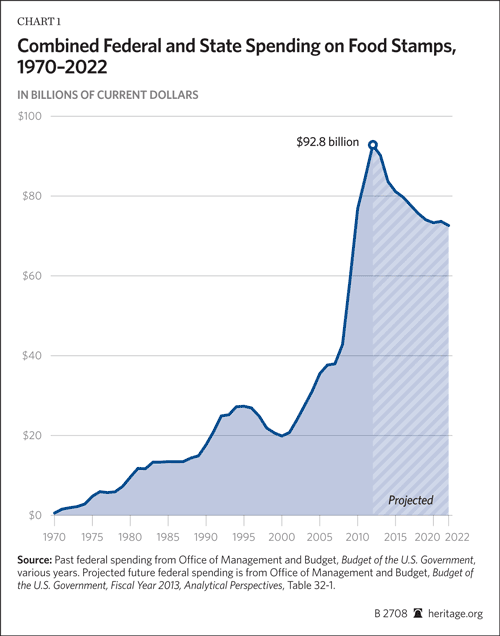
That’s partially true. Food stamp spending has roughly doubled in the past four years, and part of this is clearly due to the recession. However, food stamp spending has been on an upward climb since the program began back in the 1960s. In the decade prior to the recession, total government food stamp spending nearly doubled, from $19.8 billion in 2000 to $37.9 trillion in 2007.

Bfoodstampreform2012chart1

Moreover, according to Obama’s budget plans, food stamp spending will not return to pre-recession levels when the economy improves. “For most of the next decade, food stamp spending, adjusted for inflation and population growth, would remain at nearly twice the levels seen during the non-recessionary periods under President Bill Clinton,” note Rector and Bradley.

What’s more, food stamps are just one of roughly 80 federally funded means-tested welfare programs. The total cost of government welfare spending has been on a nearly continual climb over the past five decades and has increased 16-fold, to nearly $1 trillion annually, since the 1960s. Welfare is the fastest growing part of government spending, and under Obama’s fiscal year 2013 budget, total welfare spending will permanently increase from 4.5 percent of gross domestic product (GDP) to 6 percent of GDP.

US News & World Report also suggests as a “fact” that most food stamp recipients work.

However, a significant portion of able-bodied recipients of food stamps perform little to no work. Of the roughly 10.5 million households receiving food stamps containing an able-bodied, non-elderly adult (there are approximately 20 million households receiving food stamps total), more than half—5.5 million—performed no work during a given month in 2010. Another 1.5 million to 2 million performed fewer than 30 hours of work per week. This isn’t unique to the recession, but is typical even during good economic times.

The food stamp program is just one of dozens that comprise the complex system of federal means-tested welfare programs. Instead of continuing to pour more dollars into these programs, which have failed to promote self-sufficiency, policymakers should roll back aggregate spending on means-tested welfare to pre-recession levels when employment recovers. Likewise, programs like food stamps should be reformed to promote self-reliance through work, empowering individuals and families to become free from government dependence.


_______________________

Thank you so much for your time. I know how valuable it is. I also appreciate the fine family that you have and your commitment as a father and a husband.

Sincerely,

Everette Hatcher III, 13900 Cottontail Lane, Alexander, AR 72002, ph 501-920-5733, lowcostsqueegees@yahoo.com

Related posts:

Tell the 48 million food stamps users to eat more broccoli!!!!

Welfare Can And Must Be Reformed             Uploaded on Jun 29, 2010 If America does not get welfare reform under control, it will bankrupt America. But the Heritage Foundation’s Robert Rector has a five-step plan to reform welfare while protecting our most vulnerable. __________________________ We got to slow down the growth of Food Stamps. One […]

Republicans for more food stamps?

Eight Reasons Why Big Government Hurts Economic Growth __________________ We got to cut spending and we must first start with food stamp program and we need some Senators that are willing to make the tough cuts. Food Stamp Republicans Posted by Chris Edwards Newt Gingrich had fun calling President Obama the “food stamp president,” but […]

Obama promotes food stamps but Milton Friedman had a better suggestion

Milton Friedman’s negative income tax explained by Friedman in 1968: We need to cut back on the Food Stamp program and not try to increase it. What really upsets me is that when the government gets involved in welfare there is a welfare trap created for those who become dependent on the program. Once they […]

400% increase in food stamps since 2000

Welfare Can And Must Be Reformed Uploaded by HeritageFoundation on Jun 29, 2010 If America does not get welfare reform under control, it will bankrupt America. But the Heritage Foundation’s Robert Rector has a five-step plan to reform welfare while protecting our most vulnerable. __________________________ If welfare increases as much as it has in the […]

Food stamp spending has doubled under the Obama Administration

The sad fact is that Food stamp spending has doubled under the Obama Administration. A Bumper Crop of Food Stamps Amy Payne May 21, 2013 at 7:01 am Tweet this Where do food stamps come from? They come from taxpayers—certainly not from family farms. Yet the “farm” bill, a recurring subsidy-fest in Congress, is actually […]

Which states are the leaders in food stamp consumption?

I am glad that my state of Arkansas is not the leader in food stamps!!! Mirror, Mirror, on the Wall, Which State Has the Highest Food Stamp Usage of All? March 19, 2013 by Dan Mitchell The food stamp program seems to be a breeding ground of waste, fraud, and abuse. Some of the horror stories […]

Why not cancel the foodstamp program and let the churches step in?

Government Must Cut Spending Uploaded by HeritageFoundation on Dec 2, 2010 The government can cut roughly $343 billion from the federal budget and they can do so immediately. __________ We are becoming a country filled with people that dependent on the federal government when we should be growing our economy by lowering taxes and putting […]

Food Stamp Program is constantly ripped off and should be discontinued

Uploaded by oversightandreform on Mar 6, 2012 Learn More athttp://oversight.house.gov The Oversight Committee is examining reports of food stamp merchants previously disqualified who continue to defraud the program. According to a Scripps Howard News Service report, food stamp fraud costs taxpayers hundreds of millions every year. Watch the Oversight hearing live tomorrow at 930 […]

Open letter to President Obama (Part 326)

(This letter was emailed to White House on 11-21-11.) President Obama c/o The White House 1600 Pennsylvania Avenue NW Washington, DC 20500 Dear Mr. President, I know that you receive 20,000 letters a day and that you actually read 10 of them every day. I really do respect you for trying to get a pulse […]

Welfare state may drag England down the tubes!!!!

Welfare state may drag England down the tubes!!!! Very Funny but Very Un-PC British Video on Welfare and Immigration May 19, 2013 by Dan Mitchell I’ve shared this bit of political incorrect terrorism humor from England, as well asthis somewhat un-PC bit of tax humor. But perhaps motivated by the scandal of giving welfare to terrorists, this new video is […]

Milton Friedman in 1999 interview, “The one thing that’s missing, but that will soon be developed, is a reliable e-cash, a method whereby on the Internet you can transfer funds from A to B without A knowing B or B knowing A, the way I can take a $20 bill hand it over to you and then there’s no record of where it came from”

_______

Milton Friedman in 1999 interview, “The one thing that’s missing, but that will soon be developed, is a reliable e-cash, a method whereby on the Internet you can transfer funds from A to B without A knowing B or B knowing A, the way I can take a $20 bill hand it over to you and then there’s no record of where it came from”

February 20, 2014 2:35PM

Friedman and Hanke on Bitcoin

In 2008, Bitcoin was mysteriously introduced to the world in an obscure, technical paper written under the pseudonym Satoshi Nakamoto. By late 2013, the financial press was filled with reportage on Bitcoin and its dramatic price increase.

Well ahead of Satoshi Nakamoto, Nobelist Milton Friedman, champion of free market economics and noted expert on money and banking, anticipated the coming of digital currencies, and foresaw the potential impacts that they would have on finance and economics.

In a 1999 interview, Prof. Friedman concluded:

I think that the Internet is going to be one of the major forces for reducing the role of government. The one thing that’s missing, but that will soon be developed, is a reliable e-cash, a method whereby on the Internet you can transfer funds from A to B without A knowing B or B knowing A. The way I can take a $20 bill hand it over to you and then there’s no record of where it came from.

You may get that without knowing who I am. That kind of thing will develop on the Internet and that will make it even easier for people using the Internet. Of course, it has its negative side. It means the gangsters, the people who are engaged in illegal transactions, will also have an easier way to carry on their business.

Prof. Friedman’s anticipation of Bitcoin is truly remarkable. He even understood the concept well enough to anticipate something like the Silk Road scandal involving illegal Bitcoin transactions.

In April 2013, Nathaniel Popper of The New York Times reported on Bitcoin in an article titled “Digital Money is Gaining Champions in the Real World”. In his reportage, Popper asked me if I thought Bitcoin had the makings of a speculative mania like the 17th century Dutch tulip bulb frenzy. My response was clear and unambiguous: “To say highly speculative would be the understatement of the century.”

Subsequently, the price action in Bitcoin confirms my diagnosis (see the following chart). In January 2013, one could buy a Bitcoin for about $13. By late November, one Bitcoin would have set a buyer back over $1100. And what about Bitcoin’s price volatility? As shown in the chart, Bitcoin’s volatility is truly fantastic.

While the price currently fluctuates around $600, Bitcoin remains far from secure. Serious discrepancies in price exist even between exchanges. For example, the price of a Bitcoin on the Mt. Gox exchange has fallen by over 50% in the past week, while the price of the exact same Bitcoin on the BitStamp exchange has fallen by only 3% in the same time period.


Related posts:

“Friedman Friday” Warnings from Milton Friedman

The federal government is not doing a good job at almost anything that it does. When it expands then it just takes away our freedom and our money more than it has in the past. This trend must stop. Below are some wise words and warnings from Milton Friedman Below are some videos and quotes […]

“Friedman Friday” What were the main proposals of Milton Friedman?

Stearns Speaks on House Floor in Support of Balanced Budget Amendment Uploaded by RepCliffStearns on Nov 18, 2011 Speaking on House floor in support of Balanced Budget Resolution, 11/18/2011 ___________ Below are some of the main proposals of Milton Friedman. I highly respected his work. David J. Theroux said this about Milton Friedman’s view concerning […]

“Friedman Friday” Milton Friedman tells us why our government spends out money so foolishly

The 4 Ways to Spend Money by Milton Friedman Uploaded by Sidewinder77 on Aug 26, 2006 1. You spend your own money on yourself. 2. You spend your own money on someone else. 3. You spend someone else’s money on yourself. 4. You spend someone else’s money on someone else. ___________ Will Rogers has a […]

“How to Cure Inflation” in Milton Friedman’s FREE TO CHOOSE Part 7 of 7 “The crucial thing is to cut down total government spending from the point of view of inflation, from the point of view of productivity, some of the other measures you were talking about are far more important”

In 1980 I read the book FREE TO CHOOSE by Milton Friedman and it really enlightened me a tremendous amount.  I suggest checking out these episodes and transcripts of Milton Friedman’s film series FREE TO CHOOSE: “The Failure of Socialism” and “What is wrong with our schools?”  and “Created Equal”  and  From Cradle to Grave, […]

“How to Cure Inflation” in Milton Friedman’s FREE TO CHOOSE Part 6 of 7 “Here we go into a period of still higher unemployment later on and have it to do all over again. That’s the only choice we face. And when the public at large recognizes that, they will then elect people to Congress, and a President to office who is committed to less government spending and to less government printing of money and until that happens we will not cure inflation”

In 1980 I read the book FREE TO CHOOSE by Milton Friedman and it really enlightened me a tremendous amount.  I suggest checking out these episodes and transcripts of Milton Friedman’s film series FREE TO CHOOSE: “The Failure of Socialism” and “What is wrong with our schools?”  and “Created Equal”  and  From Cradle to Grave, […]

“How to Cure Inflation” in Milton Friedman’s FREE TO CHOOSE Part 5 of 7 There is no Congressman, no Senator, who will come out and say, “I am in favor of inflation.” There is not a single one who will say, “I am in favor of big deficits.” They’ll all say we want to balance the budget, we want to hold down spending, we want an economical government. How do you explain the difference between performance and talk on the side of Congress?

In 1980 I read the book FREE TO CHOOSE by Milton Friedman and it really enlightened me a tremendous amount.  I suggest checking out these episodes and transcripts of Milton Friedman’s film series FREE TO CHOOSE: “The Failure of Socialism” and “What is wrong with our schools?”  and “Created Equal”  and  From Cradle to Grave, […]

“How to Cure Inflation” in Milton Friedman’s FREE TO CHOOSE Part 4 of 7 “The job of the Federal Reserve is to control the money supply”

In 1980 I read the book FREE TO CHOOSE by Milton Friedman and it really enlightened me a tremendous amount.  I suggest checking out these episodes and transcripts of Milton Friedman’s film series FREE TO CHOOSE: “The Failure of Socialism” and “What is wrong with our schools?”  and “Created Equal”  and  From Cradle to Grave, […]

“How to Cure Inflation” in Milton Friedman’s FREE TO CHOOSE Part 3 of 7 “Inflation is just like alcoholism, in both cases when you start drinking or when you start printing too much money, the good effects come first, the bad effects only come later”

In 1980 I read the book FREE TO CHOOSE by Milton Friedman and it really enlightened me a tremendous amount.  I suggest checking out these episodes and transcripts of Milton Friedman’s film series FREE TO CHOOSE: “The Failure of Socialism” and “What is wrong with our schools?”  and “Created Equal”  and  From Cradle to Grave, […]

“Friedman Friday” Milton Friedman: “the purpose of the balanced-budget-and-tax-limitation amendment is to limit the government in order to free the people — this time from excessive taxation.”

Friedman on Reagan Uploaded by YAFTV on Aug 19, 2009 Nobel Laureate Dr. Milton Friedman discusses the principles of Ronald Reagan during this talk for students at Young America’s Foundation’s 25th annual National Conservative Student Conference _______________ Passing the Balanced Budget Amendment would be what the founding fathers would have wanted. Look at what my […]

“How to Cure Inflation” in Milton Friedman’s FREE TO CHOOSE Part 2 of 7 “Many a political leader has been tempted to turn to wage and price controls despite their repeated failure in practice. On this subject they never seem to learn. But some lessons may be learned”

In 1980 I read the book FREE TO CHOOSE by Milton Friedman and it really enlightened me a tremendous amount.  I suggest checking out these episodes and transcripts of Milton Friedman’s film series FREE TO CHOOSE: “The Failure of Socialism” and “What is wrong with our schools?”  and “Created Equal”  and  From Cradle to Grave, […]

“Friedman Friday” Warnings from Milton Friedman

The federal government is not doing a good job at almost anything that it does. When it expands then it just takes away our freedom and our money more than it has in the past. This trend must stop. Below are some wise words and warnings from Milton Friedman

Below are some videos and quotes from Milton Friedman and I wanted to share them with you.

Milton Friedman – Fairness Or Freedom?

Uploaded by on Nov 28, 2011

Friedman looks at two competing concepts. http://www.LibertyPen.com

Here are some  good quotes by Milton Friedman:

“A society that puts equality before freedom will get neither. A society that puts freedom before equality will get a high degree of both.”
Milton Friedman

“One of the great mistakes is to judge policies and programs by their intentions rather than their results.”
Milton Friedman

“If you put the federal government in charge of the Sahara Desert, in five years there’d be a shortage of sand.”
Milton Friedman
“The great virtue of a free market system is that it does not care what color people are; it does not care what their religion is; it only cares whether they can produce something you want to buy. It is the most effective system we have discovered to enable people who hate one another to deal with one another and help one another.”
Milton Friedman


Power of the Market – The Pencil

Uploaded by on Aug 26, 2008

Milton Friedman uses a pencil to explain how the operation of the free market promotes harmony and world peace. (1 of 30) http://www.LibertyPen.com

___________

“I am favor of cutting taxes under any circumstances and for any excuse, for any reason, whenever it’s possible.”
Milton Friedman
“Hell hath no fury like a bureaucrat scorned.”
Milton Friedman
“There’s no such thing as a free lunch.”
Milton Friedman

Milton Friedman – The Free Lunch Myth

Uploaded by on Apr 2, 2010

Milton Friedman explodes the myth that government can provide goods and services at no one’s expense. Full video available for purchase at http://www.ideachannel.com
http://www.LibertyPen.com

Will Conservative leaders in Congress let the President get away with distorting Section 7 of the Constitution?

____________

Does the president have the authority to rewrite ObamaCare?

Published on Feb 16, 2014

Sen. Mike Lee, Rep. Xavier Becerra weigh in

Wh Delays Obamacare’s Employer Mandate Until After Midterm – Employers Not Allowed To Fire Anyone?

Published on Feb 10, 2014

_____________

I am so upset that the President has stomped on the Constitution that I am writing a letter today to Washington and addressing it to a conservative leader who I know will do something about it.

I am so proud of so many of the conservatives in Congress who have voted down many of the President’s proposals to explode the debt and that is why I have turned to them today. I wish everyone of them to read this blog post that I am writing this morning because it is the only hope our nation has to stay a Republic and not turn into a Monarchy!!!

Yesterday in the Arkansas Democrat-Gazette appeared an article by the editors (Paul Greenberg is the editor of the editorial page) called, “The real Section 7, as opposed to the Hon. Barack Obama’s.” This article went through section 7 of the U.S. Constitution and shows how President Obama has distorted the Constitution to please himself. I WANT TO KNOW IF YOU WILL STAND UP TO HIM AND HOLD HIM ACCOUNTABLE FOR THESE ACTIONS? (Dan Mitchell of the Cato Institute has recently written a fine article on this same issue, and his friend Ilya Shapiro has written on it too, and so have Heritage Foundation scholars  and . ) You will notice that I have tried to keep this post very simple and not get into other issues such as President Obama’s abuse of the IRS. Issues like this can be argued but stepping over line 18 times with his unconstitutional actions in the case of Obamacare are what I am focusing on today.

Here is the complete article below:

EDITORIALS

The real Section 7

As opposed to the Hon. Barack Obama’s

This article was published February 16, 2014 at 3:05 a.m.

Editor’s note: Lo and behold, all these years later, Article I, Section 7 of the Constitution of the United States has been reviewed again, and this time read in a new light. Who knew that so many unwritten words could be found there? Perhaps not even the Founders, who wrote Section 7, which is the one specifying what presidents can do when presented with the laws passed by Congress. Here is the new-and-improved, just-rediscovered, revised-and-redesigned text. And it’s quite a piece of work: SECTION 7. All Bills for raising Revenue shall originate in the House of Representatives; but the Senate may propose or concur with Amendments as on other Bills. Every Bill which shall have passed the House of Representatives and the Senate, shall, before it becomes a Law, be presented to the President of the United States; If he approve he shall sign it, but if not he shall return it, with his Objections to that House . . . .

Or if, after passage, he shall discover some part(s)of it that he does not much care for, or just finds inconvenient, he may delay, reword, or otherwise change such passage(s), taking care that he refer to said process only as a delay, interpretation, “smoothing out this transition,” or some equally glib euphemism.

Yes, all that sounds reasonable. Antiquated laws need to be updated, and the Affordable Care Act was passed way back in 2010, which might as well be the Dark Ages by this president’s sense of history. Yes, who knew all the problems it would face by 2014? Except maybe the usual quirky critics who are always trying to hold up Progress, aka Republicans.

But a president has to have some needed elasticity, or in the popular parlance, Wiggle Room, when it comes to laws passed by Congress. Even if those laws were passed at his own strenuous urging and have been billed as his Signature Achievement, however hard he’s trying to disguise his handwriting on it.

TO CONTINUE unrolling this document just discovered in a cranny of the White House next to the billing records of Hillary Clinton, Esq.:

If after such Reconsideration two-thirds of that House shall agree to pass the Bill, it shall be sent, together with the Objections, to the other House, by which it shall likewise be reconsidered, and if approved by two-thirds of that House, it shall become a Law.

And take effect until the president feels it has become inconvenient or otherwise superseded by circumstances, political necessity, or the influence of the most powerful business interest of the moment. Then the president shall duly make any changes to the law that Congress has passed-but only if those changes are called waivers, hardship exceptions, phase-ins, or administrative adjustments, including but not limited to any and/or all of the above.

But in all such Cases the Votes of both Houses shall be determined by yeas and Nays, and the Names of the Persons voting for and against the Bill shall be entered on the Journal of each House respectively.

If anyone should be so unruly as to point out that the president is selectively enforcing the law, and should they demand the president grant individuals, aka Only Citizens, the same exemptions to his law that he grants businesses, states, labor unions or other such favored beneficiaries of his grace from time to regular time, the president shall say with due sobriety, a perfectly straight face and doleful countenance in general, that such suggestions would not be in line with the intent of the law as it has just been revealed to him by a higher power, to wit, himself.

If any Bill shall not be returned by the President within ten Days (Sundays excepted) after it shall have been presented to him, the Same shall be a Law, in like Manner as if he had signed it . . . .

But all such provisions shall be duly nullified if corporations, chambers of commerce, the Democratic Party, or other such financial and/or cultural institutions or their representatives, herein to be called lobbyists, start calling the White House at all hours and generally making pests of themselves. Also, if there is an election scheduled within the calendar year, let the president pick and choose who should have to comply with the laws passed by Congress and signed by himself, his word being good as his broken bond.

NO MATTER your opinion of Obamacare, the employer mandate, the individual mandate . . . . no matter if you work at a business that has 50 to 99 employees, or 100 or more, or push a lawnmower by yourself . . . no matter if you have had health insurance for years but have had your insurance canceled because of Obamacare, or are just now getting a policy on the new and still clunky exchanges, or have decided to quit your job now that health insurance is free, at least to you, as an American you are supposed to sleep better o’ night because this is a nation of laws. And the principal official in charge of enforcing those laws of the United States is the president of the United States. To which, watching this president in repeated action, an observer might respond with that well-known legal maxim: Don’t count on it, bub.

What the president isn’t supposed to do, theoretically, is enforce the laws for some, and look the other way when his friends, supporters or just rich folks with clout (a Chicagoism for what’s being exercised in this case) would like to ignore the law. Then they get two years to comply, extension always possible, while you, sucker, had better watch your step.

At the risk of being a stickler for a minor matter like the mere law, here’s a modest proposal: Why not just give the president’s version of the above, new-and-improved Section 7 what used to be called in the military the ol’ Section 8-and boot it out for the good of the service?

Obamacare may be this president’s baby, his legacy, his Signature Achievement. But that doesn’t mean it means whatever he says it does at any given time. At least we hope the letter-and spirit-of the law hasn’t yet been reduced to The Hon. Barack Obama’s writ or whim or political tactic of the moment.

L’etat, c’est moi, said a French monarch whose dynasty was riding for a fall. The law, it is whatever I say it is, doesn’t sound like any better a theory.

Editorial, Pages 78 on 02/16/2014

Print Headline: The real Section 7

___________________

This is very much the same case as raising the debt ceiling in my view. It seems that the Republicans keep allowing the Democrats to raise that too. Why don’t the Republicans  just vote “NO” on the next increase to the debt ceiling limit because it is our duty to balance the budget just like it is to uphold our constitutional duties!!!!!!!!!. I have praised over and over and over the 66 House Republicans that voted no on the debt ceiling increase . If they did not raise the debt ceiling then we would have a balanced budget instantly and at least if we kept the sequester in place it would slow down the growth in federal spending.  I agree that the Tea Party has made a difference and I have personally posted 49 posts on my blog on different Tea Party heroes of mine.

I have written and emailed Senator Mark Pryor over, and over again with spending cut suggestions but he has ignored all of these good ideas in favor of keeping the printing presses going as we plunge our future generations further in debt. I am convinced if he does not change his liberal voting record that he will no longer be our senator in 2014.

I have written hundreds of letters and emails to President Obama and I must say that I have been impressed that he has had the White House staff answer so many of my letters. The White House answered concerning Social Security (two times), Green Technologieswelfaresmall businessesObamacare (twice),  federal overspendingexpanding unemployment benefits to 99 weeks,  gun controlnational debtabortionjumpstarting the economy, and various other  issues.   However, his policies have not changed, and by the way the White House after answering over 50 of my letters before November of 2012 has not answered one since.   President Obama is committed to cutting nothing from the budget that I can tell.

TRY BORROWING AT A BANK WITH A FINANCIAL CONDITION LIKE THE USA HAS:

The problem in Washington is not lack of revenue but our lack of spending restraint. This video below makes that point. WASHINGTON IS A SPENDING ADDICT!!!

Back to President Obama and the Constitution, take a look at what Dan Mitchell posted today concerning the imperial President:

Just like Clark Kent could change into Superman, President Obama has a remarkable ability to change into King Obama.

Tired of that pesky Constitution? Irritated that the Founding Fathers created a system based on separation of powers? Well, there’s a superhero to overcome those obstacles.

Faster than a last-minute Obamacare reg! More powerful than the Tenth Amendment! Able to leap the enumerated powers clause in a single bound! (“Look! Up in the sky!” “It’s a bird!” “It’s a plane!” “It’s SuperPresident!”)… Yes, it’s SuperPresident … strange visitor from corrupt Chicago, who came to Washington with powers and hubris far beyond those of the Founding Fathers! SuperPresident … who can change the course of the Constitution, bend the Bill of Rights in his bare hands, and who, disguised as Barack Obama, mild-mannered uniter who stops the rise of the oceans and heals the planet, fights a never-ending battle for redistribution, statism, and the French way!

And what has our superhero done lately?

He’s arbitrarily and unilaterally changed the Obamacare law.

Since it’s the 18th time he’s done that, this may not seem very newsworthy. But the latest change is particularly interesting because the President is ordering certain companies to maintain their existing payrolls.

Check out this blurb from a Fox News story.

Obama officials made clear in a press briefing that firms would not be allowed to lay off workers to get into the preferred class of those businesses with 50 to 99 employees. …Firms will be required to certify to the IRS–under penalty of perjury–that ObamaCare was not a motivating factor in their staffing decisions. To avoid ObamaCare costs you must swear that you are not trying to avoid ObamaCare costs.

When this story first came to my attention, thanks to James Taranto, something seemed eerily familiar.

Where had I read about a government ordering companies to freeze in place their employment levels.

I went through all the usual suspects in my mind. Was it Argentina? Was it France? How about California?

And then it struck me that life was imitating fiction. Obama’s policy is so bad that it resembles a scene in an Ayn Rand novel.

In her most famous work, Atlas Shrugged, the political elite try to halt the economy’s decline by imposing Directive 10-289, which seeks to freeze in place all factors of production – including the number of workers at each firm.

All workers, wage earners and employees of any kind whatsoever shall henceforth be attached to their jobs and shall not leave nor be dismissed nor change employment.

Obama’s latest diktat doesn’t go nearly as far as Directive 10-289, thankfully, but it’s more than a bit disturbing that we’ve gotten to the point where a bunch of hacks in Washington think that they have the right to tell private companies how many people they’re allowed to have on the payroll.

But I guess we shouldn’t be surprised.

This isn’t the first time that the real-world unfolding of Obamacare has resembled a scene from Atlas Shrugged. Back in 2011, I wrote about how the waiver process for escaping the law was almost identical to the corrupt system of unfreezing railroad bonds in the book.

P.S. While searching online to get the details of Directive 10-289, I saw that John Sexton, writing for Breitbart, beat me to the punch.

P.P.S. If you prefer to get anti-statism satire from Superman instead of Atlas Shrugged, you may enjoy this cartoon.

Thank you for your time.

Sincerely,

Everette Hatcher, 13900 Cottontail Lane, Alexander, AR 72002, cell ph 501-920-5733, everettehatcher@gmail.com , www.thedailyhatch.org

PS: I named my son Wilson Daniel Hatcher after my favorite president Ronald Wilson Reagan. I got to see Reagan when he spoke in Little Rock in November of 1984 and he waved at my wife Jill and I at a corner where we stood alone when his car drove by. I wish we had more statesmen in Congress like him today and the 66 Brave Republicans who have stood up to Obama’s big government power grab! I have only a few heroes that I look up to and Adrian Rogers, Billy Graham, Francis Schaeffer, Dr. C. Everett Koop, Milton Friedman and George Washington are a few of them that come to mind. We need more men like them today but only Billy Graham is still alive out of that group.

https://i0.wp.com/www.reagan.utexas.edu/archives/photographs/large/C508-22A.jpgPresident Reagan and Nancy Reagan greeting Billy Graham at the National Prayer Breakfast held at the Washington Hilton Hotel. 2/5/81.

Related posts:

Sixty Six who resisted “Sugar-coated Satan Sandwich” Debt Deal (Part 49)

Sixty Six who resisted “Sugar-coated Satan Sandwich” Debt Deal (Part 49) This post today is a part of a series I am doing on the 66 Republican Tea Party favorites that resisted eating the “Sugar-coated Satan Sandwich” Debt Deal. Actually that name did not originate from a representative who agrees with the Tea Party, but […]

Sixty Six who resisted “Sugar-coated Satan Sandwich” Debt Deal (Part 48)

Sixty Six who resisted “Sugar-coated Satan Sandwich” Debt Deal (Part 48) This post today is a part of a series I am doing on the 66 Republican Tea Party favorites that resisted eating the “Sugar-coated Satan Sandwich” Debt Deal. Actually that name did not originate from a representative who agrees with the Tea Party, but […]

Sixty Six who resisted “Sugar-coated Satan Sandwich” Debt Deal (Part 47)

Sixty Six who resisted “Sugar-coated Satan Sandwich” Debt Deal (Part 47) This post today is a part of a series I am doing on the 66 Republican Tea Party favorites that resisted eating the “Sugar-coated Satan Sandwich” Debt Deal. Actually that name did not originate from a representative who agrees with the Tea Party, but […]

Sixty Six who resisted “Sugar-coated Satan Sandwich” Debt Deal (Part 46)

  Sixty Six who resisted “Sugar-coated Satan Sandwich” Debt Deal (Part 46) This post today is a part of a series I am doing on the 66 Republican Tea Party favorites that resisted eating the “Sugar-coated Satan Sandwich” Debt Deal. Actually that name did not originate from a representative who agrees with the Tea Party, […]

Sixty Six who resisted “Sugar-coated Satan Sandwich” Debt Deal (Part 45)

Sixty Six who resisted “Sugar-coated Satan Sandwich” Debt Deal (Part 45) This post today is a part of a series I am doing on the 66 Republican Tea Party favorites that resisted eating the “Sugar-coated Satan Sandwich” Debt Deal. Actually that name did not originate from a representative who agrees with the Tea Party, but […]

Sixty Six who resisted “Sugar-coated Satan Sandwich” Debt Deal (Part 44)

Sixty Six who resisted “Sugar-coated Satan Sandwich” Debt Deal (Part 44) This post today is a part of a series I am doing on the 66 Republican Tea Party favorites that resisted eating the “Sugar-coated Satan Sandwich” Debt Deal. Actually that name did not originate from a representative who agrees with the Tea Party, but […]

Sixty Six who resisted “Sugar-coated Satan Sandwich” Debt Deal (Part 43)

Sixty Six who resisted “Sugar-coated Satan Sandwich” Debt Deal (Part 43) This post today is a part of a series I am doing on the 66 Republican Tea Party favorites that resisted eating the “Sugar-coated Satan Sandwich” Debt Deal. Actually that name did not originate from a representative who agrees with the Tea Party, but […]

Sixty Six who resisted “Sugar-coated Satan Sandwich” Debt Deal (Part 42)

Sixty Six who resisted “Sugar-coated Satan Sandwich” Debt Deal (Part 42) This post today is a part of a series I am doing on the 66 Republican Tea Party favorites that resisted eating the “Sugar-coated Satan Sandwich” Debt Deal. Actually that name did not originate from a representative who agrees with the Tea Party, but […]

Sixty Six who resisted “Sugar-coated Satan Sandwich” Debt Deal (Part 41)

Sixty Six who resisted “Sugar-coated Satan Sandwich” Debt Deal (Part 41) This post today is a part of a series I am doing on the 66 Republican Tea Party favorites that resisted eating the “Sugar-coated Satan Sandwich” Debt Deal. Actually that name did not originate from a representative who agrees with the Tea Party, but […]

Sixty Six who resisted “Sugar-coated Satan Sandwich” Debt Deal (Part 40)

Sixty Six who resisted “Sugar-coated Satan Sandwich” Debt Deal (Part 40) This post today is a part of a series I am doing on the 66 Republican Tea Party favorites that resisted eating the “Sugar-coated Satan Sandwich” Debt Deal. Actually that name did not originate from a representative who agrees with the Tea Party, but […]

Sixty Six who resisted “Sugar-coated Satan Sandwich” Debt Deal (Part 39)

Sixty Six who resisted “Sugar-coated Satan Sandwich” Debt Deal (Part 39) This post today is a part of a series I am doing on the 66 Republican Tea Party favorites that resisted eating the “Sugar-coated Satan Sandwich” Debt Deal. Actually that name did not originate from a representative who agrees with the Tea Party, but […]

Sixty Six who resisted “Sugar-coated Satan Sandwich” Debt Deal (Part 38)

Sixty Six who resisted “Sugar-coated Satan Sandwich” Debt Deal (Part 38) This post today is a part of a series I am doing on the 66 Republican Tea Party favorites that resisted eating the “Sugar-coated Satan Sandwich” Debt Deal. Actually that name did not originate from a representative who agrees with the Tea Party, but […]

Sixty Six who resisted “Sugar-coated Satan Sandwich” Debt Deal (Part 37)

Sixty Six who resisted “Sugar-coated Satan Sandwich” Debt Deal (Part 37) This post today is a part of a series I am doing on the 66 Republican Tea Party favorites that resisted eating the “Sugar-coated Satan Sandwich” Debt Deal. Actually that name did not originate from a representative who agrees with the Tea Party, but […]

Sixty Six who resisted “Sugar-coated Satan Sandwich” Debt Deal (Part 36)

Sixty Six who resisted “Sugar-coated Satan Sandwich” Debt Deal (Part 36) This post today is a part of a series I am doing on the 66 Republican Tea Party favorites that resisted eating the “Sugar-coated Satan Sandwich” Debt Deal. Actually that name did not originate from a representative who agrees with the Tea Party, but […]

Sixty Six who resisted “Sugar-coated Satan Sandwich” Debt Deal (Part 35)

Sixty Six who resisted “Sugar-coated Satan Sandwich” Debt Deal (Part 35) This post today is a part of a series I am doing on the 66 Republican Tea Party favorites that resisted eating the “Sugar-coated Satan Sandwich” Debt Deal. Actually that name did not originate from a representative who agrees with the Tea Party, but […]

Sixty Six who resisted “Sugar-coated Satan Sandwich” Debt Deal (Part 34)

Sixty Six who resisted “Sugar-coated Satan Sandwich” Debt Deal (Part 34) This post today is a part of a series I am doing on the 66 Republican Tea Party favorites that resisted eating the “Sugar-coated Satan Sandwich” Debt Deal. Actually that name did not originate from a representative who agrees with the Tea Party, but […]

Sixty Six who resisted “Sugar-coated Satan Sandwich” Debt Deal (Part 33)

Sixty Six who resisted “Sugar-coated Satan Sandwich” Debt Deal (Part 33) This post today is a part of a series I am doing on the 66 Republican Tea Party favorites that resisted eating the “Sugar-coated Satan Sandwich” Debt Deal. Actually that name did not originate from a representative who agrees with the Tea Party, but […]

Sixty Six who resisted “Sugar-coated Satan Sandwich” Debt Deal (Part 32)

Sixty Six who resisted “Sugar-coated Satan Sandwich” Debt Deal (Part 32) This post today is a part of a series I am doing on the 66 Republican Tea Party favorites that resisted eating the “Sugar-coated Satan Sandwich” Debt Deal. Actually that name did not originate from a representative who agrees with the Tea Party, but […]

Sixty Six who resisted “Sugar-coated Satan Sandwich” Debt Deal (Part 31)

Congressmen Tim Huelskamp on the debt ceiling Sixty Six who resisted “Sugar-coated Satan Sandwich” Debt Deal (Part 31) This post today is a part of a series I am doing on the 66 Republican Tea Party favorites that resisted eating the “Sugar-coated Satan Sandwich” Debt Deal. Actually that name did not originate from a representative […]

Sixty Six who resisted “Sugar-coated Satan Sandwich” Debt Deal (Part 30)

Sixty Six who resisted “Sugar-coated Satan Sandwich” Debt Deal (Part 30) This post today is a part of a series I am doing on the 66 Republican Tea Party favorites that resisted eating the “Sugar-coated Satan Sandwich” Debt Deal. Actually that name did not originate from a representative who agrees with the Tea Party, but […]

The Sixty Six who resisted “Sugar-coated Satan Sandwich” Debt Deal (Part 29)

 Sixty Six who resisted “Sugar-coated Satan Sandwich” Debt Deal (Part 29) This post today is a part of a series I am doing on the 66 Republican Tea Party favorites that resisted eating the “Sugar-coated Satan Sandwich” Debt Deal. Actually that name did not originate from a representative who agrees with the Tea Party, but […]

The Sixty Six who resisted “Sugar-coated Satan Sandwich” Debt Deal (Part 28)

The Sixty Six who resisted “Sugar-coated Satan Sandwich” Debt Deal (Part 28) This post today is a part of a series I am doing on the 66 Republican Tea Party favorites that resisted eating the “Sugar-coated Satan Sandwich” Debt Deal. Actually that name did not originate from a representative who agrees with the Tea Party, […]

The Sixty Six who resisted “Sugar-coated Satan Sandwich” Debt Deal (Part 27)

The Sixty Six who resisted “Sugar-coated Satan Sandwich” Debt Deal (Part 27) This post today is a part of a series I am doing on the 66 Republican Tea Party favorites that resisted eating the “Sugar-coated Satan Sandwich” Debt Deal. Actually that name did not originate from a representative who agrees with the Tea Party, […]

The Sixty Six who resisted “Sugar-coated Satan Sandwich” Debt Deal (Part 26)

The Sixty Six who resisted “Sugar-coated Satan Sandwich” Debt Deal (Part 26) This post today is a part of a series I am doing on the 66 Republican Tea Party favorites that resisted eating the “Sugar-coated Satan Sandwich” Debt Deal. Actually that name did not originate from a representative who agrees with the Tea Party, […]

The Sixty Six who resisted “Sugar-coated Satan Sandwich” Debt Deal (Part 25)

Uploaded by RepJoeWalsh on Jun 14, 2011 Our country’s debt continues to grow — it’s eating away at the American Dream. We need to make real cuts now. We need Cut, Cap, and Balance. The Sixty Six who resisted “Sugar-coated Satan Sandwich” Debt Deal (Part 25) This post today is a part of a series […]

The Sixty Six who resisted “Sugar-coated Satan Sandwich” Debt Deal (Part 23)

The Sixty Six who resisted “Sugar-coated Satan Sandwich” Debt Deal (Part 23) This post today is a part of a series I am doing on the 66 Republican Tea Party favorites that resisted eating the “Sugar-coated Satan Sandwich” Debt Deal. Actually that name did not originate from a representative who agrees with the Tea Party, […]

The Sixty Six who resisted “Sugar-coated Satan Sandwich” Debt Deal (Part 22)

The Sixty Six who resisted “Sugar-coated Satan Sandwich” Debt Deal (Part 22) This post today is a part of a series I am doing on the 66 Republican Tea Party favorites that resisted eating the “Sugar-coated Satan Sandwich” Debt Deal. Actually that name did not originate from a representative who agrees with the Tea Party, […]

The Sixty Six who resisted “Sugar-coated Satan Sandwich” Debt Deal (Part 21)

The Sixty Six who resisted “Sugar-coated Satan Sandwich” Debt Deal (Part 21) This post today is a part of a series I am doing on the 66 Republican Tea Party favorites that resisted eating the “Sugar-coated Satan Sandwich” Debt Deal. Actually that name did not originate from a representative who agrees with the Tea Party, […]

The Sixty Six who resisted “Sugar-coated Satan Sandwich” Debt Deal (Part 20)

The Sixty Six who resisted “Sugar-coated Satan Sandwich” Debt Deal (Part 20) This post today is a part of a series I am doing on the 66 Republican Tea Party favorites that resisted eating the “Sugar-coated Satan Sandwich” Debt Deal. Actually that name did not originate from a representative who agrees with the Tea Party, […]

The Sixty Six who resisted “Sugar-coated Satan Sandwich” Debt Deal (Part 19)

The Sixty Six who resisted “Sugar-coated Satan Sandwich” Debt Deal (Part 19) This post today is a part of a series I am doing on the 66 Republican Tea Party favorites that resisted eating the “Sugar-coated Satan Sandwich” Debt Deal. Actually that name did not originate from a representative who agrees with the Tea Party, […]

The Sixty Six who resisted “Sugar-coated Satan Sandwich” Debt Deal (Part 18)

The Sixty Six who resisted “Sugar-coated Satan Sandwich” Debt Deal (Part 18) This post today is a part of a series I am doing on the 66 Republican Tea Party favorites that resisted eating the “Sugar-coated Satan Sandwich” Debt Deal. Actually that name did not originate from a representative who agrees with the Tea Party, […]

The Sixty Six who resisted “Sugar-coated Satan Sandwich” Debt Deal (Part 17)

The Sixty Six who resisted “Sugar-coated Satan Sandwich” Debt Deal (Part 17) This post today is a part of a series I am doing on the 66 Republican Tea Party favorites that resisted eating the “Sugar-coated Satan Sandwich” Debt Deal. Actually that name did not originate from a representative who agrees with the Tea Party, […]

The Sixty Six who resisted “Sugar-coated Satan Sandwich” Debt Deal (Part 16)

The Sixty Six who resisted “Sugar-coated Satan Sandwich” Debt Deal (Part 16) This post today is a part of a series I am doing on the 66 Republican Tea Party favorites that resisted eating the “Sugar-coated Satan Sandwich” Debt Deal. Actually that name did not originate from a representative who agrees with the Tea Party, […]

The Sixty Six who resisted “Sugar-coated Satan Sandwich” Debt Deal (Part 15)

Sen Obama in 2006 Against Raising Debt Ceiling The Sixty Six who resisted “Sugar-coated Satan Sandwich” Debt Deal (Part 15) This post today is a part of a series I am doing on the 66 Republican Tea Party favorites that resisted eating the “Sugar-coated Satan Sandwich” Debt Deal. Actually that name did not originate from […]

“The Sixty Six who resisted “Sugar-coated Satan Sandwich” Debt Deal (Part 14),”

This post today is a part of a series I am doing on the 66 Republican Tea Party favorites that resisted eating the “Sugar-coated Satan Sandwich” Debt Deal. Actually that name did not originate from a representative who agrees with the Tea Party, but from a liberal. Rep. Emanuel Clever (D-Mo.) called the newly agreed-upon […]

The Sixty Six who resisted “Sugar-coated Satan Sandwich” Debt Deal (Part 13) (Dick Powell, Famous Arkansan)

  This post today is a part of a series I am doing on the 66 Republican Tea Party favorites that resisted eating the “Sugar-coated Satan Sandwich” Debt Deal. Actually that name did not originate from a representative who agrees with the Tea Party, but from a liberal. Rep. Emanuel Clever (D-Mo.) called the newly […]

The Sixty Six who resisted “Sugar-coated Satan Sandwich” Debt Deal (Part 12)

This post today is a part of a series I am doing on the 66 Republican Tea Party favorites that resisted eating the “Sugar-coated Satan Sandwich” Debt Deal. Actually that name did not originate from a representative who agrees with the Tea Party, but from a liberal. Rep. Emanuel Clever (D-Mo.) called the newly agreed-upon […]

The Sixty Six who resisted “Sugar-coated Satan Sandwich” Debt Deal (Part 10)

The Sixty Six who resisted “Sugar-coated Satan Sandwich” Debt Deal (Part 10)   This post today is a part of a series I am doing on the 66 Republican Tea Party favorites that resisted eating the “Sugar-coated Satan Sandwich” Debt Deal. Actually that name did not originate from a representative who agrees with the Tea […]

The Sixty Six who resisted “Sugar-coated Satan Sandwich” Debt Deal (Part 9)

The Sixty Six who resisted “Sugar-coated Satan Sandwich” Debt Deal (Part 9) This post today is a part of a series I am doing on the 66 Republican Tea Party favorites that resisted eating the “Sugar-coated Satan Sandwich” Debt Deal. Actually that name did not originate from a representative who agrees with the Tea Party, […]

The Sixty Six who resisted “Sugar-coated Satan Sandwich” Debt Deal (Part 8)

The Sixty Six who resisted “Sugar-coated Satan Sandwich” Debt Deal (Part 8) This post today is a part of a series I am doing on the 66 Republican Tea Party favorites that resisted eating the “Sugar-coated Satan Sandwich” Debt Deal. Actually that name did not originate from a representative who agrees with the Tea Party, […]

The Sixty Six who resisted “Sugar-coated Satan Sandwich” Debt Deal (Part 7)

Duncan Hunter at San Diego Eagle Forum.MP4 The Sixty Six who resisted “Sugar-coated Satan Sandwich” Debt Deal (Part 7) This post today is a part of a series I am doing on the 66 Republican Tea Party favorites that resisted eating the “Sugar-coated Satan Sandwich” Debt Deal. Actually that name did not originate from a […]

The Sixty Six who resisted “Sugar-coated Satan Sandwich” Debt Deal (Part 6)

Rep Himes and Rep Schweikert Discuss the Debt and Budget Deal The Sixty Six who resisted “Sugar-coated Satan Sandwich” Debt Deal (Part 6) This post today is a part of a series I am doing on the 66 Republican Tea Party favorites that resisted eating the “Sugar-coated Satan Sandwich” Debt Deal. Actually that name did […]

The Sixty Six who resisted “Sugar-coated Satan Sandwich” Debt Deal (Part 5)

Rep. Quayle on Fox News with Neil Cavuto The Sixty Six who resisted “Sugar-coated Satan Sandwich” Debt Deal (Part 5) This post today is a part of a series I am doing on the 66 Republican Tea Party favorites that resisted eating the “Sugar-coated Satan Sandwich” Debt Deal. Actually that name did not originate from […]

________________-

“Friedman Friday” Paul Ryan discusses Friedman

Ryan on Recent Economic News, Milton Friedman and Freedom

Published on Jul 30, 2012 by

Paul Ryan: What Would Milton Friedman Say About Dismal Economic News?

On the 100th anniversary of the birth of economist Milton Friedman, United States Congressman Paul Ryan reflects on the state of the US Economy and offers his take on what Friedman would say about the public policy prescriptions emanating from the current Administration in Washington, D.C

_______________

Milton Friedman also wanted to see the Balanced Budget Amendment tied to a percentage of GDP and then passed by Congress.

Posted on: November 18th, 2011

By Chairman Rob Gleason

I have given a tremendous amount of thought to the idea of a federal balanced budget amendment. I considered this issue not only as the Chairman of the Republican Party of Pennsylvania but as a father, as a business owner and as an American. I kept coming back to one main prevailing thought which is that if America doesn’t start living within its means and soon, our country will lose the economic fabric that has made our country great. The American dream will be gone. It is a scary thought and one that should provoke thorough debate as our county continues to spiral down the path of fiscal insolvency.

Our country spends more than we take in and the bottom-line is, as a country, we have a spending problem. Our addiction to government spending has led to a downgrade of everyone’s credit rating, because America’s credit rating is our credit rating as well. The downgrade has a direct impact on the loss of global economic power that forces all of us to pay more. Our addiction to big government spending has cost us jobs especially when you consider costly regulations that do more harm than good. Although we hear Democrats call for more government spending as a means to create more jobs, it has not worked and Americans should not be fooled again.

As Pennsylvania’s families weigh spending decisions every day, they know they must have a balanced family budget. If our families ran their households the way that the Federal government runs their budget, the effects would be clear. Their bills wouldn’t have been paid. Their house would be foreclosed. Their car would be repossessed. They would be out on the street.

Pennsylvania businesses must also weigh spending decisions every day. They must meet payroll. They must pay their taxes. They must deliver a quality product if they want return business. If they don’t, payroll is missed. Jobs are lost. Their company goes under.

As a country, we can’t stand in the way of real fiscal reform. The dream of a safe and healthy retirement seems to be farther away for everyone. Without a balanced budget amendment, families across America could see losses in everything they have worked so hard to build, from retirement savings to home values to their own job and maybe even to the safety and security of their own family.

A balanced budget amendment is a guarantee that forces government to make the tough decisions now rather than lay mountains of debt on future generations.  I hope you consider this issue no matter what party affiliation you may be. As Americans, Pennsylvanians, fathers and mothers, we owe it to current and future generations to live within our means and keep the American dream alive.

“Friedman Friday” What were the main proposals of Milton Friedman?

Stearns Speaks on House Floor in Support of Balanced Budget Amendment

Uploaded by on Nov 18, 2011

Speaking on House floor in support of Balanced Budget Resolution, 11/18/2011

___________

Below are some of the main proposals of Milton Friedman. I highly respected his work.

David J. Theroux said this about Milton Friedman’s view concerning the Balanced Budget Amendment:

Balancing the Budget: Since deficit spending is simply a device for hiding tax increases, thereby lowering taxpayer resistance to government spending and impairing economic growth, all government spending should be handled according to the merits of each specific proposal in a pay-as-you-go basis. Fiscal policy should never be used to affect business cycles, and the Balanced Budget Amendment should be adopted.

Here is some more about Friedman’s life:

Milton Friedman (1912-2006)
By David J. Theroux  |  Posted: Sat. November 18, 2006

“Milton Friedman is a scholar of first rank whose original contributions to economic science have made him one of the greatest thinkers in modern history.”
President Ronald Reagan

“How grateful I have been over the years for the cogency of Friedman’s ideas which have influenced me. Cherishers of freedom will be indebted to him for generations to come.”
Alan Greenspan, former Chairman, Federal Reserve System

“Right at this moment there are people all over the land, I could put dots on the map, who are trying to prove Milton wrong. At some point, somebody else is trying to prove he’s right That’s what I call influence.”
Paul Samuelson, Nobel Laureate in Economic Science

“Friedman’s influence reaches far beyond the academic community and the world of economics. Rather than lock himself in an ivory tower, he has joined the fray to fight for the survival of this great country of ours.”
William E. Simon, former Secretary of the Treasury

“Milton Friedman is the most original social thinker of the era.”
John Kenneth Galbraith, former Professor of Economics, Harvard University

“There are various ways to describe Friedman’s influence. But one way is to ask, ‘Has he helped many people—poor people in the world?’ And I would just take India and China, 37% of the world’s population. Hundreds of millions of people in these two countries, who used to live on less than one dollar a day or two dollars a day, are now able to live at a much more decent standard of living as a result of the reform of their economic policies toward more free-market policies, less regulation, less government and the like. There was one person who they are more indebted to than anybody else for their great improvement in their situation. In my judgment, that person is Milton Friedman.”
Gary S. Becker, Nobel Laureate in Economic Science

Economist and former Newsweek columnist Henry Wallich has credited Milton Friedman with having “almost single-handedly” changed economic thinking on the subject of money.1 Indeed, Milton Friedman, the 1976 Nobel Laureate in Economic Science, was a world-renowned economist and an academician of the finest caliber. But he was much more. He was an articulate and persuasive advocate of individual freedom, and the private property, voluntary exchange economy, which is based upon and sustains that freedom. British Prime Minister Margaret Thatcher has stated, “Professor Friedman is usually referred to as a monetarist, but his basic belief is not in money. It’s in people’s inherent right and ability to choose how they will live.”

Among his proposals were the following:

Negative Income Tax: To eliminate the massive welfare system’s disincentives and enormous waste, abolish all welfare programs and replace them with a program of direct cash payments to those actually in need simply by adding a new income tax bracket (one for negative values of taxable income) to the tax code.

Educational Vouchers: To provide a competitive climate for public and private education, all parents of primary and secondary school children would be issued government vouchers to be spent at the school of their choice. Government’s only role would be to provide the vouchers; competition for clients would assure quality and innovation.

Flat Income Tax: To streamline the tax system and to lower its enormous direct costs to the general public and the indirect inefficiencies imposed on the economy, abolish the corporate income tax. In addition, tax individuals only at a non-progressive, low, flat rate, raising personal exemptions to some minimum income level, and ending all loopholes.

Stable Money Growth: To eliminate the recurring problems of inflation, unemployment, and decreased productivity, abolish the Federal Reserve System, legalize private monies, and peg the increase of the government money supply to the growth in GNP, perhaps 0 to 3 percent per year.

Floating Exchange Rates: To solve the nation’s balance-of-payments problems and to open the possibility of unilaterally eliminating anti-consumer protectionist measures, abolish exchange controls and let national and private currencies seek their own price levels in the market.

Balancing the Budget: Since deficit spending is simply a device for hiding tax increases, thereby lowering taxpayer resistance to government spending and impairing economic growth, all government spending should be handled according to the merits of each specific proposal in a pay-as-you-go basis. Fiscal policy should never be used to affect business cycles, and the Balanced Budget Amendment should be adopted.

Volunteer Army: To create a more efficient, better motivated, and morally tenable defense system, abolish the compulsory servitude of the draft and draft registration and maintain a voluntary system of enlistment based on competitive benefits and professional, career-oriented training.

No Victimless Crime Laws: To direct limited police and legal resources to the problems of violent crime, eliminate all laws creating “crimes with no victims.” More specifically, where consent is present between two or more adults no criminal injustice can be possible; hence, for Friedman government has no place in proscribing or regulating such areas as prostitution, profanity, pornography, drugs, and so forth. In this regard, Friedman was not condoning any such behavior, but instead noting that these and all non-invasive matters are best regulated by property owners via private-property agreements and institutions, as opposed to government command-and-control. Moreover, Friedman agreed with the late Harvard philosopher Robert Nozick’s position that such practices should be equally legal along with all “capitalist acts between consenting adults.”13

As a result of his devotion to individual freedom, Friedman was an early and vocal supporter of California’s Proposition 13 to reduce property taxes across-the-board, as well as President Ronald Reagan’s original proposal to cut individual and corporate income tax rates. He was opposed to price controls, farm subsidies, securities and exchange controls, tariffs, and, in fact, all government interventions into the peaceful pursuits of individuals. To Friedman, government’s role should be stringently restricted to defending the nation from foreign enemies, defending persons from force and fraud, providing a forum for decisions of the general rules determining property and similar rights, and providing a means to mediate disputes about the rules.

Perhaps Friedman’s greatest success began in 1979 when he and his wife Rose authored the book, Free to Choose, based on the famous ten-part TV series for PBS by the same title. Both the TV program and the book were drawn from an earlier series of lectures presented by Friedman. Because it aired during a period of critical economic distress during the Carter Administration and in the aftermath of the Vietnam War, Watergate scandal, and Richard Nixon’s resignation as President, the program is widely regarded as being a major factor in shifting American public opinion toward appreciating the need to dismantle government largess. The series was shown in England, Japan, Italy, Australia, Germany, Canada, and many other countries, and the book was translated for distribution around the world, selling more than one million copies.

As a result of his impact on academic and public opinion, Friedman was an economic advisor to 1964 Republican presidential candidate Barry Goldwater; Presidents Ronald Reagan, Gerald Ford, and Richard Nixon; as well as British Prime Minister Margaret Thatcher. But throughout this time, he consistently turned down full-time positions in government, preferring to continue his scientific work and leave public activities to full-time policymakers.

In addition, Friedman’s ideas were critically influential in the economic liberalization reforms in such countries as Estonia, Chile, Ireland, China, New Zealand, Czech Republic, and India. In the process, he was accused of complicity in the repressive regimes of Chilean dictator Augusto Pinochet and in Communist China. However, Friedman maintained that in advising any government, in no way was he supporting any policies that run counter to the principles of individual liberty. Indeed, he indicated that he instead sought to end all policies of oppression.

In short, Friedman believed that government’s sole functions should be to provide civil policing and justice plus national defense. For the latter however, he went further than merely supporting the protection of national borders from invaders. In the aftermath of World War II, Friedman became a supporter of the Cold War and the Wilsonian legacy of U.S. military interventionism around the world. This led him to support the Vietnam War and other overt and covert U.S. policies. However, in the process, he noted that, “I’m anti-interventionist, but I’m not an isolationist,”14 and upon reading the 1987 landmark book by Independent Institute Senior Fellow Robert Higgs, Crisis and Leviathan, which shows that war “crises” are the major engine of the very neo-mercantilism and Big Government he long opposed, Friedman became an increasing critic of “wars of choice,” including the war in Iraq.

The Friedman’s were married for 68 years and had two children: David, who teaches law and economics at Santa Clara University, and Janet, who practices law in California.

To recognize the enormous contributions of this man, I had the distinct pleasure and privilege to organize the gala National Dinner to Honor Milton Friedman on October 4, 1983, at the Fairmont Hotel in San Francisco, at which then struggling actor Arnold Schwarzenegger, who had been inspired by the “Free to Choose” TV series, first met Friedman in person.

In addition to the Nobel Prize, Friedman was the recipient of the Grand Cordon of the First Class Order of the Sacred Treasure of Japan (1987), National Medal of Science (1988), and Presidential Medal of Freedom (1988), and he was a member of the American Philosophical Society and the National Academy of Sciences.

In 1998, Milton and Rose Friedman penned their autobiography, Two Lucky People: Memoirs, which traces their remarkable personal journey and life experiences, and they both spent recent years working together pursuing their dream of educational choice for all parents throughout the U.S.

Milton Friedman died on November 16, 2006, from heart failure, in San Francisco. Unlike any other intellectual figure of the twentieth century, he transformed public debate away from the suicidal path of command economies and toward economies based on individual choice, free markets, and personal responsibility. Friedman was brilliant, creative, resilient, and effective. In his career, including the thirty years that I had the pleasure of knowing him, he was a champion who sought to facilitate greater opportunity for all, especially those most in need. In economics, education, finance, business, civil liberties, welfare, and a host of other areas, he has left a powerful legacy for the benefit of humanity.

Notes

1. John Davenport. “The Radical Economics of Milton Friedman,” Fortune, 1 June 1967, p. 131.

2. “Milton Friedman,” Current Biography 1969 (Bronx, NY: H.W. Wilson Company), p. 151.

3. “Milton Friedman,” Les Prix Nobel en 1976 (Stockholm: The Nobel Foundation, 1977), p. 239.

4. Karl Brunner. “The 1976 Nobel Prize in Economics,” Science 194 (November 5, 1976), p. 595.

5. Current Biography, p. 152.

6. Les Prix Nobel en 1976, pp. 240-41.

7. Current Biography, p. 152.

8. Les Prix Nobel en 1976, p. 241.

9. Ibid.

10. Current Biography, p. 152.

11. Milton Friedman. “He Has Set a Standard.” Wall Street Journal (June 31, 2006).

12. Milton Friedman. “Introduction.” New Individualist Review (Indianapolis: Liberty Press, 1981), pp. ix-xiv.

13. “Portrait: Milton Friedman,” Challenge (May-June 1978), p. 69; Milton Friedman, Capitalism and Freedom (Chicago: University of Chicago Press, 1962); and Milton and Rose Friedman, Free to Choose (New York: Harcourt Brace Jovanovich, 1980).

14. “Best of Both Worlds: Milton Friedman reminisces about his career as an economist and his lifetime ‘avocation’ as a spokesman for freedom,” Reason (June 1995).


David J. Theroux is the Founder, President and Chief Executive Officer of The Independent Institute and Publisher of The Independent Review.

“Friedman Friday” Voucher System

The Machine: The Truth Behind Teachers Unions

Published on Sep 4, 2012 by

America’s public education system is failing. We’re spending more money on education but not getting better results for our children.

That’s because the machine that runs the K-12 education system isn’t designed to produce better schools. It’s designed to produce more money for unions and more donations for politicians.

For decades, teachers’ unions have been among our nation’s largest political donors. As Reason Foundation’s Lisa Snell has noted, the National Education Association (NEA) alone spent $40 million on the 2010 election cycle (source: http://reason.org/news/printer/big-education-and-big-labor-electio). As the country’s largest teachers union, the NEA is only one cog in the infernal machine that robs parents of their tax dollars and students of their futures.

Students, teachers, parents, and hardworking Americans are all victims of this political machine–a system that takes money out of taxpayers’ wallets and gives it to union bosses, who put it in the pockets of politicians.

Our kids deserve better.

“The Machine” is 4:17 minutes.

Written and narrated by Evan Coyne Maloney. Produced by the Moving Picture Institute in partnership with Reason TV.

Visit http://www.MovingPictureInstitute.org to learn more.

________________

Milton Friedman: Education (Part One)

Milton Friedman on Vouchers

CNBC interview, March 24, 2003.

Michelle: you are the grandfather of school vouchers do you feel victorious?

Mr. Friedman: Far from victorious, but very optimistic and hopeful. We are at the beginning of the task because as of the moment vouchers are available to only a very small amount of children. Our goal is to have a system in which every family in the U.S. will be able to choose for itself the school to which its children go we are far from that ultimate result. If we had that a system of free choice we would also have a system of competition, innovation which would change the character of education. You know our educational system is one of the most backwards things in our society in the may we teach people they did 200 years ago there is a person in the front of the room there are children sitting down at the bottom and they are being talked to can you name any other industry in the U.S. which is as technologically backward I can name one and only one..the legislature for the same reason. Both are monopolies the elementary and secondary school system is the single most Socialist industry in the U.S. leaving aside the military, but aside from the military its a major socialist industry, it is centralized and the control comes from the center and the difficulty of having a monopoly in which people cannot choose has been exacerbated by the fact that it has been largely taken over by teachers unions, the national education association and the american federation of teachers and the unions. Understandably I do not blame them but they are interested in the welfare of their members not the welfare of the children and the result is they have introduced a degree of rigidity which makes it impossible to reform the public school system from within. Reform has to come through competition from the outside and the only way you can get competition is by making it possible for parents to have the ability to choose.

Michelle: Give to me a model, an example of how it would work

Mr. Friedman: Very simple, take the extreme the government says we are willing to finance schooling for every child. The government compels children. If you look at the role of government in education there are 3 different levels there is a level of compulsory the government says every child must go to school until such and such and age. That is the equivalent of saying if you are going to drive a car you must have a license. The second stage is funding not only do we require you to have an education but the government is willing to pay for that schooling. That would be equivalent to saying the government is willing to pay for your car that you drive. The third level is running the educational industry that would be the equivalent of the government manufacturing the automobile or to put it in a different image consider food stamps today. Food stamps are funds provided by the government but if that were to be runned like the schools they would say everybody has to use these food stamps at a government grocery and each person with food stamps is assigned to a particular government grocers so the only way you can get your food stamps is by going to that grocer do you think those groceries would be very good? We know what the situation is in schooling people say why now and not 50-75 years ago? Well, when I went to high school t hat was a long time ago in the 1920s there were a 150,000 school districts in the U.S and the population was half what it is now. Today, there are fewer than 15,000 school districts. So it used to be that you really did have competition cause you had small school districts and parents had a good deal of control over those school districts, but increasingly we have shifted to very large school districts, to centralized control, to a system in which the governmental officials in which the educational professionals control it and like every socialist industry it produces a product that is very expensive and of very low quality. Of course it is not uniform there are some very good schools do not misunderstand me, but there are also some very bad ones.

Michelle: I interviewed some folks who are against school vouchers and they say that if you really want to help out a school what you should do is provide high quality early childhood education, small classes, small schools, summer school available to children who want it. Put money to those items which they claim would work.

Mr. Friedman: They don’t, we have been doing that. The amount of money spent per child adjusted for inflation has something like doubled or tripled over the last 20 years. Twenty years ago we had this report A Nation at Risk that pointed out all of the difficulties I just referred to and which pointed out this was a first generation that was going to be less schooled then its parents. We are now in the next generation and will be even less well schooled. We have had every possible effort you could have from reform from within. It is not just in schools it is in any area reform has to come from outside it has to come from competition. Let me illustrate that from within the school system. the united states from all accounts ranks #1 in higher education people from all over the world regard the United States colleges and universities the best and most varied. On the other hand in every other international comparison we rank near the bottom in elementary and secondary education why the difference?…one word..choice. The elementary and secondary education the school picks the child it picks its customer. In higher education the customer picks its school, you have choice that makes all the difference in the world. It means competition forces product. Look over the rest of the economy is there any area in the u.s. in which progress has not required progress from the outside. Look at the telephone industry when it was broken down into the little bells and opened up the competition it started a period of rapid innovation and development the key word is competition and the question is how can you get competition. only by having the customer choosing.

Michelle: There is concern that money is going to religious schools. That the majority of the students in voucher programs that exist use them to attend schools with religious affiliation?

Mr. Friedman: Why? Because the vouchers are so small in some cases. It is true that of the private schools in the u.s the great bulk of them are religious. that is for one simple reason here is someone selling something for nothing somebody down the street is giving away chocolate and you want to get into the business of selling chocolate that is kind of tough isn’t it here at schools children can attend them they are not free they are paying for it in the form of taxes but there is no specific charge for going to that school somebody else is going to offer it. The churches, the religious organizations have had a real advantage in that they were the only ones around who were in a position to subsidize the education and keep the fees down low. If you open it wide the most recent case was Ohio, cleveland case. The voucher that they had had a max value of $2,500 now it is not easy to provide a decent education at $2,500 and make money at it make it pay at the same time the state of Ohio was spending something like over $7,000 per child on schooling if that voucher had been $7,000 instead of $2,500 I have no doubt that there would have been a whole raft of new private, non-profit both profit and non-profit schools. That is what has happened in Milwaukee. Milwaukee has a voucher system and today the fraction of the voucher users in Milwaukee going to religious schools is less than the fraction going to religious schools was before this system started because there have been new schools developed and some of them have been religious but many of them are not. In any event, the Supreme Court has settled that issue they have said that if it is the choice of the parent if there are alternatives available there are government schools, charter schools, private non-denominational schools, private denominational schools so long as the choice is in the hands of the parent that is not a violation of the 1st amendment.

Michelle: You have a friend and an ally in the White House when it comes to vouchers

Mr. Friedman: I should say. Mr. Bush has always been in favor. He is in favor of free choice. Remember vouchers are a means not an end the purpose of vouchers is to enable parents to have free choice and the purpose of having free choice is to provide competition and allow the educational industry to get out of the 17th century and get into the 21st century and have more innovation and more evolvement. There is no reason why you cannot have the same kind of change in the provision of education as you have had in industries like the computer industry, the television industry and other things.

Michelle: Is it refreshing to have a President that, Bill Clinton was firmly against vouchers.

Mr. Friedman: No, it is a case of circumstances when he was Governor of Arkansas he was not against vouchers. He was in favor, but when he became President he came out against vouchers. I should say he did not oppose vouchers as Governor and he did as President and that was for political reasons. People don’t recognize how powerful politically the teachers unions are. Something like a quarter of all the delegates at the democratic national convention are from the teachers union. They are probably the most powerful pressure group in the U.S… very large funds, very large number of people and very active politically.

Michelle: We talk in the office about how President Bush has some very Friedmanesq ideas.

Mr. Friedman: They are not freidmanesq they are just good ideas. I hope that is true anyway. I think very highly of President Bush and I think in these areas don’t misunderstand me that is not a blanket statement there are some things he has done that I disagree with, but taken as a whole he has been moving in the right direction of trying to move toward a smaller more limited government trying to provide more freedom and more initiative in all areas. His philosophy on Medicare is the same as his philosophy in schools.

Michelle: Is that refreshing?

Mr. Friedman: It is an interesting thing, if you look at the facts the one area the area in which the low income people of this country, the blacks and the minority are most disadvantaged is with respect with the kinds of schools they can send their children to. The people who live in Harlem or the slums or the corresponding areas in LA or San Francisco they can go to the same stores, shop in the same stores everybody else can, they can buy the same automobiles, they can go to supermarket but they have very limited choice of schools everybody agrees that the schools in those areas are the worst they are poor. Yet, here you have a Democrat who allege their interest is to help the poor and the low income people here you have to take a different point every poll has shown that the strongest supporters of vouchers are the low income blacks and yet hardly a single black leader has been willing to come out for vouchers there were some exceptions Paul Williams in Milwaukee who was responsible for that…and a few others

Michelle: Why do you think that is?

Mr. Friedman: For obvious reasons, political. It has been to the self interest to the leaders the school system as long as its governmental its a source of power and jobs to hand around and funds to dispose of. If it is privatized that disappears and the other aspect of it is the power of the teachers unions. Right now those of us that are in the upper income classes have freedom of choice for our children in various ways we can decide where to live and we can choose places to live that have good schools or we can afford to pay twice for schooling once by taxes and once by paying tuition at a private school. It seems to me utterly unfair that those opportunities should not be open to everybody at all levels of income. If you had a system the kind I would like to see the government would say we require every child to get a certain number of years of schooling and in order to make that possible we are going to provide for every parent a voucher equal to a certain number of dollars which they can use only for schooling can’t use it for anything else. They can add to it, but they cannot subtract from it. Those will be those can be used in government schools let the government run the school but force them to be in competition so that all government schools charge tuition, but can be paid for by that voucher but that same voucher can also be used in private schools of all kinds and then you would have an open the teachers union complained and they insist they are doing a good job. if they are doing a good job then why are they so afraid of some competition?

Copyright: MSNBC, Inc. 2003

Milton Friedman On Education (Part Six)

Uploaded by on Sep 2, 2007

Milton Friedman on education.
freetochoose.com

Related posts:

Milton Friedman’s passion was to make a difference in the lives of young people

No one did more to advance the cause of school vouchers than Milton and Rose Friedman. Friedman made it clear in his film series “Free to Choose” how sad he was that young people who live in the inner cities did not have good education opportunities available to them. Remembering Milton Friedman’s School Choice Legacy […]

Listing of transcripts and videos of Free to Choose by Milton Friedman: Episode “What is wrong with our schools?” on www.theDailyHatch.org

Everywhere school vouchers have been tried they have been met with great success. Why do you think President Obama got rid of them in Washington D.C.? It was a political disaster for him because the school unions had always opposed them and their success made Obama’s allies look bad. In 1980 when I first sat […]

Milton Friedman remembered at 100 years from his birth (Part 4)

I ran across this very interesting article about Milton Friedman from 2002: Friedman: Market offers poor better learningBy Tamara Henry, USA TODAY By Doug Mills, AP President Bush honors influential economist Milton Friedman for his 90th birthday earlier this month. About an economist Name:Milton FriedmanAge: 90Background: Winner of the 1976 Nobel Prize for economic science; […]

Open letter to President Obama (Part 117.3)

A Taxing Distinction for ObamaCare Published on Jun 28, 2012 by catoinstitutevideo http://www.cato.org/publications/commentary/it-now-falls-congress http://www.cato.org/publications/commentary/taxing-decision http://www.cato-at-liberty.org/supreme-court-unlawfully-rewrites-obamacare-to… http://www.cato-at-liberty.org/congress-its-not-a-tax-scotus-yes-it-is/ The Cato Institute’s Roger Pilon, Ilya Shapiro, Michael F. Cannon, Michael D. Tanner and Trevor Burrus evaluate today’s ruling on ObamaCare at the Supreme Court. Video produced by Caleb O. Brown and Austin Bragg. ____________ President Obama c/o The […]

Dan Mitchell’s article on Chili and video clip on Milton Friedman’s influence

Milton Friedman and Chile – The Power of Choice Uploaded by FreeToChooseNetwork on May 13, 2011 In this excerpt from Free To Choose Network’s “The Power of Choice (2006)”, we set the record straight on Milton Friedman’s dealings with Chile — including training the Chicago Boys and his meeting with Augusto Pinochet. Was the tremendous […]

Lack of Confidence in Public Schools at an All-Time High

The True Cost of Public Education Uploaded by catoinstitutevideo on Mar 5, 2010 What is the true cost of public education? According to a new study by the Cato Institute, some of the nation’s largest public school districts are underreporting the true cost of government-run education programs. http://www.cato.org/pub_display.php?pub_id=11432 Cato Education Analyst Adam B. Schaeffer explains […]

Obama’s solution to our healthcare problems: MORE FEDERAL OVERSIGHT!!!

A Taxing Distinction for ObamaCare Published on Jun 28, 2012 by catoinstitutevideo http://www.cato.org/publications/commentary/it-now-falls-congress http://www.cato.org/publications/commentary/taxing-decision http://www.cato-at-liberty.org/supreme-court-unlawfully-rewrites-obamacare-to… http://www.cato-at-liberty.org/congress-its-not-a-tax-scotus-yes-it-is/ The Cato Institute’s Roger Pilon, Ilya Shapiro, Michael F. Cannon, Michael D. Tanner and Trevor Burrus evaluate today’s ruling on ObamaCare at the Supreme Court. Video produced by Caleb O. Brown and Austin Bragg. ____________ When I think about […]

Milton Friedman on school voucher system

Max Brantley of the Arkansas Times Blog reports today that Mitt Romney is for school vouchers. I am glad to hear that. Over and over we hear that the reason private schools are better is because they don’t have to keep the troubling making kids. It reminds me of this short film that I saw many […]

Brummett wants Charter schools to show public schools how to do it”Friedman Friday”

John Brummett (10-26-11, Arkansas Democrat-Gazette online edition) does not want charter schools to put public schools out of business but he wants them to show public schools how to do it. (Paywall) I seek in these matters a kind of Clintonian third-way finesse: I support charter schools only to the extent that they should be […]

“Friedman Friday” Milton Friedman tells us why our government spends out money so foolishly

The 4 Ways to Spend Money by Milton Friedman

Uploaded by on Aug 26, 2006

1. You spend your own money on yourself.
2. You spend your own money on someone else.
3. You spend someone else’s money on yourself.
4. You spend someone else’s money on someone else.

___________

Will Rogers has a great quote that I love. He noted, “Lord, the money we do spend on Government and it’s not one bit better than the government we got for one-third the money twenty years ago”(Paula McSpadden Love, The Will Rogers Book, (1972) p. 20.)

We need a Balanced Budget Amendment today so we can limit the amount of money the federal government can spend. Why does the government spend our money so foolishly? Milton Friedman has the answer below.

Friedman’s Four Ways

By on 10.5.11 @ 6:08AM

Who’s spending whose money? That’s the crucial question.

Sometimes the explanation for vexing problems is clear as can be after you see it. A perfect example is an observation made by the late Milton Friedman in a 2004 interview with Fox News:

There are four ways to spend money. You can spend your own money on yourself. When you do that, why you really watch out for what you’re doing, and you try to get the most for your money. Then you can spend your own money on somebody else. For example, I buy a birthday present for someone. Well then, I’m not so careful about the content of the present, but I’m very careful about the cost. Then, I can spend somebody else’s money on myself. And if I spend somebody else’s money on myself, then I’m going to have a good lunch! Finally, I can spend somebody else’s money on somebody else. And if I spend somebody else’s money on somebody else, I’m not concerned about how much it costs, and I’m not concerned about what I get. And that’s government. And that’s close to 40 percent of our national income.

It would be nearly impossible to exaggerate how many of our current economic problems are explained by Friedman’s four ways of spending money. Think of the four ways in the order they’re presented as S1, S2, S3, and S4. As Friedman explains, the effectiveness of how money is spent declines inexorably as you move from S1 to S4.

The important demarcation line in ways money can be spent is between S2 and S3. In other words, the issue that matters most is your money versus someone else’s money. If you’re spending your own money on someone else, your spouse or children, for example, you still take the expenditure seriously. You still pay a price if you don’t look for bargains.

A new Gallup survey finds that “Americans believe, on average, that the federal government wastes 51 cents of every tax dollar, similar to a year ago, but up significantly from 46 cents a decade ago and from an average 43 cents three decades ago.” This is a good example of “the wisdom of crowds.” The trend shows that the crowd is wising up regarding the implications of gargantuan government.

The survey respondents are correct in their assessment of how government spends money, and you need go no further than Friedman’s distinctions of how to spend money in understanding the source of the problem.

My guess would be that many of the respondents would think the government doesn’t necessarily need to waste half the public’s money. The problem, however, is it’s the nature of the beast. Because of the realities Friedman refers to, the government will never be able to spend money as effectively as the private sector.

The problems associated with how the government spends money are not the result of who’s running the government. The problems are systemic. Unless government is seriously downsized, waste and inefficiency will remain problems no matter which party is in power.

The source of the problem can be further clarified by keeping in mind the observations of another economist, Steven Landsburg: “Most of economics can be summarized in four words: People respond to incentives.” (That’s the first sentence in his excellent book, The Armchair Economist.)

The incentives for spending money wisely and efficiently are simply too weak when it’s not your own money. It’s no skin off your nose if the benefits of the expenditure are a small fraction of the costs. When it’s your own funds being used, you will not only restrict your expenditures to things having more benefits than costs, you will choose the ones you think will have the highest ratio of benefits to costs.

When it’s your own money you’re spending, it costs you something when you spend it foolishly. That’s not to say that we never spend our own money foolishly, but it comes out of our own hides when we do. When we spend our own money foolishly, we’re left with less money to spend well. It’s a self-policing structure. Of course, your incentives are even stronger when you worked hard for the money in question.

When a politician or bureaucrat spends taxpayer money it’s treated essentially a freebie. It’s only natural that taxpayer money gets treated like monopoly money. Politicians and bureaucrats have virtually no incentive to care about the value of an expenditure or its cost. This is a profound disadvantage of public spending that will never, ever go away.

Contrary to the straw-man accusations of some liberals, conservatives do not advocate zero government expenditures. Conservatives definitely are not anarchists. Nevertheless, the inherent and inescapable inferiority of spending someone else’s money on someone else is a strong argument for minimizing the size of government. The public’s opinion that the amount of government waste has been increasing parallels the exponential growth of government.

The Solyndra fiasco is another recent confirmation of Friedman’s observations. Despite alarm bells going off, the Obama administration pushed the doomed endeavor forward. Why not? It wasn’t their money, after all. Because it has now becoming so notorious, it appears the administration may pay a political price. Nevertheless, half a billion dollars of taxpayer money has gone down a rat hole. Unfortunately, Solyndra is the rule, not the exception. Absurdly generous public employee pension plans are another predictable result of spending someone else’s money.

Friedman said that the fourth spending alternative is how we spend forty percent of GDP. He was, I think, referring only to budgetary expenditures. Forty percent is a lot. Unfortunately, it understates the full extent of the problem.

The vast regulatory apparatus of the government is basically a system of spending someone else’s money on someone else. It is estimated that government regulations currently cost the economy $1.7 trillion a year. For example, requiring a private business owner to spend hundreds of thousands of dollars to comply with the American with Disabilities Act is a clear case of spending someone else’s money on someone else. Requiring a private business to spend a million dollars doing an “environmental impact report” is a clear example of spending someone else’s money on someone else. Spending a million dollars or more on an EIR, in fact, is an example of spending someone else’s money for no one and for nothing. Minimum wage laws likewise are a case of spending someone else’s money on someone else.

The billions of hours Americans spend each year preparing their tax returns is a case of spending someone else’s time on someone else. Time is money, as they say, and most people I know complain a lot more about a scarcity of time than they do of money.

When you spend your own money (or time) on yourself, or for your loved ones, the process is essentially self-regulating. The incentives are automatically aligned with waste minimization. When such incentives are not present, elaborate and complex systems of rules and artificial punishments must be put in their place. There can never be enough rules and regulations to match the effectiveness and elegance of the self-regulating market.