Category Archives: Milton Friedman

America’s Government School System: Never Have so Many Paid so Much to Achieve so Little March 20, 2015 by Dan Mitchell (with Milton Friedman video)

Friedman & Sowell: Should Our School System Be Privatized?

No other nation in the world spends as much on education as the United States.

According to our leftist friends, who prefer to measure inputs rather than outputs, this is a cause for celebration. I guess it shows we have the best intentions. Or maybe we love our kids the most.

For those who prefer to focus on outputs, however, it’s very difficult to be happy about the results we’re getting compared to all the money that’s being spent. Heck, in some cases it’s almost as if we’re getting negative results when you compare inputs and outputs.

To paraphrase what Winston Churchill said about the Royal Air Force in World War II, never have so many paid so much to achieve so little.

Now we have more evidence that American taxpayers are paying a lot and getting a little (though I have to admit that non-teaching education bureaucrats have been big winners).

The Washington Post reports on some new research to see how America’s young adults rank compared to their peers in other nations.

The results aren’t encouraging.

This exam, given in 23 countries, assessed the thinking abilities and workplace skills of adults. It focused on literacy, math and technological problem-solving. The goal was to figure out how prepared people are to work in a complex, modern society. And U.S. millennials performed horribly. That might even be an understatement… No matter how you sliced the data – by class, by race, by education – young Americans were laggards compared to their international peers. In every subject, U.S. millennials ranked at the bottom or very close to it, according to a new study by testing company ETS.

There were three testing categories and Americans didn’t do well in any of them.

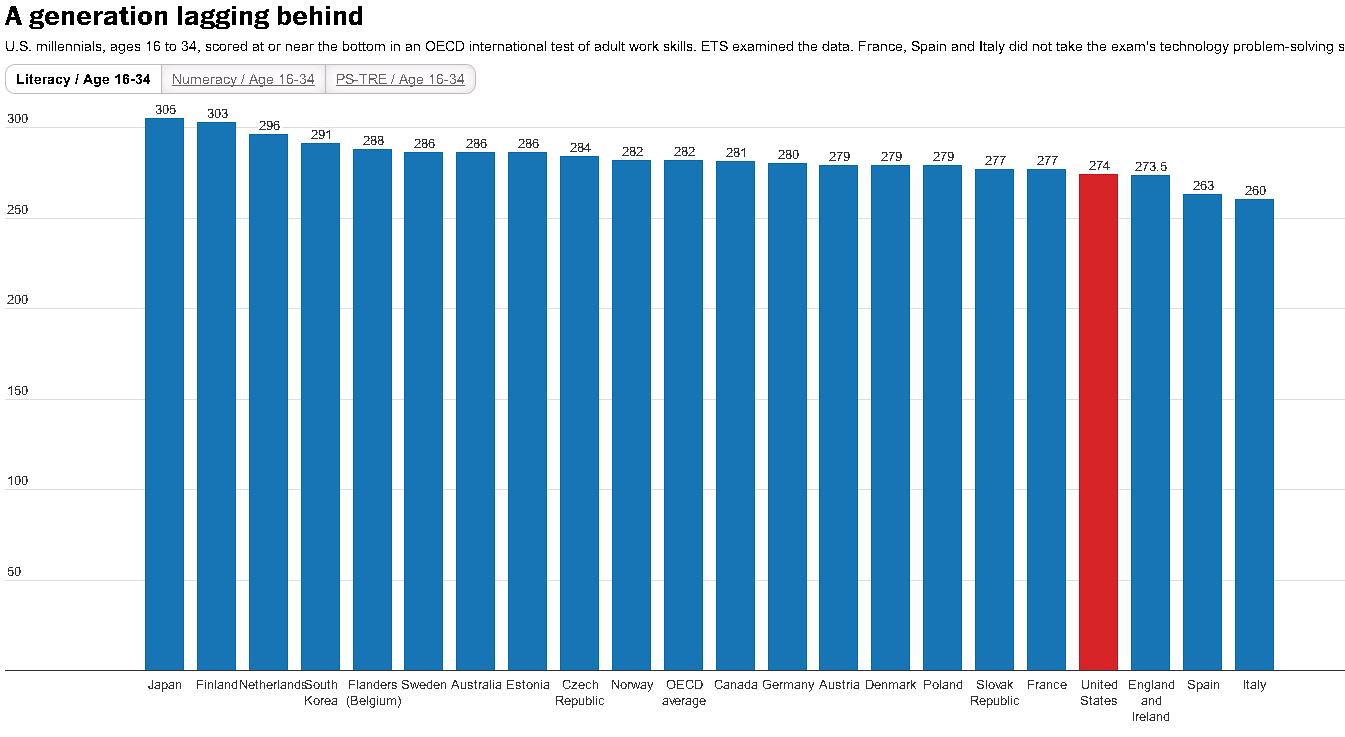
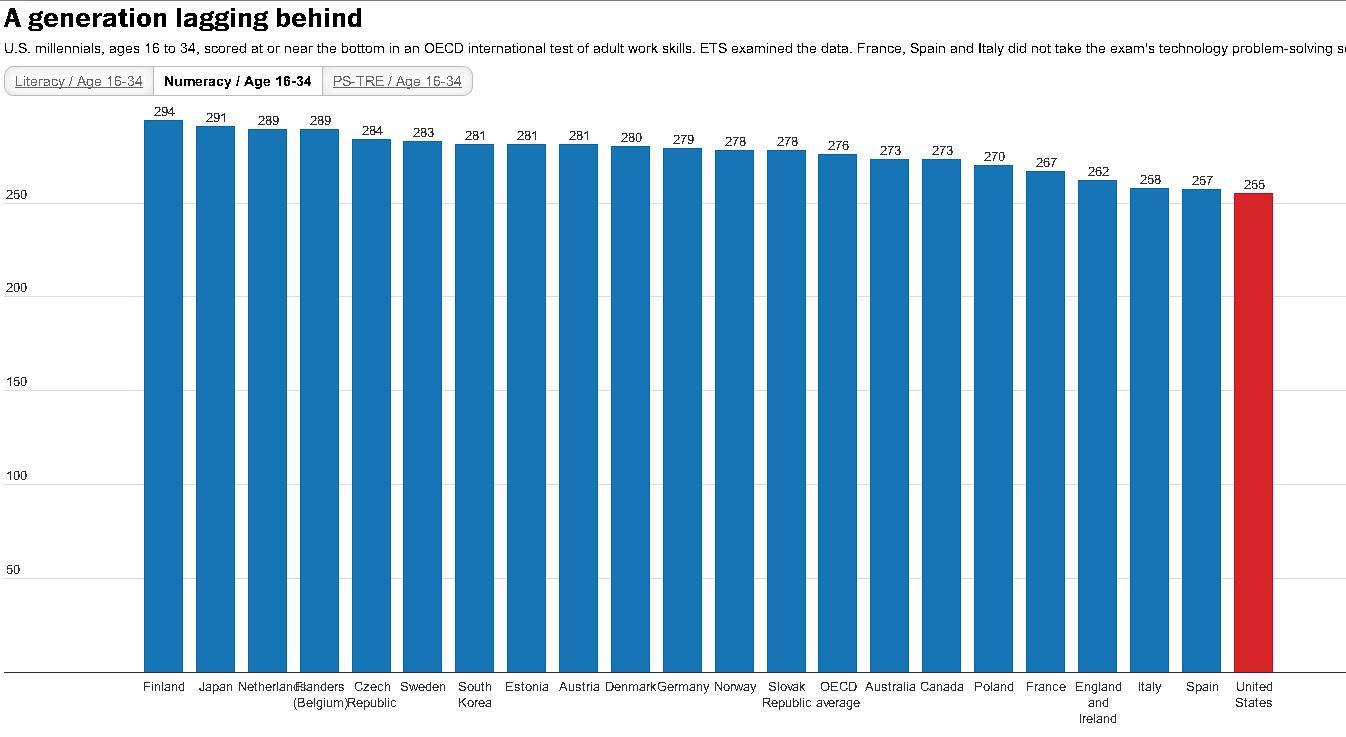
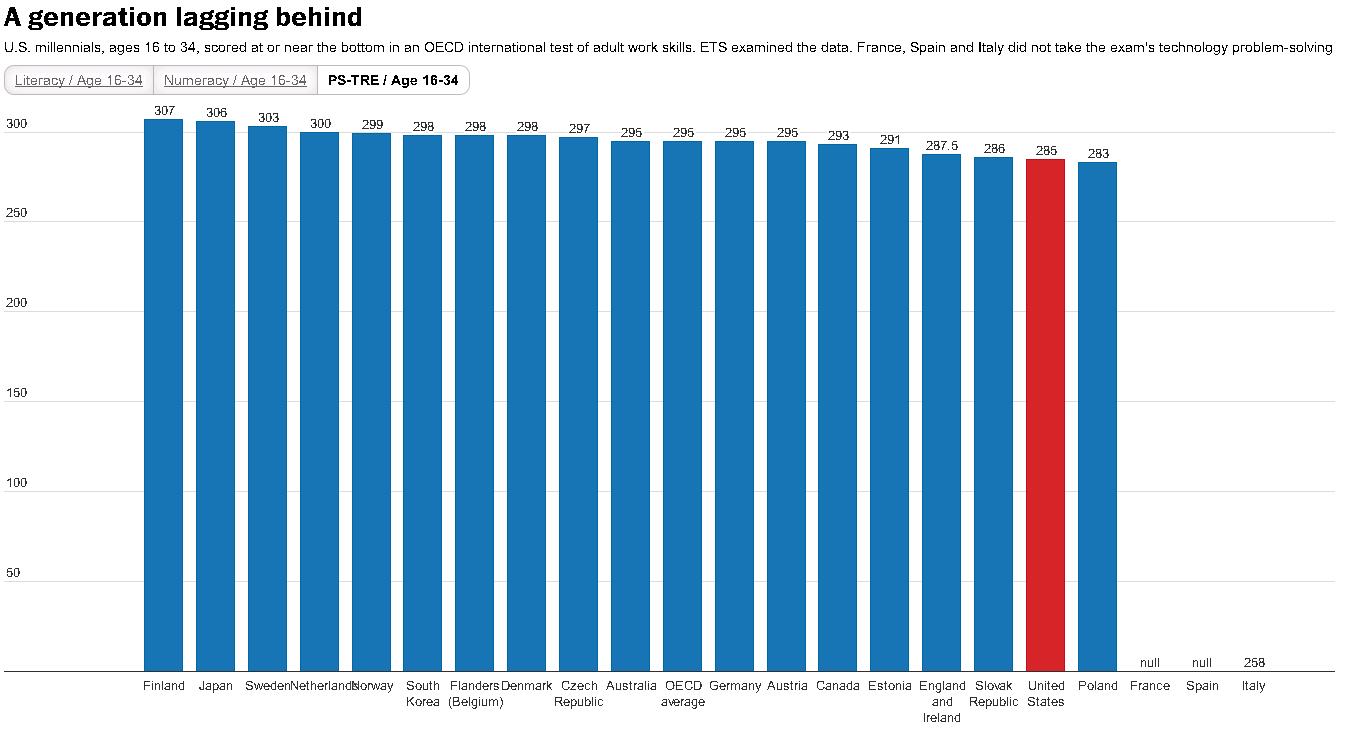
…in literacy, U.S. millennials scored higher than only three countries. In math, Americans ranked last. In technical problem-saving, they were second from the bottom. “Abysmal,” noted ETS researcher Madeline Goodman. “There was just no place where we performed well.”

Here’s the comparative data on literacy.

Here’s how Americans did on numeracy (which may explain why there’sconsiderable support for the minimum wage).

Last but not least, millennials didn’t exactly do well in problem solving, either (which may explain their bizarre answers to polling questions).

By the way, the researchers also sliced and diced the data to get apples-to-apples comparisons.

Yet even on this basis, there’s no good news for America.

U.S. millennials with master’s degrees and doctorates did better than their peers in only three countries, Ireland, Poland and Spain. …Top-scoring U.S. millennials – the 90th percentile on the PIAAC test – were at the bottom internationally, ranking higher only than their peers in Spain.  …ETS researchers tried looking for signs of promise – especially in math skills, which they considered a good sign of labor market success. They singled out native-born Americans. Nope.

At some point, we need to realize that decades of additional spending and decades of further centralization have not worked.

Maybe, just maybe, it’s time to shut down the Department of Education on the federal level and to encourage school choice on the state and local level.

After all, we already have good evidence that decentralization and competitionproduces better test scores. There’s also strong evidence for school choice from nations such as Sweden, Chile, and the Netherlands.

P.S. We’re never going to solve this problem by tinkering with the status quo. That’s like rearranging the deck chairs on the Titanic. This is why Bush’s no-bureaucrat-left-behind scheme didn’t work. And it explains why Obama’s Common Core is flopping as well.

P.P.S. Moreover, it will probably require big reform to deal with the brainless types of political correctness that exist in government schools.

P.P.P.S. If you want more evidence that the problem isn’t money, check out this research on educational outcomes in various cities. Or look at this data from New York City and Washington, DC, both of which spend record amounts of money on education.

P.P.P.P.S. I can’t resist sharing this correction of some very shoddy education reporting by the New York Times.

P.P.P.P.P.S. On the bright side, the inadequacies of government-run schools helped give birth to the home-schooling movement, which then led to this humorous video. And the political correctness that infects government schools results in a bizarre infatuation with gender performance, which helped lead to this funny video. And this bit of satire on the evolution of math training in government schools also is quite amusing.

Related posts:

FRIEDMAN FRIDAY Milton Friedman’s FREE TO CHOOSE “The Tyranny of Control” Transcript and Video (60 Minutes)

Milton Friedman’s FREE TO CHOOSE “The Tyranny of Control” Transcript and Video (60 Minutes) In 1980 I read the book FREE TO CHOOSE by Milton Friedman and it really enlightened me a tremendous amount.  I suggest checking out these episodes and transcripts of Milton Friedman’s film series FREE TO CHOOSE: “The Failure of Socialism” and […]

FRIEDMAN FRIDAY “The Tyranny of Control” in Milton Friedman’s FREE TO CHOOSE Part 7 of 7 (Transcript and Video) “I’m not pro business, I’m pro free enterprise, which is a very different thing, and the reason I’m pro free enterprise”

In 1980 I read the book FREE TO CHOOSE by Milton Friedman and it really enlightened me a tremendous amount.  I suggest checking out these episodes and transcripts of Milton Friedman’s film series FREE TO CHOOSE: “The Failure of Socialism” and “What is wrong with our schools?”  and “Created Equal”  and  From Cradle to Grave, […]

FRIEDMAN FRIDAY “The Tyranny of Control” in Milton Friedman’s FREE TO CHOOSE Part 6 of 7 (Transcript and Video) “We are the ones who promote freedom, and free enterprise, and individual initiative, And what do we do? We force puny little Hong Kong to impose limits, restrictions on its exports at tariffs, in order to protect our textile workers”

In 1980 I read the book FREE TO CHOOSE by Milton Friedman and it really enlightened me a tremendous amount.  I suggest checking out these episodes and transcripts of Milton Friedman’s film series FREE TO CHOOSE: “The Failure of Socialism” and “What is wrong with our schools?”  and “Created Equal”  and  From Cradle to Grave, […]

FRIEDMAN FRIDAY “The Tyranny of Control” in Milton Friedman’s FREE TO CHOOSE Part 5 of 7 (Transcript and Video) “There is no measure whatsoever that would do more to prevent private monopoly development than complete free trade”

In 1980 I read the book FREE TO CHOOSE by Milton Friedman and it really enlightened me a tremendous amount.  I suggest checking out these episodes and transcripts of Milton Friedman’s film series FREE TO CHOOSE: “The Failure of Socialism” and “What is wrong with our schools?”  and “Created Equal”  and  From Cradle to Grave, […]

FRIEDMAN FRIDAY “The Tyranny of Control” in Milton Friedman’s FREE TO CHOOSE Part 4 of 7 (Transcript and Video) ” What we need are constitutional restraints on the power of government to interfere with free markets in foreign exchange, in foreign trade, and in many other aspects of our lives.”

In 1980 I read the book FREE TO CHOOSE by Milton Friedman and it really enlightened me a tremendous amount.  I suggest checking out these episodes and transcripts of Milton Friedman’s film series FREE TO CHOOSE: “The Failure of Socialism” and “What is wrong with our schools?”  and “Created Equal”  and  From Cradle to Grave, […]

FRIEDMAN FRIDAY “The Tyranny of Control” in Milton Friedman’s FREE TO CHOOSE Part 3 of 7 (Transcript and Video) “When anyone complains about unfair competition, consumers beware, That is really a cry for special privilege always at the expense of the consumer”

In 1980 I read the book FREE TO CHOOSE by Milton Friedman and it really enlightened me a tremendous amount.  I suggest checking out these episodes and transcripts of Milton Friedman’s film series FREE TO CHOOSE: “The Failure of Socialism” and “What is wrong with our schools?”  and “Created Equal”  and  From Cradle to Grave, […]

FRIEDMAN FRIDAY “The Tyranny of Control” in Milton Friedman’s FREE TO CHOOSE Part 2 of 7 (Transcript and Video) “As always, economic freedom promotes human freedom”

In 1980 I read the book FREE TO CHOOSE by Milton Friedman and it really enlightened me a tremendous amount.  I suggest checking out these episodes and transcripts of Milton Friedman’s film series FREE TO CHOOSE: “The Failure of Socialism” and “What is wrong with our schools?”  and “Created Equal”  and  From Cradle to Grave, […]

FRIEDMAN FRIDAY “The Tyranny of Control” Milton Friedman’s FREE TO CHOOSE Part 1 of 7 (Transcript and Video) “Adam Smith’s… key idea was that self-interest could produce an orderly society benefiting everybody, It was as though there were an invisible hand at work”

In 1980 I read the book FREE TO CHOOSE by Milton Friedman and it really enlightened me a tremendous amount.  I suggest checking out these episodes and transcripts of Milton Friedman’s film series FREE TO CHOOSE: “The Failure of Socialism” and “What is wrong with our schools?”  and “Created Equal”  and  From Cradle to Grave, […]

Open letter to President Obama (Part 654) “The Tyranny of Control” in Milton Friedman’s FREE TO CHOOSE Part 7 of 7 (Transcript and Video) “I’m not pro business, I’m pro free enterprise, which is a very different thing, and the reason I’m pro free enterprise”

Open letter to President Obama (Part 654) (Emailed to White House on July 22, 2013) President Obama c/o The White House 1600 Pennsylvania Avenue NW Washington, DC 20500 Dear Mr. President, I know that you receive 20,000 letters a day and that you actually read 10 of them every day. I really do respect you […]

Open letter to President Obama (Part 650) “The Tyranny of Control” in Milton Friedman’s FREE TO CHOOSE Part 6 of 7 (Transcript and Video) “We are the ones who promote freedom, and free enterprise, and individual initiative, And what do we do? We force puny little Hong Kong to impose limits, restrictions on its exports at tariffs, in order to protect our textile workers”

Open letter to President Obama (Part 650) (Emailed to White House on July 22, 2013) President Obama c/o The White House 1600 Pennsylvania Avenue NW Washington, DC 20500 Dear Mr. President, I know that you receive 20,000 letters a day and that you actually read 10 of them every day. I really do respect you […]

_________

FRIEDMAN FRIDAY Free Market Conservatives like Dan Mitchell and Milton Friedman would destroy TRUMP and SANDERS in a debate on PROTECTIONISM Part 1


Milton Friedman – Free Trade vs. Protectionism

Free to Choose Part 2: The Tyranny of Control (Featuring Milton Friedman

John Cowperthwaite deserves a lot of credit for Hong Kong’s prosperity. As a British appointee, he took a hands-off policy and allowed the colony’s economy to thrive. He didn’t even want the government to collect statistics since that would give interventionists data that might be used to argue for interventionism.

I have mixed feelings about that approach. I constantly use statistics because they so often show that free markets and small government produce the best outcomes. I even use data to show that Hong Kong’s economy should be emulated.

On the other hand, there are some statistics that cause a lot of mischief.

I’ve argued, for instance, that we should focus on how national prosperity is generated (gross domestic income) rather than how it is allocated (gross domestic product). If we changed the focus to GDI, the debate would more naturally focus on pro-growth policies to boost wages, small business income, and corporate profits rather than the misguided policies (such asKeynesian economics) that are enabled by a focus on GDP.

That being said, there’s a good argument that the worst government statistic is the “trade deficit.”

This is a very destructive piece of data because people instinctively assume a “deficit” is bad. Yet I have a trade deficit every year with my local grocery store. I’m always buying things from them and they never buy anything from me. Does that mean I’m a “loser”? Of course not. Voluntary exchange, by definition, means that both parties gain from any transaction. And this principle applies when voluntary exchange occurs across national borders.

Moreover, people oftentimes don’t realize that the necessary and automatic flip side of a “trade deficit” is a “capital surplus.” In other words, when foreign companies acquire dollars by selling to American consumers, they frequently decide that investing in the American economy is the best use of that money. And the huge amount of investment from overseas is a sign of comparative prosperity and vitality, not a sign of weakness.

And for any readers who nonetheless think protectionism might be a good idea, I challenge them to answer these eight questions.

I’m confident that both Donald Trump and Bernie Sanders wouldn’t be able to successfully answer any of them. Yet it appears they’ve gained some traction with voters by calling for protectionism.

That’s quite unfortunate. If the pro-trade policy consensus in America breaks down, that would create dangerous opportunities for politicians and bureaucrats to rig the game in favor of special interests while also imposing higher costs of taxpayers and consumers.

Let’s dig into the issue.

In a column for the Wall Street Journal, Mort Kondracke and Matthew Slaughter combine to produce a strong defense of trade.

…the four leading presidential candidates…oppose the U.S. ratifying the Trans-Pacific Partnership. All four demonize trade the same way. …Where is the leader with the courage to tell the truth? To say that trade made this nation great, and that trade barriers will destroy far more jobs than they can ever “save.” …America’s exporters and importers are among the country’s most dynamic companies, paying their workers about 15%-20% more than workers earn elsewhere in the economy. The overall gains are large. Trade and related activities—spurred by accords such as the North American Free Trade Agreement, or Nafta, have boosted annual U.S. income today by about 10 percentage points of GDP relative to what it would have been otherwise. This translates into an aggregate gain of about $1.8 trillion in 2015—thousands of dollars per U.S. household every year. …creative destruction—the movement of people and capital from weaker businesses to stronger ones and new opportunities—is how many of the gains from trade arise. …For generations, American presidents of both parties have spoken about the benefits of trade. “Economic isolation and political leadership are wholly incompatible,” warned John Kennedy. “A creative, competitive America is the answer to a changing world,” said Ronald Reagan. “We should always remember: protectionism is destructionism.”

By the way, I think Kondracke and Slaughter paint with too broad a brush. Both Cruz and Clinton are far less protectionist than Trump and Sanders. Though the authors are correct in noting that they’ve been reluctant (especially in the case of Clinton) to vigorously defend free trade.

The great legal scholar Richard Epstein (also my former debating partner) writesabout the dangers of protectionism.

There are of course major difference between the insidious Trump and buffoonish Sanders. …Still, the real selling point of each boils down to one issue: In the indecorous language of the pollster, Pat Caddell, Americans feel “they have been screwed” by free trade. …free trade is in retreat as protectionism becomes the common thread across the both political parties. It is as though the economic unwisdom of the 1930 Smoot-Hawley Tariff Act is back.

Richard makes a very important point that politicians often support protectionism in an attempt to hide the damage they do with other misguided policies.

Free trade offers an uncompromising indictment of, and a powerful corrective for, America’s unsound economic policies. …the reason that local businesses outsource from the United States is the same reason why foreign businesses are reluctant to expand operations here. Our regulatory and labor environment is hostile to economic growth and there are no signs of that abating anytime soon. …the steady decline in freedom and productivity inside the United States has continued apace. Ironically, the strong likelihood that the next American president will expand protectionist practices will only make matters worse: firms, both foreign and domestic, are more reluctant to invest in the United States…free trade gives the federal government and the individual states strong incentives to clean up their act so that they can once again be attractive to foreign investment.

My buddy Ross Kaminsky explains in the American Spectator that free trade is good because it is part of the competitive process that boosts living standards, particularly for the poor.

…in trade, as in any economic endeavor, there are losers in the short run. Capitalism is, after all, fundamentally a system of creative destruction. But if there is any area of agreement among economists of all political stripes…it is that free trade provides large net benefits to the societies that engage in it, even if other nations do not lower trade barriers to the same degree. Furthermore, the benefits of trade accrue in large measure to the lower economic echelons of society in an extension of Schumpeter’s profound observation that “the capitalist achievement does not typically consist in providing more silk stockings for queens but in bringing them within the reach of factory girls in return for steadily decreasing amounts of effort.”

And Ross echoes Richard Epstein’s point about the real problem being anti-growth policies that make America less competitive.

Trade is complex and like all complex things politicians will dumb it down in a way that benefits them, generally by lying to the public and creating a frothy anger against those “damn furiners” instead of pointing fingers at the true culprits: unions, regulators, and politicians of all stripes.

Ross and Richard are right. If politicians really want more jobs in America, they should be adopting policies to boost U.S. competitiveness.

And we don’t need giant steps. Yes, a flat tax would be great, but even incremental reforms such as a lower corporate tax rate or the right tax treatment of business investment would yield big dividends.

Let’s add a few more voices to the discussion.

In an editorial, the Wall Street Journal debunks Donald Trump’s protectionist tirade against China.

The real-estate developer recently added Japan to his most-wanted list of job killers… “They’re killing us. You know what we sell to Japan? Practically nothing.” Is $116 billion worth of annual goods and services exports to Japan practically nothing? Japan is the fourth largest U.S. export market in goods after Canada, Mexico and China. …The best way to boost American exports is to remove trade barriers with new trade agreements. U.S. farm producers would particularly benefit from the Trans-Pacific Partnership with Japan and 10 other countries. Japanese tariffs on beef would fall to 9% in the 16th year of the deal from 38.5% while the 20% tariff on ground pork would be eliminated in six years. Japan’s 21.3% levy on poultry and eggs would be abolished in six to 13 years.

Writing for the Washington Post, David Ignatius defends trade in general and trade agreements in particular.

…the revolt against free trade that has captured both parties could do the most long-term damage. …there’s strong evidence that trade has benefited the U.S. economy and created whole new industries in which the United States is dominant. That’s the essence of the “creative destruction” that makes a market economy so potent: It relentlessly pushes innovation and change. …The bipartisan protectionism of Trump and Sanders has focused its attacks on the Trans-Pacific Partnership… Robert Z. Lawrence and Tyler Moran estimate that between 2017 and 2026, when TPP would have its major impact, the costs to displaced workers would be 6 percent of the benefits to the economy — or an 18-to-1 benefit-to-cost ratio. …David Autor, David Dorn and Gordon Hanson…noted that the pact would promote trade in knowledge industries where the United States has a big advantage and that “killing the TPP would do little to bring factory work back to America.”

Ignatius also makes a very important observation that protectionists want us to be scared of nations that have much bigger problems than the United States.

Trump, the businessman, seems weirdly out of touch with real economic trends. He speaks of Japan as though it were an economic powerhouse, when it has actually suffered a two-decades-long slump; he describes a surging China, when the numbers show its growth is sagging.

Amen. Japan has huge problems and China still has quite a way to go before it becomes a developed nation.

Let’s close with some good news. Politicians may be engaging in anti-trade demagoguery, and there may be some voters that are motivated by hostility to voluntary exchange, but that doesn’t mean the protectionists have won.

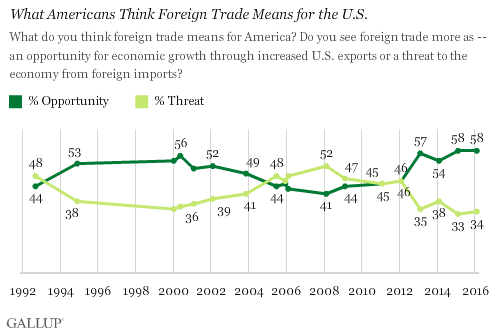
Indeed, pro-trade sentiment has never been higher by some measures. Here’s some amazingly positive polling data from Gallup.

P.S. One final point. The growing burden of government spending and taxation since World War II have been very unfortunate, but the good news is that we have strong evidence that the economic damage of worsening fiscal policy has been offset by the economic gains from trade liberalization. It would be tragic to see that reversed.

P.P.S. Fans of Richard Epstein may enjoy this video of him reminiscing about Barack Obama’s undistinguished tenure at the University of Chicago Law School, as well asthis video of him dismantling George Soros in a debate that took place at Cato.

Related posts:

FRIEDMAN FRIDAY Milton Friedman’s FREE TO CHOOSE “The Tyranny of Control” Transcript and Video (60 Minutes)

Milton Friedman’s FREE TO CHOOSE “The Tyranny of Control” Transcript and Video (60 Minutes) In 1980 I read the book FREE TO CHOOSE by Milton Friedman and it really enlightened me a tremendous amount.  I suggest checking out these episodes and transcripts of Milton Friedman’s film series FREE TO CHOOSE: “The Failure of Socialism” and […]

FRIEDMAN FRIDAY “The Tyranny of Control” in Milton Friedman’s FREE TO CHOOSE Part 7 of 7 (Transcript and Video) “I’m not pro business, I’m pro free enterprise, which is a very different thing, and the reason I’m pro free enterprise”

In 1980 I read the book FREE TO CHOOSE by Milton Friedman and it really enlightened me a tremendous amount.  I suggest checking out these episodes and transcripts of Milton Friedman’s film series FREE TO CHOOSE: “The Failure of Socialism” and “What is wrong with our schools?”  and “Created Equal”  and  From Cradle to Grave, […]

FRIEDMAN FRIDAY “The Tyranny of Control” in Milton Friedman’s FREE TO CHOOSE Part 6 of 7 (Transcript and Video) “We are the ones who promote freedom, and free enterprise, and individual initiative, And what do we do? We force puny little Hong Kong to impose limits, restrictions on its exports at tariffs, in order to protect our textile workers”

In 1980 I read the book FREE TO CHOOSE by Milton Friedman and it really enlightened me a tremendous amount.  I suggest checking out these episodes and transcripts of Milton Friedman’s film series FREE TO CHOOSE: “The Failure of Socialism” and “What is wrong with our schools?”  and “Created Equal”  and  From Cradle to Grave, […]

FRIEDMAN FRIDAY “The Tyranny of Control” in Milton Friedman’s FREE TO CHOOSE Part 5 of 7 (Transcript and Video) “There is no measure whatsoever that would do more to prevent private monopoly development than complete free trade”

In 1980 I read the book FREE TO CHOOSE by Milton Friedman and it really enlightened me a tremendous amount.  I suggest checking out these episodes and transcripts of Milton Friedman’s film series FREE TO CHOOSE: “The Failure of Socialism” and “What is wrong with our schools?”  and “Created Equal”  and  From Cradle to Grave, […]

FRIEDMAN FRIDAY “The Tyranny of Control” in Milton Friedman’s FREE TO CHOOSE Part 4 of 7 (Transcript and Video) ” What we need are constitutional restraints on the power of government to interfere with free markets in foreign exchange, in foreign trade, and in many other aspects of our lives.”

In 1980 I read the book FREE TO CHOOSE by Milton Friedman and it really enlightened me a tremendous amount.  I suggest checking out these episodes and transcripts of Milton Friedman’s film series FREE TO CHOOSE: “The Failure of Socialism” and “What is wrong with our schools?”  and “Created Equal”  and  From Cradle to Grave, […]

FRIEDMAN FRIDAY “The Tyranny of Control” in Milton Friedman’s FREE TO CHOOSE Part 3 of 7 (Transcript and Video) “When anyone complains about unfair competition, consumers beware, That is really a cry for special privilege always at the expense of the consumer”

In 1980 I read the book FREE TO CHOOSE by Milton Friedman and it really enlightened me a tremendous amount.  I suggest checking out these episodes and transcripts of Milton Friedman’s film series FREE TO CHOOSE: “The Failure of Socialism” and “What is wrong with our schools?”  and “Created Equal”  and  From Cradle to Grave, […]

FRIEDMAN FRIDAY “The Tyranny of Control” in Milton Friedman’s FREE TO CHOOSE Part 2 of 7 (Transcript and Video) “As always, economic freedom promotes human freedom”

In 1980 I read the book FREE TO CHOOSE by Milton Friedman and it really enlightened me a tremendous amount.  I suggest checking out these episodes and transcripts of Milton Friedman’s film series FREE TO CHOOSE: “The Failure of Socialism” and “What is wrong with our schools?”  and “Created Equal”  and  From Cradle to Grave, […]

FRIEDMAN FRIDAY “The Tyranny of Control” Milton Friedman’s FREE TO CHOOSE Part 1 of 7 (Transcript and Video) “Adam Smith’s… key idea was that self-interest could produce an orderly society benefiting everybody, It was as though there were an invisible hand at work”

In 1980 I read the book FREE TO CHOOSE by Milton Friedman and it really enlightened me a tremendous amount.  I suggest checking out these episodes and transcripts of Milton Friedman’s film series FREE TO CHOOSE: “The Failure of Socialism” and “What is wrong with our schools?”  and “Created Equal”  and  From Cradle to Grave, […]

Open letter to President Obama (Part 654) “The Tyranny of Control” in Milton Friedman’s FREE TO CHOOSE Part 7 of 7 (Transcript and Video) “I’m not pro business, I’m pro free enterprise, which is a very different thing, and the reason I’m pro free enterprise”

Open letter to President Obama (Part 654) (Emailed to White House on July 22, 2013) President Obama c/o The White House 1600 Pennsylvania Avenue NW Washington, DC 20500 Dear Mr. President, I know that you receive 20,000 letters a day and that you actually read 10 of them every day. I really do respect you […]

Open letter to President Obama (Part 650) “The Tyranny of Control” in Milton Friedman’s FREE TO CHOOSE Part 6 of 7 (Transcript and Video) “We are the ones who promote freedom, and free enterprise, and individual initiative, And what do we do? We force puny little Hong Kong to impose limits, restrictions on its exports at tariffs, in order to protect our textile workers”

Open letter to President Obama (Part 650) (Emailed to White House on July 22, 2013) President Obama c/o The White House 1600 Pennsylvania Avenue NW Washington, DC 20500 Dear Mr. President, I know that you receive 20,000 letters a day and that you actually read 10 of them every day. I really do respect you […]

__________

FRIEDMAN FRIDAY Milton Friedman bragged on Hong Kong’s free economy in 1980 and Dan Mitchell does in 2016!!!

Milton Friedman bragged on  Hong Kong’s free economy in 1980 and Dan Mitchell does in 2016!!!

Milton Friedman PBS Free to Choose 1980 Vol 1 of 10 Power of the Market

Published on May 9, 2012

America’s freedom and prosperity derive from the combination of the idea of human liberty in America’s Declaration of Independence with the idea of economic freedom in Adam Smith’s Wealth of Nations. Friedman explains how markets and voluntary exchange organize activity and enable people to improve their lives. He also explains the price system. Friedman visits Hong Kong, U.S. and Scotland.

Hong Kong is a truly remarkable jurisdiction.

Can you name, after all, another government in the world that brags about how little it spends on redistribution programs andhow few people are dependent on government?

And how many jurisdictions adopt private Social Security systems to help make sure the burden of government spending doesn’t climb above 20 percent of GDP?

No wonder Hong Kong routinely is at the top of the rankings in both Economic Freedom of the World and the Index of Economic Freedom.

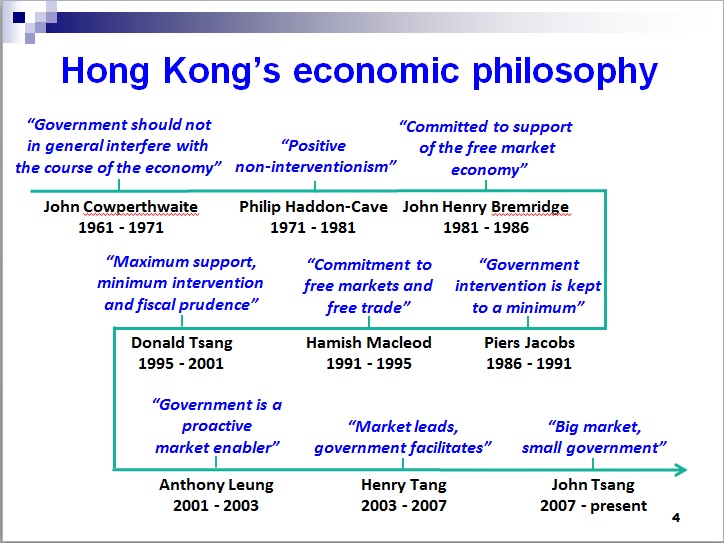
Here is some additional evidence of Hong Kong’s sensible approach. Below is a slide from a presentation by Hong Kong government officials, quoting the current Financial Secretary and all his predecessors, covering both the period of Chinese sovereignty and British sovereignty. As you can see, the one constant theme is free markets and small government.

For additional background, let’s enjoy the insight of one of these men.

In a column for Reason, my Cato Institute colleague Marian Tupy reminisces on his meeting with John Cowperthwaite, one of the British-appointed economic advisers.

…a young Scottish civil servant named John Cowperthwaite arrived in the colony to oversee its economic development. Some 50 years later, I met Cowperthwaite in St Andrews, Scotland, where I was a student and he was enjoying his retirement. As he told me, “I came to Hong Kong and found the economy working just fine. So, I left it that way.” …Of all the policies that we discussed, one stands out in my mind. I asked him to name the one reform that he was most proud of. “I abolished the collection of statistics,” he replied. Cowperthwaite believed that statistics are dangerous, because they enable social engineers of all stripes to justify state intervention in the economy. At some point during our first conversation I managed to irk him by suggesting that he was chiefly known “for doing nothing.” In fact, he pointed out, keeping the British political busy-bodies from interfering in Hong Kong’s economic affairs took up a large portion of his time.

I especially like Cowperthwaite’s insight about the downside risk of letting governments collect a lot of data.

Something that’s worth considering in a world where governments want to engage in massive data collection and data sharing for purposes of imposing and enforcing bad global tax policy.

But let’s not get sidetracked. Economic freedom in Hong Kong is today’s topic. With that in mind, here’s a chart from Marian’s column. It shows that Hong Kong used to be much poorer than the United Kingdom. But after decades of faster growth (thanks to good policy), Hong Kong is now more prosperous than its former colonial master.

In other words, Hong Kong didn’t just converge with one of the world’s richest countries, which by itself would be a remarkable and unusual achievement. It actually became richer.

This is tremendous evidence on the benefits of good policy and the importance of strong, long-run growth.

Let’s close by looking at this issue of growth and development. Here’s a video from Marginal Revolution, narrated by Professor Alex Tabarrok of George Mason University. You should watch it from start to finish, but if you’re pressed for time, make sure to at least watch the first 2:10.

Puzzle of Growth: Rich Countries and Poor Countries

There are two things that are worth emphasizing from the video.

The productivity of workers (and therefore the pay of workers) is dependent on the quantity and quality of capital.

Entrepreneurs play a key role in figuring out the best ways of mixing labor and capital and this innovation boosts productivity.

By the way, there are two sins of omission in the video. If you watch the whole thing, you’ll notice it mentions that strong economic performance is linked to therule of law, property rights, free trade, and sensible regulation.

All that is true. But what about a stable monetary system? And what about areasonable tax regime and a modest burden of government spending?

But I’m nitpicking. Let’s close with another video from Marginal Revolution. You should once again watch the entire video, but for those in a rush, I adjusted the settings so it starts at the most important part.

Growth Rates Are Crucial

The video uses GDP data that is adjusted for both inflation and population, which is a very useful approach. But the key lesson, as Professor Tabarrok explained, is that even small sustained changes in growth have enormous implications for long-run prosperity.

Indeed, that’s why Hong Kong is now richer than the United Kingdom. And it’s also worth noting that Hong Kong (and Singapore) are passing the United States.

Related Posts:

FRIEDMAN FRIDAY Milton Friedman – Tyranny of the Status Quo – Part 1 – Beneficiaries

Milton Friedman – Tyranny of the Status Quo – Part 1 – Beneficiarieshttp://www.freetochoose.net/media/broadcast/freetochoose/index.php?type=media#media

FRIEDMAN FRIDAY Milton Friedman videos

________ Milton Friedman – Iceland 1 of 8 Friedman visited Iceland in the autumn of 1984, met with prominent Icelanders and gave a lecture at the University of Iceland on the Tyranny of the Status Quo. He participated in a lively television debate on August 31, 1984 with leading socialist intellectuals, including current President Ólafur […]

FRIEDMAN FRIDAY Milton Friedman’s “Free to Choose” film transcripts and videos here on www.thedailyhatch.org

Volume 1: Power of the Market Volume 2: The Tyranny of Control Volume 3: Anatomy of a Crisis Volume 4: From Cradle to Grave Volume 5: Created Equal Volume 6: What’s Wrong With Our Schools? Volume 7: Who Protects the Consumer? Volume 8: Who Protects the Worker? Volume 9: How to Cure Inflation Volume 10: […]

FRIEDMAN FRIDAY How to Cure Health Care: What We Can Learn from Milton Friedman 2 years ago Kurt Jaros

How to Cure Health Care: What We Can Learn from Milton Friedman 2 years ago Kurt Jaros Blog Economics 3 I recently read about Michael Ciampi, a doctor from Maine who has stopped accepting payments from insurance companies, both private and public. The article states: …the decision to do away with insurance allows Ciampi to […]

FRIEDMAN FRIDAY How to Cure Health Care By Milton Friedman (A paper from 2001)

Milton Friedman on Medical Care (Full Lecture) Published on Feb 2, 2014 Website:http://www.commonsensecapitalism.com Facebook:http://www.facebook.com/pages/Common-… Twitter:https://twitter.com/#!/CommonSenseCap I have written about Obamacare over and over again on this blog. Dan Mitchell has shared many funny cartoons about Obamacare too. Milton Friedman has spoken out about government healthcare many times in the past and his film […]

FRIEDMAN FRIDAY Article by Peter Robinson 6/19/2009 @ 12:01AM Medical Analysis By Milton Friedman

Milton Friedman on Medical Care (Full Lecture) Published on Feb 2, 2014 Website:http://www.commonsensecapitalism.com Facebook:http://www.facebook.com/pages/Common-… Twitter:https://twitter.com/#!/CommonSenseCap I have written about Obamacare over and over again on this blog. Dan Mitchell has shared many funny cartoons about Obamacare too. Milton Friedman has spoken out about government healthcare many times in the past and his film […]

FRIEDMAN FRIDAY Taxmageddon and Obamacare: What Would Milton Friedman Say? Rich Tucker / @RichardBTucker / July 31, 2012

Milton Friedman on Medical Care (Full Lecture) Published on Feb 2, 2014 Website:http://www.commonsensecapitalism.com Facebook:http://www.facebook.com/pages/Common-… Twitter:https://twitter.com/#!/CommonSenseCap Taxmageddon and Obamacare: What Would Milton Friedman Say? Rich Tucker / @RichardBTucker / July 31, 2012 / 3 comments “I am in favor of cutting taxes under any circumstances and for any excuse, for any reason, whenever […]

Transcript of Milton Friedman speech from 1991

Best quote from the speech below: However, the point that impresses me now and that I want to emphasize is that the problem is not only for them but for us. They have as much to teach us as we have to teach them. What was their problem under communism? Too big, too intrusive, too […]

Milton Friedman Videos, Over 50 quotes too!!!!!

Milton Friedman – Public Schools / Voucher System Published on May 9, 2012 by BasicEconomics No description available. Milton Friedman – Public Schools / Voucher System (Q&A) Part 1 Milton Friedman: Why soaking the rich won’t work (Do the rich hoard their money? What are they investing in?) Uploaded by voogru on Apr 10, 2010 […]

FRIEDMAN FRIDAY A Way Out of Soviet-Style Health Care Solzhenitsyn’s prophetic warning about the depersonalization of medicine. By MILTON FRIEDMAN Updated March 20, 2010 12:01 a.m. ET

Milton Friedman – Health Care Reform (1992) pt 1/4 Milton Friedman – Health Care Reform (1992) pt 2/4 A Way Out of Soviet-Style Health Care Solzhenitsyn’s prophetic warning about the depersonalization of medicine. By MILTON FRIEDMAN Updated March 20, 2010 12:01 a.m. ET Editor’s note: The following is excerpted from an article with the same […]

FRIEDMAN FRIDAY Is Capitalism Humane? by Milton Friedman (Polish Scholar Edward Lipinski quoted by Friedman)

Socialist Edward Lipinski met Milton Friedman and said, “I used to believe in socialism, I still do, but socialism is an ideal but we can’t have in the real world until we are rich enough to afford it. Socialism will be practical when every man in Poland has a house and two servants.”

“Milton Friedman Speaks” – Is Capitalism Humane?

Published on Jul 31, 2012

Dr. Friedman speaks on the morality of capitalism.

Related posts:

“Friedman Friday” Milton Friedman – Power of Choice (Biography) Part 3

Milton Friedman – Power of Choice (Biography) Part 3 Published on May 21, 2012 by BasicEconomics Tribute to Milton Friedman English Pages, 8. 9. 2008 Dear colleagues, dear friends, (1) It is a great honor for me to be asked to say a few words to this distinguished and very knowledgeable audience about one of our greatest […]

“Friedman Friday” Milton Friedman – Power of Choice (Biography) Part 2

Milton Friedman – Power of Choice (Biography) Part 2 Published on May 21, 2012 by BasicEconomics My Tribute to Milton Friedman: The Little Giant of Free Market Economics By: admin- 11/17/2006 09:49 AM RESIZE: AAA  Milton Friedman, the intellectual architect of the free-market reforms of the post-World War II era, was a dear friend. I […]

“Friedman Friday” Milton Friedman – Power of Choice – Biography (Part 1)

Milton Friedman – Power of Choice – Biography (Part 1) Published on May 20, 2012 by BasicEconomics   David R. Henderson The Pursuit of Happiness ~ Milton Friedman: A Personal Tribute May 2007 • Volume: 57 • Issue: 4 David Henderson (davidrhenderson1950@gmail.com) is a research fellow with the Hoover Institution and an economics professor at […]

Milton Friedman’s Chicago Boys started the Chilean Miracle and it is still helping ordinary people today!!!

Milton Friedman and Chile – The Power of Choice Uploaded on May 13, 2011 In this excerpt from Free To Choose Network’s “The Power of Choice (2006)”, we set the record straight on Milton Friedman’s dealings with Chile — including training the Chicago Boys and his meeting with Augusto Pinochet. Was the tremendous prosperity unleashed […]

Margaret Thatcher admired Milton Friedman

RARE Friedman Footage – On Keys to Reagan and Thatcher’s Success Margaret Thatcher and Milton Friedman were two of my heroes. Thatcher praises Friedman, her freedom fighter By George Jones, Political Editor 12:01AM GMT 17 Nov 2006 A tireless champion of the free market Let’s not get misty eyed over the Friedman legacy Milton Friedman, […]

Milton Friedman and Chile an update

Milton Friedman was a great economist and a fine speaker. ___________________ I have written before about Milton Friedman’s influence on the economy of Chile. Now I saw this fine article below from http://www.heritage.org  and below that article I have included an article from the Wall Street Journal that talks about Milton Friedman’s influence on Chile. I […]

“Friedman Friday” Milton Friedman explains negative income tax to William F. Buckley in 1968

December 06, 2011 03:54 PM Milton Friedman Explains The Negative Income Tax – 1968 0 comments By Gordonskene enlarge Milton Friedman and friends.DOWNLOADS: 36 PLAYS: 35 Embed   The age-old question of Taxes. In the early 1960′s Economist Milton Friedman adopted an idea hatched in England in the 1950′s regarding a Negative Income Tax, to […]

Milton Friedman admired Margaret Thatcher

RARE Friedman Footage – On Keys to Reagan and Thatcher’s Success Margaret Thatcher and Milton Friedman were two of my heroes. Milton Friedman on How Francois Mitterrand (and Failed Lefty Economics) Helped Re-elect Margaret Thatcher Matt Welch|Apr. 10, 2013 9:37 am Yesterday I wrote a column about how Margaret Thatcher liberated Western Europe from the […]

Milton Friedman had a solution to today’s welfare mentality!!!

  I have written about the tremendous increase in the food stamp program the last 9 years before and that means that both President Obama and Bush were guilty of not trying to slow down it’s growth. Furthermore, Republicans have been some of the biggest supporters of the food stamp program. Milton Friedman had a […]

“Friedman Friday” Milton Friedman on “Firing Line” in 1968

Milton Friedman, Ronald Reagan And William F. Buckley Jr. Peter Robinson, 12.12.08, 12:01 AM EST In a time of crisis, don’t forget what they had to say. As the federal deficit surpasses $1 trillion, Congress debates a bailout for the Detroit automakers and President-elect Barack Obama draws up plans for a vast new stimulus package, […]

By Everette Hatcher III | Posted in Milton Friedman | Edit | Comments (0)

FRIEDMAN FRIDAY Transcript of Milton Friedman speech from 1991


Best quote from the speech below:

However, the point that impresses me now and that I want to emphasize is that the problem is not only for them but for us. They have as much to teach us as we have to teach them. What was their problem under communism? Too big, too intrusive, too powerful a government. I ask you, what is our problem in the United States today? We have a relatively free system. This is a great country and has a great deal of freedom, but we are losing our freedom. We are living on our capital in considerable measure. This country was built up during 150 years and more in which government played a very small role. As late as 1929, total government spending in the United States never exceeded about 12% of the national incomeabout the same fraction as in Hong Kong in recent years. Federal government spending was about 3 to 4% of the national income except at the time of the Civil War and World War I. Half of that went for the military and half for everything else. State and local governments spent about twice as much. Again, local governments spent more than state governments. In the period between then and now, the situation has changed drastically. Total government spending, as I said, is 43% of national income, and twothirds of that is federal.

Moreover, in addition to what government spends directly, it exercises extensive control over the deals that people can make in the private market. It prevents you f rom buyi ng sugar in the cheapest market; it forces you to pay twice the world price for sugar. It forces enterprises to meet all sorts of requirements about wages, hours, antipollution standards, and so on and on. Many of these may be good, but they are government dictation of how the resources shall be used. To put it in one word that should be familiar to us by now, it is socialist.

____________

“Economic Freedom, Human Freedom, Political Freedom”

by Milton Friedman

Delivered November 1, 1991


Introduction of Milton Friedman by Charles W. Baird, Director.

In 1963 I was an undergraduate economics major in a private university in Massachusetts. In a small seminar class I was assigned to read a new book by Milton Friedman, Capitalism & Freedom, and a 1958 book by John Kenneth Galbraith, The Affluent Society, which expressed contrary views. My task was to write an essay defending Galbraith against Friedman. I got an “A” on that assignment.

But, in the fullness of time, I made my way to UCLA and the tutelage of Armen Alchian. I came to appreciate the wisdom of Milton Friedman. Moreover, judging from a lecture Galbraith gave at Berkeley just last month, even he is beginning to see the light.

Professor Friedman won the Nobel Prize in economics in 1976 “for his achievements in the fields of consumption analysis, monetary history and theory, and for his demonstration of the complexity of stabilization policy.”

He was the Paul Snowden Russell Distinguished Service Professor of Economics at the University of Chicago from 1962 1977. He is now the Emeritus holder of that chair. Since 1977, he has been a Senior Research Fellow at the Hoover Institu tion.

Professor Friedman was the founder, and chief proponent of the Chicago School of monetary economicsaka., monetarism. I can recall during the 1960s that the great debate in macroeconomics, set off by Friedman & Schwartz’ monumental Monetary History of the U.S., was between the Keynesians and the Monetarists. Which was more stable: the Keynesian multiplier or, as Friedman would have it, the velocity of circulation of money? Most economists today would agree that Friedman and company had the better arguments and the better evidence.

Professor Friedman is one of the most versatile members of the profession. His 1953 article, “The Methodology of Positive Economics,” is still required reading in almost every class in economic theory. It is the starting point for all discussions of what separates good economics from bad economics. In addition to methodology and macroeconomics, he has made significant contributions in the areas of economic history, statistics, international finance, risk and insurance, and microeconomic theory. He is one of the most cited economists of the latter half of the twentieth century.

Professor Friedman is a founding member and a past president of the Mont Pelerin Societyan international organization of individuals who share a dedication to the principles of free markets and limited government. Without doubt, Milton Friedman is the best known, and most widely respected, freemarket economist in the entire world.

The three books which he coauthored with Rose Friedman, are among the best nontechnical defenses of economic freedom, human freedom, and political freedom ever written by anyone. Capitalism & Freedom (1962) set forth the case for market liberalism at a time when almost everyone accepted the premises of the welfare and regulatorystate as beyond reproach. Free to Choose (1980), was the best selling nonfiction book in the United States for the year 1980, and it was translated into most major languages. It was based on a tenpart television series of the same name. Tyranny of the Status auo (1984) was also complemented by a threepart television series of the same name in which Milton Friedman discussed a broad range of topics with seven university students of widely varying views.

Milton Friedman is one of the most influential economists of the twentieth century. He is unsurpassed as an academic teacher, formidable as a debater, persuasive as a public policy analyst, and pathbreaking as a scholar and scientist. There simply could not be a more appropriate person to deliver the Smith Center Inaugural Lecture.

Please join me in welcoming Professor Milton Friedman.

Charles W. Baird, Director


ECONOMIC FREEDOM, HUMAN FREEDOM, POLITICAL FREEDOM, Address by Milton Friedman.

I appreciate that very much, Chuck, but I don’t want you to give these good people the impression that Ken Galbraith is all bad. Rose and I were in India in the early 1960s when he was ambassador to India. I wrote Ken to see if I could visit him when we went to New Delhi. He wrote back inviting us to lunch at the embassy, adding that, as I knew, he didn’t agree with my ideas but they would do less harm in India than anywhere else he could think of.

In 1962, when our book Capitalism and Freedom was published, the general intellectual climate of opinion was very differ ent than it has since become. That book was not reviewed by a single major publication in the United States; not by Newsweek or Time, the New York Times or any other major newspaper. It was reviewed only in professional economic journals and in The Economistof London. It sold fewer than 10,000 copies in the first yearafterpublication, but since then it has sold well over half a million copies without any reviews whatsoever.

The situation was very different in 1980, as Chuck indicated, when our Free to Choose appeared. The difference was not because Free to Choose is a better book; it is not. In fact, l believe that Capitalism and Freedom is a better book. The differ ence was because the climate of opinion had changed. In the 1950s and 1960s, socialist thinking was dominant; those of us who rejected that view were regarded as fringe eccentrics. Since then, there has been a reaction against such socialist thinking and a recognition of the importance of private enterprise and of private property. Unfortunately, as I shall note later, the reaction has been more in the climate of opinion than in practice. Talk and rhetoric have been one thing; actual practice has been very different.

What I want to talk about tonight is the relationship among economic freedom, human freedom, and political freedom. In Capitalism and Freedom, I wrote: “Historical evidence speaks with a single voice on the relation between political freedom and a free market. I know of no example in time or place of a society that has been marked by a large measure of political freedom that has not also used something comparable to a free market to organize the bulk of economic activity” (p. 9). I went on to point out that “History suggests only that capitalism is a necessary condition for political freedom. Clearly it is not a sufficient condition” (p. 10).

Both of those statements remain valid today, thirty years later. Over the centuries many nonfree societies have relied on capitalism and yet have enjoyed neither human nor political freedom. Ancient Greece was fundamentally a capitalist society, but it had slaves. The U.S. South before the Civil War is another example of a society with slaves that relied predominantly on private property. Currently, South Africa has relied predominantly on private markets and private enterprise, yet it has not been a free society. Many Latin American countries are in the same position. They have been ruled by an oligarchy, and yet they have employed primarily private markets. So it is clear that capitalism is not a sufficient condition for human or political freedom, though it is a necessary condition.

While experience has not contradicted the statements I made, it has persuaded me that the dichotomy I stressed between economic freedom and political freedom is too simple. Even at this broad level, l am persuaded that it is important to con sider a trichotomy: economic freedom, human freedom, and political freedom.

The example that persuaded me that the relationship was less simple than the one I had sketched in Capitalism and Freedom is Hong Kong as it developed in the 1950s and especially as it has developed in the period since CapitalismandFreedomwaswritten. Hong Kong has beenthough unfortunately as the Mainland communist regime takes over it will not remainone of the freest, if not the freest, of countries in the world in every respect but one. Hong Kong has had an extraordinary degree of economic freedom: no tariffs and no import or export quotas, except as we in our wisdom have forced such quotas on Hong Kong in order to protect our industries from its efficiency. (It is truly absurd for the United States to force Hong Kong to limit the output of textiles so that our textile industry will not be bothered. That is no way for a great nation to behave.) Taxes have been very low, 10 to 12% of the national income. (In the United States today, government spending is 43% of the national income.) There are few regulations on business, no price controls, no wage controls.

Hong Kong’s completely free economy has achieved marvels. Here is a place with no resources except a magnificent harbor, a small piece of land, an island offs peninsula, a population of 500,000afterWorldWar 11 that has grown to a population close to six millionover ten times as large and at the same time, the standard of life has multiplied more than fourfold. It has been one of the most rapidly growing countries in the world, a remarkable example of what free markets can do if left unre stricted. I may say that Hong Kong is not a place where most of us would want to live. It is not a place where most of the people there want to live. It is very crowded; it is a very small area. If other places would take them, the people would love to go. However, the remarkable thing is that under such adverse circumstances they have done so well.

In addition to economic freedom, Hong Kong has a great deal of human freedom. I have visited many times and I have never seen any evidence of suppression of freedom of speech, freedom of the press, or any other human freedom that we regard as important.

However, in one respect Hong Kong has no freedom whatsoever. It has no political freedom. The Chinese who fled to Hong Kong were not free people. They were refugees from the communist regime and they themselves had been citizens of a regime that was very far from a free society. They did not choose freedom; it was imposed on them. It was imposed on them by outside forces. Hong Kong was governed by officials of the British Colonial Office, not by selfchosen representatives. In the past couple of years, in trying to persuade the world that Britain has not done a dastardly deed in turning Hong Kong over to the communists, the British administration has tried to institute a legislative council and to give some evidence of political representation. However, in general, over the whole of that period, there has been essentially no direct political representa tion.

That brings out an enormous paradox, the one that as I said caused me to rethink the relationship among different kinds of freedom. The British colonies that were given their political freedom after World War II have for the most part destroyed the other freedoms. Similarly, at the very time officials of the British Colonial Office were imposing economic freedom on Hong Kong, at home in Britain a socialist government was imposing socialism on Britain. Perhaps they sent the backward people out to Hong Kong to get rid of them. It shows how complex the relationship is between economic freedom and political freedom, and human freedom and political freedom. Indeed, it suggests that while economic freedom facilitates political freedom, political freedom, once established, has a tendency to destroy economic freedom.

Consider the example that I believe is most fascinating, India. It was given its political freedom by Britain over forty years ago. It has continued, with rare exceptions, to be a political democracy. It has continued to be a country where people are governed by representatives chosen at the ballot box, but it has had very little economic freedom and very limited human freedom. On the economic side, it has had extensive controls over exports and imports, over foreign exchange, over prices, over wages. There have been some reforms in the past year or so, but until recently you could not establish any kind of enterprise without getting a license from the government. The effect of such centralized control of the economy has been that the standard of life for the great bulk of the Indians is no higher today than it was forty years ago when India was given its political freedom.

The situation is even more extreme if you consider that Hong Kong, which I started with, got zero foreign aid during its growth. India has been a major recipient; it got some $55 billion of foreign aid over the past forty years. It is tempting to say that India failed to grow despite foreign aid. I believe that it was the other way: in part, India failed to grow because of foreign aid. Foreign aid provided the resources that enabled the government to impose the kind of economic policies it did.

What is true for India is true much more broadly. Foreign aid has done far more harm to the countries we have given it to than it has done good. Why? Because in every case, foreign aid has strengthened governments that were already too power ful. Mozambique, Tanzania, and many another African country testify to the same effect as India.

To come back to Hong Kong, the only reason it did not get its political freedom is because the local people did not want political freedom. They knew very well that that meant the Chinese communists would take them over. In a curious way, the existence of the Chinese communistgovernment was the major protection of the economic and human freedoms that Hong Kong enjoyed. Quite a paradoxical situation.

Hong Kong is by no means unique. Wherever the market plays a significant role, whether you have political freedom or not, human freedoms are more widespread and more extensive than where the market does not play any role. The totalitarian countries completely suppressed the market and atso had the least human freedom.

Another fascinating example that brings out the complexity of the situation is Chile. Chile, as you know, was first taken over by Salvador Allende and a socialist group. Allende came into power as a result of an election in which no one of the three major parties was able to get a majority, and subsequent political maneuvering, along with his promise to abide by the constitution. No sooner in office, however, than he reneged on his promise and proceeded to try to convert Chile into a fullfledged communist state. The important thing for my purpose is what happened after Allende’s policies provoked the military to overthrow him and set up a military junta led by General Pinochet to run the country.

Almost all military juntas are adverse to economicfreedom for obvious reasons. The military is organized from the top down: the general tells the colonel, the colonel tells the captain, the captain tells the lieutenant, and so on. A market economy is organized from the bottom up: the consumer tells the retailer, the retailer tells the wholesaler, the wholesaler tells the pro ducer, and the producer delivers. The principles underlying a military organization are precisely the reverse of those underly ing a market organization.

Pinochet and the military in Chile were led to adopt freemarket principles after they took over only because they did not have any other choice. They tried for a while to have military officers run the economy. However, inflation doubled in the first eight or nine months of their regime. When rates of inflation reached 700 to 1,000% they had to do something. By accident, the only group of economists in Chile who were not tainted by a connection with the Allende socialists were the socalled Chicago boys. They were called Chicago boys because they consisted almost entirely of economists who had studied at the University of Chicago and had received their Ph.D. degrees at the University of Chicago. They were untainted because the University of Chicago was almost the only institution in the United States at the time in which the economics department had a strong group of freemarket economists. So in desperation Pinochet turned to them.

I have nothing good to say about the political regime that Pinochet imposed. It was a terrible political regime. The real miracle of Chile is not how well it has done economically; the real miracle of Chile is that a military junta was willing to go against its principles and support a freemarket regime designed by principled believers in a free market. The results were spectacular. Inflation came down sharply. After a transitory period of recession and low output that is unavoidable in the course of reversing a strong inflation, output started to expand, and ever since, the Chilean economy has performed better than any other South American economy.

The economic development and the recovery produced by economic freedom in turn promoted the public’s desire for a greater degree of political freedom exactly what happened, if I may jump from one continent to another, in China after 1976 when the regime introduced a greater measure of economic freedom in one sector of the economy, agriculture, with great success. That, too, generated pressure for more political freedom and was one of the major factors underlying the dissatisfaction that led to Tiananmen Square.

In Chile, the drive for political freedom, that was generated by ecoriomic freedom and the resulting economic success, ultimately resulted in a referendum that introduced political democracy. Now, at long last, Chile has all three things: political freedom, human freedom and economic freedom. Chile will continue to be an interesting experiment to watch to see whetheritcan keep all three orwhether, nowthat it has politicalfreedom,that political freedom will tend to be used to destroy or reduce economic freedom.

In order to understand the paradox that economic freedom produces political freedom but political freedom may destroy economic freedom, it is important to recognize that free private markets have a far broader meaning than the usual restric tion to narrowly economic transactions. Literally, a market is simply a place where people meet, where people get together to make deals with one another. Every country has a market. At its most extreme totalitarian stage Russia had a market. But there are different kinds of markets. A private market is one in which the people making deals are making them either on their own behalf or as agents for identifiable individuals rather than as agents of governments. In the Russian market, the market existed and deals were being made all over the lot, but people were dealing with one another not on their own behalf, not as representatives for other identifiable individuals, but supposedly as agents for the government, for the public at large. A private market is very different from a government market. In a strictly private market, all the deals are between individu als acting in their own interest or as agents for other identifiable individuals.

Finally, you can have a private market, but it may or may not be a free market. The question is whether all the deals are strictly voluntary. In a free private market, all the deals are strictly voluntary. Many of the cases of private markets that I cited before were not cases of free private markets. You have a private market in many of the Latin American countries, but they are not free private markets. You have a private market in India, but it is not a free private market because many voluntary deals are not permitted. An individual can deal with anotherto exchange a good or service only if he has the permission of the government. I may say a completely free private market exists nowhere in the world. Hong Kong is perhaps the closest approximation to it. However, almost everywhere what you have, at best, is a partly free, largely hampered, private market.

A free private market is a mechanism for achieving voluntary cooperation among people. It applies to any human activity, not simply to economic transactions. We are speaking a language. Where did that language come from? Did some government entity construct the language and instruct people to use it? Was there some government commission that developed the rules of grammar? No, the language we speak developed through a free private market. People communicated with one another, they wanted to talk with one another, the words they used gradually came to be one thing rather than another, and the gram mar came to be one thing rather than another entirely as a result of free voluntary exchange.

Take another example, science. How did we develop the complicated structure of physics, economics, what will you? Again, it was developed and continues to develop as a result of a free private market in which scientists communicate with one another, exchange information with one another, because both parties to any exchange want to benefit.

A characteristic feature of a free private market is that all parties to a transaction believe that they are going to be better off by that transaction. It is not a zero sum game in which some can benefit only at the expense of others. It is a situation in which everybody thinks he is going to be better off.

A free private market is a mechanism for enabling a complex structure of cooperation to arise as an unintended consequence of Adam Smith’s invisible hand, without any deliberate design. A f ree private market involves the absence of coercion. People deal with one another voluntarily, not because somebody tells them to or forces them to. It does not follow that the people who engage in these deals like one another, or know one another, or have any interest in one another. They may hate one another. Everyone of us, everyday without recognizing it, engages in deals with people all over the world whom we do not know and who do not know us. No super planning agency is telling them to produce something for us. They may be of a different religion, a different color, a different race. The farmer who grows wheat is not interested in whether it is going to be bought by somebody who is black or white, somebody who is Catholic or Protestant; and the person who buys the wheat is not concerned about whether the person who grew it was white or black, Catholic or Protestant. So the essence of a free private market is that it is a situation in which everybody deals with one another because he or she believes he or she will be better off.

The essence of human freedom as of afree private market, is freedom of people to make their own decisions so long as they do not prevent anybody else from doing the same thing. That makes clear, l think, why free private markets are so closely related to human freedom. It is the only mechanism that permits a complex interrelated society to be organized from the bottom up rather than the top down. However, it also makes clear why free societies are so rare. Free societies restrain power. They make it very hard for bad people to do harm, but they also make it very hard for good people to do good. Implicitly or explicitly, most opponents of freedom believe that they know what is good for other people better than other people know for themselves, and they want the power to make people do what is really good for them.

The recent absolutely remarkable phenomenon of the collapse of communism in Eastern Europe raises in acute form the issues that we have been discussing. There is much talk in those countries about moving to a free market, but so far very limited success. In the past, free markets have developed in all sorts of waysout of feudalism, out of military juntas, out of autocracyand mostly they have developed by accident rather than by design. It was a pure accident that Hong Kong achieved a free market. Insofar as anyone designed it, it was the colonial officials who were sent there; but it was a pure accident that they were favorable to, or at least not hostile to, a free market. It was an accident that a free market developed in the United States, nothing natural about it. We might very well have gone down a very different road. We started to go down a very different road in the 1830s when there was widespread governmental activity in the building of canals, in the building of tollways, and the taking over of banksthere were state banks in Ohio, lilinois, and so on. What happened is that in the Panic of 1837 they all went broke, and that destroyed people’s belief that the way to run a country was by government. That had a great deal to do with the subsequent widespread belief that small government was the best government.

While free societies have developed by accident in many different ways, there is so far no example of a totalitarian country that has successfully converted to a free society. That is why what is going on in Eastern Europe is so exciting. We are witnessing something that we have not seen before. We know and they know what needs to be done. It is very simple. I tell the people in Eastern Europe when I see them that I can tell them what to do in three words: privatize, privatize, privatize. The problem is to have the political will to do so, and to do so promptly. It is going to be exciting to see whether they can do so.

However, the point that impresses me now and that I want to emphasize is that the problem is not only for them but for us. They have as much to teach us as we have to teach them. What was their problem under communism? Too big, too intrusive, too powerful a government. I ask you, what is our problem in the United States today? We have a relatively free system. This is a great country and has a great deal of freedom, but we are losing our freedom. We are living on our capital in considerable measure. This country was built up during 150 years and more in which government played a very small role. As late as 1929, total government spending in the United States never exceeded about 12% of the national incomeabout the same fraction as in Hong Kong in recent years. Federal government spending was about 3 to 4% of the national income except at the time of the Civil War and World War I. Half of that went for the military and half for everything else. State and local governments spent about twice as much. Again, local governments spent more than state governments. In the period between then and now, the situation has changed drastically. Total government spending, as I said, is 43% of national income, and twothirds of that is federal.

Moreover, in addition to what government spends directly, it exercises extensive control over the deals that people can make in the private market. It prevents you f rom buyi ng sugar in the cheapest market; it forces you to pay twice the world price for sugar. It forces enterprises to meet all sorts of requirements about wages, hours, antipollution standards, and so on and on. Many of these may be good, but they are government dictation of how the resources shall be used. To put it in one word that should be familiar to us by now, it is socialist.

The United States today is more than 50% socialist in terms of the fraction of our resources that are controlled by the govern ment. Fortunately, socialism is so inefficient that it does not control 50% of our lives. Fortunately, most of that is wasted. People worry about government waste; I don’t. I just shudder at what would happen to freedom in this country if the govern ment were efficient in spending our money. The really fascinating thing is that our private sector has been so effective, so efficient, that it has been able to produce a standard of life that is the envy of the rest of the world on the basis of less than half the resources available to all of us.

The major problems that face this country all derive from too much socialism. If you consider our educational system at the elementary and secondary level, government spending per pupil has more than tripled over the past thirty years in real terms after allowing for inflation, yet test scores keep declining, dropout rates are high, and functional illiteracy is widespread. Why should that be a surprise? Schooling at the elementary and secondary level is the largest socialist enterprise in the United States next to the military. Now why should we be better at socialism than the Russians? In fact, they ought to be better; they have had more practice at it. If you consider medical care, which is another major problem now, total spending on medical care has gone from 4% of the national income to 13%, and more than half of that increase has been in the form of government

spending. Costs have multiplied and it is reasonably clear that output has not gone up in anything like the same ratio. Our automobile industry can produce all the cars anybody wants to drive and is prepared to pay for. They do not seem to have any difficulty, but our government cannot produce the roads for us to drive on. The aviation industry can produce the planes, the airlines can get the pilots, but the government somehow cannot provide the landing strips and the air traffic controllers. I challenge anybody to name a major problem in the United States that does not derive from excessive govern ment.

Crime has been going up, our prisons are overcrowded, our inner cities are becoming unlivable all as a consequence of good intentions gone awry, the good intentions in this case being to prevent the misuse of drugs. The results: very little if any reduction in the use of drugs but a great many innocent victims. The harm which is being done by that program is far greater than any conceivable good. And the harm is not being done only at home. What business do we have destroying other countries such as Colombia because we cannot enforce our laws?

It is hard to be optimistic about how successful we can be in preserving our relatively free system. The collapse of the com munist states in Eastern Europe was the occasion for a great deal of selfcongratulation on our part. It introduced an element of complacency and smugness. We all said, ” Oh my, how good we are! See, we must be doing everything right.” But we did not learn the lesson that they had to teach us, and that lesson is that government has very real functions, but if it wanders beyond those functions and goes too far, it tends to destroy human and economic freedom.

I am nonetheless a longterm optimist. I believe that the United States is a great country and that our problems do not arise from the people as such. They arise from the structure of our government. We are being misgoverned in all these areas but not because of bad motives or bad people. The people who run our government are the same kind of people as the people outside it. We mislead ourselves if we think we are going to correct the situation by electing the right people to government. We will elect the right people and when they get to Washington they will do the wrong things. You and I would; I am not saying that there is anything special about them.

The important point is that we in our private lives and they in their governmental livesareall moved by the same incentive: topromote ourown selfinterest. ArmenAlchianonce made averyimportantcomment. He said, “You know, there is one thing you can trust everybody to do. You can trust everybody to put his interest above yours.” That goes for those of us in the private sector; that goes for people in the government sector. The difference between the two is not in the people; it is not in the incentives. It is in what it is in the selfinterest for different people to do. In the private economy, so long as we keep a free private market, one party to a deal can only benefit if the other party also benefits. There is no way in which you can satisfy your needs at the expense of somebody else. In the government market, there is another recourse. If you start a program that is a failure and you are in the private market, the only way you can keep it going is by digging into your own pocket. That is your bottom line. However, if you are in the government, you have another recourse. With perfectly good intentions and good will nobody likes to say “I was wrong”you can say, “Oh, the only reason it is a failure is because we haven’t done enough. The only reason the drug program is a failure is because we haven’t spent enough money on it.” And it does not have to be your own money. You have a very different bottom line. If you are persuasive enough, or if you have enough control over power, you can increase spending on your program at the expense of the taxpayer. That is why a private project that is a failure is closed down while a government project that is a failure is expanded.

The only way we are really going to change things is by changing the political structure. The most hopeful thing I see on that side is the great public pressure at the moment for term limits. That would be a truly fundamental change.

I want to close on a slightly optimistic note. About 200 years ago, an English newspaper wrote: “There are 775,300,000 people in the World. Of these, arbitrary governments command 741,800,000 and the free ones … Only 33 1/2 million… On the whole, slaves are three and twenty times more numerous than men enjoying, in any tolerable degree, the rights of human nature” [cited in Forrest McDonald, Novus Ordo Seclorum (Lawrence: University Press of Kansas, 1985), p.9]. I know of no such precise estimate for the present, but I made a rough estimate on the basis of the freedom surveys of Freedom House. I estimate that, while slaves still greatly outnumber free people, the ratio has fallen in the past two centuries from 23 to 1 to about 3 to 1. We are still very far from our goal of a completely free world, but, on the scale of historical time, that is amazing progressmore in the past two centuries than in the prior two millennia. Let’s hope and work to make sure that that keeps up. Thank you.

Related posts:

“Friedman Friday” Milton Friedman – Power of Choice (Biography) Part 3

Milton Friedman – Power of Choice (Biography) Part 3 Published on May 21, 2012 by BasicEconomics Tribute to Milton Friedman English Pages, 8. 9. 2008 Dear colleagues, dear friends, (1) It is a great honor for me to be asked to say a few words to this distinguished and very knowledgeable audience about one of our greatest […]

“Friedman Friday” Milton Friedman – Power of Choice (Biography) Part 2

Milton Friedman – Power of Choice (Biography) Part 2 Published on May 21, 2012 by BasicEconomics My Tribute to Milton Friedman: The Little Giant of Free Market Economics By: admin- 11/17/2006 09:49 AM RESIZE: AAA  Milton Friedman, the intellectual architect of the free-market reforms of the post-World War II era, was a dear friend. I […]

“Friedman Friday” Milton Friedman – Power of Choice – Biography (Part 1)

Milton Friedman – Power of Choice – Biography (Part 1) Published on May 20, 2012 by BasicEconomics   David R. Henderson The Pursuit of Happiness ~ Milton Friedman: A Personal Tribute May 2007 • Volume: 57 • Issue: 4 David Henderson (davidrhenderson1950@gmail.com) is a research fellow with the Hoover Institution and an economics professor at […]

Milton Friedman’s Chicago Boys started the Chilean Miracle and it is still helping ordinary people today!!!

Milton Friedman and Chile – The Power of Choice Uploaded on May 13, 2011 In this excerpt from Free To Choose Network’s “The Power of Choice (2006)”, we set the record straight on Milton Friedman’s dealings with Chile — including training the Chicago Boys and his meeting with Augusto Pinochet. Was the tremendous prosperity unleashed […]

Margaret Thatcher admired Milton Friedman

RARE Friedman Footage – On Keys to Reagan and Thatcher’s Success Margaret Thatcher and Milton Friedman were two of my heroes. Thatcher praises Friedman, her freedom fighter By George Jones, Political Editor 12:01AM GMT 17 Nov 2006 A tireless champion of the free market Let’s not get misty eyed over the Friedman legacy Milton Friedman, […]

Milton Friedman and Chile an update

Milton Friedman was a great economist and a fine speaker. ___________________ I have written before about Milton Friedman’s influence on the economy of Chile. Now I saw this fine article below from http://www.heritage.org  and below that article I have included an article from the Wall Street Journal that talks about Milton Friedman’s influence on Chile. I […]

“Friedman Friday” Milton Friedman explains negative income tax to William F. Buckley in 1968

December 06, 2011 03:54 PM Milton Friedman Explains The Negative Income Tax – 1968 0 comments By Gordonskene enlarge Milton Friedman and friends.DOWNLOADS: 36 PLAYS: 35 Embed   The age-old question of Taxes. In the early 1960′s Economist Milton Friedman adopted an idea hatched in England in the 1950′s regarding a Negative Income Tax, to […]

Milton Friedman admired Margaret Thatcher

RARE Friedman Footage – On Keys to Reagan and Thatcher’s Success Margaret Thatcher and Milton Friedman were two of my heroes. Milton Friedman on How Francois Mitterrand (and Failed Lefty Economics) Helped Re-elect Margaret Thatcher Matt Welch|Apr. 10, 2013 9:37 am Yesterday I wrote a column about how Margaret Thatcher liberated Western Europe from the […]

Milton Friedman had a solution to today’s welfare mentality!!!

  I have written about the tremendous increase in the food stamp program the last 9 years before and that means that both President Obama and Bush were guilty of not trying to slow down it’s growth. Furthermore, Republicans have been some of the biggest supporters of the food stamp program. Milton Friedman had a […]

“Friedman Friday” Milton Friedman on “Firing Line” in 1968

Milton Friedman, Ronald Reagan And William F. Buckley Jr. Peter Robinson, 12.12.08, 12:01 AM EST In a time of crisis, don’t forget what they had to say. As the federal deficit surpasses $1 trillion, Congress debates a bailout for the Detroit automakers and President-elect Barack Obama draws up plans for a vast new stimulus package, […]

By Everette Hatcher III | Posted in Milton Friedman | Edit | Comments (0)

Milton Friedman has the two solutions to the Black Teenage Unemployment Problem!!!

Milton Friedman on Donahue Show in 1979

Milton Friedman has the two solutions to the Black Teenage Unemployment Problem!!! The solutions would be first to lower the Minimum Wage Amount and  second give students the opportunity to have vouchers so their parents can put them in the best schools when they start in the kindergarten so when they finish the 12th grade they will be ready for college!!!

Milton Friedman wrote:

After minimum wage rates were raised sharply, the unemployment rate shot up for both white and black teenagers. Even more significantly, an unemployment gap opened between the rates for white and black teenagers…. We regard the minimum wage rate as one of the most, if not the most, antiblack laws on the statute books. The government first provides schools in which many young people, disproportionately black, are educated so poorly that they do not have the skills that would enable them to get good wages. It then penalizes them a second time by preventing them from offering to work for low wages as a means of inducing employers to give them on-the-job training. All in the name of helping the poor. (pp. 227-228, FREE TO CHOOSE )

We got to give Milton Friedman’s voucher system a chance!!!

Happy Birthday, Milton Friedman: Champion of Educational Freedom

July 31, 2013 at 11:30 am

Newscom

Newscom

On the late, great, Nobel Prize–winning economist Milton Friedman’s 101st birthday, it is fitting to remember his legacy of school choice and continue the fight for educational opportunity he left for us.

“A stable and democratic society is impossible without widespread acceptance of some common set of values and without a minimum degree of literacy and knowledge on the part of most citizens. Education contributes to both,” Friedman once remarked.

Friedman knew that education is essential for a free society to flourish, but he understood that government-administered schooling is not the way to achieve quality educational options for all children.

Friedman was the father of the educational choice movement, which he first conceived through the idea of school vouchers. The Friedman philosophy of education promotes educational opportunity where parents are free to choose an education that best meets the needs of their children, with money following the children to any schools of their choice: public, private, charter, virtual, or home school.

Choice releases children from government-run schools assigned to them based on their parents’ zip codes. Options such as vouchers empower parents to choose better alternatives for their children’s education. Choice improves the amount of educational options available to families and promotes competition, applying economic pressure that can lead to better performance in the public system as well.

Friedman knew that educational choice is a win-win solution for everyone.

Friedman’s legacy of educational choice continues to expand. Several states now have a plethora of educational options: school vouchers, tax credits, charter schools, online learning, and education savings accounts (ESAs).

ESAs have especially refined Friedman’s original concept of a school voucher. A family with an ESA can use 90 percent of the per-child amount of state funds that would have gone to the child’s assigned public schools to instead be deposited directly into an ESA in the child’s name. The money in the savings account follows the child and can be used by parents to finance a variety of education-related services and providers. They can, for example, use their ESA funds to pay for private school tuition, online learning, special education services, and educational therapies—all while saving taxpayer money. It is an educational option that would have made Friedman proud.

Although educational freedom continues to grow, there are still millions of children around America stuck in low-performing schools.

Friedman understood that vouchers are only a means to educational freedom:

The purpose of vouchers is to enable parents to have free choice, and the purpose of having free choice is to provide competition and allow the educational industry to get out of the 17th century and get into the 21st century and have more innovation and more evolvement.

In 2013, America faces a fork in the road: One direction is toward educational freedom; the other is toward increased centralization through one-size-fits-all efforts such as the Common Core national standards.

In honor of Friedman’s birthday, we must rededicate ourselves to the unfinished task remaining before us, the true end of his philosophy of educational choice: educational freedom in America.

Related posts:

FRIEDMAN FRIDAY Milton Friedman Quotes and Videos!!!

Milton Friedman – Public Schools / Voucher System Published on May 9, 2012 by BasicEconomics No description available. Milton Friedman – Public Schools / Voucher System (Q&A) Part 1 Milton Friedman: Why soaking the rich won’t work (Do the rich hoard their money? What are they investing in?) Uploaded by voogru on Apr 10, 2010 […]

FRIEDMAN FRIDAY Milton Friedman on the future of capitalism

  Which Way for Capitalism Milton Friedman from the May 1978 issue WHAT IS THE FUTURE of capitalism?—by which I mean the future of competitive capitalism—free enterprise capitalism. In a certain sense, every major society is capitalist. Russia has a great deal of capital, but it is under the control of governmental officials who are […]

If Milton Friedman was here he would attack Trump’s proposal for a 45 percent tax on Chinese products!

Milton Friedman – Free Trade vs. Protectionism If Milton Friedman was here he would attack Trump’s proposal for a 45 percent tax on Chinese products! Dissecting Trumponomics March 22, 2016 by Dan Mitchell At this stage, it’s quite likely that Donald Trump will be the Republican presidential nominee. Conventional wisdom suggests that this means Democrats […]

Milton Friedman destroys Donald Trump on issue of PROTECTIONISM!!!

Milton Friedman – Free Trade vs. Protectionism Free to Choose Part 2: The Tyranny of Control (Featuring Milton Friedman Mark J. Perry@Mark_J_Perry March 5, 2016 9:26 pm | AEIdeas Some economic lessons about international trade for Donald Trump from Milton Friedman and Henry George Carpe Diem Trump vs Friedman – Trade Policy Debate In the […]

While attacking TRUMP Larry Elder quotes Milton Friedman concerning Protectionism!!!!

Milton Friedman – Free Trade vs. Protectionism Free to Choose Part 2: The Tyranny of Control (Featuring Milton Friedman Donald Trump: Clueless about free trade Larry Elder rebuts candidate’s ‘they’re taking our jobs’ claim Published: 02/03/2016 at 6:39 PM One of Donald Trump’s talking points and biggest applause lines is how “they” – Japan, China […]

Free Market Conservatives like Dan Mitchell and Milton Friedman would destroy TRUMP and SANDERS in a debate on PROTECTIONISM Part 2

  Milton Friedman – Free Trade vs. Protectionism Free to Choose Part 2: The Tyranny of Control (Featuring Milton Friedman Trump vs Friedman – Trade Policy Debate Eight Questions for Protectionists September 23, 2011 by Dan Mitchell When asked to pick my most frustrating issue, I could list things from my policy field such as class […]

Free Market Conservatives like Dan Mitchell and Milton Friedman would destroy TRUMP and SANDERS in a debate on PROTECTIONISM Part 1

  Milton Friedman – Free Trade vs. Protectionism Free to Choose Part 2: The Tyranny of Control (Featuring Milton Friedman Trump, Sanders, and the Snake-Oil Economics of Protectionism March 19, 2016 by Dan Mitchell John Cowperthwaite deserves a lot of credit for Hong Kong’s prosperity. As a British appointee, he took a hands-off policy and allowed […]

“Friedman Friday” Milton Friedman videos on medical care!!!

Milton Friedman on Medical Care (Full Lecture)

Milton Friedman bragged on Hong Kong’s free economy in 1980 and Dan Mitchell does in 2016!!!

Milton Friedman bragged on  Hong Kong’s free economy in 1980 and Dan Mitchell does in 2016!!! Milton Friedman PBS Free to Choose 1980 Vol 1 of 10 Power of the Market Published on May 9, 2012 America’s freedom and prosperity derive from the combination of the idea of human liberty in America’s Declaration of Independence […]

FRIEDMAN FRIDAY Milton Friedman – Tyranny of the Status Quo – Part 1 – Beneficiaries

Milton Friedman – Tyranny of the Status Quo – Part 1 –

Beneficiarieshttp://www.freetochoose.net/media/broadcast/freetochoose/index.php?type=media#media

FRIEDMAN FRIDAY Milton Friedman Quotes and Videos!!!

Milton Friedman – Public Schools / Voucher System

Published on May 9, 2012 by

No description available.

Milton Friedman – Public Schools / Voucher System (Q&A) Part 1

Milton Friedman: Why soaking the rich won’t work (Do the rich hoard their money? What are they investing in?)

Uploaded by on Apr 10, 2010

http://blog.voogru.com/2011/11/19/a-picture-of-the-arrogance-of-wealth/

The video is self-explanatory. This is a cut of an interview with the economist Milton Friedman, which answers a question about what rich people do with the profits they maliciously obtained from the poor citizens of our great nation

Milton Friedman – Redistribution of Wealth (100% inheritance tax?)

Uploaded by on Feb 12, 2010

Milton Friedman clears up misconceptions about wealth redistribution, in general, and inheritance tax, in particular. http://www.LibertyPen.com

Milton Friedman – Market Failure

Uploaded by on Sep 21, 2011

Before attempting to correct market failure, consider the possibility of government failure. http://www.LibertyPen.com

Milton Friedman – Self-Interest & Self-Ownership

Uploaded by on Oct 7, 2011

Professor Friedman explains fundamental principles of self-ownership and self-interest to Phil Donahue. http://www.LibertyPen.com

Milton Friedman – The Proper Role of Government

Uploaded by on Oct 8, 2010

Professor Friedman lectures on the proper role of government in a free society. More videos and information on issues of liberty is available at http://www.LibertyPen.com

Milton Friedman – Collectivism

Uploaded by on Aug 20, 2010

Despite its dismal track record, collectivism continues to hold appeal for some. Professor Friedman discusses this dynamic. http://www.LibertyPen.com

Milton Friedman – The Social Security Myth

Uploaded by on Mar 5, 2010

Using Social Security as his prime example, Professor Friedman explodes the myth that the major expansions in government resulted from popular demand. In a speech delivered more than 30 years ago, he directly relates this dynamic to today’s health care debate. http://www.LibertyPen.com

Milton Friedman – The Great Depression Myth

Uploaded by on Mar 25, 2010

Milton Friedman explodes the myth that the Great Depression was produced by a failure of private enterprise. http://www.LibertyPen.com

Milton Friedman – Monopoly

Uploaded by on Jan 29, 2010

Professor Friedman explains the free market remedy to monopoly. http://www.LibertyPen.com

Power of the Market – The Pencil

Uploaded by on Aug 26, 2008

Milton Friedman uses a pencil to explain how the operation of the free market promotes harmony and world peace. (1 of 30) http://www.LibertyPen.com

Milton Friedman – Socialized Medicine

Uploaded by on Jun 22, 2009

Nobel Laureate Economist Milton Friedman explores the unsettling dynamics set into motion when government imposes itself into the health care system. (1978)

Source: Milton Friedman Speaks

Milton Friedman – The Free Lunch Myth

Uploaded by on Apr 2, 2010

Milton Friedman explodes the myth that government can provide goods and services at no one’s expense. Full video available for purchase at http://www.ideachannel.com
http://www.LibertyPen.com

Milton Friedman – Socialism is Force

Uploaded by on May 21, 2010

Milton Friedman discusses the moral values encouraged by economic systems and explains that a primary difference between capitalism and socialism is the difference between free choice and compulsory force. http://www.LibertyPen.com

Milton Friedman – Regulation In A Free Society

Uploaded by on Dec 9, 2011

Professor Friedman explains the proper role of regulation in a free market. http://www.LibertyPen

Milton Friedman – Fairness Or Freedom?

Uploaded by on Nov 28, 2011

Friedman looks at two competing concepts. http://www.LibertyPen.com

Power of the Market – Prices

Uploaded by on Aug 31, 2008

Milton Friedman explains the function of prices in the marketplace. (3 of 30) http://www.libertypen.com

Do Gooders Who Do Harm

Uploaded by on Mar 19, 2010

Milton Friedman discusses the efficacy of “affecting to trade for the public good,” as Adam Smith put it.

All too often people who are well-meaning and have good intentions end up creating results which are the opposite of the very thing they are trying to fix.

Creative Quotations from Milton Friedman

Milton Friedman on Greed

Uploaded by on Jul 14, 2007

In his book “Capitalism and Freedom” (1962) Milton Friedman (1912-2006) advocated minimizing the role of government in a free market as a means of creating political and social freedom.

An excerpt from an interview with Phil Donahue in 1979.

http://en.wikipedia.org/wiki/Milton_Friedman

Here is a good quote by Milton Friedman:

Milton Friedman quotes (showing 1-50 of 53)

“A society that puts equality before freedom will get neither. A society that puts freedom before equality will get a high degree of both.”
Milton Friedman
“One of the great mistakes is to judge policies and programs by their intentions rather than their results.”
Milton Friedman
“Now here’s somebody who wants to smoke a marijuana cigarette. If he’s caught, he goes to jail. Now is that moral? Is that proper? I think it’s absolutely disgraceful that our government, supposed to be our government, should be in the position of converting people who are not harming others into criminals, of destroying their lives, putting them in jail. That’s the issue to me. The economic issue comes in only for explaining why it has those effects. But the economic reasons are not the reasons”
Milton Friedman
“Nothing is so permanent as a temporary government program.”
Milton Friedman
“If you put the federal government in charge of the Sahara Desert, in five years there’d be a shortage of sand.”
Milton Friedman
“The great virtue of a free market system is that it does not care what color people are; it does not care what their religion is; it only cares whether they can produce something you want to buy. It is the most effective system we have discovered to enable people who hate one another to deal with one another and help one another.”
Milton Friedman
“Underlying most arguments against the free market is a lack of belief in freedom itself.”
Milton Friedman
“Well first of all, tell me: Is there some society you know that doesn’t run on greed? You think Russia doesn’t run on greed? You think China doesn’t run on greed? What is greed? Of course, none of us are greedy, it’s only the other fellow who’s greedy. The world runs on individuals pursuing their separate interests. The great achievements of civilization have not come from government bureaus. Einstein didn’t construct his theory under order from a bureaucrat. Henry Ford didn’t revolutionize the automobile industry that way. In the only cases in which the masses have escaped from the kind of grinding poverty you’re talking about, the only cases in recorded history, are where they have had capitalism and largely free trade. If you want to know where the masses are worse off, worst off, it’s exactly in the kinds of societies that depart from that. So that the record of history is absolutely crystal clear, that there is no alternative way so far discovered of improving the lot of the ordinary people that can hold a candle to the productive activities that are unleashed by the free-enterprise system.”
Milton Friedman
“I am favor of cutting taxes under any circumstances and for any excuse, for any reason, whenever it’s possible.”
Milton Friedman
“When unions get higher wages for their members by restricting entry into an occupation, those higher wages are at the expense of other workers who find their opportunities reduced. When government pays its employees higher wages, those higher wages are at the expense of the taxpayer. But when workers get higher wages and better working conditions through the free market, when they get raises by firm competing with one another for the best workers, by workers competing with one another for the best jobs, those higher wages are at nobody’s expense. They can only come from higher productivity, greater capital investment, more widely diffused skills. The whole pie is bigger – there’s more for the worker, but there’s also more for the employer, the investor, the consumer, and even the tax collector.That’s the way the free market system distributes the fruits of economic progress among all people. That’s the secret of the enormous improvements in the conditions of the working person over the past two centuries.”
Milton Friedman, Free to Choose: A Personal Statement
“There’s no such thing as a free lunch.”
Milton Friedman
“Governments never learn. Only people learn.”
Milton Friedman
“The society that puts equality before freedom will end up with neither. The society that puts freedom before equality will end up with a great measure of both”
Milton Friedman
“The Great Depression, like most other periods of severe unemployment, was produced by government mismanagement rather than by any inherent instability of the private economy.”
Milton Friedman
“Many people want the government to protect the consumer. A much more urgent problem is to protect the consumer from the government.”
Milton Friedman
“In a much quoted passage in his inaugural address, President Kennedy said, “Ask not what your country can do for you — ask what you can do for your country.” It is a striking sign of the temper of our times that the controversy about this passage centered on its origin and not on its content. Neither half of the statement expresses a relation between the citizen and his government that is worthy of the ideals of free men in a free society. The paternalistic “what your country can do for you” implies that government is the patron, the citizen the ward, a view that is at odds with the free man’s belief in his own responsibility for his own destiny. The organismic, “what you can do for your country” implies that government is the master or the deity, the citizen, the servant or the votary. To the free man, the country is the collection of individuals who compose it, not something over and above them. He is proud of a common heritage and loyal to common traditions. But he regards government as a means, an instrumentality, neither a grantor of favors and gifts, nor a master or god to be blindly worshiped and served. He recognizes no national goal except as it is the consensus of the goals that the citizens severally serve. He recognizes no national purpose except as it is the consensus of the purposes for which the citizens severally strive.”
Milton Friedman
“I think that nothing is so important for freedom as recognizing in the law each individual’s natural right to property, and giving individuals a sense that they own something that they’re responsible for, that they have control over, and that they can dispose of.”
Milton Friedman
“This plea comes from the bottom of my heart. Every friend of freedom, and I know you are one, must be as revolted as I am by the prospect of turning the United States into an armed camp, by the vision of jails filled with casual drug users and of an army of enforcers empowered to invade the liberty of citizens on slight evidence. A country in which shooting down unidentified planes “on suspicion” can be seriously considered as a drug-war tactic is not the kind of United States that either you or I want to hand on to future generations.”
Milton Friedman
“Education spending will be most effective if it relies on parental choice & private initiative — the building blocks of success throughout our society.”
Milton Friedman
“It is because it’s prohibited. See, if you look at the drug war from a purely economic point of view, the role of the government is to protect the drug cartel. That’s literally true.”
Milton Friedman
“He moves fastest who moves alone.”
Milton Friedman
“Most of the energy of political work is devoted to correcting the effects of mismanagement of government.”
Milton Friedman
“There is one and only one social responsibility of business–to use it resources and engage in activities designed to increase its profits so long as it stays within the rules of the game, which is to say, engages in open and free competition without deception or fraud”
Milton Friedman
“A major source of objection to a free economy is precisely that it … gives people what they want instead of what a particular group thinks they ought to want. Underlying most arguments against the free market is a lack of belief in freedom itself.”
Milton Friedman
“For example, the supporters of tariffs treat it as self-evident that the creation of jobs is a desirable end, in and of itself, regardless of what the persons employed do. That is clearly wrong. If all we want are jobs, we can create any number–for example, have people dig holes and then fill them up again, or perform other useless tasks. Work is sometimes its own reward. Mostly, however, it is the price we pay to get the things we want. Our real objective is not just jobs but productive jobs–jobs that will mean more goods and services to consume.”
Milton Friedman, Free to Choose: A Personal Statement
“Even the most ardent environmentalist doesn’t really want to stop pollution. If he thinks about it, and doesn’t just talk about it, he wants to have the right amount of pollution. We can’t really afford to eliminate it – not without abandoning all the benefits of technology that we not only enjoy but on which we depend.”
Milton Friedman, There’s No Such Thing as a Free Lunch
“Government has three primary functions. It should provide for military defense of the nation. It should enforce contracts between individuals. It should protect citizens from crimes against themselves or their property. When government– in pursuit of good intentions tries to rearrange the economy, legislate morality, or help special interests, the cost come in inefficiency, lack of motivation, and loss of freedom. Government should be a referee, not an active player.”
Milton Friedman
“We do not influence the course of events by persuading people that we are right when we make what they regard as radical proposals. Rather, we exert influence by keeping options available when something has to be done at a time of crisis.”
Milton Friedman
“Only a crisis – actual or perceived – produces real change. When that crisis occurs, the actions that are taken depend on the ideas that are lying around. That, I believe, is our basic function: to develop alternatives to existing policies, to keep them alive and available until the politically impossible becomes the politically inevitable.”
Milton Friedman
“Hell hath no fury like a bureaucrat scorned.”
Milton Friedman
“I’m in favor of legalizing drugs. According to my values system, if people want to kill themselves, they have every right to do so. Most of the harm that comes from drugs is because they are illegal.”
Milton Friedman
“I am a libertarian with a small ‘l’ and a Republican with a capital ‘R’. And I am a Republican with a capital ‘R’ on grounds of expediency, not on principle.”
Milton Friedman
“The unions might be good for the people who are in the unions but it doesn’t do a thing for the people who are unemployed. Because the union keeps down the number of jobs, it doesn’t do a thing for them.”
Milton Friedman
“Our minds tell us, and history confirms, that the great threat to freedom is the concentration of power. Government is necessary to preserve our freedom, it is an instrument through which we can exercise our freedom; yet by concentrating power in political hands, it is also a threat to freedom. Even though the men who wield this power initially be of good will and even though they be not corrupted by the power they exercise, the power will both attract and form men of a different stamp.”
Milton Friedman
“The existence of a free market does not of course eliminate the need for government. On the contrary, government is essential both as a forum for determining the “rule of the game” and as an umpire to interpret and enforce the rules decided on.”
Milton Friedman
“The key insight of Adam Smith’s Wealth of Nations is misleadingly simple: if an exchange between two parties is voluntary, it will not take place unless both believe they will benefit from it. Most economic fallacies derive from the neglect of this simple insight, from the tendency to assume that there is a fixed pie, that one party can gain only at the expense of another.”
Milton Friedman
“There is no place for government to prohibit consumers from buying products the effect of which will be to harm themselves”
Milton Friedman, Free to Choose: A Personal Statement
“The ICC [Interstate Commerce Commission] illustrates what might be called the natural history of government intervention. A real or fancied evil leads to demands to do something about it. A political coalition forms consisting of sincere, high-minded reformers and equally sincere interested parties. The incompatible objectives of the members of the coalition (e.g., low prices to consumers and high prices to producers) are glossed over by fine rhetoric about “the public interest,” “fair competition,” and the like. The coalition succeeds in getting Congress (or a state legislature) to pass a law. The preamble to the law pays lip service to the rhetoric and the body of the law grants power to government officials to “do something.” The high-minded reformers experience a glow of triumph and turn their attention to new causes. The interested parties go to work to make sure that the power is used for their benefit. They generally succeed. Success breeds its problems, which are met by broadening the scope of intervention. Bureaucracy takes its toll so that even the initial special interests no longer benefit. In the end the effects are precisely the opposite of the objectives of the reformers and generally do not even achieve the objectives of the special interests. Yet the activity is so firmly established and so many vested interests are connected with it that repeal of the initial legislation is nearly inconceivable. Instead, new government legislation is called for to cope with the problems produced by the earlier legislation and a new cycle begins.”
Milton Friedman, Free to Choose: A Personal Statement
“Keynes was a great economist. In every discipline, progress comes from people who make hypotheses, most of which turn out to be wrong, but all of which ultimately point to the right answer. Now Keynes, in The General Theory of Employment, Interest and Money,set forth a hypothesis which was a beautiful one, and it really altered the shape of economics. But it turned out that it was a wrong hypothesis. That doesn’t mean that he wasn’t a great man!”
Milton Friedman
“Political freedom means the absence of coercion of a man by his fellow men. The fundamental threat to freedom is power to coerce, be it in the hands of a monarch, a dictator, an oligarchy, or a momentary majority. The preservation of freedom requires the elimination of such concentration of power to the fullest possible extent and the dispersal and distribution of whatever power cannot be eliminated — a system of checks and balances.”
Milton Friedman
“Society doesn’t have values. People have values.”
Milton Friedman
“There is still a tendency to regard any existing government intervention as desirable, to attribute all evils to the market, and to evaluate new proposals for government control in their ideal form, as they might work if run by able, disinterested men free from the pressure of special interest groups.”
Milton Friedman, Capitalism and Freedom
“Lo que importa no es la inflación per se, sino la inflación no anticipada”
Milton Friedman
“With some notable exceptions, businessmen favor free enterprise in general but are opposed to it when it comes to themselves.”
Milton Friedman
“Thanks to economists, all of us, from the days of Adam Smith and before right down to the present, tariffs are perhaps one tenth of one percent lower than they otherwise would have been. … And because of our efforts, we have earned our salaries ten-thousand fold.”
Milton Friedman
“The true test of any scholar’s work is not what his contemporaries say, but what happens to his work in the next 25 or 50 years. And the thing that I will really be proud of is if some of the work I have done is still cited in the text books long after I am gone.”
Milton Friedman
“Because we live in a largely free society, we tend to forget how limited is the span of time and the part of the globe for which there has ever been anything like political freedom: the typical state of mankind is tyranny, servitude, and misery. The nineteenth century and early twentieth century in the Western world stand out as striking exceptions to the general trend of historical development. Political freedom in this instance clearly came along with the free market and the development of capitalist institutions. So also did political freedom in the golden age of Greece and in the early days of the Roman era.”
Milton Friedman
“With respect to teachers’ salaries …. Poor teachers are grossly overpaid and good teachers grossly underpaid. Salary schedules tend to be uniform and determined far more by seniority.”
Milton Friedman
“Silence was pleased.”
Milton Friedman
“We economists don’t know much, but we do know how to create a shortage. If you want to create a shortage of tomatoes, for example, just pass a law that retailers can’t sell tomatoes for more than two cents per pound. Instantly you’ll have a tomato shortage. It’s the same with oil or gas.”
Milton Friedman

FRIEDMAN FRIDAY Milton Friedman on the future of capitalism


Which Way for Capitalism

from the May 1978 issue

WHAT IS THE FUTURE of capitalism?—by which I mean the future of competitive capitalism—free enterprise capitalism. In a certain sense, every major society is capitalist. Russia has a great deal of capital, but it is under the control of governmental officials who are supposedly acting as agents of the State. That turns capitalism (state capitalism) into a wholly different system from a system under which capital is controlled by individuals in their private capacity as owners and operators of industry. What I want to take up here is the future of private enterprise—of competitive capitalism.
The future of private enterprise capitalism is also the future of a free society. There is no possibility of having a politically free society unless the major part of its economic resources are operated under a capitalistic private enterprise system.

TOWARD COLLECTIVISM

The real question, therefore, is the future of human freedom. The question that I want to consider is whether or not we are going to complete the movement that has been going on for the past 40 or 50 years, away from a free society and toward a collectivist society. Are we going to continue down that path until we have followed Chile by losing our political freedom and coming under the thumb of an all powerful government? Or are we going to be able to halt that trend, perhaps even reverse it, and establish a greater degree of freedom? One thing is clear—we cannot continue along the lines that we have been moving. In 1928, less than 50 years ago, government at all levels—federal, state, and local—spent less than 10 percent of the national income. Two-thirds of that was at the state and local level. Federal spending amounted to less than 3 percent of thenational income. Today, total government spending at all levels amounts to 40 percent of the national income, and two-thirds of that is a t the federal level. So federal government spending has moved in less than 50 years from 3 percent to over 25 percent—total government spending from 10 percent to 40 percent. Now, I guarantee you one thing. In the next 50 years government spending cannot move from 40 percent of the national income to 160 percent. Legislatures cannot repeal the laws of arithmetic. In judging whether we will keep trying to continue on this path until we have lost our freedom, it’s worth considering where we are and how we got there.

Let me say at the outset that, with all the problems I am going to talk about, this still remains a predominantly free society. There is no great country in the world (there are some small enclaves,but no great country) that offers as much freedom to the individual as the United States does. But having said that, we ought also to recognize how far we have gone away from the ideal of freedom and the extent to which our lives are restricted by governmental enactments. In talking about freedom, it is important to distinguish two different meanings, on the economic level, of the concept of free enterprise, for there is no which is more misused or more misunderstood. The one meaning that is often attached to free enterprise is that enterprises shall be free to do what they want. That is not the meaning that has historically been attached to free enterprise. What we really mean is the freedom of individuals to set up enterprises. It is the freedom of an individual to to engage in an activity so long as he uses only voluntary methods of getting other individuals to cooperate with him. If you want to see how far we have moved from the basic concept of free enterprise, you can consider how free anyone is to set up an enterprise. You are not free to establish a bank or to go into the taxicab business unless you can get a certificate of convenience and necessity from the local, state, or federal authorities. You cannot become a lawyer or a physician or a plumber or a mortician (and you can name many other cases) unless you can get a license from the government to engage in that activity. You cannot go into the business of delivering the mail or providing electricity or providing telephone service unless you get a permit from the government to do so. You cannot raise funds on the capital market and get other people to lend you money unless you go through the SEC and fill out the 400 pages of forms that they require. To take the latest restriction on freedom, you cannot any longer engage in voluntary deals with others or make bets with other people on an organized exchange about the future prices of commodities unless you get the approval of the government.

RISING TAXATION

Another example of the extent to which we have moved away from a free society is the 40 percent of our earnings, on the average, which is coopted by the government. Each and every one of us works from the first of January to late in April or May, in order to pay governmental expenses, before we can start to work for our own expenses. If you want to look at it still another way, the government owns 48 percent of every corporation in the United States. We talk about ourselves as a free enterprise society. Yet in terms of the fundamental question of who owns the means of production in the corporate sector we are 48 percent socialistic because the corporate tax is 48 percent. Once when I was in Yugoslavia some years ago I calculated that the difference in the degree of socialism in the United States and in Communist Yugoslavia was exactly 18 percentage points, because the US government took 48 percent and the Yugoslav government took 66 percent of the profits of every corporation. And of course, those numbers grossly understate the role of the government because of its effect in regulating business in areas other than taxation.

Let me give you another example of the extent to which we have lost freedom. About a year or so ago, I had a debate in Washington with that great saint of the US consumer, Ralph Nader. I posed the question of state laws requiring people who ride motorcycles to wear helmets. Now I believe that in many ways that law is the best litmus paper to distinguish true believers in individualism from people who do not believe in individualism, because the person riding the motorcycle is risking only his own life. He may be a fool to drive that motorcycle without a helmet, but part of freedom and liberty is the freedom to be a fool! So I expressed the view that the state laws which make it compulsory for people who are riding motorcycles to wear helmets are against individual freedom and against the principles of a free society. I asked Ralph Nader for his opinion, and he gave the answer I expected. He said, ‘Well,that’s all very well for a different society. But you must realize that today, if the motorcyclist driving down the road without a helmet splashes himself on the pavement, a government-subsidized ambulance will come to pick him up, they will take him to a government-subsidized hospital, he will be buried in a government-subsidized cemetery, and his wife and children will be supported by government-subsidized welfare. Therefore we can’t let him!” What he was saying was that every single one of us bears on our back a stamp that says, “Property of the US government. Do not fold, bend, or mutilate.” That is essentially the fundamental principle that animates the Ralph Naders of our time—the people who want the power to be in government. You see it everywhere. You see it in a law passed a few years ago which requires the Treasury Department to report to the Congress a category called Tax Expenditures—taxes which are not collected from you because of various deductions permitted by the law (such as interest or excess depreciation). The principle is that you are, after all, the property of the US government. You work for the government, and the government lets you keep a little of what you earn in order to be sure that you’ll keep working hard for them. But the rest of it is the property of the US government. And if the government allows you to deduct something from your taxes, it’s a government expenditure. You have no right to keep it. It’s theirs!

FREE SPEECH

We have gone very far indeed along the road to losing freedom. But you may say that I am talking only about economic matters, about whether you can enter a profession or an occupation. What about political freedom? What about the freedom of speech? How many businessmen have you heard in the past 10 years who have been willing to stand up on some public rostrum and take issue with governmental policies? Many a businessman gets up and expresses general sentiments in favor of free enterprise and of competition, but very few get up and criticize particular measures taken by government. And I don’t blame them. They would be fools to do it! Because any businessman who has the nerve to do that has to look over one shoulder and see what the IRS is going to do to his books the next day. And he has to look over the other shoulder to see whether the Justice Department is going to launch an antitrust suit. And then he has to find two or three more shoulders to see what the FTC is going to do. You can take any other three letters of the alphabet and you have to ask what they are going to do to you. In fact, a businessman today does not have effective freedom of speech. But you may say that businessmen don’t matter. What about the intellectuals? Suppose I take a professor from a medical school whose research and training is largely being financed by the National Institutes of Health. Do you suppose he wouldn’t think three times before he gives a speech against socialized medicine? Suppose I take one of my colleagues in economics who has been supported by a grant from the National Science Foundation. I personally happen to think there is no justification for the National Science Foundation. (As it happens, I have never received a grant from them, though I might have. It isn’t that they have turned me down; I haven’t asked them!) But nonetheless, do you suppose my colleagues would not be inhibited in speaking out? In fact, I have often said that about the only people who have any real freedom of speech left are people who are In the fortunate position of myself—tenured professors at major private universities on the verge of retirement! An even more chilling story about freedom of the press comes from Britain. The London Times was prevented from publishing for one day by the pressmen’s unions because the issue would have carried a story that was critical of the policies of the unions.So there is no way of separating economic freedom from political freedom. The only way you can have the one is to have the other.

FREEDOM IN THE PAST

So much for the present. What about the past? The closest approach to free enterprise we have ever had in the United States was in the 19th century. Yet your children will hear over and over again in their schools and in their classes the myth that that was a terrible period when the robber barons were grinding the poor miserable people under their heels. That’s a myth constructed out of whole cloth. The plain fact is that at no other time in human history has the ordinary man improved his condition and benefited his life as much as he did during that period of the 19th century when we were the closest to free enterprise. Many of us, I venture to say, are beneficiaries of that period. I speak of myself. My parents came to this country in the 1890’s. Like millions of others, they came with empty hands. They were able to find a place in this country, to build a life for themselves and to provide a basis on which their children and their children’s children could have a better life. There is no saga in history remotely comparable to the saga of the United States during that era, welcoming millions of people from all over the world and enabling them to find a place for themselves and to improve their lives. And it was possible only because there was an essentially free society. If the laws and regulations that today hamstring industry and commerce had been in effect in the 19th century, our standard of living today would be. below that of the 19th century. It would have been impossible to have absorbed the millions of people who came to this country. What produced the shift? Why did we move from a situation in which we had an essentially free society to a situation of increasing regimentation by government? In my opinion, the fundamental cause of most government intervention is an unholy coalition between, on the one hand, well-meaning people seeking to do good and, on the other, special interests (meaning you and me) seeking advantage from government. The great movement toward government has not come about as a result of people with evil intentions trying to do evil. No, it has come about because of good people trying to do good. But they have tried to do good with other people’s money, and doing good with other people’s money has two basic flaws. In the first place, you never spend anybody else’s money as carefully as you spend your own. So a large fraction of that money is inevitably wasted. In the second place, and equally important, you cannot do good with other people’s money unless you first get the money away from them, so that force—sending a policeman to take the money from somebody’s pocket is fundamental to the philosophy of the welfare state. That is why the attempt by good people to do good has led to disastrous results. It was this movement toward welfare statism that produced the phenomenon in Chile which ended with the Allende regime. It is this tendency to try to do good with other people’s money that has brought Great Britain once the greatest nation of the earth, the nation which is the source of our traditions and our values and our beliefs in a free society—to the edge of catastrophe.

When you start on the road to do good with other people’s money, it is easy at first. You’ve got a lot of people to pay taxes and a small number of people for whom you are trying to do good. But the later stages become harder and harder. As the number of people on the receiving end grows, you end up taxing 50 percent of the people to help 50 percent of the people—or really, 100 percent of the people to distribute benefits to 100 percent!

THE FUTURE

Where do we go from here? People may say. “You can’t turn the clock back. How can you go back?” But the thing that always amuses me about that argument is that the people who make it, and who accuse me or my colleagues of trying to turn the clock back to the 19th century, are themselves busily at work trying to turn it back to the 18th century. Adam Smith, in 1776, wrote The Wealth of Nations. It was an attack on the government controls of his time—on mercantilism, on tariffs, on restrictions, on governmental monopoly. But those are exactly the results which the present-day reformers are seeking to achieve In any event, that’s a foolish question. The real question is not whether you are turning the clock back or forward but whether you are doing the right thing. Some people argue that technological changes require big government and you can no longer talk in the terms of the 19th century when the federal government only absorbed three percent of the national income. That’s nonsense from beginning to end. Some technological changes no doubt require the government to engage in activities different from those in which it engaged before. But other technological changes reduce the need for government. The improvements in communication and transportation have greatly reduced the possibility of local monopoly which requires government intervention to protect the consumers. Moreover, if you look at the record, the great growth of government has not been in the areas dictated by technological change.

The great growth of government has been to take money from some people and to give it to others. The only way technology has entered into that is by providing the computers which make it possible to do so. Other people will say, “How can you talk about stopping this trend? What about big business? Does it really make any difference whether automobiles are made by General Motors, which is an enormous bureaucratic enterprise employing thousands of people, or by an agency of the United States Government, which is another bureaucratic enterprise?” The answer to that is very simple. It does make all the difference in the world, because there is a fundamental difference between the two. There is no way in which General Motors can get a dollar from you unless you agree to give it to them. They can only get money from you by providing you with something you value more than the money you give them. If they try to force something on you that you don’t want—ask Mr. Henry Ford what happened when they tried to introduce the Edsel. On the other hand, the government can get money from you without your consent. They can send policemen to take it out of your pocket. General Motors doesn’t have that power. And that is all the difference in the world. It is the difference between a society in which exchange is voluntary and a society in which exchange is not voluntary. It’s the reason why the government, when it is in the saddle, produces poor quality at high cost, while industry, when it’s in the saddle, produces high quality at low cost. The one has to satisfy its customers and the other does not.

Where shall we go from here? There are two possible scenarios. The one is that we shall continue in the direction in which we have been going,with gradual increases in the scope of government and government control. If we do continue in that direction, two results are inevitable. One is financial crisis and the other is loss of freedom. Great Britain is a frightening example to contemplate. It moved in this direction earlier than we and has gone much farther. The effects are patent and clear. But at least when Britain moved in this direction and thus lost its power politically and internationally, the United States was there to take over the defense of the free world. But I ask you, if the United States follows the same course, who is going to take over from us? That’s one scenario, and I very much fear it’s the more likely one. The other scenario is that we shall, in fact, halt this trend that we shall call a halt to the apparently increasing growth of government, set a limit, and hold it back. There are many favorable signs from this point of view. I may say that the greatest reason for hope, in my opinion, is the inefficiency of government. Many people complain about government waste, but I welcome it. I welcome it for two reasons. In the first place, efficiency is not a disirable thing if somebody is doing a bad thing. A great teacher of mine, Harold Hotelling, a mathematical economist, once wrote an article on the teaching of statistics. He said, “Pedagogical ability is a vice rather than a virtue if it is devoted to teaching error.” That’s a fundamental principle. Government is doing things that we don’t want it to do; so the more money it wastes, the better. In the second place, waste brings home to the public at large the fact that government is not an efficient and effective instrument for achieving its objectives.

One of the great causes for hope is a growing disillusionment around the country with the idea that government is the all-wise, all-powerful big brother who can solve every problem that comes along, that if only you throw enough money at a problem it will be resolved. Several years ago John Kenneth Galbraith wrote an article in which he said that New York City had no problem that could not be solved by an increase in government spending in New York. Well, since that time, the budget in the city of New York has more than doubled and so have the problems of New York. The one is cause and the other effect. The government has spent more, but that meant that the people have less to spend. Since the government spends money less efficiently than individuals spend their own money, as government spending has gone up,the problems have gotten worse. My main point is that this inefficiency, this waste, brings home to the public at large the undesirability of governmental intervention. There are also many unfavorable signs. It’s far easier to enact laws than to repeal them. Every special interest, including you and me, has great resistance to giving up its special privileges. I remember when Gerald Ford became president and called a summit conference to do something about the problems of inflation. I sat at that summit conference and heard representatives of one group after another go to the podium—a representative of business, a representative of the farmers, a representative of labor, you name the group—they all went to the podium and they all said the same things: “Of course, we recognize that in order to stop inflation we must cut down government spending. And I tell you, the way to cut down government spending is to spend more on me.” That was the universal refrain.

Many people say that one of the causes or hope is the rising recognition by the business community that the growth of government is a threat to the free enterprise system. I wish I could believe that, but I do not. You must recognize the facts. Business corporations in general are not defenders of free enterprise. On the contrary, they are one of the chief sources of danger. The two greatest enemies of free enterprise in the United States, in my opinion, have been, on the one hand, my fellow intellectuals and, on the other hand, the business corporations of this country. They are enemies for opposite reasons. Every one of my fellow intellectuals believes in freedom for himself. He wants free speech. He wants free research. I ask him, “Isn’t it a terrible waste that a dozen people are studying the same problem? Oughtn’t we to have a central planning committee to decide what research projects various individuals undertake?” He’ll look at me as if I’m crazy, and he’ll say, “What do you mean? Don’t you understand about the value of academic freedom and freedom of research? ” But when it comes to business he says,“Oh, that’s wasteful competition. That’s duplication over there! We must have a central planning board to make those things intelligent, sensible!”So every intellectual is in favor of freedom for himself and against freedom for anybody else. The businessman and the business enterprises are very different. Every businessman and every business enterprise is in favor of freedom for everybody else, but when it comes to himself, that’s a different question. We have to have that tariff to protect us against competition from abroad. We have to have that subsidy. Businessmen are in favor of freedom for everybody else but not themselves. There are many notable exceptions. There are many business leaders who have been extremely farsighted in their understanding of the problem and will come to the defense of a free enterprise system. But for the business community in general, the tendency is typified by U.S. Steel Company, which takes ads to extol the virtues of free enterprise but then pleads before Congress for an important quota on steel from Japan. The only result of that is for everybody who is fair-minded to say, “What a bunch of hypocrites!”

If Milton Friedman was here he would attack Trump’s proposal for a 45 percent tax on Chinese products!

Milton Friedman – Free Trade vs. Protectionism

If Milton Friedman was here he would attack Trump’s proposal for a 45 percent tax on Chinese products!

At this stage, it’s quite likely that Donald Trump will be the Republican presidential nominee. Conventional wisdom suggests that this means Democrats will win in November. On the other hand, conventional wisdom also told us that Trump would never get this far.  So it’s unclear what will happen in the general election, particularly given the ethical cloud surrounding the presumptive Democratic nominee.

So let’s contemplate what a potential Trump Administration would mean foreconomic liberty and American prosperity. Would the United States become more like Hong Kong, with a smaller burden of government and less intervention? Or more like France, with higher taxes and spending, along with additional cronyism and red tape?

The honest answer is that I don’t know. He has put forth a giant tax cut that is reasonably well designed, so that implies more prosperity, but is he serious about the plan? And does he have a plan for the concomitant spending reforms needed to make his tax proposal viable?

He also has lots of protectionist rhetoric, including a proposal for a 45 percent tax on Chinese products, which implies harmful dislocation to the American economy. Is he actually serious about risking a global trade war, or is his saber rattling just a negotiating tool, as some of his defenders claim?

And what about entitlement programs, which arguably represent the greatest long-term threat to America’s economy? Trump certainly gives the impression that he thinksSocial Security, Medicare, andMedicaid don’t need to be reformed. Is he really serious when he makes this claim?

If we take what he says seriously, Trump is more statist than every Republican who sought the GOP nomination but less statist than both Hillary Clinton and Bernie Sanders.

Though I confess I’m basing that opinion solely on whether I agreed with the candidates, as measured by the I-Side-With political quiz.

So let’s see what others have to say.

My colleague David Boaz, writing for National Review, is not impressed.

Without even getting into his past support for a massive wealth tax and single-payer health care, his know-nothing protectionism, or his passionate defense of eminent domain, I think we can say that this is a Republican campaign that would have appalled Buckley, Goldwater, and Reagan.

Speaking of National Review, Kevin Williamson argues that Trump represents the worst of cronyism.

The Tea Party’s fundamental complaint, which was the same complaint put forward by Occupy Wall Street minus the Maoist daydreaming, is that there exists a corrosive and distasteful relationship between certain politically connected businesses and the politicians who are both their patrons and their clients. Donald Trump is the face of that insalubrious relationship, a lifelong crony capitalist who brags about buying political favors.

Last but not least, my former UGA economics professor Paul Rubin (now at Emory), in a column for the Wall Street Journal, explains that Trump (and Sanders) incorrectly thinks the economy is a fixed pie.

Messrs. Trump and Sanders have been led astray by zero-sum thinking, or the assumption that economic magnitudes are fixed when they are in fact variable. If the world is zero-sum, then the number of jobs is fixed, as is gross domestic product. In Mr. Trump’s mind, if there are more Mexican workers in the U.S., then American workers must lose their jobs. In the real, positive-sum world where Mr. Trump doesn’t live, Mexican workers also consume, thus increasing GDP and creating new jobs. …Similar arguments apply to Mr. Trump’s analysis of Chinese imports. In a world of fixed GDP and prices, imports of goods from China merely replace goods that otherwise would have been produced by American workers. In the real world, imports reduce prices and increase GDP, so workers, who are also consumers, benefit from imports of lower-cost goods and increase their consumption of other goods. …Zero-sum thinking persists because it is superficially appealing. Mr. Trump’s policies would in theory benefit Americans and increase jobs. …In the actual, positive-sum world we live in, their policies…would, if adopted, lead to an economic depression that would make the 1930s look prosperous.

I actually think Prof. Rubin overstates his conclusion. It took a lot of truly awful policies by Herbert Hoover and Franklin Roosevelt to produce the Great Depression.

Barack Obama didn’t come close to Hoover and Roosevelt with his bad policies and I suspect even the bad version of Donald Trump would (thankfully) fall short as well.

Free to Choose Part 2: The Tyranny of Control (Featuring Milton Friedman

Trump vs Friedman – Trade Policy Debate

Related posts:

FRIEDMAN FRIDAY Milton Friedman’s FREE TO CHOOSE “The Tyranny of Control” Transcript and Video (60 Minutes)

Milton Friedman’s FREE TO CHOOSE “The Tyranny of Control” Transcript and Video (60 Minutes) In 1980 I read the book FREE TO CHOOSE by Milton Friedman and it really enlightened me a tremendous amount.  I suggest checking out these episodes and transcripts of Milton Friedman’s film series FREE TO CHOOSE: “The Failure of Socialism” and […]

FRIEDMAN FRIDAY “The Tyranny of Control” in Milton Friedman’s FREE TO CHOOSE Part 7 of 7 (Transcript and Video) “I’m not pro business, I’m pro free enterprise, which is a very different thing, and the reason I’m pro free enterprise”

In 1980 I read the book FREE TO CHOOSE by Milton Friedman and it really enlightened me a tremendous amount.  I suggest checking out these episodes and transcripts of Milton Friedman’s film series FREE TO CHOOSE: “The Failure of Socialism” and “What is wrong with our schools?”  and “Created Equal”  and  From Cradle to Grave, […]

FRIEDMAN FRIDAY “The Tyranny of Control” in Milton Friedman’s FREE TO CHOOSE Part 6 of 7 (Transcript and Video) “We are the ones who promote freedom, and free enterprise, and individual initiative, And what do we do? We force puny little Hong Kong to impose limits, restrictions on its exports at tariffs, in order to protect our textile workers”

In 1980 I read the book FREE TO CHOOSE by Milton Friedman and it really enlightened me a tremendous amount.  I suggest checking out these episodes and transcripts of Milton Friedman’s film series FREE TO CHOOSE: “The Failure of Socialism” and “What is wrong with our schools?”  and “Created Equal”  and  From Cradle to Grave, […]

FRIEDMAN FRIDAY “The Tyranny of Control” in Milton Friedman’s FREE TO CHOOSE Part 5 of 7 (Transcript and Video) “There is no measure whatsoever that would do more to prevent private monopoly development than complete free trade”

In 1980 I read the book FREE TO CHOOSE by Milton Friedman and it really enlightened me a tremendous amount.  I suggest checking out these episodes and transcripts of Milton Friedman’s film series FREE TO CHOOSE: “The Failure of Socialism” and “What is wrong with our schools?”  and “Created Equal”  and  From Cradle to Grave, […]

FRIEDMAN FRIDAY “The Tyranny of Control” in Milton Friedman’s FREE TO CHOOSE Part 4 of 7 (Transcript and Video) ” What we need are constitutional restraints on the power of government to interfere with free markets in foreign exchange, in foreign trade, and in many other aspects of our lives.”

In 1980 I read the book FREE TO CHOOSE by Milton Friedman and it really enlightened me a tremendous amount.  I suggest checking out these episodes and transcripts of Milton Friedman’s film series FREE TO CHOOSE: “The Failure of Socialism” and “What is wrong with our schools?”  and “Created Equal”  and  From Cradle to Grave, […]

FRIEDMAN FRIDAY “The Tyranny of Control” in Milton Friedman’s FREE TO CHOOSE Part 3 of 7 (Transcript and Video) “When anyone complains about unfair competition, consumers beware, That is really a cry for special privilege always at the expense of the consumer”

In 1980 I read the book FREE TO CHOOSE by Milton Friedman and it really enlightened me a tremendous amount.  I suggest checking out these episodes and transcripts of Milton Friedman’s film series FREE TO CHOOSE: “The Failure of Socialism” and “What is wrong with our schools?”  and “Created Equal”  and  From Cradle to Grave, […]

FRIEDMAN FRIDAY “The Tyranny of Control” in Milton Friedman’s FREE TO CHOOSE Part 2 of 7 (Transcript and Video) “As always, economic freedom promotes human freedom”

In 1980 I read the book FREE TO CHOOSE by Milton Friedman and it really enlightened me a tremendous amount.  I suggest checking out these episodes and transcripts of Milton Friedman’s film series FREE TO CHOOSE: “The Failure of Socialism” and “What is wrong with our schools?”  and “Created Equal”  and  From Cradle to Grave, […]

FRIEDMAN FRIDAY “The Tyranny of Control” Milton Friedman’s FREE TO CHOOSE Part 1 of 7 (Transcript and Video) “Adam Smith’s… key idea was that self-interest could produce an orderly society benefiting everybody, It was as though there were an invisible hand at work”

In 1980 I read the book FREE TO CHOOSE by Milton Friedman and it really enlightened me a tremendous amount.  I suggest checking out these episodes and transcripts of Milton Friedman’s film series FREE TO CHOOSE: “The Failure of Socialism” and “What is wrong with our schools?”  and “Created Equal”  and  From Cradle to Grave, […]

Open letter to President Obama (Part 654) “The Tyranny of Control” in Milton Friedman’s FREE TO CHOOSE Part 7 of 7 (Transcript and Video) “I’m not pro business, I’m pro free enterprise, which is a very different thing, and the reason I’m pro free enterprise”

Open letter to President Obama (Part 654) (Emailed to White House on July 22, 2013) President Obama c/o The White House 1600 Pennsylvania Avenue NW Washington, DC 20500 Dear Mr. President, I know that you receive 20,000 letters a day and that you actually read 10 of them every day. I really do respect you […]

Open letter to President Obama (Part 650) “The Tyranny of Control” in Milton Friedman’s FREE TO CHOOSE Part 6 of 7 (Transcript and Video) “We are the ones who promote freedom, and free enterprise, and individual initiative, And what do we do? We force puny little Hong Kong to impose limits, restrictions on its exports at tariffs, in order to protect our textile workers”

Open letter to President Obama (Part 650) (Emailed to White House on July 22, 2013) President Obama c/o The White House 1600 Pennsylvania Avenue NW Washington, DC 20500 Dear Mr. President, I know that you receive 20,000 letters a day and that you actually read 10 of them every day. I really do respect you […]

__________

Milton Friedman destroys Donald Trump on issue of PROTECTIONISM!!!

Milton Friedman – Free Trade vs. Protectionism

Free to Choose Part 2: The Tyranny of Control (Featuring Milton Friedman

Some economic lessons about international trade for Donald Trump from Milton Friedman and Henry George

Carpe Diem

Trump vs Friedman – Trade Policy Debate

In the video above Donald Trump’s uninformed, economically illiterate, and childlike views on international trade and trade policy are contrasted with Milton Friedman’s informed, economically sophisticated and mature views on trade. Toward the end of the video, Milton Friedman paraphrases what he considers to be the best argument he’s ever heard for free trade, from 19th century American economist and free trade advocate Henry George, who criticized protectionist trade policies in his 1886 book Protection or Free Trade at a time when President Grover Cleveland was pushing for reductions in US tariffs from an average rate of 47% (very close to the 45% rate Trump has proposed for Chinese imports) at a time when Britain had tariffs of less than 1% and France of 1.5%. Here’s a longer quote from Henry George, Friedman focused mostly on the underlined text below:

Trade is not invasion. It does not involve aggression on one side and resistance on the other, but mutual consent and gratification. There cannot be a trade unless the parties to it agree, any more than there can be a quarrel unless the parties to it differ. England, we say, forced trade with the outside world upon China, and the United States upon Japan. But, in both cases, what was done was not to force the people to trade, but to force their governments to let them. If the people had not wanted to trade, the opening of the ports would have been useless.

Civilized nations, however, do not use their armies and fleets to open one another’s ports to trade. What they use their armies and fleets for, is, when they quarrel, to close one another’s ports. And their effort then is to prevent the carrying in of things even more than the bringing out of things—importing rather than exporting. For a people can be more quickly injured by preventing them from getting things than by preventing them from sending things away. Trade does not require force. Free trade consists simply in letting people buy and sell as they want to buy and sell. It is protection that requires force, for it consists in preventing people from doing what they want to do. Protective tariffs are as much applications of force as are blockading squadrons, and their object is the same—to prevent trade.The difference between the two is that blockading squadrons are a means whereby nations seek to prevent their enemies from trading; protective tariffs are a means whereby nations attempt to prevent their own people from trading. What protection teaches us, is to do to ourselves in time of peace what enemies seek to do to us in time of war.

Can there be any greater misuse of language than to apply to commerce terms suggesting strife, and to talk of one nation invading, deluging, overwhelming or inundating another with goods? Goods! what are they but good things—things we are all glad to get? Is it not preposterous to talk of one nation forcing its good things upon another nation? Who individually would wish to be preserved from such invasion? Who would object to being inundated with all the dress goods his wife and daughters could want; deluged with a horse and buggy; overwhelmed with clothing, with groceries, with good cigars, fine pictures, or anything else that has value? And who would take it kindly if any one should assume to protect him by driving off those who wanted to bring him such things?

Bottom Line: To hear Donald Trump explain international trade in his infantile way and with his “great misuse of language,” China, Japan, and Mexico are currently “deluging, overwhelming, and inundating” Americans with cheap clothing, cars, and smartphones, and US consumers and businesses somehow need his protection from such an “overwhelming foreign invasion” of low-cost, affordable goods with his 45% tariffs/taxes?? And to use Henry George’s insight, if Donald Trump is elected president and is able to advance his protectionist agenda with tariffs and trade barriers, he would be doing to the US during a time of peace what our worst enemies would do to us in time of war, i.e. waging a war on American consumers and businesses who purchase goods produced outside the country. To further paraphrase George, Americans shouldn’t take it kindly that Trump seeks to protect us consumers by driving off, or raising prices on, the “invasion” of foreign goods that help us stretch our paychecks and significantly improve our standard of living.

Related posts:

FRIEDMAN FRIDAY Milton Friedman’s FREE TO CHOOSE “The Tyranny of Control” Transcript and Video (60 Minutes)

Milton Friedman’s FREE TO CHOOSE “The Tyranny of Control” Transcript and Video (60 Minutes) In 1980 I read the book FREE TO CHOOSE by Milton Friedman and it really enlightened me a tremendous amount.  I suggest checking out these episodes and transcripts of Milton Friedman’s film series FREE TO CHOOSE: “The Failure of Socialism” and […]

FRIEDMAN FRIDAY “The Tyranny of Control” in Milton Friedman’s FREE TO CHOOSE Part 7 of 7 (Transcript and Video) “I’m not pro business, I’m pro free enterprise, which is a very different thing, and the reason I’m pro free enterprise”

In 1980 I read the book FREE TO CHOOSE by Milton Friedman and it really enlightened me a tremendous amount.  I suggest checking out these episodes and transcripts of Milton Friedman’s film series FREE TO CHOOSE: “The Failure of Socialism” and “What is wrong with our schools?”  and “Created Equal”  and  From Cradle to Grave, […]

FRIEDMAN FRIDAY “The Tyranny of Control” in Milton Friedman’s FREE TO CHOOSE Part 6 of 7 (Transcript and Video) “We are the ones who promote freedom, and free enterprise, and individual initiative, And what do we do? We force puny little Hong Kong to impose limits, restrictions on its exports at tariffs, in order to protect our textile workers”

In 1980 I read the book FREE TO CHOOSE by Milton Friedman and it really enlightened me a tremendous amount.  I suggest checking out these episodes and transcripts of Milton Friedman’s film series FREE TO CHOOSE: “The Failure of Socialism” and “What is wrong with our schools?”  and “Created Equal”  and  From Cradle to Grave, […]

FRIEDMAN FRIDAY “The Tyranny of Control” in Milton Friedman’s FREE TO CHOOSE Part 5 of 7 (Transcript and Video) “There is no measure whatsoever that would do more to prevent private monopoly development than complete free trade”

In 1980 I read the book FREE TO CHOOSE by Milton Friedman and it really enlightened me a tremendous amount.  I suggest checking out these episodes and transcripts of Milton Friedman’s film series FREE TO CHOOSE: “The Failure of Socialism” and “What is wrong with our schools?”  and “Created Equal”  and  From Cradle to Grave, […]

FRIEDMAN FRIDAY “The Tyranny of Control” in Milton Friedman’s FREE TO CHOOSE Part 4 of 7 (Transcript and Video) ” What we need are constitutional restraints on the power of government to interfere with free markets in foreign exchange, in foreign trade, and in many other aspects of our lives.”

In 1980 I read the book FREE TO CHOOSE by Milton Friedman and it really enlightened me a tremendous amount.  I suggest checking out these episodes and transcripts of Milton Friedman’s film series FREE TO CHOOSE: “The Failure of Socialism” and “What is wrong with our schools?”  and “Created Equal”  and  From Cradle to Grave, […]

FRIEDMAN FRIDAY “The Tyranny of Control” in Milton Friedman’s FREE TO CHOOSE Part 3 of 7 (Transcript and Video) “When anyone complains about unfair competition, consumers beware, That is really a cry for special privilege always at the expense of the consumer”

In 1980 I read the book FREE TO CHOOSE by Milton Friedman and it really enlightened me a tremendous amount.  I suggest checking out these episodes and transcripts of Milton Friedman’s film series FREE TO CHOOSE: “The Failure of Socialism” and “What is wrong with our schools?”  and “Created Equal”  and  From Cradle to Grave, […]

FRIEDMAN FRIDAY “The Tyranny of Control” in Milton Friedman’s FREE TO CHOOSE Part 2 of 7 (Transcript and Video) “As always, economic freedom promotes human freedom”

In 1980 I read the book FREE TO CHOOSE by Milton Friedman and it really enlightened me a tremendous amount.  I suggest checking out these episodes and transcripts of Milton Friedman’s film series FREE TO CHOOSE: “The Failure of Socialism” and “What is wrong with our schools?”  and “Created Equal”  and  From Cradle to Grave, […]

FRIEDMAN FRIDAY “The Tyranny of Control” Milton Friedman’s FREE TO CHOOSE Part 1 of 7 (Transcript and Video) “Adam Smith’s… key idea was that self-interest could produce an orderly society benefiting everybody, It was as though there were an invisible hand at work”

In 1980 I read the book FREE TO CHOOSE by Milton Friedman and it really enlightened me a tremendous amount.  I suggest checking out these episodes and transcripts of Milton Friedman’s film series FREE TO CHOOSE: “The Failure of Socialism” and “What is wrong with our schools?”  and “Created Equal”  and  From Cradle to Grave, […]

Open letter to President Obama (Part 654) “The Tyranny of Control” in Milton Friedman’s FREE TO CHOOSE Part 7 of 7 (Transcript and Video) “I’m not pro business, I’m pro free enterprise, which is a very different thing, and the reason I’m pro free enterprise”

Open letter to President Obama (Part 654) (Emailed to White House on July 22, 2013) President Obama c/o The White House 1600 Pennsylvania Avenue NW Washington, DC 20500 Dear Mr. President, I know that you receive 20,000 letters a day and that you actually read 10 of them every day. I really do respect you […]

Open letter to President Obama (Part 650) “The Tyranny of Control” in Milton Friedman’s FREE TO CHOOSE Part 6 of 7 (Transcript and Video) “We are the ones who promote freedom, and free enterprise, and individual initiative, And what do we do? We force puny little Hong Kong to impose limits, restrictions on its exports at tariffs, in order to protect our textile workers”

Open letter to President Obama (Part 650) (Emailed to White House on July 22, 2013) President Obama c/o The White House 1600 Pennsylvania Avenue NW Washington, DC 20500 Dear Mr. President, I know that you receive 20,000 letters a day and that you actually read 10 of them every day. I really do respect you […]

__________