Category Archives: Milton Friedman

FRIEDMAN FRIDAY Mark J. Perry@Mark_J_Perry July 30, 2016 10:46 am | AEIdeas Happy 104th birthday, Milton Friedman

Free to Choose: Part 1 of 10 The Power of the Market (Featuring Milton Friedman)

Free to Choose Part 2: The Tyranny of Control (Featuring Milton Friedman

Free to Choose Part 4: From Cradle to Grave Featuring Milton Friedman

Happy 104th birthday, Milton Friedman

FriedmanBD

Tomorrow (Sunday) is Milton Friedman’s birthday — he was born on July 31 in 1912 and would have been 104 years old today. Unfortunately, Milton died on November 16, 2006 when he was 94 years old. In an editorial in the Wall Street Journal following Professor Friedman’s death, they reported his loss with the same tribute Milton used when Ronald Reagan died, saying “few people in human history have contributed more to the achievement of human freedom.” In honor of his legacy and birthday, here are 20 of my favorite Milton Friedman quotes:

1. There is nothing as permanent as a temporary government program.

2. Inflation is always and everywhere a monetary phenomenon.

3. Inflation is caused by too much money chasing after too few goods.

4. Sloppy writing reflects sloppy thinking.

5. All learning is ultimately self-learning.

6. I’m in favor of legalizing drugs. According to my values system, if people want to kill themselves, they have every right to do so. Most of the harm that comes from drugs is because they are illegal.

7. Nobody spends somebody else’s money as carefully as he spends his own. Nobody uses somebodyelse’s resources as carefully as he uses his own. So if you want efficiency and effectiveness, if you want knowledge to be properly utilized, you have to do it through the means of private property.

8. The government solution to a problem is usually as bad as the problem.

9. The Great Depression, like most other periods of severe unemployment, was produced by government mismanagement rather than by any inherent instability of the private economy.

10. The high rate of unemployment among teenagers, and especially black teenagers, is both a scandal and a serious source of social unrest. Yet it is largely a result of minimum wage laws. We regard the minimum wage law as one of the most, if not the most, anti-black laws on the statute books.

11. Industrial progress, mechanical improvement, all of the great wonders of the modern era have meant relatively little to the wealthy. The rich in Ancient Greece would have benefited hardly at all from modern plumbing: running servants replaced running water. Television and radio? The patricians of Rome could enjoy the leading musicians and actors in their home, could have the leading actors as domestic retainers. Ready-to-wear clothing, supermarkets — all these and many other modern developments would have added little to their life. The great achievements of Western capitalism have redounded primarily to the benefit of the ordinary person. These achievements have made available to the masses conveniences and amenities that were previously the exclusive prerogative of the rich and powerful.

12. President Kennedy said, “Ask not what your country can do for you — ask what you can do for your country.”… Neither half of that statement expresses a relation between the citizen and his government that is worthy of the ideals of free men in a free society. “What your country can do for you” implies that the government is the patron, the citizen the ward. “What you can do for your country” assumes that the government is the master, the citizen the servant.

13. On the difference between public vs. private education: “Try talking French with someone who studied it in public school. Then with a Berlitz graduate.”

14. Fair’ is in the eye of the beholder; ‘free’ is the verdict of the market. The word ‘free’ is used three times in the Declaration of Independence and once in the First Amendment to the Constitution, along with ‘freedom.’ The word ‘fair’ is not used in either of our founding documents.

15. What most people really object to when they object to a free market is that it is so hard for them to shape it to their own will. The market gives people what the people want instead of what other people think they ought to want. At the bottom of many criticisms of the market economy is really lack of belief in freedom itself.

16. The great achievements of civilization have not come from government bureaus. Einstein didn’t construct his theory under order from a bureaucrat. Henry Ford didn’t revolutionize the automobile industry that way. In the only cases in which the masses have escaped from grinding poverty, the only cases in recorded history are where they’ve had capitalism and largely free trade. If you want to know where the masses are worst off, it’s exactly in the kinds of societies that depart from that, so that the record of history is absolutely crystal clear: that there is no alternative way so far discovered of improving the lot of the ordinary people that can hold a candle to the productive activities that are unleashed by a free enterprise system.

17. The problem of social organization is how to set up an arrangement under which greed will do the least harm; capitalism is that kind of a system.

18. With some notable exceptions, businessmen favor free enterprise in general but are opposed to it when it comes to themselves.

19. The case for prohibiting drugs is exactly as strong and as weak as the case for prohibiting people from overeating.

20. The government has no more right to tell me what goes into my mouth [including illegal drugs] than it has to tell me what comes out of my mouth.

Bonus 1: You’ll find a great collection here of more than 30 Milton Friedman videos (the “Milton Friedman Speaks” lectures) on a variety of topics including “What is America?”, “Is Capitalism Humane?”, free trade, energy policy, the role of government in a free society, education and vouchers, the rights of workers, consumer protection, equality and freedom, and the future of our free society.

Bonus 2: Below are some graphics created by AEI’s Olivier Ballou to honor Friedman’s birthday:

Friedman1Friedman2Friedman3Friedman4

Free to Choose Part 5: Created Equal Featuring Milton Friedman

Free to Choose Part 6: What’s Wrong With Our Schools Featuring Milton Friedman

Free to Choose Part 7: Who Protects the Consumer Featuring Milton Friedman

Free to Choose Part 8: Who Protects the Worker Featuring Milton Friedman

Free to Choose Part 10: How to Stay Free Featuring Milton Friedman

Related posts:

FRIEDMAN FRIDAY Milton Friedman has the two solutions to the Black Teenage Unemployment Problem!!!

Milton Friedman on Donahue Show in 1979 Milton Friedman has the two solutions to the Black Teenage Unemployment Problem!!! The solutions would be first to lower the Minimum Wage Amount and  second give students the opportunity to have vouchers so their parents can put them in the best schools when they start in the kindergarten […]

Obama loves the death tax but listen to what Milton Friedman had to say about it!!!

__ Obama loves the death tax but listen to what Milton Friedman had to say about it!!! Milton Friedman Redistribution of Wealth and the Death Tax ___________ The Obama Administration’s Assault on the Rule of Law September 6, 2016 by Dan Mitchell What’s the worst development in economic policy of the Obama years? The faux stimulus […]

Milton Friedman and Dan Mitchell: Subsidies for Higher Education Are the Problem!!!

_ Milton Friedman – Should Higher Education Be Subsidized? Published on Aug 14, 2013 Professor Friedman leads a roundtable discussion with students.http://www.LibertyPen.com Hillary Is Wrong: Subsidies for Higher Education Are the Problem, not the Solution August 24, 2016 by Dan Mitchell “So many bad ideas, so little time.” That’s my attitude about Hillary Clinton. She […]

Milton Friedman and Walter Williams have explained, minimum wage laws are especially harmful for blacks!

__ Milton Friedman – A Conversation On Minimum Wage   Published on Oct 4, 2013 A debate on whether the minimum wage hurts or helps the working class.http://www.LibertyPen.com Is Anybody Shocked that Higher Minimum Wage Mandates Are Resulting in Fewer Jobs? August 25, 2016 by Dan Mitchell While economists are famous for their disagreements (and […]

Milton Friedman and Dan Mitchell on the Economics of Medical Care!!!

_ Milton Friedman on Medical Care (Full Lecture) Another Grim Reminder that Obamacare Has Made Healthcare More Expensive August 29, 2016 by Dan Mitchell Way back in 2009, some folks on the left shared a chart showing that national expenditures on healthcare compared to life expectancy. This comparison was not favorable to the United States, which […]

FRIEDMAN FRIDAY Milton Friedman on Immigration Part 2

_ Milton Friedman on Immigration Part 2 Milton Friedman – Illegal Immigration – PT 1 Milton Friedman – Illegal Immigration – PT 2 _- Immigration and the Welfare State April 4, 2010 by Dan Mitchell My previous post dealing with whether citizenship should be automatic for babies born to illegals generated a lot of commentary, so […]

FRIEDMAN FRIDAY Milton Friedman on Immigration Part 1

_ Milton Friedman – Illegal Immigration – PT 1 Milton Friedman – Illegal Immigration – PT 2 Milton Friedman stated , “you can’t have free immigration and a welfare state.” Below Dan Mitchell links back to this quote in one of his earlier posts: A Plan for Open Borders that Anti-Amnesty Folks Can Support August 18, […]

Milton Friedman on Immigration Part 2

_ Milton Friedman on Immigration Part 2 Milton Friedman – Illegal Immigration – PT 1 Milton Friedman – Illegal Immigration – PT 2   _- Immigration and the Welfare State April 4, 2010 by Dan Mitchell My previous post dealing with whether citizenship should be automatic for babies born to illegals generated a lot of commentary, […]

Milton Friedman on Immigration Part 1

_   Milton Friedman – Illegal Immigration – PT 1 Milton Friedman – Illegal Immigration – PT 2   Milton Friedman stated , “you can’t have free immigration and a welfare state.” Below Dan Mitchell links back to this quote in one of his earlier posts: A Plan for Open Borders that Anti-Amnesty Folks Can Support […]

FRIEDMAN FRIDAY Milton Friedman and Dan Mitchell on the Post Office!!!

Milton Friedman and Dan Mitchell on the Post Office!!! Ep. 10 – How to Stay Free [3/7]. Milton Friedman’s Free to Choose (1980) Pat Brennan became something of a celebrity in 1978 because she was delivering mail in competition with the United States Post Office. With her husband she set up business in a basement […]

FRIEDMAN FRIDAY Champion of Liberty by Stephen Moore Friday, October 26, 2012

Free to Choose: Part 1 of 10 The Power of the Market (Featuring Milton Friedman)

Free to Choose Part 2: The Tyranny of Control (Featuring Milton Friedman

Free to Choose Part 4: From Cradle to Grave Featuring Milton Friedman

Free to Choose Part 5: Created Equal Featuring Milton Friedman

Friday, October 26, 2012

It’s a tragedy that Milton Friedman—born one hundred years ago on July 31—did not live long enough to combat the big-government ideas that have formed the core of Obamanomics. It’s perhaps more tragic that our current president, who attended the University of Chicago, where Friedman taught for decades, never fell under the influence of the world’s greatest champion of the free market. Imagine how much better things would have turned out, for Obama and the country.

Friedman was a constant presence on the pages of the Wall Street Journal until his death in 2006 at age ninety-four. If he could, he would surely be skewering today’s $5 trillion expansion of spending and debt to create growth—and exposing the confederacy of economic dunces urging more of it.

In the 1960s, Friedman famously explained that “there’s no such thing as a free lunch.” If the government spends a dollar, that dollar has to come from producers and workers in the private economy. There is no magical “multiplier effect” by taking from productive Peter and giving to unproductive Paul. As obvious as that insight seems, it keeps being put to the test. Obamanomics may be the most expensive failed experiment in free-lunch economics in American history.

Equally illogical is the superstition that government can create prosperity by having Federal Reserve Chairman Ben Bernanke print more dollars. In the very short term, Friedman proved, excess money fools people with an illusion of prosperity. But the market quickly catches on, and there is no boost in output, just higher prices.

Next to Ronald Reagan, in the second half of the twentieth century there was no more influential voice for economic freedom worldwide than Milton Friedman. Small in stature but a giant in intellect, he was the economist who saved capitalism by dismembering the ideas of central planning when most of academia was mesmerized by the creed of government as savior.

Friedman was awarded the Nobel Prize in economics in 1976—at a time when almost all the previous prizes had gone to socialists. This marked the first sign of the intellectual comeback of free-market economics since the 1930s, when John Maynard Keynes hijacked the profession. Friedman’s 1963 book A Monetary History of the United States, written with Anna Schwartz (who died June 21), was a masterpiece and changed the way we think about the role of money.

More influential than Friedman’s scholarly writings was his singular talent for communicating the virtues of the free market to a mass audience. His two bestselling books, Capitalism and Freedom (1962) and Free to Choose (1980), are still wildly popular. His videos on YouTube on issues like the morality of capitalism are brilliant and timeless.

Friedman would surely skewer today’s $5 trillion expansion of spending and debt to create growth—and expose the dunces urging more of it.

In the early 1990s, Friedman visited poverty-stricken Mexico City for a Cato Institute forum. I remember the controversy ginned up by the media and Mexico’s intelligentsia: how dare this apostle of free-market economics be given a public forum to speak to Mexican citizens about his “outdated” ideas? Yet when Milton arrived in Mexico he received a hero’s welcome as thousands of business owners, students, and citizen activists hungry for his message encircled him everywhere he went, like crowds for a rock star.

national book fair in China
Books by Milton Friedman and other economists are promoted at a national book fair in China. Andrei Shleifer said the Friedman era “witnessed remarkable progress of mankind. As the world embraced free-market policies, living standards rose sharply while life expectancy, educational attainment, and democracy improved and absolute poverty declined.”

Once in the early 1960s, Friedman wrote the then–U.S. ambassador to New Delhi, John Kenneth Galbraith, that he would be lecturing in India. By all means come, the witty but often wrong Galbraith replied: “I can think of nowhere your free-market ideas can do less harm than in India.” As fate would have it, India did begin to embrace Friedmanism in the 1990s, and the economy began to soar. China finally caught on too.

Well over 200 million people were liberated from poverty thanks to Friedman’s urging to rediscover the free market.

Friedman stood unfailingly and heroically with the little guy against the state. He used to marvel that the intellectual left, which claims to espouse “power to the people,” so often cheers as states suppress individual rights.

While he questioned almost every statist orthodoxy, he fearlessly gored sacred cows of both political parties. He was the first scholar to sound the alarm on the rotten deal of Social Security for young workers—forced to pay into a system that will never give back as much as they could have accumulated on their own. He questioned the need for occupational licenses—which he lambasted as barriers to entry—for everything from driving a cab to becoming an attorney, or getting an MD to practice medicine.

He loved turning the intellectual tables on liberals by making the case that regulation often does more harm than good. His favorite example was the Food and Drug Administration, whose regulations routinely delay the introduction of lifesaving drugs. “When the FDA boasts a new drug will save ten thousand lives a year,” he would ask, “how many lives were lost because it didn’t let the drug on the market last year?”

He supported drug legalization (much to the dismay of supporters on the right) and was particularly proud to be an influential voice in ending the military draft in the 1970s. When his critics argued that he favored a military of mercenaries, he would retort: “If you insist on calling our volunteer soldiers ‘mercenaries,’ I will call those whom you want drafted into service involuntarily ‘slaves.’ ”

By the way, he rarely got angry, and even when he was intellectually slicing and dicing his sparring partners he almost always did it with a smile. It used to be said that over the decades at the University of Chicago and across the globe, the only one who ever defeated him in a debate was his beloved wife and co-author, Rose Friedman.

The issue to which he devoted most of his later years was school choice for all parents, and his Friedman Foundation for Educational Choice is dedicated to that cause. He used to lament that “we allow the market, consumer choice, and competition to work in nearly every industry except for the one that may matter most: education.”

As for congressional Republicans who are at risk of getting suckered into a tax-hike budget deal, they may want to remember another Milton Friedman adage: “Higher taxes never reduce the deficit. Governments spend whatever they take in and then whatever they can get away with.”

No doubt because of his continued popularity, the left has tried to tie Friedman and his principles of free trade, low tax rates, and deregulation to the global financial meltdown in 2008. Economist Joseph Stiglitz charged that Friedman’s “Chicago School bears the blame for providing a seeming intellectual foundation” for the “idea that markets are self-adjusting and the best role for government is to do nothing.” Occupy Wall Street protesters were often seen wearing T-shirts that read “Milton Friedman: Proud Father of Global Misery.”

He won the Nobel Prize in economics at a time when almost all the previous prizes had gone to socialists.

The opposite is true: Friedman opposed the government spending spree in the 2000s. He hated the government-sponsored enterprises like housing lenders Fannie Mae and Freddie Mac.

In a recent tribute to Friedman in the Journal of Economic Literature, Harvard’s Andrei Shleifer describes 1980–2005 as “The Age of Milton Friedman,” an era that “witnessed remarkable progress of mankind. As the world embraced free-market policies, living standards rose sharply while life expectancy, educational attainment, and democracy improved and absolute poverty declined.”

Well over two hundred million people were liberated from poverty thanks to the rediscovery of the free market. And now as the world teeters close to another recession, leaders urgently need to rediscover Friedman’s ideas.

I remember asking Milton, a year or so before his death, during one of our semiannual dinners in downtown San Francisco: what can we do to make America more prosperous? “Three things,” he replied instantly. “Promote free trade, school choice for all children, and cut government spending.”

How much should we cut? “As much as possible.”

Free to Choose Part 6: What’s Wrong With Our Schools Featuring Milton Friedman

Free to Choose Part 7: Who Protects the Consumer Featuring Milton Friedman

Free to Choose Part 8: Who Protects the Worker Featuring Milton Friedman

Free to Choose Part 10: How to Stay Free Featuring Milton Friedman

Related posts:

FRIEDMAN FRIDAY Milton Friedman has the two solutions to the Black Teenage Unemployment Problem!!!

Milton Friedman on Donahue Show in 1979 Milton Friedman has the two solutions to the Black Teenage Unemployment Problem!!! The solutions would be first to lower the Minimum Wage Amount and  second give students the opportunity to have vouchers so their parents can put them in the best schools when they start in the kindergarten […]

Obama loves the death tax but listen to what Milton Friedman had to say about it!!!

__ Obama loves the death tax but listen to what Milton Friedman had to say about it!!! Milton Friedman Redistribution of Wealth and the Death Tax ___________ The Obama Administration’s Assault on the Rule of Law September 6, 2016 by Dan Mitchell What’s the worst development in economic policy of the Obama years? The faux stimulus […]

Milton Friedman and Dan Mitchell: Subsidies for Higher Education Are the Problem!!!

_ Milton Friedman – Should Higher Education Be Subsidized? Published on Aug 14, 2013 Professor Friedman leads a roundtable discussion with students.http://www.LibertyPen.com Hillary Is Wrong: Subsidies for Higher Education Are the Problem, not the Solution August 24, 2016 by Dan Mitchell “So many bad ideas, so little time.” That’s my attitude about Hillary Clinton. She […]

Milton Friedman and Walter Williams have explained, minimum wage laws are especially harmful for blacks!

__ Milton Friedman – A Conversation On Minimum Wage   Published on Oct 4, 2013 A debate on whether the minimum wage hurts or helps the working class.http://www.LibertyPen.com Is Anybody Shocked that Higher Minimum Wage Mandates Are Resulting in Fewer Jobs? August 25, 2016 by Dan Mitchell While economists are famous for their disagreements (and […]

Milton Friedman and Dan Mitchell on the Economics of Medical Care!!!

_ Milton Friedman on Medical Care (Full Lecture) Another Grim Reminder that Obamacare Has Made Healthcare More Expensive August 29, 2016 by Dan Mitchell Way back in 2009, some folks on the left shared a chart showing that national expenditures on healthcare compared to life expectancy. This comparison was not favorable to the United States, which […]

FRIEDMAN FRIDAY Milton Friedman on Immigration Part 2

_ Milton Friedman on Immigration Part 2 Milton Friedman – Illegal Immigration – PT 1 Milton Friedman – Illegal Immigration – PT 2 _- Immigration and the Welfare State April 4, 2010 by Dan Mitchell My previous post dealing with whether citizenship should be automatic for babies born to illegals generated a lot of commentary, so […]

FRIEDMAN FRIDAY Milton Friedman on Immigration Part 1

_ Milton Friedman – Illegal Immigration – PT 1 Milton Friedman – Illegal Immigration – PT 2 Milton Friedman stated , “you can’t have free immigration and a welfare state.” Below Dan Mitchell links back to this quote in one of his earlier posts: A Plan for Open Borders that Anti-Amnesty Folks Can Support August 18, […]

Milton Friedman on Immigration Part 2

_ Milton Friedman on Immigration Part 2 Milton Friedman – Illegal Immigration – PT 1 Milton Friedman – Illegal Immigration – PT 2   _- Immigration and the Welfare State April 4, 2010 by Dan Mitchell My previous post dealing with whether citizenship should be automatic for babies born to illegals generated a lot of commentary, […]

Milton Friedman on Immigration Part 1

_   Milton Friedman – Illegal Immigration – PT 1 Milton Friedman – Illegal Immigration – PT 2   Milton Friedman stated , “you can’t have free immigration and a welfare state.” Below Dan Mitchell links back to this quote in one of his earlier posts: A Plan for Open Borders that Anti-Amnesty Folks Can Support […]

FRIEDMAN FRIDAY Milton Friedman and Dan Mitchell on the Post Office!!!

Milton Friedman and Dan Mitchell on the Post Office!!! Ep. 10 – How to Stay Free [3/7]. Milton Friedman’s Free to Choose (1980) Pat Brennan became something of a celebrity in 1978 because she was delivering mail in competition with the United States Post Office. With her husband she set up business in a basement […]
FRIEDMAN FRIDAY Socialism, RIP Tottering European economies prove again the Keynesian model is a failure By Stephen Moore – – Sunday, July 12, 2015

Free to Choose: Part 1 of 10 The Power of the Market (Featuring Milton Friedman)

Free to Choose Part 2: The Tyranny of Control (Featuring Milton Friedman

Socialism, RIP

Tottering European economies prove again the Keynesian model is a failure

– – Sunday, July 12, 2015

ANALYSIS/OPINION:

A few years ago, the prestigious economic publication, Journal of Economic Literature, dubbed the period from 1980 to 2005 “the age of Milton Friedman.” Harvard University economist Andrei Schleifer described this era of greater reliance on free markets and privatization, as arguably the period of greatest economic advance for mankind in world history. It would be hard to argue against that. As freedom and free markets were on the march, more than 1 billion people worldwide, mostly in China and India, moved out of poverty. Tens of trillions of dollars of new wealth were created worldwide.

But the last decade could be described as the comeback of socialism. In response to the financial crisis, nations foolheartedly turned to central governments to steer them out of crisis. Government debt, spending and regulatory activity soared all across Europe and in the United States. The Keynesian model that government welfare spending as a “stimulus” came storming back in vogue — nowhere more so than in the United States.

Many countries, including Greece, Italy, Spain, Portugal and France — as well as the United States — experimented with quasi-socialist governments. Now the bitter price is being paid.

This more than anything else explains why the world is twisting in financial turmoil in recent weeks. Not just Greece, but at least a half a dozen nations appear to be on the verge of bankruptcy because they can’t afford the social welfare states they have, and the bills are coming due. The socialists are getting hammered.

Meanwhile, China’s government is responding to a manufactured stock market bubble with more promises of Keynesian monetary and fiscal stimulus — interventions that will work there as well as they have in Japan and the United States.

Wall Street is acting as though more government intervention will calm financial markets, when it is excessive intervention of government that created the crisis in the first place. Greece is socialism on steroids — a place where the government gives a lot of things away for free, few people work, and millions receive government pensions, paychecks or welfare benefits. Fifty percent of young people don’t have a job and over half of Greeks retire before age 60. The wagon is full and no one is left to pull it. Now Greece thinks that the Germans or the, EU, the IMF or the United States is going to pay for it all. The crash is coming very soon and the standard of living in Greece will surely plummet. Thank you, socialism.

But there are so many more dominoes that could come crashing down. Almost all of Europe is a financial sink hole. The debts as a share of gross domestic product are 100 percent or more and the public spending as a share of GDP is now just shy of 50 percent.

Pundits on the left such as Paul Krugman can only lamely respond to the European meltdown by arguing that there is “too much austerity” even as debt loads keeps rising every year. The one nation in Europe that didn’t use massive Keynesian stimulus, Germany, is the one place where the economy is still functioning.

Dan Mitchell, an economist at the Cato Institute, has noted that the idea peddled by the left that nations like Greeceare being ruined by austerity is one of the great mythologies of modern times. “The nations in the most economic trouble,” he says, “tend to be the ones that have jacked up their government spending and debt the most.”

Even in the United States, socialism is failing. Connecticut is the Greece of the East Coast. It keeps raising taxes and spending, and the state is in perpetual insolvency. The same can be said of Detroit, Chicago and a dozen California cities that can’t pay their bills. Puerto Rico is a socialist welfare state and it may need to go into receivership to pay off tens of billions of unpayable debt.

We are now entering a new era of global finance when government bonds — sovereign debt — will be defaulted on because there is no one left to pay the bills and no one to bail them out. The poor will get poorer and the middle class will fall behind — the opposite of what socialism promised to deliver.

Shortly before he died, Milton Friedman lamented: The enduring lesson of the 20th century is that socialism is a failure and free markets are a success. But the politicians keep advocating just a little more socialism.” That is precisely what is ailing the world economy today.

Stephen Moore is a Fox News contributor and co-author of “An Inquiry into the Nature and Causes of the Wealth of States,” (Wiley, 2015).

Free to Choose Part 4: From Cradle to Grave Featuring Milton Friedman

Free to Choose Part 5: Created Equal Featuring Milton Friedman

Free to Choose Part 6: What’s Wrong With Our Schools Featuring Milton Friedman

Free to Choose Part 7: Who Protects the Consumer Featuring Milton Friedman

Free to Choose Part 8: Who Protects the Worker Featuring Milton Friedman

Free to Choose Part 10: How to Stay Free Featuring Milton Friedman

Related posts:

FRIEDMAN FRIDAY Milton Friedman has the two solutions to the Black Teenage Unemployment Problem!!!

Milton Friedman on Donahue Show in 1979 Milton Friedman has the two solutions to the Black Teenage Unemployment Problem!!! The solutions would be first to lower the Minimum Wage Amount and  second give students the opportunity to have vouchers so their parents can put them in the best schools when they start in the kindergarten […]

Obama loves the death tax but listen to what Milton Friedman had to say about it!!!

__ Obama loves the death tax but listen to what Milton Friedman had to say about it!!! Milton Friedman Redistribution of Wealth and the Death Tax ___________ The Obama Administration’s Assault on the Rule of Law September 6, 2016 by Dan Mitchell What’s the worst development in economic policy of the Obama years? The faux stimulus […]

Milton Friedman and Dan Mitchell: Subsidies for Higher Education Are the Problem!!!

_ Milton Friedman – Should Higher Education Be Subsidized? Published on Aug 14, 2013 Professor Friedman leads a roundtable discussion with students.http://www.LibertyPen.com Hillary Is Wrong: Subsidies for Higher Education Are the Problem, not the Solution August 24, 2016 by Dan Mitchell “So many bad ideas, so little time.” That’s my attitude about Hillary Clinton. She […]

Milton Friedman and Walter Williams have explained, minimum wage laws are especially harmful for blacks!

__ Milton Friedman – A Conversation On Minimum Wage   Published on Oct 4, 2013 A debate on whether the minimum wage hurts or helps the working class.http://www.LibertyPen.com Is Anybody Shocked that Higher Minimum Wage Mandates Are Resulting in Fewer Jobs? August 25, 2016 by Dan Mitchell While economists are famous for their disagreements (and […]

Milton Friedman and Dan Mitchell on the Economics of Medical Care!!!

_ Milton Friedman on Medical Care (Full Lecture) Another Grim Reminder that Obamacare Has Made Healthcare More Expensive August 29, 2016 by Dan Mitchell Way back in 2009, some folks on the left shared a chart showing that national expenditures on healthcare compared to life expectancy. This comparison was not favorable to the United States, which […]

FRIEDMAN FRIDAY Milton Friedman on Immigration Part 2

_ Milton Friedman on Immigration Part 2 Milton Friedman – Illegal Immigration – PT 1 Milton Friedman – Illegal Immigration – PT 2 _- Immigration and the Welfare State April 4, 2010 by Dan Mitchell My previous post dealing with whether citizenship should be automatic for babies born to illegals generated a lot of commentary, so […]

FRIEDMAN FRIDAY Milton Friedman on Immigration Part 1

_ Milton Friedman – Illegal Immigration – PT 1 Milton Friedman – Illegal Immigration – PT 2 Milton Friedman stated , “you can’t have free immigration and a welfare state.” Below Dan Mitchell links back to this quote in one of his earlier posts: A Plan for Open Borders that Anti-Amnesty Folks Can Support August 18, […]

Milton Friedman on Immigration Part 2

_ Milton Friedman on Immigration Part 2 Milton Friedman – Illegal Immigration – PT 1 Milton Friedman – Illegal Immigration – PT 2   _- Immigration and the Welfare State April 4, 2010 by Dan Mitchell My previous post dealing with whether citizenship should be automatic for babies born to illegals generated a lot of commentary, […]

Milton Friedman on Immigration Part 1

_   Milton Friedman – Illegal Immigration – PT 1 Milton Friedman – Illegal Immigration – PT 2   Milton Friedman stated , “you can’t have free immigration and a welfare state.” Below Dan Mitchell links back to this quote in one of his earlier posts: A Plan for Open Borders that Anti-Amnesty Folks Can Support […]

FRIEDMAN FRIDAY Milton Friedman and Dan Mitchell on the Post Office!!!

Milton Friedman and Dan Mitchell on the Post Office!!! Ep. 10 – How to Stay Free [3/7]. Milton Friedman’s Free to Choose (1980) Pat Brennan became something of a celebrity in 1978 because she was delivering mail in competition with the United States Post Office. With her husband she set up business in a basement […]

FRIEDMAN FRIDAY What Would Milton Friedman Say? Immigration opponents often try to claim the famed economist as an ally. They’re mistaken. By STEPHEN MOORE Updated May 29, 2013 8:31 p.m. ET

Free to Choose: Part 1 of 10 The Power of the Market (Featuring Milton Friedman)

What Would Milton Friedman Say?

Immigration opponents often try to claim the famed economist as an ally. They’re mistaken.

One of the fascinating sideshows of the immigration debate within the Republican Party and the conservative movement is the debate about where the late Nobel Prize-winning economist Milton Friedman stood on the issue. The blogosphere is abuzz with varying interpretations of what Friedman thought about the impact of immigration on the economy.

Quoting the most-revered champion of free-market economics since Adam Smith has become a little like quoting the Bible: There are sometimes multiple and conflicting interpretations. So it is that both sides of the immigration debate are invoking Friedman to bolster their position on the current immigration bill.

Earlier this month when the Heritage Foundation released a study on the multitrillion dollar economic costs of the immigration bill, its new president, Jim DeMint, wrote in the Washington Post: “The economist Milton Friedman warned that the United States cannot have open borders and an extensive welfare state.”

Sure enough, Friedman did say this sort of thing on multiple occasions. He once declared in a speech easily accessible on YouTube that: “It is one thing to have free immigration to jobs. It is another to have free immigration to welfare. And you cannot have both.” Indeed, he was convinced that what some refer to as open immigration and others refer to as open borders was “incompatible” with a large welfare state.

In 1988, I attended a small lunch with Friedman and the economist Julian Simon, who had a mutual admiration for each other’s work. But the two locked horns on this issue. Simon, who had recently published “The Economic Consequences of Immigration,” argued that the bigger the welfare state, the greater the case for more immigration because immigrants use less in income-transfer programs than the native born and thus subsidize the cost of the welfare state. Friedman was not convinced.

But Friedman was unquestionably pro-immigration. In 1984, when I was working at the Heritage Foundation, I surveyed the top 75 economists in the country on their views on the economics of immigration. There are few issues that economists agree on so universally: The views of the Keynesians and free marketers ran equally about 9 to 1 in favor of immigration.

Friedman responded to the survey by saying that “legal and illegal immigration has a very positive impact on the U.S. economy.” He believed that one of the most powerful forces of freedom was that people could “move across borders and vote with their feet.” He wholly rejected the idea that immigrants are undesirable because they compete with Americans for jobs and lower wages. The free enterprise system, he argued, “created the high wages in the first place.”

Friedman also had an unorthodox opinion of illegal immigration that many of the restrictionists who are so eager to cite him might find troubling. “Look, for example, to the obvious, immediate and practical example of illegal Mexican immigration,” he said in “What is America?” a 1978 lecture available on YouTube. “Now that Mexican immigration over the border is a good thing. It is a good thing for the illegal immigrants. It is a good thing for the United States, and it is a good thing for the citizens of the country.”

Then came this zinger: “But it is only a good thing if it is illegal.” Why? Because the illegals “don’t qualify for welfare and social security” and other government benefits.

His point was that as long as immigrants are attracted to the U.S. for jobs and economic opportunity, they are contributors—but not necessarily so if the welcome mat comes with government benefits that are paid for by taxpayers. If they cannot gain access to the entitlement state, Friedman said, the country benefits.

The 1996 welfare reform, signed into law by President Bill Clinton, imposed tight restrictions on welfare benefits for new immigrants. Welfare caseloads among the foreign born fell by half, although some of those rules have been eroded—for instance, by ending some of the work requirements—under President Barack Obama, whose economists believe that welfare is a fiscal stimulus.

Republicans and conservatives might want to coalesce around a position of tight welfare and generous immigration rules. That is something Milton Friedman would no doubt regard as the ideal outcome. As another late great economist—William Niskanen, a member of President Reagan’s Council of Economic Advisers and chairman of the Cato Institute—once put it: “Better to build a wall around the welfare state than the country.”
Mr. Moore is a member of the Journal’s editorial board.

Free to Choose Part 2: The Tyranny of Control (Featuring Milton Friedman

Free to Choose Part 4: From Cradle to Grave Featuring Milton Friedman

Free to Choose Part 5: Created Equal Featuring Milton Friedman

Free to Choose Part 6: What’s Wrong With Our Schools Featuring Milton Friedman

Free to Choose Part 7: Who Protects the Consumer Featuring Milton Friedman

Free to Choose Part 8: Who Protects the Worker Featuring Milton Friedman

Free to Choose Part 10: How to Stay Free Featuring Milton Friedman

Related posts:

FRIEDMAN FRIDAY Milton Friedman has the two solutions to the Black Teenage Unemployment Problem!!!

Milton Friedman on Donahue Show in 1979 Milton Friedman has the two solutions to the Black Teenage Unemployment Problem!!! The solutions would be first to lower the Minimum Wage Amount and  second give students the opportunity to have vouchers so their parents can put them in the best schools when they start in the kindergarten […]

Obama loves the death tax but listen to what Milton Friedman had to say about it!!!

__ Obama loves the death tax but listen to what Milton Friedman had to say about it!!! Milton Friedman Redistribution of Wealth and the Death Tax ___________ The Obama Administration’s Assault on the Rule of Law September 6, 2016 by Dan Mitchell What’s the worst development in economic policy of the Obama years? The faux stimulus […]

Milton Friedman and Dan Mitchell: Subsidies for Higher Education Are the Problem!!!

_ Milton Friedman – Should Higher Education Be Subsidized? Published on Aug 14, 2013 Professor Friedman leads a roundtable discussion with students.http://www.LibertyPen.com Hillary Is Wrong: Subsidies for Higher Education Are the Problem, not the Solution August 24, 2016 by Dan Mitchell “So many bad ideas, so little time.” That’s my attitude about Hillary Clinton. She […]

Milton Friedman and Walter Williams have explained, minimum wage laws are especially harmful for blacks!

__ Milton Friedman – A Conversation On Minimum Wage   Published on Oct 4, 2013 A debate on whether the minimum wage hurts or helps the working class.http://www.LibertyPen.com Is Anybody Shocked that Higher Minimum Wage Mandates Are Resulting in Fewer Jobs? August 25, 2016 by Dan Mitchell While economists are famous for their disagreements (and […]

Milton Friedman and Dan Mitchell on the Economics of Medical Care!!!

_ Milton Friedman on Medical Care (Full Lecture) Another Grim Reminder that Obamacare Has Made Healthcare More Expensive August 29, 2016 by Dan Mitchell Way back in 2009, some folks on the left shared a chart showing that national expenditures on healthcare compared to life expectancy. This comparison was not favorable to the United States, which […]

FRIEDMAN FRIDAY Milton Friedman on Immigration Part 2

_ Milton Friedman on Immigration Part 2 Milton Friedman – Illegal Immigration – PT 1 Milton Friedman – Illegal Immigration – PT 2 _- Immigration and the Welfare State April 4, 2010 by Dan Mitchell My previous post dealing with whether citizenship should be automatic for babies born to illegals generated a lot of commentary, so […]

FRIEDMAN FRIDAY Milton Friedman on Immigration Part 1

_ Milton Friedman – Illegal Immigration – PT 1 Milton Friedman – Illegal Immigration – PT 2 Milton Friedman stated , “you can’t have free immigration and a welfare state.” Below Dan Mitchell links back to this quote in one of his earlier posts: A Plan for Open Borders that Anti-Amnesty Folks Can Support August 18, […]

Milton Friedman on Immigration Part 2

_ Milton Friedman on Immigration Part 2 Milton Friedman – Illegal Immigration – PT 1 Milton Friedman – Illegal Immigration – PT 2   _- Immigration and the Welfare State April 4, 2010 by Dan Mitchell My previous post dealing with whether citizenship should be automatic for babies born to illegals generated a lot of commentary, […]

Milton Friedman on Immigration Part 1

_   Milton Friedman – Illegal Immigration – PT 1 Milton Friedman – Illegal Immigration – PT 2   Milton Friedman stated , “you can’t have free immigration and a welfare state.” Below Dan Mitchell links back to this quote in one of his earlier posts: A Plan for Open Borders that Anti-Amnesty Folks Can Support […]

FRIEDMAN FRIDAY Milton Friedman and Dan Mitchell on the Post Office!!!

Milton Friedman and Dan Mitchell on the Post Office!!! Ep. 10 – How to Stay Free [3/7]. Milton Friedman’s Free to Choose (1980) Pat Brennan became something of a celebrity in 1978 because she was delivering mail in competition with the United States Post Office. With her husband she set up business in a basement […]
FRIEDMAN FRIDAY Obama loves the death tax but listen to what Milton Friedman had to say about it!!!

__

Obama loves the death tax but listen to what Milton Friedman had to say about it!!!

Milton Friedman Redistribution of Wealth and the Death Tax

___________

What’s the worst development in economic policy of the Obama years?

Those are all good answers, but if you look at the data from Economic Freedom of the World, a major reason for the decline in America’s score is that the rule of law has eroded.

In other words, the United States is becoming a place where clear and neutral rules are being replaced by arbitrary and capricious government power. And this is not a trivial matter. Issues related to the rule of law account for 20 percent of a nation’s grade – the same level of importance as fiscal policy.

In another worrisome development, the United States only ranked #19 as of 2014 in a global ranking of how well nations maintain the rule of law.

There are several reasons why America’s ranking is going down. To cite just a few: The arbitrary rewrites of Obamacare. The Operation Chokepoint fiasco. IRS regulations that overturn existing law.

And it appears the Obama Administration wants to go out with a bang.

The Wall Street Journalopines on a new regulatory scheme from the Treasury Department to boost the death tax burden by arbitrarily inflating the value of certain assets.

…before President Obama leaves office, his Treasury Department is rushing to implement a de facto increase in the federal estate tax. Since Congress does not agree that the Internal Revenue Service should suck more cash out of family firms, Treasury Secretary Jack Lew is up to his usual tricks, trashing established interpretations of tax law to bypass the legislative branch. Not even Mr. Lew has the gall to claim he can raise the federal death-tax rate of 40% without congressional approval. So the game here is to contrive ways to expose more of the value—or imagined value—of an estate to IRS revenue collectors. Last month Mr. Lew’s Treasury announced a proposed rule to close what it calls an estate and gift tax “loophole.” Until now, the IRS permitted realistic values for portions of closely held corporations and partnerships. …consider a minority stake with limited rights in a family business. While the business as a whole may have considerable value, how much would an investor be willing to pay for a small, illiquid piece of a private business that she can’t control? The typical answer is not much. On the other hand, the investor might pay handsomely for a controlling interest. The IRS has long recognized this reality and has allowed the discounting of interests in closely held businesses to more closely reflect what they could fetch on the open market, rather than simply assigning a percentage of a firm’s overall estimated value.

In other words, Obama’s Treasury Department wants to force heirs to pay tax on what they think an asset is worth rather than what it would fetch on the open market.

This regulatory scheme – if ultimately successful – will make a bad tax even worse.

(https://humoresquecartoons.com is responsible for this fine cartoon!!!)


And it also will be bad for the economy.

…what seems like a reasonable interpretation to some looks like a wasted revenue opportunity to the Obama Treasury. …As always, Mr. Lew and Treasury are happy to seize more wealth from the private economy. …But voters may ask how much economic destruction is acceptable in the name of such fairness. …the tax clearly encourages people to consume now rather than invest in the future. This means lower GDP over time and fewer opportunities for the poor, some of whom might want to work for family businesses. The Tax Foundation reckons that the economy would be 0.8% larger over a decade without the estate tax.

Here’s another example.

The Obama Administration has been shaking down banks for money because of supposed misdeeds leading up the government-caused financial crisis.

The various fines may of may not be legitimate, but what’s really troubling is that a big chunk of the money is then being steered to left-wing groups. Many of which are seeking to impact the political process.

Andy Koenig of Freedom Partners has a column in the Wall Street Journal with some of the unseemly details.

The administration’s multiyear campaign against the banking industry has quietly steered money to organizations and politicians who are working to ensure liberal policy and political victories at every level of government. The conduit for this funding is the Residential Mortgage-Backed Securities Working Group, a coalition of federal and state regulators and prosecutors created in 2012 to “identify, investigate, and prosecute instances of wrongdoing” in the residential mortgage-backed securities market. In conjunction with the Justice Department, the RMBS Working Group has reached multibillion-dollar settlements with essentially every major bank in America. …Combined, the banks must divert well over $11 billion into “consumer relief,” which is supposed to benefit homeowners harmed during the Great Recession. …a substantial portion is allocated to private, nonprofit organizations drawn from a federally approved list. Some groups on the list—Catholic Charities, for instance—are relatively nonpolitical. Others—La Raza, the National Urban League, the National Community Reinvestment Coalition and more—are anything but. This is a handout to the administration’s allies. Many of these groups engage in voter registration, community organizing and lobbying on liberal policy priorities at every level of government. They also provide grants to other liberal groups not eligible for payouts under the settlements. …The settlements also give banks a financial incentive to fund these groups. Most of the deals give double credit or more against the settlement amount for every dollar in “donations.”

Needless to say, diverting money to political allies sounds like the kind of chicanery you’d find in a banana republic, not an advanced western society.

But it gets worse.

Here’s another Wall Street Journaleditorial on an additional bit of regulatory/tax overreach by the Treasury Department. It deals with the Obama Administration trying to stop “inversions” by unilaterally changing the rules in ways that will hamper sensible business practices for all multinational companies.

The Treasury Secretary…wants to prevent “earnings stripping,” in which companies allegedly make loans from their overseas businesses to their U.S. subsidiaries to minimize taxes. The feds succeeded in destroying the proposed merger of Pfizer and Allergan. But we warned in April that the Treasury plan would be “ugly for everybody,” imposing new costs and paperwork burdens on companies that never had any intention of moving overseas or stripping earnings. And sure enough, from small S corps all the way to Exxon, the afflicted have been explaining how the new rules will make it more expensive and difficult to do even routine business functions like cash management. …the banks hate this rule too. By limiting their ability to move money across borders to meet customer demand and respond to market stress, it could force them to violate other regulations, or worse. A July letter from Citigroup, Bank of America and J.P. Morgan Chase to Treasury officials warned the rules could make “financial services groups more fragile in times of financial stress, thereby creating risk to the financial stability of the United States.” …If Mr. Lew were reasonable, he’d drop this misguided assault on American business and work with lawmakers to craft a corporate tax reform that ensures U.S. companies never want to leave the U.S.

A report in the New York Times highlighted some of the legal issues involved in this issue.

The U.S. Chamber of Commerce filed a lawsuit on Thursday to block new rules issued by the Obama administration that prevent American corporations from merging with foreign-based companies and moving their headquarters abroad to save on taxes. The business group, along with the Texas Association of Business, filed the lawsuit in federal court in Austin, Tex., saying the administration was overstepping its authority in issuing the rules. …“If the defendants’ rule is permitted to stand, it is not just mergers that will suffer — it is the rule of law, and the certainty and stability required for effective commerce, markets and economic growth, that are truly threatened by the defendants’ unauthorized and unlawful action,” the plaintiffs said in their filing. …“Although it might seem esoteric, this action is a clear case of federal executive branch officers and agencies bypassing Congress and short-circuiting legislative debate over a hotly contested issue,” the lawsuit says.

Ugh. At least Hillary Clinton is proposing to change the law in pursuit of bad policy on inversions. Obama just waves his magic wand.

Let’s wrap up by refocusing on why the rule of law is a fundamental building block of a free society. Back in 2014, I shared a very good video from Learn Liberty about the importance of the rule of law.

That video is a compelling explanation of why it is good to have clear rules, along with limits on the arbitrary power of government officials.

Indeed, it’s probably no exaggeration to assert that rule of law is the greatest contribution of western civilization.

Here’s a movie clip (courtesy of FEE) that makes this point.

Based on the Obama Administration’s unilateral and capricious actions, maybe a new movie should be made about the rise and decline of western civilization.

P.S. On the topic of Obama and movies, here’s some humor to offset today’s dismal topic.

Related posts:

Killing the Death Tax is the best way to go!!!

_______________ Killing the Death Tax is the best way to go!!! Want an Economic Boost? Let’s Kill the Death Tax Rachel Greszler / October 13, 2014 / 11 comments 169 208 Time to kill the death tax? (Photo: Getty Images) COMMENTARY BY Rachel Greszler Rachel Greszler is a senior policy analyst in economics and entitlements […]

Open letter to President Obama (Part 410)The death tax discourages saving and investing

(Emailed to White House on 1-9-13.) President Obama c/o The White House 1600 Pennsylvania Avenue NW Washington, DC 20500 Dear Mr. President, I know that you receive 20,000 letters a day and that you actually read 10 of them every day. I really do respect you for trying to get a pulse on what is […]

The death tax discourages saving and investing

The death tax discourages saving and investing. The only Good Death Tax Is a Dead Death Tax January 5, 2013 by Dan Mitchell Just before the end of the year, I shared some fascinating research about people dying quicker or living longer when there are changes in the death tax. Sort of the ultimate Laffer Curve […]

The “Death tax” is immoral

Dan Mitchell notes, “To make matters worse, the United States also has one of the most onerous death taxes in the world.” I just don’t understand why a person has to pay a death tax when he dies. If a person is a very talented pianist is he allowed to pass that teaching and skill […]

FRIEDMAN FRIDAY Milton Friedman came up with the NEGATIVE INCOME TAX

____ Milton Friedman – The Negative Income Tax The Conservative Case for a Guaranteed Basic Income NOAH GORDON AUG 6, 2014 Creating a wage floor is an effective way to fight poverty—and it would reduce government spending and intrusion. Swiss backers of a minimum income spread out coins in Bern. Denis Balibouse/Reuters Last week, my […]

Milton Friedman came up with NEGATIVE INCOME TAX!!!

_________________ Milton Friedman – The Negative Income Tax The Conservative Case for a Guaranteed Basic Income NOAH GORDON AUG 6, 2014 Creating a wage floor is an effective way to fight poverty—and it would reduce government spending and intrusion. Swiss backers of a minimum income spread out coins in Bern. Denis Balibouse/Reuters Last week, my […]

Science Increasingly Makes the Case for God The odds of life existing on another planet grow ever longer. Intelligent design, anyone? By ERIC METAXAS Dec. 25, 2014 in Wall Street Journal

___________ Science Increasingly Makes the Case for God The odds of life existing on another planet grow ever longer. Intelligent design, anyone? ENLARGE CORBIS By ERIC METAXAS Dec. 25, 2014 4:56 p.m. ET 7247 COMMENTS In 1966 Time magazine ran a cover story asking: Is God Dead? Many have accepted the cultural narrative that he’s […]

FRIEDMAN FRIDAY “How to Cure Inflation” in Milton Friedman’s FREE TO CHOOSE Part 1 of 7 Taxation without representation: Getting knocked up to higher tax brackets because of inflation!!!!

In 1980 I read the book FREE TO CHOOSE by Milton Friedman and it really enlightened me a tremendous amount.  I suggest checking out these episodes and transcripts of Milton Friedman’s film series FREE TO CHOOSE: “The Failure of Socialism” and “What is wrong with our schools?”  and “Created Equal”  and  From Cradle to Grave, […]

Open letter to President Obama (Part 720) Tax Freedom Day

Open letter to President Obama (Part 720) (Emailed to White House on 6-25-13.) President Obama c/o The White House 1600 Pennsylvania Avenue NW Washington, DC 20500 Dear Mr. President, I know that you receive 20,000 letters a day and that you actually read 10 of them every day. I really do respect you for trying to get […]

Open letter to President Obama (Part 688) “How to Cure Inflation” in Milton Friedman’s FREE TO CHOOSE Part 1 of 7 Taxation without representation: Getting knocked up to higher tax brackets because of inflation!!!!

Open letter to President Obama (Part 688) (Emailed to White House on July 29, 2013) President Obama c/o The White House 1600 Pennsylvania Avenue NW Washington, DC 20500 Dear Mr. President, I know that you receive 20,000 letters a day and that you actually read 10 of them every day. I really do respect you […]

FRIEDMAN FRIDAY Dan Mitchell and Milton Friedman: Subsidies for Higher Education Are the Problem!

Milton Friedman – Should Higher Education Be Subsidized?

Published on Aug 14, 2013

Professor Friedman leads a roundtable discussion with students. http://www.LibertyPen.com

“So many bad ideas, so little time.”

That’s my attitude about Hillary Clinton. She proposes misguided policies at such a rapid rate that I feel like I’m having to spend too much of each day trying to correct all the economic mistakes that emanate from her and her campaign.

For the fifth time over the last seven days (see other examples here, here, here, and here), I feel obliged to do it again.

Our topic is her proposal to increase handouts, subsidies, and bailouts for colleges and universities.

Here’s a brief interview I just did on the topic. Our discussion had to be abruptly ended because of what the industry calls a “hard break,” but I got out my main points that 1) subsidies benefit college bureaucracies rather than students and 2) that Hillary’s ostensible reforms will make things worse.

By the way, I can’t resist chuckling about the main assertion put forth by Alan Colmes. He thought it would be effective to point out that some of the handouts started under President George W. Bush.

But so what?!? The fact that a bad policy originated under a Republican before being expanded by a Democrat doesn’t somehow turn a pig’s ear into a silk purse.

Also, just in case you’re curious about what I was planning to say when the interview was cut off. I was going to point out that I agreed with Alan about President Bush’s role, but I was going to say that was additional evidence (given Bush’s overall statist record while president) against what Hillary is proposing.

And then, my additional point was going to be that it’s a very bad idea to allow loan forgiveness just for former students who become bureaucrats (i.e., go into “public service”). For Heaven’s sake, people who get government jobs already are getting far higher compensation than taxpayers in the private sector. Needless to say, it’s not a good idea to make a life of bureaucratic indolence even more attractive.

But let’s return to the bigger issue of why it’s misguided to have bailouts, subsidies, and handouts for higher education. If you want the opinions of a real expert on this issue, Charlie Sykes has a column on the topic in the Wall Street Journal.

Hillary Clinton’s plan for higher education is simple: a massive bailout wrapped in the promise of free tuition and relief from student loans. It’s a proposal that seems specifically designed to further inflate the higher-education bubble, while relieving the college-industrial complex of any pressure to reform. …College today costs too much, takes too long and offers dubious value to too many students. For decades, the price of a degree has risen much faster than the rate of inflation. …schools are spending more than ever on administration, promotions, athletics and noninstructional student services. The New England Center for Investigative Reporting and the American Institutes for Research found that between 1987 and 2012, colleges added 517,636 administrators and professional employees, creating a ratio at public colleges of two non-academic staffers for every full-time, tenure-track faculty member.

The current system has been bad news for students, who – thanks to subsidy-induced increases in tuition and fees – have been trapped on a treadmill.

Mr Sykes elaborates.

If the student finances the bill with loans, it’s more like buying a Lamborghini on credit—and then driving it off a cliff. Total student-loan debt has hit $1.3 trillion, according to the Federal Reserve, exceeding both the nation’s credit-card debt and its auto loans. Two-thirds of students now borrow to pay for their education, up from 45% in 1993, according to a New York Times analysis of federal data. At the end of 2014 the average student-loan borrower owed $26,700,according to analysts at the New York Fed, while 4% owed $100,000 or more.

More giveaways from government may seem like a good idea for students, but that’s only made possible by instead hurting taxpayers.

And students almost surely will suffer as well when you consider the indirect effectsof this intervention.

Forgiving student debt or providing “free” tuition, with no new accountability measures, will only worsen today’s problems for future generations. The multibillion-dollar bailout Mrs. Clinton has proposed would only shift the costs of higher education to taxpayers, many of whom have not had the benefit of college. The Democratic nominee’s plan would also encourage more students to make poor educational choices by creating the illusion that college is free.

By the way, it’s very important to note that taxpayers are getting a rotten deal.

We’ve had lots more spending in recent decades, but no actual improvement in education.

Over the past five decades, billions in state and federal subsidies have contributed significantly to the exploding cost of higher education by making it easier for colleges to justify outrageous amenities. “Free” tuition will only further distort the incentives. …there is little evidence that additional spending has enhanced the value of the college degree. In a 2014 academic study of collegiate spending, economists Robert E. Martin and R. Carter Hill noted that research universities had cumulatively spent more than half a trillion dollars from 1987 to 2005. “There should be evidence of higher quality at these investment levels,” they wrote. Instead, “completion rates declined, grade inflation increased, students spend less time studying, adult numeracy/literacy rates declined, and critical thinking skills did not improve.”

Amen.

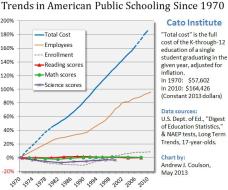
Indeed, this is exactly what we’ve seen in K-12 education.

Someone (more clever than me) needs to come up with the collegiate equivalent ofthis famous chart from the late Andrew Coulson.

We already know that the United Statesspends more per student on K-12 education than any other nation and gets mediocre results . That’s probably mostly due to the inefficient monopoly structureof elementary and secondary education.

The problems at the collegiate level are third-party payer and the inevitable negative effects of bureaucratic bloat and inefficiency.

The bottom line is that Hillary is right when she says higher-education spending is an investment. The problem is that she likes making investments that generate negative returns.

P.S. You won’t be surprised to learn that Paul Krugman also approves of investments with negative returns.

Related posts:

We won’t solve the problem of rising college costs unless the federal government’s role is abolished!!!!

  Reduce Out-of-Control College Costs by Ending Government Subsidies April 5, 2015 by Dan Mitchell I’ve written many times about the shortcomings of government schools at the K-12 level. We spend more on our kids than any other nation, yet our test scores are comparatively dismal. And one of my points, based on this very sobering […]

Who is to blame for rising college costs?

College costs are soaring higher than inflation ever since 1981 and the government has a lot to do with that. Who Should Be Blamed for the Rising Cost of College? December 11, 2012 by Dan Mitchell Notwithstanding the title of this post, perhaps nobody deserves blame. Sometimes, a good or service rises in price solely as […]

FRIEDMAN FRIDAY Milton Friedman and Walter Williams have explained, minimum wage laws are especially harmful for blacks!

Milton Friedman – A Conversation On Minimum Wage

Published on Oct 4, 2013

A debate on whether the minimum wage hurts or helps the working class. http://www.LibertyPen.com

Friedman would say, “IF A DOLLAR MORE RAISE IN THE MINIMUM WAGE WOULD HELP THEN WHY NOT RAISE EVERYONE UP TO $100 AN HOUR?” Of course, that exposes that fallacy of liberals’ argument and that is by raising up the minimum wage at some point will further limit access to the market to the most needy of our citizens would like to gain employment and cause massive layoffs!!!!!!

While economists are famous for their disagreements (and their incompetent forecasts), there is universal consensus in the profession that demand curves slope downward. That may be meaningless jargon to non-economists, but it simply means that people buy less of something when it becomes more expensive.

And this is why it makes no senseto impose minimum wage requirements, or to increase mandated wages where such laws already exist.

If you don’t understand this, just do a thought experiment and imagine what would happen if the minimum wage was $100 per hour. The answer is terrible unemployment, of course, which means it’s a very bad idea.

So why, then, is it okay to throw a “modest” number of people into the unemployment line with a “small” increase in the minimum wage?

Yet some politicians can’t resist pushing such policies because it makes them seem like Santa Claus to low-information voters. Vote for me, they assert, because I’ll get you a pay raise!

All of this sounds good, and it may even be the final result for some workers. But there’s overwhelming evidence that you get more unemployment when politicians boost the minimum wage.

There are no “magic boats.” In the real world, businesses only hire workers when they expect that additional employees will generate more than enough revenue to offset their costs. So when politicians artificially increase the cost of hiring workers, there will be some workers (particularly those with low skills) who become redundant.

And that’s exactly what we’re seeing in cities that have chosen to mandate higher minimum wages.

The Wall Street Journal opines on Seattle’s numbers.

Seattle’s increase last year seems to be reducing employment. That’s the finding of a new report by researchers at the University of Washington. The study compared nine months of 2015 in Seattle, where the wage is ticking up gradually and hit $13 an hour in January, with similar areas elsewhere in Washington. …The researchers found that the ordinance decreased the low-wage employment rate by about one-percentage point. …The ordinance “modestly held back” employment of low-wage earners, and hours worked “lagged behind” regional trends, on average four hours each quarter (or 19 minutes a week). Many such individuals moved to take jobs outside the city at “an elevated rate compared to historical patterns,” says the report. …None of this will surprise anyone who understands that increasing the cost of something will reduce the demand for it. Then again, that concept seems to elude both major presidential candidates, who have floated national minimum-wage increases.

By the way, it’s not just Trump and Clinton supporting this destructive policy. Mitt Romney also was on the wrong side back in 2012.

And it goes without saying that Obama has been a demagogue on the issue.

Sigh.

Let’s examine evidence from another city. Mark Perry of the American Enterprise Institute looks at what has been happening in Washington, DC.

Since the DC minimum wage increased in July 2015 to $10.50 an hour, restaurant employment in the city has increased less than 1% (and by 500 jobs), while restaurant jobs in the surrounding suburbs increased 4.2% (and by 7,300 jobs). An even more dramatic effect has taken place since the start of this year – DC restaurant jobs fell by 1,400 jobs (and by 2.7%) in the first six months of 2016 between January and July – that’s the largest loss of District food jobs during a 6-month period in 15 years. Perhaps some of those job losses were related to the $1 an hour minimum wage hike on July 1, bringing the city’s new minimum wage to $11.50 an hour. In contrast, restaurant employment outside the city grew at a 1.6% rate in the suburbs (and by 2,900 jobs) during the January to July period. …While it might take several more years to assess the full impact, the preliminary evidence so far suggests that DC’s minimum wage law is having a negative effect on staffing levels at the city’s restaurants. At the same time that suburban restaurants have increased employment levels by nearly 3,000 new positions since January, restaurants in the District have shed jobs in five out of the last six months, with a total loss of 1,400 jobs during that period (an average of nearly 8 jobs lost every day). The last time DC experienced restaurant job losses in five out of six consecutive months was 25 years ago in 1991, and the last time 1,400 jobs were lost over any six-month period was 15 years ago during the 2001 recession.

Here’s a chart looking at how restaurant employment in DC and the suburbs used to be closely correlated, but how there’s been a divergence since the city hiked the minimum wage.

As Mark noted, we’ll know even more as time passes, but the net result so far is predictably negative.

For additional background info, this video is a succinct explanation of why minimum-wage mandates are such a bad idea.

Let’s close with something rather amusing. It turns out that the State Department, during Hillary Clinton’s tenure, actually understood that higher minimum wages destroy jobs. Indeed, her people were even willing to fight against such job-killing measures.

But in Haiti rather than America, as Politifact reports.

Memos from 2008 and 2009 obtained by Wikileaks strongly suggest…that the State Department helped block the proposed minimum wage increase. The memos show that U.S. Embassy officials in Haiti clearly opposed the wage hike and met multiple times with factory owners who directly lobbied against it to the Haitian president. …media outlets assessed the cables and found, among many other revelations, that the “U.S. Embassy in Haiti worked closely with factory owners contracted by Levi’s, Hanes, and Fruit of the Loom to aggressively block a paltry minimum wage increase” for workers in apparel factories. …Deputy Chief of Mission David Lindwall put it most bluntly, when he said the minimum wage law “did not take economic reality into account but that appealed to the unemployed and underpaid masses.” …The U.S. Embassy, meanwhile, continued to lament the hike… USAID studies found that a 200 gourdes minimum wage “would make the sector economically unviable and consequently force factories to shut down.”

Hmmm…., I wonder if some of those textile companies made contributions to theClinton Foundation?

P.S. People in Switzerland obviously understand this issue, overwhelmingly voting against a minimum-wage mandate in 2014.

P.P.S. As Walter Williams has explained, minimum wage laws are especially harmful for blacks.

Related posts:

FRIEDMAN FRIDAY February 13, 2013 1:07PM Obama’s Minimum Wage Plan By Chris Edwards

____ February 13, 2013 1:07PM Obama’s Minimum Wage Plan By Chris Edwards Share Economic research has only a tenuous relationship to economic policymaking in Washington. President Obama’s new proposal to raise the federal minimum wage from $7.25 to $9.00 is a case in point. It would bad for workers and the economy, but the administration […]

February 13, 2013 1:07PM Obama’s Minimum Wage Plan By Chris Edwards

_______ February 13, 2013 1:07PM Obama’s Minimum Wage Plan By Chris Edwards Share Economic research has only a tenuous relationship to economic policymaking in Washington. President Obama’s new proposal to raise the federal minimum wage from $7.25 to $9.00 is a case in point. It would bad for workers and the economy, but the administration […]

A Little Café shows the USA the real cost of the Minimum Wage Increase!!!!

________ A Little Café shows the USA the real cost of the Minimum Wage Increase!!!! A Little Cafe That Sparked a Big Minimum Wage Debate Eric Boehm / @Watchdogorg / August 15, 2014 / 0 comments STILLWATER, Minn.—With its waitress and single cook, its retro-style booths with pale green cushions and its stainless steel wrap-around […]

Jerry Brown raised taxes in California and a rise in the minimum wage, but it won’t work like Krugman thinks!!!

___________   Jerry Brown raised taxes in California and a rise in the minimum wage, but it won’t work like Krugman thinks!!!! This cartoon below shows what will eventually happen to California and any other state that keeps raising taxes higher and higher.   Krugman’s “Gotcha” Moment Leaves Something to Be Desired July 25, 2014 by […]

Open letter to President Obama (Part 513) (Minimum Wage, Maximum Foolishness)

Open letter to President Obama (Part 513) (Emailed to White House on 5-4-13.) President Obama c/o The White House 1600 Pennsylvania Avenue NW Washington, DC 20500 Dear Mr. President, I know that you receive 20,000 letters a day and that you actually read 10 of them every day. I really do respect you for trying to get […]

Open letter to President Obama (Part 468) (Minimum Wage Laws includes editorial cartoon)

Open letter to President Obama (Part 468) (Emailed to White House on 4-9-13.) President Obama c/o The White House 1600 Pennsylvania Avenue NW Washington, DC 20500 Dear Mr. President, I know that you receive 20,000 letters a day and that you actually read 10 of them every day. I really do respect you for trying […]

Milton Friedman observed: “The real tragedy of minimum wage laws is that they are supported by well-meaning groups who want to reduce poverty. But the people who are hurt most by higher minimums are the most poverty stricken (includes editorial cartoon)

State of the Union 2013 Published on Feb 13, 2013 Cato Institute scholars Michael Tanner, Alex Nowrasteh, Julian Sanchez, Simon Lester, John Samples, Pat Michaels, Jagadeesh Gokhale, Michael F. Cannon, Jim Harper, Malou Innocent, Juan Carlos Hidalgo, Ilya Shapiro, Trevor Burrus and Neal McCluskey respond to President Obama’s 2013 State of the Union Address. Video […]

Cartoons from Dan Mitchell’s blog that demonstrate what Obama is doing to our economy (Minimum wage humor)

I have put up lots of cartoons from Dan Mitchell’s blog before and they have got lots of hits before. Many of them have dealt with the economy, eternal unemployment benefits, socialism,  Greece,  welfare state or on gun control. Funny…but Sad…Look at How the Minimum Wage Destroys Opportunity July 2, 2011 by Dan Mitchell My Cato colleague, Mark […]

Dan Mitchell on the minimum wage law (includes two editorial cartoons)

  It seems that everything President Obama does to help the economy actually does the opposite. Minimum Wage, Maximum Foolishness March 7, 2013 by Dan Mitchell Should the federal government make life more difficult for low-skilled workers? I hope everyone will emphatically say “NO!” Heck, most people understandably will think you’re crazy for even asking such […]

Why do the liberals want to increase unemployment more by increasing minimum wage?

Williams with Sowell – Minimum Wage Why do the liberals want to increase unemployment more by increasing minimum wage? With Unemployment Already High, Why Are Leftists Pushing for an Increase in the Minimum Wage? September 3, 2012 by Dan Mitchell The unemployment rate has been stuck above 8 percent ever since Obama pushed through his ill-fated […]

The Social Responsibility of Business is to Increase its Profits by Milton Friedman

Free to Choose: Part 1 of 10 The Power of the Market (Featuring Milton Friedman)

Free to Choose Part 2: The Tyranny of Control (Featuring Milton Friedman

Free to Choose Part 4: From Cradle to Grave Featuring Milton Friedman

The Social Responsibility of Business is to Increase its Profits

by Milton FriedmanThe New York Times Magazine, September 13, 1970. Copyright @ 1970 by The New York Times Company.

When I hear businessmen speak eloquently about the “social responsibilities of business in a free-enterprise system,” I am reminded of the wonderful line about the Frenchman who discovered at the age of 70 that he had been speaking prose all his life. The businessmen believe that they are defending free en­terprise when they declaim that business is not concerned “merely” with profit but also with promoting desirable “social” ends; that business has a “social conscience” and takes seriously its responsibilities for providing em­ployment, eliminating discrimination, avoid­ing pollution and whatever else may be the catchwords of the contemporary crop of re­formers. In fact they are–or would be if they or anyone else took them seriously–preach­ing pure and unadulterated socialism. Busi­nessmen who talk this way are unwitting pup­pets of the intellectual forces that have been undermining the basis of a free society these past decades.

The discussions of the “social responsibili­ties of business” are notable for their analytical looseness and lack of rigor. What does it mean to say that “business” has responsibilities? Only people can have responsibilities. A corporation is an artificial person and in this sense may have artificial responsibilities, but “business” as a whole cannot be said to have responsibilities, even in this vague sense. The first step toward clarity in examining the doctrine of the social responsibility of business is to ask precisely what it implies for whom.

Presumably, the individuals who are to be responsible are businessmen, which means in­dividual proprietors or corporate executives. Most of the discussion of social responsibility is directed at corporations, so in what follows I shall mostly neglect the individual proprietors and speak of corporate executives.

In a free-enterprise, private-property sys­tem, a corporate executive is an employee of the owners of the business. He has direct re­sponsibility to his employers. That responsi­bility is to conduct the business in accordance with their desires, which generally will be to make as much money as possible while con­forming to the basic rules of the society, both those embodied in law and those embodied in ethical custom. Of course, in some cases his employers may have a different objective. A group of persons might establish a corporation for an eleemosynary purpose–for exam­ple, a hospital or a school. The manager of such a corporation will not have money profit as his objective but the rendering of certain services.

In either case, the key point is that, in his capacity as a corporate executive, the manager is the agent of the individuals who own the corporation or establish the eleemosynary institution, and his primary responsibility is to them.

Needless to say, this does not mean that it is easy to judge how well he is performing his task. But at least the criterion of performance is straightforward, and the persons among whom a voluntary contractual arrangement exists are clearly defined.

Of course, the corporate executive is also a person in his own right. As a person, he may have many other responsibilities that he rec­ognizes or assumes voluntarily–to his family, his conscience, his feelings of charity, his church, his clubs, his city, his country. He ma}. feel impelled by these responsibilities to de­vote part of his income to causes he regards as worthy, to refuse to work for particular corpo­rations, even to leave his job, for example, to join his country’s armed forces. Ifwe wish, we may refer to some of these responsibilities as “social responsibilities.” But in these respects he is acting as a principal, not an agent; he is spending his own money or time or energy, not the money of his employers or the time or energy he has contracted to devote to their purposes. If these are “social responsibili­ties,” they are the social responsibilities of in­dividuals, not of business.

What does it mean to say that the corpo­rate executive has a “social responsibility” in his capacity as businessman? If this statement is not pure rhetoric, it must mean that he is to act in some way that is not in the interest of his employers. For example, that he is to refrain from increasing the price of the product in order to contribute to the social objective of preventing inflation, even though a price in crease would be in the best interests of the corporation. Or that he is to make expendi­tures on reducing pollution beyond the amount that is in the best interests of the cor­poration or that is required by law in order to contribute to the social objective of improving the environment. Or that, at the expense of corporate profits, he is to hire “hardcore” un­employed instead of better qualified available workmen to contribute to the social objective of reducing poverty.

In each of these cases, the corporate exec­utive would be spending someone else’s money for a general social interest. Insofar as his actions in accord with his “social responsi­bility” reduce returns to stockholders, he is spending their money. Insofar as his actions raise the price to customers, he is spending the customers’ money. Insofar as his actions lower the wages of some employees, he is spending their money.

The stockholders or the customers or the employees could separately spend their own money on the particular action if they wished to do so. The executive is exercising a distinct “social responsibility,” rather than serving as an agent of the stockholders or the customers or the employees, only if he spends the money in a different way than they would have spent it.

But if he does this, he is in effect imposing taxes, on the one hand, and deciding how the tax proceeds shall be spent, on the other.

This process raises political questions on two levels: principle and consequences. On the level of political principle, the imposition of taxes and the expenditure of tax proceeds are gov­ernmental functions. We have established elab­orate constitutional, parliamentary and judicial provisions to control these functions, to assure that taxes are imposed so far as possible in ac­cordance with the preferences and desires of the public–after all, “taxation without repre­sentation” was one of the battle cries of the American Revolution. We have a system of checks and balances to separate the legisla­tive function of imposing taxes and enacting expenditures from the executive function of collecting taxes and administering expendi­ture programs and from the judicial function of mediating disputes and interpreting the law.

Here the businessman–self-selected or appointed directly or indirectly by stockhold­ers–is to be simultaneously legislator, execu­tive and, jurist. He is to decide whom to tax by how much and for what purpose, and he is to spend the proceeds–all this guided only by general exhortations from on high to restrain inflation, improve the environment, fight poverty and so on and on.

The whole justification for permitting the corporate executive to be selected by the stockholders is that the executive is an agent serving the interests of his principal. This jus­tification disappears when the corporate ex­ecutive imposes taxes and spends the pro­ceeds for “social” purposes. He becomes in effect a public employee, a civil servant, even though he remains in name an employee of a private enterprise. On grounds of political principle, it is intolerable that such civil ser­vants–insofar as their actions in the name of social responsibility are real and not just win­dow-dressing–should be selected as they are now. If they are to be civil servants, then they must be elected through a political process. If they are to impose taxes and make expendi­tures to foster “social” objectives, then politi­cal machinery must be set up to make the as­sessment of taxes and to determine through a political process the objectives to be served.

This is the basic reason why the doctrine of “social responsibility” involves the acceptance of the socialist view that political mechanisms, not market mechanisms, are the appropriate way to determine the allocation of scarce re­sources to alternative uses.

On the grounds of consequences, can the corporate executive in fact discharge his al­leged “social responsibilities?” On the other hand, suppose he could get away with spending the stockholders’ or customers’ or employees’ money. How is he to know how to spend it? He is told that he must contribute to fighting inflation. How is he to know what ac­tion of his will contribute to that end? He is presumably an expert in running his company–in producing a product or selling it or financing it. But nothing about his selection makes him an expert on inflation. Will his hold­ ing down the price of his product reduce infla­tionary pressure? Or, by leaving more spending power in the hands of his customers, simply divert it elsewhere? Or, by forcing him to produce less because of the lower price, will it simply contribute to shortages? Even if he could an­swer these questions, how much cost is he justi­fied in imposing on his stockholders, customers and employees for this social purpose? What is his appropriate share and what is the appropri­ate share of others?

And, whether he wants to or not, can he get away with spending his stockholders’, cus­tomers’ or employees’ money? Will not the stockholders fire him? (Either the present ones or those who take over when his actions in the name of social responsibility have re­duced the corporation’s profits and the price of its stock.) His customers and his employees can desert him for other producers and em­ployers less scrupulous in exercising their so­cial responsibilities.

This facet of “social responsibility” doc­ trine is brought into sharp relief when the doctrine is used to justify wage restraint by trade unions. The conflict of interest is naked and clear when union officials are asked to subordinate the interest of their members to some more general purpose. If the union offi­cials try to enforce wage restraint, the consequence is likely to be wildcat strikes, rank­-and-file revolts and the emergence of strong competitors for their jobs. We thus have the ironic phenomenon that union leaders–at least in the U.S.–have objected to Govern­ment interference with the market far more consistently and courageously than have business leaders.

The difficulty of exercising “social responsibility” illustrates, of course, the great virtue of private competitive enterprise–it forces people to be responsible for their own actions and makes it difficult for them to “exploit” other people for either selfish or unselfish purposes. They can do good–but only at their own expense.

Many a reader who has followed the argu­ment this far may be tempted to remonstrate that it is all well and good to speak of Government’s having the responsibility to im­pose taxes and determine expenditures for such “social” purposes as controlling pollu­tion or training the hard-core unemployed, but that the problems are too urgent to wait on the slow course of political processes, that the exercise of social responsibility by busi­nessmen is a quicker and surer way to solve pressing current problems.

Aside from the question of fact–I share Adam Smith’s skepticism about the benefits that can be expected from “those who affected to trade for the public good”–this argument must be rejected on grounds of principle. What it amounts to is an assertion that those who favor the taxes and expenditures in question have failed to persuade a majority of their fellow citizens to be of like mind and that they are seeking to attain by undemocratic procedures what they cannot attain by democratic proce­dures. In a free society, it is hard for “evil” people to do “evil,” especially since one man’s good is another’s evil.

I have, for simplicity, concentrated on the special case of the corporate executive, ex­cept only for the brief digression on trade unions. But precisely the same argument ap­plies to the newer phenomenon of calling upon stockholders to require corporations to exercise social responsibility (the recent G.M crusade for example). In most of these cases, what is in effect involved is some stockholders trying to get other stockholders (or customers or employees) to contribute against their will to “social” causes favored by the activists. In­sofar as they succeed, they are again imposing taxes and spending the proceeds.

The situation of the individual proprietor is somewhat different. If he acts to reduce the returns of his enterprise in order to exercise his “social responsibility,” he is spending his own money, not someone else’s. If he wishes to spend his money on such purposes, that is his right, and I cannot see that there is any ob­jection to his doing so. In the process, he, too, may impose costs on employees and cus­tomers. However, because he is far less likely than a large corporation or union to have mo­nopolistic power, any such side effects will tend to be minor.

Of course, in practice the doctrine of social responsibility is frequently a cloak for actions that are justified on other grounds rather than a reason for those actions.

To illustrate, it may well be in the long run interest of a corporation that is a major employer in a small community to devote resources to providing amenities to that community or to improving its government. That may make it easier to attract desirable employees, it may reduce the wage bill or lessen losses from pilferage and sabotage or have other worthwhile effects. Or it may be that, given the laws about the deductibility of corporate charitable contributions, the stockholders can contribute more to chari­ties they favor by having the corporation make the gift than by doing it themselves, since they can in that way contribute an amount that would otherwise have been paid as corporate taxes.

In each of these–and many similar–cases, there is a strong temptation to rationalize these actions as an exercise of “social responsibility.” In the present climate of opinion, with its wide spread aversion to “capitalism,” “profits,” the “soulless corporation” and so on, this is one way for a corporation to generate goodwill as a by-product of expenditures that are entirely justified in its own self-interest.

It would be inconsistent of me to call on corporate executives to refrain from this hyp­ocritical window-dressing because it harms the foundations of a free society. That would be to call on them to exercise a “social re­sponsibility”! If our institutions, and the atti­tudes of the public make it in their self-inter­est to cloak their actions in this way, I cannot summon much indignation to denounce them. At the same time, I can express admiration for those individual proprietors or owners of closely held corporations or stockholders of more broadly held corporations who disdain such tactics as approaching fraud.

Whether blameworthy or not, the use of the cloak of social responsibility, and the nonsense spoken in its name by influential and presti­gious businessmen, does clearly harm the foun­dations of a free society. I have been impressed time and again by the schizophrenic character of many businessmen. They are capable of being extremely farsighted and clearheaded in matters that are internal to their businesses. They are incredibly shortsighted and muddle­headed in matters that are outside their businesses but affect the possible survival of busi­ness in general. This shortsightedness is strikingly exemplified in the calls from many businessmen for wage and price guidelines or controls or income policies. There is nothing that could do more in a brief period to destroy a market system and replace it by a centrally con­trolled system than effective governmental con­trol of prices and wages.

The shortsightedness is also exemplified in speeches by businessmen on social respon­sibility. This may gain them kudos in the short run. But it helps to strengthen the already too prevalent view that the pursuit of profits is wicked and immoral and must be curbed and controlled by external forces. Once this view is adopted, the external forces that curb the market will not be the social consciences, however highly developed, of the pontificating executives; it will be the iron fist of Government bureaucrats. Here, as with price and wage controls, businessmen seem to me to reveal a suicidal impulse.

The political principle that underlies the market mechanism is unanimity. In an ideal free market resting on private property, no individual can coerce any other, all coopera­tion is voluntary, all parties to such coopera­tion benefit or they need not participate. There are no values, no “social” responsibilities in any sense other than the shared values and responsibilities of individuals. Society is a collection of individuals and of the various groups they voluntarily form.

The political principle that underlies the political mechanism is conformity. The indi­vidual must serve a more general social inter­est–whether that be determined by a church or a dictator or a majority. The individual may have a vote and say in what is to be done, but if he is overruled, he must conform. It is appropriate for some to require others to contribute to a general social purpose whether they wish to or not.

Unfortunately, unanimity is not always feasi­ble. There are some respects in which conformity appears unavoidable, so I do not see how one can avoid the use of the political mecha­nism altogether.

But the doctrine of “social responsibility” taken seriously would extend the scope of the political mechanism to every human activity. It does not differ in philosophy from the most explicitly collectivist doctrine. It differs only by professing to believe that collectivist ends can be attained without collectivist means. That is why, in my book Capitalism and Freedom, I have called it a “fundamentally subversive doctrine” in a free society, and have said that in such a society, “there is one and only one social responsibility of business–to use it resources and engage in activities designed to increase its profits so long as it stays within the rules of the game, which is to say, engages in open and free competition without deception or fraud.”

Free to Choose Part 5: Created Equal Featuring Milton Friedman

Free to Choose Part 6: What’s Wrong With Our Schools Featuring Milton Friedman

Free to Choose Part 7: Who Protects the Consumer Featuring Milton Friedman

Free to Choose Part 8: Who Protects the Worker Featuring Milton Friedman

Free to Choose Part 10: How to Stay Free Featuring Milton Friedman

Related posts:

FRIEDMAN FRIDAY Milton Friedman has the two solutions to the Black Teenage Unemployment Problem!!!

Milton Friedman on Donahue Show in 1979 Milton Friedman has the two solutions to the Black Teenage Unemployment Problem!!! The solutions would be first to lower the Minimum Wage Amount and  second give students the opportunity to have vouchers so their parents can put them in the best schools when they start in the kindergarten […]

Obama loves the death tax but listen to what Milton Friedman had to say about it!!!

__ Obama loves the death tax but listen to what Milton Friedman had to say about it!!! Milton Friedman Redistribution of Wealth and the Death Tax ___________ The Obama Administration’s Assault on the Rule of Law September 6, 2016 by Dan Mitchell What’s the worst development in economic policy of the Obama years? The faux stimulus […]

Milton Friedman and Dan Mitchell: Subsidies for Higher Education Are the Problem!!!

_ Milton Friedman – Should Higher Education Be Subsidized? Published on Aug 14, 2013 Professor Friedman leads a roundtable discussion with students.http://www.LibertyPen.com Hillary Is Wrong: Subsidies for Higher Education Are the Problem, not the Solution August 24, 2016 by Dan Mitchell “So many bad ideas, so little time.” That’s my attitude about Hillary Clinton. She […]

Milton Friedman and Walter Williams have explained, minimum wage laws are especially harmful for blacks!

__ Milton Friedman – A Conversation On Minimum Wage   Published on Oct 4, 2013 A debate on whether the minimum wage hurts or helps the working class.http://www.LibertyPen.com Is Anybody Shocked that Higher Minimum Wage Mandates Are Resulting in Fewer Jobs? August 25, 2016 by Dan Mitchell While economists are famous for their disagreements (and […]

Milton Friedman and Dan Mitchell on the Economics of Medical Care!!!

_ Milton Friedman on Medical Care (Full Lecture) Another Grim Reminder that Obamacare Has Made Healthcare More Expensive August 29, 2016 by Dan Mitchell Way back in 2009, some folks on the left shared a chart showing that national expenditures on healthcare compared to life expectancy. This comparison was not favorable to the United States, which […]

FRIEDMAN FRIDAY Milton Friedman on Immigration Part 2

_ Milton Friedman on Immigration Part 2 Milton Friedman – Illegal Immigration – PT 1 Milton Friedman – Illegal Immigration – PT 2 _- Immigration and the Welfare State April 4, 2010 by Dan Mitchell My previous post dealing with whether citizenship should be automatic for babies born to illegals generated a lot of commentary, so […]

FRIEDMAN FRIDAY Milton Friedman on Immigration Part 1

_ Milton Friedman – Illegal Immigration – PT 1 Milton Friedman – Illegal Immigration – PT 2 Milton Friedman stated , “you can’t have free immigration and a welfare state.” Below Dan Mitchell links back to this quote in one of his earlier posts: A Plan for Open Borders that Anti-Amnesty Folks Can Support August 18, […]

Milton Friedman on Immigration Part 2

_ Milton Friedman on Immigration Part 2 Milton Friedman – Illegal Immigration – PT 1 Milton Friedman – Illegal Immigration – PT 2   _- Immigration and the Welfare State April 4, 2010 by Dan Mitchell My previous post dealing with whether citizenship should be automatic for babies born to illegals generated a lot of commentary, […]

Milton Friedman on Immigration Part 1

_   Milton Friedman – Illegal Immigration – PT 1 Milton Friedman – Illegal Immigration – PT 2   Milton Friedman stated , “you can’t have free immigration and a welfare state.” Below Dan Mitchell links back to this quote in one of his earlier posts: A Plan for Open Borders that Anti-Amnesty Folks Can Support […]

FRIEDMAN FRIDAY Milton Friedman and Dan Mitchell on the Post Office!!!

Milton Friedman and Dan Mitchell on the Post Office!!! Ep. 10 – How to Stay Free [3/7]. Milton Friedman’s Free to Choose (1980) Pat Brennan became something of a celebrity in 1978 because she was delivering mail in competition with the United States Post Office. With her husband she set up business in a basement […]
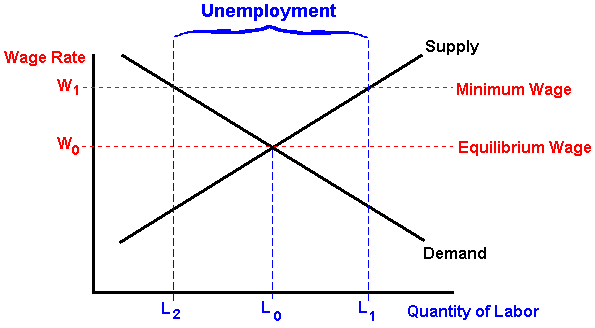
FRIEDMAN FRIDAY Milton Friedman and Dan Mitchell look at the economics of medical care!!

Milton Friedman on Medical Care (Full Lecture)

Way back in 2009, some folks on the left shared a chart showing that national expenditures on healthcare compared to life expectancy.

This comparison was not favorable to the United States, which easily spent the most money but didn’t have concomitantly impressive life expectancy.

At the very least, people looking at the chart were supposed to conclude that other nations had better healthcare systems.

And since the chart circulated while Obamacare was being debated, supporters of that initiative clearly wanted people to believe that the U.S. somehow could get better results at lower cost if the government played a bigger role in the healthcare sector.

There were all sorts of reasons to think that chart was misleading (higher average incomes in the United States, more obesity in the United States, different demographics in the United States, etc), but my main gripe was that the chart was being used to advance the cause of bigger government when it actually showed – at least in part – the consequences of government intervention.

The real problem, I argued, was third-party payer. Thanks to programs such asMedicare and Medicaid, government already was paying for nearly 50 percent of all heath spending in the United States (indeed, the U.S. has more government spending for health programs than some nations with single-payer systems!).

But that’s just party of the story. Thanks to a loophole in the tax code for fringe benefits (a.k.a., the healthcare exclusion), there’s a huge incentive for both employers and employees to provide compensation in the form of very generous health insurance policies. And this means a big chunk of health spending is paid by insurance companies.

The combination of these direct and indirect government policies is that consumers pay very little for their healthcare. Or, to be more precise, they may pay a lot in terms of taxes and foregone cash compensation, but their direct out-of-pocket expenditures are relatively modest.

And this is why I said the national health spending vs life expectancy chart was far less important than a chart I put together showing the relentless expansion of third-party payer. And the reason this chart is so important is that it helps to explain why healthcare costs are so high and why there’s so much inefficiency in the health sector.

Simply stated, doctors, hospitals, and other providers have very little market-based incentive to control costs and be efficient because they know that the overwhelming majority of consumers won’t care because they are buying care with other people’s money.

To get this point across, I sometimes ask audiences how their behavior would change if I told them I would pay 89 percent of their dinner bill on Friday night. Would they be more likely to eat at McDonald’s or a fancy steakhouse? The answer is obvious (or should be obvious) since they are in box 2 of Milton Friedman’s matrix.

So why, then, would anybody think that Obamacare – a program that was designed to expand third-party payer – was going to control costs?

Though I guess it doesn’t matter what anybody thought at the time. The sad reality is that Obamacare was enacted. The President famously promised healthcare would be more affordable under his new system, both for consumers and for taxpayers.

So what happened?

Well, the law’s clearly been bad news for taxpayers.

But let’s focus today on households, which haveborne the brunt of the President’s bad policies. The Wall Street Journal had a report a few days ago about what’s been happening to the spending patterns of middle-class households.

The numbers are rather grim, at least for those who thought Obamacare would control health costs.

A June Brookings Institution study found middle-income households now devote the largest share of their spending to health care, 8.9%… By 2014, middle-income households’ health-care spending was 25% higher than what they were spending before the recession that began in 2007, even as spending fell for other “basic needs” such as food, housing, clothing and transportation, according to an analysis for The Wall Street Journal by Brookings senior fellow Diane Schanzenbach. …Workers aren’t the only ones feeling the pain of rising health-care costs. Employers still typically pay roughly 80% of individual health-insurance premiums… In 2015, 8% of Americans’ household spending went toward health care, up from 5.8% in 2007, according to the Labor Department.

Here’s a chart from the story. It looks at data from 2007-2014, so it surely wouldn’t be fair to say Obamacare caused all the increase. But it would be fair to say that the law hasn’t delivered on the empty promise of lower costs.

Let’s close with a few important observations.

First, there’s a very strong case to repeal Obamacare, but nobody should be under the illusion that this will solve the myriad problems in the health sector. It would be a good start, but never forget that the third-party payer problem existed before Obamacare.

Second, undoing third-party payer will be like putting toothpaste back in a tube. Even though there are some powerful examples of how healthcare costs are constrained when genuine market forces are allowed to operate, consumers will be very worried about shifting to a system where they pay directly for a greater share of their healthcare costs.

Third, there’s one part of Obamacare that shouldn’t be repealed. The so-called Cadillac Tax may not be the right way to deal with the distorting impact of the healthcare exclusion, but it’s better than nothing.

Actually, we could add one final observation since the Obama era will soon be ending. When historians write about his presidency, will his main legacy be the Obamacare failure? Or will they focus more on the failed stimulus? Or maybe the economic stagnation that was caused by his policies?

Related posts:

Michael Cannon observed, “The centerpiece of Rubio’s proposal… If you purchase a government-approved health plan, you could save, for example, $2,000 on your taxes. If you don’t, you pay that $2,000 to the government. That is exactly how Obamacare’s individual mandate works.”

  Michael Cannon observed, “The centerpiece of Rubio’s proposal… If you purchase a government-approved health plan, you could save, for example, $2,000 on your taxes. If you don’t, you pay that $2,000 to the government. That is exactly how Obamacare’s individual mandate works.” The Obama-Rubio “Healthcare Mandate” Controversy March 2, 2016 by Dan Mitchell My colleague […]

FRIEDMAN FRIDAY Taxmageddon and Obamacare: What Would Milton Friedman Say? Rich Tucker / @RichardBTucker / July 31, 2012

Milton Friedman on Medical Care (Full Lecture) Published on Feb 2, 2014 Website:http://www.commonsensecapitalism.com Facebook:http://www.facebook.com/pages/Common-… Twitter:https://twitter.com/#!/CommonSenseCap Taxmageddon and Obamacare: What Would Milton Friedman Say? Rich Tucker / @RichardBTucker / July 31, 2012 / 3 comments “I am in favor of cutting taxes under any circumstances and for any excuse, for any reason, whenever […]

FRIEDMAN FRIDAY Column: Don’t blame Heritage for ObamaCare mandate By Stuart Butler

Milton Friedman on Medical Care (Full Lecture) Published on Feb 2, 2014 Website:http://www.commonsensecapitalism.com Facebook:http://www.facebook.com/pages/Common-… Twitter:https://twitter.com/#!/CommonSenseCap I have written about Obamacare over and over again on this blog. Dan Mitchell has shared many funny cartoons about Obamacare too. Milton Friedman has spoken out about government healthcare many times in the past and his film […]

FRIEDMAN FRIDAY Milton Friedman on the Energy Crisis (and ObamaCare to come) By Robert Bradley Jr. — July 31, 2013

Milton Friedman – Health Care Reform (1992) pt 1/4 Milton Friedman – Health Care Reform (1992) pt 2/4 Milton Friedman on the Energy Crisis (and ObamaCare to come) By Robert Bradley Jr. — July 31, 2013 July 31st is the birth date of one of the great intellectuals of the freedom philosophy. Milton Friedman (1912–2006) would have […]

FRIEDMAN FRIDAY Milton Friedman And ObamaCare November 4, 2013

Milton Friedman – Health Care Reform (1992) pt 1/4 Milton Friedman – Health Care Reform (1992) pt 2/4 Milton Friedman – Health Care Reform (1992) pt 3/4 Milton Friedman – Health Care Reform (1992) pt 4/4 Milton Friedman And ObamaCare November 4, 2013 Where is Milton Friedman when we need him most? His ability to […]

FRIEDMAN FRIDAY Milton Friedman would oppose bailouts, Obamacare Robert Enlow | Tuesday Jul 31, 2012 6:02 PM

Milton Friedman on Medical Care (Full Lecture) Published on Feb 2, 2014 Website:http://www.commonsensecapitalism.com Facebook:http://www.facebook.com/pages/Common-… Twitter:https://twitter.com/#!/CommonSenseCap I have written about Obamacare over and over again on this blog. Dan Mitchell has shared many funny cartoons about Obamacare too. Milton Friedman has spoken out about government healthcare many times in the past and his film […]

Taxmageddon and Obamacare: What Would Milton Friedman Say? Rich Tucker / @RichardBTucker / July 31, 2012

Milton Friedman on Medical Care (Full Lecture) Published on Feb 2, 2014 Website:http://www.commonsensecapitalism.com Facebook:http://www.facebook.com/pages/Common-… Twitter:https://twitter.com/#!/CommonSenseCap Taxmageddon and Obamacare: What Would Milton Friedman Say? Rich Tucker / @RichardBTucker / July 31, 2012 / 3 comments “I am in favor of cutting taxes under any circumstances and for any excuse, for any reason, whenever […]

Column: Don’t blame Heritage for ObamaCare mandate By Stuart Butler

Milton Friedman on Medical Care (Full Lecture) Published on Feb 2, 2014 Website:http://www.commonsensecapitalism.com Facebook:http://www.facebook.com/pages/Common-… Twitter:https://twitter.com/#!/CommonSenseCap I have written about Obamacare over and over again on this blog. Dan Mitchell has shared many funny cartoons about Obamacare too. Milton Friedman has spoken out about government healthcare many times in the past and his film […]

FRIEDMAN FRIDAY Whining Harvard Professors Discover Obamacare 3225 JAN 5, 2015 4:29 PM EST By Megan McArdle

Milton Friedman on Medical Care (Full Lecture) Published on Feb 2, 2014 Website:http://www.commonsensecapitalism.com Facebook:http://www.facebook.com/pages/Common-… Twitter:https://twitter.com/#!/CommonSenseCap I have written about Obamacare over and over again on this blog. Dan Mitchell has shared many funny cartoons about Obamacare too. Milton Friedman has spoken out about government healthcare many times in the past and his film […]

Milton Friedman on the Energy Crisis (and ObamaCare to come) By Robert Bradley Jr. — July 31, 2013

Milton Friedman – Health Care Reform (1992) pt 1/4 Milton Friedman – Health Care Reform (1992) pt 2/4 Milton Friedman on the Energy Crisis (and ObamaCare to come) By Robert Bradley Jr. — July 31, 2013 July 31st is the birth date of one of the great intellectuals of the freedom philosophy. Milton Friedman (1912–2006) would have […]

22 Quotes to Celebrate Milton Friedman Day Samantha Reinis / @samantha_reinis / August 01, 2015

_

Free to Choose: Part 1 of 10 The Power of the Market (Featuring Milton Friedman)

Free to Choose Part 2: The Tyranny of Control (Featuring Milton Friedman

Conservative economist Milton Friedman would have been 103 years old if he were still living today. He won a Nobel Prize for his work in economics and served as an advisor to President Nixon. (Photo: Everett Collection/Newscom)

July 31 is known as a day to honor conservative economist Milton Friedman, as he would have been 103 years old if he were still living today.

Friedman was awarded the Nobel Prize for his work in economics, specifically for “his achievements in the field of consumption analysis, monetary history and theory, and for his demonstration of the complexity of stabilization policy.”

He served as an advisor to President Nixon in the White House and was the president of the American Economic Association before becoming a senior research fellow at the Hoover Institution at Stanford University. Friedman was known for his defense of the free market and call for school choice through a voucher programs.

To honor this great man, here are 22 of his most notable quotes regarding the economy, government, and life.

  1. If you put the federal government in charge of the Sahara Desert, in 5 years there’d be a shortage of sand.”
  2. “The great achievements of civilization have not come from government bureaus. Einstein didn’t construct his theory under order from a bureaucrat. Henry Ford didn’t revolutionize the automobile industry that way.”
  3. “Governments never learn. Only people learn.”
  4. “Many people want the government to protect the consumer. A much more urgent problem is to protect the consumer from the government.”
  5. “One of the great mistakes is to judge policies and programs by their intentions rather than their results.”
  6. “There is no such thing as a free lunch.”
  7. “I am in favor of cutting taxes under any circumstance and for any excuse, for any reason, whenever it’s possible.”
  8. “A society that puts equality before freedom will get neither. A society that puts freedom before equality will get a high degree of both.”
  9. “If all we want are jobs, we can create any number—for example, have people dig holes and then fill them up again, or perform other useless tasks. Work is sometimes its own reward. Mostly, however, it is the price we pay to get the things we want. Our real objective is not just jobs but productive jobs—jobs that will mean more goods and services to consume.”
  10. “The most important single central fact about a free market is that no exchange takes place unless both parties benefit.”
  11. “When everybody owns something, nobody owns it, and nobody has a direct interest in maintaining or improving its condition. That is why buildings in the Soviet Union—like public housing in the United States—look decrepit within a year or two of their construction.”
  12. “Hell hath no fury like a bureaucrat scorned.”
  13. “The lack of balance in governmental activity reflects primarily the failure to separate sharply the question what activities it is appropriate for government to finance from the question what activities it is appropriate for government to administer—a distinction that is important in other areas of government activity as well.”
  14. “Nothing is so permanent as a temporary government program.”
  15. “Is there some society you know that doesn’t run on greed? You think Russia doesn’t run on greed? You think China doesn’t run on greed? What is greed? Of course, none of us are greedy, it’s only the other fellow who’s greedy.”
  16. “I think the government solution to a problem is usually as bad as the problem and very often makes the problem worse.”
  17. “The Great Depression, like most other periods of severe unemployment, was produced by government mismanagement rather than by any inherent instability of the private economy.”
  18. “Underlying most arguments against the free market is a lack of belief in freedom itself.”
  19. “I think that the Internet is going to be one of the major forces for reducing the role of government.”
  20. Concentrated power is not rendered harmless by the good intentions of those who create it.”
  21. “Inflation is taxation without legislation.”
  22. “Nobody spends somebody else’s money as carefully as he spends his own. Nobody uses somebody else’s resources as carefully as he uses his own. So if you want efficiency and effectiveness, if you want knowledge to be properly utilized, you have to do it through the means of private property.”

Free to Choose Part 4: From Cradle to Grave Featuring Milton Friedman

Free to Choose Part 5: Created Equal Featuring Milton Friedman

Free to Choose Part 6: What’s Wrong With Our Schools Featuring Milton Friedman

Free to Choose Part 7: Who Protects the Consumer Featuring Milton Friedman

Free to Choose Part 8: Who Protects the Worker Featuring Milton Friedman

Free to Choose Part 10: How to Stay Free Featuring Milton Friedman

Related posts:

FRIEDMAN FRIDAY Milton Friedman has the two solutions to the Black Teenage Unemployment Problem!!!

Milton Friedman on Donahue Show in 1979 Milton Friedman has the two solutions to the Black Teenage Unemployment Problem!!! The solutions would be first to lower the Minimum Wage Amount and  second give students the opportunity to have vouchers so their parents can put them in the best schools when they start in the kindergarten […]

Obama loves the death tax but listen to what Milton Friedman had to say about it!!!

__ Obama loves the death tax but listen to what Milton Friedman had to say about it!!! Milton Friedman Redistribution of Wealth and the Death Tax ___________ The Obama Administration’s Assault on the Rule of Law September 6, 2016 by Dan Mitchell What’s the worst development in economic policy of the Obama years? The faux stimulus […]

Milton Friedman and Dan Mitchell: Subsidies for Higher Education Are the Problem!!!

_ Milton Friedman – Should Higher Education Be Subsidized? Published on Aug 14, 2013 Professor Friedman leads a roundtable discussion with students.http://www.LibertyPen.com Hillary Is Wrong: Subsidies for Higher Education Are the Problem, not the Solution August 24, 2016 by Dan Mitchell “So many bad ideas, so little time.” That’s my attitude about Hillary Clinton. She […]

Milton Friedman and Walter Williams have explained, minimum wage laws are especially harmful for blacks!

__ Milton Friedman – A Conversation On Minimum Wage   Published on Oct 4, 2013 A debate on whether the minimum wage hurts or helps the working class.http://www.LibertyPen.com Is Anybody Shocked that Higher Minimum Wage Mandates Are Resulting in Fewer Jobs? August 25, 2016 by Dan Mitchell While economists are famous for their disagreements (and […]

Milton Friedman and Dan Mitchell on the Economics of Medical Care!!!

_ Milton Friedman on Medical Care (Full Lecture) Another Grim Reminder that Obamacare Has Made Healthcare More Expensive August 29, 2016 by Dan Mitchell Way back in 2009, some folks on the left shared a chart showing that national expenditures on healthcare compared to life expectancy. This comparison was not favorable to the United States, which […]

FRIEDMAN FRIDAY Milton Friedman on Immigration Part 2

_ Milton Friedman on Immigration Part 2 Milton Friedman – Illegal Immigration – PT 1 Milton Friedman – Illegal Immigration – PT 2 _- Immigration and the Welfare State April 4, 2010 by Dan Mitchell My previous post dealing with whether citizenship should be automatic for babies born to illegals generated a lot of commentary, so […]

FRIEDMAN FRIDAY Milton Friedman on Immigration Part 1

_ Milton Friedman – Illegal Immigration – PT 1 Milton Friedman – Illegal Immigration – PT 2 Milton Friedman stated , “you can’t have free immigration and a welfare state.” Below Dan Mitchell links back to this quote in one of his earlier posts: A Plan for Open Borders that Anti-Amnesty Folks Can Support August 18, […]

Milton Friedman on Immigration Part 2

_ Milton Friedman on Immigration Part 2 Milton Friedman – Illegal Immigration – PT 1 Milton Friedman – Illegal Immigration – PT 2   _- Immigration and the Welfare State April 4, 2010 by Dan Mitchell My previous post dealing with whether citizenship should be automatic for babies born to illegals generated a lot of commentary, […]

Milton Friedman on Immigration Part 1

_   Milton Friedman – Illegal Immigration – PT 1 Milton Friedman – Illegal Immigration – PT 2   Milton Friedman stated , “you can’t have free immigration and a welfare state.” Below Dan Mitchell links back to this quote in one of his earlier posts: A Plan for Open Borders that Anti-Amnesty Folks Can Support […]

FRIEDMAN FRIDAY Milton Friedman and Dan Mitchell on the Post Office!!!

Milton Friedman and Dan Mitchell on the Post Office!!! Ep. 10 – How to Stay Free [3/7]. Milton Friedman’s Free to Choose (1980) Pat Brennan became something of a celebrity in 1978 because she was delivering mail in competition with the United States Post Office. With her husband she set up business in a basement […]