Category Archives: Milton Friedman

FRIEDMAN FRIDAY Trump Administration’s Infrastructure Initiative should include more private-sector involvement!!!

__

Trump Administration’s Infrastructure Initiative should include more private-sector involvement!!!

Milton Friedman – The role of government in a free society (Q&A)

During the election, Donald Trump promised a big package of infrastructure spending, twice as much new spending as Hillary Clinton was proposing.

During his victory speech the night of the election, he doubled down on this approach, promising that more infrastructure spending would be one his first priorities.

This sounds like bad news for advocates of limited government. And it may turn out to be bad news. Though if you look at what the Trump campaign actually proposed, there’s a lot of wiggle room.

I will work with Congress to introduce the following broader legislative measures and fight for their passage within the first 100 days of my Administration: …American Energy & Infrastructure Act. Leverages public-private partnerships, and private investments through tax incentives, to spur $1 trillion in infrastructure investment over 10 years. It is revenue neutral.

In other words, it’s possible that President-Elect Trump might give us an Obama-style stimulus scheme. Or he may take a radically different approach by removing roadblocks that hinder more private-sector involvement.

And my colleague Chris Edwards points out that the private sector already does most of the heavy lifting when it comes to infrastructure spending.

Hillary Clinton says that “we are dramatically underinvesting” in infrastructure and she promises a large increase in federal spending. Donald Trump is promising to spend twice as much as Clinton. …But more federal spending is the wrong way to go.  …let’s look at some data. There is no hard definition of “infrastructure,” but one broad measure is gross fixed investment in the BEA national accounts. …The first thing to note is that private investment at about $3 trillion was six times larger than combined federal, state, and local government nondefense investment of $472 billion. Private investment in pipelines, broadband, refineries, factories, cell towers, and other items greatly exceeds government investment in schools, highways, prisons, and the like. …if policymakers want to boost infrastructure spending, they should reduce barriers to private investment.

This is very helpful and interesting data. And one of the obvious conclusions is that the types of infrastructure that historically are the responsibility of the private sector (pipelines, cell towers, etc) are handled much more efficiently than those (highways, mass transit, etc) that have been monopolized by governments.

Trump presumably intends his infrastructure plan to focus on the latter type of infrastructure, so let’s consider three simple rules to help guide an effective approach for transportation.

1. More private-sector involvement

A key principle for good infrastructure policy is to harness the efficiency of the private sector.

Why? Because, as Lawrence McQuillan of the Independent Institute argues, governments naturally are inefficient and incompetent at building and managing infrastructure.

Government authorities view maintenance solely as a cost, rather than as an investment that can increase future revenues. As a result, roads remain riddled with potholes, bridges crumble, airports are overcrowded, water is contaminated, and we have classrooms with mold and falling ceilings. Moreover, without a profit motive, repairs are seldom done in a timely manner or at lowest cost. Instead of assets being owned and controlled by people who understand the economics of the industry and have the technical knowledge to operate and repair them efficiently, politicians (the majority of whom appear to be lawyers these days) and bureaucrats control them. This guarantees waste, inefficiency and cronyism, such as the greenlighting of white-elephant projects that are driven by politics rather than economics.

But there is some good news.

Chris Edwards explains that the private sector is taking a larger role.

Before the 20th century, for example, more than 2,000 turnpike companies in America built more than 10,000 miles of toll roads. And up until the mid-20th century, most urban rail and bus services were private. With respect to railroads, the federal government subsidized some of the railroads to the West, but most U.S. rail mileage in the 19th century was in the East, and it was generally unsubsidized. The takeover of private infrastructure by governments here and abroad in the 20th century caused many problems. Fortunately, most governments have reversed course in recent decades and started to hand back infrastructure to the private sector. …Short of full privatization, many countries have partly privatized portions of their infrastructure through public-private partnerships (“PPPs” or “P3s”). PPPs differ from traditional government contracting by shifting various elements of financing, management, maintenance, operations, and project risks to the private sector. …Unfortunately, the United States “has lagged behind Australia and Europe in privatization of infrastructure such as roads, bridges and tunnels,” notes the OECD. More than one fifth of infrastructure spending in Britain and Portugal is now through the PPP process, so this has become a normal way of doing business in some countries. Canada is also a leader in using PPP for major infrastructure projects.

2. Less involvement from Washington

To the extent that government must be involved, another important principle is to let state and local governments handle infrastructure.

That’s what I argued back in 2014.

…the Department of Transportation should be dismantled for the simple reason that we’ll get better roads at lower cost with the federalist approach of returning responsibility to state and local governments. …Washington involvement is a recipe for pork and corruption. Lawmakers in Congress – including Republicans – get on the Transportation Committees precisely because they can buy votes and raise campaign cash by diverting taxpayer money to friends and cronies. …the federal budget is mostly a scam where endless streams of money are shifted back and forth in leaky buckets. This scam is great for insiders and bad news for taxpayers. Washington involvement necessarily means another layer of costly bureaucracy. And this is not a trivial issues since the Department of Transportation is infamous for overpaid bureaucrats.

For a more detailed explanation, Professor Edward Glaeser of Harvard has some devastating analysis in an article for City Journal.

The most pressing problem with federal infrastructure spending is that it is hard to keep it from going to the wrong places. We seem to have spent more in the places that already had short commutes and less in the places with the most need. Federal transportation spending follows highway-apportionment formulas that have long favored places with lots of land but not so many people. …Low-density areas are remarkably well-endowed with senators per capita, of course, and they unsurprisingly get a disproportionate share of spending from any nationwide program. Redirecting tax dollars across jurisdictions is rarely fair—and it isn’t right, either, that poorer, lower-density regions should subsidize New York’s subway and airports. Washington’s involvement also distorts infrastructure planning by favoring pet projects. The Recovery Act set aside $8 billion for high-speed rail, for instance, despite the fact that such projects would never be appropriate for most of moderate-density America. California was lured down the high-speed hole with Washington support… Detroit’s infamous People Mover Monorail would never have been built without federal aid. Alaska’s $400 million Gravina Island bridge to nowhere was a particularly notorious example of how Congress abuses transportation investment. As the Office of Management and Budget noted, during the Bush years, highway funding was “not based on need or performance and has been heavily earmarked.”

3. Sensible cost-benefit analysis

Our third principle is that infrastructure should only be built if it makes sense. In other words, do the benefits exceed the costs?

In the private sector, the profit motive automatically generates that type of calculation.

With government, that effort becomes much more challenging.

Professor Michael Boskin at Stanford explains the problem in a column for the Wall Street Journal.

…a huge pot of additional money earmarked for infrastructure, on top of the recently passed $305 billion five-year highway bill, is sure to unleash a mad scramble in Congress to secure funds for the home turf. The logrolling and pork will get ugly without far tighter cost-benefit tests and oversight. …Most federal infrastructure spending is done by sending funds to state and local governments. For highway programs, the ratio is usually 80% federal, 20% state and local. But that means every local district has an incentive to press the federal authorities to fund projects with poor national returns. We all remember Alaska’s infamous “bridge to nowhere.” In other words, if a local government is putting up only 20% of the funds, it needs the benefits to its own citizens to be only 21% of the total national cost. Yet every state and every locality has potential infrastructure needs that it would like the rest of the country to pay for. That leads to the misallocation of federal funds and infrastructure projects that benefit the few at the cost of the many. …taxpayers generally don’t notice all the fiscal cross-hauling, sending their money to Washington to be sent back in leaky buckets to local jurisdictions. Since we all reside in a state and locality, it’s an inefficient negative sum game with complex cross-subsidies. If these local projects are so good, why aren’t citizens willing to finance the projects locally?

And don’t forget government infrastructure always is more expensive – sometimes far more expensive – than politicians first promise. Chris Edwards has the details.

Federal infrastructure projects often suffer from large cost overruns. Highway projects, energy projects, airport projects, and air traffic control projects have ended up costing far more than promised. When both federal and state governments are involved in infrastructure, it reduces accountability. That was one of the problems with the federally backed Big Dig highway project in Boston, which exploded in cost to five times the original estimate. U.S. and foreign studies have found that privately financed infrastructure projects are less likely to have cost overruns.

The challenge, of course, is getting governments to produce honest cost-benefit analysis. Bureaucrats respond to the people who control their jobs and control their pay. So if politicians want to squander more money, it’s quite likely that bureaucrats will concoct the numbers needed to justify the expansion of government.

To cite a high-profile example, I caught the IMF making up numbers to justify infrastructure boondoggles, even though that politically driven analysis contradicted the work of the bureaucracy’s professional economists.

Let’s finish with two additional points.

First, advocates of more infrastructure spending act like there’s some national crisis.

But if this is true, why does the United States get relatively high scores from the World Economic Forum?

Second, let’s consider the example of Japan. That nation has been stuck in a multi-decade period of stagnation, with very little expectation of an economic turnaround. But if infrastructure spending was some sort of elixir, that economy should be booming.

…a look at ailing Japan, which has spent over $6.3 trillion since 1981 on truly impressive bridges and bullet trains, suggests infrastructure isn’t always a cure for economic woes.

The bottom line is that Donald Trump should not follow the business-as-usual approach of simply dumping more money into a system that almost always produces poor results.

P.S. Whoever does the “Redpanels” cartoons is very clever. I’ve already shared ones on the minimum wage, universal basic income, and Keynesian economics. Now, here’s one on federal infrastructure.
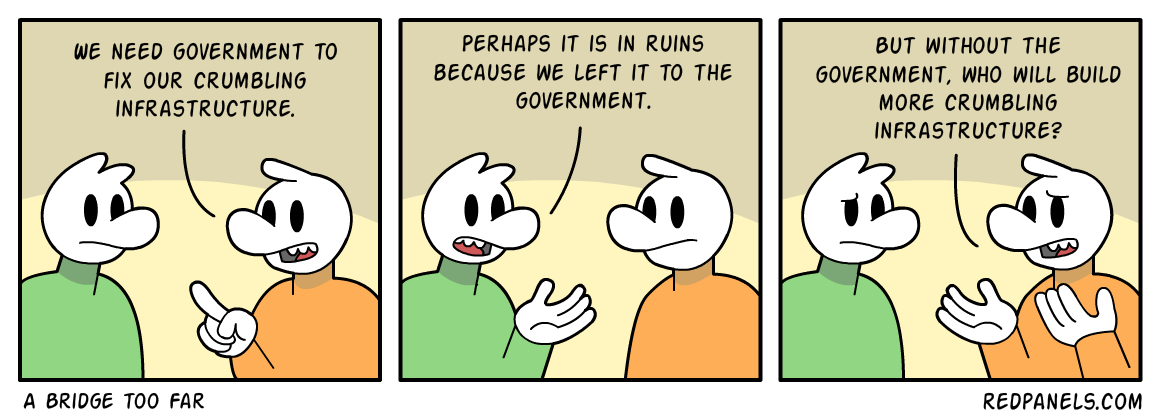
P.P.S. I wrote two years ago about the guy in England who built a private road to help drivers avoid lengthy delays caused by poor government planning. We have an even more…um…interesting example from Russia of how the private sector can take over when the government founders.

Gangs smuggling goods into Russia have secretly repaired a road on the Belarussian border in order to boost business, the TASS news agency reported Monday. Smugglers have transformed the gravel track in the Smolensk region in order to help their heavy goods vehicles traveling on the route, said Alexander Laznenko from the Smolensk region border agency. The criminal groups have widened and raised the road and added additional turning points, he said. The road, which connects Moscow to the Belarussian capital of Minsk, is known to be used by smugglers wishing to avoid official customs posts.

This is like a libertarian fantasy. The private sector builds a road to help entrepreneurs avoid trade taxes. What’s not to love? And unlike the libertarian sex fantasy or my 1992 debate fantasy, it’s actually true!

Related posts:

FRIEDMAN FRIDAY Mark J. Perry@Mark_J_Perry July 30, 2016 10:46 am | AEIdeas Happy 104th birthday, Milton Friedman

Free to Choose: Part 1 of 10 The Power of the Market (Featuring Milton Friedman) Free to Choose Part 2: The Tyranny of Control (Featuring Milton Friedman Free to Choose Part 4: From Cradle to Grave Featuring Milton Friedman Mark J. Perry@Mark_J_Perry July 30, 2016 10:46 am | AEIdeas Happy 104th birthday, Milton Friedman Tomorrow […]

FRIEDMAN FRIDAY Champion of Liberty by Stephen Moore Friday, October 26, 2012

Free to Choose: Part 1 of 10 The Power of the Market (Featuring Milton Friedman) Free to Choose Part 2: The Tyranny of Control (Featuring Milton Friedman Free to Choose Part 4: From Cradle to Grave Featuring Milton Friedman Free to Choose Part 5: Created Equal Featuring Milton Friedman Champion of Liberty by Stephen Moore […]

FRIEDMAN FRIDAY Socialism, RIP Tottering European economies prove again the Keynesian model is a failure By Stephen Moore – – Sunday, July 12, 2015

Free to Choose: Part 1 of 10 The Power of the Market (Featuring Milton Friedman) Free to Choose Part 2: The Tyranny of Control (Featuring Milton Friedman Socialism, RIP Tottering European economies prove again the Keynesian model is a failure By Stephen Moore – – Sunday, July 12, 2015 ANALYSIS/OPINION: A few years ago, the […]

FRIEDMAN FRIDAY What Would Milton Friedman Say? Immigration opponents often try to claim the famed economist as an ally. They’re mistaken. By STEPHEN MOORE Updated May 29, 2013 8:31 p.m. ET

Free to Choose: Part 1 of 10 The Power of the Market (Featuring Milton Friedman) What Would Milton Friedman Say? Immigration opponents often try to claim the famed economist as an ally. They’re mistaken. By STEPHEN MOORE Updated May 29, 2013 8:31 p.m. ET One of the fascinating sideshows of the immigration debate within the […]

FRIEDMAN FRIDAY Obama loves the death tax but listen to what Milton Friedman had to say about it!!!

__ Obama loves the death tax but listen to what Milton Friedman had to say about it!!! Milton Friedman Redistribution of Wealth and the Death Tax ___________ The Obama Administration’s Assault on the Rule of Law September 6, 2016 by Dan Mitchell What’s the worst development in economic policy of the Obama years? The faux stimulus […]

FRIEDMAN FRIDAY Dan Mitchell and Milton Friedman: Subsidies for Higher Education Are the Problem!

Milton Friedman – Should Higher Education Be Subsidized? Published on Aug 14, 2013 Professor Friedman leads a roundtable discussion with students. http://www.LibertyPen.com Hillary Is Wrong: Subsidies for Higher Education Are the Problem, not the Solution August 24, 2016 by Dan Mitchell “So many bad ideas, so little time.” That’s my attitude about Hillary Clinton. She proposes […]

FRIEDMAN FRIDAY Milton Friedman and Walter Williams have explained, minimum wage laws are especially harmful for blacks!

Milton Friedman – A Conversation On Minimum Wage Published on Oct 4, 2013 A debate on whether the minimum wage hurts or helps the working class. http://www.LibertyPen.com Is Anybody Shocked that Higher Minimum Wage Mandates Are Resulting in Fewer Jobs? August 25, 2016 by Dan Mitchell While economists are famous for their disagreements (and their incompetent […]

FRIEDMAN FRIDAY Milton Friedman and Dan Mitchell look at the economics of medical care!!

Milton Friedman on Medical Care (Full Lecture) Another Grim Reminder that Obamacare Has Made Healthcare More Expensive August 29, 2016 by Dan Mitchell Way back in 2009, some folks on the left shared a chart showing that national expenditures on healthcare compared to life expectancy. This comparison was not favorable to the United States, which easily […]

FRIEDMAN FRIDAY 2 videos by Milton Friedman on welfare state plus 2 cartoons that illustrate the fate of socialism from the Cato Institute

__________   Cato Institute scholar Dan Mitchell is right about Greece and the fate of socialism: Two Pictures that Perfectly Capture the Rise and Fall of the Welfare State July 15, 2011 by Dan Mitchell In my speeches, especially when talking about the fiscal crisis in Europe (or the future fiscal crisis in America), I often […]

FRIEDMAN FRIDAY Milton Friedman has the two solutions to the Black Teenage Unemployment Problem!!!

Milton Friedman on Donahue Show in 1979 Milton Friedman has the two solutions to the Black Teenage Unemployment Problem!!! The solutions would be first to lower the Minimum Wage Amount and  second give students the opportunity to have vouchers so their parents can put them in the best schools when they start in the kindergarten […]
FRIEDMAN FRIDAY Milton Friedman favored entitlement reform and Trump better too!!!

PRC Forum: Milton Friedman (U1060) – Full Video

____

Published on Mar 18, 2016

Milton Friedman, 1976 Nobel Laureate in Economics and author of “Free To Choose,” urges alertness to the difference between false and real problems. The problem is not budget deficits, trade deficits, or the federal debt. The problem is government spending relative to income, protectionist policies, and unfunded debt resulting from entitlements. Dr. Friedman simplifies and explains these and other policy issues. ©1987/58 min.

___________

I’m a fiscal policy wonk, so I freely acknowledge that I sometimes look at the world through green-eyeshade-colored lenses. But I don’t think it’s an exaggeration to say that expanding entitlements,Demographic 2030 changing demographics, and increasing dependency are the main long-run threats to the American economy.

And this is why the concerns I had about a Hillary Clinton presidency aren’t that different from the concerns I have about a Donald Trump presidency.

Simply stated, he apparently doesn’t even think there’s a problem that needs to be addressed. Here’s what Trump said in an interview with the Daily Signal.

I’m not going to cut Social Security like every other Republican and I’m not going to cut Medicare or Medicaid.

Some people have told me not to get too worried about this statement because candidates make so many speeches and give so many interviews that they’re bound to make mistakes and say things they don’t really mean.

I agree that we shouldn’t get too hung up on every slip of the tongue on the campaign trail (notwithstanding this clip, for instance, Obama surely doesn’t think there are 57 states).

But the Trump people actually re-posted the Daily Signal interview on the campaign’s website, which certainly suggests (to use legal terminology) malice and forethought on the issue of entitlements.

That being said, this doesn’t mean Trump is a lost cause and that genuine entitlement reform is an impossibility.

  • First, politicians oftentimes say things they don’t mean (remember Obama’s pledge that people could keep their doctors and their health plans if Obamacare was enacted?).
  • Second, the plans to fix Social Security, Medicare, and Medicaid don’t involve any cuts. Instead, reformers are proposing changes that will slow the growth of outlays.
  • Third, if Trump is even slightly serious about pushing through his big tax cut, he’ll need to have some plan to restrain overall spending to make his agenda politically viable.

For what it’s worth, I’m particularly hopeful (or not un-hopeful, to be more accurate) that Trump will be willing to address Medicaid reform, ideally as part of an overall proposal to block-grant all means-tested programs.

One reason for my semi-optimism is that the programs is becoming even more of a mess thanks to Obamacare and plenty of governors and state legislators would gladly accept that kind of reform simply to have more control over state budget matters.

And every serious budget person in Washington understands the program must be reformed because of spiraling costs.

The Wall Street Journal has an editorial today about out-of-control Medicaid spending.

One immediate problem is ObamaCare’s expansion of Medicaid, which has seen enrollment at least twice as high as advertised. …Governors claimed not joining would leave “free money” on the table because the feds would pick up 100% of the costs of new beneficiaries. In a new report this week for the Foundation for Government Accountability, Jonathan Ingram and Nicholas Horton tracked down the original enrollment projections by actuaries in 24 states that expanded and have since disclosed at least a year of data on the results. Some 11.5 million people now belong to ObamaCare’s new class of able-bodied enrollees, or 110% higher than the projections. Analysts in California expected only 910,000 people to sign up, but instead 3.84 million have, 322% off the projections. The situation is nearly as dire in New York, where enrollment is 276% higher than expected, and Illinois, which is up 90%. This liberal state triumvirate is particularly notable because they already ran generous welfare states long before ObamaCare.

Of course, the “free money” for states is a fiscal burden for all taxpayers. It’s just that the money from taxpayers gets cycled through Washington before going to state capitals.

But it’s also worth noting that the money soon won’t be “free.”

The state spending share of new Medicaid enrollment will rise to 5% next year and then to 10% by 2020, up from 0% today. The enrollment overruns mean these states will have less to spend than they planned for every other priority, especially the least fortunate.

I suppose this is a good opportunity to recycle my video on Medicaid reform. It was filmed more than five years ago, so some of the numbers are outdated (they’re worse today!). But the policy analysis is still right on point.

Promote Federalism and Replicate the Success of Welfare Reform with Medicaid Block Grants

Who knows, maybe Trump actually will do the right thing and (in a phrase he took from Reagan) make America great again.

Remember, none of us expected that economic freedom would expand during Bill Clinton’s presidency, so a bit of optimism isn’t totally out-of-bounds.

Related posts:

FRIEDMAN FRIDAY Mark J. Perry@Mark_J_Perry July 30, 2016 10:46 am | AEIdeas Happy 104th birthday, Milton Friedman

Free to Choose: Part 1 of 10 The Power of the Market (Featuring Milton Friedman) Free to Choose Part 2: The Tyranny of Control (Featuring Milton Friedman Free to Choose Part 4: From Cradle to Grave Featuring Milton Friedman Mark J. Perry@Mark_J_Perry July 30, 2016 10:46 am | AEIdeas Happy 104th birthday, Milton Friedman Tomorrow […]

FRIEDMAN FRIDAY Champion of Liberty by Stephen Moore Friday, October 26, 2012

Free to Choose: Part 1 of 10 The Power of the Market (Featuring Milton Friedman) Free to Choose Part 2: The Tyranny of Control (Featuring Milton Friedman Free to Choose Part 4: From Cradle to Grave Featuring Milton Friedman Free to Choose Part 5: Created Equal Featuring Milton Friedman Champion of Liberty by Stephen Moore […]

FRIEDMAN FRIDAY Socialism, RIP Tottering European economies prove again the Keynesian model is a failure By Stephen Moore – – Sunday, July 12, 2015

Free to Choose: Part 1 of 10 The Power of the Market (Featuring Milton Friedman) Free to Choose Part 2: The Tyranny of Control (Featuring Milton Friedman Socialism, RIP Tottering European economies prove again the Keynesian model is a failure By Stephen Moore – – Sunday, July 12, 2015 ANALYSIS/OPINION: A few years ago, the […]

FRIEDMAN FRIDAY What Would Milton Friedman Say? Immigration opponents often try to claim the famed economist as an ally. They’re mistaken. By STEPHEN MOORE Updated May 29, 2013 8:31 p.m. ET

Free to Choose: Part 1 of 10 The Power of the Market (Featuring Milton Friedman) What Would Milton Friedman Say? Immigration opponents often try to claim the famed economist as an ally. They’re mistaken. By STEPHEN MOORE Updated May 29, 2013 8:31 p.m. ET One of the fascinating sideshows of the immigration debate within the […]

FRIEDMAN FRIDAY Obama loves the death tax but listen to what Milton Friedman had to say about it!!!

__ Obama loves the death tax but listen to what Milton Friedman had to say about it!!! Milton Friedman Redistribution of Wealth and the Death Tax ___________ The Obama Administration’s Assault on the Rule of Law September 6, 2016 by Dan Mitchell What’s the worst development in economic policy of the Obama years? The faux stimulus […]

FRIEDMAN FRIDAY Dan Mitchell and Milton Friedman: Subsidies for Higher Education Are the Problem!

Milton Friedman – Should Higher Education Be Subsidized? Published on Aug 14, 2013 Professor Friedman leads a roundtable discussion with students. http://www.LibertyPen.com Hillary Is Wrong: Subsidies for Higher Education Are the Problem, not the Solution August 24, 2016 by Dan Mitchell “So many bad ideas, so little time.” That’s my attitude about Hillary Clinton. She proposes […]

FRIEDMAN FRIDAY Milton Friedman and Walter Williams have explained, minimum wage laws are especially harmful for blacks!

Milton Friedman – A Conversation On Minimum Wage Published on Oct 4, 2013 A debate on whether the minimum wage hurts or helps the working class. http://www.LibertyPen.com Is Anybody Shocked that Higher Minimum Wage Mandates Are Resulting in Fewer Jobs? August 25, 2016 by Dan Mitchell While economists are famous for their disagreements (and their incompetent […]

FRIEDMAN FRIDAY Milton Friedman and Dan Mitchell look at the economics of medical care!!

Milton Friedman on Medical Care (Full Lecture) Another Grim Reminder that Obamacare Has Made Healthcare More Expensive August 29, 2016 by Dan Mitchell Way back in 2009, some folks on the left shared a chart showing that national expenditures on healthcare compared to life expectancy. This comparison was not favorable to the United States, which easily […]

FRIEDMAN FRIDAY 2 videos by Milton Friedman on welfare state plus 2 cartoons that illustrate the fate of socialism from the Cato Institute

__________   Cato Institute scholar Dan Mitchell is right about Greece and the fate of socialism: Two Pictures that Perfectly Capture the Rise and Fall of the Welfare State July 15, 2011 by Dan Mitchell In my speeches, especially when talking about the fiscal crisis in Europe (or the future fiscal crisis in America), I often […]

FRIEDMAN FRIDAY Milton Friedman has the two solutions to the Black Teenage Unemployment Problem!!!

Milton Friedman on Donahue Show in 1979 Milton Friedman has the two solutions to the Black Teenage Unemployment Problem!!! The solutions would be first to lower the Minimum Wage Amount and  second give students the opportunity to have vouchers so their parents can put them in the best schools when they start in the kindergarten […]

FRIEDMAN FRIDAY Milton always was looking for any excuse to lower taxes and so should Trump!!!

__

Milton Friedman – Is tax reform possible?

Cutting the U.S.’s Corporate Tax Rate

There are several features of President-Elect Trump’s tax plan that are worthy of praise, including death tax repeal, expensing, and lower marginal tax rates on households.

But the policy that probably deserves the most attention is Trump’s embrace of a 15 percent tax rate for business.

What makes this policy so attractive – and vitally important – is that the rest of the world has been in a race to reduce corporate tax burdens.

Ironically, the U.S. helped start the race by cutting the corporate tax rate as part of the 1986 Tax Reform Act. But ever since then, policy in America has stagnated while other developed nations are engaged in a virtuous contest to become more competitive.

And that race continues every day.

Most impressively, as reported by the Financial Times, Hungary will cut its corporate tax rate from 19 percent to 9 percent.

Hungary’s government is to cut its corporate tax rate to the lowest level in the EU in a sign of increasingly competitive tax practices among countries seeking to lure foreign direct investment. Prime Minister Viktor Orban said a new 9 per cent corporate tax rate would be introduced in 2017, significantly lower than Ireland’s 12.5 per cent. …The government said the new single band would apply to all businesses. “Corporation tax will be lowered to single digits next year: a rate of 9 per cent will apply equally to small and medium-sized enterprises and large corporations,” a statement said. …Gabor Bekes, senior research fellow at Hungary’s Institute of Economics…said the measure would likely provoke complaints of unfair tax competition from western capitals.

Needless to say, complaints from Paris, Rome, and Berlin would be a sign that Hungary is doing the right thing.

Croatia also is moving policy in the right direction, albeit in a less aggressive fashion.

Corporate income tax will…be cut from 20 to 18 per cent for large companies and from 20 to 12 per cent for small and mid-level companies whose income is no higher than 400,000 euros annually.

Though the Croatian government also plans to lower tax rates on households.

Before the reform, people with salaries between 300 and 1,750 euros a month were taxed at 25 per cent, while now everyone earning up to 2,325 euros a month will be taxed at a 24 per cent rate. People earning more than 2,325 euros a month will have a 36 per cent tax rate, replacing a 40 per cent tax rate for anyone earning over 1,750 euros a month.

But let’s keep the focus on business taxation.

Our friends on the left don’t like Trump’s plan for a corporate tax cut, but here are there things they should know.

  1. A lower corporate tax rate won’t necessarily reduce corporate tax revenue, particularly over time as there’s more investment and job creation.
  2. A lower corporate tax rate will dramatically – if not completely – eliminate any incentive for American companies to engage in inversions.
  3. A lower corporate tax rate will boost workers wages by increasing the nation’s capital stock and thus improving productivity.

If you want more information, here’s my primer on corporate taxation. You can also watch this video.

Or, to make matters simple, we can just copy Estonia, which has the world’s best system according to the Tax Foundation.

Related posts:

FRIEDMAN FRIDAY Mark J. Perry@Mark_J_Perry July 30, 2016 10:46 am | AEIdeas Happy 104th birthday, Milton Friedman

Free to Choose: Part 1 of 10 The Power of the Market (Featuring Milton Friedman) Free to Choose Part 2: The Tyranny of Control (Featuring Milton Friedman Free to Choose Part 4: From Cradle to Grave Featuring Milton Friedman Mark J. Perry@Mark_J_Perry July 30, 2016 10:46 am | AEIdeas Happy 104th birthday, Milton Friedman Tomorrow […]

FRIEDMAN FRIDAY Champion of Liberty by Stephen Moore Friday, October 26, 2012

Free to Choose: Part 1 of 10 The Power of the Market (Featuring Milton Friedman) Free to Choose Part 2: The Tyranny of Control (Featuring Milton Friedman Free to Choose Part 4: From Cradle to Grave Featuring Milton Friedman Free to Choose Part 5: Created Equal Featuring Milton Friedman Champion of Liberty by Stephen Moore […]

FRIEDMAN FRIDAY Socialism, RIP Tottering European economies prove again the Keynesian model is a failure By Stephen Moore – – Sunday, July 12, 2015

Free to Choose: Part 1 of 10 The Power of the Market (Featuring Milton Friedman) Free to Choose Part 2: The Tyranny of Control (Featuring Milton Friedman Socialism, RIP Tottering European economies prove again the Keynesian model is a failure By Stephen Moore – – Sunday, July 12, 2015 ANALYSIS/OPINION: A few years ago, the […]

FRIEDMAN FRIDAY What Would Milton Friedman Say? Immigration opponents often try to claim the famed economist as an ally. They’re mistaken. By STEPHEN MOORE Updated May 29, 2013 8:31 p.m. ET

Free to Choose: Part 1 of 10 The Power of the Market (Featuring Milton Friedman) What Would Milton Friedman Say? Immigration opponents often try to claim the famed economist as an ally. They’re mistaken. By STEPHEN MOORE Updated May 29, 2013 8:31 p.m. ET One of the fascinating sideshows of the immigration debate within the […]

FRIEDMAN FRIDAY Obama loves the death tax but listen to what Milton Friedman had to say about it!!!

__ Obama loves the death tax but listen to what Milton Friedman had to say about it!!! Milton Friedman Redistribution of Wealth and the Death Tax ___________ The Obama Administration’s Assault on the Rule of Law September 6, 2016 by Dan Mitchell What’s the worst development in economic policy of the Obama years? The faux stimulus […]

FRIEDMAN FRIDAY Dan Mitchell and Milton Friedman: Subsidies for Higher Education Are the Problem!

Milton Friedman – Should Higher Education Be Subsidized? Published on Aug 14, 2013 Professor Friedman leads a roundtable discussion with students. http://www.LibertyPen.com Hillary Is Wrong: Subsidies for Higher Education Are the Problem, not the Solution August 24, 2016 by Dan Mitchell “So many bad ideas, so little time.” That’s my attitude about Hillary Clinton. She proposes […]

FRIEDMAN FRIDAY Milton Friedman and Walter Williams have explained, minimum wage laws are especially harmful for blacks!

Milton Friedman – A Conversation On Minimum Wage Published on Oct 4, 2013 A debate on whether the minimum wage hurts or helps the working class. http://www.LibertyPen.com Is Anybody Shocked that Higher Minimum Wage Mandates Are Resulting in Fewer Jobs? August 25, 2016 by Dan Mitchell While economists are famous for their disagreements (and their incompetent […]

FRIEDMAN FRIDAY Milton Friedman and Dan Mitchell look at the economics of medical care!!

Milton Friedman on Medical Care (Full Lecture) Another Grim Reminder that Obamacare Has Made Healthcare More Expensive August 29, 2016 by Dan Mitchell Way back in 2009, some folks on the left shared a chart showing that national expenditures on healthcare compared to life expectancy. This comparison was not favorable to the United States, which easily […]

FRIEDMAN FRIDAY 2 videos by Milton Friedman on welfare state plus 2 cartoons that illustrate the fate of socialism from the Cato Institute

__________   Cato Institute scholar Dan Mitchell is right about Greece and the fate of socialism: Two Pictures that Perfectly Capture the Rise and Fall of the Welfare State July 15, 2011 by Dan Mitchell In my speeches, especially when talking about the fiscal crisis in Europe (or the future fiscal crisis in America), I often […]

FRIEDMAN FRIDAY Milton Friedman has the two solutions to the Black Teenage Unemployment Problem!!!

Milton Friedman on Donahue Show in 1979 Milton Friedman has the two solutions to the Black Teenage Unemployment Problem!!! The solutions would be first to lower the Minimum Wage Amount and  second give students the opportunity to have vouchers so their parents can put them in the best schools when they start in the kindergarten […]

FRIEDMAN FRIDAY Trump should compare France to Hong Kong and then follow Hong Kong’s example of less government!!!!

__________

Milton Friedman – A Limit On Spending

__________

Trump should compare France to Hong Kong and then follow Hong Kong’s example of less government!!!! Take a look at Friedman examination of Hong Kong in this episode below:

Milton Friedman PBS Free to Choose 1980 Vol 1 of 10 Power of the Market

Published on May 9, 2012

America’s freedom and prosperity derive from the combination of the idea of human liberty in America’s Declaration of Independence with the idea of economic freedom in Adam Smith’s Wealth of Nations. Friedman explains how markets and voluntary exchange organize activity and enable people to improve their lives. He also explains the price system. Friedman visits Hong Kong, U.S. and Scotland.

I’m very happy that we don’t have a one-world government, but my views have nothing to do with conspiratorial fears involving blue helmets and black helicopters.

Instead, I’m happy that there are lots of independent nations because that means lots of different approaches to public policy. And that means we have lots of real-life experiments about the relative merits of big government vs small government.

And this brings me joy because the evidence overwhelmingly shows that you get much better results when the size and scope of government is constrained.

Just compare France and Switzerland. Or look at the wreckage of communism. Or consider the prosperity of Hong Kong and Singapore.

Heck, I’ve put together all sorts of long-run comparisons to show that free markets produce much better results than statism.

This is also why I like federalism inside a nation. I think this decentralized approach leads to better policy, as we can see from Switzerland.

But it also means I have another set of real-life experiments about public policy.  And, once again, this brings a smile to my face because the data clearly show the negative consequences of big government.

It’s especially amusing to compare California and Texas. The Golden State is a playground for statist policies, including the highest income tax in the nation. The Lone Star State, by contrast, is famous for its laissez-faire approach and it doesn’t have any income tax.

And if you look at income data, we have very clear evidence that living standards are climbing much faster in Texas, particularly for the middle class.

I’m certainly not the only person to notice that there’s a clear link between good policy and good results.

Writing for Investor’s Business Daily, Vance Ginn of the Texas Public Policy Foundation compares Texas and California. He starts by noting that the Lone Star State and the Golden State share some common characteristics.

Texas and California…contribute 25% of U.S. economic output, have similar abundances of natural resources, and are where 20% of Americans reside.

But that’s where the similarity ends. California almost surely wins the battle for which state has the best climate and scenery, but Texas is way ahead when you measure economic freedom.

Texas has low taxes, no personal income tax, and less regulation, versus California’s high taxes, highest marginal personal income tax rate nationwide, and burdensome regulations. The Economic Freedom of North America report…ranks Texas as the third most free state and California as second worst. The Tax Foundation ranks Texas as having the 14th best business tax climate while California ranks third worst.

Vance then addresses the left-wing stereotype that Texas is a poverty-stricken backwater.

He looks at various measures and finds that Texas always comes out on top. There’s more poverty in California.

What about poverty? Taking the average over the 2013 to 2015 period, the Census Bureau provides the official poverty rate of 16.1% in Texas and 15% in California, which suggests that the critics are right. However, that rate doesn’t account for regional differences in housing costs or noncash government assistance. The supplemental poverty rate includes these factors and instead finds a rate of 14.9% in Texas while California has the highest rate nationwide at 20.6%.

But there’s more income in Texas.

What about real income? Average nominal median household income from 2010 to 2014 (in 2014 dollars) in California ($61,489) is 17% higher and nationwide ($53,482) is 1.7% higher than in Texas ($52,576). But, the Bureau of Economic Analysis’ regional price parities data for 2014 show that the cost of living for California is 17% higher and the U.S. average is 3.5% higher than in Texas. Therefore, real income in Texas purchases as much as in California and even more when you consider that Texas doesn’t have a personal income tax.

Vance then points out that there is more income inequality in California, which I generally think is an irrelevant measure.

In this case, though, it probably does matter because bad policy is causing disproportionate harm for the poor and middle class in California.

The column also looks at the jobs data (which will cause special angst for Paul Krugman).

In the last decade, Texas has been the economic and job creation engine as the real private sector expanded 29% in Texas compared with only 14% in California. Moreover, total civilian employment increased 1.2 million in California but 1.7 million in Texas, with a labor force two-thirds the size of California’s. This increase in Texas’ employment accounts for nearly one-third of all jobs created nationwide.

So what’s the moral of the story?

Vance closes his column with some very appropriate advice for the incoming Trump Administration.

The more you tax and regulate something, the less you get of it. Clearly, less government contributes to higher standards of living in Texas. …As the new administration and policymakers nationwide reassess which direction to take, it’s important to remember that spending is the disease and taxes are a function of that disease. Restraining spending growth while following the Texas model of free market capitalism would be an excellent way to get the economy, and personal finances, back on track.

None of this means policy is perfect in Texas, needless to say. There are several ways that policy could be improved.

But if you’re looking for general lessons about the relative merits of big government vs. small government, both Texas and California are role models. They teach us lessons about job creation. About business climate. About government efficiency. And about labor mobility. And the lesson is always the same: You get better results when government is smaller and less intrusive.

Last but not least, there’s even a very amusing joke about California, Texas, and a coyote.

Related posts:

FRIEDMAN FRIDAY Mark J. Perry@Mark_J_Perry July 30, 2016 10:46 am | AEIdeas Happy 104th birthday, Milton Friedman

Free to Choose: Part 1 of 10 The Power of the Market (Featuring Milton Friedman) Free to Choose Part 2: The Tyranny of Control (Featuring Milton Friedman Free to Choose Part 4: From Cradle to Grave Featuring Milton Friedman Mark J. Perry@Mark_J_Perry July 30, 2016 10:46 am | AEIdeas Happy 104th birthday, Milton Friedman Tomorrow […]

FRIEDMAN FRIDAY Champion of Liberty by Stephen Moore Friday, October 26, 2012

Free to Choose: Part 1 of 10 The Power of the Market (Featuring Milton Friedman) Free to Choose Part 2: The Tyranny of Control (Featuring Milton Friedman Free to Choose Part 4: From Cradle to Grave Featuring Milton Friedman Free to Choose Part 5: Created Equal Featuring Milton Friedman Champion of Liberty by Stephen Moore […]

FRIEDMAN FRIDAY Socialism, RIP Tottering European economies prove again the Keynesian model is a failure By Stephen Moore – – Sunday, July 12, 2015

Free to Choose: Part 1 of 10 The Power of the Market (Featuring Milton Friedman) Free to Choose Part 2: The Tyranny of Control (Featuring Milton Friedman Socialism, RIP Tottering European economies prove again the Keynesian model is a failure By Stephen Moore – – Sunday, July 12, 2015 ANALYSIS/OPINION: A few years ago, the […]

FRIEDMAN FRIDAY What Would Milton Friedman Say? Immigration opponents often try to claim the famed economist as an ally. They’re mistaken. By STEPHEN MOORE Updated May 29, 2013 8:31 p.m. ET

Free to Choose: Part 1 of 10 The Power of the Market (Featuring Milton Friedman) What Would Milton Friedman Say? Immigration opponents often try to claim the famed economist as an ally. They’re mistaken. By STEPHEN MOORE Updated May 29, 2013 8:31 p.m. ET One of the fascinating sideshows of the immigration debate within the […]

FRIEDMAN FRIDAY Obama loves the death tax but listen to what Milton Friedman had to say about it!!!

__ Obama loves the death tax but listen to what Milton Friedman had to say about it!!! Milton Friedman Redistribution of Wealth and the Death Tax ___________ The Obama Administration’s Assault on the Rule of Law September 6, 2016 by Dan Mitchell What’s the worst development in economic policy of the Obama years? The faux stimulus […]

FRIEDMAN FRIDAY Dan Mitchell and Milton Friedman: Subsidies for Higher Education Are the Problem!

Milton Friedman – Should Higher Education Be Subsidized? Published on Aug 14, 2013 Professor Friedman leads a roundtable discussion with students. http://www.LibertyPen.com Hillary Is Wrong: Subsidies for Higher Education Are the Problem, not the Solution August 24, 2016 by Dan Mitchell “So many bad ideas, so little time.” That’s my attitude about Hillary Clinton. She proposes […]

FRIEDMAN FRIDAY Milton Friedman and Walter Williams have explained, minimum wage laws are especially harmful for blacks!

Milton Friedman – A Conversation On Minimum Wage Published on Oct 4, 2013 A debate on whether the minimum wage hurts or helps the working class. http://www.LibertyPen.com Is Anybody Shocked that Higher Minimum Wage Mandates Are Resulting in Fewer Jobs? August 25, 2016 by Dan Mitchell While economists are famous for their disagreements (and their incompetent […]

FRIEDMAN FRIDAY Milton Friedman and Dan Mitchell look at the economics of medical care!!

Milton Friedman on Medical Care (Full Lecture) Another Grim Reminder that Obamacare Has Made Healthcare More Expensive August 29, 2016 by Dan Mitchell Way back in 2009, some folks on the left shared a chart showing that national expenditures on healthcare compared to life expectancy. This comparison was not favorable to the United States, which easily […]

FRIEDMAN FRIDAY 2 videos by Milton Friedman on welfare state plus 2 cartoons that illustrate the fate of socialism from the Cato Institute

__________   Cato Institute scholar Dan Mitchell is right about Greece and the fate of socialism: Two Pictures that Perfectly Capture the Rise and Fall of the Welfare State July 15, 2011 by Dan Mitchell In my speeches, especially when talking about the fiscal crisis in Europe (or the future fiscal crisis in America), I often […]

FRIEDMAN FRIDAY Milton Friedman has the two solutions to the Black Teenage Unemployment Problem!!!

Milton Friedman on Donahue Show in 1979 Milton Friedman has the two solutions to the Black Teenage Unemployment Problem!!! The solutions would be first to lower the Minimum Wage Amount and  second give students the opportunity to have vouchers so their parents can put them in the best schools when they start in the kindergarten […]

FRIEDMAN FRIDAY The Social Responsibility of Business is to Increase its Profits by Milton Friedman The New York Times Magazine, September 13, 1970. Copyright @ 1970 by The New York Times Company.

Free to Choose: Part 1 of 10 The Power of the Market (Featuring Milton Friedman)

Free to Choose Part 2: The Tyranny of Control (Featuring Milton Friedman

Free to Choose Part 4: From Cradle to Grave Featuring Milton Friedman

The Social Responsibility of Business is to Increase its Profits

by Milton FriedmanThe New York Times Magazine, September 13, 1970. Copyright @ 1970 by The New York Times Company.

When I hear businessmen speak eloquently about the “social responsibilities of business in a free-enterprise system,” I am reminded of the wonderful line about the Frenchman who discovered at the age of 70 that he had been speaking prose all his life. The businessmen believe that they are defending free en­terprise when they declaim that business is not concerned “merely” with profit but also with promoting desirable “social” ends; that business has a “social conscience” and takes seriously its responsibilities for providing em­ployment, eliminating discrimination, avoid­ing pollution and whatever else may be the catchwords of the contemporary crop of re­formers. In fact they are–or would be if they or anyone else took them seriously–preach­ing pure and unadulterated socialism. Busi­nessmen who talk this way are unwitting pup­pets of the intellectual forces that have been undermining the basis of a free society these past decades.

The discussions of the “social responsibili­ties of business” are notable for their analytical looseness and lack of rigor. What does it mean to say that “business” has responsibilities? Only people can have responsibilities. A corporation is an artificial person and in this sense may have artificial responsibilities, but “business” as a whole cannot be said to have responsibilities, even in this vague sense. The first step toward clarity in examining the doctrine of the social responsibility of business is to ask precisely what it implies for whom.

Presumably, the individuals who are to be responsible are businessmen, which means in­dividual proprietors or corporate executives. Most of the discussion of social responsibility is directed at corporations, so in what follows I shall mostly neglect the individual proprietors and speak of corporate executives.

In a free-enterprise, private-property sys­tem, a corporate executive is an employee of the owners of the business. He has direct re­sponsibility to his employers. That responsi­bility is to conduct the business in accordance with their desires, which generally will be to make as much money as possible while con­forming to the basic rules of the society, both those embodied in law and those embodied in ethical custom. Of course, in some cases his employers may have a different objective. A group of persons might establish a corporation for an eleemosynary purpose–for exam­ple, a hospital or a school. The manager of such a corporation will not have money profit as his objective but the rendering of certain services.

In either case, the key point is that, in his capacity as a corporate executive, the manager is the agent of the individuals who own the corporation or establish the eleemosynary institution, and his primary responsibility is to them.

Needless to say, this does not mean that it is easy to judge how well he is performing his task. But at least the criterion of performance is straightforward, and the persons among whom a voluntary contractual arrangement exists are clearly defined.

Of course, the corporate executive is also a person in his own right. As a person, he may have many other responsibilities that he rec­ognizes or assumes voluntarily–to his family, his conscience, his feelings of charity, his church, his clubs, his city, his country. He ma}. feel impelled by these responsibilities to de­vote part of his income to causes he regards as worthy, to refuse to work for particular corpo­rations, even to leave his job, for example, to join his country’s armed forces. Ifwe wish, we may refer to some of these responsibilities as “social responsibilities.” But in these respects he is acting as a principal, not an agent; he is spending his own money or time or energy, not the money of his employers or the time or energy he has contracted to devote to their purposes. If these are “social responsibili­ties,” they are the social responsibilities of in­dividuals, not of business.

What does it mean to say that the corpo­rate executive has a “social responsibility” in his capacity as businessman? If this statement is not pure rhetoric, it must mean that he is to act in some way that is not in the interest of his employers. For example, that he is to refrain from increasing the price of the product in order to contribute to the social objective of preventing inflation, even though a price in crease would be in the best interests of the corporation. Or that he is to make expendi­tures on reducing pollution beyond the amount that is in the best interests of the cor­poration or that is required by law in order to contribute to the social objective of improving the environment. Or that, at the expense of corporate profits, he is to hire “hardcore” un­employed instead of better qualified available workmen to contribute to the social objective of reducing poverty.

In each of these cases, the corporate exec­utive would be spending someone else’s money for a general social interest. Insofar as his actions in accord with his “social responsi­bility” reduce returns to stockholders, he is spending their money. Insofar as his actions raise the price to customers, he is spending the customers’ money. Insofar as his actions lower the wages of some employees, he is spending their money.

The stockholders or the customers or the employees could separately spend their own money on the particular action if they wished to do so. The executive is exercising a distinct “social responsibility,” rather than serving as an agent of the stockholders or the customers or the employees, only if he spends the money in a different way than they would have spent it.

But if he does this, he is in effect imposing taxes, on the one hand, and deciding how the tax proceeds shall be spent, on the other.

This process raises political questions on two levels: principle and consequences. On the level of political principle, the imposition of taxes and the expenditure of tax proceeds are gov­ernmental functions. We have established elab­orate constitutional, parliamentary and judicial provisions to control these functions, to assure that taxes are imposed so far as possible in ac­cordance with the preferences and desires of the public–after all, “taxation without repre­sentation” was one of the battle cries of the American Revolution. We have a system of checks and balances to separate the legisla­tive function of imposing taxes and enacting expenditures from the executive function of collecting taxes and administering expendi­ture programs and from the judicial function of mediating disputes and interpreting the law.

Here the businessman–self-selected or appointed directly or indirectly by stockhold­ers–is to be simultaneously legislator, execu­tive and, jurist. He is to decide whom to tax by how much and for what purpose, and he is to spend the proceeds–all this guided only by general exhortations from on high to restrain inflation, improve the environment, fight poverty and so on and on.

The whole justification for permitting the corporate executive to be selected by the stockholders is that the executive is an agent serving the interests of his principal. This jus­tification disappears when the corporate ex­ecutive imposes taxes and spends the pro­ceeds for “social” purposes. He becomes in effect a public employee, a civil servant, even though he remains in name an employee of a private enterprise. On grounds of political principle, it is intolerable that such civil ser­vants–insofar as their actions in the name of social responsibility are real and not just win­dow-dressing–should be selected as they are now. If they are to be civil servants, then they must be elected through a political process. If they are to impose taxes and make expendi­tures to foster “social” objectives, then politi­cal machinery must be set up to make the as­sessment of taxes and to determine through a political process the objectives to be served.

This is the basic reason why the doctrine of “social responsibility” involves the acceptance of the socialist view that political mechanisms, not market mechanisms, are the appropriate way to determine the allocation of scarce re­sources to alternative uses.

On the grounds of consequences, can the corporate executive in fact discharge his al­leged “social responsibilities?” On the other hand, suppose he could get away with spending the stockholders’ or customers’ or employees’ money. How is he to know how to spend it? He is told that he must contribute to fighting inflation. How is he to know what ac­tion of his will contribute to that end? He is presumably an expert in running his company–in producing a product or selling it or financing it. But nothing about his selection makes him an expert on inflation. Will his hold­ ing down the price of his product reduce infla­tionary pressure? Or, by leaving more spending power in the hands of his customers, simply divert it elsewhere? Or, by forcing him to produce less because of the lower price, will it simply contribute to shortages? Even if he could an­swer these questions, how much cost is he justi­fied in imposing on his stockholders, customers and employees for this social purpose? What is his appropriate share and what is the appropri­ate share of others?

And, whether he wants to or not, can he get away with spending his stockholders’, cus­tomers’ or employees’ money? Will not the stockholders fire him? (Either the present ones or those who take over when his actions in the name of social responsibility have re­duced the corporation’s profits and the price of its stock.) His customers and his employees can desert him for other producers and em­ployers less scrupulous in exercising their so­cial responsibilities.

This facet of “social responsibility” doc­ trine is brought into sharp relief when the doctrine is used to justify wage restraint by trade unions. The conflict of interest is naked and clear when union officials are asked to subordinate the interest of their members to some more general purpose. If the union offi­cials try to enforce wage restraint, the consequence is likely to be wildcat strikes, rank­-and-file revolts and the emergence of strong competitors for their jobs. We thus have the ironic phenomenon that union leaders–at least in the U.S.–have objected to Govern­ment interference with the market far more consistently and courageously than have business leaders.

The difficulty of exercising “social responsibility” illustrates, of course, the great virtue of private competitive enterprise–it forces people to be responsible for their own actions and makes it difficult for them to “exploit” other people for either selfish or unselfish purposes. They can do good–but only at their own expense.

Many a reader who has followed the argu­ment this far may be tempted to remonstrate that it is all well and good to speak of Government’s having the responsibility to im­pose taxes and determine expenditures for such “social” purposes as controlling pollu­tion or training the hard-core unemployed, but that the problems are too urgent to wait on the slow course of political processes, that the exercise of social responsibility by busi­nessmen is a quicker and surer way to solve pressing current problems.

Aside from the question of fact–I share Adam Smith’s skepticism about the benefits that can be expected from “those who affected to trade for the public good”–this argument must be rejected on grounds of principle. What it amounts to is an assertion that those who favor the taxes and expenditures in question have failed to persuade a majority of their fellow citizens to be of like mind and that they are seeking to attain by undemocratic procedures what they cannot attain by democratic proce­dures. In a free society, it is hard for “evil” people to do “evil,” especially since one man’s good is another’s evil.

I have, for simplicity, concentrated on the special case of the corporate executive, ex­cept only for the brief digression on trade unions. But precisely the same argument ap­plies to the newer phenomenon of calling upon stockholders to require corporations to exercise social responsibility (the recent G.M crusade for example). In most of these cases, what is in effect involved is some stockholders trying to get other stockholders (or customers or employees) to contribute against their will to “social” causes favored by the activists. In­sofar as they succeed, they are again imposing taxes and spending the proceeds.

The situation of the individual proprietor is somewhat different. If he acts to reduce the returns of his enterprise in order to exercise his “social responsibility,” he is spending his own money, not someone else’s. If he wishes to spend his money on such purposes, that is his right, and I cannot see that there is any ob­jection to his doing so. In the process, he, too, may impose costs on employees and cus­tomers. However, because he is far less likely than a large corporation or union to have mo­nopolistic power, any such side effects will tend to be minor.

Of course, in practice the doctrine of social responsibility is frequently a cloak for actions that are justified on other grounds rather than a reason for those actions.

To illustrate, it may well be in the long run interest of a corporation that is a major employer in a small community to devote resources to providing amenities to that community or to improving its government. That may make it easier to attract desirable employees, it may reduce the wage bill or lessen losses from pilferage and sabotage or have other worthwhile effects. Or it may be that, given the laws about the deductibility of corporate charitable contributions, the stockholders can contribute more to chari­ties they favor by having the corporation make the gift than by doing it themselves, since they can in that way contribute an amount that would otherwise have been paid as corporate taxes.

In each of these–and many similar–cases, there is a strong temptation to rationalize these actions as an exercise of “social responsibility.” In the present climate of opinion, with its wide spread aversion to “capitalism,” “profits,” the “soulless corporation” and so on, this is one way for a corporation to generate goodwill as a by-product of expenditures that are entirely justified in its own self-interest.

It would be inconsistent of me to call on corporate executives to refrain from this hyp­ocritical window-dressing because it harms the foundations of a free society. That would be to call on them to exercise a “social re­sponsibility”! If our institutions, and the atti­tudes of the public make it in their self-inter­est to cloak their actions in this way, I cannot summon much indignation to denounce them. At the same time, I can express admiration for those individual proprietors or owners of closely held corporations or stockholders of more broadly held corporations who disdain such tactics as approaching fraud.

Whether blameworthy or not, the use of the cloak of social responsibility, and the nonsense spoken in its name by influential and presti­gious businessmen, does clearly harm the foun­dations of a free society. I have been impressed time and again by the schizophrenic character of many businessmen. They are capable of being extremely farsighted and clearheaded in matters that are internal to their businesses. They are incredibly shortsighted and muddle­headed in matters that are outside their businesses but affect the possible survival of busi­ness in general. This shortsightedness is strikingly exemplified in the calls from many businessmen for wage and price guidelines or controls or income policies. There is nothing that could do more in a brief period to destroy a market system and replace it by a centrally con­trolled system than effective governmental con­trol of prices and wages.

The shortsightedness is also exemplified in speeches by businessmen on social respon­sibility. This may gain them kudos in the short run. But it helps to strengthen the already too prevalent view that the pursuit of profits is wicked and immoral and must be curbed and controlled by external forces. Once this view is adopted, the external forces that curb the market will not be the social consciences, however highly developed, of the pontificating executives; it will be the iron fist of Government bureaucrats. Here, as with price and wage controls, businessmen seem to me to reveal a suicidal impulse.

The political principle that underlies the market mechanism is unanimity. In an ideal free market resting on private property, no individual can coerce any other, all coopera­tion is voluntary, all parties to such coopera­tion benefit or they need not participate. There are no values, no “social” responsibilities in any sense other than the shared values and responsibilities of individuals. Society is a collection of individuals and of the various groups they voluntarily form.

The political principle that underlies the political mechanism is conformity. The indi­vidual must serve a more general social inter­est–whether that be determined by a church or a dictator or a majority. The individual may have a vote and say in what is to be done, but if he is overruled, he must conform. It is appropriate for some to require others to contribute to a general social purpose whether they wish to or not.

Unfortunately, unanimity is not always feasi­ble. There are some respects in which conformity appears unavoidable, so I do not see how one can avoid the use of the political mecha­nism altogether.

But the doctrine of “social responsibility” taken seriously would extend the scope of the political mechanism to every human activity. It does not differ in philosophy from the most explicitly collectivist doctrine. It differs only by professing to believe that collectivist ends can be attained without collectivist means. That is why, in my book Capitalism and Freedom, I have called it a “fundamentally subversive doctrine” in a free society, and have said that in such a society, “there is one and only one social responsibility of business–to use it resources and engage in activities designed to increase its profits so long as it stays within the rules of the game, which is to say, engages in open and free competition without deception or fraud.”

Free to Choose Part 5: Created Equal Featuring Milton Friedman

Free to Choose Part 6: What’s Wrong With Our Schools Featuring Milton Friedman

Free to Choose Part 7: Who Protects the Consumer Featuring Milton Friedman

Free to Choose Part 8: Who Protects the Worker Featuring Milton Friedman

Free to Choose Part 10: How to Stay Free Featuring Milton Friedman

Related posts:

FRIEDMAN FRIDAY Milton Friedman has the two solutions to the Black Teenage Unemployment Problem!!!

Milton Friedman on Donahue Show in 1979 Milton Friedman has the two solutions to the Black Teenage Unemployment Problem!!! The solutions would be first to lower the Minimum Wage Amount and  second give students the opportunity to have vouchers so their parents can put them in the best schools when they start in the kindergarten […]

Obama loves the death tax but listen to what Milton Friedman had to say about it!!!

__ Obama loves the death tax but listen to what Milton Friedman had to say about it!!! Milton Friedman Redistribution of Wealth and the Death Tax ___________ The Obama Administration’s Assault on the Rule of Law September 6, 2016 by Dan Mitchell What’s the worst development in economic policy of the Obama years? The faux stimulus […]

Milton Friedman and Dan Mitchell: Subsidies for Higher Education Are the Problem!!!

_ Milton Friedman – Should Higher Education Be Subsidized? Published on Aug 14, 2013 Professor Friedman leads a roundtable discussion with students.http://www.LibertyPen.com Hillary Is Wrong: Subsidies for Higher Education Are the Problem, not the Solution August 24, 2016 by Dan Mitchell “So many bad ideas, so little time.” That’s my attitude about Hillary Clinton. She […]

Milton Friedman and Walter Williams have explained, minimum wage laws are especially harmful for blacks!

__ Milton Friedman – A Conversation On Minimum Wage   Published on Oct 4, 2013 A debate on whether the minimum wage hurts or helps the working class.http://www.LibertyPen.com Is Anybody Shocked that Higher Minimum Wage Mandates Are Resulting in Fewer Jobs? August 25, 2016 by Dan Mitchell While economists are famous for their disagreements (and […]

Milton Friedman and Dan Mitchell on the Economics of Medical Care!!!

_ Milton Friedman on Medical Care (Full Lecture) Another Grim Reminder that Obamacare Has Made Healthcare More Expensive August 29, 2016 by Dan Mitchell Way back in 2009, some folks on the left shared a chart showing that national expenditures on healthcare compared to life expectancy. This comparison was not favorable to the United States, which […]

FRIEDMAN FRIDAY Milton Friedman on Immigration Part 2

_ Milton Friedman on Immigration Part 2 Milton Friedman – Illegal Immigration – PT 1 Milton Friedman – Illegal Immigration – PT 2 _- Immigration and the Welfare State April 4, 2010 by Dan Mitchell My previous post dealing with whether citizenship should be automatic for babies born to illegals generated a lot of commentary, so […]

FRIEDMAN FRIDAY Milton Friedman on Immigration Part 1

_ Milton Friedman – Illegal Immigration – PT 1 Milton Friedman – Illegal Immigration – PT 2 Milton Friedman stated , “you can’t have free immigration and a welfare state.” Below Dan Mitchell links back to this quote in one of his earlier posts: A Plan for Open Borders that Anti-Amnesty Folks Can Support August 18, […]

Milton Friedman on Immigration Part 2

_ Milton Friedman on Immigration Part 2 Milton Friedman – Illegal Immigration – PT 1 Milton Friedman – Illegal Immigration – PT 2   _- Immigration and the Welfare State April 4, 2010 by Dan Mitchell My previous post dealing with whether citizenship should be automatic for babies born to illegals generated a lot of commentary, […]

Milton Friedman on Immigration Part 1

_   Milton Friedman – Illegal Immigration – PT 1 Milton Friedman – Illegal Immigration – PT 2   Milton Friedman stated , “you can’t have free immigration and a welfare state.” Below Dan Mitchell links back to this quote in one of his earlier posts: A Plan for Open Borders that Anti-Amnesty Folks Can Support […]

FRIEDMAN FRIDAY Milton Friedman and Dan Mitchell on the Post Office!!!

Milton Friedman and Dan Mitchell on the Post Office!!! Ep. 10 – How to Stay Free [3/7]. Milton Friedman’s Free to Choose (1980) Pat Brennan became something of a celebrity in 1978 because she was delivering mail in competition with the United States Post Office. With her husband she set up business in a basement […]

FRIEDMAN FRIDAY 22 Quotes to Celebrate Milton Friedman Day Samantha Reinis / @samantha_reinis / August 01, 2015

Free to Choose: Part 1 of 10 The Power of the Market (Featuring Milton Friedman)

Free to Choose Part 2: The Tyranny of Control (Featuring Milton Friedman

Conservative economist Milton Friedman would have been 103 years old if he were still living today. He won a Nobel Prize for his work in economics and served as an advisor to President Nixon. (Photo: Everett Collection/Newscom)

July 31 is known as a day to honor conservative economist Milton Friedman, as he would have been 103 years old if he were still living today.

Friedman was awarded the Nobel Prize for his work in economics, specifically for “his achievements in the field of consumption analysis, monetary history and theory, and for his demonstration of the complexity of stabilization policy.”

He served as an advisor to President Nixon in the White House and was the president of the American Economic Association before becoming a senior research fellow at the Hoover Institution at Stanford University. Friedman was known for his defense of the free market and call for school choice through a voucher programs.

To honor this great man, here are 22 of his most notable quotes regarding the economy, government, and life.

  1. If you put the federal government in charge of the Sahara Desert, in 5 years there’d be a shortage of sand.”
  2. “The great achievements of civilization have not come from government bureaus. Einstein didn’t construct his theory under order from a bureaucrat. Henry Ford didn’t revolutionize the automobile industry that way.”
  3. “Governments never learn. Only people learn.”
  4. “Many people want the government to protect the consumer. A much more urgent problem is to protect the consumer from the government.”
  5. “One of the great mistakes is to judge policies and programs by their intentions rather than their results.”
  6. “There is no such thing as a free lunch.”
  7. “I am in favor of cutting taxes under any circumstance and for any excuse, for any reason, whenever it’s possible.”
  8. “A society that puts equality before freedom will get neither. A society that puts freedom before equality will get a high degree of both.”
  9. “If all we want are jobs, we can create any number—for example, have people dig holes and then fill them up again, or perform other useless tasks. Work is sometimes its own reward. Mostly, however, it is the price we pay to get the things we want. Our real objective is not just jobs but productive jobs—jobs that will mean more goods and services to consume.”
  10. “The most important single central fact about a free market is that no exchange takes place unless both parties benefit.”
  11. “When everybody owns something, nobody owns it, and nobody has a direct interest in maintaining or improving its condition. That is why buildings in the Soviet Union—like public housing in the United States—look decrepit within a year or two of their construction.”
  12. “Hell hath no fury like a bureaucrat scorned.”
  13. “The lack of balance in governmental activity reflects primarily the failure to separate sharply the question what activities it is appropriate for government to finance from the question what activities it is appropriate for government to administer—a distinction that is important in other areas of government activity as well.”
  14. “Nothing is so permanent as a temporary government program.”
  15. “Is there some society you know that doesn’t run on greed? You think Russia doesn’t run on greed? You think China doesn’t run on greed? What is greed? Of course, none of us are greedy, it’s only the other fellow who’s greedy.”
  16. “I think the government solution to a problem is usually as bad as the problem and very often makes the problem worse.”
  17. “The Great Depression, like most other periods of severe unemployment, was produced by government mismanagement rather than by any inherent instability of the private economy.”
  18. “Underlying most arguments against the free market is a lack of belief in freedom itself.”
  19. “I think that the Internet is going to be one of the major forces for reducing the role of government.”
  20. Concentrated power is not rendered harmless by the good intentions of those who create it.”
  21. “Inflation is taxation without legislation.”
  22. “Nobody spends somebody else’s money as carefully as he spends his own. Nobody uses somebody else’s resources as carefully as he uses his own. So if you want efficiency and effectiveness, if you want knowledge to be properly utilized, you have to do it through the means of private property.”

Free to Choose Part 4: From Cradle to Grave Featuring Milton Friedman

Free to Choose Part 5: Created Equal Featuring Milton Friedman

Free to Choose Part 6: What’s Wrong With Our Schools Featuring Milton Friedman

Free to Choose Part 7: Who Protects the Consumer Featuring Milton Friedman

Free to Choose Part 8: Who Protects the Worker Featuring Milton Friedman

Free to Choose Part 10: How to Stay Free Featuring Milton Friedman

Related posts:

FRIEDMAN FRIDAY Milton Friedman has the two solutions to the Black Teenage Unemployment Problem!!!

Milton Friedman on Donahue Show in 1979 Milton Friedman has the two solutions to the Black Teenage Unemployment Problem!!! The solutions would be first to lower the Minimum Wage Amount and  second give students the opportunity to have vouchers so their parents can put them in the best schools when they start in the kindergarten […]

Obama loves the death tax but listen to what Milton Friedman had to say about it!!!

__ Obama loves the death tax but listen to what Milton Friedman had to say about it!!! Milton Friedman Redistribution of Wealth and the Death Tax ___________ The Obama Administration’s Assault on the Rule of Law September 6, 2016 by Dan Mitchell What’s the worst development in economic policy of the Obama years? The faux stimulus […]

Milton Friedman and Dan Mitchell: Subsidies for Higher Education Are the Problem!!!

_ Milton Friedman – Should Higher Education Be Subsidized? Published on Aug 14, 2013 Professor Friedman leads a roundtable discussion with students.http://www.LibertyPen.com Hillary Is Wrong: Subsidies for Higher Education Are the Problem, not the Solution August 24, 2016 by Dan Mitchell “So many bad ideas, so little time.” That’s my attitude about Hillary Clinton. She […]

Milton Friedman and Walter Williams have explained, minimum wage laws are especially harmful for blacks!

__ Milton Friedman – A Conversation On Minimum Wage   Published on Oct 4, 2013 A debate on whether the minimum wage hurts or helps the working class.http://www.LibertyPen.com Is Anybody Shocked that Higher Minimum Wage Mandates Are Resulting in Fewer Jobs? August 25, 2016 by Dan Mitchell While economists are famous for their disagreements (and […]

Milton Friedman and Dan Mitchell on the Economics of Medical Care!!!

_ Milton Friedman on Medical Care (Full Lecture) Another Grim Reminder that Obamacare Has Made Healthcare More Expensive August 29, 2016 by Dan Mitchell Way back in 2009, some folks on the left shared a chart showing that national expenditures on healthcare compared to life expectancy. This comparison was not favorable to the United States, which […]

FRIEDMAN FRIDAY Milton Friedman on Immigration Part 2

_ Milton Friedman on Immigration Part 2 Milton Friedman – Illegal Immigration – PT 1 Milton Friedman – Illegal Immigration – PT 2 _- Immigration and the Welfare State April 4, 2010 by Dan Mitchell My previous post dealing with whether citizenship should be automatic for babies born to illegals generated a lot of commentary, so […]

FRIEDMAN FRIDAY Milton Friedman on Immigration Part 1

_ Milton Friedman – Illegal Immigration – PT 1 Milton Friedman – Illegal Immigration – PT 2 Milton Friedman stated , “you can’t have free immigration and a welfare state.” Below Dan Mitchell links back to this quote in one of his earlier posts: A Plan for Open Borders that Anti-Amnesty Folks Can Support August 18, […]

Milton Friedman on Immigration Part 2

_ Milton Friedman on Immigration Part 2 Milton Friedman – Illegal Immigration – PT 1 Milton Friedman – Illegal Immigration – PT 2   _- Immigration and the Welfare State April 4, 2010 by Dan Mitchell My previous post dealing with whether citizenship should be automatic for babies born to illegals generated a lot of commentary, […]

Milton Friedman on Immigration Part 1

_   Milton Friedman – Illegal Immigration – PT 1 Milton Friedman – Illegal Immigration – PT 2   Milton Friedman stated , “you can’t have free immigration and a welfare state.” Below Dan Mitchell links back to this quote in one of his earlier posts: A Plan for Open Borders that Anti-Amnesty Folks Can Support […]

FRIEDMAN FRIDAY Milton Friedman and Dan Mitchell on the Post Office!!!

Milton Friedman and Dan Mitchell on the Post Office!!! Ep. 10 – How to Stay Free [3/7]. Milton Friedman’s Free to Choose (1980) Pat Brennan became something of a celebrity in 1978 because she was delivering mail in competition with the United States Post Office. With her husband she set up business in a basement […]

The more you tax of something, the less you get of it!!!

__

The more you tax of something, the less you get of it!!!

Milton Friedman: Why soaking the rich won’t work.

__

Milton Friedman on taxing the rich to help the poor


Back in August, I acknowledged that lifestyle leftists in California won a real victory. They imposed a tax on sugary soft drinks in Berkeley and achieved a reduction in consumption.

But I pointed out that their success actually was an affirmation of supply-side economics, which is simply the common-sense principle that taxes impact behavior. Simply stated, the more you tax of something, the less you get of it.

Which is why I’m constantly trying to get my leftist friends to be intellectually consistent. Even though I don’t think it’s the role of government to dictate our private behavior, I tell them that they are right about higher taxes on tobacco leading to less smoking (also more smuggling, but that’s a separate issue).

Yet these people simultaneously claim that higher tax rates on income (especially on the evil rich!) won’t lead to less work, saving, investment, and entrepreneurship.

Maybe the disconnect is that leftists think tobacco and sugar are special cases.

So let’s look at another example of a “successful” tax increase.

Oct 4 Home sales in the Vancouver region’s heated housing market fell for the second consecutive month after the province introduced a tax on foreign home ownership, the Real Estate Board of Greater Vancouver said on Tuesday. In a statement, the board said September’s sales were at 2,253 homes, down 32.6 percent on a year-to-year basis and down 9.5 percent from August, the first full month after British Columbia announced a 15 percent tax on foreign buyers.

Hmmm…., a tax gets imposed on X (in this case, housing) and the result in less X. What a shocking outcome!

One week ago, I would have suggested that Hillary Clinton look at this story before moving forward with her plan for more class-warfare tax hikes.

Given the surprising election outcome, I’ll suggest that Donald Trump look at this story before moving forward with his plan to boost the capital gains tax on “carried interest.” And he definitely should use this example to bolster support for the main features of his tax plan, particularly the lower corporate rate and death tax repeal.

P.S. Even Barack Obama has endorsed the core principle of supply-side economics.


Related posts:

FRIEDMAN FRIDAY Mark J. Perry@Mark_J_Perry July 30, 2016 10:46 am | AEIdeas Happy 104th birthday, Milton Friedman

Free to Choose: Part 1 of 10 The Power of the Market (Featuring Milton Friedman) Free to Choose Part 2: The Tyranny of Control (Featuring Milton Friedman Free to Choose Part 4: From Cradle to Grave Featuring Milton Friedman Mark J. Perry@Mark_J_Perry July 30, 2016 10:46 am | AEIdeas Happy 104th birthday, Milton Friedman Tomorrow […]

FRIEDMAN FRIDAY Champion of Liberty by Stephen Moore Friday, October 26, 2012

Free to Choose: Part 1 of 10 The Power of the Market (Featuring Milton Friedman) Free to Choose Part 2: The Tyranny of Control (Featuring Milton Friedman Free to Choose Part 4: From Cradle to Grave Featuring Milton Friedman Free to Choose Part 5: Created Equal Featuring Milton Friedman Champion of Liberty by Stephen Moore […]

FRIEDMAN FRIDAY Socialism, RIP Tottering European economies prove again the Keynesian model is a failure By Stephen Moore – – Sunday, July 12, 2015

Free to Choose: Part 1 of 10 The Power of the Market (Featuring Milton Friedman) Free to Choose Part 2: The Tyranny of Control (Featuring Milton Friedman Socialism, RIP Tottering European economies prove again the Keynesian model is a failure By Stephen Moore – – Sunday, July 12, 2015 ANALYSIS/OPINION: A few years ago, the […]

FRIEDMAN FRIDAY What Would Milton Friedman Say? Immigration opponents often try to claim the famed economist as an ally. They’re mistaken. By STEPHEN MOORE Updated May 29, 2013 8:31 p.m. ET

Free to Choose: Part 1 of 10 The Power of the Market (Featuring Milton Friedman) What Would Milton Friedman Say? Immigration opponents often try to claim the famed economist as an ally. They’re mistaken. By STEPHEN MOORE Updated May 29, 2013 8:31 p.m. ET One of the fascinating sideshows of the immigration debate within the […]

FRIEDMAN FRIDAY Obama loves the death tax but listen to what Milton Friedman had to say about it!!!

__ Obama loves the death tax but listen to what Milton Friedman had to say about it!!! Milton Friedman Redistribution of Wealth and the Death Tax ___________ The Obama Administration’s Assault on the Rule of Law September 6, 2016 by Dan Mitchell What’s the worst development in economic policy of the Obama years? The faux stimulus […]

FRIEDMAN FRIDAY Dan Mitchell and Milton Friedman: Subsidies for Higher Education Are the Problem!

Milton Friedman – Should Higher Education Be Subsidized? Published on Aug 14, 2013 Professor Friedman leads a roundtable discussion with students. http://www.LibertyPen.com Hillary Is Wrong: Subsidies for Higher Education Are the Problem, not the Solution August 24, 2016 by Dan Mitchell “So many bad ideas, so little time.” That’s my attitude about Hillary Clinton. She proposes […]

FRIEDMAN FRIDAY Milton Friedman and Walter Williams have explained, minimum wage laws are especially harmful for blacks!

Milton Friedman – A Conversation On Minimum Wage Published on Oct 4, 2013 A debate on whether the minimum wage hurts or helps the working class. http://www.LibertyPen.com Is Anybody Shocked that Higher Minimum Wage Mandates Are Resulting in Fewer Jobs? August 25, 2016 by Dan Mitchell While economists are famous for their disagreements (and their incompetent […]

FRIEDMAN FRIDAY Milton Friedman and Dan Mitchell look at the economics of medical care!!

Milton Friedman on Medical Care (Full Lecture) Another Grim Reminder that Obamacare Has Made Healthcare More Expensive August 29, 2016 by Dan Mitchell Way back in 2009, some folks on the left shared a chart showing that national expenditures on healthcare compared to life expectancy. This comparison was not favorable to the United States, which easily […]

FRIEDMAN FRIDAY 2 videos by Milton Friedman on welfare state plus 2 cartoons that illustrate the fate of socialism from the Cato Institute

__________   Cato Institute scholar Dan Mitchell is right about Greece and the fate of socialism: Two Pictures that Perfectly Capture the Rise and Fall of the Welfare State July 15, 2011 by Dan Mitchell In my speeches, especially when talking about the fiscal crisis in Europe (or the future fiscal crisis in America), I often […]

FRIEDMAN FRIDAY Milton Friedman has the two solutions to the Black Teenage Unemployment Problem!!!

Milton Friedman on Donahue Show in 1979 Milton Friedman has the two solutions to the Black Teenage Unemployment Problem!!! The solutions would be first to lower the Minimum Wage Amount and  second give students the opportunity to have vouchers so their parents can put them in the best schools when they start in the kindergarten […]
Trump better favor entitlement reform!!!

PRC Forum: Milton Friedman (U1060) – Full Video

____

Published on Mar 18, 2016

Milton Friedman, 1976 Nobel Laureate in Economics and author of “Free To Choose,” urges alertness to the difference between false and real problems. The problem is not budget deficits, trade deficits, or the federal debt. The problem is government spending relative to income, protectionist policies, and unfunded debt resulting from entitlements. Dr. Friedman simplifies and explains these and other policy issues. ©1987/58 min.

___________

I’m a fiscal policy wonk, so I freely acknowledge that I sometimes look at the world through green-eyeshade-colored lenses. But I don’t think it’s an exaggeration to say that expanding entitlements,Demographic 2030 changing demographics, and increasing dependency are the main long-run threats to the American economy.

And this is why the concerns I had about a Hillary Clinton presidency aren’t that different from the concerns I have about a Donald Trump presidency.

Simply stated, he apparently doesn’t even think there’s a problem that needs to be addressed. Here’s what Trump said in an interview with the Daily Signal.

I’m not going to cut Social Security like every other Republican and I’m not going to cut Medicare or Medicaid.

Some people have told me not to get too worried about this statement because candidates make so many speeches and give so many interviews that they’re bound to make mistakes and say things they don’t really mean.

I agree that we shouldn’t get too hung up on every slip of the tongue on the campaign trail (notwithstanding this clip, for instance, Obama surely doesn’t think there are 57 states).

But the Trump people actually re-posted the Daily Signal interview on the campaign’s website, which certainly suggests (to use legal terminology) malice and forethought on the issue of entitlements.

That being said, this doesn’t mean Trump is a lost cause and that genuine entitlement reform is an impossibility.

  • First, politicians oftentimes say things they don’t mean (remember Obama’s pledge that people could keep their doctors and their health plans if Obamacare was enacted?).
  • Second, the plans to fix Social Security, Medicare, and Medicaid don’t involve any cuts. Instead, reformers are proposing changes that will slow the growth of outlays.
  • Third, if Trump is even slightly serious about pushing through his big tax cut, he’ll need to have some plan to restrain overall spending to make his agenda politically viable.

For what it’s worth, I’m particularly hopeful (or not un-hopeful, to be more accurate) that Trump will be willing to address Medicaid reform, ideally as part of an overall proposal to block-grant all means-tested programs.

One reason for my semi-optimism is that the programs is becoming even more of a mess thanks to Obamacare and plenty of governors and state legislators would gladly accept that kind of reform simply to have more control over state budget matters.

And every serious budget person in Washington understands the program must be reformed because of spiraling costs.

The Wall Street Journal has an editorial today about out-of-control Medicaid spending.

One immediate problem is ObamaCare’s expansion of Medicaid, which has seen enrollment at least twice as high as advertised. …Governors claimed not joining would leave “free money” on the table because the feds would pick up 100% of the costs of new beneficiaries. In a new report this week for the Foundation for Government Accountability, Jonathan Ingram and Nicholas Horton tracked down the original enrollment projections by actuaries in 24 states that expanded and have since disclosed at least a year of data on the results. Some 11.5 million people now belong to ObamaCare’s new class of able-bodied enrollees, or 110% higher than the projections. Analysts in California expected only 910,000 people to sign up, but instead 3.84 million have, 322% off the projections. The situation is nearly as dire in New York, where enrollment is 276% higher than expected, and Illinois, which is up 90%. This liberal state triumvirate is particularly notable because they already ran generous welfare states long before ObamaCare.

Of course, the “free money” for states is a fiscal burden for all taxpayers. It’s just that the money from taxpayers gets cycled through Washington before going to state capitals.

But it’s also worth noting that the money soon won’t be “free.”

The state spending share of new Medicaid enrollment will rise to 5% next year and then to 10% by 2020, up from 0% today. The enrollment overruns mean these states will have less to spend than they planned for every other priority, especially the least fortunate.

I suppose this is a good opportunity to recycle my video on Medicaid reform. It was filmed more than five years ago, so some of the numbers are outdated (they’re worse today!). But the policy analysis is still right on point.

Promote Federalism and Replicate the Success of Welfare Reform with Medicaid Block Grants


Who knows, maybe Trump actually will do the right thing and (in a phrase he took from Reagan) make America great again.

Remember, none of us expected that economic freedom would expand during Bill Clinton’s presidency, so a bit of optimism isn’t totally out-of-bounds.

Related posts:

FRIEDMAN FRIDAY Mark J. Perry@Mark_J_Perry July 30, 2016 10:46 am | AEIdeas Happy 104th birthday, Milton Friedman

Free to Choose: Part 1 of 10 The Power of the Market (Featuring Milton Friedman) Free to Choose Part 2: The Tyranny of Control (Featuring Milton Friedman Free to Choose Part 4: From Cradle to Grave Featuring Milton Friedman Mark J. Perry@Mark_J_Perry July 30, 2016 10:46 am | AEIdeas Happy 104th birthday, Milton Friedman Tomorrow […]

FRIEDMAN FRIDAY Champion of Liberty by Stephen Moore Friday, October 26, 2012

Free to Choose: Part 1 of 10 The Power of the Market (Featuring Milton Friedman) Free to Choose Part 2: The Tyranny of Control (Featuring Milton Friedman Free to Choose Part 4: From Cradle to Grave Featuring Milton Friedman Free to Choose Part 5: Created Equal Featuring Milton Friedman Champion of Liberty by Stephen Moore […]

FRIEDMAN FRIDAY Socialism, RIP Tottering European economies prove again the Keynesian model is a failure By Stephen Moore – – Sunday, July 12, 2015

Free to Choose: Part 1 of 10 The Power of the Market (Featuring Milton Friedman) Free to Choose Part 2: The Tyranny of Control (Featuring Milton Friedman Socialism, RIP Tottering European economies prove again the Keynesian model is a failure By Stephen Moore – – Sunday, July 12, 2015 ANALYSIS/OPINION: A few years ago, the […]

FRIEDMAN FRIDAY What Would Milton Friedman Say? Immigration opponents often try to claim the famed economist as an ally. They’re mistaken. By STEPHEN MOORE Updated May 29, 2013 8:31 p.m. ET

Free to Choose: Part 1 of 10 The Power of the Market (Featuring Milton Friedman) What Would Milton Friedman Say? Immigration opponents often try to claim the famed economist as an ally. They’re mistaken. By STEPHEN MOORE Updated May 29, 2013 8:31 p.m. ET One of the fascinating sideshows of the immigration debate within the […]

FRIEDMAN FRIDAY Obama loves the death tax but listen to what Milton Friedman had to say about it!!!

__ Obama loves the death tax but listen to what Milton Friedman had to say about it!!! Milton Friedman Redistribution of Wealth and the Death Tax ___________ The Obama Administration’s Assault on the Rule of Law September 6, 2016 by Dan Mitchell What’s the worst development in economic policy of the Obama years? The faux stimulus […]

FRIEDMAN FRIDAY Dan Mitchell and Milton Friedman: Subsidies for Higher Education Are the Problem!

Milton Friedman – Should Higher Education Be Subsidized? Published on Aug 14, 2013 Professor Friedman leads a roundtable discussion with students. http://www.LibertyPen.com Hillary Is Wrong: Subsidies for Higher Education Are the Problem, not the Solution August 24, 2016 by Dan Mitchell “So many bad ideas, so little time.” That’s my attitude about Hillary Clinton. She proposes […]

FRIEDMAN FRIDAY Milton Friedman and Walter Williams have explained, minimum wage laws are especially harmful for blacks!

Milton Friedman – A Conversation On Minimum Wage Published on Oct 4, 2013 A debate on whether the minimum wage hurts or helps the working class. http://www.LibertyPen.com Is Anybody Shocked that Higher Minimum Wage Mandates Are Resulting in Fewer Jobs? August 25, 2016 by Dan Mitchell While economists are famous for their disagreements (and their incompetent […]

FRIEDMAN FRIDAY Milton Friedman and Dan Mitchell look at the economics of medical care!!

Milton Friedman on Medical Care (Full Lecture) Another Grim Reminder that Obamacare Has Made Healthcare More Expensive August 29, 2016 by Dan Mitchell Way back in 2009, some folks on the left shared a chart showing that national expenditures on healthcare compared to life expectancy. This comparison was not favorable to the United States, which easily […]

FRIEDMAN FRIDAY 2 videos by Milton Friedman on welfare state plus 2 cartoons that illustrate the fate of socialism from the Cato Institute

__________   Cato Institute scholar Dan Mitchell is right about Greece and the fate of socialism: Two Pictures that Perfectly Capture the Rise and Fall of the Welfare State July 15, 2011 by Dan Mitchell In my speeches, especially when talking about the fiscal crisis in Europe (or the future fiscal crisis in America), I often […]

FRIEDMAN FRIDAY Milton Friedman has the two solutions to the Black Teenage Unemployment Problem!!!

Milton Friedman on Donahue Show in 1979 Milton Friedman has the two solutions to the Black Teenage Unemployment Problem!!! The solutions would be first to lower the Minimum Wage Amount and  second give students the opportunity to have vouchers so their parents can put them in the best schools when they start in the kindergarten […]

Trump should lower taxes!!!

__

Milton Friedman – Is tax reform possible?

Cutting the U.S.’s Corporate Tax Rate

There are several features of President-Elect Trump’s tax plan that are worthy of praise, including death tax repeal, expensing, and lower marginal tax rates on households.

But the policy that probably deserves the most attention is Trump’s embrace of a 15 percent tax rate for business.

What makes this policy so attractive – and vitally important – is that the rest of the world has been in a race to reduce corporate tax burdens.

Ironically, the U.S. helped start the race by cutting the corporate tax rate as part of the 1986 Tax Reform Act. But ever since then, policy in America has stagnated while other developed nations are engaged in a virtuous contest to become more competitive.

And that race continues every day.

Most impressively, as reported by the Financial Times, Hungary will cut its corporate tax rate from 19 percent to 9 percent.

Hungary’s government is to cut its corporate tax rate to the lowest level in the EU in a sign of increasingly competitive tax practices among countries seeking to lure foreign direct investment. Prime Minister Viktor Orban said a new 9 per cent corporate tax rate would be introduced in 2017, significantly lower than Ireland’s 12.5 per cent. …The government said the new single band would apply to all businesses. “Corporation tax will be lowered to single digits next year: a rate of 9 per cent will apply equally to small and medium-sized enterprises and large corporations,” a statement said. …Gabor Bekes, senior research fellow at Hungary’s Institute of Economics…said the measure would likely provoke complaints of unfair tax competition from western capitals.

Needless to say, complaints from Paris, Rome, and Berlin would be a sign that Hungary is doing the right thing.

Croatia also is moving policy in the right direction, albeit in a less aggressive fashion.

Corporate income tax will…be cut from 20 to 18 per cent for large companies and from 20 to 12 per cent for small and mid-level companies whose income is no higher than 400,000 euros annually.

Though the Croatian government also plans to lower tax rates on households.

Before the reform, people with salaries between 300 and 1,750 euros a month were taxed at 25 per cent, while now everyone earning up to 2,325 euros a month will be taxed at a 24 per cent rate. People earning more than 2,325 euros a month will have a 36 per cent tax rate, replacing a 40 per cent tax rate for anyone earning over 1,750 euros a month.

But let’s keep the focus on business taxation.

Our friends on the left don’t like Trump’s plan for a corporate tax cut, but here are there things they should know.

  1. A lower corporate tax rate won’t necessarily reduce corporate tax revenue, particularly over time as there’s more investment and job creation.
  2. A lower corporate tax rate will dramatically – if not completely – eliminate any incentive for American companies to engage in inversions.
  3. A lower corporate tax rate will boost workers wages by increasing the nation’s capital stock and thus improving productivity.

If you want more information, here’s my primer on corporate taxation. You can also watch this video.

Or, to make matters simple, we can just copy Estonia, which has the world’s best system according to the Tax Foundation.


Related posts:

FRIEDMAN FRIDAY Mark J. Perry@Mark_J_Perry July 30, 2016 10:46 am | AEIdeas Happy 104th birthday, Milton Friedman

Free to Choose: Part 1 of 10 The Power of the Market (Featuring Milton Friedman) Free to Choose Part 2: The Tyranny of Control (Featuring Milton Friedman Free to Choose Part 4: From Cradle to Grave Featuring Milton Friedman Mark J. Perry@Mark_J_Perry July 30, 2016 10:46 am | AEIdeas Happy 104th birthday, Milton Friedman Tomorrow […]

FRIEDMAN FRIDAY Champion of Liberty by Stephen Moore Friday, October 26, 2012

Free to Choose: Part 1 of 10 The Power of the Market (Featuring Milton Friedman) Free to Choose Part 2: The Tyranny of Control (Featuring Milton Friedman Free to Choose Part 4: From Cradle to Grave Featuring Milton Friedman Free to Choose Part 5: Created Equal Featuring Milton Friedman Champion of Liberty by Stephen Moore […]

FRIEDMAN FRIDAY Socialism, RIP Tottering European economies prove again the Keynesian model is a failure By Stephen Moore – – Sunday, July 12, 2015

Free to Choose: Part 1 of 10 The Power of the Market (Featuring Milton Friedman) Free to Choose Part 2: The Tyranny of Control (Featuring Milton Friedman Socialism, RIP Tottering European economies prove again the Keynesian model is a failure By Stephen Moore – – Sunday, July 12, 2015 ANALYSIS/OPINION: A few years ago, the […]

FRIEDMAN FRIDAY What Would Milton Friedman Say? Immigration opponents often try to claim the famed economist as an ally. They’re mistaken. By STEPHEN MOORE Updated May 29, 2013 8:31 p.m. ET

Free to Choose: Part 1 of 10 The Power of the Market (Featuring Milton Friedman) What Would Milton Friedman Say? Immigration opponents often try to claim the famed economist as an ally. They’re mistaken. By STEPHEN MOORE Updated May 29, 2013 8:31 p.m. ET One of the fascinating sideshows of the immigration debate within the […]

FRIEDMAN FRIDAY Obama loves the death tax but listen to what Milton Friedman had to say about it!!!

__ Obama loves the death tax but listen to what Milton Friedman had to say about it!!! Milton Friedman Redistribution of Wealth and the Death Tax ___________ The Obama Administration’s Assault on the Rule of Law September 6, 2016 by Dan Mitchell What’s the worst development in economic policy of the Obama years? The faux stimulus […]

FRIEDMAN FRIDAY Dan Mitchell and Milton Friedman: Subsidies for Higher Education Are the Problem!

Milton Friedman – Should Higher Education Be Subsidized? Published on Aug 14, 2013 Professor Friedman leads a roundtable discussion with students. http://www.LibertyPen.com Hillary Is Wrong: Subsidies for Higher Education Are the Problem, not the Solution August 24, 2016 by Dan Mitchell “So many bad ideas, so little time.” That’s my attitude about Hillary Clinton. She proposes […]

FRIEDMAN FRIDAY Milton Friedman and Walter Williams have explained, minimum wage laws are especially harmful for blacks!

Milton Friedman – A Conversation On Minimum Wage Published on Oct 4, 2013 A debate on whether the minimum wage hurts or helps the working class. http://www.LibertyPen.com Is Anybody Shocked that Higher Minimum Wage Mandates Are Resulting in Fewer Jobs? August 25, 2016 by Dan Mitchell While economists are famous for their disagreements (and their incompetent […]

FRIEDMAN FRIDAY Milton Friedman and Dan Mitchell look at the economics of medical care!!

Milton Friedman on Medical Care (Full Lecture) Another Grim Reminder that Obamacare Has Made Healthcare More Expensive August 29, 2016 by Dan Mitchell Way back in 2009, some folks on the left shared a chart showing that national expenditures on healthcare compared to life expectancy. This comparison was not favorable to the United States, which easily […]

FRIEDMAN FRIDAY 2 videos by Milton Friedman on welfare state plus 2 cartoons that illustrate the fate of socialism from the Cato Institute

__________   Cato Institute scholar Dan Mitchell is right about Greece and the fate of socialism: Two Pictures that Perfectly Capture the Rise and Fall of the Welfare State July 15, 2011 by Dan Mitchell In my speeches, especially when talking about the fiscal crisis in Europe (or the future fiscal crisis in America), I often […]

FRIEDMAN FRIDAY Milton Friedman has the two solutions to the Black Teenage Unemployment Problem!!!

Milton Friedman on Donahue Show in 1979 Milton Friedman has the two solutions to the Black Teenage Unemployment Problem!!! The solutions would be first to lower the Minimum Wage Amount and  second give students the opportunity to have vouchers so their parents can put them in the best schools when they start in the kindergarten […]

Trump should compare France to Hong Kong and then follow Hong Kong’s example of less government!!!!

______________

Milton Friedman – A Limit On Spending

__________

Trump should compare France to Hong Kong and then follow Hong Kong’s example of less government!!!! Take a look at Friedman examination of Hong Kong in this episode below:

Milton Friedman PBS Free to Choose 1980 Vol 1 of 10 Power of the Market


Published on May 9, 2012

America’s freedom and prosperity derive from the combination of the idea of human liberty in America’s Declaration of Independence with the idea of economic freedom in Adam Smith’s Wealth of Nations. Friedman explains how markets and voluntary exchange organize activity and enable people to improve their lives. He also explains the price system. Friedman visits Hong Kong, U.S. and Scotland.

I’m very happy that we don’t have a one-world government, but my views have nothing to do with conspiratorial fears involving blue helmets and black helicopters.

Instead, I’m happy that there are lots of independent nations because that means lots of different approaches to public policy. And that means we have lots of real-life experiments about the relative merits of big government vs small government.

And this brings me joy because the evidence overwhelmingly shows that you get much better results when the size and scope of government is constrained.

Just compare France and Switzerland. Or look at the wreckage of communism. Or consider the prosperity of Hong Kong and Singapore.

Heck, I’ve put together all sorts of long-run comparisons to show that free markets produce much better results than statism.

This is also why I like federalism inside a nation. I think this decentralized approach leads to better policy, as we can see from Switzerland.

But it also means I have another set of real-life experiments about public policy.  And, once again, this brings a smile to my face because the data clearly show the negative consequences of big government.

It’s especially amusing to compare California and Texas. The Golden State is a playground for statist policies, including the highest income tax in the nation. The Lone Star State, by contrast, is famous for its laissez-faire approach and it doesn’t have any income tax.

And if you look at income data, we have very clear evidence that living standards are climbing much faster in Texas, particularly for the middle class.

I’m certainly not the only person to notice that there’s a clear link between good policy and good results.

Writing for Investor’s Business Daily, Vance Ginn of the Texas Public Policy Foundation compares Texas and California. He starts by noting that the Lone Star State and the Golden State share some common characteristics.

Texas and California…contribute 25% of U.S. economic output, have similar abundances of natural resources, and are where 20% of Americans reside.

But that’s where the similarity ends. California almost surely wins the battle for which state has the best climate and scenery, but Texas is way ahead when you measure economic freedom.

Texas has low taxes, no personal income tax, and less regulation, versus California’s high taxes, highest marginal personal income tax rate nationwide, and burdensome regulations. The Economic Freedom of North America report…ranks Texas as the third most free state and California as second worst. The Tax Foundation ranks Texas as having the 14th best business tax climate while California ranks third worst.

Vance then addresses the left-wing stereotype that Texas is a poverty-stricken backwater.

He looks at various measures and finds that Texas always comes out on top. There’s more poverty in California.

What about poverty? Taking the average over the 2013 to 2015 period, the Census Bureau provides the official poverty rate of 16.1% in Texas and 15% in California, which suggests that the critics are right. However, that rate doesn’t account for regional differences in housing costs or noncash government assistance. The supplemental poverty rate includes these factors and instead finds a rate of 14.9% in Texas while California has the highest rate nationwide at 20.6%.

But there’s more income in Texas.

What about real income? Average nominal median household income from 2010 to 2014 (in 2014 dollars) in California ($61,489) is 17% higher and nationwide ($53,482) is 1.7% higher than in Texas ($52,576). But, the Bureau of Economic Analysis’ regional price parities data for 2014 show that the cost of living for California is 17% higher and the U.S. average is 3.5% higher than in Texas. Therefore, real income in Texas purchases as much as in California and even more when you consider that Texas doesn’t have a personal income tax.

Vance then points out that there is more income inequality in California, which I generally think is an irrelevant measure.

In this case, though, it probably does matter because bad policy is causing disproportionate harm for the poor and middle class in California.

The column also looks at the jobs data (which will cause special angst for Paul Krugman).

In the last decade, Texas has been the economic and job creation engine as the real private sector expanded 29% in Texas compared with only 14% in California. Moreover, total civilian employment increased 1.2 million in California but 1.7 million in Texas, with a labor force two-thirds the size of California’s. This increase in Texas’ employment accounts for nearly one-third of all jobs created nationwide.

So what’s the moral of the story?

Vance closes his column with some very appropriate advice for the incoming Trump Administration.

The more you tax and regulate something, the less you get of it. Clearly, less government contributes to higher standards of living in Texas. …As the new administration and policymakers nationwide reassess which direction to take, it’s important to remember that spending is the disease and taxes are a function of that disease. Restraining spending growth while following the Texas model of free market capitalism would be an excellent way to get the economy, and personal finances, back on track.

None of this means policy is perfect in Texas, needless to say. There are several ways that policy could be improved.

But if you’re looking for general lessons about the relative merits of big government vs. small government, both Texas and California are role models. They teach us lessons about job creation. About business climate. About government efficiency. And about labor mobility. And the lesson is always the same: You get better results when government is smaller and less intrusive.

Last but not least, there’s even a very amusing joke about California, Texas, and a coyote.

Related posts:

FRIEDMAN FRIDAY Mark J. Perry@Mark_J_Perry July 30, 2016 10:46 am | AEIdeas Happy 104th birthday, Milton Friedman

Free to Choose: Part 1 of 10 The Power of the Market (Featuring Milton Friedman) Free to Choose Part 2: The Tyranny of Control (Featuring Milton Friedman Free to Choose Part 4: From Cradle to Grave Featuring Milton Friedman Mark J. Perry@Mark_J_Perry July 30, 2016 10:46 am | AEIdeas Happy 104th birthday, Milton Friedman Tomorrow […]

FRIEDMAN FRIDAY Champion of Liberty by Stephen Moore Friday, October 26, 2012

Free to Choose: Part 1 of 10 The Power of the Market (Featuring Milton Friedman) Free to Choose Part 2: The Tyranny of Control (Featuring Milton Friedman Free to Choose Part 4: From Cradle to Grave Featuring Milton Friedman Free to Choose Part 5: Created Equal Featuring Milton Friedman Champion of Liberty by Stephen Moore […]

FRIEDMAN FRIDAY Socialism, RIP Tottering European economies prove again the Keynesian model is a failure By Stephen Moore – – Sunday, July 12, 2015

Free to Choose: Part 1 of 10 The Power of the Market (Featuring Milton Friedman) Free to Choose Part 2: The Tyranny of Control (Featuring Milton Friedman Socialism, RIP Tottering European economies prove again the Keynesian model is a failure By Stephen Moore – – Sunday, July 12, 2015 ANALYSIS/OPINION: A few years ago, the […]

FRIEDMAN FRIDAY What Would Milton Friedman Say? Immigration opponents often try to claim the famed economist as an ally. They’re mistaken. By STEPHEN MOORE Updated May 29, 2013 8:31 p.m. ET

Free to Choose: Part 1 of 10 The Power of the Market (Featuring Milton Friedman) What Would Milton Friedman Say? Immigration opponents often try to claim the famed economist as an ally. They’re mistaken. By STEPHEN MOORE Updated May 29, 2013 8:31 p.m. ET One of the fascinating sideshows of the immigration debate within the […]

FRIEDMAN FRIDAY Obama loves the death tax but listen to what Milton Friedman had to say about it!!!

__ Obama loves the death tax but listen to what Milton Friedman had to say about it!!! Milton Friedman Redistribution of Wealth and the Death Tax ___________ The Obama Administration’s Assault on the Rule of Law September 6, 2016 by Dan Mitchell What’s the worst development in economic policy of the Obama years? The faux stimulus […]

FRIEDMAN FRIDAY Dan Mitchell and Milton Friedman: Subsidies for Higher Education Are the Problem!

Milton Friedman – Should Higher Education Be Subsidized? Published on Aug 14, 2013 Professor Friedman leads a roundtable discussion with students. http://www.LibertyPen.com Hillary Is Wrong: Subsidies for Higher Education Are the Problem, not the Solution August 24, 2016 by Dan Mitchell “So many bad ideas, so little time.” That’s my attitude about Hillary Clinton. She proposes […]

FRIEDMAN FRIDAY Milton Friedman and Walter Williams have explained, minimum wage laws are especially harmful for blacks!

Milton Friedman – A Conversation On Minimum Wage Published on Oct 4, 2013 A debate on whether the minimum wage hurts or helps the working class. http://www.LibertyPen.com Is Anybody Shocked that Higher Minimum Wage Mandates Are Resulting in Fewer Jobs? August 25, 2016 by Dan Mitchell While economists are famous for their disagreements (and their incompetent […]

FRIEDMAN FRIDAY Milton Friedman and Dan Mitchell look at the economics of medical care!!

Milton Friedman on Medical Care (Full Lecture) Another Grim Reminder that Obamacare Has Made Healthcare More Expensive August 29, 2016 by Dan Mitchell Way back in 2009, some folks on the left shared a chart showing that national expenditures on healthcare compared to life expectancy. This comparison was not favorable to the United States, which easily […]

FRIEDMAN FRIDAY 2 videos by Milton Friedman on welfare state plus 2 cartoons that illustrate the fate of socialism from the Cato Institute

__________   Cato Institute scholar Dan Mitchell is right about Greece and the fate of socialism: Two Pictures that Perfectly Capture the Rise and Fall of the Welfare State July 15, 2011 by Dan Mitchell In my speeches, especially when talking about the fiscal crisis in Europe (or the future fiscal crisis in America), I often […]

FRIEDMAN FRIDAY Milton Friedman has the two solutions to the Black Teenage Unemployment Problem!!!

Milton Friedman on Donahue Show in 1979 Milton Friedman has the two solutions to the Black Teenage Unemployment Problem!!! The solutions would be first to lower the Minimum Wage Amount and  second give students the opportunity to have vouchers so their parents can put them in the best schools when they start in the kindergarten […]