It has been two years since Obamacare was signed into law, and although the major provisions don’t begin until 2014, some have already been implemented. The parts of the law already in effect were thought by its proponents to be its most popular, but as detailed in Heritage’s “The Obamacare Two-Year Checkup: More Reasons for Repeal,” the law is already proving ineffective in some cases and harmful in others. Here are some of the biggest failures of Obamacare highlighted by the paper:
The disappearance of child-only policies. Obamacare requires insurers who sell child-only plans to accept all applicants regardless of health condition. This allows parents to wait until their children are sick to enroll them in health plans. Two years later, one survey found that “17 states indicated that no insurers were selling child-only policies to new enrollees, and 39 states responded that at least one insurer exited the child-only market since the new law took effect.”
“Free” preventive services cost Americans. Obamacare requires coverage of certain preventive services with no cost-sharing for the individual. Two years later, the list includes abortion-inducing drugs, sterilization, and other contraceptives as mandated coverage—even for many religious organizations. Heritage analysts report, “This created an outcry from members of many faiths who feel this decision is an attack on religious freedom and their ability to serve communities across the country.”
A failing small business tax credit. Obamacare provides a temporary tax credit to small employers as an incentive for them to offer health insurance to their employees. Two years later, the IRS reports that only 7 percent of the originally estimated 4.4 million eligible small businesses have claimed the credit.
A broke program for early retirees. Obamacare established a temporary reinsurance program from May 2010 to January 2014 to pay a portion of companies’ costs to insure early retirees between the ages of 55 and 65. Two years later, the program ran out of money almost three years early and is no longer accepting additional applications. As Heritage analysts explain, the program “clearly shifts the costs of paying for unsustainable promises made to public and private employees to federal taxpayers and further underscores how the true cost of implementing the health care law exceeds original estimates.”
Low enrollment in high-risk pools. Obamacare creates high-risk pools for individuals with pre-existing conditions who have been uninsured for at least six months to purchase insurance. Two years later, using the Administration’s own numbers, enrollment in the high-risk pools remains low: only 13 percent of initial estimates. Heritage analysts point out, “At the same time, medical-claims costs have been 2.5 times higher than initially projected, and the high-risk pools may still exhaust or exceed the available funding, even though they serve such a small portion of those they were intended to help.”
A damaging medical loss ratio (MLR). Obamacare requires insurers to spend 80 percent (85 percent for large group plans) of premium revenue on medical claims or quality improvement. Two years later, Heritage analysts point out, “Seventeen states applied for the MLR waivers, arguing that the regulations would destabilize their markets.” The Administration has granted a full waiver to only one state; six received a partial waiver, and 10 requests were rejected. Some insurers have already left the market because of the requirement, and the strict medical loss ratio threatens the existence of health savings accounts, which are used by 11 million Americans.
An unsustainable new entitlement. Obamacare created the CLASS Act, a government-run long-term care insurance program. Two years later, the Administration has declared the CLASS program unsustainable and halted its implementation. Heritage analysts report, “On February 1, 2012, the House of Representatives voted 267 (including 28 Democrats) to 159 to repeal the troubled CLASS program, and it now awaits consideration by the U.S. Senate.”
To read about all of the consequences of Obamacare chronicled in “The Obamacare Two-Year Checkup: More Reasons for Repeal,” click here.
Cato Institute Senior Fellow and Georgetown University law professor Randy E. Barnett discusses the arguments to be presented to the Supreme Court beginning March 26.
I know that many people feel strongly that we live in a democracy and because the people want Obamacare then they should be able to get it. However, that is not exactly true that we live in a pure democracy.
My daily email containing the editorials and opinion columns from the Washington Post included an item written by E.J. Dionne entitled “Supreme Court activists: Conservative justices forget we’re a democracy.”
Did he forget that America is a constitutional republic, or perhaps was never taught?
Did he not learn about separation of powers in school, and that the courts are supposed to protect us against tyranny of the majority emanating from the legislature?
I suspect he does understand, at least with regard to the first question. For instance, I’d bet a lot of money that he was correctly in favor of the Court’s decision to protect flag burning as a form of political speech, notwithstanding public opinion and congressional approval.
But he seems to join with other leftists in treating the interstate commerce clause as some sort of blank check for federal intervention into every aspect of our lives. And it shows up in various ways in his column.
…conservative justices are prepared to act as an alternative legislature…discussing whether parts of the law could stand if other parts fell… Sotomayor asked what was wrong with leaving as much discretion as possible “in the hands of the people who should be fixing this, not us.” It was nice to be reminded that we’re a democracy, not a judicial dictatorship. …This is what conservative justices will do if they strike down or cripple the health-care law. …a court that…sees no limits on its power, no need to defer to those elected to make our laws.
At the risk of being blunt, the conservative justices are doing exactly what they should be doing. They’re deciding if a law enacted by Congress is consistent with the powers granted to Congress by the Constitution.
America has a democratic form of government, but we are not a democracy. At least not in the sense that 51 percent of the people have the unlimited right to rape and pillage 49 percent of the people.
I have no idea of the Supreme Court will make the right decision, but I am overwhelmingly confident that the Founding Fathers didn’t envision mandated health insurance as a function of the federal government.
The individual mandate to purchase health insurance is the linchpin of the Patient Protection and Affordable Care Act. It is among the issues to be handled by the Supreme Court beginning March 26, 2012.
Michael F. Cannon is the director of health policy studies at the Cato Institute.
____________________
Tim Sandefur Discusses ObamaCare’s Medicaid Expansion
Cato Institute Senior Fellow and Georgetown University law professor Randy E. Barnett discusses the arguments to be presented to the Supreme Court beginning March 26.
__________
Milton Friedman – Socialized Medicine at Mayo Clinic in 1978
They’re right, though they probably don’t realize the seriousness of that looming crisis.
Here’s what you need to know: America’s fiscal crisis is actually a spending crisis, and that spending crisis is driven by entitlements.
More specifically, the vast majority of the problem is the result of Medicaid, Medicare, and Social Security, programs that are poorly designed and unsustainable.
The Medicaid program imposes high costs while generating poor results. This Center for Freedom and Prosperity Foundation video explains how block grants, such as the one proposed by Congressman Paul Ryan, will save money and improve healthcare by giving states the freedom to innovate and compete.
This Center for Freedom and Prosperity Foundation video explains how a “premium-support” plan would solve Medicare’s fiscal crisis and improve the overall healthcare system. This voucher-based system also would protect seniors from bureaucratic rationing. http://www.freedomandprosperity.org
There are two crises facing Social Security. First the program has a gigantic unfunded liability, largely thanks to demographics. Second, the program is a very bad deal for younger workers, making them pay record amounts of tax in exchange for comparatively meager benefits. This video explains how personal accounts can solve both problems, and also notes that nations as varied as Australia, Chile, Sweden, and Hong Kong have implemented this pro-growth reform. www.freedomandprosperity.org
_______________________
Regular readers know I’m fairly gloomy about the future of liberty, but this is one area where there is a glimmer of hope.
The Chairman of the House Budget Committee actually put together a plan that addresses the two biggest problems (Medicare and Medicaid) and the House of Representatives actually adopted the proposal.
The Senate didn’t act, of course, and Obama would veto any good legislation anyhow, so I don’t want to be crazy optimistic. Depending on how things play out politically in the next six years, I’ll say there’s actually a 20 percent chance to save America.
The Medicaid program imposes high costs while generating poor results. This Center for Freedom and Prosperity Foundation video explains how block grants, such as the one proposed by Congressman Paul Ryan, will save money and improve healthcare by giving states the freedom to innovate and compete
__________
President Obama thinks the answer to our budget problem is to raise taxes. I disagree and think that we must restrain spending and reform entitlements.
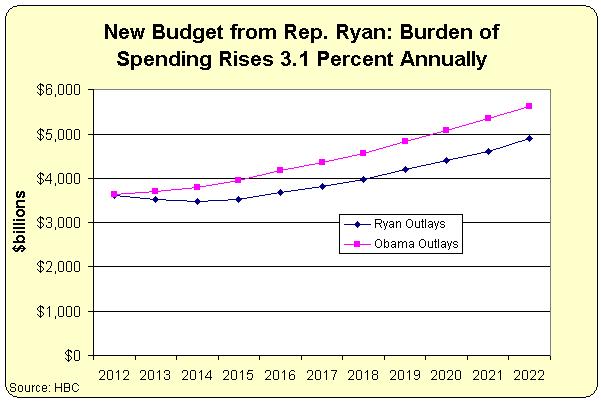
Below is an article by Dan Mitchell of the Cato Institute on the Ryan plan.
Perhaps most important, Congressman Ryan’s plan restrains spending growth, allowing the private sector to grow faster than the burden of government, thus satisfying Mitchell’s Golden Rule so that spending falls as a share of GDP.
The most important detail in the proposal is that the federal budget, which currently consumes 24 percent of GDP, would fall to less than 20 percent of GDP beginning in 2016.
That’s the good news. There are three pieces of not-so-good news.
I suppose it’s also worth mentioning that Ryan’s proposal isn’t as good as Rand Paul’s budget. Spending only climbs 2.2 percent yearly under the plan put together by the Kentucky Senator, and he also abolishes several useless cabinet-level departments.
But the very good shouldn’t be the enemy of the good. As noted already, Congressman Ryan’s plan meets the most important test, which is restraining spending so that the federal budget grows slower than the private economy. And, as the chart shows, he obviously imposes more fiscal restrain then President Obama.
P.S. I am frustrated and nauseated by all the people who are fixating on whether Congressman Ryan’s plan balances the budget in 10 years, 20 years, or whenever. What matters is shrinking the burden of government. I hereby bestow the Bob Dole Award on all the people who are mistakenly focusing on the symptom of red ink rather than the underlying disease of bloated government.
P.P.S. I’m happy to report that there is no value-added tax in the revenue portion of Congressman Ryan’s budget. There is a VAT in his Roadmap plan, and I endlessly worry that this poison pill will re-emerge and ruin other good fiscal plans put forth by the Wisconsin lawmaker.
_______
Saving Medicare: Free Market Reforms Are Better than Bureaucratic Rationing
This Center for Freedom and Prosperity Foundation video explains how a “premium-support” plan would solve Medicare’s fiscal crisis and improve the overall healthcare system. This voucher-based system also would protect seniors from bureaucratic rationing. http://www.freedomandprosperity.org
http://blog.heritage.org/2012/02/13/sen-blunt-vows-to-keep-pressure-on-obama-… | Sen. Roy Blunt (R-MO) introduced legislation to protect religious organizations from Obamacare’s overreach last summer. Now, as President Obama presses forward with his anti-conscience mandate, Blunt is prepared to keep the pressure on the White House.
“We want to be sure we’ve established the principle here that the Constitution establishes — that President Washington understood and President Jefferson understood, and my guess is, every president between them and right now understood — and that is respect for conscience is respect for religious freedom,” Blunt said.
Sen. John Barrasso earned the nickname “Wyoming’s Doctor” after working for 24 years as an orthopedic surgeon in Casper. Today he represents the state in the U.S. Senate and is one of the leading critics of Obamacare.
More than two decades with patients gave Barrasso a firsthand glimpse of government’s involvement in medicine — at that was before President Obama signed his unpopular health care law in 2009. Last week Barrasso visited Heritage to share his concerns about the doctor-patient relationship and other side effects of Obamacare.
Sen. Marco Rubio (R-FL), born to Cuban immigrants, told us in an exclusive interview Wednesday that the pope should make time to see dissidents. Rubio was at Heritage to promote freedom in Cuba, particularly as it relates to technology and Internet access.
Rep. Paul Ryan (R-WI) is mighty disappointed with President Obama. The chairman of the House Budget Committee, who has bested Obama in head-to-head policy showdowns, blames the president for failing to outline a solution to the debt crisis while dividing America with talk of class warfare.
Ryan’s speech at Heritage yesterday made news for its strong critique of Obama. He sat down for an interview afterward to outline why he’s so disheartened by Obama. Ryan also redefined how Americans should look at class warfare, taking aim at crony capitalism and the politically connected who drive American further into debt.
Despite the monumental challenges facing America, Ryan said he remains an optimist. He’s hopeful the Joint Select Committee on Deficit Reduction will include some of the House-passed budget reforms in its final report.
The interview runs 5 minutes. Hosted by Rob Bluey and produced by Kyle Tuckness with the help of Hannah Sternberg. For more videos from Heritage, subscribe to our YouTube channel.
Children cannot be denied coverage because of a pre-existing condition. Young people can stay on their parents’ health insurance plan until they are 26 years old. Preventive services, which will ultimately help control health care costs, have been added to some plans at no extra charge. Those are real changes — which can have a huge, positive impact on people’s lives — that have nothing to do with petty attempts to pin a seemingly unpopular program to the president right before election time.
Take these things away, and folks are likely to notice. A lot of folks. According to the U.S. Department of Health and Human Services, the Affordable Care Act has had the following impact on Arkansans: 865,000 people who already had private insurance no longer have a lifetime limit on their health insurance plans; 439,000 people received added preventive services from their insurance companies without cost-sharing (that’s including 110,000 children); 380,845 Medicare recipients have received preventive services; 23,837 young people have acquired health care coverage by staying on their parents’ plans.
I see a few problems with this assessment. Why did Matthews fail to mention that Obamacare will not give everyone coverage!!! Also he failed to mention the religious values that Obamacare would trangress or the drop in quality we will be seeing or the millions that will be shoved into an already bankrupt Medicaid system that will bankrupt Arkansas’ state government.
There is always a cost and somebody always pays. The real question is how efficient is the government versus the private market. Take Obama’s lightbulb.
But even I’m shocked the federal government gave an affordability award for a light bulb that costs $50. I’m not making this up. Here’s a blurb from ABC News.
The U.S. government has awarded appliance-maker Philips $10 million for devising an “affordable” alternative to today’s standard 60-watt incandescent bulb. That standard bulb sells for around $1. The Philips alternative sells for $50. Of course, the award-winner is no ordinary bulb. It uses only one-sixth the energy of an incandescent. And it lasts 30,000 hours–about 30 times as long. In fact, if you don’t drop it, it may last 10 years or more. But only the U.S. Government (in this case, the Department of Energy) could view a $50 bulb as cheap.
Isn’t that wonderful? My tax dollars were used to reward a company that produced a light bulb I can’t afford.
Michael Tanner is a senior fellow at the Cato Institute and author of Leviathan on the Right: How Big-Government Conservatism Brought Down the Republican Revolution.
This week marks two years since of the passage of the Patient Protection and Affordable Care Act, and if the Obama administration has chosen to all but ignore the second anniversary of Obamacare, the rest of us should pause and reflect on just what a monumental failure of policy the health-care-reform law has been.
What’s more, it has been a failure on its own terms. After all, when health-care reform was passed, we were promised that it would do three things: 1) provide health-insurance coverage for all Americans; 2) reduce insurance costs for individuals, businesses, and government; and 3) increase the quality of health care and the value received for each dollar of health-care spending. At the same time, the president and the law’s supporters in Congress promised that the legislation would not increase the federal-budget deficit or unduly burden the economy. And it would do all these things while letting those of us who were happy with our current health insurance keep it unchanged. Two years in, we can see that none of these things is true.
Obamacare is a costly and dangerous failure.
For example, we now know that, contrary to claims made when the bill passed, the law will not come close to achieving universal coverage. In fact, as time goes by, it looks as if the bill will cover fewer and fewer people than advertised. According to a report from the Congressional Budget Office released last week, Obamacare will leave 27 million Americans uninsured by 2022. This represents an increase of 2–4 million uninsured over previous reports. Moreover, it should be noted that, of the 23 million Americans who will gain coverage under Obamacare, 17 million will not be covered by real insurance, but will simply be dumped into the Medicaid system, with all its problems of access and quality. Thus, only about 20 million Americans will receive actual insurance coverage under Obamacare. That’s certainly an improvement over the status quo, but it’s also a far cry from universal coverage — and not much bang for the buck, given Obamacare’s ever-rising cost.
At the same time, the legislation is a major failure when it comes to controlling costs. While we were once told that health-care reform would “bend the cost curve down,” we now know that Obamacare will actually increase U.S. health-care spending. This should come as no surprise: If you are going to provide more benefits to more people, it is going to cost you more money. The law contained few efforts to actually contain health-care costs, and the CBO now reports that many of the programs it did contain, such as disease management and care coordination, will not actually reduce costs. As the CBO noted, “in nearly every program involving disease management and care coordination, spending was either unchanged or increased relative to the spending that would have occurred in the absence of the program, when the fees paid to the participating organization were considered.”
This failure to control costs means that the law will add significantly to the already-crushing burden of government spending, taxes, and debt. According to the CBO, Obamacare will cost $1.76 trillion by 2022. To be fair, some media outlets misreported this new estimate as a doubling of the law’s originally estimated cost of $940 billion. In reality, most of the increased cost estimate is the result, not of increased programmatic costs, but of an extra two years of implementation. Still, many observers warned at the time that the original $940 million estimate was misleading because it included only six years of actual expenditures, with the ten-year budget window. The new estimate is, therefore, a more accurate measure of how expensive this law will be. Yet even this estimate covers only eight years of implementation. And it leaves out more than $115 billion in important implementation costs, as well as costs of the so-called doc fix. It also double-counts Social Security taxes and Medicare savings. Some studies suggest a better estimate of Obamacare’s real ten-year cost could run as high as $2.7–3 trillion. And this does not even include the over $4.3 trillion in costs shifted to businesses, individuals, and state governments.
All this spending means that we will pay much more in debt and taxes. But we will also pay more in insurance premiums. Once upon a time, the president promised us that health-care reform would lower our insurance premiums by $2,500 per year. That claim has long since been abandoned. Insurance premiums are continuing to rise at record rates. And, while there are many factors driving premiums up, Obamacare itself is one of them. According to the Kaiser Family Foundation, insurance premiums had been rising at roughly 5 percent per year pre-Obamacare. That jumped to 9 percent last year. And roughly half that four-percentage-point increase can be directly attributed to Obamacare. Even Jonathan Gruber of MIT, one of the architects of both Obamacare and Romneycare, now admits that many individuals will end up paying more for insurance than they would have without the reform — even after taking into account government subsidies — and that those increases will be substantial. According to Gruber, “after the application of tax subsidies, 59 percent of the individual market will experience an average premium increase of 31 percent.”
Finally, if the past two years should have taught us anything, it is that we may not be able to keep our current insurance, even if we are happy with it. The CBO suggests that as many as 20 million workers could lose their employer-provided health insurance as a result of Obamacare. Instead, they will be dumped into government-run insurance exchanges. And, the recent dust-up over insurance coverage for contraceptives is a clear illustration of how the government will now be designing insurance plans for all of us. Regardless of how one feels about the contraceptive mandate itself, it is just the tip of the iceberg as government mandates tell employers what insurance they must provide, and tell us what insurance we must buy, even if that insurance is more expensive, contains benefits we don’t want, or violates our consciences.
Next week, Obamacare will slouch its way to the Supreme Court. How the justices decide will be based on questions of constitutional law. Their decision will set a crucial precedent in setting the boundaries between government power and individual rights. But regardless of whether the Court upholds Obamacare or strikes it down, in whole or in part, we should understand that, simply as a matter of health-care reform, Obamacare is a costly and dangerous failure.




 The Daily Hatch